Below is my 5 minutes video for the Unit 3 assessment:
In case of issues with the above link, try this:
Below is my 5 minutes video for the Unit 3 assessment:
In case of issues with the above link, try this:

Date: 25th April 2025
Tutor: Jonathan Kearney
Preparation notes:
I need help with –
1. The main help that I need is to decide on what to exhibit at the Graduate Show. I have prepared some ideas that I will present at the tutorial.
2. I want to find a way to make newsprint (my newspaper art work) archival. Who is the best person or department at CSM/UAL that can help me please?
3. For Unit 3 learning outcomes – ‘evidence of plans for showing your work’. Is the graduation show sufficient or do we need more?
——-
General progress update –
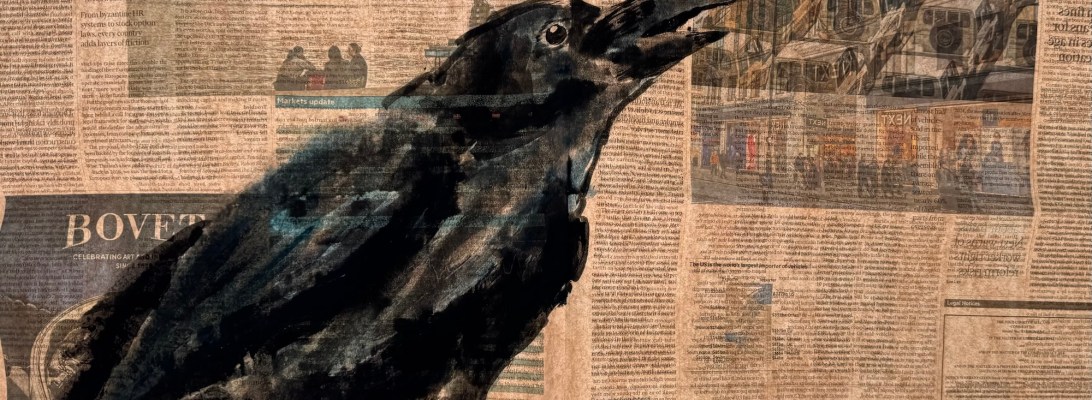
Since our last discussion, I have continued to make art in response to the current issues I feel strongly about. I have been making a series of new work called News Art.
It started with this initial exploration – we have already reviewed the paintings; I have since completed the reflections and learning sections for the blog:
https://eliza-rawlings.com/2025/03/27/ma-u3-grief-is-the-thing-with-feathers-painting/
Then I completed these new works:
https://eliza-rawlings.com/2025/04/20/ma-u3-newspaper-art-responding-to-headlines/
https://eliza-rawlings.com/2025/04/21/ma-u3-news-art-exploring-silhouettes/
https://eliza-rawlings.com/2025/04/21/ma-u3-news-art-installation-ideas-holding-up-to-the-light/
I have been reflecting on my reflective practice as my process:
https://eliza-rawlings.com/2025/04/14/ma-u3-reflecting-on-my-reflective-practice/
I have also started to plan ‘life after MA’ – how I’ll develop my practice in the longer term and in a sustainable way. Here is my initial draft plan:
https://eliza-rawlings.com/2025/04/21/ma-u3-building-my-sustainable-art-practice/
I have updated my study statement to include a few new objectives for my latest work since it is an exploration that I hadn’t planned to do at the beginning of the course. They are listed on the last two pages of the statement:
https://eliza-rawlings.com/2024/02/03/ma-y1-study-statement-eliza-rawlings/
–
Notes from the tutorial –
1. Graduate show – we discussed the different options I presented for the show. Key takeaways are:
– Cheongsam paintings and News Art are two different bodies of work and if we were to show both then they should be displayed separately. Think of them as two separate things.
– If we show the dresses then all will need to have identical mannequins. This I confirmed would be the case.
– News Art feels more urgent and remarkable. There is an energy and there is a voice (be it a quiet voice). Using non-dominant hand also adds to the work with a sense of risk and excitement. All the different layers together. My history in engineering working with newspaper printing presses also feature in this body of work.
– News Art – it feels like everything has been leading to this. A culmination of my commitment to interrogate.
– Practicalities – ceiling is 4m high. Same height throughout the site.
– If we go for a wall display, I could use a builder’s flood light to back-lit the newspapers. Can also have the newspaper coming out at an angle – anchored to the top of the wall but coming out a few feet from the wall at the bottom (like the side of a tent) – this also feels more confrontational. Can use the bottom of the newspapers to hide the flood light units.
– The pieces of newspapers can be stitched together.
– Do not go for an overall coordinated composition, leave it untidy and loose.
– Try flood lighting in day light to see how it looks when illuminated.
– Wall height is 2.4m, some can be 3m. Width can be 1.4m (2 x double page spread)
Other thoughts:
– Don’t rule out cylinder lights for future shows.
– LED light strips to go behind wall mount newspapers, looped around like a drawing.
2. Life after MA – ideas for how to show work:
– Group show.
– What’s going on in the city that might help other events, e.g. late opening of museums. Do a proposal for showing work alongside the event.
– Do not think about the audience, just focus on making work to a deadline, getting the work to a show quality and taking good photos.
– Propose to office spaces.
– Rent artists run spaces.
– Go outdoors! In my case, can go to The Downs where I go to see the crows. Can hang News Art from the trees, set up a table where I paint the crows. Take some crow food and maybe some human food for visitors, too.
FEEDBACK
There were two sets of feedback at the end of Unit 2 that I want to capture here, then I will reflect on both sets together at the end. The two sets are (1) Group feedback on my 3 minute video and (2) Unit assessment feedback.
1. Group feedback on my 3 minute video
At the end of Unit 2, we each made a 3 minute video about our art practice. Then the videos were shown to the class and we gave each other feedback. I am very grateful for the thoughtfulness of the feedback I received and I would like to capture them here.
My 3 minute video:
https://eliza-rawlings.com/2024/11/24/ma-u2-3-minute-video/
Firstly, my fellow MA students each completed a note on Miro after seeing the video and below are the notes they wrote for me, captured from the Miro board in no particular order:
Ashton I feel… ‘wow’ed by the consistent high standard of your work, 2!; amused that you described it as a pick and mix!! I also feel shocked to learn why the banana has been used in regards to racial slurs, I did not know that until now, and I feel impressed at the way you responded to that using humour when it’s a hard hitting subject. I wonder …how this will continue to develop as there’s lots of paths combined to create these pieces – current/hidtorical racial prejudices and how they occur, cultural symbolisms, food connotations etc. I think… the fact that you can split your work into what continues your narrative vs develops your style / technique is a very good understanding to have, and not something I’ve considered before. That you can still be developing your art practice even if not confronting heavy subjects, that it doesn’t have to pause in times you feel able to continue the narrative.
Sara I feel… a lot of joy in your textiles work and curious about where it may lead to I wonder … how this may link to other current affairs such as the example of the coconuts. I think…your work appears well thought and considered with lots of interesting connections and a great use of metaphors.
Karl I feel… excited about your exploration of memory within your new painting I wonder … how you can connect the culturally appropriated objects and your genuine experience in the work. I think… that the process of making the dress and the painting on it is a great metaphor for perceptions of cultural identity and the space between the pictorial image and the duality of the dresses.
Roz I feel…engaged with richness and quirky imagery, drawn into a powerful metaphor I wonder… whether the dress will hold more opportunities or what 3rd element is needed now in this 3rd space to take you further along your journey I think you have been very successful in your ordering of the complex that you offer clarity, but are sassy in your delivery. And that you are owning, controlling the defining of your status
Chelsea I feel… that the pieces are funny which makes them more accessible because you don’t feel that you are at first glance engaging in a weighty subject. I wonder… where this will all go next. I think… its all very colorful and eye catching and offers a way in to learning about how we talk about people, it re-humanises that which others have tried to dehumanise, especially with the use of clothing.
Bethany I feel… nostalgia and familiarity, the 3rd Space idea, albeit from a different standpoint. I feel curious about your family history in HK, which was an odd colony. I wonder… whether the metonymies might be handled more provocatively, more personally, as a feminist? I think… I am drawn to the gritty, personal stories, the oddity of Cantonese steamed fish served with Spam.
Catherine I feel I want more. I like the element of surprise with your work, ….what will she do next…. You definitely have my attention Eliza. And you are so eloquent – Bravo. I wonder if you will use other clothes items in the future – the dress is so strong and powerful and a perfect vehicle for the way you express yourself and your research.
Tom I feel… educated in a nice way I wonder … what she has discovered about process vs outcome I think… the work deals with potentially emotive topics in a sensitive and restrained way
Ben I feel… I wonder… making paint and making food have a great deal of crossover could they be brought together I think… some lovely colour and ideas – looking forward to seeing how far it could be taken
Oi Fah I feel… well informed I wonder… good metaphor I think… well organized
Daniel I feel… the work is provoking – in a good way – to seeking I wonder… where else could you take this work and how it could be expanded I think…your aproach worked
Lais I feel seen and understood through your video and practice, especially because of how you approach it and colonialism I wonder what comes next for you, and if you will keep exploring textiles I think this is beautiful work and it reaches me on a deeper level.
Madeleina I feel… informed and inspired I wonder… what other items of inspiration are hidden in Eliza’s attic which she could start painting on! I think… Eliza is making a very important and insightful social commentary through her joyful creative work
Karen I feel… a great balance of research and lived experience. I hear a voice. I wonder… how the dress images would translate in other media…. I think…the food is a great metaphor and I love the titles of the work.
Holly I feel… delighted by some of your images especially on the “family dinner” cheongsam dress I wonder… how you view the differences or similarities between “narrative” and “style”, I wonder what would happen if you worked with actual food in your practice I think… it’s interesting how you thought you had lost your mother’s dress but then found it after many years, sort of a metaphor there around identity and fluctuations in connection and expression with/of identity, I think you have quite a bit of clarity about what you’re interested in exploring there appeared to me to be a lot of coherence in the work despite your view that it lacked coherence
Martina I feel… intrigued and amused. I want to see more I wonder… if the dress-paintings are thought to be worn I think…you should reconsider the relation between your narrative and stylistic work. The two seem beautifully integrated to me!
Terrye I feel… inspired by your dresses – playful and colourful interpretations of your identity and a link to your past I wonder… what happens if a European dress is used as an alternative identity – you mention hybrid identity I think…your process towards using materials is a way to create intrigue and excitement in viewing your work.
Jonathan I feel… connected to your story – the narrative is important to you I wonder… if we the audience only need to see small parts of this – eg the food – do we need to see it on a dress I think… the narrative and style are connecting, maybe you can be brave a try just the food paints for a while?
Lucy I feel… lucky to hear Eliza, invited to a personal world that reflects moments in time that are not just culturally important but personally I wonder… how do you feel in the dresses I think…the way you use the dresses to respond to one another is exciting, how in response to the banana you made the egg to reflect you
Dee I feel… transported to my mothers world of dress making I wonder… What a catwalk fashion show of your art would look like I think… The development of your style/narrative is an excellently engineered solution… the next development for me is the latest painting and I am excited to see what happens next
Victoria I feel… inspired by colours and emotional I wonder… inspiration background, ideas for research. If inner dialog is involved and what’s next I think…interesting process, great ability to create deep emotional art. Very complex and simple at the same time, i really like that concept
Inna I feel… I feel that bright colors are a source of energy and inspiration. They bring life to a work, drawing attention and sparking thought. Behind each vibrant hue, there’s a depth of carefully considered ideas, symbols, and stories. It’s not just about the visual impact but about how every detail communicates its own emotion and meaning. I wonder… What stories and carefully considered ideas lie behind each vibrant hue? I think… I also think the allure of bright colors lies in their universality—they resonate with people across cultures and contexts, carrying both personal and collective significance. They can symbolize hope, energy, or transformation, making them a vibrant language that transcends words.
Then we ran a video session where people chipped in with comments on what worked for them about my work. Summary of the video feedback on ‘what worked…’
– Connection to topical discussions
– Dresses
– Fitting my personal narrative
– Use of colour
– Clarity of thoughts and processes
– Metaphor of food
– Playful
– Wanted to look into it to see the stories
– Detail of the food and fish
– Balance of research and lived experiences
– Metaphor of wearing cultural identity
– Confidence in communicating narrative and views
– Dresses – sculpture as well as painting
– Oddness of the food combo
– Making tinned food appealing
– Strangeness of food is brilliant
–
2. Unit Assessment Feedback
At the end of Unit 2, I received some invaluable feedback from my course tutor. There was feedback on my practice and my research paper. I agree with much of the feedback and I will not list everything here. I will extract the key points that have caused me to think more deeply about specific elements of my practice. I want to use this blog to further explore my thinking and consider my response in order to develop my practice.
The specific points that I want to respond to are:
1. Is there a risk that the terms “banana” and “egg” can feel reductive, even when reclaimed, how do you (do you need to) account for the multidimensional experiences of diasporic individuals? Could these inadvertently reinforce the stereotypes they seek to critique, without offering sufficient nuance or alternative narratives? How might someone from the Chinese diaspora interpret these works? How do you want them to engage with the works?
2. …your HK family dinners bring a nuance and context to your broader theme. … Does this painting need to be on a cheongsam? What does the cheongsam canvas add or takeaway from the image?
3. …we encourage you to continue experimenting with different techniques, layering methods, transparencies, marks etc. E.g. how might you use thin transparent layers in your work? If you spend time looking at a variety of oil paintings in real life, what effects might you incorporate into your own work?
4. We also encourage you to go back to the documentation of the painting progression – some of us thought the fish dish was stronger at the earlier more “sketchy” stage, experiment with how “finished” elements of the painting need to be. How might this relate to memory? The sketchiness of remembering? The gaps in between the memories, the ‘flying white’.
REFLECTIONS
I really valued the group sessions. I feel blessed that I am in such a supportive community where everyone is thoughtful, kind and genuinely wanting to help each other to progress. I treasure their feedback, it is more than a gift. I started to make and paint on Cheongsam canvases in the last few months, I am still at an early stage with this exploration and I am constantly questioning if it is the right way to go. My group’s feedback gave me the confidence to continue as they seem to enjoy seeing the colourful dresses. Some of the comments have helped to reinforce my decision. However, my tutor feedback has caused me to rethink this point – does it need to be on a Cheongsam? What does it add or take away from the image?
I have been thinking a lot about this since receiving the feedback. Making a Cheongsam painting is a special process in that it makes me feel that I have created something special (to me) when it’s finished. It’s not a judgement of whether it’s good or bad, it just means more to me because of the complexity of the creative process. I set out in my MA Study Statement to find a way to create something that is unique and recognisably mine and I thought I had found that when I started making Cheongsam canvases, hence I referred to it as my turning point. Also, looking back at my earlier work before joining the MA course, I have had attempts at making dress canvases. This was from a period when I was investigating the concept of Expanded Painting and ways to eradicate the traditional canvas. Below are images of the dresses I had made at the time (one of which was also a Cheongsam):
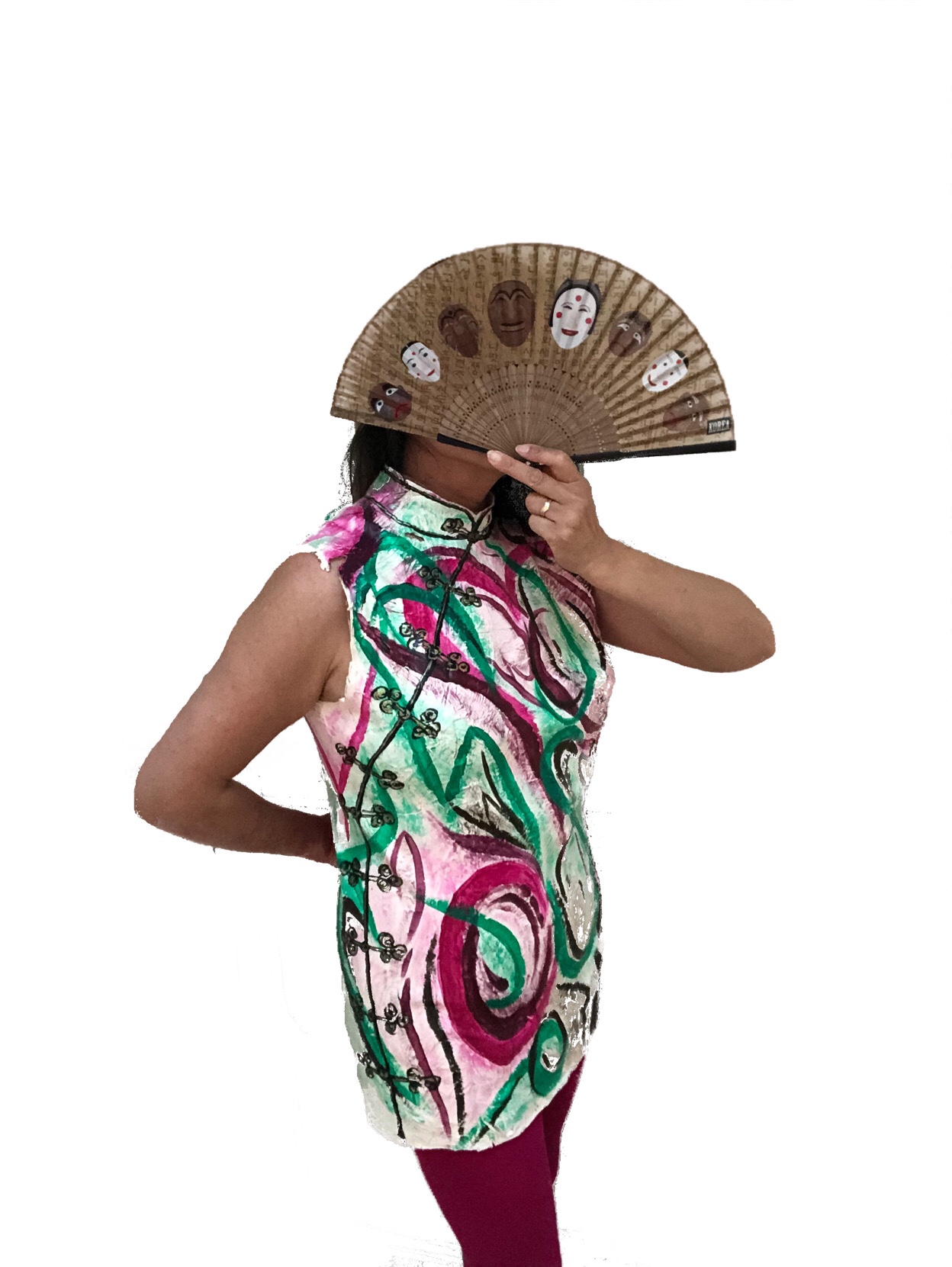
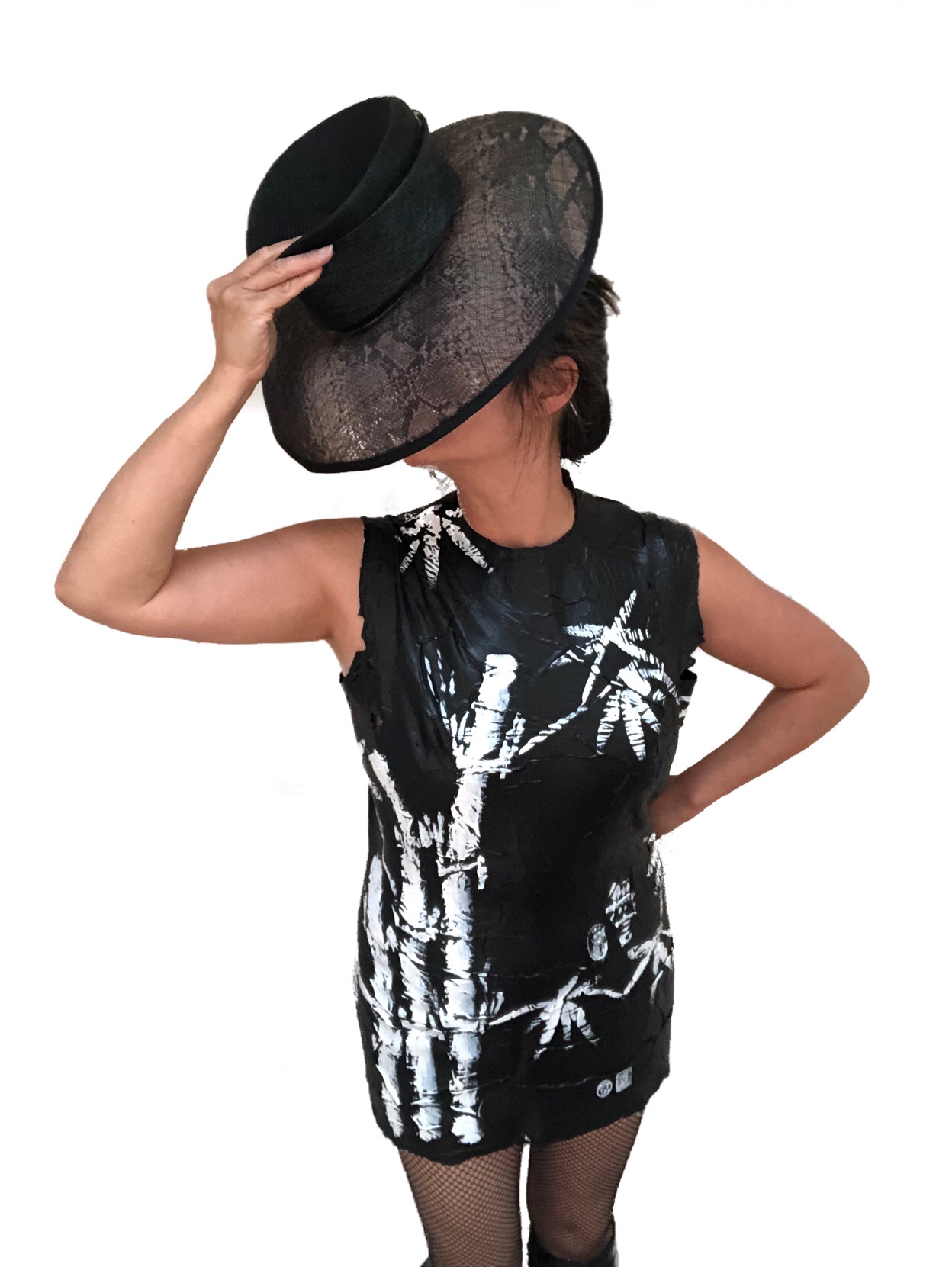
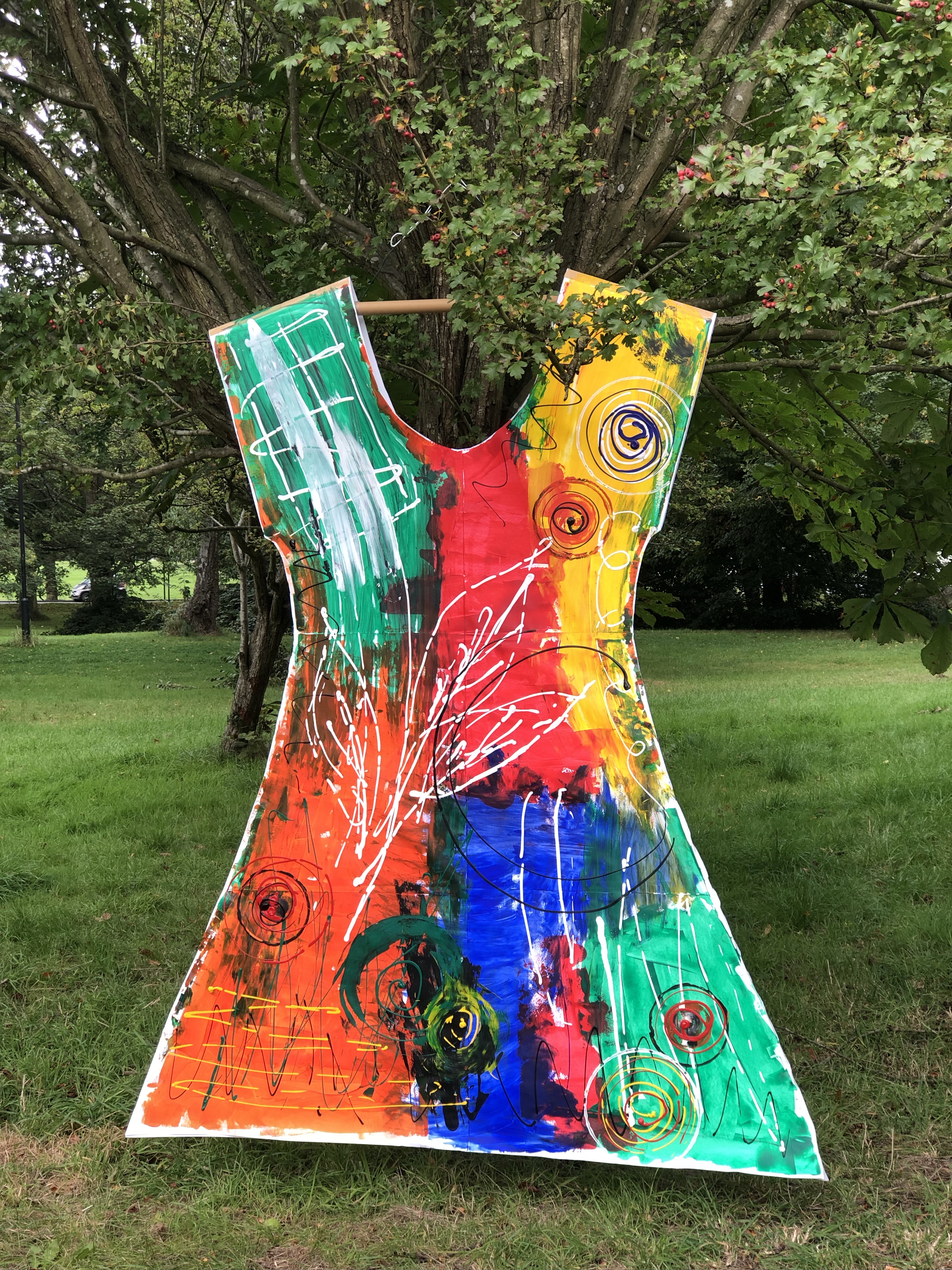
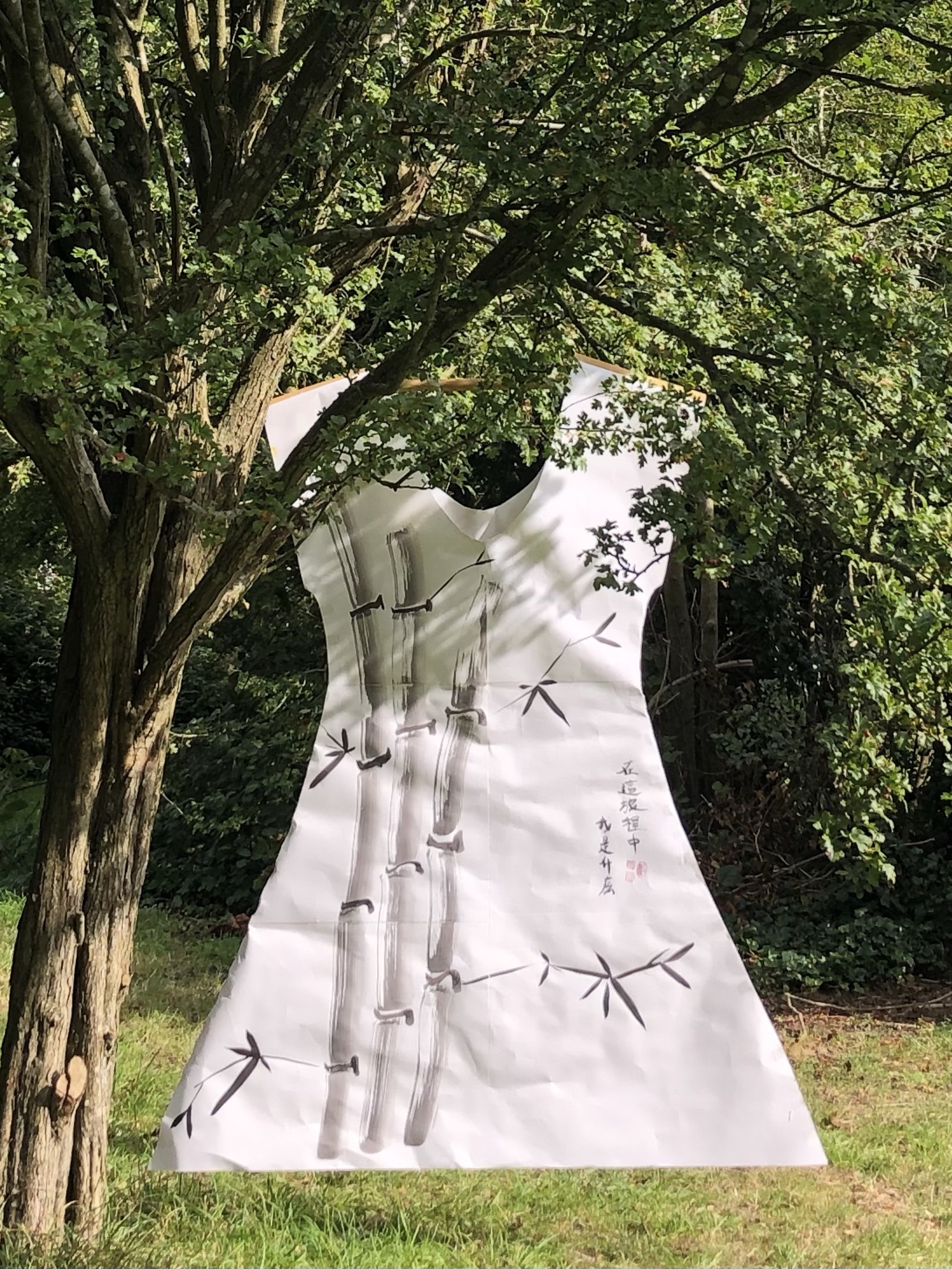
I like the way the Cheongsam or dress paintings are 3D paintings, a hybrid between painting and sculpture. I think showing them as 2D photos does take away from the image especially in my latest Cheongsam series as the curved sides of the dress obscure part of the image. Perhaps a film may help to convey the image better.
I believe the Cheongsam shaped canvas adds to the story and narrative that I am trying to convey about my journey and how we ‘wear’ our identity. Here is a past UAL exhibition about wearing our identity which I found interesting:
https://fashionexhibitionmaking.arts.ac.uk/wearing-our-identity-the-first-peoples-collection/
However, I wonder if my Cheongsam canvases can seem rather ‘gimmicky’. I think I understand the question from my tutor asking if I have the courage to make just a painting without having to paint it on a Cheongsam (I interpret that as ‘without the use of any gimmick’). My response would be – I’m not sure if I’m there yet, but I should try.
My response here also ties in with the feedback about exploring oil in more ways and trying different techniques. I think that is valid as I am aware that I have been using oil in a limited or single-dimensional way (undiluted and impasto). This can have the effect of over-saturation and I should broaden my approach to utilise all that the oil paint has to offer. By exploring thinner transparent layers and producing less finished images, that would add ambiguity and help me to convey my narrative of working from patchy memories.
On the other points regarding whether ‘banana’ or ‘egg’ are too reductive as metaphors – I plan to respond in a separate blog after completing some research.
LEARNING
I enjoy doing the Cheongsam paintings and I feel that I would like to maintain that element in my practice. However, not all my work need to be on a dress or 3D canvas. My priority now should be to explore more painting techniques and widen my ‘painting vocabulary’ so I can be more creative in expressing complex narratives. To do this, I will pause the making of the dress canvases and spend more of my studio time on painting.
NEXT STEPS
– Explore different techniques of using oil paint so I can be more creative and multi dimensional in my expressions.
– Explore different approaches to painting and ways of thinking about painting.
– Pause the making of Cheongsam canvases for now to release time and return to it at a later time.
– Respond to the ‘banana’ and ‘egg’ feedback with a separate blog.
This blog details my preparation for Tutorial #4 due to take place on 29th November 2024 with Jonathan Kearney.
Referring to my Study Statement, I have circled two specific areas for Unit 2 on my work plan for this tutorial preparation.
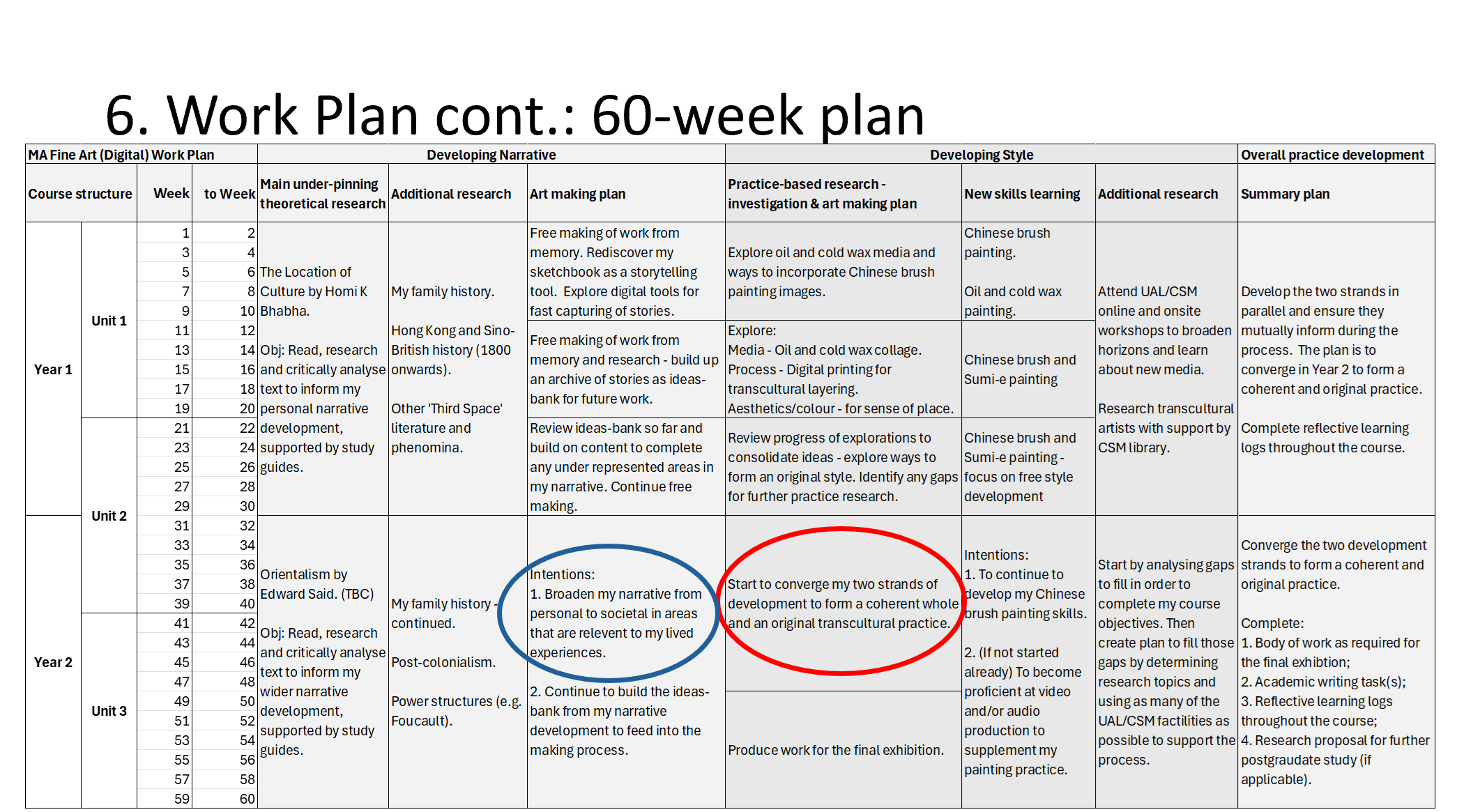
For the last few months, I have been making art in parallel with writing a research paper. The progress for both are as follows.
PROGRESS (MAKING)
Since the last tutorial, I have continued to explore making Cheongsam shaped canvases for painting. I feel that this way of making could be the start of the convergence of my narrative and style development work. I was hoping that this convergence would happen sometime during Year 2 of my MA programme (as circled in red). So I am pleased that the Cheongsam paintings could be the convergence that I was looking for to take my practice forward.
Cheongsam Paintings
The following blogs detail the Cheongsam paintings that I have been working on as well as the thinking and narratives behind the work:
MA U2: Cheongsam Series – Food as metaphor for cultural identity – Introduction
MA U2: Cheongsam Series – Food as metaphor for cultural identity – ‘No, I’m an egg.’
MA U2: Cheongsam Series – Food as metaphor for cultural identity – ‘You’re a banana!’
This is a blog capturing the reworking of the first Cheongsam painting to give it the intended meaning and context:
MA U2: Cheongsam series – reworking Appropriation. Appropriation.
Below is my latest work which is the start of a new series of Cheongsam paintings about memories of ‘Family dinners’ from 1970s Hong Kong. The change of medium from acrylic to oil meant that I had to change the canvas material and dress design as captured below.
MA U2: Cheongsam dress canvas – new method and design
MA U2: Cheongsam Series – Family dinner #1 – Front
Other Making Activities
Chinese painting – I have continued to attend my monthly Chinese painting classes, here are some of my work:
Chinese painting – shrimps, sunflowers, pine trees and more
Drawing – travel drawings using non-dominant hand:
MA U2: Quick sketches with non-dominant hand
Book Art – I was very inspired by the Book Art workshop during the low res week in London. Here is an example of an attempt with some Suminagashi paper that I made:
MA U2: Book art – Part 1
PROGRESS (RESEARCH)
Writing the research paper has given me ideas to take the context of my practice beyond just examining my personal identity. It was always my intention to find a way to go towards something broader and societal (as circled in blue on my Study Statement). Below is a blog capturing my reflections and learning from writing the research paper which is the start of this thinking process.
https://eliza-rawlings.com/2024/11/19/ma-u2-research-paper-reflections-and-learning/
HELP NEEDED
I would like help with the following points please – I will expand further on 2 and 3 during our tutorial:
1. Any feedback on the Cheongsam paintings and research paper (if available) would be most appreciated.
2. Ideas for the final degree show – I am considering a series of Cheongsam dresses (3D paintings), shall I include other work such as video and 2D paintings as well? I am planning ahead because the Cheongsam paintings take a long time to make.
3. Next step on my learning journey – I have done further research and would like some more advice please.
– End of prep notes –
Notes from tutorial:
Positive feedback on the research paper. We are still waiting for formal feedback from my supervisor. An area of improvement is the overuse of ‘This paper argues…’, so important to be mindful of this overuse in future writing.
Degree show ideas – we discussed making more Cheongsam paintings about childhood dinners because I still have many ideas or dishes still to do. So I will continue with that series. However, I should not limit myself to just Cheongsam paintings and I will explore the other aspects of my practice. E.g. review the Steamed McDonalds video that I have made but not edited yet. I will review and edit to see if it would be a good piece of work to complement the Cheongsam dinner paintings.
We discussed the ‘fair use’ policy of using music soundtracks in my video. It is fine to use in an educational setting for a student video as I am not planning to profit from it. As for using sound – always be careful to make it relevant to the content and context.
We discussed the next steps of my development regarding options after the MA course. The discussion was very helpful and I have some actions to investigation options.
– End of tutorial notes –
Below is my 3 minutes video for the Unit 2 assessment:
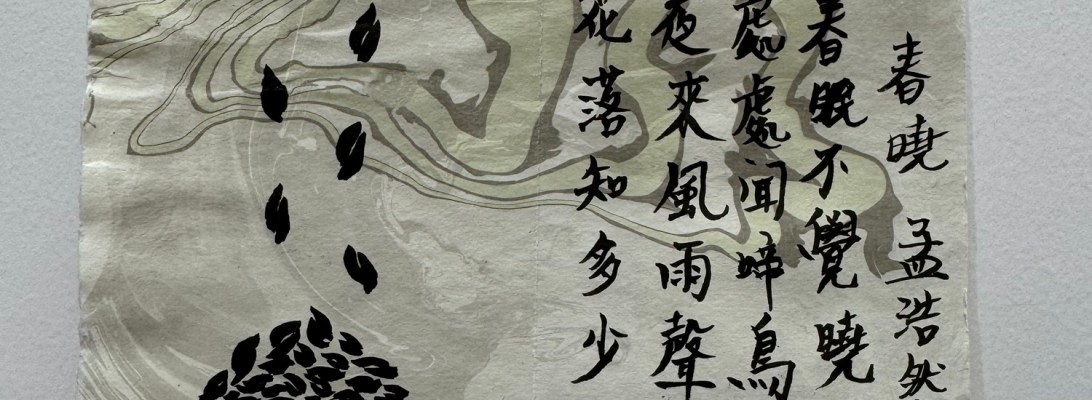
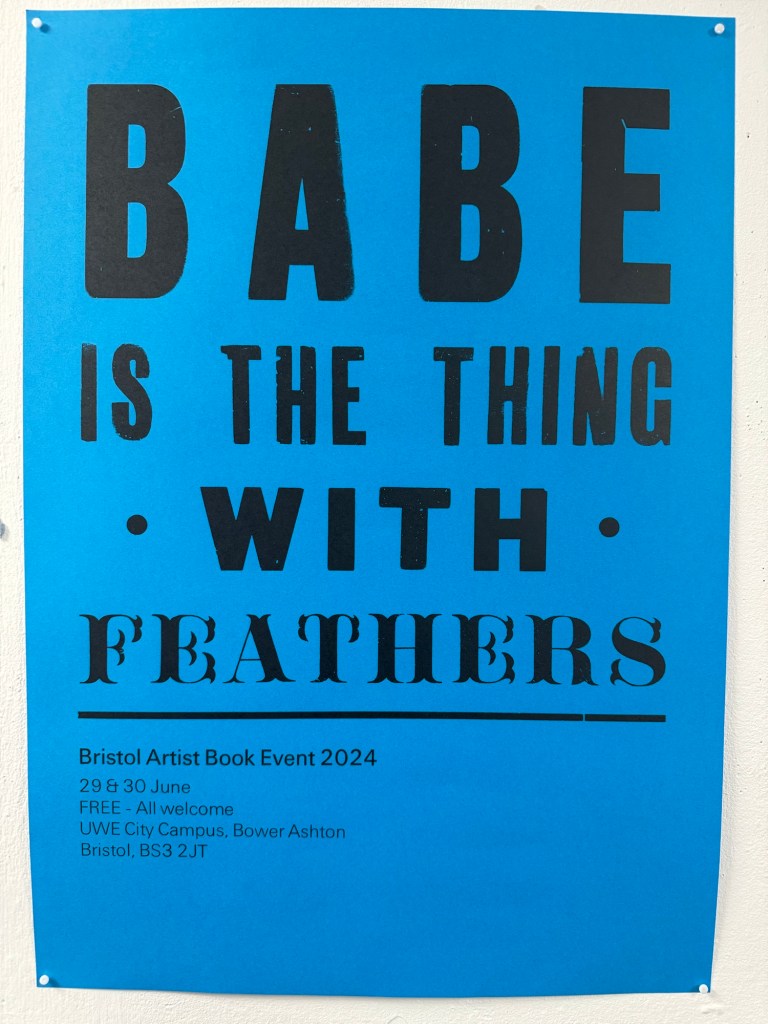
During the MA low residency at CSM in March 2024, we had a book art workshop where we learnt to make zines and some simple book. The artist hosting the session mentioned a book art event that takes place in Bristol once every few years. I was delighted to find that it was on this year and I attended the fair.
–
There were nearly 100 stands; it was a great opportunity to talk to and learn from experienced book artists. I came away feeling enthusiastic to try this beautiful art form.
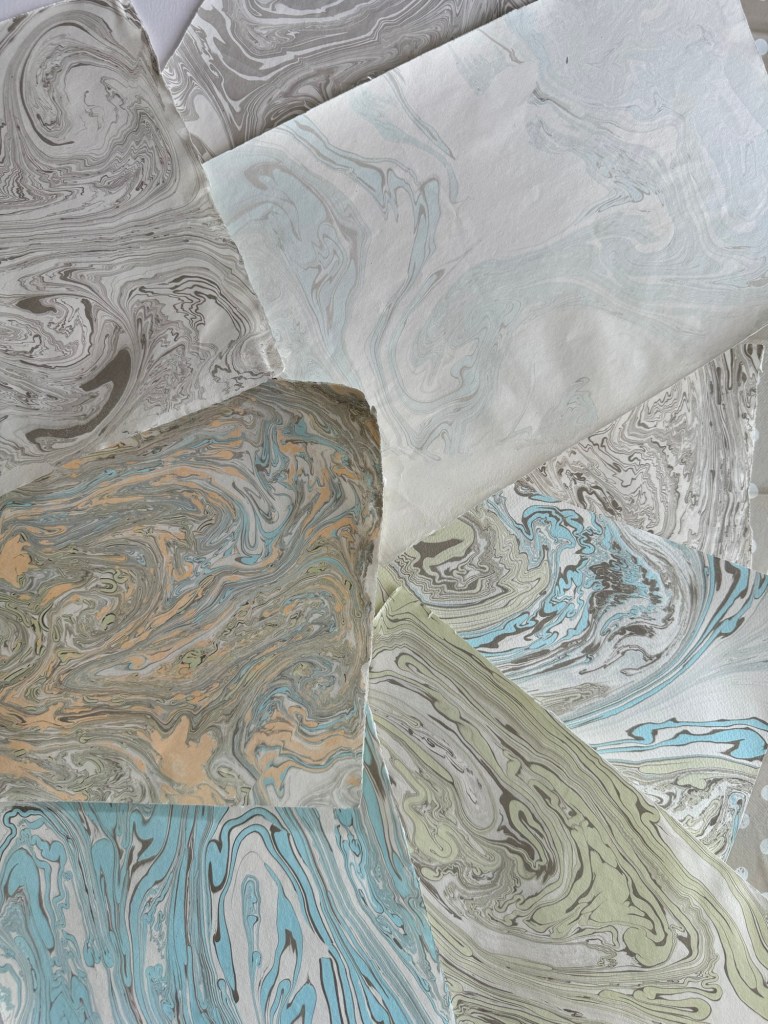
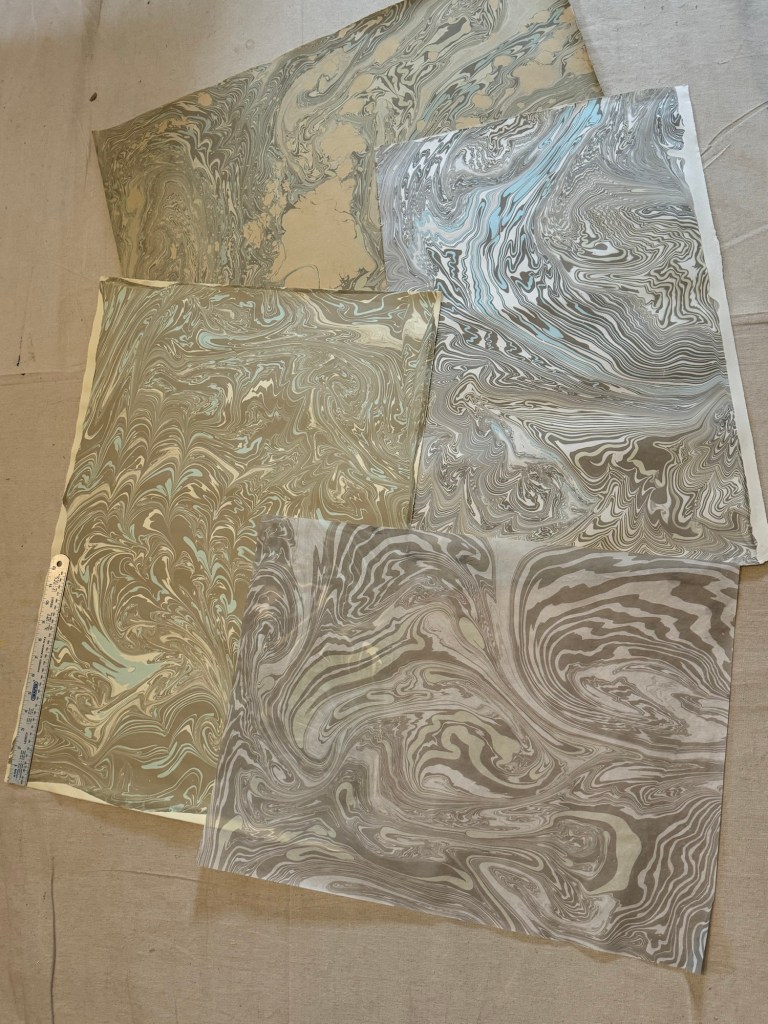
Another reason for my enthusiasm was that I recently attended a Suminagashi workshop. Suminagashi is an ancient Japanese technique of making handmade marble paper and washi by floating water-based inks on water, then laying the paper on top to absorb the ink and water pattern. See post:
Here are some of the Suminagashi paper that I made during the workshop:
METHOD
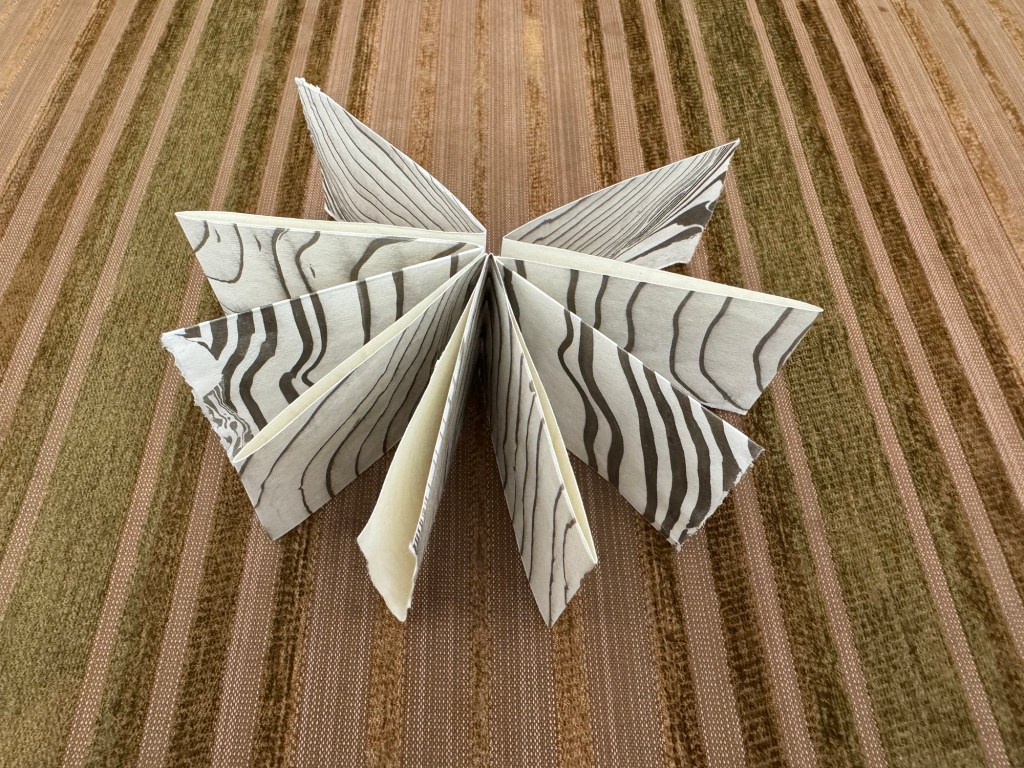
From the techniques learnt during the low residency workshop at CSM, I made a few different types of simple books using the smaller sheets of Suminagashi paper:
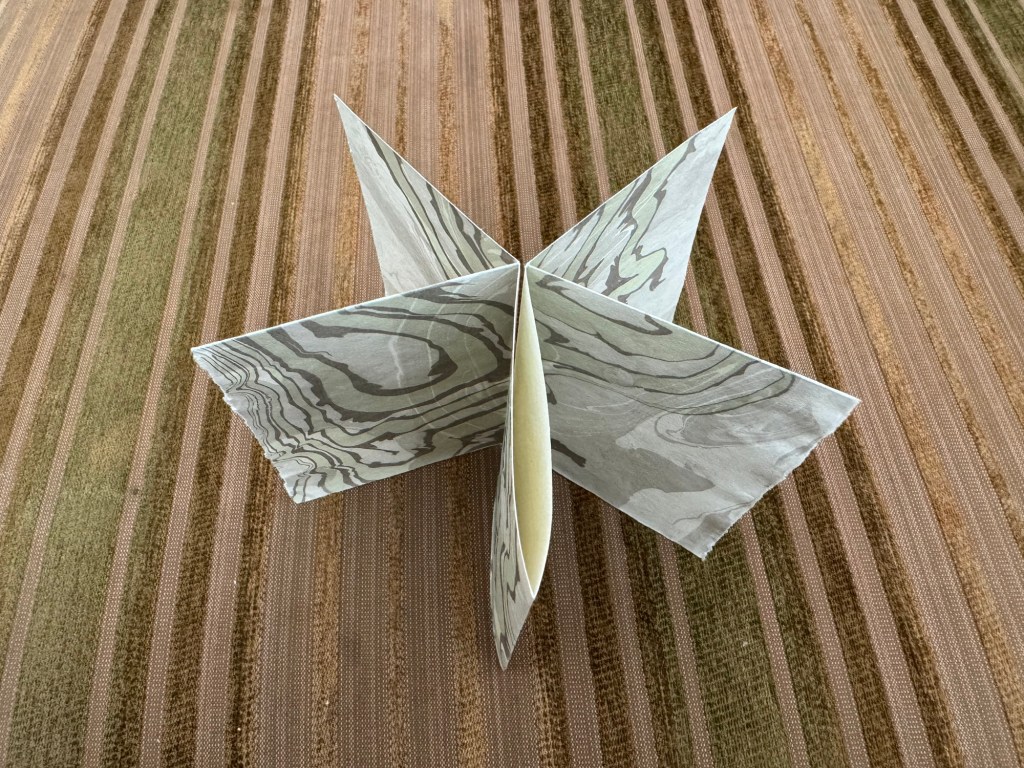
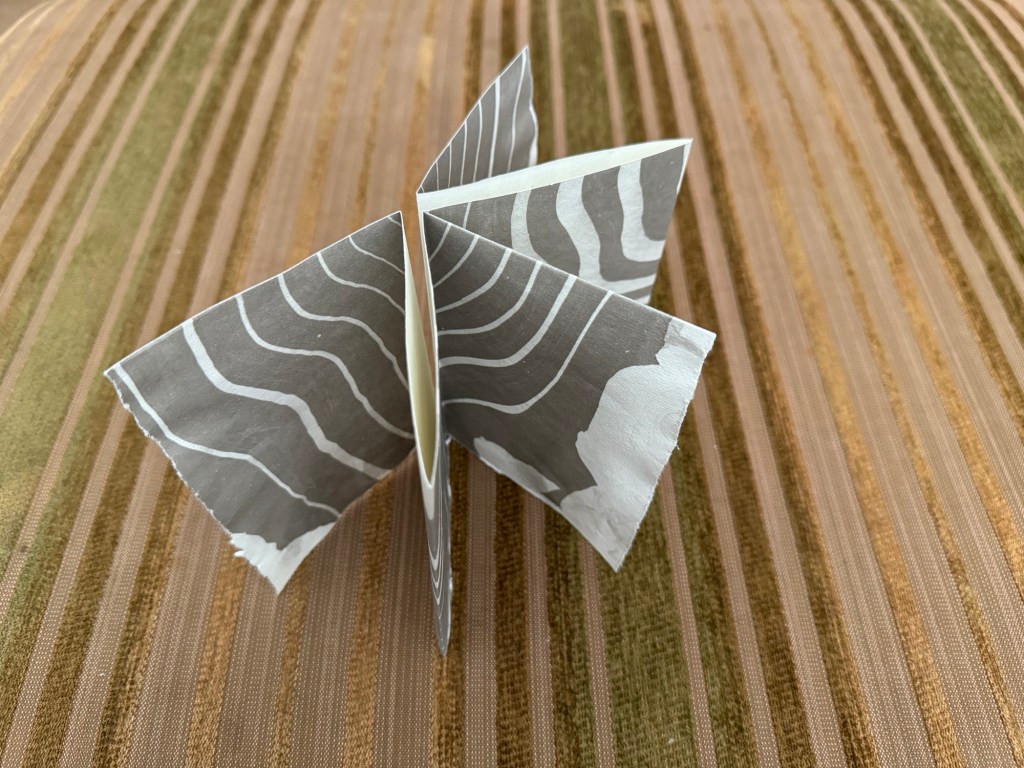
–
I experimented with some Chinese ink calligraphy on one sheet of paper, then folded it into a simple book:
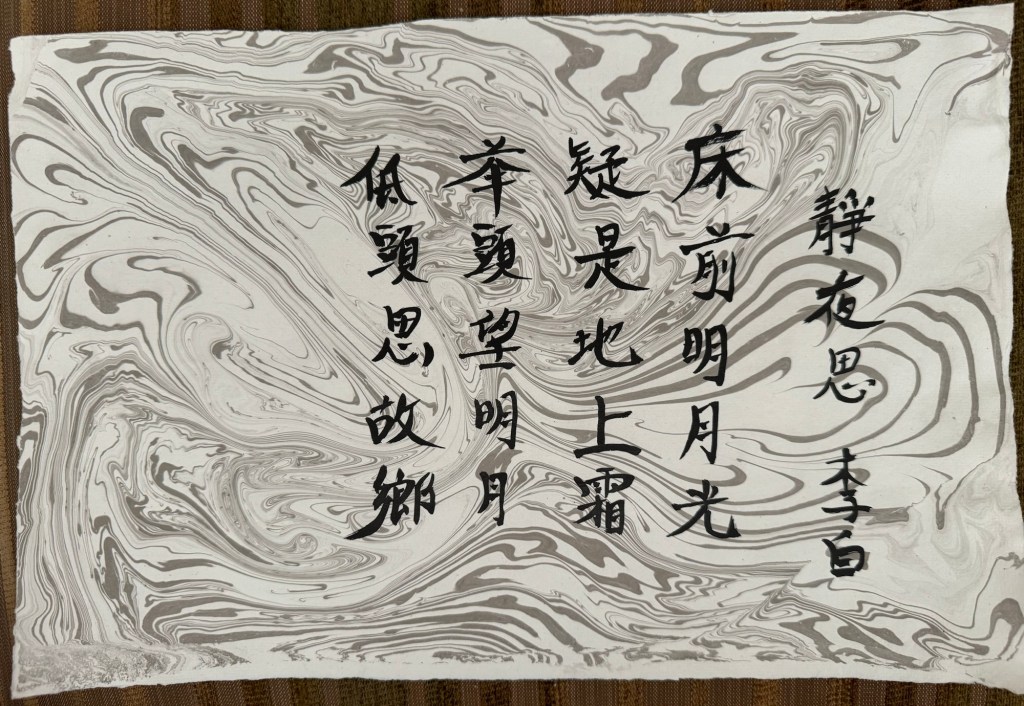
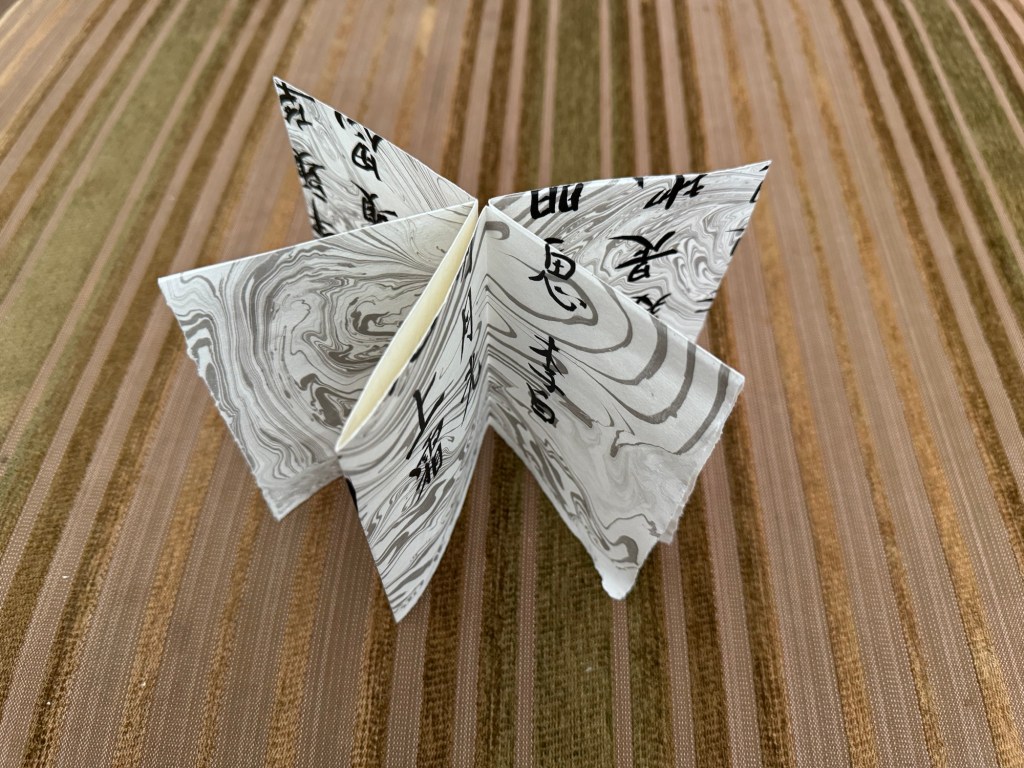
–
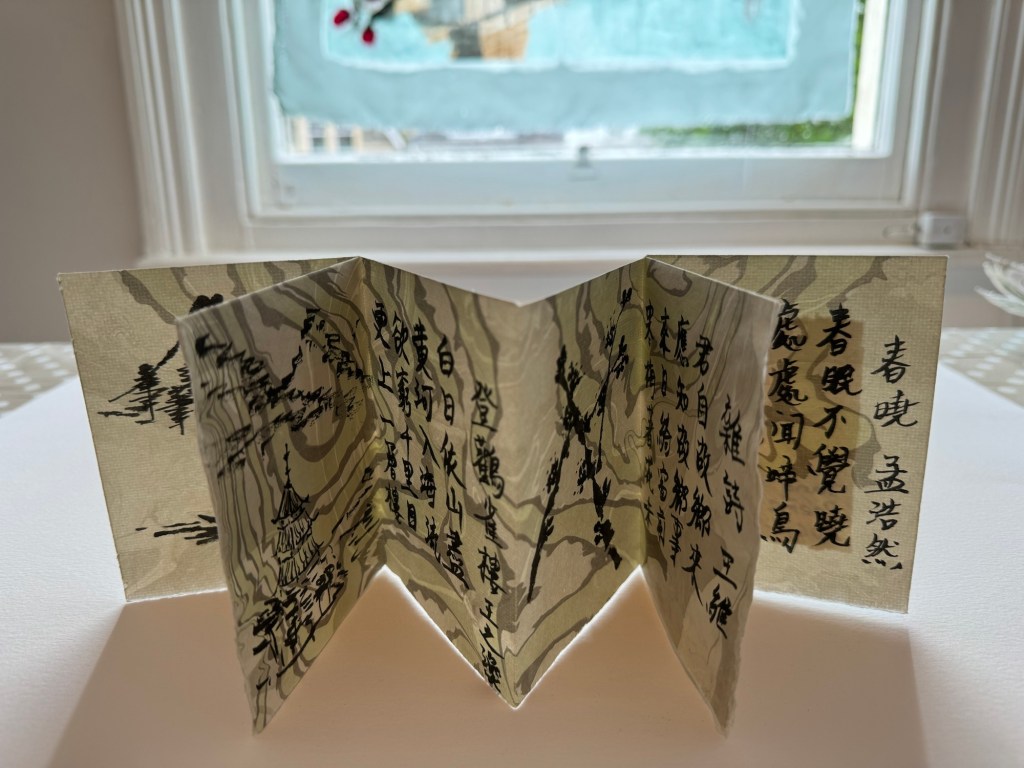
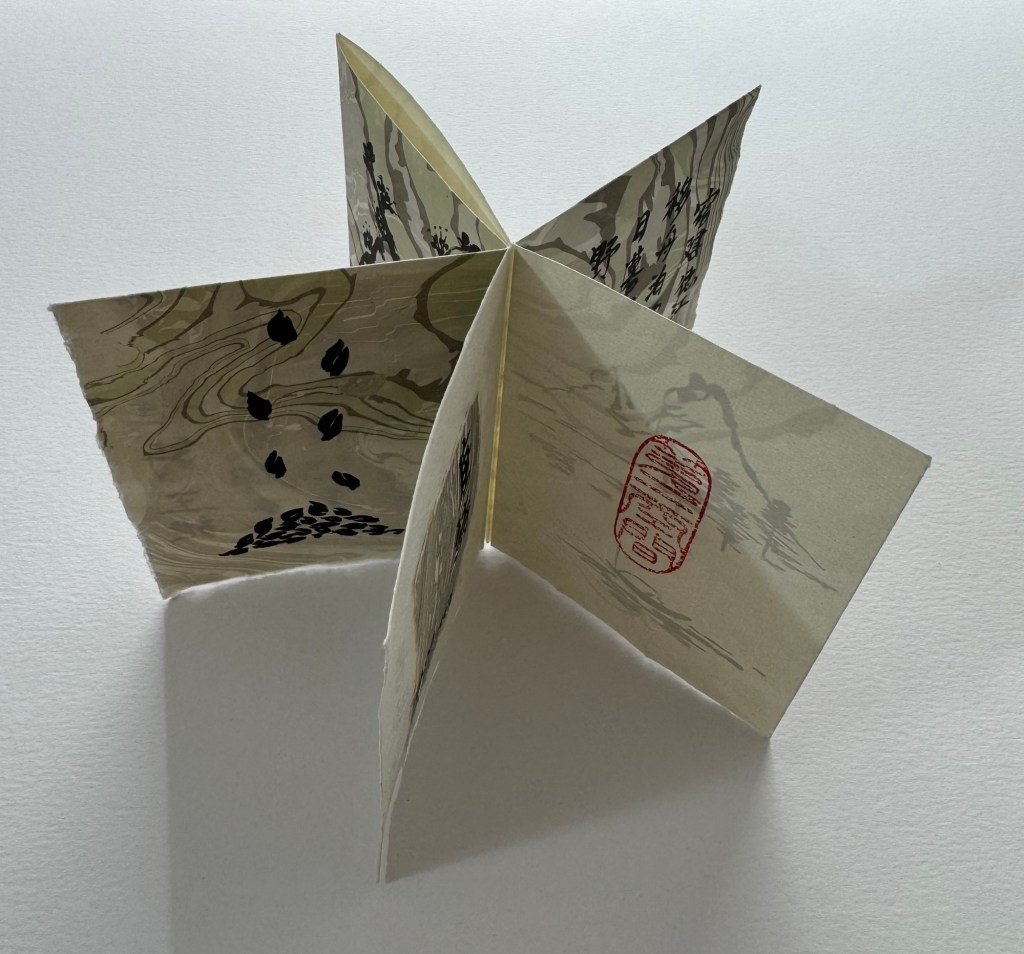
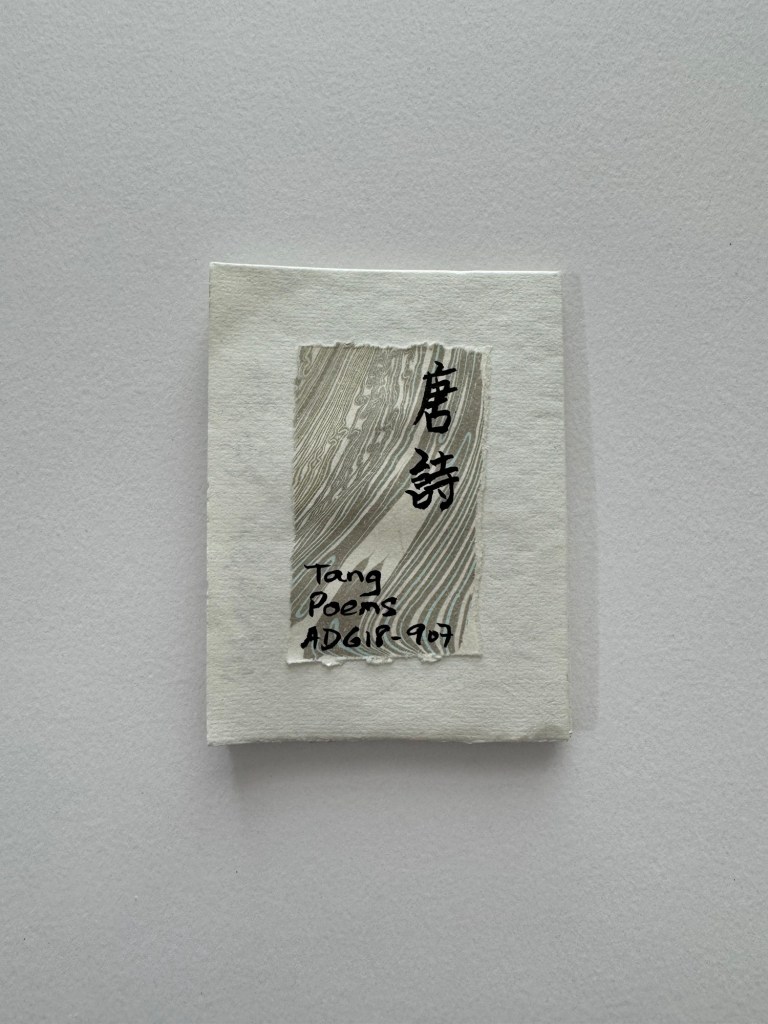
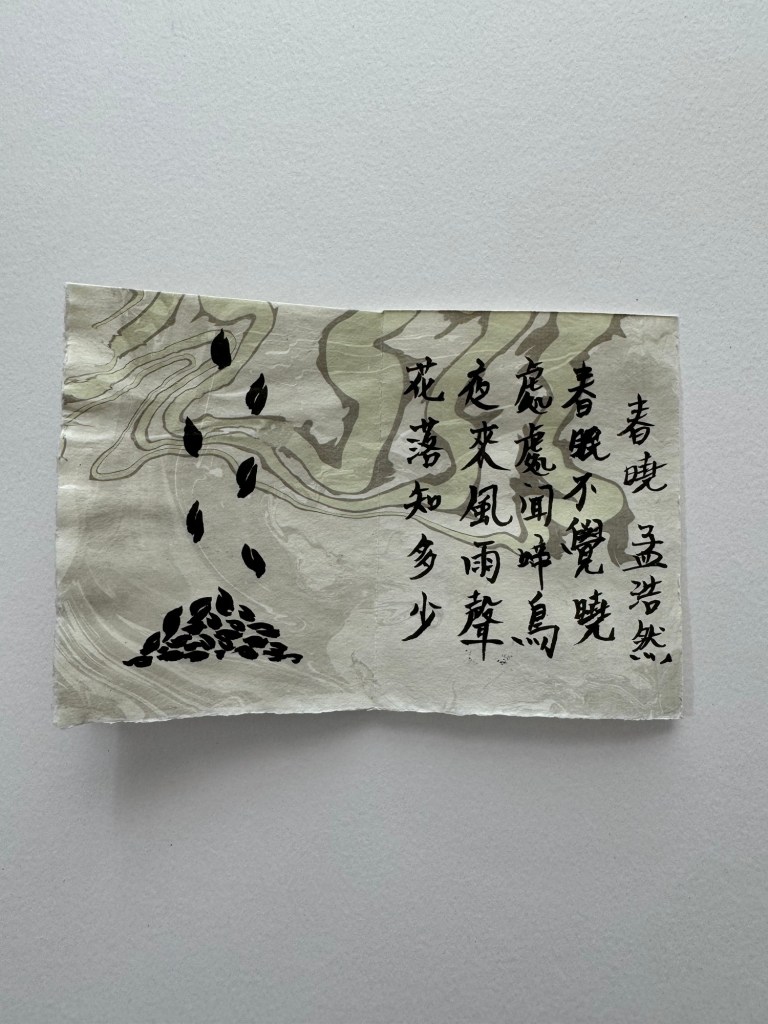
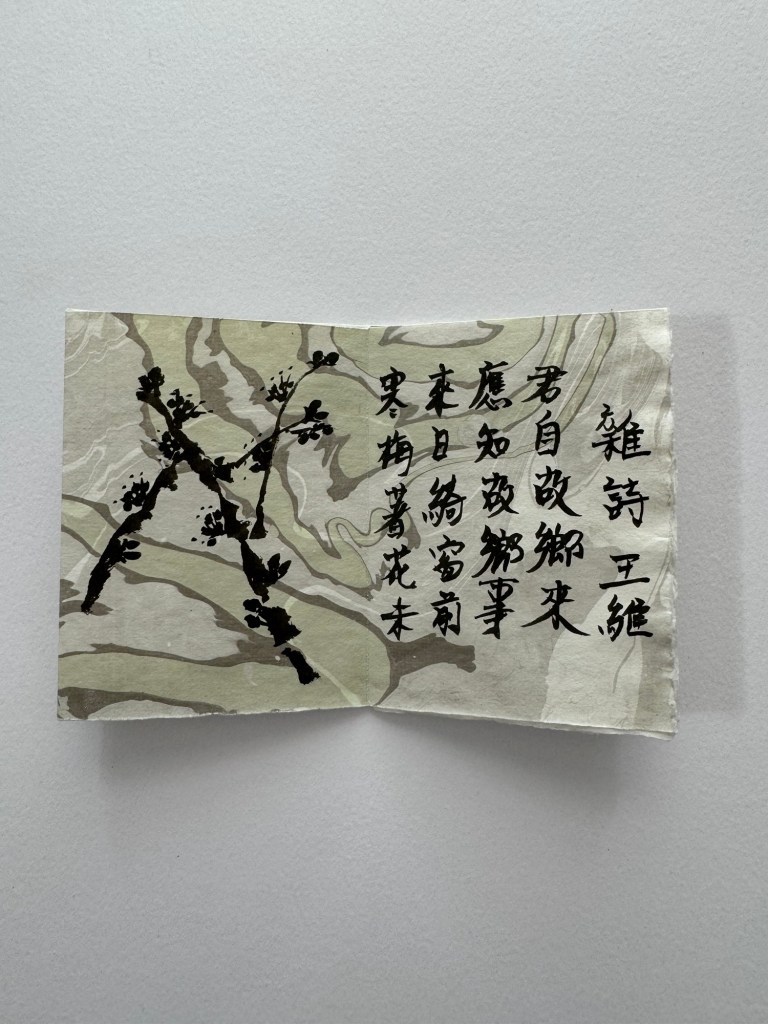
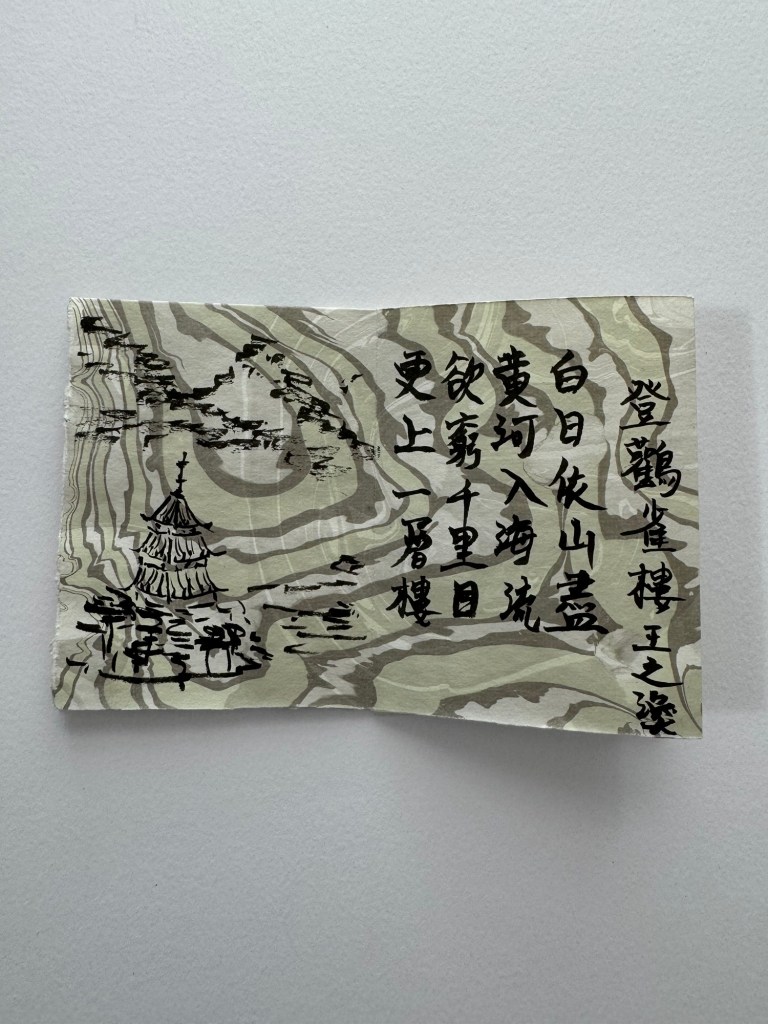
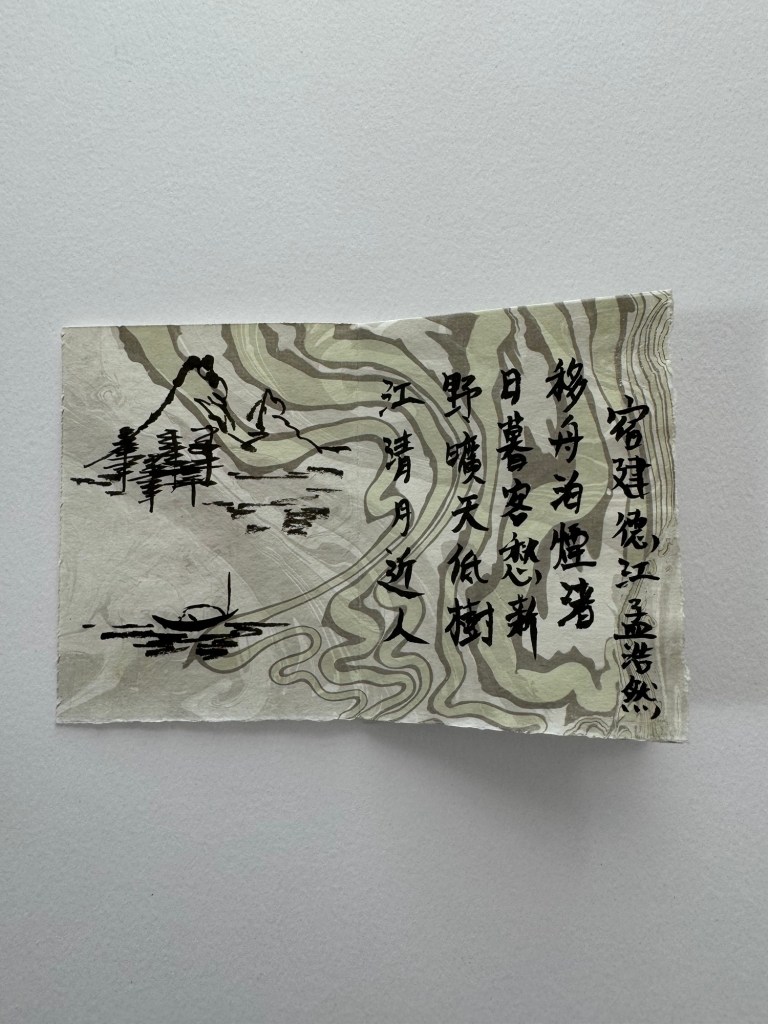
On another Suminagashi book that I made, I chose four Tang Dynasty poems and wrote them in the book using Chinese ink calligraphy, each paired with a small painting:
–
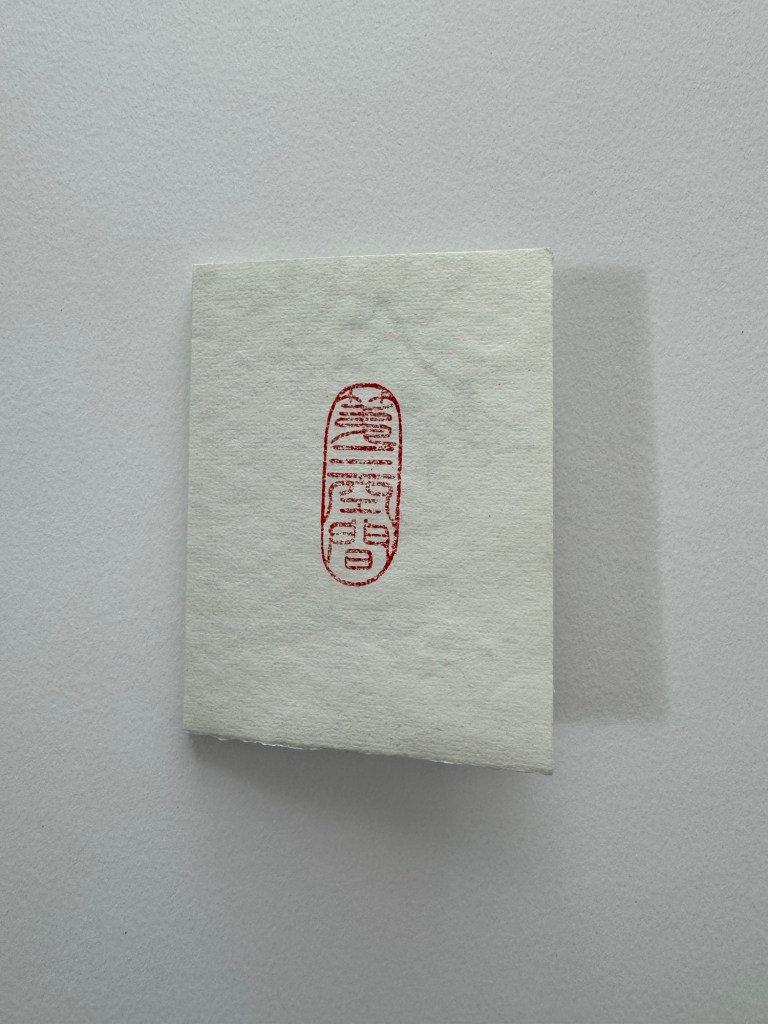
The seal on the last page of the book is a new Chinese stone seal that I designed. I managed to have it carved in Hong Kong and brought back to the UK by my Chinese painting tutor. The phrase on the seal means ‘The Third Space’, a concept that my art practice is based on so I will use it like my artist’s signature. The seal is carved in an ancient Chinese font.
Below is a video with my narration, reading out the English translation of the poems. Note that traditional Chinese books open from the opposite direction to English, Romance or Germanic language books:
–
REFLECTIONS
I was really inspired by the visit to the book art fair. It helped me to understand how broad the scope of this art form can be. I knew very little about book art until the low res workshop earlier this year and I am excited by it. I enjoyed making the simple books in this exploration, especially using the Suminagashi paper. Here is a summary of what I enjoyed about this exploration:
– I enjoyed the quiet pleasure in the act of folding paper carefully, especially with beautiful paper such as the Suminagashi paper. The feel of the material surface, the edges and creases all added to the meditative effect that this art form has to offer.
– I enjoyed learning a new skill in making books. Although I am only making very simple ones at the moment, I am excited by the potential complexity and scope that book making can offer. It is new knowledge and a new challenge for me.
– Once a book is made, it is like having a new canvas calling out for creativity that requires a new way of thinking compared to my other work.
For me, it is a two stage process: (1) Think about how I want ‘the canvas’ to be and realising that idea through physical making; then (2) express my art on the made canvas. The stages are similar to the Cheongsam (Chinese dress) canvases that I have been making for painting. That approach also requires creating a 3D canvas first through a step-by-step ‘technical’ process before any drawing or painting can take place.
The similarities between my book-making and dress-making to create canvases only occurred to me during the writing of the above reflections. I was beginning to feel concerned that I might be going from one thing to another too soon in my practice. I am not dropping the dress-making work, in fact, far from it – I have planned many other projects based on Cheongsam canvases. But I also want to explore book art and I now realise the similarities between the two in the context of my practice. I believe it can be explained as follows:
– The book-making or dress-making processes start by my following some guided steps, this way of making gives me a structured approach to starting a project. Meaning, it is unlike just getting out a plain sheet of paper or a pre-made blank canvas where you are immediately faced with having to decide what to paint. Through the structural and systematic start of the creative process (i.e. making a book or a dress), I can proceed to create ‘productively’ and while I am making the ‘complex canvas’, I can think about what to paint on the canvas or to finalise the ideas in my head. The process of making the canvas (which in the case of a dress can take several days) gives me quality thinking time whilst doing something productive and not just sat in front of a blank canvas feeling bad that nothing was happening.
LEARNING
Attending the book art fair taught me a lot about the scope that this art form can offer. In my own experiments, I have learnt more about the art of making books from a technical perspective – I am at a very early stage right now but I definitely want to learn more to make more complex or larger books.
My reflections above made me realise that the process of making the canvas myself (e.g. a book or a dress) has been a key part to my enjoyment in making art recently because I have been using the canvas making time and process to aid my thinking and to finalise my creative ideas. I have been doing this without consciously knowing it. I value the fact that making items such as a book or a dress are established processes and therefore give me a secure and stable route to start each piece of work. On the contrary, if I were to create a completely free-form assemblage from found items as a starting point, I would be inhibited by such an open and abstract process at the beginning of a piece of work – I would not know where to start and therefore it would be like sitting in front of a blank canvas again. This realisation is very important and useful for me because I can now think about other potential canvases that I can make from an established method in order to expand my practice.
NEXT STEPS
– Continue to make books and learn about book making to expand my knowledge.
– Think about other canvases that I can create in addition to books and dresses that would enable me to have the quality thinking time as part of my creative process and to avoid the ‘starring at a blank canvas’ problem.
UPDATE:
I made another book using a piece of Suminagashi paper folded into a small long book. In it, I wrote four short Tang Dynasty poems in Chinese calligraphy and coloured some areas using Chinese painting colour.

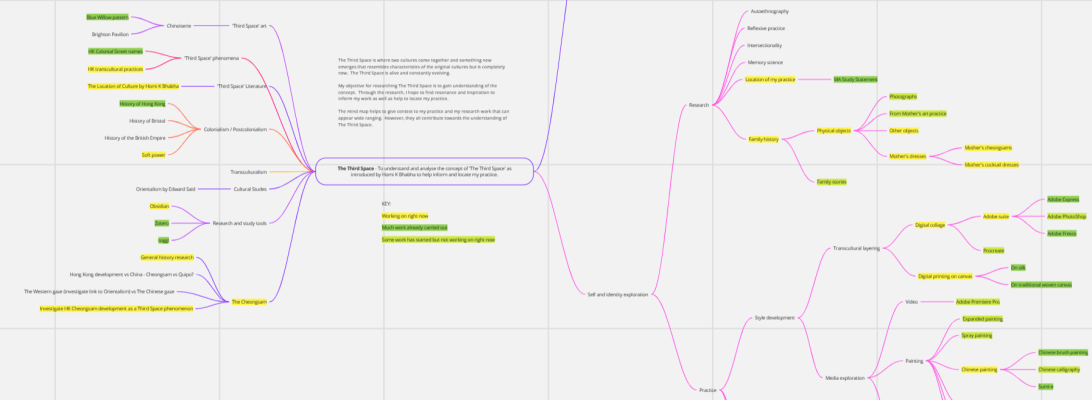
This blog details my preparation notes for Tutorial #3. It summarises my study plan and progress so far for this term (Y1 Summer term 2024).
STUDY PLAN
I refer to my Study Statement to review what I had planned for this term to see if the plan is still relevant. The orange highlights show the items I had planned for this term and that I am actually working on:
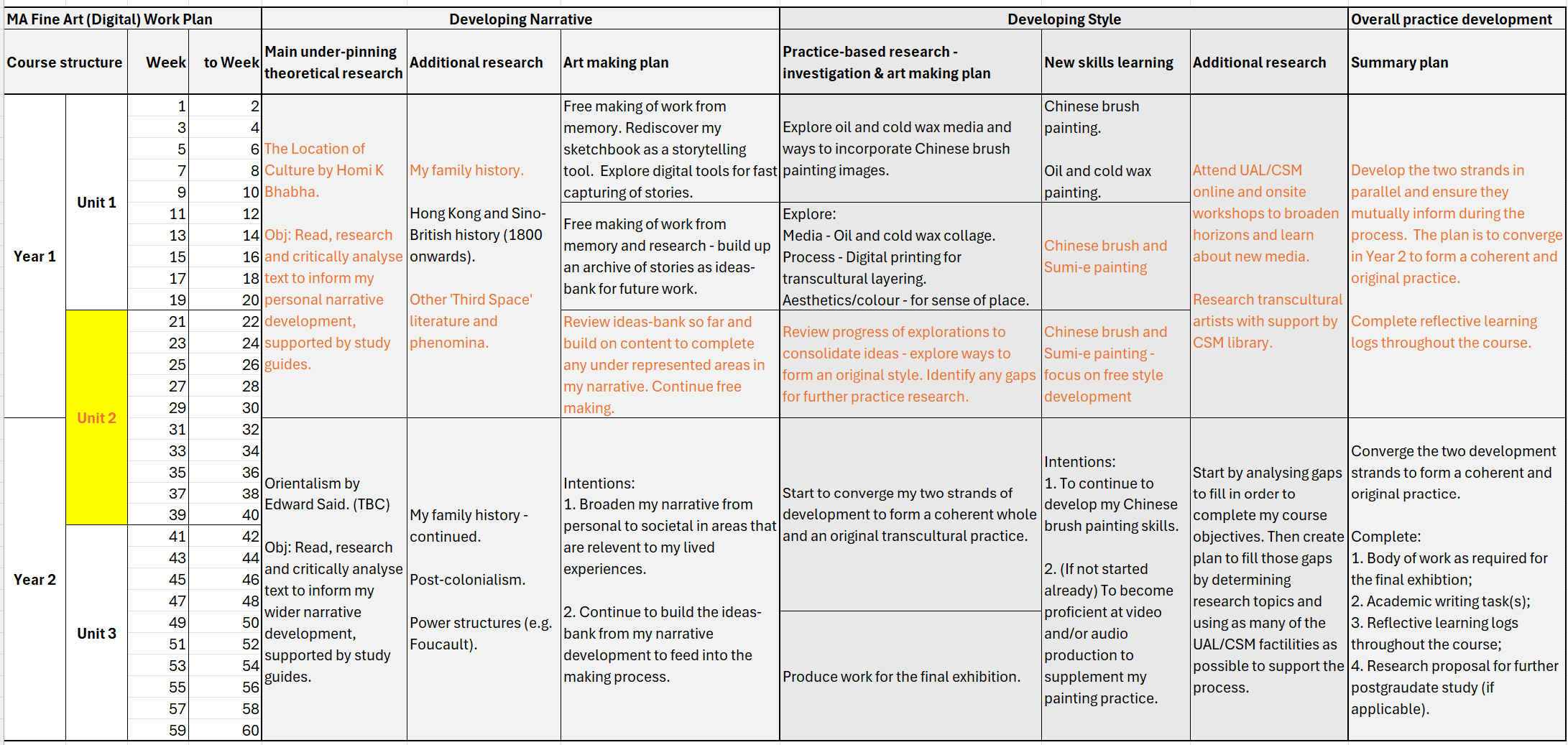
Overall, the topics listed in my Study Statement for this term are still largely relevant. For my making, I have some new creative ideas based on the Chinese Cheongsam as a result of an accidental find…
Finding two of my mother’s Cheongsams (also called Qipao – traditional Chinese dress) in my loft that I thought I had accidentally thrown away 23 years ago has given me new inspiration to make Cheongsam related art. My mother’s Cheongsams are of a modern mid-20th century design and is a ‘hybrid’ design combining the traditional Chinese style with European design of that era (tight fitting/figure hugging design inspired by Dior, Chanel etc.). I find the topic of an iconic Eastern-Western hybrid garment intriguing, exciting and I want to make art about it. It is also helping me to bring together my two development strands (narrative and style) – this convergence within my practice is happening earlier than I expected which may or may not be good. Time will tell..
See below for the new activities added to my Mind Map as a result of this latest discovery:
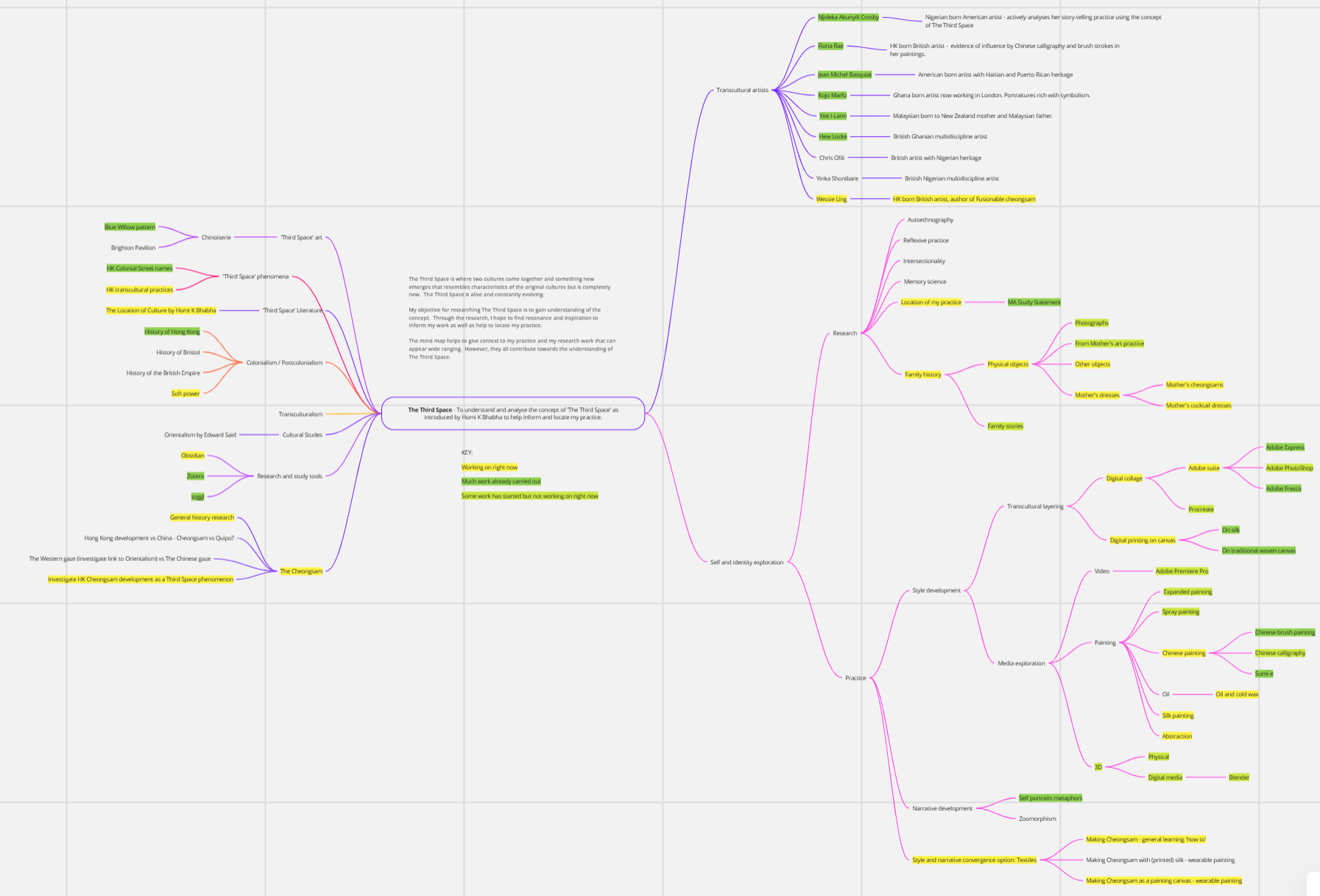
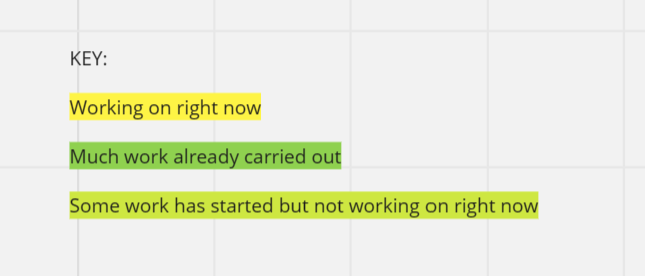
I added a light-green category to show work that I have started but not working on right now.
I have added the Cheongsam as a new topic for academic research and resources from the UAL libraries have been very useful:
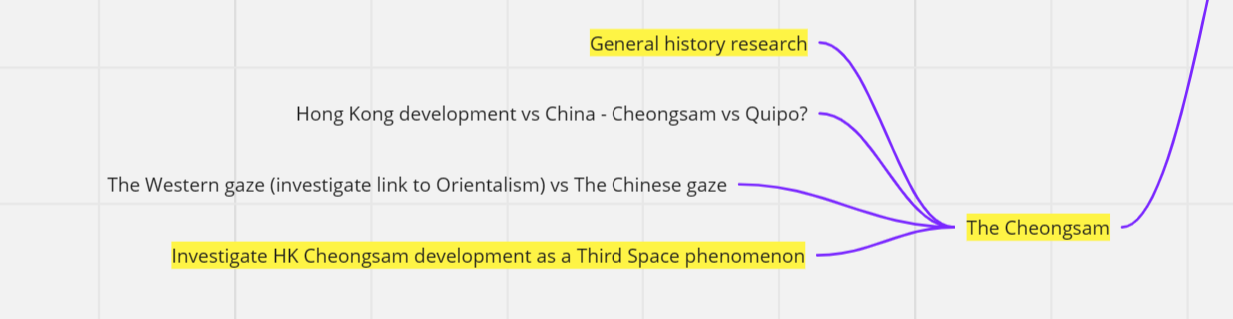
I have added my mother’s dresses that I found in the loft as part of my family history research:
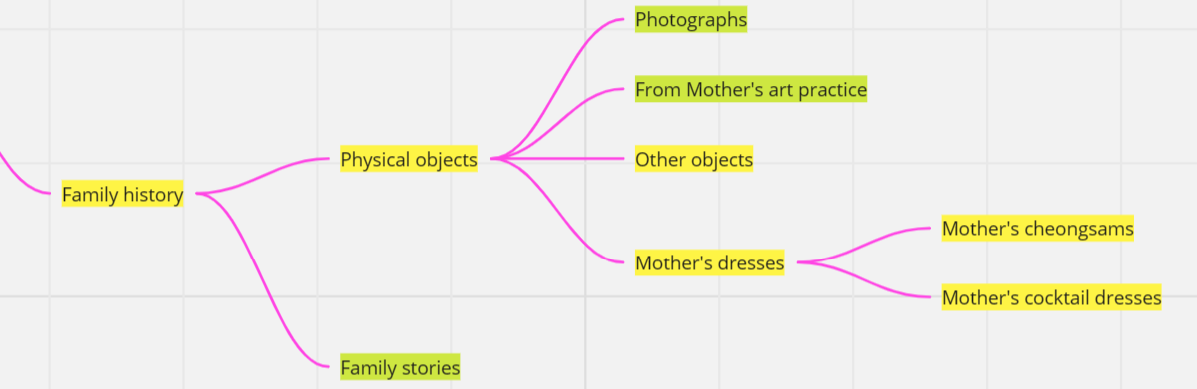
I also added Cheongsam to my list of making projects for this term. The plan is to make a series of wearable paintings:

–
PROGRESS (MAKING)
The progress of making during this term since discovering my mother’s Cheongsams are listed below:
– The first Cheongsam wearable painting was completed and documented in these two blogs:
MA Y1 U2: Cheongsam Series #3 – wearable painting
MA Y1 U2: Cheongsam Series #4 – Appropriation. Appropriation.
– I am working on the next Cheongsam painting, here is a digital sketch showing the idea so far:
MA Y1 U2: Cheongsam Series #5 – She’s a banana! – Part A
– The blogs below show some earlier work that were carried out prior to the above paintings during the ‘thinking’ time that led to the idea of making a Cheongsam wearable painting:
MA Y1 U2: Cheongsam Series #2 – study drawing
MA Y1 U2: Cheongsam Series #1 – oil and cold wax abstract
Finally, below is a blog detailing my reflections after the MA Interim Show and my struggle in trying to pin down the elusive third space…
MA Y1 U2: The elusive Third Space – Reflections from MA interim show and feedback
PROGRESS (RESEARCH PAPER)
I am close to finalising the title question. Details to be supplied separately to this blog.
TIME PLANNING FOR THIS TERM
I aim to split my time 50/50 between making and the research paper.
NOTES FROM TUTUORIAL #3
Date: 10th May 2024
Tutor: Jonathan Kearney
Notes: All the topics listed were discussed. Key points noted were:
– Out of the two similar titles for the Research paper – either is fine at this stage. Once more work is done then can decide on which route to go or maybe even something different.
– Homi K Bhabha’s book The Location of Culture – can quote from YouTube videos about the book. It’s ok to reference someone else’s interpretation of the text.
– Also look at TCK – Third Culture Kids texts.
– Positionality – not essential to declare for this type of research paper. But also ok to do, can be in introduction or conclusion. Although not essential, maybe interesting to declare for the reader in my case so they understand my motives for the research.
– We discussed how fixed I am about making a ‘wearable painting’ – my feeling was that I was not fixed on it. I don’t want the act of making it wearable (searching for washable paint and materials etc.) to distract from the making. It is a painting that can be wore (briefly for say a photo-shoot) and not intended to be a piece of proper garment. Keeping it as a painting also means I can use my usual artist grade paint and materials.
– What next to make – I have ideas for two pop art themed Cheongsam paintings based on food as metaphor about heritage and identity. I will make those and then hopefully to make more after that. I am excited about this concept. The vision is to make many (exact number to be determined) such ‘dress as a canvas’ paintings for them to be displayed on headless mannequins as a collective installation. I am excited by this vision!
Date of the tutorial: 7th Feb 2024
Who with: J Kearney
Preparation notes for Tutorial:
Below are topics that I would like to discuss please.
1. Advice on work for exhibition.
2. Clarifying Learning Outcomes.
3. My current challenges are:
– Still struggling to find my transcultural style but I am pursuing a plan of exploration with practice-based research and I feel I’m making progress. Hence I’m not too worried at this stage.
– Delving deep into my narrative development – I am still agonising over the fragility of the process so would like to give an update on this. (Metaphor – like a treasure chest of snakes.)
If time allows:
4. Pick up on a discussion from our last tutorial – ‘freedom with structure’ or ‘freedom vs structure’?
5. Update on my Third Space research.
Below are for info only (in case we need to refer to specifics during the tutorial):
Here is an update of my latest Mind Map.
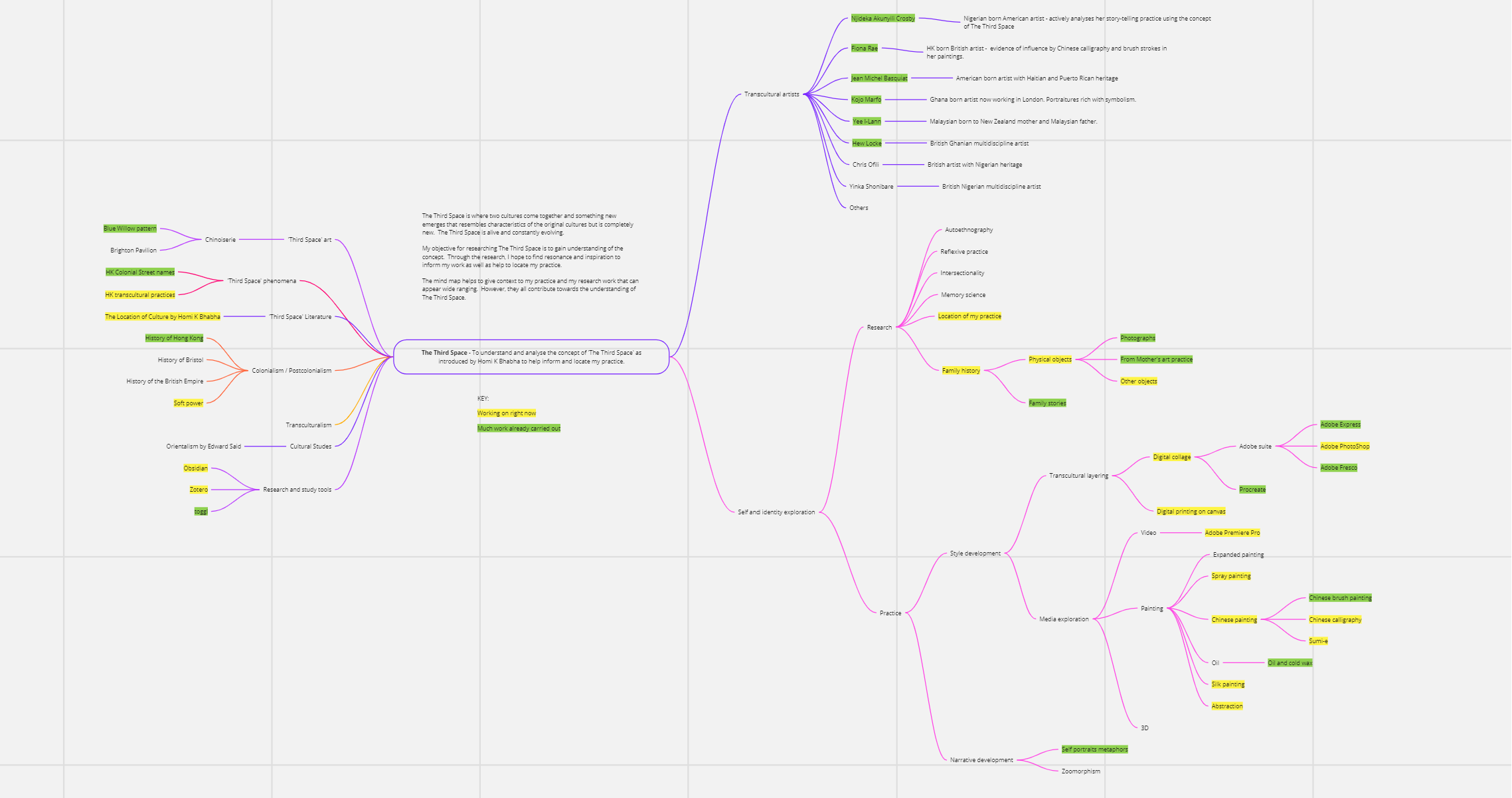
Example blogs of style development – practice-based research to explore media:
https://eliza-rawlings.com/2023/12/20/ma-y1-u1-exploring-oil-and-cold-wax-part-4/
https://eliza-rawlings.com/2023/12/24/ma-y1-u1-exploring-oil-and-cold-wax-part-5/
https://eliza-rawlings.com/2024/01/09/ma-y1-u1-exploring-media-oil-and-cold-wax-part-6/
Example blogs for narrative development through free making:
https://eliza-rawlings.com/2023/11/26/ma-y1-u1-hk-street-names-part-1/
https://eliza-rawlings.com/2023/12/28/ma-y1-u1-developing-narrative-bowling-lawn-incident/
Notes from the last tutorial:
https://eliza-rawlings.com/2023/10/27/ma-y1-u1-tutorial-1/
Work done as a result of our discussion on using photos: –
(a) Below is latest work-in-progress, will do a Chinese brush painting on top:
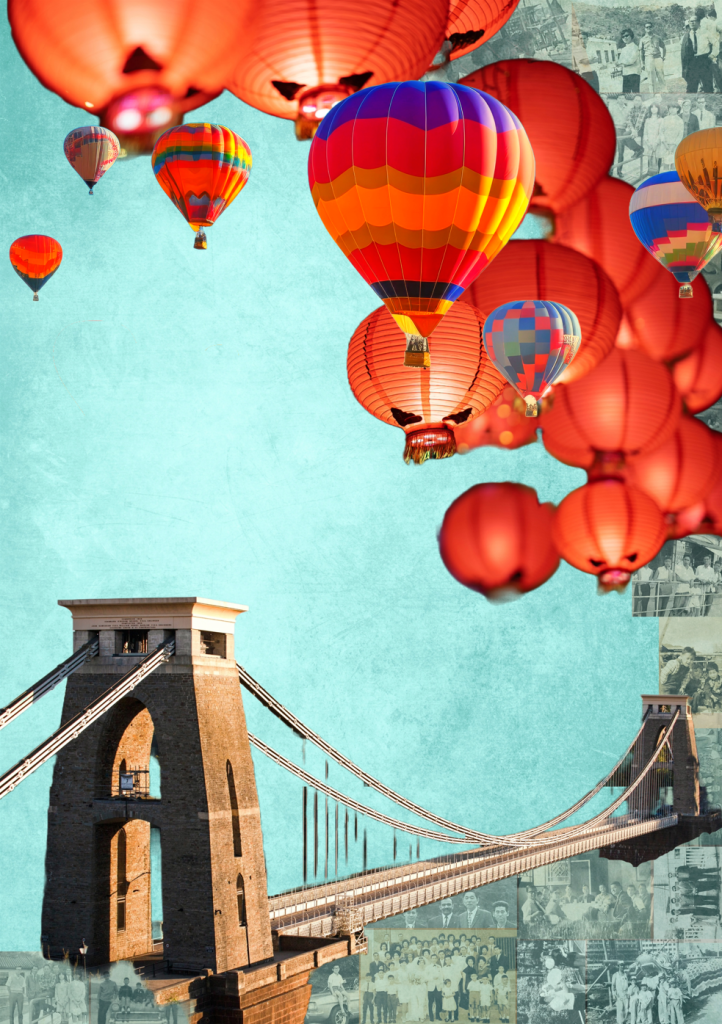
(b) The first experiment on using photo and blog:
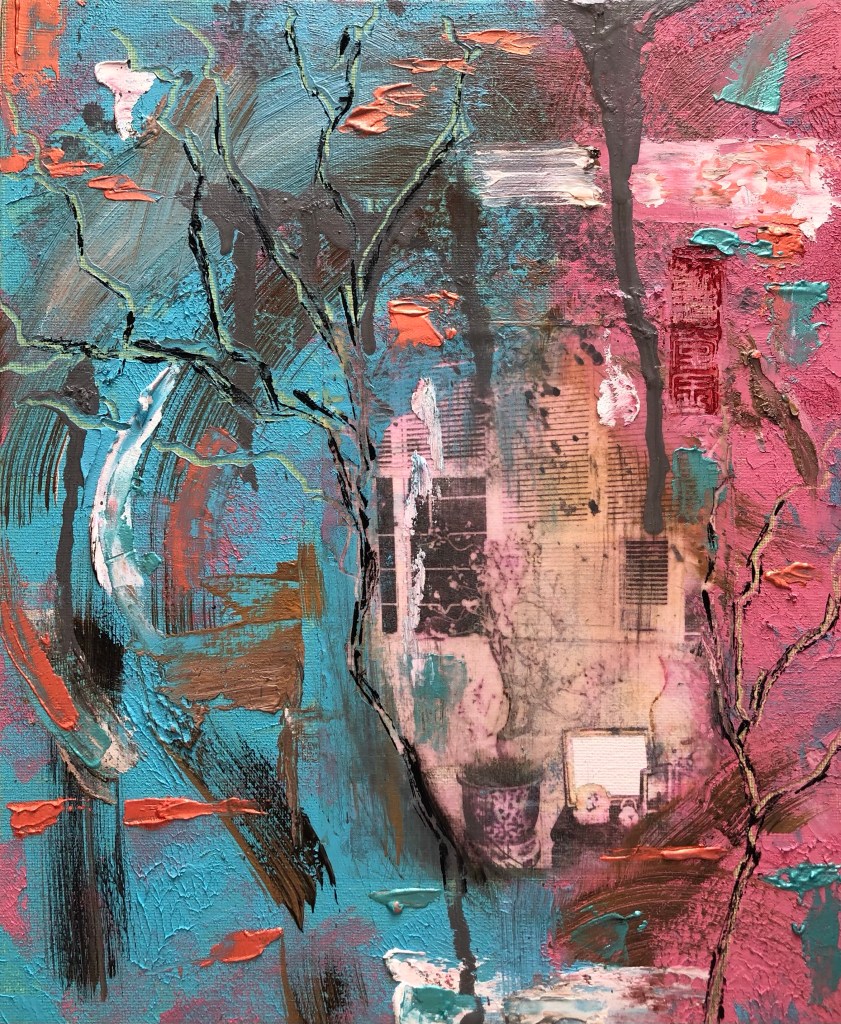
https://eliza-rawlings.com/2023/11/18/ma-y1-u1-using-a-personal-photo/
–
Notes / reflections from discussions:
Below are notes / reflections on the items discussed.
1. Exhibitions –
MA Interim show: We discussed this topic in detail about the different options. Outcome is – use ‘HK Street signs’ as a backup piece. Video will need to be shortened to 2 mins long. Work on the transcultural silk piece and if that works out then I can show it instead. We discussed the different ways to hang the silk – the key is to consider the mount as part of the art work, what kind of effect overall etc.. It was a very helpful discussion.
MK Calling: discussed options on framing and how much to ask the gallery curator. It’s ok to propose a new frame as an option but not to ask questions that are too open or require too much of the curator’s time.
2. Learning outcomes discussed and clarified.
3. We discussed this item because I’m happy to continue my planned explorations and don’t need input yet.
4. I shared my thinking on how the structure gives me a secure space to freely explore. Hence it’s freedom with structure and not freedom vs structure. i.e. the structure is not inhibiting the freedom but in fact enabling it. This way of working and my being comes from my duality of being a highly institutionalised rebel.
Next steps:
The immediate next steps are focused on getting my work ready for the MA Interim show and MK Calling.T
As for the rest – continue with the work I have planned for developing my practice.
BACKGROUND
For the MA course, the guideline is to work on average 20 hours per week throughout the year, or 30 hours per week if only working during term time.
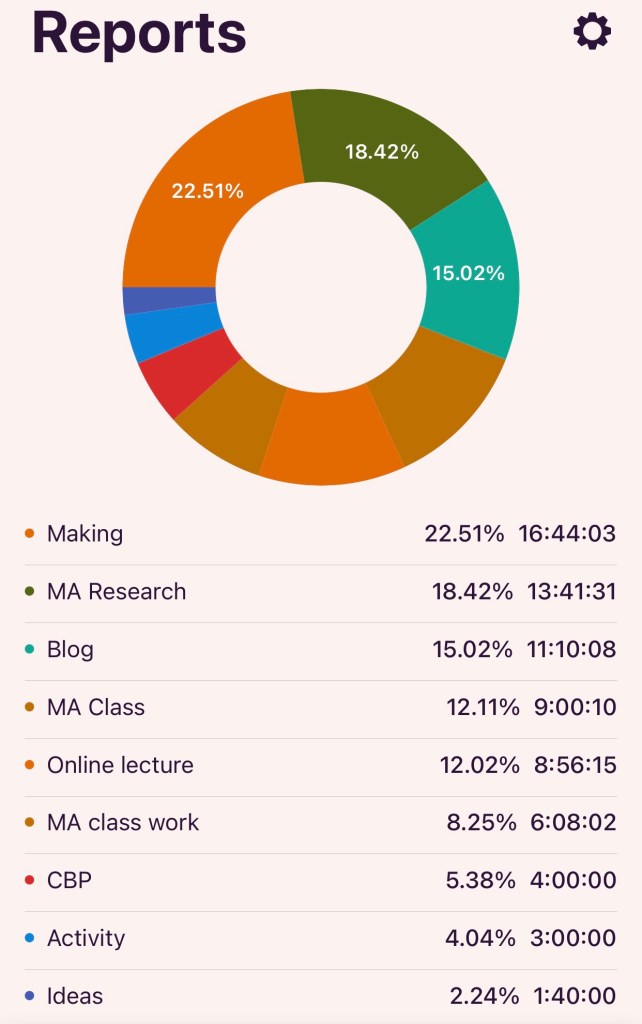
Work can be anything ranging from making, research or ideation. I am using the Toggl Track App on my phone to help me track my hours spent on the course and the hours are logged against the activity type. I plan to log a summary report at the end of each month to keep track of progress. However, the informal time spent thinking about my practice whilst going about day-to-day life is not recorded as they tend to ‘just happen’.
The purpose of monitoring my hours is to help me to establish a working rhythm so I know what it feels like to work the required hours for the course on an ongoing basis. It will also help me to plan and allocate time in my week to do the work. The analysis by activity type helps me to balance time for the different aspects of developing my practice so I can watch out for trends, e.g. spending too much time researching and not enough time making.
REPORTS
Each report will show the total number of hours worked per month and hours spent according to activity categories.
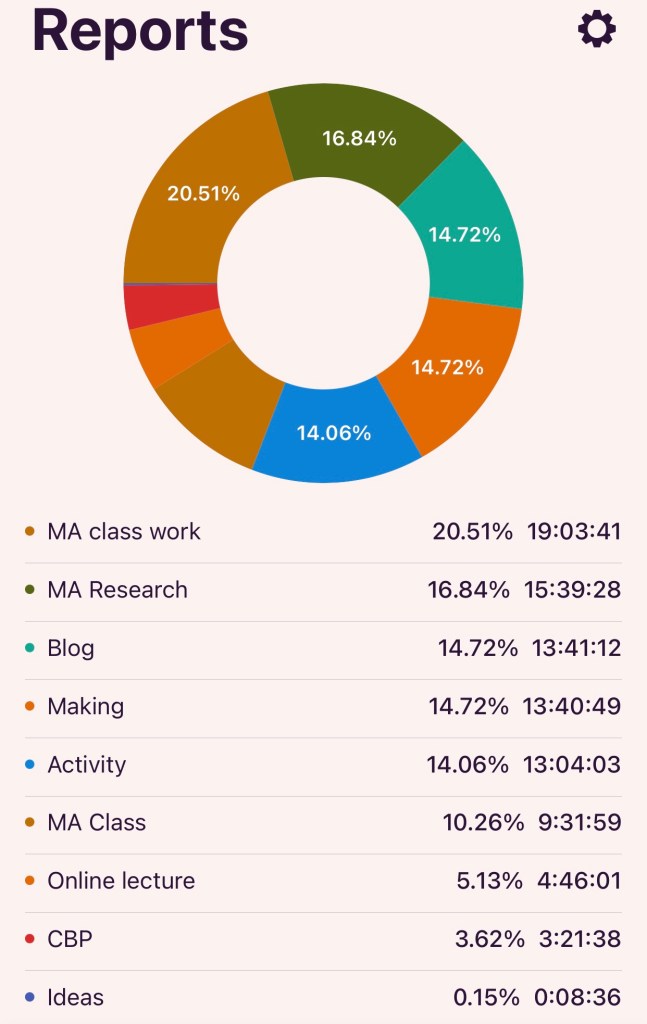
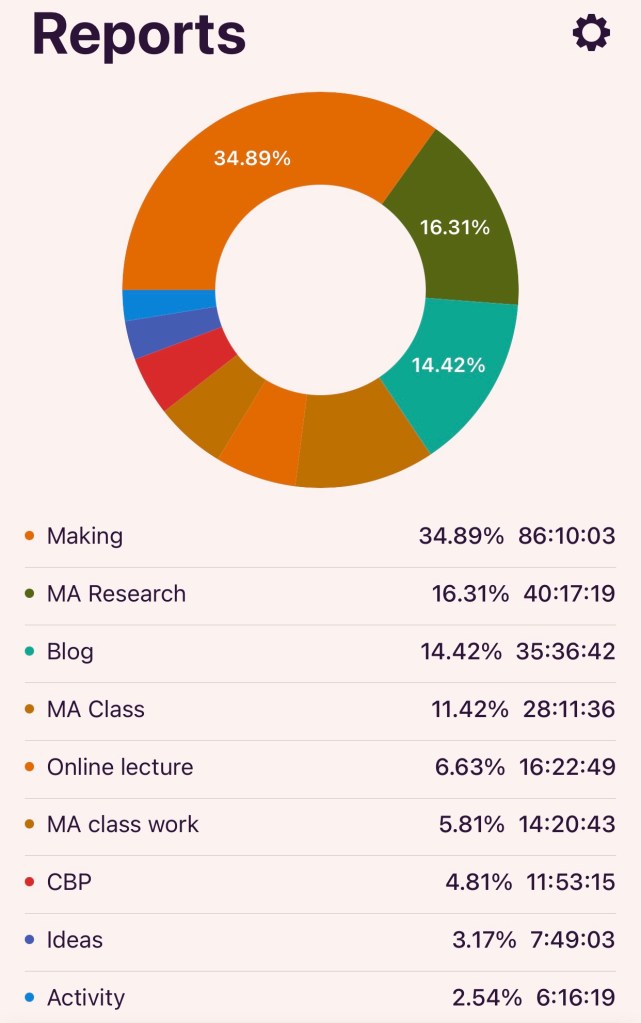
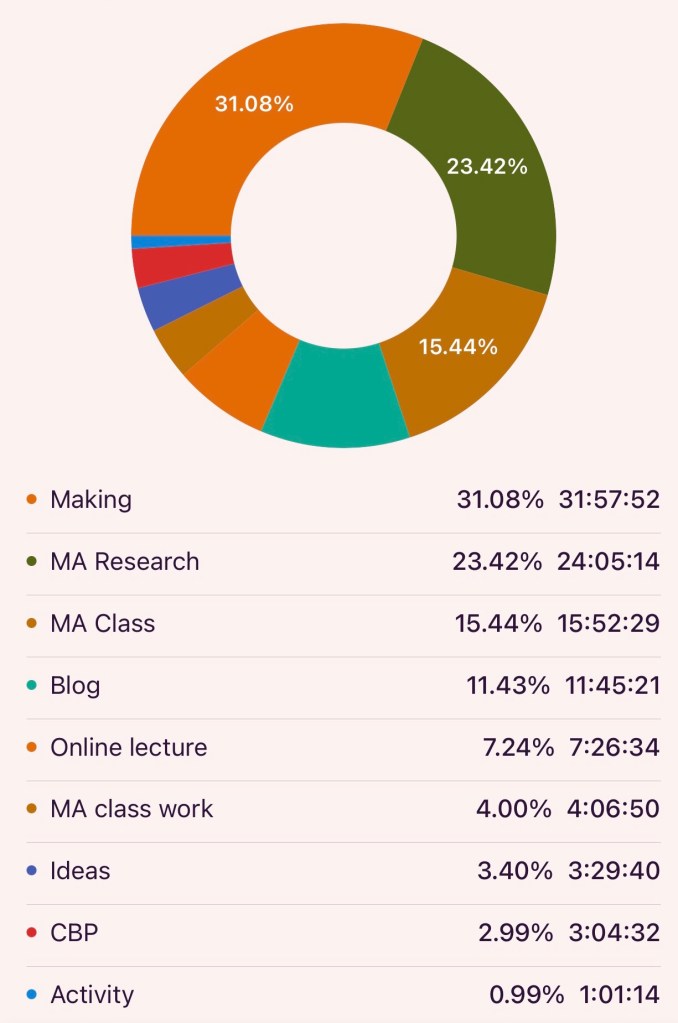
Key: ‘CBP’ is Chinese Brush Painting; ‘Activity’ is typically outside the studio such as visiting exhibitions or local artists group activities. The rest are self-explanatory.
The reports in this blog are listed in reverse chronological order.
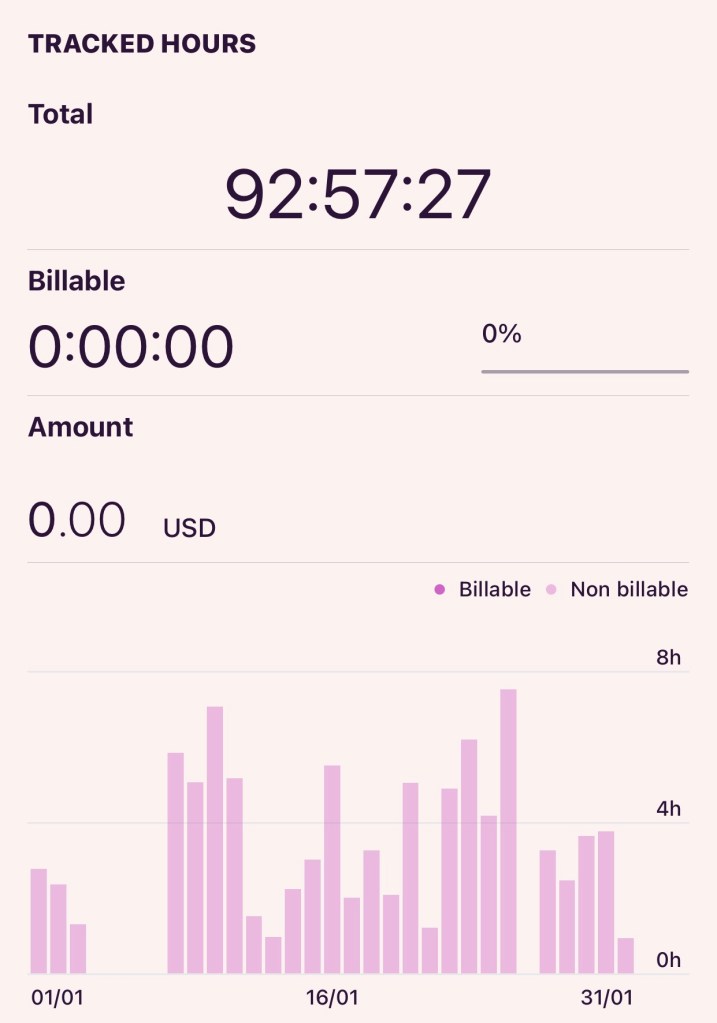
January 2024
A fair amount of time in January was spent on writing my study statement (captured under MA Class Work). For research work – I am reading a very informative book on The Modern History of Hong Kong which is a key part of my research on my heritage and the transcultural phenomena in the former British Colony. Also, I went to London for three days to attend a workshop at UAL LCF, to visit the CSM campus and two galleries (Tate Modern and The RA). As a result of these activities, the amount of time spent on making was less than I wanted for January. My plan for Feb is to really ramp up my making time because I expect to have less studio time in March due to the low residency in London.
–
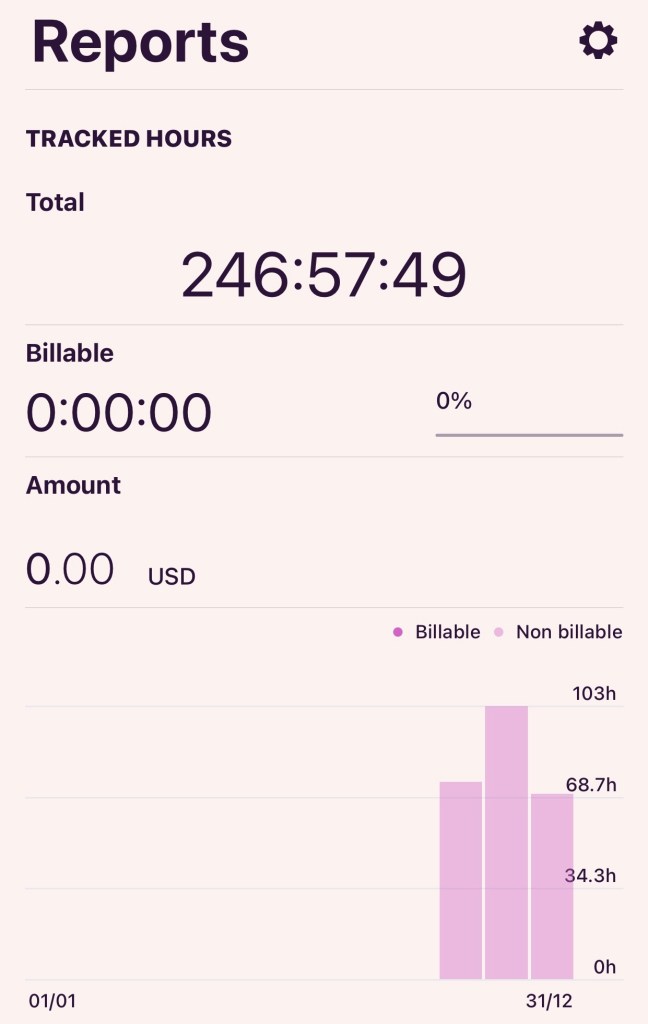
Report at the end of December 2023:
Below is the report for the total time spent during the first term, i.e. Oct, Nov and Dec 2023.
–
Below is the time and activity analysis for the first term:
–
Reflections (end of Dec 2023):
My reason for doing this time analysis was to establish a rhythm in order to make the most of the opportunity of this MA course. I am happy with the overall time spent and the split between the different activities. During the first term, I feel I have established a rhythm that is sustainable going forward and I plan to continue to monitor my progress using this tool.
November 2023
This is the first full month of the course and I didn’t have any trips away, so it was easier to fit in time for work. Below is report for the whole month of November.
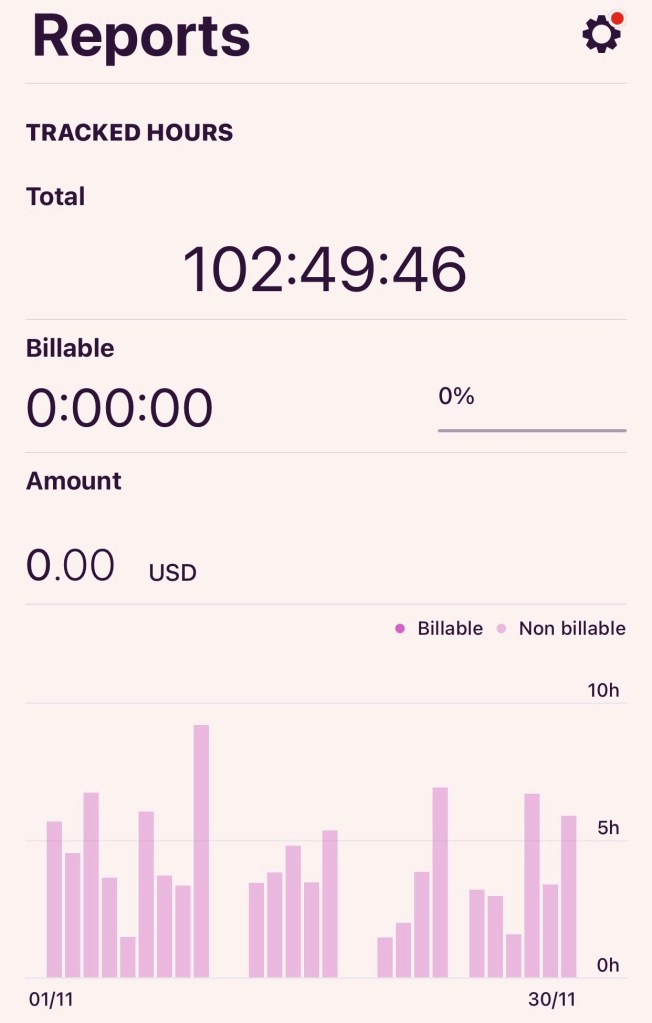
–
Reflections (End of Nov 2023):
I have found the Toggl app very helpful and easy to use in tracking my time. I really want to make the most of the MA course so establishing a rhythm and knowing what the right rhythm feels like is useful for me. Having a way to meaningfully monitor my time is also assuring so I know I’m not spending too little or too much time on something. I know that time is a quantity measure and doesn’t reflect quality – but it’s a start in holding myself to account for the opportunity that I have with the course.
October 2023
October was the beginning of term and work on the course didn’t really get going until week 2 of the month.
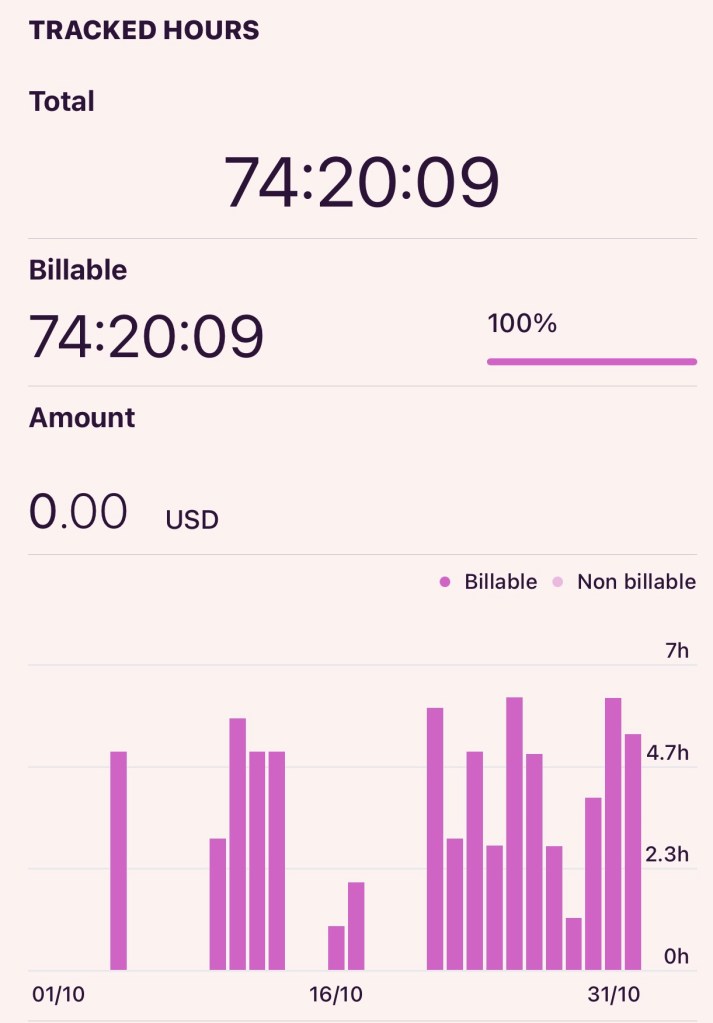
 elizarawlings