MA Y1 U1: Tutorial #1

Date of the tutorial: 30th Oct 2023 11:00am

Who with: Jonathan Kearney

TUTORIAL NOTES

Notes from our discussions and my reflections:

The mind map – whether The Third Space or Self-exploration should be the centre is something that could change over time. Just because I have decided on the former now doesn’t mean that the latter might not emerge as the centre at a later stage.

Reflections: I found the mind mapping process very useful in bringing clarity to my thoughts and practice. However, I recognise that it is important to avoid being too rigid. Need to make sure I give myself the space to think freely and not to bind myself to a fixed structure which could hinder my scope of exploration.

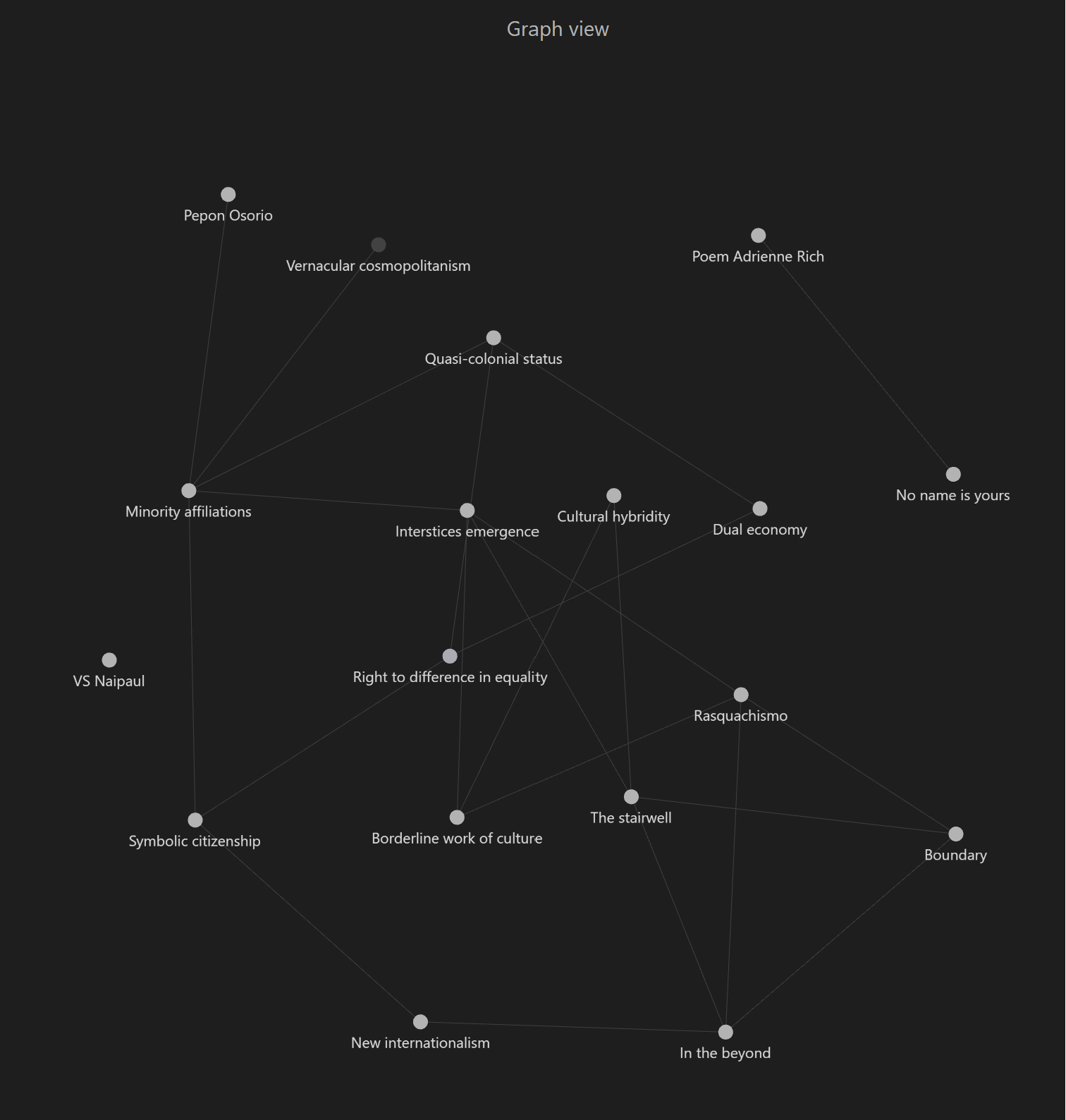
The extended-brain system of note taking – zettlekasten, can use this method to help me organise my thoughts when reading and researching about The Third Space as this book is so foundational to my practice at the moment. Obsidian software is an useful tool for this.

Reflections: I have found reading The Third Space very useful but have felt that I needed a better way to make notes and capture my thoughts so that I can build on what I read and make sense of it in the context of my practice. I am always worried about useful thoughts escaping me. So this part of the discussion was very helpful and I will research about the zettlekasten concept as well as try the Obsidian software.

Chinese painting – we discussed why not blogged until now and related discoveries.

Reflections: It was useful to delve deeper about the Chinese painting part of my practice. To talk out loud about where it has been and where it is going was helpful. Not only is the Chinese painting a skills-learning opportunity, it is helping me to discover my heritage and my personal history. It has led me to explore a range of topics such as Chinese philosophy and poetry as well as art. I was surprised to find that there was so much of that culture inherent within me despite leaving HK and my family when I was a young teenager many decades ago. I do feel blessed that I have a lot of material to ‘mine’ because so far that content has been largely untouched. However, among my excitement there is much hesitancy because of the uncertainty of what I might find. Also I am mindful of managing the challenges of vulnerability, detachment and self-preservation. Nonetheless, I am excited overall but I will take my time to ‘mine’ like an archaeologist doing an ancient monument dig because of the fragility.

The real challenges in my practice – Aside from the technical challenges such as digital printing on canvas, what are the real challenges for me in my practice?

Reflections: In this discussion, I reminded myself of a key part of my practice that I have been struggling with for some time – expressing my transculturalism. It was in this search that I came across The Third Space and I have been hoping that its research would help me with this challenge. I feel I am still at the beginning of that discovery. I have also been researching into other transcultural artists (as listed on my mind map) to gain insight into how they express their transculturalism. To explore my third space, I have been working on layering images from cultures that have influenced me. My challenge is to discover that something ‘new’ or unique to me. Right now, I feel my images are layers of culturally distinct images rather than a coherent whole – this remains my challenge to explore how to achieve that aesthetic coherence that uniquely describes my third space.

My creative ecosystem – we discussed this and how I have been building an ecosystem for my creative practice. I was asked to think about ‘working at my best – what is it like?’

Reflections: Referring to my search for a way to express my third space, I need to be more mindful about the ‘practice based research’ part of my work and make it an integral part of my day-to-day discovery. I will work on this and also consider the posed question carefully. 

My prep questions requesting help – all answers captured under original questions below.

Next steps:

Be mindful to not let the structure that I build into my practice hinder my creative exploration.

Research zettlekasten and try out the Obsidian software to support my reading of The Location of Culture and research on The Third Space.

Although I said that I was not ready to ‘dig too deeply’ into my family history yet due to the fragility of the process, I will explore using some recently found family photo images for my forthcoming work.

Consider the question ‘working at my best – what is it like?’


My response to the question ‘working at my best – what is it like?’:

When I am working at my best, what is it like?

The environment –

In my home studio, alone. The room is warm but not hot; relatively orderly; quiet outside, with the radio or a podcast on; materials available and accessible.

My state of mind, how I feel –

I have lots of time, not in a rush, no pressure to be elsewhere. Free from interruptions.

My mind is free from worry.

I am doing the work for myself, not for anyone else.

I feel completely free and anonymous. The work doesn’t matter, it is not for show. That is when I can be truly liberated in my thinking and making.

Dance like no one is watching; sing like nobody’s listening; paint like no one will ever see your work and you will never have to explain.


Preparation for Tutorial:

I have been working on several strands to develop my research-led practice. To bring clarity to my thinking, I have created a mind map to capture the different topics that I have been working on or plan to work on in order to show their relationships to each other and their context within my overall practice. This map also shows the areas that I am currently working on.
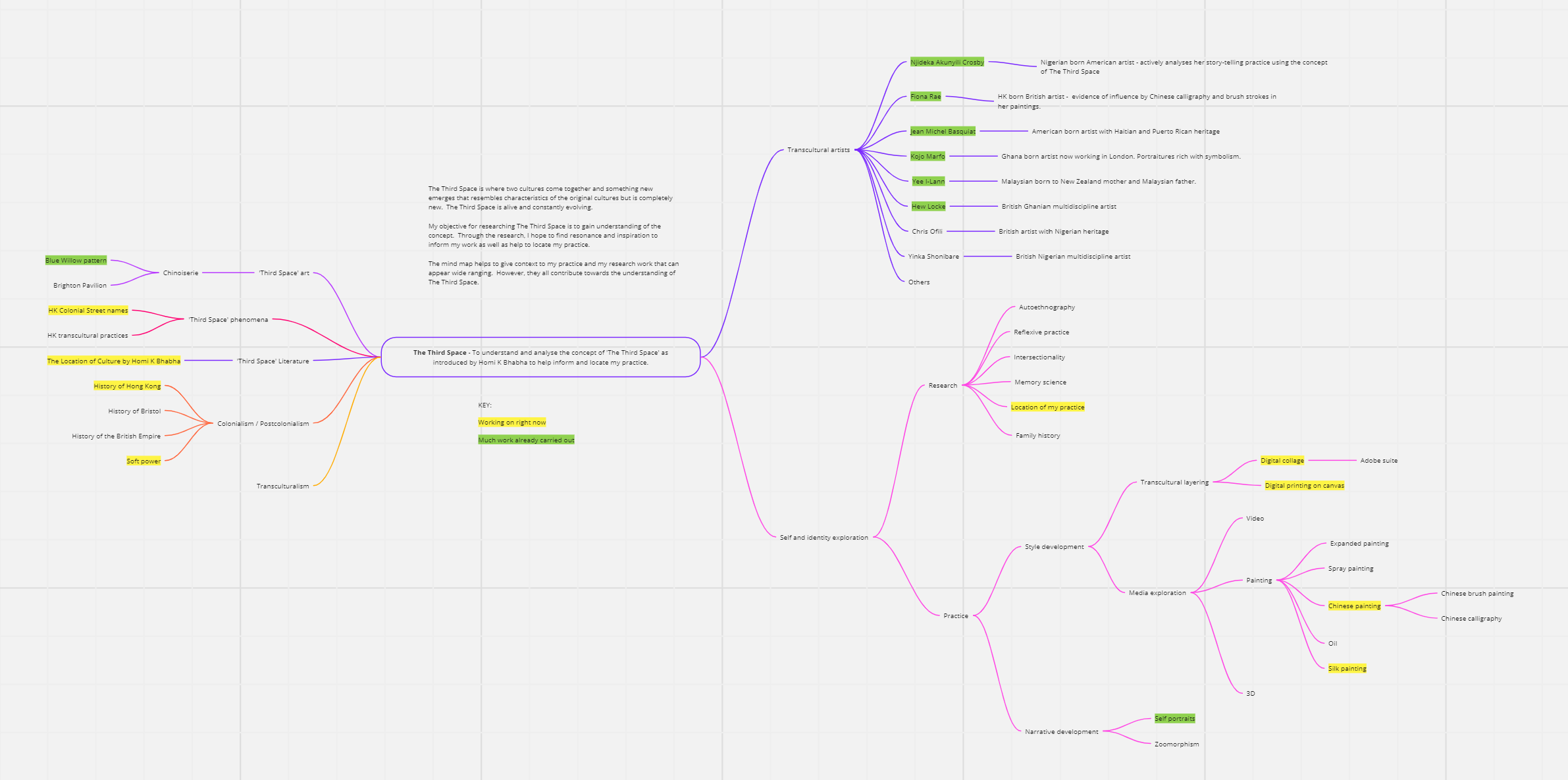
To plan for Unit 1, I want to consider these two questions:

1. What are my aims?

2. What do I want to discover?

Unit 1 timescale – Two terms from Oct 2023 to End March 2024, approximately six months.

What are my aims?

For Unit 1, I want to continue the two strands of my practice exploration – developing my style as well as my narrative. I am hoping that at some point, the two strands will converge in a way where my narrative work would feed ideas into the layering style work thereby forming a more coherent practice overall. However, I don’t feel that will happen in the next six months.

The aims for developing my style:

– Digital Printing: A key priority is to resolve the difficulties I have been having in digital printing onto canvas. I have contacted CSM Digital Printing lab to find out my options. After receiving some helpful info, I am preparing a series of experiments to evaluate my digital printing options. My aim is to come to some conclusions on this point by the end of Unit 1. Progress so far is captured in this blog:

https://eliza-rawlings.com/2023/10/10/ma-y1-u1-project-one-investigation-of-techniques-for-digital-printing-on-canvas/

– Chinese Painting: I have been learning Chinese brush painting and I am enjoying it. Despite learning for nearly two years, I have not written any blogs about this work because I didn’t know where I was going with it. I have now decided that I will continue this path of learning and hope to incorporate more of this genre into my main practice. As a result, I aim to start to blog regularly about my Chinese painting work and I hope to explore how best to incorporate it coherently into my practice through the reflective blogging process. Below is my first blog on this subject:

https://eliza-rawlings.com/2023/10/26/chinese-painting-rooster/

– Research canvas background images: I aim to do more research and make digital image collages that reflect my lived experience to form the canvas background for my style development work. Once I have compiled my latest collages, I will use the CSM digital printing lab for printing on canvas. Then I will use the printed canvases to make the next series of work.

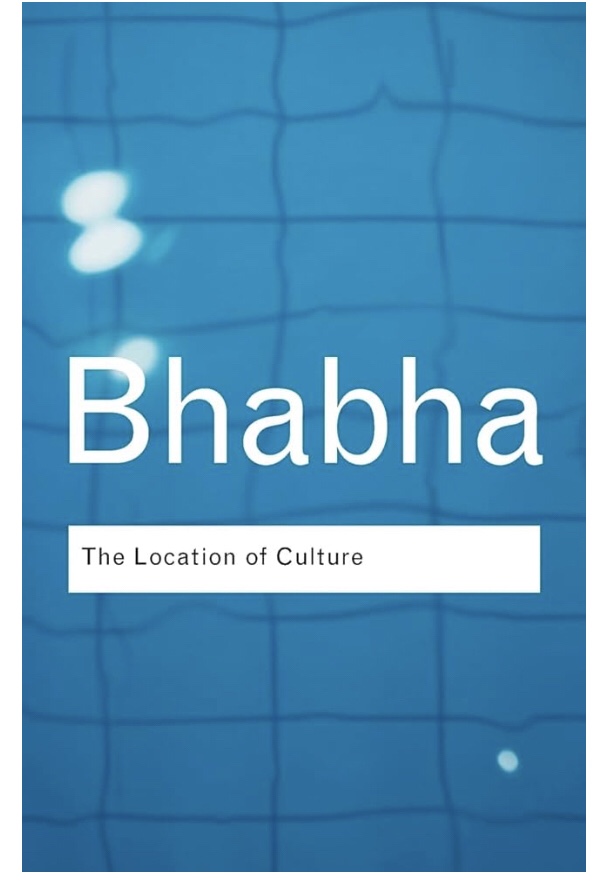
– The Third Space: I am reading The Location of Culture and I am finding resonance for my practice. I have started a blog on my reading, I aim to use it to capture my reflections and thinking as I go along. I also want to research more transcultural artists to explore how they have interpreted and expressed their third space. Reading progress is slow because of the thinking and reflecting involved. Blog for this work so far:

https://eliza-rawlings.com/2023/10/22/ma-y1-research-the-location-of-culture-by-h-bhabha/

The aims for developing my narrative:

– Make work freely and reflect: I don’t have as defined a plan here as I have for my style development work. Here, I want to just make work, leaving it as free and unstructured as possible to make whatever comes to mind. My aim is to use the reflective process on the work that I make to explore my thoughts and narrative. Below is a blog on my latest narrative work – Self-portrait #3:

https://eliza-rawlings.com/2023/10/27/ma-y1-u1-self-portrait-3/

What do I want to discover?

– An improved process for my multimedia layering work: with better canvas materials and using the CSM printing facilities.

– My Third Space: through my reading and making, I want to research and reflect on the meaning of The Third Space for me. I expect this exploration to last a long time and long beyond Unit 1 but I want to make some concrete progress in the next six months.

– My narrative: this is in fact part of the Third Space exploration, but I have not made sense of how they fit together yet. So for the time being, I will continue to discover my narrative through free making. My research into other transcultural artists will hopefully give me some helpful insights.

What do I need help with?

1. Digital printing and painting on large silk canvases – where can I get help if I struggle?

Discussed.

2. Feedback on whether having such a mind map helps or hinders the creative process.

Discussed.

3. Question – will there be any essay writing assignments?

Yes, in Unit 2. 3,000 to 4,000 piece of writing. More info in April.

4. Any other general feedback would be appreciated.

Discussed.

5. Can I access free Adobe suite software and stock photos library as UAL student?

https://www.arts.ac.uk/students/stories/get-adobe-cc-for-under-42

6. Where do I go if I need help with a specific medium, e.g. painting with oil and cold wax?

Technical Moodle – see Paint and surface, some technicians can help. 

For info only – Below are other blogs that I have written this month.

A ‘risk-taking’ drawing exercise:

https://eliza-rawlings.com/2023/10/25/ma-y1-u1-exercise-drawing-out-of-comfort-zone/

Thoughts on how I want to structure my blogs for this course:

https://eliza-rawlings.com/2023/10/05/ma-year-1-blogs-planning/

Ideas on work to make next:

A painting based on reflections from the ‘risk-taking’ drawing exercise and the Chinese painting blog – creating a loose painting background using the left-hand and eyes-closed approach, then adding Chinese brush painting style symbols as an experiment.

Third Space/soft power – HK Colonial street names – I want to make something about this topic that I have been giving a lot of thoughts to over the last few years, maybe experiment as part of the above painting to start with to see where it takes me.

A narrative painting from memory – childhood story in HK about a lawn bowling green incident reflecting the colonial era.
MA Y1 U1: Developing narrative – Self-portrait #3

BACKGROUND

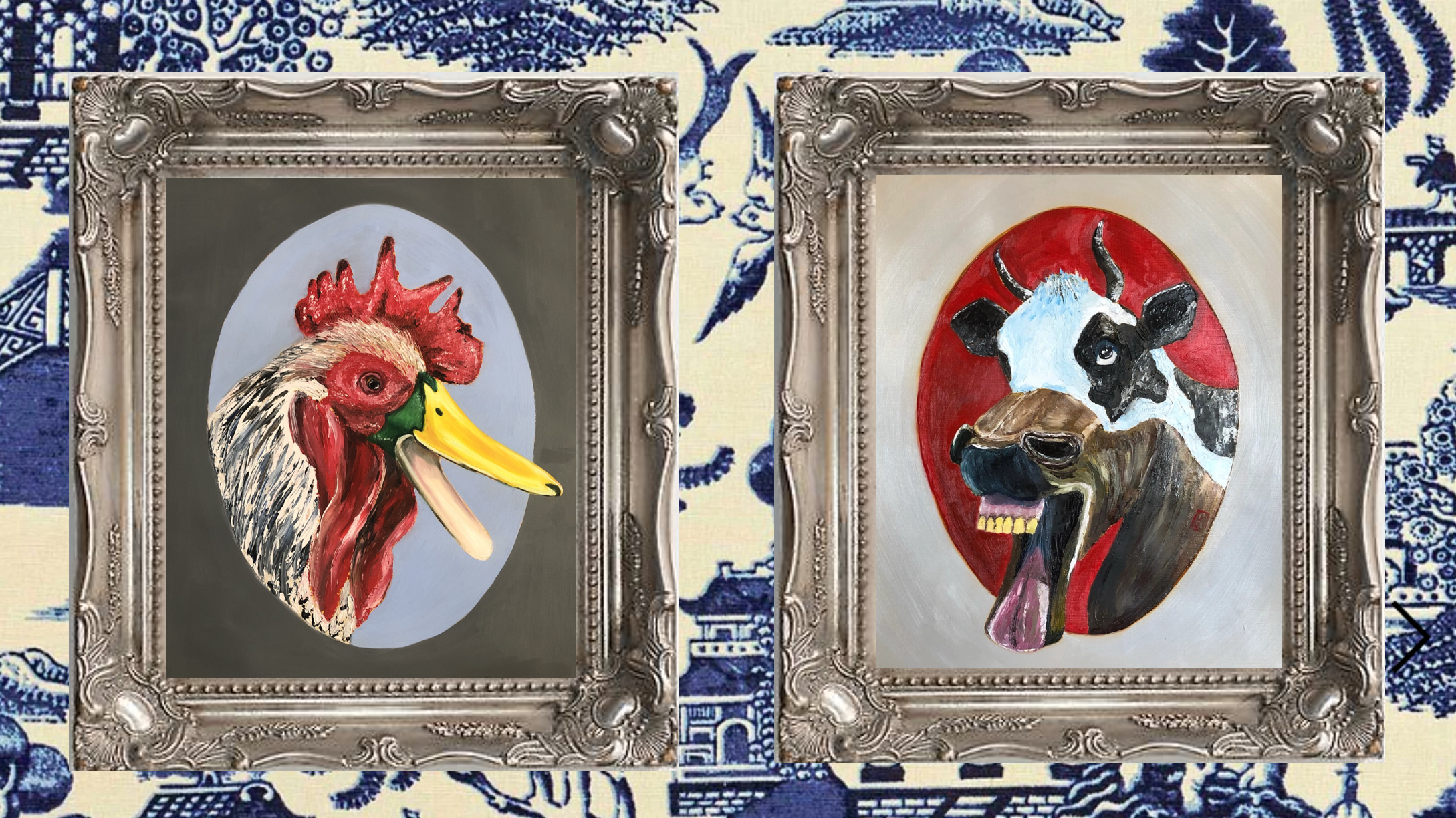
As part of my narrative development work, I have previously done two self-portraits as metaphors that reflected my transcultural lived experiences – an image of them is at the bottom of this blog. These self-portraits are a combination of two different creatures reflecting the conflicts that I experience at times within my mind.

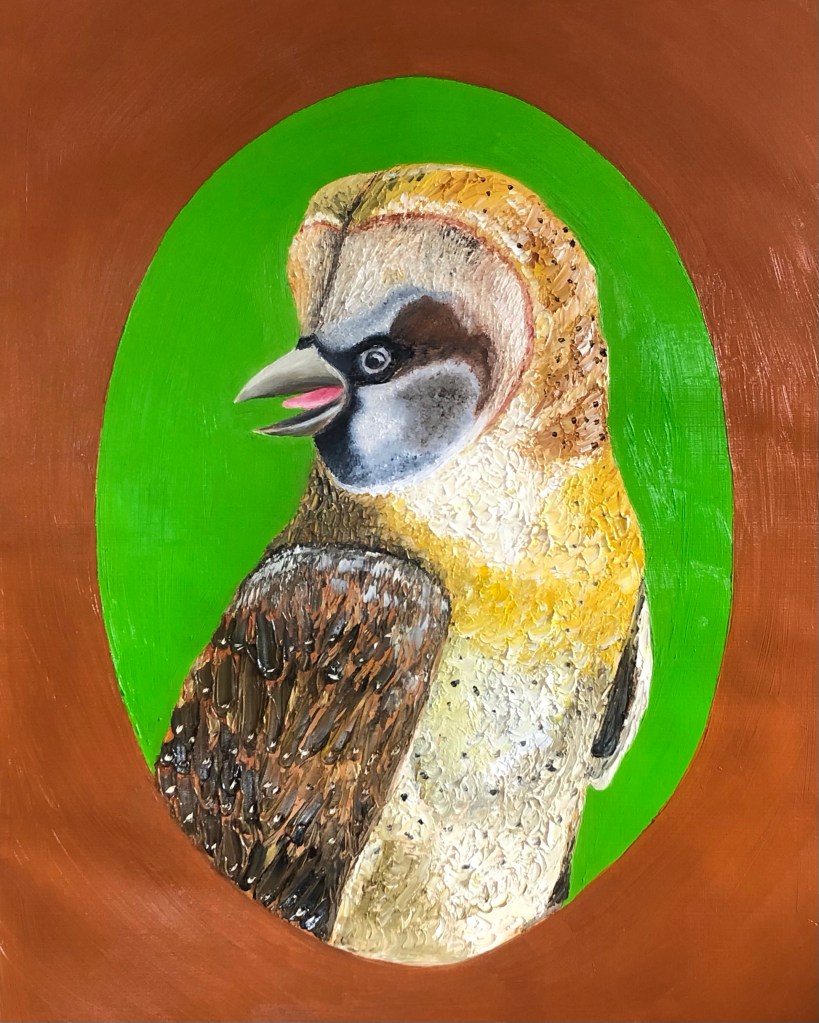
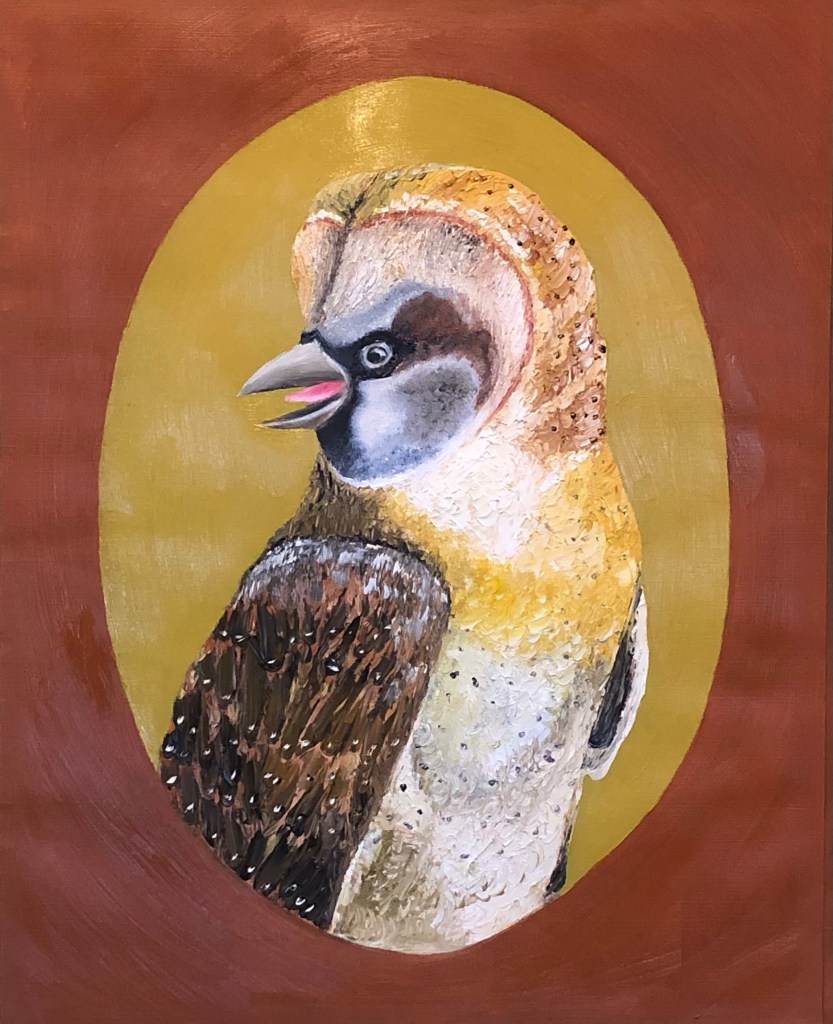
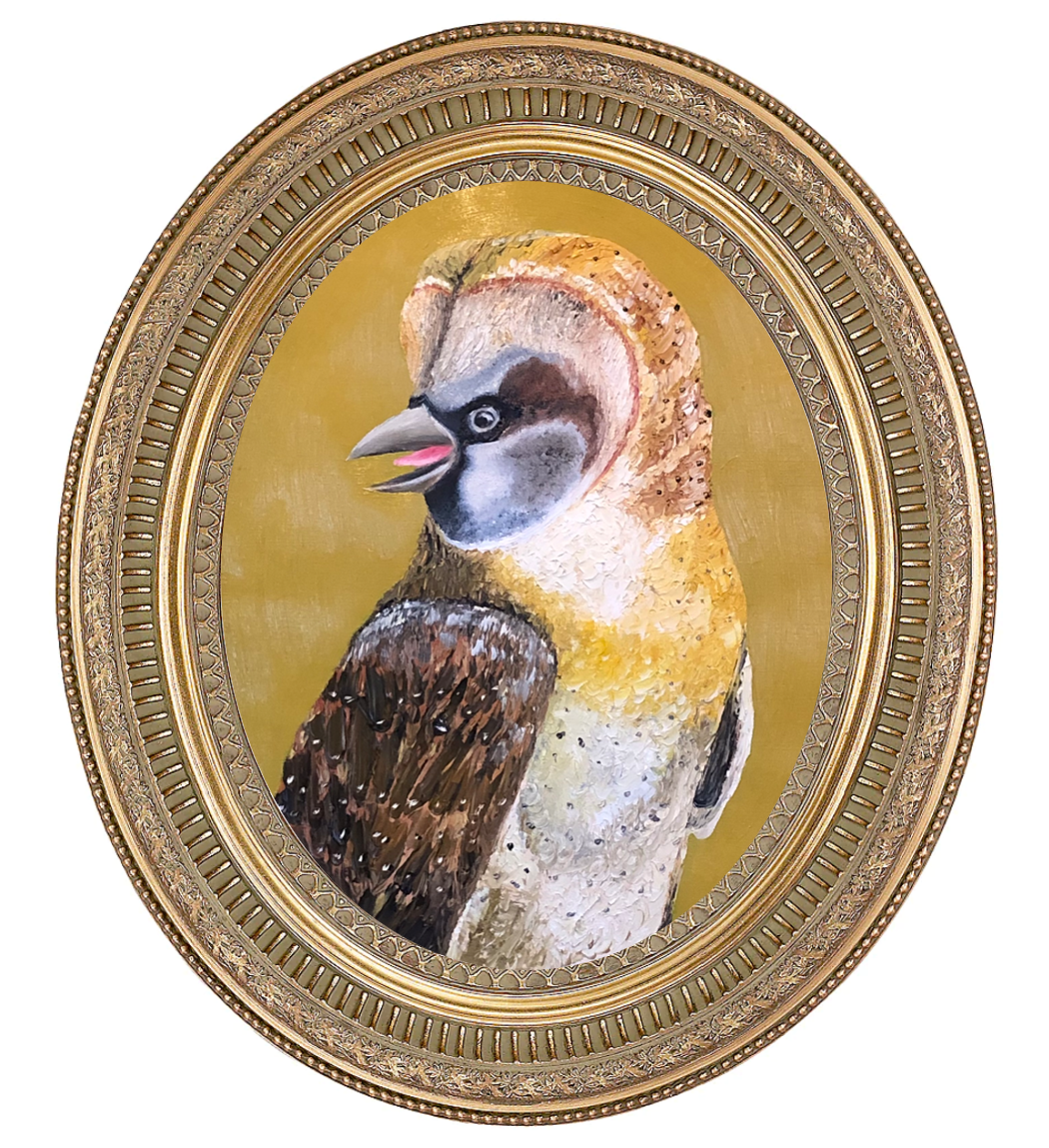
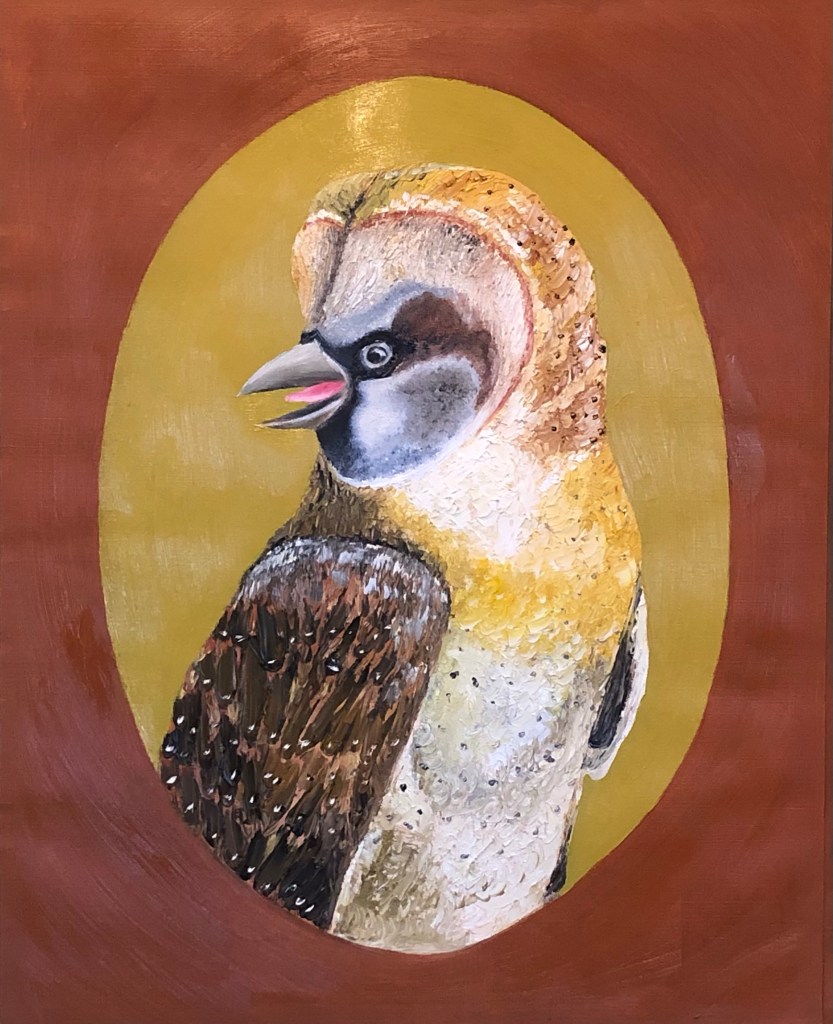
Self-Portrait #3: The Owl-sparrow

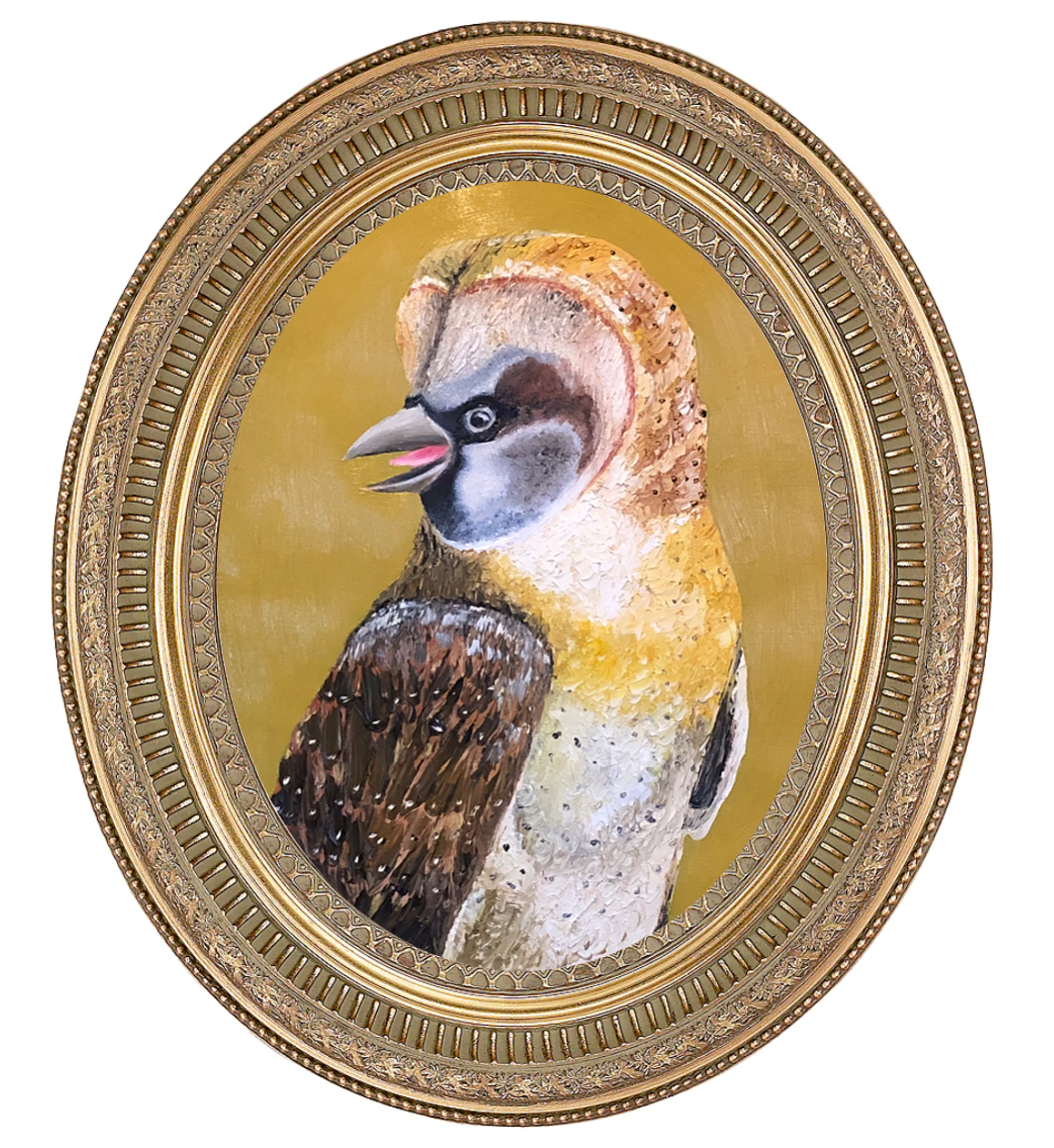
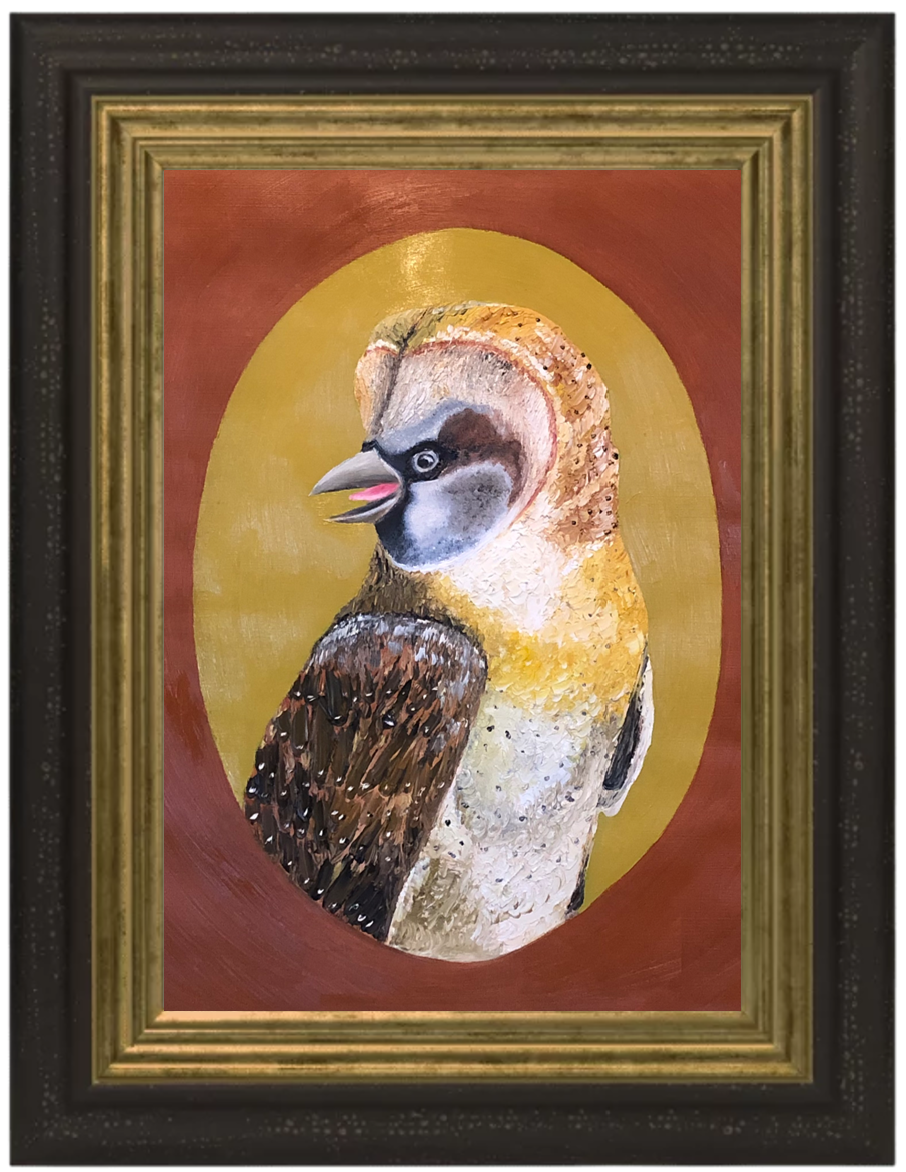
Finished painting simulated with frame:

Finished painting, unframed – oil on paper, size 51×41 cm

METHOD

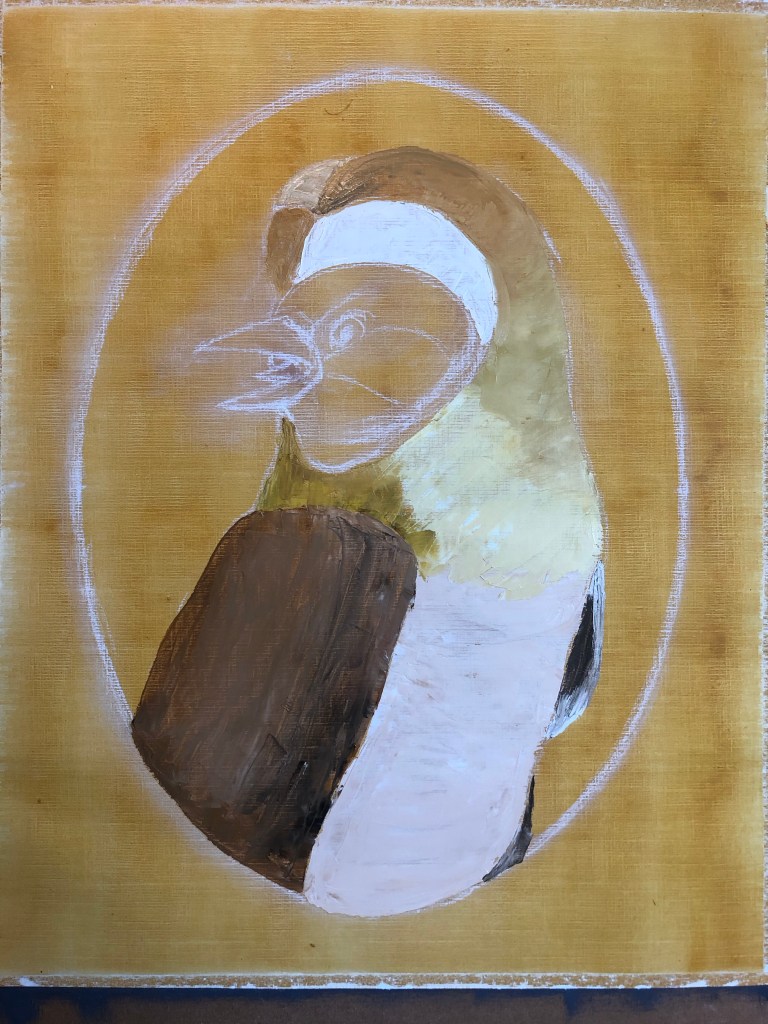
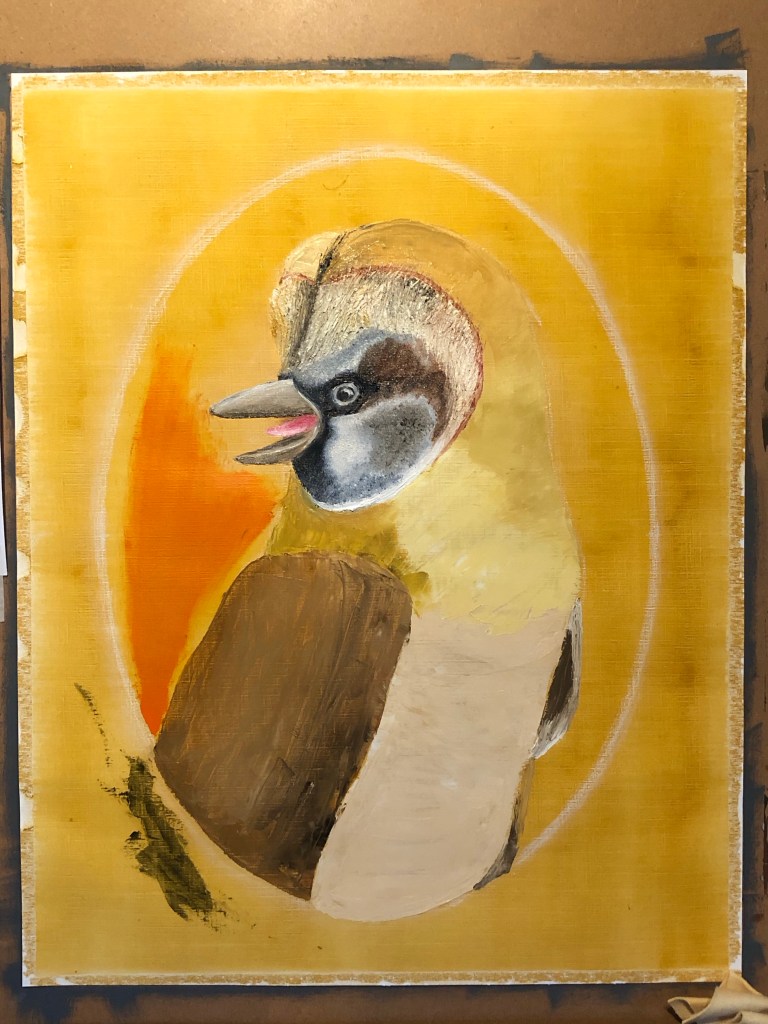
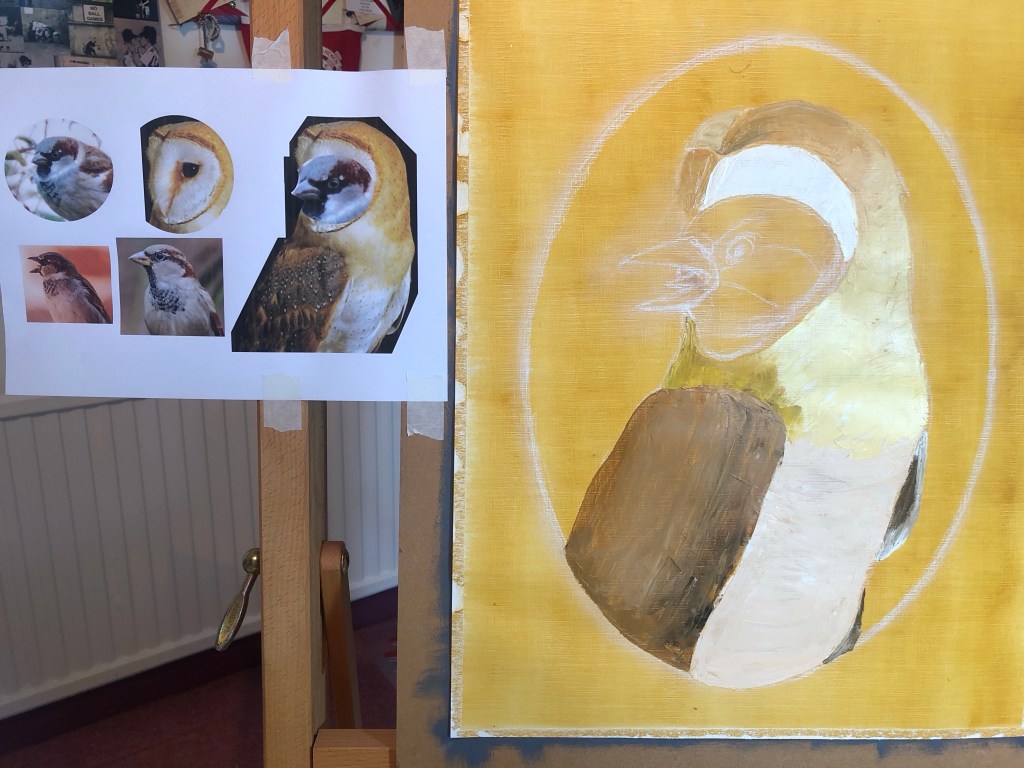
This is the third painting of this kind that I have done so I am working with a familiar process. Firstly, I consider the creatures that metaphorically represent the two sides of my conflicting feelings. Then I research images of the chosen creatures online – I usually have in mind the posture that I want for the painting which helps to narrow down the images that I choose. I then use paper cutting as a way to combine the creatures so that the image overall makes sense anatomically. Then I chalk the outline and block in the colours in oil. At this stage, I also decide on the finer details of the facial features, e.g. mouth open or closed etc..

As I paint, I start to consider the background colours:

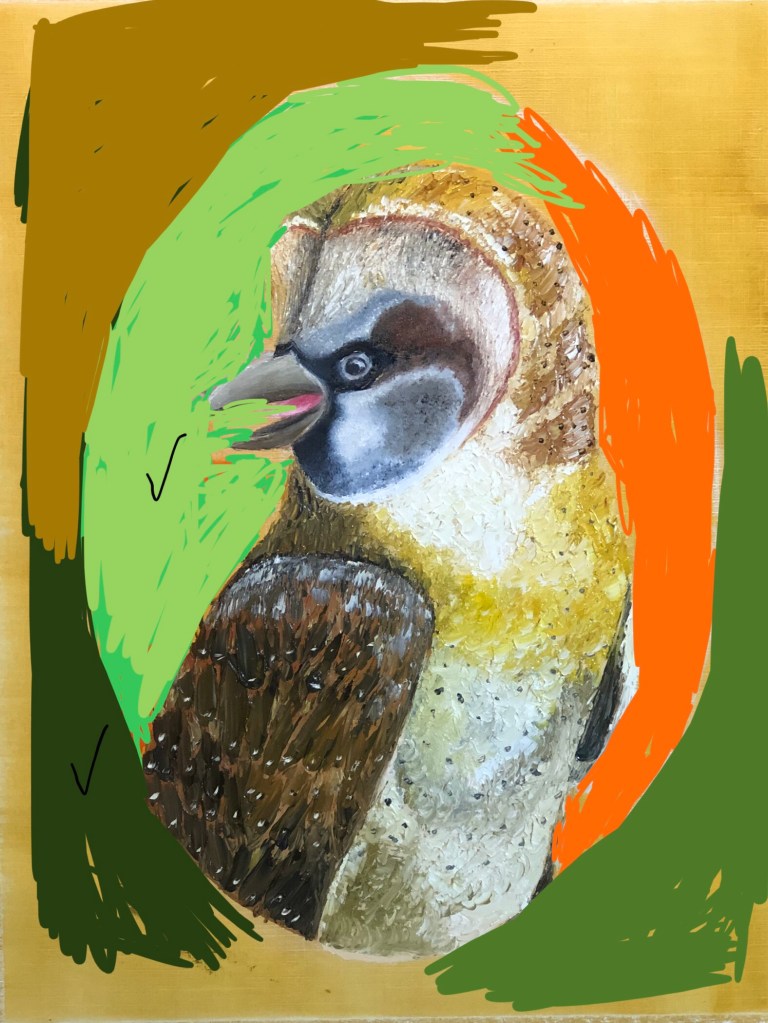
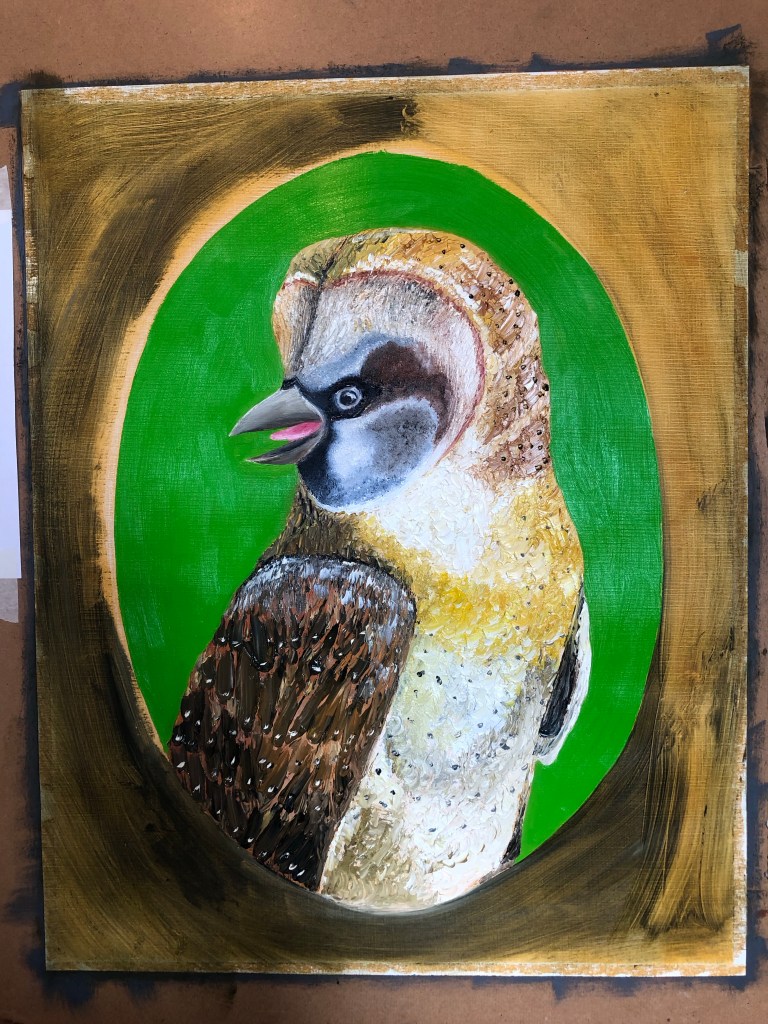
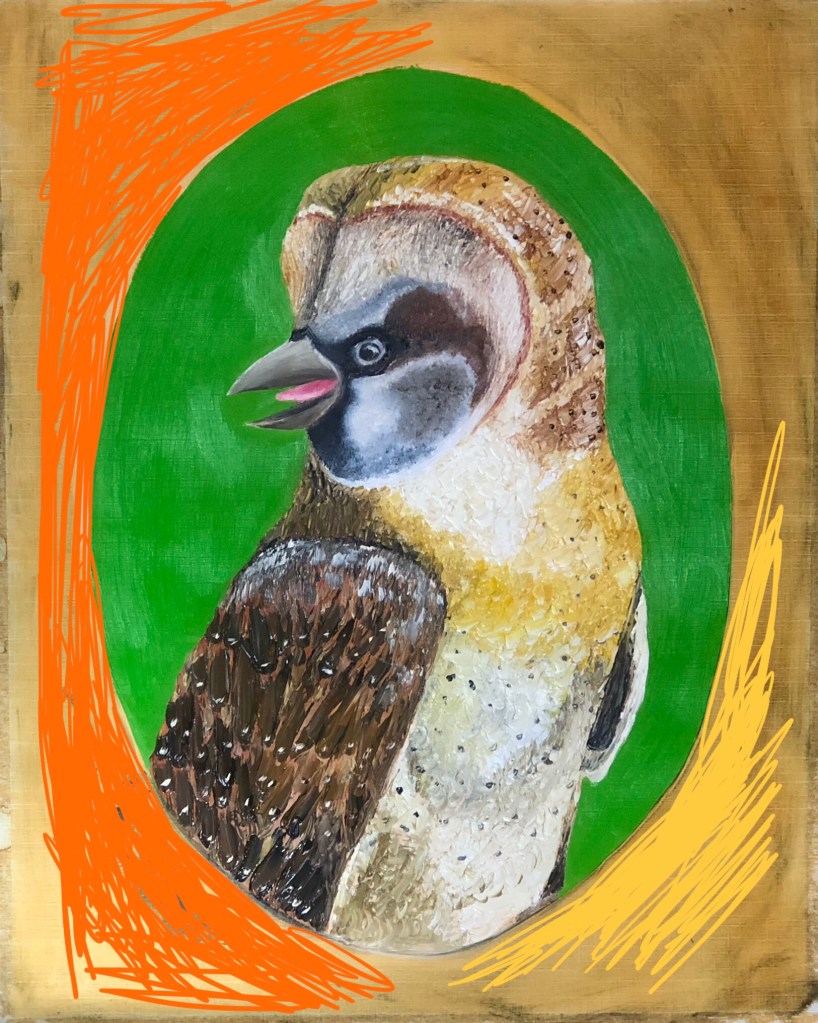
Recently, I have started using my iPhone to colour in the background so I can easily make changes and experiment. In this case, I chose a light green for the oval background and a darker green for the mount.

Once the creature was complete, the background was painted.

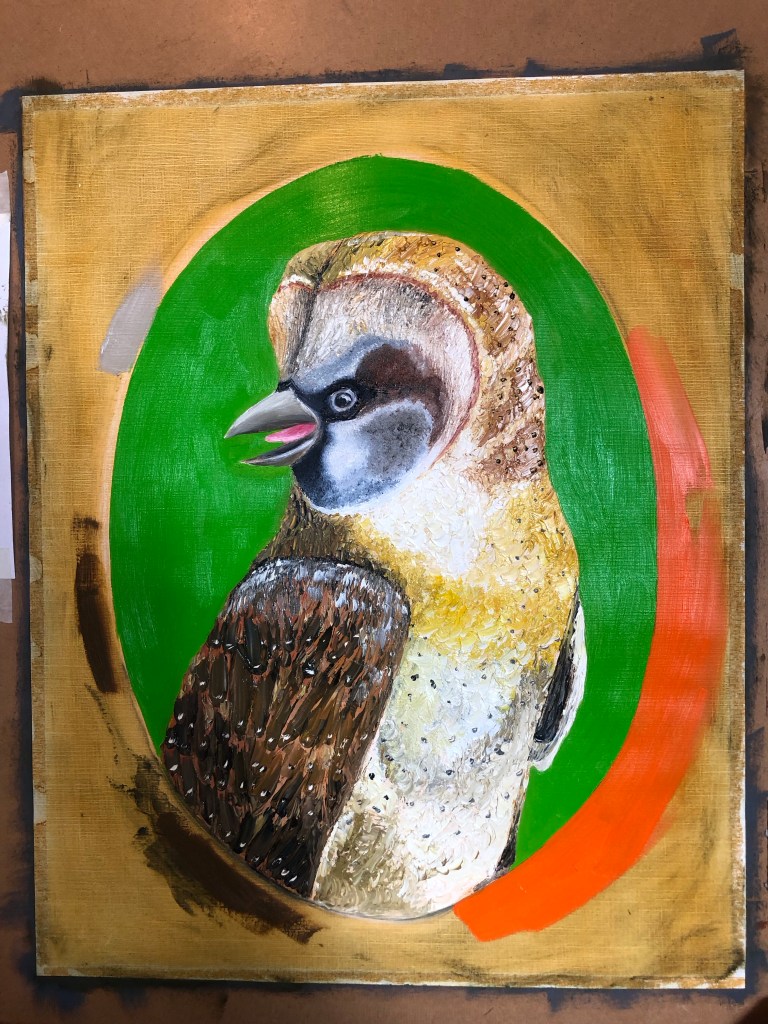
I was not happy with the mount colour above, hence I returned to my iPhone to try out other colours:

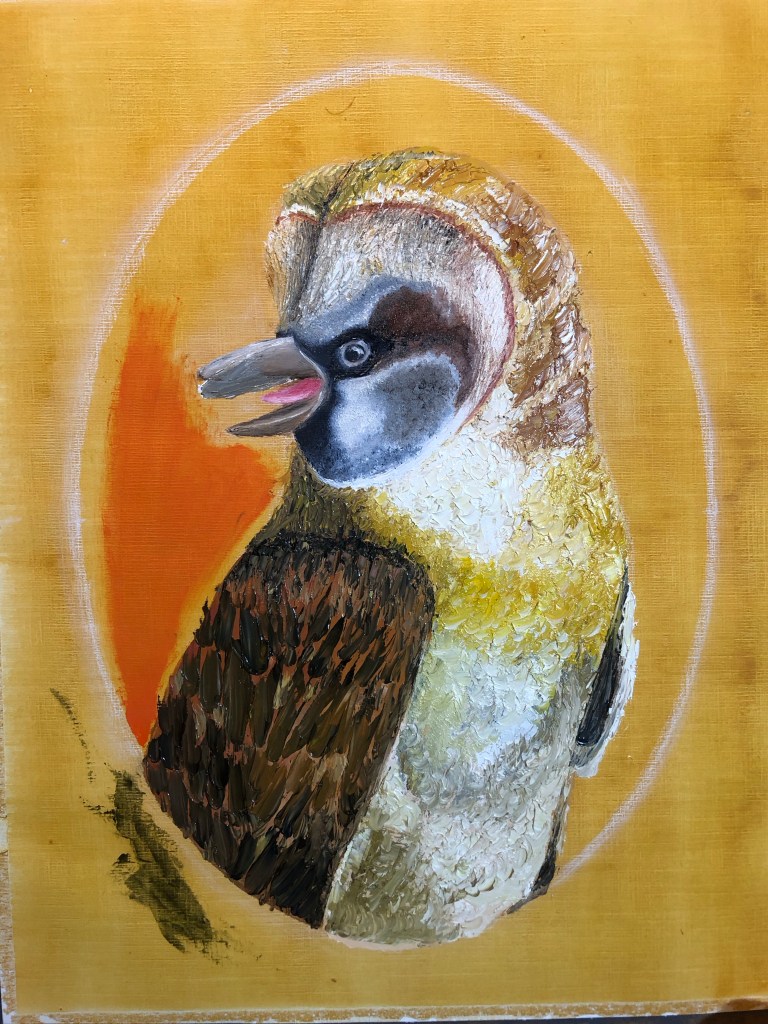
Having chosen orange on the iPhone simulation, I did not like the effect when I started painting the mount because I felt the natural colours of the bird and the bright background were not well harmonised.

In the end, I settled for raw sienna for the mount which I was satisfied with. However, I was not happy with the green background because the brightness over dominated the bird.

I changed the bright green background to a light sage colour and below was the final outcome.

Different picture frames were tried with the image to give it a finished portrait look:

REFLECTIONS

The idea for this portrait came about as a result of a question that I was asked during the first ‘accountability 3’ session. I was asked what I thought of HK nowadays. I always feel a sense of awkwardness and my pulse quickens when I am asked to comment about HK. This has been the case for many years since the early 1990s when it was clear that HK would be handed over in 1997. Since I’m from HK, I believe there is an expectation that I would say something insightful. However, to be truthful, I never know what to say because I left HK in 1980 and have not lived there since. Although I have been back for the occasional holiday once every few years, I did not and do not feel in any way qualified to make any sensible comments. I do not like expressing opinions without facts that I can trust. All the information about the HK situation that I know would have come from the media which I believe to be biased as all press from all sides tend to be. I don’t have means of getting up-to-date first hand experience there which makes me feel helpless. As a result, there is a void of knowledge that I subconsciously didn’t want to acknowledge because acknowledging that would mean acknowledging the distance between me and my heritage. Perhaps there is also the ‘insider or outsider’ feeling. Many years ago, when I was asked the HK question, I had given the answer ‘I don’t know what will happen in Bristol tomorrow, why would I know what will happen to HK in x years’ time?’ I know that reply was not so friendly. I guess I was tired of waffling again and again to sound knowledgeable whilst feeling like an outsider from all sides.

I had never given this matter much thought until I was asked about HK recently during the ‘accountability 3’ discussion. It prompted me to reflect deeper why I always felt awkward with those types of questions. I wanted to do a painting to capture those thoughts and use the making process to help explore my feelings.

So I did another self-portrait. I painted an owl with the face of a sparrow. The owl symbolises wisdom and knowledge meaning that my appearance makes people think I should have insight, but when I speak, I can only be a sparrow. I use a sparrow as a metaphor for me as a child because when I was growing up in HK, I remember always seeing small tree sparrows on the balcony of my parents’ apartment. Hence I use that to represent me as a child.

I did the painting over three days and I was able to explore the above thoughts to gain some personal insight.

LEARNING

It has been a useful reflection process.

<<To be completed>>

NEXT STEPS

<<To be completed>>

Previous Self-portraits:

Chinese Painting: Rooster

Background

I have been learning Chinese brush painting for nearly two years. I started this learning after I was given some of my late mother’s paint brushes and other items from her studio. She came to art late in her life and was an accomplished artist in Chinese painting with solo exhibitions as well as her own students before she died 20 years ago.

It is not my aim to specialise in Chinese painting, but I would like to learn this genre of art as part of my overall practice. I am currently exploring my identify and heritage through my art practice. I have been experimenting with a multimedia layering process with found and painted images that reflect my transcultural lived experience. I want to be competent in Chinese brush painting and calligraphy to the extent where I can confidently incorporate painted Chinese brushstrokes into my multimedia work.

I plan to start blogging about my Chinese art work so that I can use this process to reflect and improve. Also to capture any thoughts on my identity and heritage discovery along the way.

ROOSTER

METHOD

The latest topic in my Chinese art class is feathered creatures, starting with the rooster and chickens.

In Chinese culture, the rooster symbolises a range of meaning from punctuality to prosperity. It is also the tenth animal in the Chinese zodiac system.

Below are two of my latest paintings.

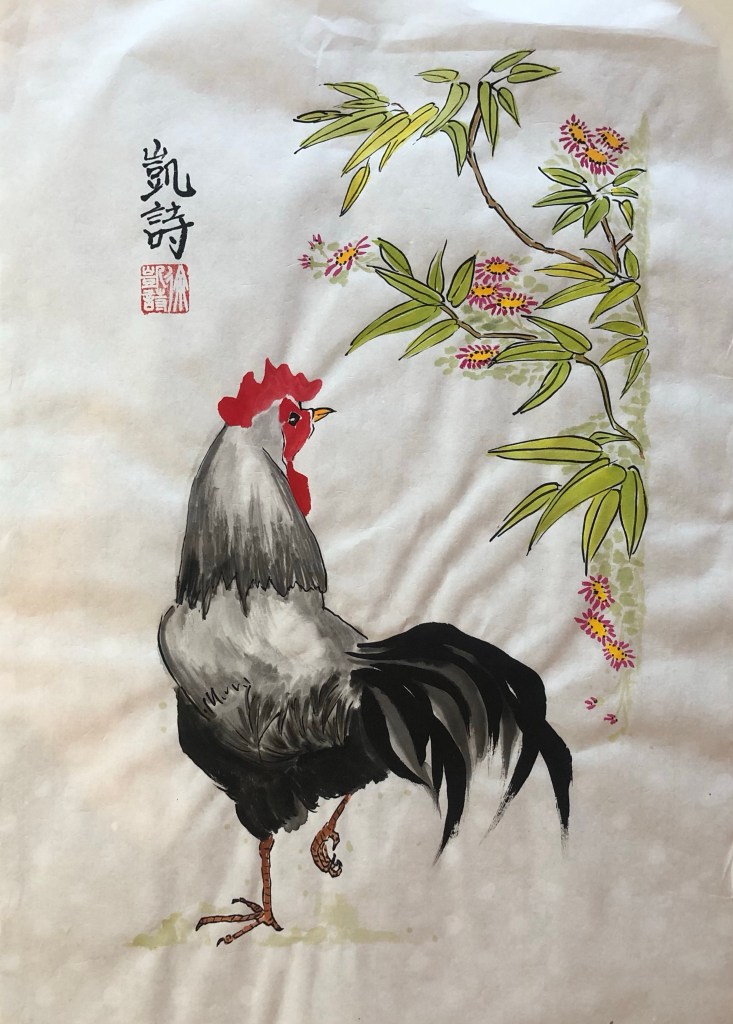
1. Own composition

It has taken me some time to start doing my own composition from scratch. Up to now, I have been mostly copying from worksheets or other artists’ paintings as part of the learning process.

In this composition, the rooster is the host and the plant is the guest. Hence the dominance of the rooster in terms of size and positioning.

The rooster is painted in mostly freestyle. In particular, I wanted to show the energy and character in its tail which I feel is the most flamboyant part of its anatomy. It is also the most difficult to get right; if the tail looks limp then the whole bird lacks energy. Hence it is the key challenge for me.

Finished work – Chinese ink on Xuan paper, 50 x 35 cm

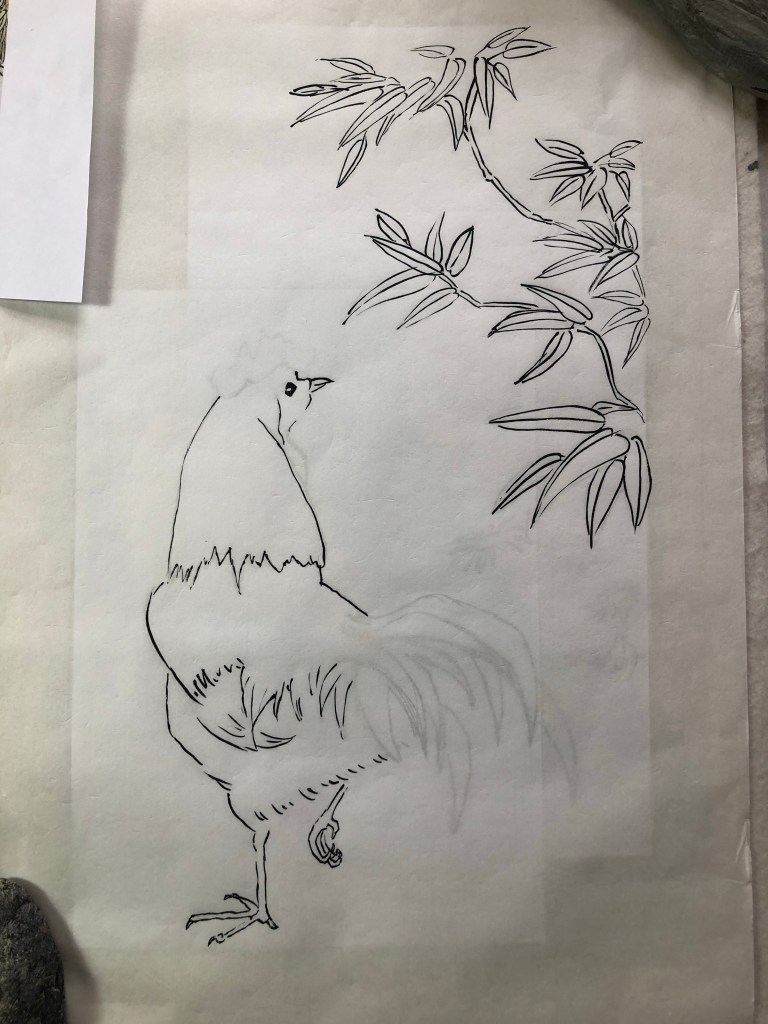
One technique that I learnt is to do a preliminary pencil sketch of the composition on paper, then lay the Xuen paper (thin rice paper for Chinese painting) on top as shown below.

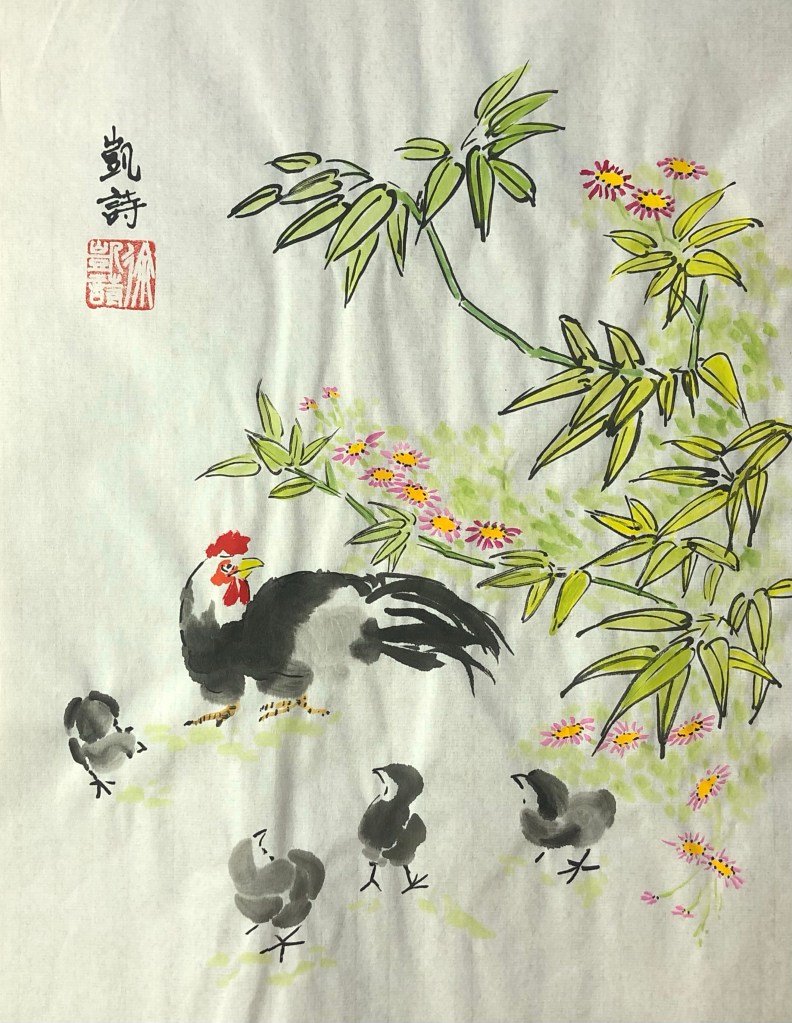
2. Copied composition – Rooster and chicks (Size 34.5 x 26.5cm)

REFLECTIONS

Despite learning Chinese painting for nearly two years, I have not written any blogs about my work in this area. I think it was because I wasn’t sure what learning I would get out of reflecting on this part of my work. On the surface, Chinese painting seemed illustrative to me, however, as I learnt more about it, the more I realised how complex it is. I am particularly interested in freestyle rather than meticulous style because freestyle is as it implies – I feel it gives me more freedom to express hence I can engage with it more on a physical and emotional level. However, I find freestyle painting totally unforgiving compared to the other painting media that I am used to (e.g. oil or acrylic). Meaning that with freestyle Chinese painting, often one small mistake could ruin the whole piece, hence I am rather excited by the challenge and the tension that I feel during the painting process.

I have enjoyed doing my own composition with the larger rooster painting here, it felt like a rites of passage as it was my first ‘own composition’ piece in Chinese brush painting. I was pleased with how the tail worked out in the large rooster but felt that the proportion between the rooster and the shrub didn’t seem right with the rooster being disproportionately large. So this is something to bear in mind.

Reflecting on this part of my practice, I feel that I have been keeping my Chinese painting practice quite separate from my main practice, partly because I felt I was at too early a stage in my learning here. I have not fully resolved how to handle the disparity between my levels of confidence in the two different styles (Chinese brush painting vs oil or acrylic painting) – perhaps I can incorporate limited elements or symbols in Chinese brush style within my main paintings as inspired by Fiona Rae, where individual symbols don’t have to make sense but collectively they can represent something. As I become more confident in Chinese brush painting, I want to then incorporate that on a larger scale into my practice to explore my transcultural narrative.

LEARNING

Aside from the practical learning such as the proportioning between the host (rooster) and the guest (shrub), writing this blog and reflecting here has highlighted how I have not been giving sufficient prominence to this part of my practice in my thinking or blogging. Doing this blog was a first step in properly bringing it into my main practice. As for resolving the disparities in confidence, the reflections here have provided ideas in using symbols as a start to create intrigue and possible tension on the canvas to prompt questions. This will be a good practical start.

NEXT STEPS

Continue to regularly blog about my Chinese painting work to prompt reflections and learning. Also to experiment with incorporating Chinese brush painting symbols into my main paintings as a way to explore my narrative through my practice.

MA Y1 U1: Exercise – drawing out of comfort zone

Background

We were asked to take a risk this week in our making. I thought a lot about what to do but couldn’t come up with anything. Then I attended a CSM online lecture on ‘Thinking through drawing’ which gave me the idea of doing a drawing in a way that is outside of my comfort zone. I haven’t done any drawing for a while so this is a good opportunity to rekindle with drawing.

METHOD

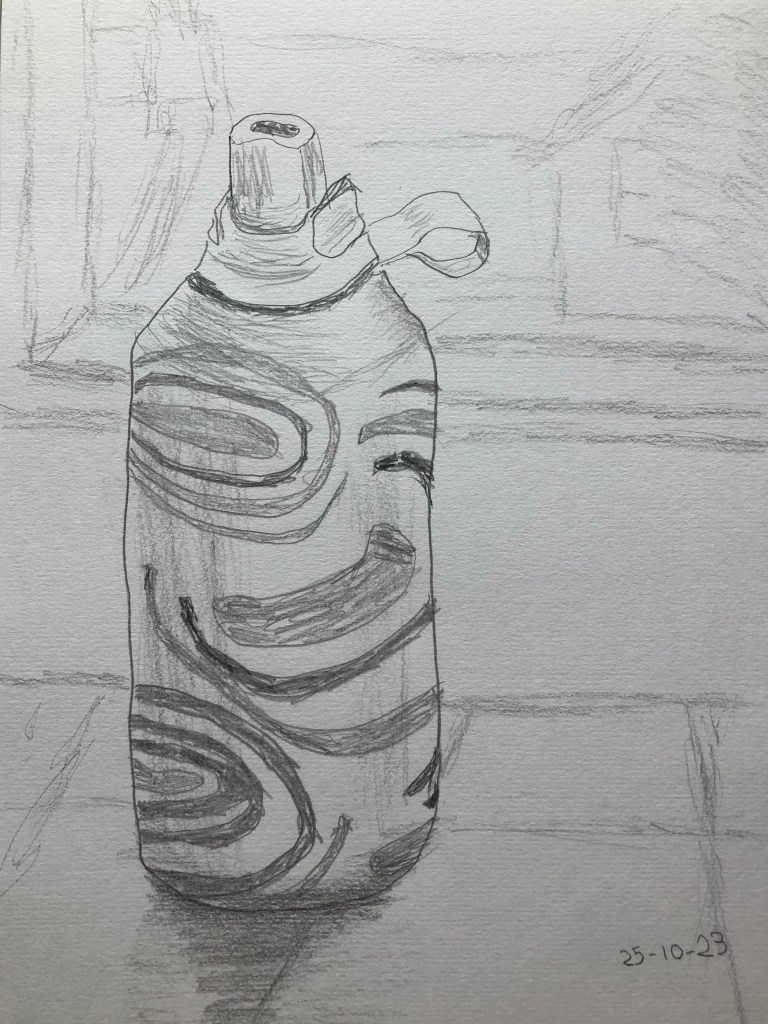
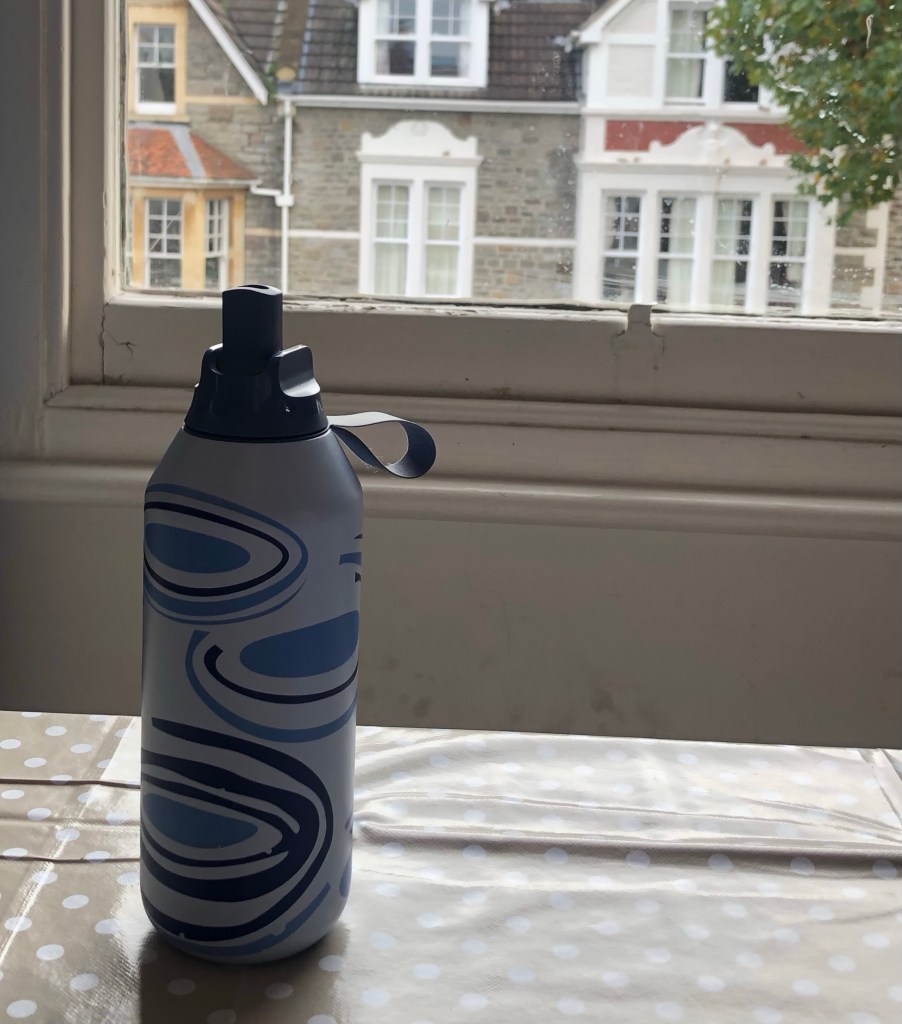
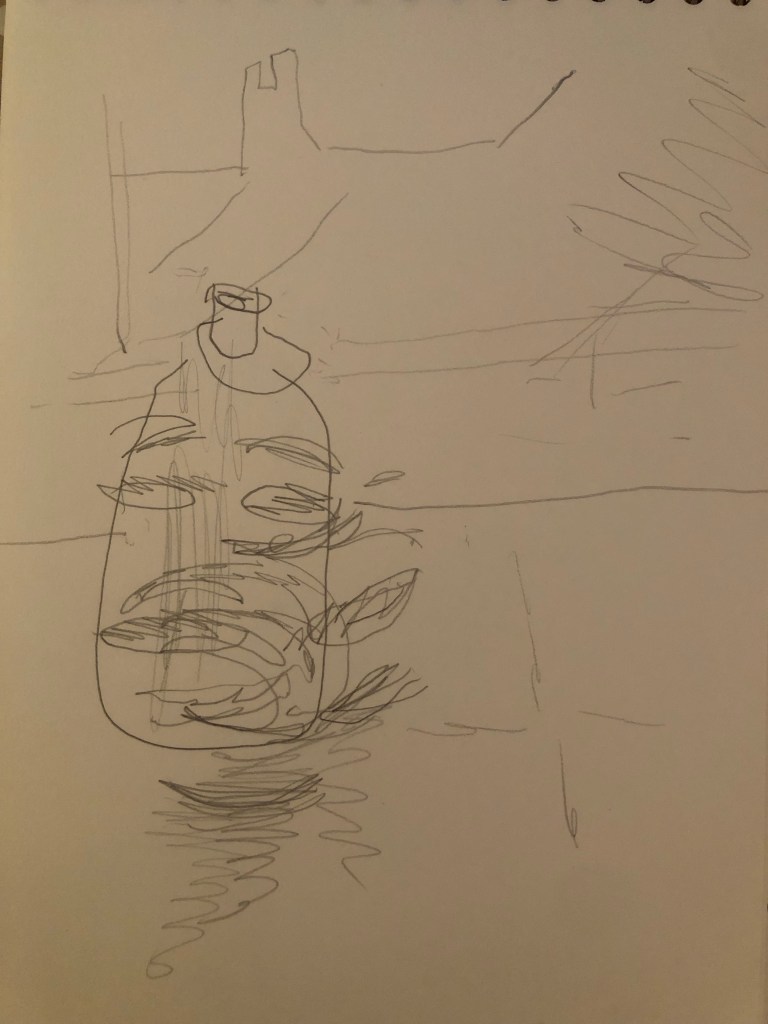
When drawing, I often obsess too much about getting it right and for this exercise, I want to rekindle with drawing but not to focus on getting it right. Hence I drew with my non dominant hand (left hand). I didn’t want to overthink or overplan so I just used the subject in front of me – my water bottle.

Drawing with non dominant (left) hand

REFLECTIONS

I haven’t done any still life drawing for a few years and I have never done one with my left hand so this was a new experience. I found I gripped the pencil very hard because it was difficult to control. The process of seeing, processing then translating into motion was more intense and much more deliberate than normal as is evidenced in the hard outline of the bottle. The outcome turned out better than I expected. However, what did I really learn? All I have done here was to try to replicate what I normally do with some struggle, rather than use the opportunity to discover something new.

METHOD (Part 2)

After feeling that I didn’t get too much out of the exercise, I did a second drawing. This time with my left hand again but my eyes closed. I.e. it was done from memory.

Drawn with non dominant (left) and eyes closed

REFLECTIONS (Part 2)

The second drawing was a lot quicker than the first, took around 1/10 of the time. This is because I was trying too hard to process the ‘getting it right’ part in the first drawing. Whereas in the second drawing, I knew I wouldn’t get it right hence I was more liberated in just making marks. For me, the mark making in the second drawing was more confident where the first was hesitant. I like the second drawing and found it more interesting as an image.

LEARNING

I have been round this circle before where my mark making or brush strokes are more free and confident when I am not overthinking. This is not a new learning but yet another reminder of what I need to do. My last few pieces of work have been more detail oriented and I didn’t feel I could let-loose and be more liberated. I believe that to progress onto making more confident work, I need to find my equivalent of left-handed and eyes-closed in my making.

Next Steps

Do a painting that doesn’t matter to avoid overthinking. Try left handed and/or eyes closed for at least part of it, or to start with to get the composition going, then respond to it.

MA Y1: Research – The Location of Culture by H Bhabha

Background

This blog captures my notes and reflections as I read this book. I found much resonance in Bhabha’s text and I hope this blog will be a treasure trove of inspiration for me to make work through exploring my Third Space.

This is an ongoing blog that I plan to update as I go along as I expect to take time digesting the text and is likely to involve much re-reading over time.

Notes and reflections:

Introduction refers to novels by VS Naipaul drawing out essence to position Bhabha’s notion of ‘vernacular cosmopolitanism’ which asserts measuring global progress from the minority perspective.

The right to difference in equality.

A dual economy is not a developed economy.

‘Symbolic citizenship’ (Avishai Margalit) – surveillance culture of security… how do we tell the good migrant from the bad migrant? Which cultures are safe and unsafe?

Minority affiliations or solidarities arise in response to the failures and limits of democratic representation, creating new modes of agency, new strategies of recognition.

Poem by Adrienne Rich – An Atlas of the Difficult World (1991) has powerful images. To do: research for images

Adrienne Rich struggles to find ways to establish narrative of what lies in-between the distinct moments that allows the characters to become affiliated in the spirit of ‘right to difference in equality’.

Rich places herself at the intersections of these narratives as a cultural re-visioning of a particular history ‘of one’s own’.

No name is yours until you speak it. Your personhood cannot be denied.

The borderline engagement of cultural differences may as often be consensual as conflictual. They have confound our definitions of tradition and modernity. Realign the customers boundaries between the private and the public.

Using architecture as a metaphor with stairwell connecting rooms – this interstitial passage between fixed identifications opens up the possibility of a cultural hybridity that entertains differences without an assumed or imposed hierarchy.

Useful links on Homi Bhabha’s work

Short lecture on Bhabha’s work:

Someone reviewing the book:

1.5 hours long lecture by Bhabha:

In-betweenness by Dr. Masood Raja

Chad A Haag review series on whole book:

Update 14th Dec 2023

At the Unit 1 tutorial, I was introduced to a note taking tool called Obsidian. It is based on the Zettelkasten method of note taking. I have since started using Obsidian and I have found it to be very useful and powerful. It will be very helpful for me because I was starting to struggle with just capturing my notes and thoughts on a list here. I needed to structure my thoughts and the data in a better way. So from now on, I will capture my notes on The Location of Culture in Obsidian instead of listing them in this blog.

Example of the graph view of notes so far taken with Obsidian:

I have also watched all five of the Chad A Haag study notes videos on YouTube – they are excellent and have helped me to quickly get a sense of the ideas by Homi K Bhabha. It is a book that requires time to study and digest. I will continue to read the book and will really take my time to understand it because it forms the foundation of my research in my art practice.

MA Y1 U1: Research – Investigation of techniques for digital printing on canvas

Background

In my style development work, I developed a transcultural layering process where I combined multiple layers of images (both found and painted) that are relevant to my lived experiences to form an overall painting. Thus far, my process has been:

1. Creating digital collages of found images (manipulated and processed using Adobe Express).

2. Inkjet printing the digital collage onto paper (A1 size used so far).

3. Using dispersion liquid to transfer from the printed A1 poster onto a fabric canvas (I have experimented with satin and woven cotton canvas).

4. Painting on top of the imprinted fabric canvas.

All the layered images, printed or painted, are related to my lived experience as a transcultural person. Hence I called this part of my practice Transcultural Layering.

The process described here has been developed in my home studio where the facilities are limited. Hence dispersion liquid is used because it is a process that I can manage myself. The disadvantage of using dispersion liquid is that it changes the material canvas, creating a layer like dried PVA glue. This is useable with the more robust paint media such as acrylic or oil. However, for more delicate media such as Chinese ink brush painting on satin, the lack of absorbency of the glue-like canvas means the brush strokes do not work as intended. To overcome this, I had to do the Chinese brush painting first then transfer the image onto the reverse side of the satin canvas. This makes the process unnecessarily complicated and I was unable to fulfil my desire to paint the top layer in response to the printed base image.

Project description

I want to investigate what facilities are available at CSM to solve my challenge of digital printing on canvas. Once I have established what’s available, I will visit campus to do some experiments and assess the outcomes to build a catalogue of processes, techniques and materials that I can choose from for future work.

Part 1 – Investigate digital printing facilities at CSM

Experiencing – What I did

To solve my challenge to print on canvas, I want to make use of the facilities and expertise available at CSM to help me explore better ways to do the digital image transfer onto canvas. Also to explore other canvas materials. To this end, I emailed the digital printing lab to ask what facilities are available that are accessible for me and I was absolutely delighted to receive the following info.

“We have a UV printer that can print onto pretty much anything including fabric, max printable area is 77x33cm. You could tile an image onto a larger piece of fabric if you are not worried about the alignment of the tiles being perfect, ie an overlap or gap.

We also have a large format solvent printer that can print onto canvas up to about 450gsm. We stock a polycotton canvas (printable widths of 1.3m and .85m) and people have printed on their own coated and uncoated canvas. With uncoated canvas the ink tends to bleed into the fabric giving a blurred image.
Both of the above use solvent inks that have a sheen to them in dark colours they are not a matt finish.

We also have an archival inkjet canvas printable width 1.1m, matt finish.
All of them should be ok with acrylic or oil paint, ink might only work on the inkjet.”

Further info pricing, file formats etc can be accessed from the moodle link below

Course: CSM Technical Moodle, Section: Digital Print (arts.ac.uk)

Digital Print Location: B301

Opening hours

  • Digital Print
    Mon to Thurs: 10:30 – 12:30 | 14:00 – 17:00 Fri: 10:30 – 13:00
  • Riso
    Tue & Thu: 10:30 – 12:30 only

Reflecting – How I feel

I am so thrilled! The reply was beyond my expectation. Not only is my challenge solved, I have many options to choose from! The experience also reassured me of how easy it is to ask for help at CSM – this is important for me because I am new to the university and am still trying to find my way around. I have since researched into other facilities at CSM and I want to make the most of my access to them for my practice.

Thinking – What I learned

Be optimistic, the outcome is often better than expected and never hesitate to ask.

Also, I feel very privileged to have access to all the facilities and I am keen to not waste the opportunities like I would have done in my younger student days!

Acting – What to do next

In order to build a catalogue of canvas printing options, I will do one or more prints from each of the different printers and then assess the outcomes to determine their suitability for the kind of work that I make.

As for making use of the other facilities, I don’t have a plan yet but will open my mind when planning my work to include the facilities available in my thinking.

Part 2 – Printing experiments at CSM

Plan – Print trials to do

Obtain prices then arrange for the following prints:

1. UV Printer (max size 77x33cm)

– 1 x A3 cotton canvas

– 1 x A3 silk canvas

2. Large format solvent printer

– 1 x A3 cotton canvas

– 1 x A3 silk canvas

3. Inkjet printer

– 1 x A3 cotton canvas

– 1 x A3 silk canvas

All printers and canvases to print the same image in order to compare the outcomes.

I have decided to research and compile a new image of digital collage. I will use Adobe Express for this work.

MA Y1 – Blogs planning

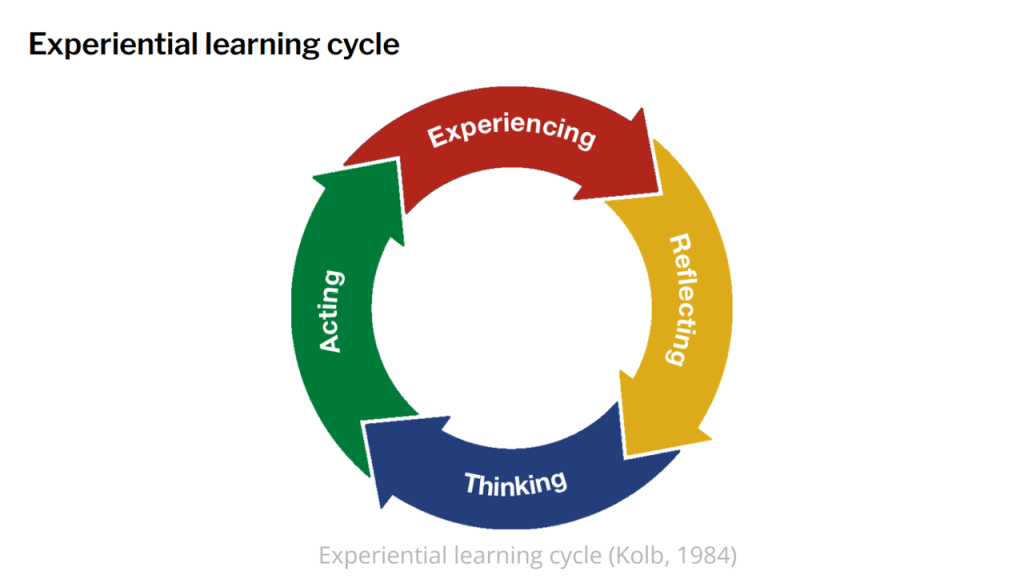
Structure of blogs – Kolb’s learning cycle

I plan to structure my blogs based on Kolb’s learning cycle. This is because I find the format helpful in guiding my thinking and learning process. The meaning of each stage is adapted with my personal interpretations to suit my practice development.

EXPERIENCING: What did I do?

– Under METHOD, I will capture my methods and decisions during the making process.

REFLECTING: How did I feel?

– Under REFLECTIONS, I will capture my feelings and thoughts throughout and after the making process. The intention is to be as broad and uninhibited as possible to include feelings about the creative process as well as any personal insight.

THINKING: What did I learn?

– Under LEARNING, I will bring the focus back to the context of my practice after being as broad as possible in my reflection. Here, I will capture my learning after analysing the insights gained in the reflecting stage.

ACTING: What will I do next?

– Under NEXT STEPS, I will capture my next actions that could be about making, research or any relevant activities in order to develop myself or my practice.

Categories

I will use WordPress for my blogs. I am planning to use the following categories to organise my blogs:

– Thoughts

– My Projects

– My Work

– My Writing

– Research

– Tutorials CSM MA FA

– Course notes CSM MA FA

Tags

I am planning the following tags for my blogs to start with. I expect to add to the list as my research deepens during the course.

– Transculturalism

– Colonialism and Postcolonialism

– Feminism

– Third Space

– Chinoiserie

– Digital Printing

– Chinese painting