This blog details my preparation for Tutorial #4 due to take place on 29th November 2024 with Jonathan Kearney.
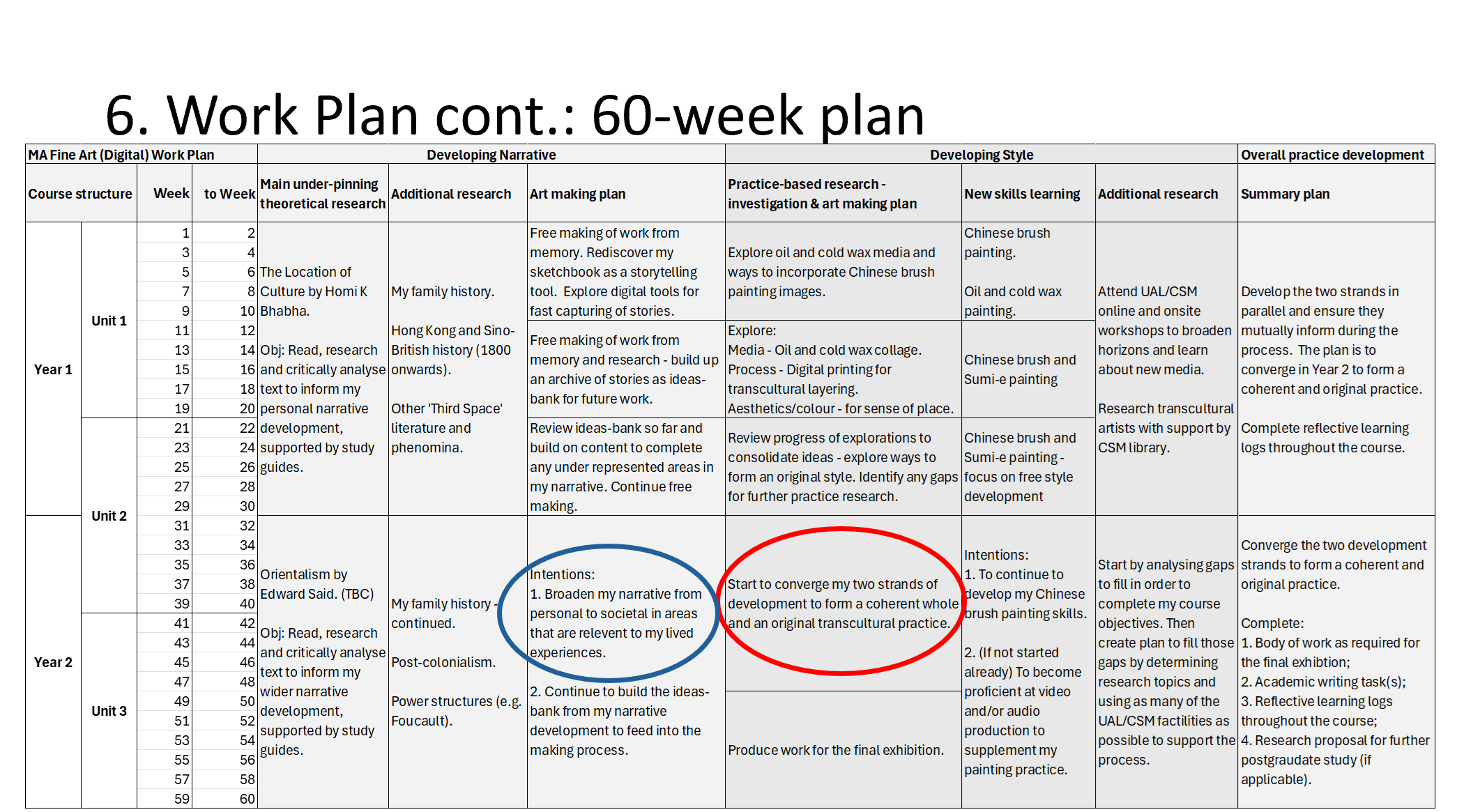
Referring to my Study Statement, I have circled two specific areas for Unit 2 on my work plan for this tutorial preparation.
For the last few months, I have been making art in parallel with writing a research paper. The progress for both are as follows.
PROGRESS (MAKING)
Since the last tutorial, I have continued to explore making Cheongsam shaped canvases for painting. I feel that this way of making could be the start of the convergence of my narrative and style development work. I was hoping that this convergence would happen sometime during Year 2 of my MA programme (as circled in red). So I am pleased that the Cheongsam paintings could be the convergence that I was looking for to take my practice forward.
Cheongsam Paintings
The following blogs detail the Cheongsam paintings that I have been working on as well as the thinking and narratives behind the work:
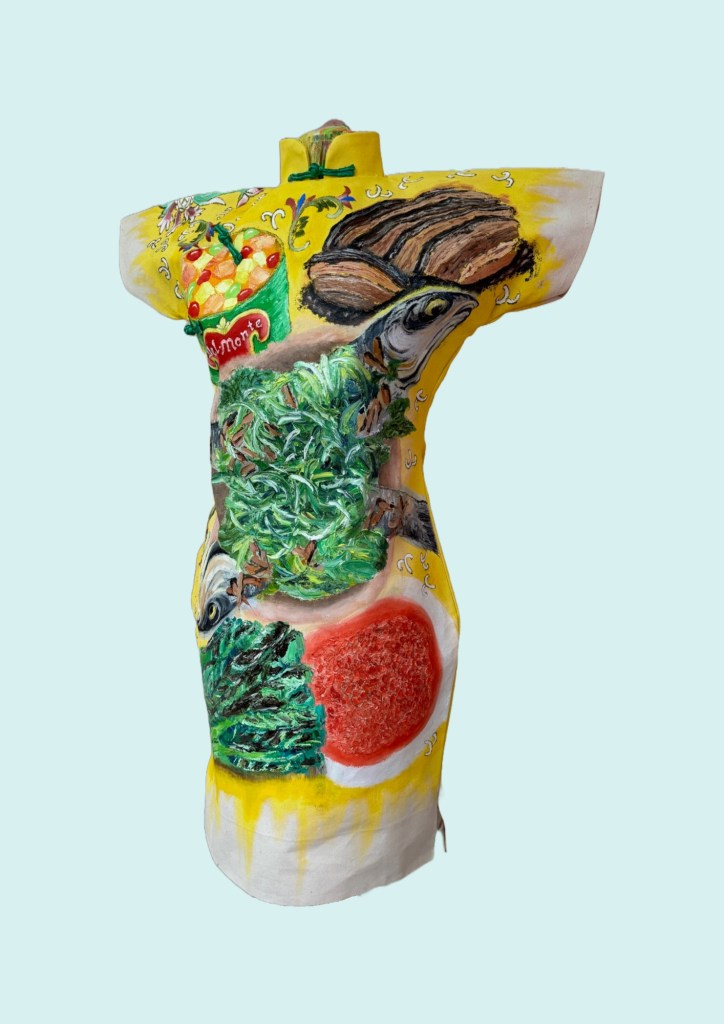
Below is my latest work which is the start of a new series of Cheongsam paintings about memories of ‘Family dinners’ from 1970s Hong Kong. The change of medium from acrylic to oil meant that I had to change the canvas material and dress design as captured below.
Book Art – I was very inspired by the Book Art workshop during the low res week in London. Here is an example of an attempt with some Suminagashi paper that I made:
Writing the research paper has given me ideas to take the context of my practice beyond just examining my personal identity. It was always my intention to find a way to go towards something broader and societal (as circled in blue on my Study Statement). Below is a blog capturing my reflections and learning from writing the research paper which is the start of this thinking process.
I would like help with the following points please – I will expand further on 2 and 3 during our tutorial:
1. Any feedback on the Cheongsam paintings and research paper (if available) would be most appreciated.
2. Ideas for the final degree show – I am considering a series of Cheongsam dresses (3D paintings), shall I include other work such as video and 2D paintings as well? I am planning ahead because the Cheongsam paintings take a long time to make.
3. Next step on my learning journey – I have done further research and would like some more advice please.
– End of prep notes –
Notes from tutorial:
Positive feedback on the research paper. We are still waiting for formal feedback from my supervisor. An area of improvement is the overuse of ‘This paper argues…’, so important to be mindful of this overuse in future writing.
Degree show ideas – we discussed making more Cheongsam paintings about childhood dinners because I still have many ideas or dishes still to do. So I will continue with that series. However, I should not limit myself to just Cheongsam paintings and I will explore the other aspects of my practice. E.g. review the Steamed McDonalds video that I have made but not edited yet. I will review and edit to see if it would be a good piece of work to complement the Cheongsam dinner paintings.
We discussed the ‘fair use’ policy of using music soundtracks in my video. It is fine to use in an educational setting for a student video as I am not planning to profit from it. As for using sound – always be careful to make it relevant to the content and context.
We discussed the next steps of my development regarding options after the MA course. The discussion was very helpful and I have some actions to investigation options.
By analysing the work of Njideka Akunyili Crosby and Fiona Rae this paper will argue that transcultural art can enhance understanding of the human experience amid unprecedented levels of migration and displacement.
I have enjoyed working on the research paper because it gave me the opportunity to analyse the work of two of my favourite transcultural artists. I like studying other transcultural artists’ work because I usually find resonance and they help to inform my practice.
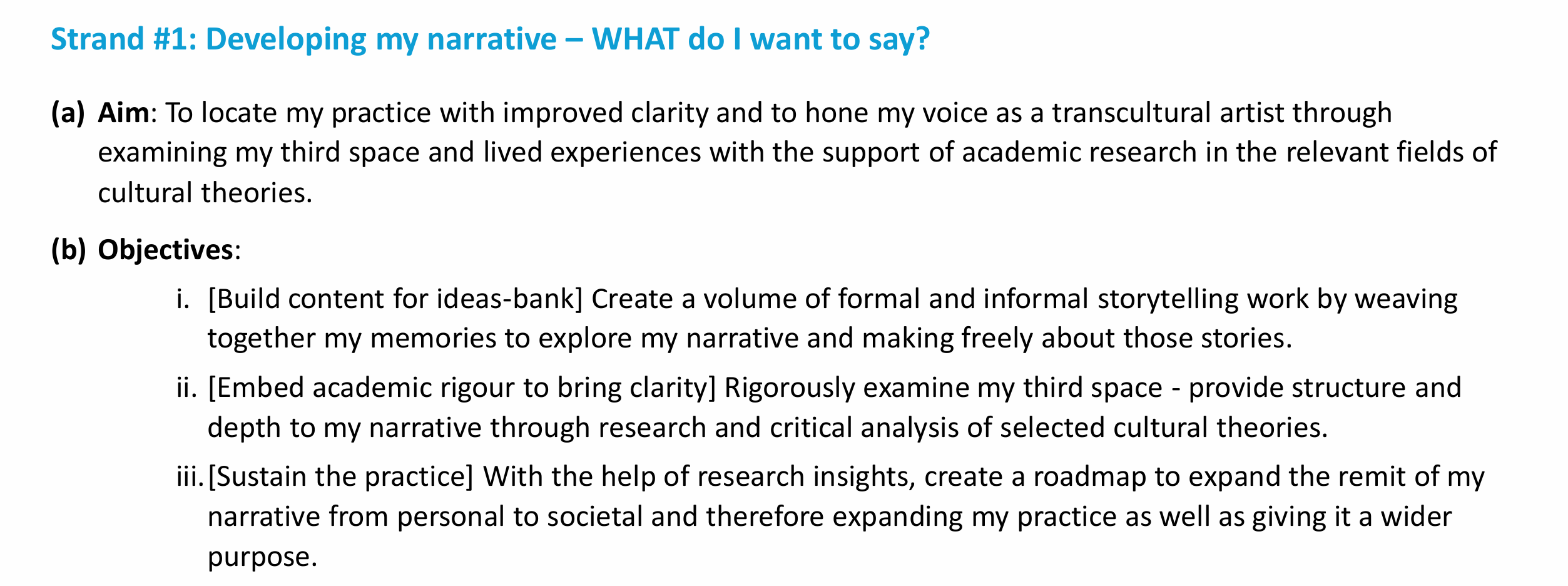
Below is an extract from my MA Study Statement where I detailed my objectives for my narrative development work.
I believe doing the research paper has helped me to address Objectives ii and iii and the reasons will be explained within this blog. This blog captures my thinking, questions and reflections along the journey of writing the research paper with a learning summary at the end.
REFLECTIONS
As stated in Objective ii, I want to use research and academic rigour to bring clarity to my thinking in examining my narrative which is based on the idea of The Third Space.
The Third Space
I first found out about Homi K Bhabha’s notion of the Third Space three years ago when I watched a lecture by the artist Njideka Akunyili Crosby (link included later in the text). In the lecture, Akunyili Crosby explained Bhabha’s Third Space and directly located her art practice within her Third Space. I found such strong resonance with her explanation and her work that I started to research Bhabha’s work, especially his book The Location of Culture:
Bhabha, H. (1994) The Location of Culture. London: Routledge
Bhabha uses concepts such as mimicry, interstice and hybridity in the book and his work was deeply rooted in colonial and postcolonial theories. I found his work very useful in helping me to unpack some of my personal experiences, growing up in colonial Hong Kong, then migrating to the UK in 1980 and now living as a British Chinese. Understanding his work has helped me in the sense-making of parts of my transcultural journey and I have been expressing some of my insights in my identity-based art practice.
So I was excited to approach my research paper using Bhabha’s work as the theoretical foundation to analyse the artistic expressions of the two chosen transcultural artists to examine how the notion of the ‘Third Space’ had influenced transcultural artists. However, my supervisor (rightly) challenged me on why I chose Bhabha’s thirty year old theory and if it was still relevant today.
To justify the use of Bhabha’s theory was a good challenge. For me, Bhabha’s theory was personal, it helped me to unpack issues that have puzzled or troubled me from my childhood in colonial Hong Kong as well as living as a migrant in the UK. So for me, Bhabha’s work is relevant for me today despite it being written thirty years ago. However, I knew that only putting in my personal experience in the research paper as a justification would not be sufficient or academically robust!
I started by researching texts on the meaning of ‘culture’ which helped to anchor my thoughts before proceeding onto the meaning of ‘transcultural’. I then researched more recent academic texts in transculturalism that either directly referenced Bhabha in their research, or described contemporary hybrid existence that reflected the cultural negotiations within the Third Space as asserted by Bhabha. The challenge of a limited word count meant I had to select the most relevant works to focus on for this paper. Examples of texts that I used to justify using Bhabha’s work are as follows along with the lecture by Akunyili Crosby where she located her practice within the Third Space. I felt the latter was the most powerful example of Bhabha’s contemporary relevance:
Iyall Smith, K.E. and Leavy, P. (eds) (2009) Hybrid identities: theoretical and empirical examinations. Chicago, IL: Haymarket Books (Studies in critical social sciences book series)
Grunitzky, C (2004) Transculturalism: how the world is coming together. New York: TRUE Agency
My supervisor also suggested that I should extend my scope of research to find relevance in my topic in the contemporary world because merely analysing artistic expressions was not enough. I should seek to ‘go deeper and richer’. This was a bigger challenge than justifying Bhabha’s text.
In my Study Statement Objective iii, I had always planned to expand my practice from personal identity to societal issues to give it a wider purpose. At the time of writing my Study Statement, I had in mind to expand towards the area of postcolonial theories because of my background and also my interest in Bhabha’s work. However, I did not feel the urge to bring postcolonialism into my research paper right now because there has been something else more pressing preying on my mind. I have been very troubled by the ongoing escalation of wars or conflicts around the world and the sheer amount of displaced people as a result. To the extent that I fear society might become immune to such news. The issues surrounding immigration have been at the top of political agendas around the world especially in countries that continue to hold power. Furthermore, closer to home for me, over 200,000 Hong Kong people have moved to the UK in the last three years as voluntary international migrants with the special visa scheme granted by the British Government. I wonder how they are managing in a country with a very different culture after uprooting from their homeland under the circumstances. So all these thoughts have been on my mind.
Then as I started to analyse the works of Akunyili Crosby and Fiona Rae who are both migrants, I was drawn to the extent of the sense-making in their work, the way they use their art to respond to and make sense of their changing environments as they migrated from one country to another. I found much resonance with their work. Bhabha’s notion of the Third Space gave me a structure to analyse and contrast their artistic expressions. It helped me to find differences and similarities. The two artists expressed their transcultural sense-making very differently but their wish or need to go through that sense-making was a common theme. It brought home to me that every migrant or displaced individual have that need to make sense of their new or changing environment and that is fundamental for survival – this was explained and verified when I researched Damasio’s texts such as:
Damasio, A. (2021) Feeling & Knowing. New York: Pantheon Books.
I proceeded to try to bridge my transcultural artists research with this very human ‘need’ that must be happening to millions of people right now around the world (281 millions in 2014 according to The International Organization of Migration).
However, a fundamental question remained – so what? So what if migrant artists share the same human experiences as other migrants? It is not exactly a grand revelation. I instinctively felt that there was something more that a transcultural artist could do than just make art, their stories are human as well as relevant and can enhance our understanding of the human conditions involved or perhaps something even more. So I continued to research hybrid identities, the role of artists, transcultural art etc. hoping to find some inspiration. A ‘lightbulb moment’ came to me from:
Petersen, A.R. (2017) Migration into art: transcultural identities and art-making in a globalised world. Manchester: Manchester university press (Rethinking art’s histories)
Petersen proposes the notion of ‘the artist as a migrant worker’ and explains that instead of cementing the myth of the artist as a detached creator, the proposed notion invites a more profound exploration of how the artist’s role can be reconfigured as that of a translator, mediator and bridge-builder between people and cultures. Petersen contends that art can be an instrument of orientation and has the ability to negotiate contradictions and complexities. Petersen uses a botanical metaphor to describe a migrant’s way of forming affiliations as ‘radicant’, planting roots along its travel like an ivy or strawberry plant, as oppose to a native, or ‘radicle’, that plants a root from it’s original location. Researching Petersen’s text gave me the idea of using transcultural art to help migrants with their personal sense-making and enhance their sense of belonging through finding resonance.
Having analysed the different texts that I researched, I further assert that the native can also benefit from critically understanding transcultural art in order to better appreciate the human experience amid the unprecedented levels of migration that will likely impact all aspects of society whether one is a migrant or a native. I felt that there was also a place for transcultural art to humanise the migration experience so as to prevent society from becoming immune to the ongoing conflict situations and the resultant displacement of people. This is an area that I would have wanted to expand on more but was constrained by word count, therefore I am considering doing further research on this subject.
LEARNING
I have learnt a lot through doing the research paper and it would take too long to detail everything here. In the context of my art practice, the key learning points for me in doing the research paper are as follows.
– Through a deeper insight into Bhabha’s work, I have cemented my belief of its relevance in today’s society despite being written thirty years ago. I also feel more strongly than before that it is relevant to me and I will continue to use it as a theoretical foundation for my personal inquiries. Furthermore, through my research, I have found other more recent texts that will help to broaden my thinking in the topic of cultural hybridity and inform my contemporary art practice. This learning has directly helped me with Objective ii in my Study Statement.
– Analysing the work by the two transcultural artists alongside academic texts has made me think more deeply about what sense-making means. Of course, I understand the dictionary meaning of the phrase but I am beginning to grasp what sense-making feels like. To the extent that after finishing a recent painting, I really felt that I had gone through a sense-making process. It felt like a new enlightenment for me. It still feels nebulous and I hope to grasp it more firmly as I develop my practice.
– I have learnt about the magnitude of the number of international migrants and displaced people in 2024. I knew it was large and increasing, but it was beyond my expectation. Also, it was useful to study research about what causes feelings of isolation for migrates and how senses of belonging are developed. I appreciate I have only touched on the surface of those profound subjects through a 4,000 word research paper and I am compelled to find out more.
– The research has helped me to find relevance for transcultural art and propose a role for the transcultural artist in our society amid unprecedented migration and displacement. As a transcultural artist, I find this exciting and it supports the pursuit of my Study Statement Objective iii – finding a wider purpose for my practice. However, I need to be mindful of some risks…
– I am mindful that a 4,000 word research paper could only touch on the surface of all the issues and ideas that I have discussed. Much more research needs to take place and ideas need to be rigorously examined with a wider audience than just myself before I can really claim the location of my practice within this wider purpose. Otherwise, I could be at risk of being naïve which would not help me and definitely not help the 281 million migrants and displaced people.
NEXT STEPS
Since I have enjoyed writing this research paper and I feel strongly about the topic, I am considering doing further research as part of my personal and practice development.
After finishing three other Cheongsam paintings, I started this work with a new Cheongsam canvas design and thicker gauge canvas as described in this blog:
I then explored the possible subjects for this painting and decided to focus on food. In the last two ‘food’ Cheongsam paintings, food was used as a racial identity metaphor. Food in the context of this new painting is about memories of family dinners in the 1970s when I was growing up in Hong Kong. Food was and still is a very important part of the Hong Kong culture. Family dinners are very important and day-to-day life often centres around family dinners. The Hong Kong society is a fusion of many cultures and this is strongly reflected in its food. I want to make a series of paintings to explore my childhood memories and tell my transcultural stories through my family dinners.
METHOD
The idea of making paintings about my family dinners came to me when I visited my sister and she cooked a dish of steamed whole seabass with ginger, spring onions, shiitake mushrooms and coriander in soy sauce. She reminded me this was exactly the same recipe that our late mother used to cook for our family dinners. Seeing the dish and her description triggered many deeply buried memories. I started to remember all the different dishes that my mother use to cook – all those memories that I have long forgotten. I took a photo of my sister’s steamed fish as I wanted to incorporate that into my painting.
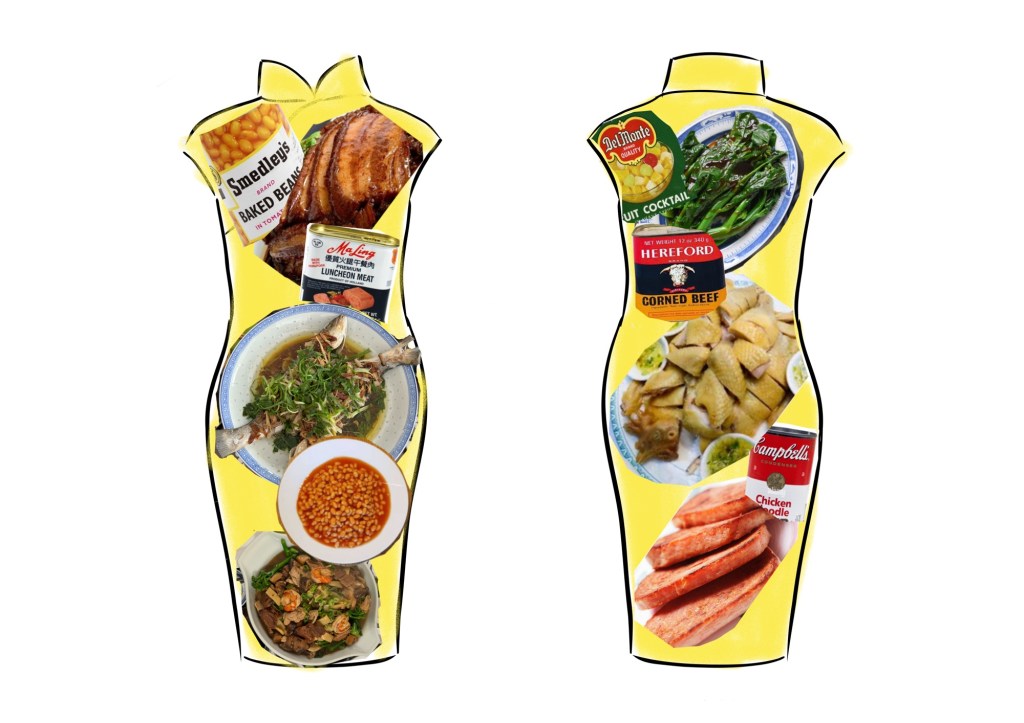
As soon as I returned home, I started to research images of dishes that I have had and worked on the composition. Below are some examples created using Adobe Fresco:
Here is a video of the Fresco creation process:
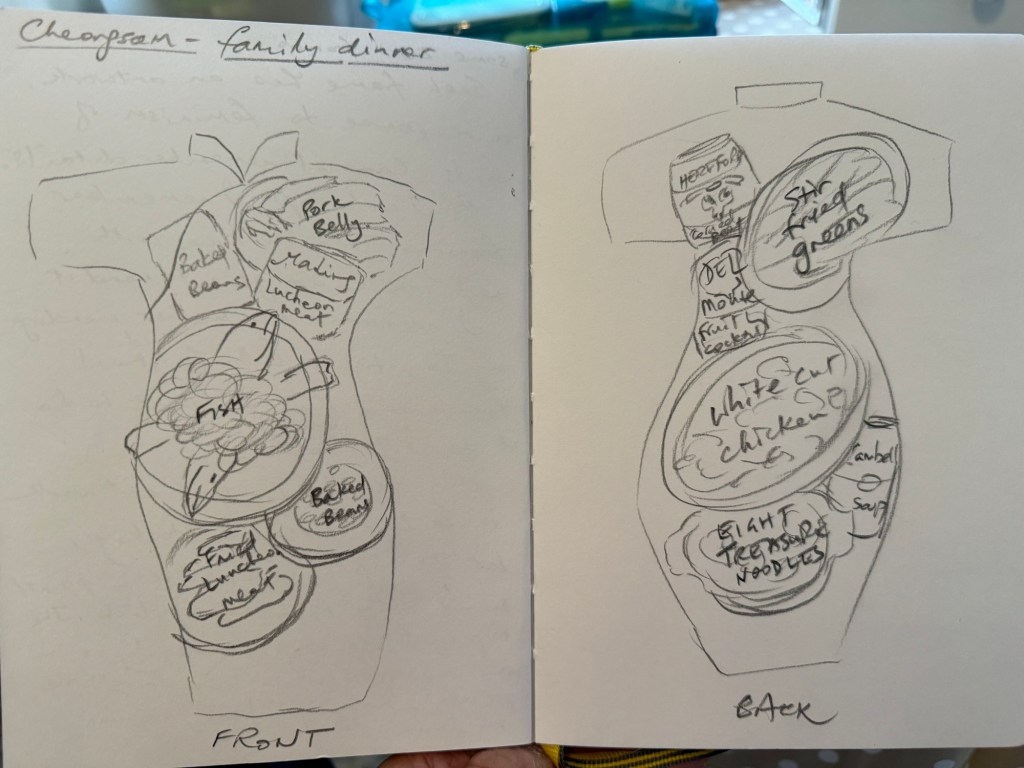
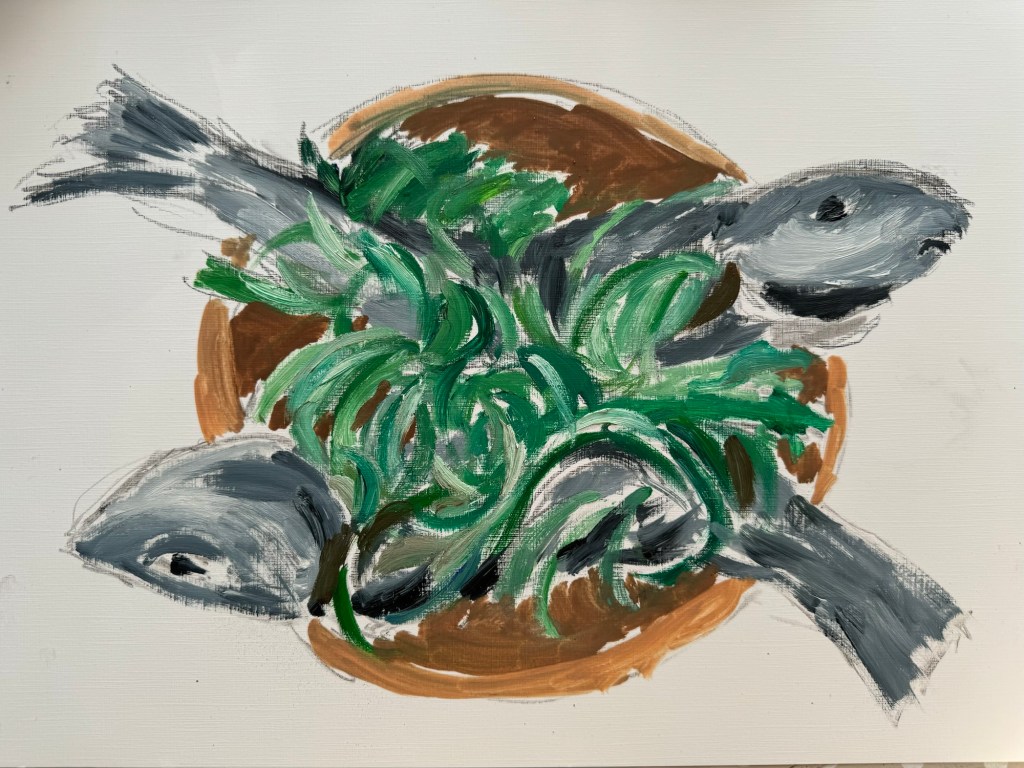
I also used my sketchbook to experiment with different compositions.
–
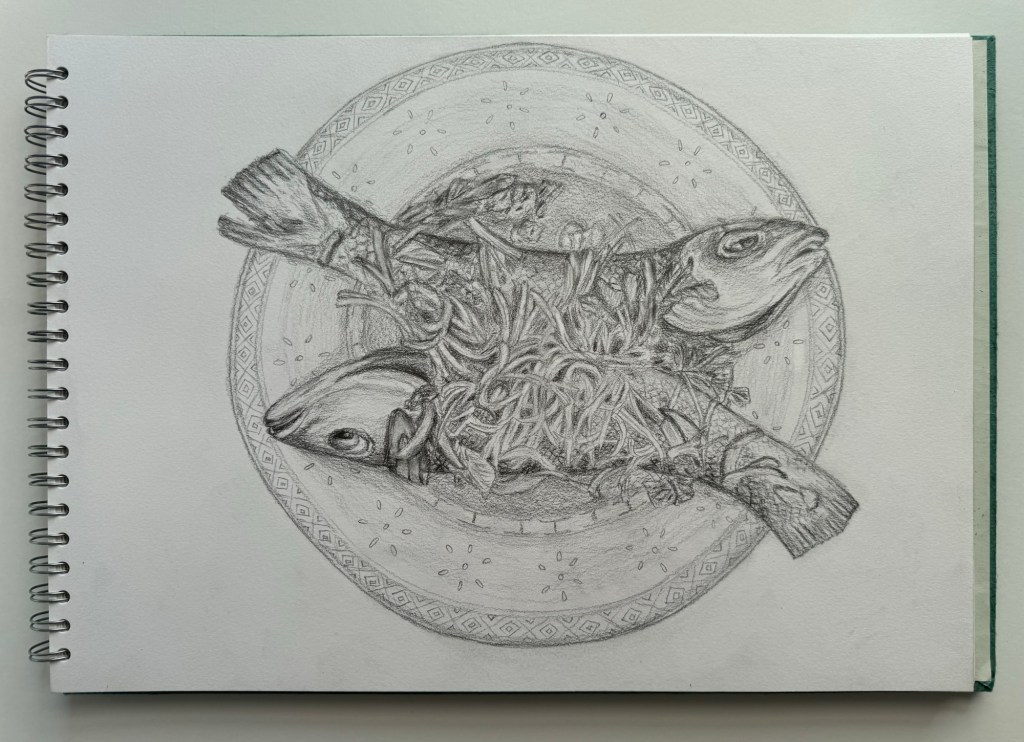
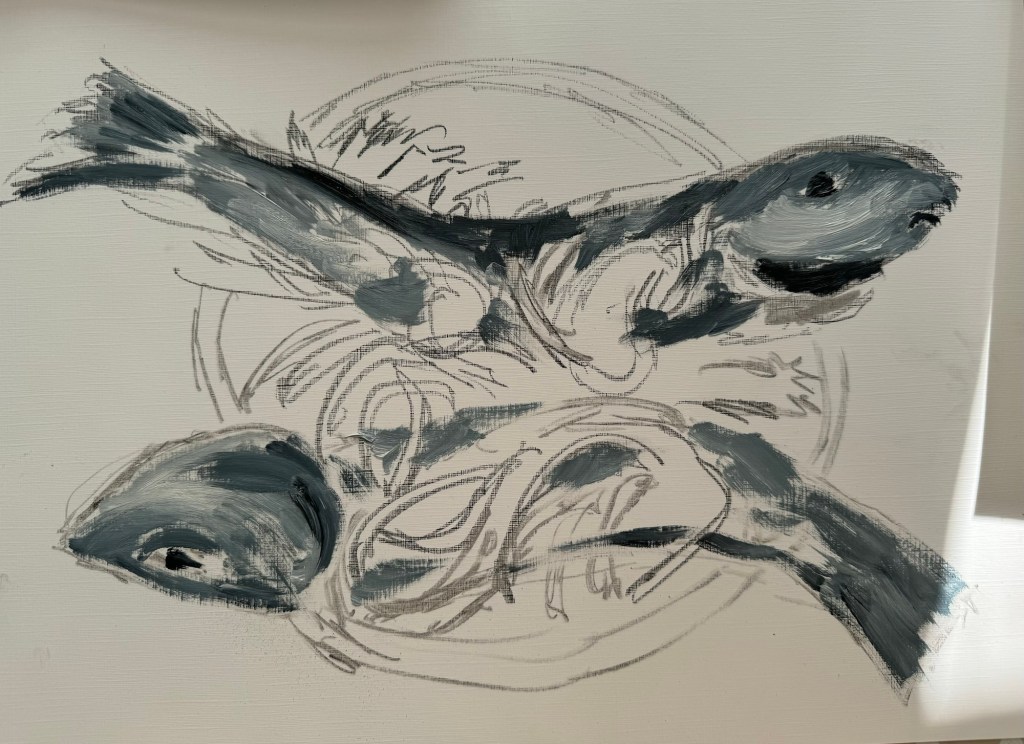
The previous Cheongsam paintings were in acrylic on calico canvas and I wanted to paint in oil for this work because I enjoy painting in oil and I wanted to return to oil after not doing so for some time. Also, I had in mind that the toppings for the fish would be ‘piled up’ and I felt that oil paint would give me more freedom and time to play with getting the right texture. I usually just start painting straight away on the canvas, but on this occasion, something was holding me back and I had the urge to do some study drawings first to give me time to think about the details and composition. Below is the study drawing for the fish dish:
–
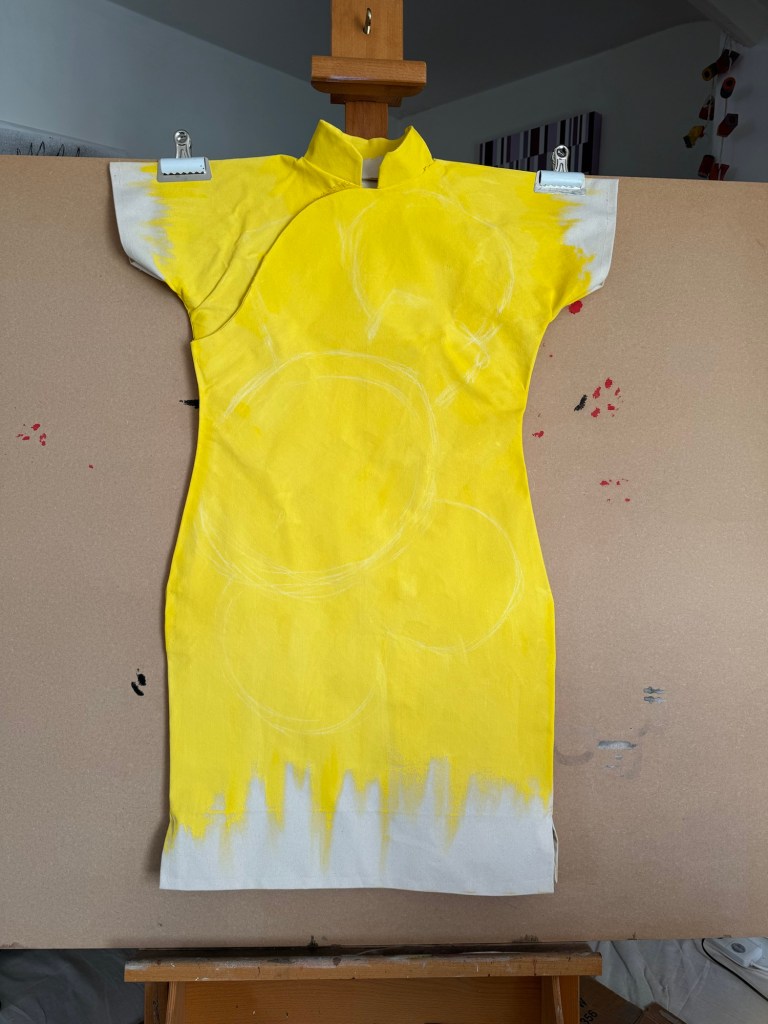
At the top of this blog, I listed an earlier blog about using a new design for the Cheongsam with thicker canvas material. This latest dress design and material combination caused the waist area to crease on the mannequin. So far, I have painted all the previous Cheongsams on a mannequin. However, for this one, I felt that it needed to be painted flat to eliminate the creases during the painting process. So I moved the canvas from the mannequin to the easel.
–
Painting moved to the easel so that I could paint on a flat surface:
–
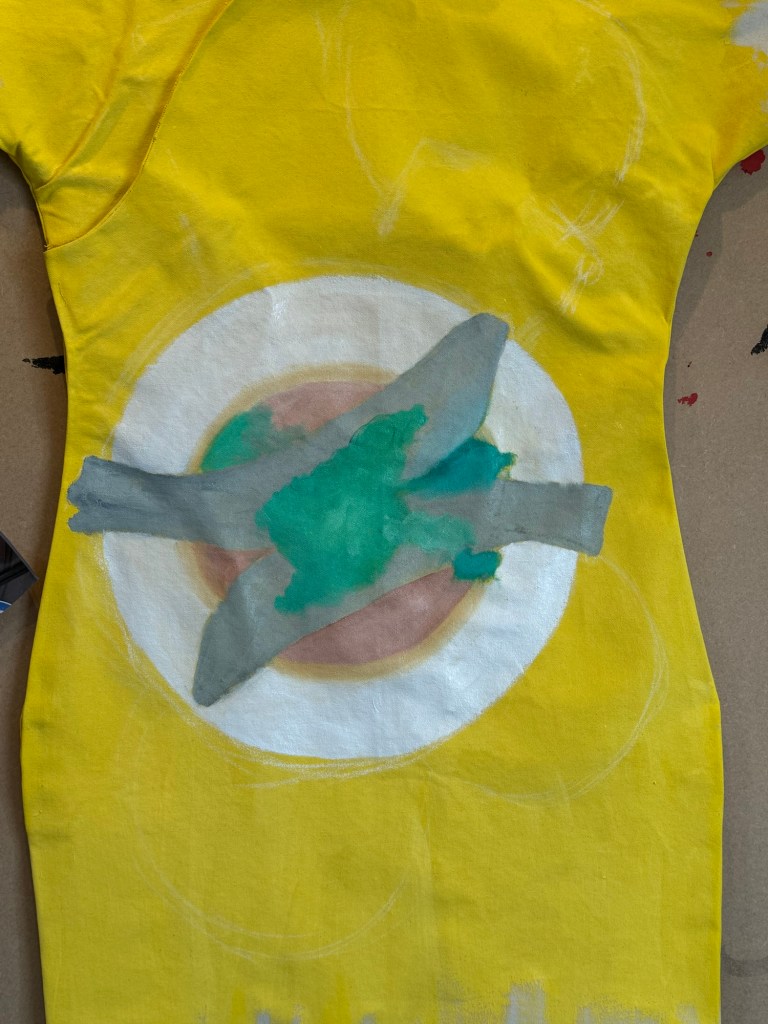
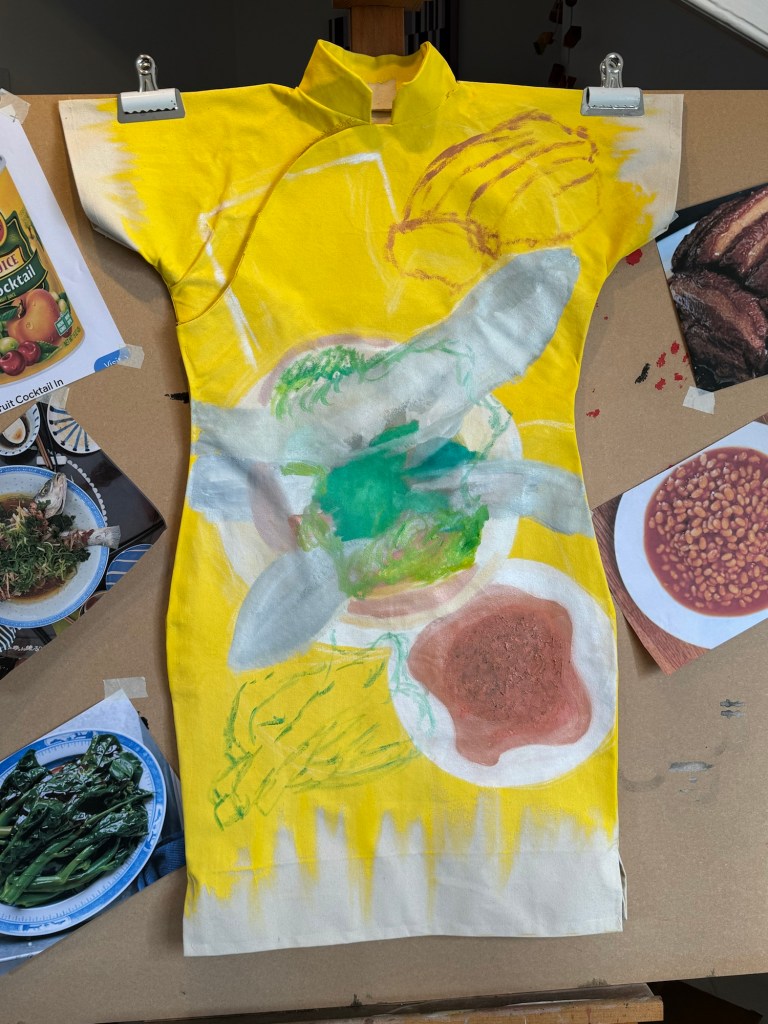
I proceeded to mark out the composition starting with the centre piece – the steamed fish. The placement of the fish dish is reflective of a Chinese family dinner where the steamed fish (if on the menu) would typically be placed in the centre as the signature dish.
–
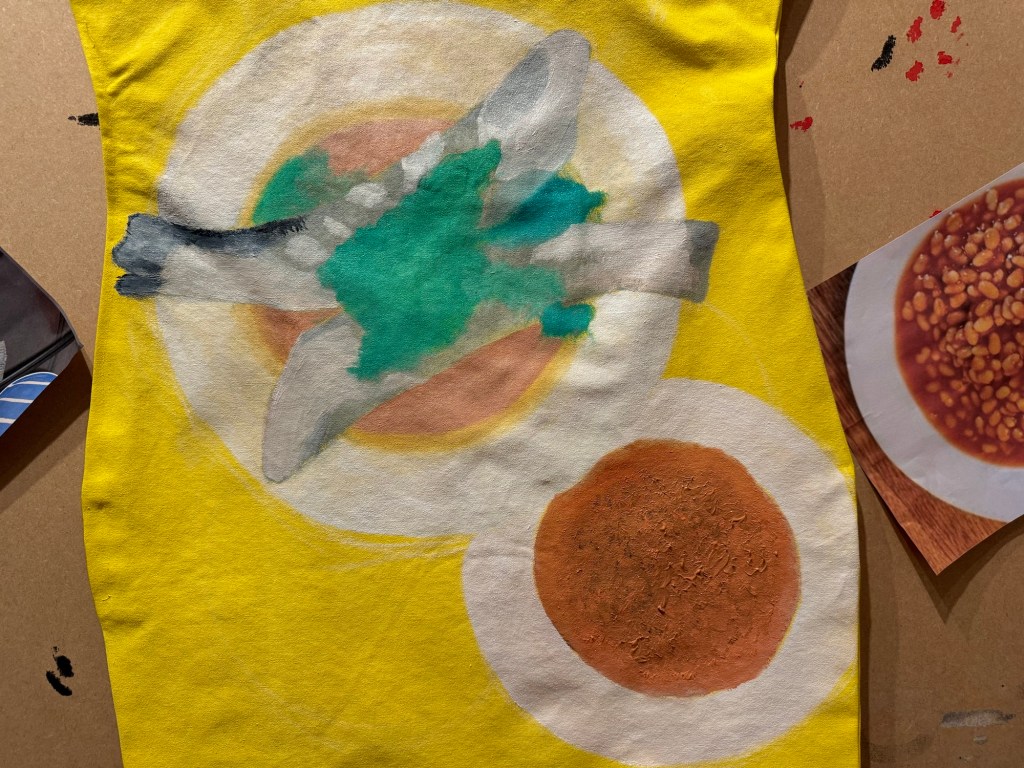
Having roughly marked out the fish dish, I added a plate of steamed baked beans. Since Hong Kong is/was such a fusion of different cultures and heavily influenced by the British due to colonialism, it was not unusual to have imported tinned food served alongside traditional Chinese dishes in my family. In hindsight, it sounds strange and funny to serve these two very different dishes together; but at the time it was the most natural thing – food was just food especially for a child. I never thought about their origins or the reasons that caused these two dishes to came to be served next to each other. I remember my mother calling baked beans ‘pork beans’ at the time and I remember at times there were small pieces of pork fat among the beans. I researched this and found that manufacturers did put pieces of pork in with the beans but removed them due to World War II meat rationing. I am not sure if they reintroduced pork in the 1970s or if what we ate were left over from the old pre-war stock!
–
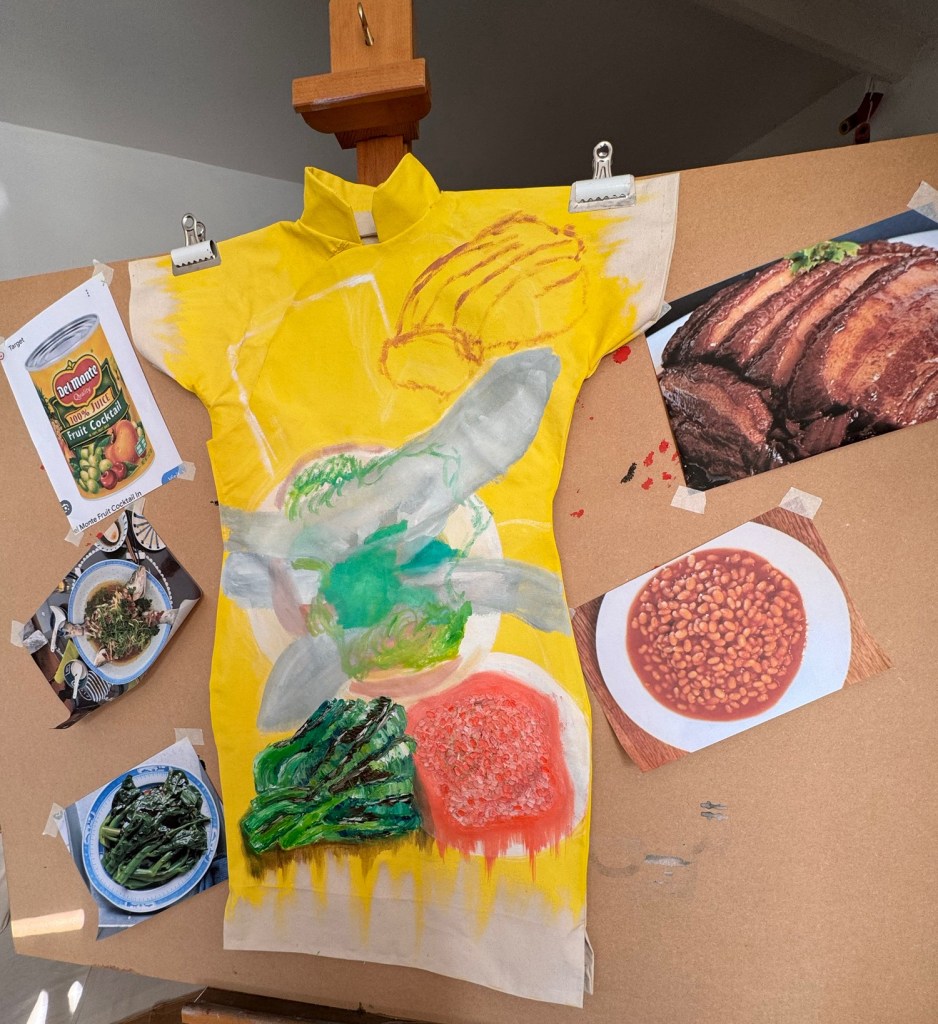
Other dishes were gradually added to the menu, each dish having their individual significance in the role they played in our family dinner. I also enlarged the two fish to give them more prominence and I wanted a tight composition as from memory, dinner tables in Hong Kong were always crowded with food.
–––
I tried using charcoal with oil which I had never done before and below are photos of the initial experiment on oil-paper:
––
The experiment was not satisfactory because the charcoal did not work well on oil-paper, so I returned to experimenting on the canvas:
–
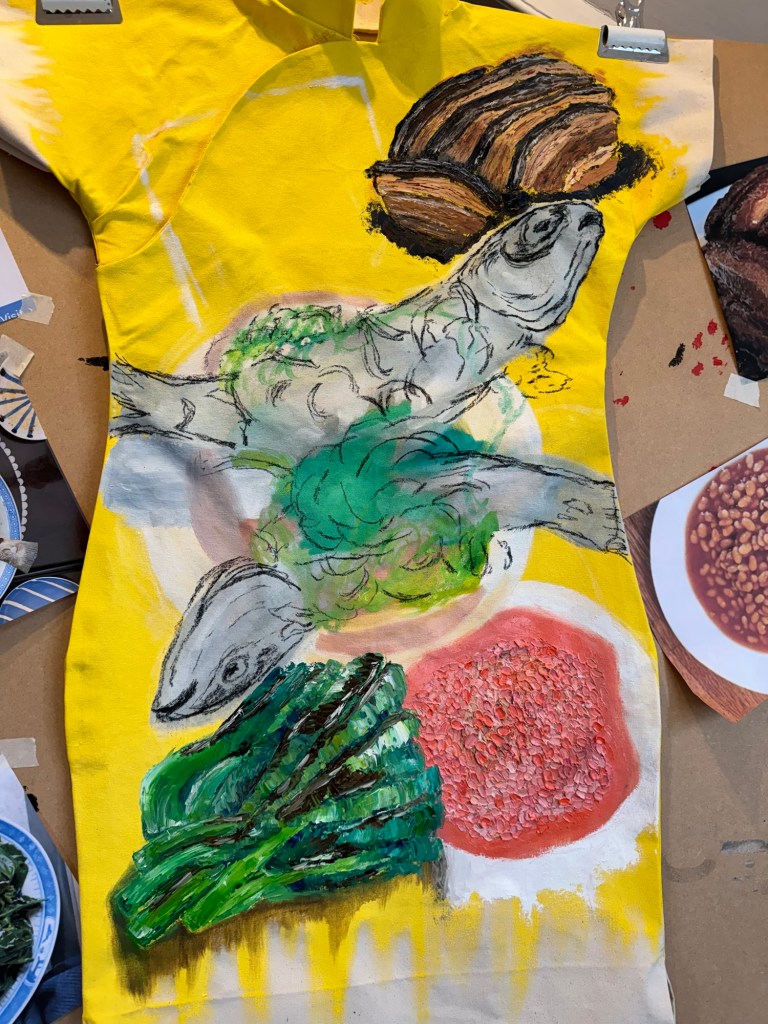
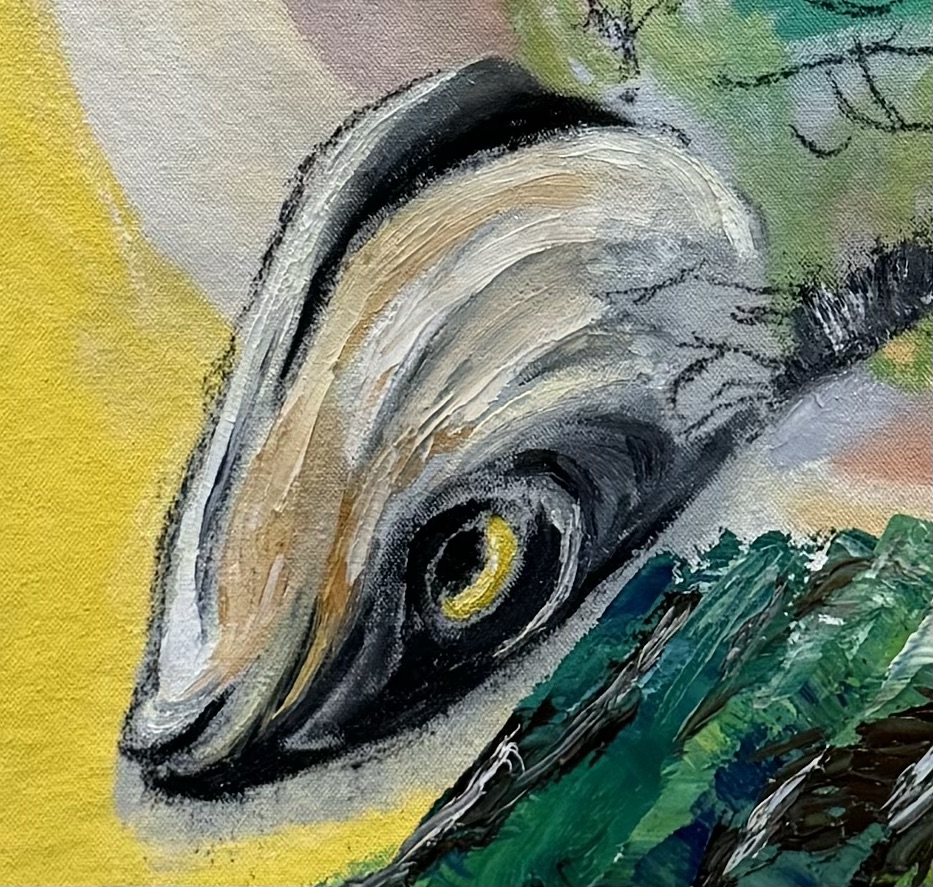
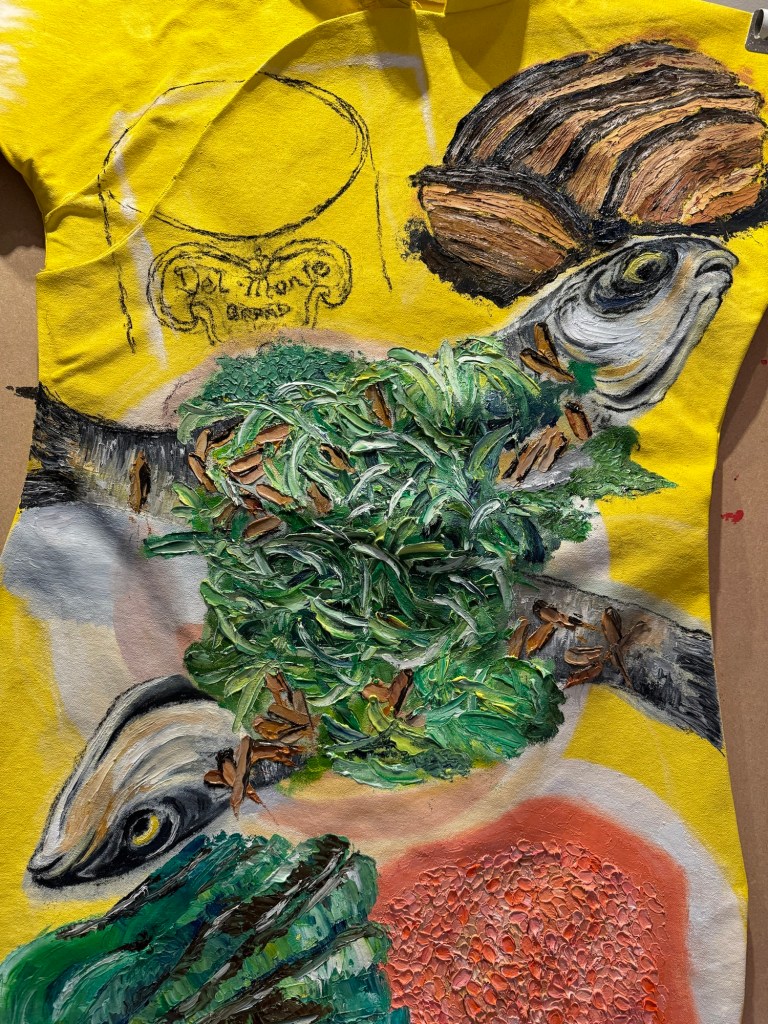
I was pleased with the charcoal effect and proceeded to paint the fish:
––
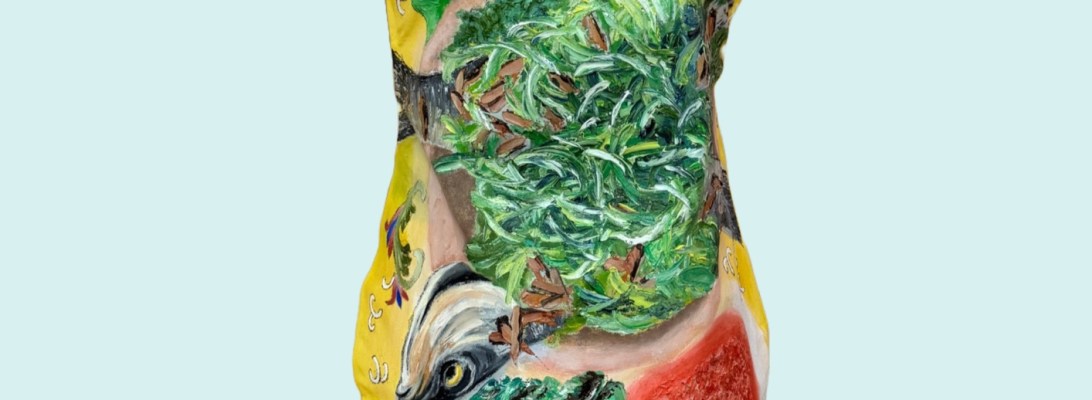
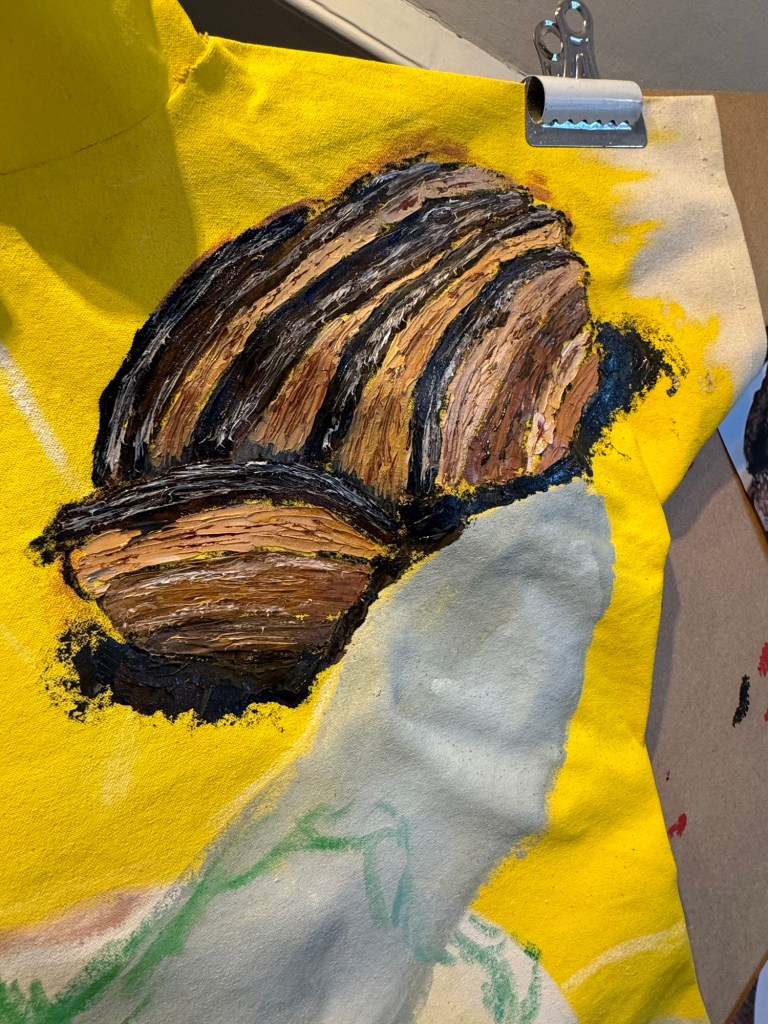
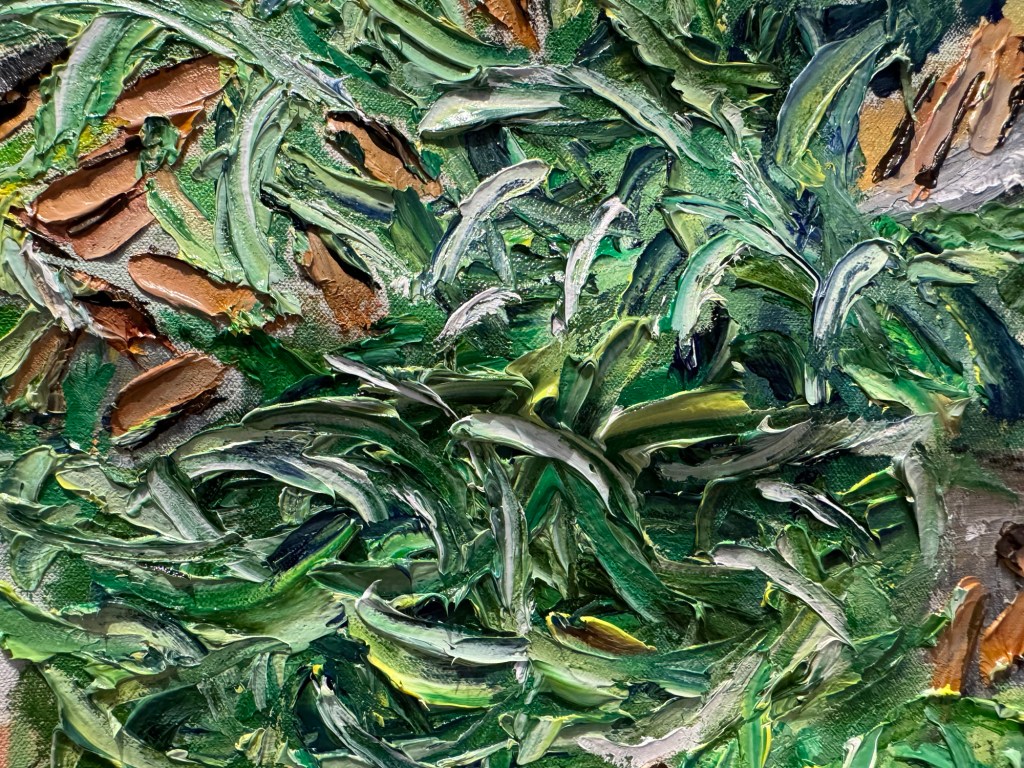
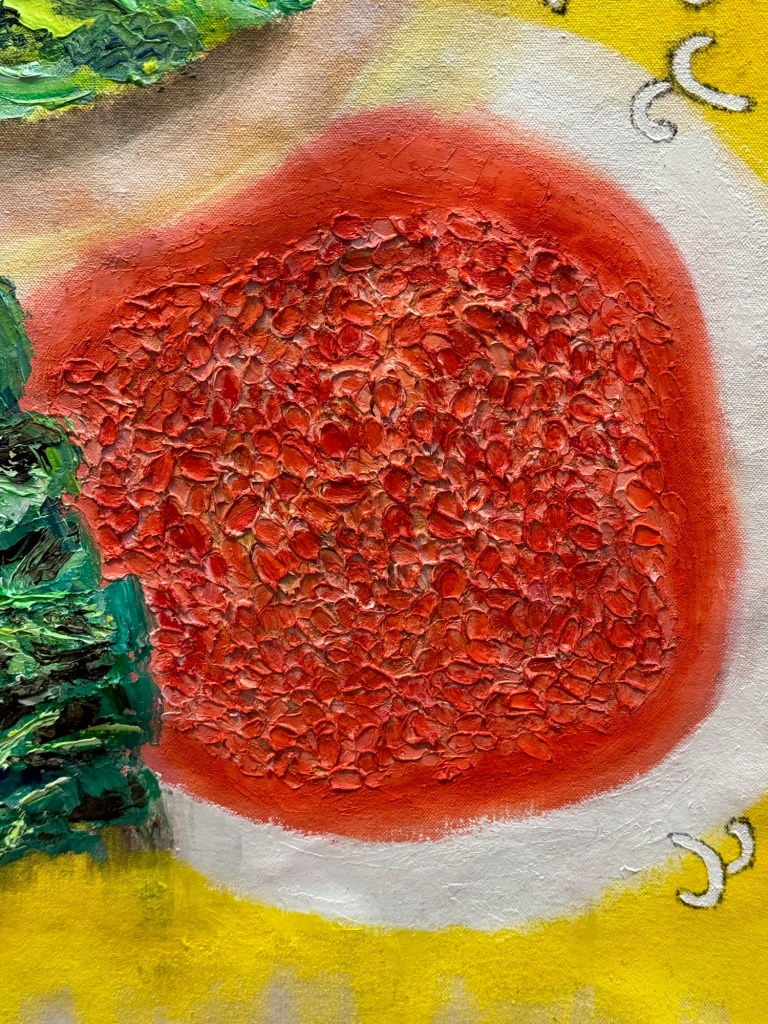
Toppings of spring onions, shiitake mushrooms etc. were added in thick layers of oil paint:
–
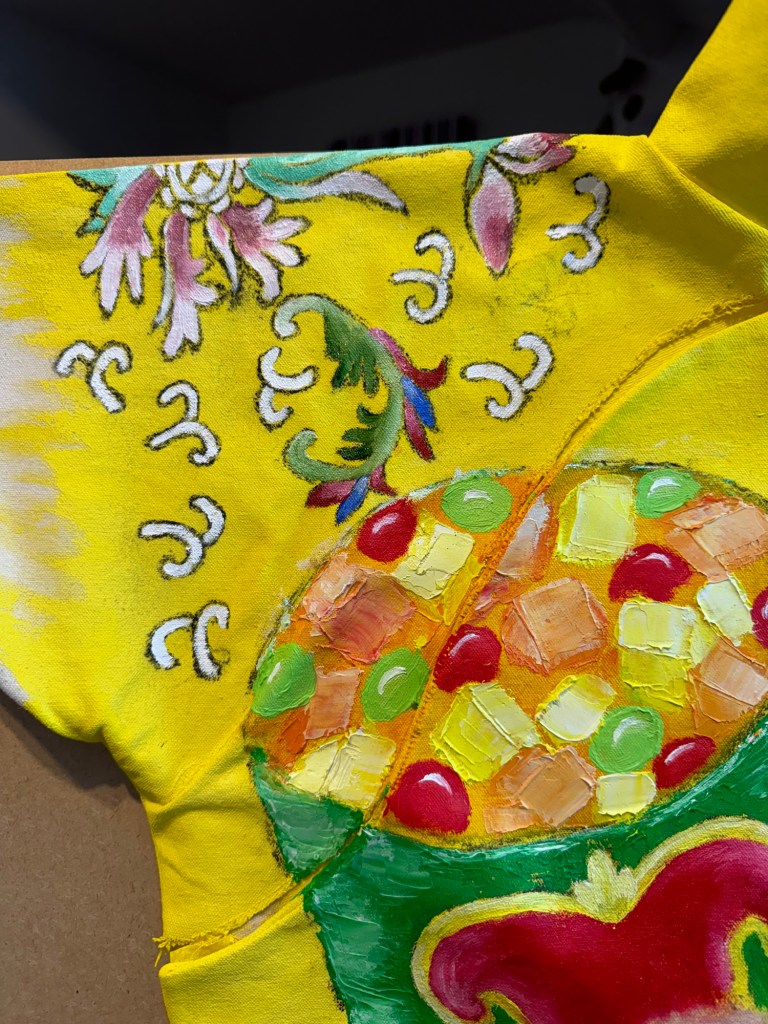
Time to add the dessert – Del Monte fruit cocktail.
––
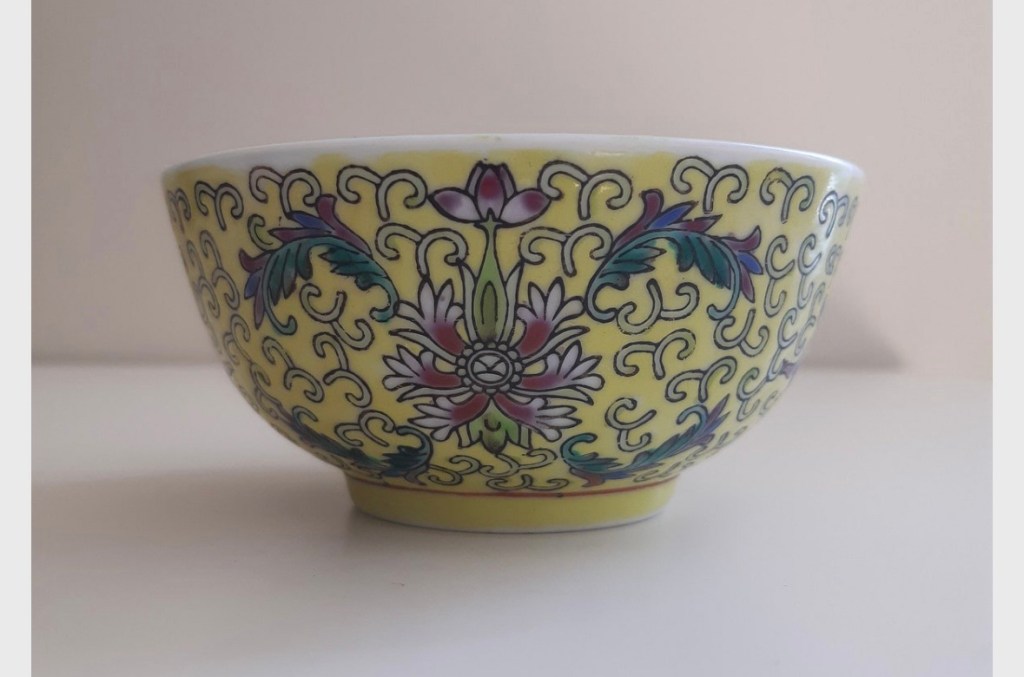
To complete the composition, I added pattern details from the Chinese dinner set that my parents used at the time around the various dishes on the painting.
–––
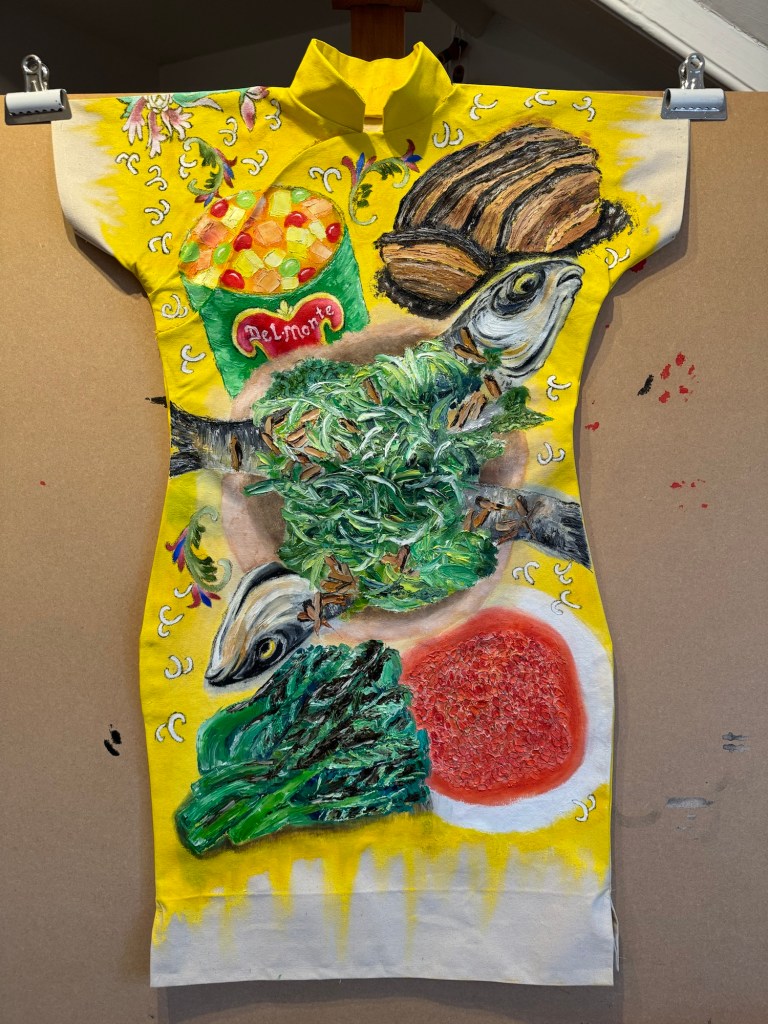
The completed front part of the Cheongsam painting:
–
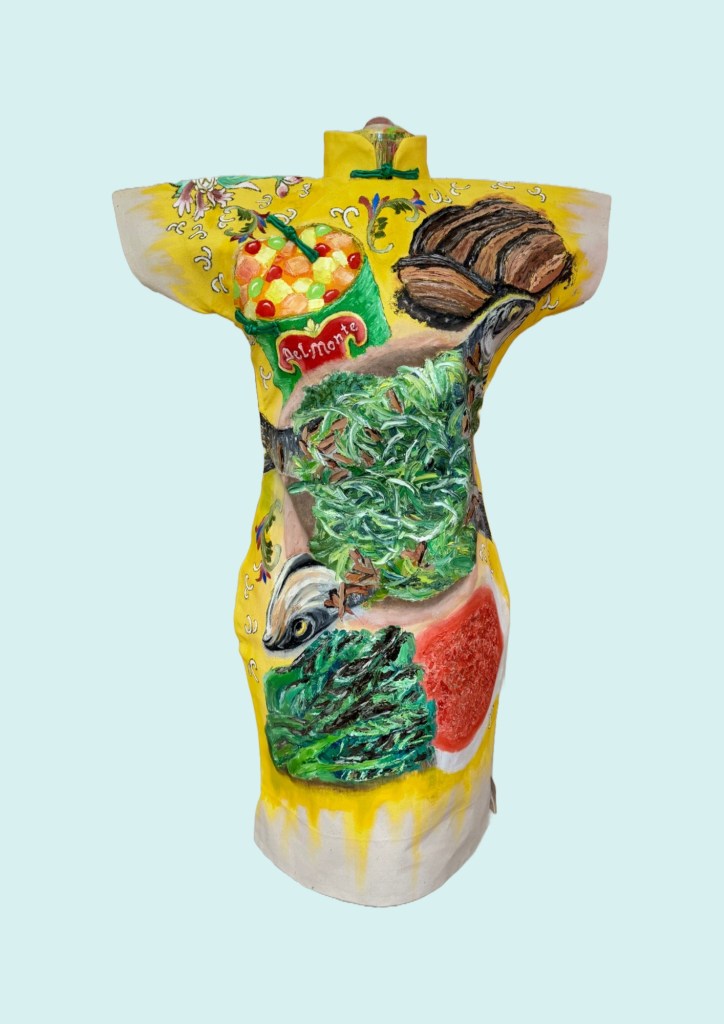
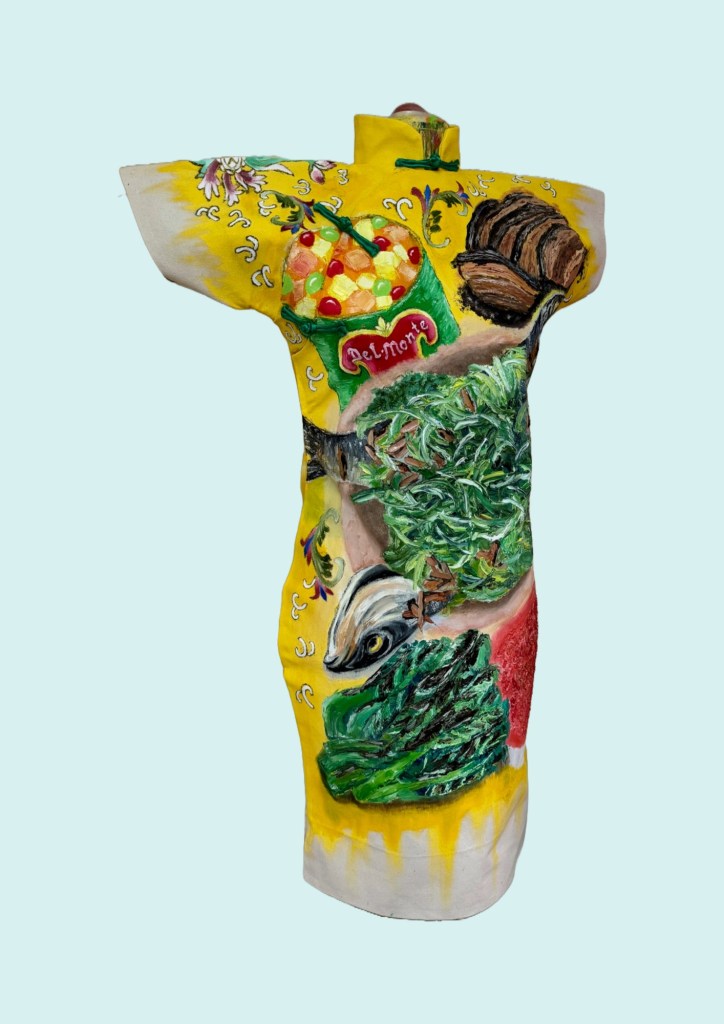
The painting was put back onto a mannequin as I wanted the oil paint to cure according to the shape that it would eventually be displayed in. Then green satin ‘frog’ fasteners were added to complete the Cheongsam look.
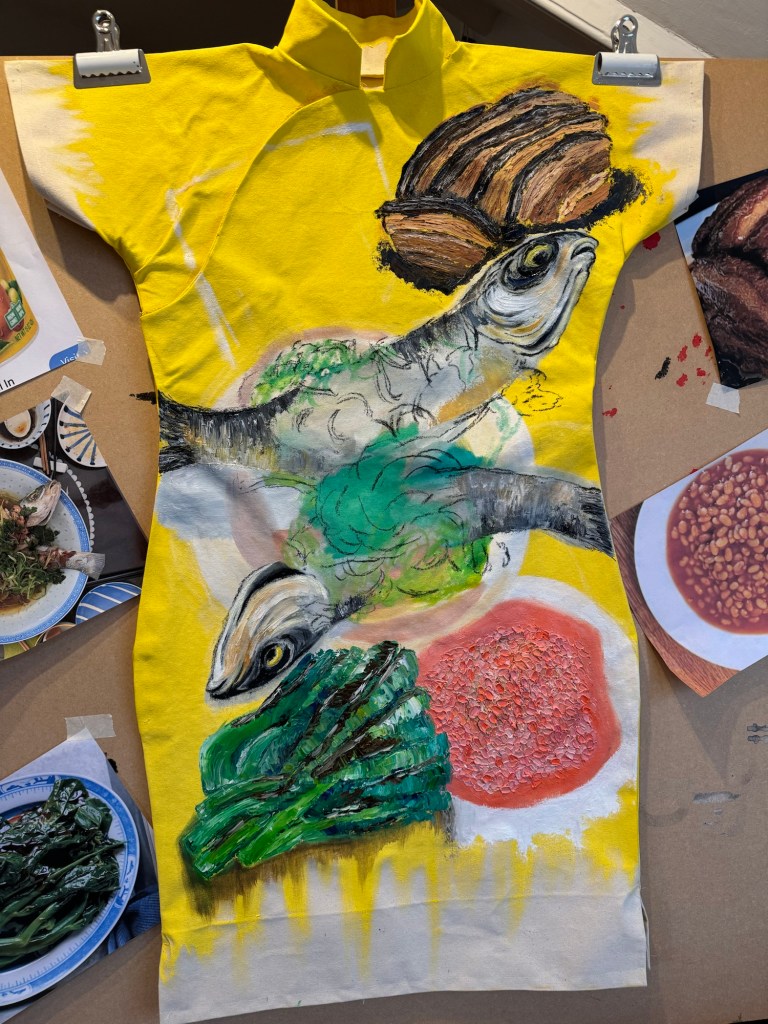
Below are images of the finished front half of the painting with –
-Steamed whole fish with spring onions, ginger, coriander and sliced shiitake mushrooms in soy sauce;
-Braised pork belly with preserved mustard greens;
-Gai Lan (greens) with oyster sauce;
-Steamed baked beans (imported) and
-Del Monte fruit cocktail (imported).
‘Family dinner #1‘, oil and charcoal on 240gsm cotton canvas. Size: 98 x 68 x 28cm.
–––
REFLECTIONS
So many thoughts and memories went through my mind while making this painting, it is hard to know where to start for my reflections. Like I have done before, I will use ‘free writing’ to capture them as they come into my consciousness as I write.
– Only in hindsight when I am doing this painting did I realise what a strange fusion of cuisine we experienced growing up in Hong Kong. Not only because imported tinned food like ‘pork beans’ (now known as baked beans) were served alongside carefully prepared Cantonese dishes, but the fact that the beans were steamed in a wok to heat up was rather amusing. Since my mother would not have known how baked beans were meant to be served, so steaming in a wok was her default method. As children, we loved mixing the baked beans with our boiled rice in our bowls because of the sugar and salt in the beans. Like many children all over the world, we (sadly) appreciated the processed food more than the poor mother’s fresh cooking!
– My father was the patriarch. He expected a well cooked meal twice a day (he used to come home for lunch). If the meal was not up to standard then there would be consequences. He was not physically violent but there would be a ‘dark cloud’ over our dinner, eaten in silence with the children exchanging glances but no one dared utter a word. The rejected dishes would be sent back to the kitchen to be remedied if possible (if overcooked then not possible).
– So my mother had to deliver two perfect cooking performances per day, everyday. Chinese cooking can be challenging, to get the taste balance, texture, freshness, aesthetics (just to name a few requirements) correct for every dish is very demanding. Especially when the ‘judge’ had high expectations. For example, for a steamed whole fish, the fish had to be cooked just right, not overcooked or undercooked – this is challenging even for restaurant chefs. If there was steamed fish then as soon as my father sat down at the table, he would split the fish open along the spine bone with his chopsticks and examine the ‘colour’ of the flesh, if there was any hint of pink along the spine ( meaning undercooking) then the chopsticks would be slammed down as a gesture of disapproval, no words needed to be said and the dish would be taken back to be remedied. It is no wonder my mother sometimes used Western tinned food to make up the number of dishes to get by. Since my father worked for the Hong Kong Government and was a life-long civil servant to the ‘Colonial Crown Service’, he was very accepting of Western tinned food because we (the colonised) were led to believe that anything from the West was superior. So in this context, colonialism in fact brought with it some occasional relief for my mother in her job of family meals planning.
– I think I chose a bright yellow background for my Cheongsam dinner because I love food and enjoying good food makes me happy as it is such a key part of my heritage. I always wanted family dinners to be fun, bright and cheerful. Although there were often ‘dark clouds’ that loomed over our family dinners, as kids, we would find reasons to giggle at the dinner table – it was our way of responding to the situation through kids’ humour.
– The background yellow is also similar to one of the dinner sets that my parents had hence I incorporated some of its design onto the dress. I will elaborate about the dinner set design on the back of the dress as it has an interesting history.
– There were other back stories to the dishes on the painting and on how ‘the family dinner’ was often where the dynamics of my parents’ relationship played out. I am reluctant to detail all of them because it would be unfair to my parents who are not around to say whether they wanted their stories to be told. Also, I am not sure if I am ready to express everything yet.
– I wonder, how does one find out if the dead would want their stories told and how does one decide whether to tell them anyway? Also, I can only tell a story through my lens, so whose story would I be telling?
– Recently, I have been thinking a lot about ‘process vs outcome’ in my practice. I have thought more deeply about this since I started to make Cheongsam paintings. I think it is because the work takes longer and involves more complexity, so the extensive creative process gives me time to think more deeply. Especially with this Family Dinner painting – the composition is more complex than the previous ones and painting in oil takes longer which is part of why I love to paint in oil – the process and materiality force me to take my time. The surrendering of agency to the process elates me. My thinking during my making process comes in many forms, such as reflections and memory recalls that I would often incorporate into my painting, or ‘put aside’ in my ideas bank for future paintings. All these thoughts go towards the sense-making of my journey, my identity and the world around me. It is right now at this very moment in time while writing this set of reflections that I have come to truly understand what ‘sense-making’ means – to me. I wish I could bottle this moment before the thought eludes me.
– I wrote in my research paper about two transcultural artists and their sense-making that takes place on the canvas. For the paper, I researched about sense-making and how that process fundamentally supports the human survival. In the context of migration, people displacement or in a transcultural setting, where the environment is new or constantly changing – I believe the opportunity to reflect and make sense of one’s experience is essential to survival in a meaningful way; to feel belonged in the world and not merely to exist. Unfortunately for many, the quest for physical survival can be overwhelming therefore depriving them of the opportunity for the much needed sense-making.
LEARNING
When I first started planning the structure of my blogs at the start of my MA programme, I had planned for the REFLECTIONS section to be free-thinking and free-flowing, capturing whatever came to mind related to the work or during the making process. The LEARNING section is there to bring the thinking back to the context of my practice to extract any practice-related learning and plan the next steps. This structure has helped me to develop my practice so far and is becoming even more important as my reflections become more extensive and ‘free’. So I will now try to extract some learning from the this piece of work and the above reflections.
– Referring to my thoughts on ‘process vs outcome’, there is increasing clarity for me as to why I am not always bothered about the work once it is finished. For me, the work is a way to provide a process – the process is more precious to me. The process gives me quality thinking time and it ‘walks with me’. I enjoy making very much, but it is the making while thinking or reflecting that is the most valuable for me.
– So what am I going to do with this realisation, or confirmation of what is valuable for me in my practice? I don’t know yet, maybe I don’t need to do anything to bring these thoughts to a conclusion, perhaps it is just a beginning with no end – that feels exciting. So I will go with ‘it’ and try not to over think ‘it’.
– I have thought a lot about how I could capture some of the more abstract elements that came out during the making process, perhaps onto a piece of physical work – could be painting, writing, 3D etc.. I remember in a much earlier blog, I talked about wanting to find ways to express my thoughts through abstraction as that might liberate me to express more freely without the confinement of physical preconceptions. A specific image that has been recurring in my mind since finishing the Family Dinner painting was the pink tinge (of blood) that would sometimes be visible along the fish’s spine as my father parted the flesh of an undercooked fish with his chopsticks. For me, that tinge of pink symbolised innocence and trouble at the same time. I need to do something with that pink to get it out of my head.
– As I was making this painting, many memories of other interesting family dishes and stories came to mind and I am bursting to paint more dinners to capture them.
– I also need to complete the back of this dress. I had originally thought about painting a second dinner on the back, but I have decided to not do this because I want to save some of the dishes for other dresses as I want to make a series of several ‘Family Dinner’ paintings. Also, I want to paint the design of the dinner set that my parents had because it has an interesting history.
– As for the new Cheongsam sewing pattern that I used for this painting canvas – I am very pleased with the new design because it does not have any darts so the canvas can be painted flat which means I can use thicker canvases and paint in oil which is my preferred medium for this current series of painting.
– The new Cheongsam canvas design also means I have reduced the making time of the canvas from two days down to around half a day. This improvement was due to a simpler design and my experience gained in making these canvases – I am now more confident in sewing with my machine and quicker in trouble-shooting. This means I have more time for the other parts of the creative process.
– A key learning in making Family Dinner #1 was to take time in my making. I have in the past rushed my work, for no specific reason but to just ‘get things done’. The study drawing of the steamed fish was invaluable for me and gave me the confidence to experiment and take chances when painting on the canvas because of my enhanced observations. I now appreciate why artists make study drawings!
NEXT STEPS
– Paint the back of Family Dinner #1 with the family dinner set design.
– Start to research and make Family Dinner #2.
– Continue to take time in my making, e.g. allow time to make study drawings and appreciate materiality.
– Experiment and play: do some abstract paintings of ‘the pink tinge’ to explore how to capture some of the ‘magic’ that I have felt during my making process.
Since I have decided to do a series of paintings on Cheongsam shaped canvases, I started to look for more efficient ways of making the canvas to give me more painting time. I was asked by my tutor if it was important for me to make the canvas myself or if they could be made by someone else. My response was that I felt I had to make them because that was part of the making process for me. I have become increasingly aware that the process is more important for me than the outcome since the process provides valuable thinking and reflecting time for me.
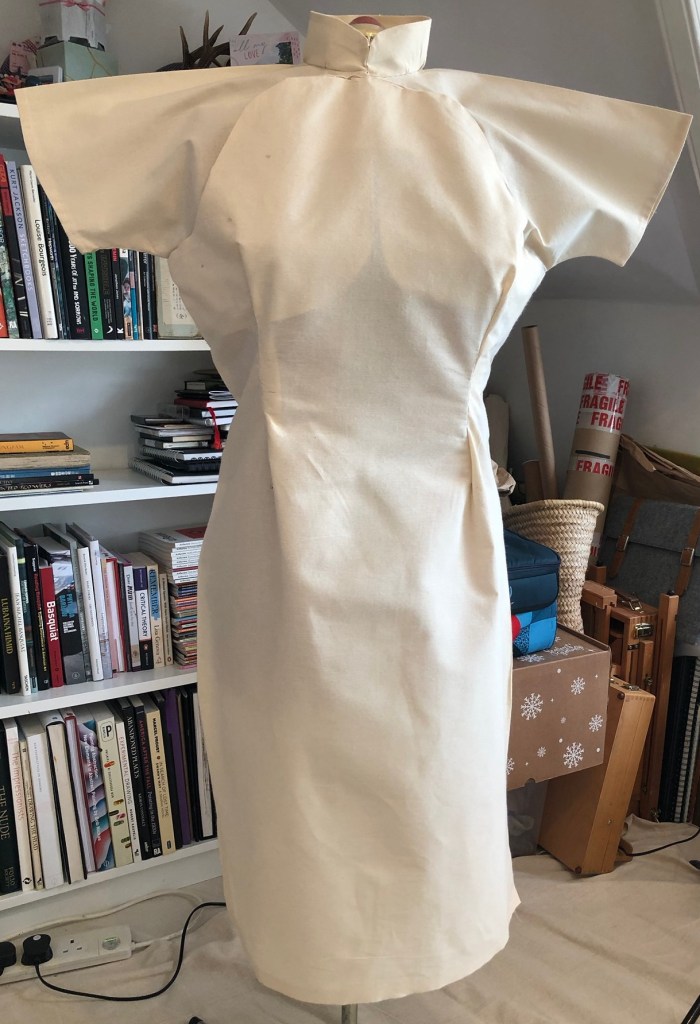
The photo below shows the design of the Cheongsam canvas that I have been using up to now. It is made of relatively light calico material and the design is easy to make. It is a loose fitting design and I have been putting in darts on the front and back to give a more fitted look in line with modern Cheongsam designs that have been influenced by European designers in the 1960s. This design has worked well as I have been painting simple pop art designs in acrylic and the materials worked well together.
–
However, for the next few pieces of work, I wanted to make more complex paintings in oil. So I needed a more robust canvas material and ideally a dress design without having to sew the darts which could be difficult with a thick canvas.
METHOD
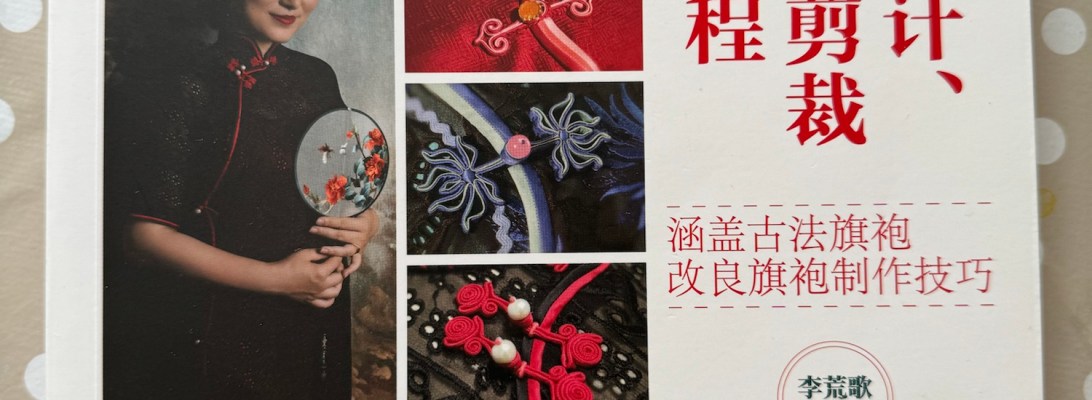
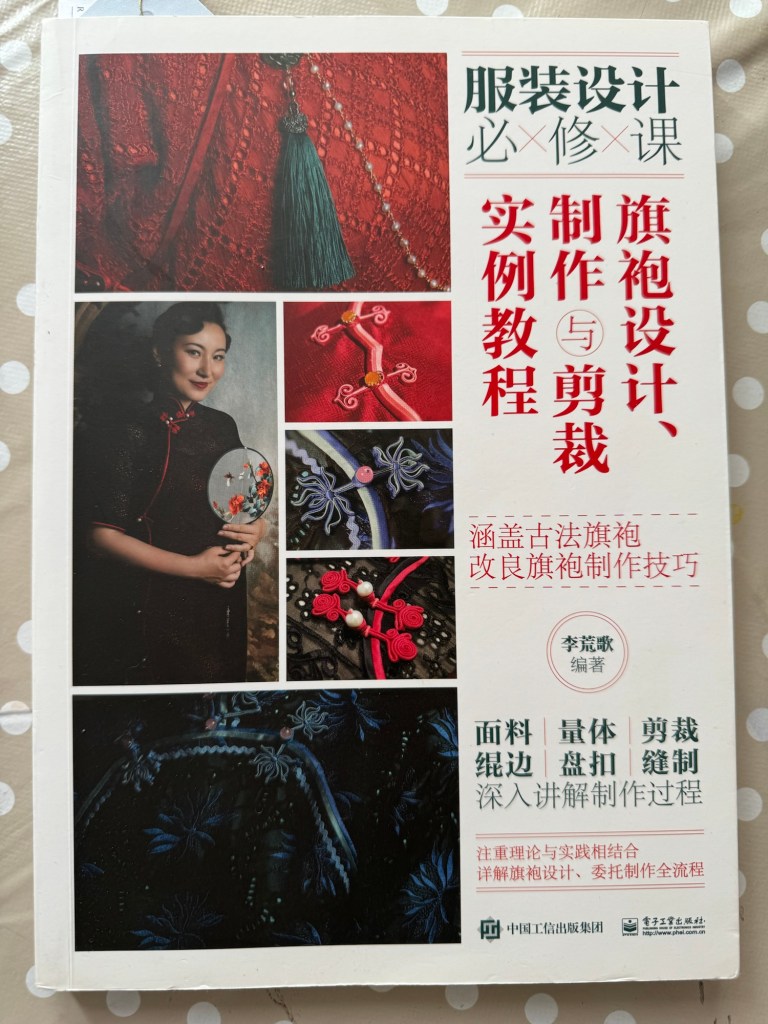
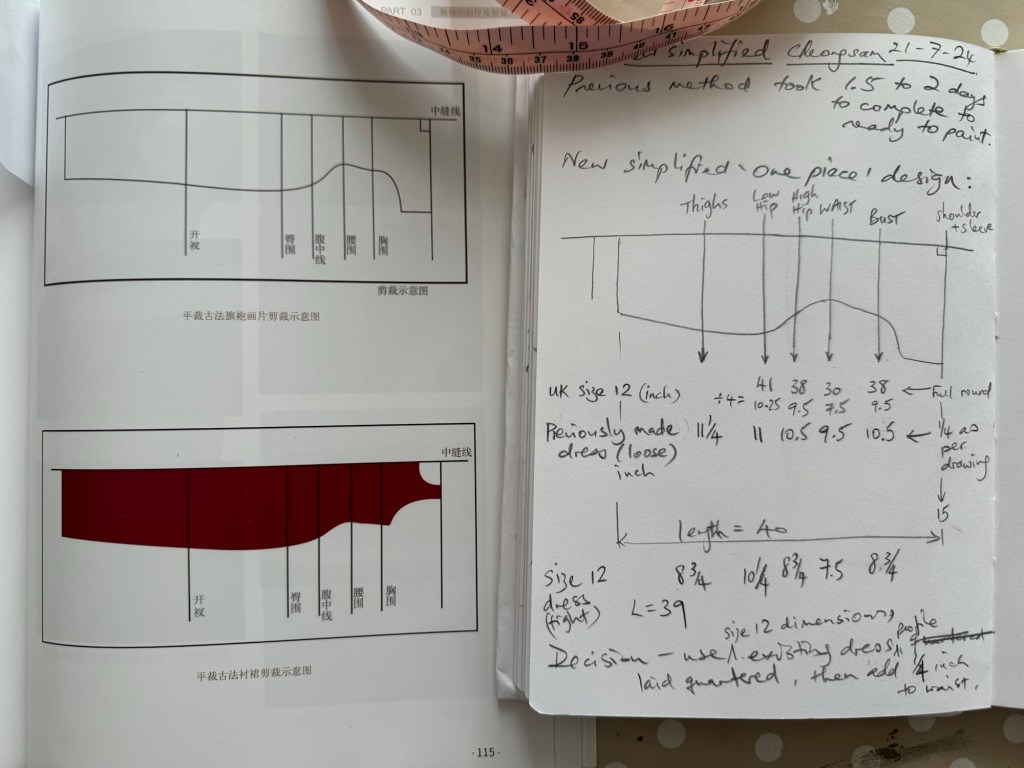
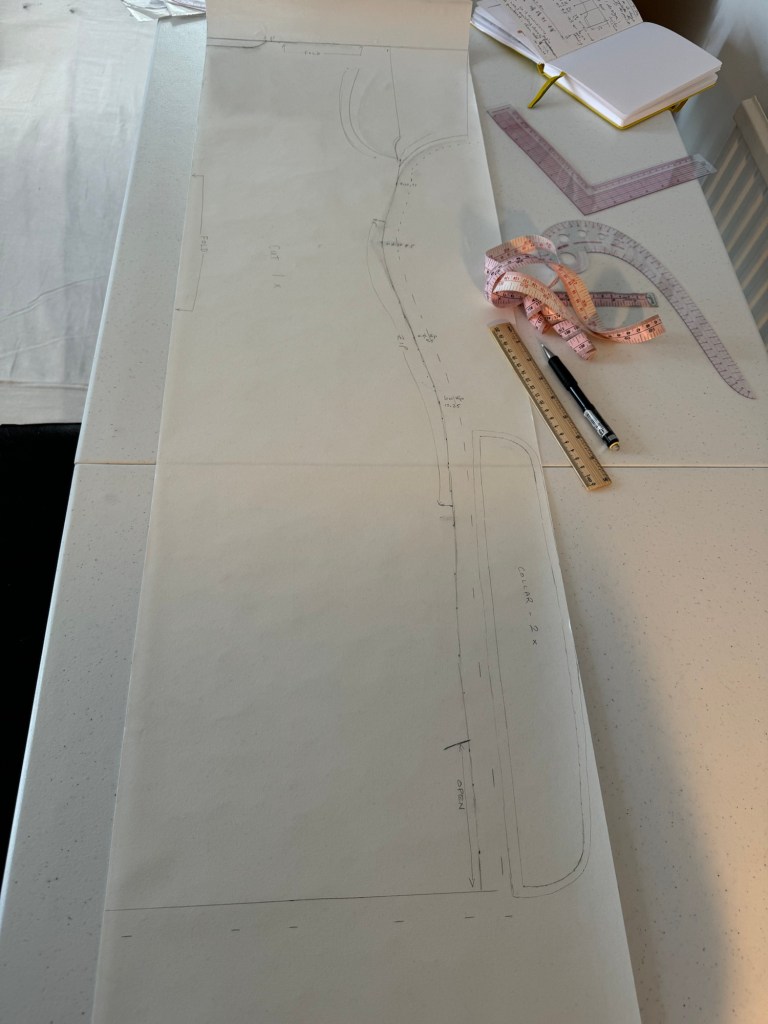
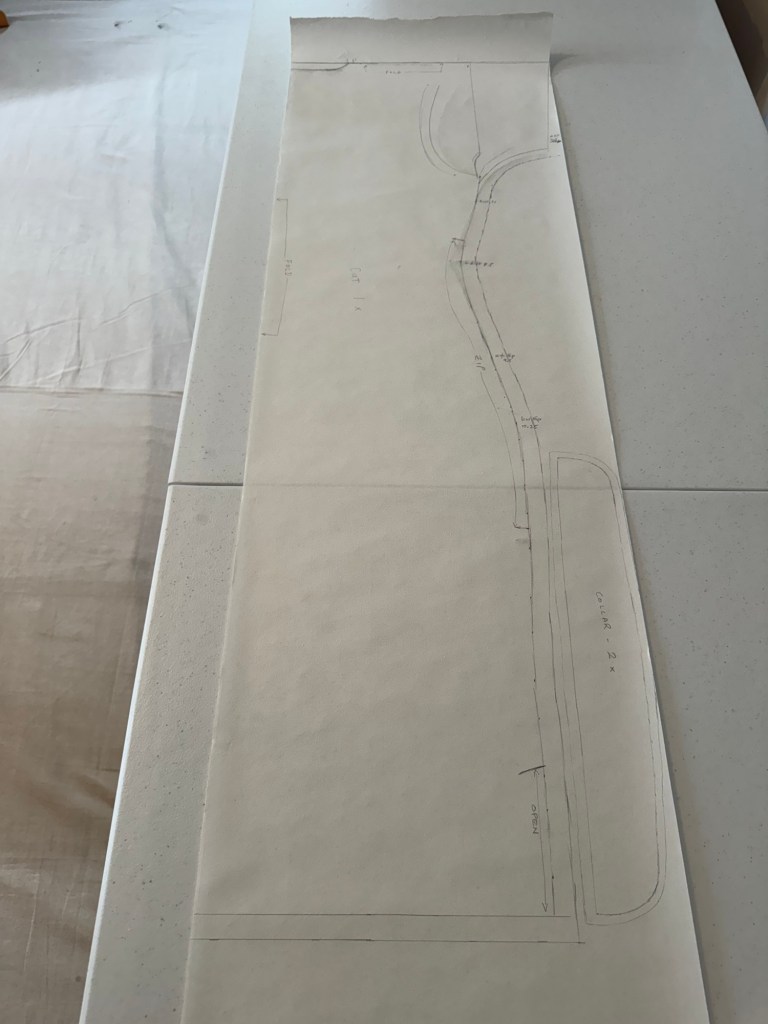
I sourced a book from Hong Kong that has a simpler Cheongsam pattern that didn’t involve sewing darts to achieve the traditional fitted look:
I copied the design into my sketchbook and customised the measurements:
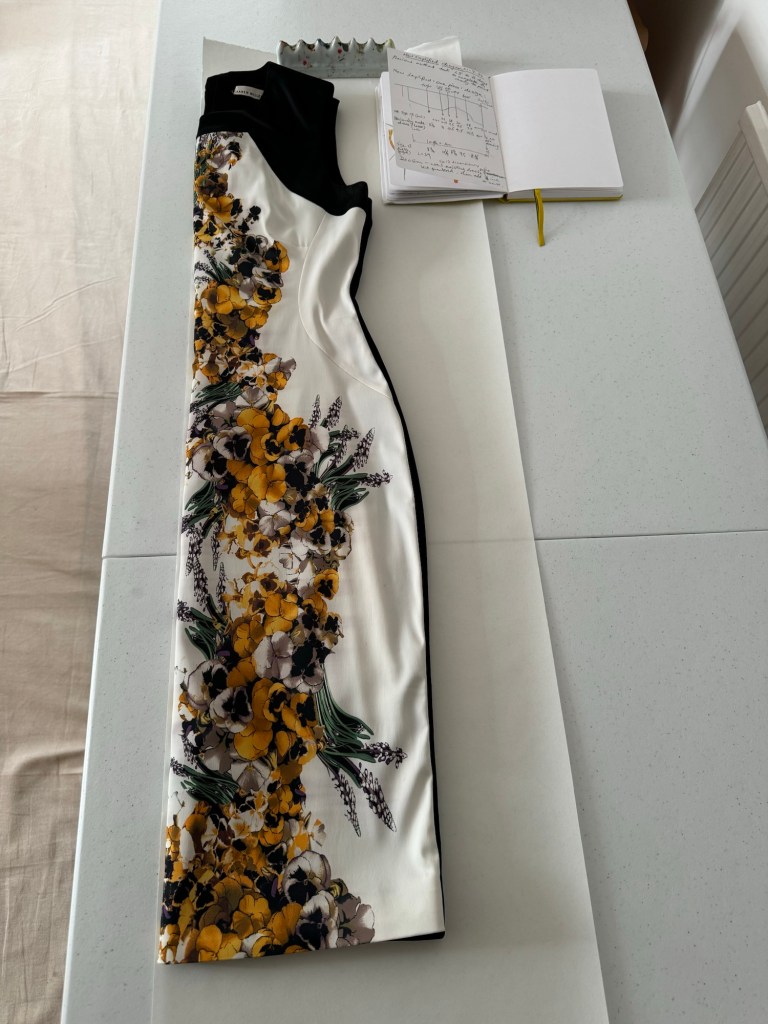
The measurements were checked against an existing dress of mine:
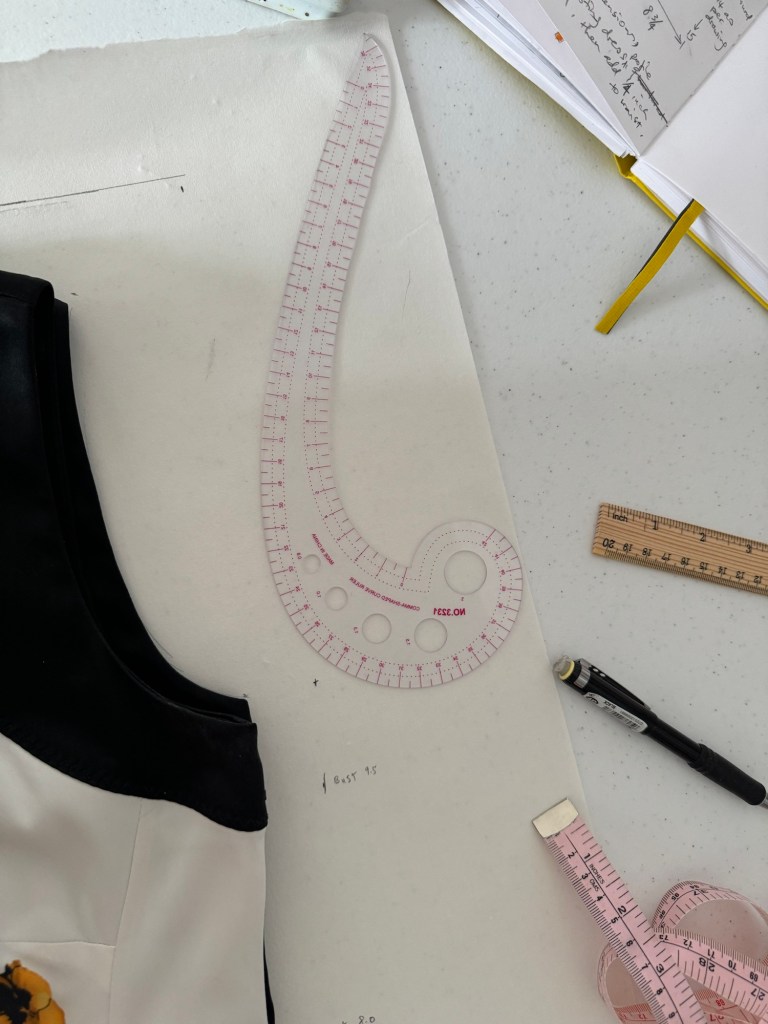
Dressmaker’s drawing tools were used to add in the curves and complete the pattern:
–––
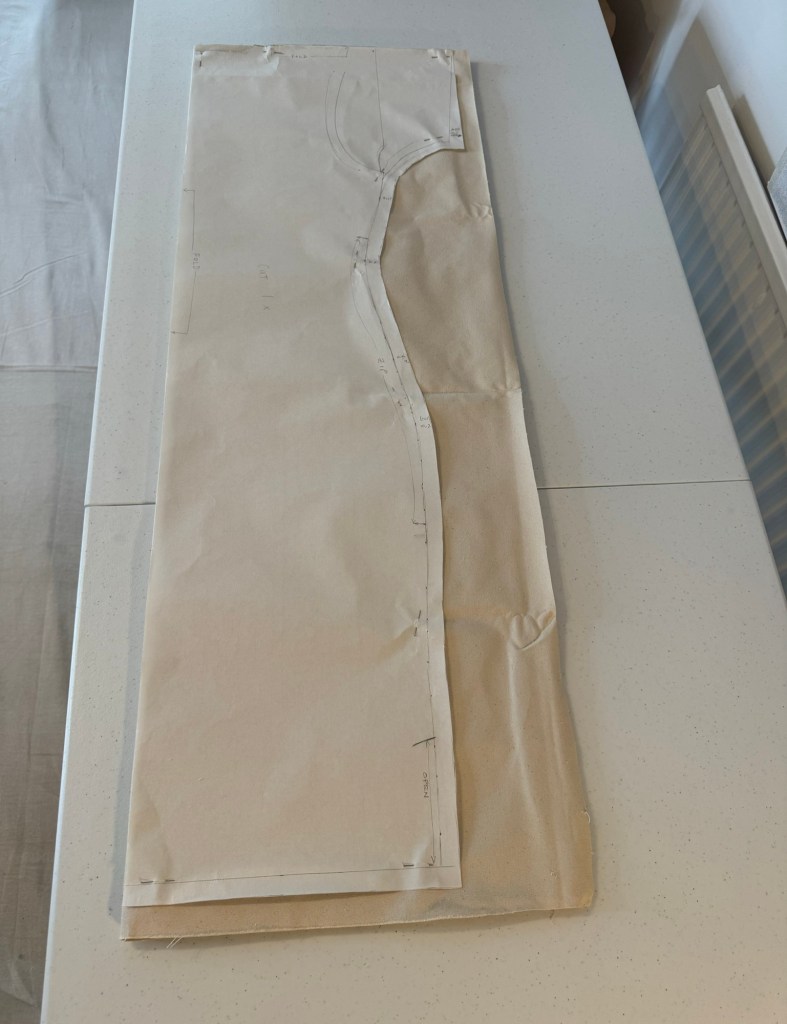
The pattern was pinned to the 240gsm cotton canvas for cutting:
–
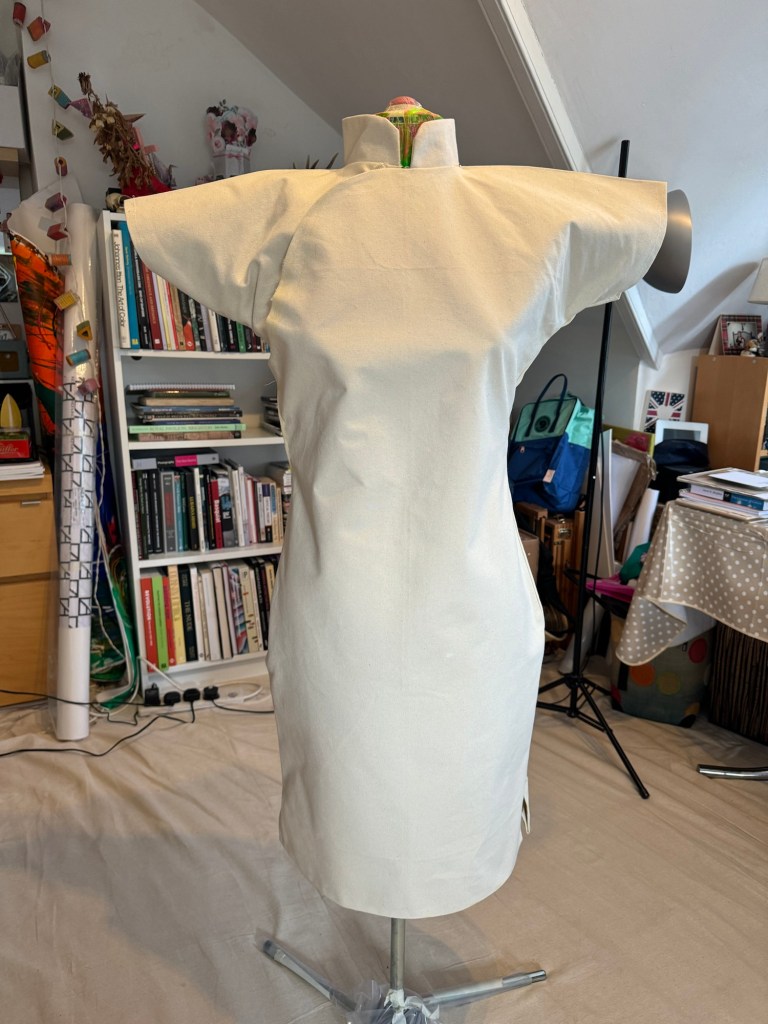
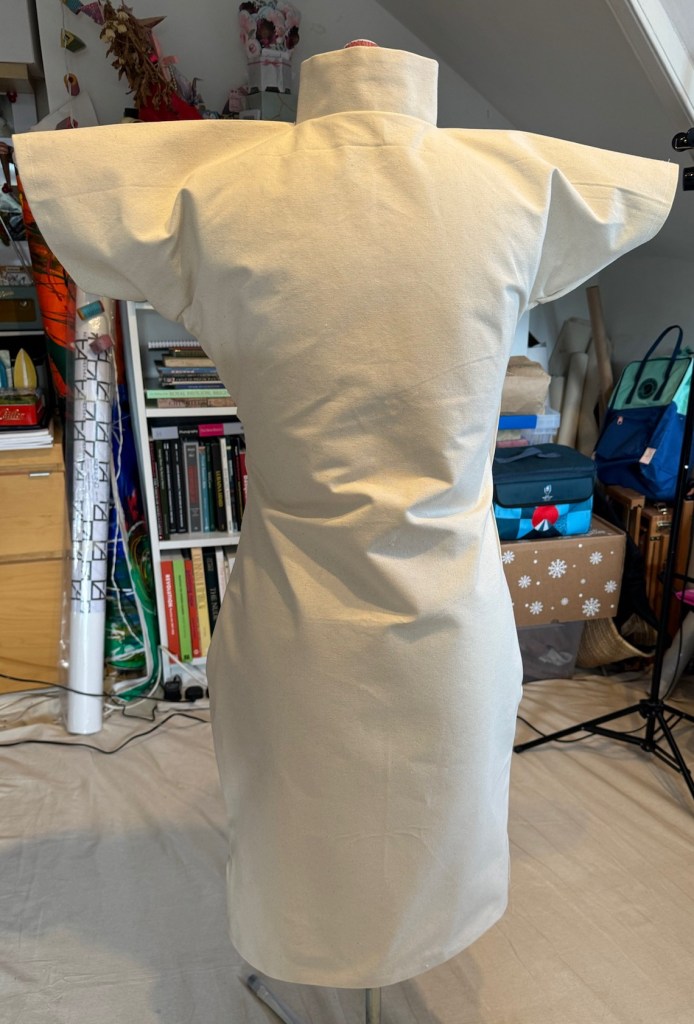
The dress was sewn according to the instructions:
–
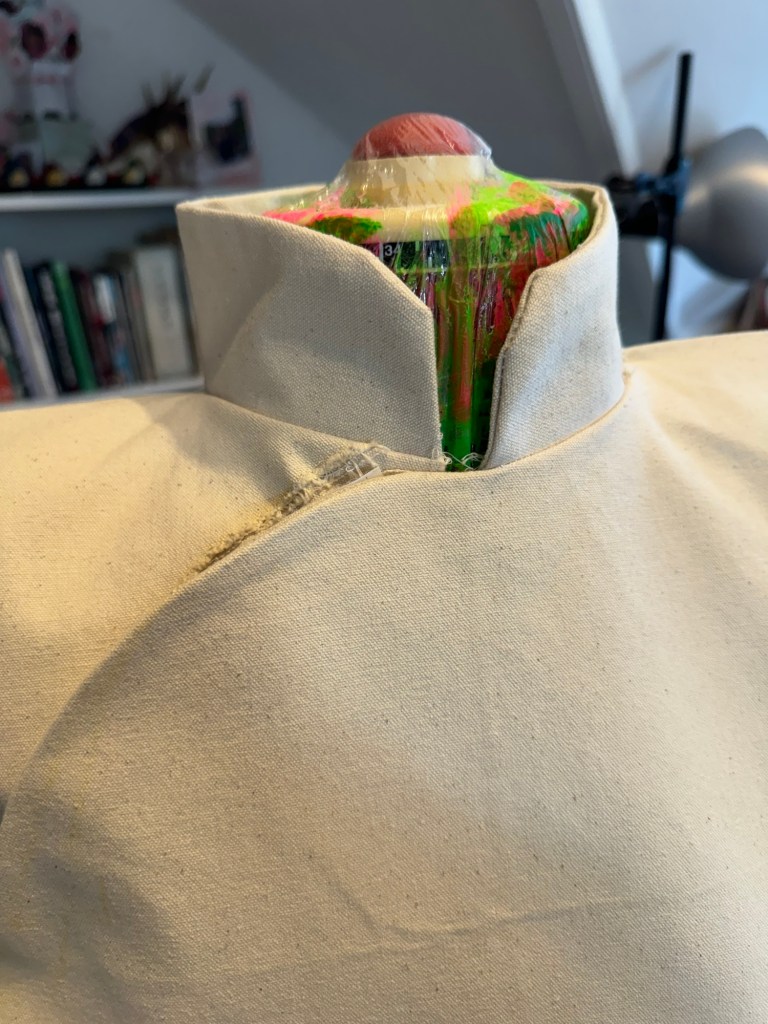
A mistake was made when cutting the front hence a part of the seam was showing. Hopefully it would be less obvious once the dress was painted.
–
Back view:
–
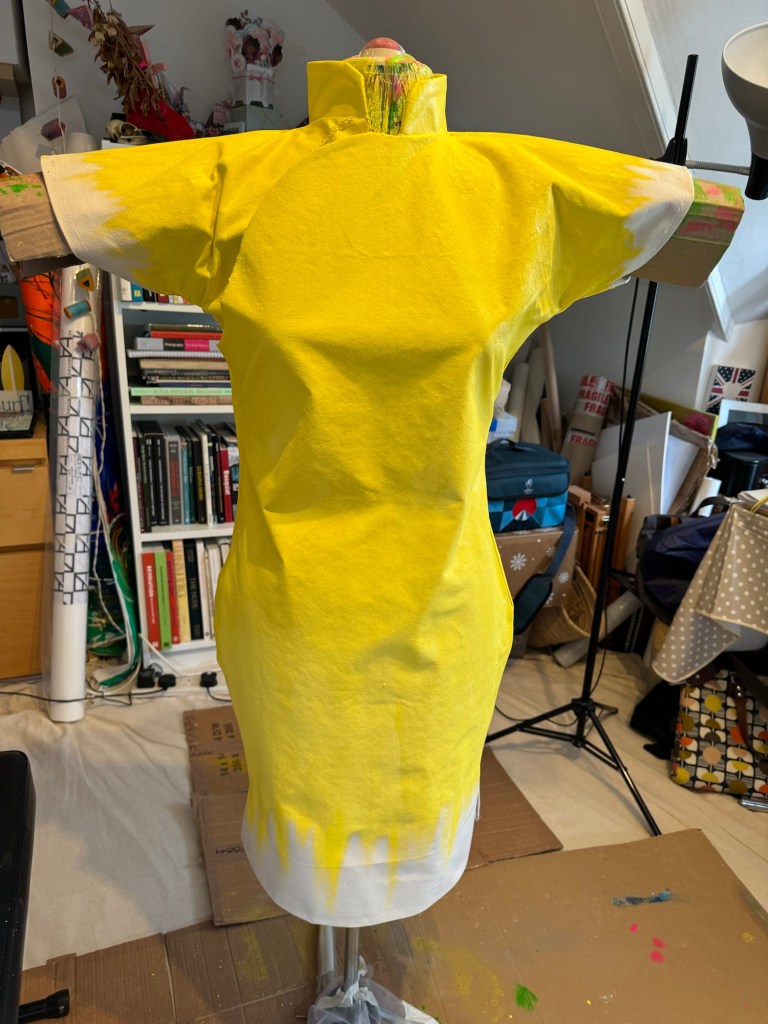
The dress was painted with a vibrant yellow colour – a mixture of gesso and acrylic paint to prime the canvas.
–
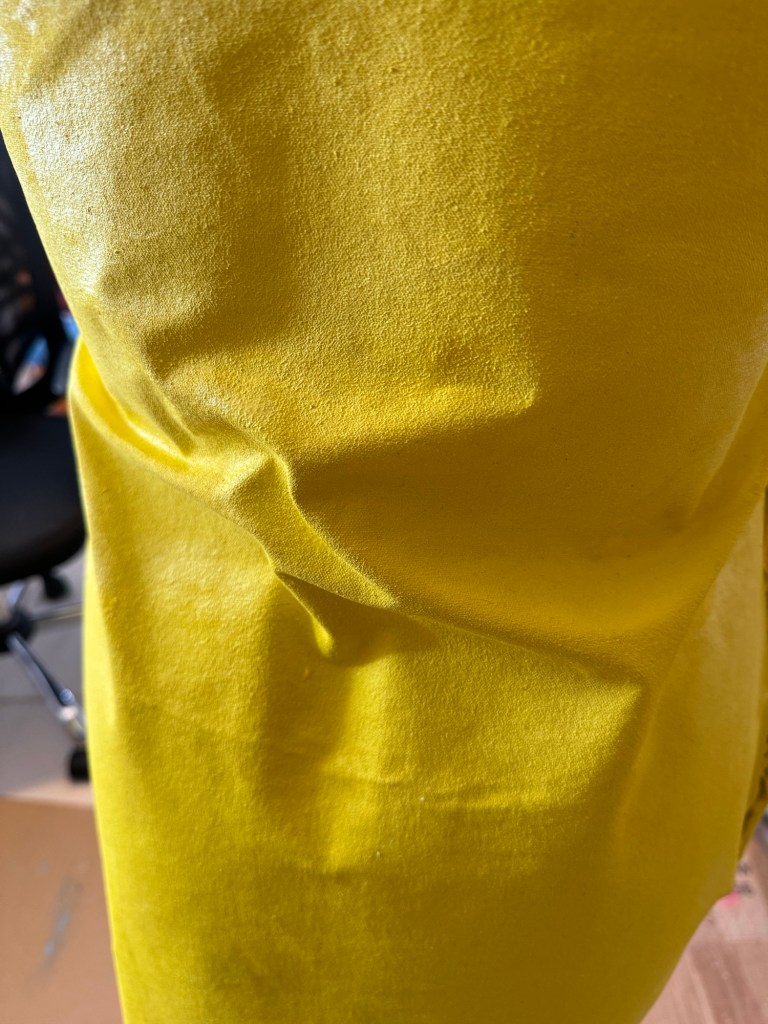
Due to the stiffness of the fabric, there were areas around the waist where the painted fabric was creasing heavily. That’s not great for painting so would need to find a way to minimise this problem:
–
REFLECTIONS
I was very pleased to find the simpler dress pattern especially because that made it easier to use thicker canvases for painting as I wanted to go into painting in oil which is a medium that I preferred.
However, not sewing in darts has caused the fabric to crease heavily around the waist and I needed to find a solution rather than adding darts to such a heavy fabric. Despite this, I was very pleased with the progress of experimenting with a new pattern that would really speed up the process of making the Cheongsam canvas.
LEARNING
I was frustrated by myself in missing out one small step when cutting which led to the seam being shown on the front chest area. Lesson learnt and I have made a clear note in the pattern as a reminder for next time.
NEXT STEPS
Find a solution to minimise the creasing around the waist and start painting!

 elizarawlings