MA Y1 U1: Time and activity analysis – ongoing log

BACKGROUND

For the MA course, the guideline is to work on average 20 hours per week throughout the year, or 30 hours per week if only working during term time.

Work can be anything ranging from making, research or ideation. I am using the Toggl Track App on my phone to help me track my hours spent on the course and the hours are logged against the activity type. I plan to log a summary report at the end of each month to keep track of progress. However, the informal time spent thinking about my practice whilst going about day-to-day life is not recorded as they tend to ‘just happen’.

The purpose of monitoring my hours is to help me to establish a working rhythm so I know what it feels like to work the required hours for the course on an ongoing basis. It will also help me to plan and allocate time in my week to do the work. The analysis by activity type helps me to balance time for the different aspects of developing my practice so I can watch out for trends, e.g. spending too much time researching and not enough time making.

REPORTS

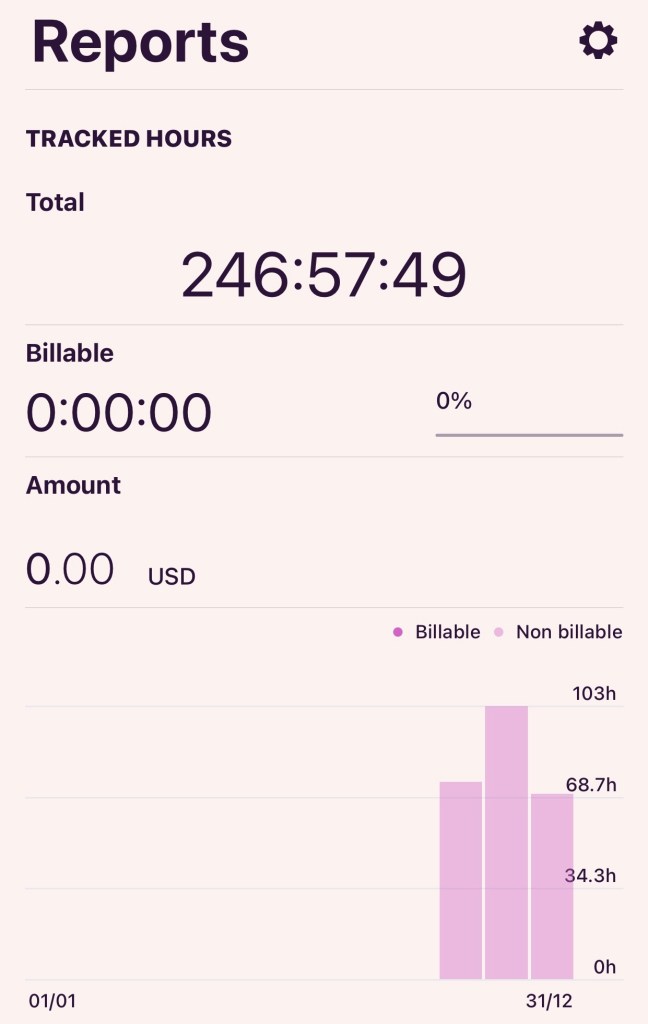
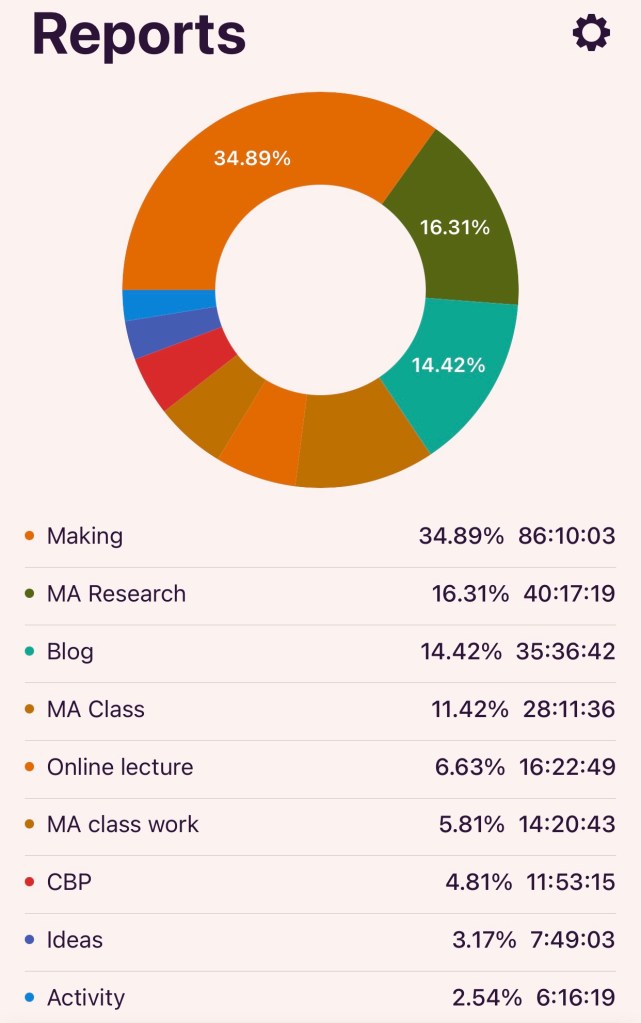
Each report will show the total number of hours worked per month and hours spent according to activity categories.

Key: ‘CBP’ is Chinese Brush Painting; ‘Activity’ is typically outside the studio such as visiting exhibitions or local artists group activities. The rest are self-explanatory.

The reports in this blog are listed in reverse chronological order.

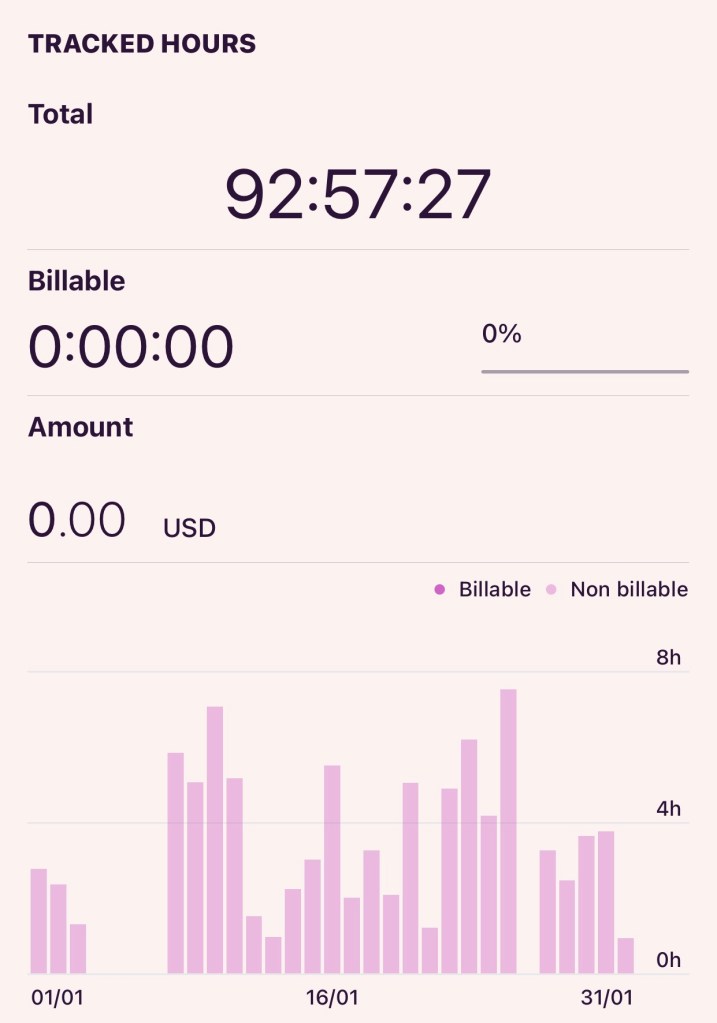
January 2024

A fair amount of time in January was spent on writing my study statement (captured under MA Class Work). For research work – I am reading a very informative book on The Modern History of Hong Kong which is a key part of my research on my heritage and the transcultural phenomena in the former British Colony. Also, I went to London for three days to attend a workshop at UAL LCF, to visit the CSM campus and two galleries (Tate Modern and The RA). As a result of these activities, the amount of time spent on making was less than I wanted for January. My plan for Feb is to really ramp up my making time because I expect to have less studio time in March due to the low residency in London.
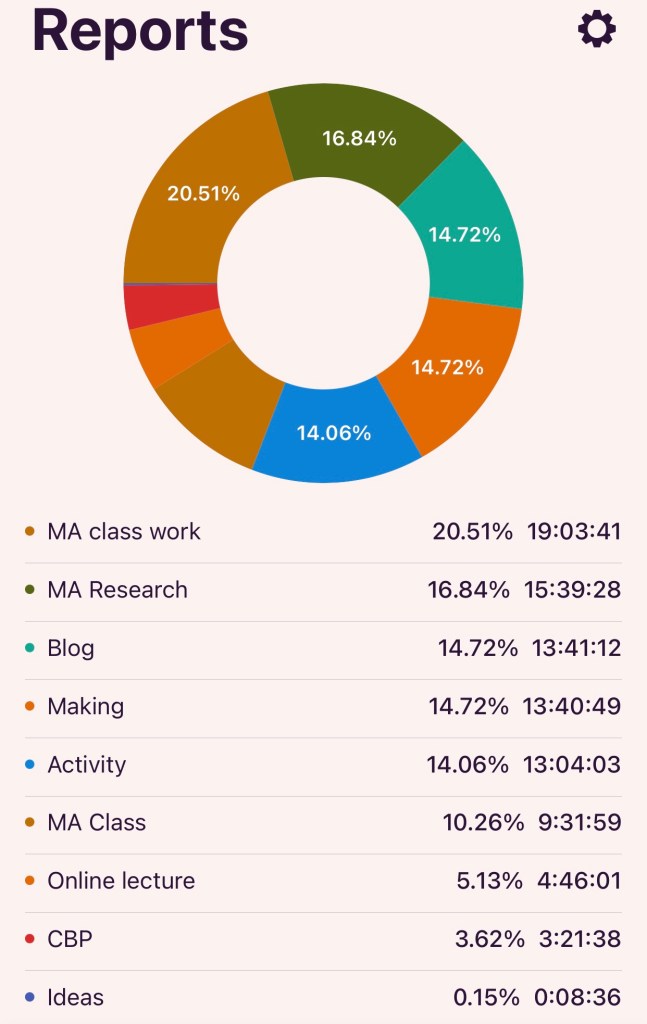
Report at the end of December 2023:

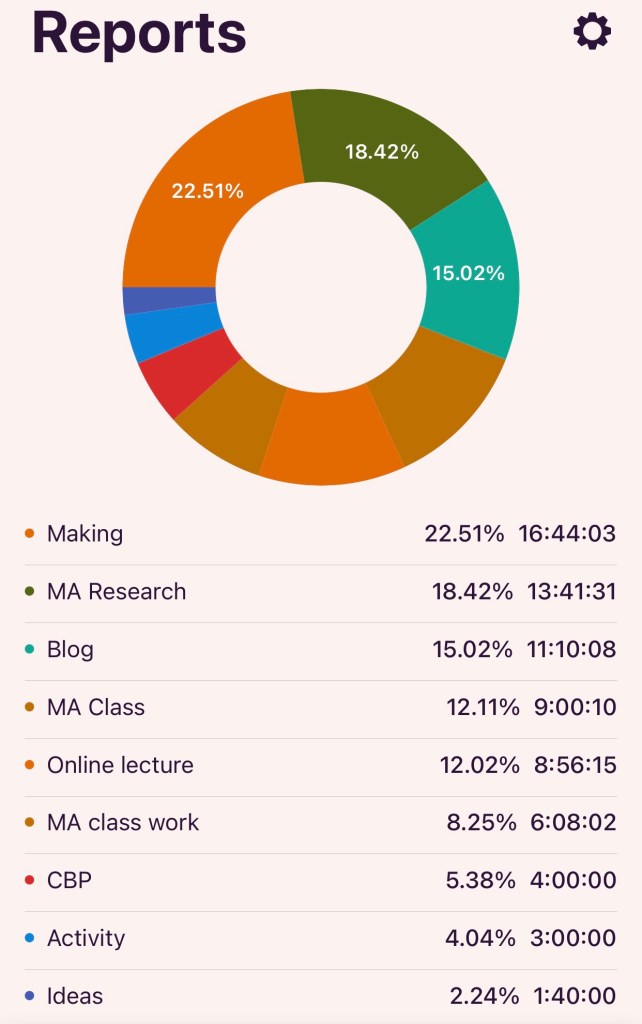
Below is the report for the total time spent during the first term, i.e. Oct, Nov and Dec 2023.
Below is the time and activity analysis for the first term:
Reflections (end of Dec 2023):

My reason for doing this time analysis was to establish a rhythm in order to make the most of the opportunity of this MA course. I am happy with the overall time spent and the split between the different activities. During the first term, I feel I have established a rhythm that is sustainable going forward and I plan to continue to monitor my progress using this tool.

November 2023

This is the first full month of the course and I didn’t have any trips away, so it was easier to fit in time for work. Below is report for the whole month of November.
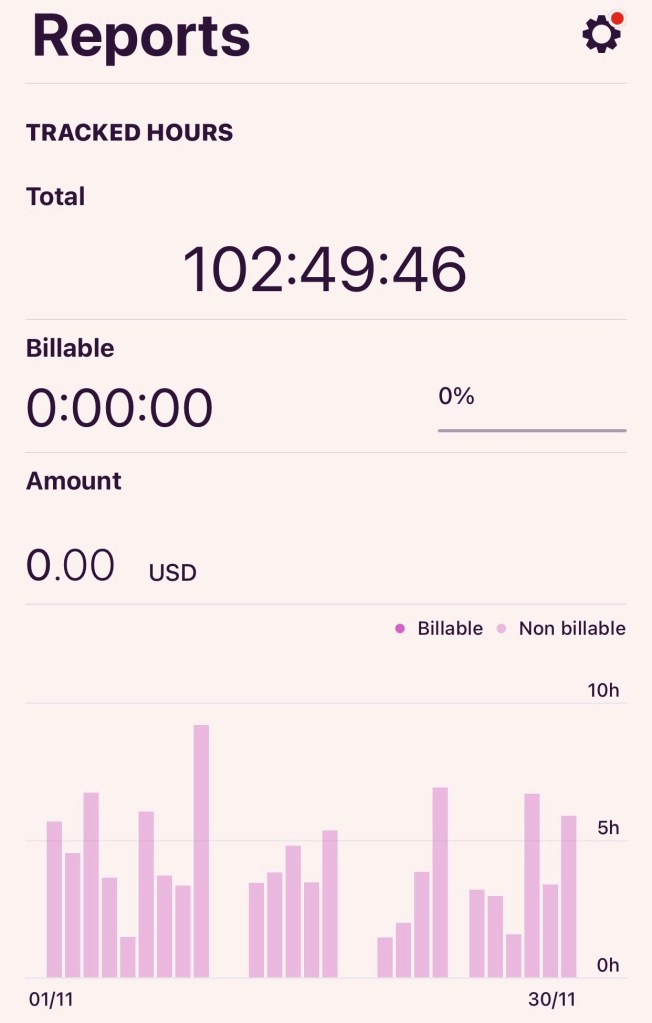
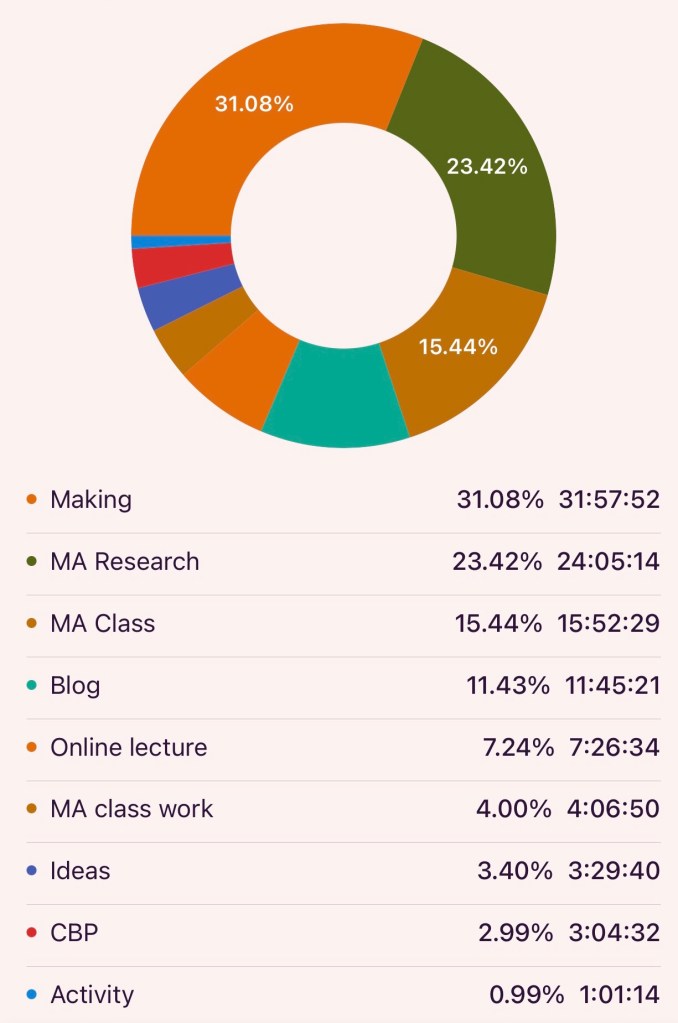
Reflections (End of Nov 2023):

I have found the Toggl app very helpful and easy to use in tracking my time. I really want to make the most of the MA course so establishing a rhythm and knowing what the right rhythm feels like is useful for me. Having a way to meaningfully monitor my time is also assuring so I know I’m not spending too little or too much time on something. I know that time is a quantity measure and doesn’t reflect quality – but it’s a start in holding myself to account for the opportunity that I have with the course.

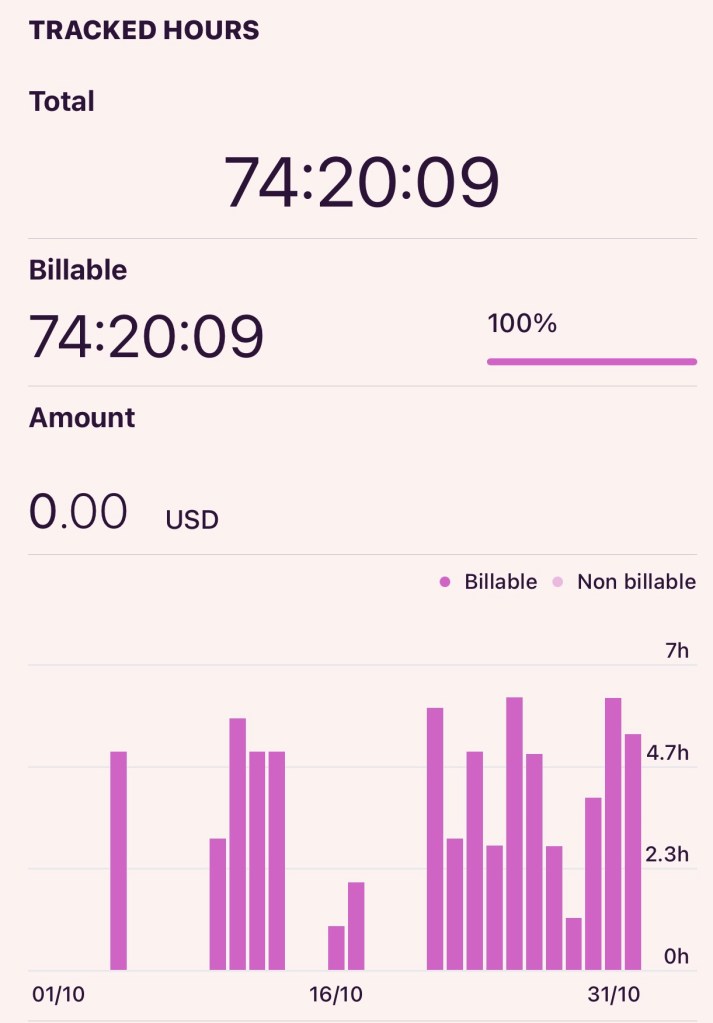
October 2023

October was the beginning of term and work on the course didn’t really get going until week 2 of the month.
MA Y1 U1: Progress update – ongoing MindMap

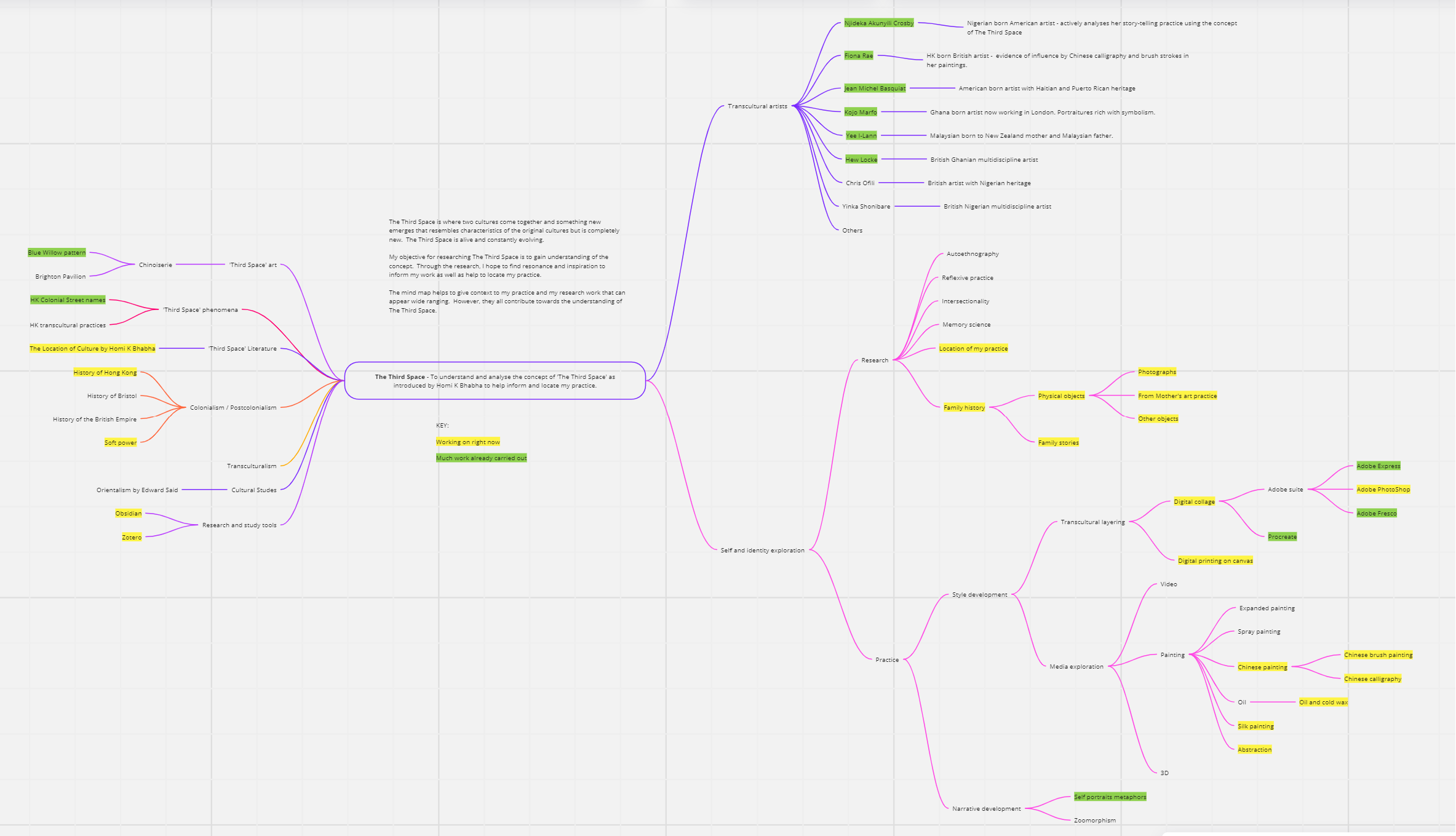
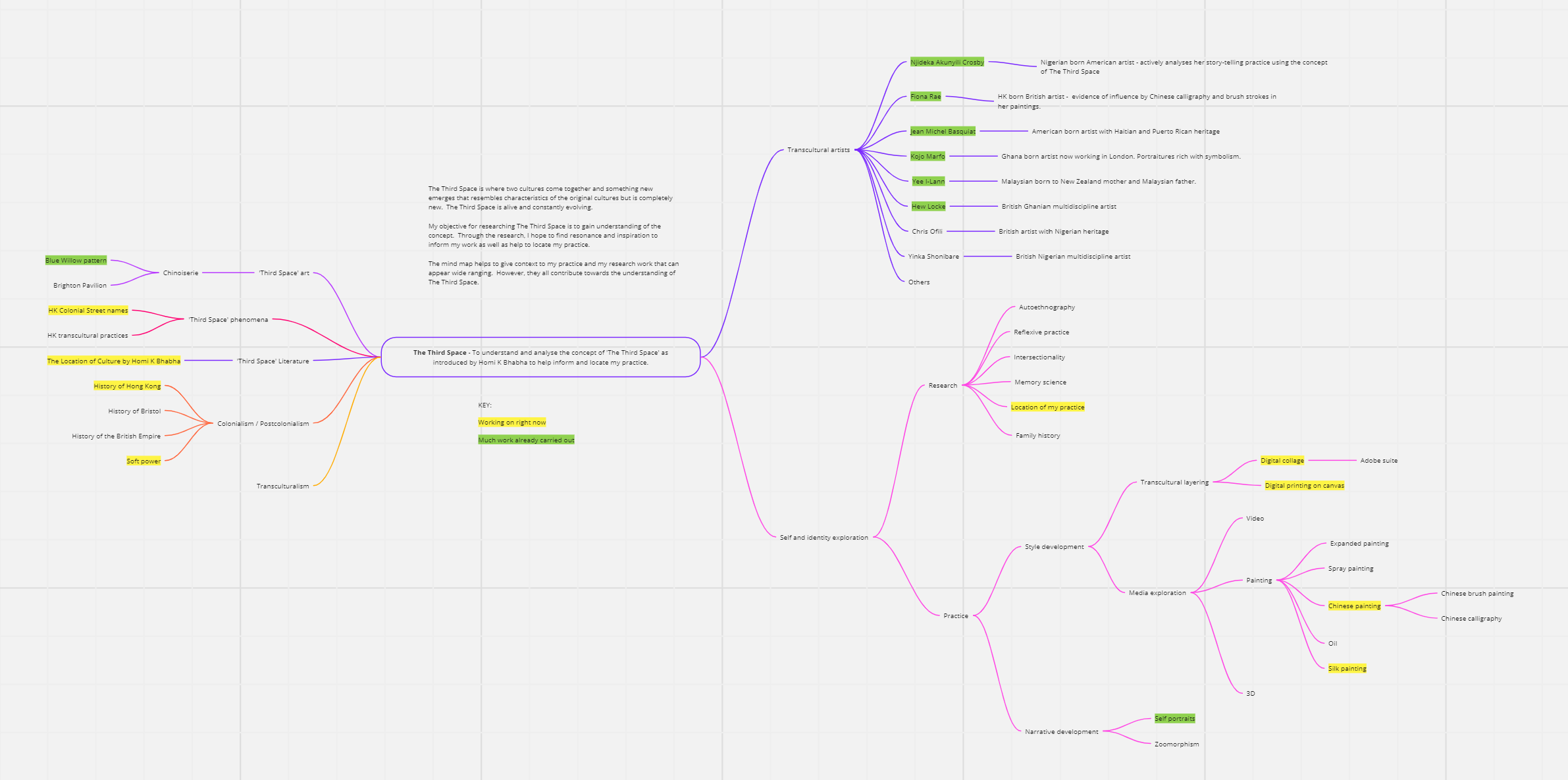
I created a MindMap at the start of the course to chart the topics that I have been working on and intended to work on. I plan to periodically update the MindMap and this is a blog to quickly capture my progress over time. I expect the map to expand or change as my practice and research grow. I am mindful not to let such a structure confine my practice development – this point was discussed with my tutor at the first tutorial.

My reason for creating the map in the first place was to examine the central purpose of my practice. Then to ensure that all the topics I am working on do contribute towards the central purpose, rather than going off in random tangents. This is important to me because of who I am; I like to freely explore but I need to have an underlying structure that I can come back to and not feel too lost in wandering.

The maps are shown in reverse chronological order.

Date updated: 11th December 2023 (End of first term)

REFLECTION:

I feel that The Third Space is still valid as the central purpose of my practice and I will continue in that direction. I have updated the map with the colour code – some items have gone to yellow and some turned green which was reassuring to know that I have worked on what I had set out to focus on. I have also added some new sub-branches which are expansions of existing topics. The only new branch was ‘Research and study tools’ – an area that I was not expecting but I am very pleased that through the MA course, I am learning about new tools that will help me to organise my research work. Since I have previously mainly used Microsoft Office products, this new knowledge and area of learning are completely new to me hence I felt I should capture them as a new area on the map.

Date created: 23rd October 2023 (Soon after start of Unit 1)

RELATED BLOG

The blog below is a time and activity analysis detailing the time spent on various aspects of my practice development on an ongoing basis:

MA Y1 U1: Time and activity analysis – ongoing log

NOTE

The time and activity analyses show what I have been spending my time on and the MindMaps show where I am working on in my practice map.

MA Y1 – Blogs planning

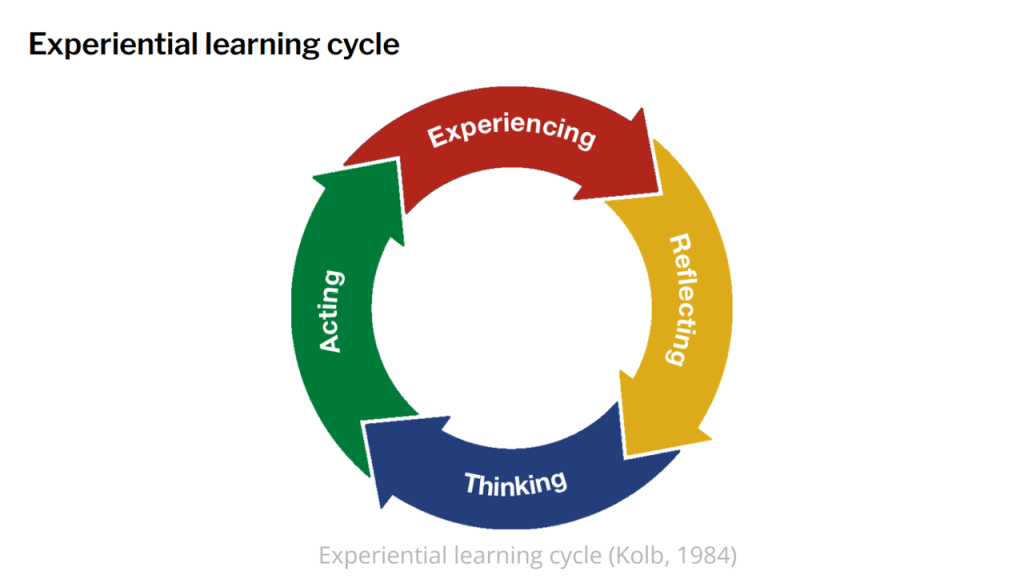
Structure of blogs – Kolb’s learning cycle

I plan to structure my blogs based on Kolb’s learning cycle. This is because I find the format helpful in guiding my thinking and learning process. The meaning of each stage is adapted with my personal interpretations to suit my practice development.

EXPERIENCING: What did I do?

– Under METHOD, I will capture my methods and decisions during the making process.

REFLECTING: How did I feel?

– Under REFLECTIONS, I will capture my feelings and thoughts throughout and after the making process. The intention is to be as broad and uninhibited as possible to include feelings about the creative process as well as any personal insight.

THINKING: What did I learn?

– Under LEARNING, I will bring the focus back to the context of my practice after being as broad as possible in my reflection. Here, I will capture my learning after analysing the insights gained in the reflecting stage.

ACTING: What will I do next?

– Under NEXT STEPS, I will capture my next actions that could be about making, research or any relevant activities in order to develop myself or my practice.

Categories

I will use WordPress for my blogs. I am planning to use the following categories to organise my blogs:

– Thoughts

– My Projects

– My Work

– My Writing

– Research

– Tutorials CSM MA FA

– Course notes CSM MA FA

Tags

I am planning the following tags for my blogs to start with. I expect to add to the list as my research deepens during the course.

– Transculturalism

– Colonialism and Postcolonialism

– Feminism

– Third Space

– Chinoiserie

– Digital Printing

– Chinese painting