BACKGROUND
As part of my research on The Third Space (Ref. The location of culture by Homi K Bhabha), I have been seeking out ‘third space’ phenomena from my memory and surroundings in order to gain a deeper understanding of the concept. To this end, I decided to research and do a project on the street names of Hong Kong.
When HK was a British colony, many streets were named after British Governors or officials sent to manage HK. Their English names were converted into Chinese (Cantonese) using transliteration*. As a result, the street names when pronounced in Cantonese are meaningless and often nonsensical. Since street names are such a fundamental part of daily lives, those strange sounding streets names have become a natural part of the day-to-day language without anyone questioning their nonsensical nature.
This project is to highlight the transliteration of HK street names as an example of a third space phenomenon from a place that has deep personal relevance for me.
METHOD
This is the first step and an experiment to test out the idea and process.
I researched online images of street signs in HK and picked out those that were transliterated from British names. Since the HK street signs nowadays are of a new design that I am not familiar with, where possible, I have chosen images that were from the 1960s, 70s and 80s – the period when I lived in HK and when HK was still under colonial British rule.
A digital collage of the road signs was made using Adobe Express then inkjet printed onto paper.
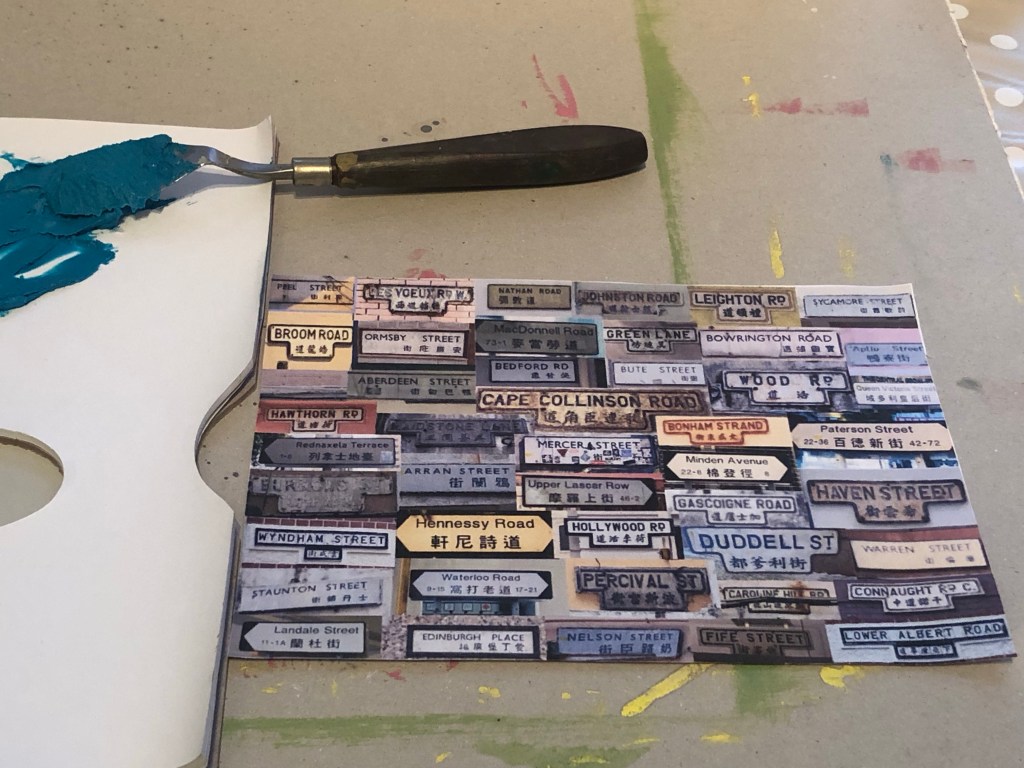
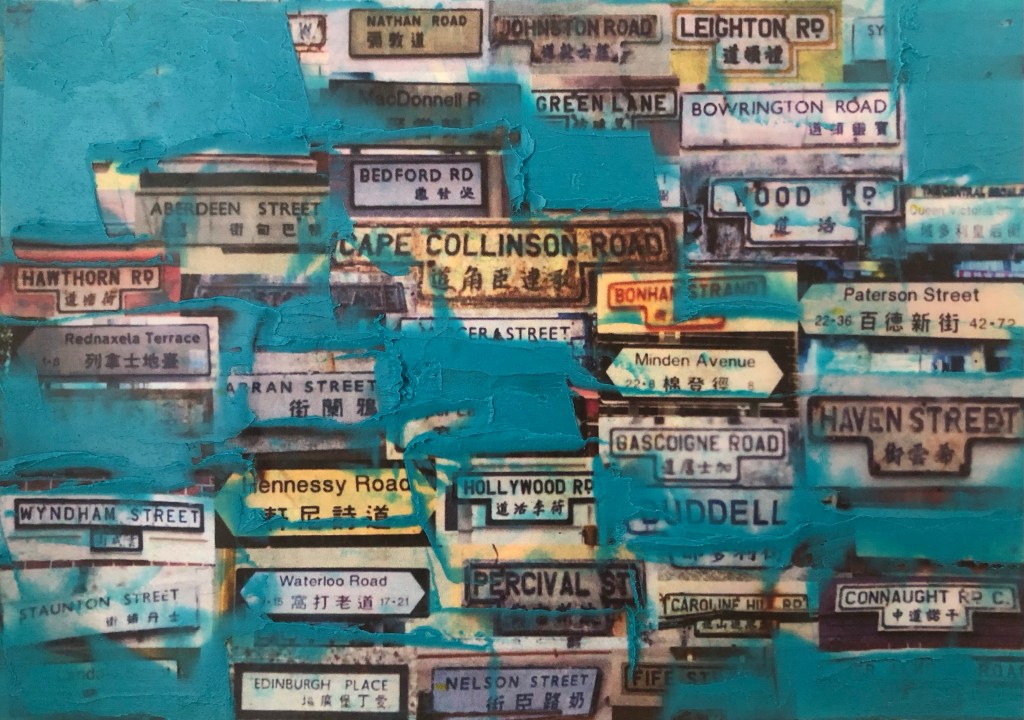
Teal colour oil paint was mixed with cold wax in 50:50 ratio and the printed image was covered in a thick layer of the oil-wax mix.

My iPhone was set up in video capture mode to record – I gradually scraped off the paint revealing most of the street signs one by one as I read out in English then Cantonese each street name. The purpose of the voice over was to enable viewers to hear the Cantonese transliteration.
–
REFLECTIONS
This was an experiment to test out the concept on a small scale before taking it onto a large canvas to create a painting. The aim is to ultimately create two pieces of work – a painting as well as a video accompanied by a piece of writing explaining the background of the street names used as part of my research into colonialism.
I believe the way these streets were named in HK was an example of how soft power worked in a British colony where the names of the colonisers such as Governors and Royalty were permanently imprinted into the day-to-day lives of the local people, serving as a reminder of the colonial power structure. The fact that road and streets were named in this way served as a constant reminder of who was in charge of the the land.
I started this project with casual research online, however, my interest in the topic increased as I went deeper into the research as it became clear the extent of the soft power exercised in these examples. As I looked at the street signs and read out each name, I could hear my late parents saying those names on a daily basis in conversation – which road had bad traffic jams, what was the shortest route to get to a place or giving directions to a shop. As a child, I listened to my parents using the transliterated and nonsensical street names like it was just normal. Everyone used those names without giving it a second thought. I left HK when I was a young teenager and never lived there as an adult. I now wonder what it was like for my parents to live their whole lives in a colony, to live, work and bring up children as colonised subjects. Doing this project has caused me to think about that more deeply. I always feel conflicted when I think about this topic – HK was a British Colony with in-built structural injustices that came with being colonised, but HK also became successful globally partly due to the commercial, legal and justice systems that were put in place by the British bringing prosperity to the city and stability for the people. This is a conflicted feeling that I will continue to examine – just like the transliterated street names, what seemed natural or normal once upon a time, now no longer make sense and I am still trying to unpack that conflicted feeling.
Regarding the art work, I was pleased with the outcome of the project, especially as an initial experiment. Through my research, I have found many more interesting facts about the naming of streets in HK, I could potentially divide them into categories and make several art work to create a series.
LEARNING
In the context of my art practice, this research project has helped me to gain a deeper understanding of The Third Space as coined by Homi K Bhabha. The phenomenon of the street names researched here is unique and only came about as a result of the English and Chinese languages coming together through colonisation. There is also the underlying cultural influences from both sides, e.g. holding military personnel in high esteem for the British and in the case of Bedford Road, the Chinese name reflecting the entrepreneurial mindset of the locals.
I am been struggling to make art through examining my third space – one that is personal to my lived experience. I have struggled to create images that is a result of that third space, instead, I have been layering together distinct images from the two cultures that have influenced me. To expand on this point with an example from the HK street names:
Example – take Wood Road that was named after John Roskruge Wood, an acting chief justice during the colonial period. If it were translated into Chinese, the character 木 for wood (as in wood from trees) would have been used. Instead, the phonetic sound of Wood was used in the transliteration, hence the Chinese character 活 meaning alive or living was used to get the closest sound to Wood. The Third Space phenomenon gave rise to a very different outcome.
Analysing the HK street names was the first time I found a concrete example of the third space phenomenon that is relevant to me and my heritage. So I will continue to research this topic as well as look for other signs of the colonial era in HK that may help with my personal identity research.
Whenever I struggle with creating images for my third space, I come back to researching the work of the artist Fiona Rae because I feel she has captured the essence of the third space well with her British and Asian influences. I will continue to research her work.
NEXT STEPS
– Repeat this work on a larger scale using proper canvas material to make a painting and a video.
– Test the video on non-Chinese speaking people to see if the transliteration sounds were noticeable, i.e. is the video voice over meaningful.
– Complete the piece of writing to accompany the art work.
– Research deeper into the HK street names to potentially make a series of work on this theme.
– Research further the history of HK to look for other third space phenomena to inform my personal identity work.
– Research Fiona Rae’s work and find more transcultural British/East Asian artists to add my list for research.
ADDITIONAL RESEARCH INFORMATION
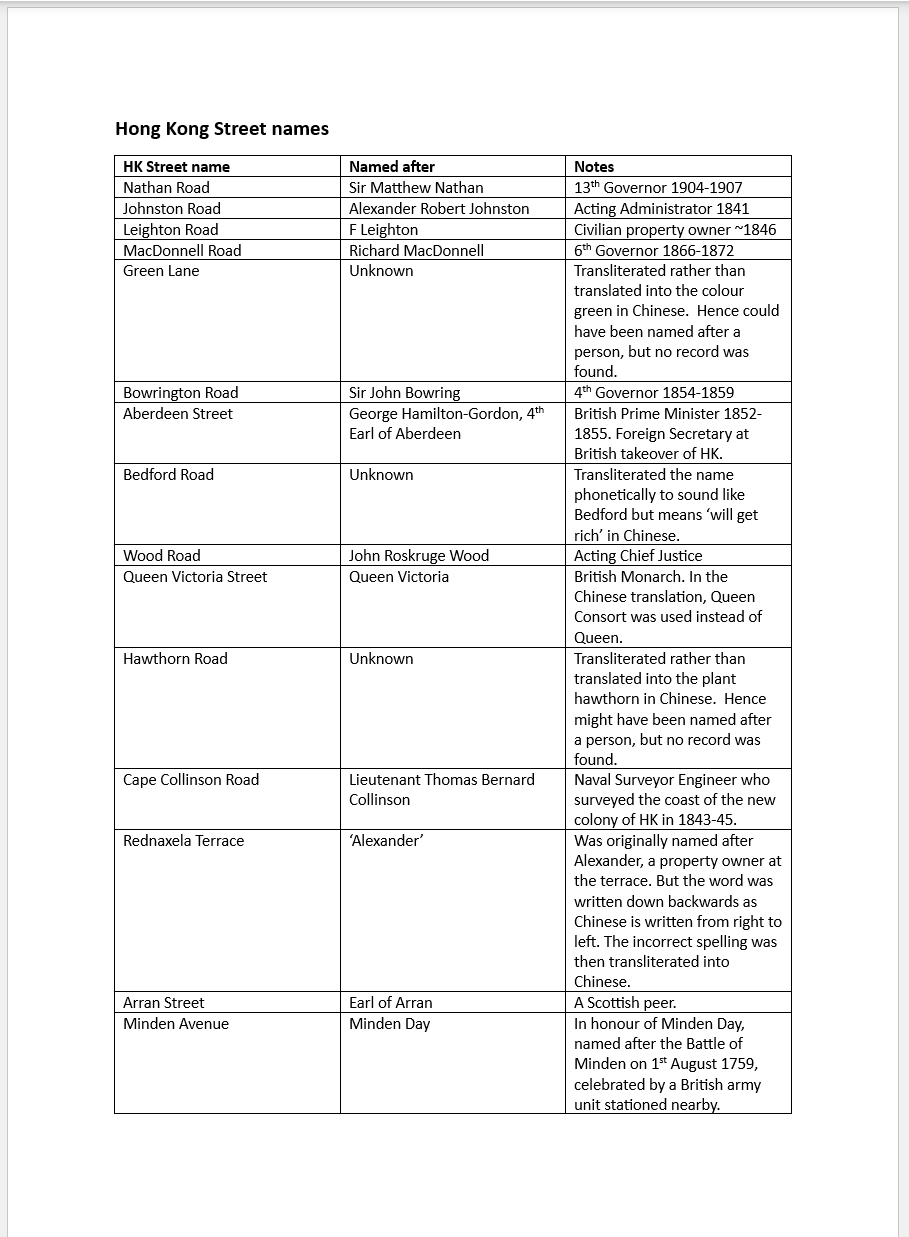
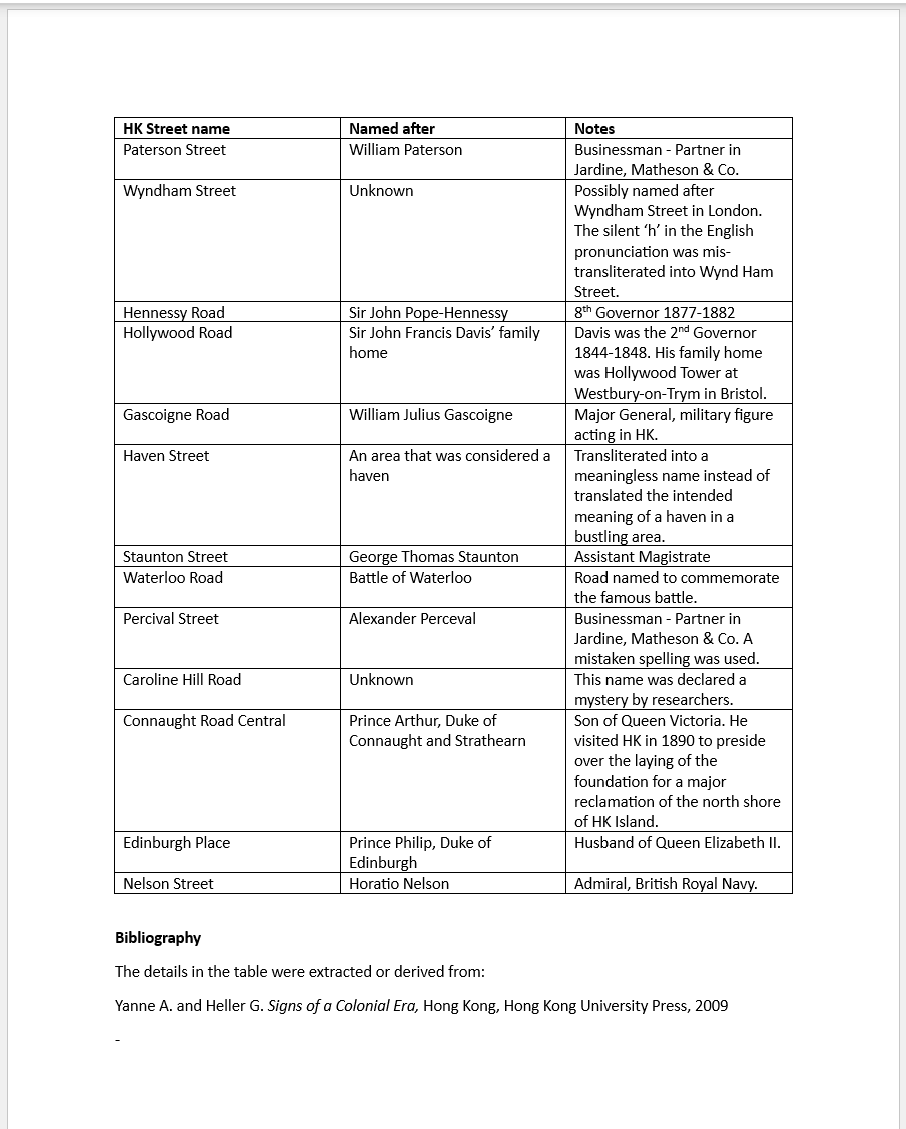
Below is a table showing the background of every street name revealed in this painting and video – whom they were named after as well as amusing mistakes in translation or transliteration.
* What is transliteration?
Below are blogs and extracts explaining the meaning of transliteration in the context of this project.
The Meaning of Transliteration – Blog (aussietranslations.com.au)
Extract:
Translation provides the meaning of words in a second language. Transliteration does not provide the words’ meaning but it makes it easier to pronounce them. Transliteration alters the letters from a language or alphabet into characters of a similar-sounding in a different alphabet. It is quite clear that there is frequently a demand for the transliteration of some languages, especially in this globalised world where people who do not share the same language can have some access to languages with a dissimilar alphabet.
What’s the difference between translation and transliteration? | Foreign Tongues
Extract:
A transliteration doesn’t tell you the meaning of the word, but it gives you an idea of how the word is pronounced in a foreign language. It makes a language a little more accessible to people who are unfamiliar with that language’s alphabet.
 elizarawlings