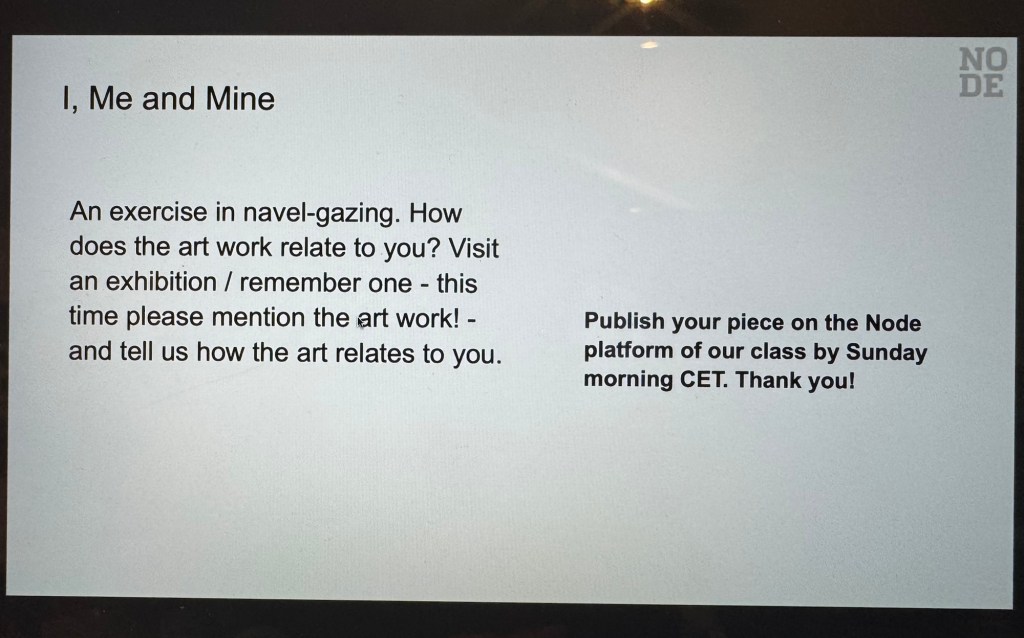
Assignment:
Submission:
Coming from an engineering background where accuracy and precision are essential and at times critical to the work, I have found it liberating to study and practice art. Liberating because ambiguity is valued in art and it is ok to not have an answer or to leave it open for interpretation. Whereas communication has to be literal in engineering. If you have built a bridge to take a maximum of 50 cars at a time, then that limit must be correct and adhered to. You cannot say to the users ‘Maybe 60 cars is ok, not sure, what do you think? Perhaps just try it.’ The consequences could be disastrous.
But liberating the mind takes immense effort, it requires the brain to relearn how to see, think and interpret. It is mind-bendingly hard. When I first saw ‘The Treachery of images’ (1929) by Magritte – an oil on canvas painting of a pipe with the caption (translated into English) ‘This is not a pipe’, I struggled. The art work is literal and ambiguous at the same time. The drawing is clearly of a pipe, but not a physical pipe. Therefore, the caption is accurate – it is literal from that perspective. However, if someone had asked me, ‘What is that?’ I would have reply, ‘That’s a pipe’ when it is clearly a painting of a pipe and not a pipe. For me, the ambiguity comes in the interpretation of the art work and in trying to understand the artist’s motivation.
Googling the meaning of this artwork yields many different interpretations. The interpretations vary from ‘representation vs reality’, ‘the authority of language vs visual representation’ to more philosophically, ‘the relationship between words, images, and objects is not as straightforward as we might assume’. I do not know if Magritte ever explained his work with a definitive explanation (I hope not) and his later work ‘The Treachery of images’ in 1952, an ink drawing of a pipe with the caption ‘This continues to not be a pipe’, was another effort to poke his viewers to continue the search for the meaning of this very literal artwork.
The persistent tension that Magritte maintained between truth and fiction, reality and surreality is one of the great achievements of his surrealist art; it will no doubt continue to cause us to scratch our heads in search of the meaning despite the literal message that has been plainly laid out before us. I am thankful that through my art learning I have come to understand that – it is ok to not know the answer.

 elizarawlings