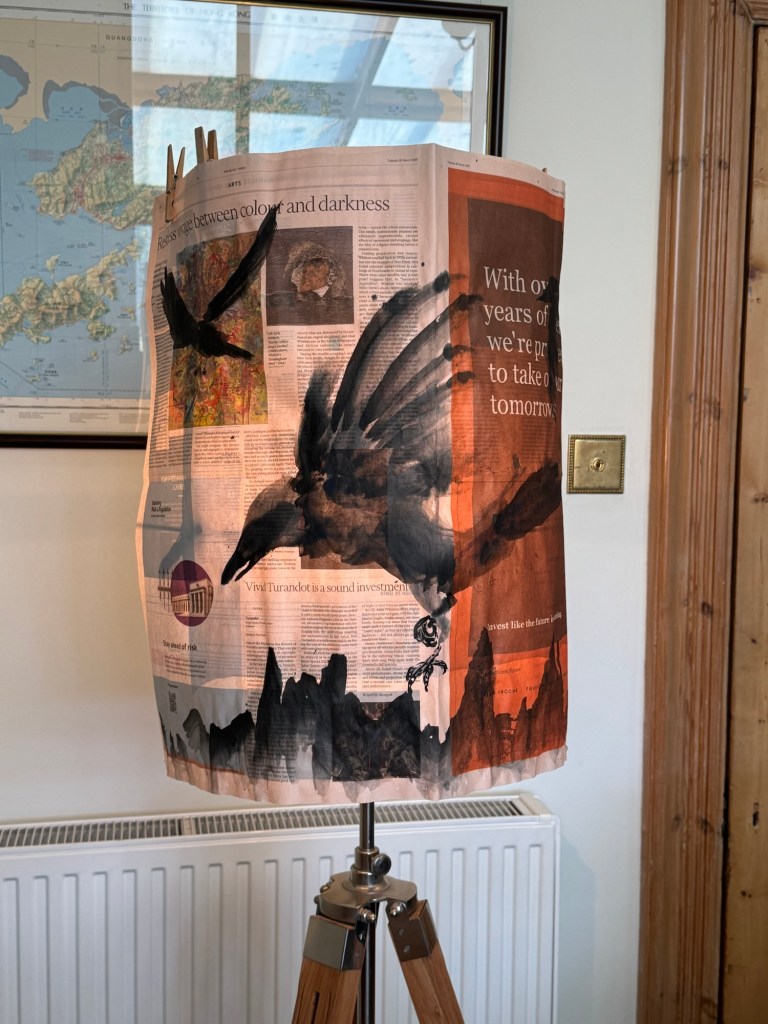
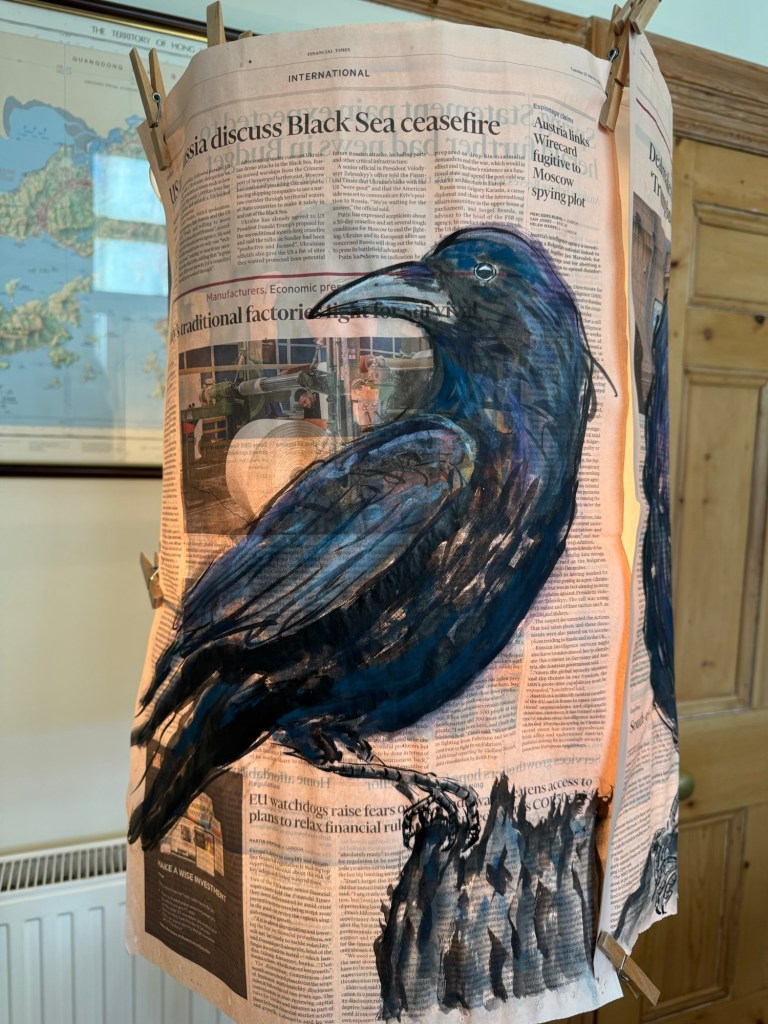
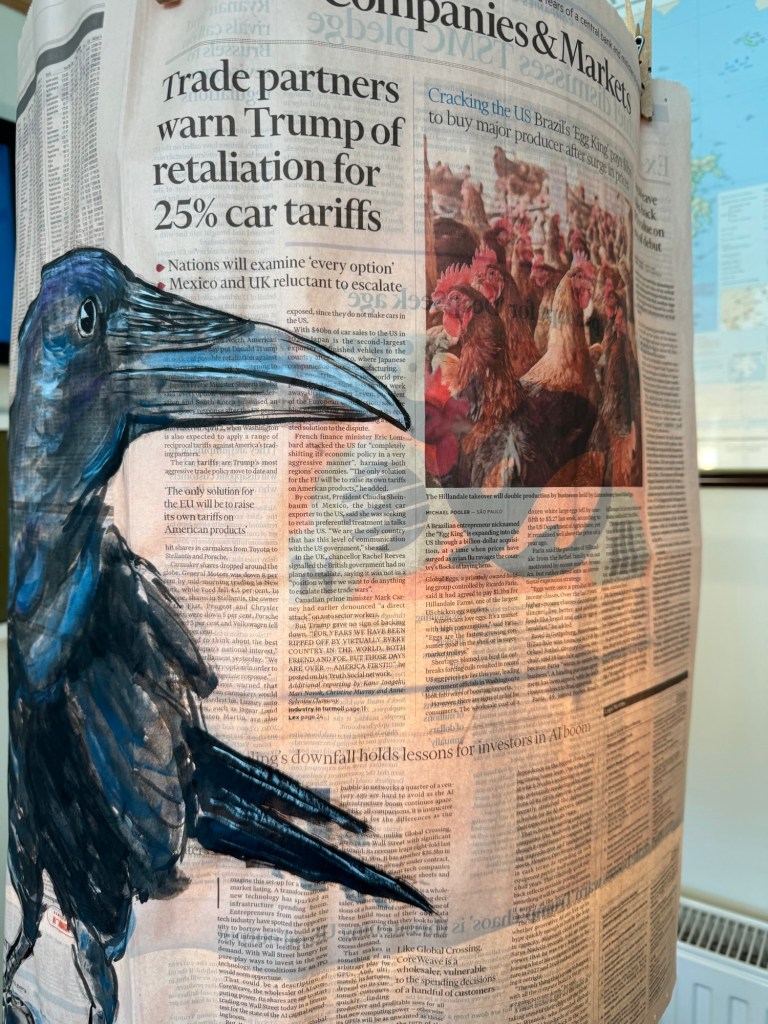
Returning to oil: timed painting

EXPERIENCE

In the last year, I have been mostly drawing or painting in Chinese ink for my ‘News’ series of work. Whilst ‘News’ is still an ongoing project, I have returned to painting in oil. Somehow, the winter months make me want to paint in oil with the hours of tinkering in the dark evenings.

My other reason for returning to oil is to explore additional ways to paint on newspapers. I have so far only painted on newspapers with Chinese ink for ‘News’ and I want to experiment with oil on newspapers.

I have felt for some time that I have reached a plateau with my oil painting; I also received some feedback from my MA about painting in thinner layers. So I feel it’s time to take that further and develop my oil painting techniques.

I joined a local public art class on ‘oil painting – improvers’, hoping to explore develop further. In my first lesson, I discussed the use of Winsor and Newton Liquin with my tutor and I experimented with it for a crow painting on canvas board:
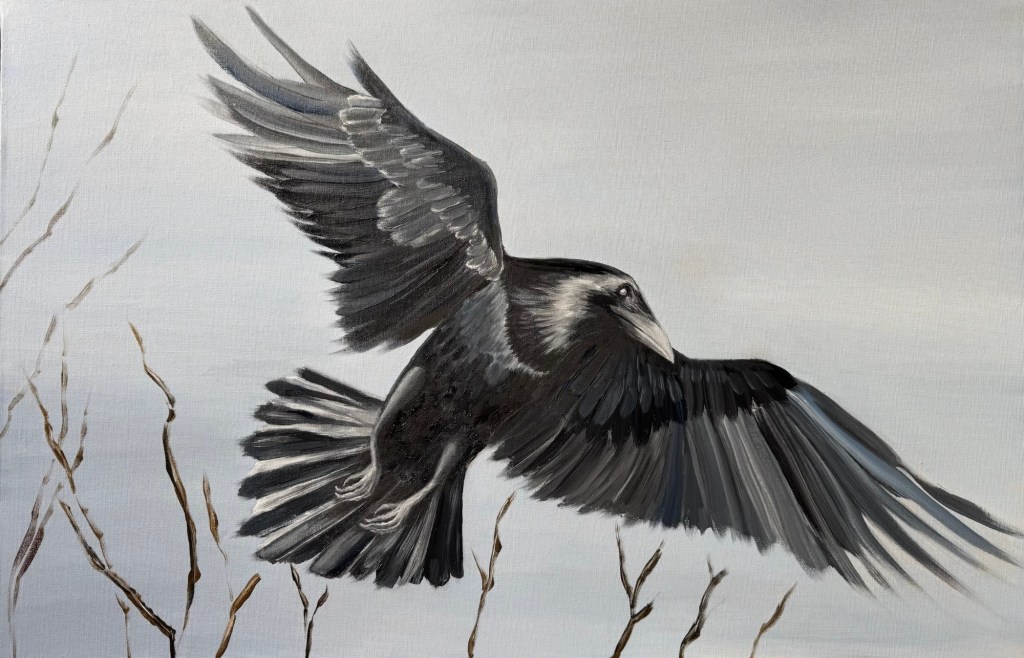
Oil on canvas board, 76x51cm

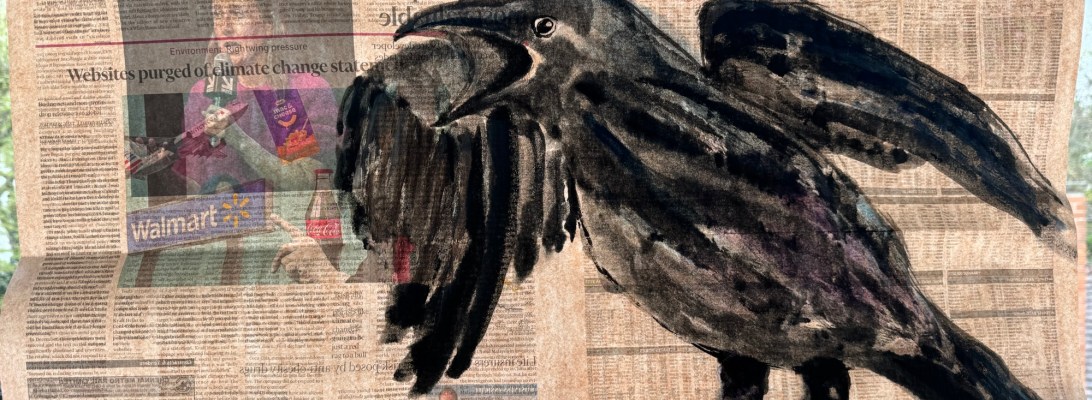
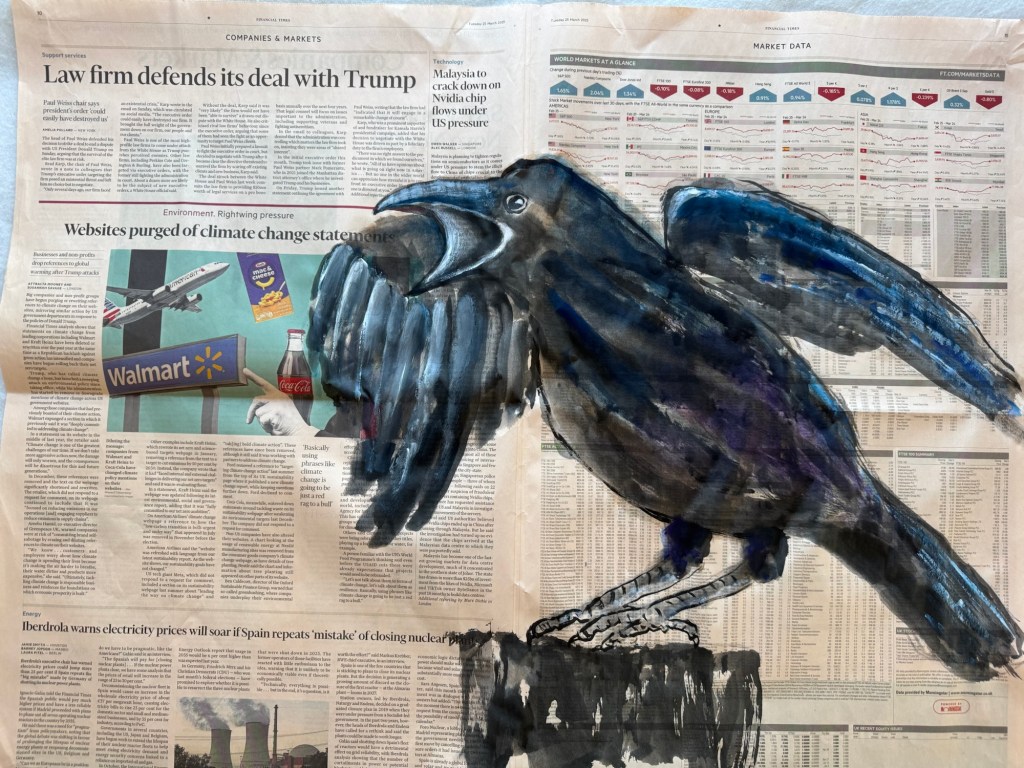
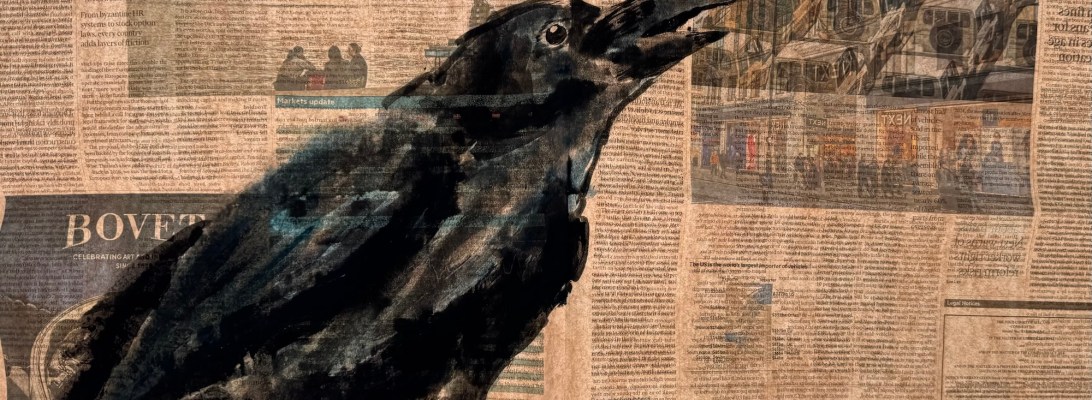
I also painted a crow on newspaper. Here, I made a news article collage on a board, then applied one layer of clear gesso and painted on top:
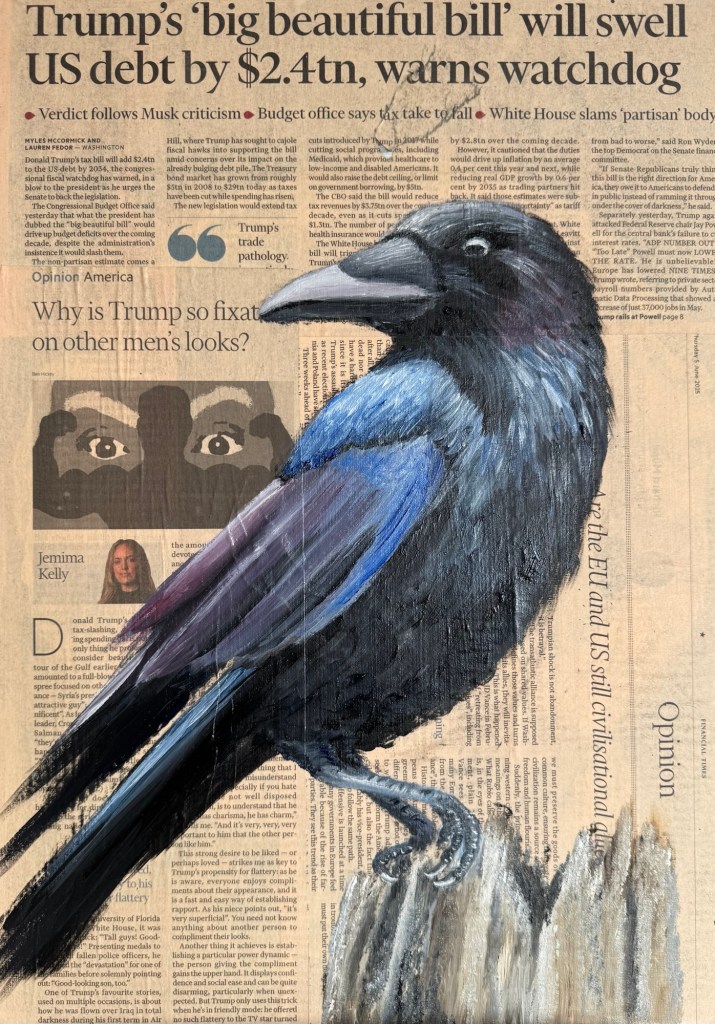
Oil on newspaper, size A2

I was hoping to use Liquin to make the oil behave and flow more like ink on the newspaper – it has made it more fluid and I could use soft synthetic brushes to apply the oil to reduce the drag on the canvas, but it is still oil which was ok. I was happy with painting in thinner layers but I was still focusing too much on the fine detail. I wanted to be more loose and I discussed this with my oil tutor.

My tutor made the following comments:

-Painting from photos makes one more prone to focusing on the details.

-Having lots of time can draw the painter into over focusing on the details.

-Suggested exercise to try – set a time limit to make a painting, say two hours, then just get the whole painting done in that time. It’s ok to go back and improve afterwards, but try to get the whole thing done in two hours.

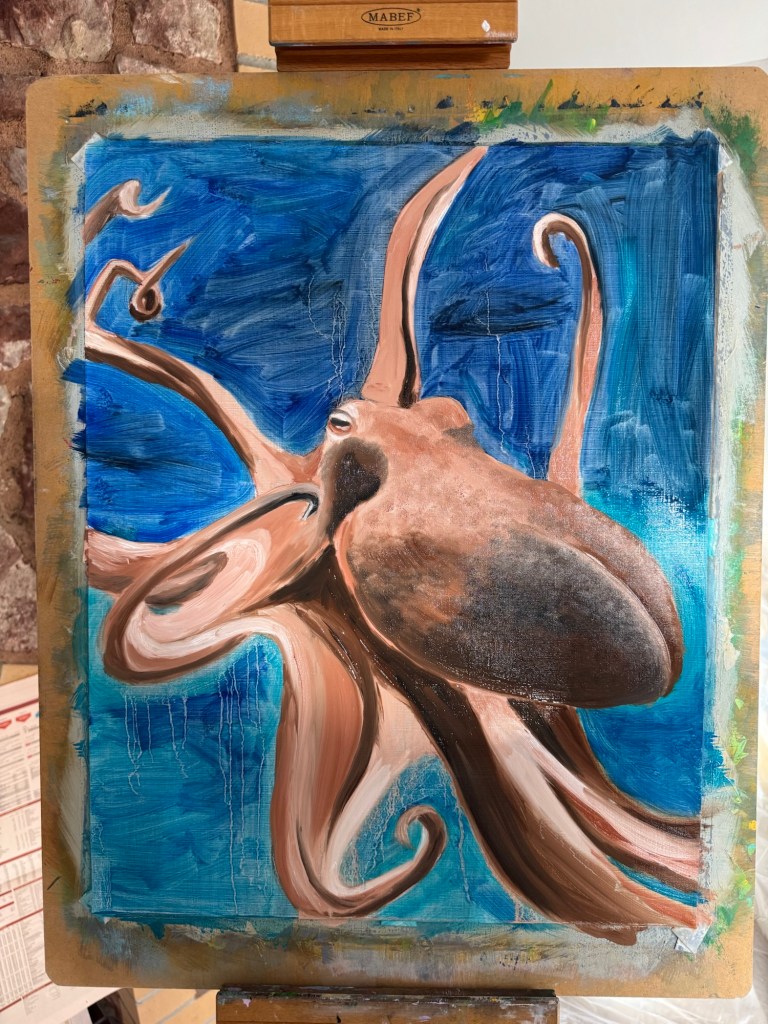
For the two hour exercise, I decided to painting something that I had not painted before, so I chose an octopus.

An outline of the octopus was marked out then a lean layer was added for the octopus.
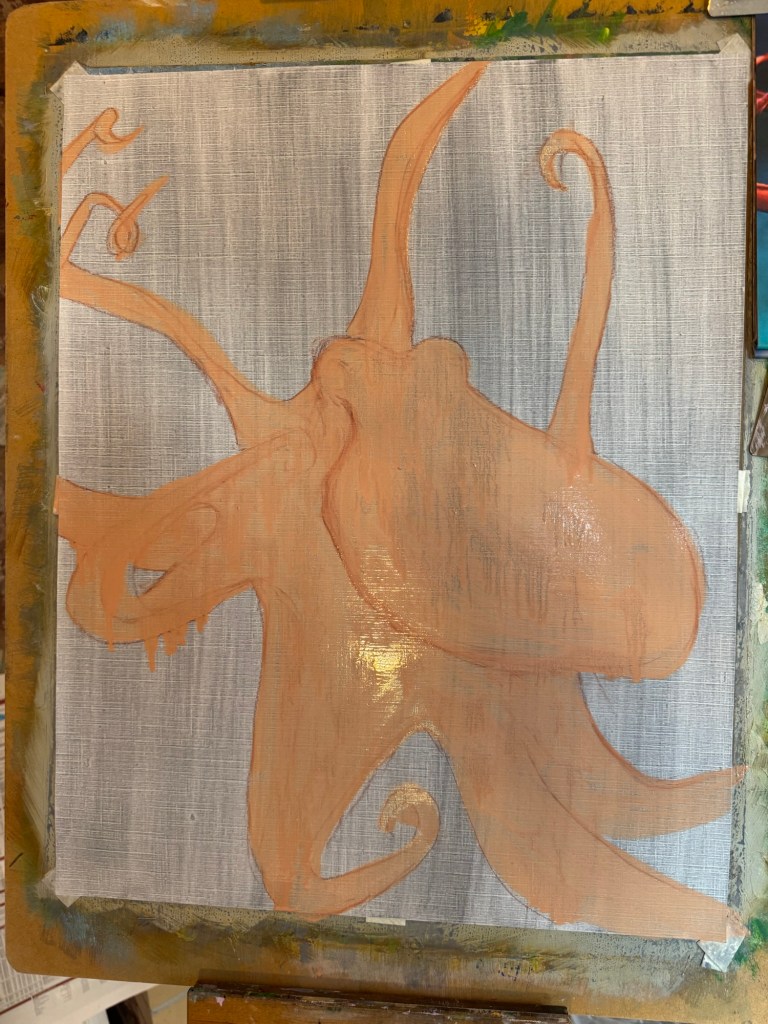
A lean layer of the sea was added:
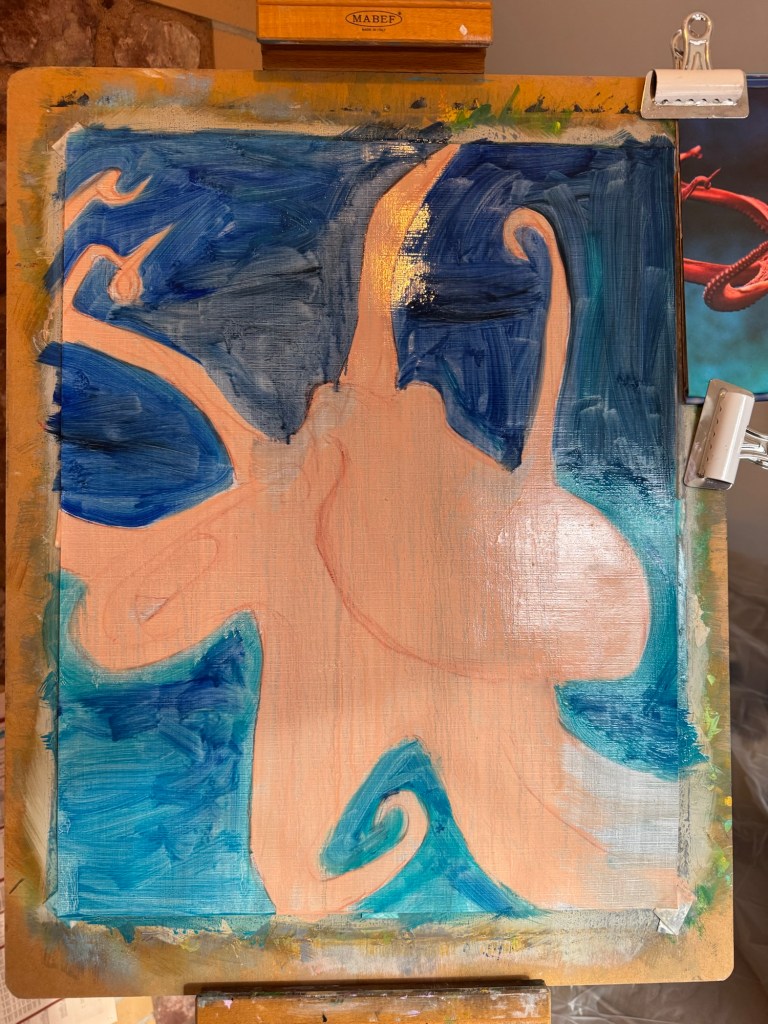
Progress at one hour:
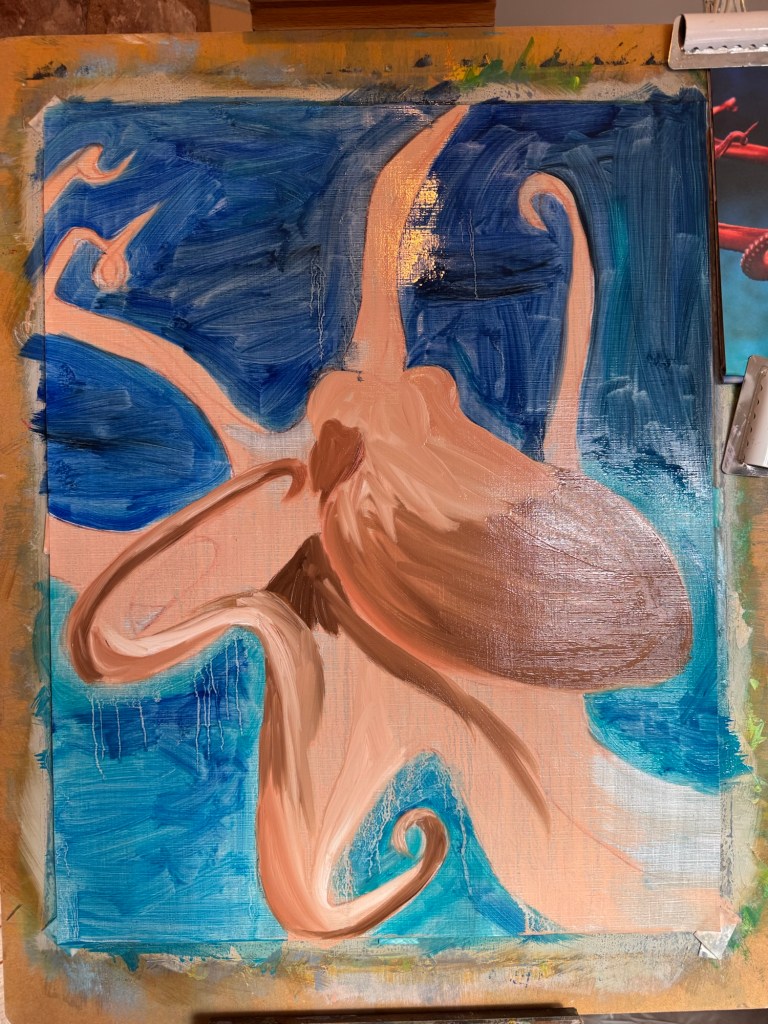
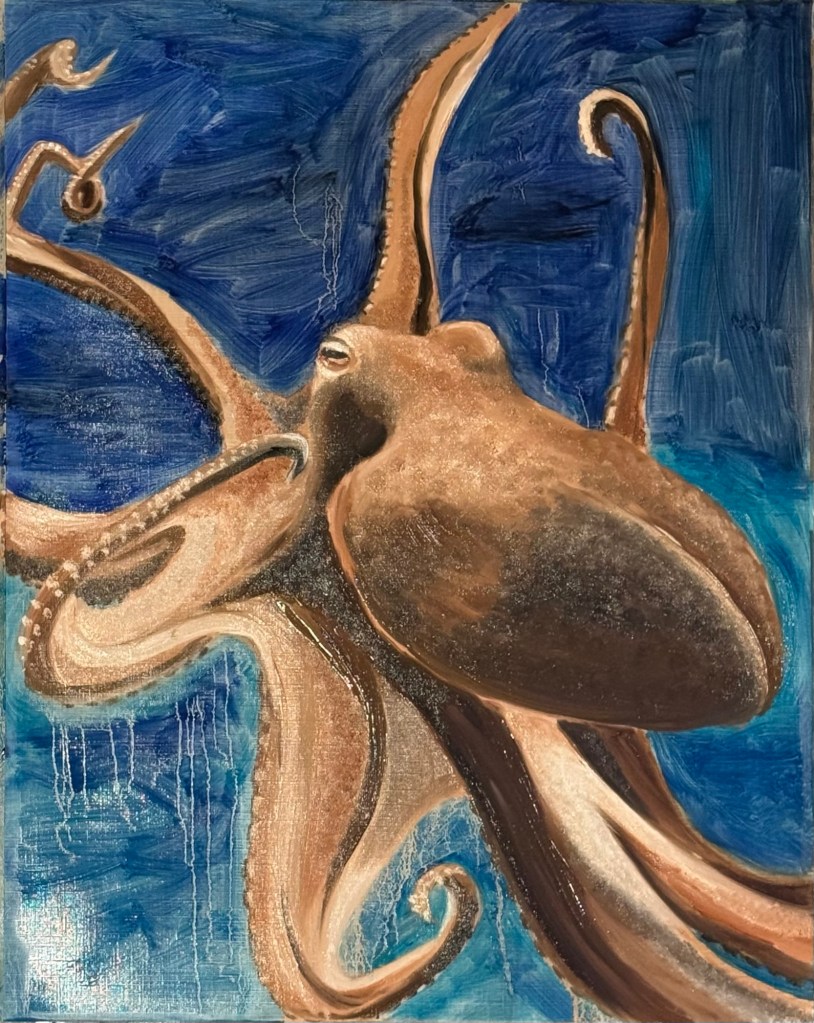
Progress at two hours:
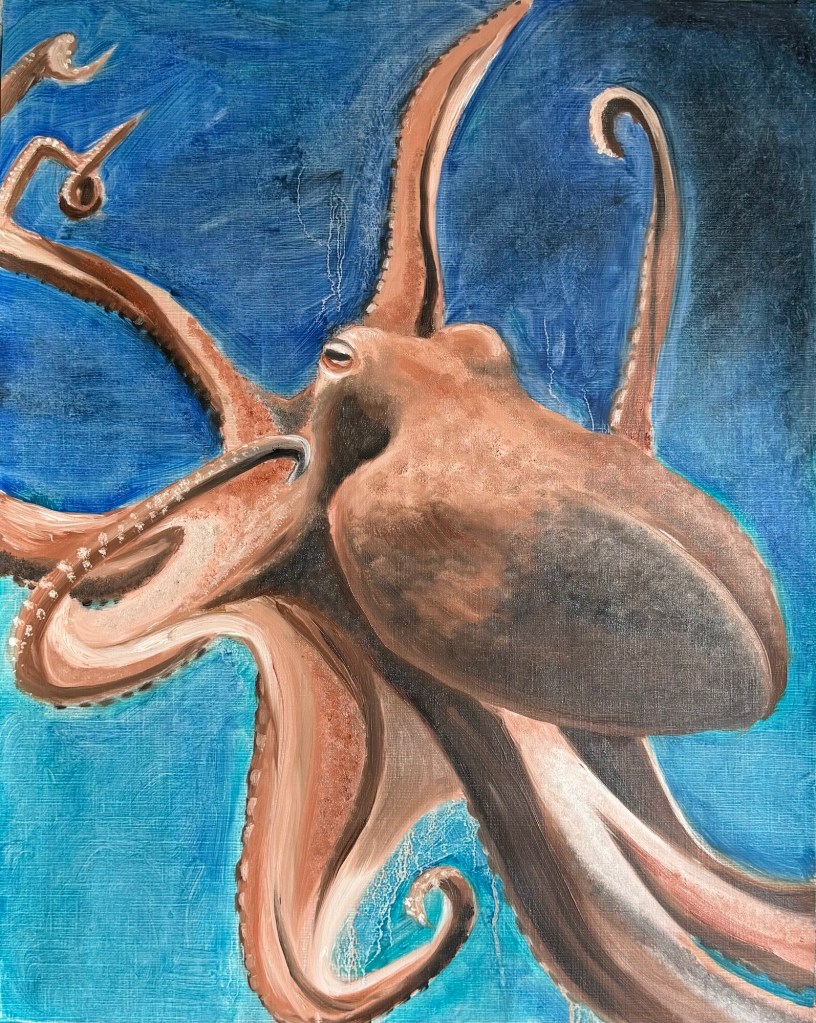
Then I worked on improving it for one more hour such as adding the suckers on the tentacles.
Kitchen paper was used to give the sea a more blended but slight ragging effect:
REFLECTIONS

I have enjoyed painting in oil again. I’m also excited by the possibility of using oil on newspapers just to see what happens. I think oil on newspapers gives opportunities to try different materials and perhaps large and heavier canvases.

The experiments with Liquin were successful in that I like using it; it helped the oil paint to flow but unlike linseed oil, it doesn’t ‘bleed’ even if large quantity is used. Also the quicker drying property suits the quick painting experiments that I’m doing at the moment.

The two hour painting was enjoyable but challenging. I felt rushed to start with, I needed to mark out the object which took time. Then blocking the octopus with a lean layer of oil took me to 15 mins in. I found myself at times drawn into details too soon, then I remembered it was a timed painting which pushed me onto the next part. I think if I wasn’t timed then I would have spent too much time on certain details. So the timing helped to move me on. I also make a mistake with mixing the paint for the sea as I added too much yellow and had to started again which wasted time.

As I painted, I started to remember fundamental oil painting techniques and processes that I had long forgotten – such as marking out shapes of the same tone systematically. Over the years, I had drifted into painting an object at a time, e.g. I would have approached each tentacle at a time, when I should have blocked out the same tone on the whole painting which is more efficient. So I switched to this way of working part way through.

I soon doubted if an octopus was a good subject because it is anatomically very complex. Eight is a lot of legs! So again I remembered the basic concept of just seeing shapes and paint according to those shapes. Also, squinting my eyes to see the shadows and shades better.

LEARNING

The timed painting surprised me by making me remember and refocus on the basic techniques of oil painting – many of those I had stopped using. So I think I need to refocus on the basics and make them default parts of the process. More timed painting practice needed!

NEXT STEPS

Do more timed paintings to hone the loosening approach and just more oil painting to improve my process.
Sculpture: The three-legged crow

BACKGROUND

I have been using crows as a metaphor to express how I have been feeling about the change in world order in recent months. I continue to find crows fascinating and many people have told me about how they feel about crows and how they relate to crows after seeing my work. I feel there is still much to explore about crows but I want to come away from painting for a while. I have been painting crows in Chinese ink on newspapers – although the research and set up can take some time, the actual painting process is quick (typically 10-20mins). As autumn approached, I wanted to do some slow-making and do something more physical to exert my energy, hence I explored other ways of making whilst remaining with the crow.

METHOD

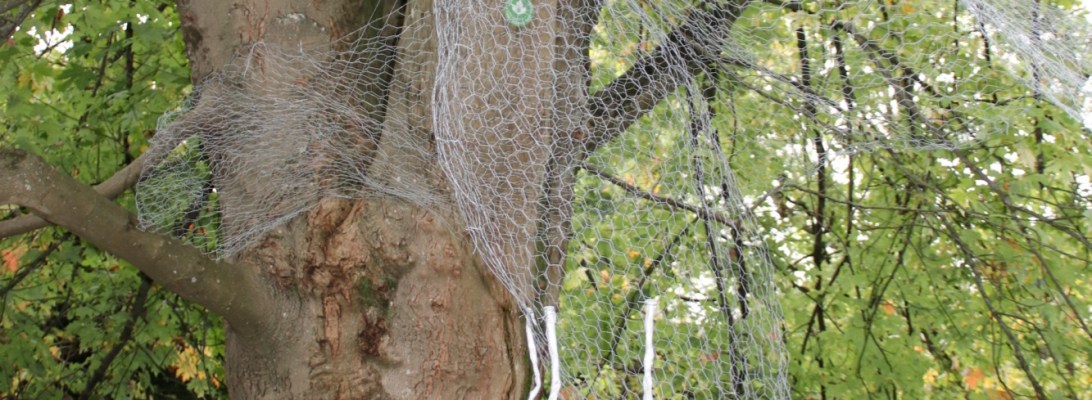
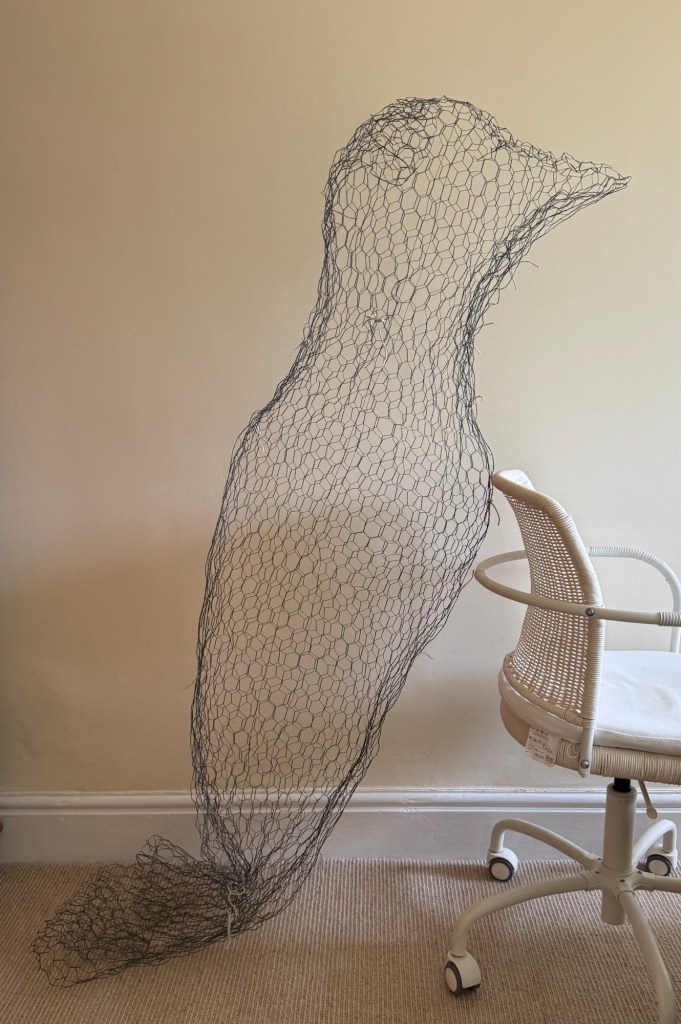
A few years ago, I attended a short course at CSM on making plaster sculptures. We used chicken wire to make the frame/armature before applying scrim and plaster. I thoroughly enjoyed the course and I made a few plaster sculptures after I got home. As a result, I still have some chicken wire in my studio and I decided to make a large crow in chicken wire. The idea was to then cover it with the FT newspaper to make a papier mache ‘News’ crow.

Works-in-progress chicken wire crow

I used all the chicken wire I had and made a crow of size:

Height 2m

Wing span 2.6m

Beak to tail length 2.5m

I felt a real connection with the crow. With such a large bird made in thin wire, although the chicken wire is robust, there was a vulnerability and gentleness about the bird that I connected with. At that moment, I felt I could not do papier mache because slapping on all that glue and making it rigid just felt too violent. I still wanted to do something with newspapers but not sure what yet.

I wondered if the sculpture could exist just as a wire sculpture. To develop that idea, I wanted to give the piece more meaning than just ‘a crow’. So I researched what the crow symbolised in my culture. I was fascinated to find that there was a famous three-legged crow in Chinese and East Asian mythology. (See below for Research info on the three-legged crow)

I summarised my research into this paragraph to express what I wanted to say with my three-legged crow:

In East Asian mythology, the three-legged crow is a revered symbol of divine power and celestial guidance, appearing in the folklore of China, Korea, and Japan. In Japan, this creature is known as ‘Yatagarasu’, said to have led the first emperor toward unity and purpose. The three legs are often interpreted as representing heaven, earth, and humanity – or past, present, and future – reminding us that true direction comes from balance.

This sculpture invites reflection: not just on where we’re going, but how we choose to get there.

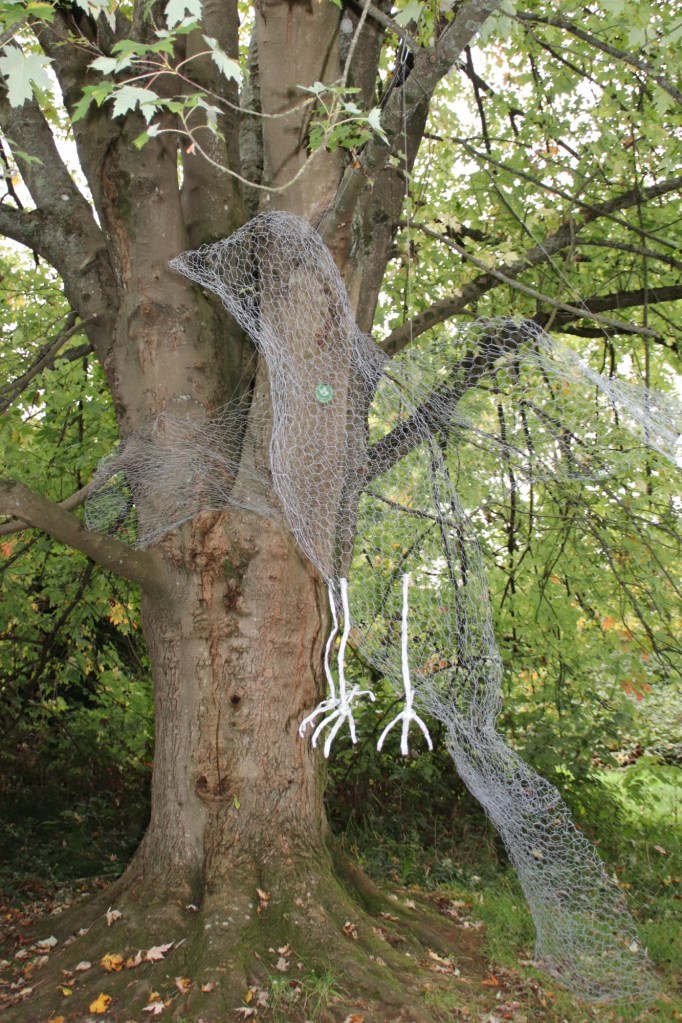
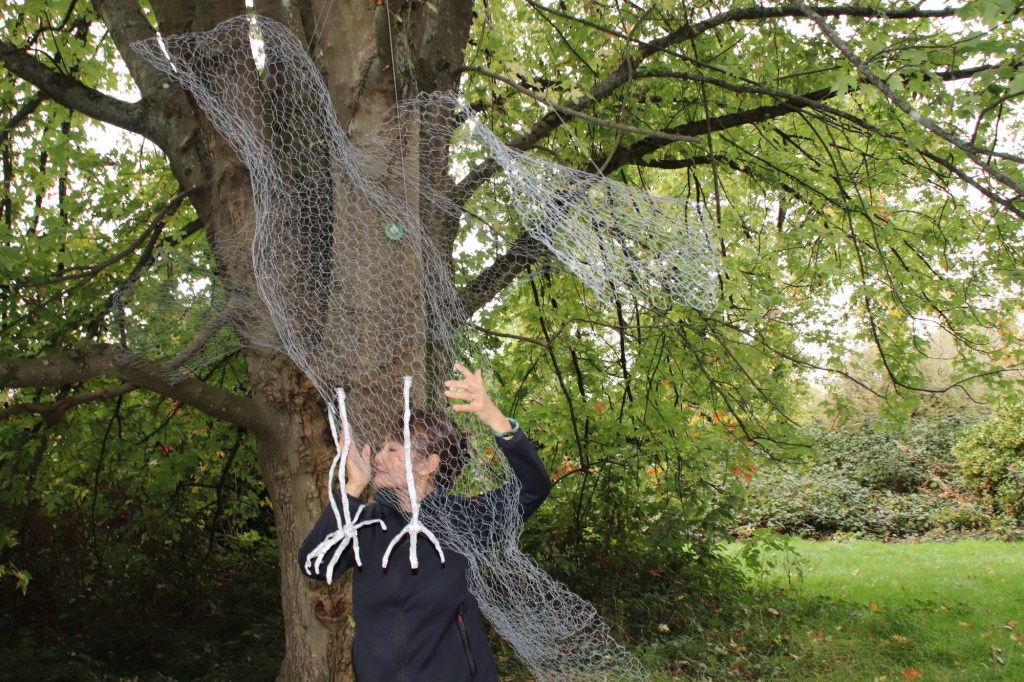
Before I did anything else to it, I took it outdoors for a photo shoot on The Downs nearby. I took some photos with it hanging from a tree and then I posed with my crow as a form of performance.

Three-legged crow

REFLECTIONS

I set out to make something physical to exert energy; something that would take time to make to give myself time for contemplation as autumn approached. Also, this was my first proper project after finishing my MA. Although I have been making art, they have been shorter work to fit in with a busy summer schedule of travelling and other commitments. So it felt great to be able to dedicate proper time to make something physical in the studio.

The outcome was a wire sculpture – the three-legged crow. I was pleasantly surprised by the outcome. I didn’t expect to have such connection and affinity with the work. I didn’t expect to feel protective over it to the extent of not wanting to papier mache as it felt too violent.

I have always valued the process of making, but most of the time I have not been too bothered about the work once it was made. The process was the key for me. However, on this occasion, I felt differently about the work, I wanted to take care of it.

For me, the work exudes gentleness; and softness somehow is also its strength. Perhaps it represents how I feel about the world right now… the vulnerability (the world’s or mine?).

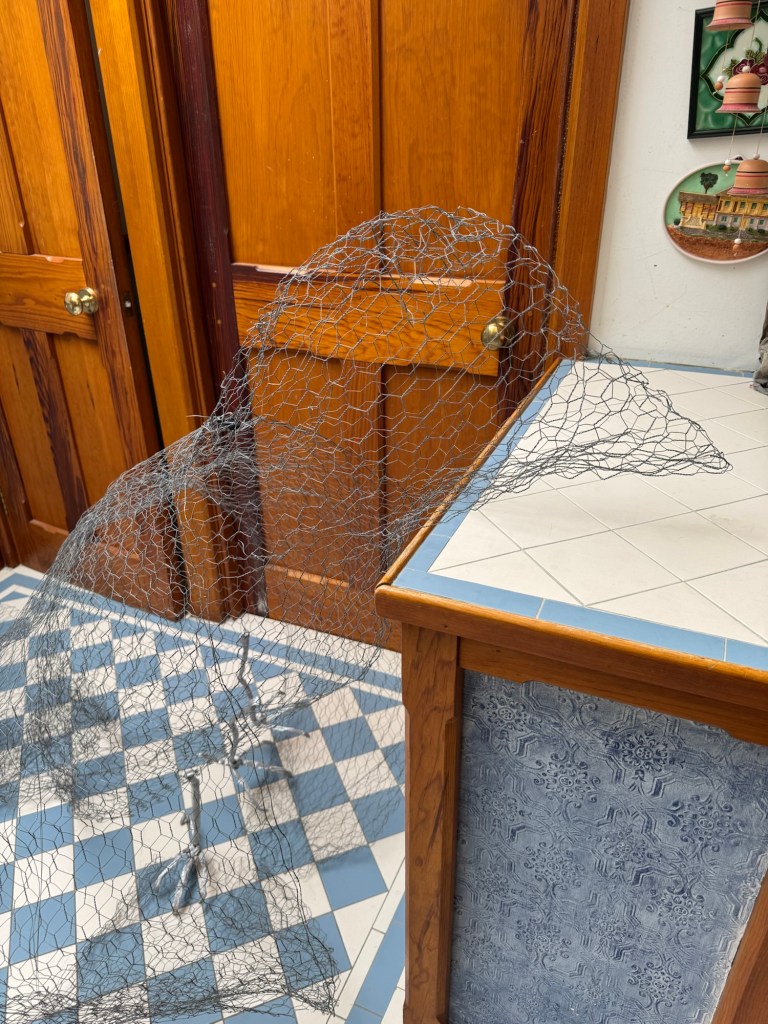
This photo was particularly poignant – I placed the crow in my porch after bringing it home from the photo shoot and it just looked sad and vulnerable…

LEARNING

-The research on the three-legged crow reminded me of the details of mythical stores that I heard when I was a child in HK – details that I had long forgotten. So it was good that I was able to connect it with a new piece of work.

-I was pleased to find a meaning with the three-legged crow that aligns with what I want to say right now about the state of the world. It’s not only about where we are heading, but about how we want to get there.

-I thoroughly enjoyed taking the crow out for a photo shoot, more than I expected as I was self-conscious. What would the neighbours say!? But I enjoyed it especially the performance aspect – I want to do more!

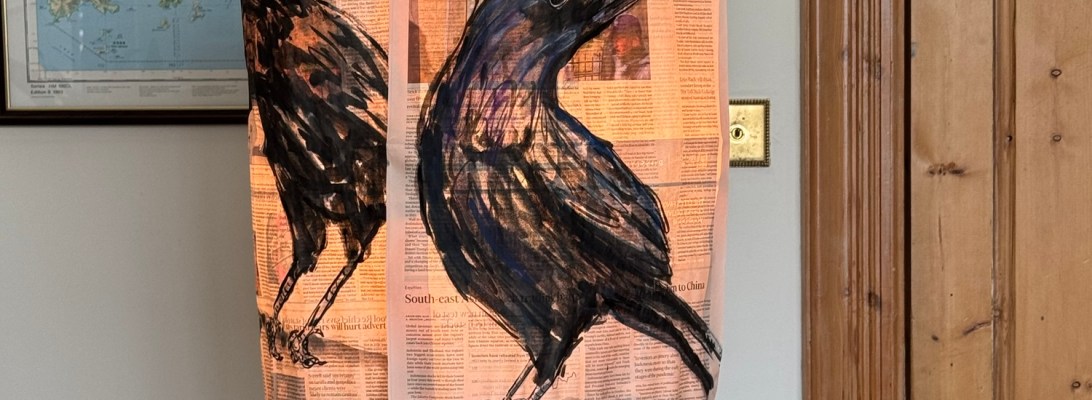
-This is an unfinished piece of work. I still want to incorporate newspapers into the work but its softness has to be maintained. So I’m considering weaving strips of cut up newspaper articles into the chicken wire, then perhaps painting on that. Possible lighting the piece from within like a lantern , maintaining the theme of rear-illumination as I have been doing with ‘News’.

NEXT STEPS

-Experiment with adding newspaper to the work such as weaving strips of cut up news articles and painting on top.

-Consider ways to incorporate more performance into my work.

RESEARCH – Three-legged crow

Below are CoPilot’s responses to my various questions that helped me to build up an understanding and a mental image of the three-legged crow:

The Legend of the Three-Legged Crow (金乌) –

In ancient Chinese mythology, the sun was not just a celestial body—it was alive, and it had a spirit. That spirit took the form of a three-legged crow, known as the Jinwu (金乌), or “Golden Crow.” This mystical bird lived in the sun and was said to have three legs, symbolizing cosmic harmony—often interpreted as heaven, earth, and humanity.

According to legend, there were ten suns, each represented by a three-legged crow. These suns lived in the Fusang tree, a divine mulberry tree located in the eastern sea. Every day, one of the crows would be carried across the sky in a chariot driven by the solar goddess Xihe, bringing light and warmth to the world. The ten crows took turns, one per day, in a ten-day cycle.

But one day, all ten suns grew restless and rose into the sky at once, scorching the earth with unbearable heat. Rivers dried up, crops withered, and people suffered terribly. The world was on the brink of destruction.

To save humanity, the legendary archer Hou Yi was summoned. With his divine bow and arrows, Hou Yi shot down nine of the ten suns, leaving only one to continue its daily journey across the sky. Peace and balance were restored.

The surviving three-legged crow remains in the sun to this day, watching over the world and maintaining the rhythm of day and night.

This myth not only explains the sun’s movement but also reflects ancient Chinese beliefs about cosmic order, divine intervention, and the balance between chaos and harmony. The image of the three-legged crow appears in Han dynasty tombs, bronze mirrors, and ancient murals, symbolizing power, immortality, and celestial authority.

Symbolism of the Three-Legged Crow in Chinese Culture –

– Solar Deity: The crow is believed to reside in the sun, acting as its spirit or charioteer. Ancient texts describe ten such crows living in the Fusang tree in the eastern sea, each taking turns to fly across the sky and illuminate the world.

– Cosmic Balance: The myth of the ten suns (ten three-legged crows) explains natural order and chaos. When all ten suns rose at once, scorching the earth, the archer Hou Yi shot down nine, restoring balance. This story emphasizes the importance of harmony in nature.

– Divine Messenger: The crow is often seen as a celestial creature, a messenger of the gods. It appears in myths involving deities like Xiwangmu (Queen Mother of the West) and solar goddess Xihe.

– Three Legs: The number three symbolizes completeness and cosmic unity—often interpreted as representing heaven, earth, and humanity. It may also reflect the sun’s three phases: dawn, noon, and dusk.

– Longevity and Mysticism: In Daoist texts, the crow is said to consume divine herbs and live eternally, linking it to immortality and spiritual transcendence.

– Imperial Power: During the Han dynasty, the three-legged crow was a symbol of imperial authority and divine right. It appeared in art, tombs, and ceremonial objects to signify the emperor’s connection to cosmic forces.

This mythical bird is not just a creature of legend—it’s a profound symbol of how ancient Chinese people understood the universe, time, and the divine.

Research: Drawing – left vs right hand

I introduced the idea of drawing or painting with my non-dominant hand whilst developing my body of work ‘News’. I did that as a way to challenge myself and to introduce uncertainty / vulnerability into the process to reflect how I felt about the state of the world at the time. Since then, I have become fascinated by the subject and I have been reading the book ‘The Master and his emissary’ by Iain McGilchrist on the divided brain. I read about Divergent Artistic Behaviour which states that:

Truly creative art can only result from divergent artistic behaviour – behaviour that was previously unknown or often unexpected and unexplored.

Divergent behaviour demands something from you that you have not been taught or that is not part of the suggested or normal steps in solving a problem.

That understanding has reinforced my desire to explore using my non-dominant hand to draw and paint as that has been unexplored up to now.

In this research experiment, I want to gain a deeper understanding of what the difference is between the work that is produced by my dominant hand right vs my non-dominant left hand.

METHOD

I have previously done an exercise with both hands drawing together simultaneously and one of the outcome of that was to consider whether I needed to have both hands drawing simultaneously and whether I had to have my eyes closed. My conclusion after some consideration was that no, I didn’t need to do either. If my objective is to research the difference between how the two sides of the brain produce work through my hands then there is no need to do it simultaneously or have my eyes closed. In a way, those parameters could confuse because there were too many variables introduced at the same time. Therefore, in this exercise, I’m going to just draw with each hand and compare the outcomes.

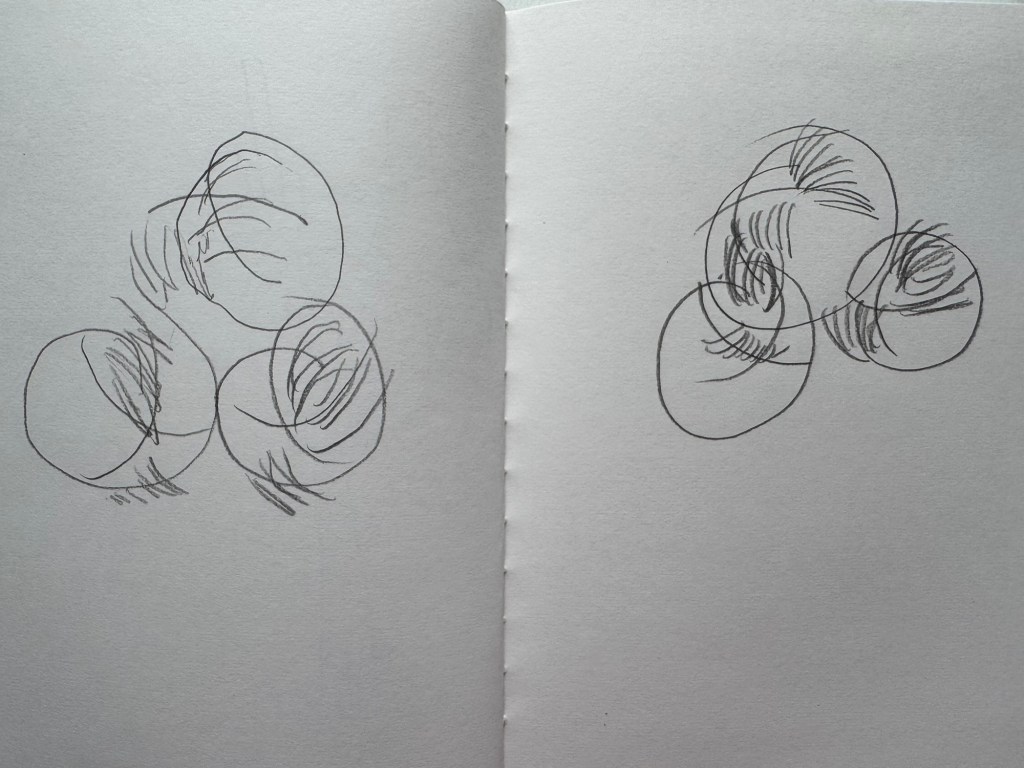
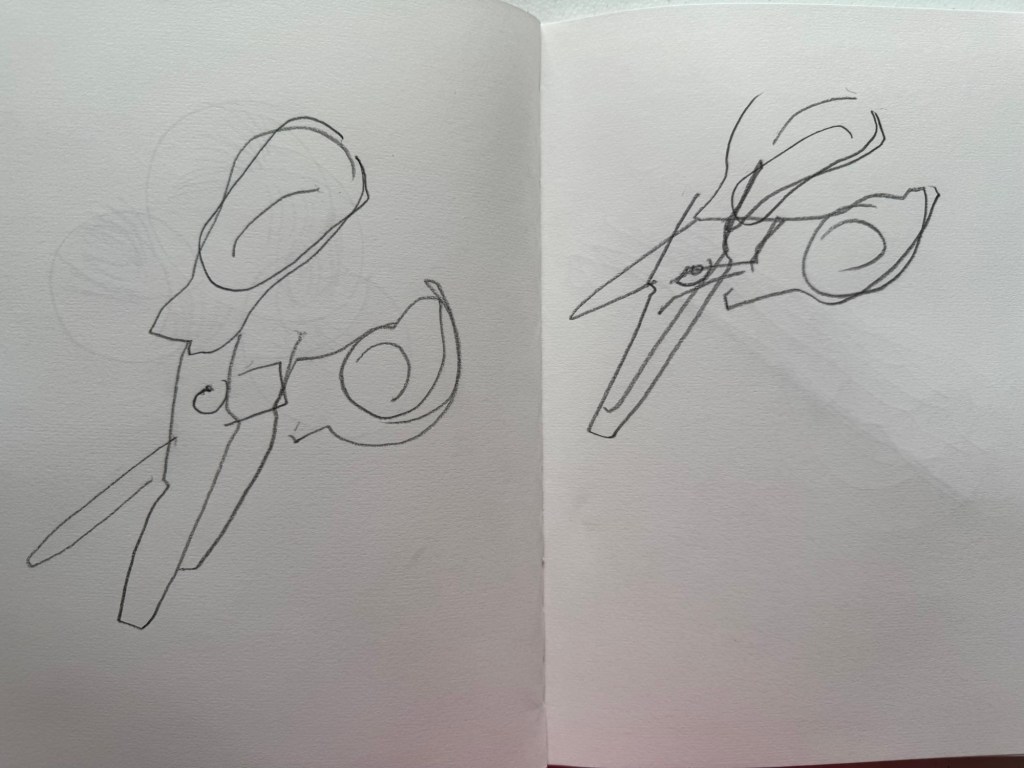
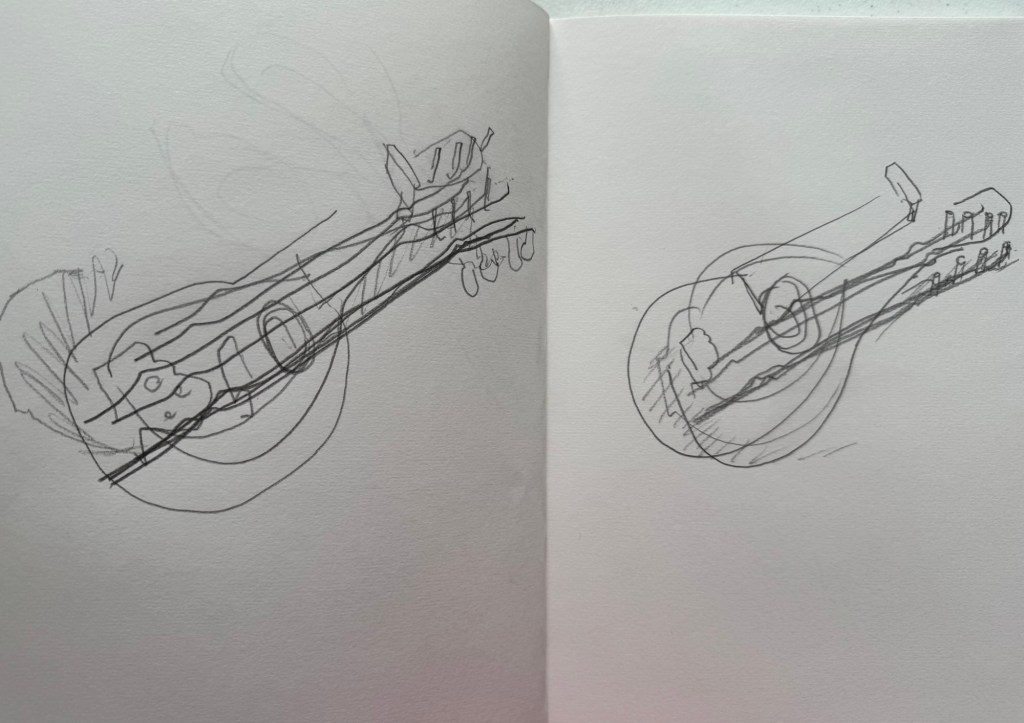
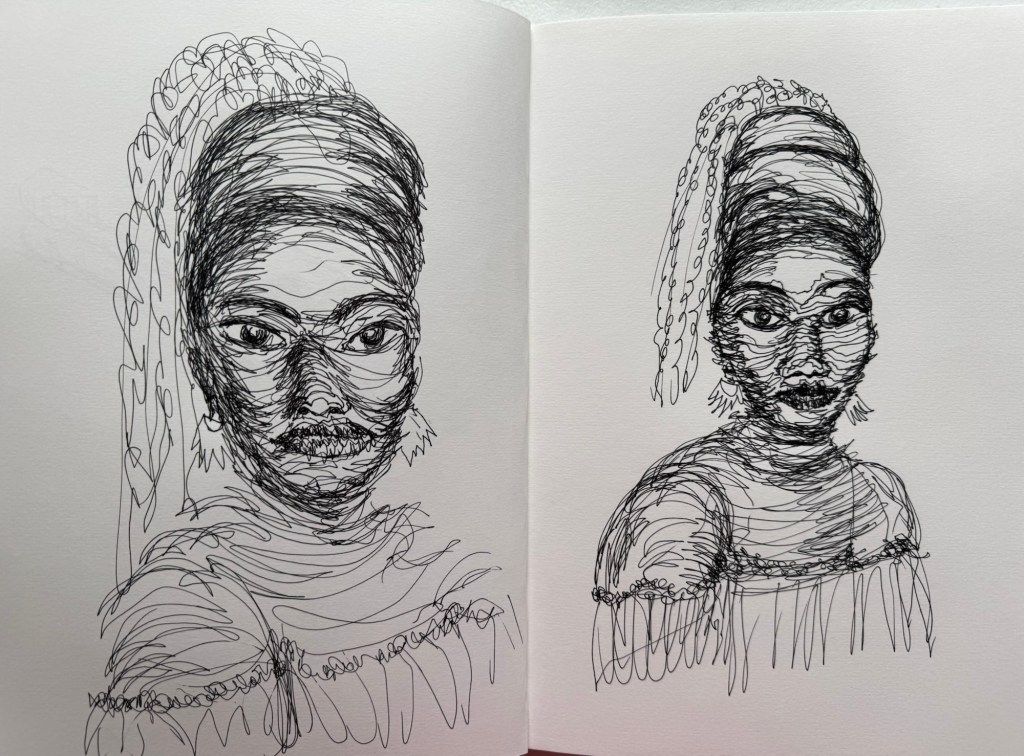
I used the method of ‘blind contour drawing’ – drawing with eyes looking at the object and not looking at all at the drawing. Below are some of the items I drew in my studio with the left page drawn by my left hand and the right by the right hand.

Studio light
Juggling balls
Scissors
Miniature Chinese lute – Pipa

Cross-contour drawing –

A woman’s face

REFLECTIONS

It has been an interesting exercise. Firstly, I feel that there was no need to draw simultaneous like I had done in the previous experiment. The key is to study the difference at this stage and not the difference when drawing simultaneously. One step at a time.

The images drawn with my left hand were consistently larger than those drawn with my right hand. I have observed this before in other similar experiments. I am able to be more loose when drawing with my left hand. The right hand seems to be naturally more tight, as though there are invisible boundaries on the page that I had to work within. Whereas with my left hand – I don’t feel the boundaries and therefore am not confined by it.

The left hand drawings are less accurate compared to the right hand, but there is sufficient likeness to be recognisable as the piece.

I am increasingly ‘addicted’ to drawing with my non-dominant left hand and increasingly less satisfied with my right hand because the latter is a constant reminder of my inability to push boundaries – I get pulled back into being too tight and constrained when making art with my right hand, it’s like muscle memory that I cannot erase. Whereas the lack of control in my left hand enables me to, or grants me permission to just make and not think too hard as there is no expectation for the outcome to be good. With my non-dominant hand, I am often pleasantly surprised whereas with my dominant hand I often feel disappointed.

LEARNING

I am more able to create freely with my non-dominant left hand because there is no expectation and the lack of control enables me to push myself, often ending in pleasant surprises. I enjoy this way of making with my left hand and would like to pursue it further. Perhaps even make it a key aspect of my practice.

NEXT STEPS

Keep creating and pushing boundaries with my non-dominant left hand.

Continue to explore the differences between making with my left and my right hands.

Try writing or calligraphy to see how the left hand performs on that.

At some point, I need to consider more deeply why I am drawn to this way of making. I must not ignore this point because I feel there is a link to who I am and how I am evolving. So I must come back to this point when I feel ready.

Research: Simultaneous drawings with both hands

I have been painting with my non-dominant hand in my ‘News’ series of work. I became intrigued about the push and pull between the left and right sides of my brain. So I decided to experiment with drawing with both hands simultaneously.

METHOD

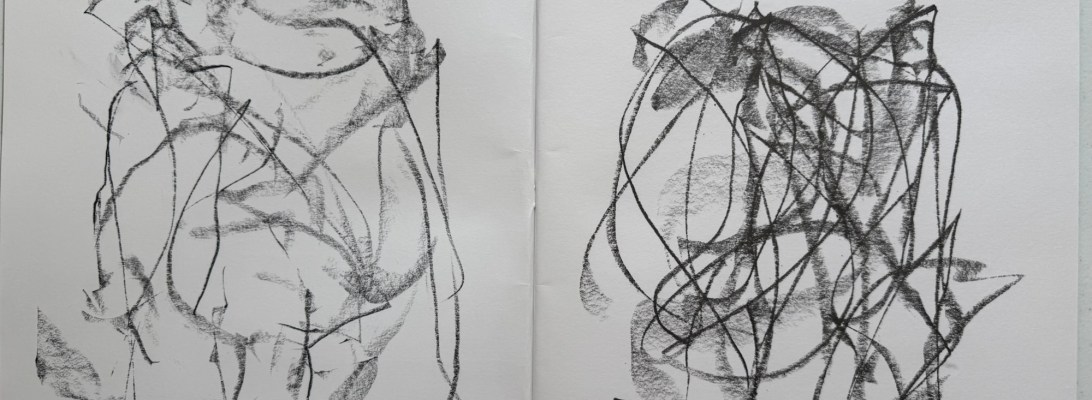
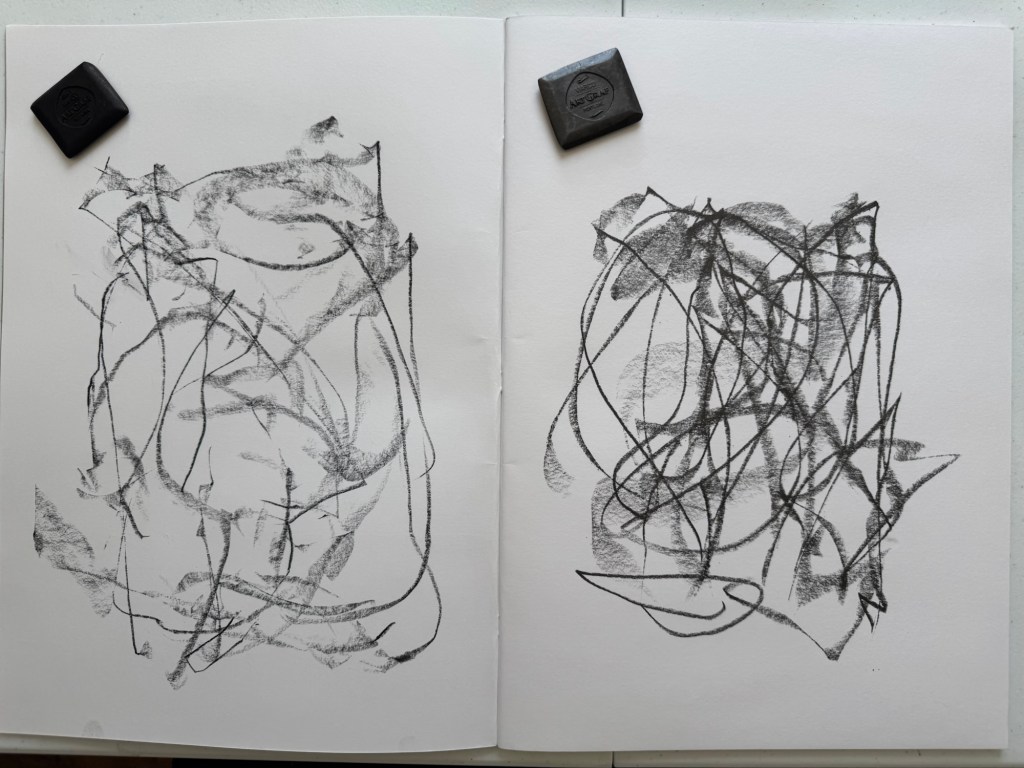
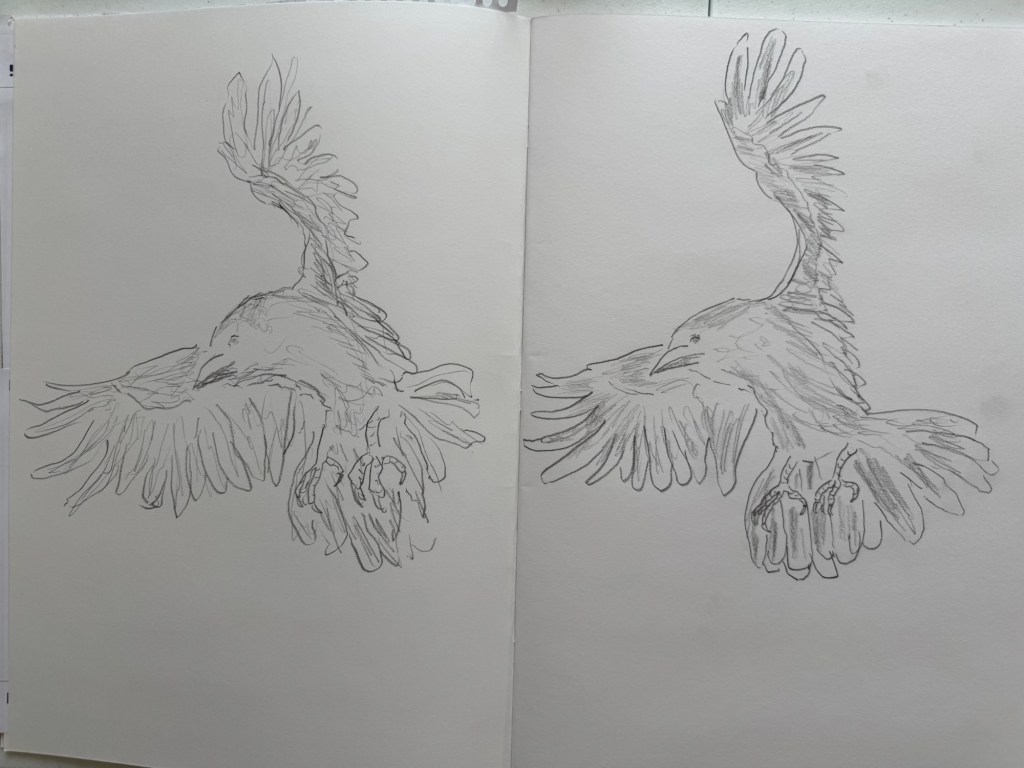
On an A2 sketchbook, I used my left (non dominant) hand to draw on the left page and my right (dominant) hand on the right page. I closed my eyes and drew simultaneously with graphite tabs. Below is the first drawing:

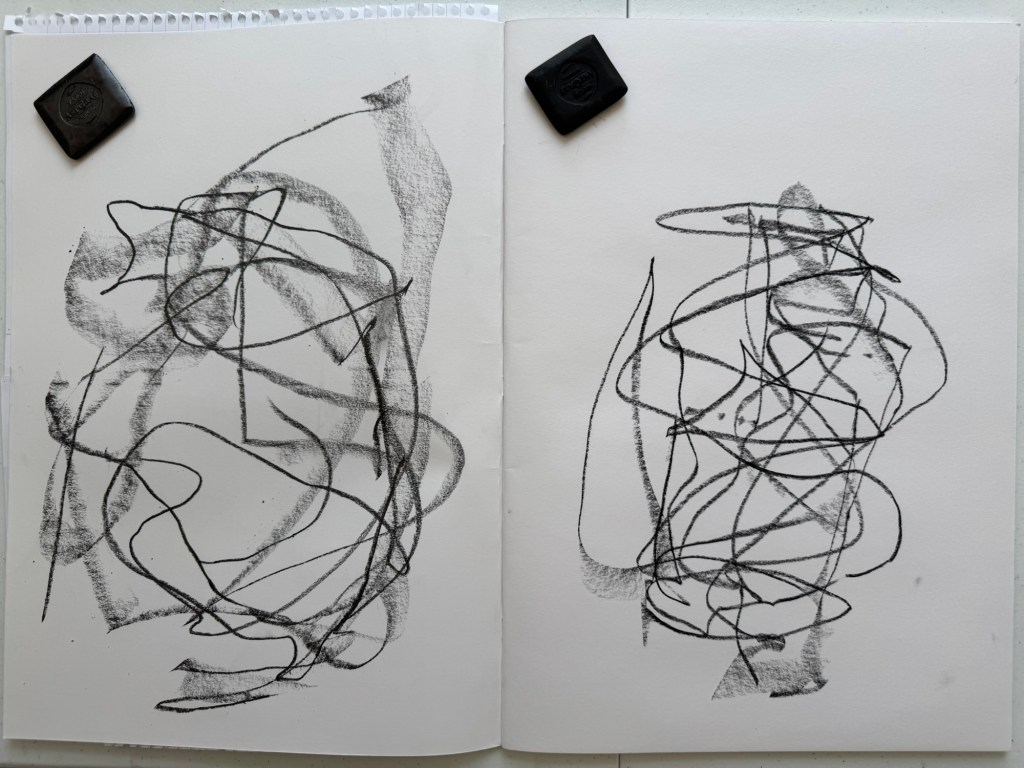
This is the second drawing done in the same way:

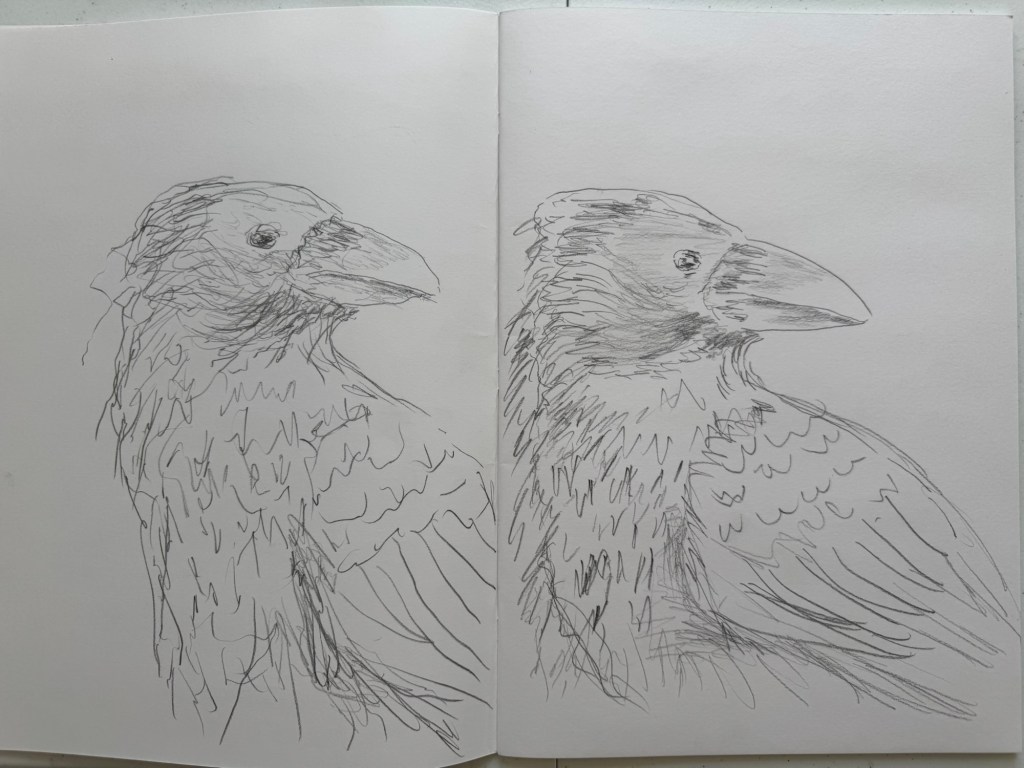
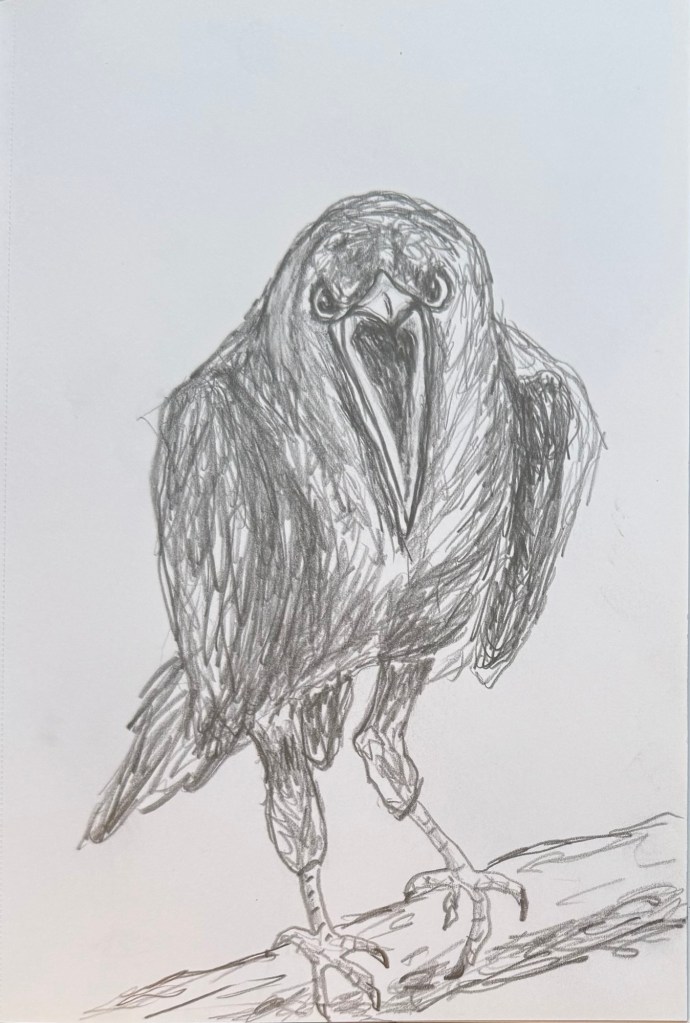
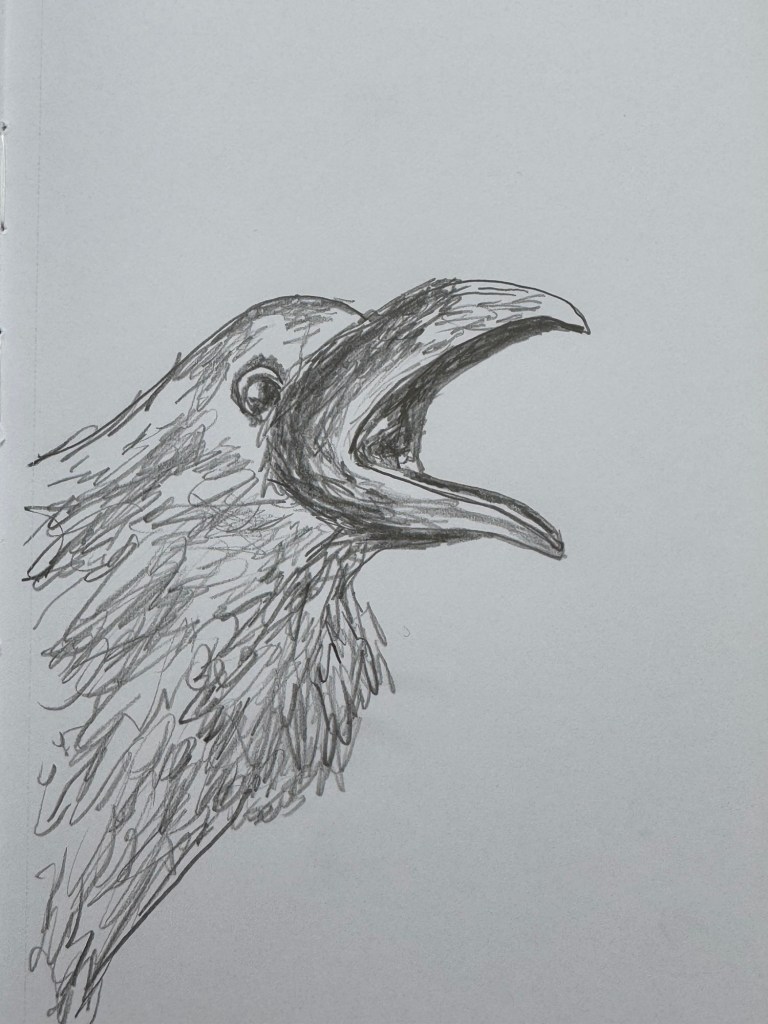
I then drew some crows with my eyes opened. Again, both hands drew simultaneously using 4B pencils. First drawing:

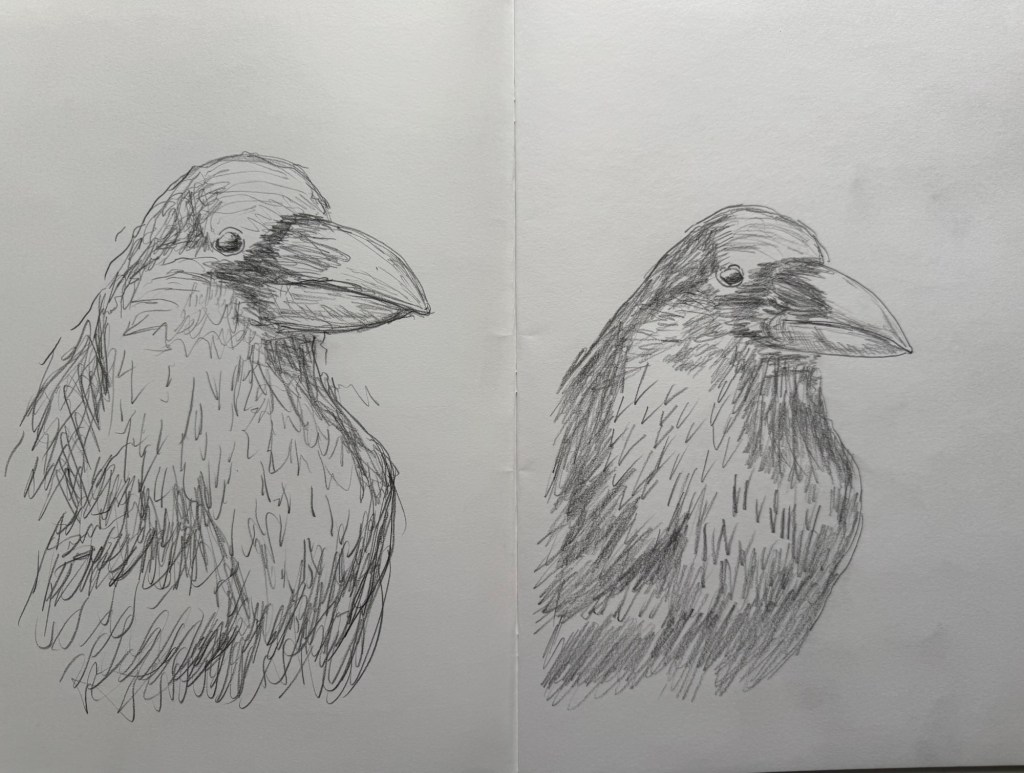
Second drawing:

Below is the third drawing. By the time of doing this drawing, my brain felt tired from the intense concentration that I finished these drawings separately:

REFLECTIONS

The first two drawings were abstract mark making with my eyes closed. I wanted to see if there would be any difference with a free and simple method like this. My initial observation was that the non-dominant hand drawings were larger and less restrained. There were similarities in composition but not identical. I purposely wanted to create different images to see if I could get both sides of the brain to do different things simultaneously. So from that point of view, I was not able to create independent images, not even simple ones.

I then drew the crows from photos. In these cases, I purposely created the same image but wanted to do it as a kind of brain training exercise to see if I could do more complex simultaneous drawings. The images were quite similar but the left hand being looser in its mark making, consistent with the abstract drawings.

I prefer the looser mark making from the left hand, but I think I have know this for some time, hence choosing to do the News paintings with my left non-dominant hand.

I have found the simultaneous drawings of the crows rather brain-aching. The intense concentration required to do the drawings was tiring, hence I had to finish the final pair of drawings separately. This makes me think that controlling both sides of the brain simultaneously is not a usual activity, hence so much concentration was needed.

I have also started researching the work of Iain McGilchrist and I am reading the book about the divided brain ‘The Master and his Emissary’. I have not read enough yet to be able to shed light on what I am experiencing with my simultaneous drawings. So I will need to continue with the book to find further insights.

LEARNING

I think it’s too early to extract learning from this exploration. I don’t know how much further I will take these experiments and how they would contribute to my practice. I think I would like to explore more the abstract mark making drawings and perhaps do some paintings with this approach to see what happens. As for the crow drawings, I know I can do them and I am unsure of what else I want out of them at this stage.

Studying Iain McGilchrist’s work will help me to progress this line of research.

NEXT STEPS

-Explore further abstract mark making with both hands. Do drawings as well as paintings.

-Consider if they have to be simultaneous and if I need to close my eyes – what am I trying to achieve with those imposed parameters?

-Consider what I am trying to find out, i.e. what are my objectives for this investigation?

-Continue to read the book ‘The Master and his emissary’ and see how the insight could contribute to my art practice.

MA Degree Show – Reflections

My MA Degree Show took place from 1-6 July 2025 at Central Saint Martins’ campus at Granary Square, Kings Cross, London. It was a fantastic experience and I want to capture my reflections and learning here.

METHOD

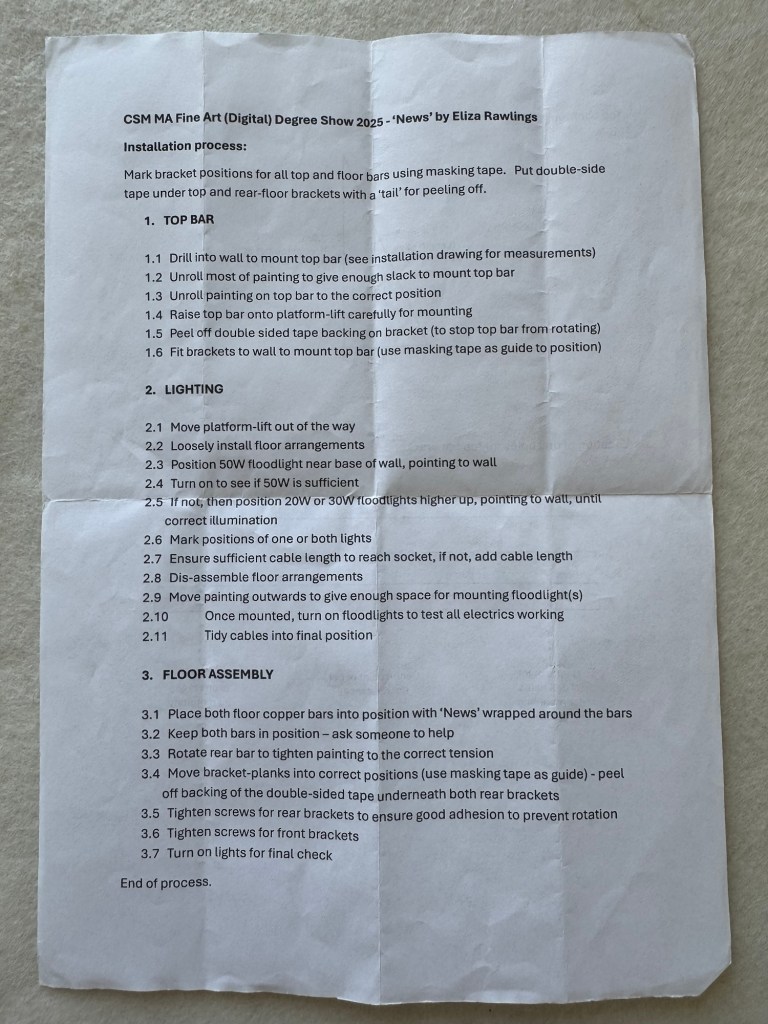
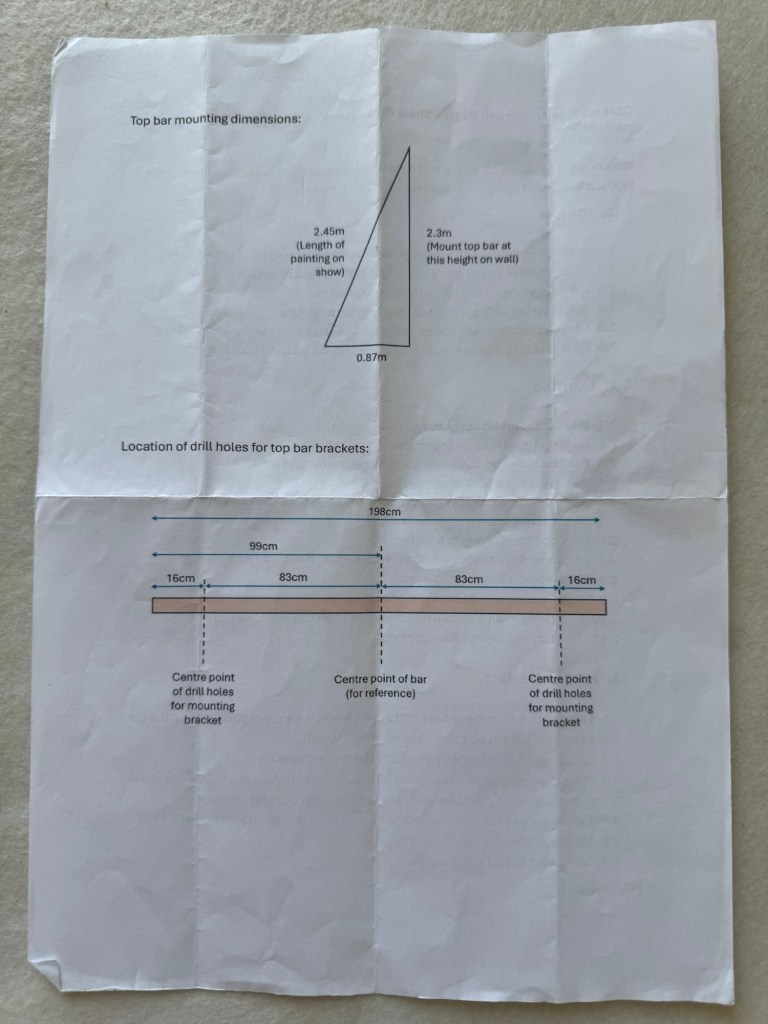
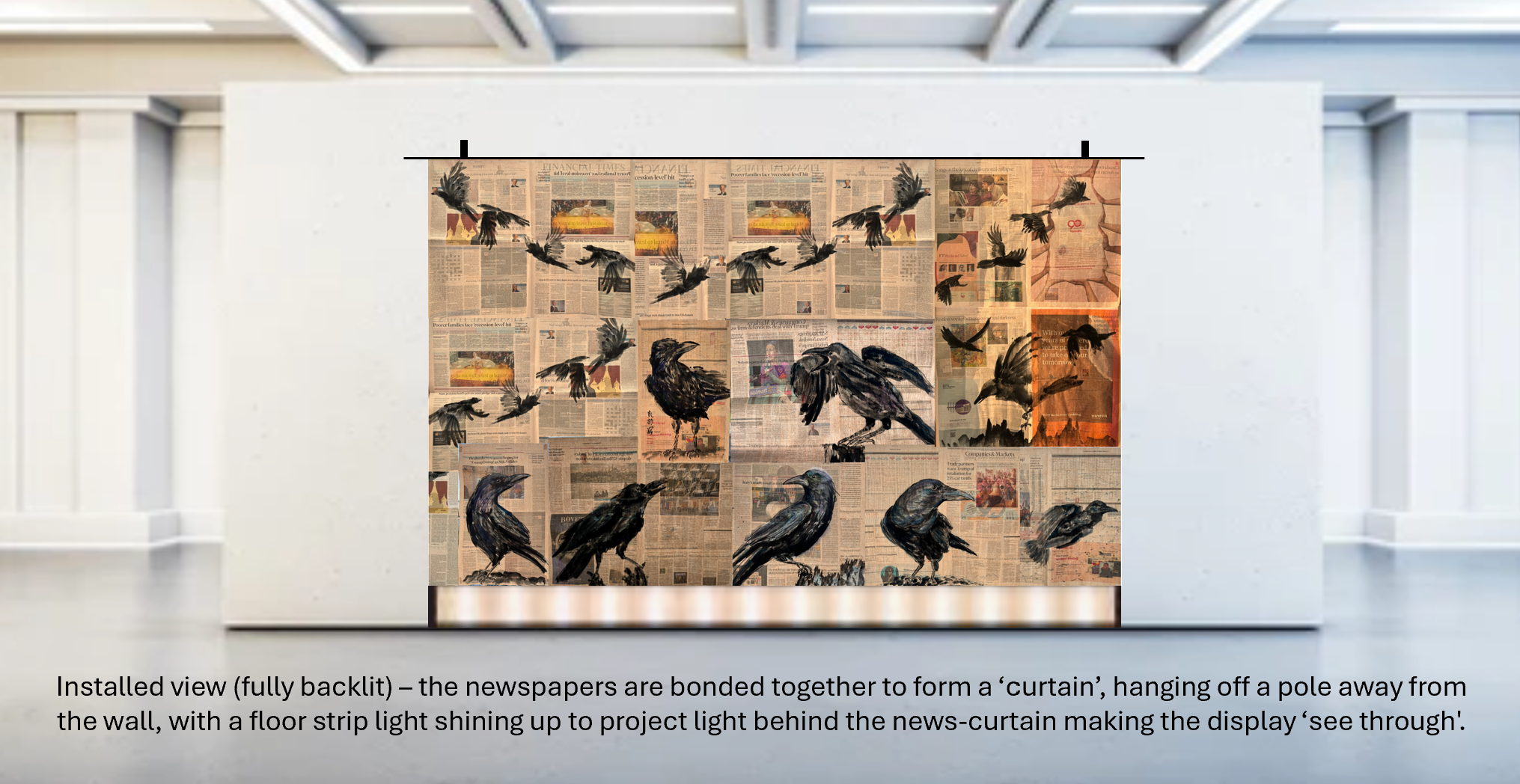
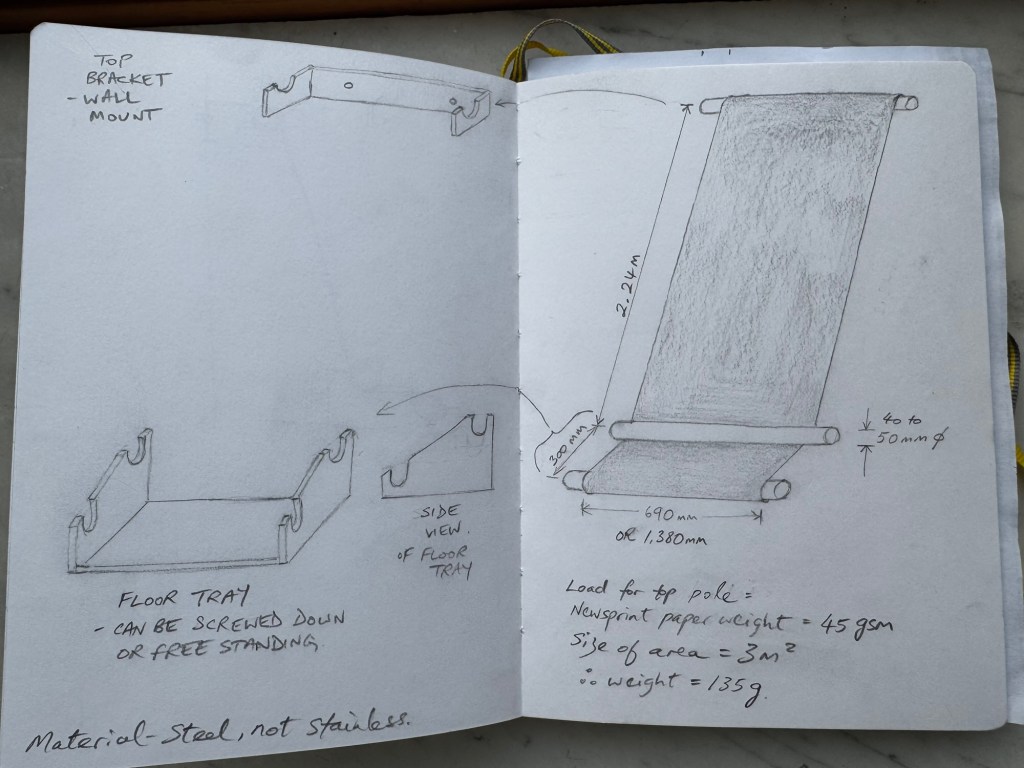
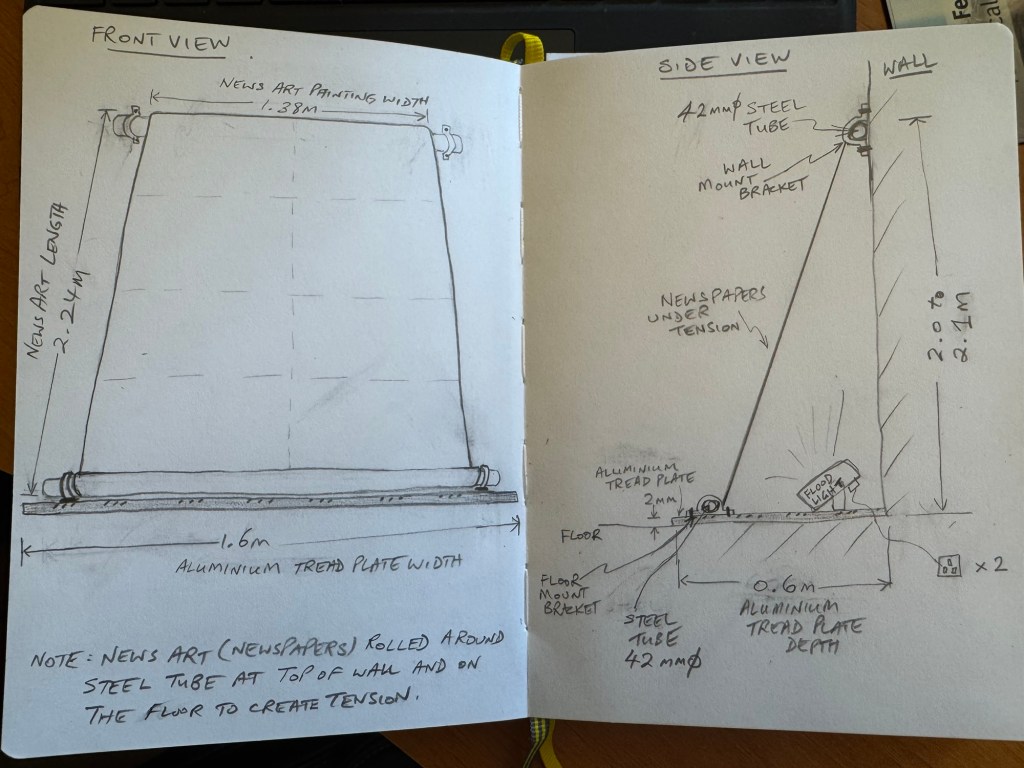
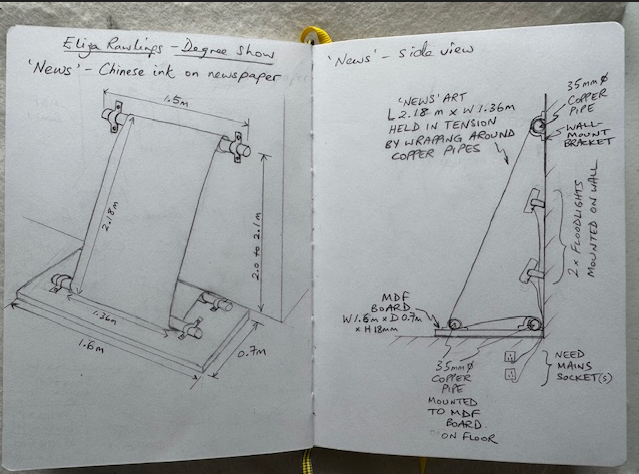
After planning what to show, creating the work and buying the parts, I wrote a list of installation instructions and a simple drawing to show the top-bar mounting. This is to ensure a smooth installation process especially where a technician’s help was required. The technicians are usually very busy, hence I wanted to use their time efficiently.

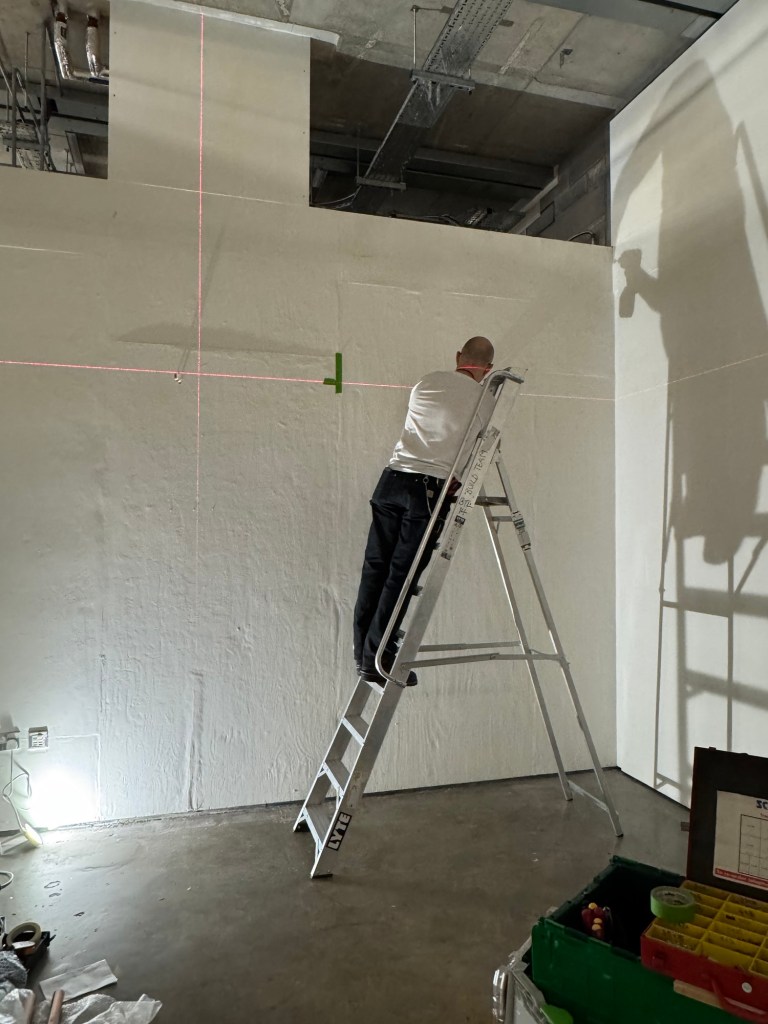
The technician used a laser levelling device to mark out the drill positions which made it a quick process:

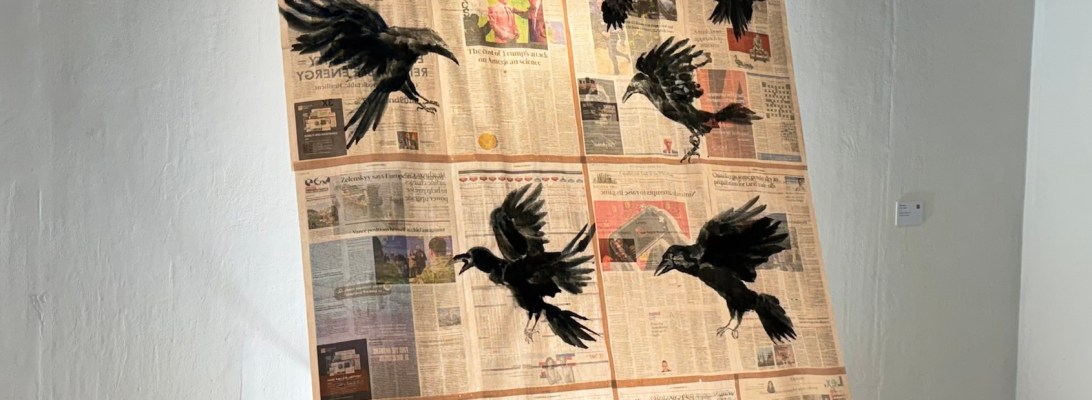
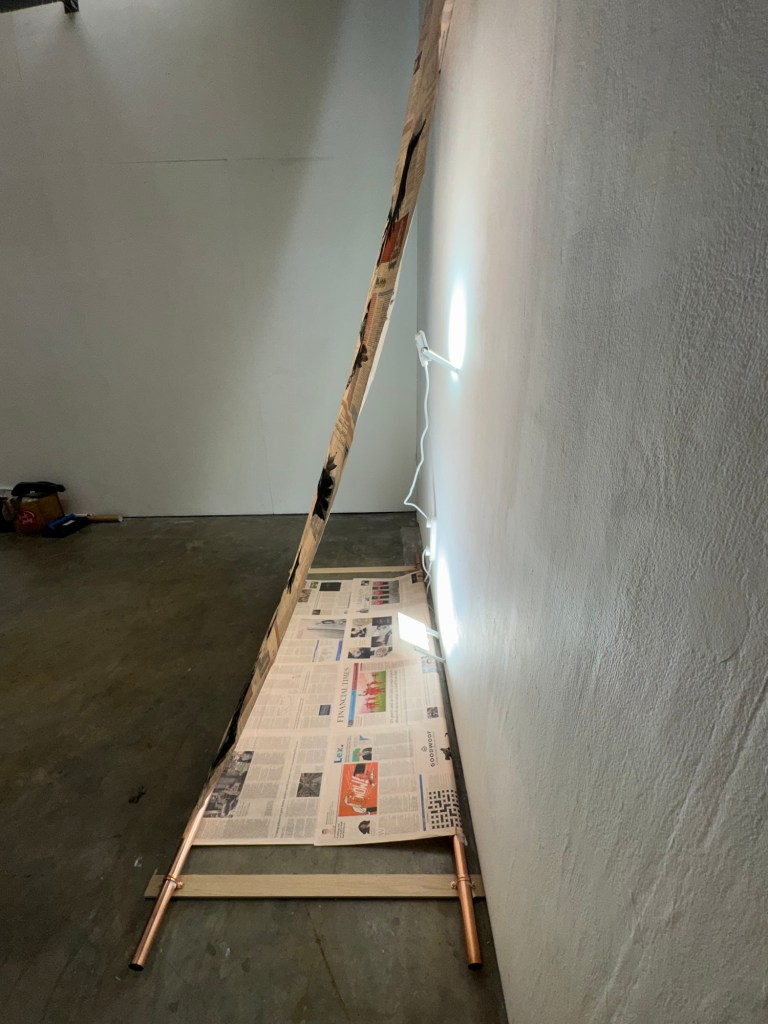
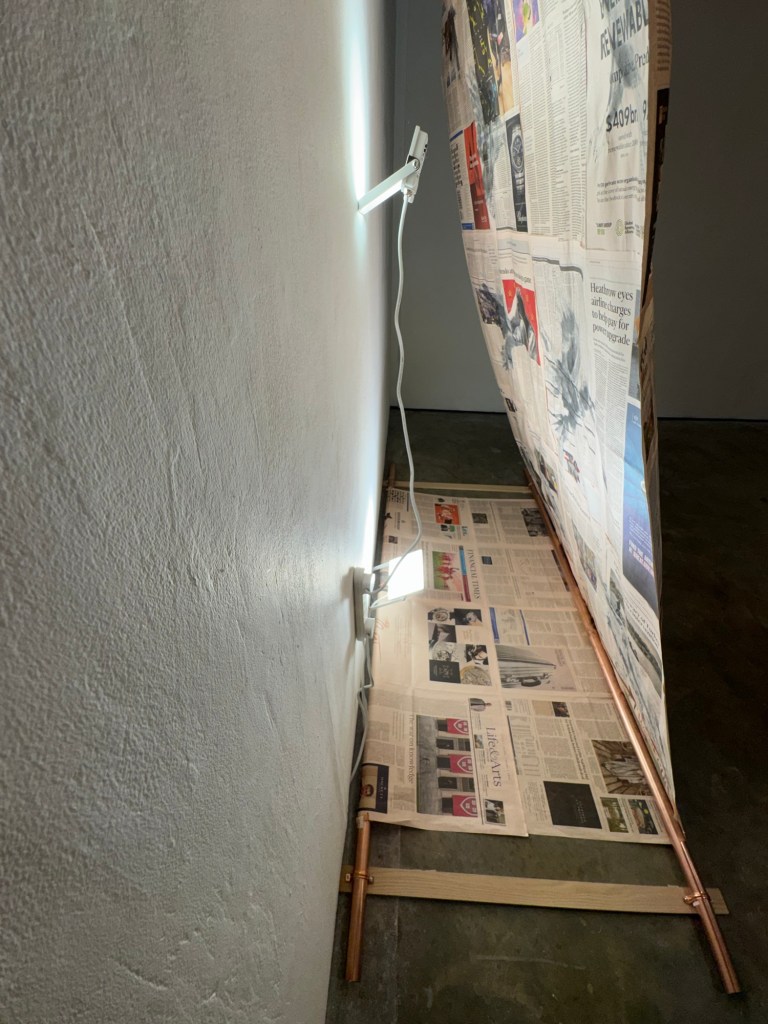
After mounting the top-bar, the two floor bars and planks were installed. That was straight forward. Then a key part was the back-lit using flood lights. I had to decide on the power rating and whether to use one or two units. After some trials I decided to use a 50w LED light near the bottom and a 20w light around half way up. This created a uniform spread of light onto the artwork and not patches of light.

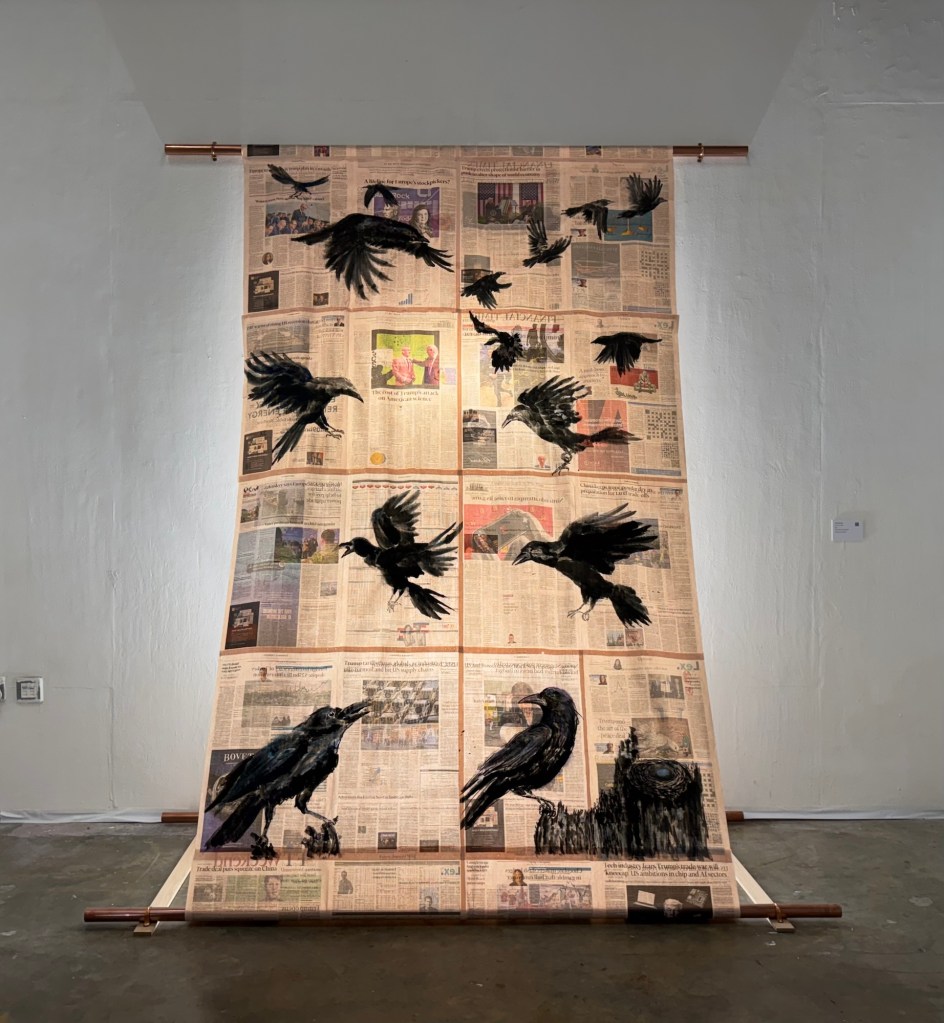
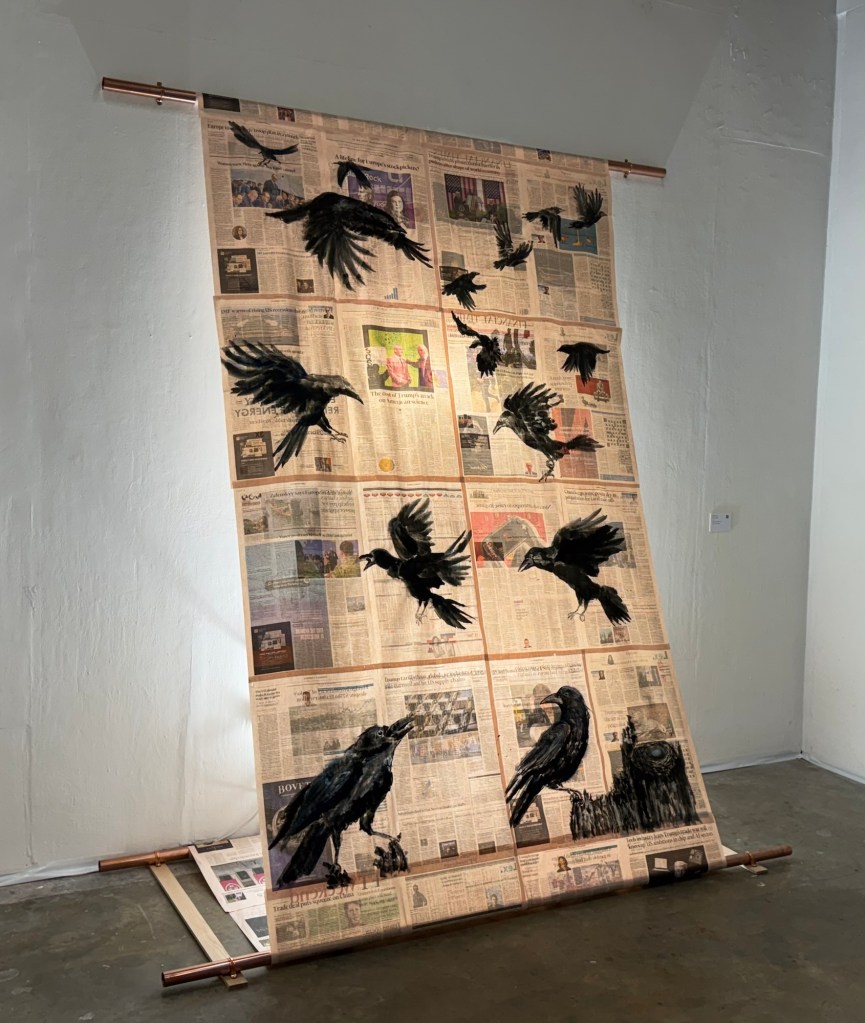
The completed installation:

The artwork label stated the name of the art work and that it was painted with my non-dominant hand because I received some feedback that the non-dominant hand element was lost in the piece and I should make that clearer. Hence I decided to state that on the label.

REFLECTIONS

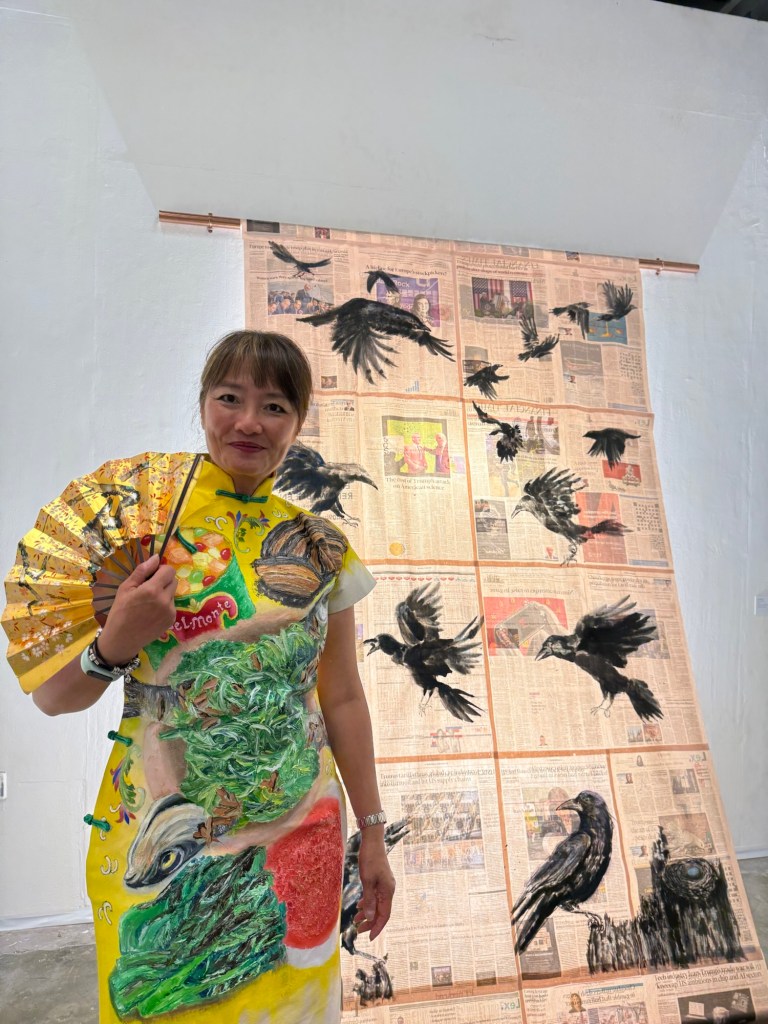
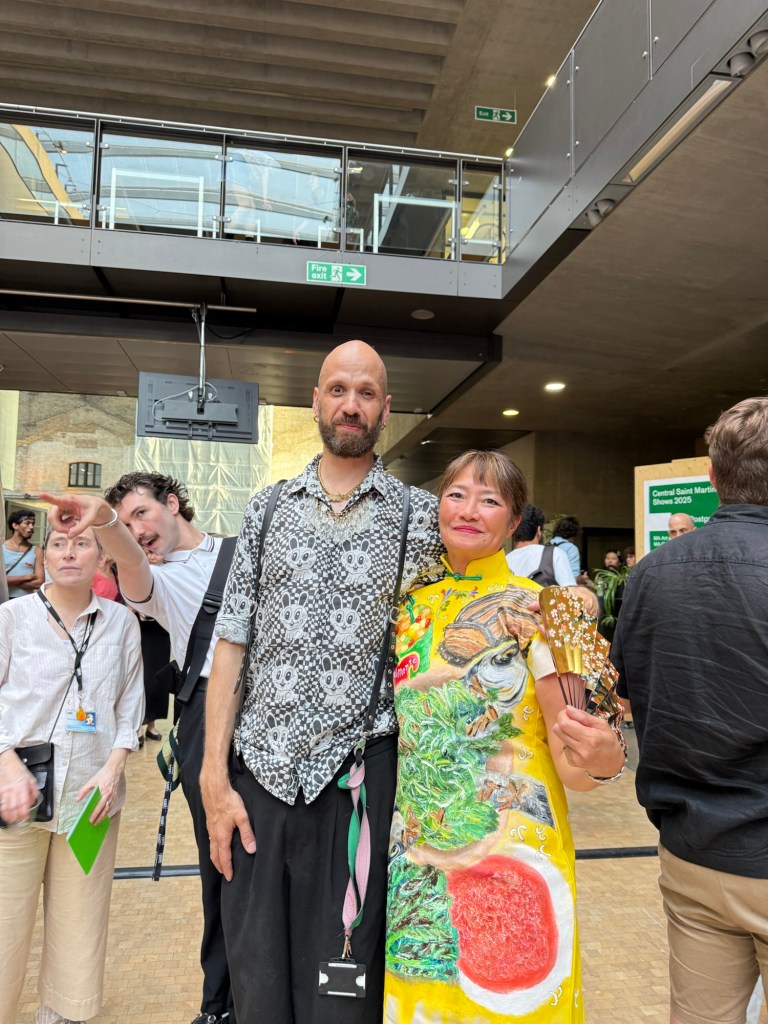
I have thoroughly enjoyed the show – both the install and the show. I wore my Family Dinner Cheongsam painting on the PV night and I enjoyed the compliments and the feedback. During the show, I have at times stood back from my News work and observed visitors looking at my work. It was satisfying when they stopped by, looked carefully and closely to the work. The experience confirmed to me that I enjoyed showing my work. Not necessary wanting people to say ‘it’s amazing’ but I wanted people to think it’s a thoughtful or clever idea, more so than ‘it’s a beautiful painting’ because it was never intended to be.

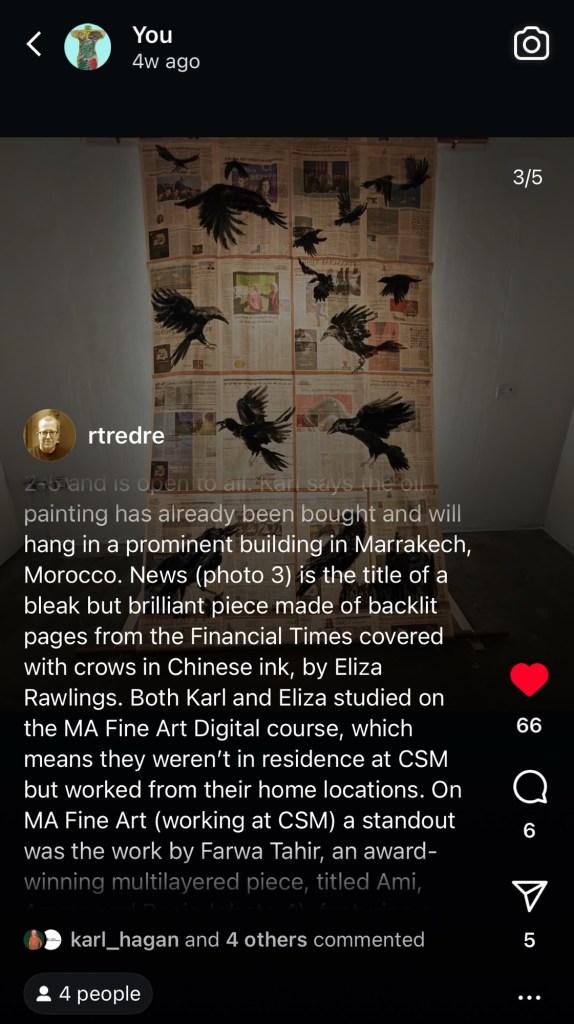
The most satisfying feedback I received was from this person ‘rtredre’ (a CSM MA course leader) on his Insta account. He described my piece as ‘bleak but brilliant’ and I was one of four pieces of work that he picked out from the show. I was delighted by this feedback and his description was exactly what I wanted – it was meant to be bleak and I was flattered that he thought it was brilliant.

I had a few conversations with visitors, excluding friends and family, the following conversations were the most notable:

-A curator/culture manager who was working on his PhD in London. He had a good look at the piece then asked me to explain to him which I did. His feedback was that he got what I wanted to convey from the work itself and my explanation just reinforced it which was good to hear. He also advised me, as a curator, to spend time making work and be true to myself, I.e. not to let anyone (galleries etc.) to push me in specific directions.

-A management consultant who enjoyed arts and talking to artists. She liked my work and encouraged me to start collecting email addresses to form a database for circulating newsletters or inviting to future shows. She gave me her details for us to stay in touch.

-A CSM tutor who liked the way I painted with Chinese ink and she felt my use of the non-dominant hand was very interesting and worth further exploration.

-Another CSM tutor who talked to me about Iain McGilchrist’s work on the divided brain – again referring to my use of the non-dominant hand as an interesting area.

I feel that the overall show was a success and I was happy about how everything went. I was pleased with the preparation I did beforehand and minimised any last minute panics on site. I feel that many other artists were much more relaxed and left a lot of decisions till they were on site. I think in the short term, I would still work the way I have because not being completely prepared might cause me too much stress. Being prepared helped me to enjoy the experience and I guess that’s just who I am.

As for my work, I feel there is still much work to be done on ‘News’ and I have not reached the end of this project yet. With much of the world still in turmoil, I feel there is still more to say for me and I will continue. Perhaps think about a more ambitious way of showing the work from an installation perspective. I feel that my engineering and metal fabrication experience could enable me to do a more complex installation.

LEARNING

-I enjoy showing my work and talking to visitors about my work. I think I was at times still talking like a student or ‘beginner’ and didn’t convey the confidence that I should feel or that I actually felt deep down. I should find opportunities to talk about my art and develop a confident way of talking about my work.

-Some of the conversations with visitors were encouraging in that they talked about my future shows like it was a given that I would do more shows. That was very encouraging.

-My work was picked out by a CSM MA course leader among three others – two of them were winners of top awards from the show. That gave me a new level of confidence as an artist.

-With several people mentioning that my use of non-dominant hand was interesting from an academic research perspective, I felt excited by those conversations and I will explore the subject further as part of my practice research.

-I feel there is still much work to be done on my project ‘News’ – perhaps choose another topic to focus on for a change but remaining with the ‘News’ concept. Use my engineering knowledge to design more complex installations.

NEXT STEPS

-Create opportunities to talk about my work in a more professional way. Perhaps start with talking to artist friends. Or do more videos where I talk about my work. I have been used to talking professionally about my business in my ‘previous corporate life’. I would never have talked in an ‘uncertain or apologetic way’, so perhaps I could channel some of those skills for talking about my art. I am a professional artist now after all!

-Research about the use of my non-dominant hand – both in practice research and academic reading. Explore more non-dominant hand vs dominant hand making – study myself to see what I find. For academic reading – start with Iain McGilchrist’s work.

-Continue to make more ‘News’ work, explore other news topics.

-Explore more ambitious way to show the work in terms of installation – use my engineering skills.

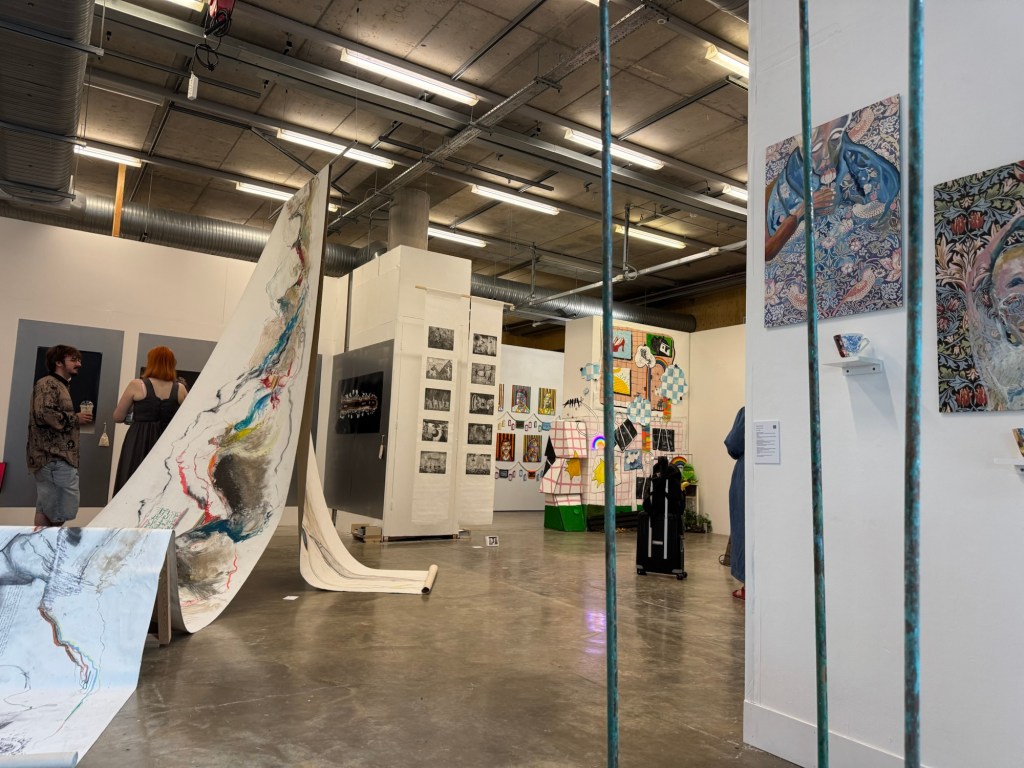
Some photos from the Show:

MA U3: ‘News’ Art – developing ideas for MA Degree Show

BACKGROUND

Since my recent re-evaluation of my art practice to enable me to respond to what has been happening in the world, I have been making a new body of work – ‘News’. I feel the urge to show my new work at my MA Degree Show. This blog is about the development of ideas and a plan for the Degree Show.

METHOD

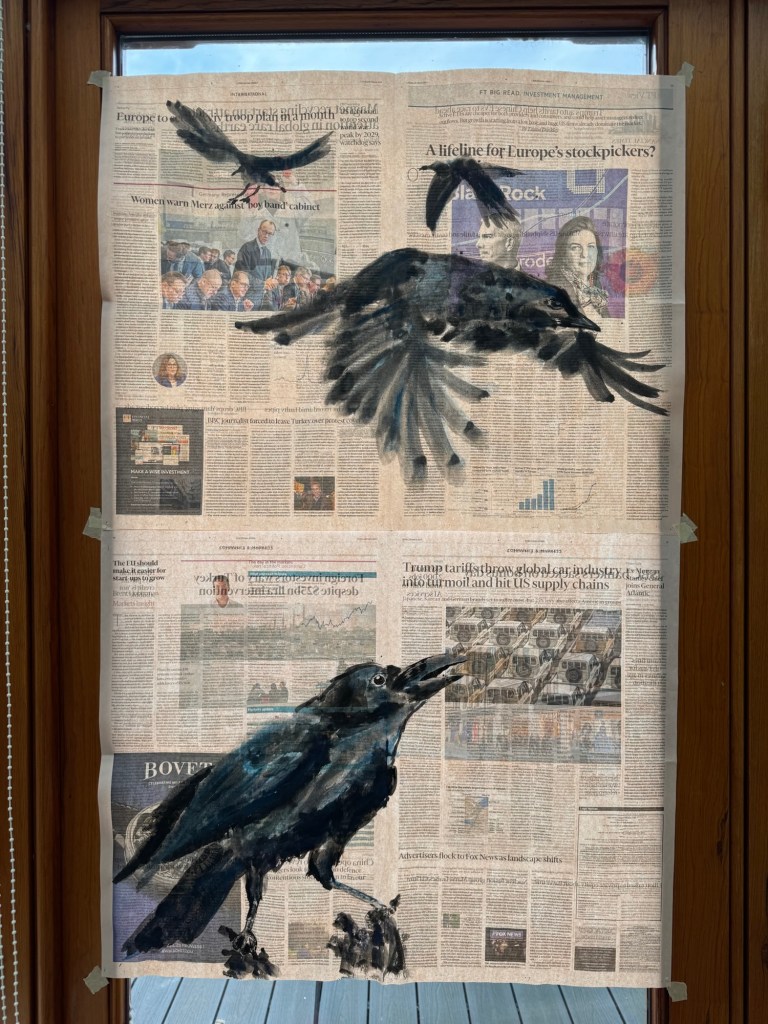
Firstly, I wanted to explore if combining multiple sheets of ‘News’ would make a good composition. Since each sheet was made as an independent painting, I needed to see if they would ‘make sense’ together. So I stuck together a few paintings and put them up against two glass doors to see how I felt. I was encouraged by what I saw and felt there was potential in the concept. I then proceeded to design the installation – how should the paintings be presented?

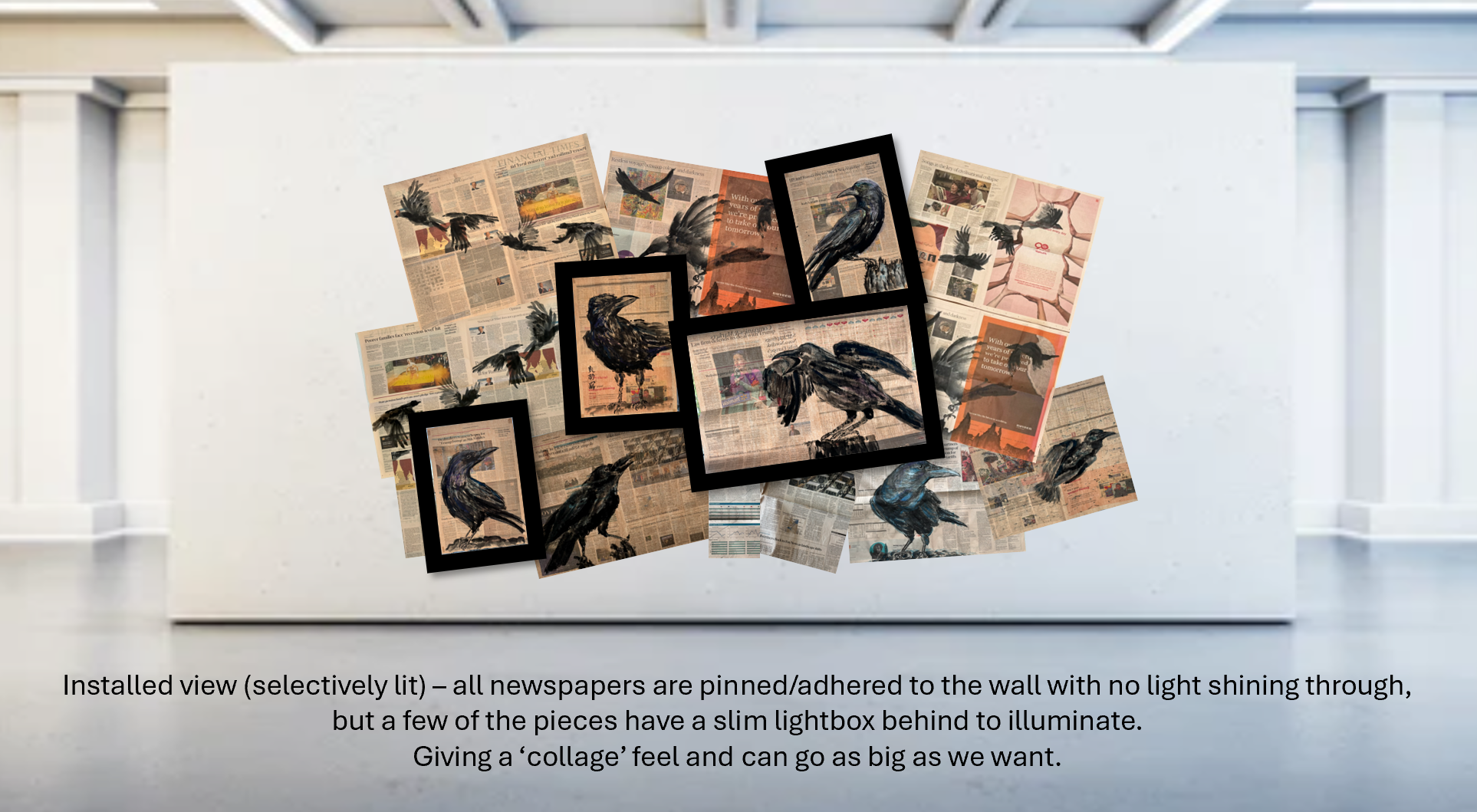
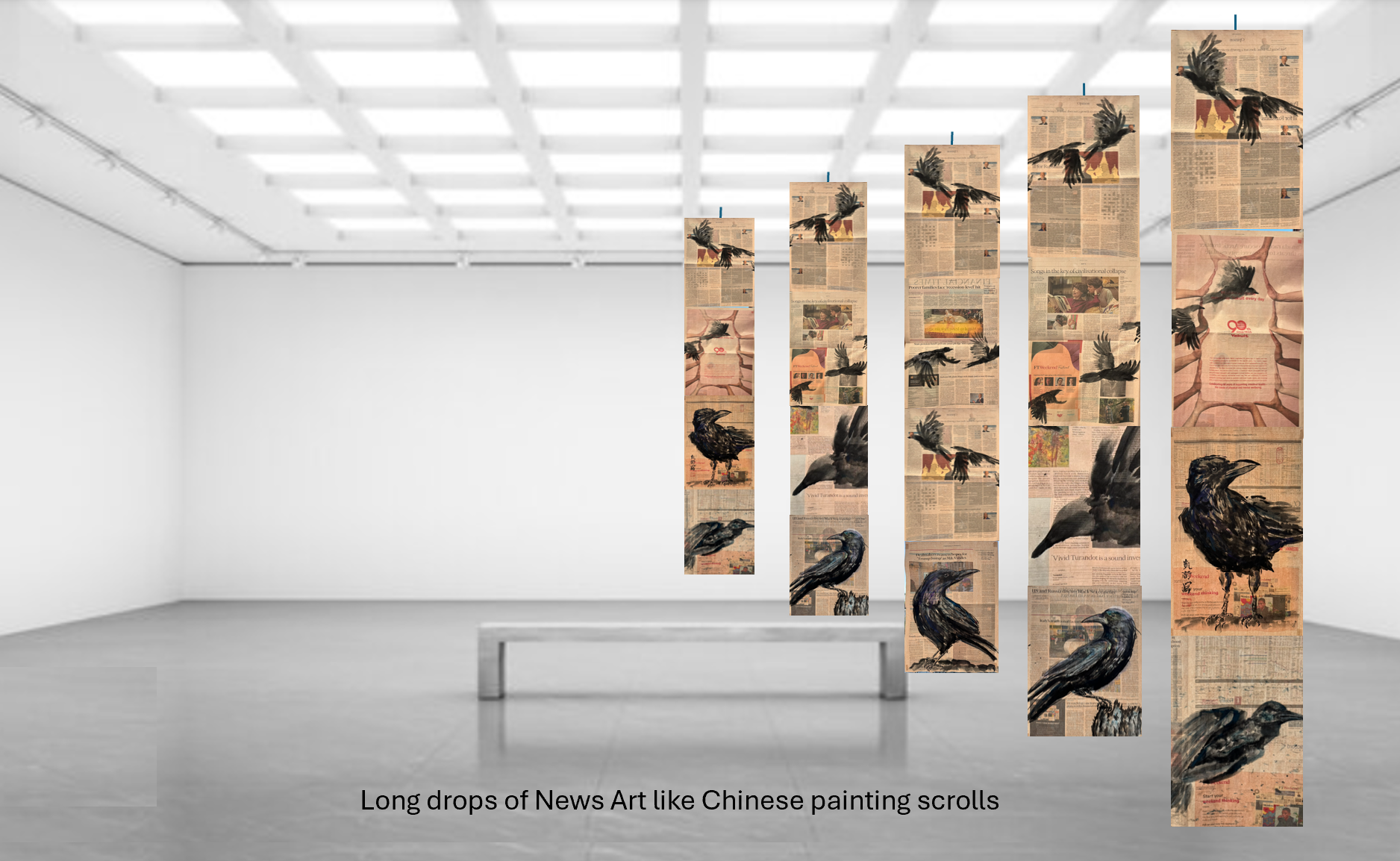
Below are some mock up ideas that I prepared to discuss with my tutor:

After discussing with my tutor, we felt that the first option had the most potential for the CSM site. So I proceeded to think about how to create one large painting by combining multiple newspaper paintings together that would be appropriate for the Show both in demonstrating the concept and that is robust enough for a public exhibition.

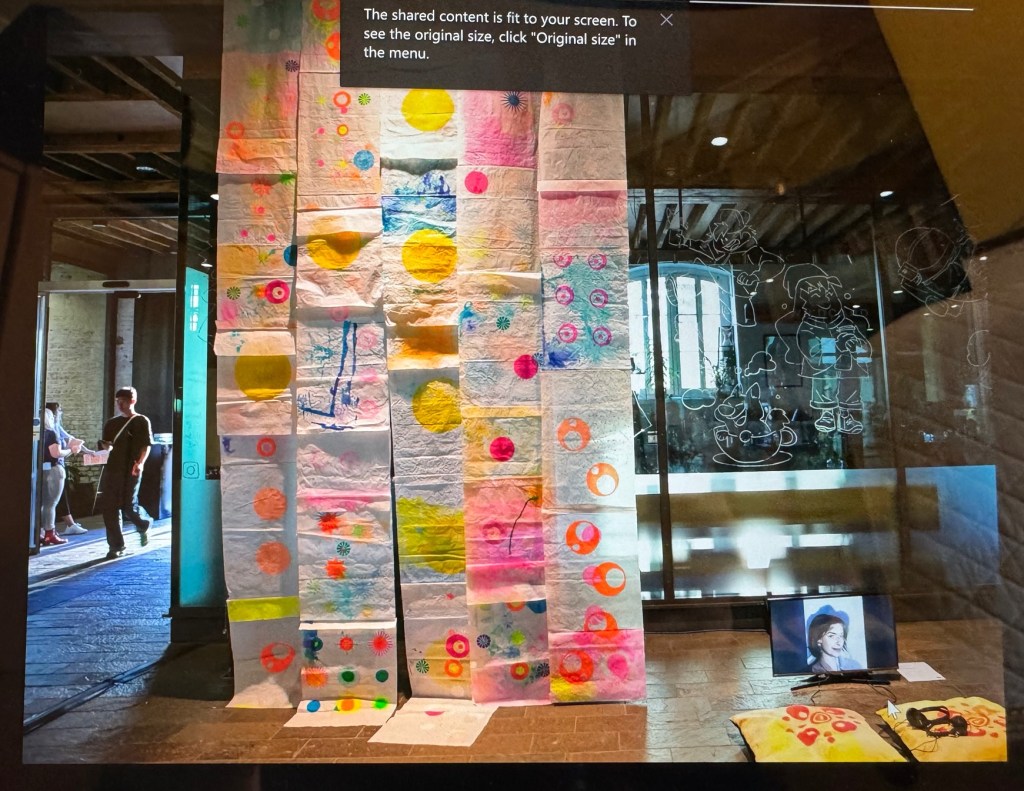
My tutor showed me an installation by a previous student who stitched together pieces of paper to form a long drop. I liked the idea of stitching together the pieces rather than just taping because I think it would be more robust and also reflect my wish to mend what’s happening in the world through my work – somehow.

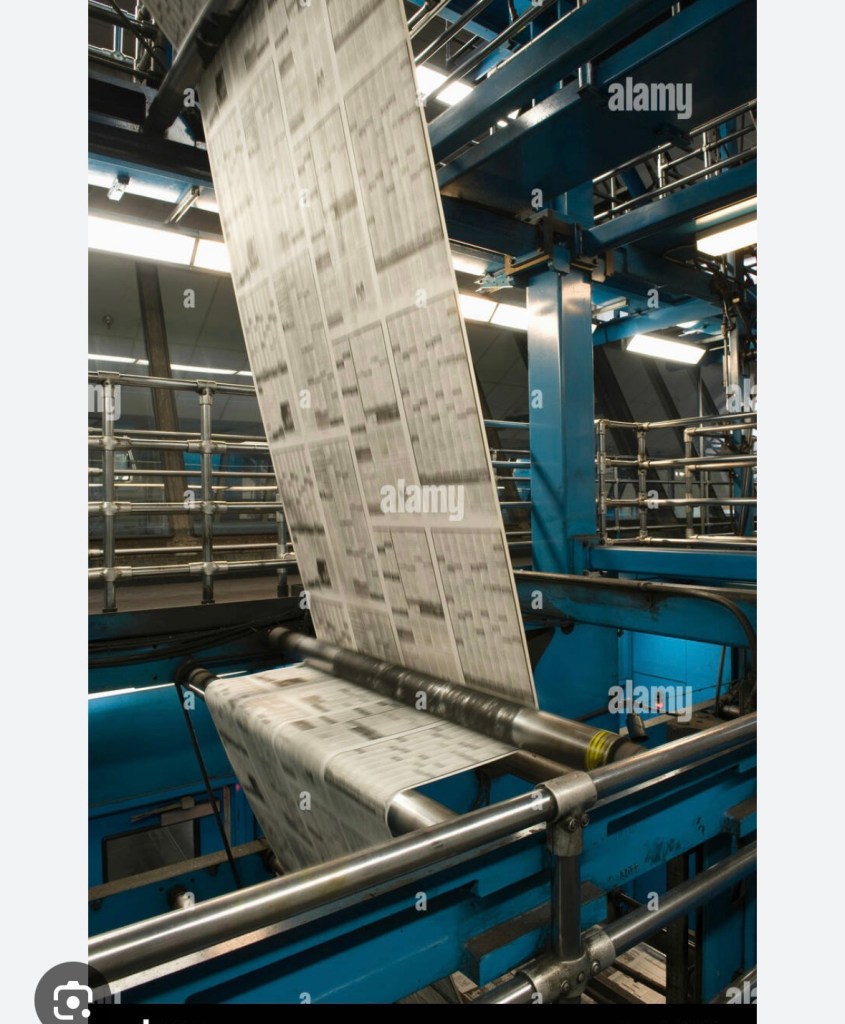
I then tried out different ideas on my sketch book and decided a narrower long drop (rather than a wide one as in the original idea) could work well to resemble how newspapers are printed and processed in the factory. Working so intensely with newspapers and examining newsprint so closely has reminded me of my time as a young engineer working on control systems for newspaper printing presses including many Fleet Street titles. I remember vividly how exhilarating and awe-inspiring it was to see the newspaper webs flying at high speed between feeder rollers around the monumental machines (see example image below). Since my art practice is about exploring my identity and engineering has been such a large part of my life (35+ years), I wanted to make an installation at the degree show that incorporated elements of my memory from those days.

I experimented with the ideas of using three tubes to represent parts of the printing machine. Initially, I looked into buying used feeder rollers from printing press refurbishment companies but they were costly. Then I considered using mild steel tubes (not stainless steel as they would be too shiny). Below is an initial design idea which I used to get some costing. A key objective was the ease of installation knowing how busy the build up would be with such a big student show.

Then I wondered if three tubes would be too many and considered a two tubes design. In all cases, one or more flood lights would be used to illuminate the artwork from behind. Here is a two tubes design:

After further discussions and advice from my tutor, the final design was to use 3 x copper plumbing pipes as the copper colour would complement well the Financial Times’ salmon paper. The second pipe on the floor would be placed behind the painting giving the look of the newspaper feeding into the wall. I considered using two small flood lights, but I might go with a dimmable flood light instead because I have found that the back-illumination light level could be critical – too bright and the images became saturated and if too dim then the reverse side images would be hardly visible. Hence a dimmable unit would give more flexibility for an unfamiliar site with unknown ambient light level. Here is the final design:

The next task was to test out the stitching and the wrapping of the newspaper around a pipe to see how the paper behaved. Also to determine the optimum pipe diameter to use.

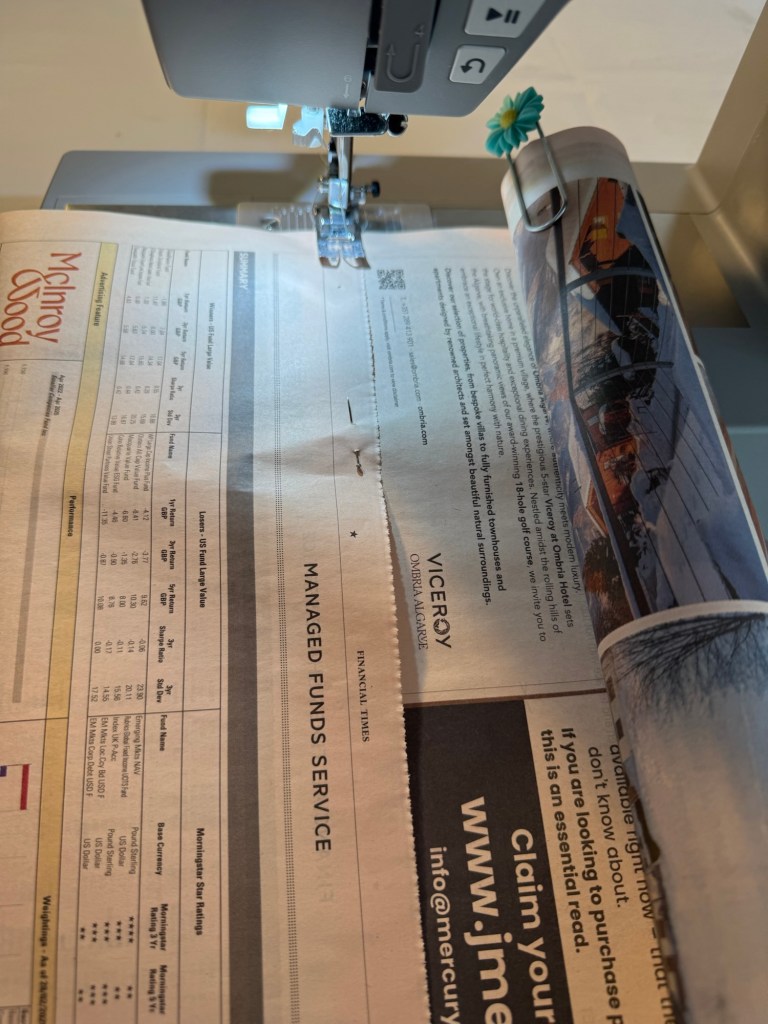
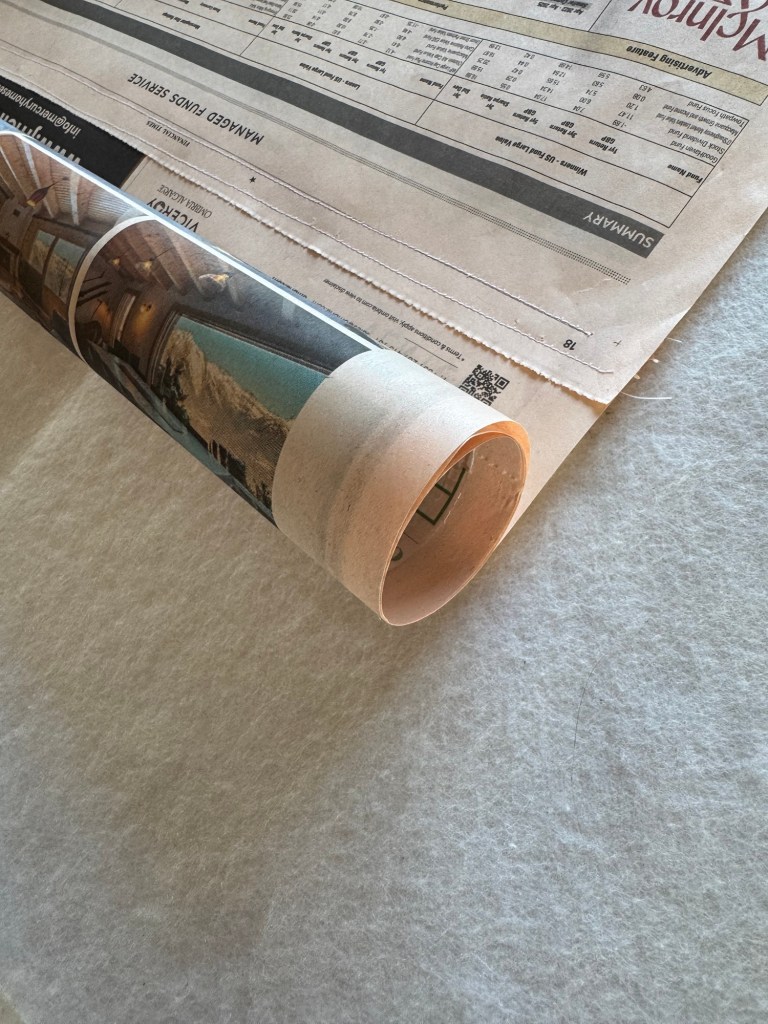
Using a sewing machine for large sheets of paper could be challenging because unlike fabric, the paper could not be bunched up to fit around the sewing machine body. Hence I rolled up the newspaper around a plastic tube and held the roll in place with a large paperclip so that it could be fed into the machine without damaging the paper. The two sheets of newspapers were held together using dressmaking pins just like I would do when binding fabrics.

The machine settings were as follows with the stitch size fairly small for strength but not tiny as it might rip the paper:

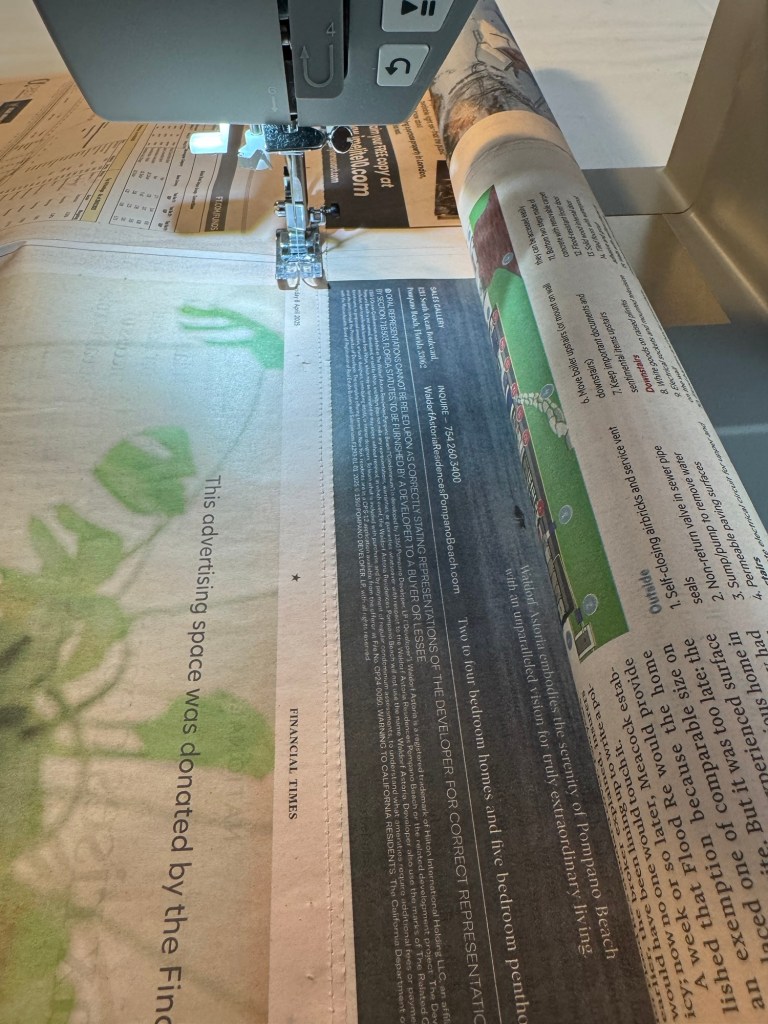
The paper was then fed slowly into the machine for sewing. Two rows of stitches were made to ensure strength of the bind:

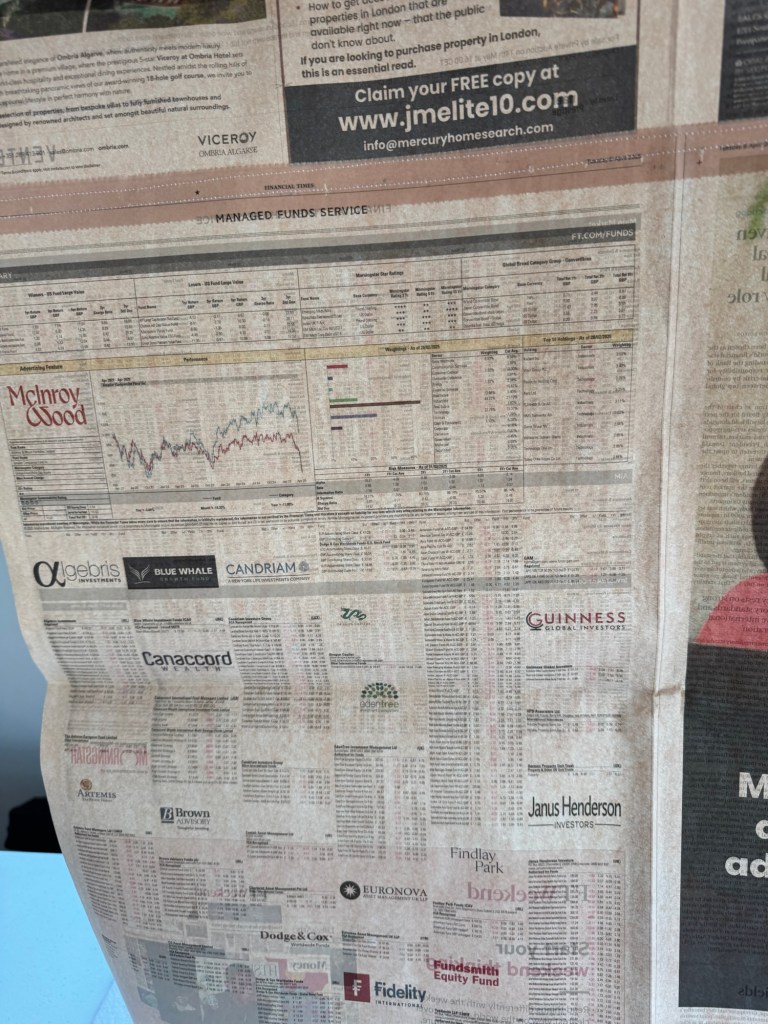
Completed sewing and with paper hanging vertically:

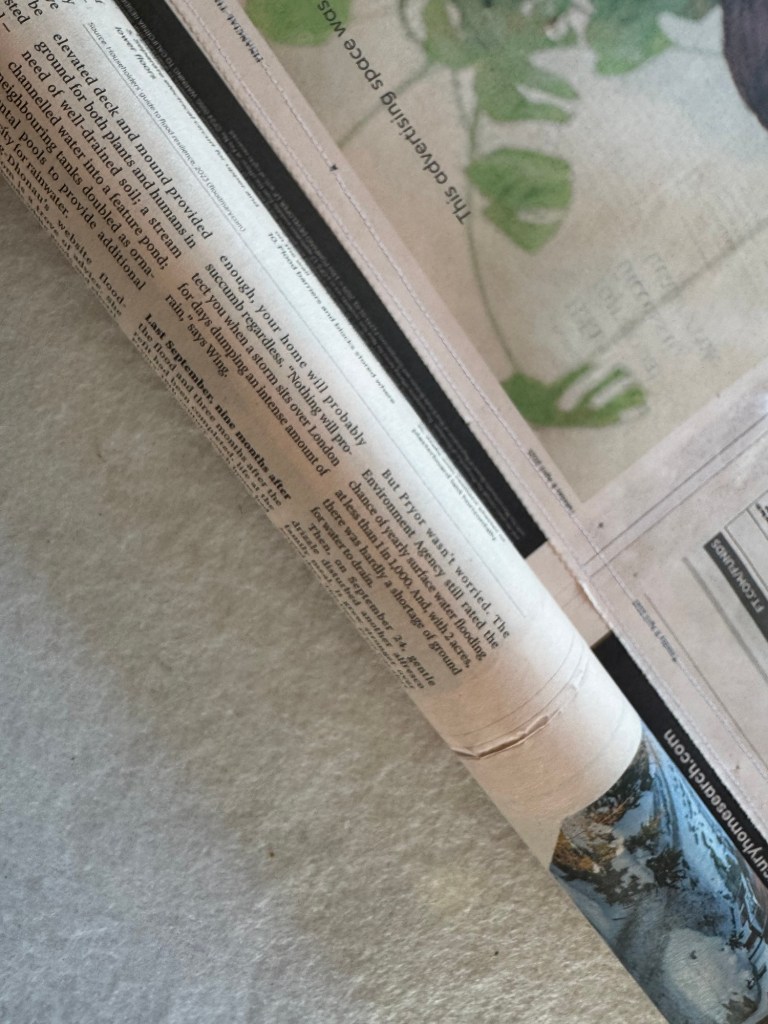
Below are close up images of the stitching and how the paper wrapped around the tube. This tube was of 40mm diameter and the paper wrapped well around it:

I tried wrapping around a smaller diameter tube (22mm) and it felt too tight and obviously would require more revolutions of wrapping and I felt that would introduce more risk in the paper not aligning and looking untidy:

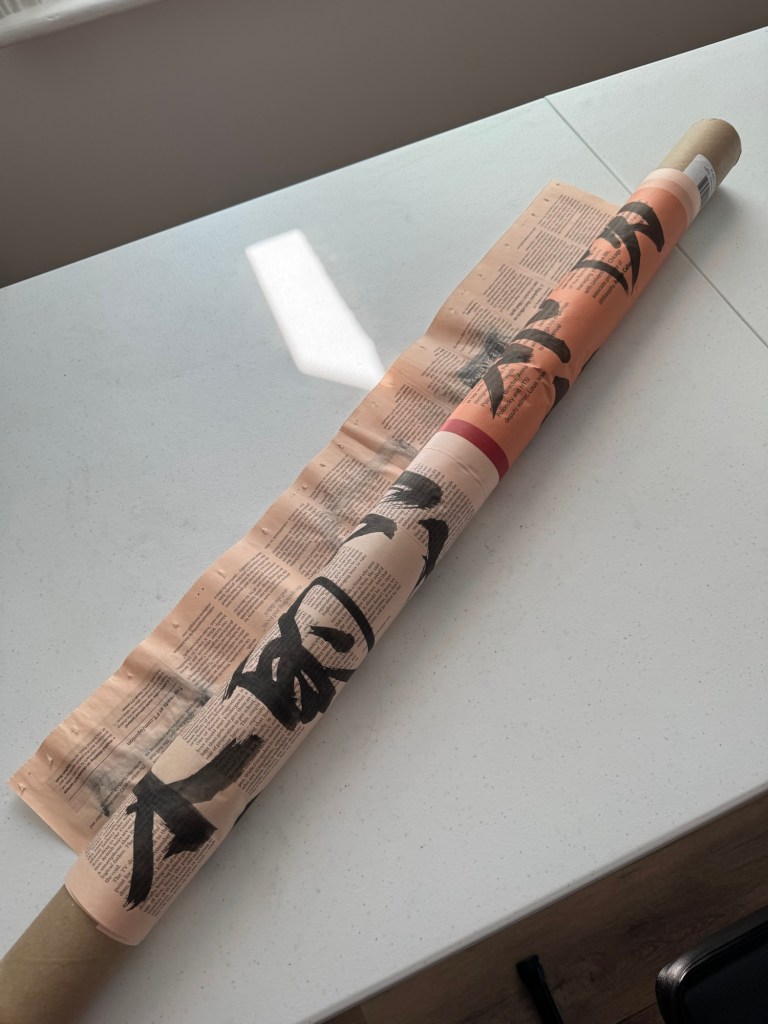
Another example of paper wrapped around a tube. This time with painted paper only as an experiment because the installation for the Show would only use unpainted paper to wrap around the tube.

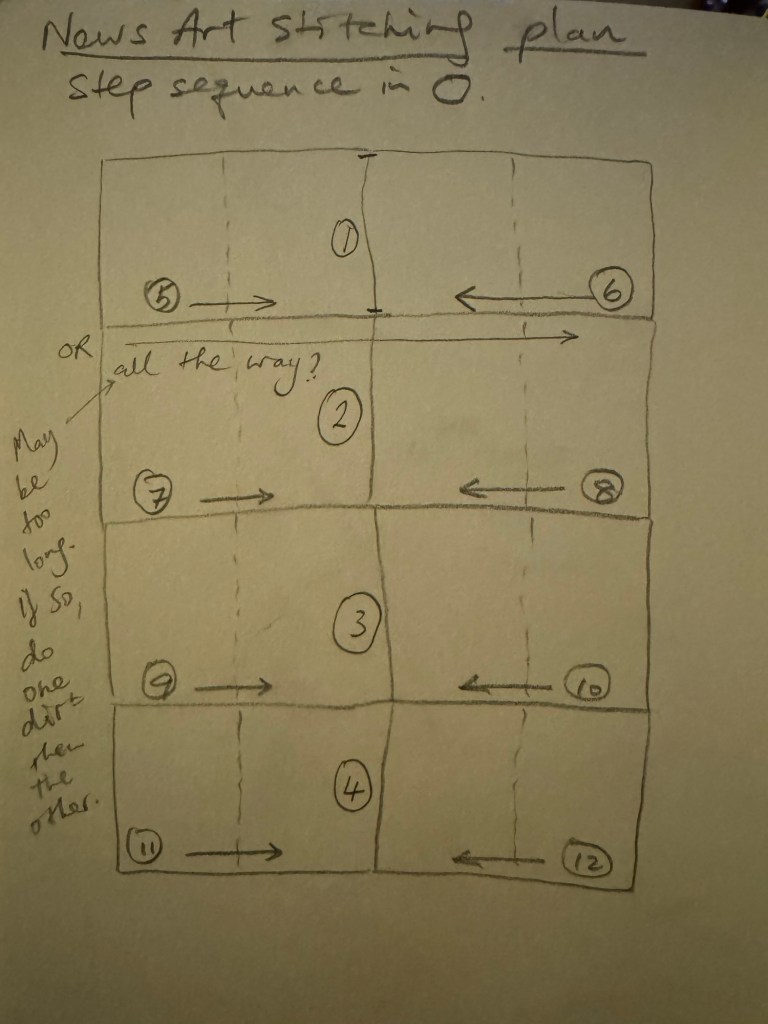
Since I am planning to create a painting size of 2 x double page spread broadsheets, that is approximately 1.36m wide and it would be difficult to feed into the sewing machine in one go, I created the following stitching plan to do the stitching half way, then turn around and do the other half from the opposite direction. I might try to do it all the way with some spare newspaper as an experiment to start with.

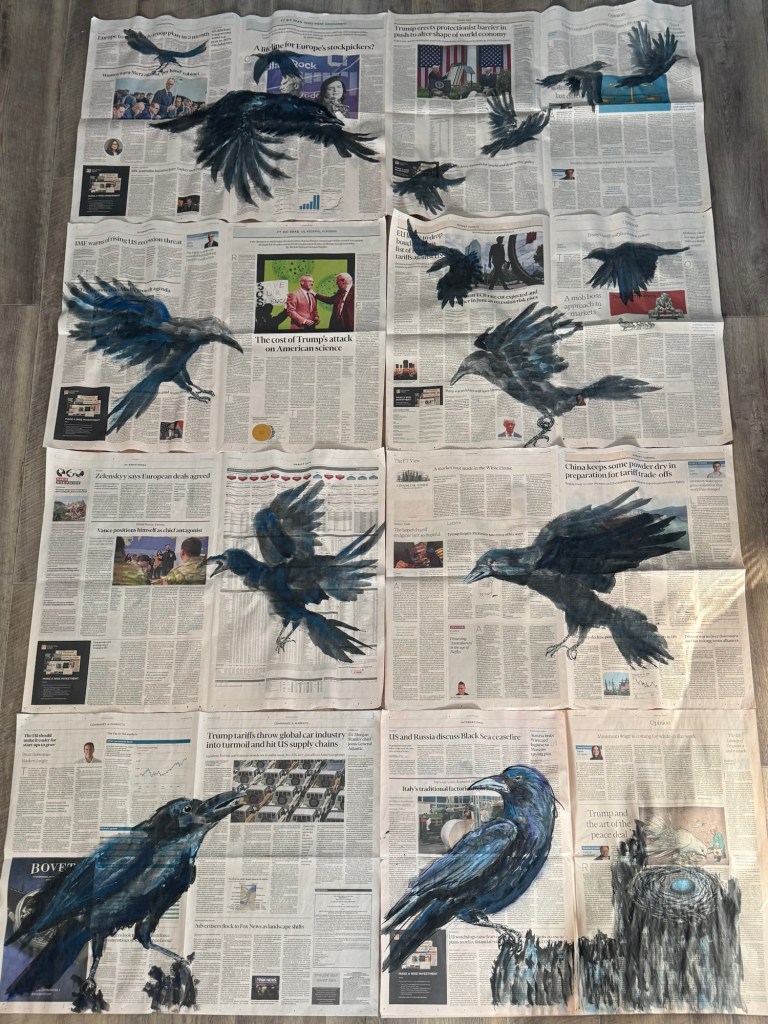
Final selection of eight paintings to form a composition for the Degree Show:

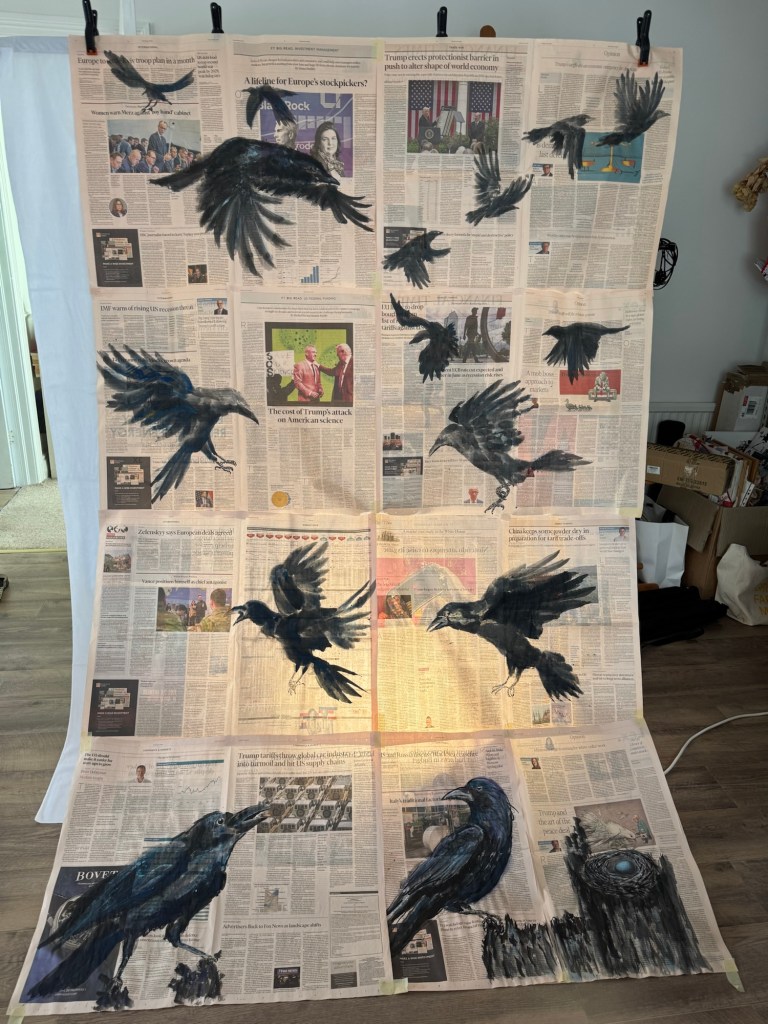
Mock up in front of flood light to test concept:

REFLECTIONS

I started to re-evaluate my art practice just before the Low Res in March and I started to make ‘News’ art at the end of March which is less than two months ago. I cannot believe how much has happened and that I am planning to show this new body of work at the Degree Show. During my recent tutorial, my tutor said that everything I have been doing as well as my commitment to interrogation have been leading to this and it does feel that way to me. I am feeling a momentum that I had not felt before and I am very excited (and somewhat nervous but in a good way) about showing this work at the Show. I do not know if it would work out or if it would present itself as I imagined. But I take confidence from what David Bowie said in this video where he was giving advice to artists:

https://youtu.be/JRtZc_Nmo5w?si=PYU871rvIuJu7wjo

My main takeaway from Bowie’s video was when he said, ‘…Always remember the reason you initially started working, you felt there was something inside yourself that if you could manifest it in some way then you would understand more about yourself and how you co-exist with the rest of society… If you feel safe then you are not working in the right area. Always go a little out of your depth, when you feel your feet are not quite touching the bottom then you are just about in the right place to do something exciting.’

I sincerely hope that Bowie is right and I look forward to finding out!

Another point that I have been reflecting on is that this new body of work is aesthetically and topically very different to my last body of work, The Cheongsam Series, where I was making oil paintings on dress-shaped canvases to explore my transcultural journey.

Much of my work in the last two years have been about my transcultural identity, but I knew that at some point I would want to go beyond just talking about my transcultural journey onto issues about society – issues that are still related to me, my lived experience but about other aspects of my identity. I mentioned this in my Study Statement from Unit 1 as my intention, but as I was making my transcultural work I have at times felt bounded to that topic and I was unsure of how to progress or transition onto the next body of work without seeming incoherent. Then when the ‘calling’ came to make work about the rapid change in world order and how people close to me were being affected, my urge to move onto the next body of work felt like a natural progression. Of course, there was much time spent on reflecting, agonising, experimenting, observing and reflective-writing that led me to making ‘News’ art. I am very pleased that I have gone through the transition process from one body of work to the next while I was still on the MA programme. This is because I felt safe and secure in trying something completely different in a supportive environment and I made it happen. I have learnt that I could do it and it wasn’t as scary as I thought it might be. Guided by my reflective process and taking it step by step meant that I felt in control of the transition – not necessary in control of the making but in control of the change process which gave me a solid platform to take risks in the making. This learning experience has been very important for me as I now feel confident to do that again independently after the course. I feel I can move onto the next body of work when the next ‘calling’ comes. I know I can rely on my instincts guided by my reflective process to make it happen. I expect I will return to my transculturality work at some point because there is still much to explore and I certainly have not exhausted the subject yet – far from it.

LEARNING

I have learnt that I now feel able to transition from one body of work to the next and take risks along the way. I will follow my instincts and use my reflective process to guide me. This has been an important realisation as I go forward to develop my practice.

As for the Degree Show, there has been a lot to think about in planning for the show and I have really enjoyed the challenge. Especially looking at sourcing the right materials for the installation – I learnt a lot in that process, such as to consider the materials’ behaviour, the aesthetics and planning for a site that I am not familiar with including all the contingencies to consider. It’s all good experience for any future exhibitions. Creating the paintings is only half the work, presenting it properly and all the site considerations require just as much work which is something to bear in mind in the future. Planning and allowing plenty of time is key!

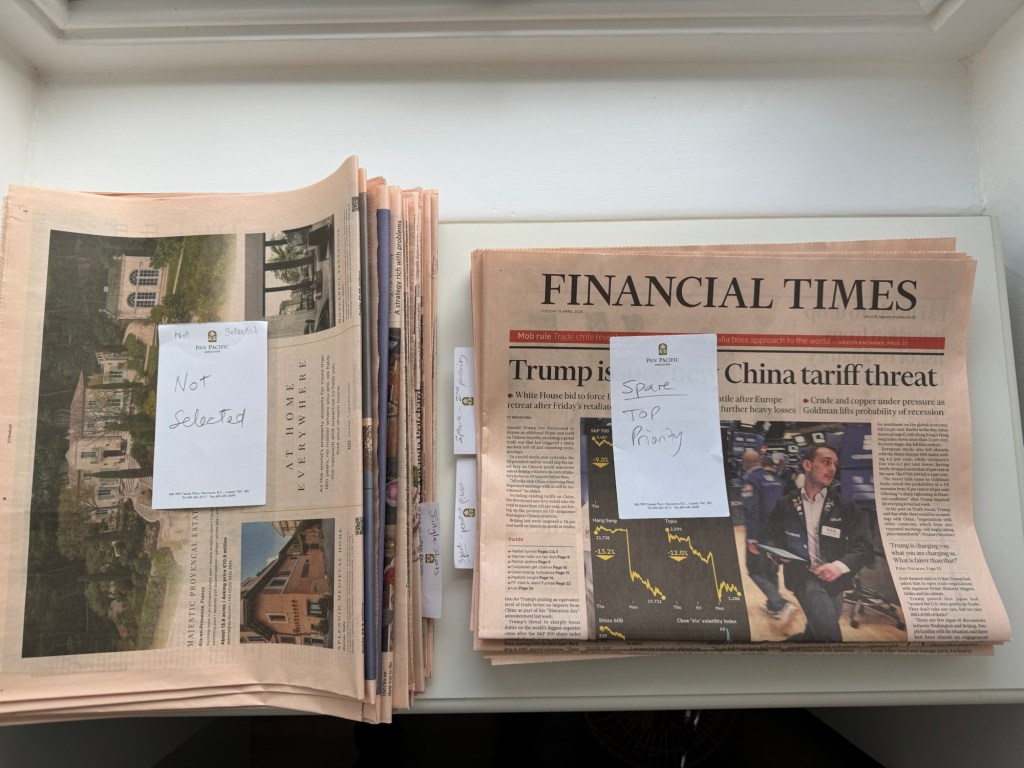
I have also learnt that I needed to introduce a new process of organising my materials – namely the newspapers! Especially considering news has a life span. My ‘News’ artwork needs to be about the here and now and can’t be left on the shelf for too long or the news story would have expired. So I needed to create a system to sort the newspapers so they don’t end up piling up in my studio. I decided to organise my newspapers as follows.

I found it helpful to have a specific topic for selecting the newspapers to paint on. In this case, it’s about the sudden change in world order due to the US Government’s drastic roll out of damaging policies.

So when I get a copy of the newspaper, I sort the pages into the following categories:

– Selected pages for painting – with the appropriate headline, perhaps an interesting image and not too much advertising especially not big dark blocks.

– Spares: top priority / second priority / good for practicing

– Not selected

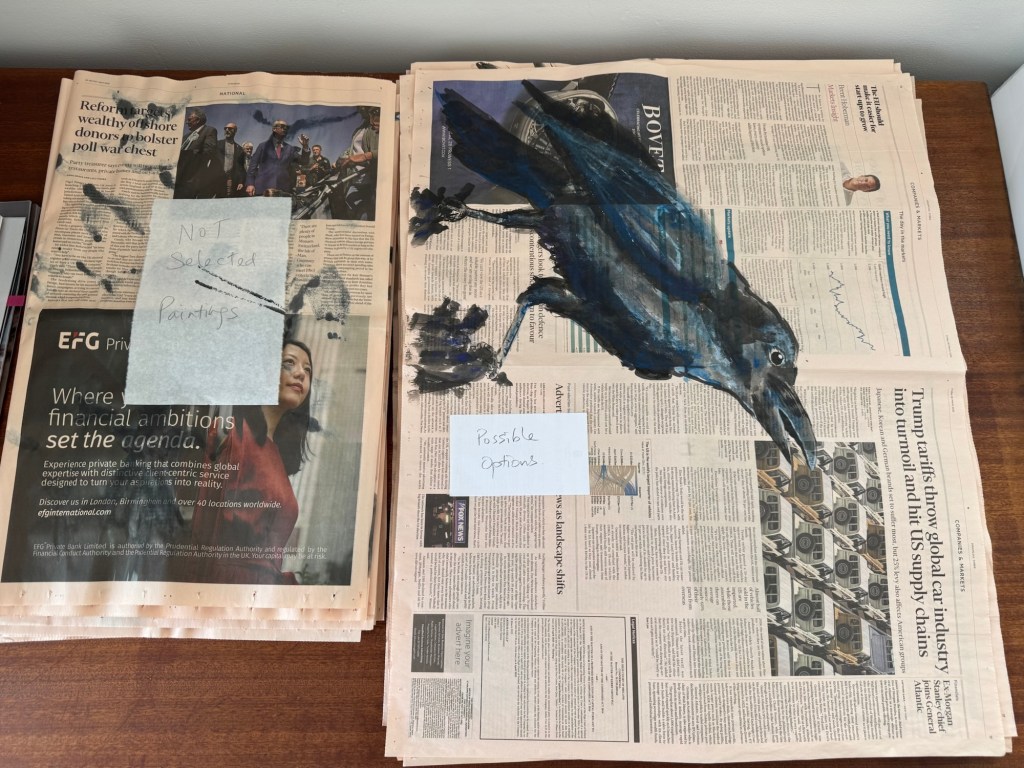
Out of all the ‘News’ paintings that I have created, they were sorted into ‘possibles’ for the show and ‘not selected’. Then I continued to make more paintings until I had enough ‘good’ ones that I was happy with for the Show.

NEXT STEPS

Make it happen for the Show!

Always remember Bowie’s advice!

Maintain my confidence, follow my instincts and reflective process to develop future bodies of work.

MA U3: ‘News’ Art – exploring compositions

I have continued to work on my latest body of work – ‘News’. I decided to explore different crow expressions to use in my compositions. In particular, more expressive, angry or ones in flight. So that I have a wider variety of expressions to choose from when responding to news articles that I see.

METHOD

Lately, whenever I feel unsure about how to proceed then I have been returning to drawing. I find the process comforting and grounding. So I started with a few drawings on expressive crows using my non-dominant hand.

Angry crow:

This one was meant to be angry but actually looked anxious:

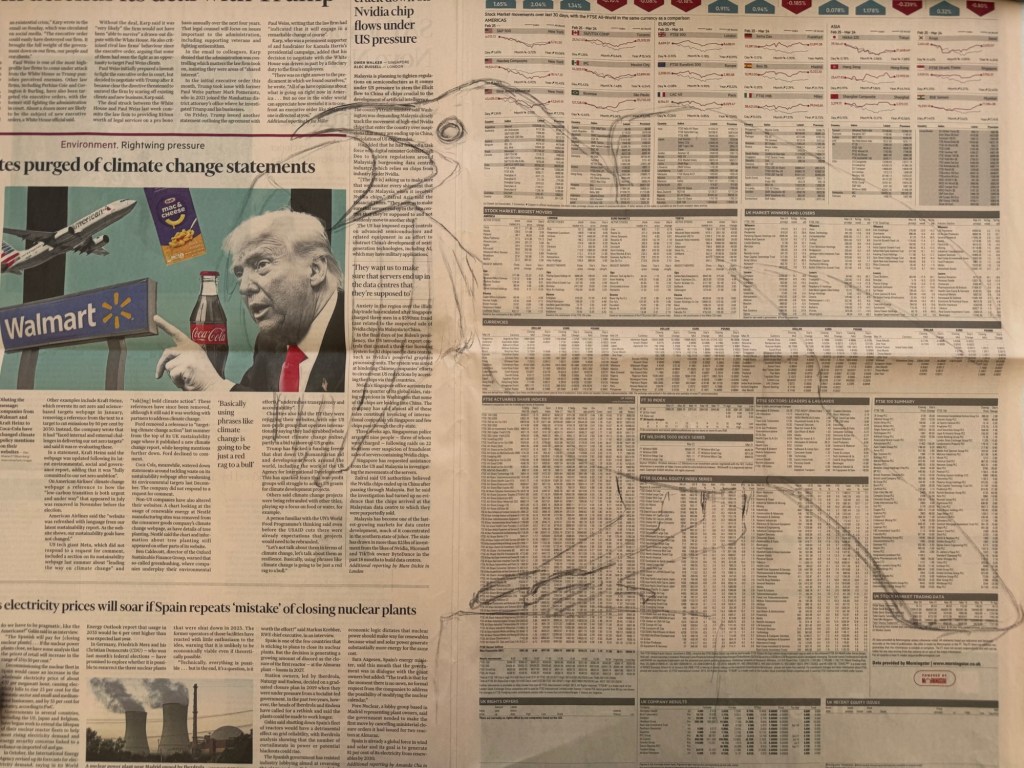
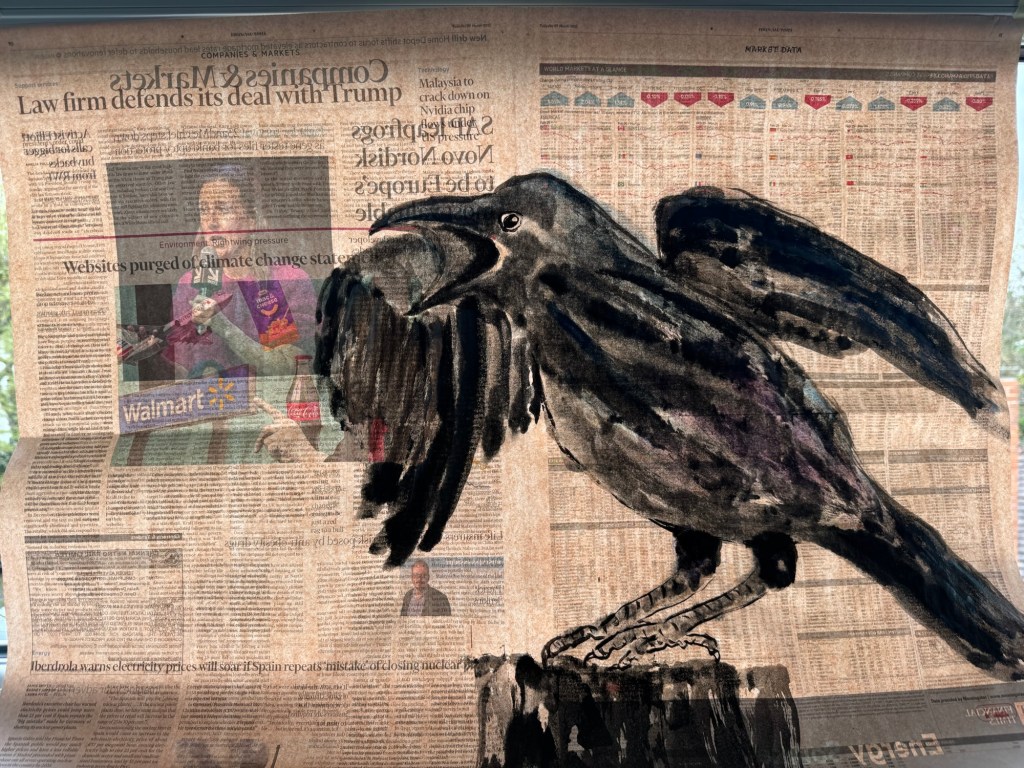
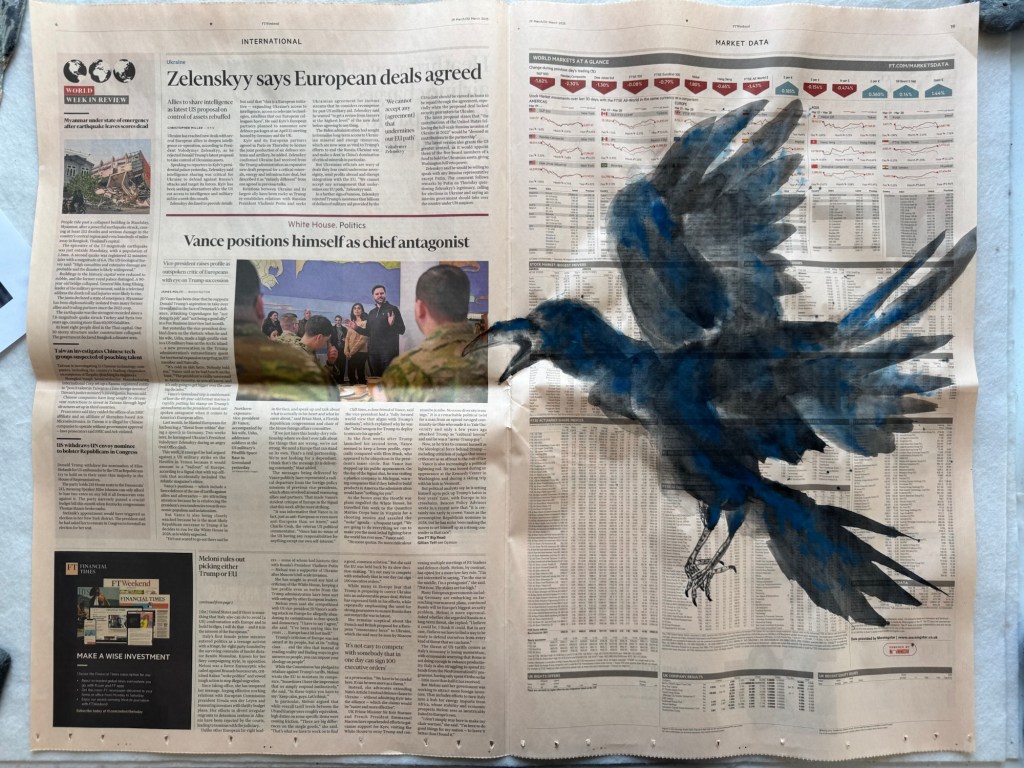
I then went onto painting on newspaper. I used charcoal to mark the outline of a crow that I wanted to paint. The newspaper was chosen especially for this composition – a shouting crow:

I then painted the crow – staying with my non-dominant hand. I was going to paint the wing behind the man’s head. But then decided to cover up the head. This was the finished work:

The painting was held up to the light. The man’s head was slightly visible despite being covered. What came through was a woman speaking on a microphone on the reverse side of the newsprint which made the composition more interesting.

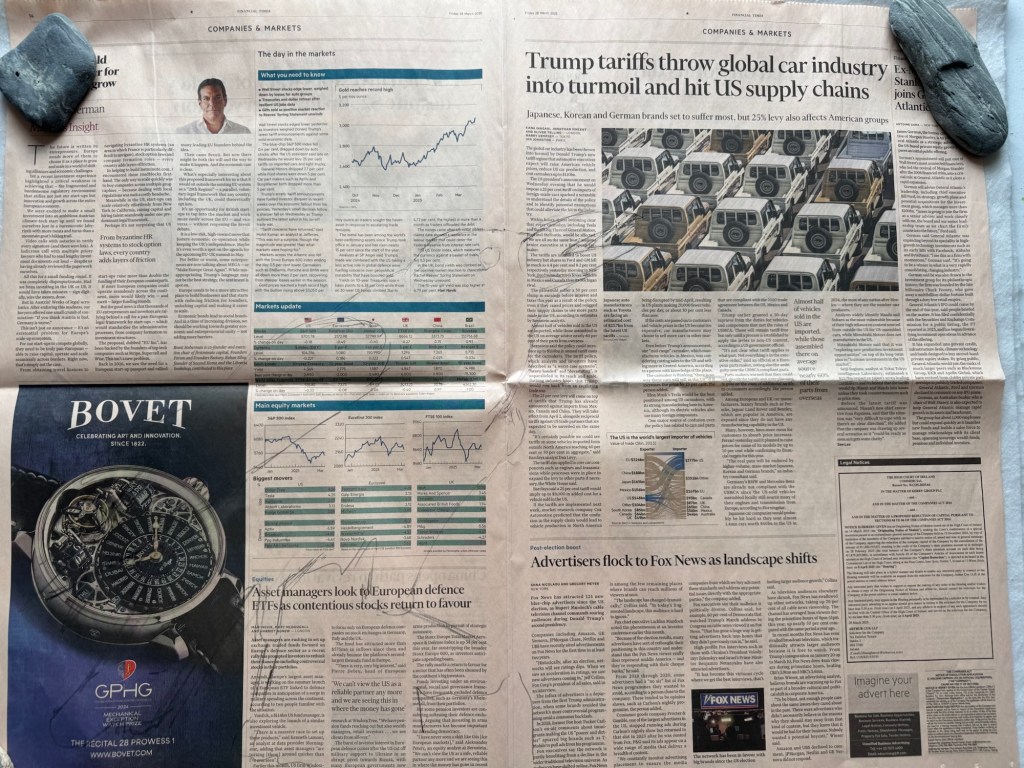
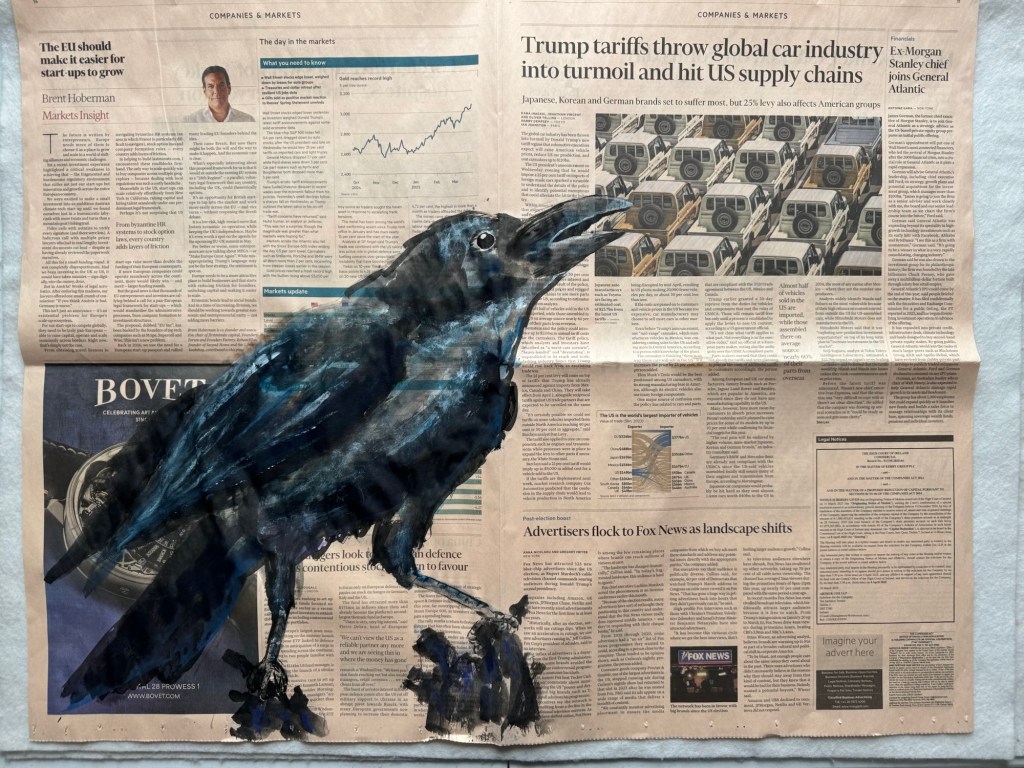
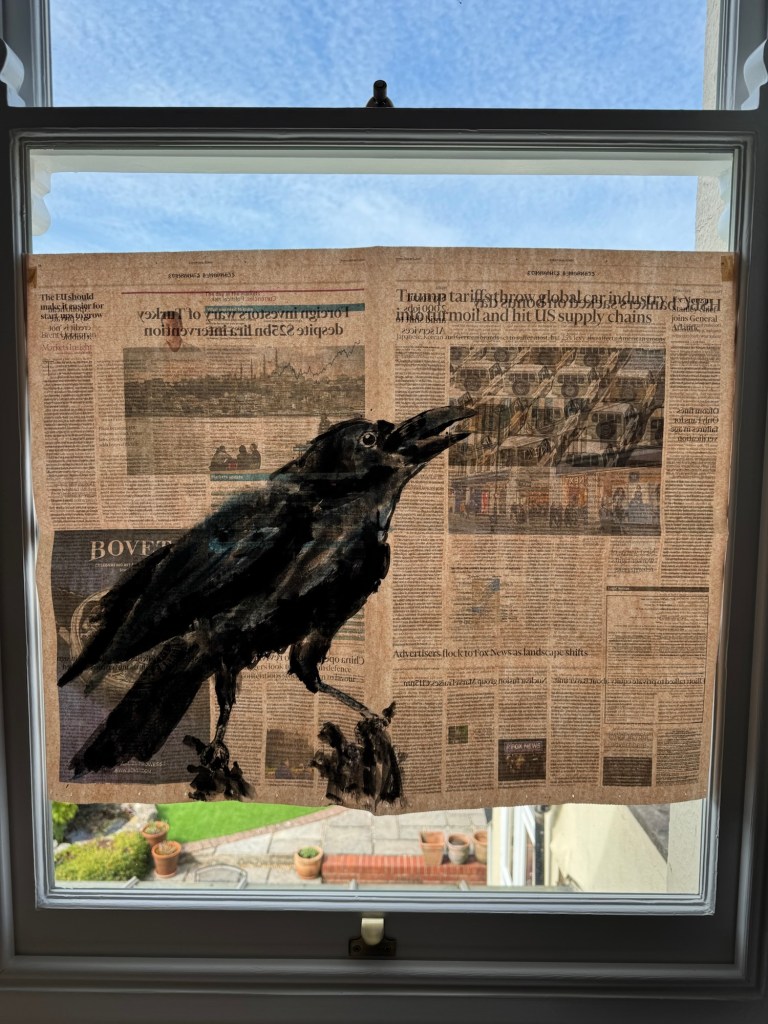
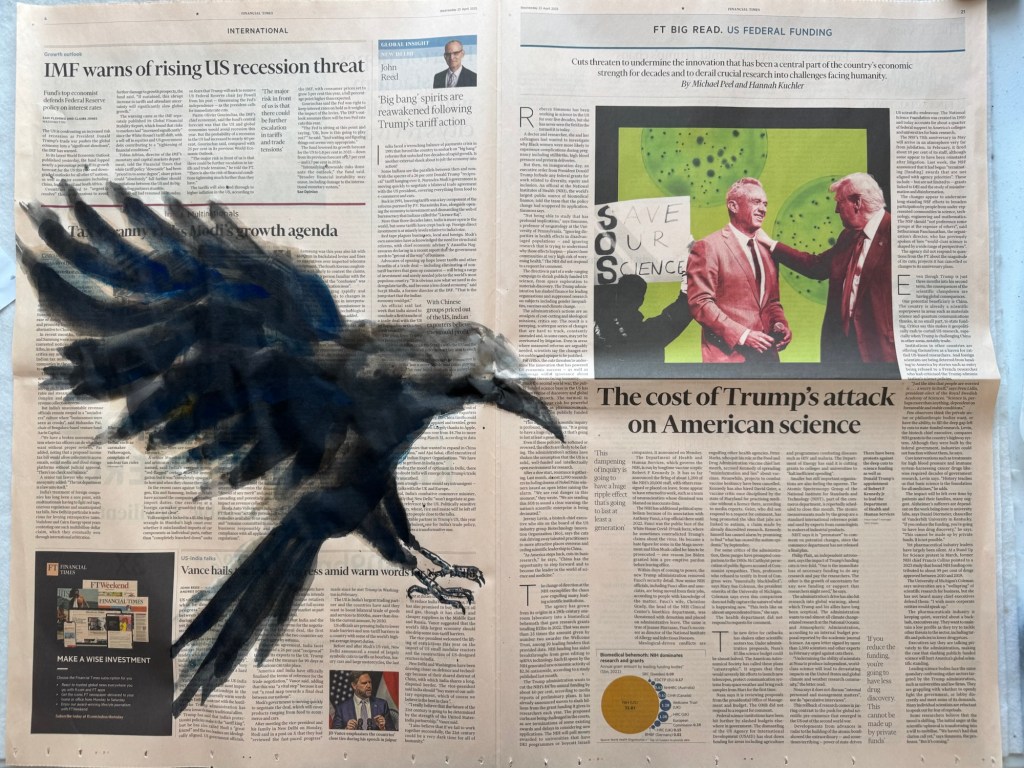
Then I experimented with a crow looking in despair up to an article about the tariff trade war. Perhaps it was not totally in despair, but certainly questioning what’s going on:

Again the finished painting was held up to the light as a metaphor for holding someone to account. The images on the reverse side made the photograph of the cars under the trade tariff headline more ambiguous.

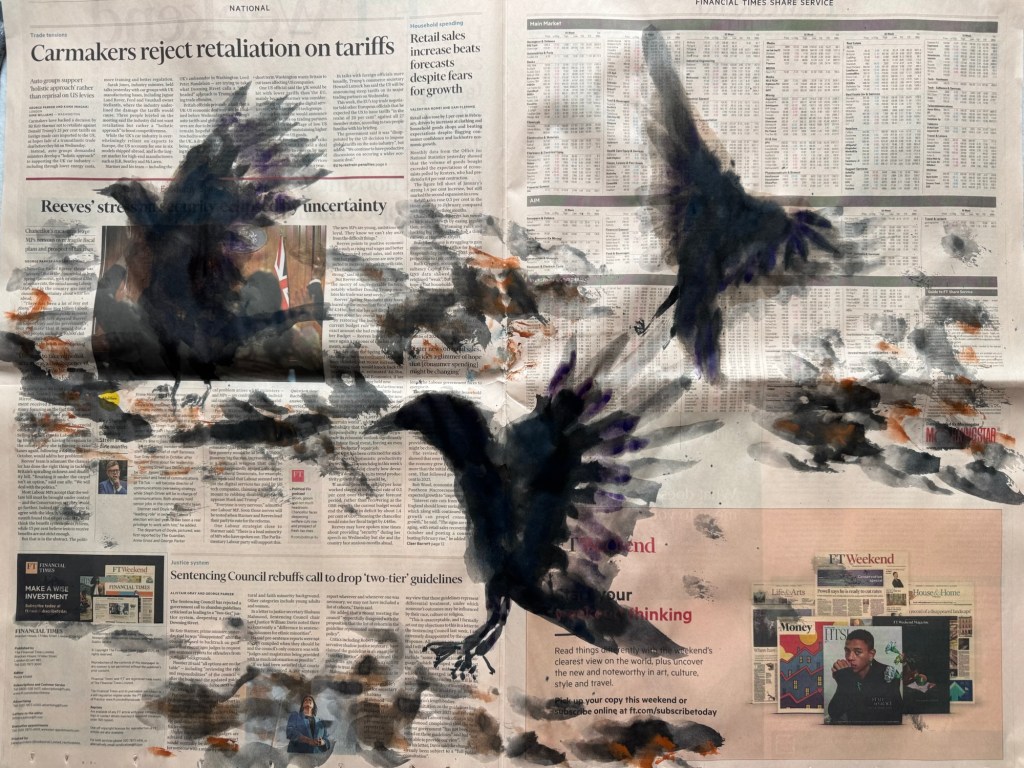
Crows in flight going in different directions:

Putting together paintings to start exploring combined composition:

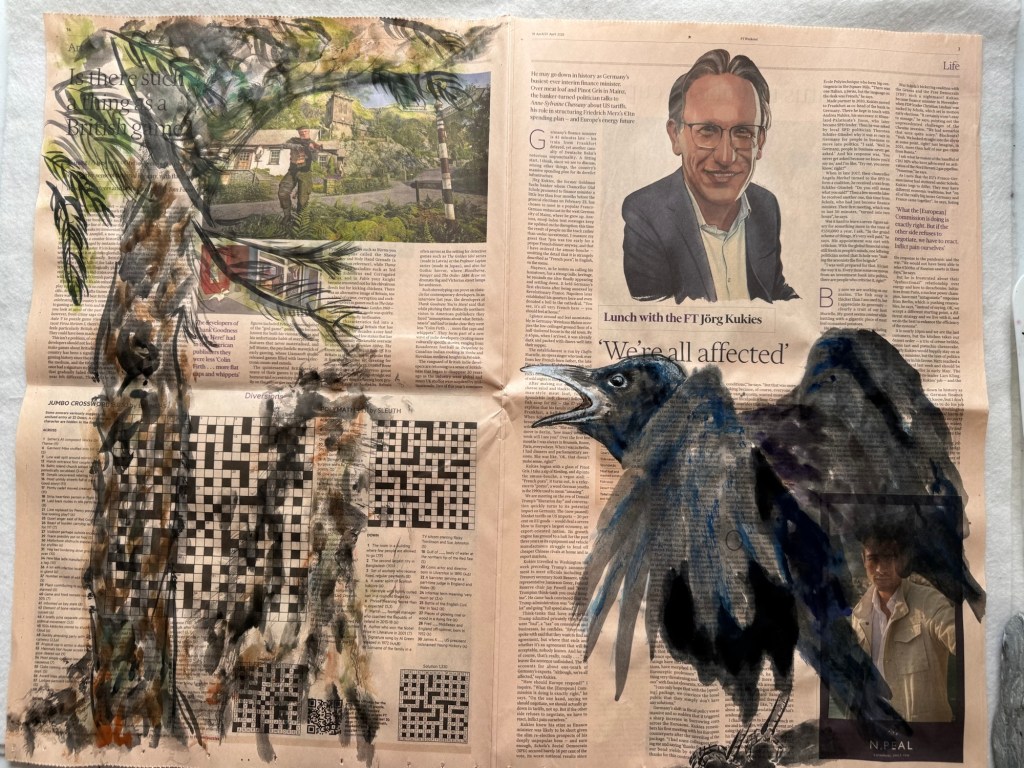
Another shouting crow under the headline ‘We are all affected’. The crow was in line with the gun held up by the man on the left page. Then I noticed a large capital letter ‘O’ on the crow’s body – like it had been shot by the man in the photo. I added a pine tree around the greenery on the photo on the left, but I don’t think it worked. It distracted too much from what the crow was going through.

A few landing crows:

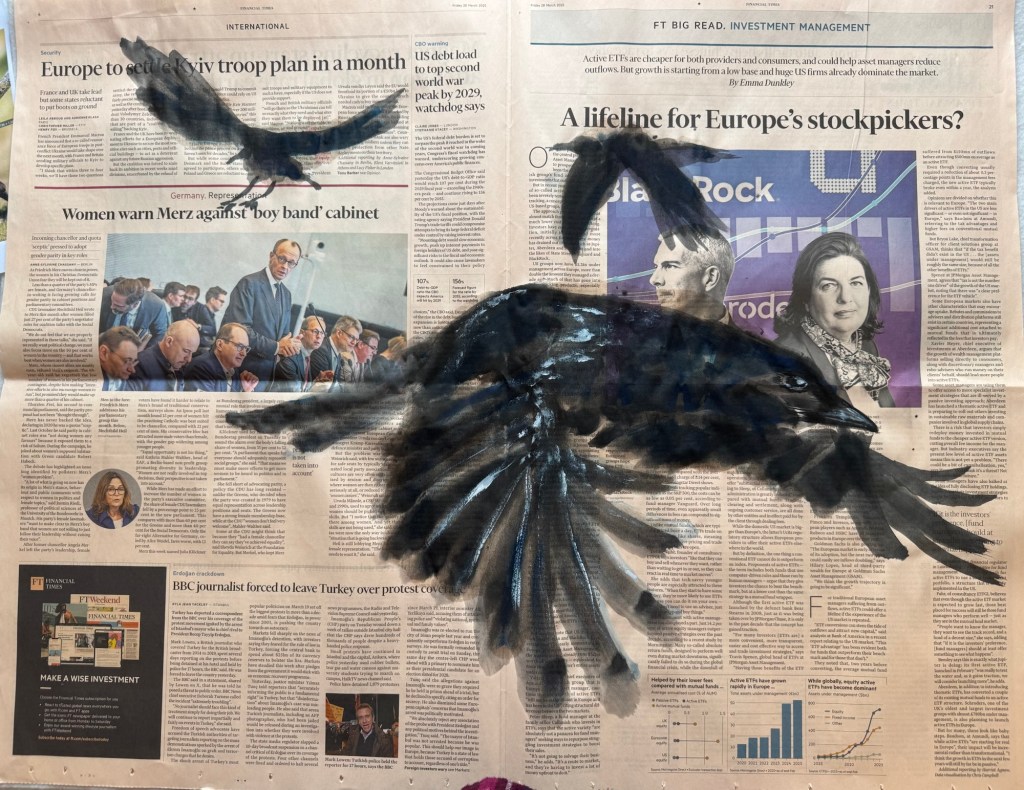
A large landing crow going for a prey:

A screaming crow in flight aiming at a photo:

REFLECTIONS

As I made more work, I became more confident about this new body of work. My confidence increased in both the concept and the process. My recent tutorial was very useful in helping me to reflect on my thinking behind the work and the progress so far. My increased confidence meant I was able to go for a more freestyle approach to my Chinese ink painting in the work listed above. The freestyle approach enabled me to be more expressive and spontaneous. The last few paintings shown here were done without needing to use charcoal upfront to mark out the composition which I was pleased about.
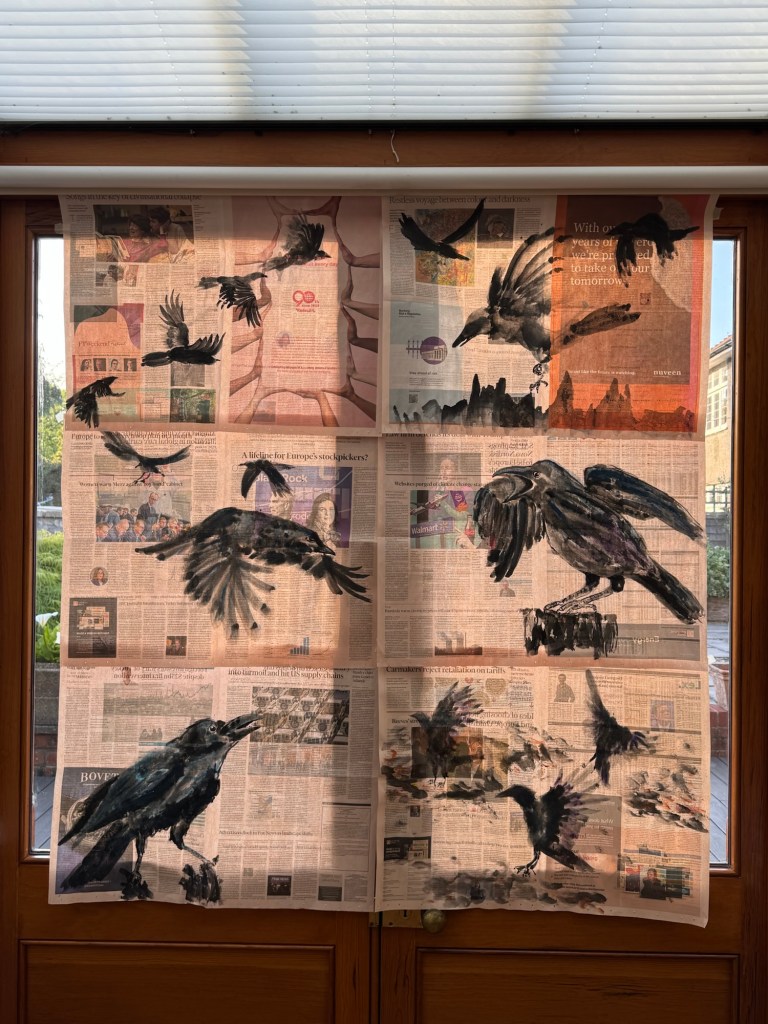
I was not happy with every outcome here, some of the depictions were more aligned with my intentions, some not so. But I was trying not to overthink it at this stage. Just wanted to keep making as I know from my Chinese painting class that it would get better with practice.

I continue to find Chinese ink painting ‘unforgiving’. I have written about this before and it still has not changed – it is just part of that medium and again, practice helps. ‘Just keep making’ is the key.

Also, I believe painting with my non-dominant hand has helped me to not agonise over my work too much because it’s not meant to be perfect. It will be what it will be! I have found it liberating to paint in this way and I plan to continue this exploration.

LEARNING

I am gaining confidence in the making process through practise and more importantly – I am pleasantly surprised by my confidence in tackling a completely new body of work that is very different from my previous transcultural work. I am happy that this major change happened during my MA course because the guidance available gave me the courage to do something completely new and experimental.

Also, the structure of my reflective practice has really helped me to realise the concept knowing that if I got stuck then the reflective process would help me to find answers or a way forward.

I feel very excited about this new body of work and I am really enjoying this way of making. It continues to help me to respond to what’s happening in the world through my practice which is very important for me right now.

To build on this, I want to think more about why painting with my non-dominant hand has become so important to me. Also I want to understand more about my overall process – from buying the newspaper to completing a painting.

NEXT STEPS

Think more about my reasons for using my non-dominant hand – especially think about this as I paint.

Start to be more considered when moving from one step to the next in my process to better understand the process with the aim of future improvement and development.

Keep making and think about what to do for the degree show.

MA U3: ‘News’ Art installation ideas – holding up to the light

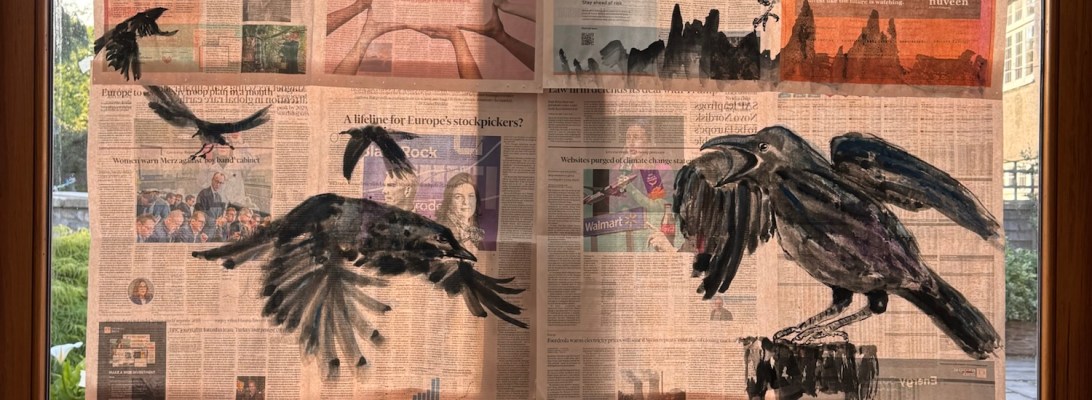
When I first showed my News Art to my tutor, we talked about the way I photographed the paintings in front of a window and letting the light shine through was a metaphor for ‘holding the news up to the light’.

As the saying goes, if you are ‘holding something up to the light’, you see through and understand the true nature of it more clearly; or you hold something to account. I felt it was a good metaphor and if I were to show my News Art then I would want to hold it up to the light. This way of showing also reveals the images on the reverse side of the newspaper adding more intrigue and ambiguity to the overall composition.

METHOD

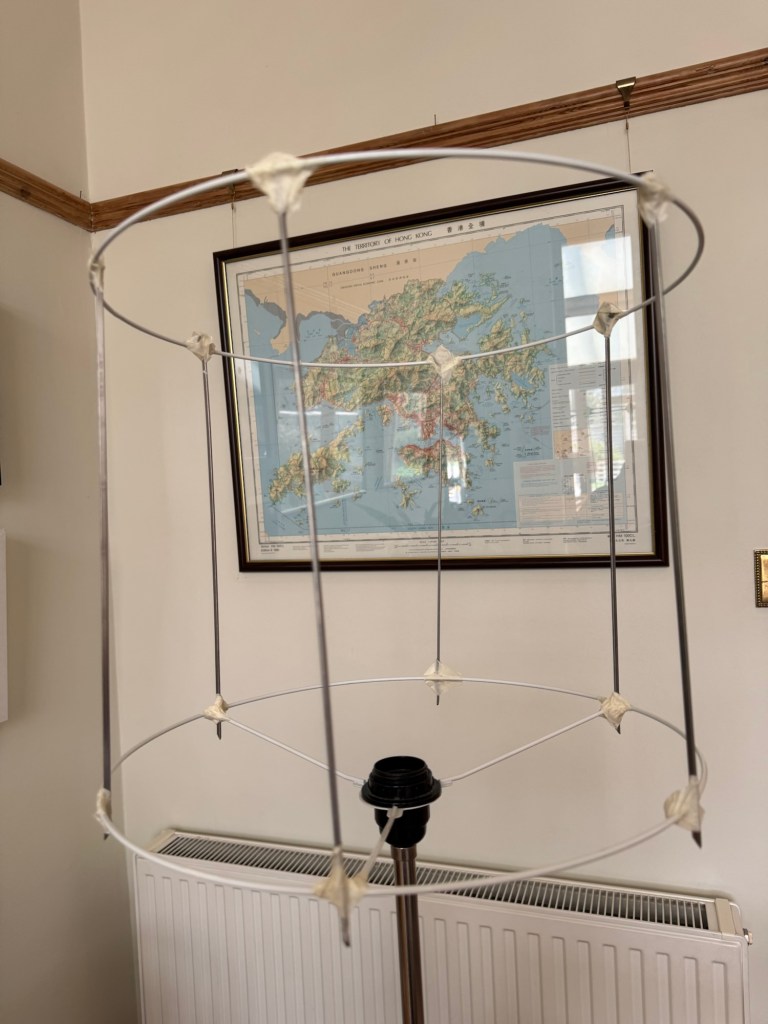
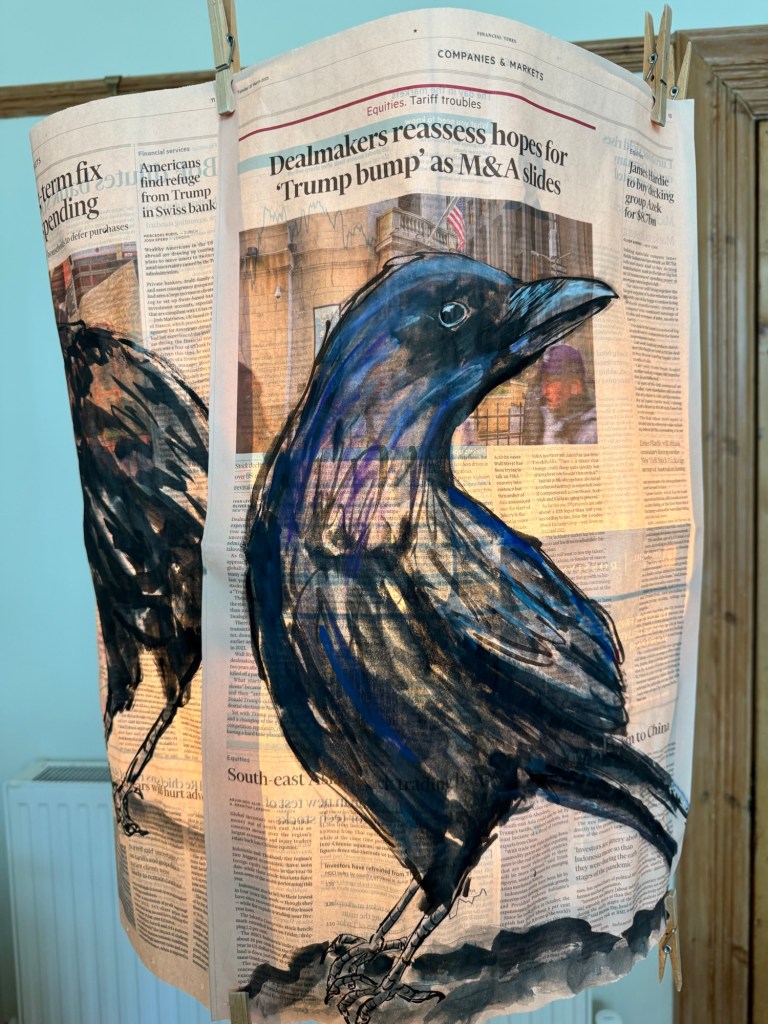
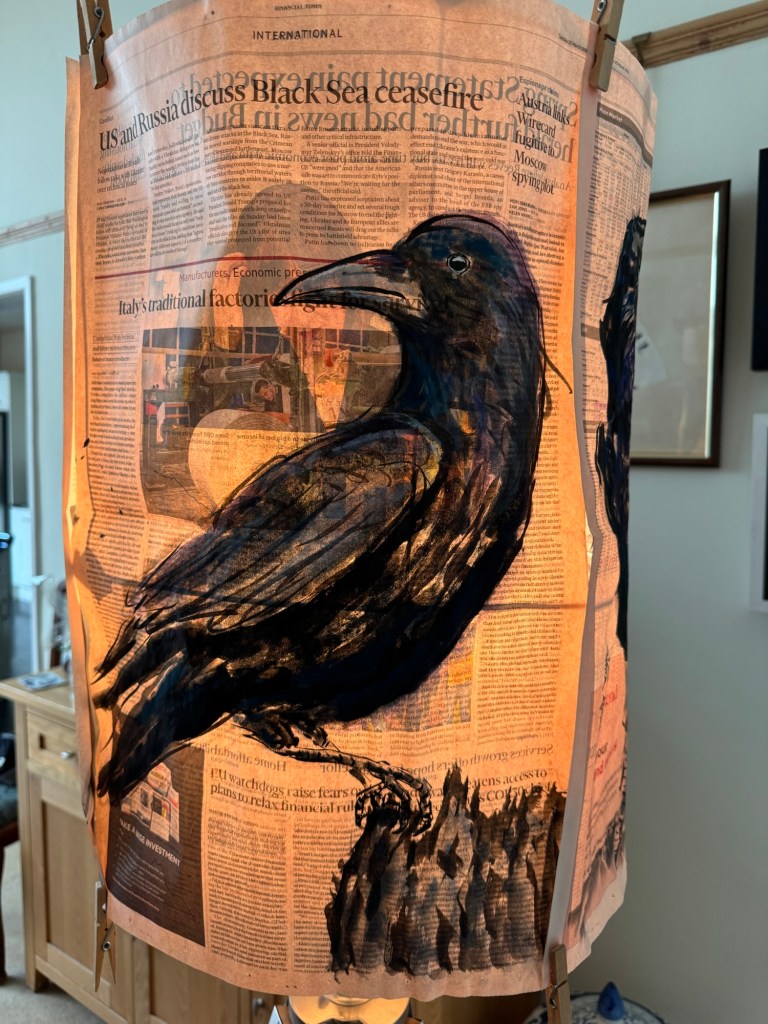
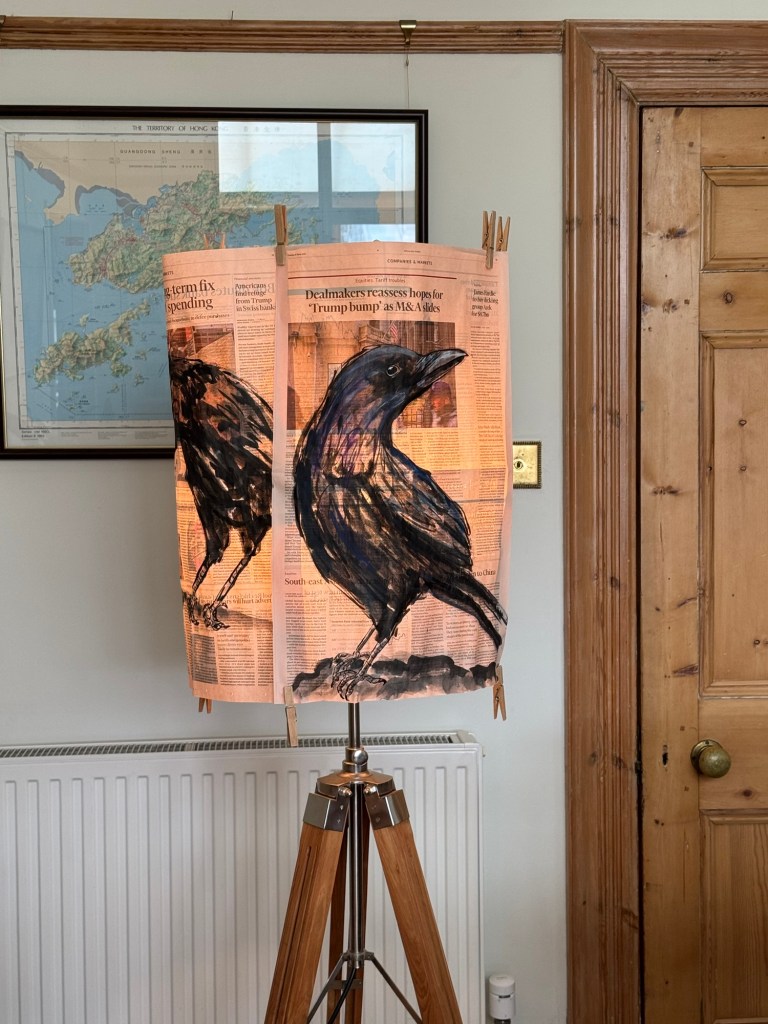
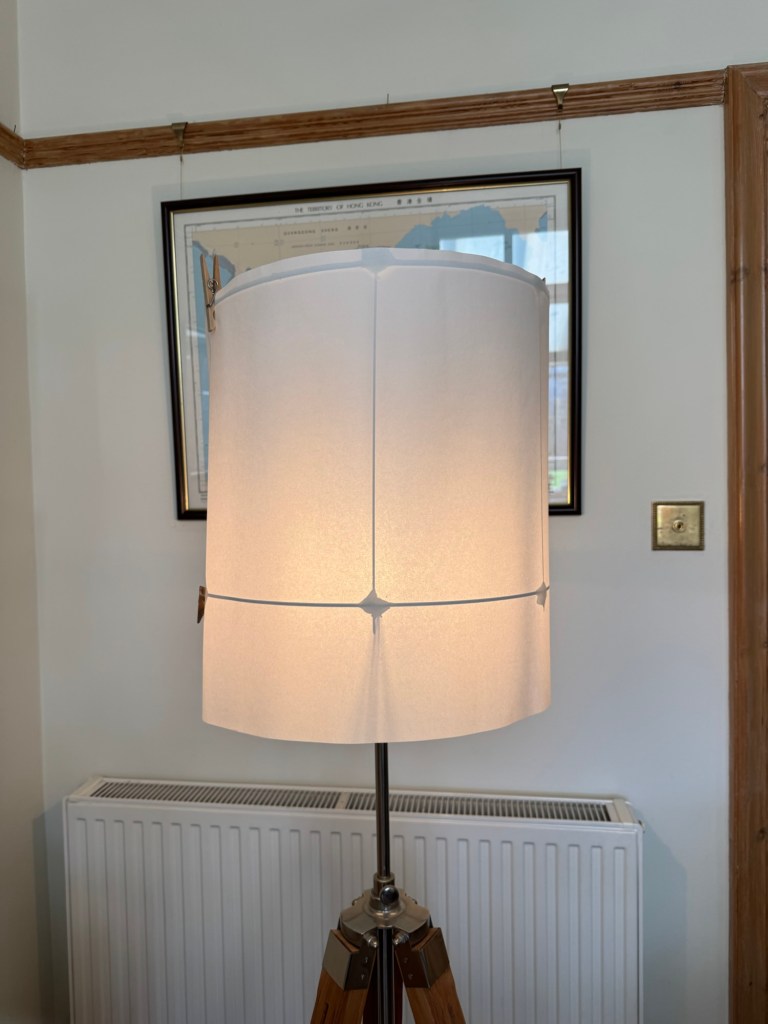
To find ways of showing the News Art with light shining through – it is necessary to not rely on having a window or sunshine for an installation. So I created a mock up lampshade frame to test how it would work if the light source was a light bulb.

Mock up lampshade frame

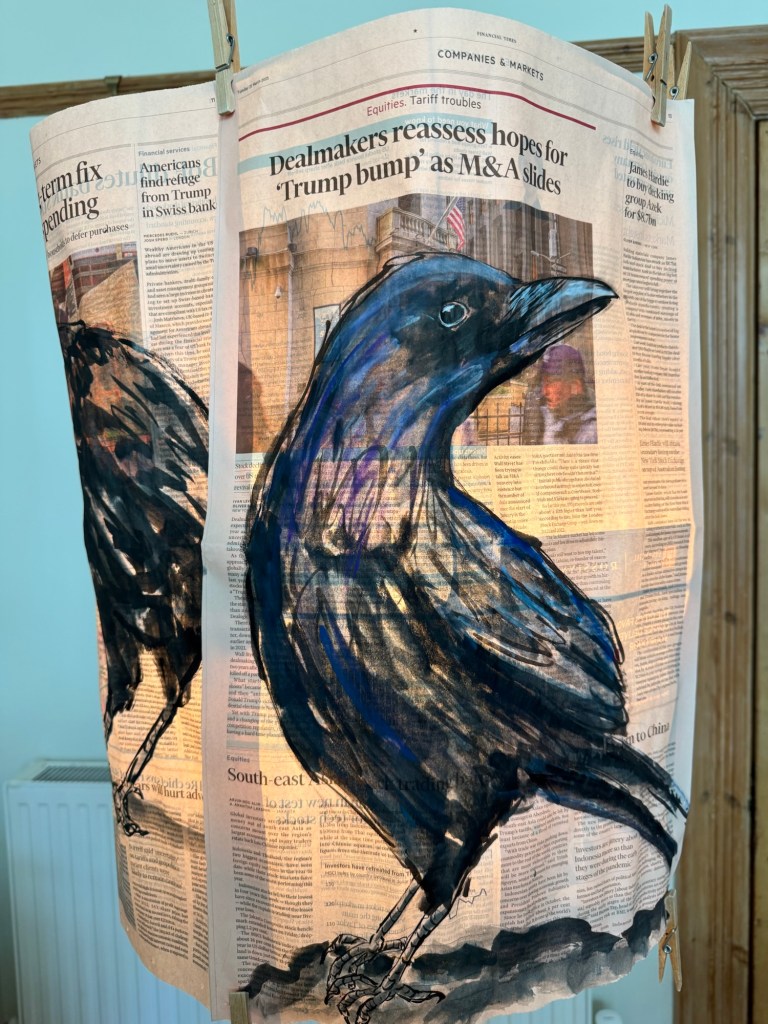
Then clipped the News Art to the frame with the light turned on:

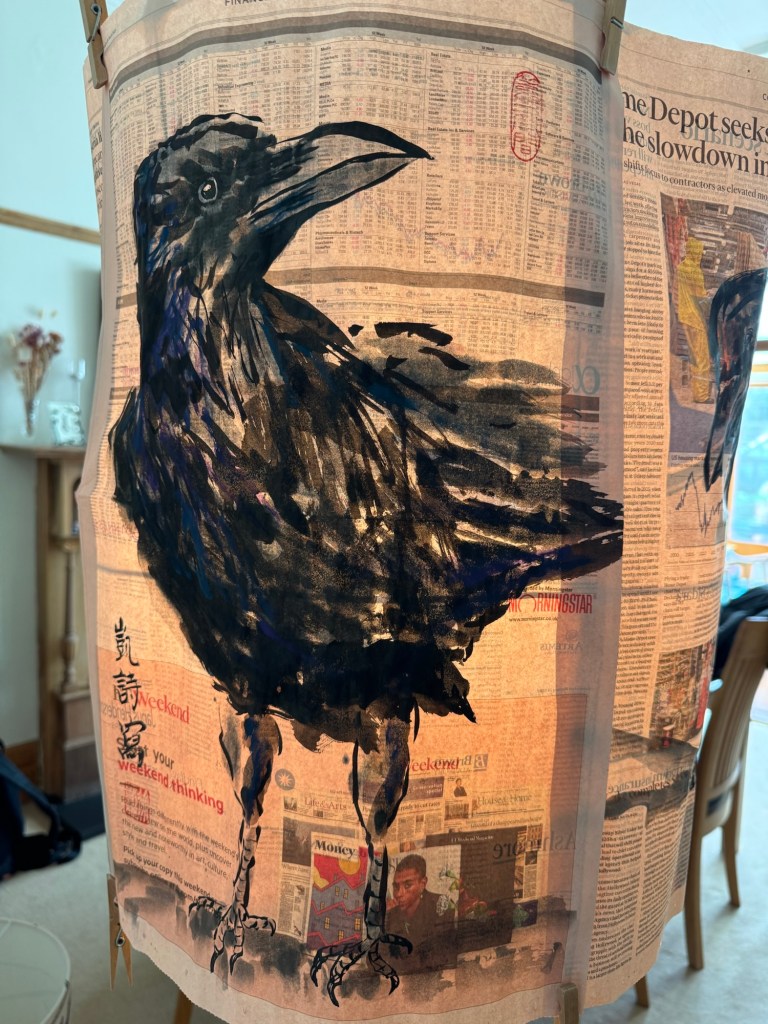
Tried a few different images:

This showed the reverse side images were coming through well:

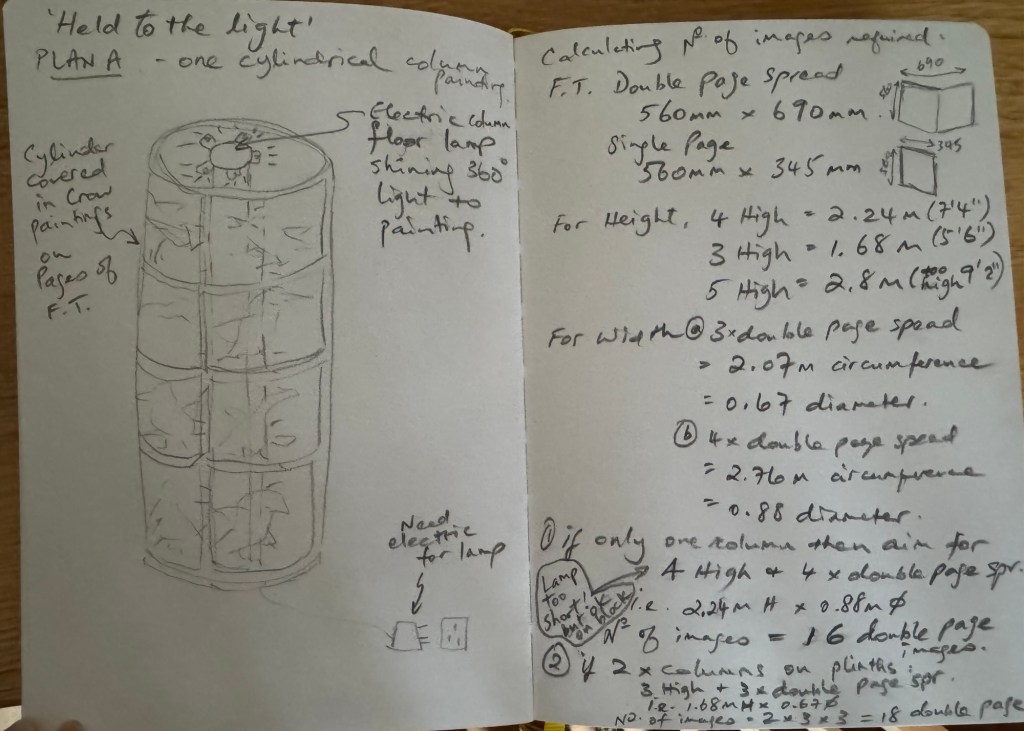
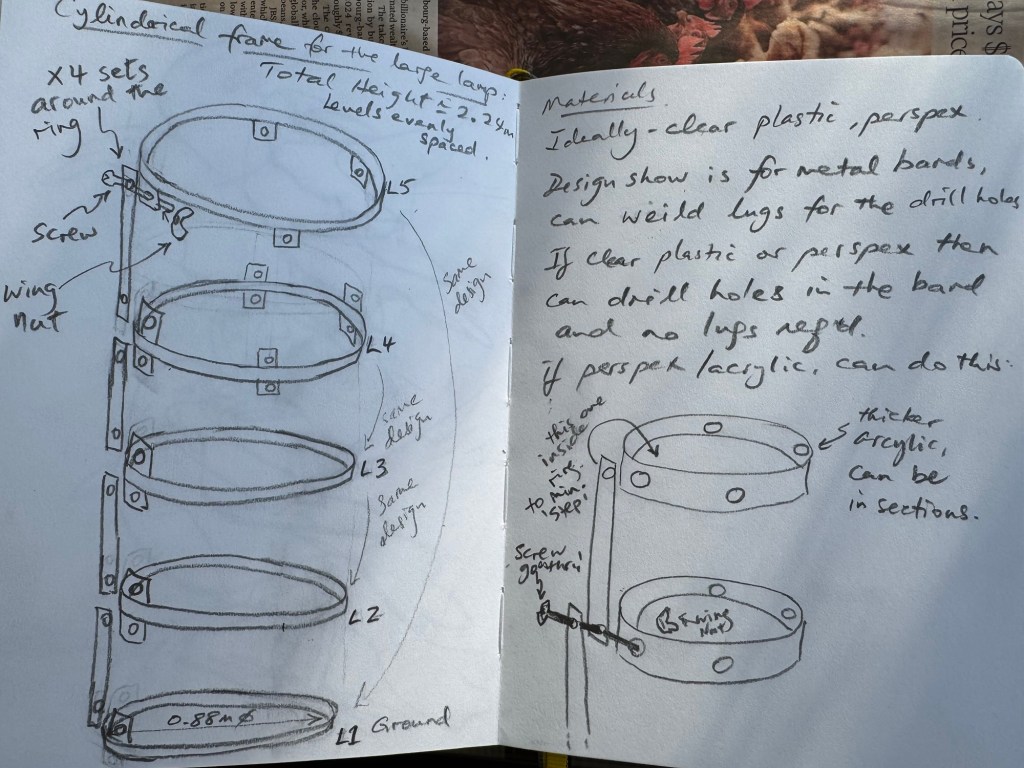
Then I considered a design for a cylindrical light tower to display the paintings in an installation:

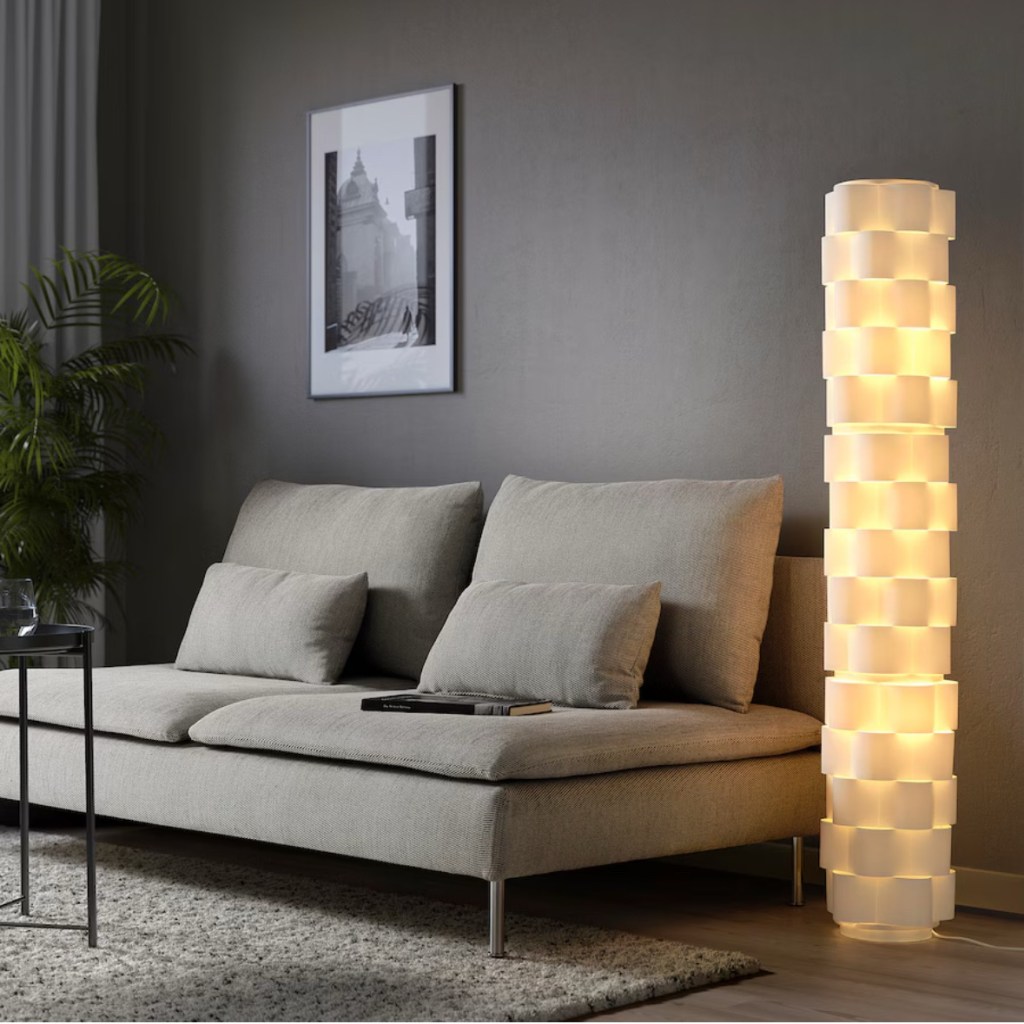
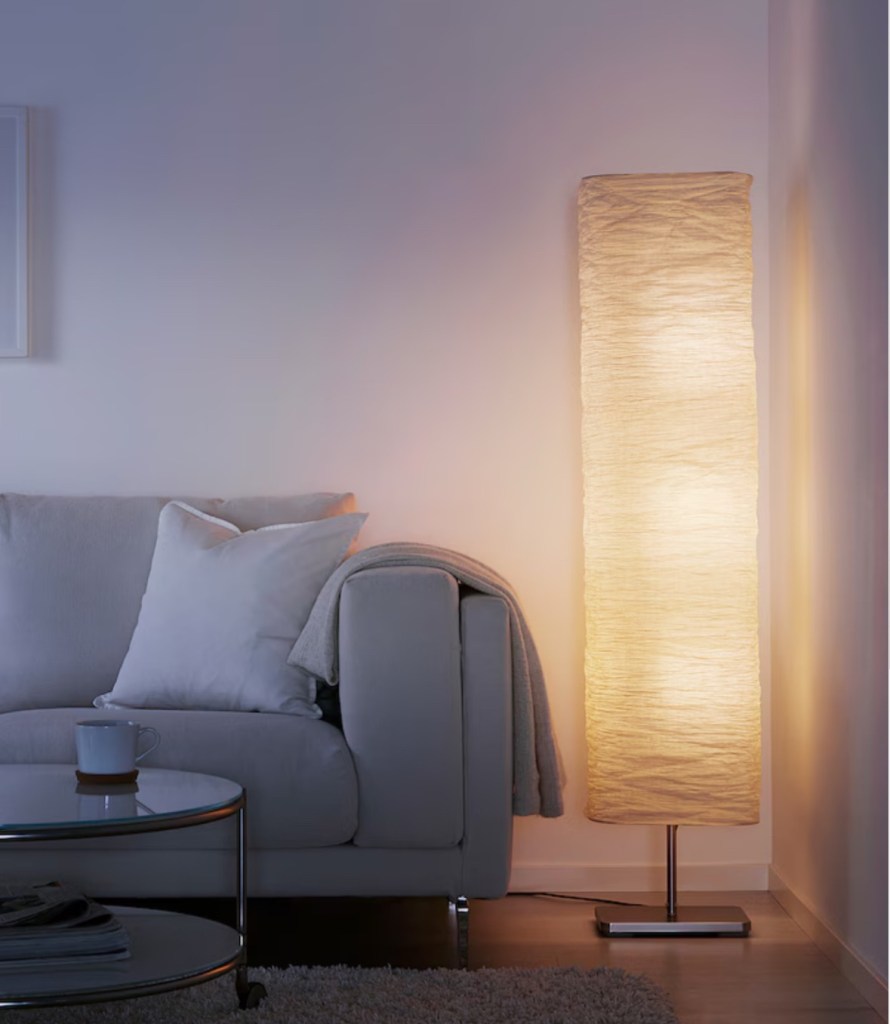
Some ideas were found online at places like IKEA with floor standing lamps that could be used instead of a custom made frame with the latter being a potentially costly option.

As an example, for the rectangular shade in paper shown above – it can take 2 double page spread of The FT at 3-high. It has more area than the circular one so would be better. This means 6 double page spreads per lamp. For a 3 lamp installation then that would mean 18 double page spreads in total. The rice paper lampshade could be slashed or torn to represent violence that is happening at the moment.

However, the rice paper shade around the lamp might block too much of the light. Hence more tests were done with the mock up lampshade and rice paper.

Mock up lamp with rice paper shade

There was sufficient light coming through the rice paper lampshade to reveal the images on the reverse side of the newspaper:

REFLECTIONS

The experiment was successful in demonstrating that a light bulb can illuminate the newspaper sufficiently to reveal the reverse side images, even with a layer of rice paper in between. This means the IKEA lamps could be used if I wanted a cylindrical installation.

A cylindrical installation means the viewer would have to walk around the lamp to see the whole composition. This maybe fine and could be a good way to install in the middle of a room with multiple floor standing lamps. However, if I wanted a large and flat composition like one large painting, then that would need to be hung on a wall or from the ceiling. If against a wall then I would need a light curtain of some kind to throw light onto the back of the newspaper. Ideally an enormous light panel or light box would be ideal but they tend to be very expensive. More to think about…

LEARNING

The experiments so far showed that a lamp with just one bulb was sufficient to show the reverse side images. Of course it would also depend on the distance between the light source and the newspaper. But the results were encouraging and I will continue to think about different ways to install my News Art work.

NEXT STEPS

Think of different ways to illuminate the art work in preparation for coming up with ideas for the degree show.

Also to just keep making!