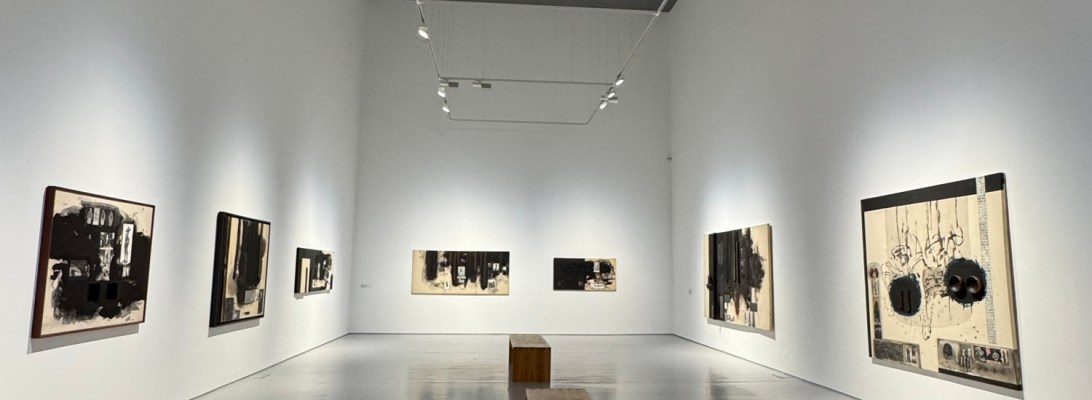
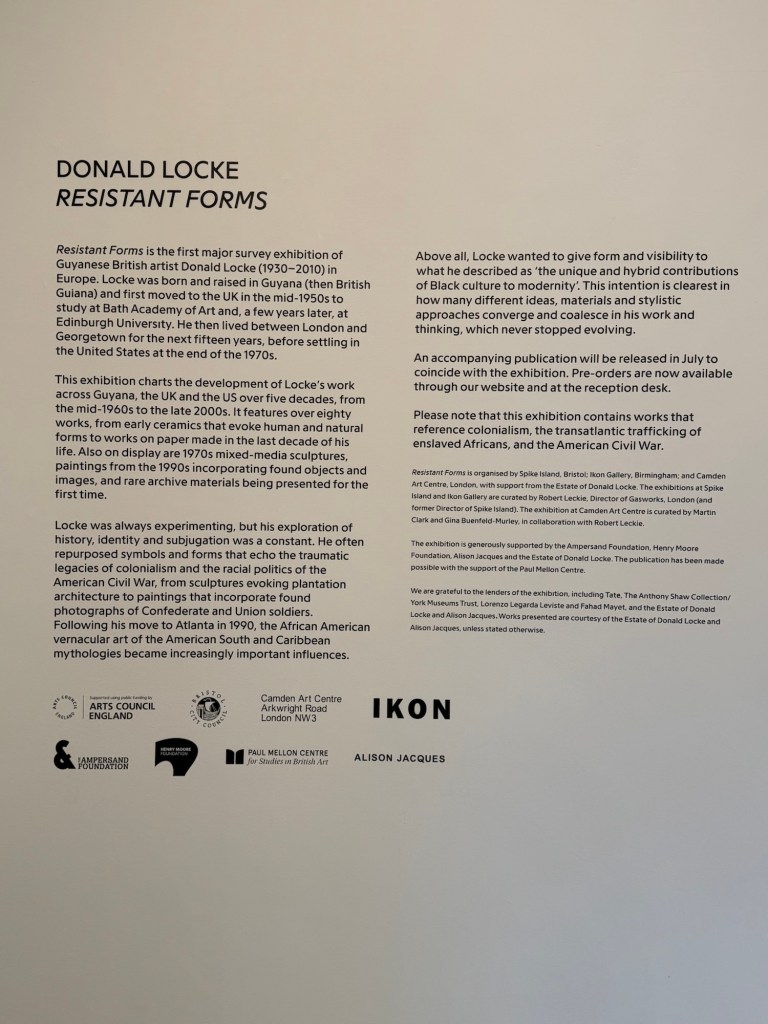
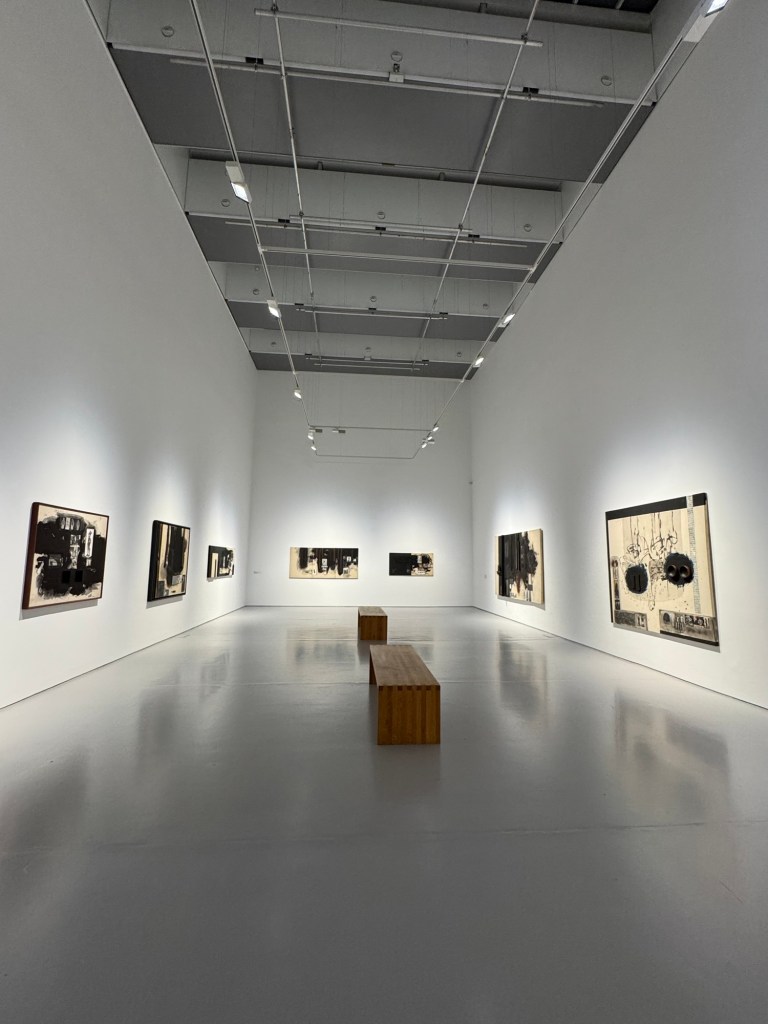
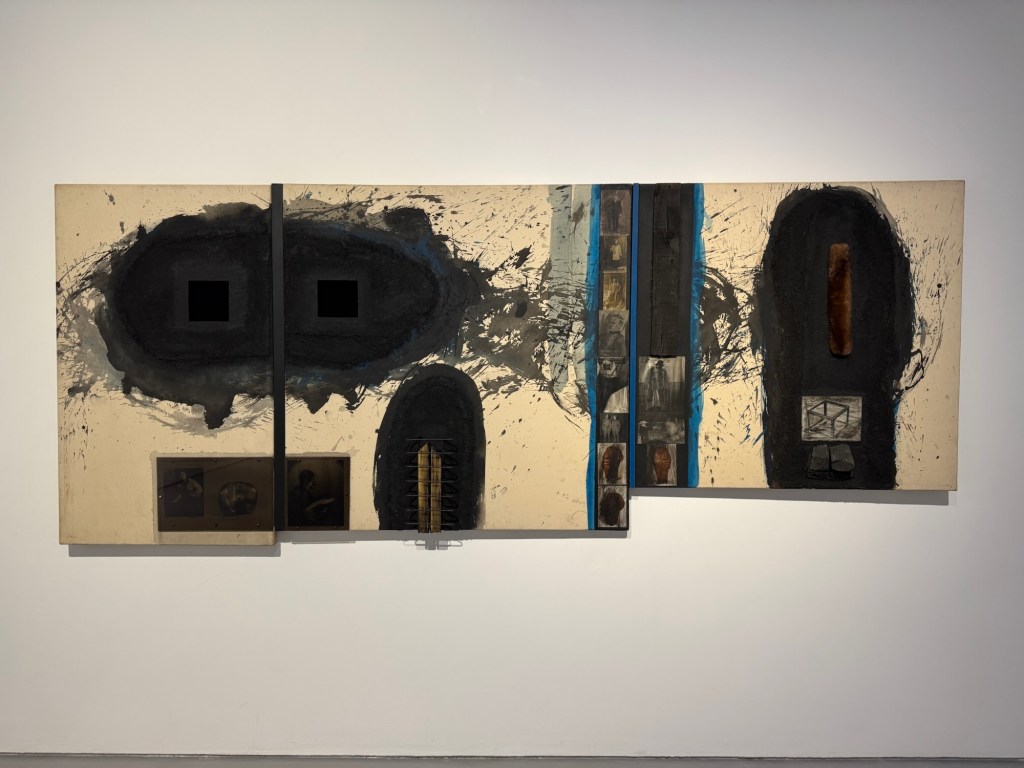
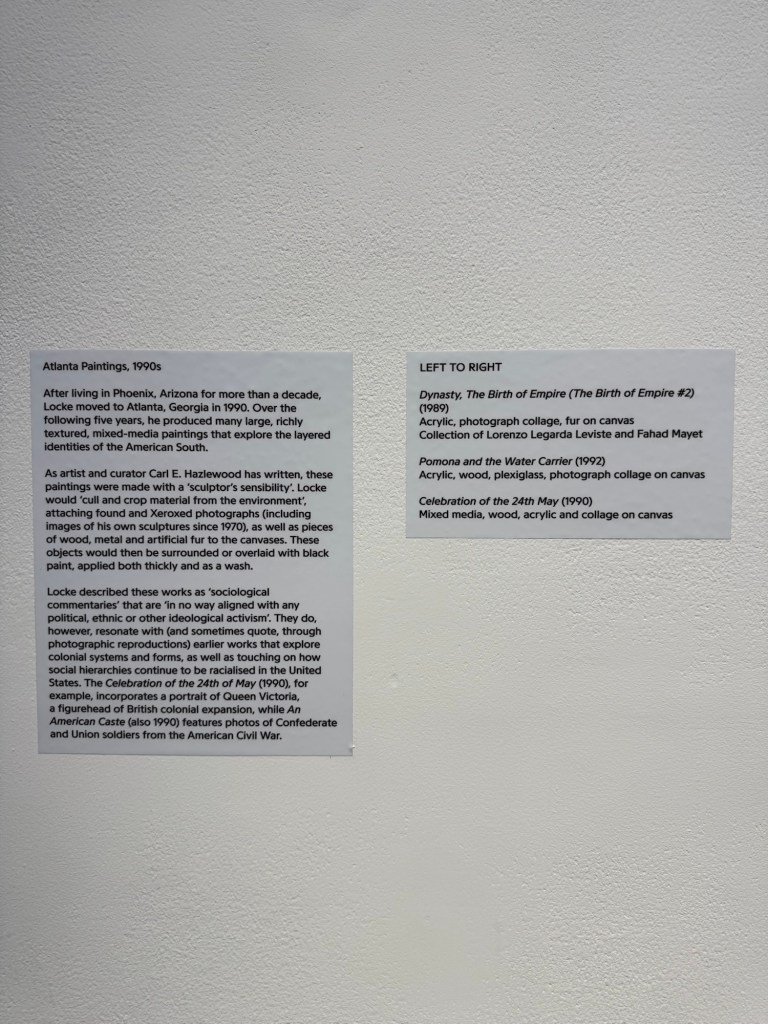
Today I visited Donald Locke’s exhibition Resistant Forms’ at Spike Island Bristol. Below are some of the photos I took to remind me of the work that I found particular resonance with.
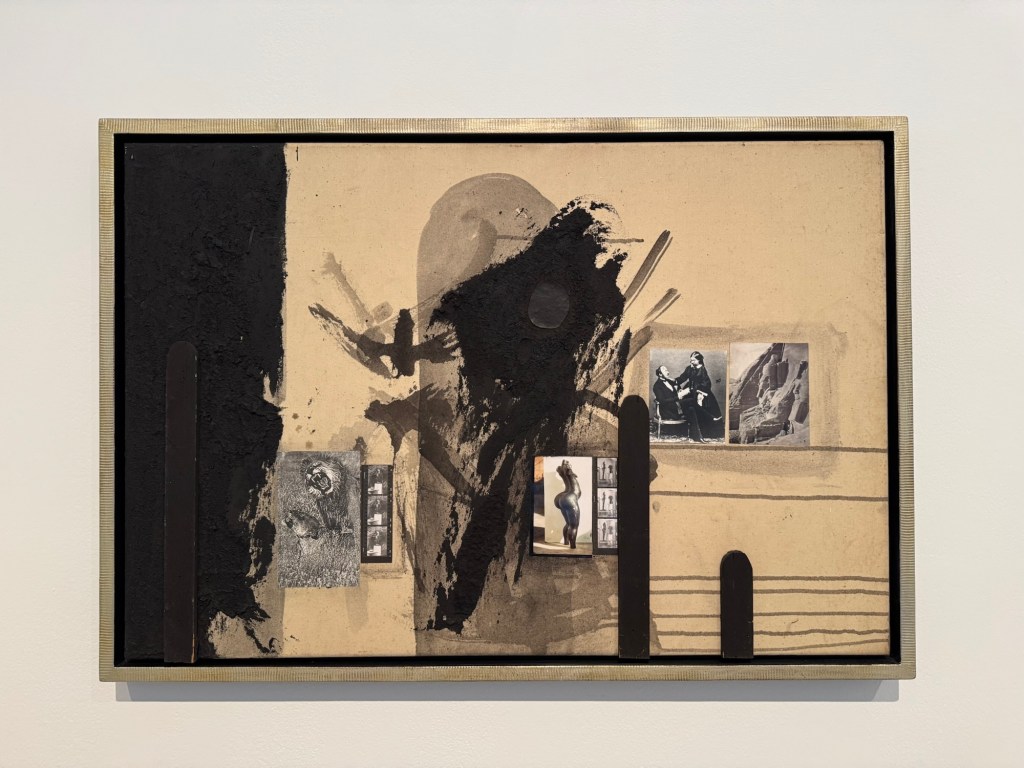
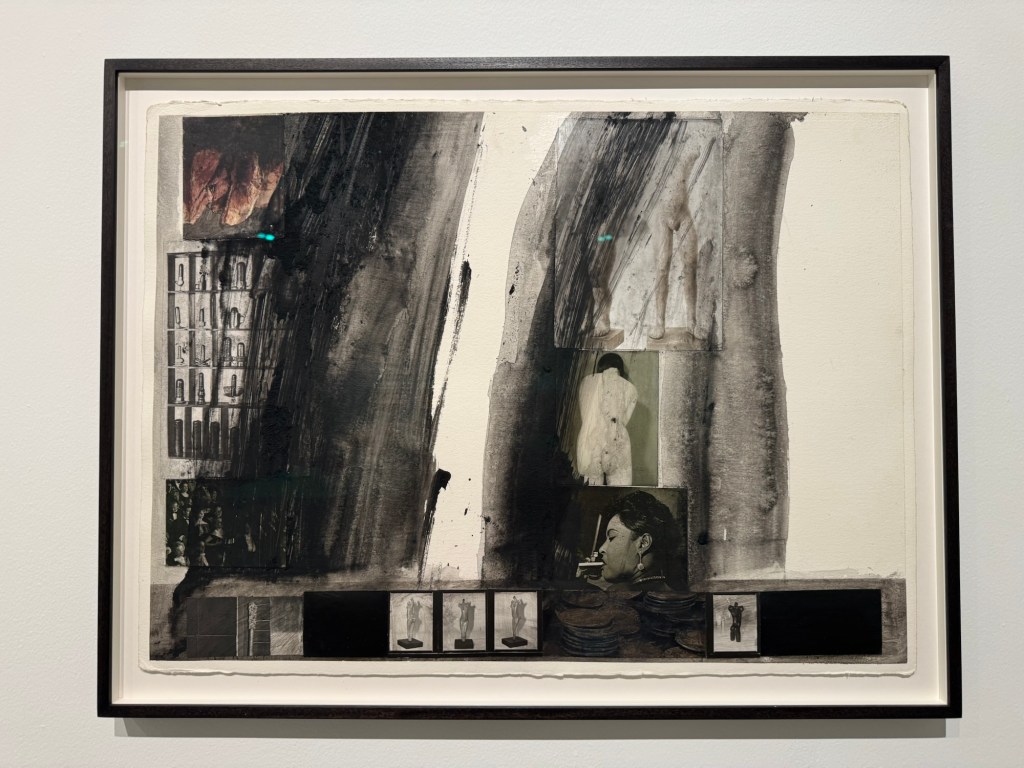
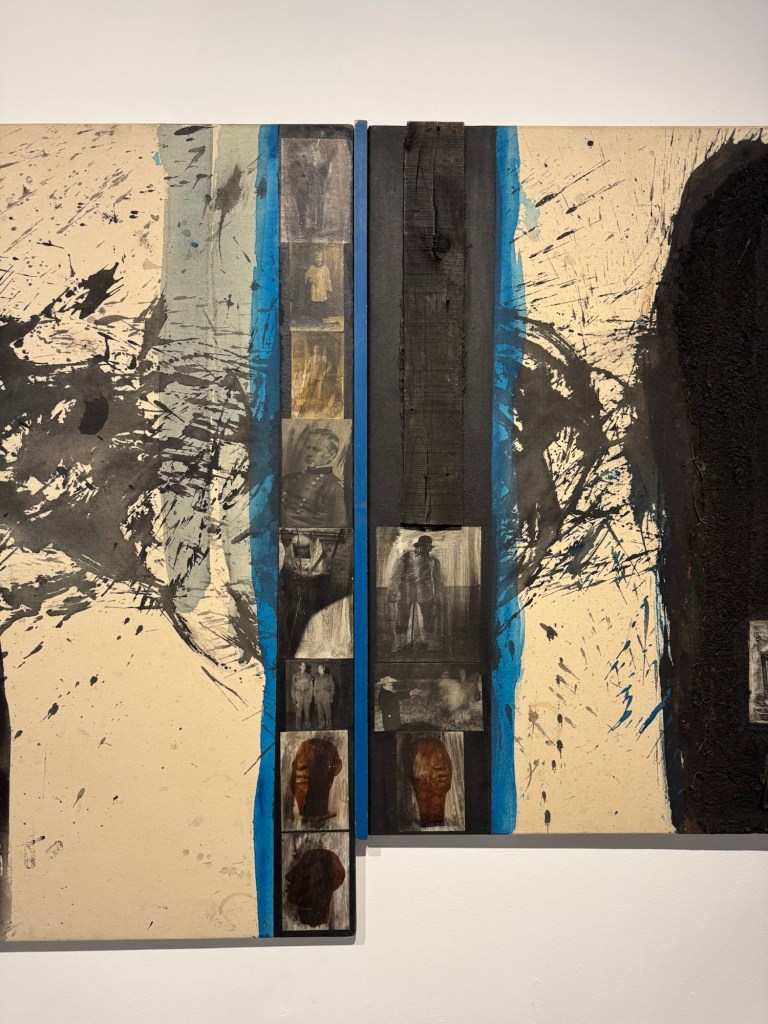
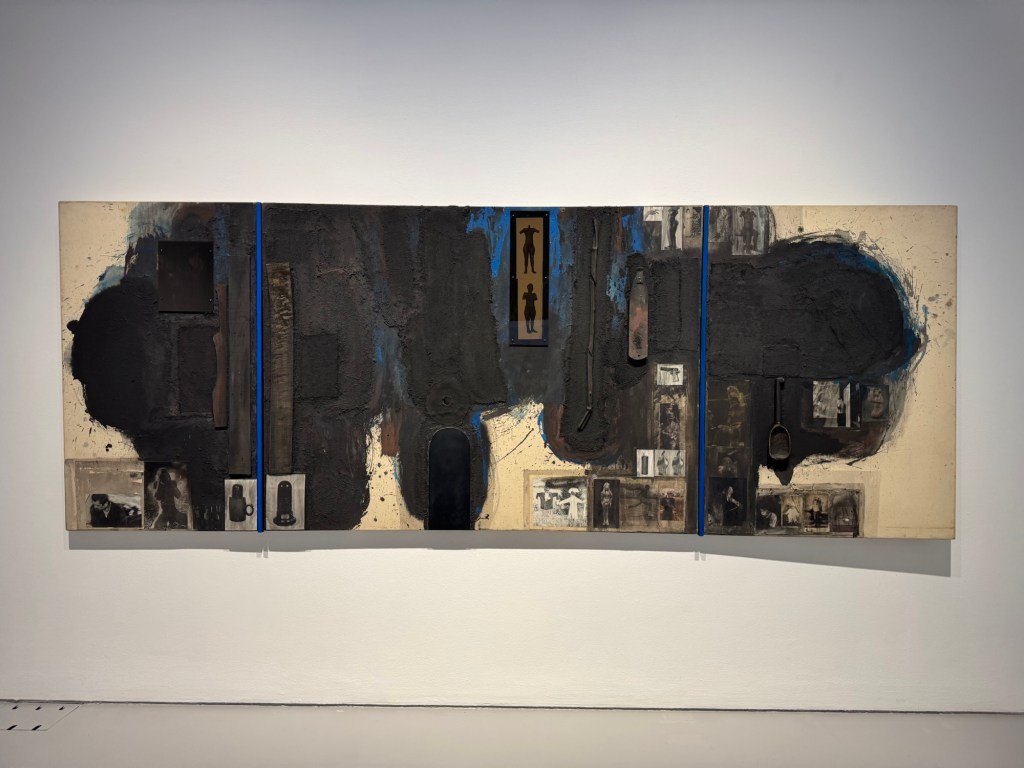
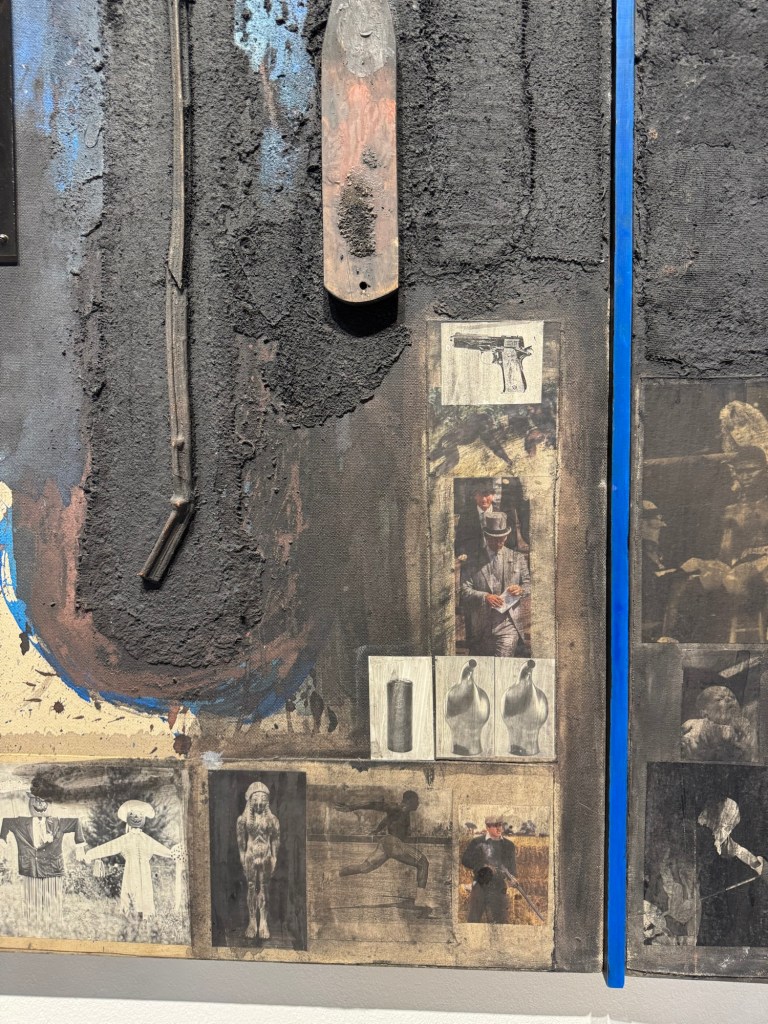
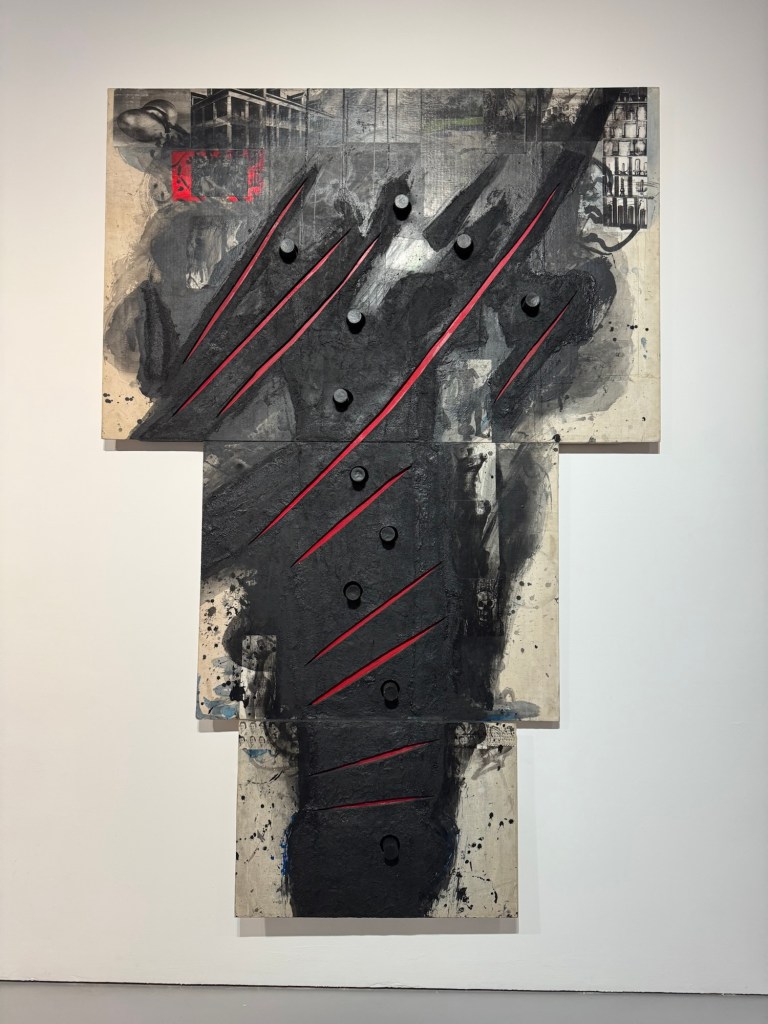
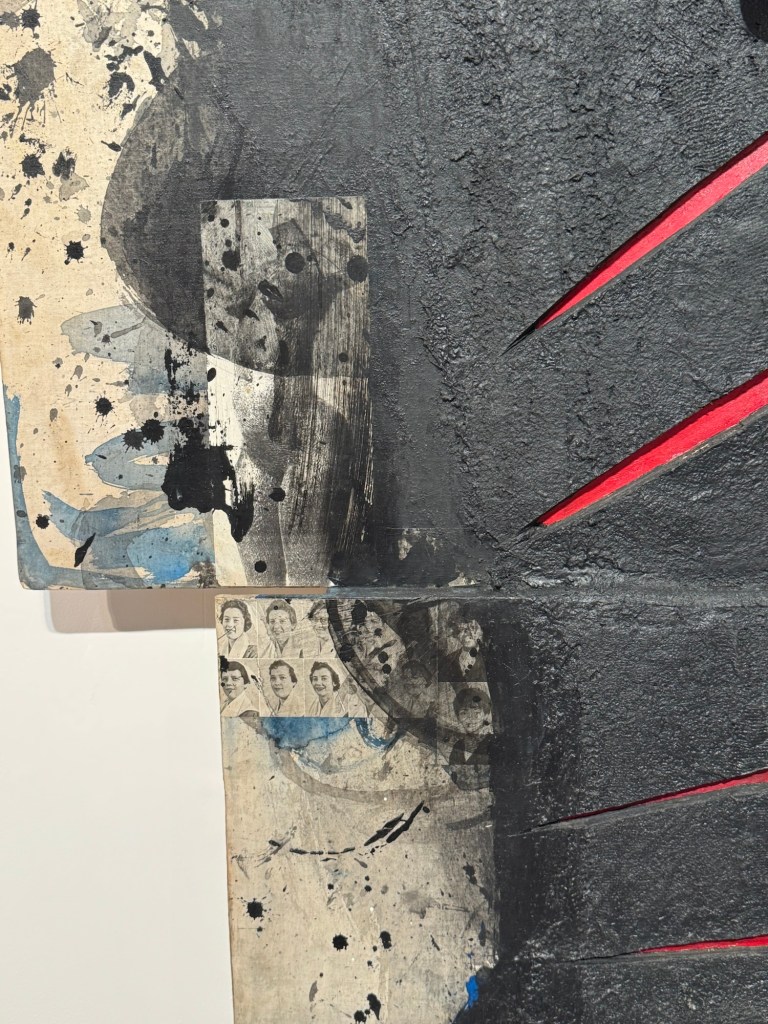
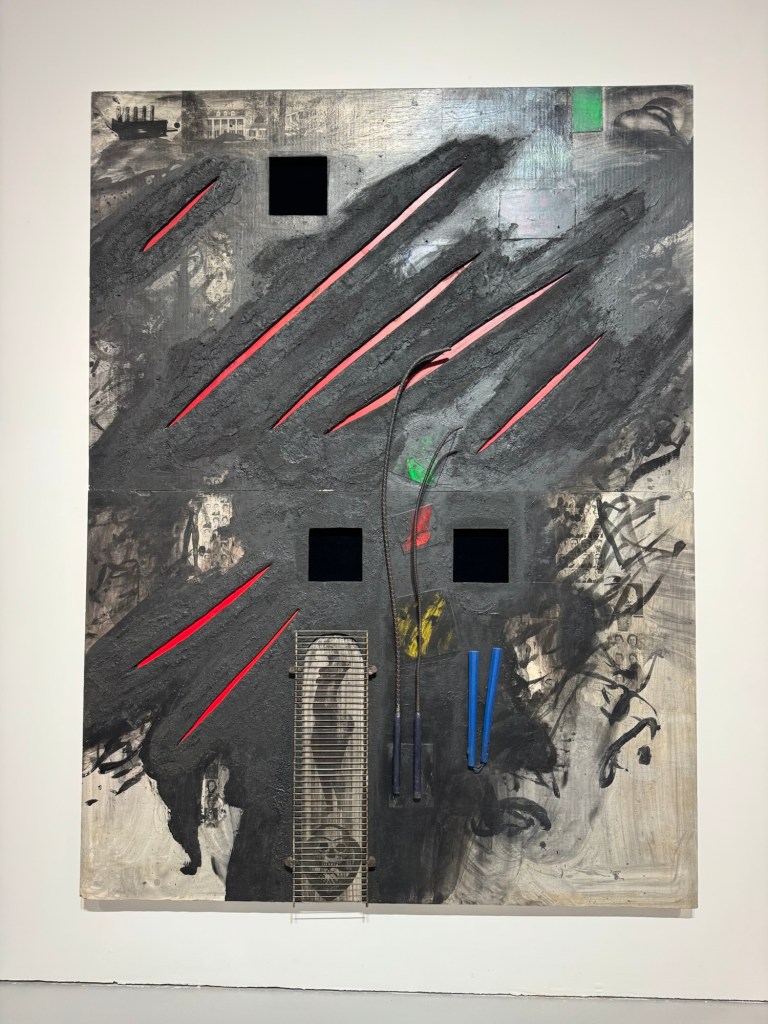
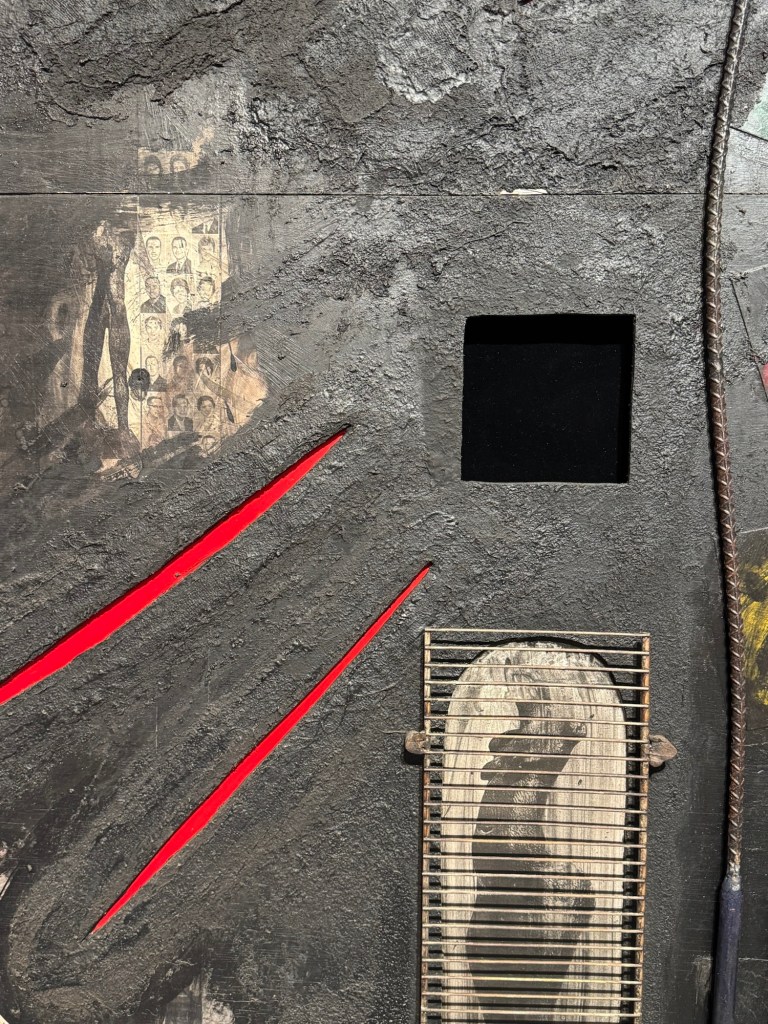
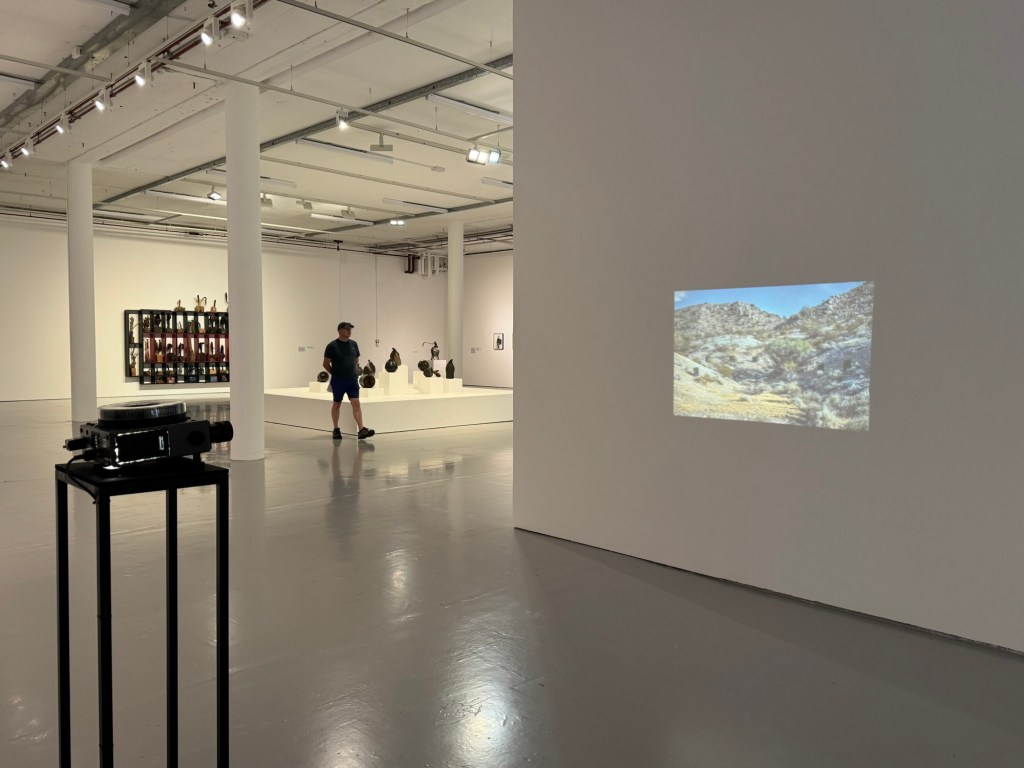
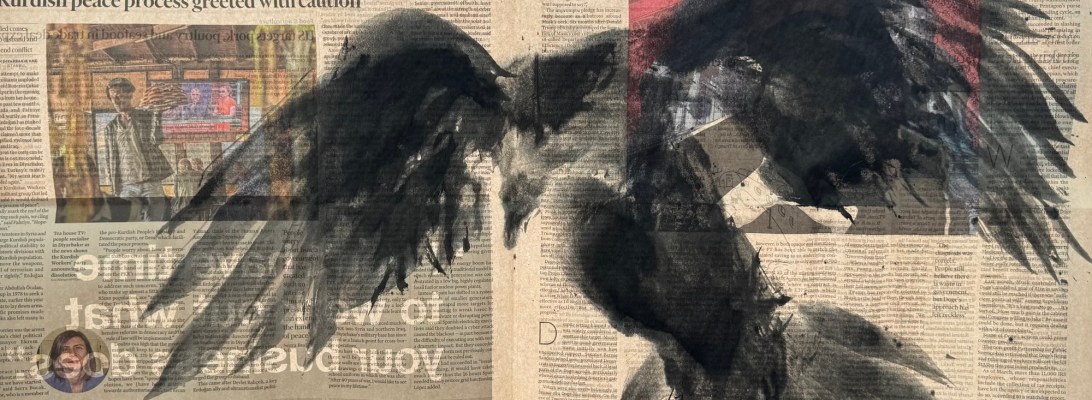
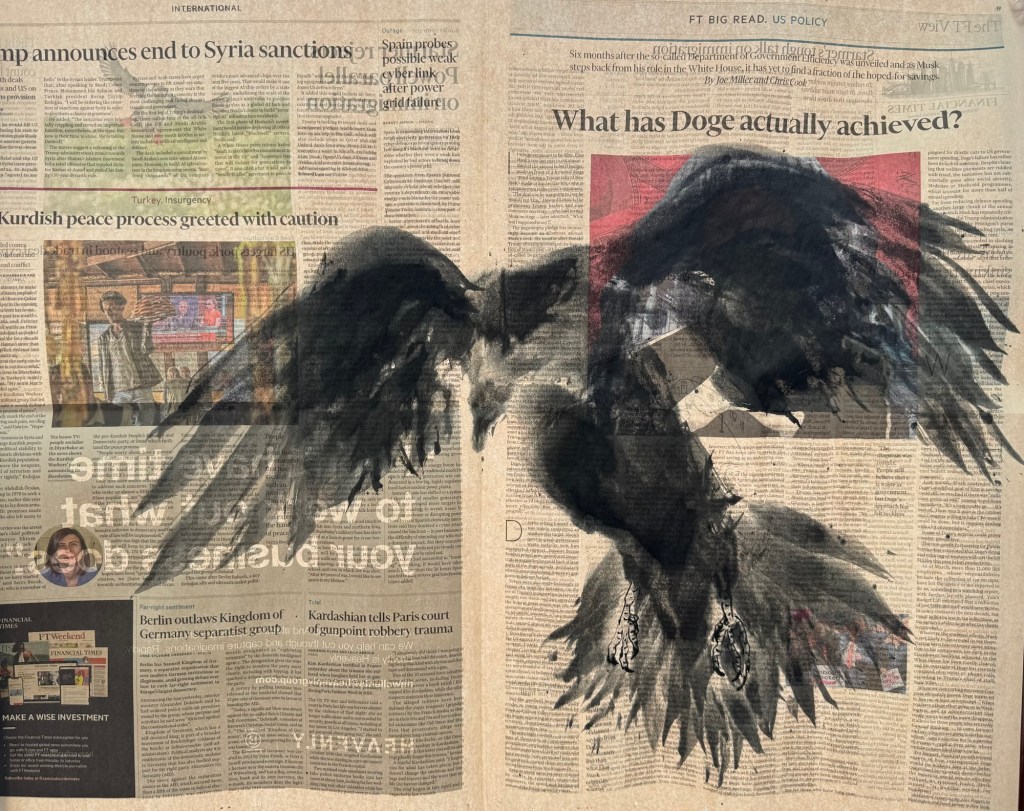
Use of collage, image looks like a crowUse of acrylic in a way that resembles inkAmbiguous use of photosLarge scale paintings with presence and energyClose up of the above showing photos collageUse of mixed media including metal grill mounted onto painting Placement of projector and understated size of projected image
REFLECTIONS
I want to capture ideas that came to me during the visit that made me think about how I could learn from Locke and build on my practice.
Use of mix media techniques:
On some of his paintings, the use of acrylic paint with ‘dry brushing’ to create the flying white effect like in Chinese painting energised the painting. It gave me the idea of trying my crow paintings in other medium, such as dilute oil, to see how that works. The use of different materials to create collage was also interesting. I could use ripped up newspapers to create collage effect on a canvas then paint on top. Locke also used items like metal grills to good effect. I can consider what objects, metal or otherwise, that could be incorporated to add meaning and texture to the work.
Use of photos:
Some old photos were used in the collage. I have many old family photos that I have been considering how to incorporate into my work. The way Locke used the photos were more random – a few here and there. Whereas I have tried too hard in the past; I could just use small images in a few places – I don’t need to tell the whole story in one painting. I must remember this. Also, he had just pasted / stuck the photos (copies of) onto the canvas. I always felt that I should photo-transfer the images onto the canvas – this is not necessary. Locke also used images or photos of his own work (sculptures) in his paintings – those images (e.g. female nude) appeared on multiple paintings and acted as a link to join the works together.
Use of projector understatedly
The projector was projecting at waist height with a not too large image. It was understated and effective. I often feel that projection has to be big and has to fill a wall. It clearly doesn’t have to at all. The projection was also placed in a way that you have to walk through the beam to get past. It was an interesting positioning which makes the viewer interact with it.
LEARNING
There are no major learning from the visit and mainly just ideas that came to me as I studied Locke’s work. The main take away for me was to think about experimenting beyond just painting on the whole piece of newspaper. The news headlines remain important to the body of work (News), but through the use of collages, the newspapers could be incorporated to maintain the theme while opening up the materials that I can use. Locke’s extensive use of black was very effective which resonated with me.
NEXT STEPS
Start to think about how I can start to make more complex and ambitious work with multi media materials yet remaining connected to the topic of News.
‘News’ in Chinese ink painted with chicken feather brush
As I am making more and more paintings on The FT, I want to consider more carefully how to display the work and also making the newspaper art archival.
METHOD
1- Online research
I have been researching online for ideas. There have been all kinds of suggestions. I find this post useful as there are different suggestions to try.
However, none of the suggested solutions are truly archival due to the nature of the newspaper material. One of the comments said that newspapers were a museum curator’s nightmare. I think that sums it up. The only suggestion that is truly archival is to make digital images and gyclee prints. That is something that I will consider.
2- Ask an expert
Another investigation route that I pursued was to ask a paper conservation specialist at UAL. His reply was as follows:
“Newsprint is made using mechanical wood pulp for the paper fibres. These are naturally rich in a chemical called lignin.
Lignin is not particularly stable. It breaks down with time with 2 effects:
Some breakdown products are strongly coloured, making the newsprint go increasingly yellow and eventually brown.
Some breakdown products are acidic, leading to the paper becoming increasingly fragile over time.
This breakdown will still happen in dark conditions, but the energy from light makes the breakdown progress much more quickly. Ultraviolet has more energy than visible light, so can do damage more quickly.
It’s not possible to make newsprint archival.
UV-proof glazing would be beneficial if the paper is to be displayed in a window where it’s subject to sunlight.
If the artwork is illuminated using artificial light, UV exposure will be less. Fluorescent lights and halogen spot lights emit some UV. LED lights typically emit no UV.
Most acrylics will filter out some UV due to being made with UV-stabilisers to help make the acrylic last longer.
Last time I checked (which was ages ago…) framers quality UV-filtering acrylics and glasses were similar in price.
For storage, I’d recommend keeping the papers between unbuffered, acid-free boards. Many archival boards are calcium carbonate buffered, which helps neutralise the acids created as lignin breaks down, but alkaline conditions can also increase the yellowing of lignin (through a different mechanism than the breakdown route).
Sandwiching newsprint between glass/plastic offers some benefits in isolating the paper from various environmental effects, but might also lead to a surrounding microclimate rich in acidic breakdown products.”
– End of expert’s reply –
This was a very helpful reply and the sentence that I highlighted in bold again confirms that there is no way of making newspaper archival which is a pity.
REFLECTIONS
After doing this research, I have to accept that it is not possible to make newspaper archival. I feel rather sad about that and the engineer in me thinks ‘there must be a way, it just has not been found yet!’ However, I need to employ a solution now to manage or show the work that I have been creating while continuing to find a long term solution which may or may not be possible. If museums around the world have not found a solution then maybe I won’t be able to either – not in the short to medium term anyway.
Making digital images and then gyclee prints is a very good and viable solution. I will definitely pursue that and learn how to photograph my News paintings properly. As a start, I will need a light box frame that I can wall mount.
I have also considered sandwiching the News paintings between UV proof acrylic panels and mounting it away from the wall with spacers to let light in from behind – this solution also requires further experimentation.
The above are ways to present the paintings for photographing. Once I have found a way of photographing the work then I can consider making limited edition gyclee prints from them.
Other ideas that I have had are photographing the news page, then printing it on silk or other thin fabric, then painting or embroidering on the image.
LEARNING
The main learning was that there was no known way of making newspaper archival. I have to accept that and consider how to find ways to capture the image and reproduce in archival materials. Also, if I were to sell the original work on newspaper then what advice should accompany the sale? How should it be framed, mounted and what life time is to be expected? Perhaps letting the News painting degrade over time is one of its unique feature? As long as it can stay safely in a frame then what harm is there? It will go yellow or brown over time – perhaps that adds value like a vintage bottle of wine or whisky!
The key is to have clarity of how to manage the life of the paintings and offer archival alternatives to the originals. Not that I am planning to sell my work at the moment, but if someone were to enquire then I need to have prepared a professional response.
NEXT STEPS
Immediately:
Investigate ways to mount the prints for displaying and photographing. E.g. light box frames or ‘acrylic sandwich’ mounted on spacers.
Investigate ways to take good quality digital photographs of the mounted work.
Investigate ways to make archival gyclee prints of the photographs – what method of printing and what paper would be best? Best options for framing?
Consider what advice to give with any original art work – recommended ways to mount and likely life before degrading occurs. Think of ways to articulate the value of a degrading or degraded piece of News art. i.e. make the non-archival nature of the art a feature of the work.
Longer term:
Investigate options to print on fabric then paint on the fabric or embroider to create original art. Or print painted News images on silk as an alternative to paper – need to think why use silk or fabric though.
After receiving my Unit 3 assessment feedback, I want to reflect on and respond to one of the points raised as I feel it is essential for progressing my current body of work ‘News’.
REFLECTIONS
Below is an extract from my assessment feedback that posed a question about my use of the crow as a metaphor:
‘…You talk about the crows being a metaphor for the awful events that are happening in today’s world but does a metaphor need to be more than that? In a novel or film it might be the timing of a crows arrival and departure in relation to events happening that turns it into a metaphor. Or in a poem it might be a detailed description of a crows behaviour? How might this impact on the way you continue painting crows? In what way, if at all, does the pose of each crow relate to the headlines on the actual page, either the front of the page or the reverse side that might be revealed by a light source behind?‘
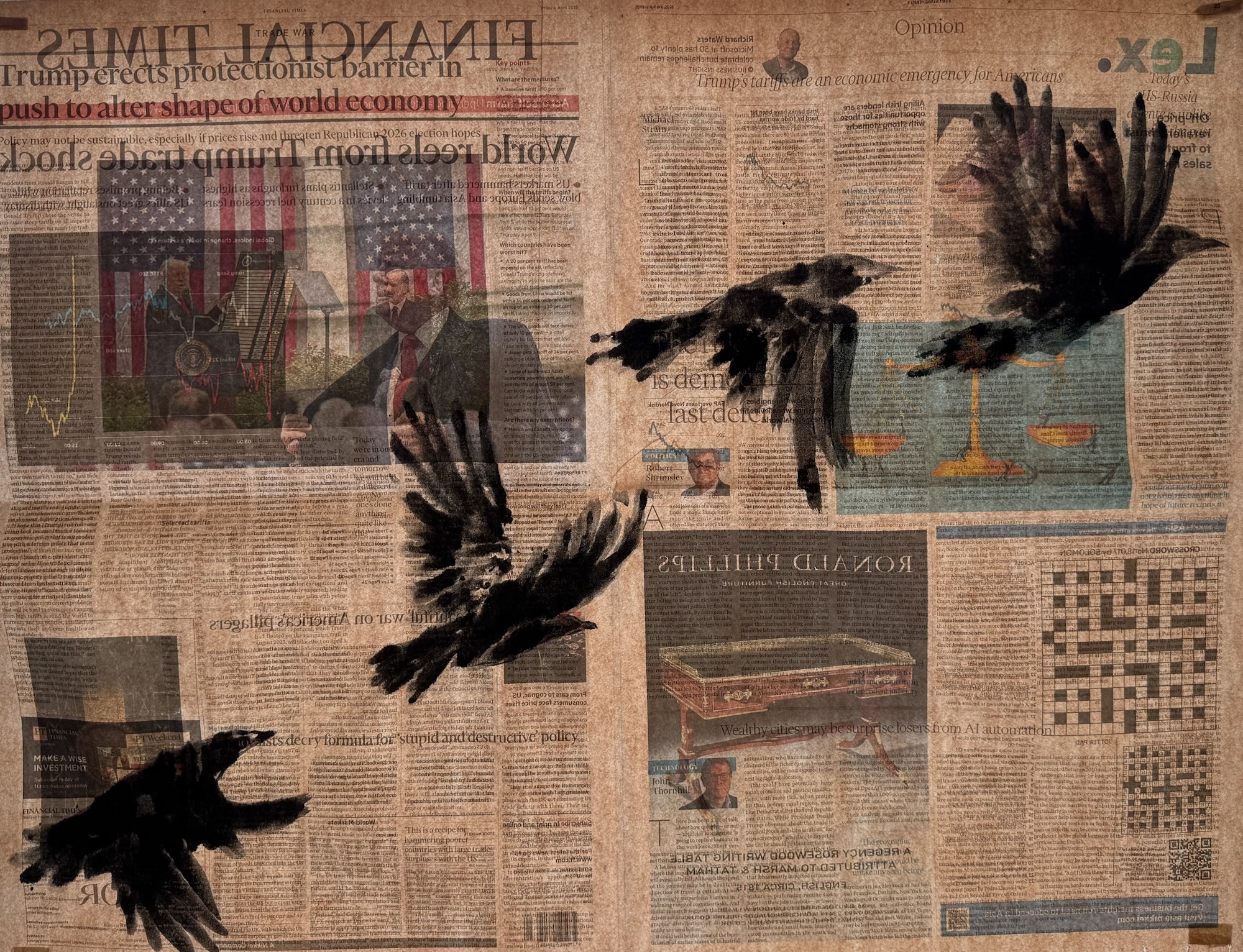
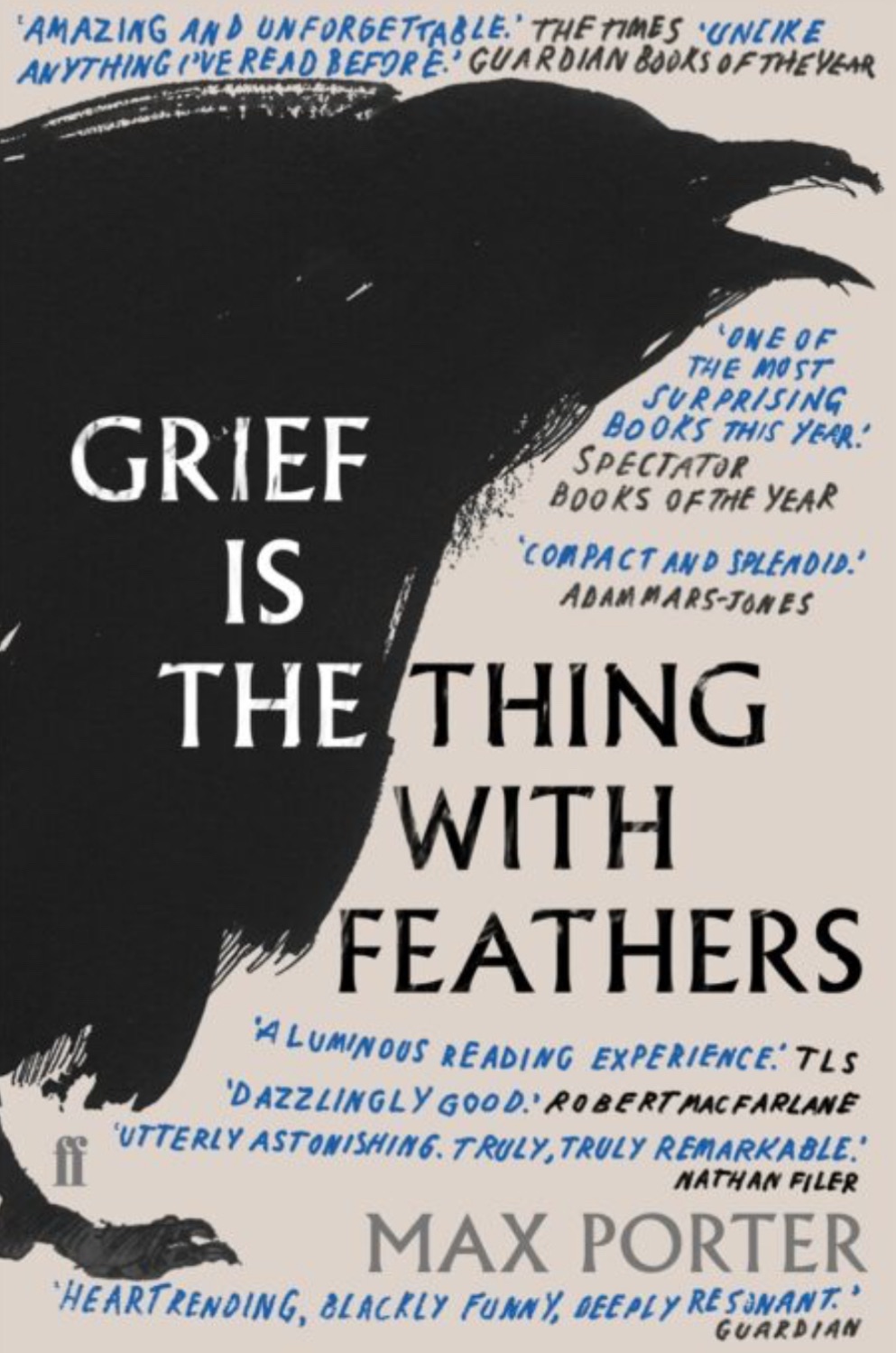
The timing of this question was very appropriate because I have been thinking about this a lot. I chose the crow as a metaphor for my grief for the loss of a world order that I understood. The crow was inspired by the book ‘Grief is the thing with feathers’ by Max Porter. When I started this series of work, I just wanted to paint something as I felt a sense of urgency and the book came to mind with the crow as a metaphor for grief. Hence I started there. The black feathers worked well with my chosen medium of Chinese ink and the characterful crows gave me lots of ideas to work with. I started without thinking too much about the pose or the composition of the pieces, I just wanted to paint and express how I felt. Then I started to locate the bird more purposefully next to headlines or images and experimented with compositions. Now that I have done many such paintings, I started to get an idea of what I wanted to achieve with this body of work and with the crow.
I want to use the crows to bring attention to certain news headlines. I noticed that when people look at my News paintings, they usually start with the crow. They would study it for a while, then their eyes would wander around the news headlines or images nearby and then focus on the articles. It was important for me to choose a neutral or as unbiased as possible a newspaper because I don’t want to tell or preach to the viewer what they should think about the news piece; I want the viewers to decide for themselves and to show a factual headline or news article to trigger their thinking is my intention.
Reflecting on the questions posed in my feedback, I believe my use of the crow has several roles. Like in the novel I referred to, the crow as a metaphor revealed itself to me when I started to despair about situations in the world – that was when the crow ‘entered stage’ as in a theatre. In the last few weeks, there were times when I felt perhaps it was time to move on from the crow as perhaps world events were settling down. That feeling lasted at most a day when something else happened that enrages me again and I had to bring the crow back to centre-stage. There seems to be an endless supply of headlines at the moment which is energising for my art but absolutely draining for me as a human.
As for the point about the pose of the crow, it has been an interesting development and revelation for me. I remember when I first started studying art, a tutor at the time said that how we felt would inevitably come through to our work; our work was influenced by our subconscious. I didn’t quite believe that at the time but was happy to keep an open mind. Of course, I have since experienced that many times. There have been a few News paintings where some unconscious expressions came through that I only noticed afterwards. Below are two examples.
Example 1 –
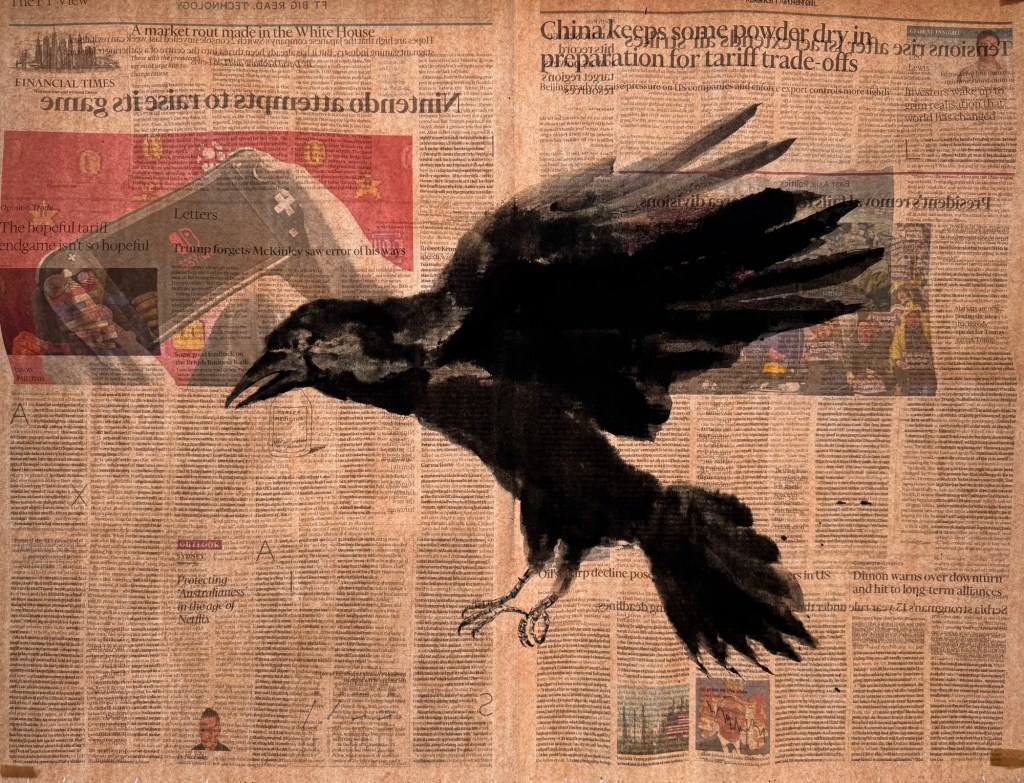
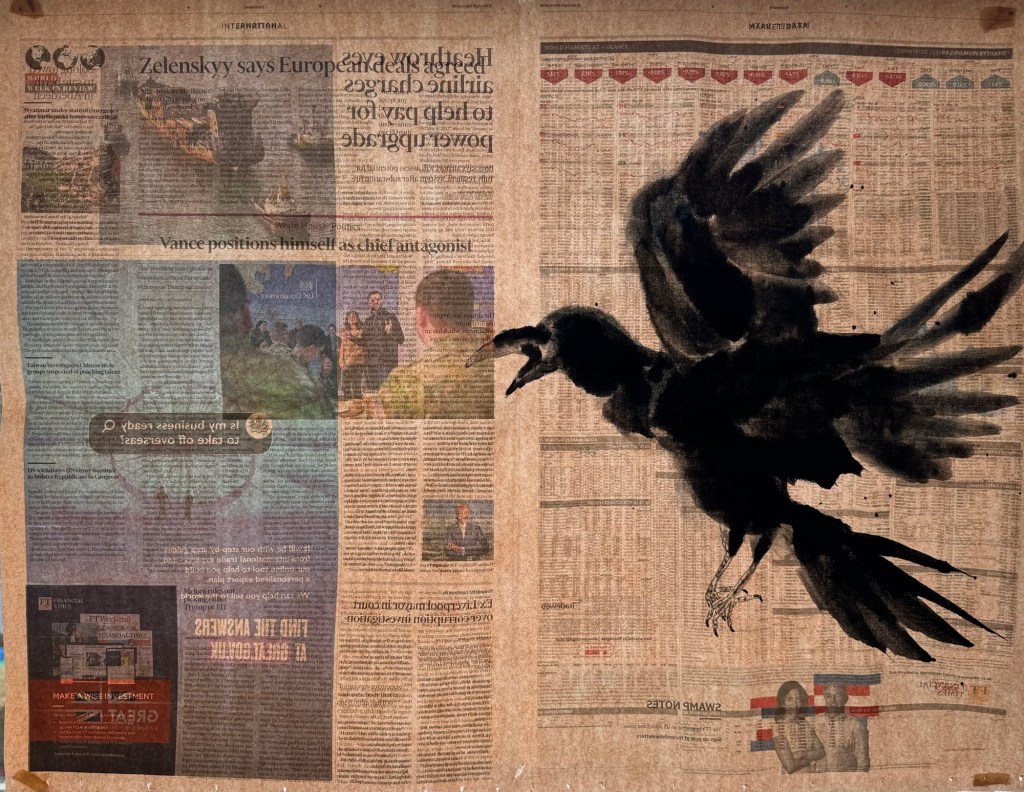
In the painting below, I wanted to position the crow to look like it was going for the bottle of ‘tariff medicine’. But since I do not do a mark up drawing on the page (not anymore) and I just leave the painting to chance, I do not have control of exactly what comes out especially as I’m painting with my non-dominant hand. In this case, the crow ended up overshooting the medicine bottle and it ended with an ‘uh-oh’ or ‘oh no…’ expression which was not my intention but highly appropriate.
–
Example 2 –
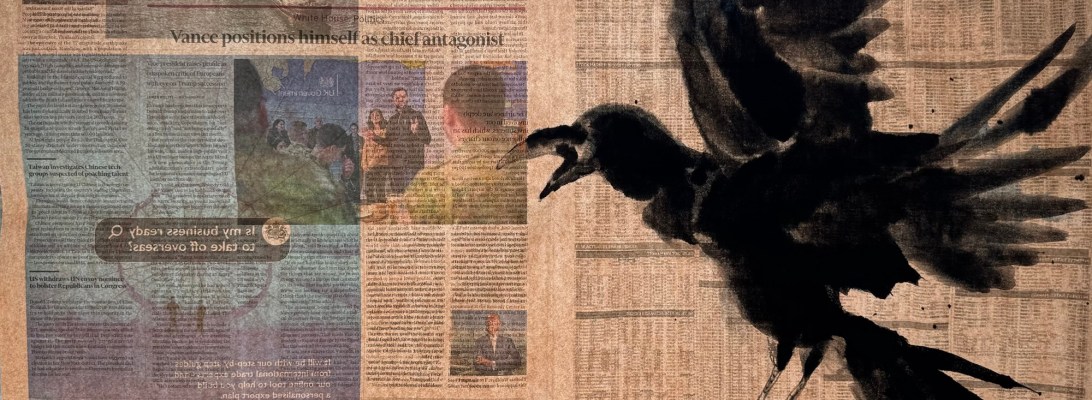
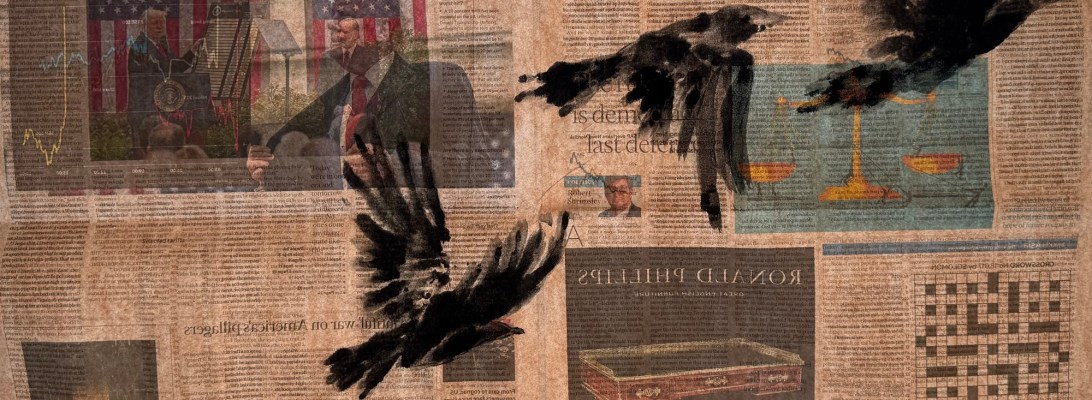
In this case, the chosen headline and image on the newspaper was about the US VP. I intended to bring in the crow from the right hand side (enter stage right) pointing towards the photo image. Again, I didn’t have too much control over the exact depiction but the crow came out screaming at the photo and its feathers somewhat ruffled. It seems to reflect what goes on in my consciousness.
–
As for the back lighting of the images and what they reveal – I tried at one point to place the bird purposely to align with images on the reverse side, but they rarely work out satisfactorily. So now I choose a newspaper page where there are headlines that I want to respond to on the front and although I do look at the reverse side to make sure there is something interesting on the back, I tend to locate the bird according to the front page and then leave the reverse side to chance. This means I don’t pose the bird according to the reverse image purposely and just wait to see what happens when the painting is finished. By not being overly deliberate, it has provided some interesting compositions. It also contributes to the notion of uncertainty that continues to form a large part of this body of work.
Final reflections regarding using the crow as a metaphor… as I was writing this blog, I have started to use theatre stage language to describe how I use the crow and I feel that is appropriate. The crow has become my actor on stage to carry a message, it has been on stage throughout this series of work. It comes in and out of the spot light depending on what it wants to draw attention to. It accompanies me as I navigate the ‘new world order’ and represents me when I want to say something. One day, when the world is right again (I remain hopeful) then perhaps Crow would exit stage left. I have started exploring bringing in other creatures to broaden the repertoire. I have enjoyed using the Chinese ink as a medium and I have thought about using a rat but that seems to be very controversial. I have also thought about spiders because I was inspired by Louise Bourgeois’ spiders and how she used them to signify strength. I certainly feel that I need as much strength as I can summon up everyday just to read the horrendous news at the moment. This idea is only at an early stage. I will keep thinking.
LEARNING
In writing my reflections and response to the Unit 3 feedback, it has helped me to crystallise my reasons for using the crow in my work – why I use it and how I use it. I feel there is still much to achieve with my crow and there is still some way to go on this journey. So I will continue with it but will be more mindful of how and why I’m using the crow as a metaphor as I progress. I sense that the metaphor has already shifted somewhat and has gone beyond just grief. It is becoming my voice which is also an appropriate metaphor because the crow is intelligent (can read my mind) and vocal (speak for me). Also, in many cultures and mythologies, crows and ravens are depicted as messengers, not necessarily from another world, but rather from between different realms of existence. So using the crow as my messenger has become part of the metaphor.
I will continue to explore other creatures that has a metaphorical meaning for me and that works well with my chosen media of Chinese ink on newspaper. Spiders are one possibility that I am considering.
NEXT STEPS
Continue to use the crow in this series of work, News.
Consider more deeply about the metaphors that I use – how they apply as a metaphor and how they evolve along the journey.
Explore other creatures or metaphors to bring into the work. Be sensitive to what they mean and think broadly to avoid unintentionally offending people.
I have been planning how to continue to develop my art practice after I finish my MA. The key for me is to ensure I work in a way that maintains my interests with variety and balance to keep up the momentum so that it is sustainable in the long term.
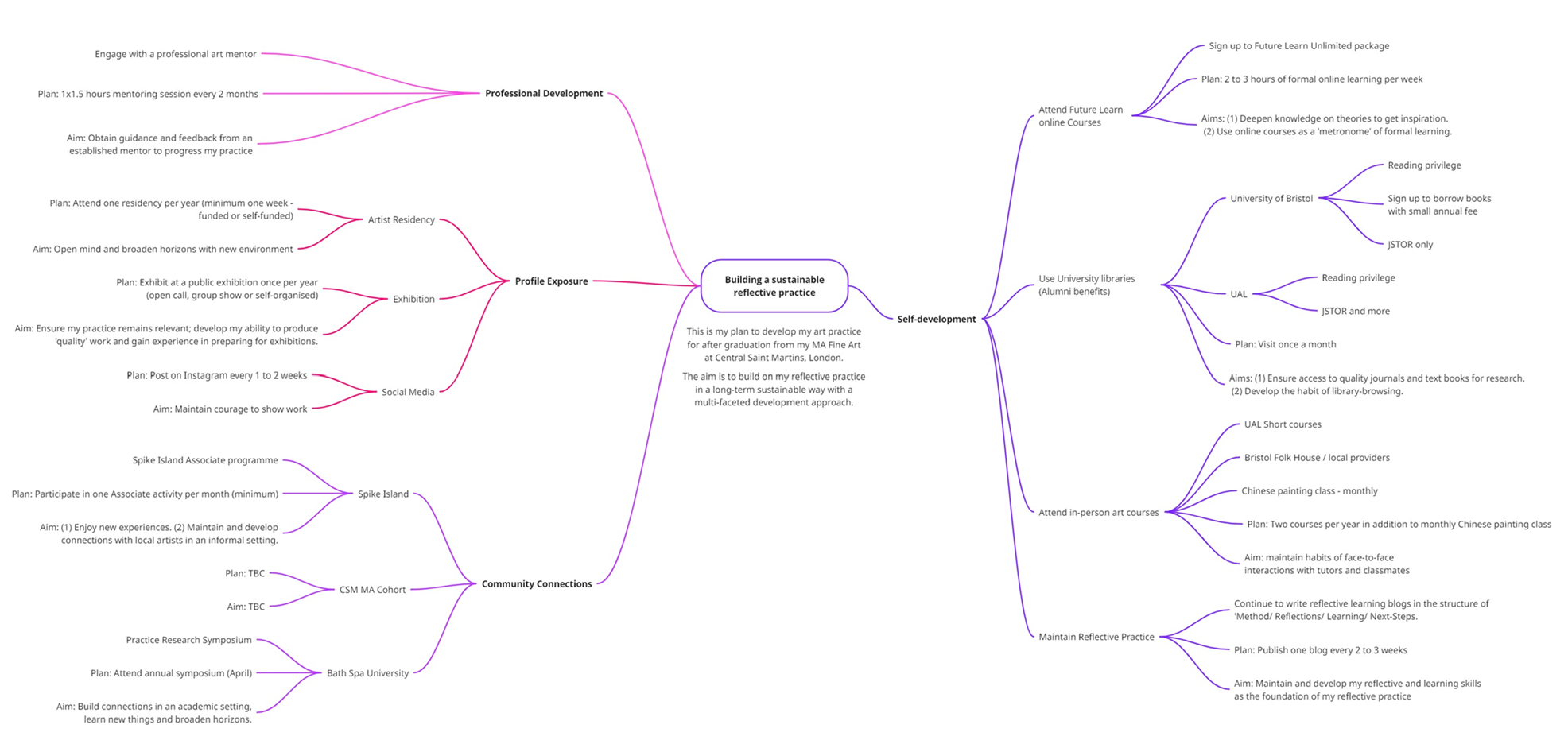
As a starting point, I have created a MindMap where I have captured my aims as well as resources that are available to me. I have tried to create a balanced plan covering the following areas with a structure that I hope will help to establish a rhyme after my MA:
– Personal / Self-development: Attend in person classes, e.g. continuing my monthly Chinese painting lessons, as well as online learning. I have identified around one year’s content (with 3 to 4 hours per week starting with cultural theories) on Future Learn that I have just subscribed to and I plan to attend those online modules every Thursday afternoon in place of the MA weekly classes to keep up a learning rhythm.
– Reflective practice: A key part of my self-development has been my reflective practice. The structure that I have built into my blogs has been invaluable in helping me to develop my practice. It offers a safety framework that I can return to especially when I feel a bit lost or uncertain. Writing the reflective blogs has put me back on track time and again when I have been stuck. So I plan to continue with the blogs because they help me immensely and I have set myself a goal in the frequency of blogging.
– Professional development: I plan to engage with an art mentor having a session once every two months. I have been recommended a mentor used by several Spike Island Associates and I have connected with him. It’s my way of holding myself accountable and forms part of the rhythm.
– Profile exposure: I need goals to work towards in order to maintain my momentum and I have set myself targets such as attending one artist-residency per year – this could be self-funded if I do not get accepted onto a competitive one as I don’t want to give myself an excuse to not do it. I feel the act of attending a residency, making art away from my environment, would open my mind and expand my horizons. In addition, I want to show my work as a way to keep my thinking and my work ‘current’. I will look out for Open Calls that are aligned with my work and if that doesn’t work out then I would create my own ‘show’. That could be in whatever capacity, even just displaying my work in a park in my neighbourhood – the purpose is to have an event of some kind for me to make work for and aim towards.
– Community connections: Although I enjoy my own company and can happily make work in my studio without seeing anyone. I appreciate that being connected with other artists is important for my development and well being. Hearing others talk about their work always gives me inspiration. Talking about my work to others is also a healthy thing to do. I am fortunate to live in Bristol where there are many artist communities that I have always found to be friendly and supportive. So I will definitely continue to connect with them regularly (e.g. attend events with Spike Island Associates).
Below is my first draft MindMap plan showing my plans and aims for each element. Items within the map are there to feed into my art-making; to give me inspiration, to deepen my knowledge and to help me think.
The plan is work-in-progress and I will continue to build on it over time. I may not even fully follow it, but having a plan in place is important for me to have a starting point, so that I am not faced with a blank calendar and feeling lost the day after graduation!
I will follow the plan for as long as I enjoy it; if I stop enjoying it then I will revise it. I hope as I travel on this journey, other things will come up and the plan will evolve as my needs change. I will be very sad when my MA course ends but I am very excited to continue the journey with all the new skills, knowledge and friends that I have gained on the programme.
–
REFLECTIONS
A few things that were said to me recently have got me thinking about my MA…
A very good artist friend said that she noticed I have been talking about ‘my practice’ and about ‘being an artist’. I remember when I first joined the MA course, I would only describe myself as ‘an art student’. When asked if I were an artist, I would reply, ‘not really, I am just an art student’. Then sometime during the last two years and I don’t remember exactly when, I have started to talk about being an artist. I had not noticed it until my friend pointed it out to me and I am pleased to say that I feel comfortable about referring to myself as an artist now when I was certainly very hesitant two years ago. I believe it’s the MA course that has given me the confidence and encouragement to do so.
Another comment came from a photography tutor. I have attended a few one-off photography workshops locally and have got to know the tutor well. Earlier this year, she asked what I was planning to do after my MA and at the time I said I wasn’t sure – it was before I created the above MindMap and I was considering doing another taught MA. She said, ‘I am sure you are going to do something because you can’t waste an MA from Central Saint Martins.’ That really made me reflect on what an opportunity and a privilege it has been to do this course (in fact, to do further education of any kind). I do not have ambition to be a famous artist or to have gallery representation, that was not what I came here for. I came here to develop myself and to learn. I have thoroughly enjoyed the course and I am loving making art. So I am just going to keep on making and be true to myself in my art – as David Bowie said, ‘don’t make art to please other people’. I hope that is enough to not ‘waste’ this excellent learning opportunity that I have had the privilege to enjoy.
LEARNING
In addition to making art, I will continue to explore how I can use ‘my voice as an artist’ and I hope the MindMap plan will help me with this. I have always wanted to broaden my practice to examine societal issues so I plan to build on my ‘News’ art – my ambition is to make large scale industrial-style ‘News’ art installations. I am excited to see where all these will take me.
NEXT STEPS
– Follow the MindMap plan after graduation – revise it if needed. But always have a plan to maintain the rhythm.
– Explore how I can use ‘my voice as an artist’.
– Continue to make ‘News’ art – scale up.
– Keep on making art, be true to myself and keep on enjoying it!
On 3rd October 2023, I wrote my first blog for my MA Fine Art (Digital) course. It was about my intention to structure my blogs in a way that would help me to create a sustainable reflective practice.
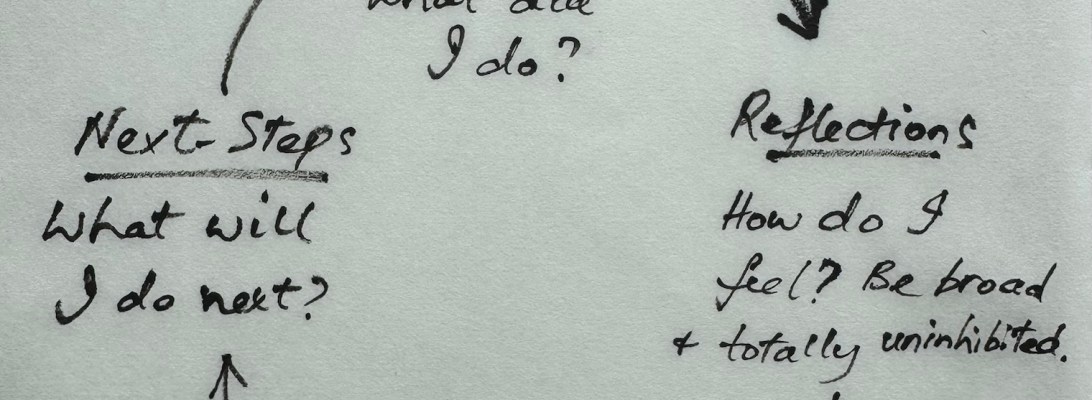
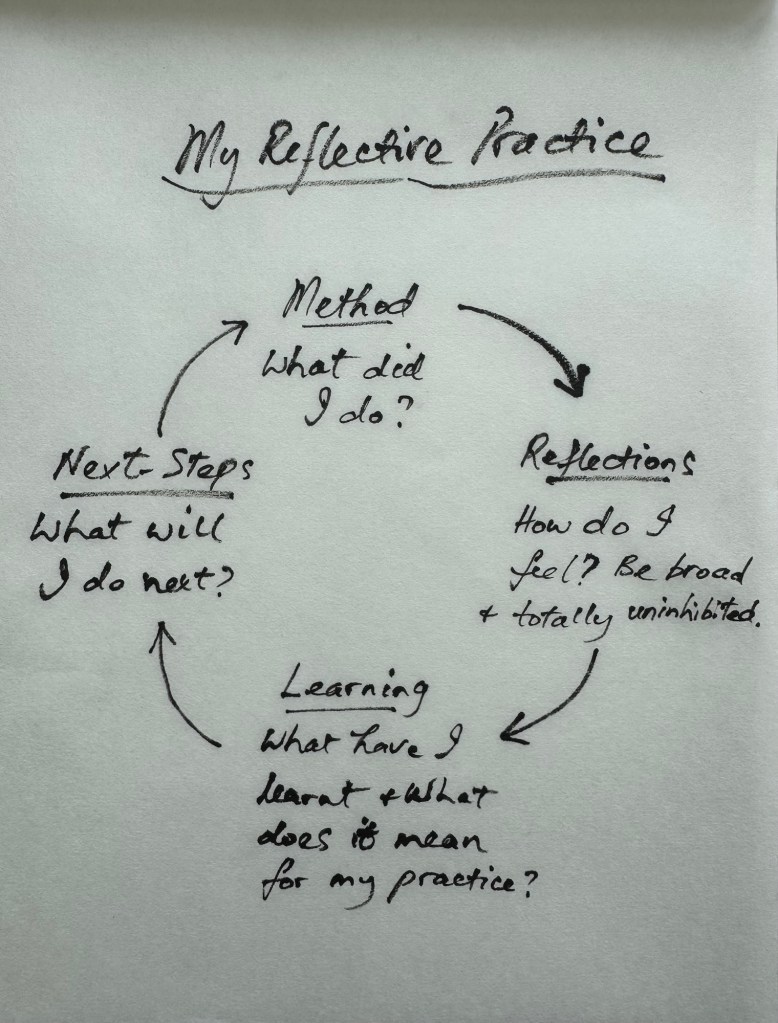
In the blog, I talked about my intention to base my blogs on Kolb’s learning cycle and as a result, I have created the following 4-stage structure and I have been using it for all my blogs throughout my MA course:
1. METHOD (Experiencing stage)
– To capture my making process and decisions along the way.
2. REFLECTIONS (Reflecting stage)
– To capture all my thoughts, feelings, reflections and personal insights throughout as well as after the making process. The aim is to think as broadly and be as uninhibited as possible to ‘open up the horizons’ and/or to ‘dig deep’.
3. LEARNING (Thinking stage)
– To bring my reflections back to the context of my art practice – what have I learnt and what does it all mean for my practice? Also to capture any emerging intentions if appropriate.
4. NEXT STEPS (Acting stage)
– To summarise ‘what to do next’ in clear actions to give direction to progress my practice.
Below is my reflective process in a diagram.
My reflective process
It will be referred to as The ‘MeReLeNe’ process for short from here on.
REFLECTIONS
Writing my blogs in this ‘MeReLeNe’ structure during my two year MA programme has helped me to cement a structured approach and develop my reflective practice. I have been an engineer all my life before coming to the arts and I need an underlying structure in order to liberate me to explore freely and safely, knowing that if I ever felt lost or ‘wobbly’ then I could come back to a tried and tested structure that would give me security and guidance. Since this is a structure that I have developed for myself and tested over a two year period, I feel that I can trust and rely on my process to progress my practice making it sustainable as I feel very committed to it. I have come to realise that it is much more than a safety structure… At times during the last two years, I have felt unsure about what direction to take or felt lost about what to make. Then inevitably I would realise that I have not written my blog for my last piece of work yet, hence I felt lost. Without exception, once I reflected properly in my blog and captured my learning in the context of my art practice, the next-steps would then reveal themselves naturally in the process. Sometimes the next-steps could be simply to ‘make some more’ and that simple statement may seem generic, but I would know where to take it as a result of going through the reflective process.
I am excited about having tested and embedded this structure into my practice. It is now such a fundamental part of my practice that I cannot image working without it because I would soon become lost.
Furthermore, in the last two years, at times I have felt unsure of what my ‘process’ was, was it painting with oil, oil and cold wax, making Cheongsam canvases or painting on newspapers? I found it hard to explain to people when asked about my practice, especially for anyone not familiar with contemporary art. People would ask if I painted landscapes or portraits; watercolour or oil. It’s impossible to give a straight answer when my medium and methods would vary depending on what I was trying to say. It might vary from project to project, but writing this blog has brought clarity to what my art practice is about:
‘My contemporary art practice is about exploring my identity and my environment through narratives. I use whatever medium that is appropriate to help me express what I want to say. My reflective practice is my process.’
LEARNING
I have learnt that I definitely need a structure to thrive in my practice. It provides a safe environment for me to wander and explore freely knowing I can ‘come home’ to this process to consolidate my learning and progress.
The key revelation for me is having the clarity that ‘My reflective practice is my process’. I believe my tutor has allured to this several times recently and I now know what he means.
NEXT STEPS
Continue to use and embed the ‘Method-Reflections-Learning-NextSteps’ (or MeReLeNe) process for my reflective practice.
Start to acknowledge that my reflective practice is my process. Own it.
During my recent tutorial, we discussed how the world events are affecting how I felt about my art practice. The change in world order made me not want to do bright and colourful paintings like my recent Family Dinner paintings as they now seemed frivolous with the destructions going on. I also talked about my sense of helplessness as an artist. Therefore, I am in the stage of reconsidering my practice – what do I want it to be about? I have always positioned my art practice as about identity exploration, starting with my personal identity and I started (chronologically) from my childhood in Hong Kong (e.g. the Cheongsam and Family Dinners etc.).
REFLECTIONS
– The feeling of ‘Voicelessness’ as an artist – see separate blog. I think I have worked through that one for now. Briefly – I believe my choice of being an artist (vs my previous position as a business leader within a commercial organisation) gives me much more freedom but with an unknown and unpredictable audience as there is no defined platform for communication. So having reflected on that, I do really value the freedom of voice that I have now. I just need to work out what to do with it.
– How to deal with the current feelings of despair for the change in world order? I can’t ignore it but I don’t want to directly confront it in my art practice because I would risk ranting and being too in-your-face rather than communicating and expressing sensitively and intelligently.
– So I thought about satire and actually went through the process of creating character metaphors that I would use ( one is a turkey eating French fries and the other a loaf of cheap white bread) but I decided against satire because it would require me to closely study those characters which I don’t want to do as I need to preserve my sanity.
After much thinking and reflecting, I decided to focus on how I feel instead which is anger, heartbreak and grief. Grief for the loss of a world order with values that I understood. It was not perfect at all but there was at least an established sense of right and wrong (usually according to the law); where helping the needed was applauded. I grieve for the loss of all that and more. I grieve for all the vulnerable people who will suffer even more or lose their lives and I grieve for those who have made it their mission to help but are now suddenly left helpless and scrambling for themselves. I am not against change and efficiently, but the destructive way of execution has been brutal – unnecessarily.
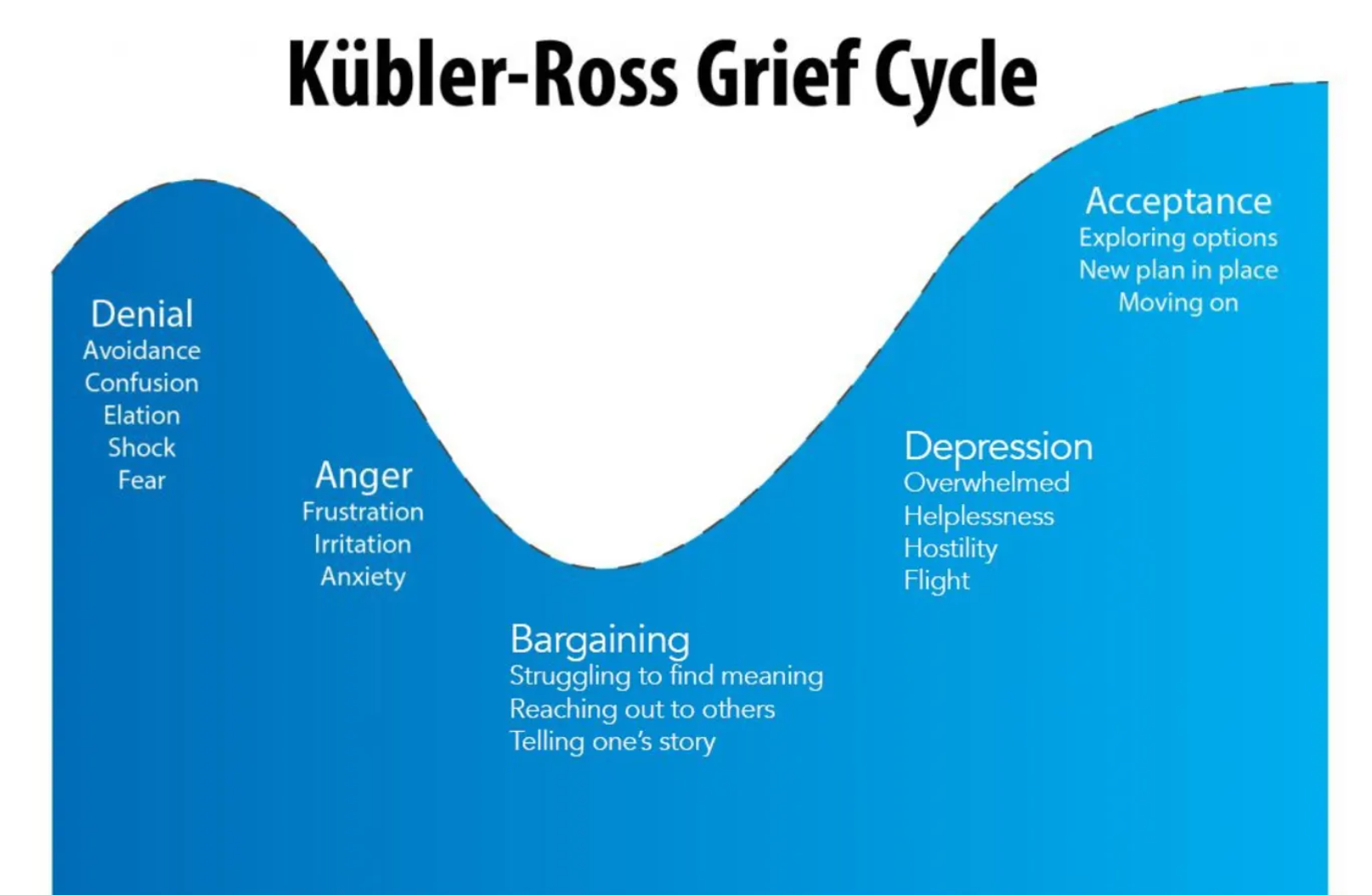
I am likening my feelings and others that I know who are going through the ‘world order change process’ as going through the Kubler-Ross grief cycle.
I find myself oscillating around Anger, Bargaining and Depression depending on what new (and shocking) information comes to light on a particular day. But unlike grieving for the loss of a loved one, I feel it’s not acceptable to reach acceptance which is a problem because I am therefore stuck in the perpetual grief cycle until ‘the show is over’.
So I decided to use my art practice to express the grief that I am feeling. I know (and hope) that it is just a temporary state because I believe I am a naturally optimistic person and I want to return to feeling hopeful about the future of humankind.
I remember the book ‘Grief is the thing with feathers’ by Max Porter where a father and two young boys grieved for the death of their lost wife/mother. Grief was portrayed as a crow. The short novel was written creatively in a way that helped me to picture the crow vividly. Inspired by the novel, I want to do something with crows and feathers in my art practice to express the grief I’m feeling right now for the world.
Other reasons for choosing crows:
– They are intelligent (compared to other bird species and mammals) but ‘voiceless’ as they can only caw (according to the human ears). I feel that is a good metaphor for how I feel as a ‘voiceless’ artist and perhaps how many artists feel in the world right now.
– Crow feathers are interesting in colour and texture. I want to explore further in my art making.
– I have always been fascinated by crows and they were once the subject of a personal project in my Chinese painting practice. So somehow I feel a connection with them.
LEARNING
So what does it all mean for my art practice?
It would be useful to think about ‘the fluid circle’ that was discussed during my tutorial – I go in and out of a fluid circle depending on how able I feel in responding to the world events.
– Inside the circle is retreat mode – coming inside the circle to hide from the world and have time-out. When I’m in that mode, I want to work on things that are simpler or more familiar for comfort. I can do drawings which I find comforting, or explore photography and the new objectivity approach to give relief through working with facts and an established process; letting the process take control momentarily.
– Outside the circle is confront mode – where reality is faced and dealt with. It could be energising but likely to be draining. The most useful and manageable thing to work on there right now is dealing with that feeling of grief and work out how to channel that into my work. Therefore I have been thinking about doing art with crows and feathers.
Is this a deviation from my main practice? I have been thinking about this a lot. If my practice is about identity, then I believe reflecting on one’s state of mind is a key part of that identity exploration. So having done much thinking about this, I feel comfortable that what I am doing here remains part of my soul searching – just instead of exploring the past (my heritage), I am exploring the ‘right here’ and ‘right now’ for me.
What about the Cheongsam dresses? I have had such positive feedback from my MA course mates during the low residency week that I feel I should do some more with the dresses especially for the degree show. Perhaps make a dress with crow feathers? Many Cheongsam dresses are decorated with dragons and phoenix, so perhaps a crow instead?
NEXT STEPS
– Just make art depending on how I feel in the moment. Do something with crows and feathers to release and express the grief as well as create time to think about the future.
– Keep thinking about what else I can do with feathers, perhaps Cheongsam dresses and possible installations.
– Give space and time for the thinking.
ADDITIONAL NOTES – CONSIDERATIONS FOR MY STUDY STATEMENT
Since I am rethinking my practice, I revisited my Study Statement to see how my new exploration proposed here would impact my planned study. I feel that my Methodology and the Outcomes would remain unchanged. My aims and objectives were strongly focused on transculturalism and the work proposed here (exploring my currently feeling of grief and loss of world order) would not fall into that topic. However, within my Study Statement, my main goal was to explore my identity and I believe exploring my current state of mind falls well within that – it is all part of me and my lived experience. In my Statement, I also referred to wanting to expand my practice to explore wider societal issues including feminism and power structures – I believe my response to the current global political situations falls within this remit. To incorporate the new exploration into my study, I should consider adding some new ‘aims and objectives’ to ensure I remain on track with my study goals.
After reflecting on the overall work plan, I believe it remains valid and on track. One of the key aims of my study was to find convergence in my practice with the parallel development of my narrative and style that I started the course with. I believe I have achieved that (or at least have found a way to achieve it) in my Cheongsam series of work and I had written in my blog at the time stating that I was delighted to have found a way to converge the two strands through the Cheongsam dress canvases. Therefore I believe there is room in Unit 3 to accommodate an additional set of aims and objectives that have now become pressing for me.
NEXT STEPS
Consider additional aims and objectives for the newly proposed exploration.
COMPLETED ADDITIONAL OBJECTIVES
The following two pages have been added to my Study Statement:
This is a piece of short reflective writing after discussing with my tutor about my sense of voicelessness as an artist given recent world events. I’m pleased that things do not feel as bleak after thinking it through hence I felt it was important to capture my thoughts here. I feel a new sense of purpose.
REFLECTIONS
Voicelessness… or is it?
With the rapid change in world order, I have become acutely aware of my voicelessness as an artist.
In my previous life… in any crises be it the financial crisis, Brexit or Covid pandemic, I always had a voice through my corporate platforms. Those at the top of a hierarchy have a voice by default whether they have anything to say or not. What helped me to get through those crises was the sheer amount of work involved in getting the business and all the people I was responsible for through the challenges. There was little time to think how I felt about it all.
Opting out of the system for me meant giving up the structures that provided a scaffold for the coping mechanism. But having a voice in that environment was an immense responsibility. Every word and every pause mattered; there were too much and too many at stake.
Opting out and giving up my previous voice was my choice, it was my very reason for choosing because with voicelessness comes immense freedom. Freedom in turn releases an even more powerful voice. I feel a new kind of responsibility and a new purpose.
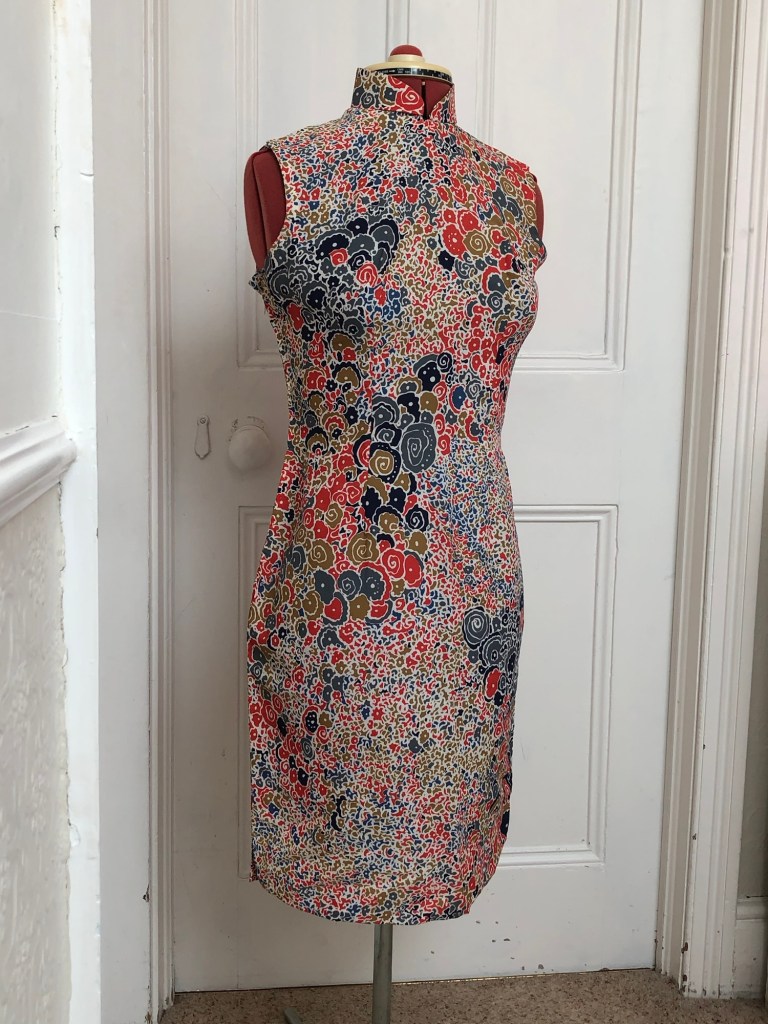
In the last few months, I have been making paintings on Cheongsam shaped canvases. The idea came to me when I accidentally found my mother’s Cheongsam in my attic. The shape of the dress is so iconic and I am so fond of the Cheongsam that I felt compelled to do something with it.
My mother’s Cheongsam
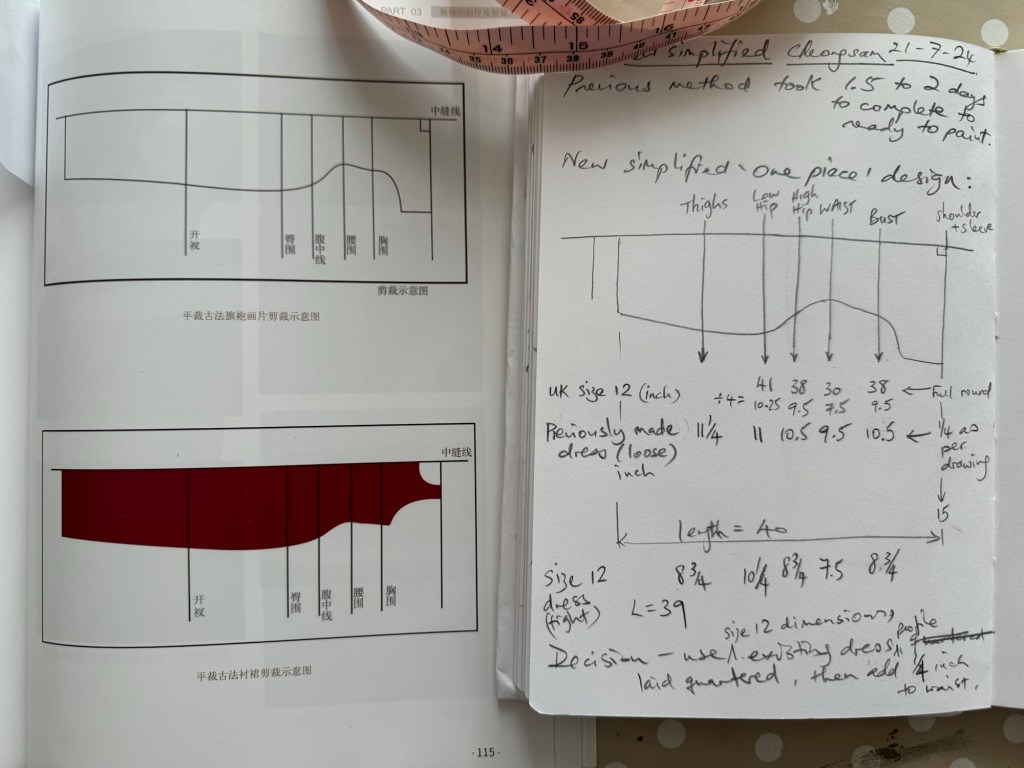
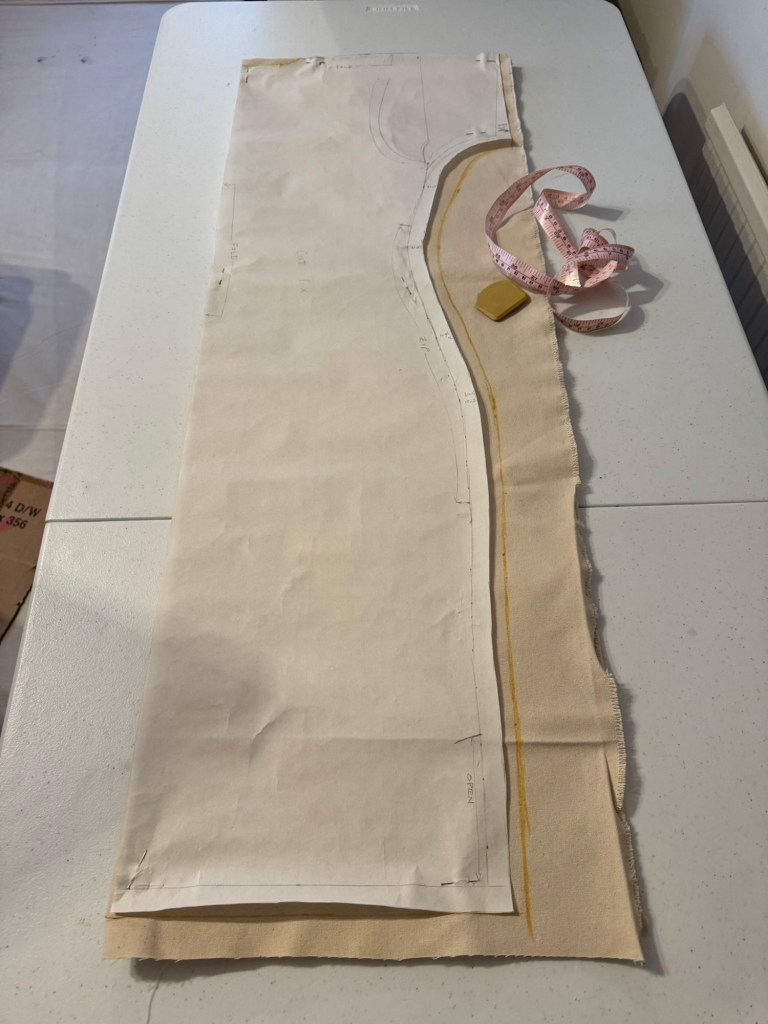
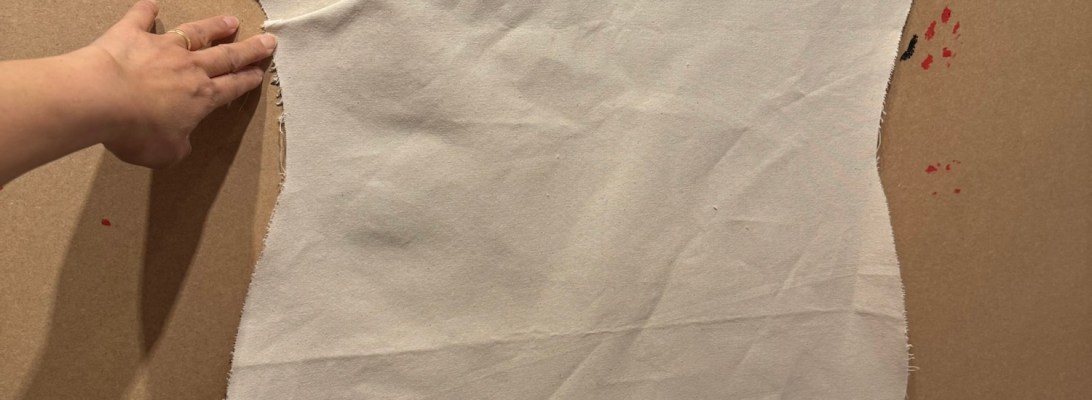
I made painting canvases in the shape of a Cheongsam and developed the dress pattern over time to create a design that was quick and easy to make.
Measurements for my patternCutting the painting canvas to the pattern
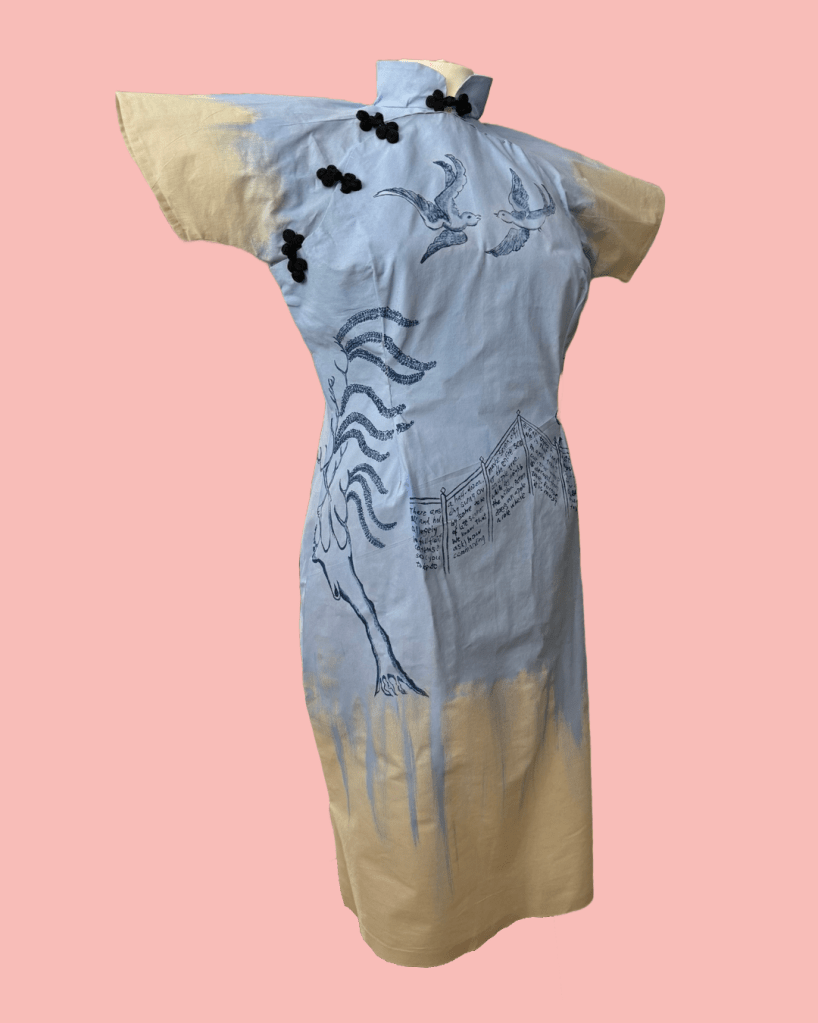
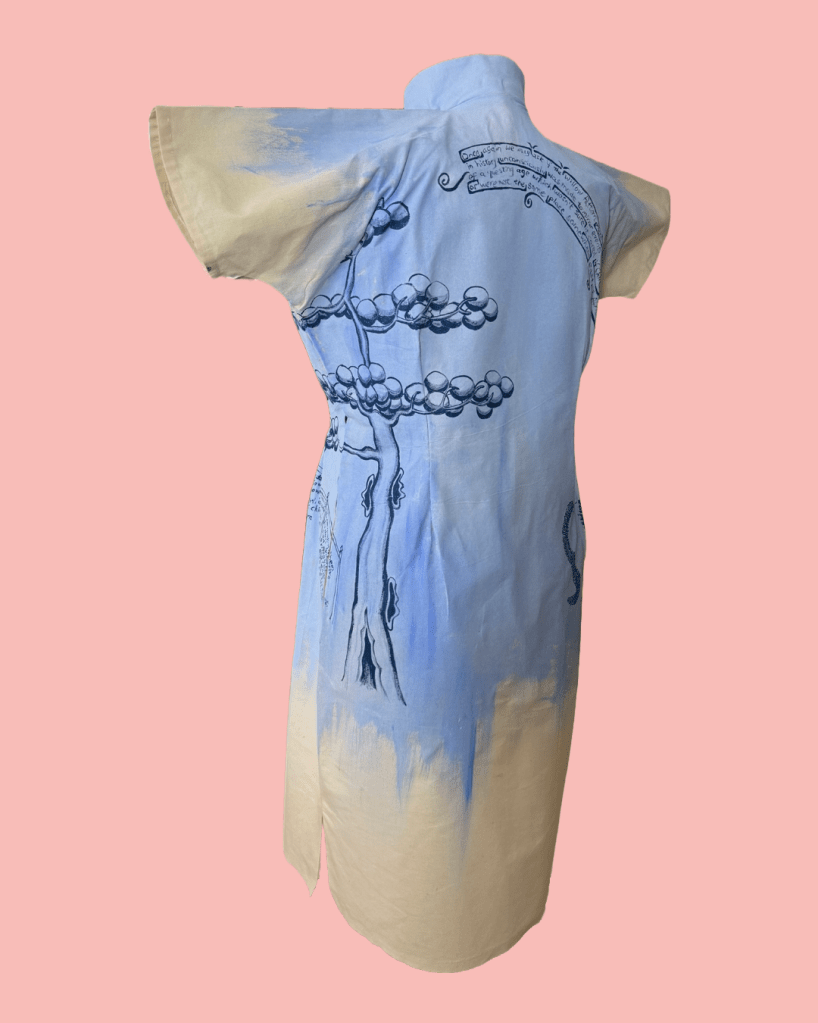
Below are the Cheongsam paintings that I made and each has been documented with its own blog, so I will not elaborate on the background and my reflections. It’s just a quick list and recap here.
The first Cheongsam painting was my response to the traditional Blue Willow pattern. It was painting in acrylic on calico canvas:
Blue Willow – front viewBlue Willow – back view
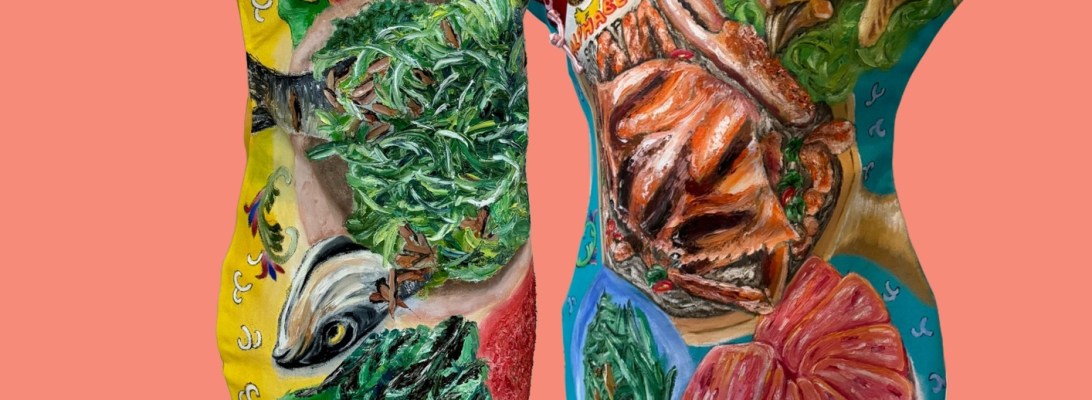
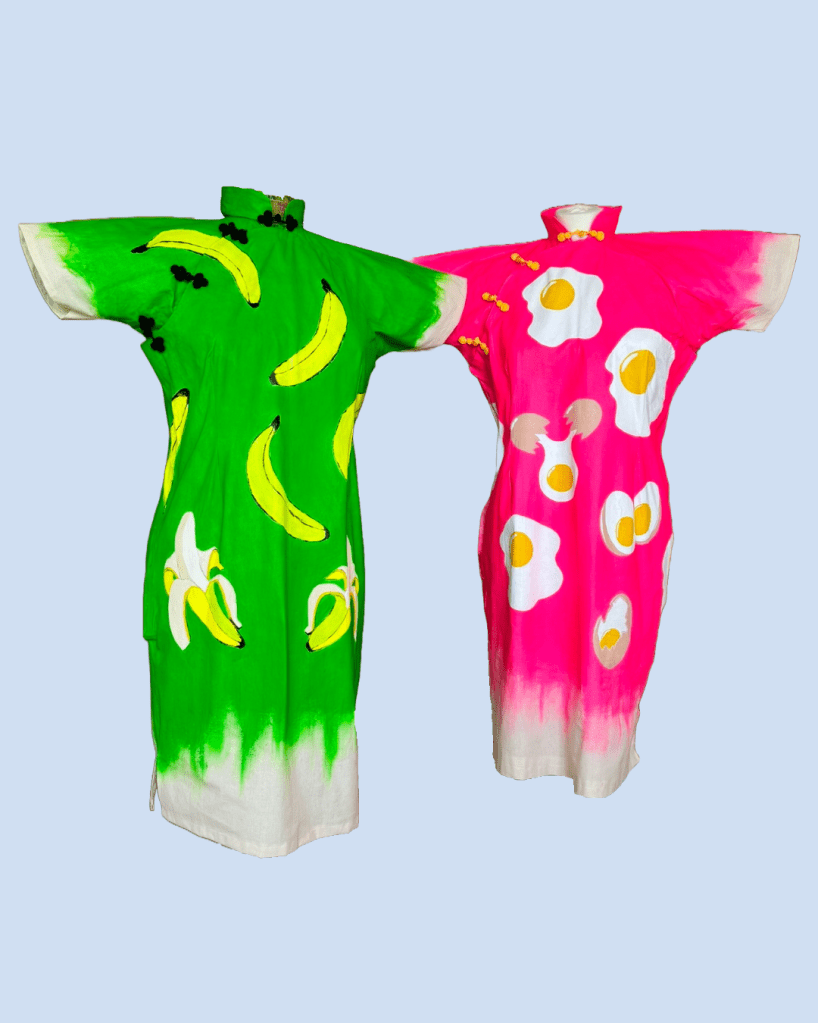
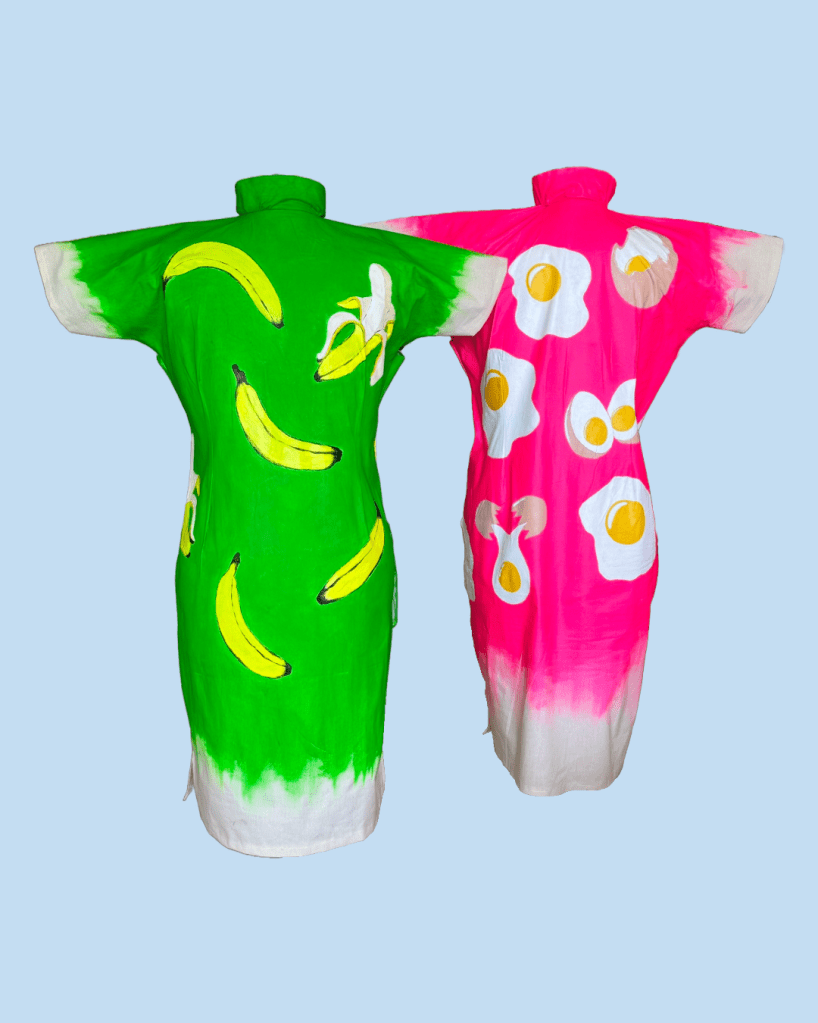
The second and third Cheongsam paintings are also acrylic on calico canvas and are intended to be shown as a pair (diptych). They depict food used as a racial identity metaphor. One is called ‘You’re a banana’ and a response to it called ‘No, I am an egg’.
Front view of ‘You’re a banana’ (left) and ‘No, I am an egg’ (right)Back view
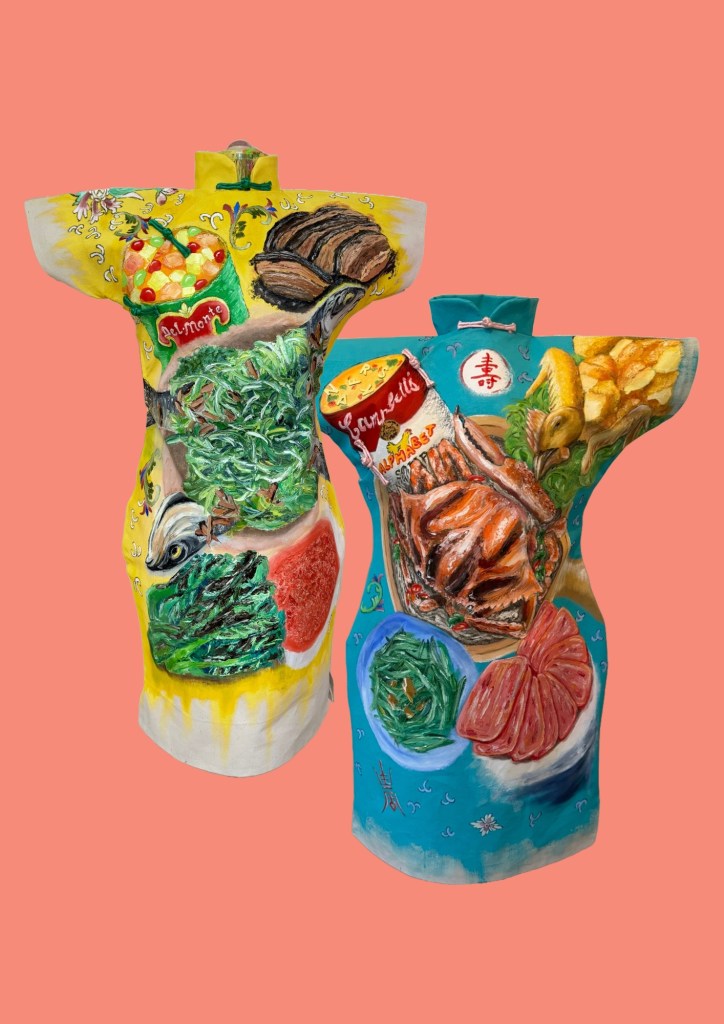
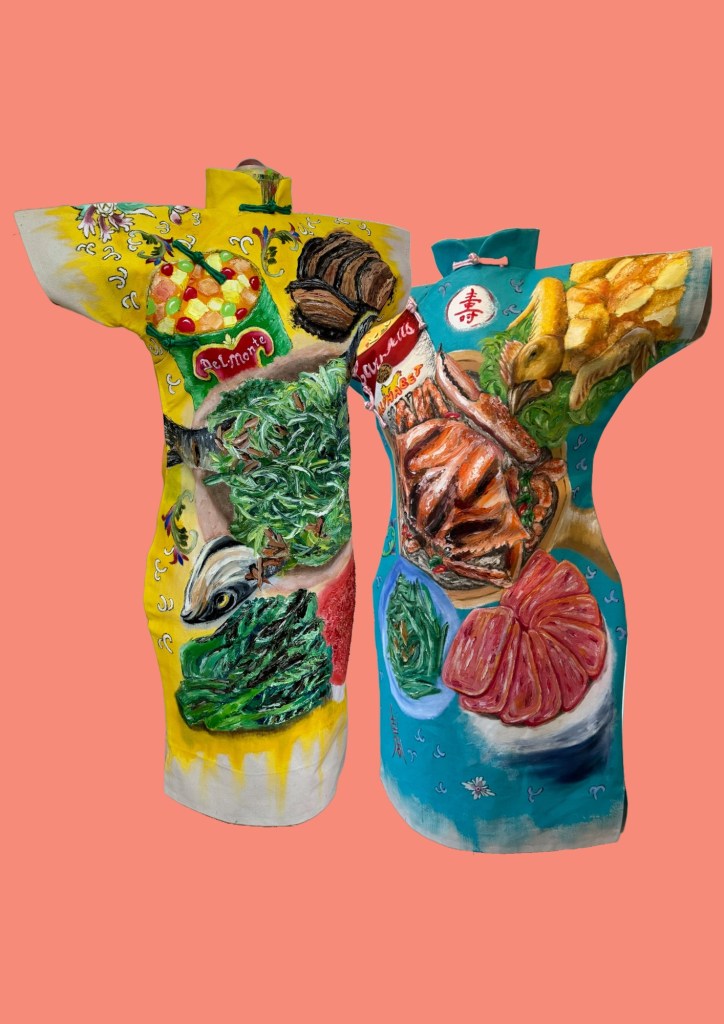
The final pair of Cheongsam paintings are Family Dinners #1 and #2, depicting my childhood family dinners while growing up in Hong Kong. Both are oil on cotton canvas.
Front view – Family Dinner #1 (left) and Family Dinner #2 (right)Slanted front view
REFLECTIONS
I have thoroughly enjoyed making the Cheongsam paintings because:
– They are something different. They brought a new dimension and energy to my practice.
– I felt they could help me to make my work recognisably mine. This was an objective I set for myself in my study statement.
– I have enjoyed the dressmaking element. The technical discovery has been rewarding. The process of dressmaking reminds me of my childhood watching my mother making dresses. Brought back many memories.
– I enjoyed the challenge of making 3D paintings. I had previously explored the subject of expanded painting and I was pleased to return to that kind of work.
– I enjoyed exploring food as identity metaphor. It has opened a whole can of worms that has required more thinking and research that are ongoing.
– I enjoyed painting the dinners very much. I love painting in oil and food brings me much pleasure – both eating and painting them. Food is such a large part of my Hong Kong Chinese culture that painting them onto a Cheongsam canvas felt particularly meaningful. Afterall the trigger for painting on Cheongsam canvases came from finding my mother’s dress and she was the one who created all the lovely dishes that we ate. Cooking dinners for her family was such a large part of her daily life that it would be impossible to think about her and my family without thinking about her food. When I meet up with my sister nowadays, we mostly seem to talk about food and each dish would lead us into reminiscing about different stories from our childhood.
– I had intended to make more and more Cheongsam dresses for the remainder of my MA course to build up a collection for the final year degree show. However, my thinking has changed since receiving my Unit 2 feedback.
– My Unit 2 feedback made me think more deeply about why I am painting on Cheongsam dresses. Why dresses? Why Cheongsam and is the time well-spent in making dress-canvases? Shouldn’t I spend more time painting? There was a lot to think about and reflect on from the Unit 2 feedback and I have written a dedicated blog on that.
So where does that leave me and my Cheongsams?
I think I should pause on my Cheongsam paintings, because:
– I know I can make Cheongsam shaped canvases. I feel I have developed a good process for that. So I can return to that any time.
– However, I should spend more time on developing my painting techniques. Part of the Unit 2 feedback was about exploring different ways to apply oil. I have started experimenting with that and I should concentrate on that to build up my ‘painting vocabulary’. I do feel that I need to expand my vocabulary to take my work to the next level of expression.
– Part of my plan to expand my vocabulary is to understand more about Qi Baishi’s motto of ‘the marvel of painting exists between likeness and unlikeness’. This requires painting with sight as well as the heart.
– Right now, I feel that I would like to return to making Cheongsam canvases at some point, but I will pause that for now and focus on developing my painting techniques.
LEARNING
There has been much technical learning from the dressmaking that I will take to future projects, especially if I return to making Cheongsam canvases.
I have really enjoyed making the Cheongsam paintings, but that does not mean I have to keep doing them. It’s ok to do something else.
I should spend more time refining my painting skills and challenge myself in that area in order to progress my practice. Once I reach a higher level then I can apply those skills in so many different ways, can be on Cheongsams or anything else.
NEXT STEPS
Continue to build up my ‘painting vocabulary’ by expanding the ways I use oil.
Continue to research the meaning of Qi’s motto – working between likeness and unlikeness.
There were two sets of feedback at the end of Unit 2 that I want to capture here, then I will reflect on both sets together at the end. The two sets are (1) Group feedback on my 3 minute video and (2) Unit assessment feedback.
1. Group feedback on my 3 minute video
At the end of Unit 2, we each made a 3 minute video about our art practice. Then the videos were shown to the class and we gave each other feedback. I am very grateful for the thoughtfulness of the feedback I received and I would like to capture them here.
Firstly, my fellow MA students each completed a note on Miro after seeing the video and below are the notes they wrote for me, captured from the Miro board in no particular order:
Ashton I feel… ‘wow’ed by the consistent high standard of your work, 2!; amused that you described it as a pick and mix!! I also feel shocked to learn why the banana has been used in regards to racial slurs, I did not know that until now, and I feel impressed at the way you responded to that using humour when it’s a hard hitting subject. I wonder …how this will continue to develop as there’s lots of paths combined to create these pieces – current/hidtorical racial prejudices and how they occur, cultural symbolisms, food connotations etc. I think… the fact that you can split your work into what continues your narrative vs develops your style / technique is a very good understanding to have, and not something I’ve considered before. That you can still be developing your art practice even if not confronting heavy subjects, that it doesn’t have to pause in times you feel able to continue the narrative.
Sara I feel… a lot of joy in your textiles work and curious about where it may lead to I wonder … how this may link to other current affairs such as the example of the coconuts. I think…your work appears well thought and considered with lots of interesting connections and a great use of metaphors.
Karl I feel… excited about your exploration of memory within your new painting I wonder … how you can connect the culturally appropriated objects and your genuine experience in the work. I think… that the process of making the dress and the painting on it is a great metaphor for perceptions of cultural identity and the space between the pictorial image and the duality of the dresses.
Roz I feel…engaged with richness and quirky imagery, drawn into a powerful metaphor I wonder… whether the dress will hold more opportunities or what 3rd element is needed now in this 3rd space to take you further along your journey I think you have been very successful in your ordering of the complex that you offer clarity, but are sassy in your delivery. And that you are owning, controlling the defining of your status
Chelsea I feel… that the pieces are funny which makes them more accessible because you don’t feel that you are at first glance engaging in a weighty subject. I wonder… where this will all go next. I think… its all very colorful and eye catching and offers a way in to learning about how we talk about people, it re-humanises that which others have tried to dehumanise, especially with the use of clothing.
Bethany I feel… nostalgia and familiarity, the 3rd Space idea, albeit from a different standpoint. I feel curious about your family history in HK, which was an odd colony. I wonder… whether the metonymies might be handled more provocatively, more personally, as a feminist? I think… I am drawn to the gritty, personal stories, the oddity of Cantonese steamed fish served with Spam.
Catherine I feel I want more. I like the element of surprise with your work, ….what will she do next…. You definitely have my attention Eliza. And you are so eloquent – Bravo. I wonder if you will use other clothes items in the future – the dress is so strong and powerful and a perfect vehicle for the way you express yourself and your research.
Tom I feel… educated in a nice way I wonder … what she has discovered about process vs outcome I think… the work deals with potentially emotive topics in a sensitive and restrained way
Ben I feel… I wonder… making paint and making food have a great deal of crossover could they be brought together I think… some lovely colour and ideas – looking forward to seeing how far it could be taken
Oi Fah I feel… well informed I wonder… good metaphor I think… well organized
Daniel I feel… the work is provoking – in a good way – to seeking I wonder… where else could you take this work and how it could be expanded I think…your aproach worked
Lais I feel seen and understood through your video and practice, especially because of how you approach it and colonialism I wonder what comes next for you, and if you will keep exploring textiles I think this is beautiful work and it reaches me on a deeper level.
Madeleina I feel… informed and inspired I wonder… what other items of inspiration are hidden in Eliza’s attic which she could start painting on! I think… Eliza is making a very important and insightful social commentary through her joyful creative work
Karen I feel… a great balance of research and lived experience. I hear a voice. I wonder… how the dress images would translate in other media…. I think…the food is a great metaphor and I love the titles of the work.
Holly I feel… delighted by some of your images especially on the “family dinner” cheongsam dress I wonder… how you view the differences or similarities between “narrative” and “style”, I wonder what would happen if you worked with actual food in your practice I think… it’s interesting how you thought you had lost your mother’s dress but then found it after many years, sort of a metaphor there around identity and fluctuations in connection and expression with/of identity, I think you have quite a bit of clarity about what you’re interested in exploring there appeared to me to be a lot of coherence in the work despite your view that it lacked coherence
Martina I feel… intrigued and amused. I want to see more I wonder… if the dress-paintings are thought to be worn I think…you should reconsider the relation between your narrative and stylistic work. The two seem beautifully integrated to me!
Terrye I feel… inspired by your dresses – playful and colourful interpretations of your identity and a link to your past I wonder… what happens if a European dress is used as an alternative identity – you mention hybrid identity I think…your process towards using materials is a way to create intrigue and excitement in viewing your work.
Jonathan I feel… connected to your story – the narrative is important to you I wonder… if we the audience only need to see small parts of this – eg the food – do we need to see it on a dress I think… the narrative and style are connecting, maybe you can be brave a try just the food paints for a while?
Lucy I feel… lucky to hear Eliza, invited to a personal world that reflects moments in time that are not just culturally important but personally I wonder… how do you feel in the dresses I think…the way you use the dresses to respond to one another is exciting, how in response to the banana you made the egg to reflect you
Dee I feel… transported to my mothers world of dress making I wonder… What a catwalk fashion show of your art would look like I think… The development of your style/narrative is an excellently engineered solution… the next development for me is the latest painting and I am excited to see what happens next
Victoria I feel… inspired by colours and emotional I wonder… inspiration background, ideas for research. If inner dialog is involved and what’s next I think…interesting process, great ability to create deep emotional art. Very complex and simple at the same time, i really like that concept
Inna I feel… I feel that bright colors are a source of energy and inspiration. They bring life to a work, drawing attention and sparking thought. Behind each vibrant hue, there’s a depth of carefully considered ideas, symbols, and stories. It’s not just about the visual impact but about how every detail communicates its own emotion and meaning. I wonder… What stories and carefully considered ideas lie behind each vibrant hue? I think… I also think the allure of bright colors lies in their universality—they resonate with people across cultures and contexts, carrying both personal and collective significance. They can symbolize hope, energy, or transformation, making them a vibrant language that transcends words.
Then we ran a video session where people chipped in with comments on what worked for them about my work. Summary of the video feedback on ‘what worked…’
– Connection to topical discussions
– Dresses
– Fitting my personal narrative
– Use of colour
– Clarity of thoughts and processes
– Metaphor of food
– Playful
– Wanted to look into it to see the stories
– Detail of the food and fish
– Balance of research and lived experiences
– Metaphor of wearing cultural identity
– Confidence in communicating narrative and views
– Dresses – sculpture as well as painting
– Oddness of the food combo
– Making tinned food appealing
– Strangeness of food is brilliant
–
2. Unit Assessment Feedback
At the end of Unit 2, I received some invaluable feedback from my course tutor. There was feedback on my practice and my research paper. I agree with much of the feedback and I will not list everything here. I will extract the key points that have caused me to think more deeply about specific elements of my practice. I want to use this blog to further explore my thinking and consider my response in order to develop my practice.
The specific points that I want to respond to are:
1. Is there a risk that the terms “banana” and “egg” can feel reductive, even when reclaimed, how do you (do you need to) account for the multidimensional experiences of diasporic individuals? Could these inadvertently reinforce the stereotypes they seek to critique, without offering sufficient nuance or alternative narratives? How might someone from the Chinese diaspora interpret these works? How do you want them to engage with the works?
2. …your HK family dinners bring a nuance and context to your broader theme. … Does this painting need to be on a cheongsam? What does the cheongsam canvas add or takeaway from the image?
3. …we encourage you to continue experimenting with different techniques, layering methods, transparencies, marks etc. E.g. how might you use thin transparent layers in your work? If you spend time looking at a variety of oil paintings in real life, what effects might you incorporate into your own work?
4. We also encourage you to go back to the documentation of the painting progression – some of us thought the fish dish was stronger at the earlier more “sketchy” stage, experiment with how “finished” elements of the painting need to be. How might this relate to memory? The sketchiness of remembering? The gaps in between the memories, the ‘flying white’.
REFLECTIONS
I really valued the group sessions. I feel blessed that I am in such a supportive community where everyone is thoughtful, kind and genuinely wanting to help each other to progress. I treasure their feedback, it is more than a gift. I started to make and paint on Cheongsam canvases in the last few months, I am still at an early stage with this exploration and I am constantly questioning if it is the right way to go. My group’s feedback gave me the confidence to continue as they seem to enjoy seeing the colourful dresses. Some of the comments have helped to reinforce my decision. However, my tutor feedback has caused me to rethink this point – does it need to be on a Cheongsam? What does it add or take away from the image?
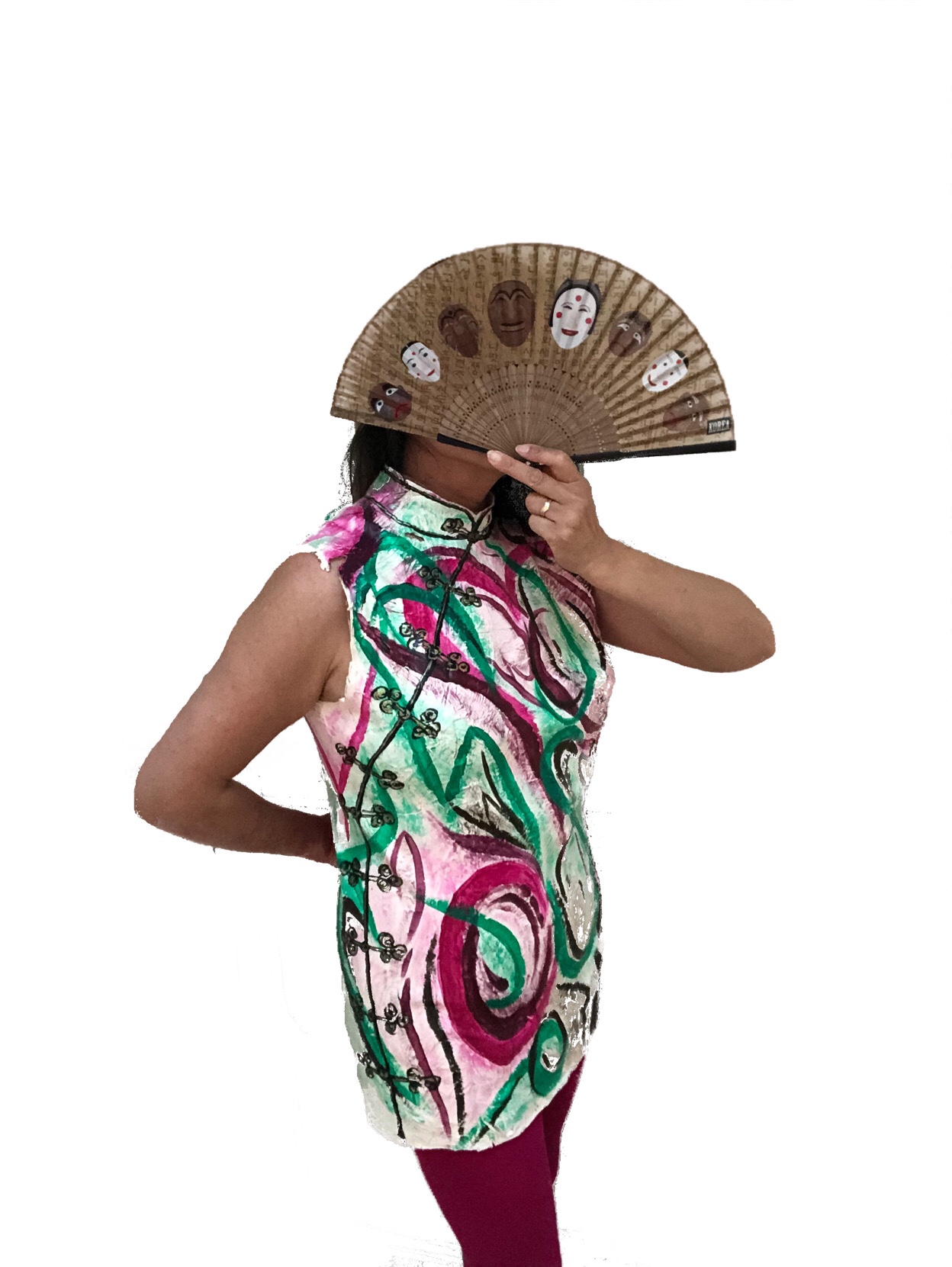
I have been thinking a lot about this since receiving the feedback. Making a Cheongsam painting is a special process in that it makes me feel that I have created something special (to me) when it’s finished. It’s not a judgement of whether it’s good or bad, it just means more to me because of the complexity of the creative process. I set out in my MA Study Statement to find a way to create something that is unique and recognisably mine and I thought I had found that when I started making Cheongsam canvases, hence I referred to it as my turning point. Also, looking back at my earlier work before joining the MA course, I have had attempts at making dress canvases. This was from a period when I was investigating the concept of Expanded Painting and ways to eradicate the traditional canvas. Below are images of the dresses I had made at the time (one of which was also a Cheongsam):
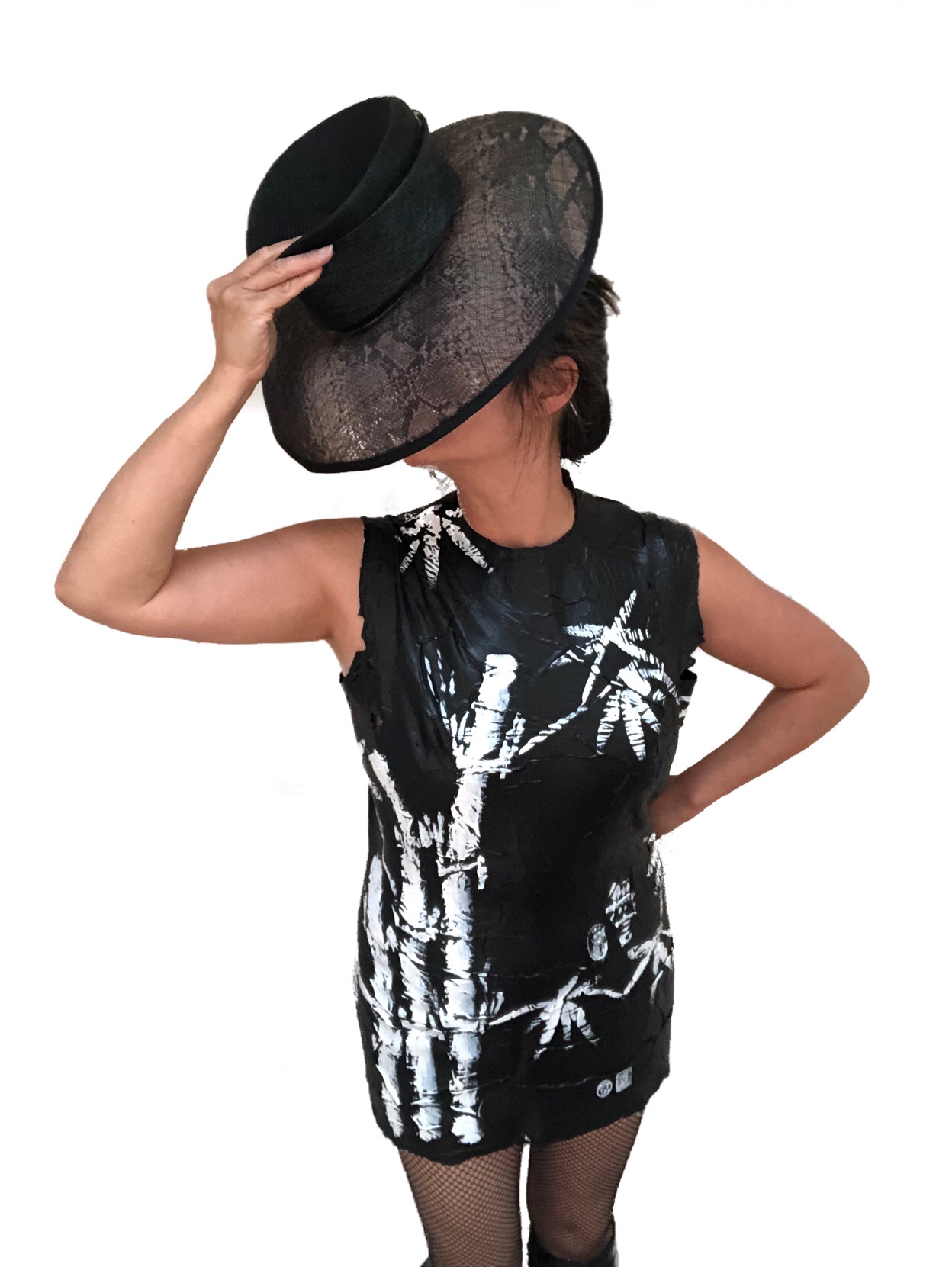
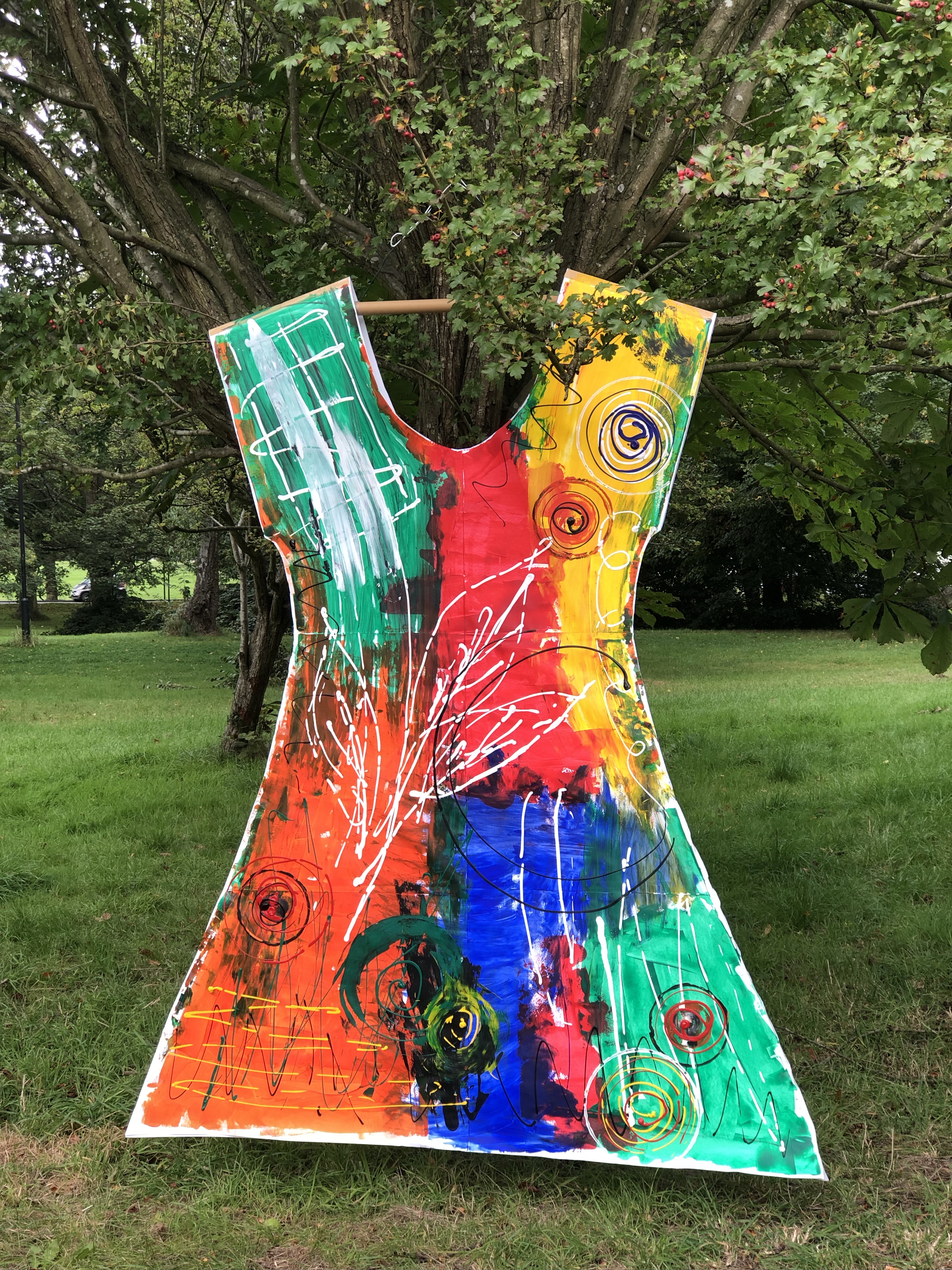
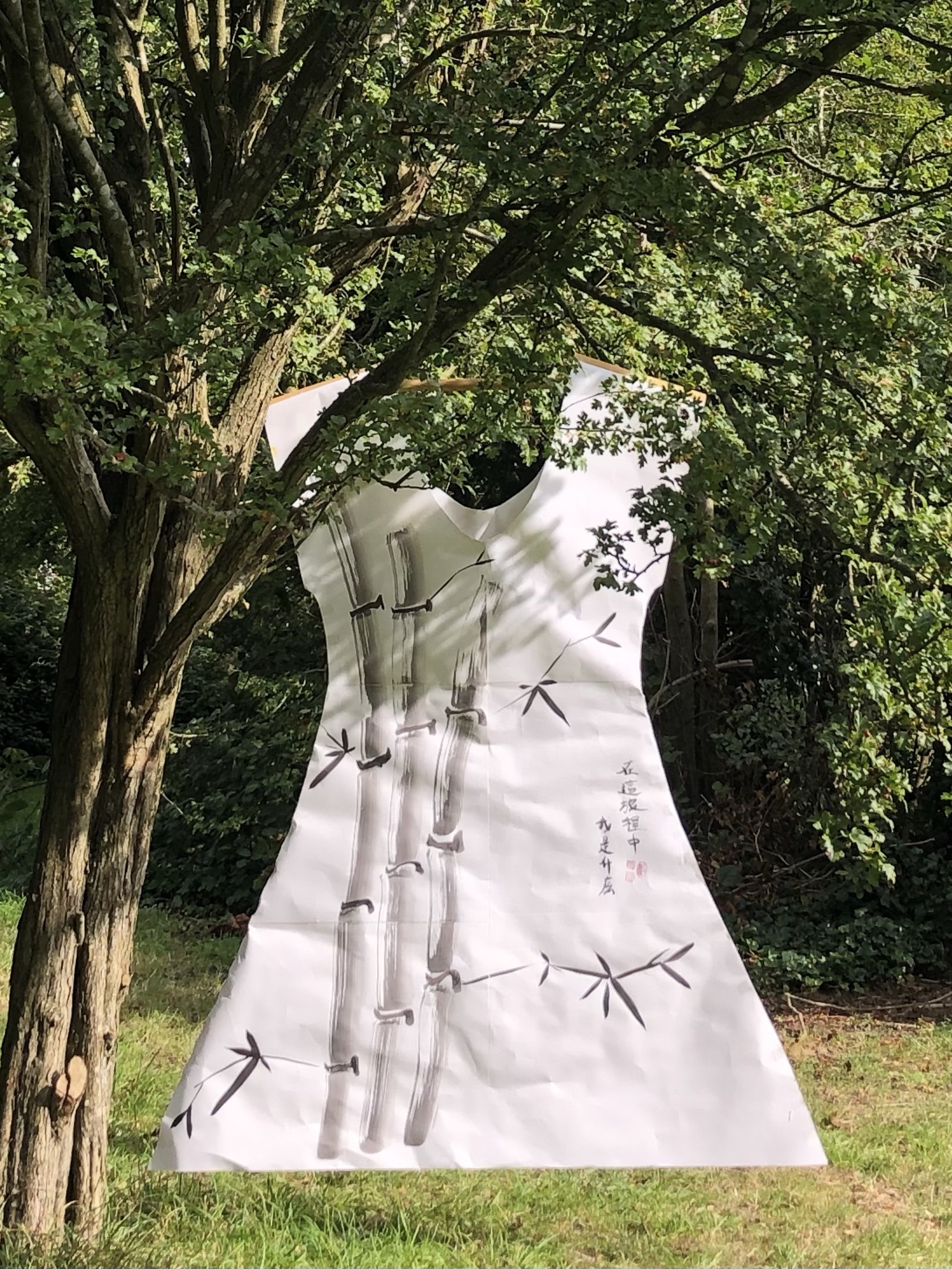
Acrylic ‘canvas-less’ Cheongsam paintingAcrylic ‘canvas-less’ little black dressFront of large paper dress paintingBack of large paper dress painting
I like the way the Cheongsam or dress paintings are 3D paintings, a hybrid between painting and sculpture. I think showing them as 2D photos does take away from the image especially in my latest Cheongsam series as the curved sides of the dress obscure part of the image. Perhaps a film may help to convey the image better.
I believe the Cheongsam shaped canvas adds to the story and narrative that I am trying to convey about my journey and how we ‘wear’ our identity. Here is a past UAL exhibition about wearing our identity which I found interesting:
However, I wonder if my Cheongsam canvases can seem rather ‘gimmicky’. I think I understand the question from my tutor asking if I have the courage to make just a painting without having to paint it on a Cheongsam (I interpret that as ‘without the use of any gimmick’). My response would be – I’m not sure if I’m there yet, but I should try.
My response here also ties in with the feedback about exploring oil in more ways and trying different techniques. I think that is valid as I am aware that I have been using oil in a limited or single-dimensional way (undiluted and impasto). This can have the effect of over-saturation and I should broaden my approach to utilise all that the oil paint has to offer. By exploring thinner transparent layers and producing less finished images, that would add ambiguity and help me to convey my narrative of working from patchy memories.
On the other points regarding whether ‘banana’ or ‘egg’ are too reductive as metaphors – I plan to respond in a separate blog after completing some research.
LEARNING
I enjoy doing the Cheongsam paintings and I feel that I would like to maintain that element in my practice. However, not all my work need to be on a dress or 3D canvas. My priority now should be to explore more painting techniques and widen my ‘painting vocabulary’ so I can be more creative in expressing complex narratives. To do this, I will pause the making of the dress canvases and spend more of my studio time on painting.
NEXT STEPS
– Explore different techniques of using oil paint so I can be more creative and multi dimensional in my expressions.
– Explore different approaches to painting and ways of thinking about painting.
– Pause the making of Cheongsam canvases for now to release time and return to it at a later time.
– Respond to the ‘banana’ and ‘egg’ feedback with a separate blog.
 elizarawlings