Further to my blog on the Cheongsam series where I introduced the idea of using food as metaphor for racial or cultural identity, I want to capture more of my thoughts, ideas and research on this subject to document the meaning behind this series of work. Here is my earlier blog with some background and where I had generated a preliminary design digitally:
MA U2: Cheongsam Series #5 – She’s a banana! – Part A
In the above blog, I referred to the Hollywood film Crazy Rich Asians where the American-born Chinese protagonist was referred to as ‘a banana’ by her best friend because the protagonist was perceived by her future mother-in-law (a traditional Chinese woman living in Asia) to be ‘yellow’ on the outside but ‘white’ on the inside.
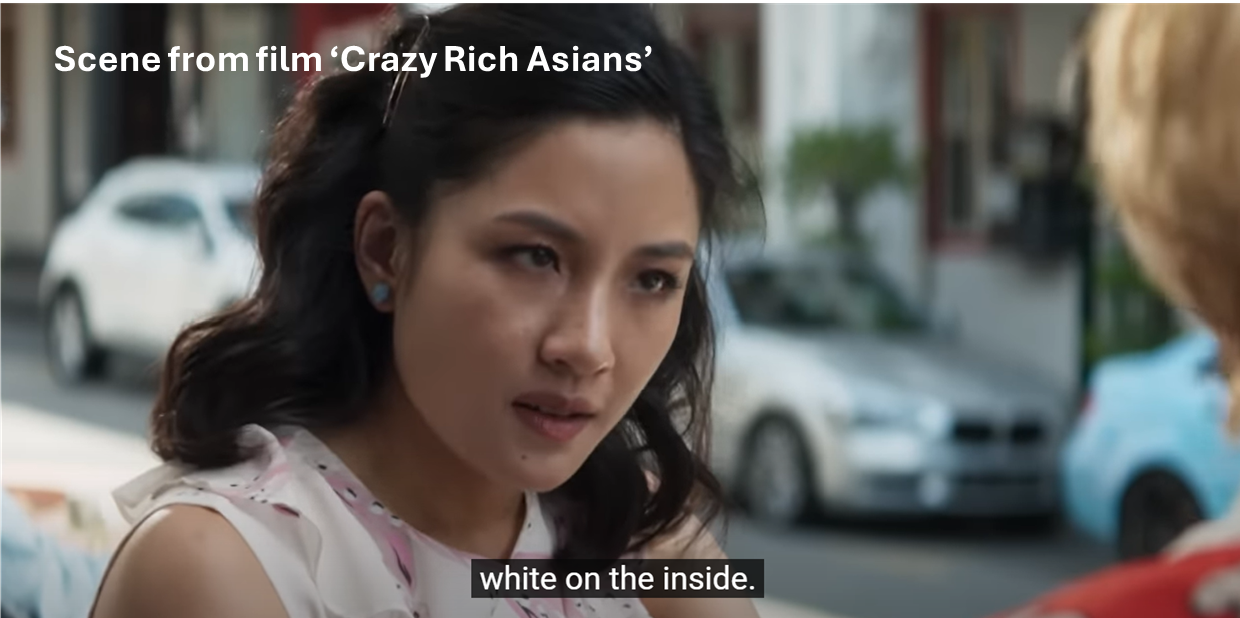
Here is a clip of the scene:
‘Banana’ reference, clip time from 1:15 to 1:45:
https://youtu.be/QC8Fdx0OZYY?si=v0sOGeJKtGbUH4d2
In my earlier blog, I mentioned that I remember being called a banana, too, because I moved to the UK as a young teenager and have lived here for decades, hence I have inevitably adopted much of the British culture. As a result, I consider myself a transcultural person and have based my art practice on this subject. I personally do not consider the description of ‘banana’ an insult, it is very widely used within Chinese communities and its meaning is widely known. Also, there is the legacy of colonialism where being considered ‘westernised’ is not necessary a bad thing (reference The Location of Culture by Homi K Bhabha, chapter ‘Of mimicry and man: The ambivalence of colonial discourse’) if one wants to get on in ‘the west’ and avoid being treated as ‘an outsider’. This point deserves to be explored in a dedicated blog so it will not be covered here. All I will say here is that I feel neutral about the term ‘banana’. In fact, I think it is a clever metaphor and a good seeding idea for making art!
In my research, I also found this article which summarises how different types of food are used as metaphors in the context of race and culture identity:
Although I acknowledge that reducing a race or culture to a colour can be problematic as described at the end of the article, I remain undisturbed by the use of food metaphors for myself because it helps me to start a thinking process. The point about ‘overthinking’ in the article refers to ‘an egg’ which means a person that is yellow in the core but with a white outer layer. As someone who is prone to overthinking, I liked the egg metaphor immensely. Yes, I have a ‘yellow’ shell and much of my core has become ‘white’ due to living in Britain most of my life, but I was born in Hong Kong to Chinese parents and lived there until I was a teenager. The very rich culture and heritage in the Hong Kong Chinese society are deeply rooted within me and will always be part of my core. It is not something that can be erased and also not something that I want to change. So, after much overthinking, I have decided that my response would be, ‘No, I am an egg’ to anyone who thinks I am a banana. Of course, it would be a boiled egg to be precise, but that would be really over thinking it.
NEXT STEPS
In my earlier blog, I had planned to make a Cheongsam painting with bananas as part of the process to explore my transcultural identity. After this research, I want to make two paintings, one with bananas and one with eggs as a response to the former.
ADDITIONAL READING
Here is a list of interesting articles about the ‘banana’ metaphor for East Asians living in ‘the west’ with different points of view and lived experiences:
https://www.thedp.com/article/2016/10/amy-chan-asian-hyphen-american
https://dchp.arts.ubc.ca/entries/banana
UPDATE (4th October 2024)
Since publishing this blog and making the Cheongsam paintings, there has been a trial where a teacher went to a protest march holding a placard referring to the then Prime Minister Sunak and Home Secretary Braverman as coconuts. The teacher was trialled and found not guilty.
Her lawyer told the court the placard was “a pictorial attempt” at “political criticism” of Mr Sunak and Ms Braverman.
After a two-day trial, the judge ruled that the placard was “part of the genre of political satire”.
BBC news article:
https://www.bbc.co.uk/news/articles/cx2x202v2ejo.amp
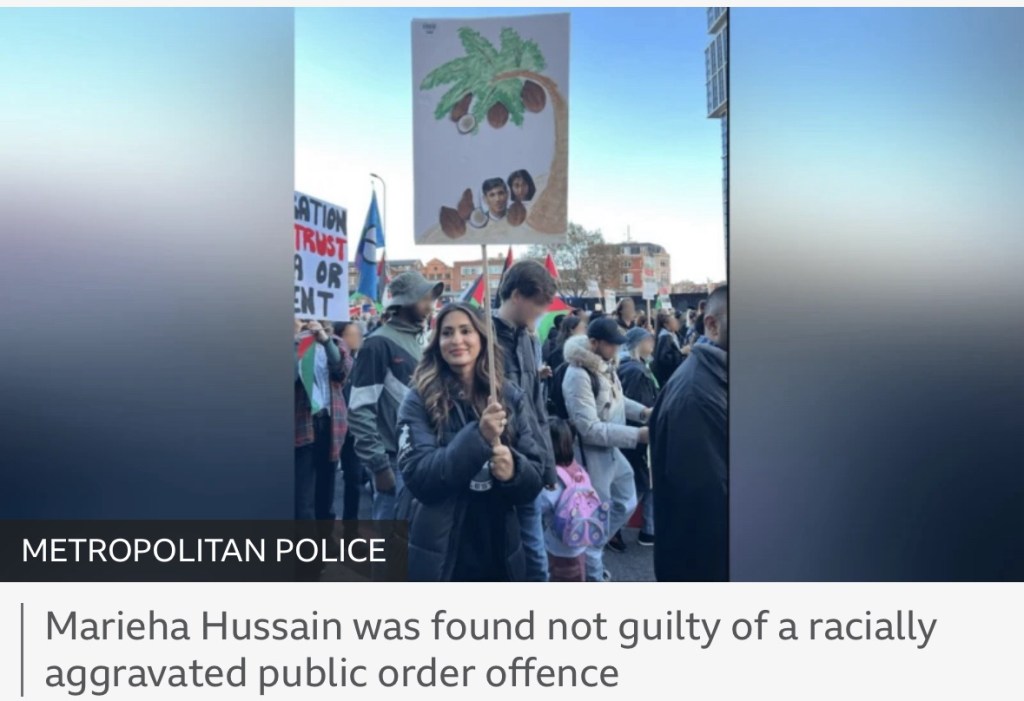
Using ‘coconut’ to describe a person who is ‘brown on the outside but white on the inside’ is equally common as using ‘banana’ to describe an East Asian person.
 elizarawlings