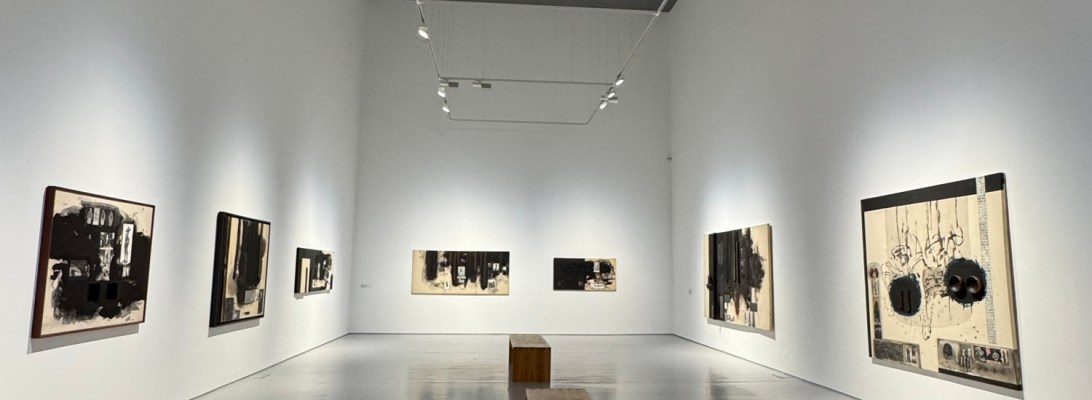
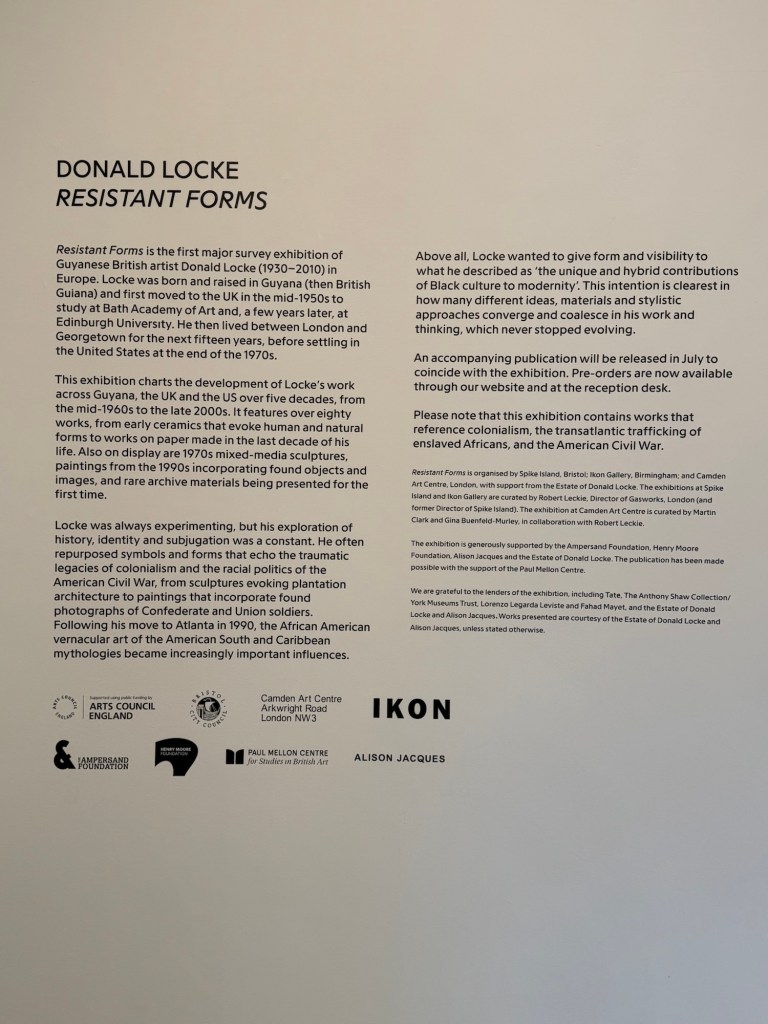
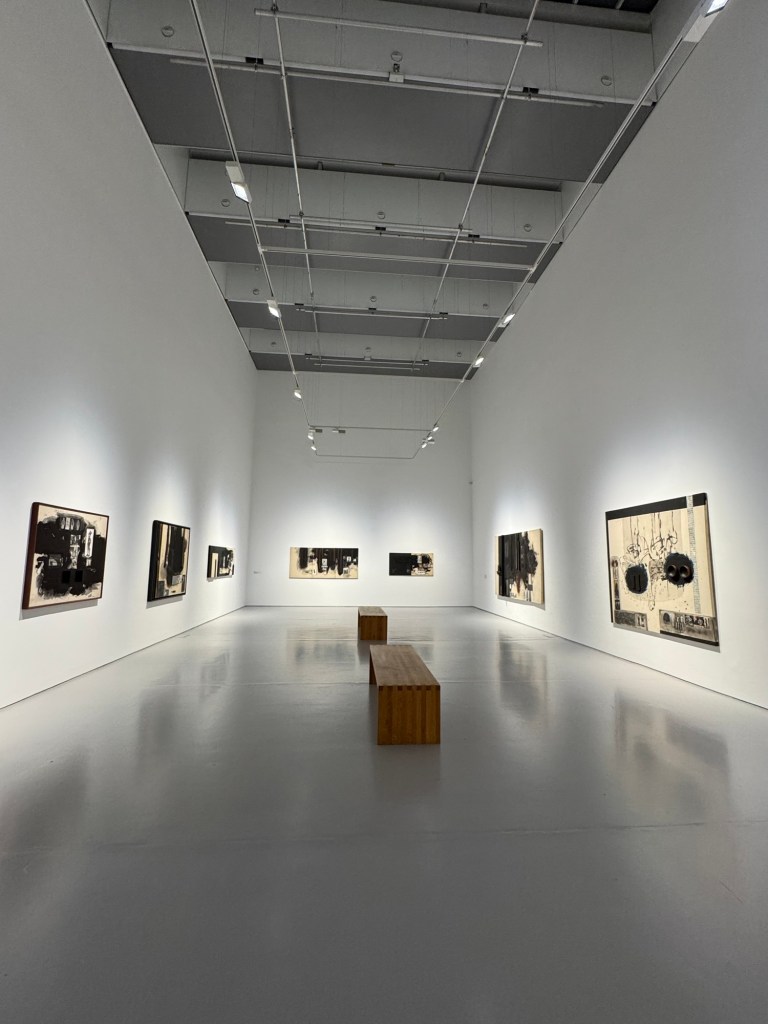
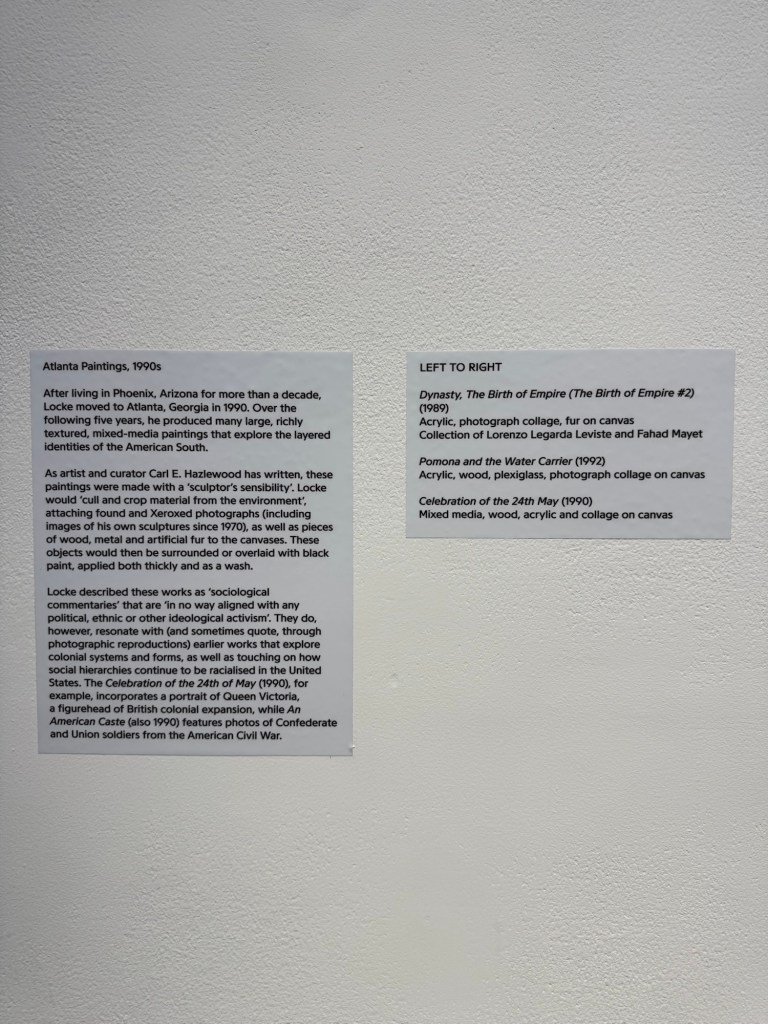
Today I visited Donald Locke’s exhibition Resistant Forms’ at Spike Island Bristol. Below are some of the photos I took to remind me of the work that I found particular resonance with.
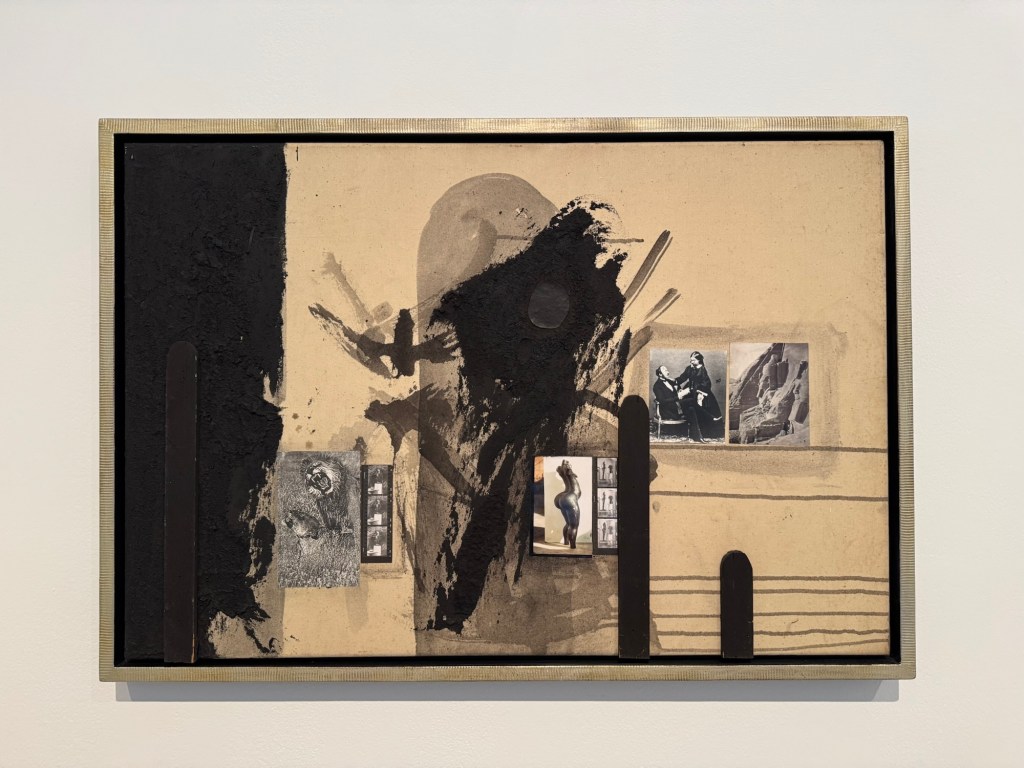
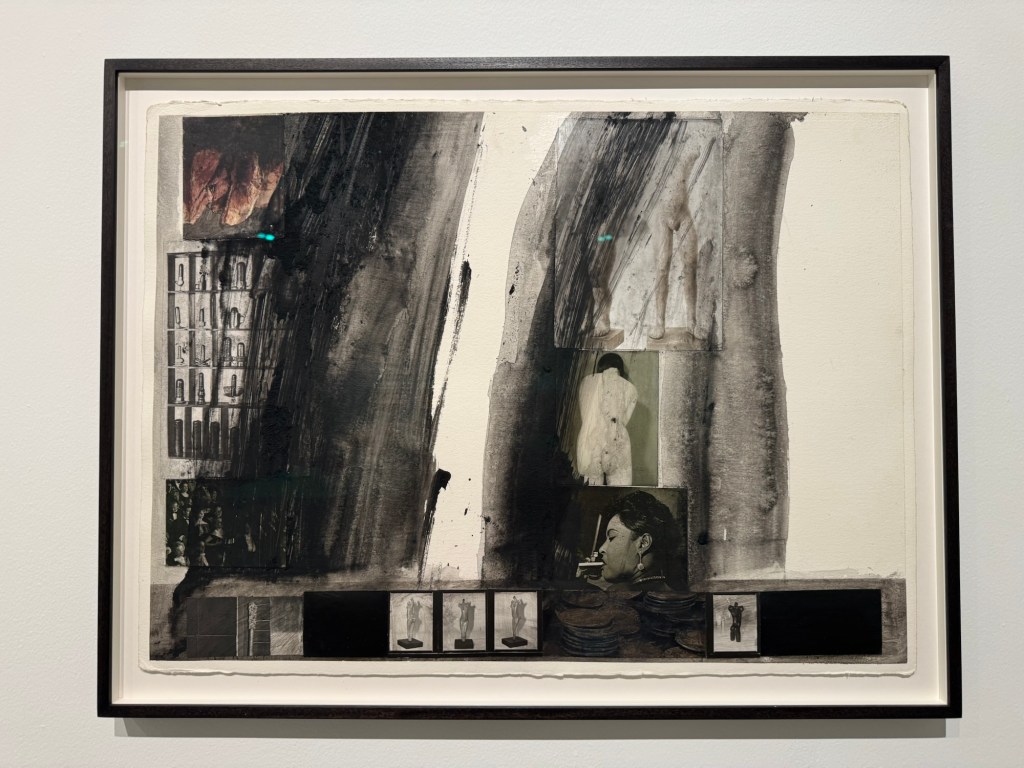
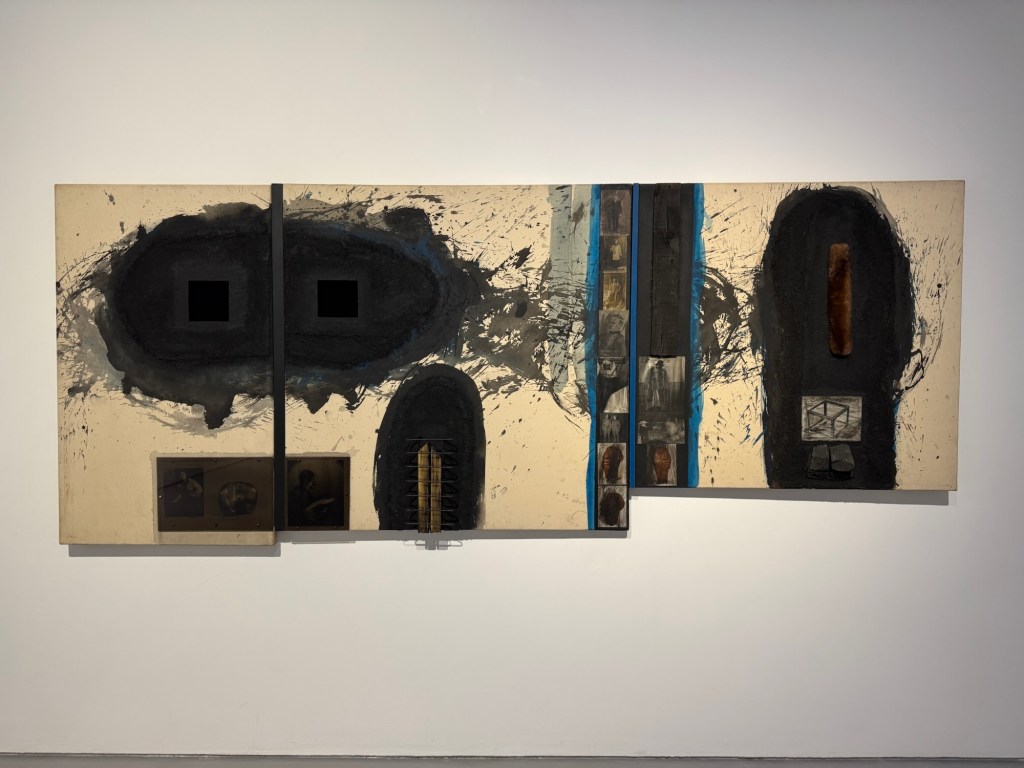
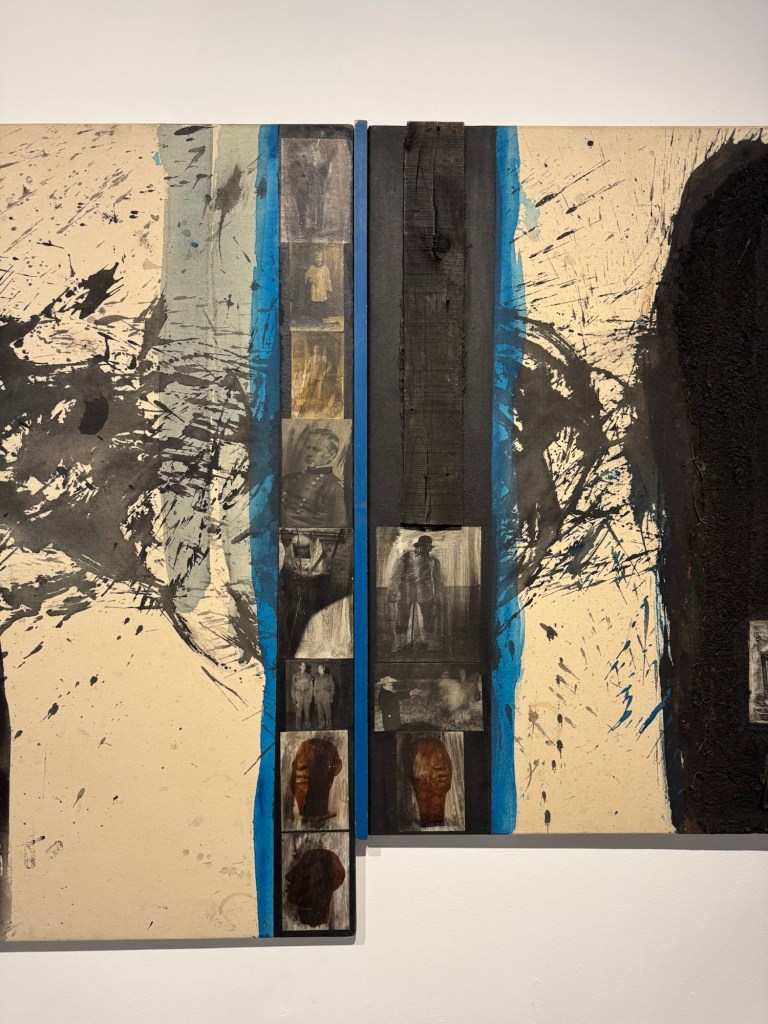
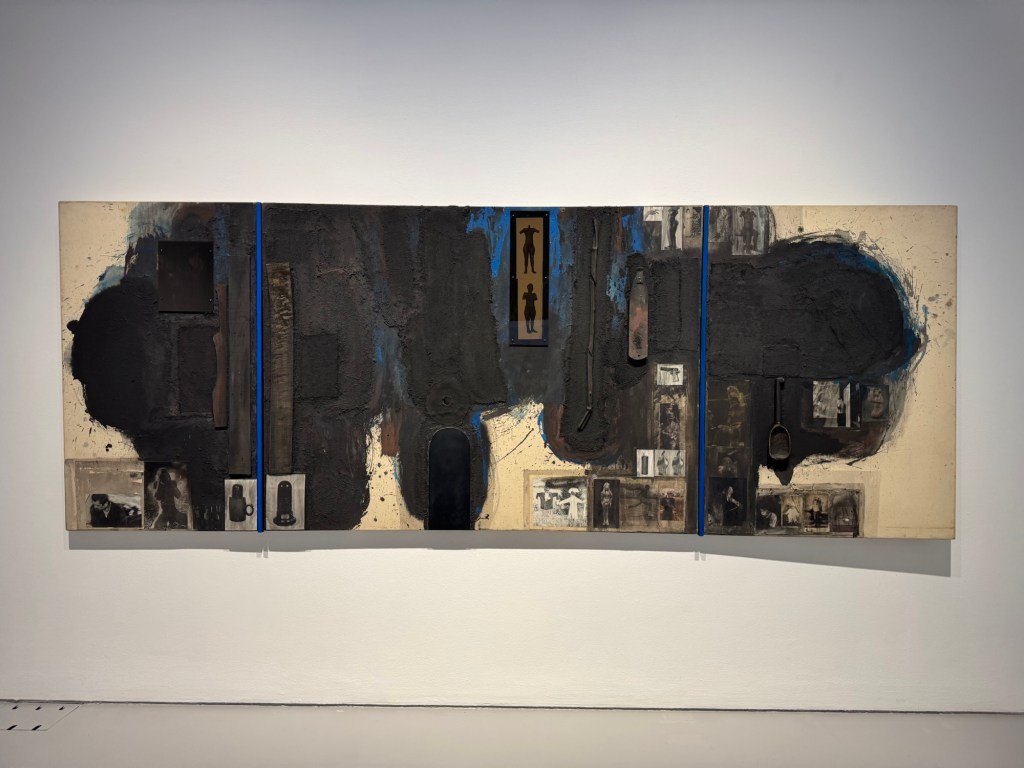
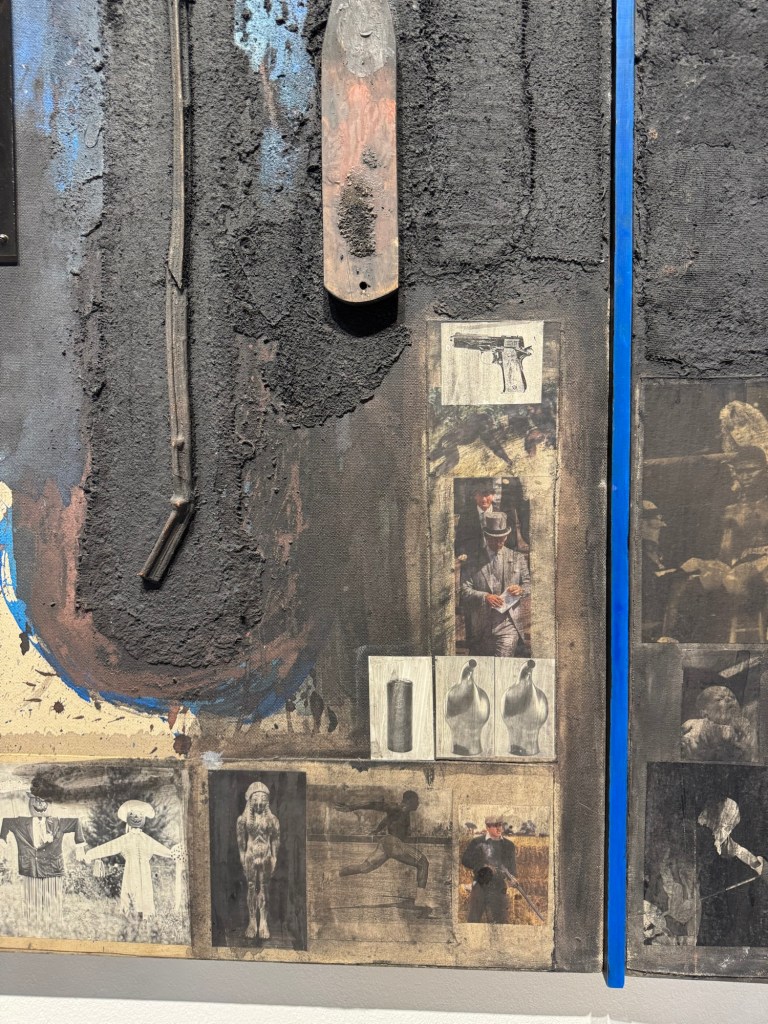
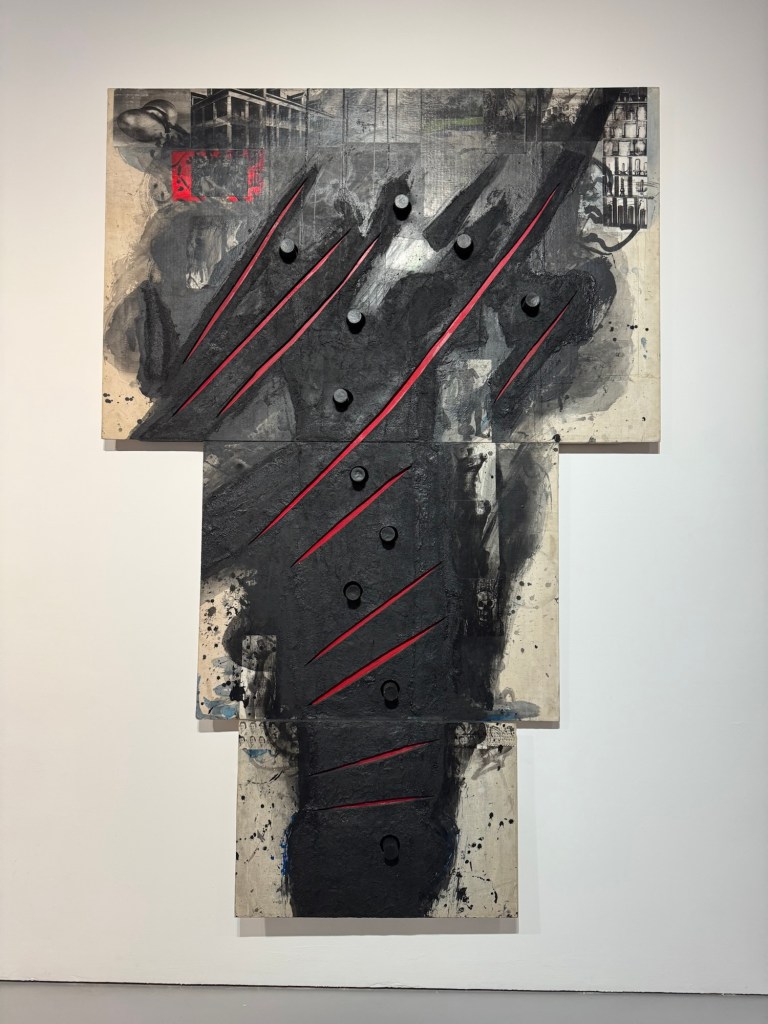
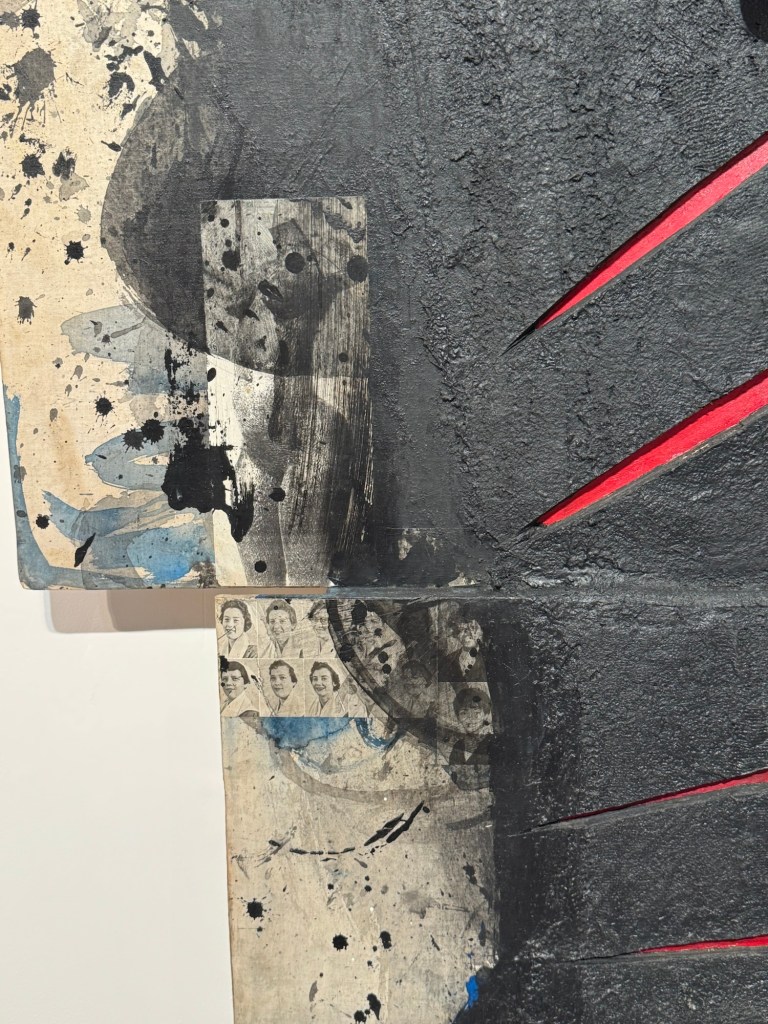
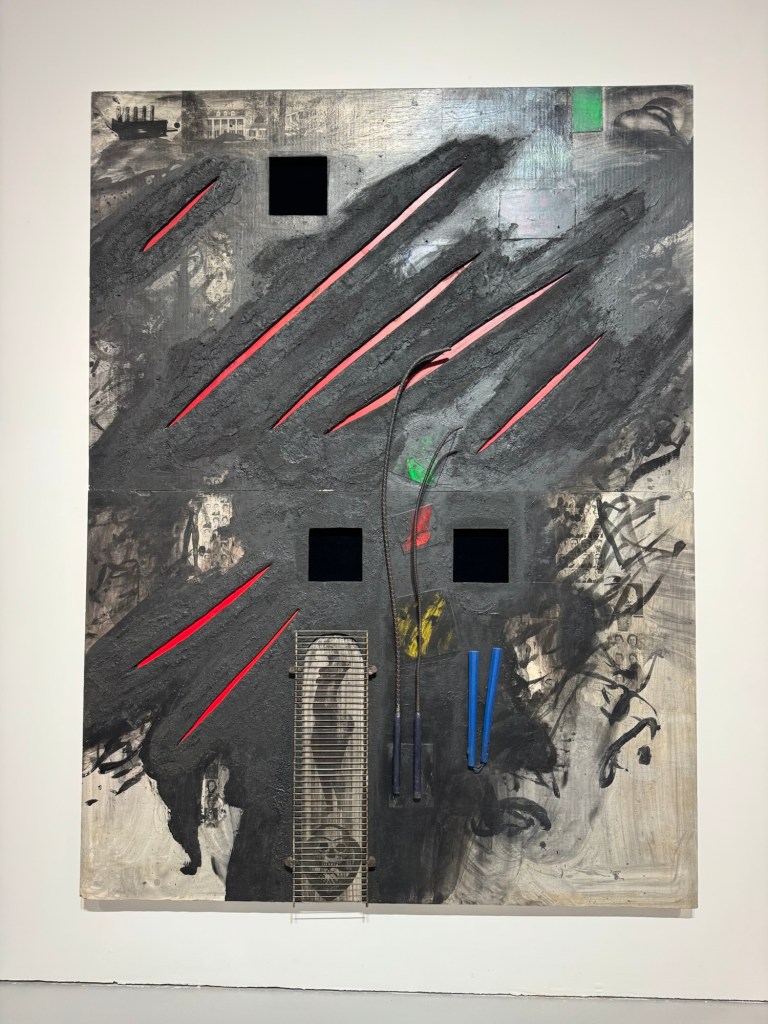
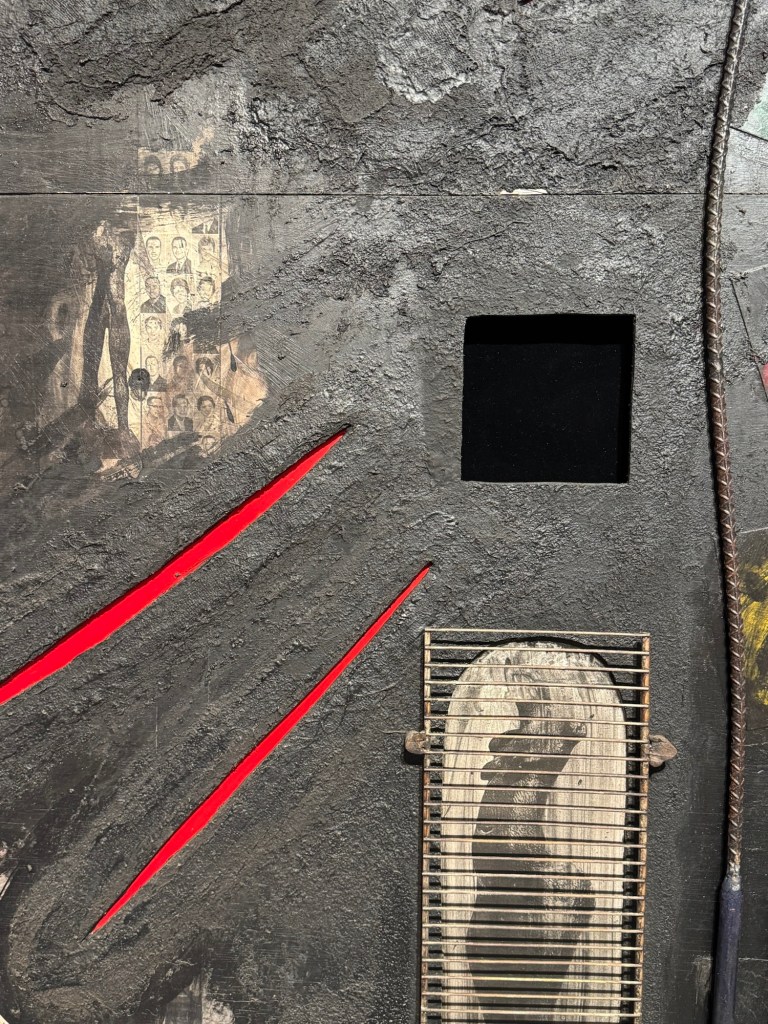
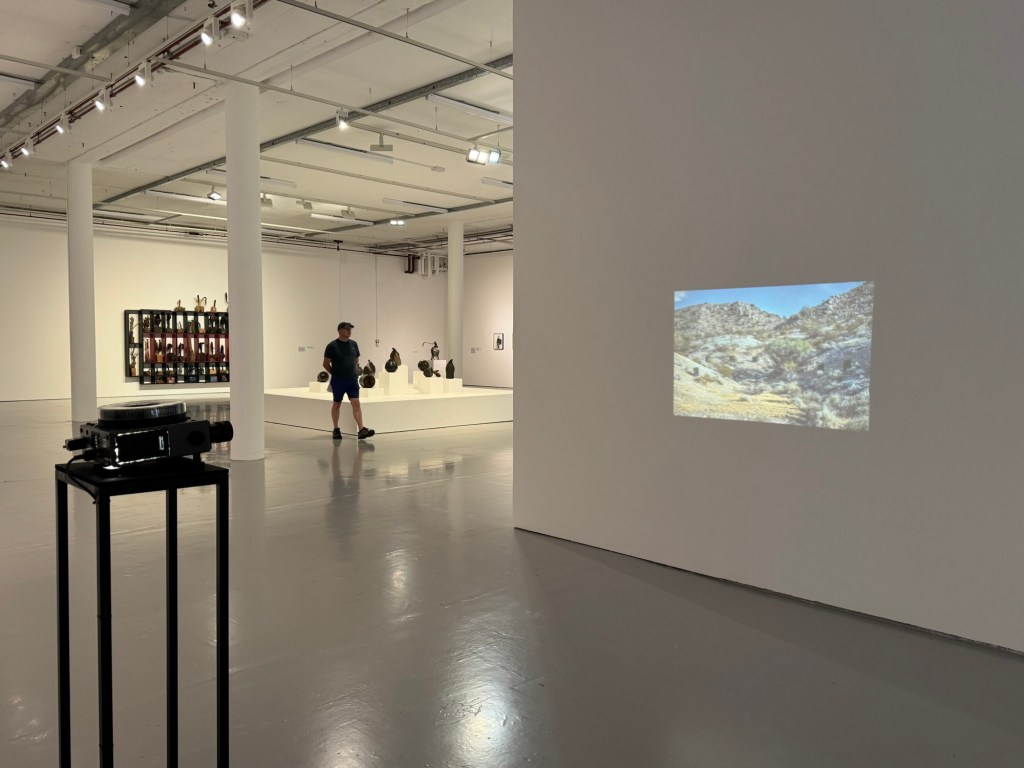
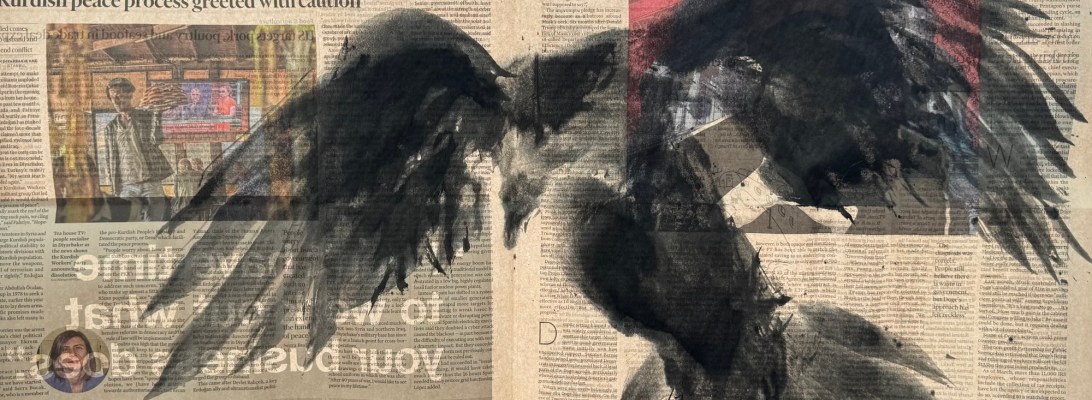
Use of collage, image looks like a crowUse of acrylic in a way that resembles inkAmbiguous use of photosLarge scale paintings with presence and energyClose up of the above showing photos collageUse of mixed media including metal grill mounted onto painting Placement of projector and understated size of projected image
REFLECTIONS
I want to capture ideas that came to me during the visit that made me think about how I could learn from Locke and build on my practice.
Use of mix media techniques:
On some of his paintings, the use of acrylic paint with ‘dry brushing’ to create the flying white effect like in Chinese painting energised the painting. It gave me the idea of trying my crow paintings in other medium, such as dilute oil, to see how that works. The use of different materials to create collage was also interesting. I could use ripped up newspapers to create collage effect on a canvas then paint on top. Locke also used items like metal grills to good effect. I can consider what objects, metal or otherwise, that could be incorporated to add meaning and texture to the work.
Use of photos:
Some old photos were used in the collage. I have many old family photos that I have been considering how to incorporate into my work. The way Locke used the photos were more random – a few here and there. Whereas I have tried too hard in the past; I could just use small images in a few places – I don’t need to tell the whole story in one painting. I must remember this. Also, he had just pasted / stuck the photos (copies of) onto the canvas. I always felt that I should photo-transfer the images onto the canvas – this is not necessary. Locke also used images or photos of his own work (sculptures) in his paintings – those images (e.g. female nude) appeared on multiple paintings and acted as a link to join the works together.
Use of projector understatedly
The projector was projecting at waist height with a not too large image. It was understated and effective. I often feel that projection has to be big and has to fill a wall. It clearly doesn’t have to at all. The projection was also placed in a way that you have to walk through the beam to get past. It was an interesting positioning which makes the viewer interact with it.
LEARNING
There are no major learning from the visit and mainly just ideas that came to me as I studied Locke’s work. The main take away for me was to think about experimenting beyond just painting on the whole piece of newspaper. The news headlines remain important to the body of work (News), but through the use of collages, the newspapers could be incorporated to maintain the theme while opening up the materials that I can use. Locke’s extensive use of black was very effective which resonated with me.
NEXT STEPS
Start to think about how I can start to make more complex and ambitious work with multi media materials yet remaining connected to the topic of News.
‘News’ in Chinese ink painted with chicken feather brush
As I am making more and more paintings on The FT, I want to consider more carefully how to display the work and also making the newspaper art archival.
METHOD
1- Online research
I have been researching online for ideas. There have been all kinds of suggestions. I find this post useful as there are different suggestions to try.
However, none of the suggested solutions are truly archival due to the nature of the newspaper material. One of the comments said that newspapers were a museum curator’s nightmare. I think that sums it up. The only suggestion that is truly archival is to make digital images and gyclee prints. That is something that I will consider.
2- Ask an expert
Another investigation route that I pursued was to ask a paper conservation specialist at UAL. His reply was as follows:
“Newsprint is made using mechanical wood pulp for the paper fibres. These are naturally rich in a chemical called lignin.
Lignin is not particularly stable. It breaks down with time with 2 effects:
Some breakdown products are strongly coloured, making the newsprint go increasingly yellow and eventually brown.
Some breakdown products are acidic, leading to the paper becoming increasingly fragile over time.
This breakdown will still happen in dark conditions, but the energy from light makes the breakdown progress much more quickly. Ultraviolet has more energy than visible light, so can do damage more quickly.
It’s not possible to make newsprint archival.
UV-proof glazing would be beneficial if the paper is to be displayed in a window where it’s subject to sunlight.
If the artwork is illuminated using artificial light, UV exposure will be less. Fluorescent lights and halogen spot lights emit some UV. LED lights typically emit no UV.
Most acrylics will filter out some UV due to being made with UV-stabilisers to help make the acrylic last longer.
Last time I checked (which was ages ago…) framers quality UV-filtering acrylics and glasses were similar in price.
For storage, I’d recommend keeping the papers between unbuffered, acid-free boards. Many archival boards are calcium carbonate buffered, which helps neutralise the acids created as lignin breaks down, but alkaline conditions can also increase the yellowing of lignin (through a different mechanism than the breakdown route).
Sandwiching newsprint between glass/plastic offers some benefits in isolating the paper from various environmental effects, but might also lead to a surrounding microclimate rich in acidic breakdown products.”
– End of expert’s reply –
This was a very helpful reply and the sentence that I highlighted in bold again confirms that there is no way of making newspaper archival which is a pity.
REFLECTIONS
After doing this research, I have to accept that it is not possible to make newspaper archival. I feel rather sad about that and the engineer in me thinks ‘there must be a way, it just has not been found yet!’ However, I need to employ a solution now to manage or show the work that I have been creating while continuing to find a long term solution which may or may not be possible. If museums around the world have not found a solution then maybe I won’t be able to either – not in the short to medium term anyway.
Making digital images and then gyclee prints is a very good and viable solution. I will definitely pursue that and learn how to photograph my News paintings properly. As a start, I will need a light box frame that I can wall mount.
I have also considered sandwiching the News paintings between UV proof acrylic panels and mounting it away from the wall with spacers to let light in from behind – this solution also requires further experimentation.
The above are ways to present the paintings for photographing. Once I have found a way of photographing the work then I can consider making limited edition gyclee prints from them.
Other ideas that I have had are photographing the news page, then printing it on silk or other thin fabric, then painting or embroidering on the image.
LEARNING
The main learning was that there was no known way of making newspaper archival. I have to accept that and consider how to find ways to capture the image and reproduce in archival materials. Also, if I were to sell the original work on newspaper then what advice should accompany the sale? How should it be framed, mounted and what life time is to be expected? Perhaps letting the News painting degrade over time is one of its unique feature? As long as it can stay safely in a frame then what harm is there? It will go yellow or brown over time – perhaps that adds value like a vintage bottle of wine or whisky!
The key is to have clarity of how to manage the life of the paintings and offer archival alternatives to the originals. Not that I am planning to sell my work at the moment, but if someone were to enquire then I need to have prepared a professional response.
NEXT STEPS
Immediately:
Investigate ways to mount the prints for displaying and photographing. E.g. light box frames or ‘acrylic sandwich’ mounted on spacers.
Investigate ways to take good quality digital photographs of the mounted work.
Investigate ways to make archival gyclee prints of the photographs – what method of printing and what paper would be best? Best options for framing?
Consider what advice to give with any original art work – recommended ways to mount and likely life before degrading occurs. Think of ways to articulate the value of a degrading or degraded piece of News art. i.e. make the non-archival nature of the art a feature of the work.
Longer term:
Investigate options to print on fabric then paint on the fabric or embroider to create original art. Or print painted News images on silk as an alternative to paper – need to think why use silk or fabric though.
After receiving my Unit 3 assessment feedback, I want to reflect on and respond to one of the points raised as I feel it is essential for progressing my current body of work ‘News’.
REFLECTIONS
Below is an extract from my assessment feedback that posed a question about my use of the crow as a metaphor:
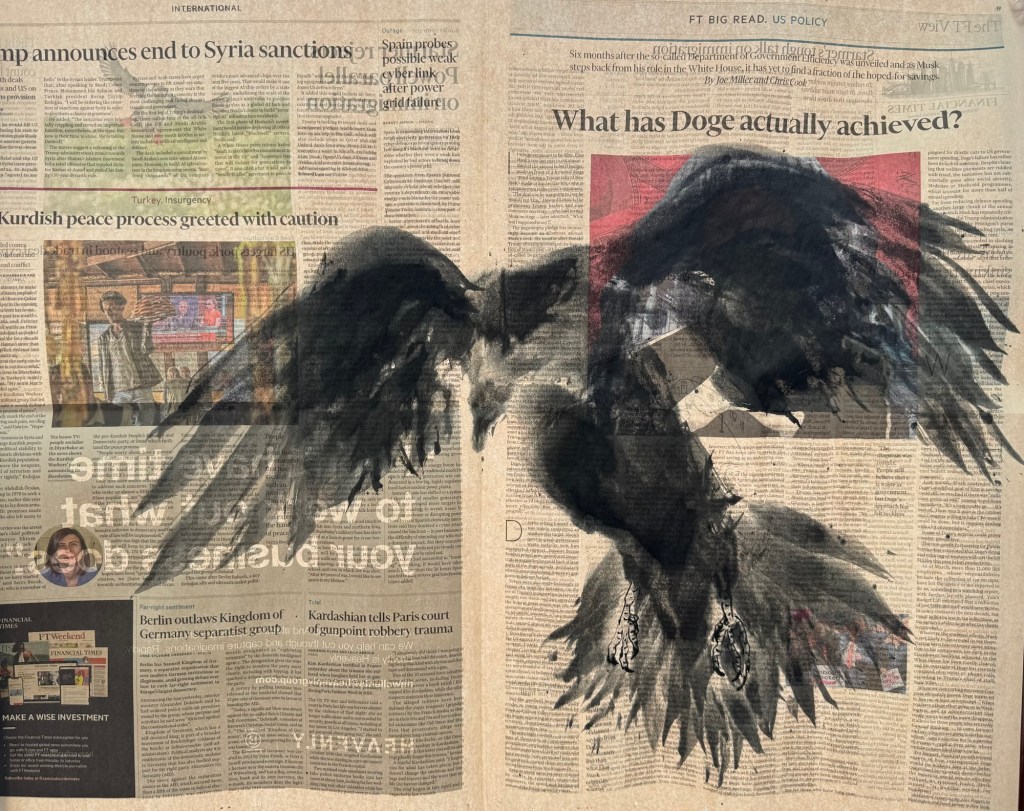
‘…You talk about the crows being a metaphor for the awful events that are happening in today’s world but does a metaphor need to be more than that? In a novel or film it might be the timing of a crows arrival and departure in relation to events happening that turns it into a metaphor. Or in a poem it might be a detailed description of a crows behaviour? How might this impact on the way you continue painting crows? In what way, if at all, does the pose of each crow relate to the headlines on the actual page, either the front of the page or the reverse side that might be revealed by a light source behind?‘
The timing of this question was very appropriate because I have been thinking about this a lot. I chose the crow as a metaphor for my grief for the loss of a world order that I understood. The crow was inspired by the book ‘Grief is the thing with feathers’ by Max Porter. When I started this series of work, I just wanted to paint something as I felt a sense of urgency and the book came to mind with the crow as a metaphor for grief. Hence I started there. The black feathers worked well with my chosen medium of Chinese ink and the characterful crows gave me lots of ideas to work with. I started without thinking too much about the pose or the composition of the pieces, I just wanted to paint and express how I felt. Then I started to locate the bird more purposefully next to headlines or images and experimented with compositions. Now that I have done many such paintings, I started to get an idea of what I wanted to achieve with this body of work and with the crow.
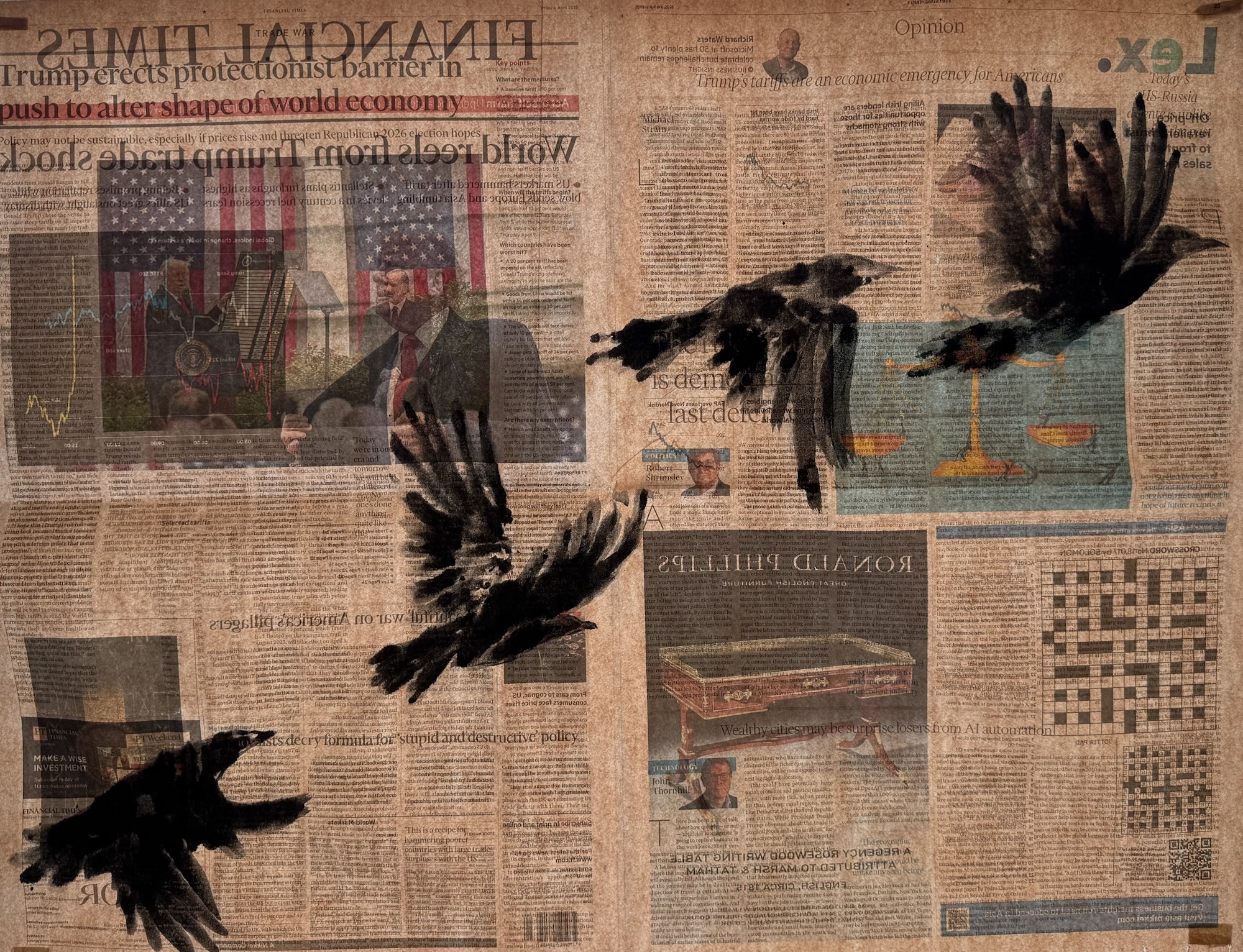
I want to use the crows to bring attention to certain news headlines. I noticed that when people look at my News paintings, they usually start with the crow. They would study it for a while, then their eyes would wander around the news headlines or images nearby and then focus on the articles. It was important for me to choose a neutral or as unbiased as possible a newspaper because I don’t want to tell or preach to the viewer what they should think about the news piece; I want the viewers to decide for themselves and to show a factual headline or news article to trigger their thinking is my intention.
Reflecting on the questions posed in my feedback, I believe my use of the crow has several roles. Like in the novel I referred to, the crow as a metaphor revealed itself to me when I started to despair about situations in the world – that was when the crow ‘entered stage’ as in a theatre. In the last few weeks, there were times when I felt perhaps it was time to move on from the crow as perhaps world events were settling down. That feeling lasted at most a day when something else happened that enrages me again and I had to bring the crow back to centre-stage. There seems to be an endless supply of headlines at the moment which is energising for my art but absolutely draining for me as a human.
As for the point about the pose of the crow, it has been an interesting development and revelation for me. I remember when I first started studying art, a tutor at the time said that how we felt would inevitably come through to our work; our work was influenced by our subconscious. I didn’t quite believe that at the time but was happy to keep an open mind. Of course, I have since experienced that many times. There have been a few News paintings where some unconscious expressions came through that I only noticed afterwards. Below are two examples.
Example 1 –
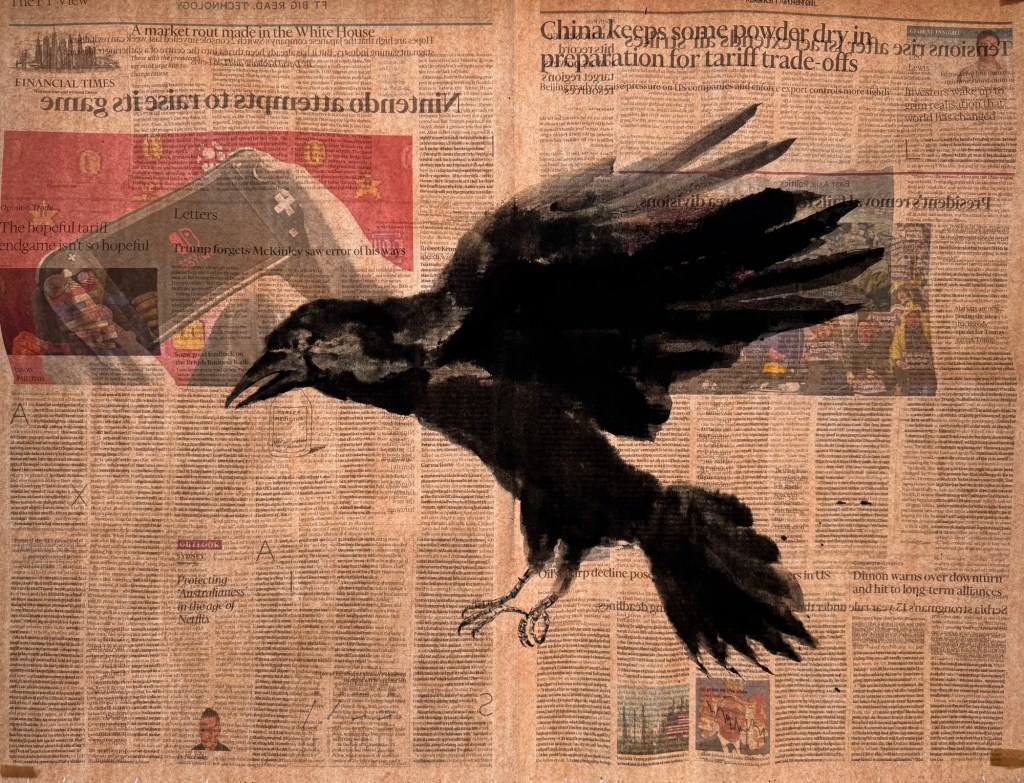
In the painting below, I wanted to position the crow to look like it was going for the bottle of ‘tariff medicine’. But since I do not do a mark up drawing on the page (not anymore) and I just leave the painting to chance, I do not have control of exactly what comes out especially as I’m painting with my non-dominant hand. In this case, the crow ended up overshooting the medicine bottle and it ended with an ‘uh-oh’ or ‘oh no…’ expression which was not my intention but highly appropriate.
–
Example 2 –
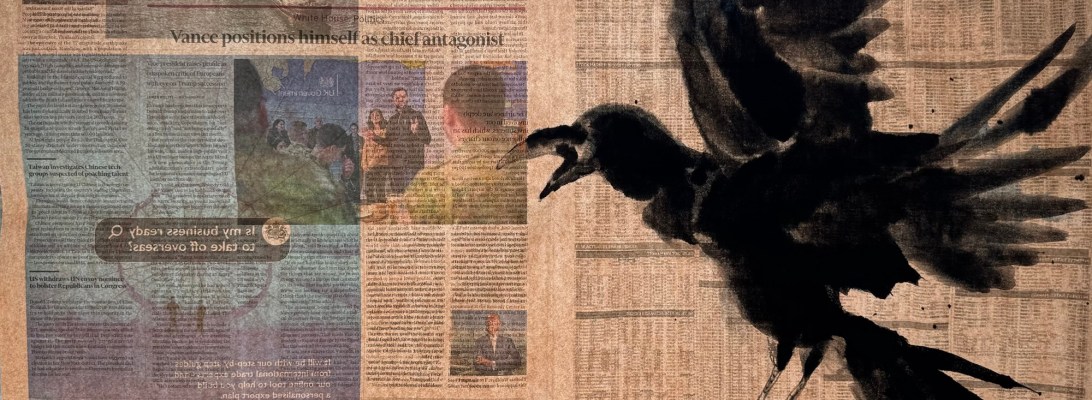
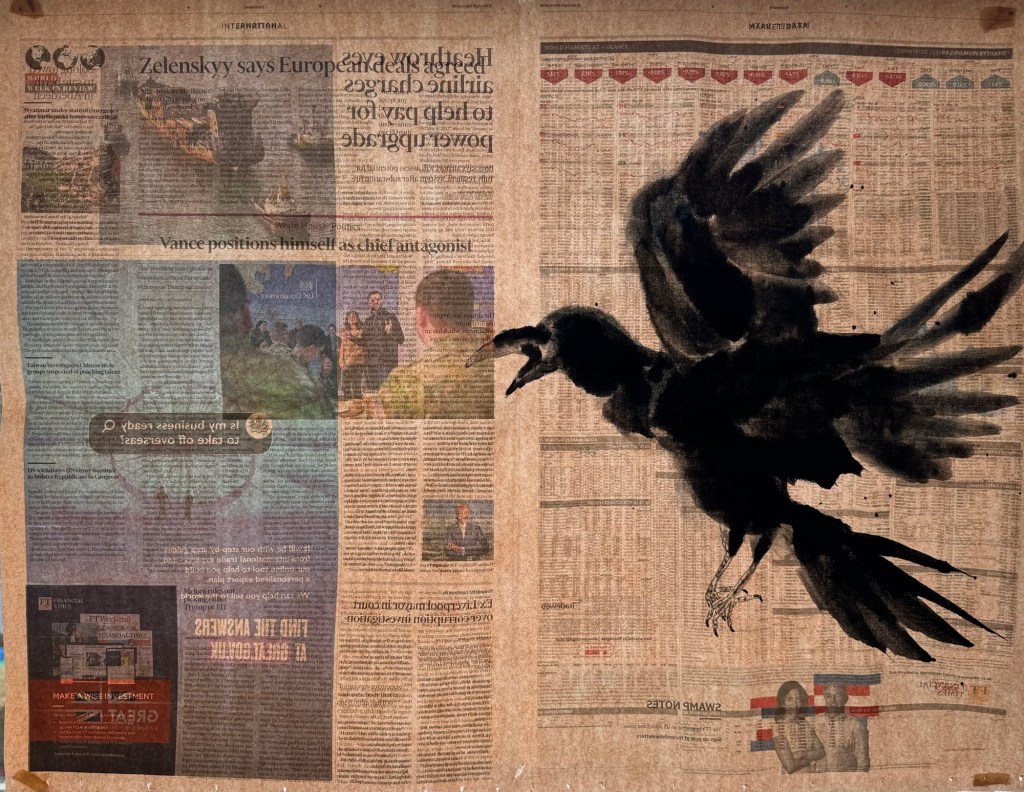
In this case, the chosen headline and image on the newspaper was about the US VP. I intended to bring in the crow from the right hand side (enter stage right) pointing towards the photo image. Again, I didn’t have too much control over the exact depiction but the crow came out screaming at the photo and its feathers somewhat ruffled. It seems to reflect what goes on in my consciousness.
–
As for the back lighting of the images and what they reveal – I tried at one point to place the bird purposely to align with images on the reverse side, but they rarely work out satisfactorily. So now I choose a newspaper page where there are headlines that I want to respond to on the front and although I do look at the reverse side to make sure there is something interesting on the back, I tend to locate the bird according to the front page and then leave the reverse side to chance. This means I don’t pose the bird according to the reverse image purposely and just wait to see what happens when the painting is finished. By not being overly deliberate, it has provided some interesting compositions. It also contributes to the notion of uncertainty that continues to form a large part of this body of work.
Final reflections regarding using the crow as a metaphor… as I was writing this blog, I have started to use theatre stage language to describe how I use the crow and I feel that is appropriate. The crow has become my actor on stage to carry a message, it has been on stage throughout this series of work. It comes in and out of the spot light depending on what it wants to draw attention to. It accompanies me as I navigate the ‘new world order’ and represents me when I want to say something. One day, when the world is right again (I remain hopeful) then perhaps Crow would exit stage left. I have started exploring bringing in other creatures to broaden the repertoire. I have enjoyed using the Chinese ink as a medium and I have thought about using a rat but that seems to be very controversial. I have also thought about spiders because I was inspired by Louise Bourgeois’ spiders and how she used them to signify strength. I certainly feel that I need as much strength as I can summon up everyday just to read the horrendous news at the moment. This idea is only at an early stage. I will keep thinking.
LEARNING
In writing my reflections and response to the Unit 3 feedback, it has helped me to crystallise my reasons for using the crow in my work – why I use it and how I use it. I feel there is still much to achieve with my crow and there is still some way to go on this journey. So I will continue with it but will be more mindful of how and why I’m using the crow as a metaphor as I progress. I sense that the metaphor has already shifted somewhat and has gone beyond just grief. It is becoming my voice which is also an appropriate metaphor because the crow is intelligent (can read my mind) and vocal (speak for me). Also, in many cultures and mythologies, crows and ravens are depicted as messengers, not necessarily from another world, but rather from between different realms of existence. So using the crow as my messenger has become part of the metaphor.
I will continue to explore other creatures that has a metaphorical meaning for me and that works well with my chosen media of Chinese ink on newspaper. Spiders are one possibility that I am considering.
NEXT STEPS
Continue to use the crow in this series of work, News.
Consider more deeply about the metaphors that I use – how they apply as a metaphor and how they evolve along the journey.
Explore other creatures or metaphors to bring into the work. Be sensitive to what they mean and think broadly to avoid unintentionally offending people.
 elizarawlings