MA U3: Tutorial #6

Date: 25th April 2025

Tutor: Jonathan Kearney

Preparation notes:

I need help with –

1. The main help that I need is to decide on what to exhibit at the Graduate Show. I have prepared some ideas that I will present at the tutorial.

2. I want to find a way to make newsprint (my newspaper art work) archival. Who is the best person or department at CSM/UAL that can help me please?

3. For Unit 3 learning outcomes – ‘evidence of plans for showing your work’. Is the graduation show sufficient or do we need more?

——-

General progress update –

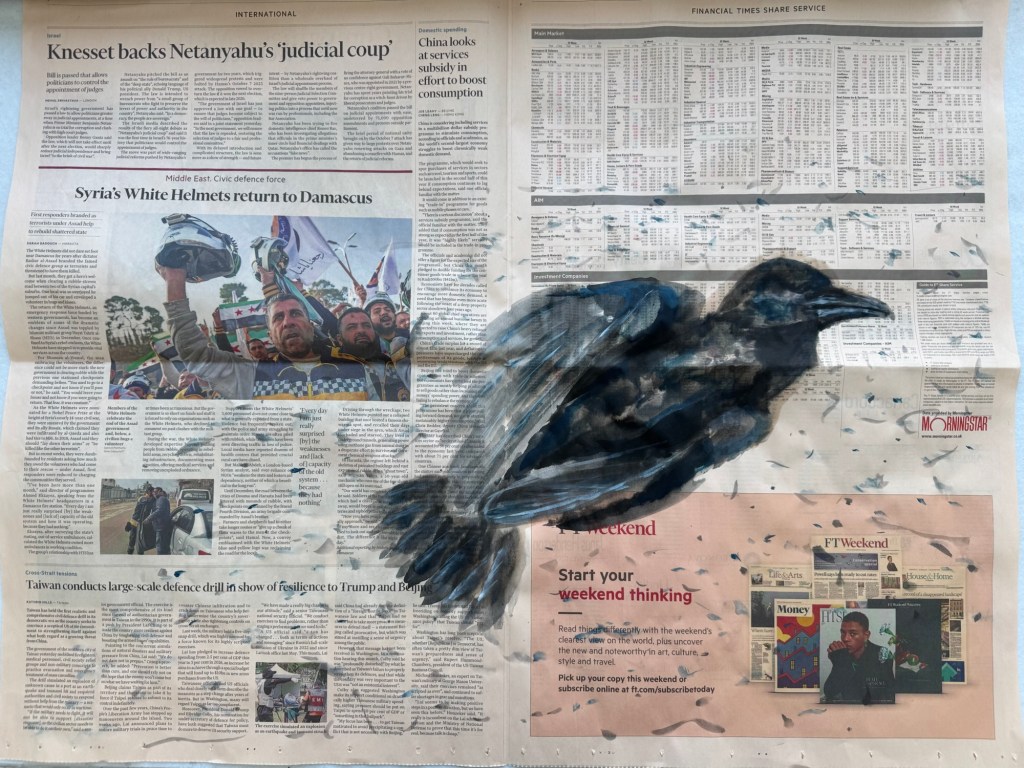
Since our last discussion, I have continued to make art in response to the current issues I feel strongly about. I have been making a series of new work called News Art.

It started with this initial exploration – we have already reviewed the paintings; I have since completed the reflections and learning sections for the blog:

https://eliza-rawlings.com/2025/03/27/ma-u3-grief-is-the-thing-with-feathers-painting/

Then I completed these new works:

https://eliza-rawlings.com/2025/04/20/ma-u3-newspaper-art-responding-to-headlines/

https://eliza-rawlings.com/2025/04/21/ma-u3-news-art-exploring-silhouettes/

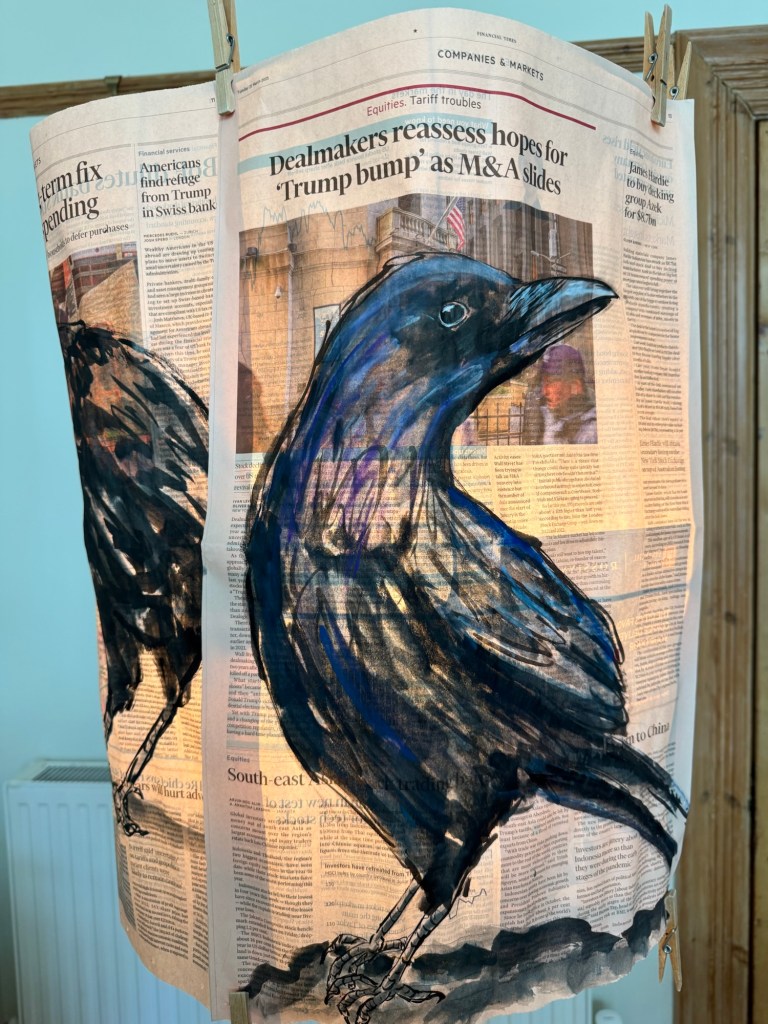
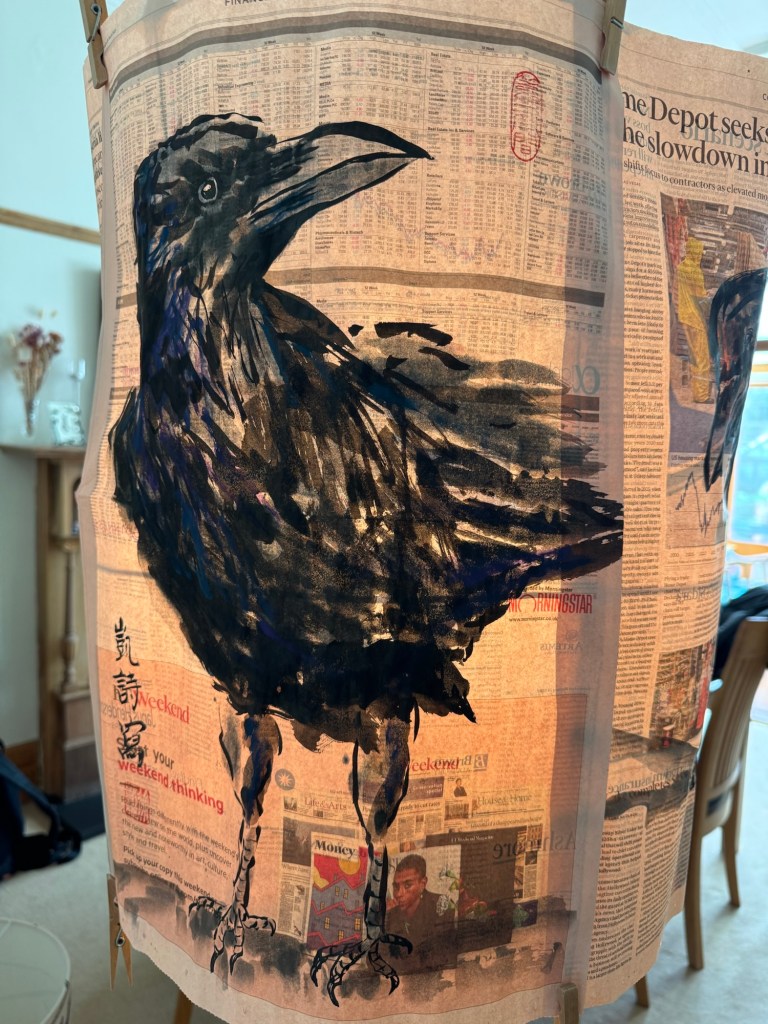
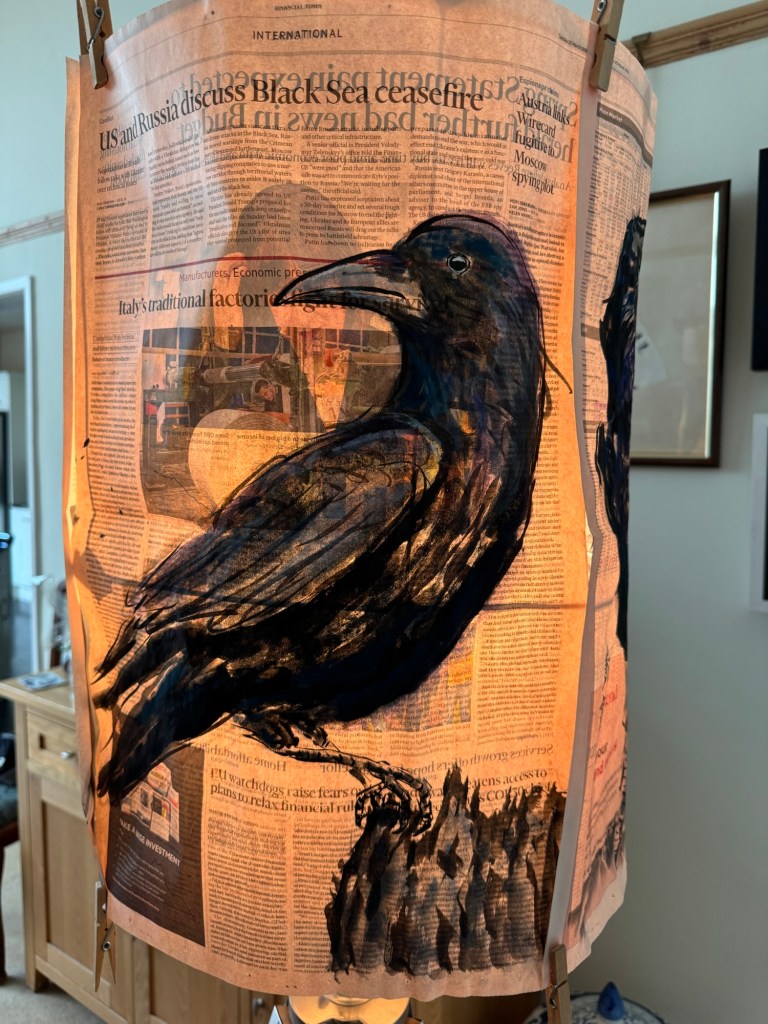
https://eliza-rawlings.com/2025/04/21/ma-u3-news-art-installation-ideas-holding-up-to-the-light/

I have been reflecting on my reflective practice as my process:

https://eliza-rawlings.com/2025/04/14/ma-u3-reflecting-on-my-reflective-practice/

I have also started to plan ‘life after MA’ – how I’ll develop my practice in the longer term and in a sustainable way. Here is my initial draft plan:

https://eliza-rawlings.com/2025/04/21/ma-u3-building-my-sustainable-art-practice/

I have updated my study statement to include a few new objectives for my latest work since it is an exploration that I hadn’t planned to do at the beginning of the course. They are listed on the last two pages of the statement:

https://eliza-rawlings.com/2024/02/03/ma-y1-study-statement-eliza-rawlings/

Notes from the tutorial –

1. Graduate show – we discussed the different options I presented for the show. Key takeaways are:

– Cheongsam paintings and News Art are two different bodies of work and if we were to show both then they should be displayed separately. Think of them as two separate things.

– If we show the dresses then all will need to have identical mannequins. This I confirmed would be the case.

– News Art feels more urgent and remarkable. There is an energy and there is a voice (be it a quiet voice). Using non-dominant hand also adds to the work with a sense of risk and excitement. All the different layers together. My history in engineering working with newspaper printing presses also feature in this body of work.

– News Art – it feels like everything has been leading to this. A culmination of my commitment to interrogate.

– Practicalities – ceiling is 4m high. Same height throughout the site.

– If we go for a wall display, I could use a builder’s flood light to back-lit the newspapers. Can also have the newspaper coming out at an angle – anchored to the top of the wall but coming out a few feet from the wall at the bottom (like the side of a tent) – this also feels more confrontational. Can use the bottom of the newspapers to hide the flood light units.

– The pieces of newspapers can be stitched together.

– Do not go for an overall coordinated composition, leave it untidy and loose.

– Try flood lighting in day light to see how it looks when illuminated.

– Wall height is 2.4m, some can be 3m. Width can be 1.4m (2 x double page spread)

Other thoughts:

– Don’t rule out cylinder lights for future shows.

– LED light strips to go behind wall mount newspapers, looped around like a drawing.

2. Life after MA – ideas for how to show work:

– Group show.

– What’s going on in the city that might help other events, e.g. late opening of museums. Do a proposal for showing work alongside the event.

– Do not think about the audience, just focus on making work to a deadline, getting the work to a show quality and taking good photos.

– Propose to office spaces.

– Rent artists run spaces.

– Go outdoors! In my case, can go to The Downs where I go to see the crows. Can hang News Art from the trees, set up a table where I paint the crows. Take some crow food and maybe some human food for visitors, too.
MA U3: ‘News’ Art installation ideas – holding up to the light

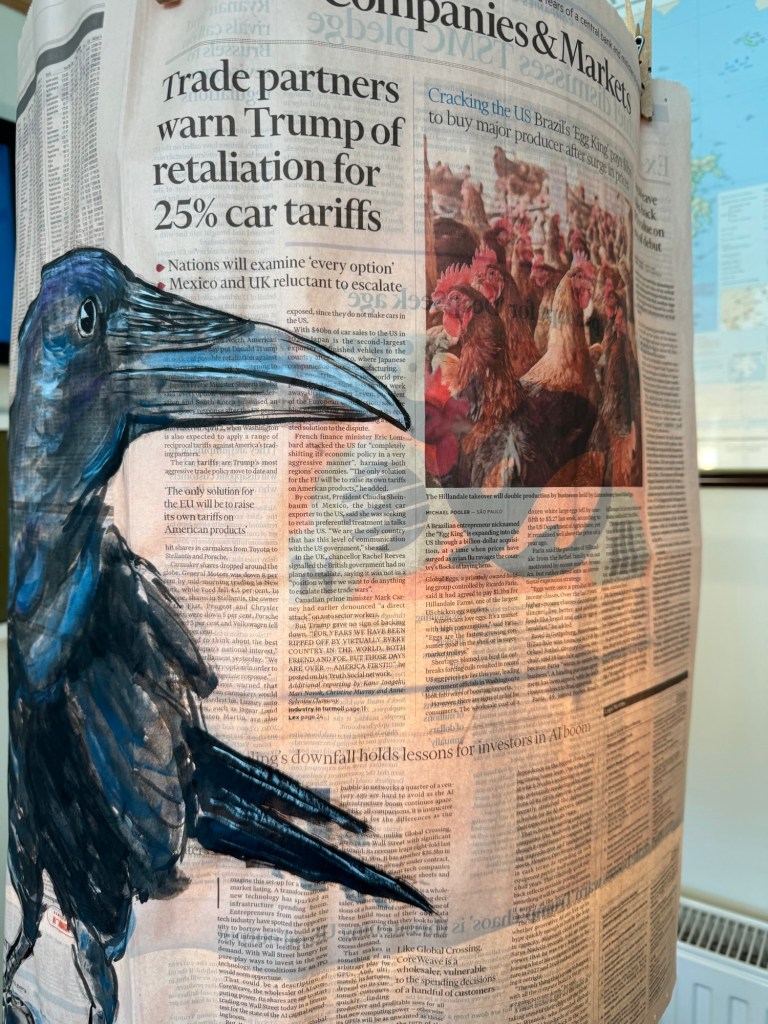
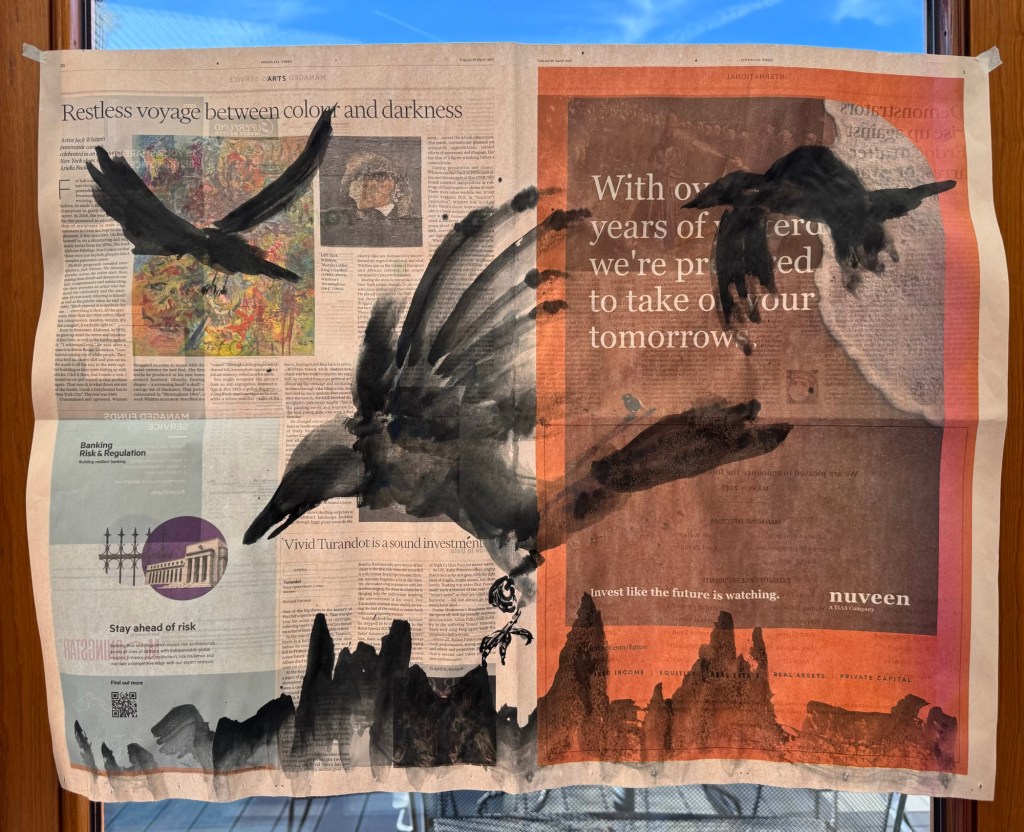
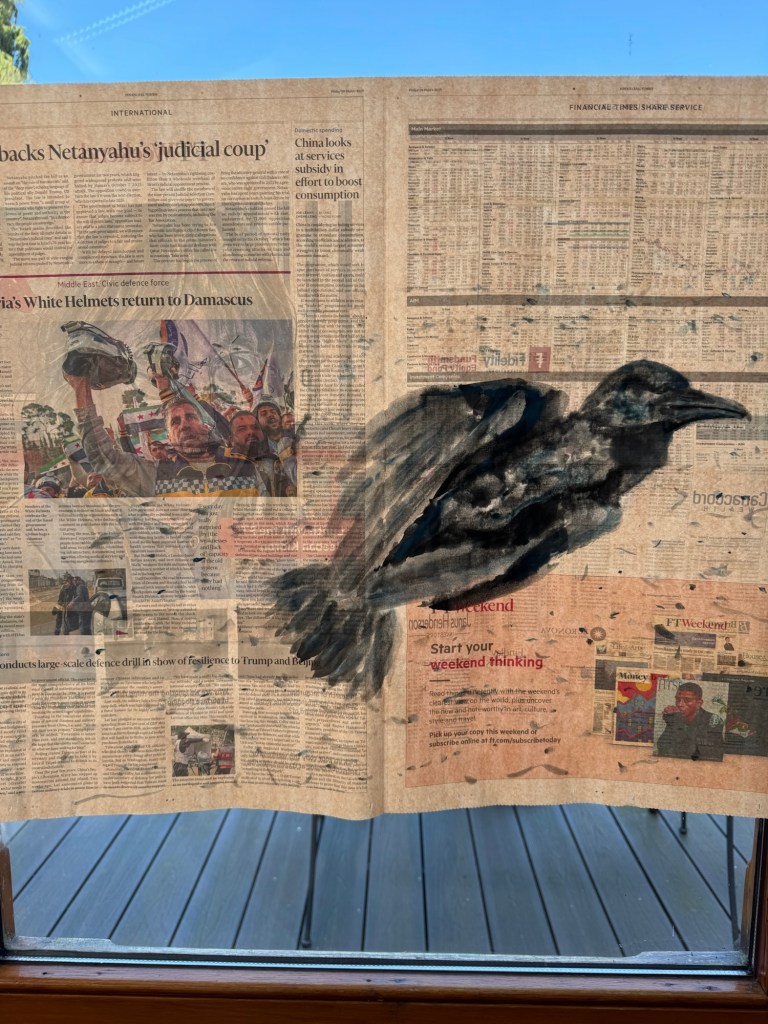
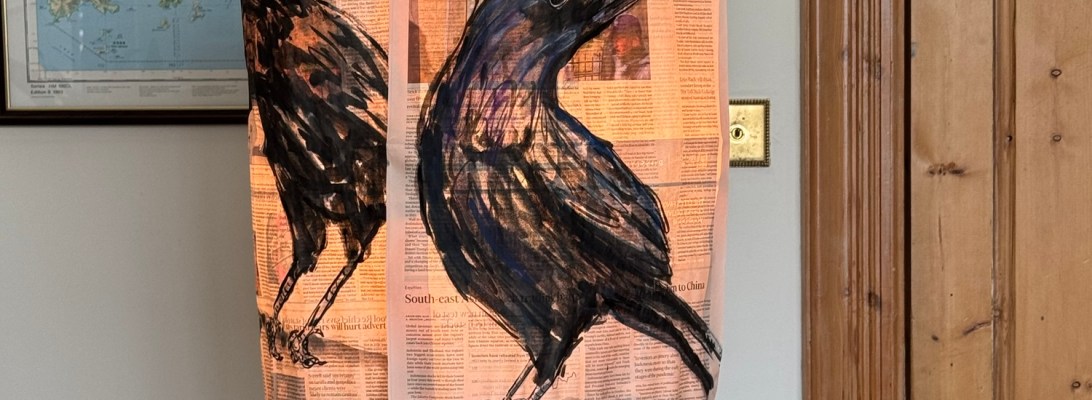
When I first showed my News Art to my tutor, we talked about the way I photographed the paintings in front of a window and letting the light shine through was a metaphor for ‘holding the news up to the light’.
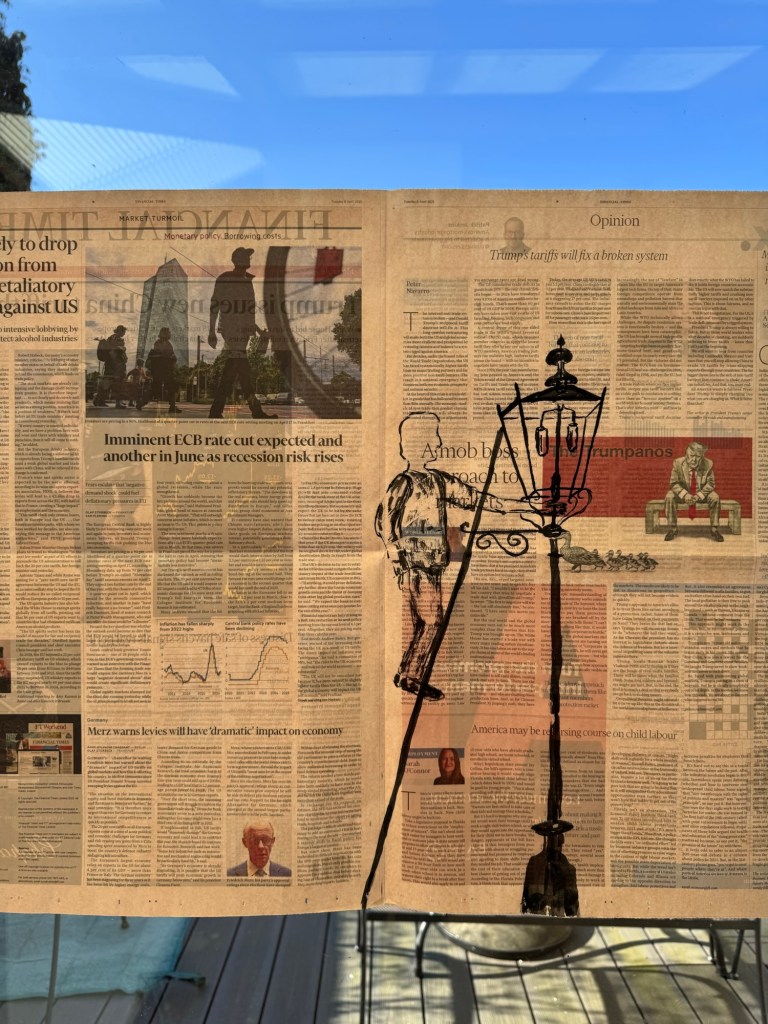
As the saying goes, if you are ‘holding something up to the light’, you see through and understand the true nature of it more clearly; or you hold something to account. I felt it was a good metaphor and if I were to show my News Art then I would want to hold it up to the light. This way of showing also reveals the images on the reverse side of the newspaper adding more intrigue and ambiguity to the overall composition.

METHOD

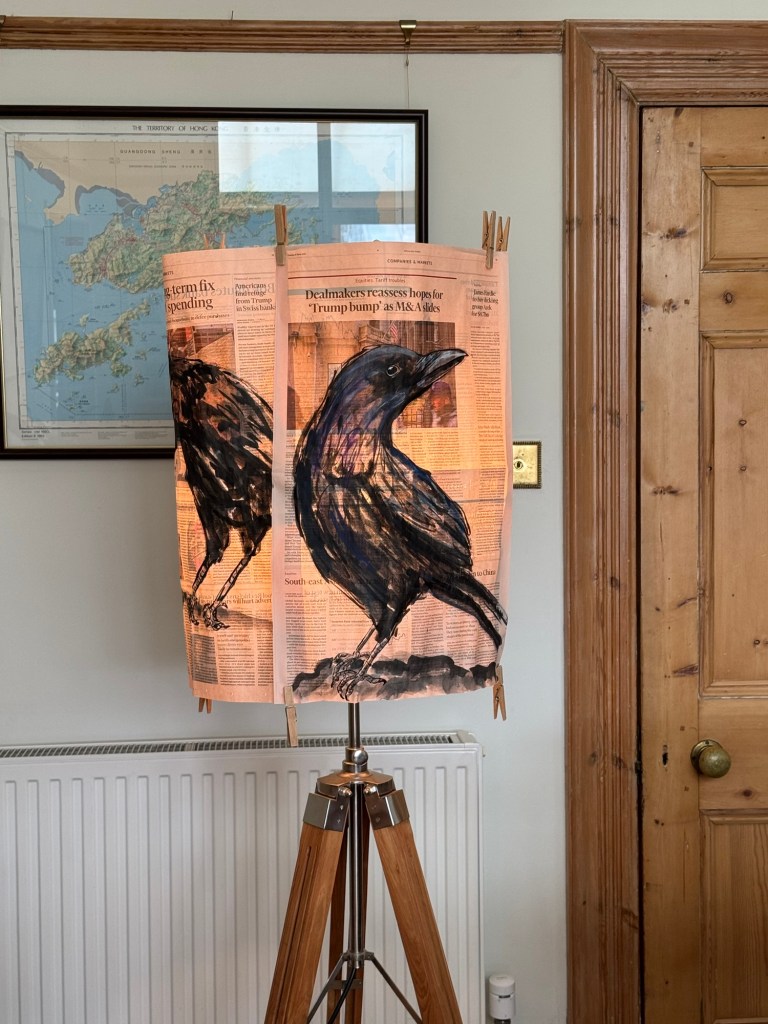
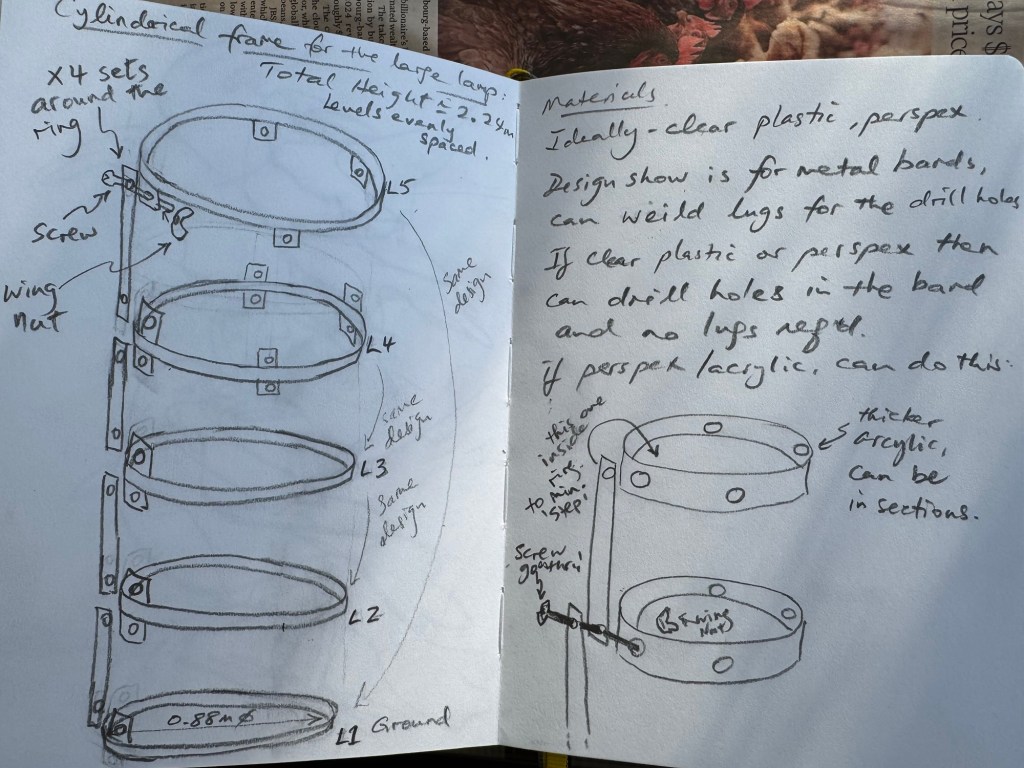
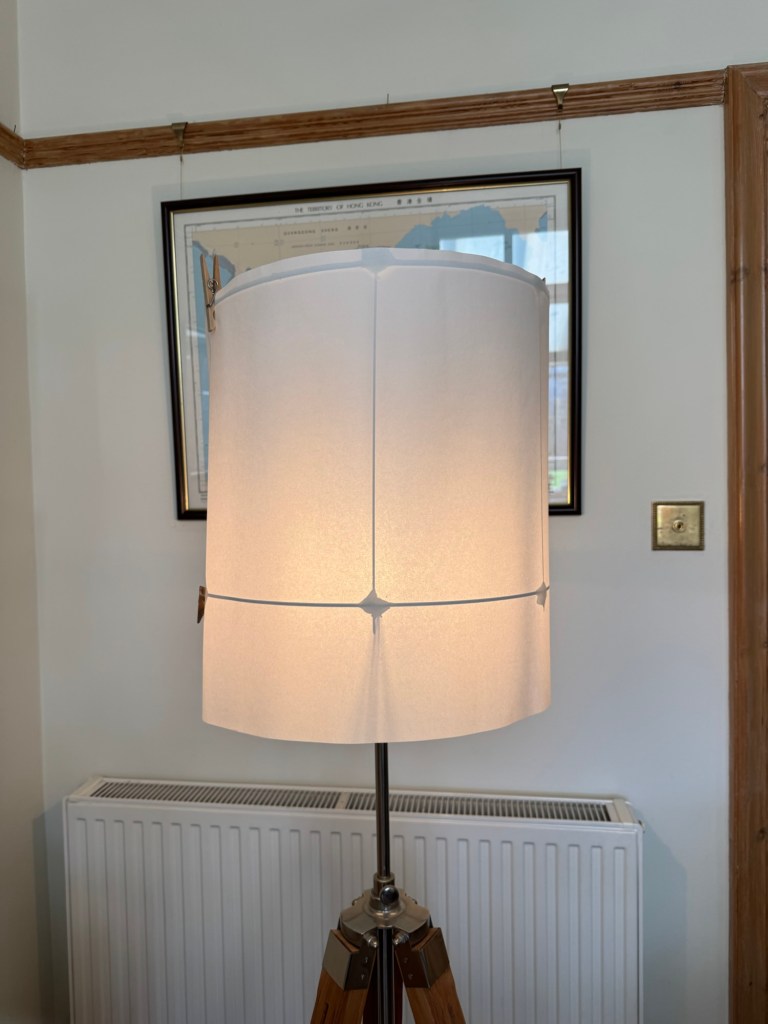
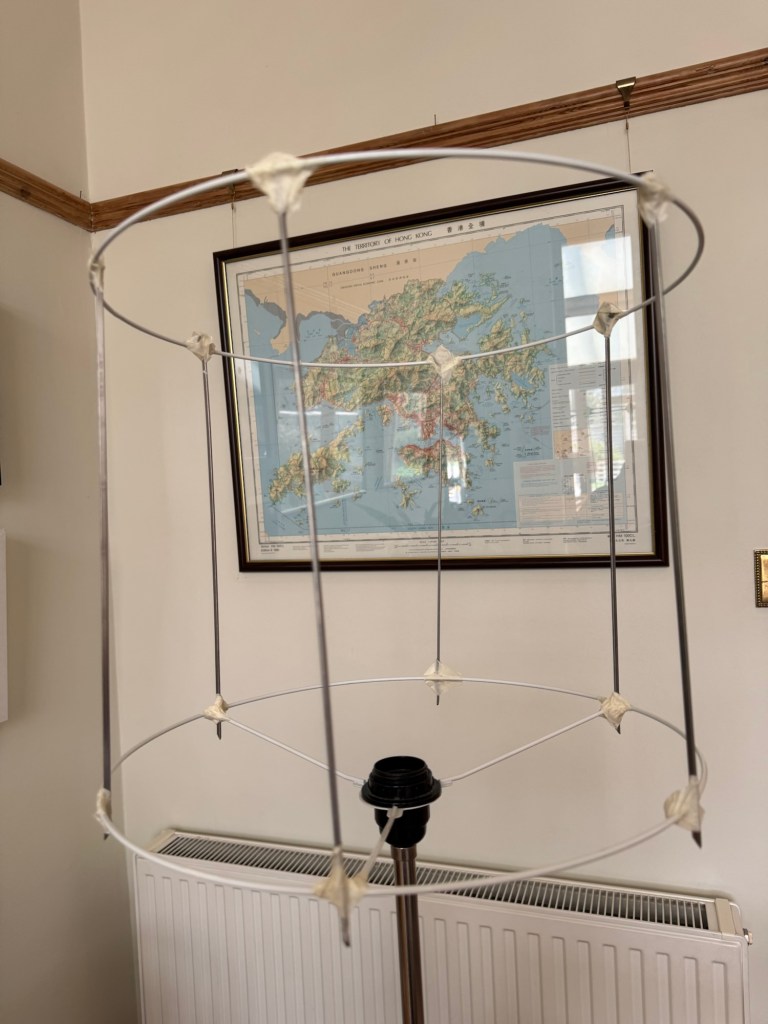
To find ways of showing the News Art with light shining through – it is necessary to not rely on having a window or sunshine for an installation. So I created a mock up lampshade frame to test how it would work if the light source was a light bulb.

Mock up lampshade frame

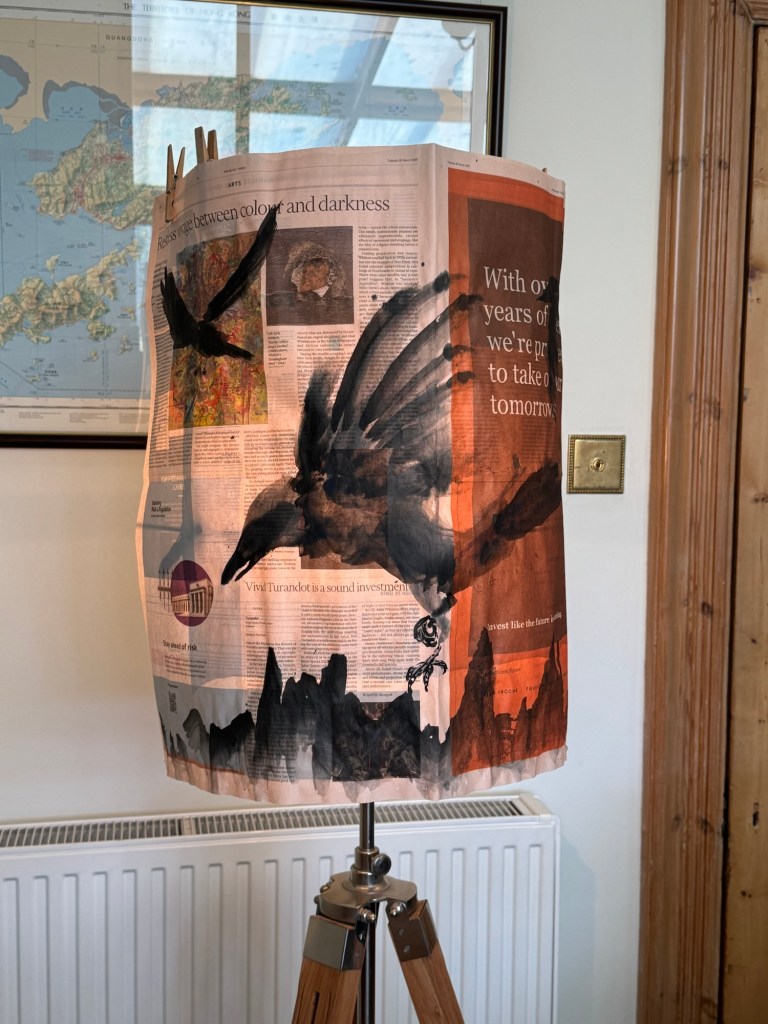
Then clipped the News Art to the frame with the light turned on:

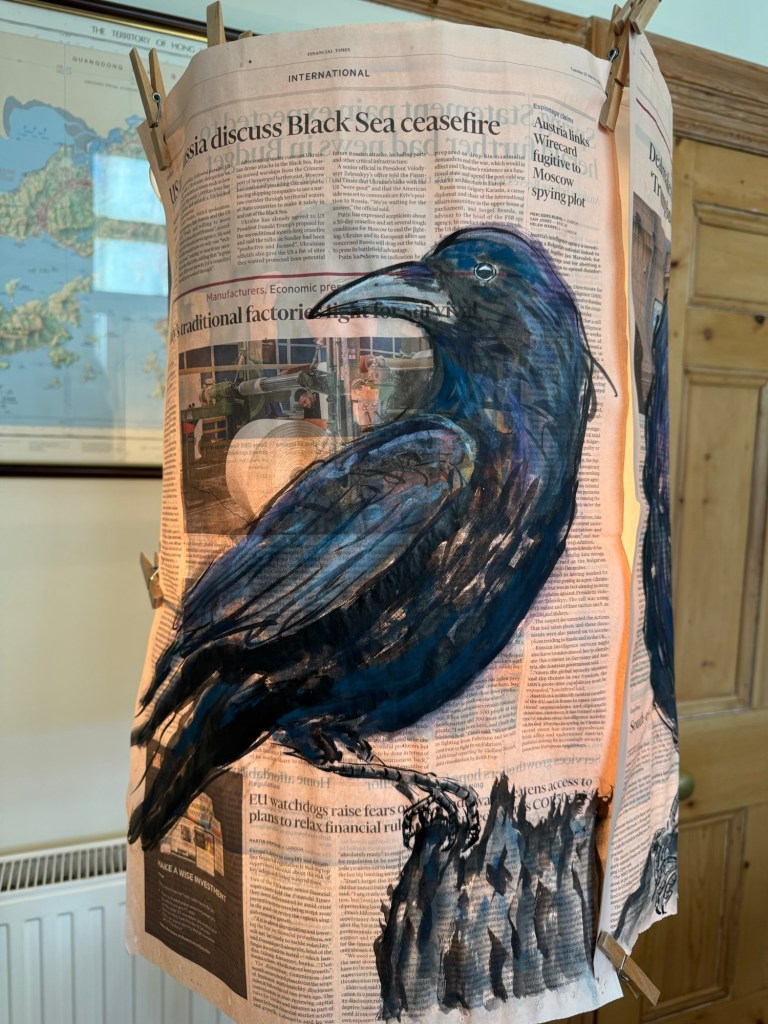
Tried a few different images:

This showed the reverse side images were coming through well:

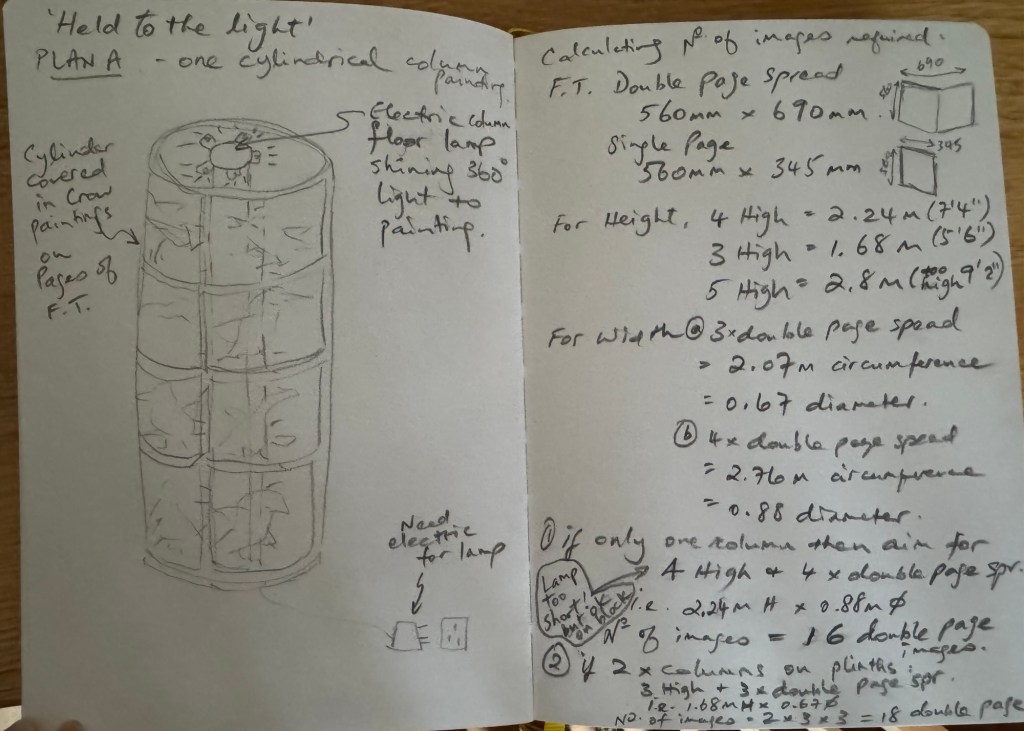
Then I considered a design for a cylindrical light tower to display the paintings in an installation:

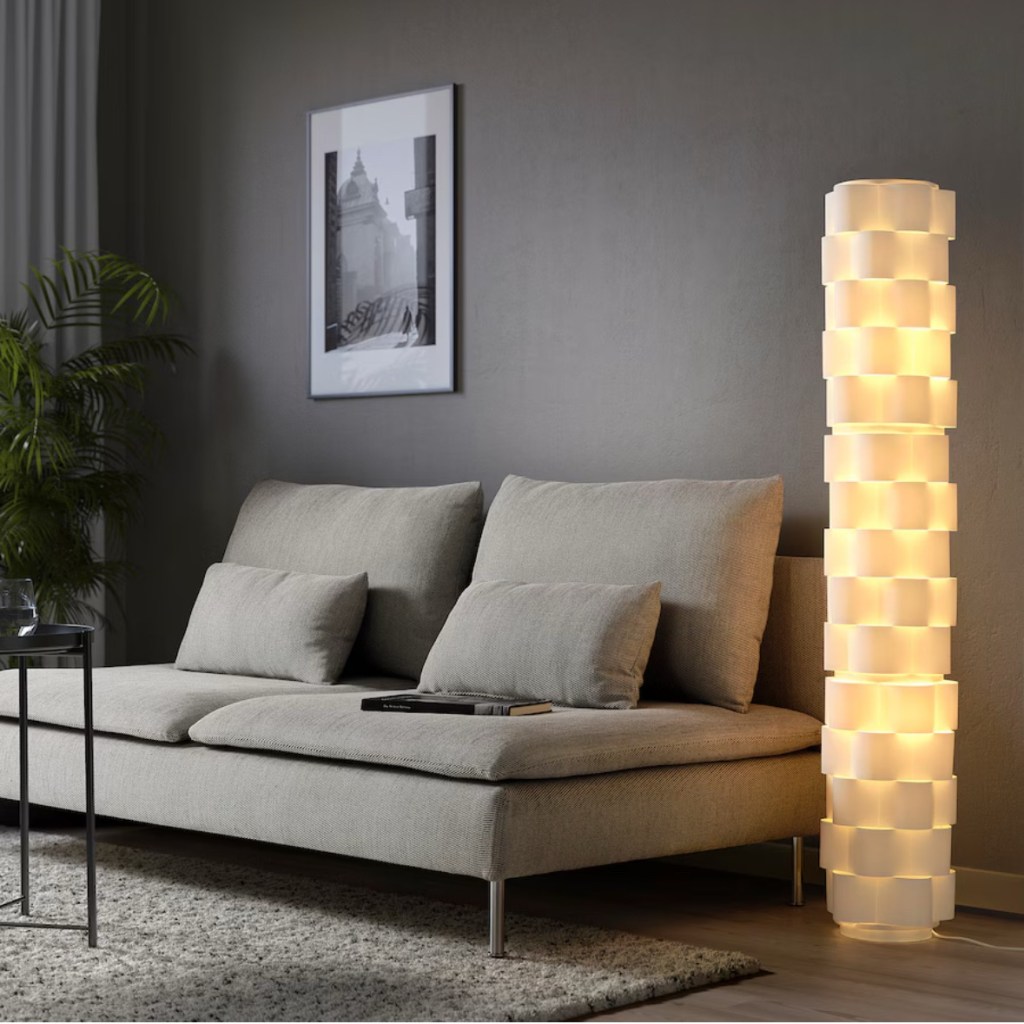
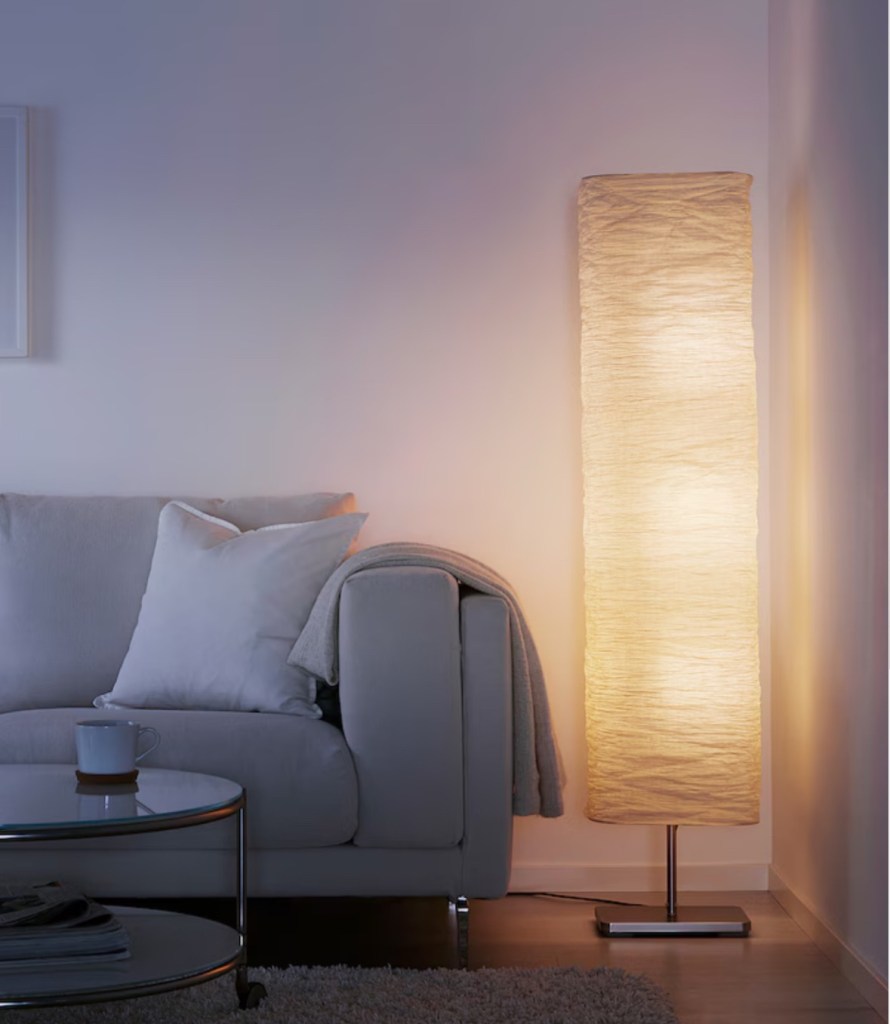
Some ideas were found online at places like IKEA with floor standing lamps that could be used instead of a custom made frame with the latter being a potentially costly option.

As an example, for the rectangular shade in paper shown above – it can take 2 double page spread of The FT at 3-high. It has more area than the circular one so would be better. This means 6 double page spreads per lamp. For a 3 lamp installation then that would mean 18 double page spreads in total. The rice paper lampshade could be slashed or torn to represent violence that is happening at the moment.

However, the rice paper shade around the lamp might block too much of the light. Hence more tests were done with the mock up lampshade and rice paper.

Mock up lamp with rice paper shade

There was sufficient light coming through the rice paper lampshade to reveal the images on the reverse side of the newspaper:

REFLECTIONS

The experiment was successful in demonstrating that a light bulb can illuminate the newspaper sufficiently to reveal the reverse side images, even with a layer of rice paper in between. This means the IKEA lamps could be used if I wanted a cylindrical installation.

A cylindrical installation means the viewer would have to walk around the lamp to see the whole composition. This maybe fine and could be a good way to install in the middle of a room with multiple floor standing lamps. However, if I wanted a large and flat composition like one large painting, then that would need to be hung on a wall or from the ceiling. If against a wall then I would need a light curtain of some kind to throw light onto the back of the newspaper. Ideally an enormous light panel or light box would be ideal but they tend to be very expensive. More to think about…

LEARNING

The experiments so far showed that a lamp with just one bulb was sufficient to show the reverse side images. Of course it would also depend on the distance between the light source and the newspaper. But the results were encouraging and I will continue to think about different ways to install my News Art work.

NEXT STEPS

Think of different ways to illuminate the art work in preparation for coming up with ideas for the degree show.

Also to just keep making!

MA U3: ‘News’ Art – exploring silhouettes

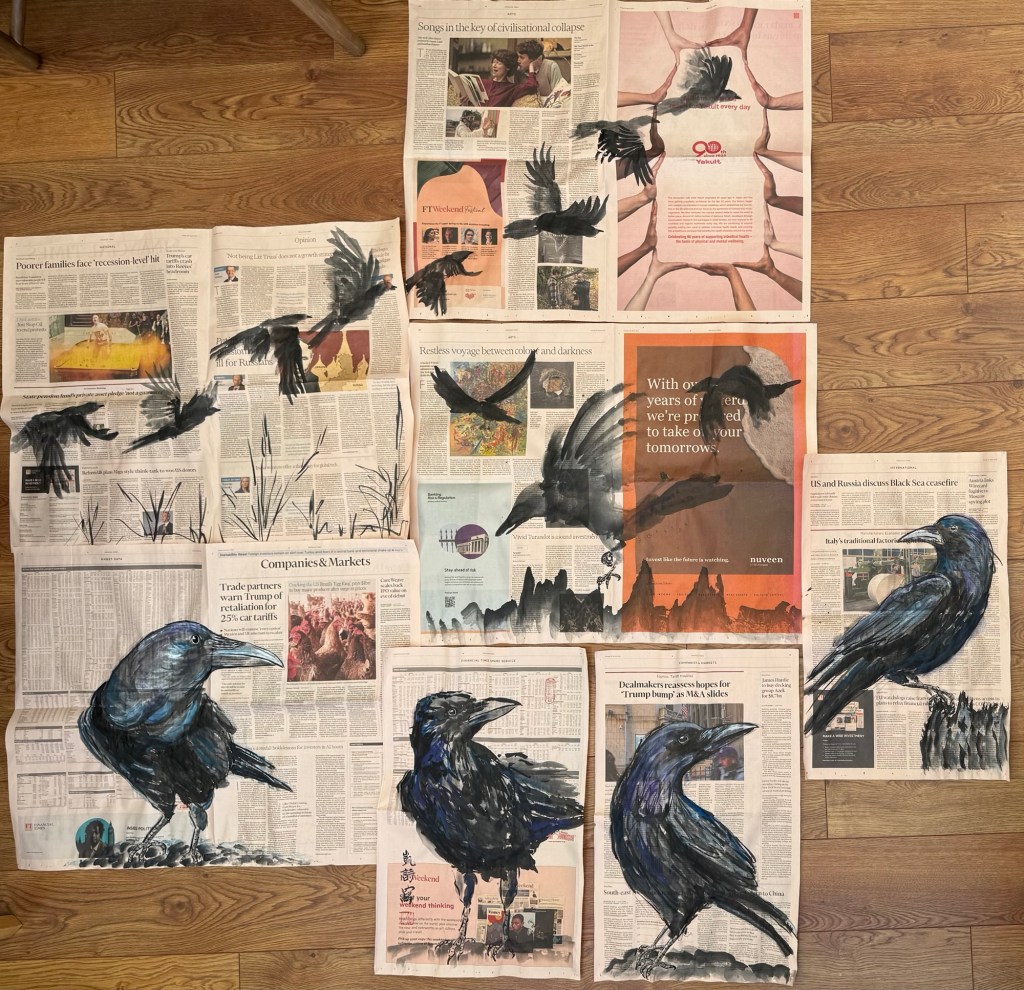
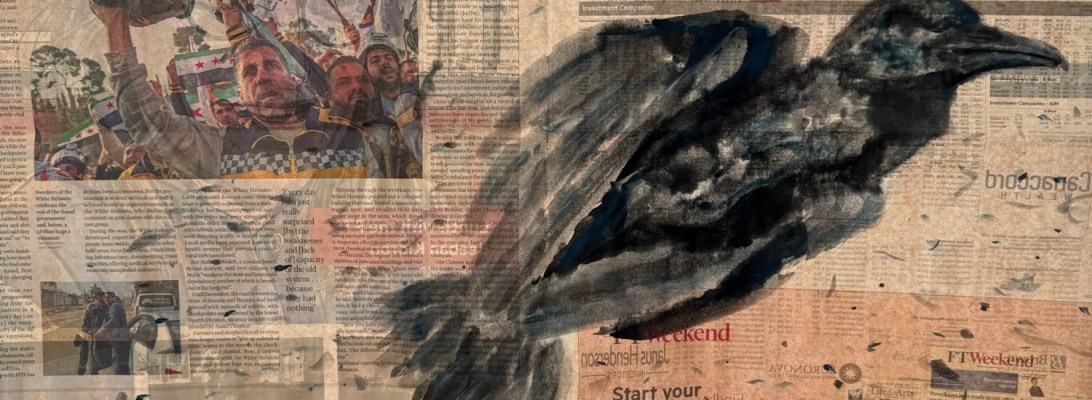
After reflecting on the News Art that I made in response to news headlines directly, I decided to be more subtle in the way I respond to the headlines. I decided to explore a more abstract way to express my feelings. What started my creating of News Art was the grief that I felt for the state of the world and my choice of using crows, inspired by the book ‘Grief is the thing with feathers’. So I returned to just painting some crow images as ideas came to me and not to overthink or be too deliberate.

METHOD

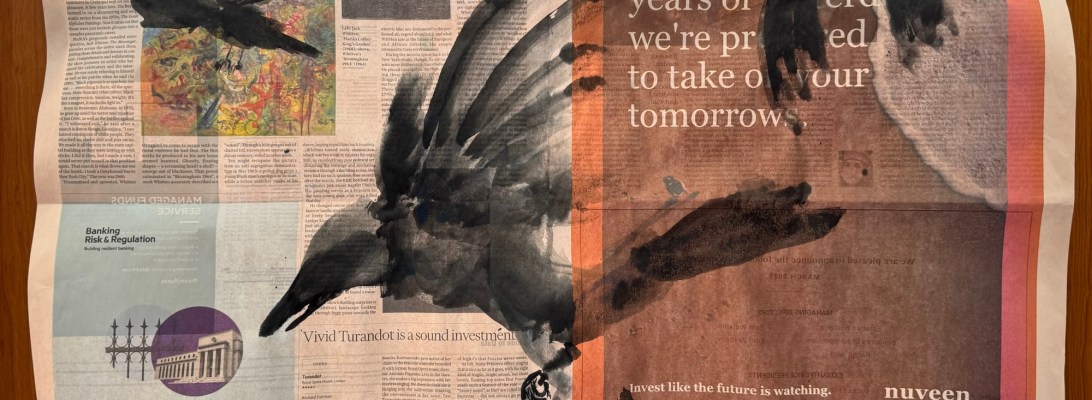
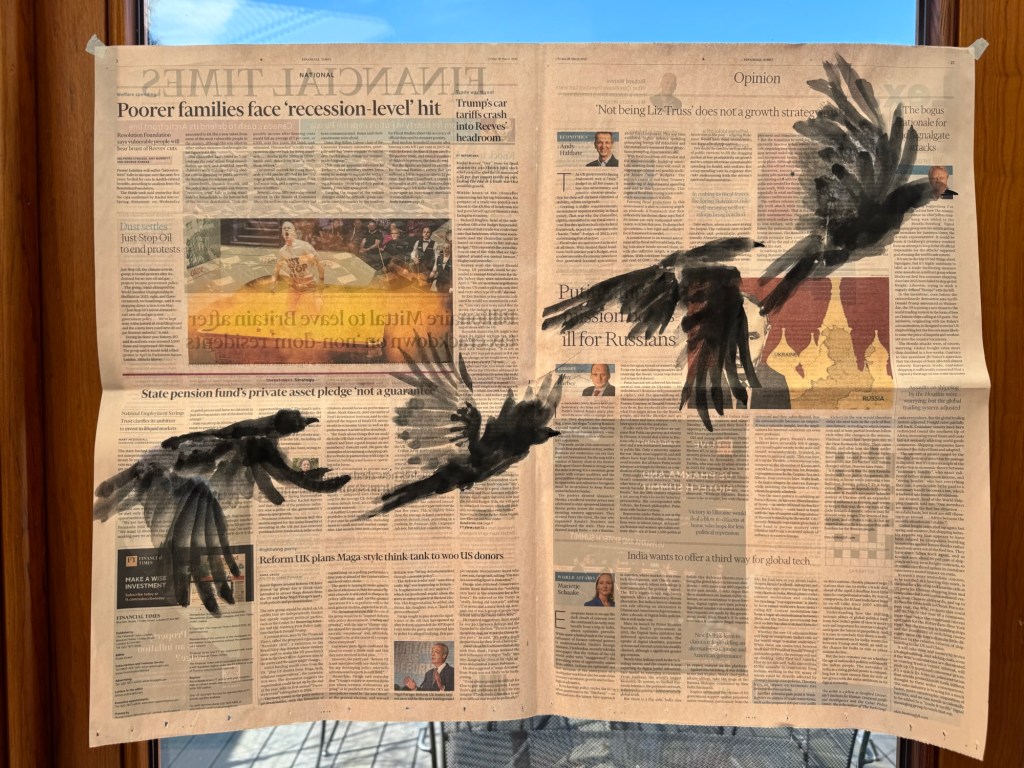
Without too much planning or thinking, I painted a few crows in flight using Chinese brush and ink in a free style Chinese painting approach. Then I held the painting up to the light:

Another painting done in the same way with a similar composition:

A more close-up view of a crow coming down for its prey with two others in the sky:

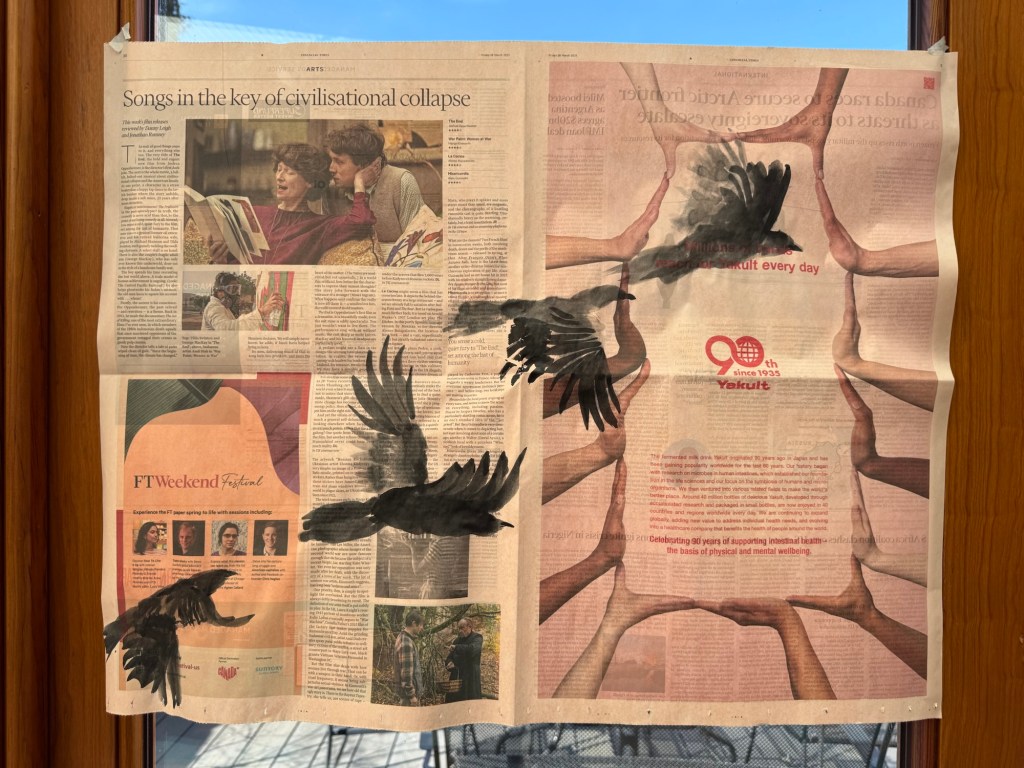
Since I had done quite a few of the crow paintings, I laid them out to see how they would look as a larger composition to get ideas on how to install these paintings as a group:

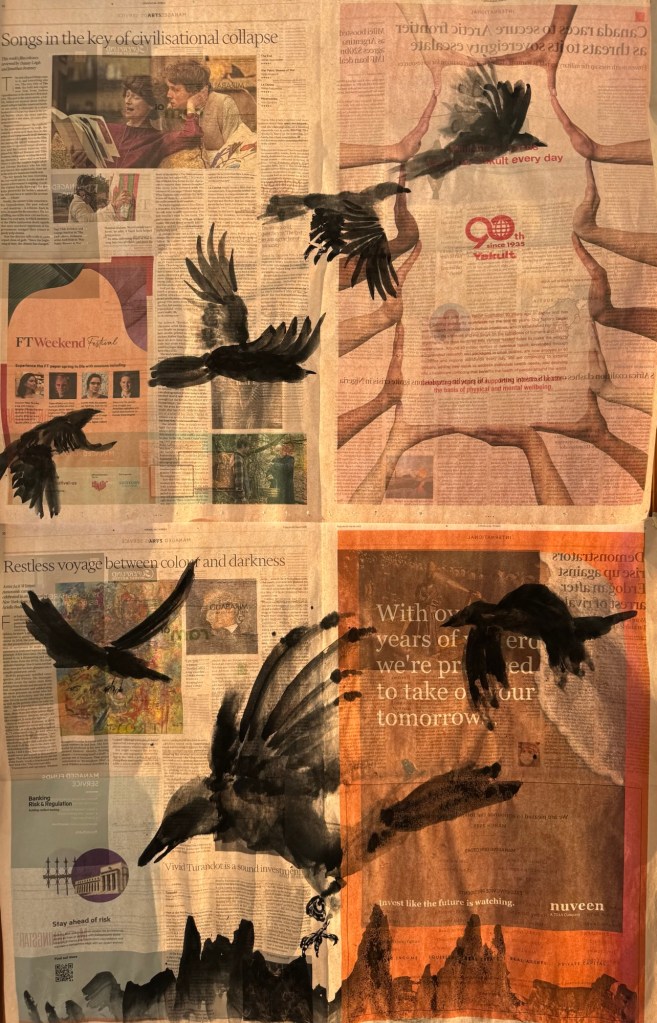
I finished by selecting two silhouette paintings that went well together and held them up to the light as one composition:

REFLECTIONS

I am pleased with the silhouette paintings. I like painting in Chinese free style. Some of the crow bodies were not quite right but overall the wings have worked out well. I feel they do give a sense of movement in flight. I am also happier with the more subtle and abstract approach to the news headlines selected. I also purposely chose the ‘ring of hands’ for the crows to fly through, like an escape route for them. We all need one of those at the moment!

Doing my newly discovered News Art has given me a reason to read the newspaper when I have felt inclined to avoid the news. Looking through the newspaper to pick out headlines to respond to has given me courage to face what’s happening in the world in a way that I didn’t expect.

LEARNING

I feel excited by my new discovery of making art in this way. I am gradually developing a process and as I get to know more about the newsprint material, I feel able to push things further such as how wet I could make it (very wet, surprisingly). I really like painting on the newspaper because it is not a blank canvas and the contents and images on each page give me so many ideas which is great.

One thing to bear in mind is that newsprint is not archival. This would be a problem if I continue to pursue this way of making. I need to look into ways to preserve the artwork especially if I’m thinking about showing these work at some point. Proper research is needed including asking specialists at CSM.

Overall, the main learning is to just keep making more work to explore this way of making. Ideas flood in as I make.

NEXT STEPS

Make more News Art!

Research ways to make News Art archival.

MA U3: ‘News’ Art – responding to headlines

I have been continuing my experiments with making art on newspapers as a way to respond to what’s happening in the world. In previous blogs, I have talked about using crows to express the grief and the sense of loss that I have been feeling.

This blog captures the experiments where I have responded more directly to the news with the painted images. I have also tried to think more carefully about the process of this way of making. Through trial and error, I believe I have developed a more systematic process of producing these paintings which I have documented below.

METHOD

My response to some recent news about innocent people being killed in a war was to explore painting dead crows. I have often seen dead birds on the road or pavement, but I have never studied them closely. So the start of the making process was to research online images of dead crows.

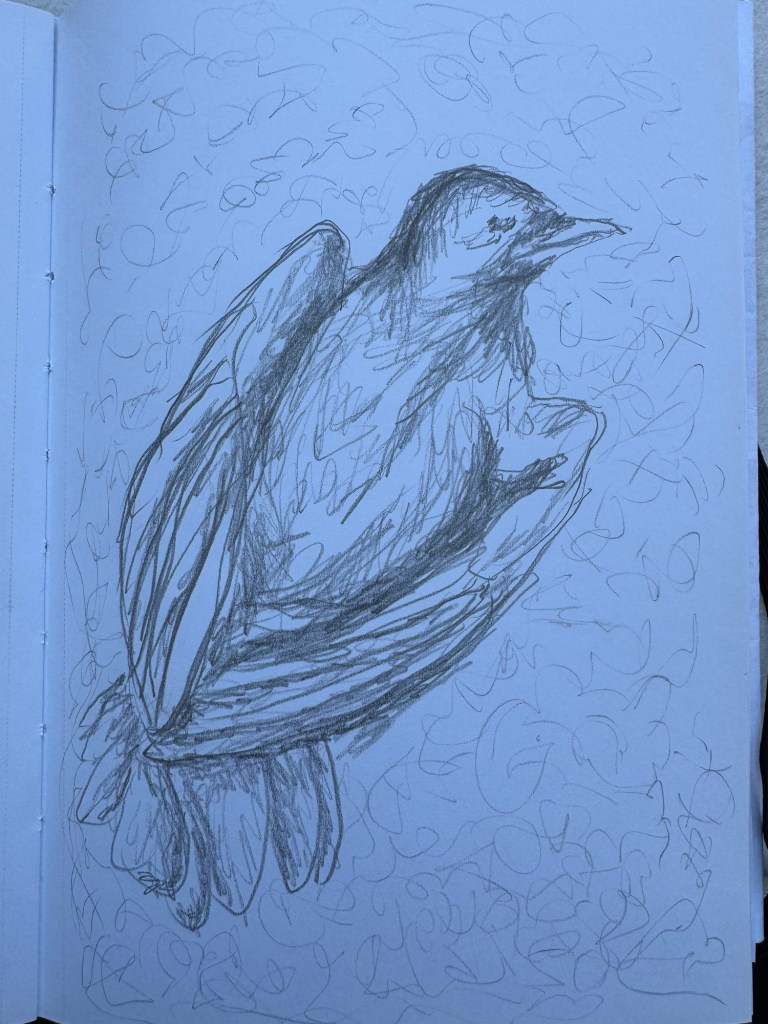
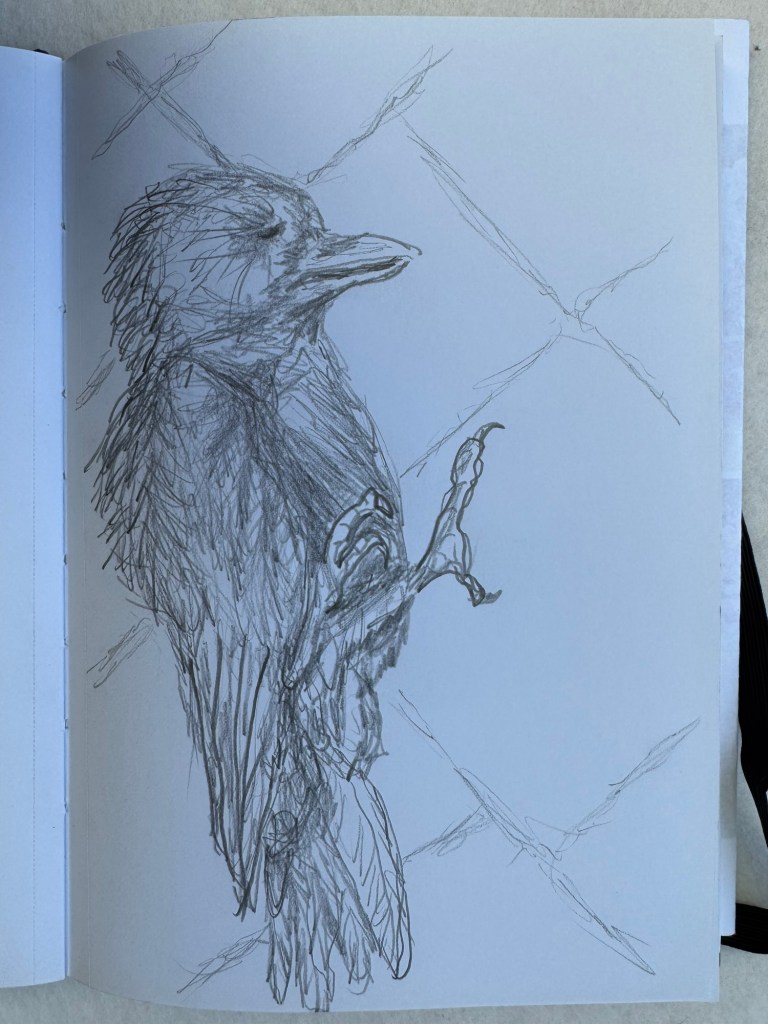
Once I found a desired image, I would do a drawing in my sketchbook with my non-dominant hand. I have previously documented my wish and need to use my non-dominant hand to be more expressive while experiencing that feeling of not having complete control of what was happening.

Drawing of dead crow lying on its back

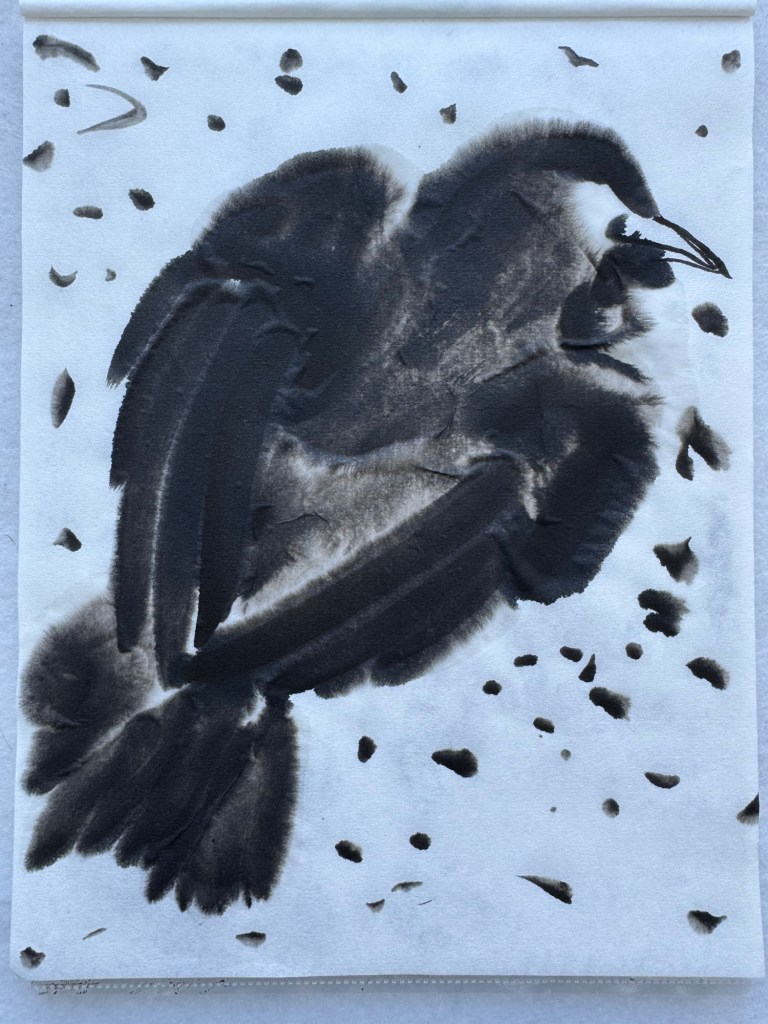
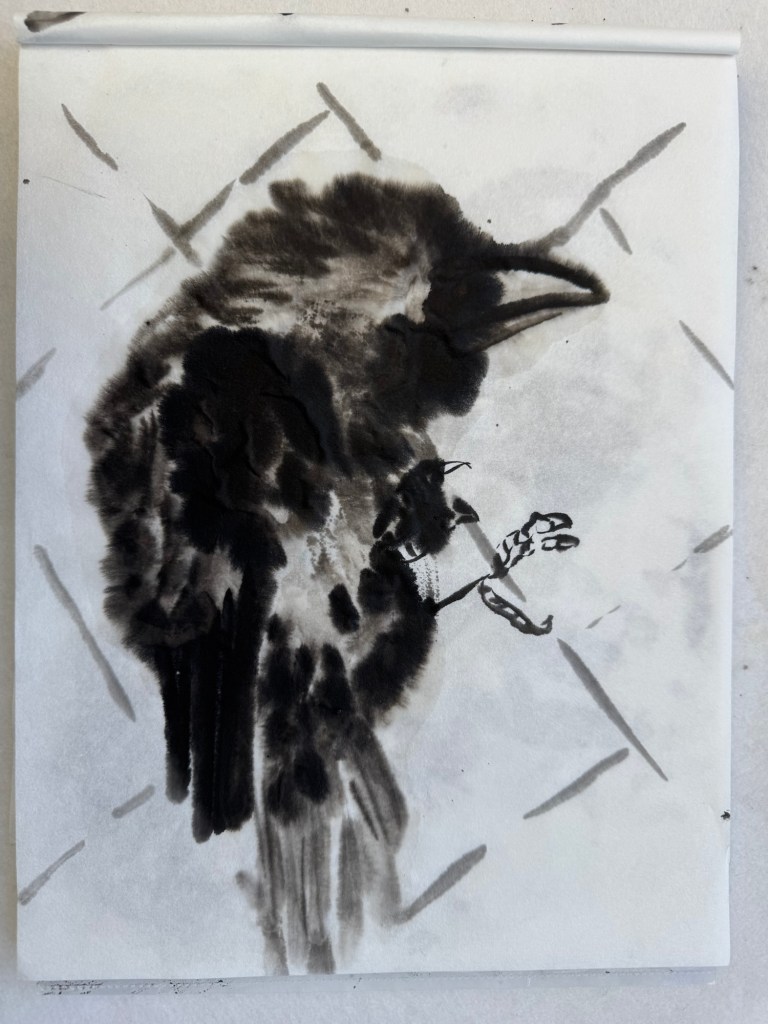
I then did a Chinese ink study of the same dead crow composition on a piece of A4 rice paper:

Chinese ink study of crow composition – A4

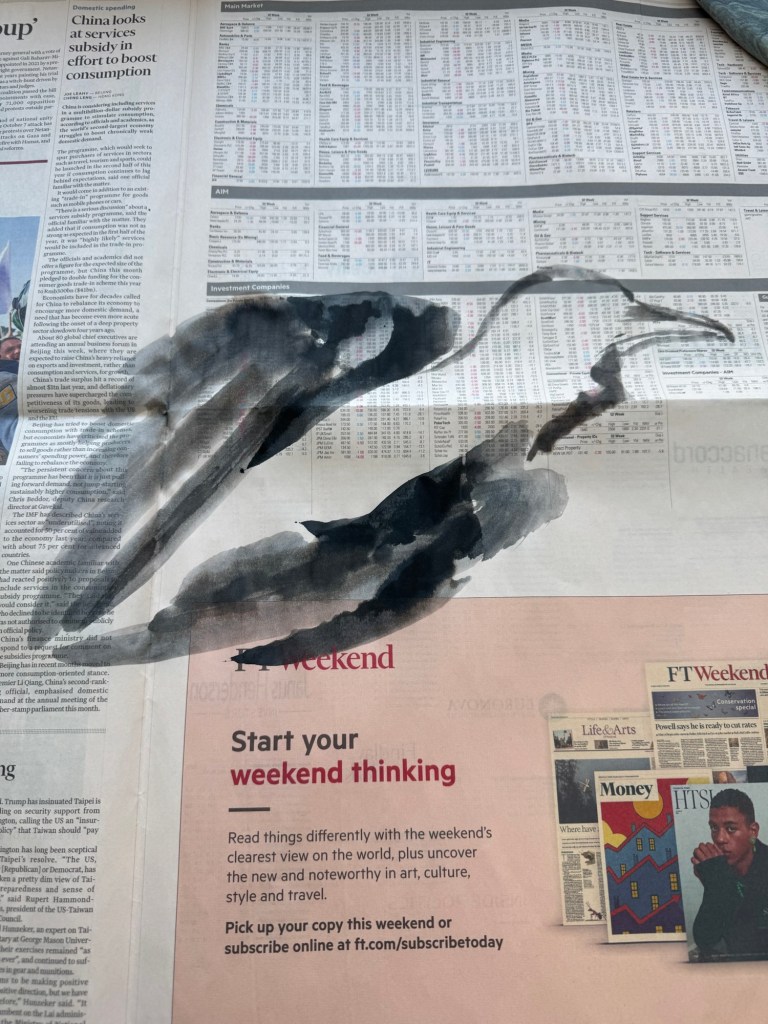
I then choose the newspaper and started to paint the chosen composition:

Finished dead crow:

Painting held up to the light, taped to a glass window:

Finished painting – dead crow

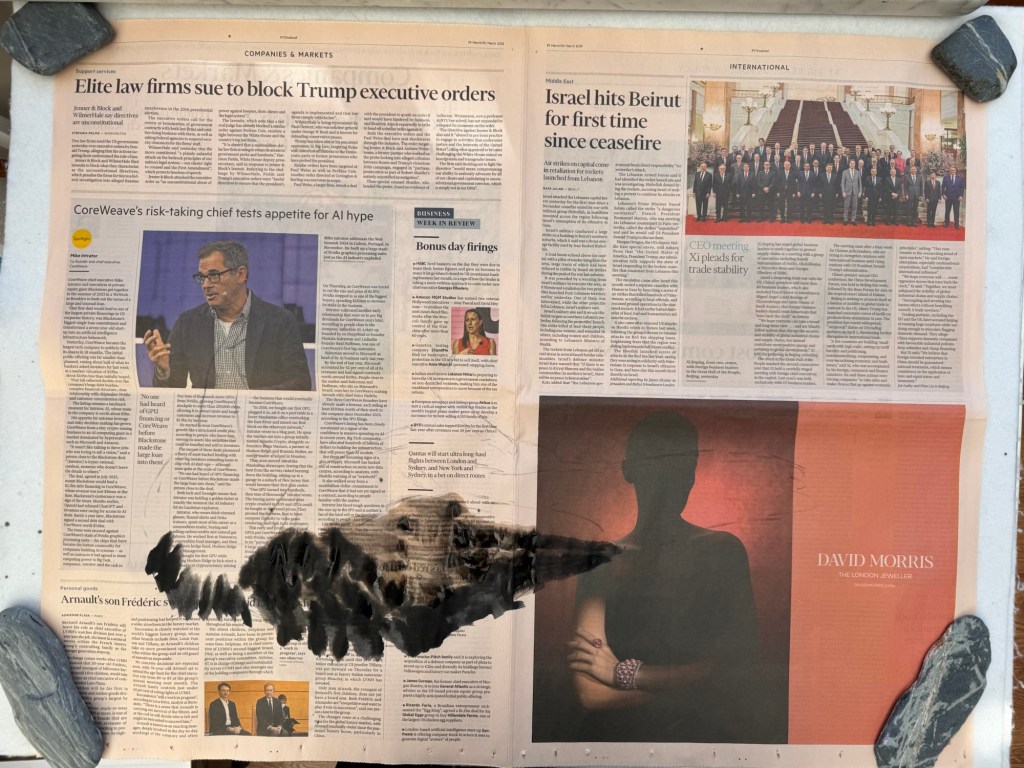
A second experiment with a different dead crow was done following the same process, but with an added step of making a faint charcoal outline sketch on the newspaper of the crow before painting. This step was added because brush painting with ink on paper is unforgiving, hence having a sketch of the shape helps to ensure the composition is largely in the right place.

Sketchbook drawing of the second dead crow:

Sketchbook pencil drawing

Chinese brush painting study of crow body:

Chinese ink on rice paper – A4

Charcoal outline was drawn prior to painting to mark out the composition:

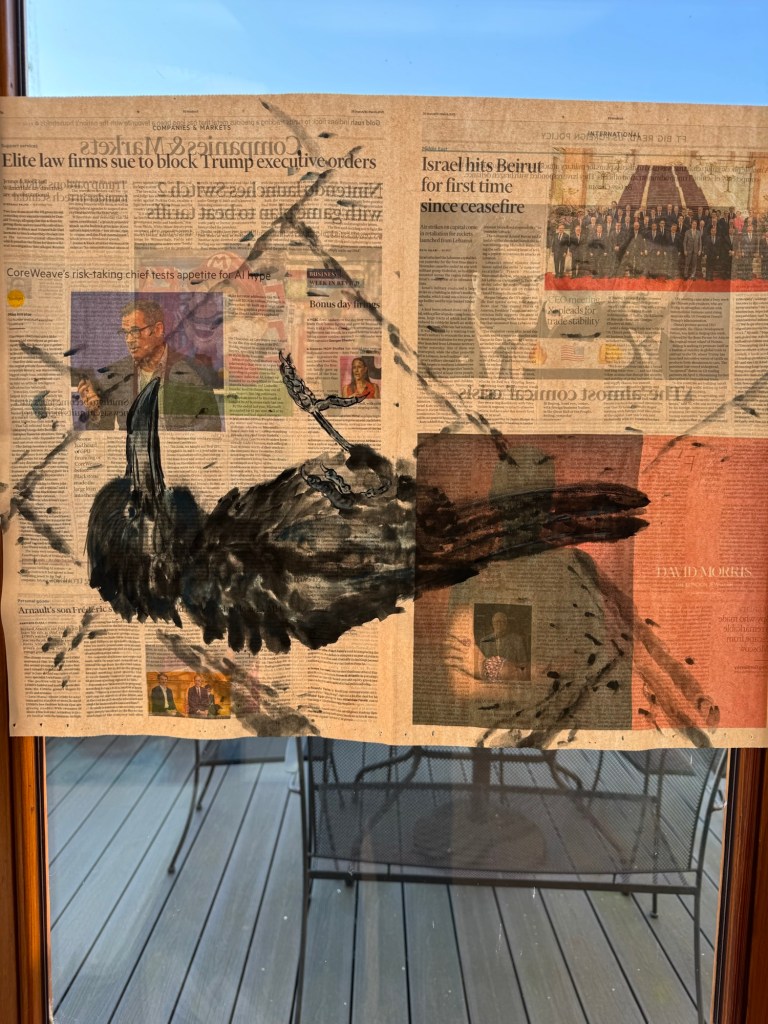
Completed painting of dead crow lying on its side on pavement, held up to the light.

Painted dead crow on The FT

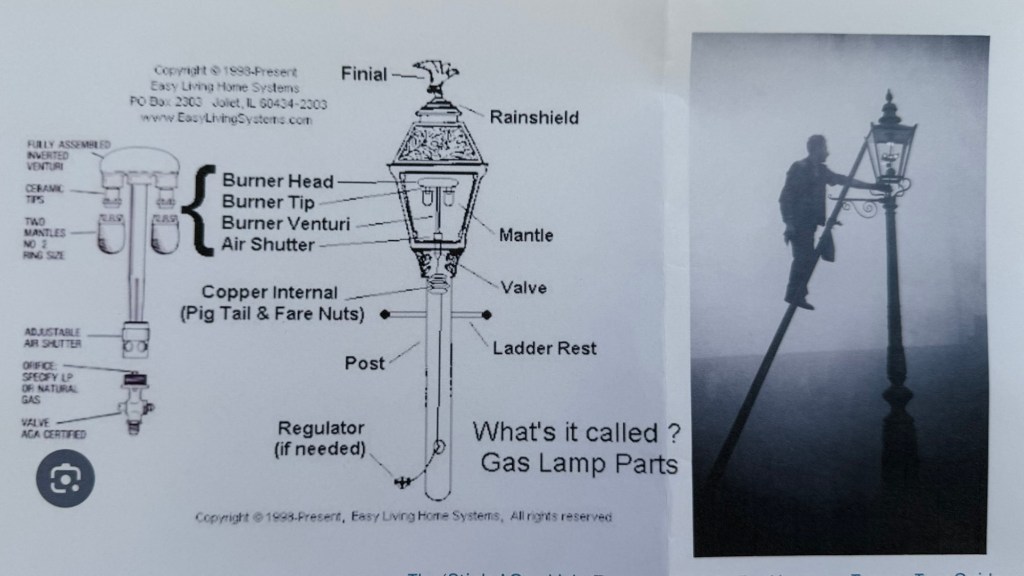
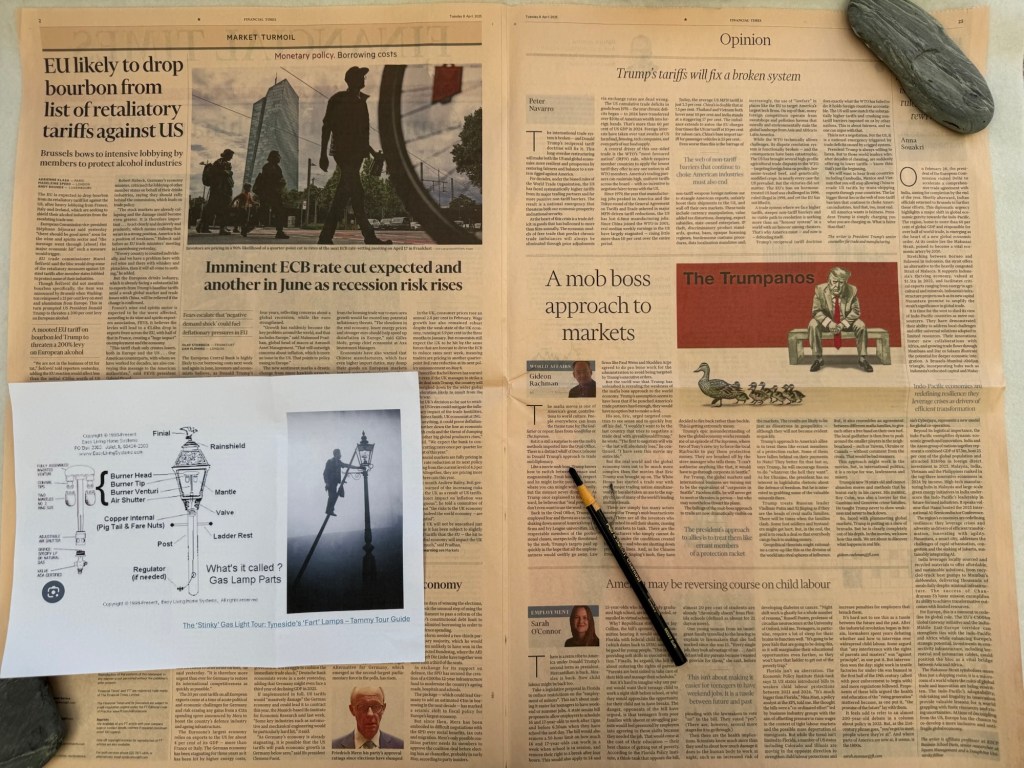
The last experiment on responding to the news involved an image of a man lighting a gas lamp. It was important for me to research how a street gas lamp worked so that I knew what I was drawing. The diagram below was very helpful.

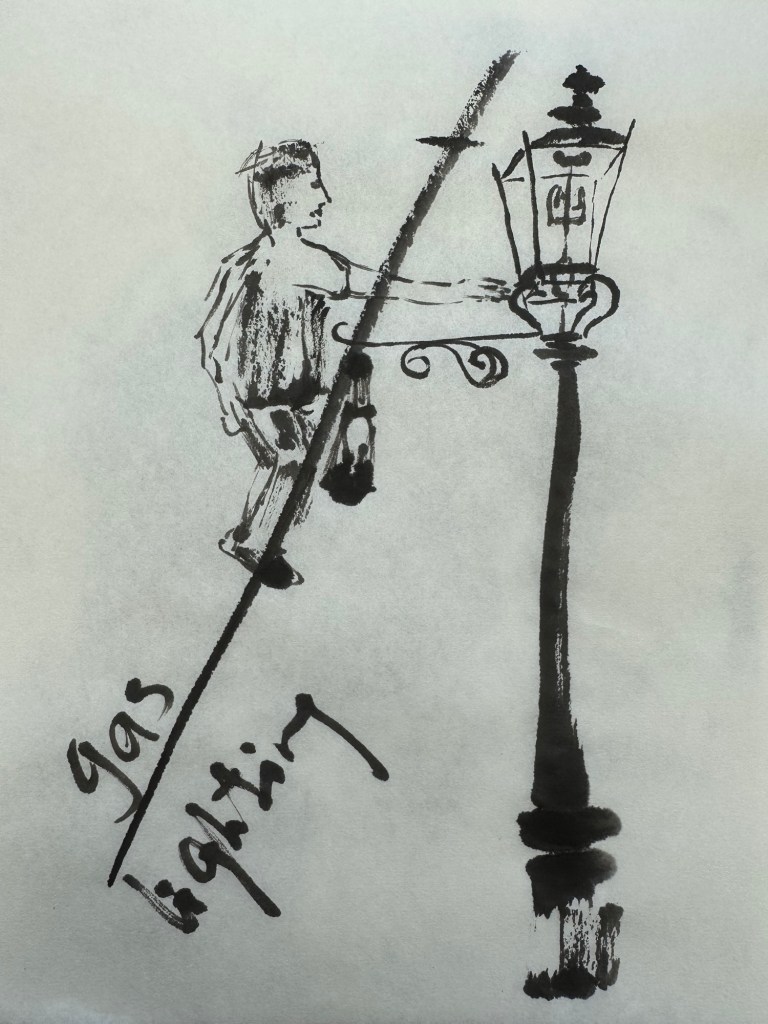
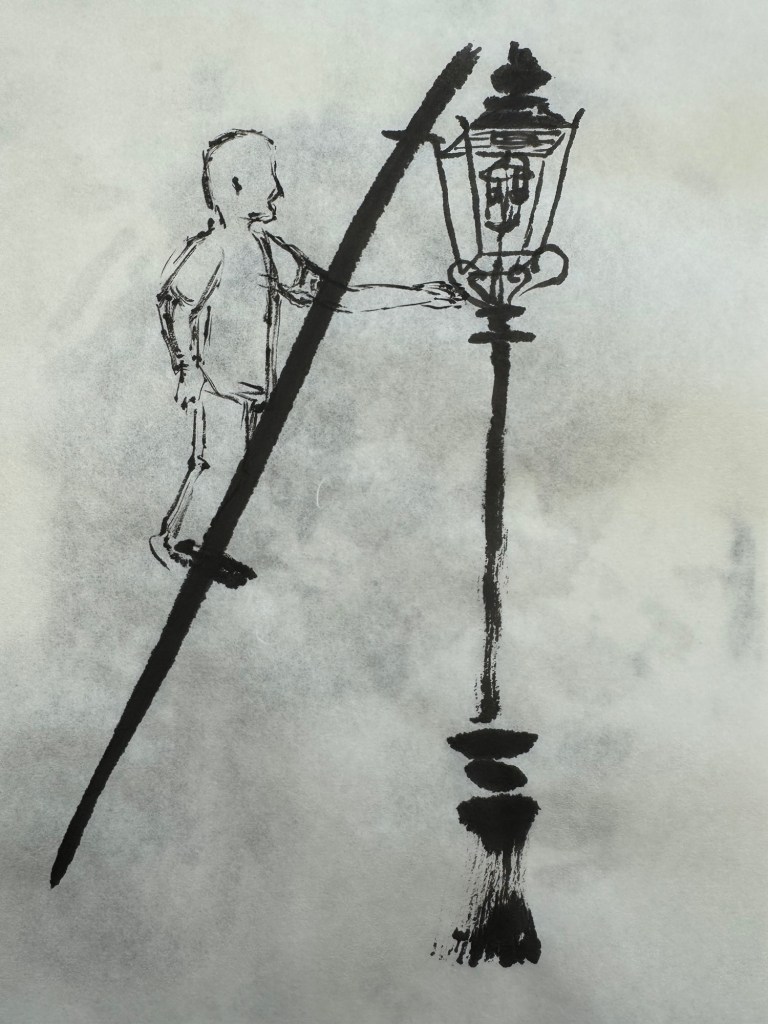
This time, I did two ink sketches as initial study to test the composition:

The chosen newspaper page that I wanted to respond to was laid flat and a rough charcoal drawing of the composition was made:

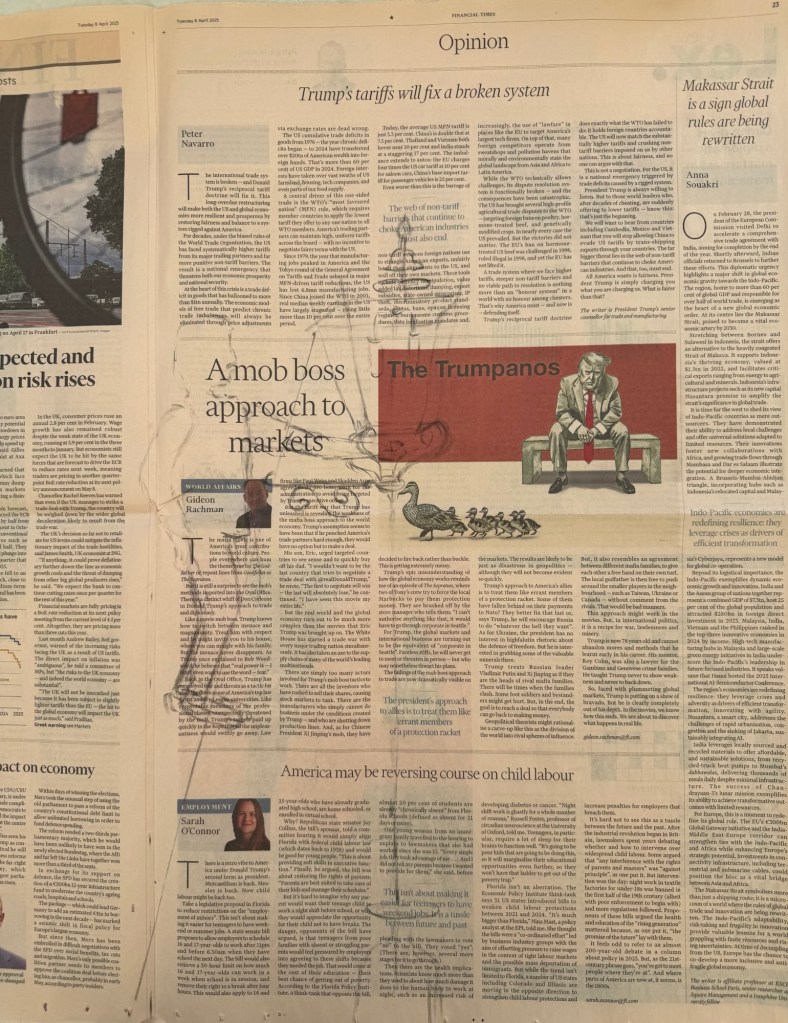
Then the painting was done and held up to the light. Gaslighting – Chinese ink on newspaper:

REFLECTIONS

It was cathartic to directly respond to the news. So I enjoyed making these pieces of work. However, looking at them now, they feel rather literal and obvious. Dead crows to respond to innocent paramedics being killed and a man lighting a gas street lamp to respond to the gaslighting going on in many places. All seemed too obvious.

These paintings were made using my dominant hand – I think it was because these composition ideas were very new and I wanted to be more confident in my depiction. However, I believe the outcomes are less satisfactory than the previous ones where I used my non-dominant hand. The mark making here seemed too deliberate and lacking the energy that I had achieved previously.

Although the artistic outcome was not completely satisfactory, the process of responding to the news by directly calling it out was satisfying. It was like ranting without actually ranting. Also, I gained clarity and tested out the process in a more conscious way. So all was not lost.

LEARNING

The initial drawing and sketching step was helpful for new compositions. But I don’t feel it’s an essential step, depending on how familiar I am with the subject.

Using charcoal to mark out the composition on the newspaper was very useful and is an essential step that I should use.

Responding directly with images may end up being too literal or obvious. So use with care.

NEXT STEPS

Try different approaches to composition and images. Experiment with more abstract images.

Make more work.

MA U3: Reflecting on my Reflective Practice

METHOD

On 3rd October 2023, I wrote my first blog for my MA Fine Art (Digital) course. It was about my intention to structure my blogs in a way that would help me to create a sustainable reflective practice.

Link for the first blog:

https://eliza-rawlings.com/2023/10/05/ma-year-1-blogs-planning/

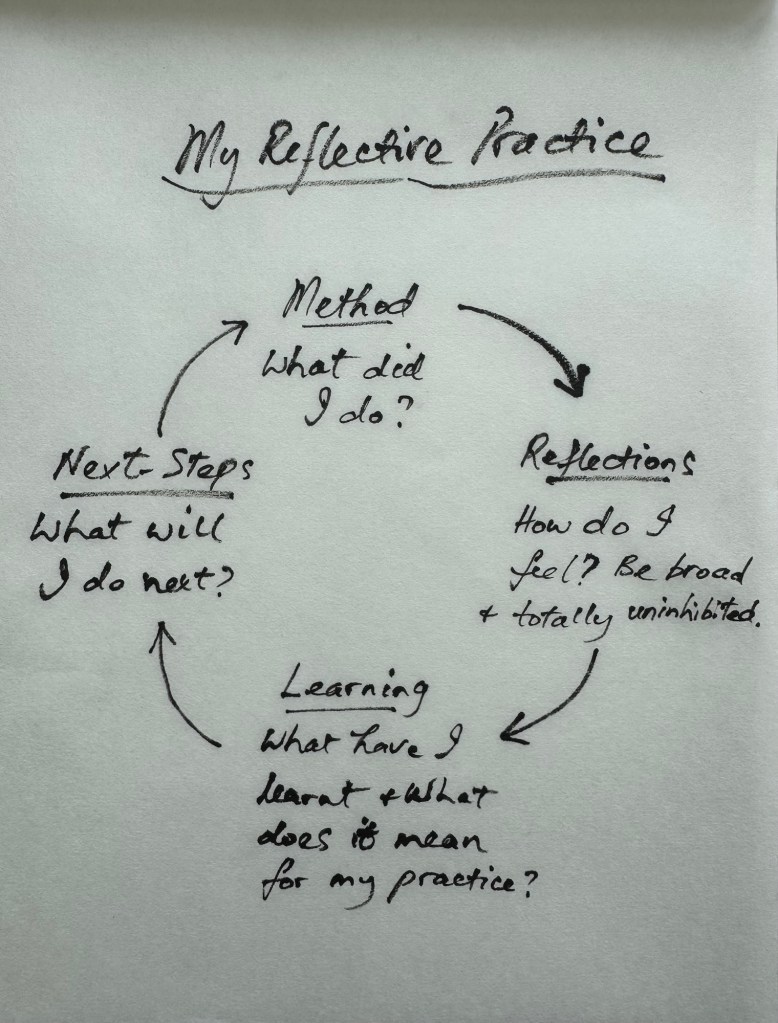
In the blog, I talked about my intention to base my blogs on Kolb’s learning cycle and as a result, I have created the following 4-stage structure and I have been using it for all my blogs throughout my MA course:

1. METHOD (Experiencing stage)

– To capture my making process and decisions along the way.

2. REFLECTIONS (Reflecting stage)

– To capture all my thoughts, feelings, reflections and personal insights throughout as well as after the making process. The aim is to think as broadly and be as uninhibited as possible to ‘open up the horizons’ and/or to ‘dig deep’.

3. LEARNING (Thinking stage)

– To bring my reflections back to the context of my art practice – what have I learnt and what does it all mean for my practice? Also to capture any emerging intentions if appropriate.

4. NEXT STEPS (Acting stage)

– To summarise ‘what to do next’ in clear actions to give direction to progress my practice.

Below is my reflective process in a diagram.

My reflective process

It will be referred to as The ‘MeReLeNe’ process for short from here on.

REFLECTIONS

Writing my blogs in this ‘MeReLeNe’ structure during my two year MA programme has helped me to cement a structured approach and develop my reflective practice. I have been an engineer all my life before coming to the arts and I need an underlying structure in order to liberate me to explore freely and safely, knowing that if I ever felt lost or ‘wobbly’ then I could come back to a tried and tested structure that would give me security and guidance. Since this is a structure that I have developed for myself and tested over a two year period, I feel that I can trust and rely on my process to progress my practice making it sustainable as I feel very committed to it. I have come to realise that it is much more than a safety structure… At times during the last two years, I have felt unsure about what direction to take or felt lost about what to make. Then inevitably I would realise that I have not written my blog for my last piece of work yet, hence I felt lost. Without exception, once I reflected properly in my blog and captured my learning in the context of my art practice, the next-steps would then reveal themselves naturally in the process. Sometimes the next-steps could be simply to ‘make some more’ and that simple statement may seem generic, but I would know where to take it as a result of going through the reflective process.

I am excited about having tested and embedded this structure into my practice. It is now such a fundamental part of my practice that I cannot image working without it because I would soon become lost.

Furthermore, in the last two years, at times I have felt unsure of what my ‘process’ was, was it painting with oil, oil and cold wax, making Cheongsam canvases or painting on newspapers? I found it hard to explain to people when asked about my practice, especially for anyone not familiar with contemporary art. People would ask if I painted landscapes or portraits; watercolour or oil. It’s impossible to give a straight answer when my medium and methods would vary depending on what I was trying to say. It might vary from project to project, but writing this blog has brought clarity to what my art practice is about:

‘My contemporary art practice is about exploring my identity and my environment through narratives. I use whatever medium that is appropriate to help me express what I want to say. My reflective practice is my process.’

LEARNING

I have learnt that I definitely need a structure to thrive in my practice. It provides a safe environment for me to wander and explore freely knowing I can ‘come home’ to this process to consolidate my learning and progress.

The key revelation for me is having the clarity that ‘My reflective practice is my process’. I believe my tutor has allured to this several times recently and I now know what he means.

NEXT STEPS

Continue to use and embed the ‘Method-Reflections-Learning-NextSteps’ (or MeReLeNe) process for my reflective practice.

Start to acknowledge that my reflective practice is my process. Own it.