It has been a while since I last posted about my Chinese brush painting. I continue to attend my monthly Chinese painting class. After completing the Sumi-e classes, we have returned to meticulous style work. I prefer freestyle and would not usually do meticulous style by choice. However, the tutor is rightly insisting on starting a new topic with meticulous style work so that we pay close attention to the anatomy of the subject.
The subject this month is the heron – a beautiful stylish bird that is often depicted in Chinese paintings. The homework was a rather detailed image and we were asked to ‘go big’.
METHOD
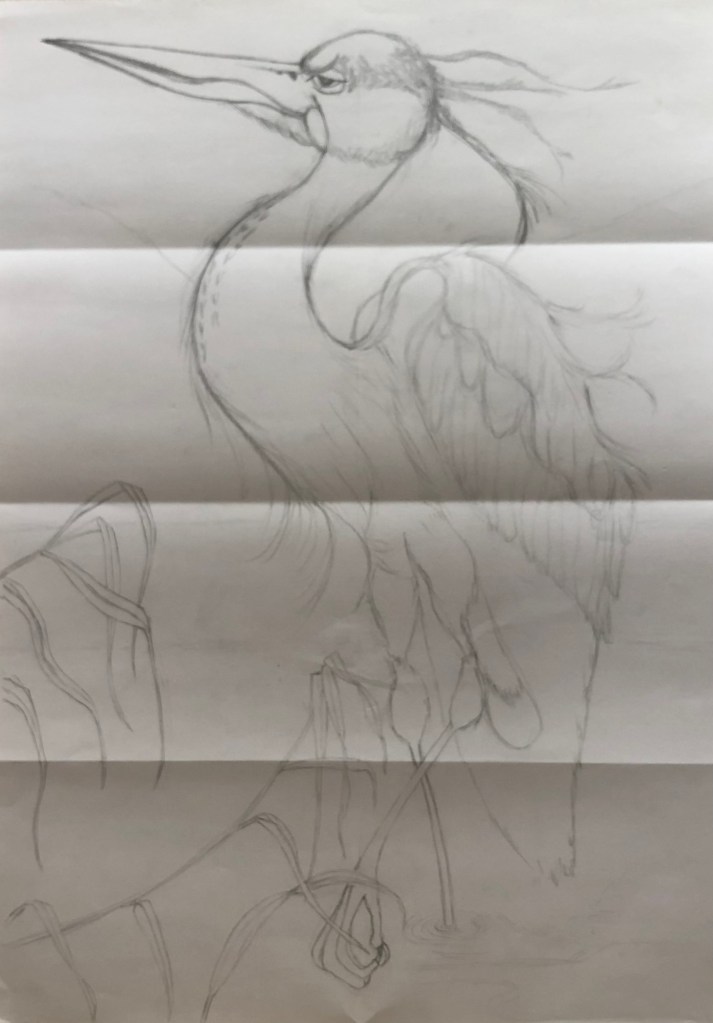
To go big, I did a large pencil drawing of the heron so I can use it as a template for the painting. The tutor said that this method of making a template is not ‘cheating’ as long as the template drawing is done by ourselves, i.e. not just using a photocopy of an image for tracing.
Below is my A2 size pencil drawing:
–
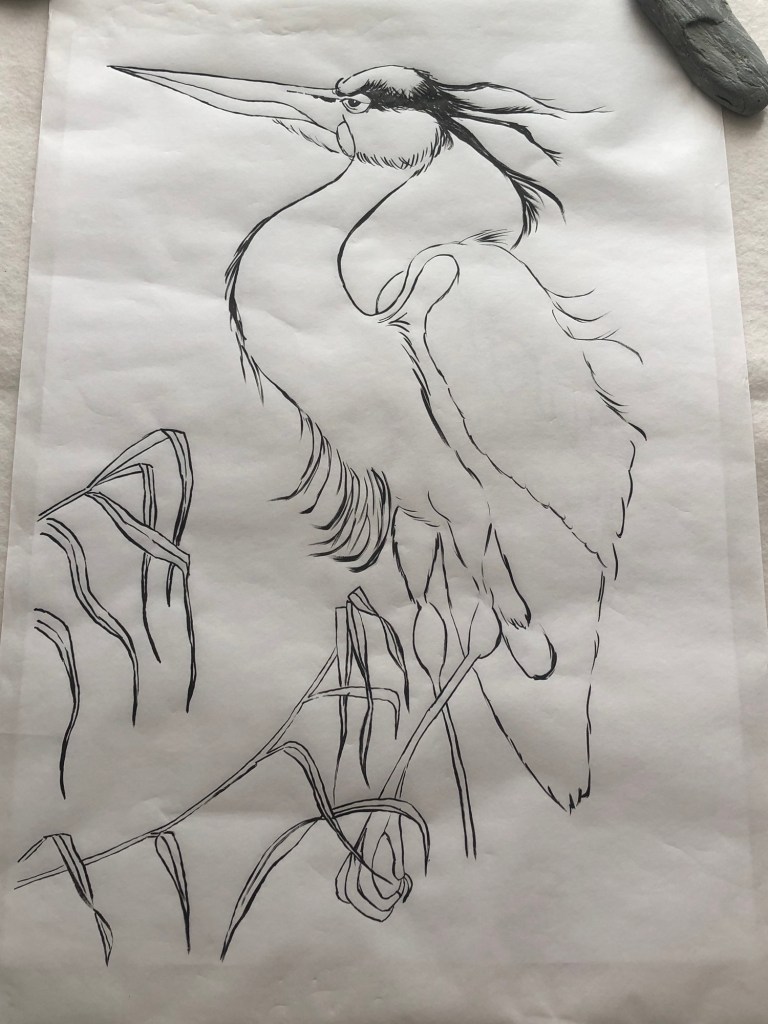
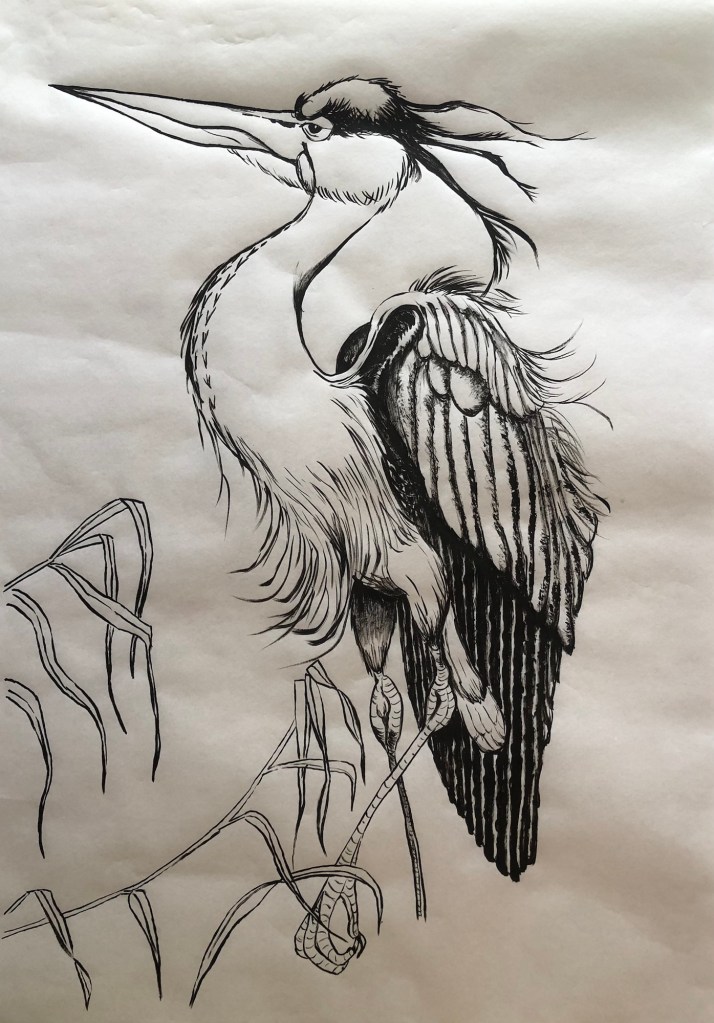
I chose to use Moon Palace paper for this drawing because it was the widest width Chinese painting paper that I have. The paper was laid over the pencil drawing and the outline of the bird was painted using Chinese ink and brush. The brush here was used in drawing mode for the outline, meaning that only the very tip of the Chinese brush was used like a pencil. This stage requires a very steady hand!
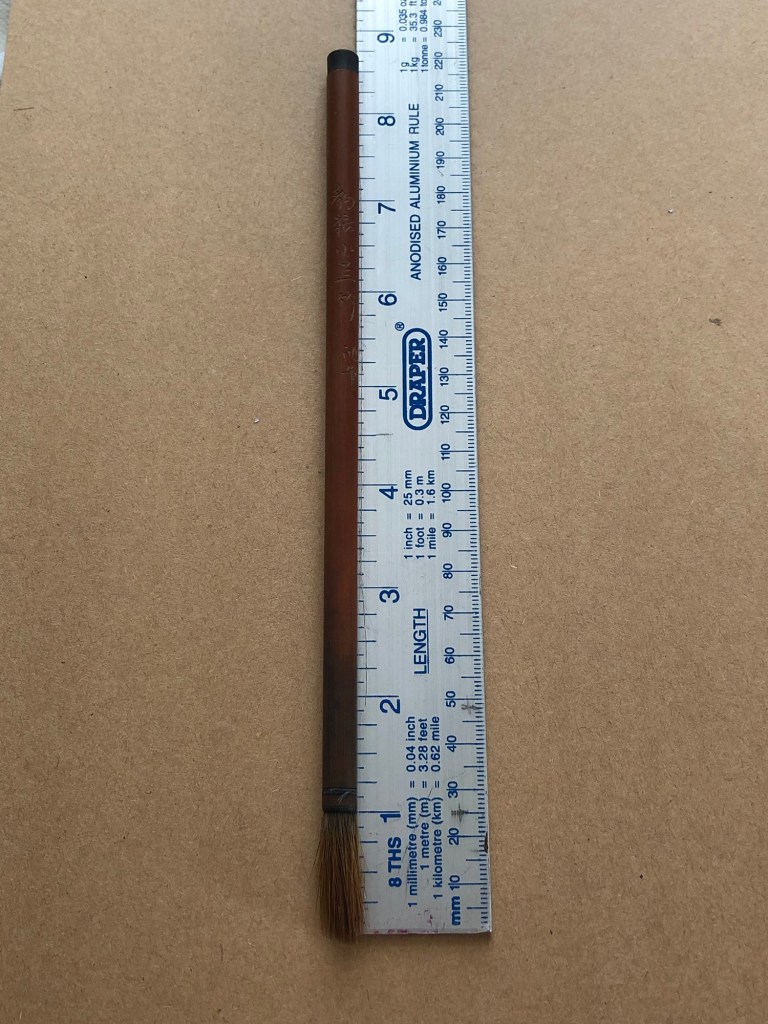
A 30 year old wolf hair brush that belonged to my mother was used for this painting:
Work in progress:
Painting completed with outlines and dark areas ready for colour painting:
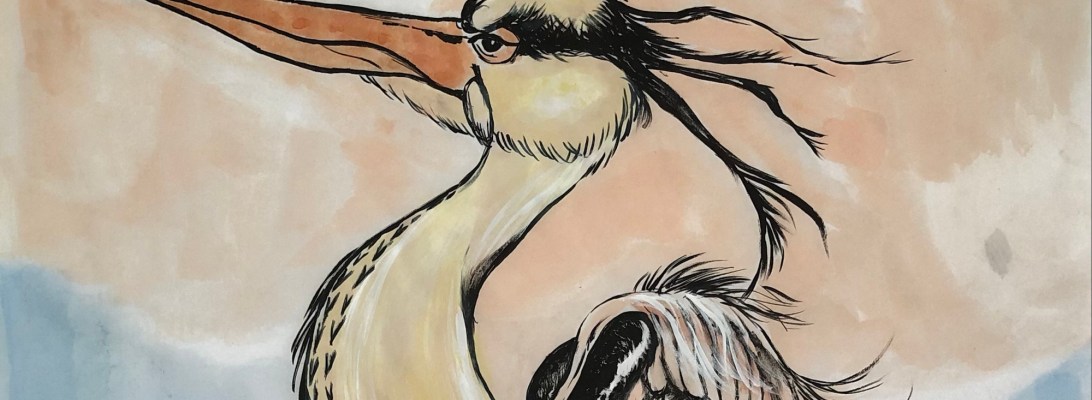
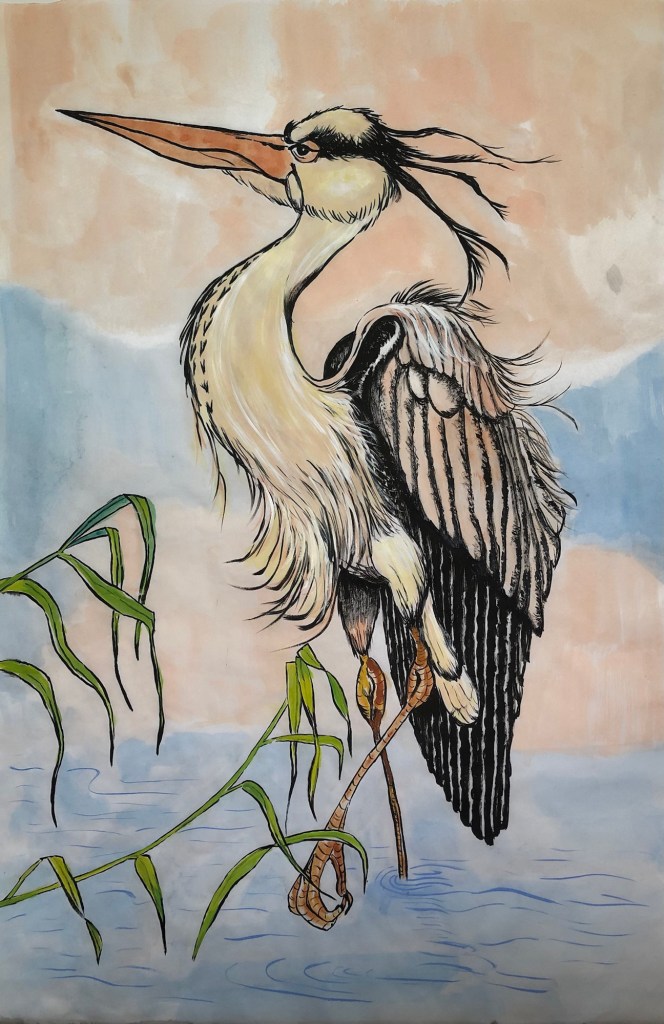
Finished work:
Heron – Chinese ink on Moon Palace paper. Size H68cm x W45.5cm.
–
REFLECTIONS
This is a meticulous style figurative painting. There is technique involved especially in understanding the materials behaviour and working out the optimum process could be challenging. However for me, I feel the illustrative nature of this type of work does not demand the level of thinking or inquiry like making a piece of contemporary art would. So what can I reflect on?
The thought that kept coming to my mind during the making process was – the image seems ‘universal’, so what makes this a Chinese painting? I used Chinese materials (Chinese ink, moon palace paper and my mother’s Chinese wolf hair brush), but the composition in this case seems universal to me. So I posed a question to myself – what makes a painting a Chinese painting? Is it just the materials or does it have to ‘look Chinese’, meaning does it have to possess certain aesthetic qualities? What makes a piece of art ‘Chinese art’? I am puzzled by this and I don’t have an answer yet. It is something that I’ll continue to think about. I may pose this question at my next Chinese painting class and see what others think.
Following on from Cheongsam Series #2, the plan was to create a wearable painting in the form of a Cheongsam. I have little experience in dressmaking but I remember watching my mother make dresses when I was young. She was a very talented dressmaker and I used to enjoy watching her work. I vaguely remember my grandmother being a dressmaker, too, so I guess my mother must have been inspired by her mother. I also learnt sewing at school so I have some knowledge of the process. I started to research how to make a Cheongsam.
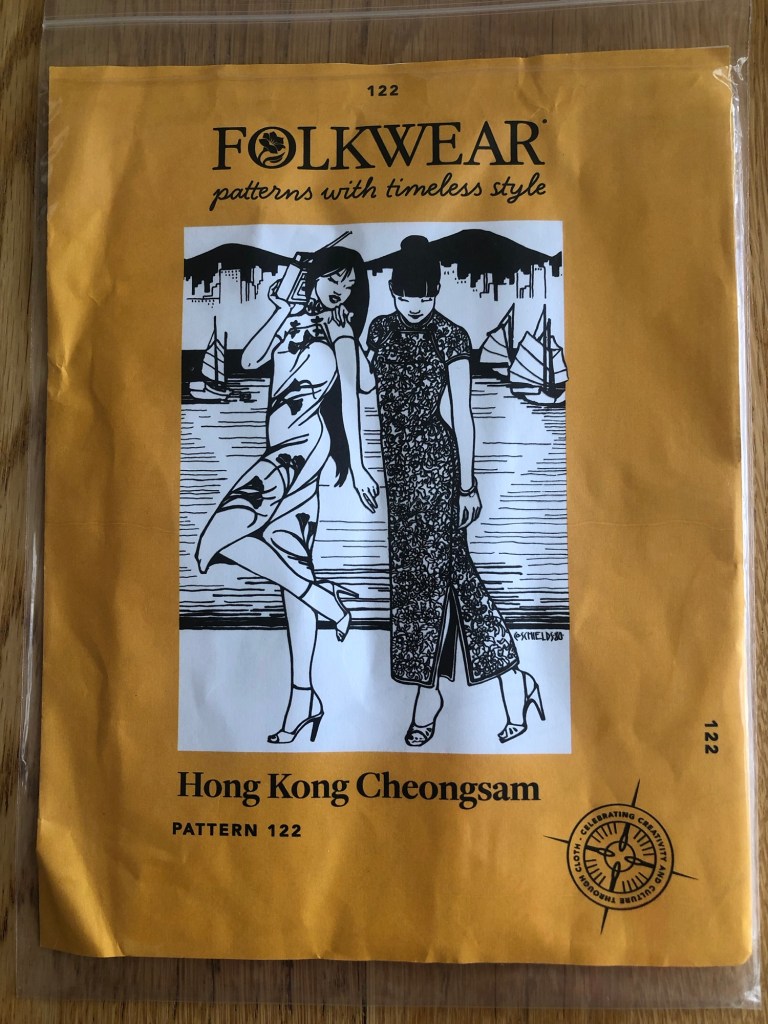
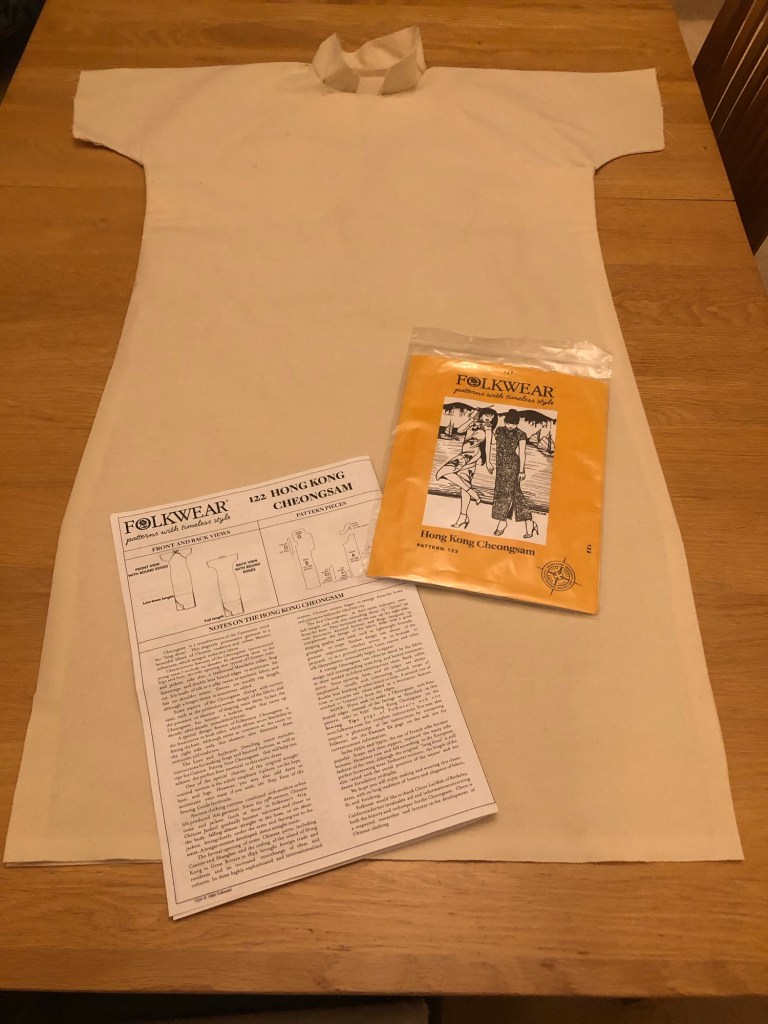
I researched different sewing patterns online looking for one that’s not too complicated and I managed to find one. The reviews of the pattern suggested it was easy to make and I ordered one.
METHOD
–
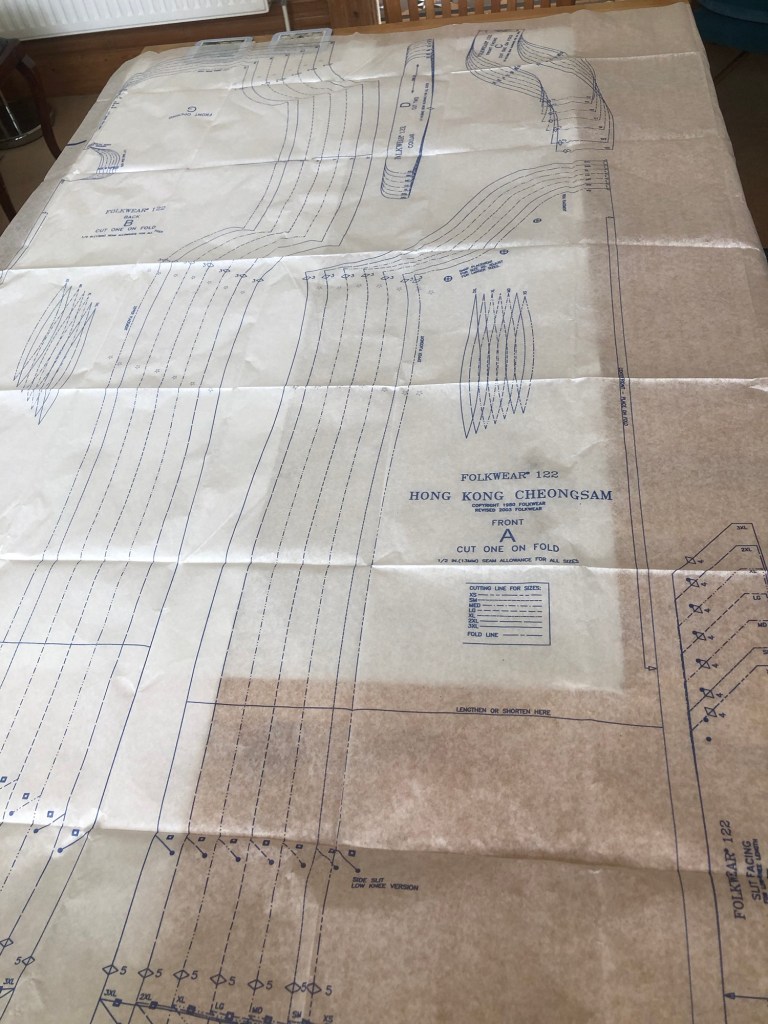
The pattern seemed straightforward and simple which was a great way for me to learn to make a Cheongsam. I measured myself and chose a size on the pattern.
–
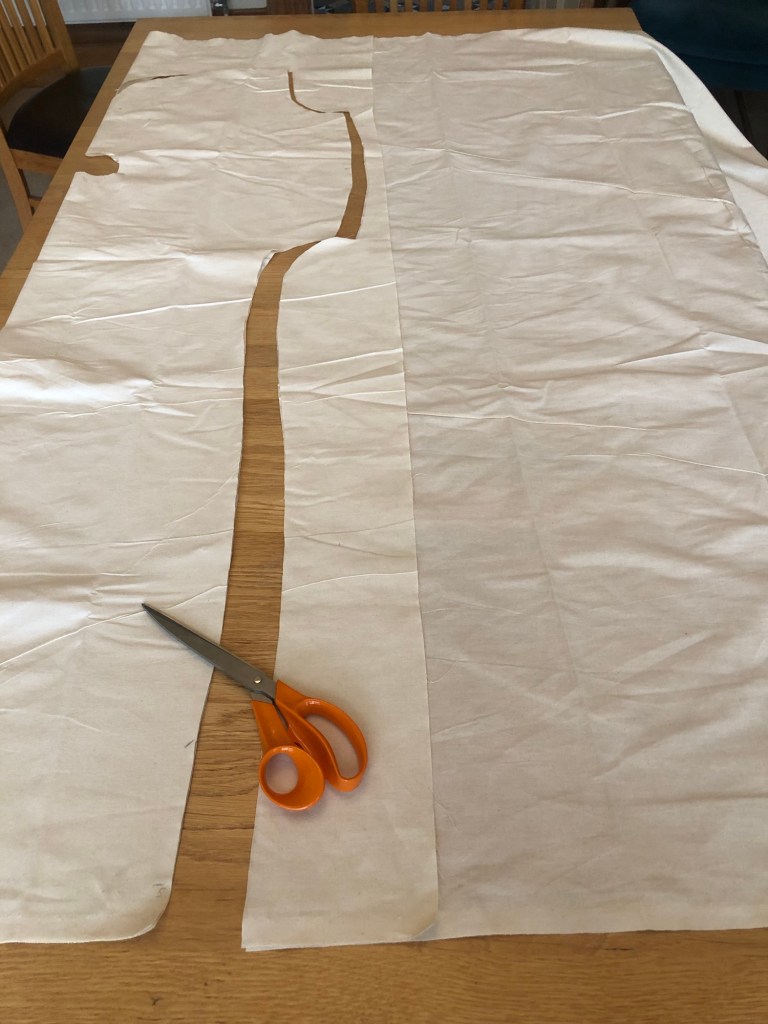
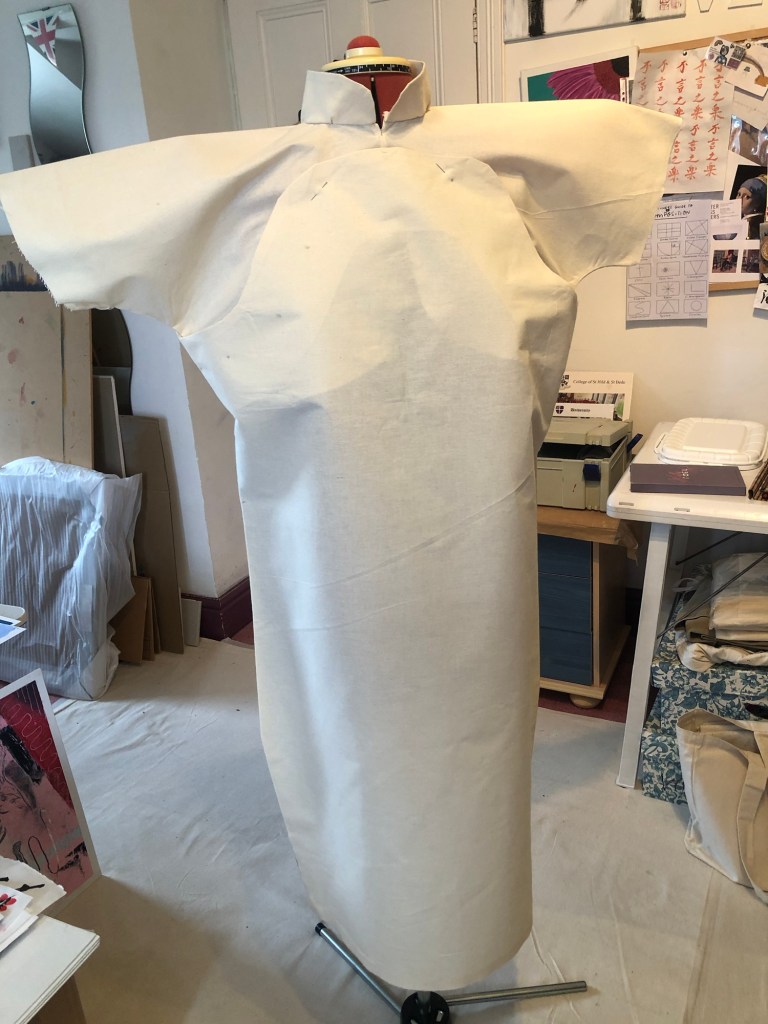
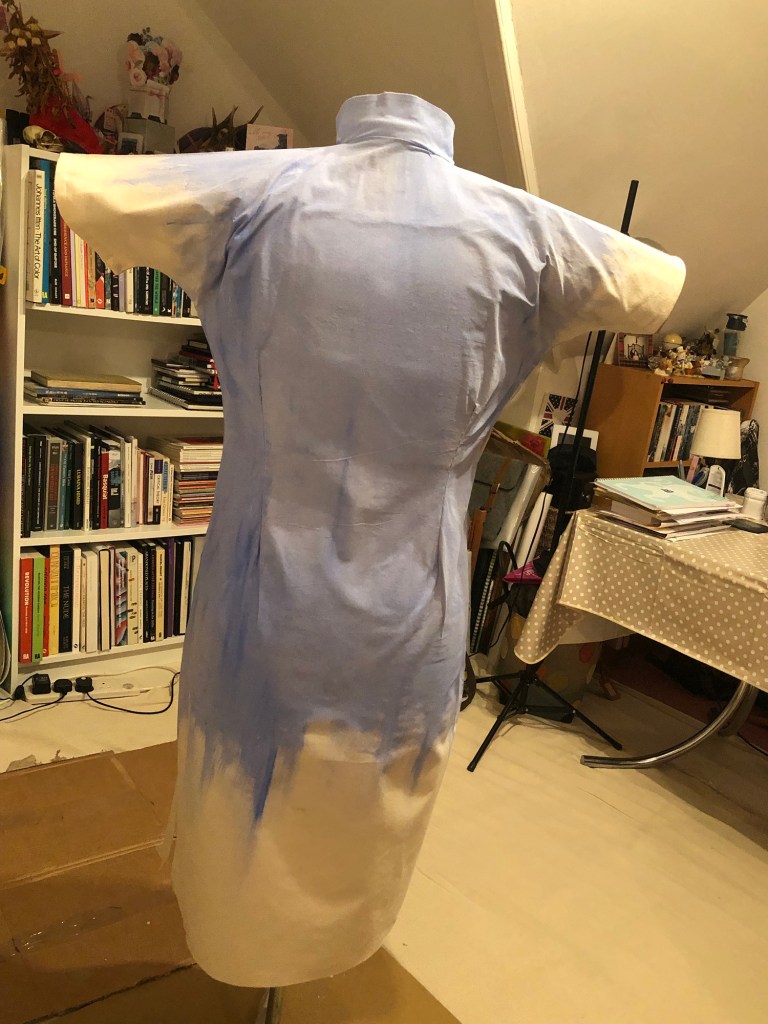
The fabric I used was a light weight calico cotton canvas material. I felt the light weight yet tough texture of the fabric was suitable for a wearable painting.
–
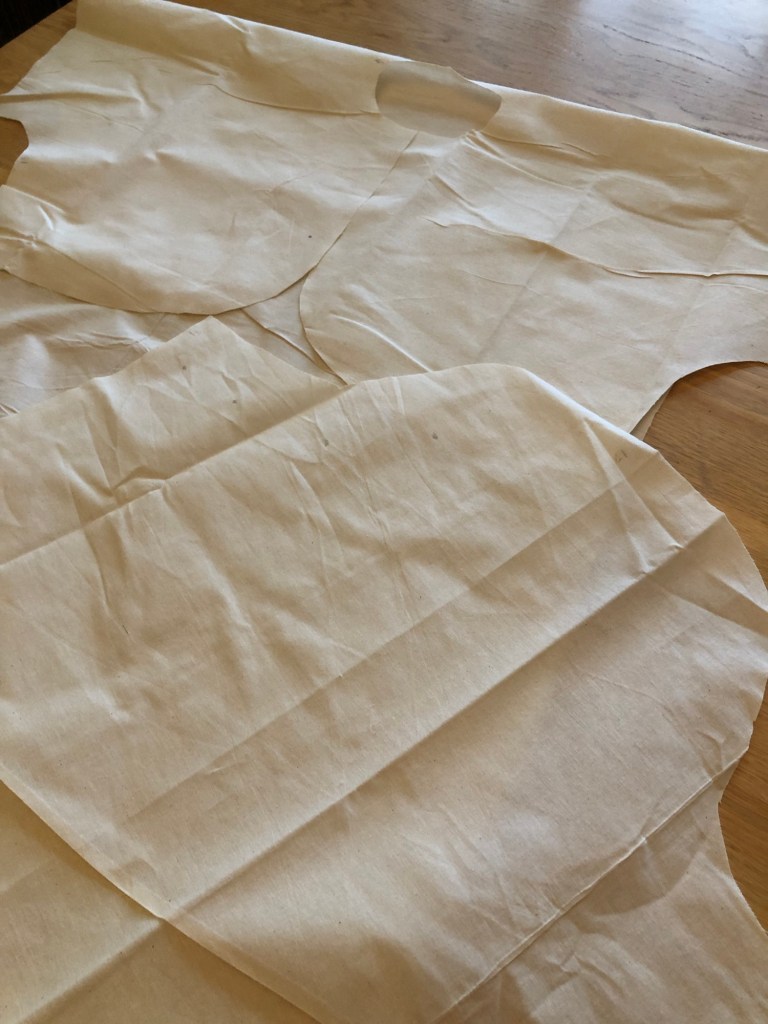
Pieces of canvas material was cut according to the pattern.
–
My 40 year old sewing machine which has not been used for many years refused to work due to years of neglect. So I had to hand sew the dress.
–
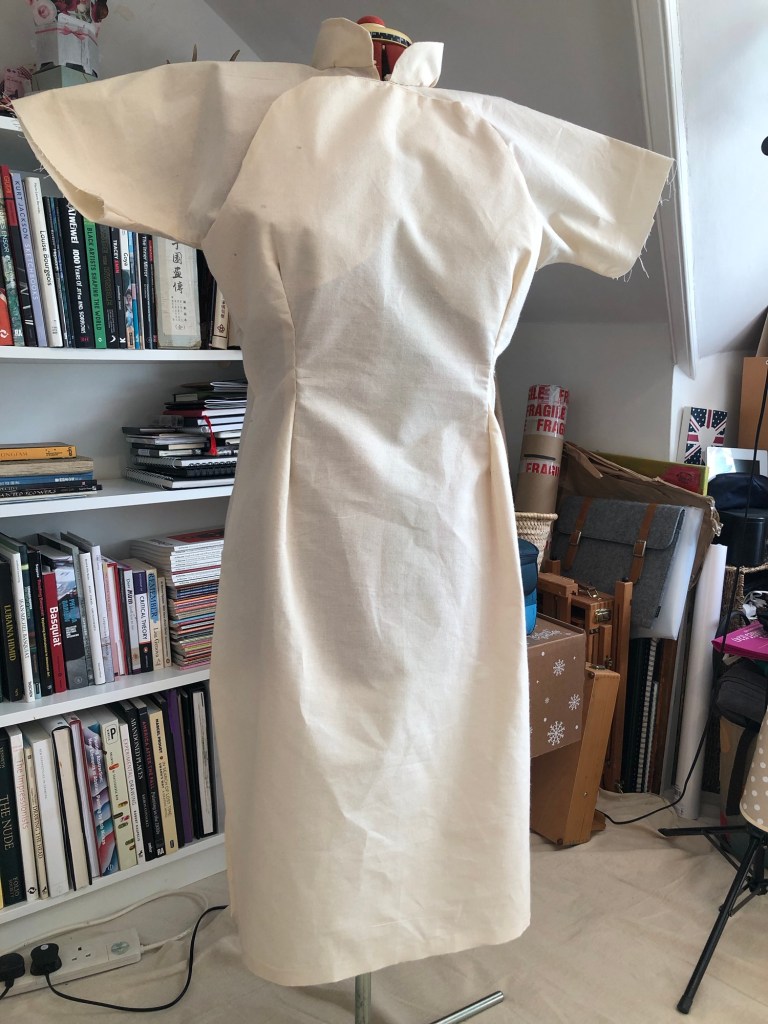
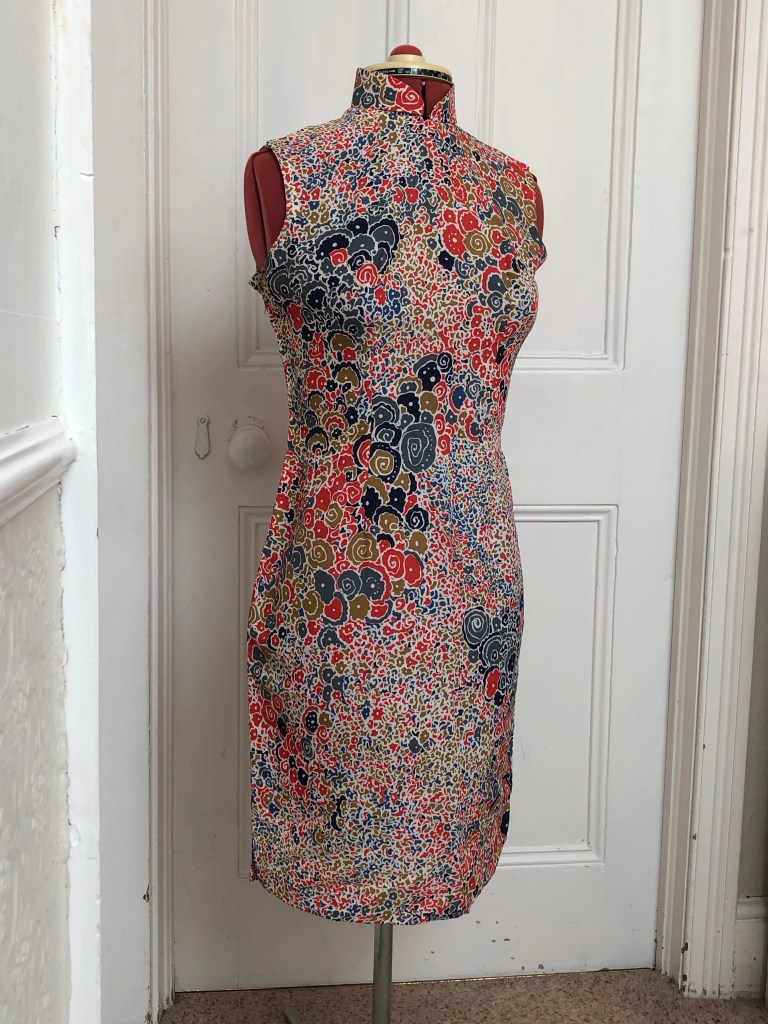
The canvas dress was put onto a dress maker’s mannequin for finishing.
–
I was overly generous in my fabric cutting so the dress felt very large. The sewing pattern had provision for darts for a tighter fit. So I marked those out and sewn darts onto the front and back.
–
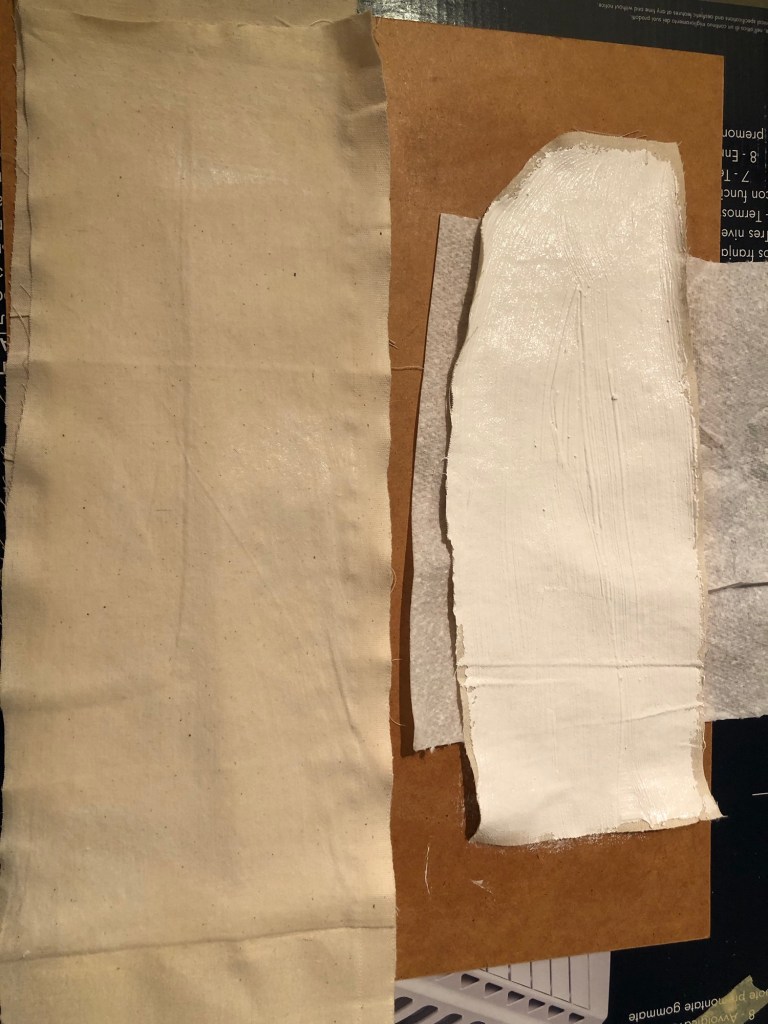
To decide on a primer for the canvas dress, both gesso and diluted white acrylic paint were painted onto fabric samples as experiments.
–
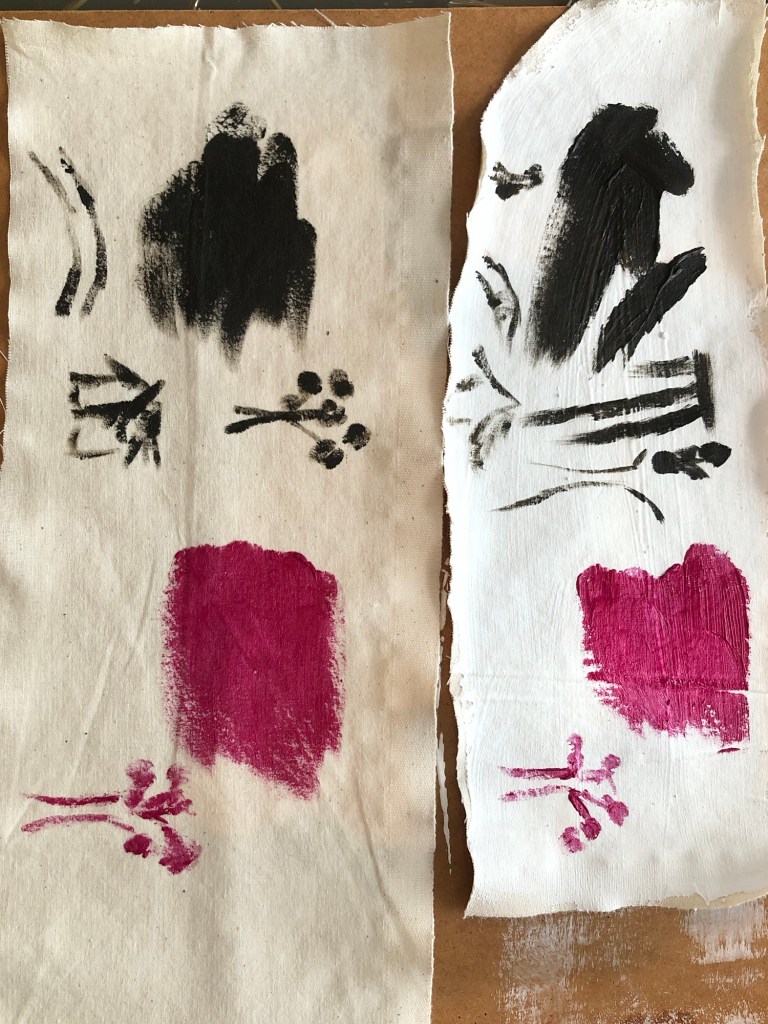
Once dried, acrylic paint was applied to both surfaces to see which would perform better. The gesso was preferred because it provided a smoother surface.
–
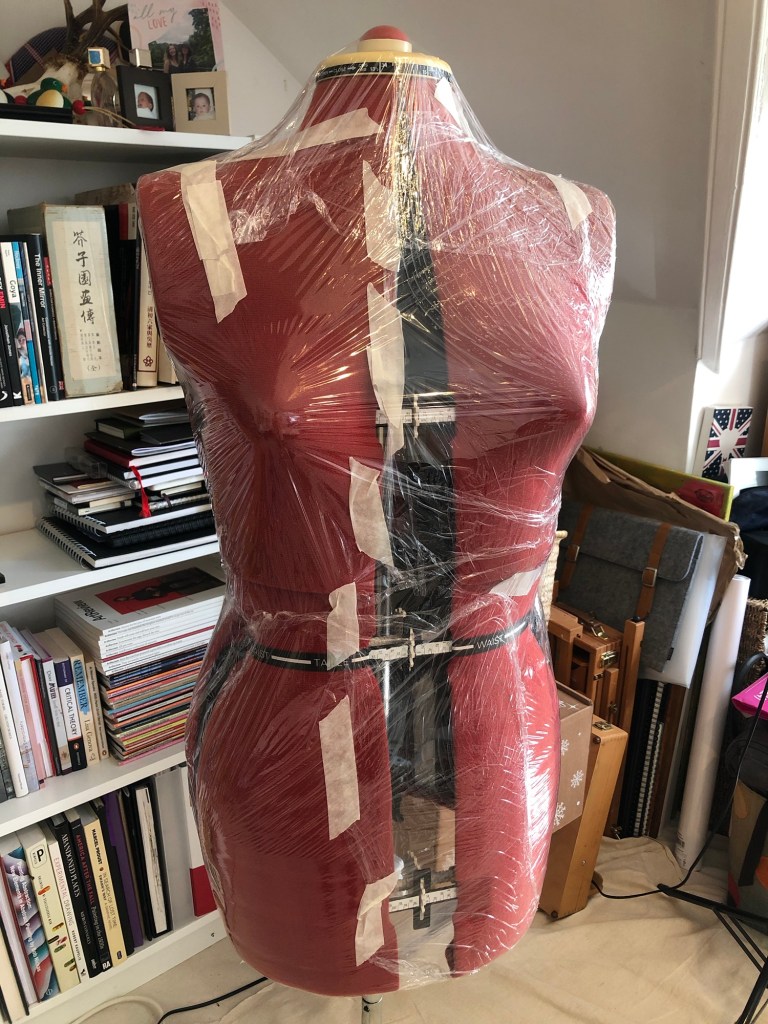
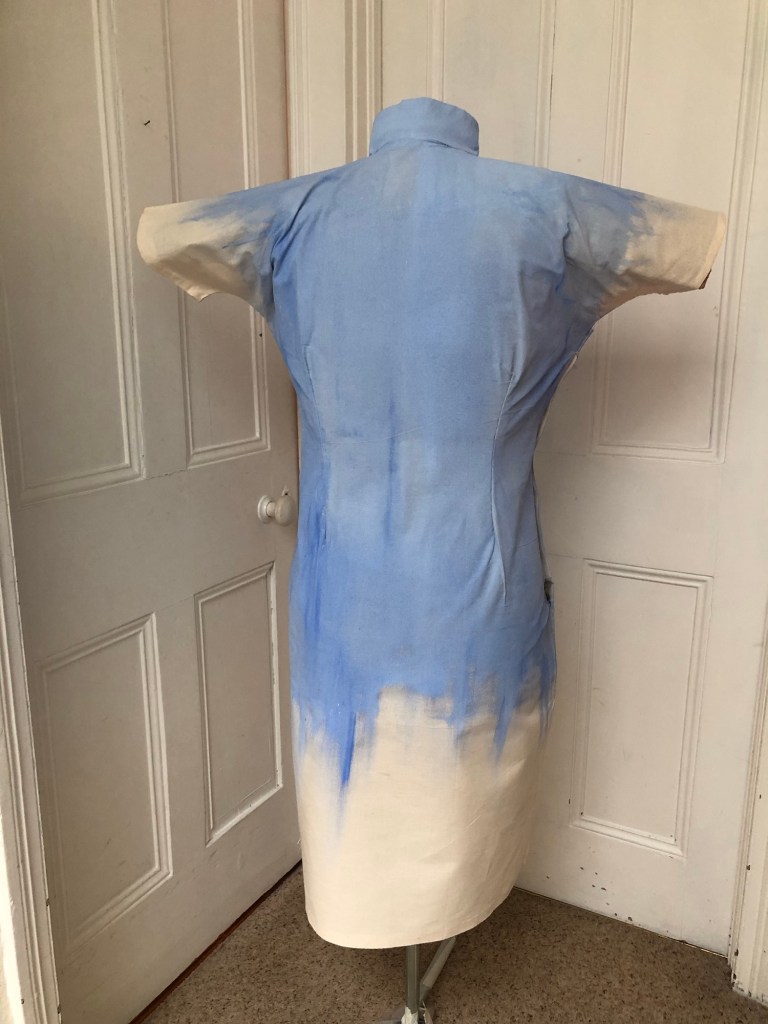
Since the fabric was light weight, the mannequin was wrapped in clingfilm for protection from the painting process.
–
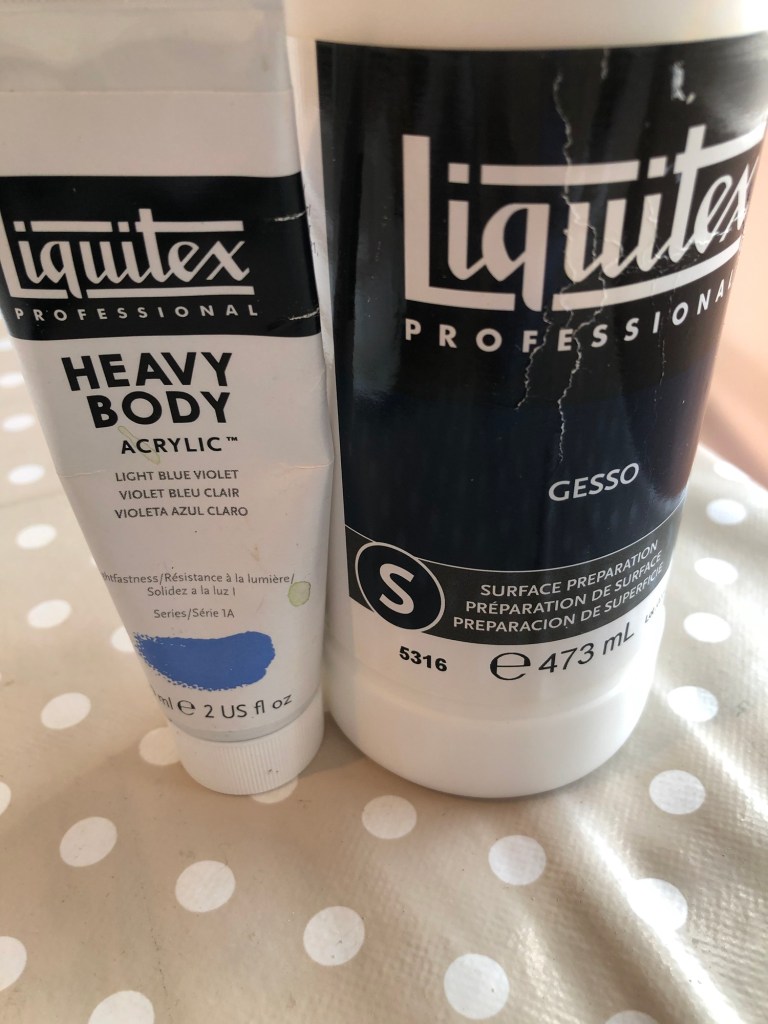
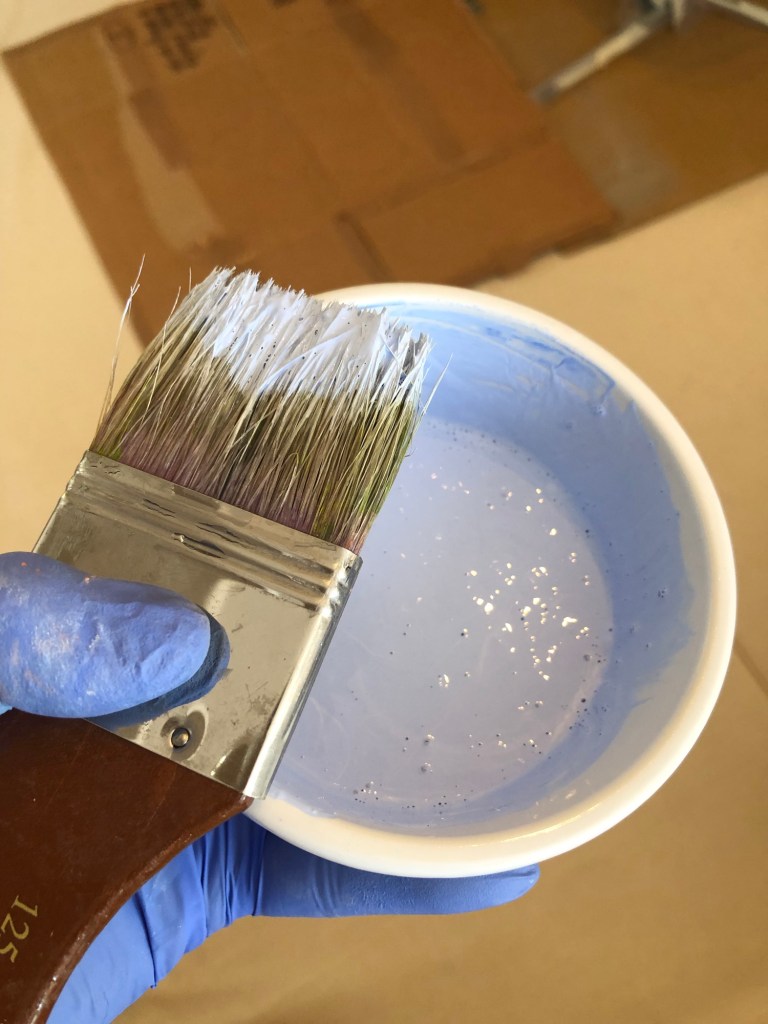
White gesso with acrylic blue tint were diluted as primer.
–
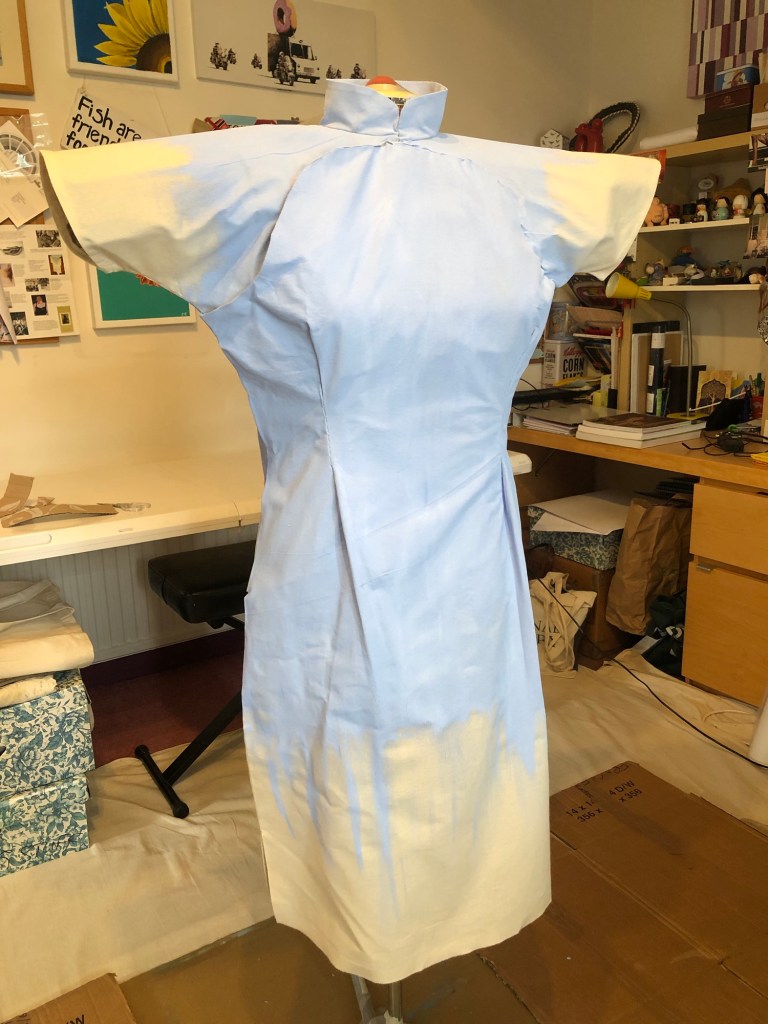
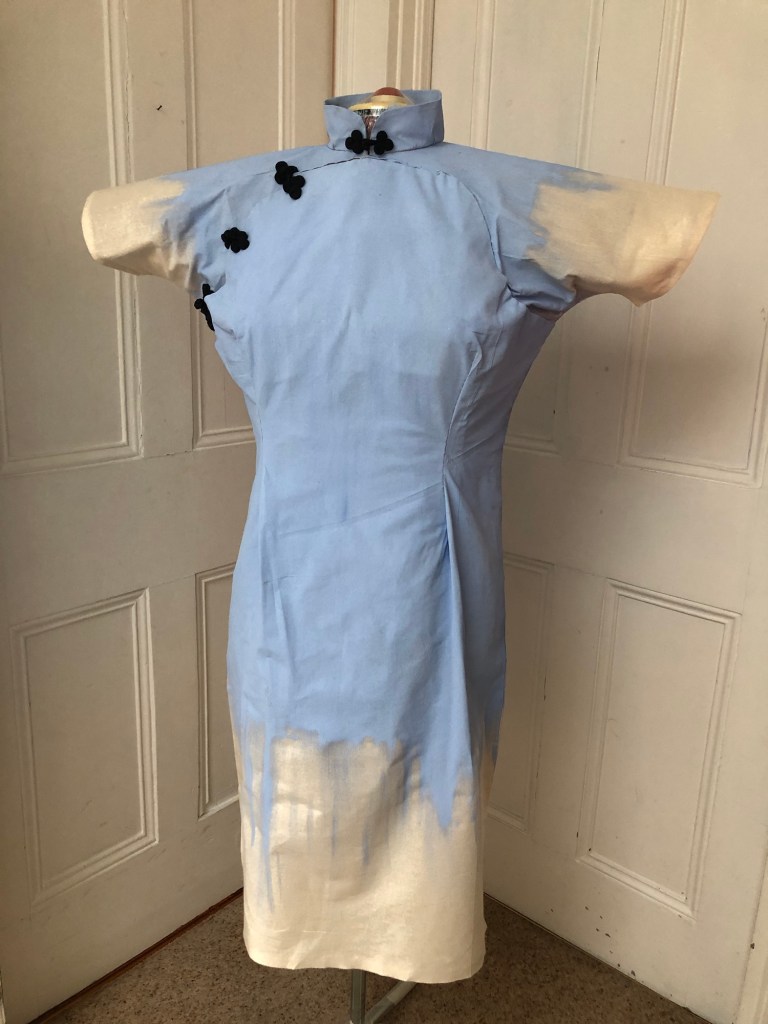
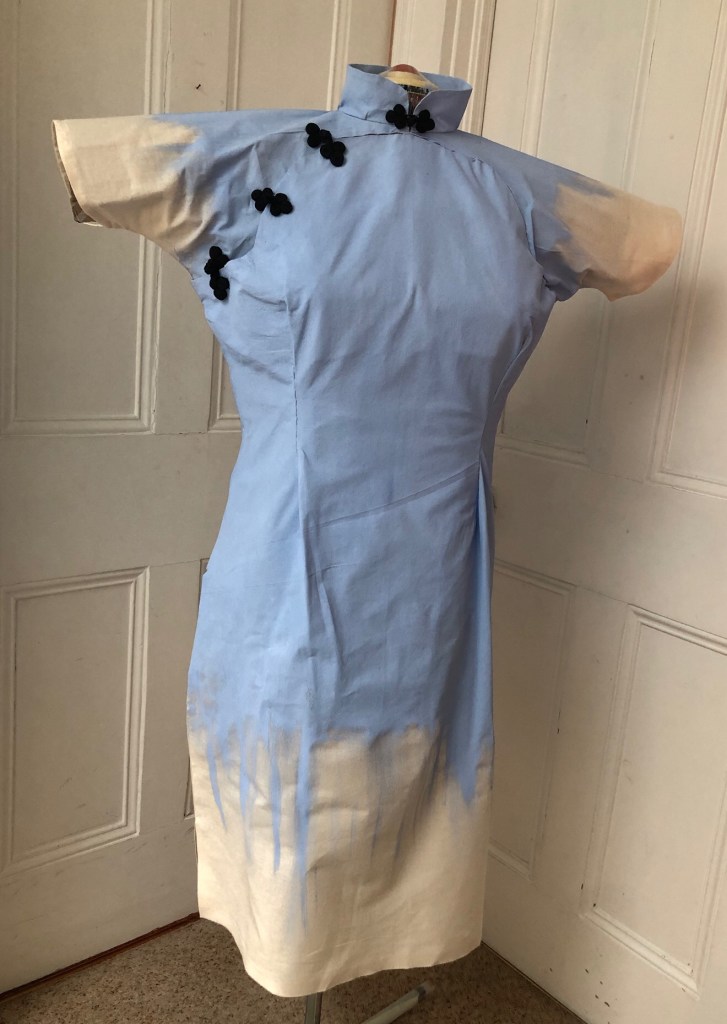
The canvas dress was primed on both sides. The tint worked well and I could use that as the background for the painting.
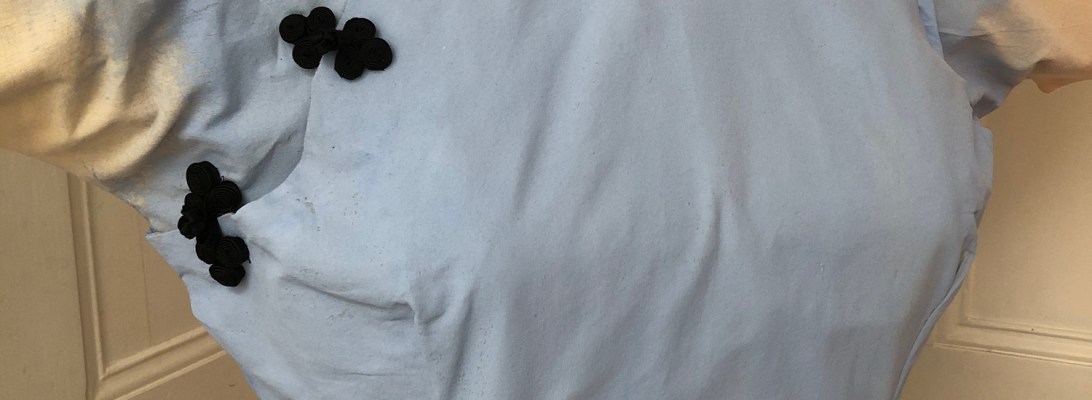
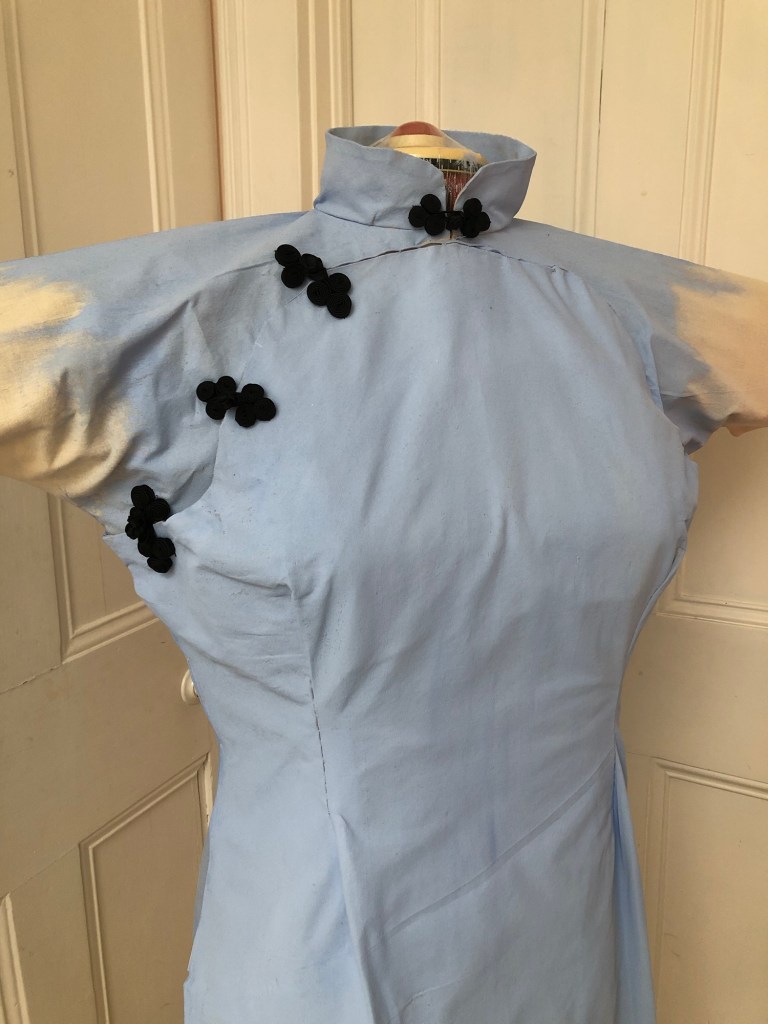
The final finishing step was to add the frogs (tradition fabric buttons or fasteners).
–
REFLECTIONS
I am pleased with the fact that I managed to make a canvas dress using a bought sewing pattern. This experience has given me confidence to take on other sewing or textile projects which will provide an addition dimension to my practice which I feel excited about. For now, I have made a 3D canvas in the shape of a Cheongsam and primed it. Although the painting was not yet finished, I wanted to pause and reflect on the progress so far and take time to consider what to paint on the dress.
The Cheongsam series started as a result of me finding my mother’s old Cheongsams in my loft, which triggered intrigue and inspiration for me to make work on the Cheongsam subject. I know little about the Cheongsam and I am starting to research about its history especially its evolution and how the style changed over time partly due to influences from the West. E.g. the Cheongsam started off as a loose fitting garment, however, as European designers such as Christian Dior marketed more figure-hugging dresses that were pinched at the waist, the Cheongsam started to evolve as Chinese women wanted to emulate European fashion. From around mid-20th century, the Cheongsam started to evolve as a result of the two cultures coming together and the new figure-hugging silhouette emerged which lasted till today. To this end, I believe the modern Cheongsam is a form of a Third Space phenomenon which fits in well with my overall research topic based on Homi K Bhabha’s book, The Location of Culture. My knowledge on the Cheongsam is very limited and I will be borrowing several books on the subject from CSM library. I look forward to finding out more to inform my Cheongsam series of work.
Having established that the modern Cheongsam is potentially a Third Space phenomenon, I would like to use the 3D canvas dress made here for a painting to show something about the Third Space, perhaps another Third Space phenomenon. I am considering making a series of Cheongsam canvases, each painted with a Third Space phenomenon and all as wearable paintings. I want to make them wearable so that they are metaphors for the uniform that transcultural people wear and the roles that they play as they navigate the different cultures in their environment. This work can help to inform my transcultural identity and heritage research.
LEARNING
I have learnt various techniques while making the dress and the experience will be useful as I go onto making other garments to feed into my practice.
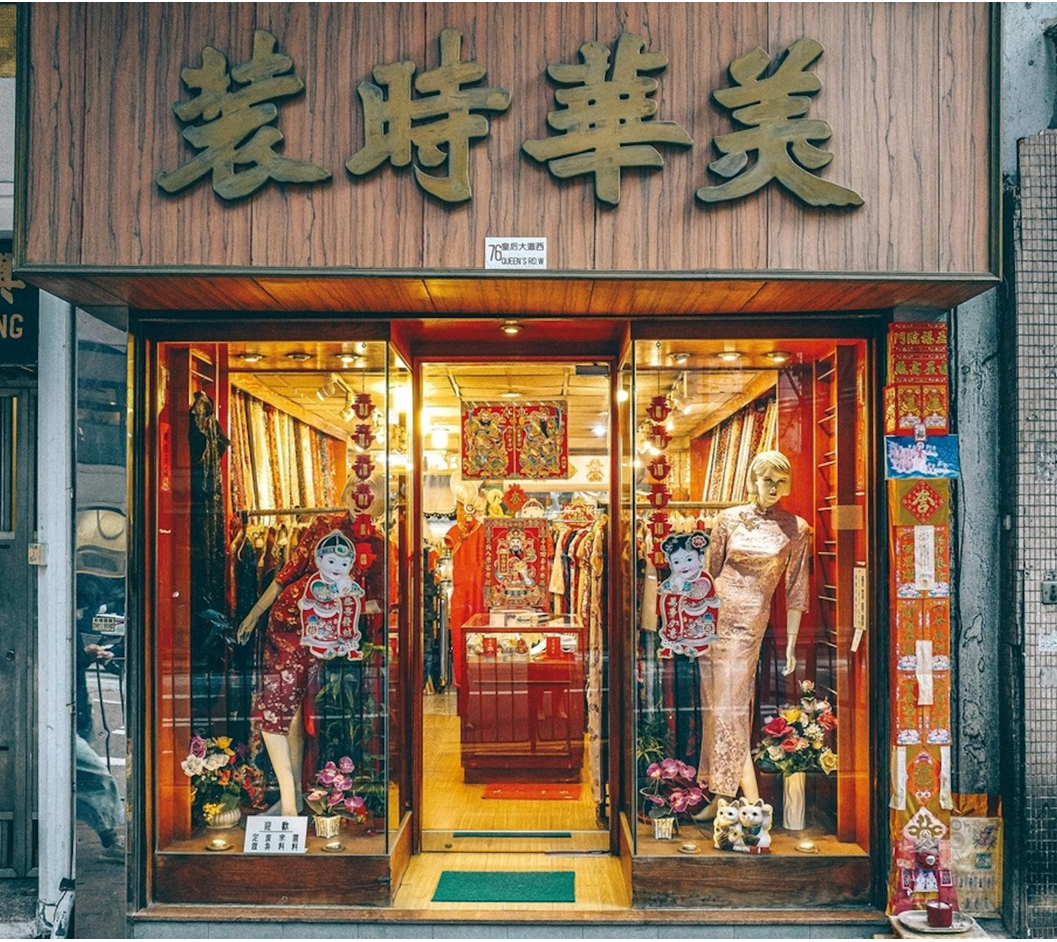
I need to learn more about the history of the Cheongsam because it intrigues me and is an interesting part of the Hong Kong heritage that will help inform my art practice. Especially with my late mother being a skilful dressmaker and I remember clearly the dress that I found being in her wardrobe for many years. My older sister remembers visiting the tailor’s shop with my mother to order the dress. In fact, she has recently found the history of the shop for me – it still exists in Hong Kong.
–
NEXT STEPS
Decide what to paint on the canvas and do the painting.
Research about Cheongsam to build on the series of work.
where I had made an abstract painting after finding my late mother’s Cheongsam in my loft, I was unsure of where to go from there. I enjoyed the making process in series #1 but didn’t feel like building on that particular piece of work. At the end of series #1, I said that I would make some informal work and have a play in my sketchbook. I studied the dress again to get inspiration. When nothing came to mind, I decided to do some drawings and use that time and the act of drawing to facilitate my thinking.
METHOD
A pencil drawing studying the unique shape of the Cheongsam was made as a first exercise:
I have always been mesmerised by the pattern of this particular Cheongsam of my mother’s:
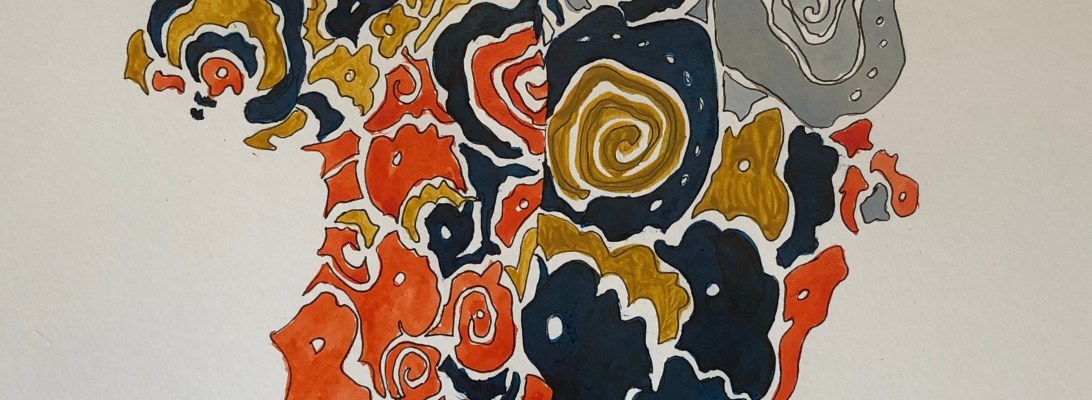
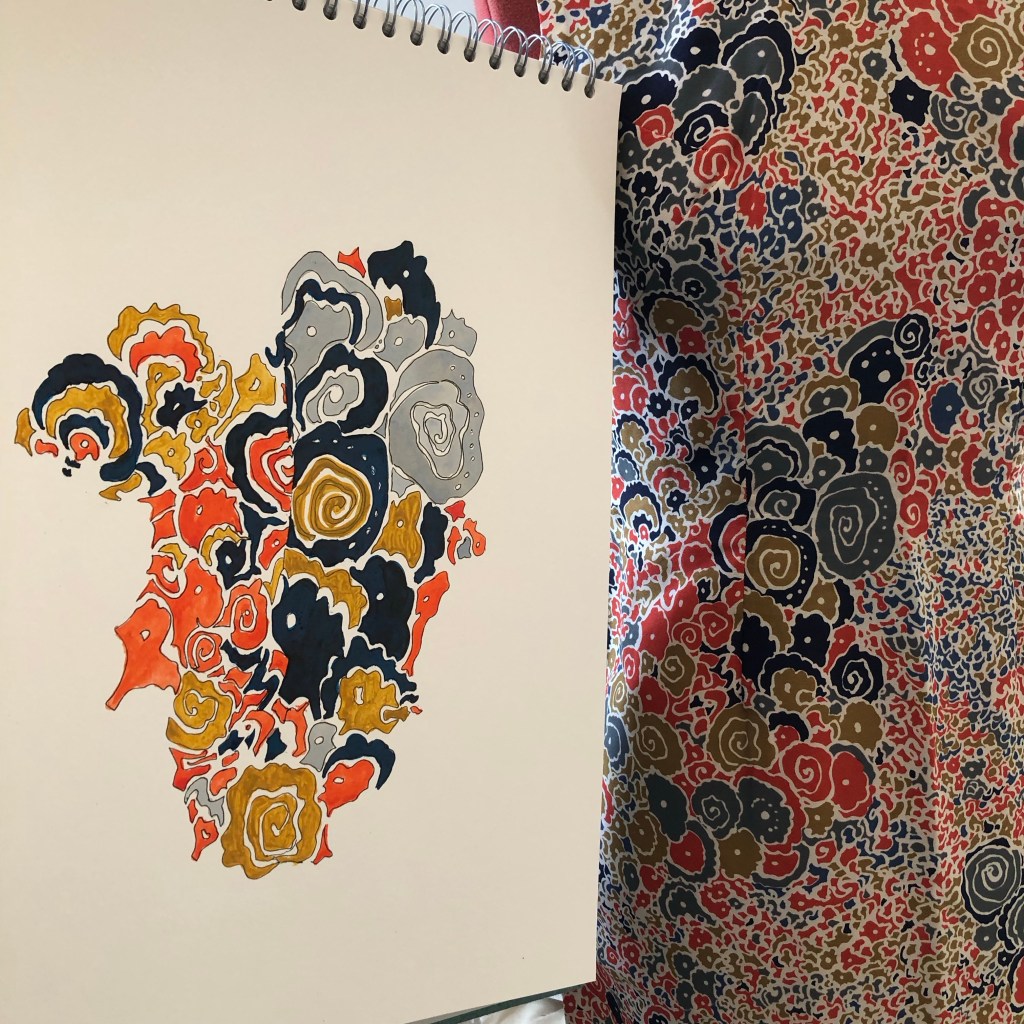
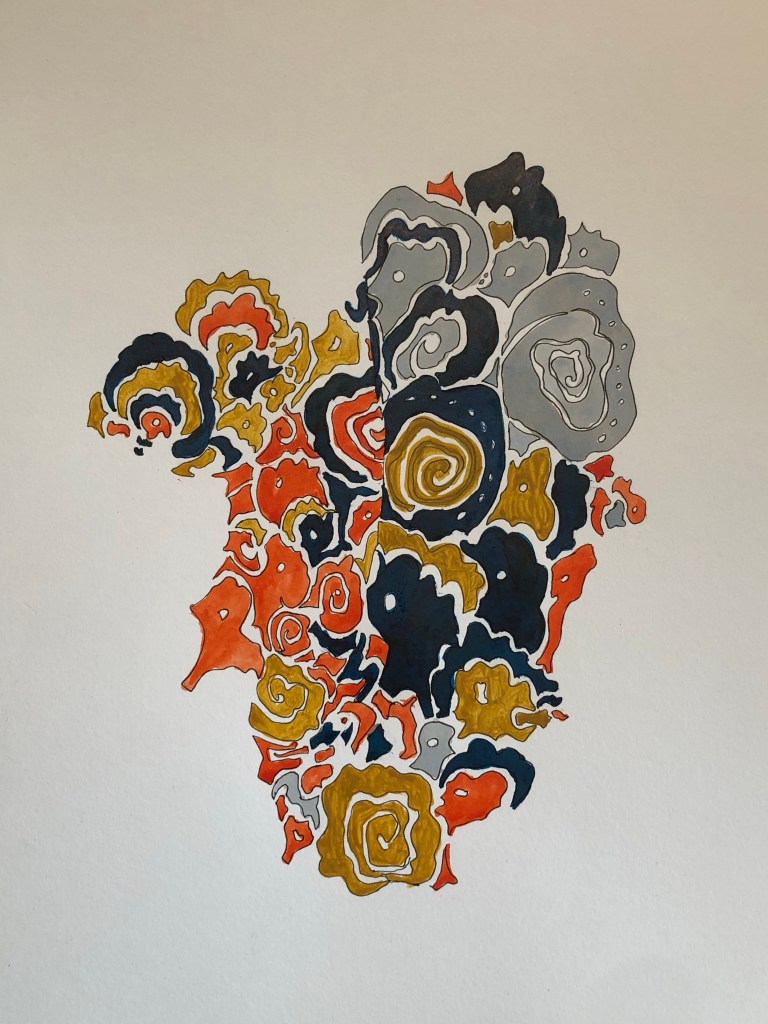
So I made a colour study of the most memorable part of the pattern. This area of the pattern has been imprinted on my mind since I was a little girl.
–
Since the fabric and the dress are so delicate, I wanted to use ink for the colour study. Any paint such as oil or acrylic would seem overly heavy.
–
The initial blue ink was too bright, so a darker blue ink (Quink) was used to complete the study.
A study of an abstract pattern on a mid-20th century Hong Kong cheongsam. Ink and pen drawing
REFLECTIONS
I was pleased that I managed to follow through on the plan I had set myself after the last painting – to make some informal work, hence the sketches. Also, I kept thinking about my tutor’s advice – just keep making, make anything – objects, images etc. I have not done much drawing since starting my MA and it was good to play in my sketchbook again.
During the drawing, my mind wandered onto what work to make next. I was so mesmerised by the cheongsam and the fabric pattern that I wanted to make one – to make a cheongsam. I didn’t just want to make a dress, I wanted to make a wearable painting cheongsam. I thought about making a cheongsam using a canvas material then painting on the 3D canvas dress. I have had many ideas about making wearable paintings in the past and that thought has just occurred to me again. So I think it’s time to do it.
Making a cheongsam is not easy and I’m not an experienced dress maker. So I researched online to find easy to make dress patterns. Also, I researched online the books available at UAL to find out more about the history of the cheongsam. I have reserved four books at CSM and also purchased one online. I’m looking forward to properly embarking on this research project to inform my cheongsam series of work.
LEARNING
– The drawing exercise was very useful and enjoyable. Since it was not a highly challenging piece of work, I was able to let my mind wander and came up with ideas of making wearable cheongsam paintings. I should use drawing more as a way to explore and think. I know it does work, I just need to do it more.
– I bought a book on the history of cheongsam online and realised I should have looked at the UAL library first. I was delighted by the library’s materials on the cheongsam and the facility to borrow books from other UAL college libraries was very useful. UAL also had a copy of the book I bought, so I could have saved some money – must remember to search the library first next time.
– I am excited about starting the next project on making a wearable painting with opportunities to research the dress’ history as well as the materials for this application.
NEXT STEPS
– Make a wearable cheongsam painting based on the ideas that came to mind during my sketching.
– Research the history of the cheongsam so I can be more informed in my making.
During one of my visits to Hong Kong some 30 years ago when my mother was still alive, she gave me four dresses as keepsakes – two hand tailor-made silk Cheongsams (traditional Chinese dress) from when she was a young woman and two evening dresses that she made herself for dinner balls that she went to with my father. One of the cheongsams was my favourite, it had a distinctive and memorable pattern. I remember very clearly that I used to open her wardrobe as a little girl to admire it and I was mesmerised by the pattern. Everything about it said ‘my mum’ to me. So I was very happy when she gave it to me to keep as it was very precious and had so much history.
Then in 2001 when I moved house (in Bristol, UK), I cleared lots of old things into a skip. As the skip was driven away, I remembered a small suitcase containing the precious dresses was accidentally thrown into the skip but it was too late. It was one of the things that I have regretted all these years.
That was some 22 years ago. Then earlier this year, I was clearing out the loft and found a box containing some old items, inside which was a plastic carrier bag contain the four dresses. It was as close to a miracle as I could image. I hadn’t thrown away those dresses after all! To find them again after all these years was an emotional moment for me.
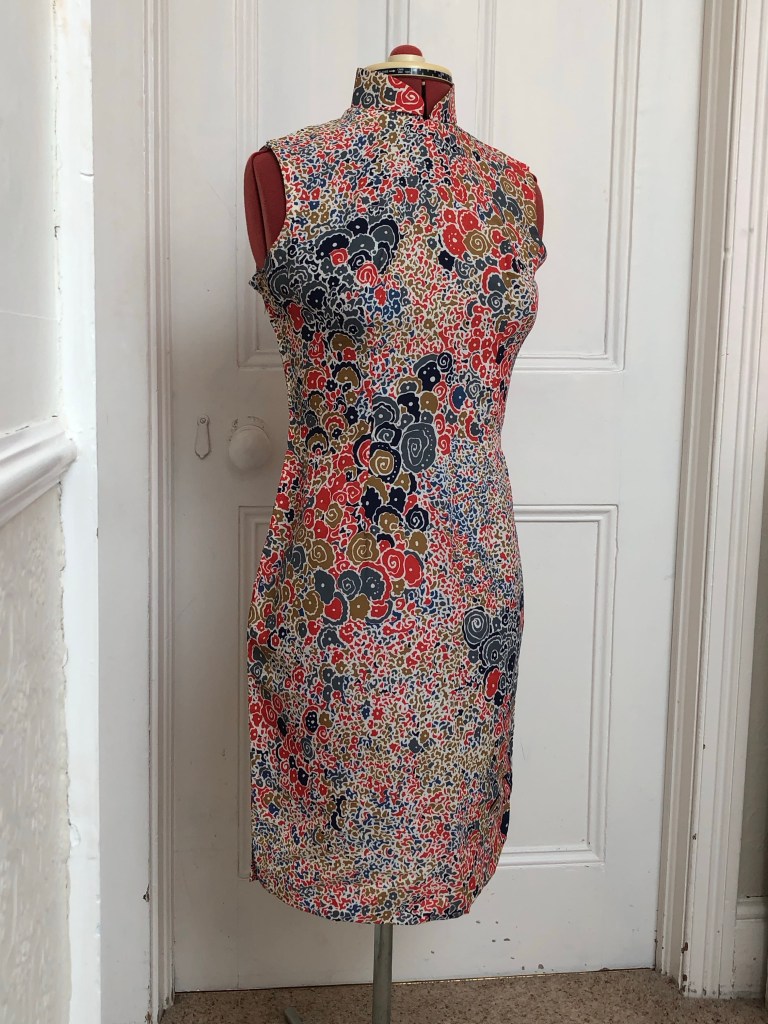
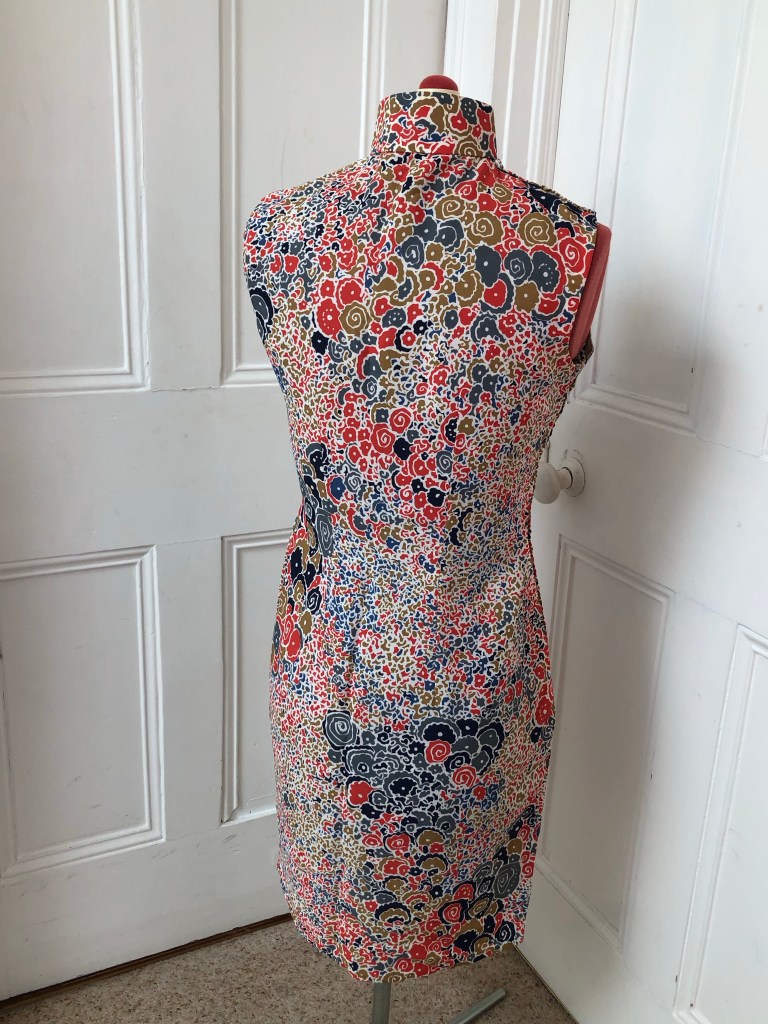
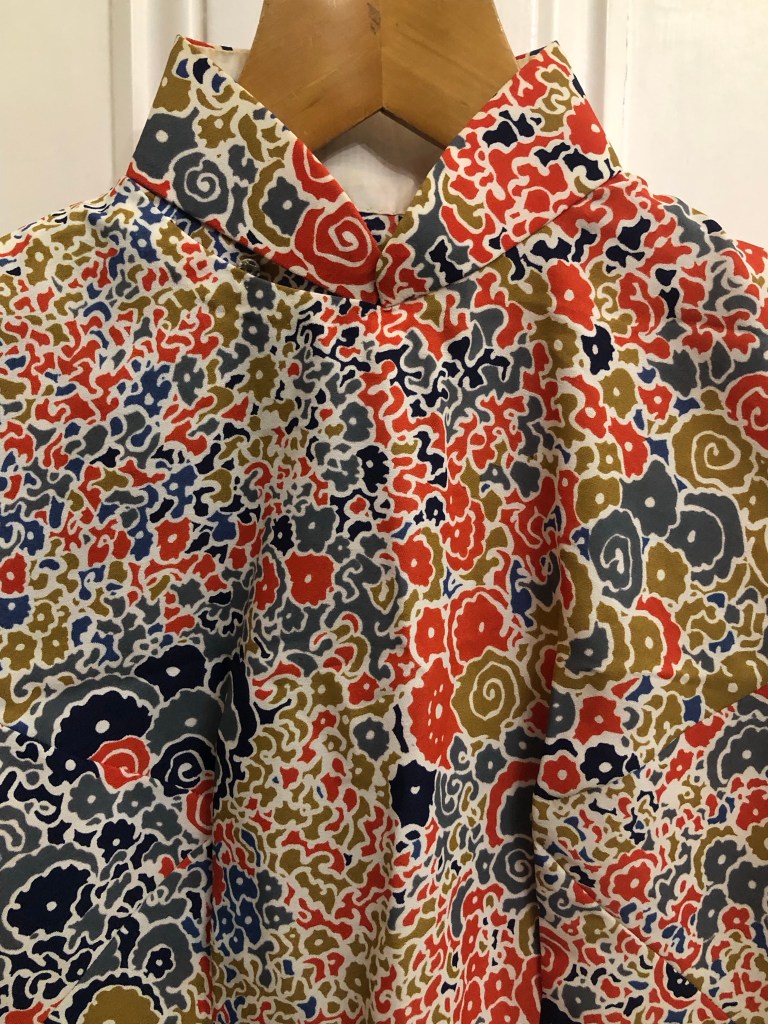
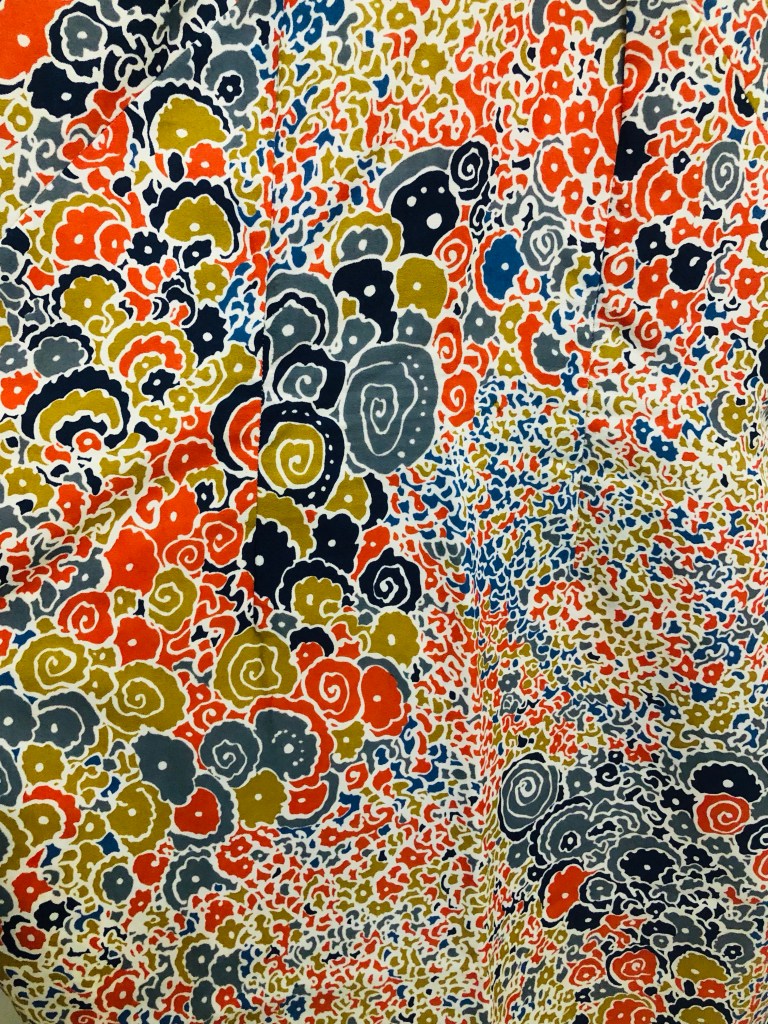
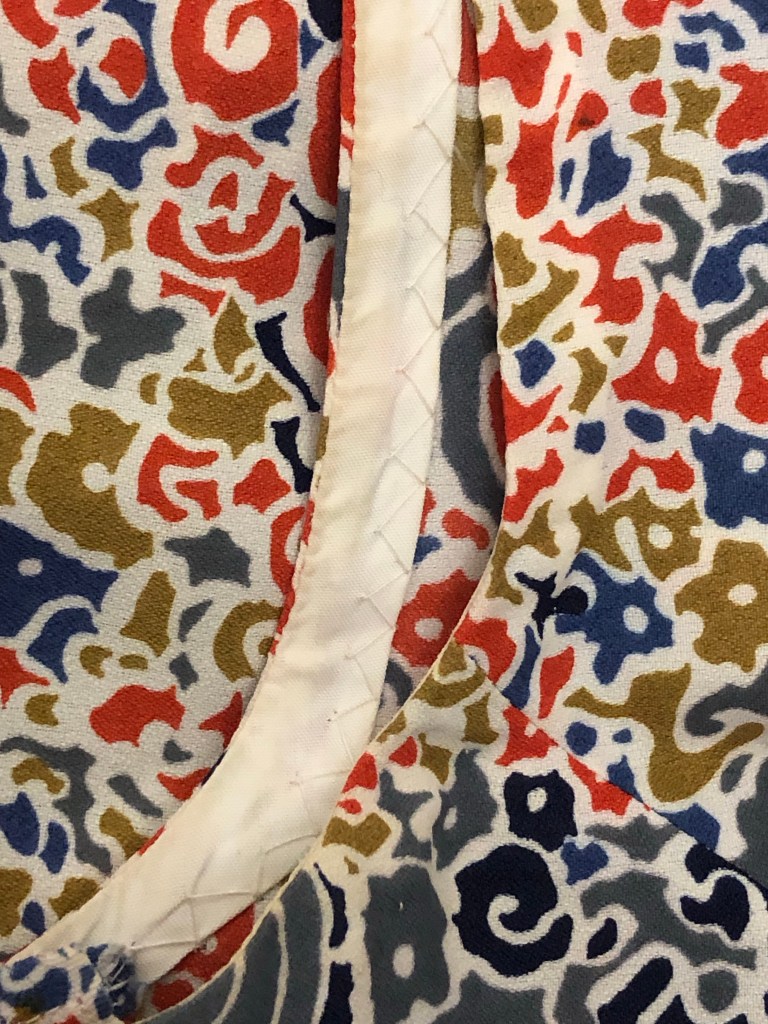
Here is the distinctive Cheongsam that I adored. It is a traditional Chinese dress made with a contemporary western style abstract patterned fabric of the time (late 1960s). It is a good example of a piece of transcultural garment. It has some deep creases from being folded for so many years but I am unsure of how best to iron or care for it, so until I find out, I decided to refold it for safe keeping. Below are some photos I took before putting it away.
Front viewBack viewClose up of the Madarin collar design Close up of the abstract pattern that fascinated me as a child Close up of the details of hand made stitches along a seam
There is so much history to this interesting dress, its rich features and heritage make it very precious and can provide inspiration for my art making. However, I was unsure of what to do and where to start.
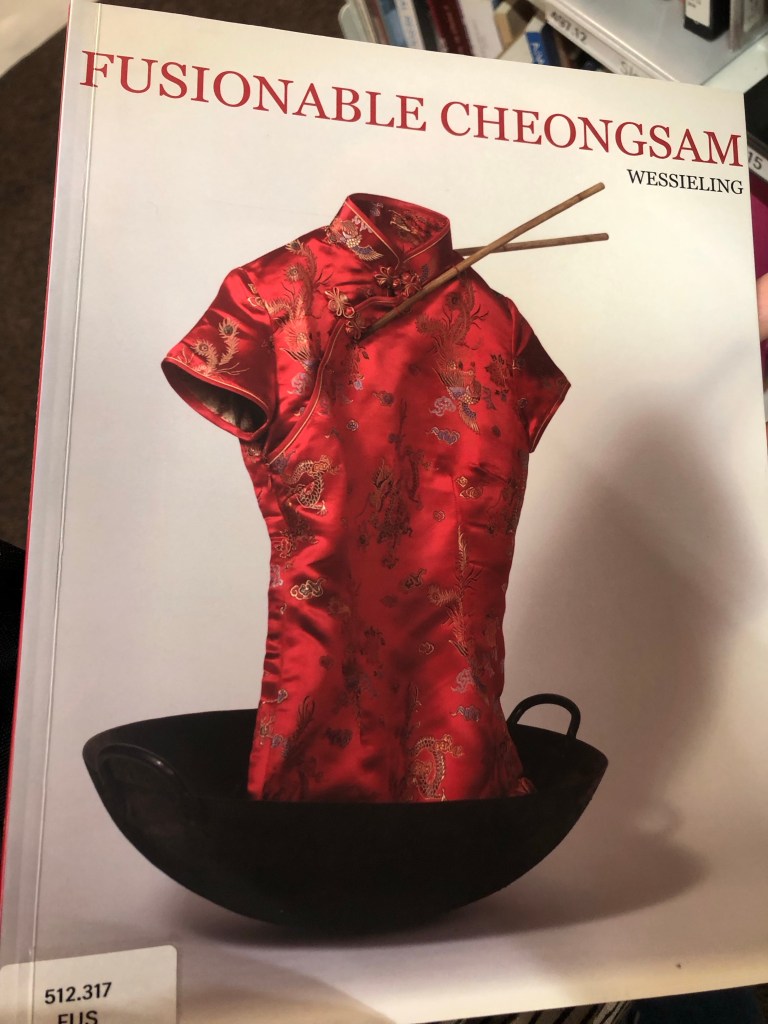
When I recently visited the Stuart Hall Library in London as part of my MA Fine Art course Low Residency at CSM, I saw the book called Fusionable Cheongsam. I was unable to spend too much time there because we were on a tight schedule for the day and I hope to return soon to have a good read of the book. However, I had seen enough to convince me that the Cheongsam could be a good focus for my art making. I decided to start with a painting.
METHOD
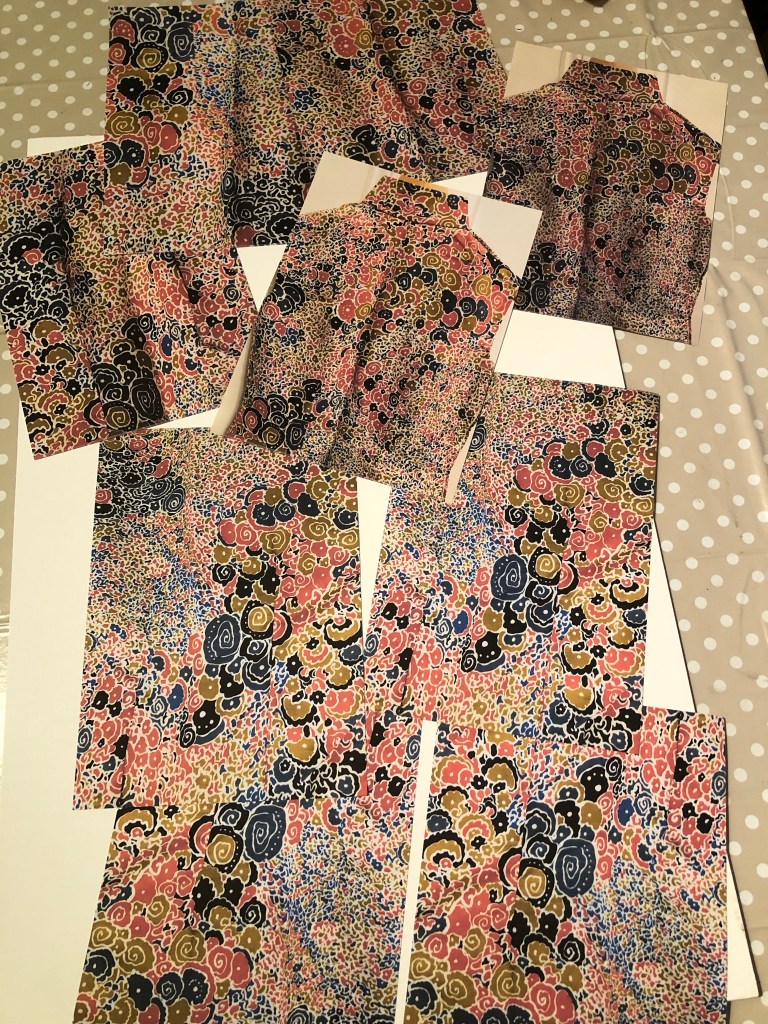
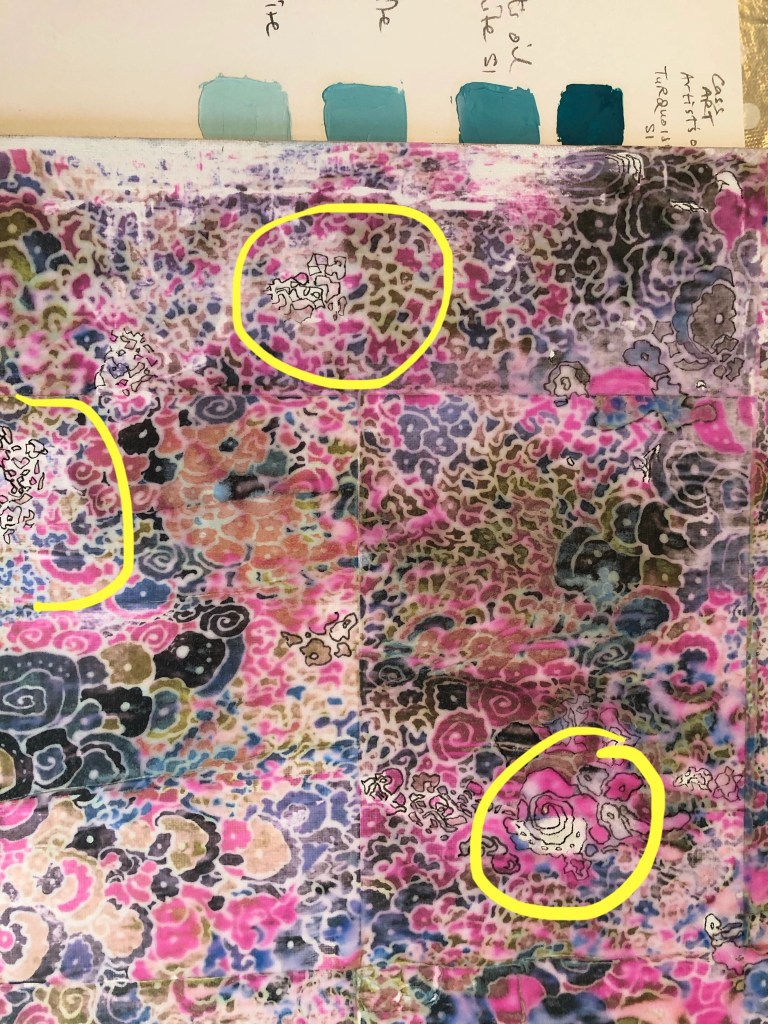
Photographs of various parts of the Cheongsam fabric pattern were taken and printed on an EPSON EcoTank ET2860 inkjet printer.
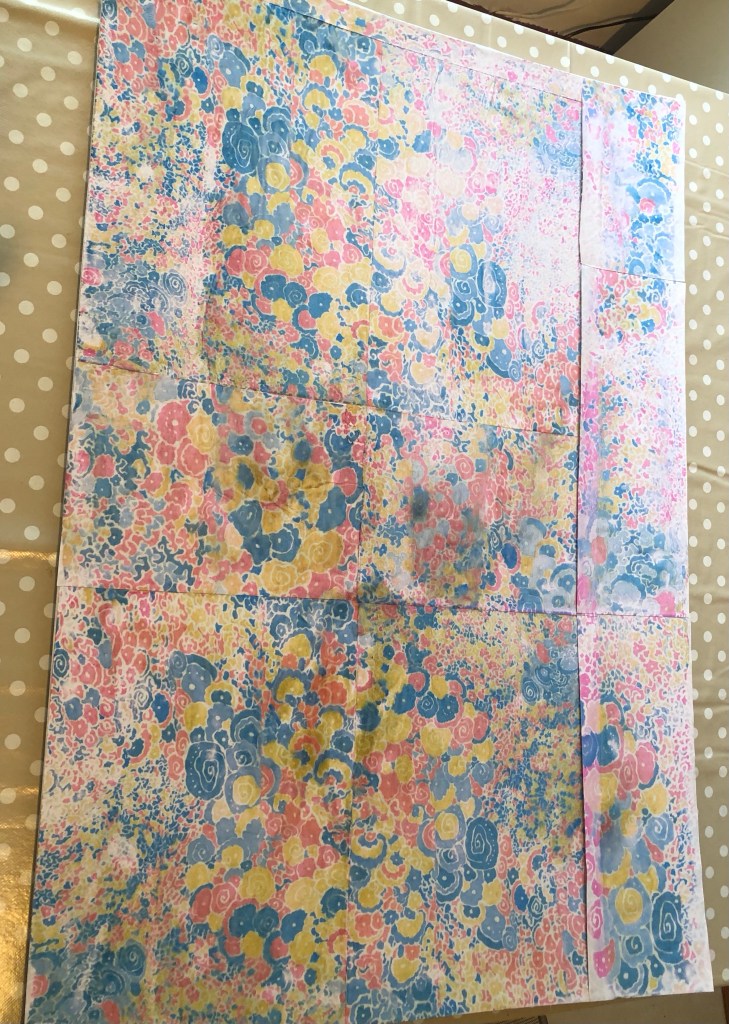
Images were selected to fully cover a 30×20 inch canvas board. Dispersion liquid was used to transfer the printed images onto the canvas and left to dry overnight.
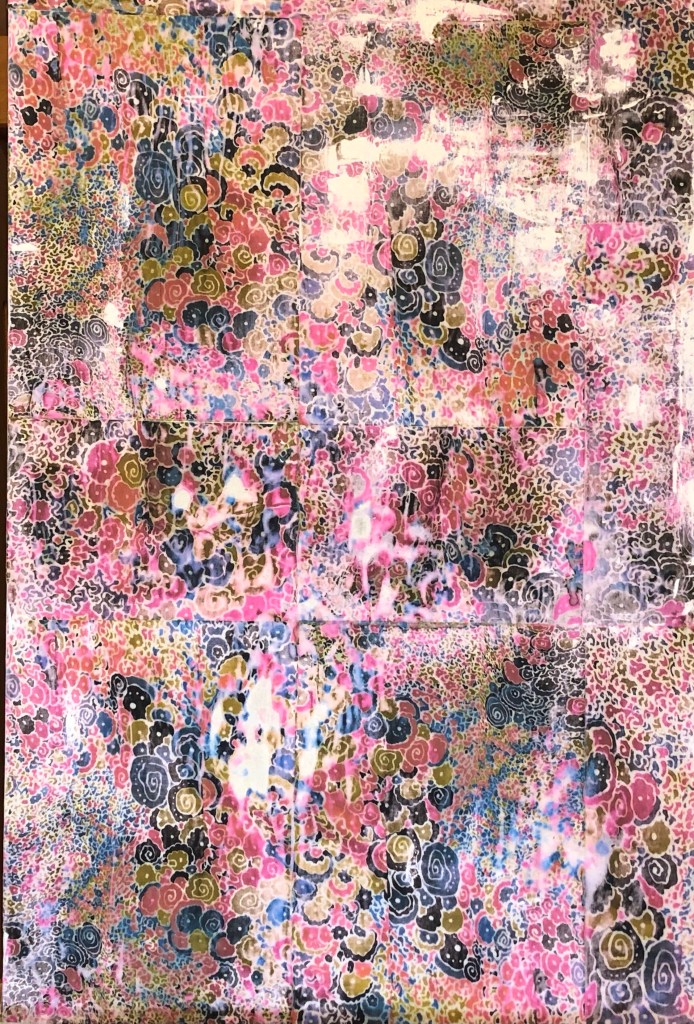
The paper was rubbed off leaving the transferred image on the canvas. As expected, the process usually leaves blank patches as it had done here:
Where there were blank spaces, the outline of the abstract shapes were drawn in using a 0.2mm black fine liner pen.
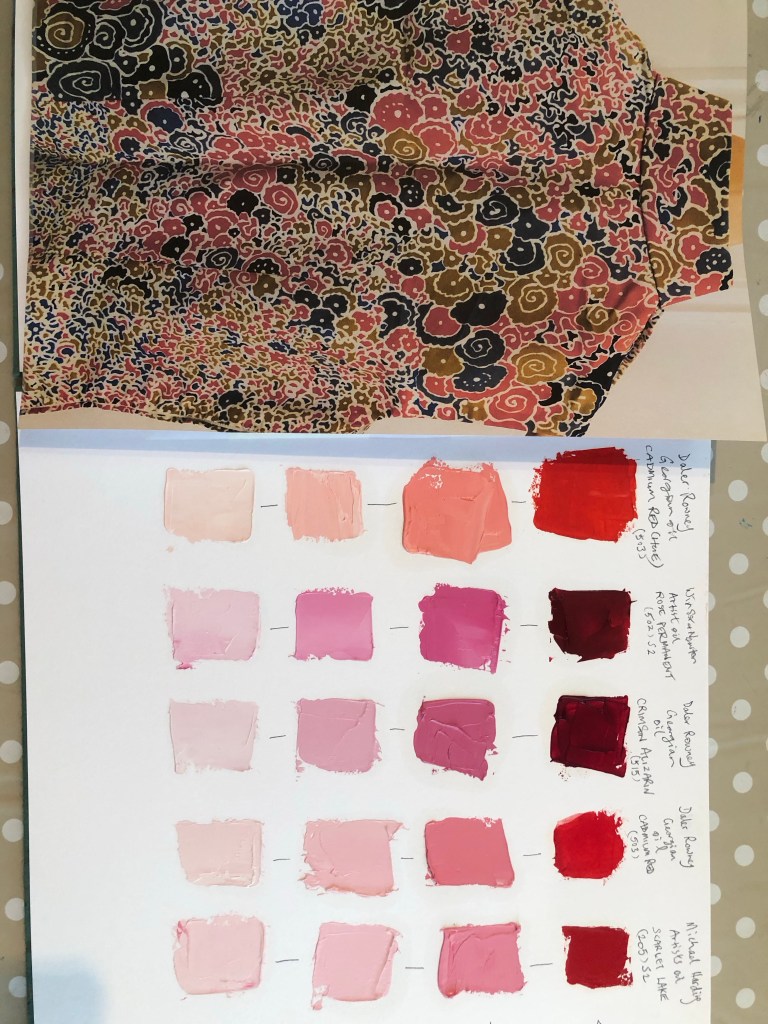
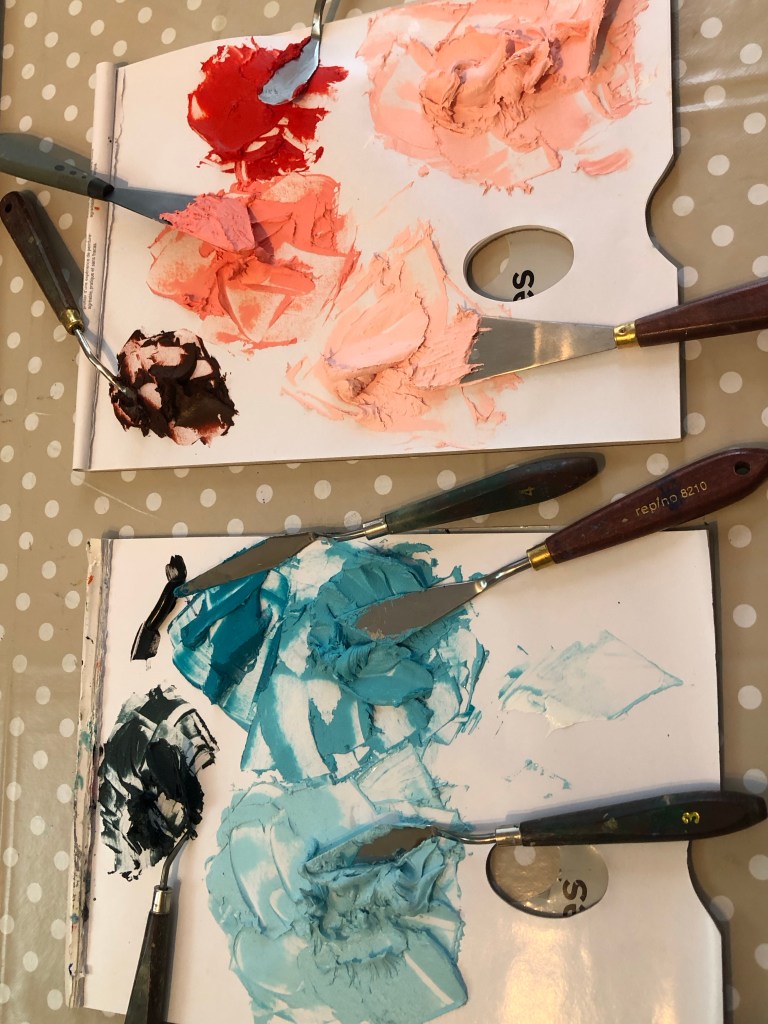
Using the colour charts I prepared a few weeks ago, various colour shades were chosen for the top layer oil and cold wax painting. The oil and cold wax were mixed in 50/50 ratio.
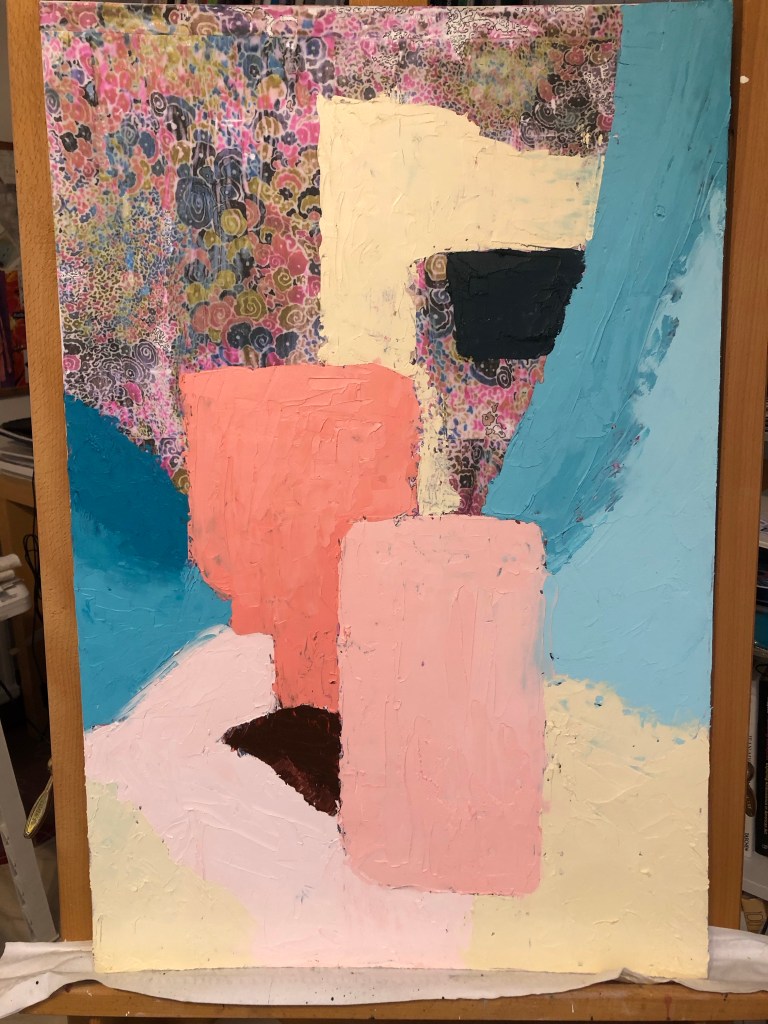
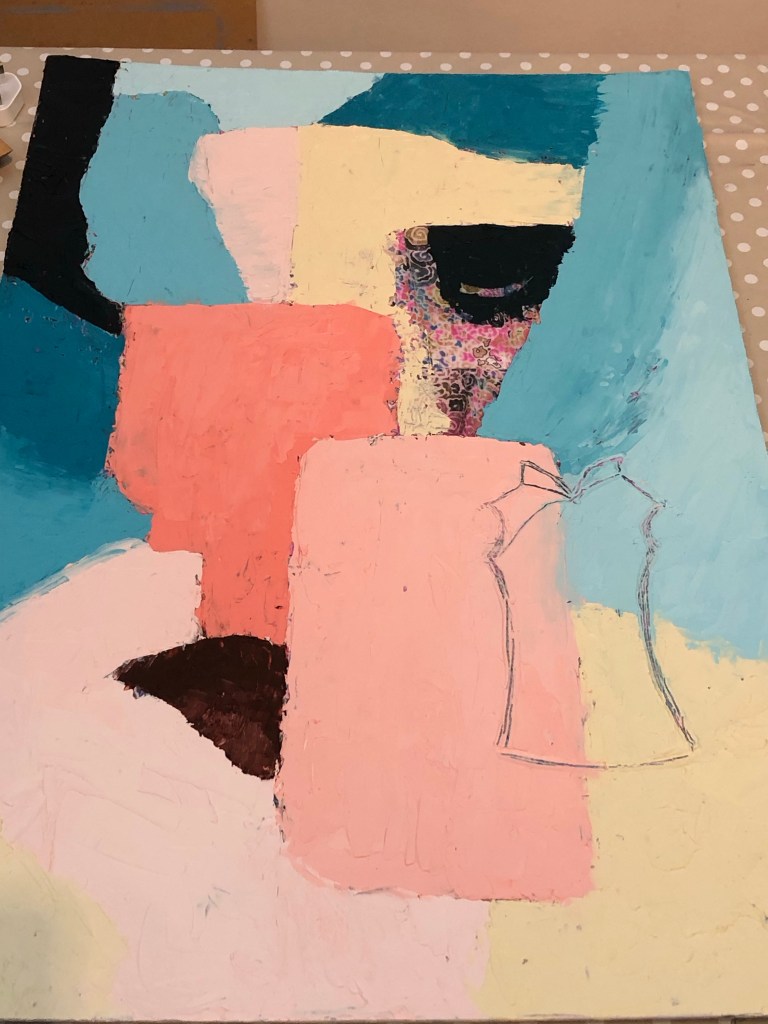
Blocks of colour were painted onto the canvas. The approach was abstract and without pre-planning, I was just responding to the canvas. Towards the bottom centre area, I wanted to paint a dark red triangle, what came out was part of a mouth or lips. The lips led me to start painting an abstract face:
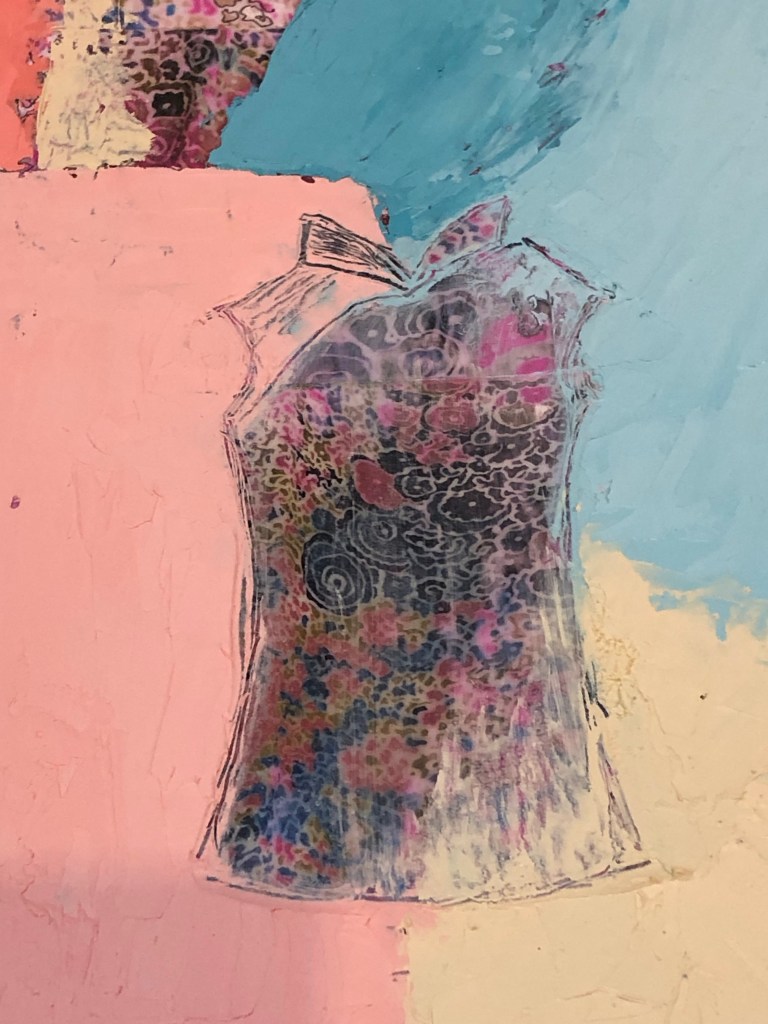
Once the top layer painting was completed, I started to scratch off the paint, firstly in the shape of a small cheongsam.
Then the paint was scraped off and the area cleaned with environmentally friendly solvent:
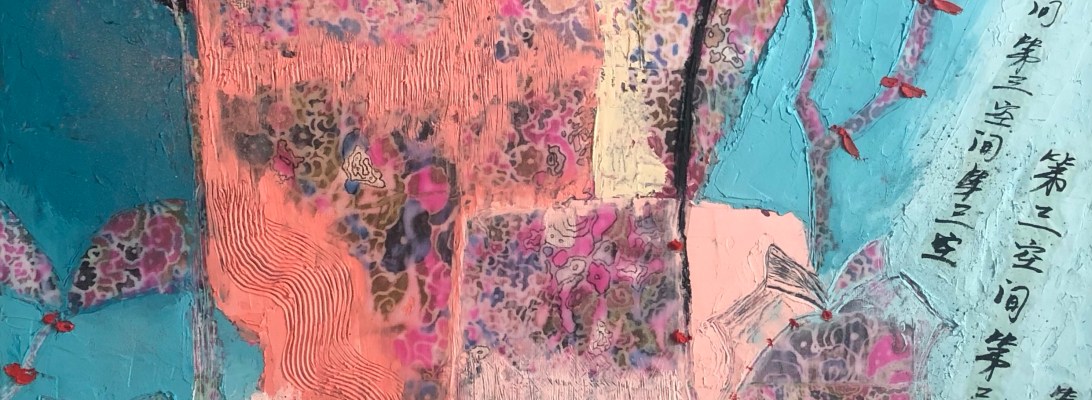
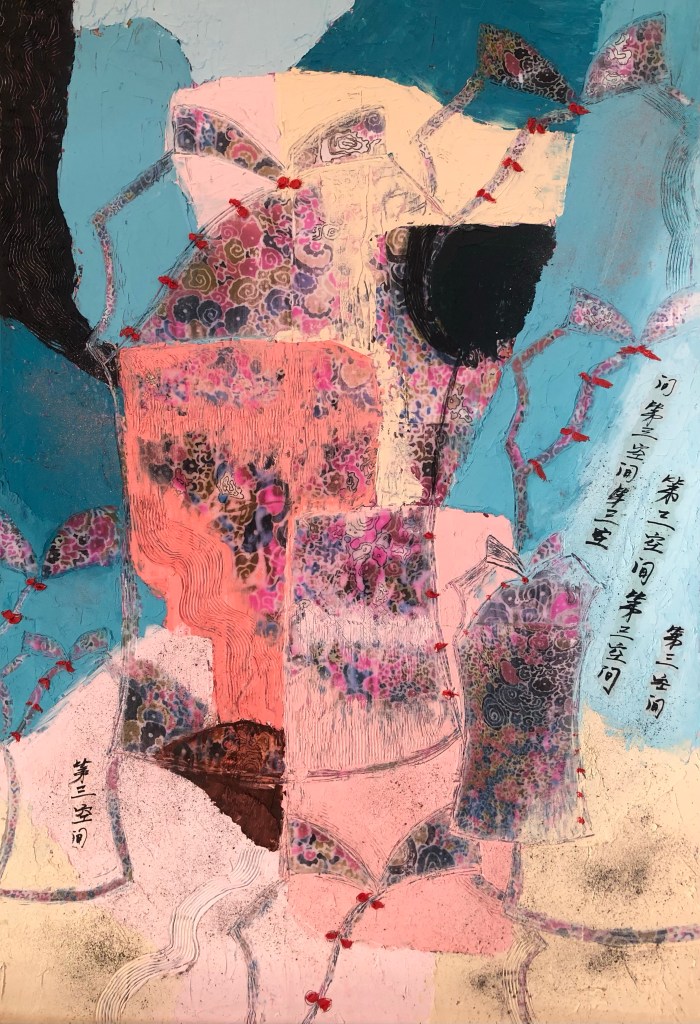
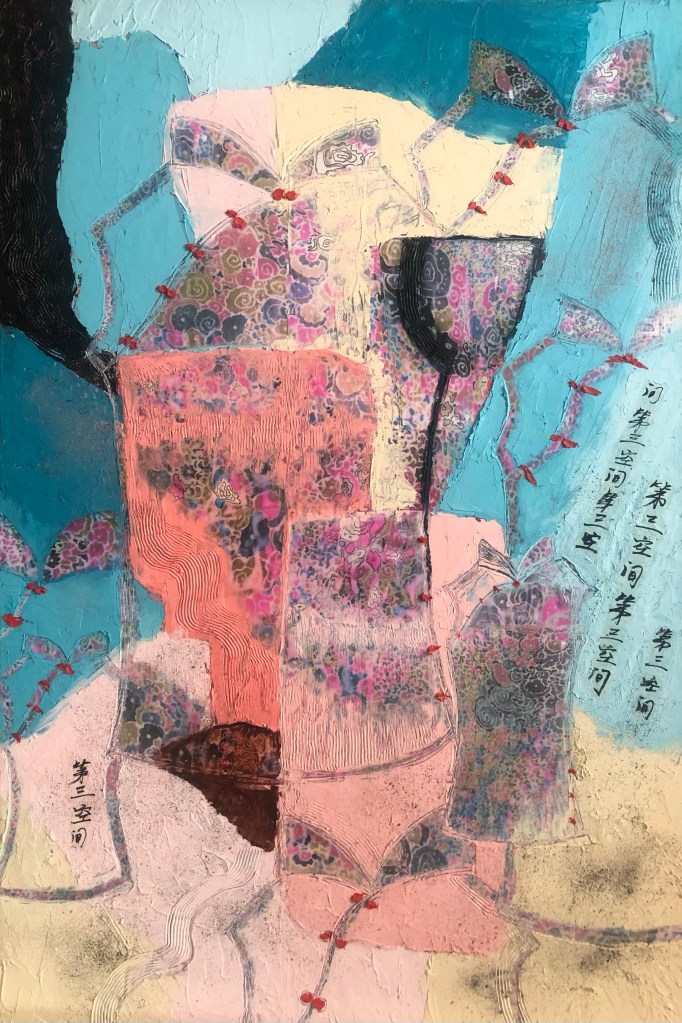
I liked the image and I then responded to it by making marks of several other cheongsams of various sizes. Bright red paint was used to depict the traditional Chinese buttons used on garments. Strips of Chinese calligraphy with the phrase ‘third space’ was layered onto the paint then pigment was sprinkled to add texture.
I felt troubled by the face, especially the dark eye, it looked too sinister. So I scraped off most of the dark eye to give it a kinder look.
Finished work below – Cheongsam #1. Oil and cold wax on canvas with image transfer. Size 20×30 in.
REFLECTIONS
What I am happy with:
– The colour palette
– The fabric pattern that came through
– The Cheongsam shaped mark making
– The little red buttons as a colour pop
– The inlaying of Chinese calligraphy
– Enjoyed working with oil and cold wax media
What I’m not happy with:
– The composition, the ‘lips’ accidentally appearing led me to subconsciously start creating a face-like composition. I’m not sure if it worked. When the ‘eye’ was completely filled in black, it became a strange and eerie creature. It was too distracting hence I scraped off most of the black to reduce the impact.
– Due to the strange face, it doesn’t sit comfortably with me which perhaps is a good thing. Better than being forgettable.
Other thoughts:
– I wanted to use the cheongsam series to help me to delve into my thoughts about my family, especially my mother, our relationship and my heritage. I am not sure if I achieved this in just this painting because I was overly focusing on making the work and trying to get the composition right. But I am keen to continue the Cheongsam series and feel that I am at the beginning of something.
– I am intrigued by the history of the Cheongsam and want to find out more.
– The fact that such a traditional Chinese garment of my mother’s was made with a western style abstract pattern was intriguing – this is what the Third Space is about and I have accidentally stumbled upon this excellent example – my mother, a Chinese woman from colonised Hong Kong, chose this dress with this fabric. I have not fully processed this finding yet, but I wanted to acknowledge it here and will slowly delve into what I think and how I feel about this.
LEARNING
– Various symbols have emerged from this piece. I am inspired by Fiona Rae’s work where she often uses playful symbols. I can try a playful approach with e.g. lips or butterflies. The collars of the Cheongsam remind me of butterflies, they could be turned into a signature symbol that I use in my work.
– Other symbols such as the distinctive buttons that are used in Cheongsam and traditional Chinese garments, I loved playing with them when I was a child – I can investigate those further.
– I am intrigued by the Cheongsam and I want to research about its history and other related art such as in the book ‘Fusion of Cheongsam’ to get inspiration for making.
– As I was painting, I felt that I was trying too hard especially in the composition of the oil and cold wax layer. It felt deliberate rather than a free response to the canvas. I could use my sketchbook more to plan composition for my work, do more quick trial and error exploration.
NEXT STEPS
– Continue the Cheongsam exploration because I feel excited by the subject – research into its history and related art to get inspiration.
– Keep making, do some informal work. Not every piece has to be a finished painting.
– Play in my sketchbook.
– Relax and enjoy the making process. Take time and don’t try too hard.
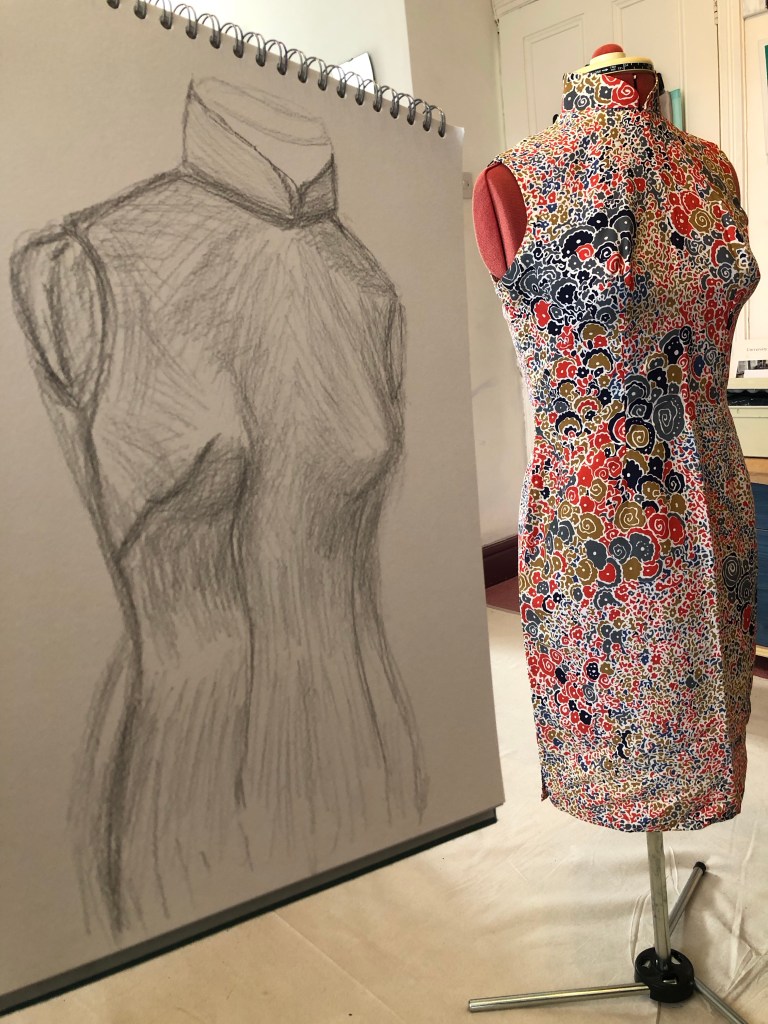
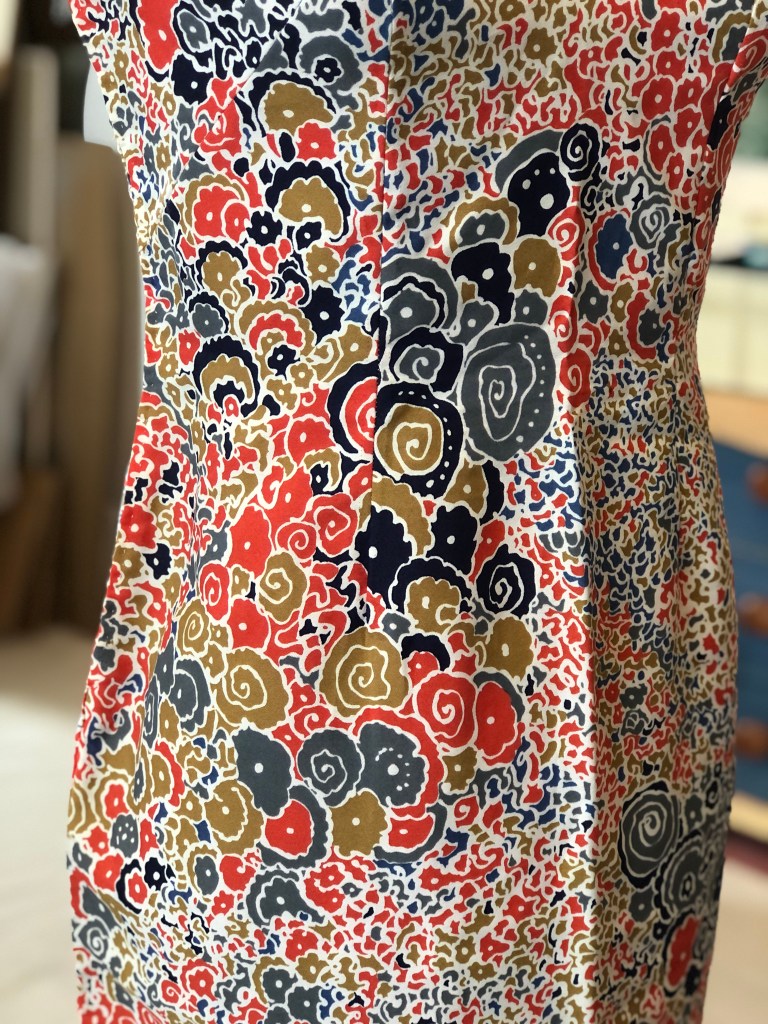
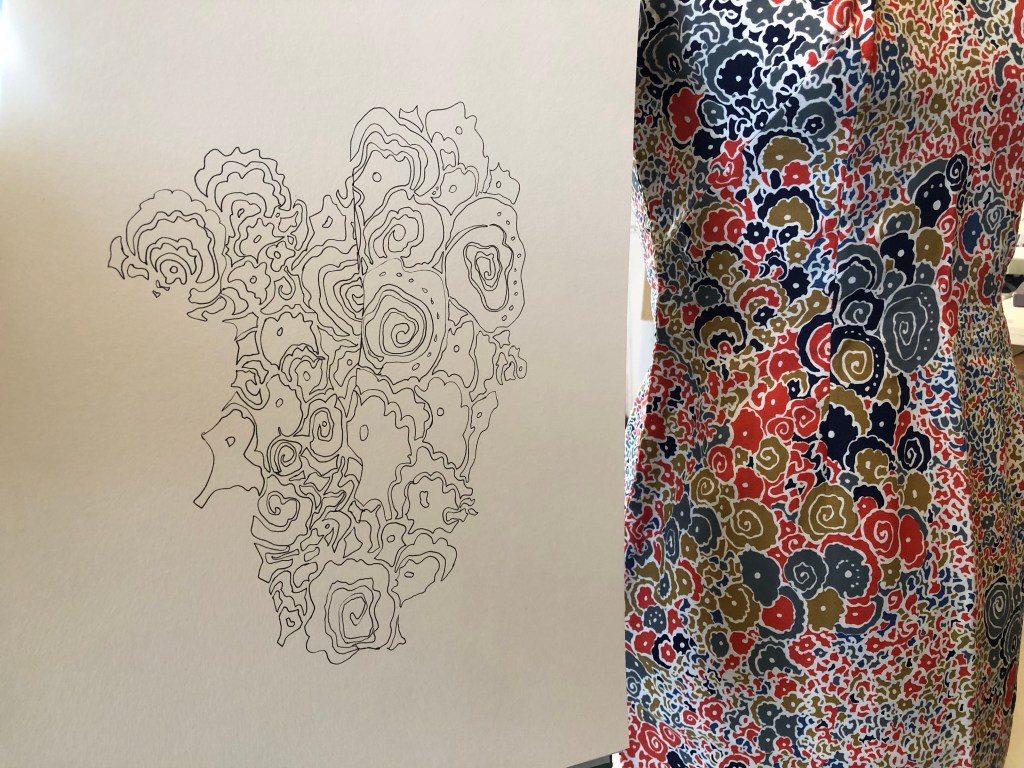
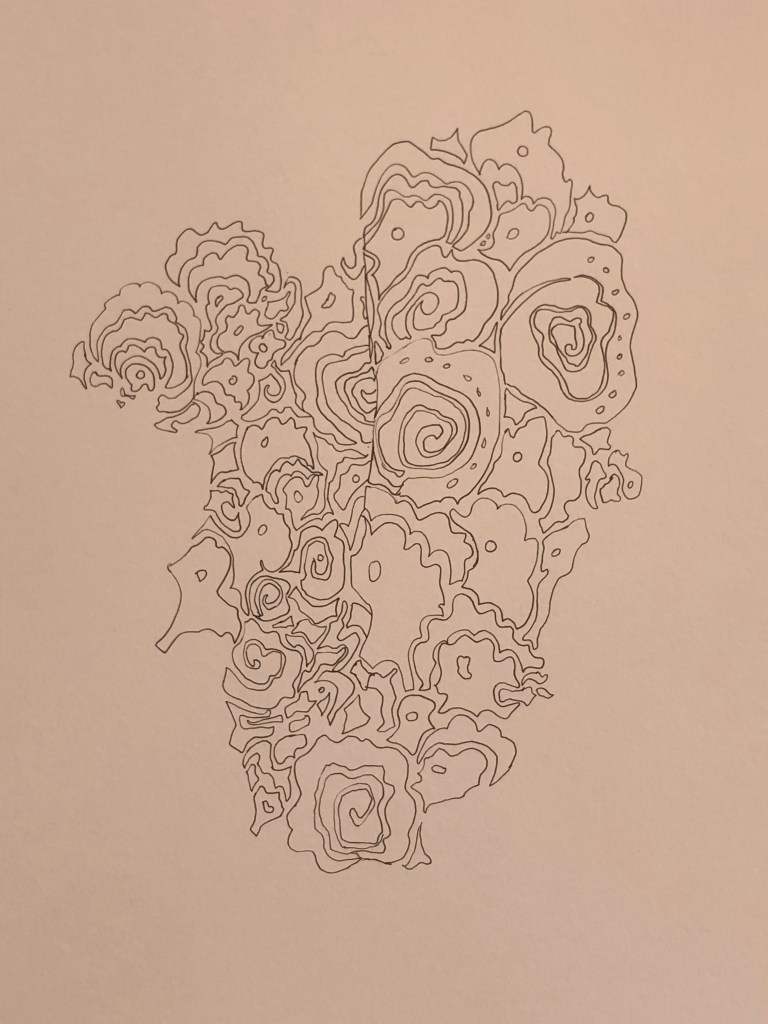

 elizarawlings