In exploring transcultural art and my own style, I have been looking for ways to do Chinese brush painting with ink on top of oil paint. I am hoping that through these experiments, I can find ways to combine eastern and western art materials in my work whilst maintaining the characteristics of both genre.
Here is an earlier experiment and this blog is a response to it:
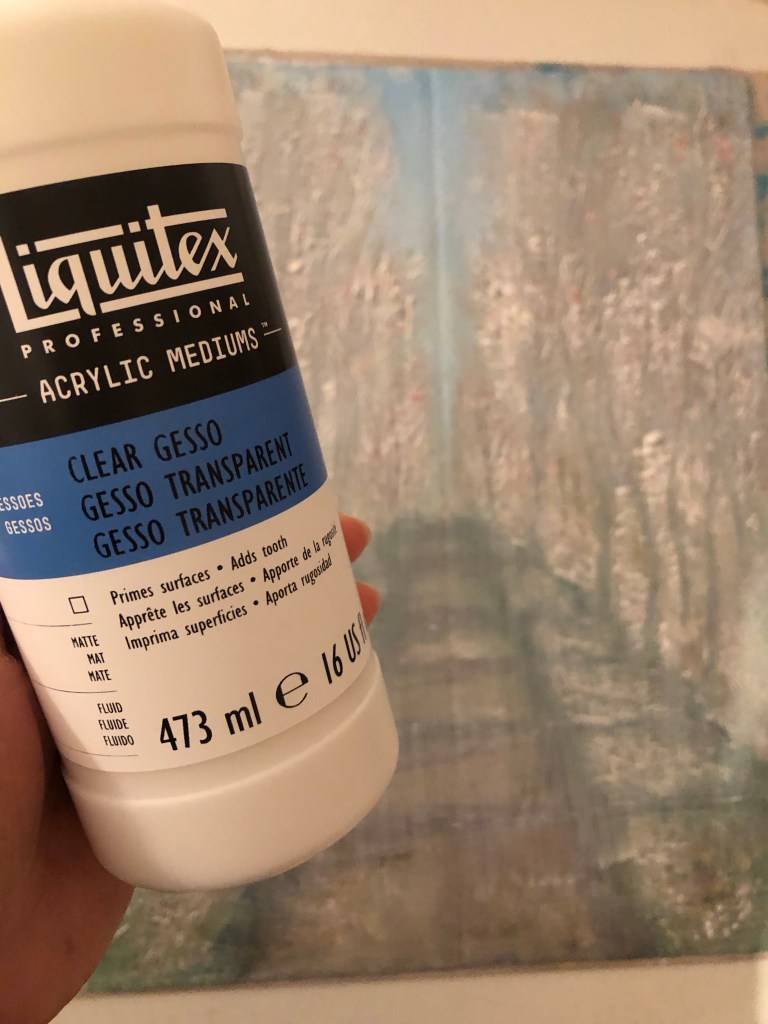
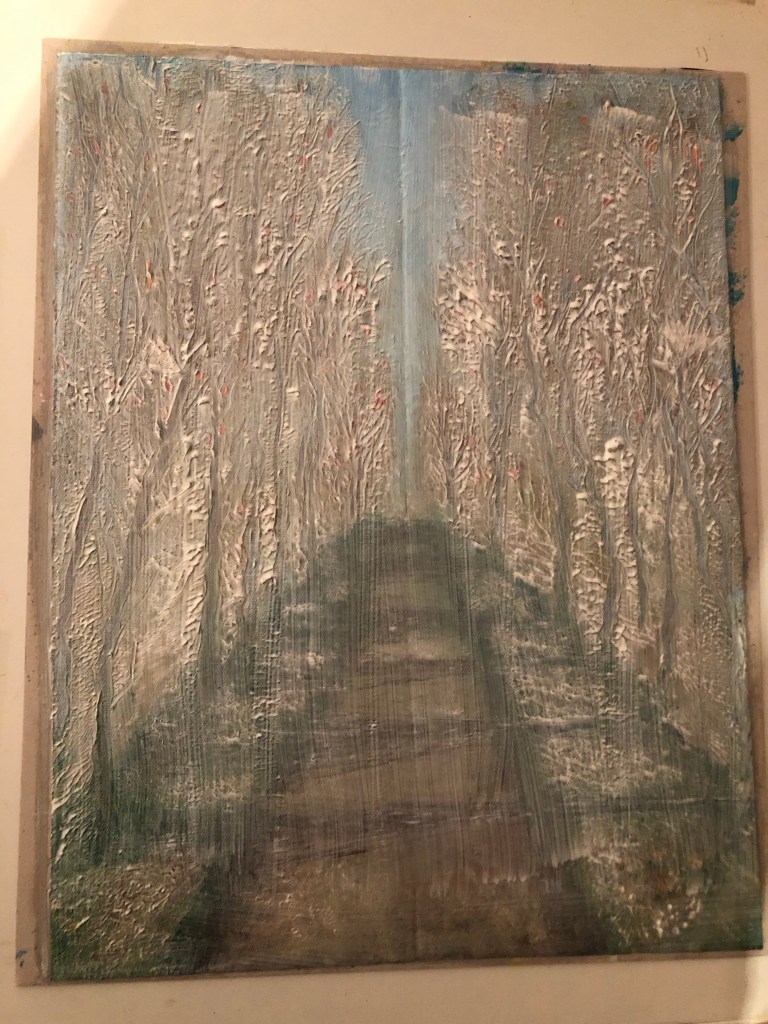
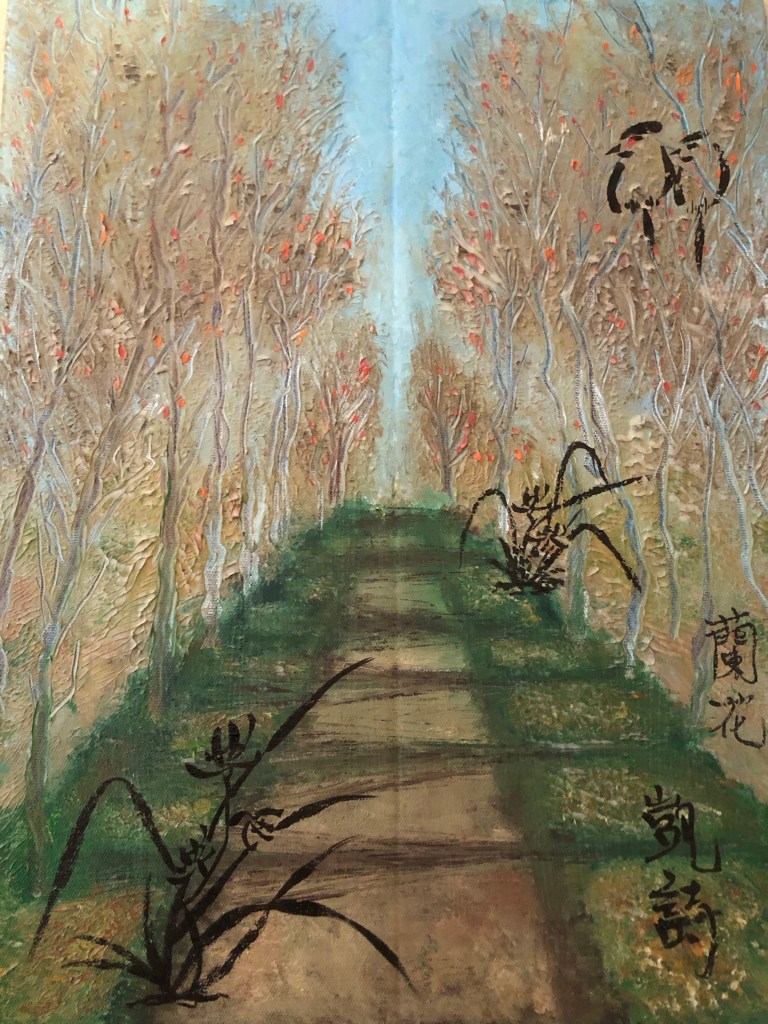
In this experiment, I took an old oil painting that had a range of textures and I applied a layer of clear gesso on top of the dried oil paint to creat a surface for Chinese brush painting to see if that would work.
A thick layer of clear gesso was applied to an oil painting.It was left to dry overnight.
After the gesso has dried, I painted various images using a Chinese brush and ink on different parts of the canvas to test out how the brush and ink performed on different textures.
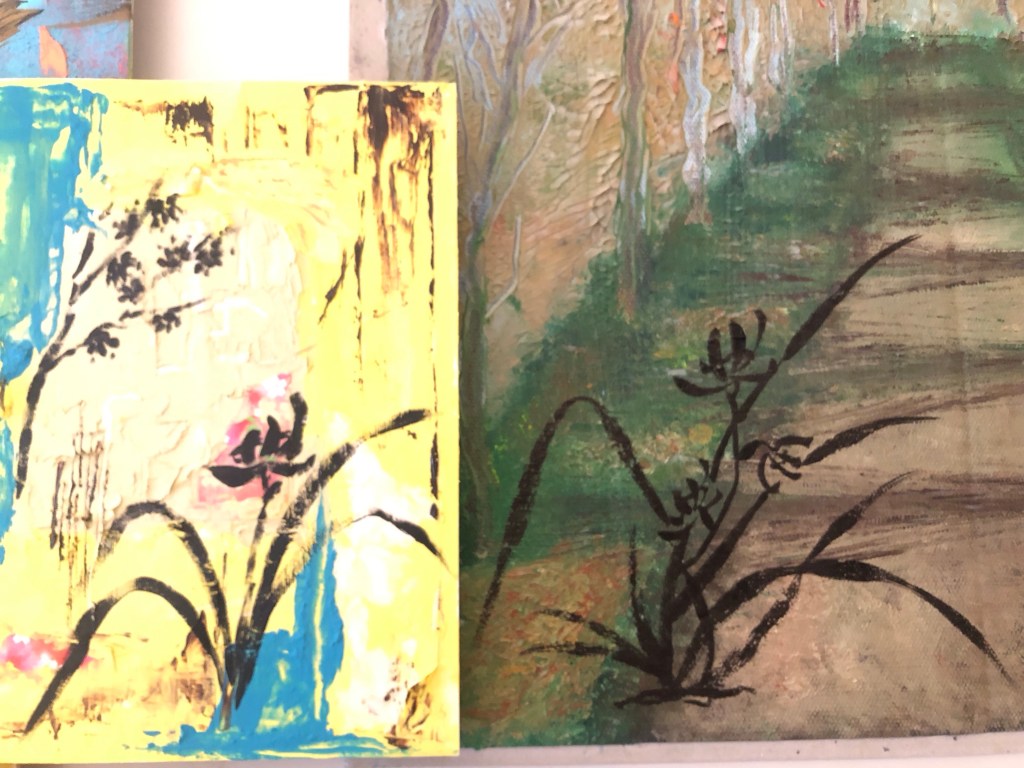
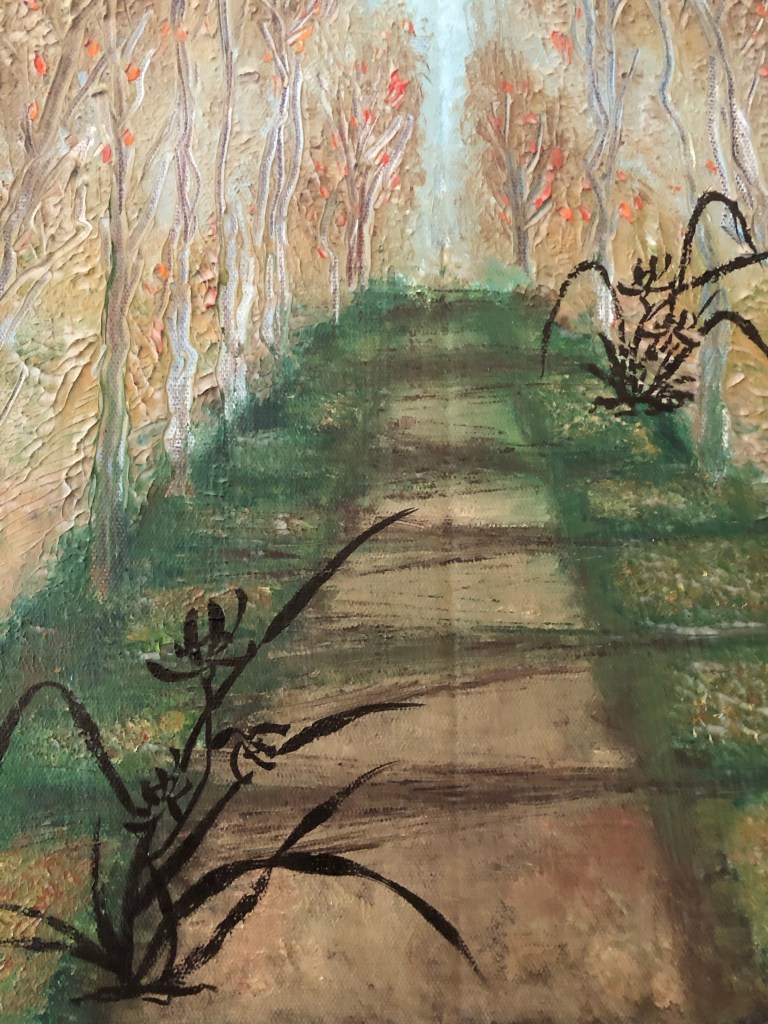
A Chinese orchid was painted in the least textured area of the painting. Here the outcome was compared to a similar exercise on dried oil without gesso (painting on the left):
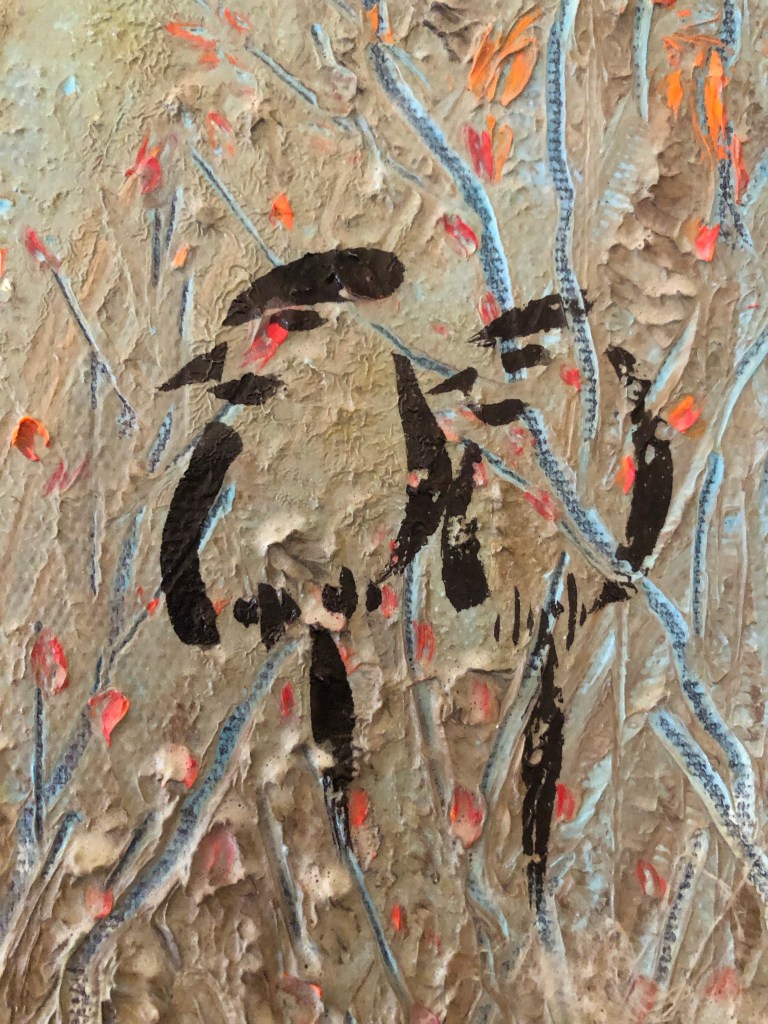
Two birds were painted in the tree branches which was the most textured area on the painting:
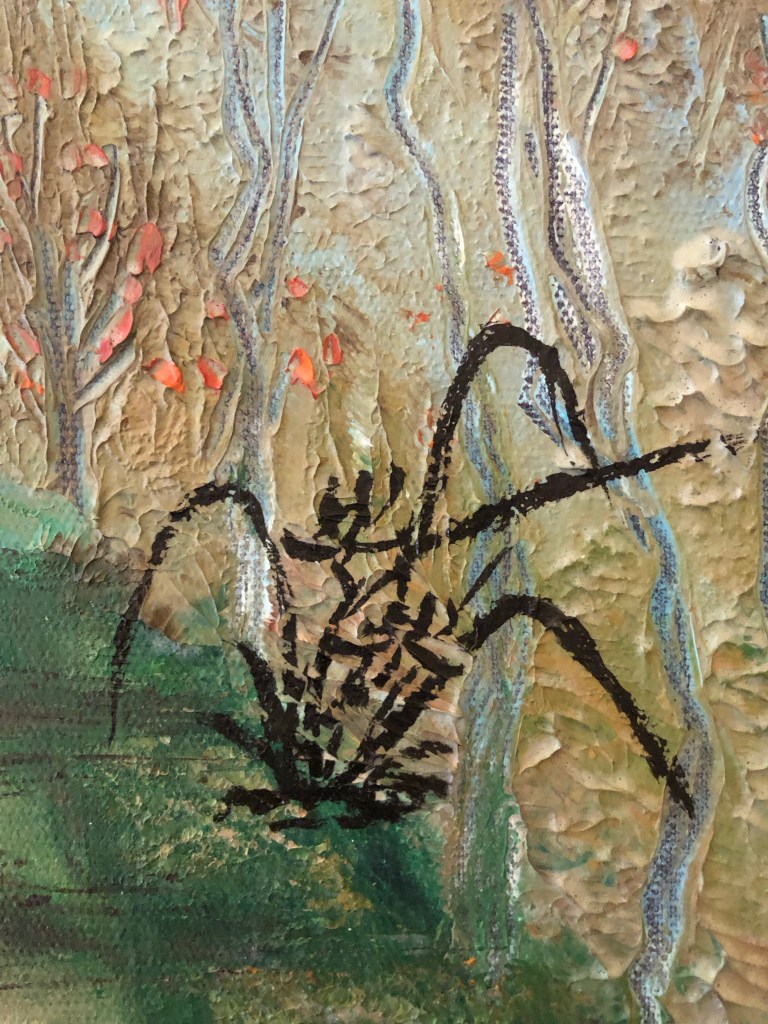
An orchid was painted in the medium textured area in the mid ground of the painting:
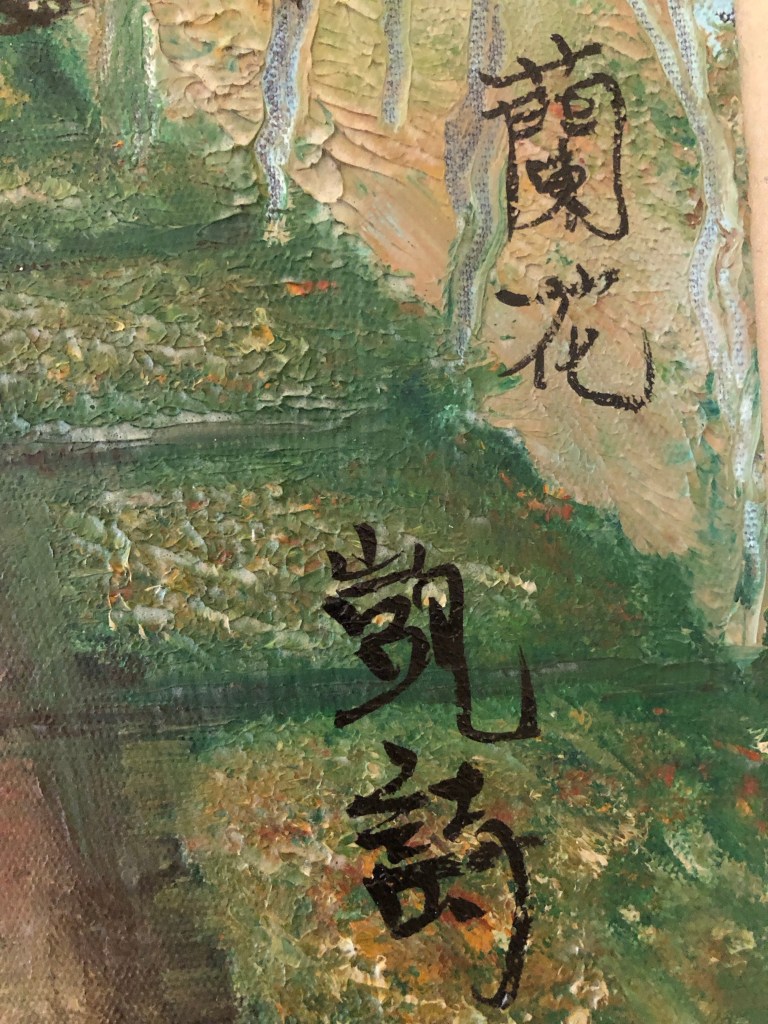
Some Chinese calligraphy was tested using different size brushes:
–
REFLECTIONS
For me, a smooth surface such as silk or Xuan/rice paper is required for Chinese brush painting to be at its best. So that the brush strokes can glide across the page. I painted the Chinese orchids in the experiment because to paint the long and bendy leaves in one stroke required a continuous smooth movement whilst slightly lifting and turning the brush. Similar to calligraphy. In the heavily textured area in the tree branches, I painted two birds because I knew that long brush strokes wouldn’t stand a chance in that area, hence the short and relatively straight strokes for the simplified birds. Since this is mainly an experiment, the technical outcomes are captured under the LEARNING section.
I will note here my reflections about how I felt during the process. I felt excited that there was another avenue to explore as I really wanted to find a way to combine on the same painting the Chinese and western materials. However, this experiment showed that although I have made progress, I have not found the ideal way to achieve my objective of combining the two different materials. Perhaps the challenges I have had is also a metaphor for my lived experience in navigating the two cultures in daily lives.
Another thought was that I should definitely research more on other transcultural artists’ work as I expect someone else would have done this before me.
LEARNING
– As expected, the smoother texture area (the large orchid) performed the best. In comparison to the earlier experiment of painting on oil without the gesso layer – it was clear that the one with gesso performed much better enabling the Chinese paint brush to glide more easily.
– The heavier textured areas had too much ‘pitting’ and even with a brush heavily loaded with ink (like with the bird on the left), it was hard to achieve a smooth stroke. Hence I don’t believe this combination of material would work satisfactorily for me. If I wanted to do Chinese style brush strokes on such a texture then I’m better off using oil on a soft brush, the oil paint would fill the pits more effectively even if not completely.
– The two sets of calligraphy were done with brushes of different size, the lower set was with a thicker brush and that comes across better. The thinner brush did not have the strength to deposit sufficient ink on the oil surface.
– There is further refinement I could do to smooth the oil surface such as sanding and more layers of gesso.
NEXT STEPS
– Research other transcultural artists to see if anyone has achieved Chinese brush painting on top of an oil painting.
– Research further how Fiona Rae achieved her Chinese style brush strokes with oil paint on traditional canvas.
– Using the same oil painting here, sand an area and then apply further layers of gesso, then sand again if needed, to see if that would create a smooth enough surface without damaging the original image too much thereby achieving the desired results.
As part of my research on The Third Space (Ref. The location of culture by Homi K Bhabha), I have been seeking out ‘third space’ phenomena from my memory and surroundings in order to gain a deeper understanding of the concept. To this end, I decided to research and do a project on the street names of Hong Kong.
When HK was a British colony, many streets were named after British Governors or officials sent to manage HK. Their English names were converted into Chinese (Cantonese) using transliteration*. As a result, the street names when pronounced in Cantonese are meaningless and often nonsensical. Since street names are such a fundamental part of daily lives, those strange sounding streets names have become a natural part of the day-to-day language without anyone questioning their nonsensical nature.
This project is to highlight the transliteration of HK street names as an example of a third space phenomenon from a place that has deep personal relevance for me.
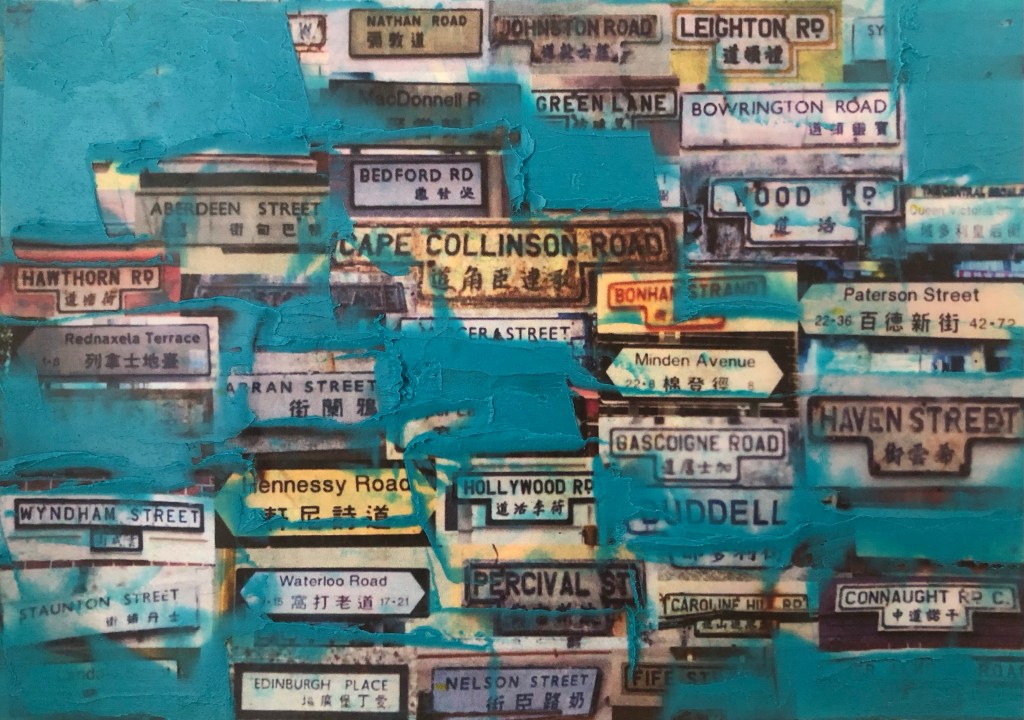
Finished painting – HK Street names 1 – oil and cold wax on inkjet printed paper, size 18.4 x 12.8 cm.
METHOD
This is the first step and an experiment to test out the idea and process.
I researched online images of street signs in HK and picked out those that were transliterated from British names. Since the HK street signs nowadays are of a new design that I am not familiar with, where possible, I have chosen images that were from the 1960s, 70s and 80s – the period when I lived in HK and when HK was still under colonial British rule.
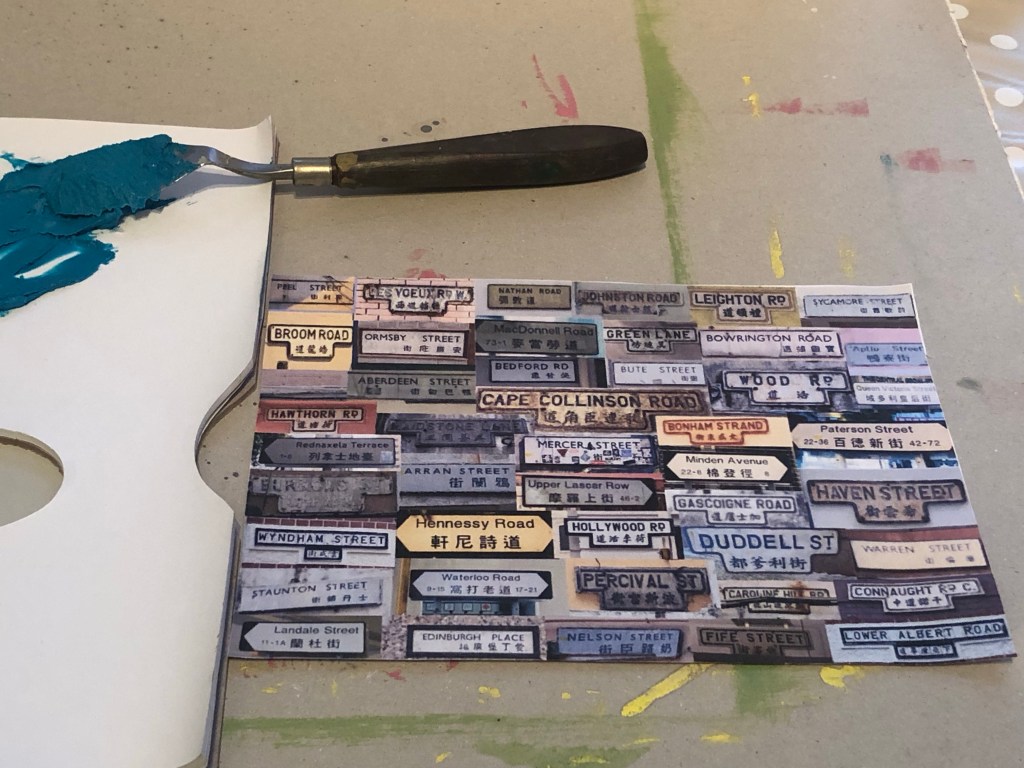
A digital collage of the road signs was made using Adobe Express then inkjet printed onto paper.
Teal colour oil paint was mixed with cold wax in 50:50 ratio and the printed image was covered in a thick layer of the oil-wax mix.
My iPhone was set up in video capture mode to record – I gradually scraped off the paint revealing most of the street signs one by one as I read out in English then Cantonese each street name. The purpose of the voice over was to enable viewers to hear the Cantonese transliteration.
–
REFLECTIONS
This was an experiment to test out the concept on a small scale before taking it onto a large canvas to create a painting. The aim is to ultimately create two pieces of work – a painting as well as a video accompanied by a piece of writing explaining the background of the street names used as part of my research into colonialism.
I believe the way these streets were named in HK was an example of how soft power worked in a British colony where the names of the colonisers such as Governors and Royalty were permanently imprinted into the day-to-day lives of the local people, serving as a reminder of the colonial power structure. The fact that road and streets were named in this way served as a constant reminder of who was in charge of the the land.
I started this project with casual research online, however, my interest in the topic increased as I went deeper into the research as it became clear the extent of the soft power exercised in these examples. As I looked at the street signs and read out each name, I could hear my late parents saying those names on a daily basis in conversation – which road had bad traffic jams, what was the shortest route to get to a place or giving directions to a shop. As a child, I listened to my parents using the transliterated and nonsensical street names like it was just normal. Everyone used those names without giving it a second thought. I left HK when I was a young teenager and never lived there as an adult. I now wonder what it was like for my parents to live their whole lives in a colony, to live, work and bring up children as colonised subjects. Doing this project has caused me to think about that more deeply. I always feel conflicted when I think about this topic – HK was a British Colony with in-built structural injustices that came with being colonised, but HK also became successful globally partly due to the commercial, legal and justice systems that were put in place by the British bringing prosperity to the city and stability for the people. This is a conflicted feeling that I will continue to examine – just like the transliterated street names, what seemed natural or normal once upon a time, now no longer make sense and I am still trying to unpack that conflicted feeling.
Regarding the art work, I was pleased with the outcome of the project, especially as an initial experiment. Through my research, I have found many more interesting facts about the naming of streets in HK, I could potentially divide them into categories and make several art work to create a series.
LEARNING
In the context of my art practice, this research project has helped me to gain a deeper understanding of The Third Space as coined by Homi K Bhabha. The phenomenon of the street names researched here is unique and only came about as a result of the English and Chinese languages coming together through colonisation. There is also the underlying cultural influences from both sides, e.g. holding military personnel in high esteem for the British and in the case of Bedford Road, the Chinese name reflecting the entrepreneurial mindset of the locals.
I am been struggling to make art through examining my third space – one that is personal to my lived experience. I have struggled to create images that is a result of that third space, instead, I have been layering together distinct images from the two cultures that have influenced me. To expand on this point with an example from the HK street names:
Example – take Wood Road that was named after John Roskruge Wood, an acting chief justice during the colonial period. If it were translated into Chinese, the character 木 for wood (as in wood from trees) would have been used. Instead, the phonetic sound of Wood was used in the transliteration, hence the Chinese character 活 meaning alive or living was used to get the closest sound to Wood. The Third Space phenomenon gave rise to a very different outcome.
Analysing the HK street names was the first time I found a concrete example of the third space phenomenon that is relevant to me and my heritage. So I will continue to research this topic as well as look for other signs of the colonial era in HK that may help with my personal identity research.
Whenever I struggle with creating images for my third space, I come back to researching the work of the artist Fiona Rae because I feel she has captured the essence of the third space well with her British and Asian influences. I will continue to research her work.
NEXT STEPS
– Repeat this work on a larger scale using proper canvas material to make a painting and a video.
– Test the video on non-Chinese speaking people to see if the transliteration sounds were noticeable, i.e. is the video voice over meaningful.
– Complete the piece of writing to accompany the art work.
– Research deeper into the HK street names to potentially make a series of work on this theme.
– Research further the history of HK to look for other third space phenomena to inform my personal identity work.
– Research Fiona Rae’s work and find more transcultural British/East Asian artists to add my list for research.
ADDITIONAL RESEARCH INFORMATION
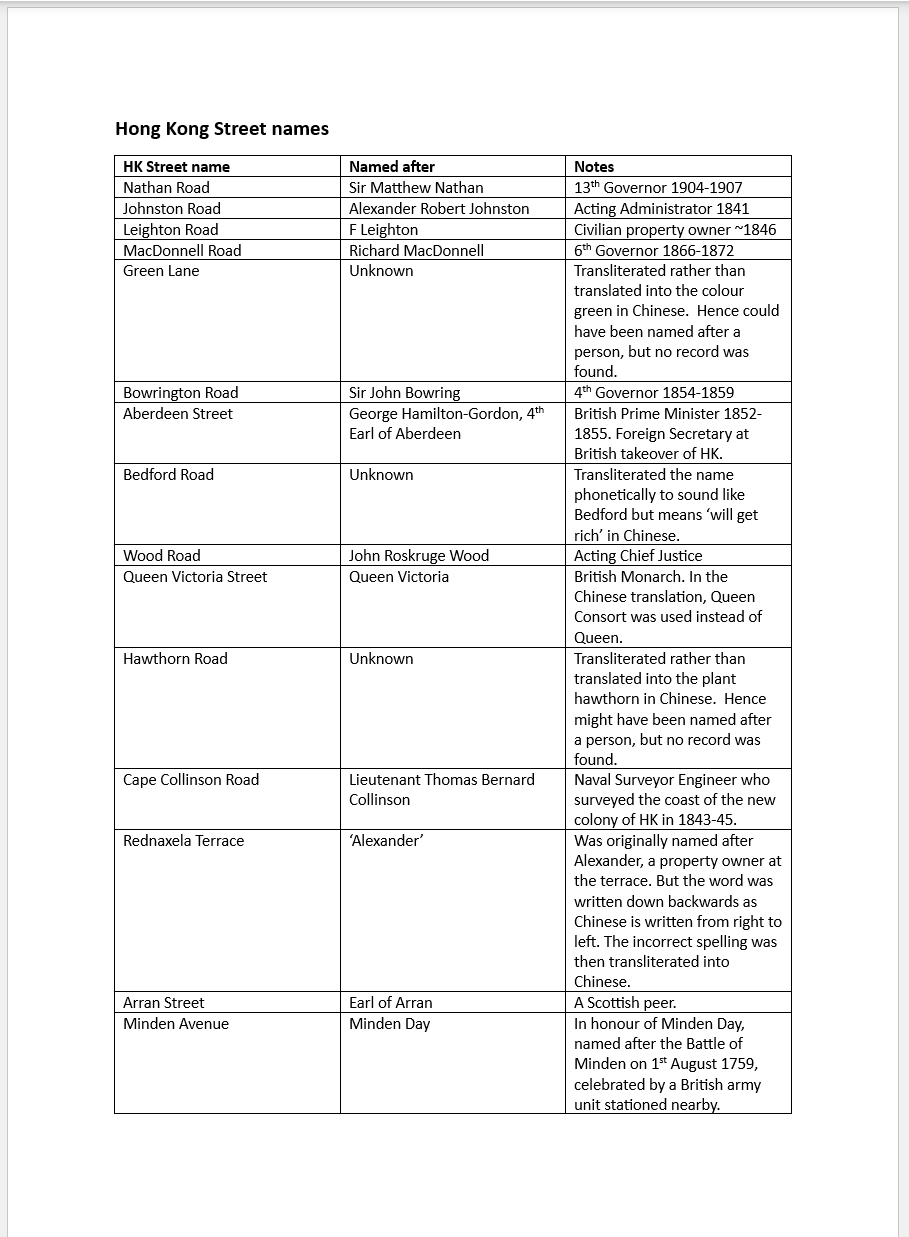
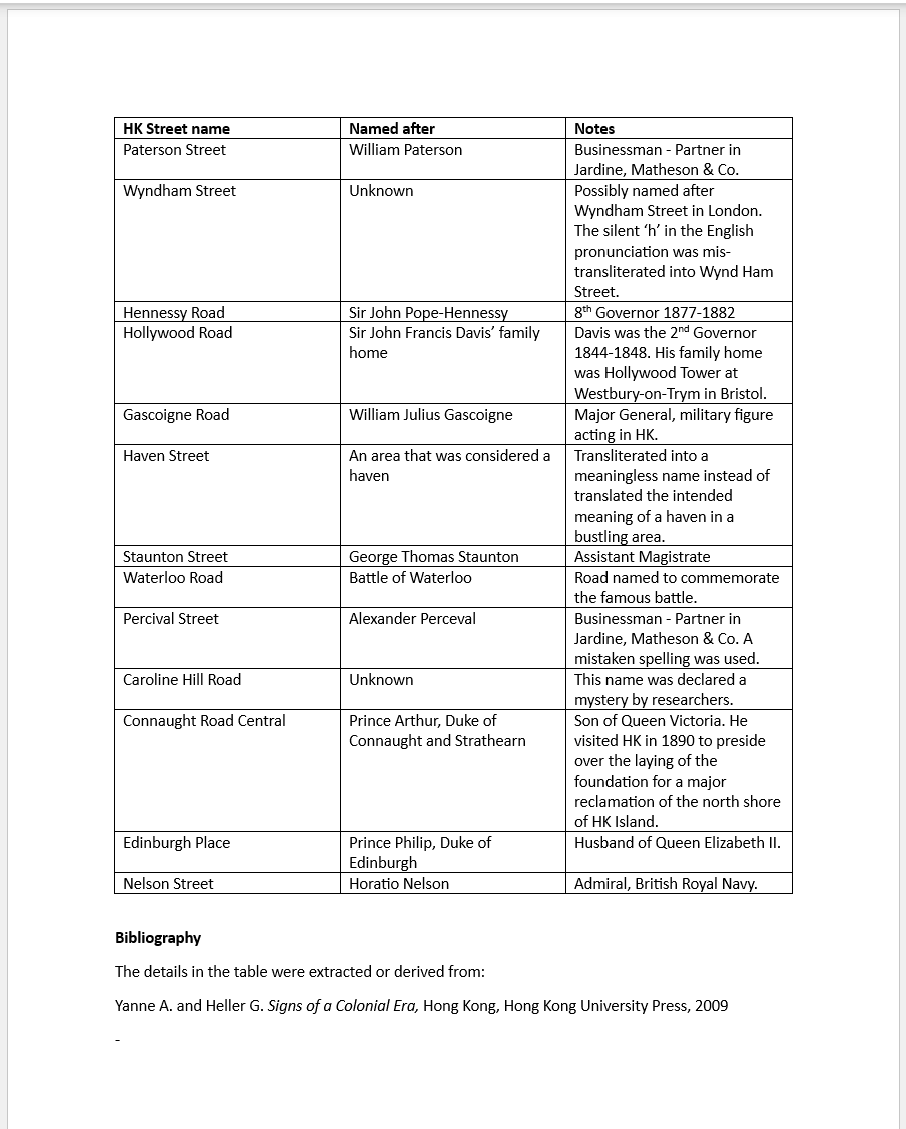
Below is a table showing the background of every street name revealed in this painting and video – whom they were named after as well as amusing mistakes in translation or transliteration.
* What is transliteration?
Below are blogs and extracts explaining the meaning of transliteration in the context of this project.
Translation provides the meaning of words in a second language. Transliteration does not provide the words’ meaning but it makes it easier to pronounce them. Transliteration alters the letters from a language or alphabet into characters of a similar-sounding in a different alphabet. It is quite clear that there is frequently a demand for the transliteration of some languages, especially in this globalised world where people who do not share the same language can have some access to languages with a dissimilar alphabet.
A transliteration doesn’t tell you the meaning of the word, but it gives you an idea of how the word is pronounced in a foreign language. It makes a language a little more accessible to people who are unfamiliar with that language’s alphabet.
After experimenting with oil and cold wax, I wanted to do a painting with that medium. As for the subject of this work – I wanted to start with an old photograph of my parents’ home.
METHOD
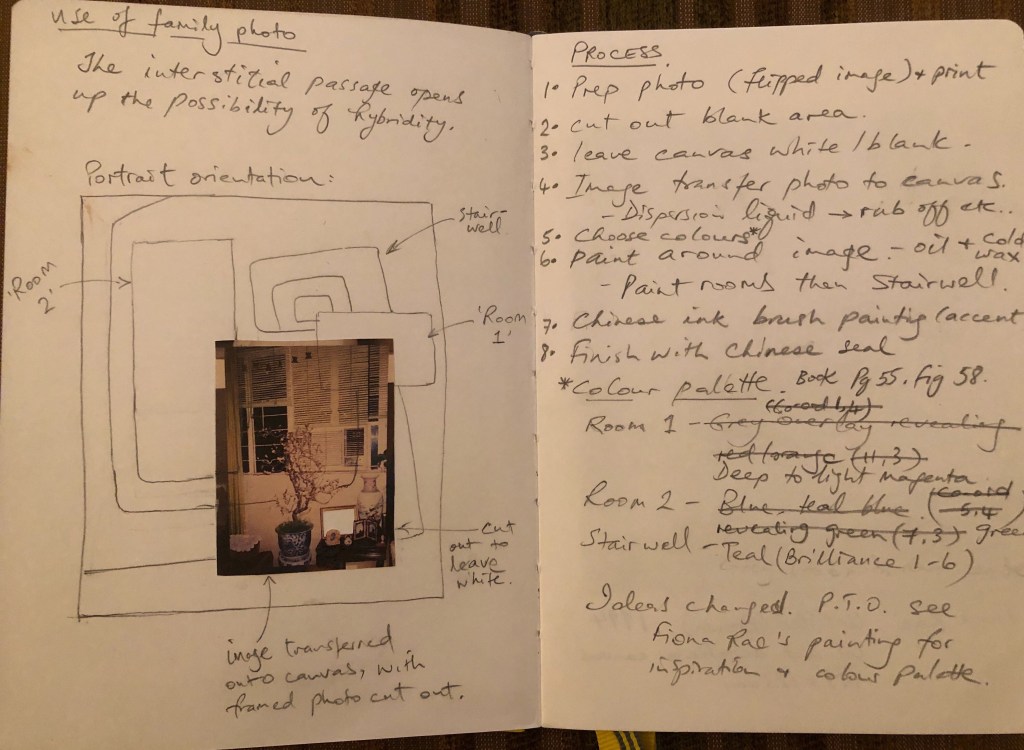
After watching a video about sketchbooks recently, I decided to return to using my sketchbook to develop ideas. Here is what I came up with for this painting.
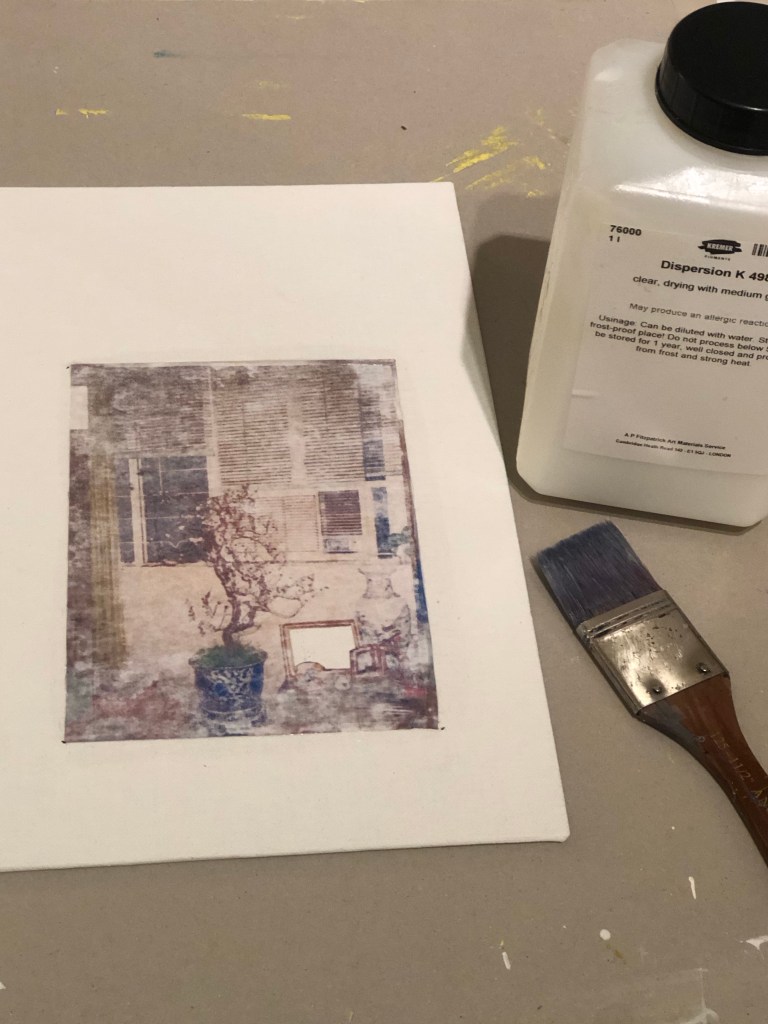
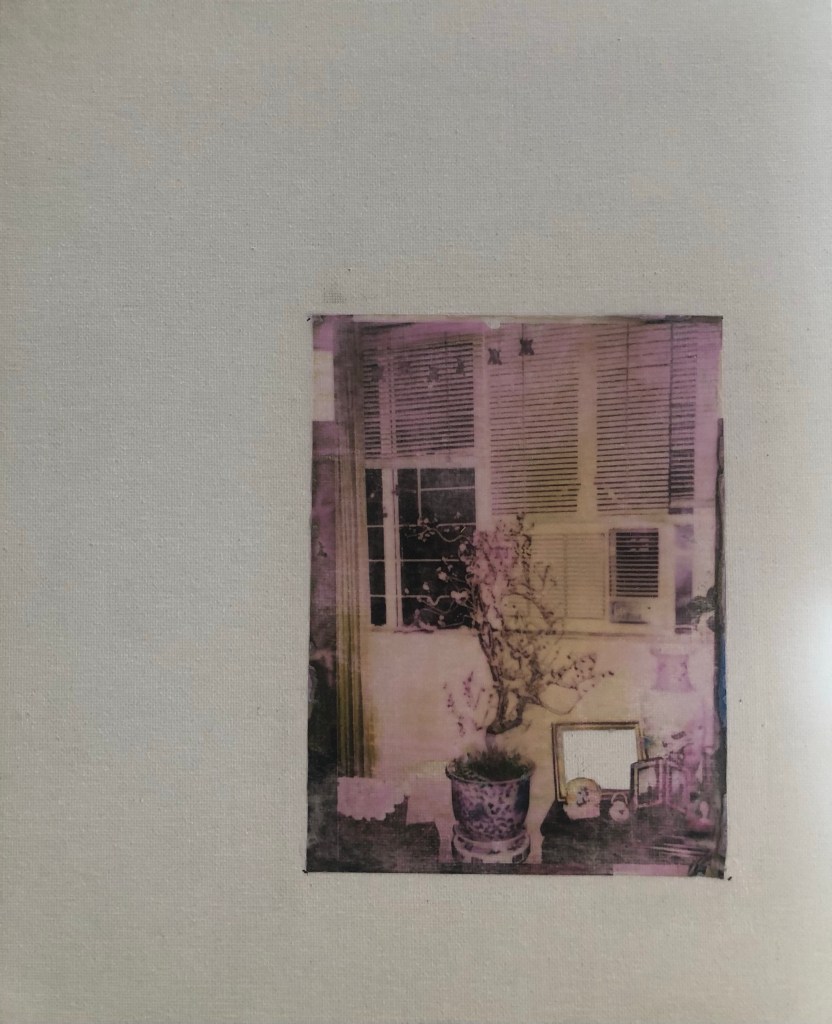
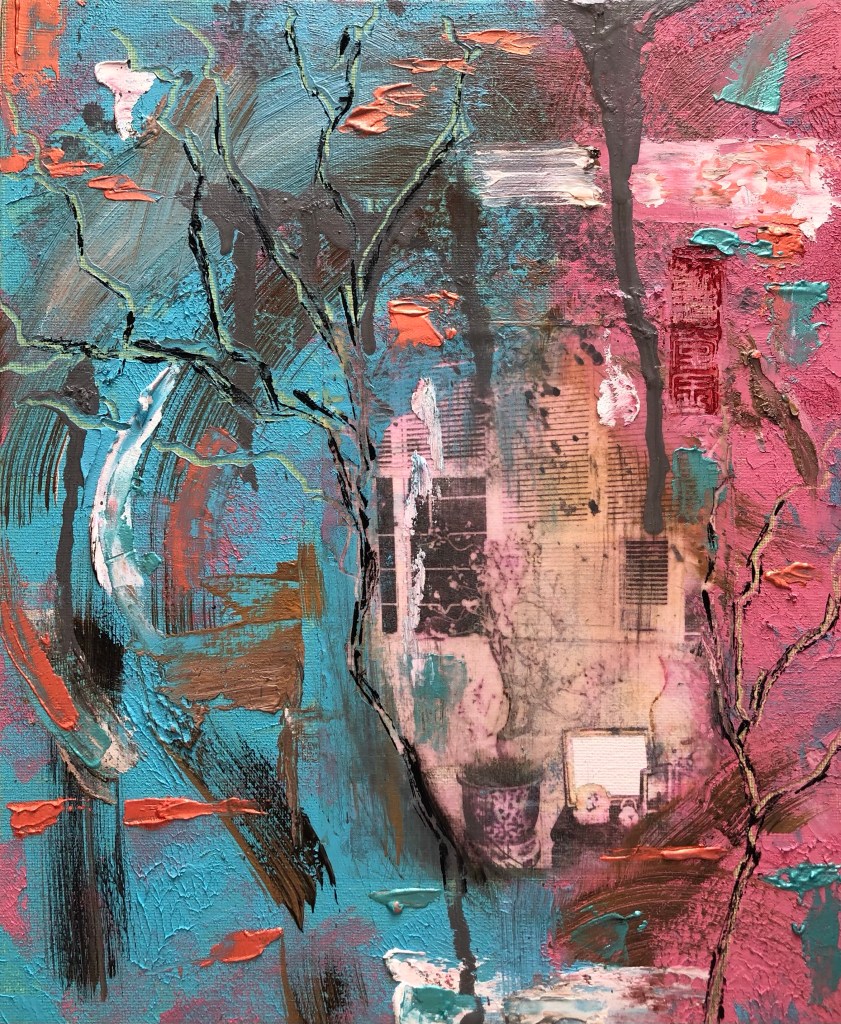
I took a digital copy of an old photo from my parents’ home, printed it out and transferred the image onto a 12×16 inch canvas board using dispersion liquid. One of the framed photos in the image was of me at my graduation with my parents from years earlier – I didn’t want to include that hence I cut it out to leave a blank space with the aim of raising questions or intrigue for the viewer.
Image being transferred onto canvas board
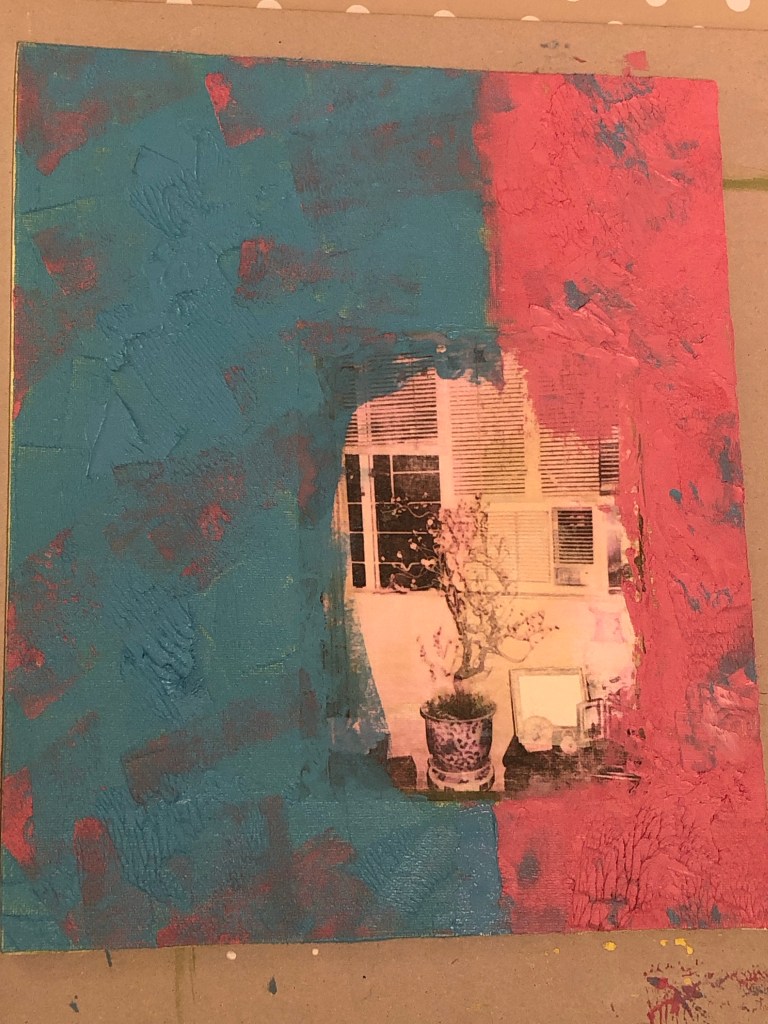
Below is a bare canvas board with the transferred photo image:
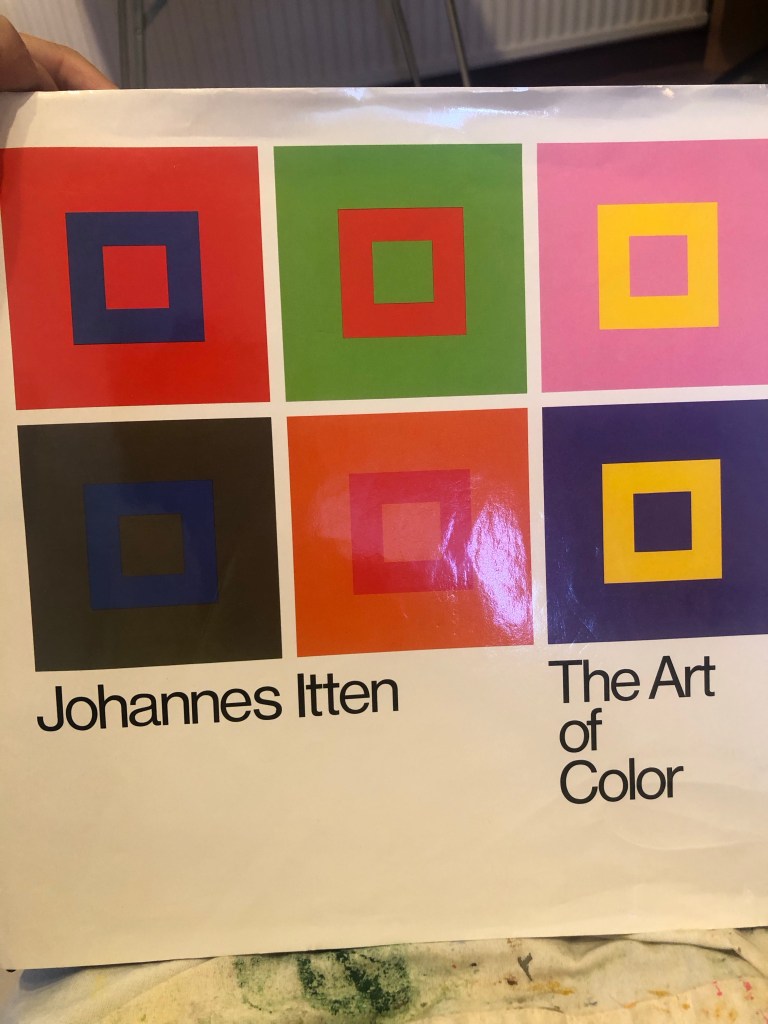
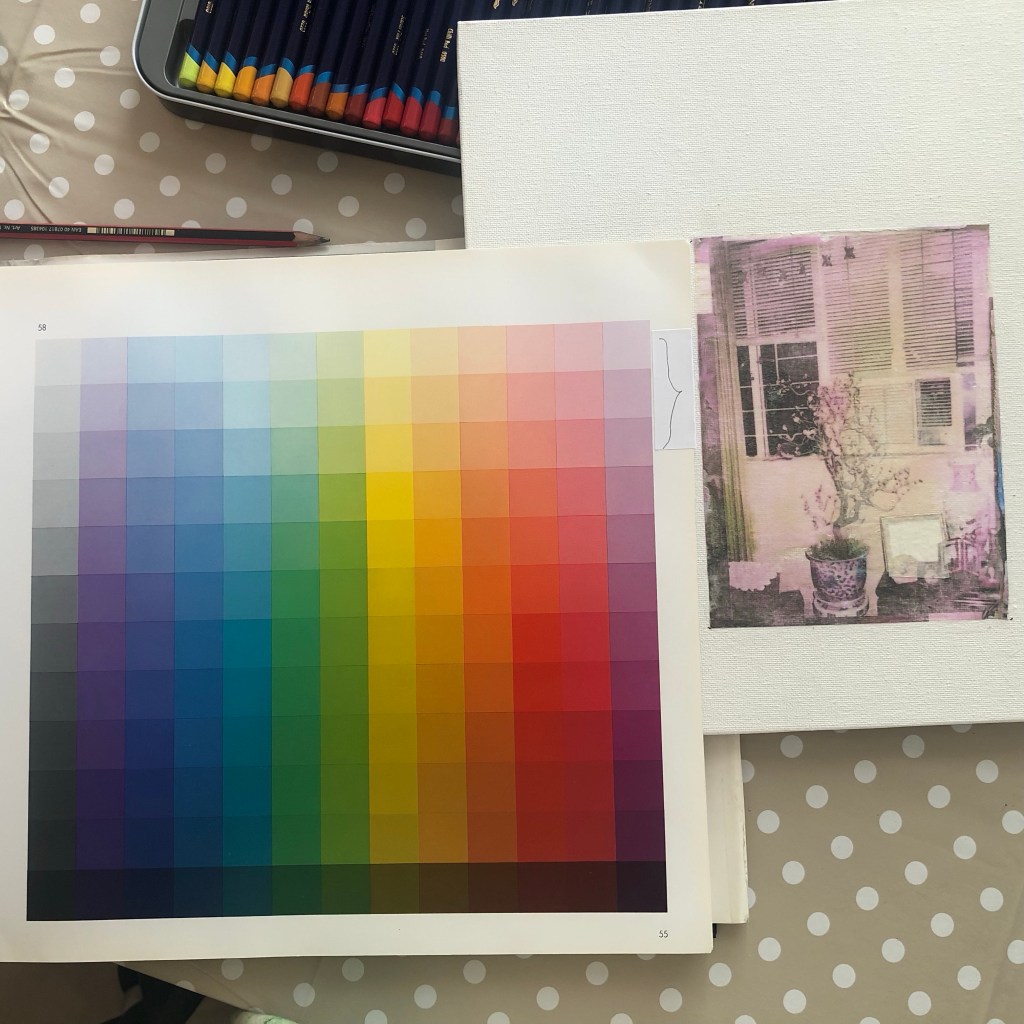
I would usually apply paint instinctively in response to the image on the canvas, however, I wanted to be more considered in my approach hence referring to The Art of Colour book to do some research and plan the colour palette for the work.
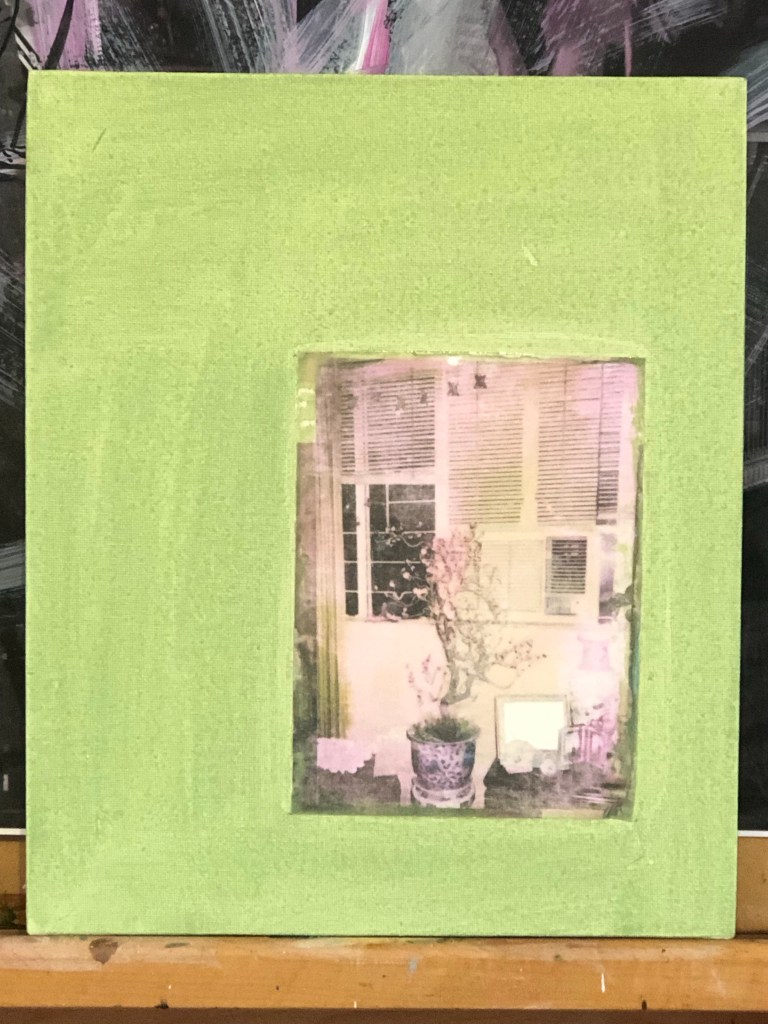
I picked out a green shade from the photo and did an acrylic wash to cover the canvas:
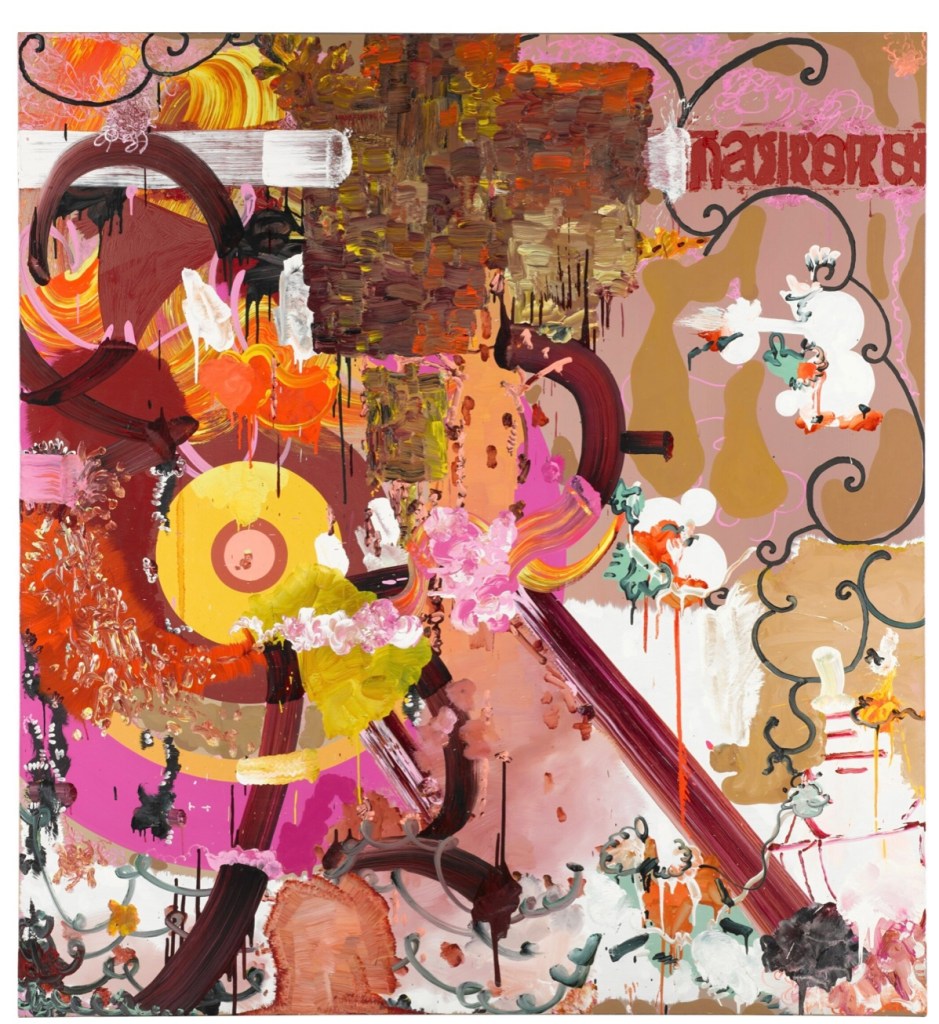
I was feeling lost despite faced with a very informative book. So I did some artist research to look at the colour palette on this painting by Fiona Rae – an artist that I admire and researching into her work was part of my intention from the last experiment:
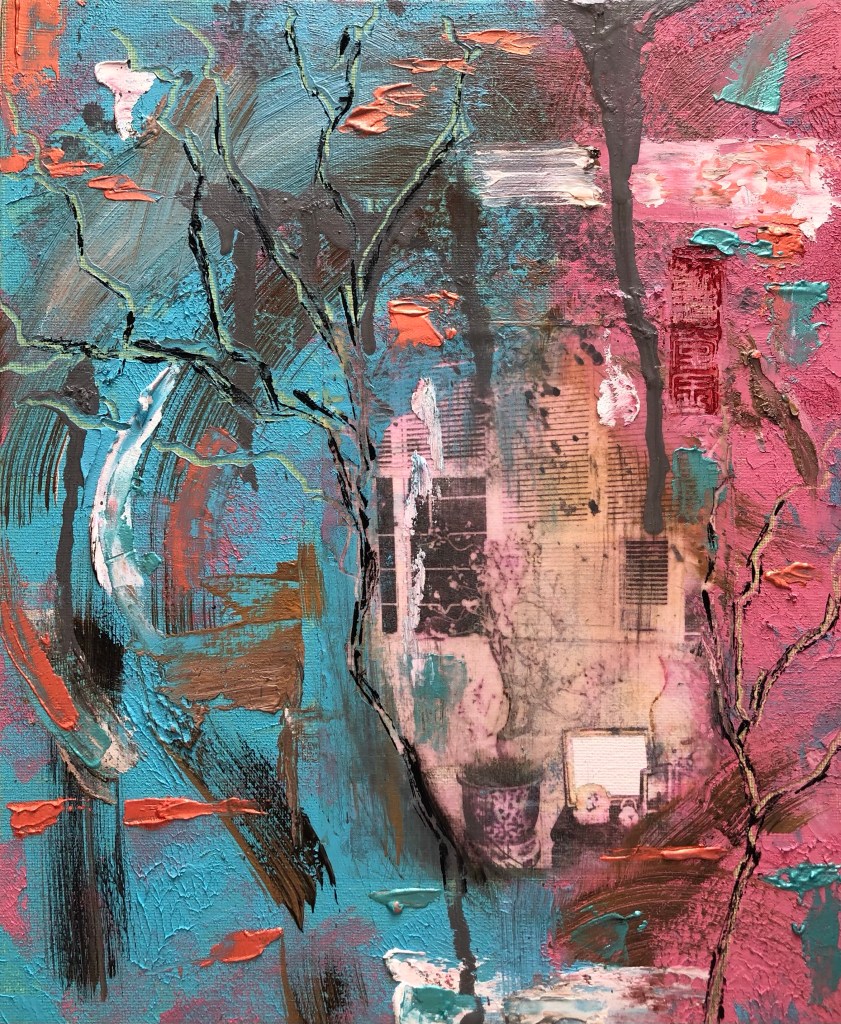
That gave me the inspiration to start painting. I tried to stay with the idea developed in my sketchbook with blocks of colours in oil and cold wax reflecting the different cultural areas that I operate in.
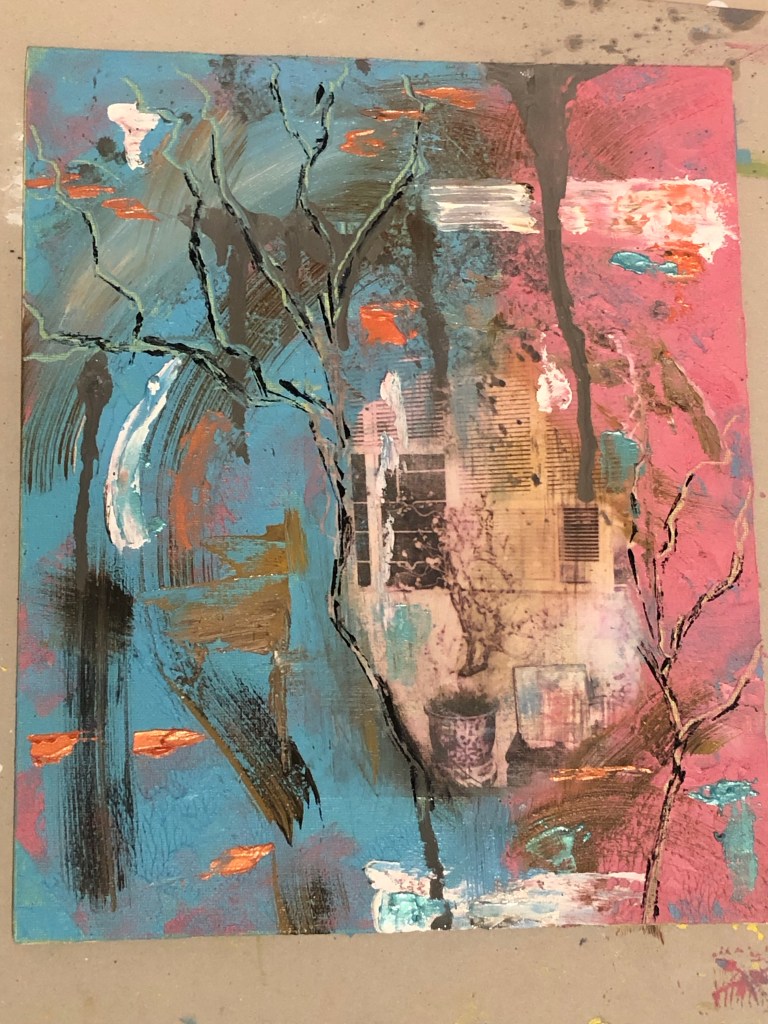
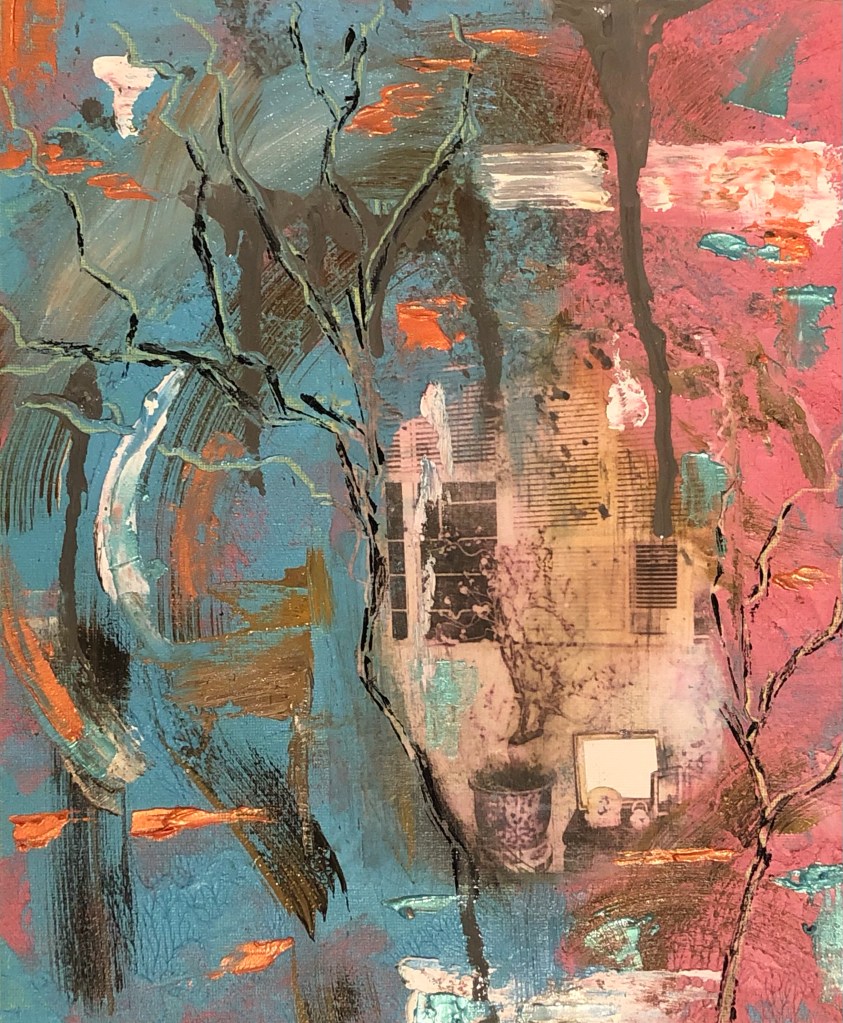
I wanted to add connections between the two blocks to represent the stairwell connecting ‘the two rooms’ as in the analogy used by Homi K Bhabha in his book The Location of Culture about people living in different cultures simultaneously – one ends up running back and forth. I then scratched the oil and wax medium to create branches like those on the peach tree in the photo.
I masked the cut-out of my photo while painting. Below is with the mask removed after I finished painting:
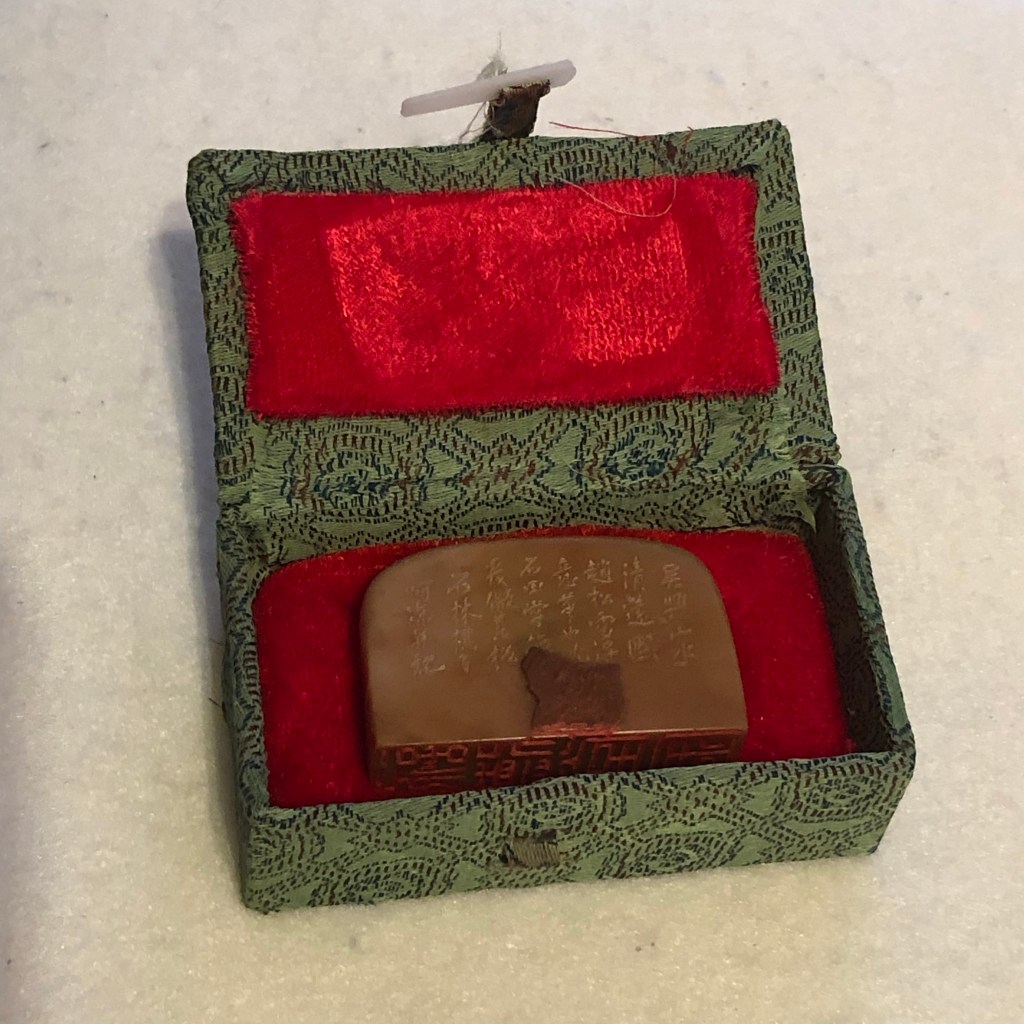
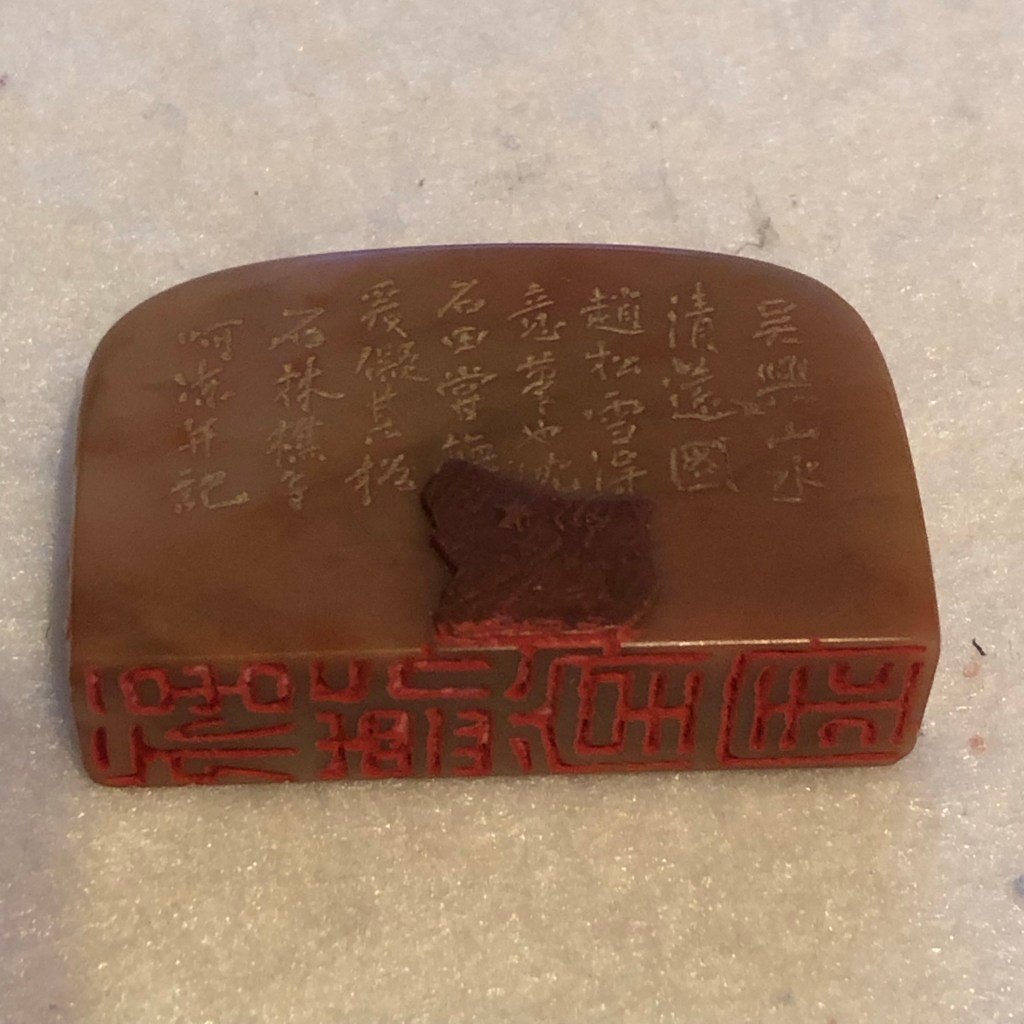
I wanted to put a seal stamp on the painting from my late mother to connect her with this work. Here is one of her seals (she was a Chinese artist):
The seal was stamped on the top right of the photo image to complete the painting.
–
REFLECTIONS
In The Location of Culture, Homi K Bhabha talks about the negotiation of cultures and where that takes place. He uses the analogy of a stairwell connecting different rooms and a transcultural person is constantly running in between those rooms. That analogy resonated with me and I wanted to build my image around this concept as captured in my sketchbook.
Regarding the use of a family photo – this idea came about when I was recently shown four photo albums that belonged to my family. I was asked to take them but I didn’t feel ready to take them yet. I wasn’t ready to start delving into my memory although working from memory is a key part of my narrative work. My deeper memory felt fragile hence I wanted to ease into the process. My tutor suggested that perhaps I could try working with one or two old photos to see how I got on. I chose one photo that was taken at Chinese New Year with the traditional new year peach blossoms surrounded by some framed family photos. It was taken many years after I left home and I didn’t feel a connection to my parents’ home even though I felt I should do. Hence I cut out the photo of me from the scene as I felt out of place there. The cutting out of part of an image from a photo was something that I wanted to try to see if it would convey that sense of ‘absence’ or ‘not belonging’. I was pleased with how it worked out on the image transfer and the masking process.
Despite the research into colour palettes and tone brilliance, I ended up doing it rather instinctively – this was a disappointment because I wanted to be more scientific and considered in my use of colours – so this remains an area of development.
I enjoyed using oil and cold wax and found that I had many options of mark making. I was pleased with how the scratched tree branches came out and the black thin marks helped to enhance the tree. I would have wanted to paint the tree in Chinese painting style but I have not worked out how to paint that delicately onto oil – ink doesn’t work on oil (materially incompatible) and oil is too viscous to achieve the delicate aesthetic – this remains an area that needs further investigation.
I presented the painting at a group crit. I didn’t mention the cut out photo and wanted to see if anyone would ask about it. No one did which made me think perhaps it was not an effective way to provoke a response.
At the crit, I was also asked by the facilitator if it would matter to me if no one understood my work. My instinctive answer was ‘no, it wouldn’t bother me’ although it’s always good if someone understood the work or found a connection with it. My take away was that perhaps this painting was aesthetically too confusing and hence people didn’t get it.
LEARNING
There were practical learning points such as to continue to work on colour theory and find ways to satisfactorily depict delicate Chinese brush painting onto a ‘western’ medium such as oil because I want to explore ways to bring different cultural genres together to convey my transcultural lived experience. This continues to be a key area of exploration for me.
On a personal point, although I liked this painting, I learnt that I still have some way to go to express myself in an abstract manner that connects with the viewer. My two colour zones with connections for the ‘stairwell’ didn’t really come across as I intended and the viewers seemed indifferent to the photo image. These made me think that what I wanted to say was not sufficiently thought-through, so I need to revisit what I wanted to say and not to rush in trying to say too much in one painting because all the messages and symbolic meanings would just get lost within the image. I have been advised before to avoid trying to say everything or too much in one painting – I must remember that.
NEXT STEPS
– Continue to learn and experiment with colours as I want to use colours appropriately to help me to convey my story.
– Do experiments: dig out some old oil painting exercises, cover with clear gesso and see if I can use Chinese ink on top of that.
– Revisit my style development. Do more research into the third space to really understand what that means to me and what it could look like aesthetically in order to develop a language that I can use. For this point, I want to develop my abstraction skills and will continue to explore oil and cold wax in this development.
– I want to continue to explore the cut-out photo technique to play with the notion of absence in my narrative. Although no one asked about it in this case, I remain excited about the possibilities.
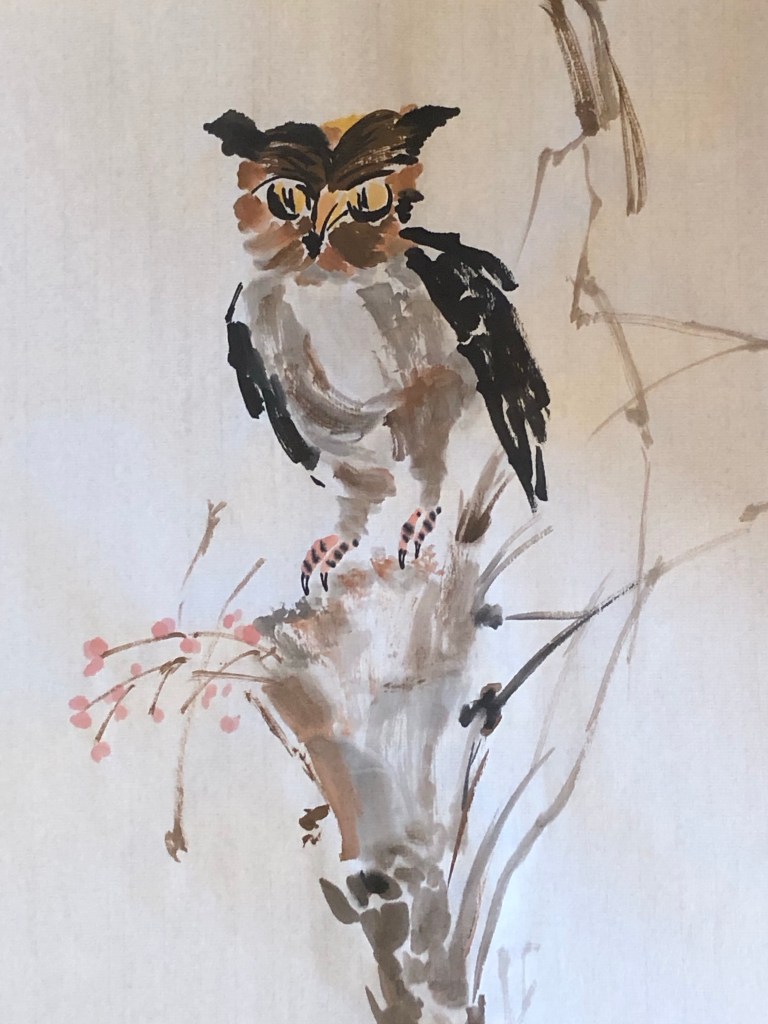
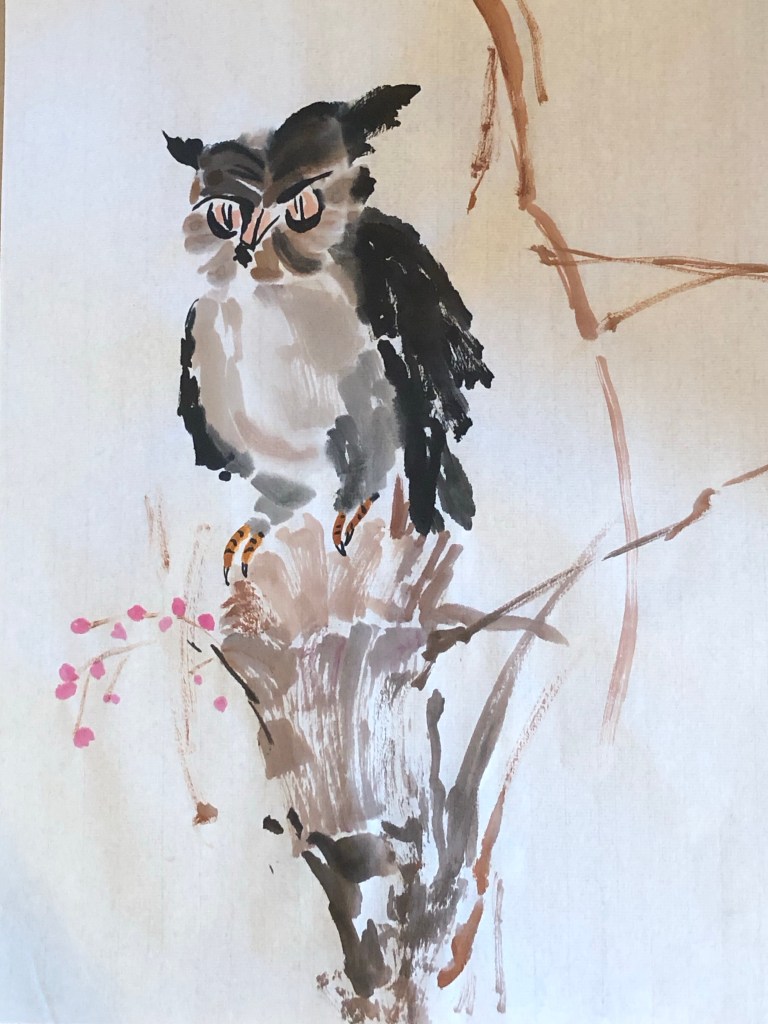
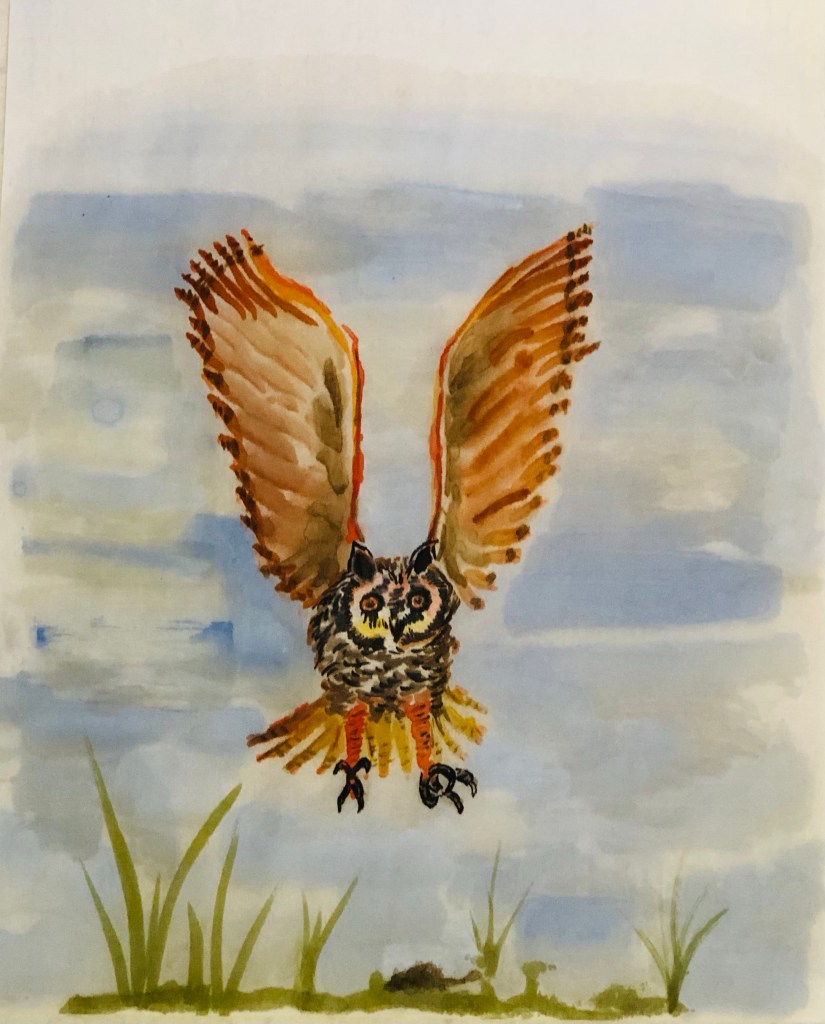
At this month’s Chinese painting class, we learnt to paint owls as part two of the feathered creatures series after painting the rooster last month. I enjoyed last month’s work on the rooster very much and preferred it to the owl.
Since these paintings are just copies of worksheets from class, I will not be reflecting on this work and this blog is merely a record of this month’s lesson.
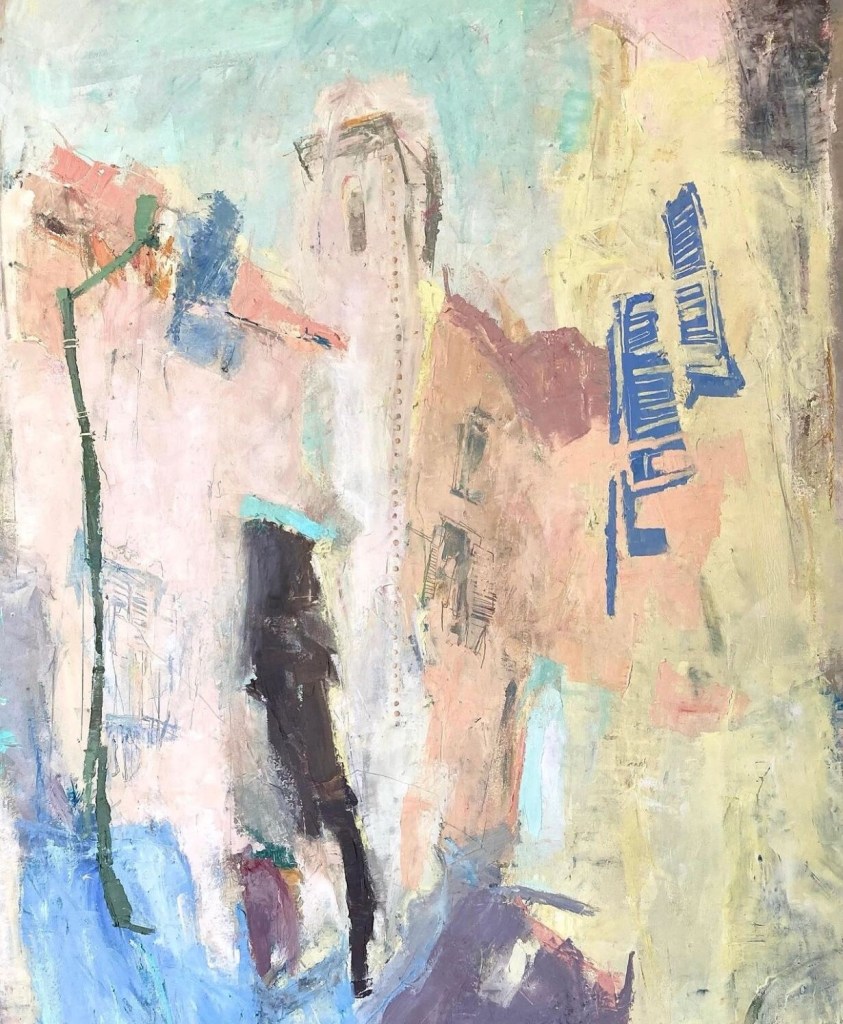
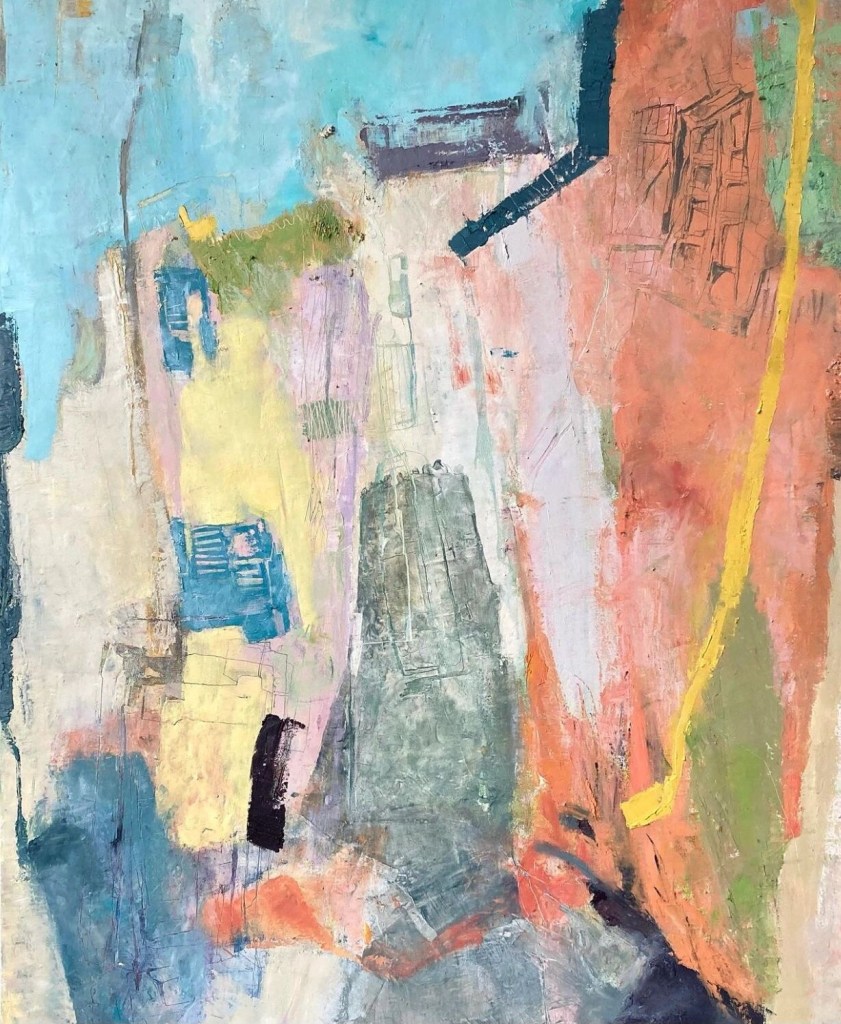
I have been wanting to experiment with oil and cold wax in abstraction because I find myself often drawn to other abstract artists’ work using these specific media. For example, a local artist from Bristol called Julia Maleeva. Below are examples of her work.
Julia Maleeva – Belfry 100x150cm. Oil and cold wax on canvas:
Julia Maleeva – Lemon shadow in love 100x150cm. Oil and cold wax on canvas:
–
METHOD
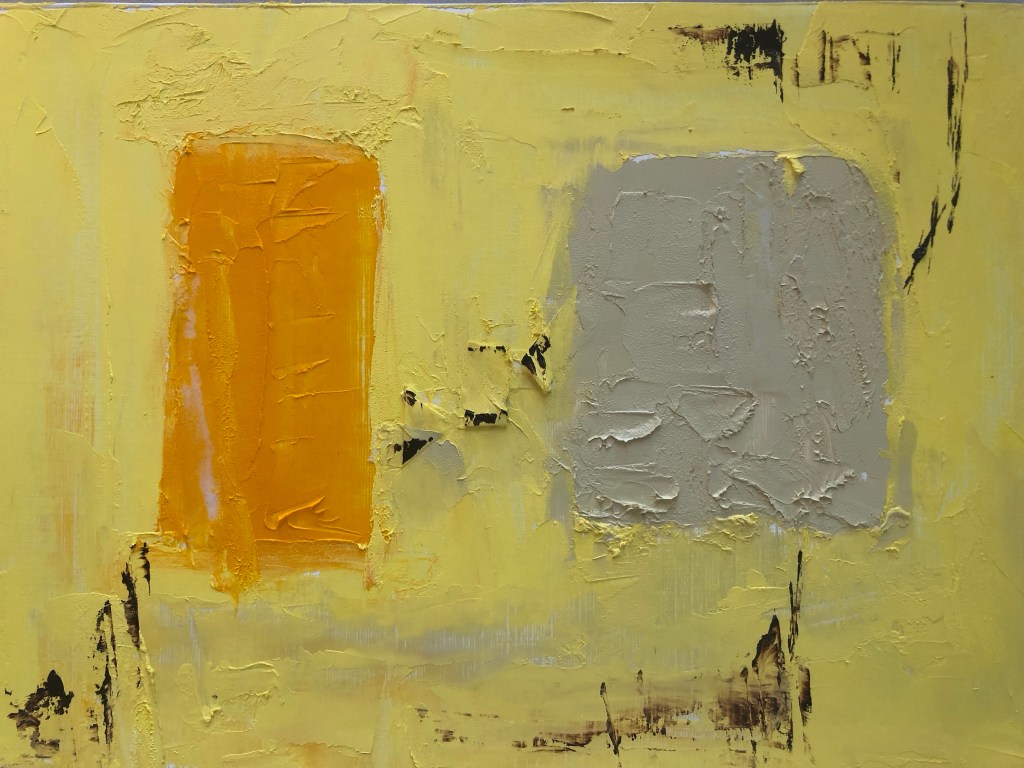
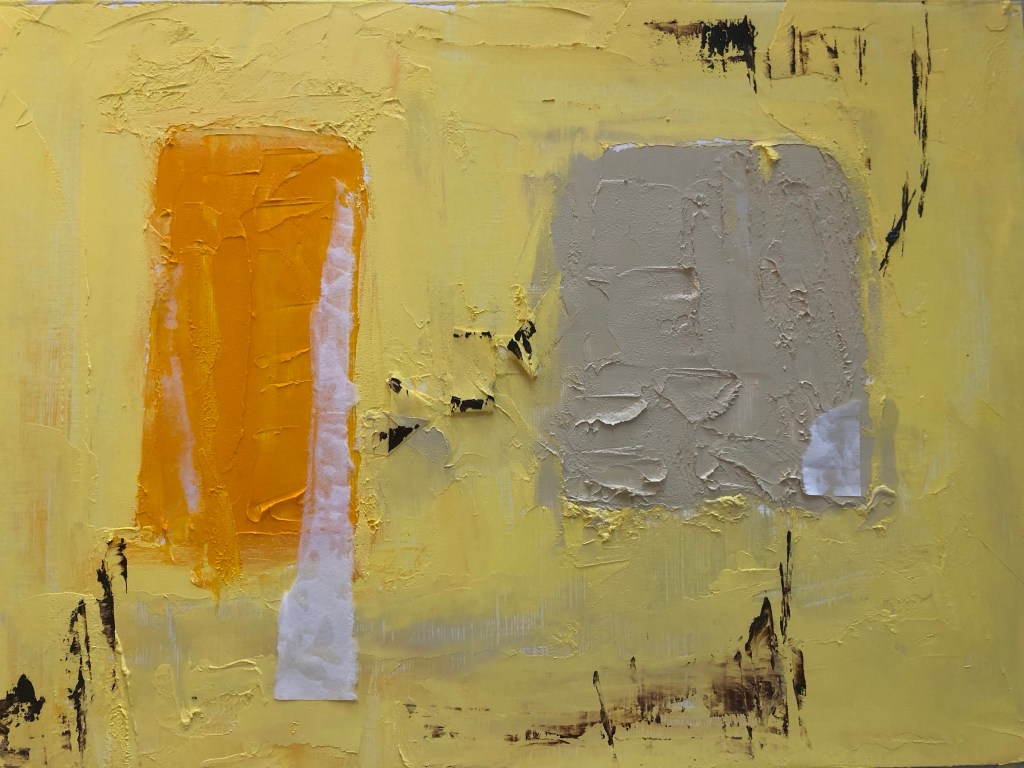
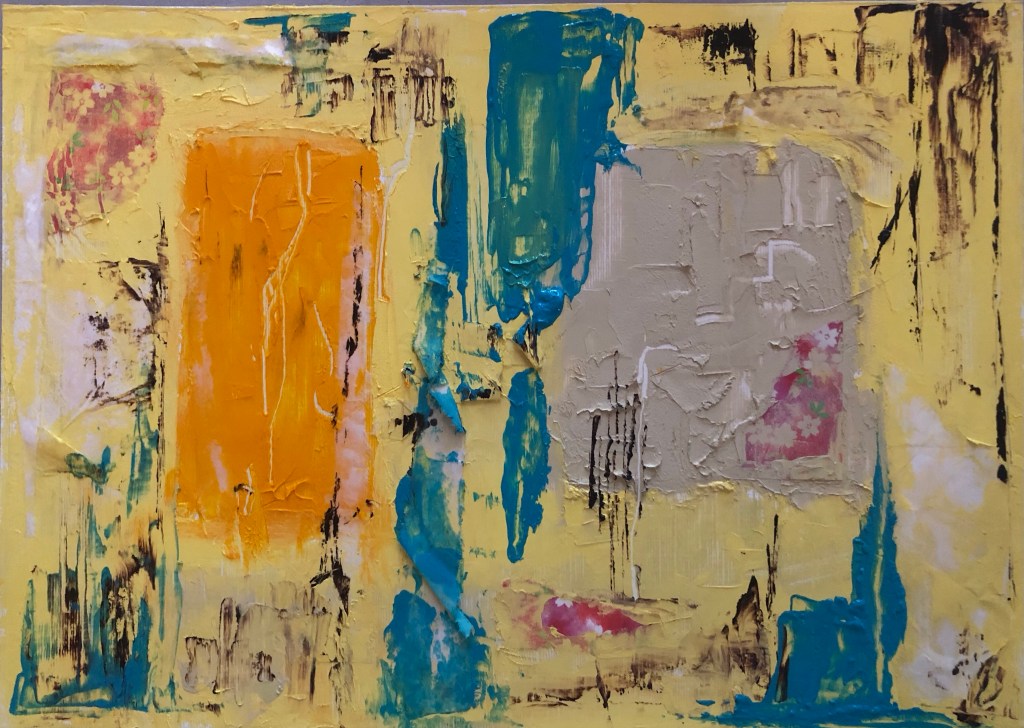
The objective of this exercise was just to experiment and try out how the oil and cold wax work together, applied using palette knives. I also wanted to add elements of collage to give additional texture.
Oil paint and cold wax mixed in 50/50 ratio, with a twisted paper strip to see if the paper would stick or if adhesive would be required:
More strips of paper was added:
More experimentation in different areas:
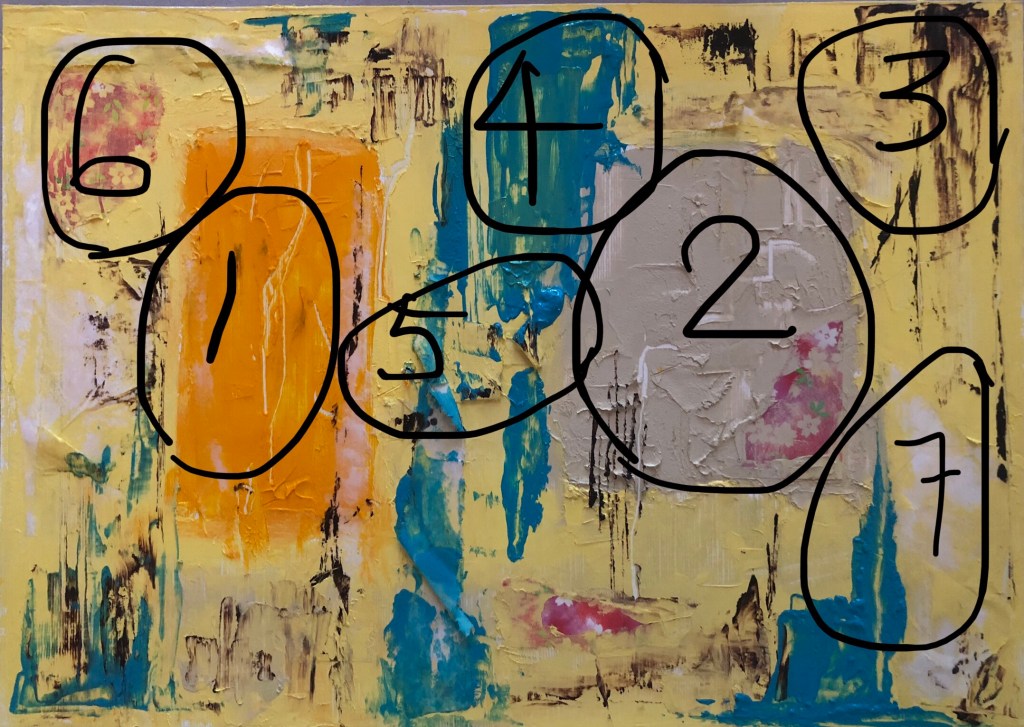
Each area explained (background is oil and cold wax mixed):
1 and 2: colour blocks of oil and cold wax mixed in 50/50 ratio.
3: pure oil paint was added to see how it appears on top of oil and wax background.
4: Blue area was oil, cold wax and solvent mixed to a thin and runny viscosity.
5: A twisted strip of paper stuck on the paint without requiring adhesive.
6: Strips of origami paper stuck on without adhesive.
7: Paper strips stuck on/half buried without adhesive.
I tried doing some Chinese style painting using oil paint as a top layer.
–
REFLECTIONS
I was pleased with the experiment of oil and cold wax. I felt at ease working with the medium and it was a pleasure applying it onto canvas. I noticed the colours remained true but the wax did make the paint more matt. The solvent worked well to thin the viscosity and I can imagine using this mixture if I wanted the paint to run down the canvas with a dripping effect.
The paper collage stuck well to the medium although I expect additional adhesive would be required for larger pieces.
I was not happy with the Chinese painting using oil paint. I couldn’t use ink on top of oil as the ink would pool rather than be absorbed. Hence I used oil and the finesse of the typical Chinese brush painting was completely lost and the depiction was poor. So this is an area that needs further investigation to achieve the desired effect if I wanted a Chinese style painting as the top layer on top of oil in my multimedia layering work.
In addition to trying out cold wax as a medium, I wanted to return to exploring abstraction as a way to be more expressive in my work. In exploring my style through multimedia layering, I find myself often being drawn into being too illustrative or repetitive in my expression and I wanted to investigate my deeper thoughts through abstraction and this is the first experiment in this series.
LEARNING
This initial experiment with oil and cold wax was positive and it is a medium that I want to explore further in addition to just using oil. The cold wax would enable me to give more texture and structure to my painting. Also it would allow me to scratch through the paint/wax as an effective way of mark making. Adding paper strips could add interest but I would use that only on a small scale; I can imagine it coming loose in the long term if larger pieces of collage were used in this way.
I am still searching for the ideal way to paint a Chinese style painting on top of oil to help me to express the transcultural nature of my style – the challenge is to find a medium that delivers the finesse whilst being compatible materially with my preferred western medium such as oil. I will revisit research that I have previously done on an artist who has successfully achieved similar to the style that I am looking for – Fiona Rae. She was able to achieve Chinese style brush strokes using oil.
NEXT STEPS
– Continue to explore oil and cold wax and do another painting to build experience in this style of abstraction.
– Research further into Fiona Rae’s work and see how she achieved her Chinese style brush strokes using oil.
– Keep experimenting with oil and cold wax.
– Keep searching for ways to paint with Chinese ink on oil paint.
– Record my thought processes and inspiration. Ideas lab, how I get from A to B in my ideas and making process.
– Like a journal.
– Record the process of making. Record my journey of getting there.
– The most important aspect of my work is me. Sketchbook helps tell the story.
– Sketchbooks are meant to be messy. Not meant to be perfect.
– Process and heritage are key in the making process.
– Sketchbooks teach us discipline. Say, everyday or every other day, put something in the sketchbook.
– Pandora (jewellery) video showing the process, how it’s made by hand, starting with a sketch. Part of their corporate story telling.
– Same for Dior – video showing making process again started with a design sketch.
How to digitise the sketchbook:
Photograph or scanning
Photograph:
– Use natural flat light like daylight and shoot from above. Avoid ceiling lights.
– Can use mobile phone.
– Can use ring light from Amazon. Creates an even spread.
– Place the sketchbook on unique background to create interest. Add prop but do not distract from content e.g. put a pencil next to a pencil sketch. Try different styles.
Photographing emphasises the 3D aspect of the book instead of scanning, giving more creative approach.
Scanning:
– Easy to do, flat 2D look.
Basic Photoshop
– use spot healing tool to remove blemishes.
– Photoshop help available 9am to 6pm Mon to Fri. Go to Collaborate:
– Adobe Acrobat DC can add, delete or move pages around.
Flipbook software
– Issuu / Yumpu
– Cam make a magazine
– Can email speaker for help with Flipbook.
Basic Copyright:
– Fair Use/Dealing law
– Do not fear showing your work.
– Use (c) Copyright – Name – Date if you want to copyright.
– Can use watermark in PDF. Can add Metadata copyright into photoshop or PDF file.
Where to start?
– Look online, YouTube to get ideas. Start somewhere then be disciplined, say one sketch a day.
– Example of sketchbook entry – take a photo of something on TV or when you’re out that you like, record voice note about what you like about it. Then put in sketchbook.
For further info:
z.chaudhri@arts.ac.uk
REFLECTIONS
It was a very useful session. I have bought a new sketchbook for the MA course but hadn’t used it yet. I have been capturing my ideas in an Ideals Lab blog. The blog is a good way to quickly note down ideas while they are fresh in my mind but I feel it does not offer the creative and ideas evolution ability in a way that a sketchbook does. So I know I need to make better use of my sketchbook and make it a meaningful part of my creative process. I must admit that I often used my sketchbook because I knew I was meant to, but I didn’t always find it useful. Hence I tended to go from ideas in my head straight to the canvas. I appreciate that approach does not enable me to maximise the ideas exploration part of my process and it’s something that I need to improve on.
It was useful to hear about the options for digitalising the sketchbook.
LEARNING
It was a good refresher to remind me of the usefulness of a sketchbook. But it’s only useful if I make it part of my process. A key learning is to find meaning in the sketchbook process, not just to use it, but use it to add value to the creative process. The only way is to start using it, keep experimenting, find enjoyment in using it and go from there.
NEXT STEPS
Use the new sketchbook to explore ideas for my next painting.
UPDATE
Using the sketchbook to develop ideas and process for the latest painting:
I’m happy with how the sketchbook helped me in the latest painting, but I need to continue to make it a natural part of my process.
 elizarawlings