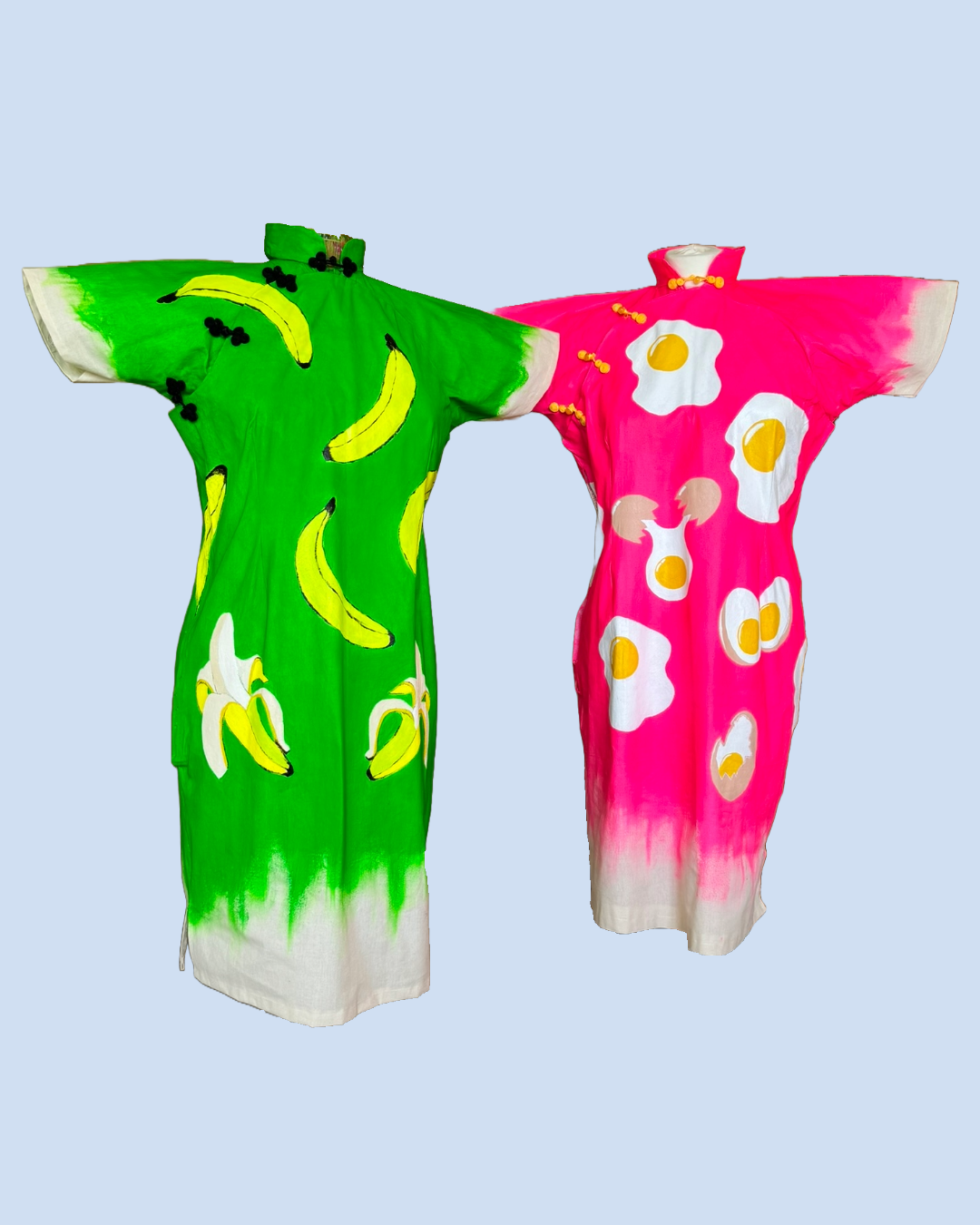
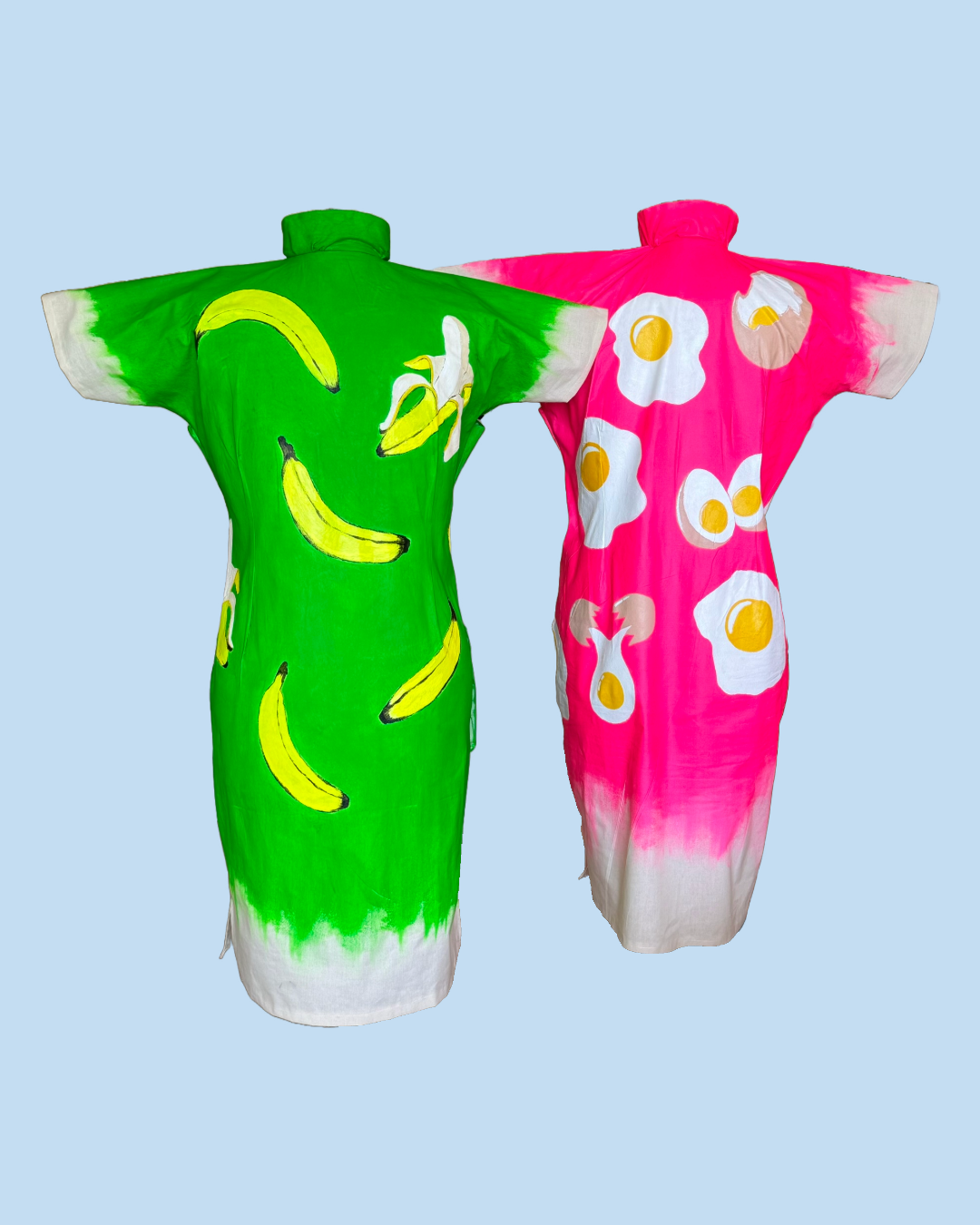
This blog details my overall reflections for the Cheongsam Series – Food as metaphor for cultural identity. I made two paintings on this topic and they are captured in the two blogs below:
The finished paintings are intended to be displayed as a pair because they respond to each other.
–
REFLECTIONS
It has taken me some time to write this blog as I am not sure where to start. My reflections on the making process, composition and technical learning are captured within the individual painting blogs. This blog is meant for reflecting more deeply on what making these paintings has meant for me. I shall capture my thoughts as they come into my mind as a form of free writing.
The dressmaking part:
– Throughout the making of the Cheongsam dresses, I thought a lot about watching my mother dressmaking when I was a child. The way she designed the clothes, for herself and for her children; measuring us, making her patterns on waxy paper, chalking the cloth aided by her special yellow wooden rulers and cutting the fabric with the long sharp scissors. Then sewing using her manual Singer sewing machine with a leather belt that turned the wheel as she pedalled. I remember having fitting sessions with part-finished garments and then she would do the final finishing off. Every button was chosen with care. It’s not until I made these canvas dresses for my paintings that I realised how very clever she was. Although dressmaking is not difficult, making it well requires talents and skills just like any craft. She made evening gowns, tailored jackets and trousers! Those are very difficult items!
– One could ask, so what? Many people made and still make clothes. What’s the big deal? I reflected much about her life while making my canvas dresses because the process of dressmaking is largely unchanged therefore I could clearly visualise my mother going through all the steps that I am now replicating decades later. My mother married at 17 years old and became a mother at 19. Hong Kong in the 1950s and 60s was a very patriarchal society and she as a Chinese woman was confined to her role – wife, mother, cook, cleaner, homemaker etc.. However, it is clear on reflection that she had ambitions that were not fulfilled by her role ‘assigned’ by society. There were few avenues for a woman of her time to express herself and she chose to do it through her dressmaking. She later went onto Chinese painting and became an accomplished artist with many students. Two weeks ago I was shown the various awards that she was given as an artist by cultural institutions in Hong Kong and China – I hope to explore more about her journey as a painter at a later stage.
– As my father’s career advanced in the Colonial Hong Kong Government, my mother would accompany him to official white-tie dinner balls (British style). She would always design and make her own evening dresses. She was the only woman who made her own dresses at those events. She always sought to be different and I believe in those days, her dress design and making was where she found a channel of expression as well as solace. It gave her an escape from the shackles of societal expectations of a traditional Chinese woman.
– I left home when I was a young teenager to boarding school in England and never lived with my parents since. Sadly they both passed before I really had the time or inclination to get to know them properly. So in a way I’m reflecting on her as a stranger with fragmented information from my patchy memory. Despite that, how did I end up picking up art in later life and in a strange way walking her path? I don’t think I have the answers yet but my own artistic journey has given me insight into what she was seeking as a person, as herself.
The painting part:
– It took me a while to decide what to paint. I like using metaphors in my work and when I stumbled across an image of Warhol’s banana, it gave me the idea to paint something in pop art theme as a contrast to the traditional Chinese dress canvas – I like making work that has an undertone of incongruity because that is afterall the metaphor for myself. Furthermore, a banana was the perfect subject as a cultural metaphor – yellow on the outside and white on the inside.
– I researched the use of the word ‘banana’ to describe a westernised East Asian person and I was delighted to find many insightful and humourous articles that resonated with me. The highlight was finding the film clip from the Hollywood movie Crazy Rich Asians talking about the protagonist being a banana – it was for me an endorsement of the phrase and bringing it into contemporary popular culture.
– As I got older and started to take time to look into my heritage, I felt that ‘banana’ alone was an insufficient metaphor for me. Growing up as a child in Hong Kong, a British influenced Chinese society, it was (and still is) so culturally rich that my core is deeply rooted in that heritage. Hence when I read an article about an egg with the yellow core as a cultural metaphor, I was hooked by the idea and felt it was a good response to the ‘banana’ metaphor.
– As I was painting both dresses, I was keen to adhere to the pop art theme painted on the Chinese dress canvas to capture the incongruity, or perhaps the fusion of the different cultures that I seek to represent in my work. At the end, I felt I have largely achieved what I intended despite much time spent on getting the right ‘green’ for the banana dress.
– The most poignant moment came when I was mixing and remixing to search for the correct shade of yellow and white colours to use for the eggs and bananas. I kept asking myself – ‘Is the white ‘white’ enough?’ or ‘Is the yellow too ‘yellow’?’ The constant search for the right shade of colour to use was a good metaphor for my attempt to fit in especially in my early years as a youngster in a new culture. Like many young people in a new environment, one was always working out how to behave, how to dress, how to do the makeup, what jewellery to wear etc. in order to fit in and be an insider. Or not to be treated as an outsider. It was a mutation process over time.
– The making of the two paintings here has turned out to be a better metaphor for my cultural transmutation journey than I ever expected.
LEARNING
I believe this blog concludes the ‘Cheongsam – food as metaphor’ series of work. I want to continue to make more Cheongsam paintings including looking for a more efficient way to make the dress canvas – it is time consuming but I want to continue with the idea so I need to find better ways of making the canvas.
I will continue to use the Cheongsam canvases to explore my identity which is a fundamental part of my practice. I feel using a Cheongsam canvas is a turning point in my practice, the idea came to me just as I was struggling to find a way forward to bring my ideas together. These two paintings are just the beginning of something, not sure exactly what yet, but I feel it’s a beginning.
Since much effort goes into making these canvases, I want to revisit the first Cheongsam painting that I made with the ‘Blue Willow pattern’ to see if I could make more of it so as not to waste the piece because I was not that satisfied with the outcome at the time.
NEXT STEPS
Revisit the Blue Willow pattern painting dress to give it more meaning.
Explore more efficient ways to make the Cheongsam dress canvas.
Make more work!
 elizarawlings