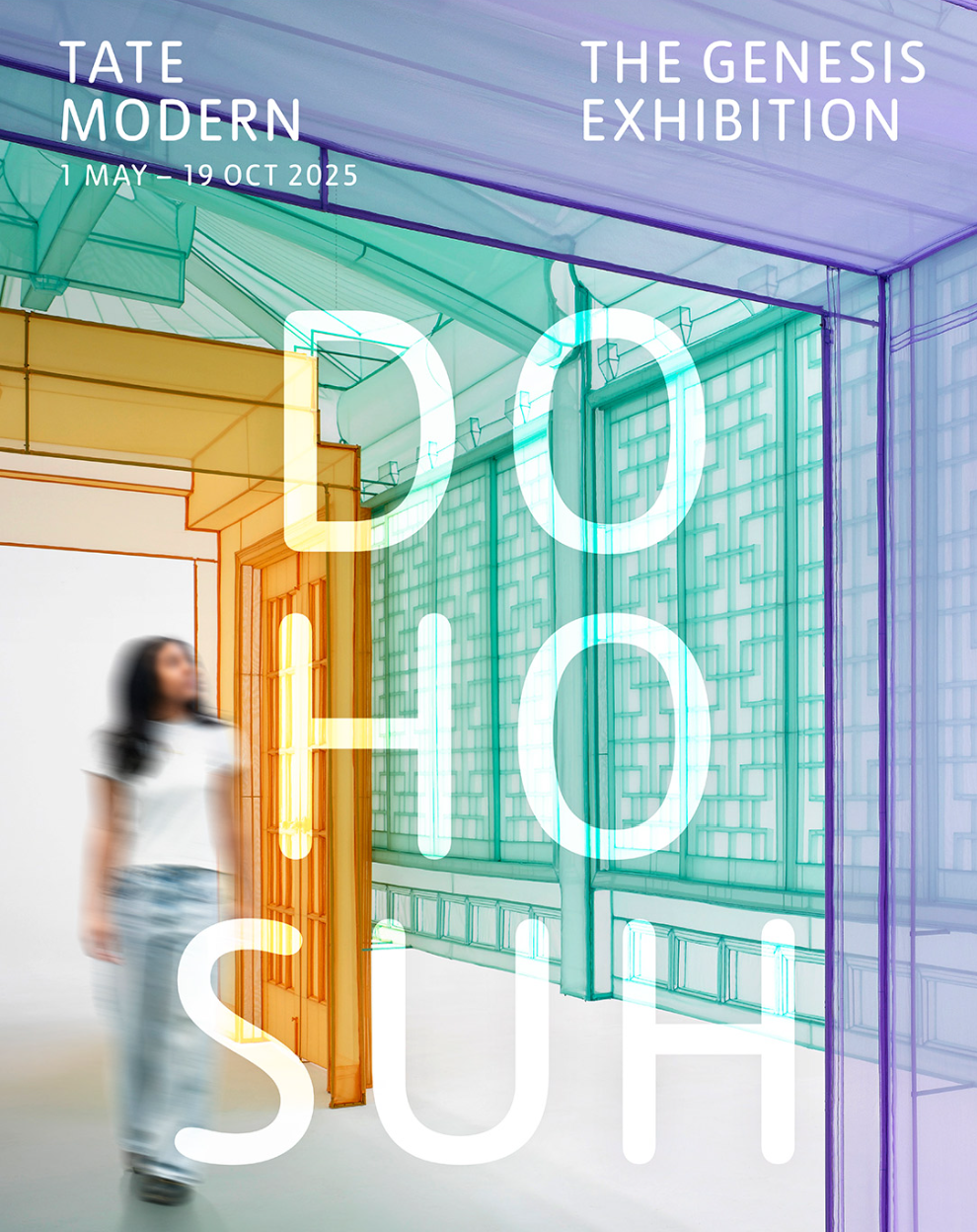
I was looking for an exhibition to go to with my daughter who lives abroad and was in London for the weekend. After reading a couple of reviews, I decided on ‘Do Ho Suh: Walk the House’ at Tate Modern.
The exhibition was very busy as it was the last weekend of the show after the end date was extended. As we walked between the monumental exhibits whilst navigating the crowd, I could hear frequent bleeping sounds. It was the threshold-wire sensors protecting the displays being triggered by keen viewers leaning too closely to examine the details.
A video playing on a small screen captured the artist working meticulously. A young couple standing next to me gave a running commentary in Cantonese about the intricate process and delicate materials used. It made me nostalgic because the artist’s hands reminded me of my brother’s when he worked on his wood board carving; they both use their slender but strong fingers with the same intensity. I was mesmerised by my own nostalgia.
A thin curtain separated a large area where a film was projected onto an entire wall. Two labels on the wall at the entrance to the area described the locations of the film. We couldn’t read the detailed descriptions as more people were pushing to come in. We gleamed the headlines and started watching. My daughter turned to me and said, ‘I’ve lived in places like that.’ I replied, ‘So have I.’ ‘Yeah, pretty universal,’ she muttered. I was not sure if she meant the experience or the place. Perhaps both.
We were drawn to a darker corner with intrigue. Looking through a gap between semi-transparent panels, I met eyes with another visitor. There was a momentary connection then we both looked away. My daughter called me over and said, ‘Look, Mum, there is a miniature toilet.’ We both laughed and took pictures of the toilet.
We returned to the exhibits in the main area. I felt my phone vibrate. It was my daughter posting a photo on the family chat of me staring intently at a display with the caption ‘When art meets electrical engineering. Rapt.’ We played who could name the country of origin of the pieces on display judging by the shape of the electric sockets. It then occurred to me that I moved away from home to another country when I was young and she has moved away from her home country, too. We now have that shared experience. I wonder where she calls home now.
Wading through a crowd watching another large film projection, some standing and some sitting on the floor, we reached the gift shop. The final few fridge magnets were half price. It’s the last weekend after all.
I introduced the idea of drawing or painting with my non-dominant hand whilst developing my body of work ‘News’. I did that as a way to challenge myself and to introduce uncertainty / vulnerability into the process to reflect how I felt about the state of the world at the time. Since then, I have become fascinated by the subject and I have been reading the book ‘The Master and his emissary’ by Iain McGilchrist on the divided brain. I read about Divergent Artistic Behaviour which states that:
Truly creative art can only result from divergent artistic behaviour – behaviour that was previously unknown or often unexpected and unexplored.
Divergent behaviour demands something from you that you have not been taught or that is not part of the suggested or normal steps in solving a problem.
That understanding has reinforced my desire to explore using my non-dominant hand to draw and paint as that has been unexplored up to now.
In this research experiment, I want to gain a deeper understanding of what the difference is between the work that is produced by my dominant hand right vs my non-dominant left hand.
METHOD
I have previously done an exercise with both hands drawing together simultaneously and one of the outcome of that was to consider whether I needed to have both hands drawing simultaneously and whether I had to have my eyes closed. My conclusion after some consideration was that no, I didn’t need to do either. If my objective is to research the difference between how the two sides of the brain produce work through my hands then there is no need to do it simultaneously or have my eyes closed. In a way, those parameters could confuse because there were too many variables introduced at the same time. Therefore, in this exercise, I’m going to just draw with each hand and compare the outcomes.
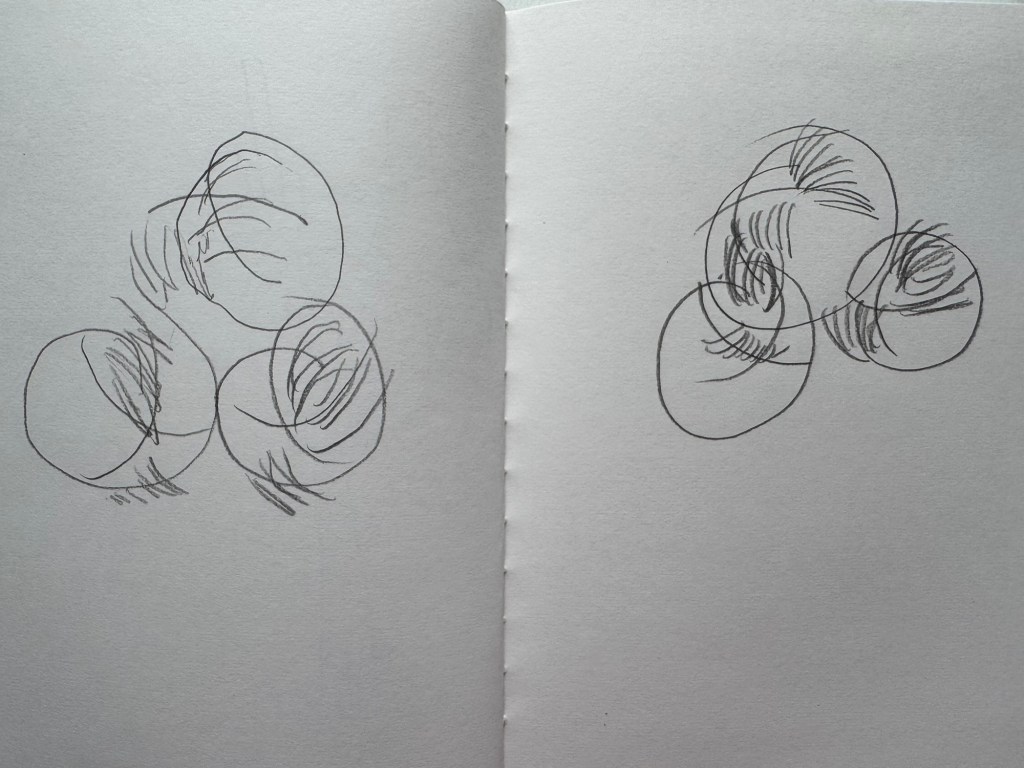
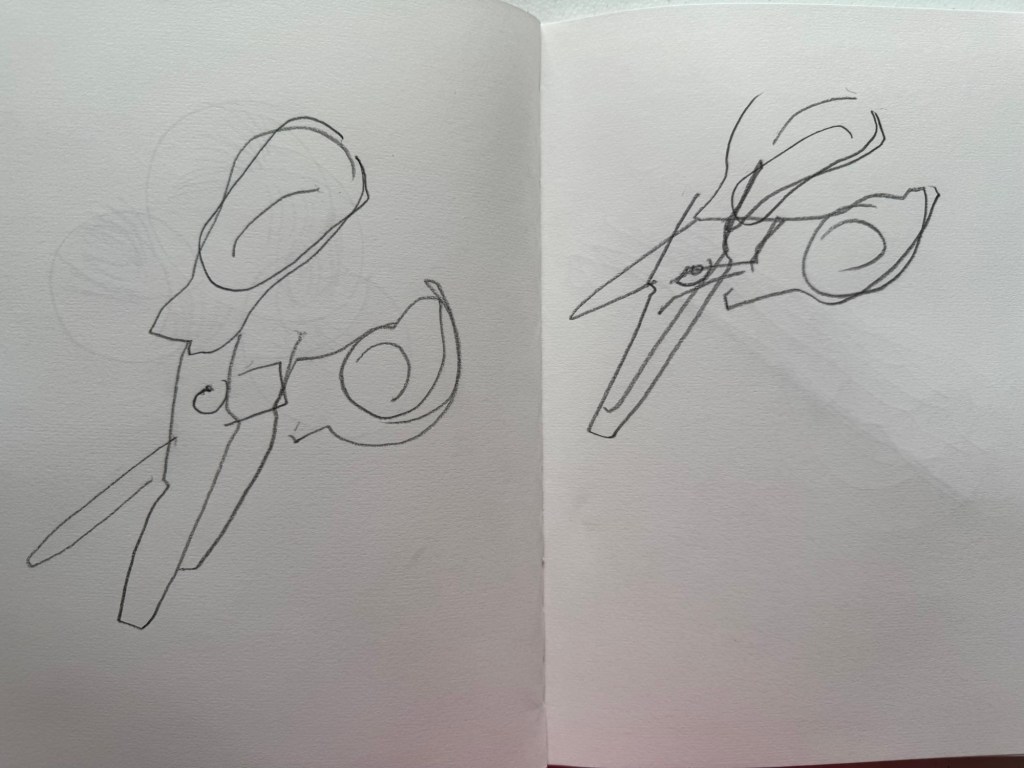
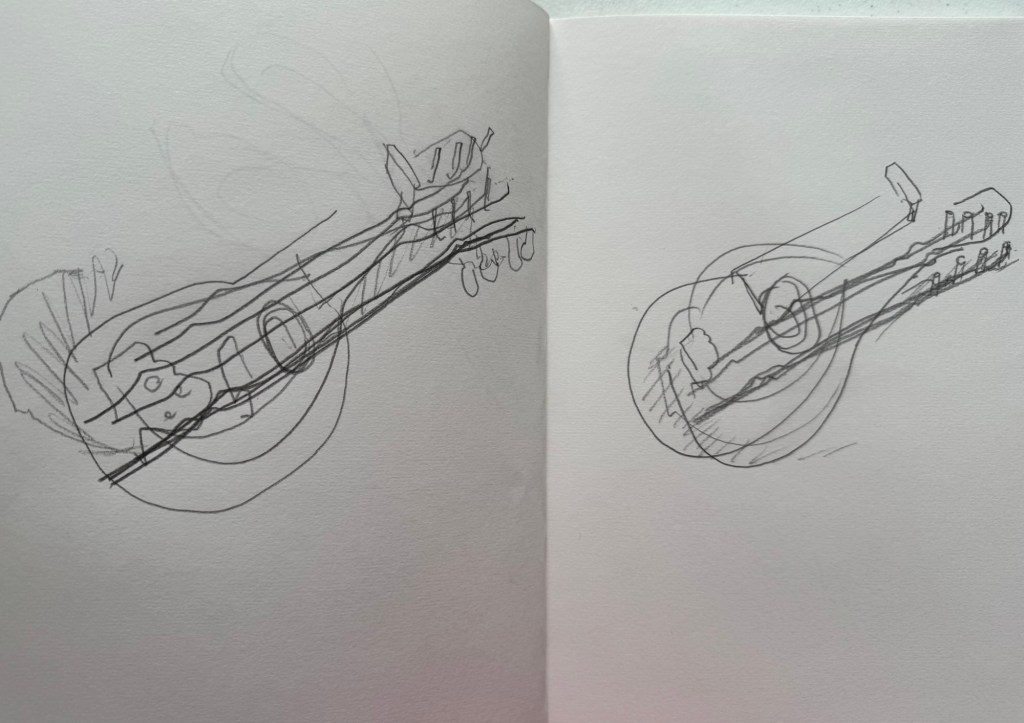
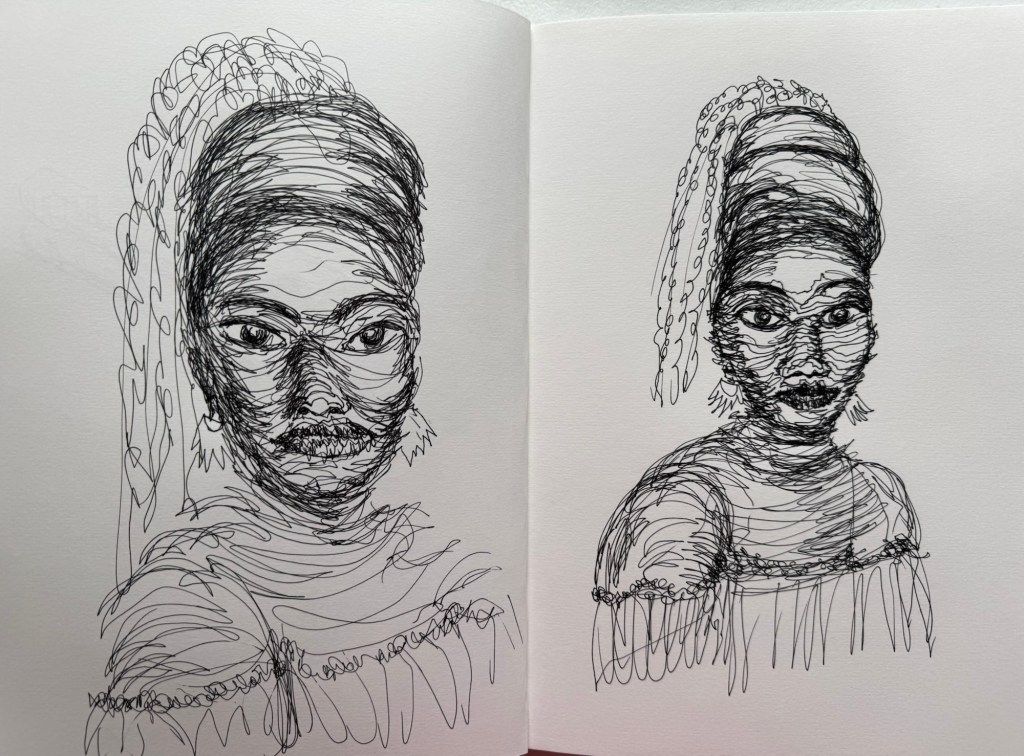
I used the method of ‘blind contour drawing’ – drawing with eyes looking at the object and not looking at all at the drawing. Below are some of the items I drew in my studio with the left page drawn by my left hand and the right by the right hand.
Studio lightJuggling ballsScissors Miniature Chinese lute – Pipa
Cross-contour drawing –
A woman’s face
REFLECTIONS
It has been an interesting exercise. Firstly, I feel that there was no need to draw simultaneous like I had done in the previous experiment. The key is to study the difference at this stage and not the difference when drawing simultaneously. One step at a time.
The images drawn with my left hand were consistently larger than those drawn with my right hand. I have observed this before in other similar experiments. I am able to be more loose when drawing with my left hand. The right hand seems to be naturally more tight, as though there are invisible boundaries on the page that I had to work within. Whereas with my left hand – I don’t feel the boundaries and therefore am not confined by it.
The left hand drawings are less accurate compared to the right hand, but there is sufficient likeness to be recognisable as the piece.
I am increasingly ‘addicted’ to drawing with my non-dominant left hand and increasingly less satisfied with my right hand because the latter is a constant reminder of my inability to push boundaries – I get pulled back into being too tight and constrained when making art with my right hand, it’s like muscle memory that I cannot erase. Whereas the lack of control in my left hand enables me to, or grants me permission to just make and not think too hard as there is no expectation for the outcome to be good. With my non-dominant hand, I am often pleasantly surprised whereas with my dominant hand I often feel disappointed.
LEARNING
I am more able to create freely with my non-dominant left hand because there is no expectation and the lack of control enables me to push myself, often ending in pleasant surprises. I enjoy this way of making with my left hand and would like to pursue it further. Perhaps even make it a key aspect of my practice.
NEXT STEPS
Keep creating and pushing boundaries with my non-dominant left hand.
Continue to explore the differences between making with my left and my right hands.
Try writing or calligraphy to see how the left hand performs on that.
At some point, I need to consider more deeply why I am drawn to this way of making. I must not ignore this point because I feel there is a link to who I am and how I am evolving. So I must come back to this point when I feel ready.
I have been painting with my non-dominant hand in my ‘News’ series of work. I became intrigued about the push and pull between the left and right sides of my brain. So I decided to experiment with drawing with both hands simultaneously.
METHOD
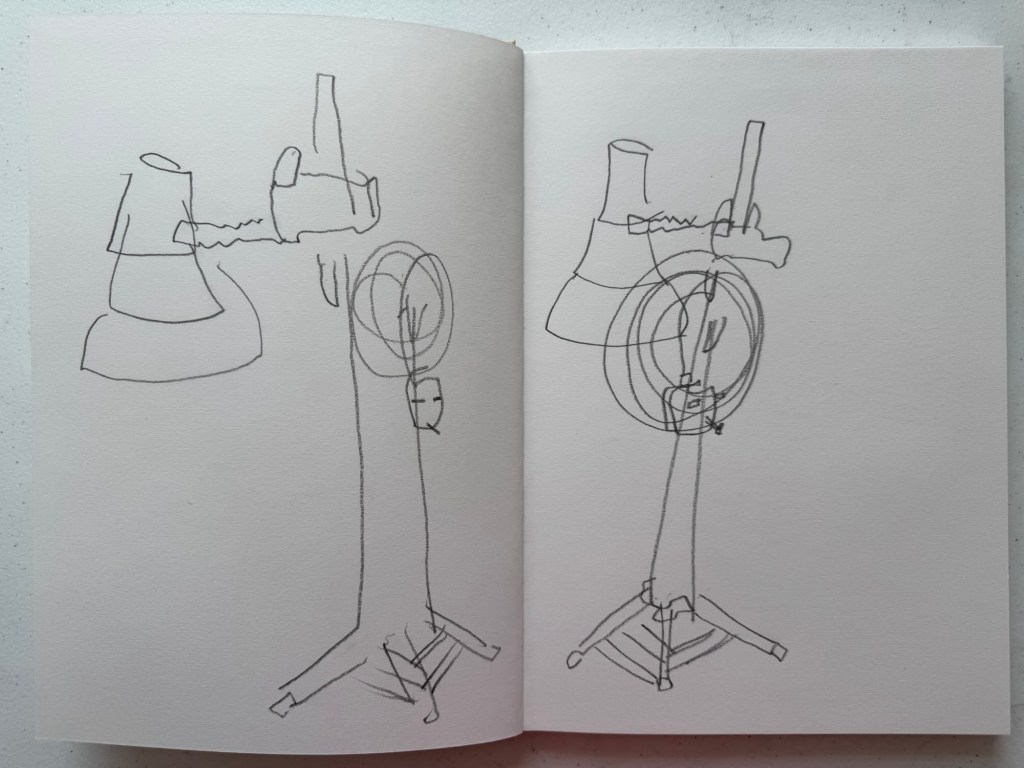
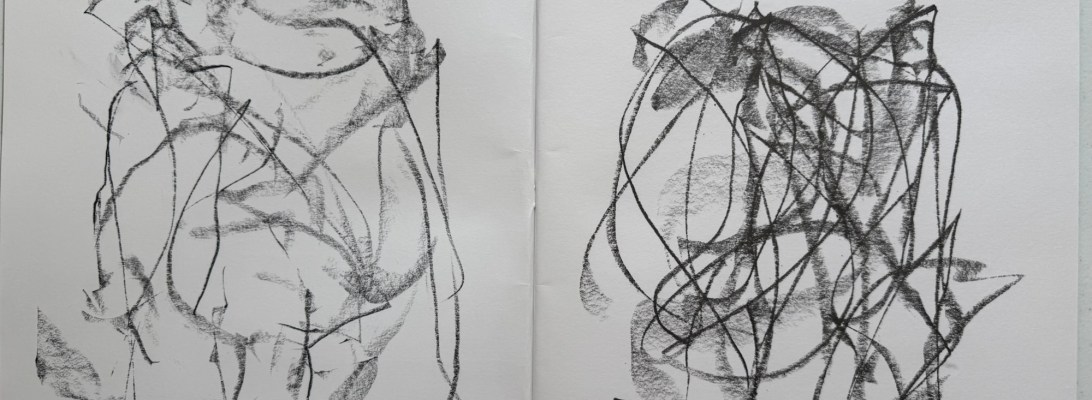
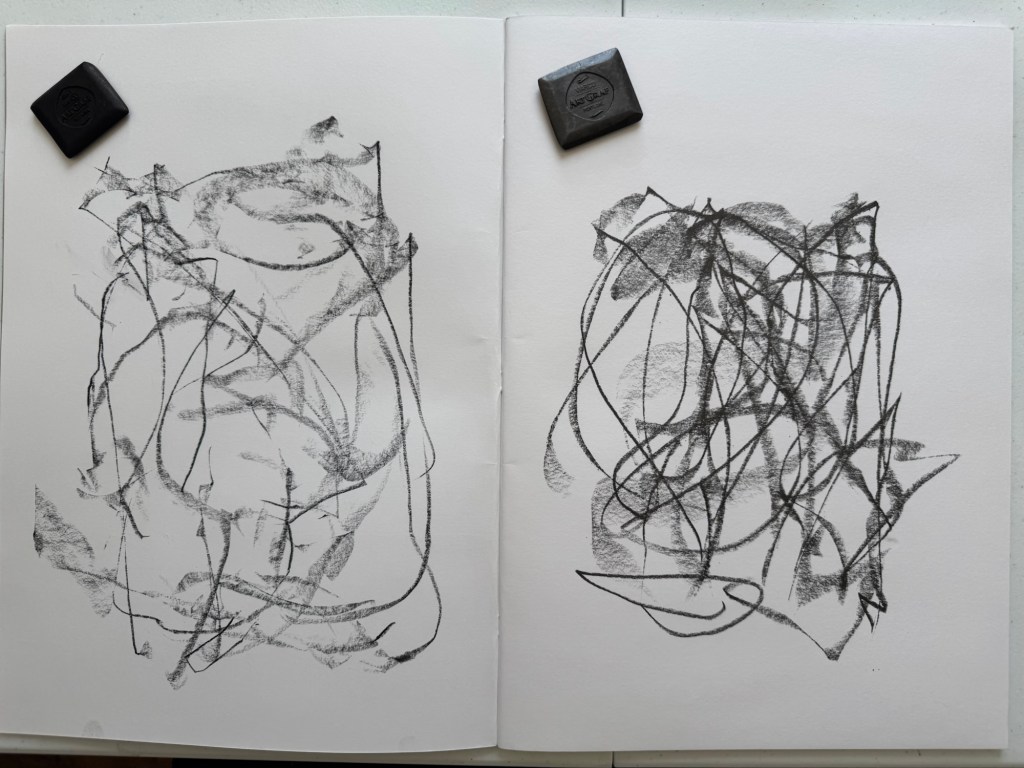
On an A2 sketchbook, I used my left (non dominant) hand to draw on the left page and my right (dominant) hand on the right page. I closed my eyes and drew simultaneously with graphite tabs. Below is the first drawing:
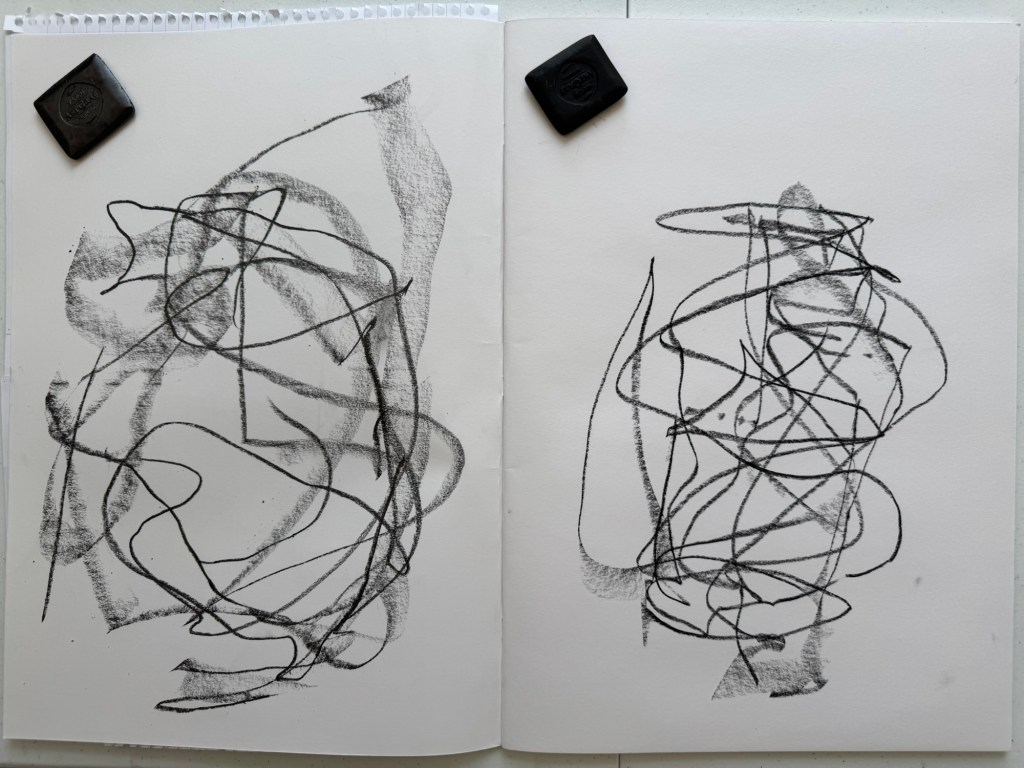
This is the second drawing done in the same way:
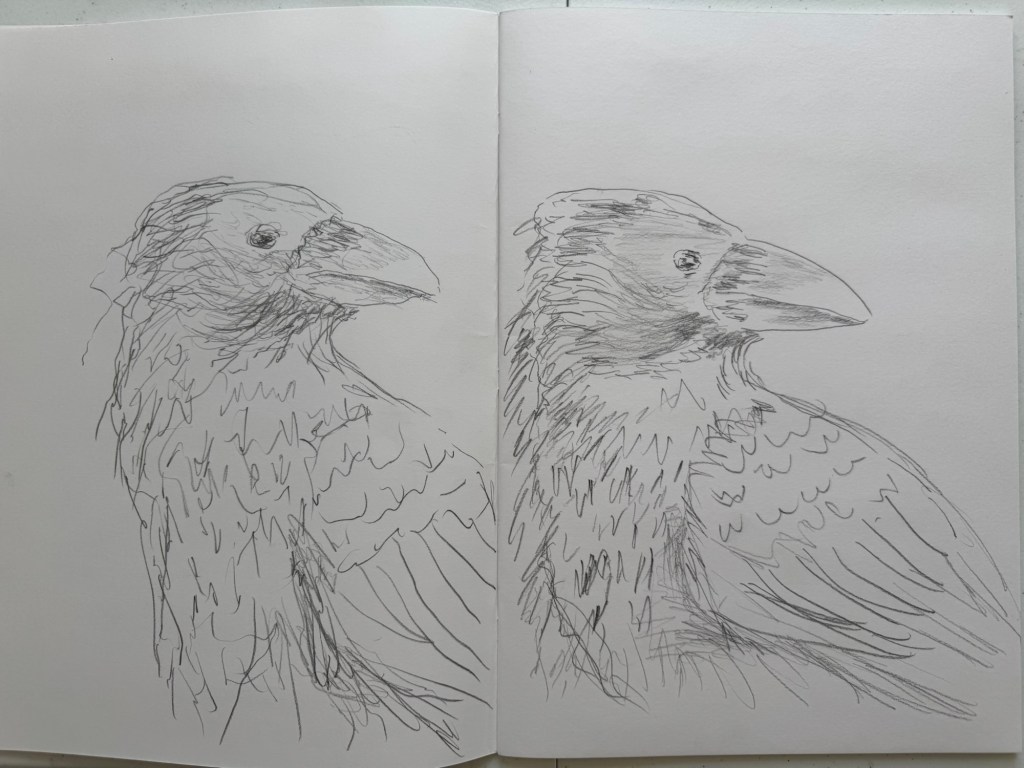
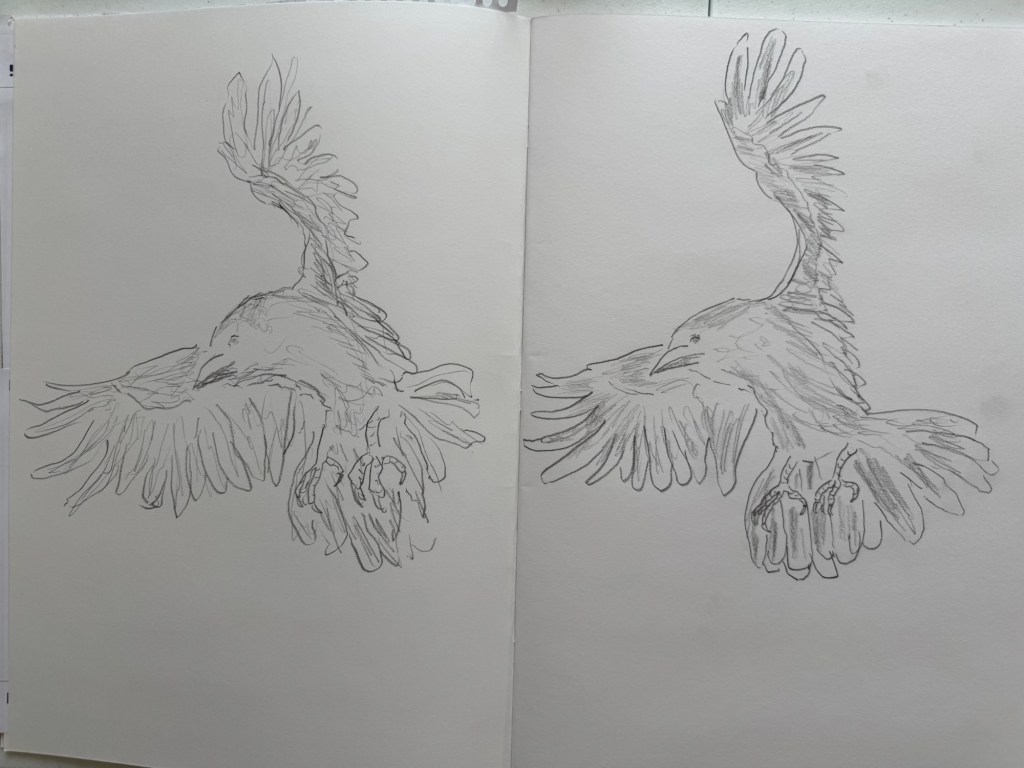
I then drew some crows with my eyes opened. Again, both hands drew simultaneously using 4B pencils. First drawing:
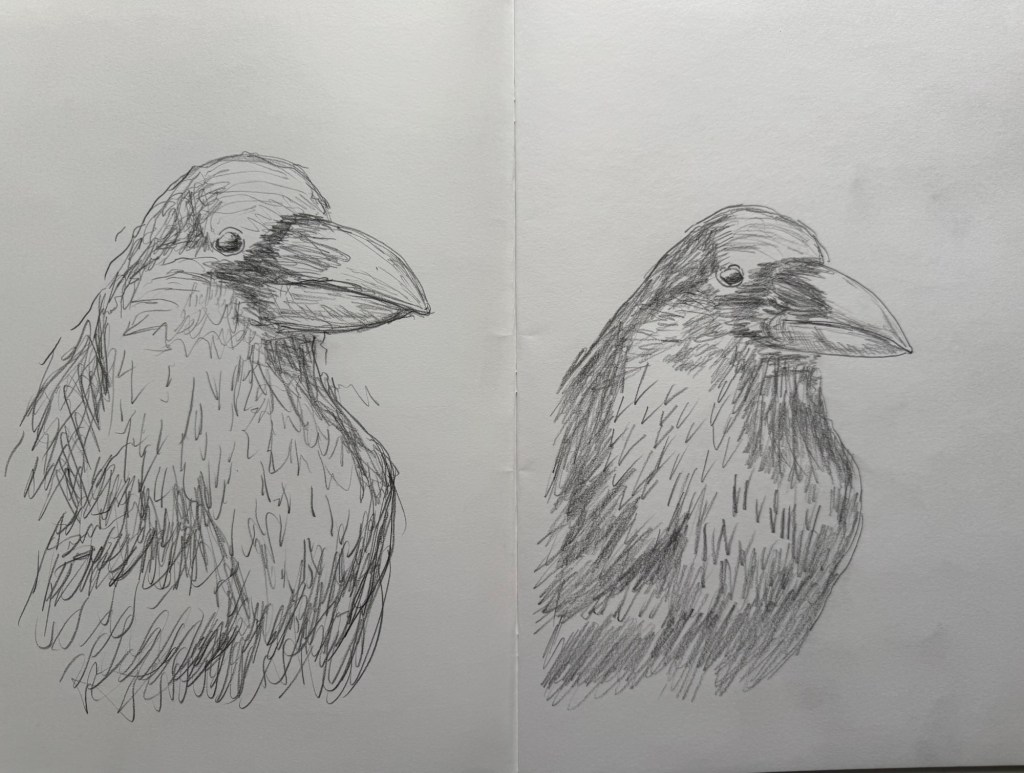
Second drawing:
Below is the third drawing. By the time of doing this drawing, my brain felt tired from the intense concentration that I finished these drawings separately:
–
REFLECTIONS
The first two drawings were abstract mark making with my eyes closed. I wanted to see if there would be any difference with a free and simple method like this. My initial observation was that the non-dominant hand drawings were larger and less restrained. There were similarities in composition but not identical. I purposely wanted to create different images to see if I could get both sides of the brain to do different things simultaneously. So from that point of view, I was not able to create independent images, not even simple ones.
I then drew the crows from photos. In these cases, I purposely created the same image but wanted to do it as a kind of brain training exercise to see if I could do more complex simultaneous drawings. The images were quite similar but the left hand being looser in its mark making, consistent with the abstract drawings.
I prefer the looser mark making from the left hand, but I think I have know this for some time, hence choosing to do the News paintings with my left non-dominant hand.
I have found the simultaneous drawings of the crows rather brain-aching. The intense concentration required to do the drawings was tiring, hence I had to finish the final pair of drawings separately. This makes me think that controlling both sides of the brain simultaneously is not a usual activity, hence so much concentration was needed.
I have also started researching the work of Iain McGilchrist and I am reading the book about the divided brain ‘The Master and his Emissary’. I have not read enough yet to be able to shed light on what I am experiencing with my simultaneous drawings. So I will need to continue with the book to find further insights.
LEARNING
I think it’s too early to extract learning from this exploration. I don’t know how much further I will take these experiments and how they would contribute to my practice. I think I would like to explore more the abstract mark making drawings and perhaps do some paintings with this approach to see what happens. As for the crow drawings, I know I can do them and I am unsure of what else I want out of them at this stage.
Studying Iain McGilchrist’s work will help me to progress this line of research.
NEXT STEPS
-Explore further abstract mark making with both hands. Do drawings as well as paintings.
-Consider if they have to be simultaneous and if I need to close my eyes – what am I trying to achieve with those imposed parameters?
-Consider what I am trying to find out, i.e. what are my objectives for this investigation?
-Continue to read the book ‘The Master and his emissary’ and see how the insight could contribute to my art practice.
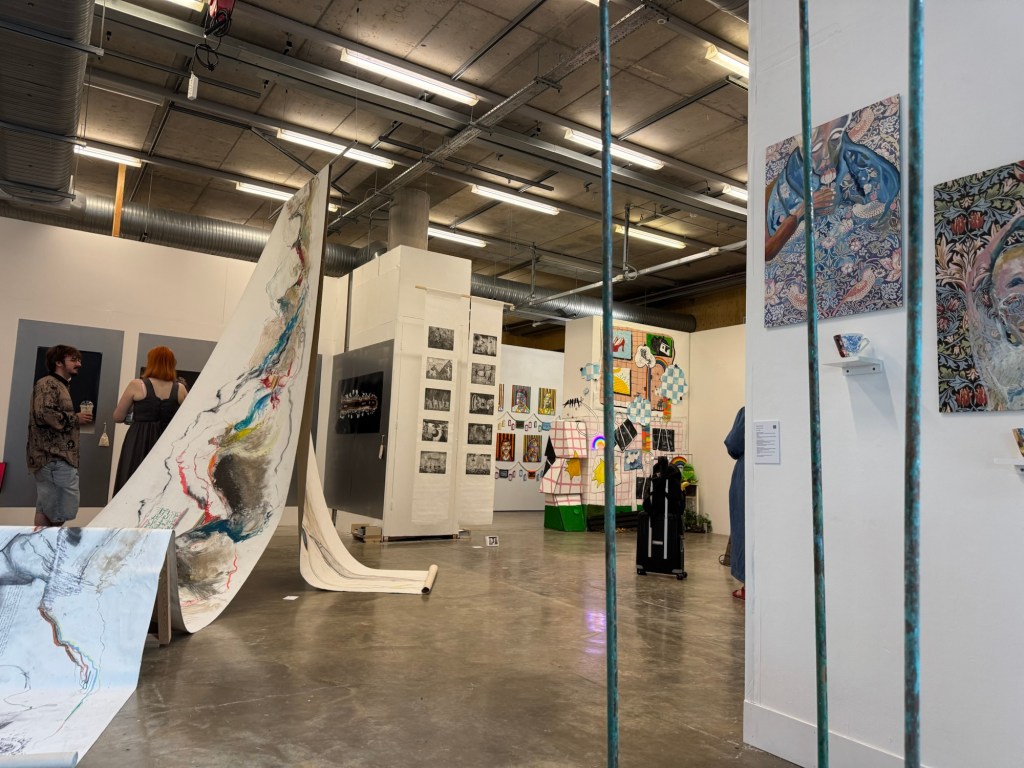
My MA Degree Show took place from 1-6 July 2025 at Central Saint Martins’ campus at Granary Square, Kings Cross, London. It was a fantastic experience and I want to capture my reflections and learning here.
METHOD
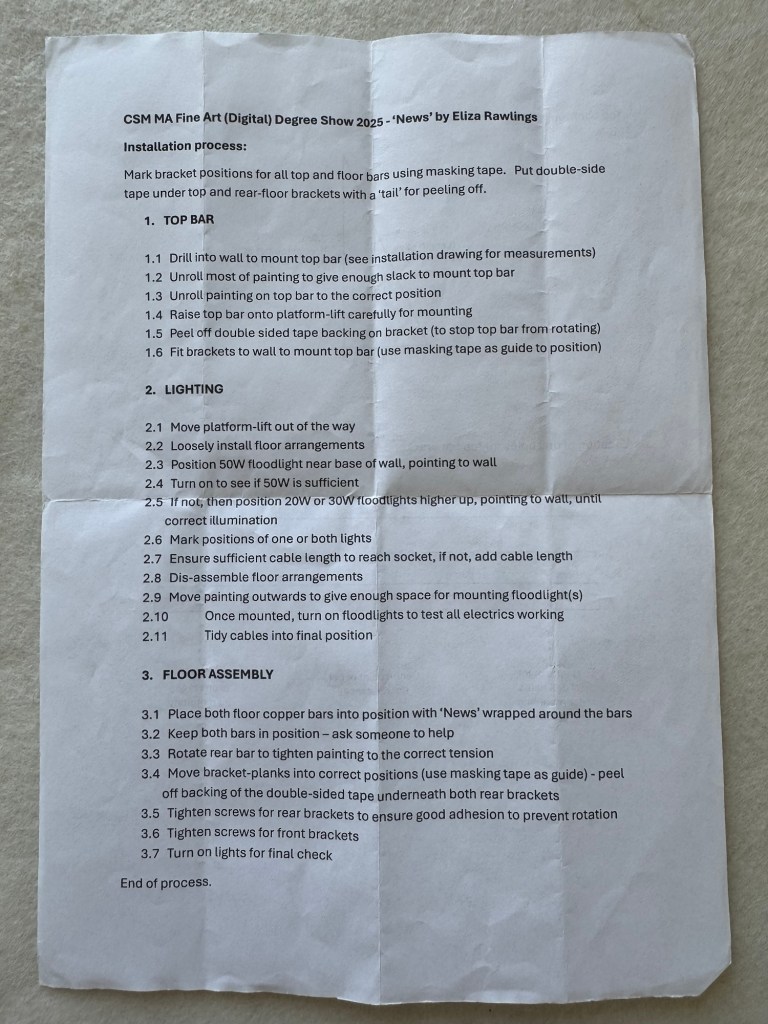
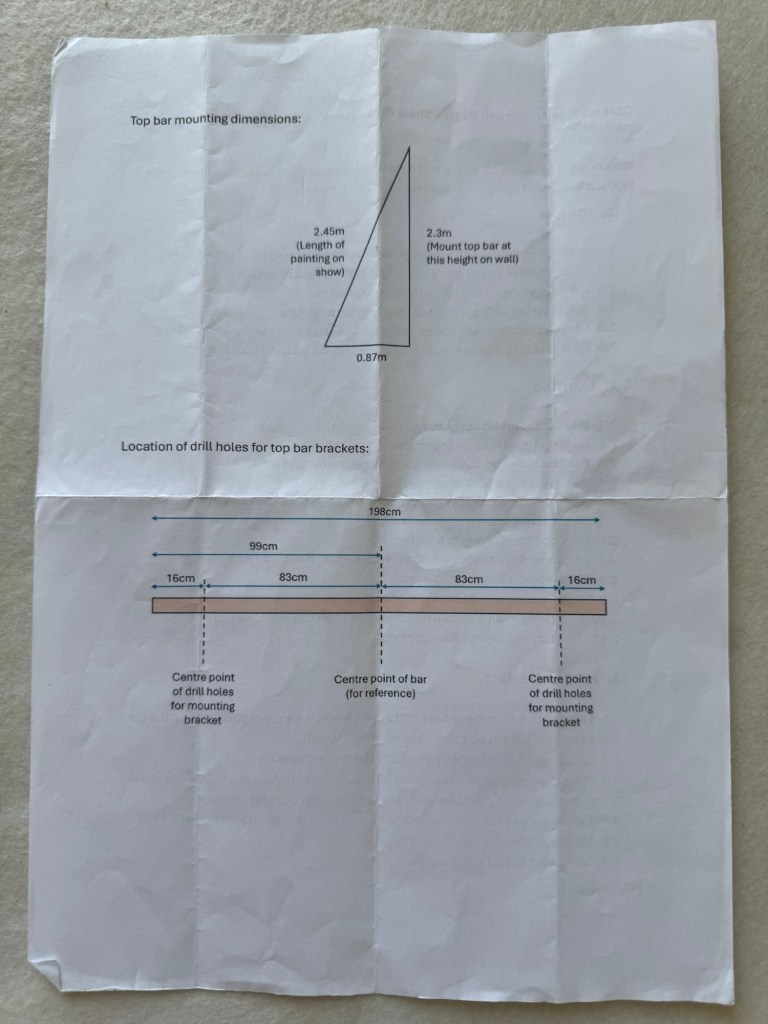
After planning what to show, creating the work and buying the parts, I wrote a list of installation instructions and a simple drawing to show the top-bar mounting. This is to ensure a smooth installation process especially where a technician’s help was required. The technicians are usually very busy, hence I wanted to use their time efficiently.
–
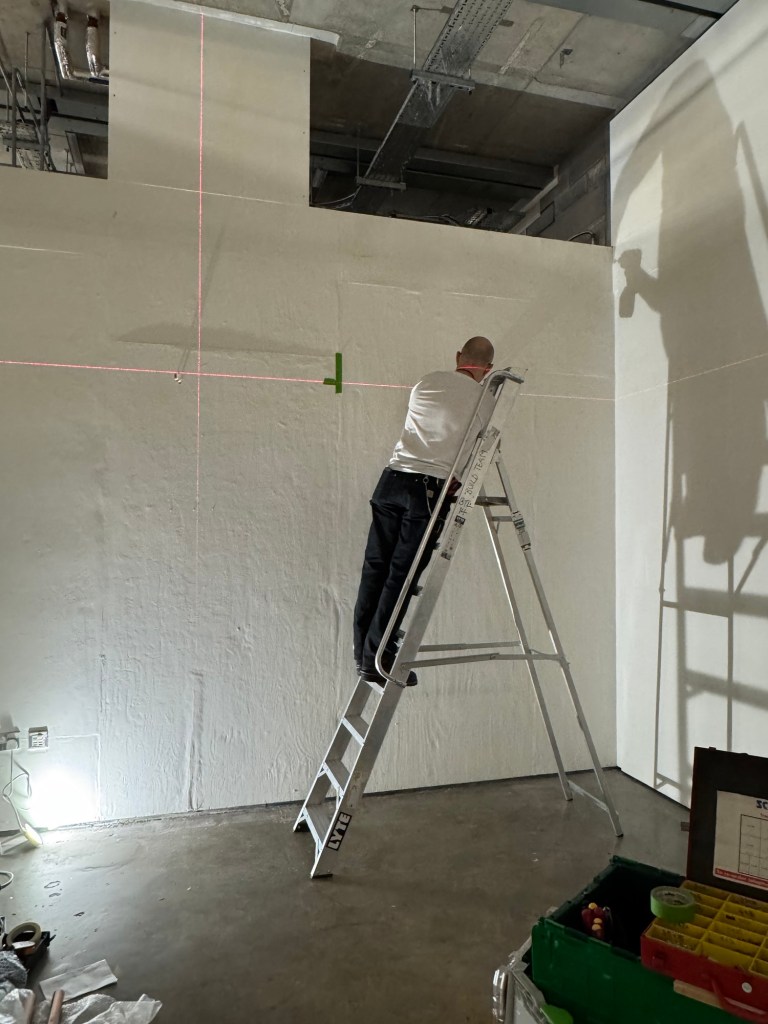
The technician used a laser levelling device to mark out the drill positions which made it a quick process:
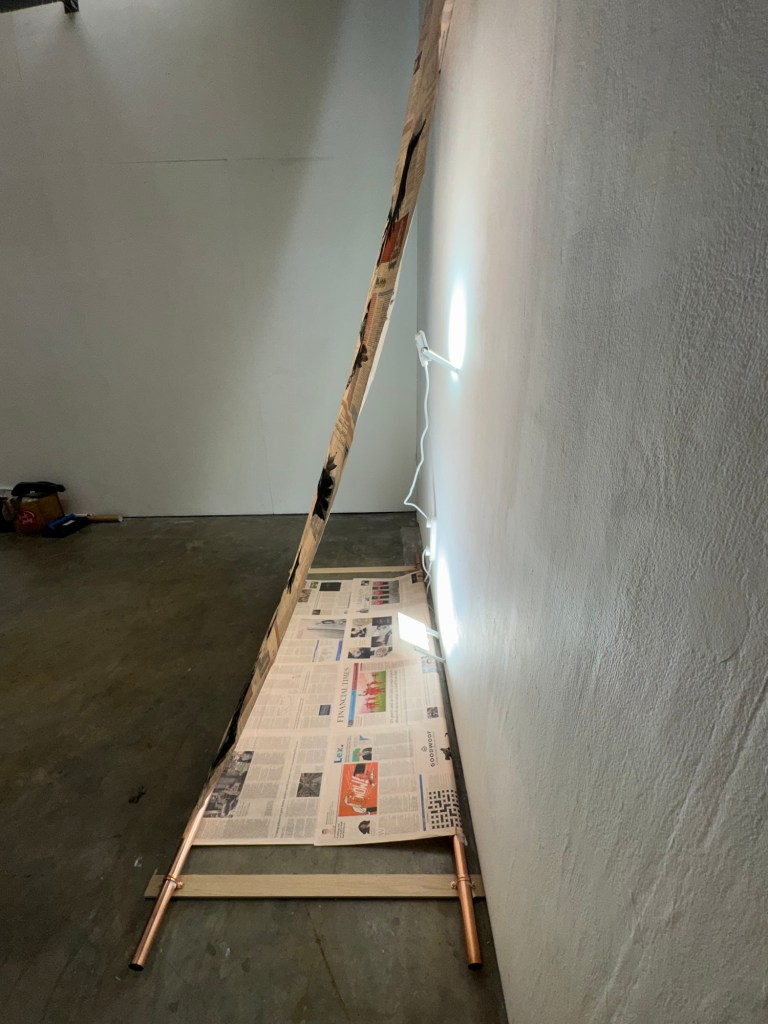
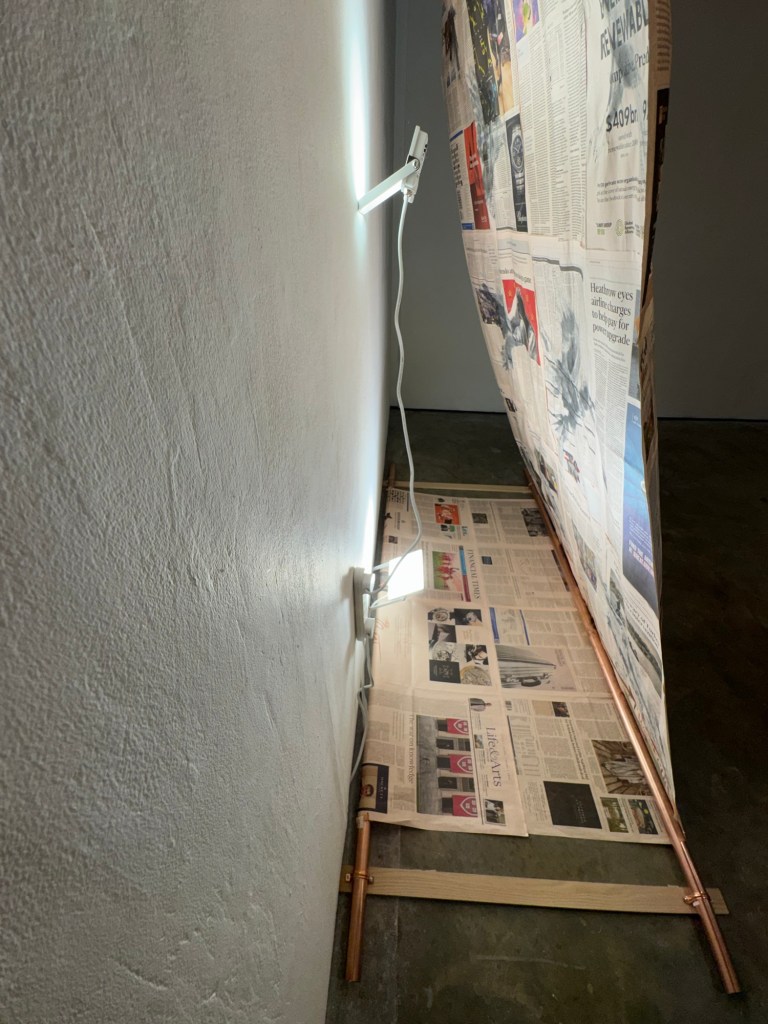
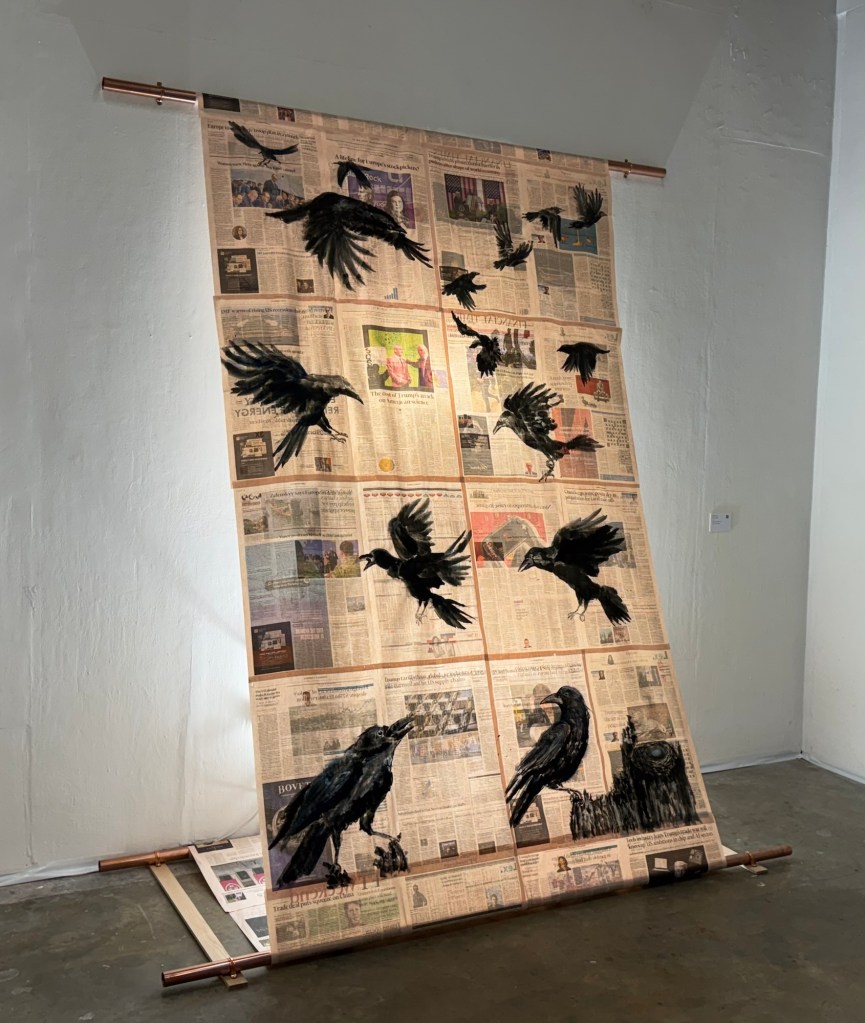
After mounting the top-bar, the two floor bars and planks were installed. That was straight forward. Then a key part was the back-lit using flood lights. I had to decide on the power rating and whether to use one or two units. After some trials I decided to use a 50w LED light near the bottom and a 20w light around half way up. This created a uniform spread of light onto the artwork and not patches of light.
–
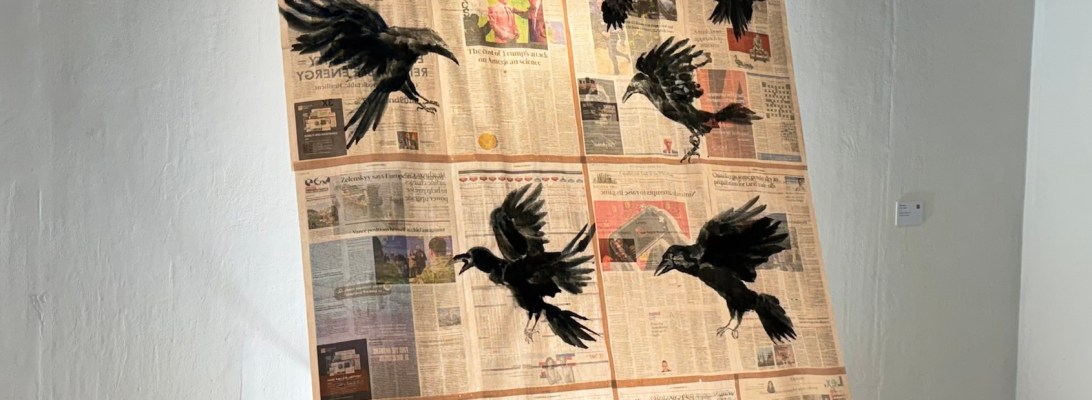
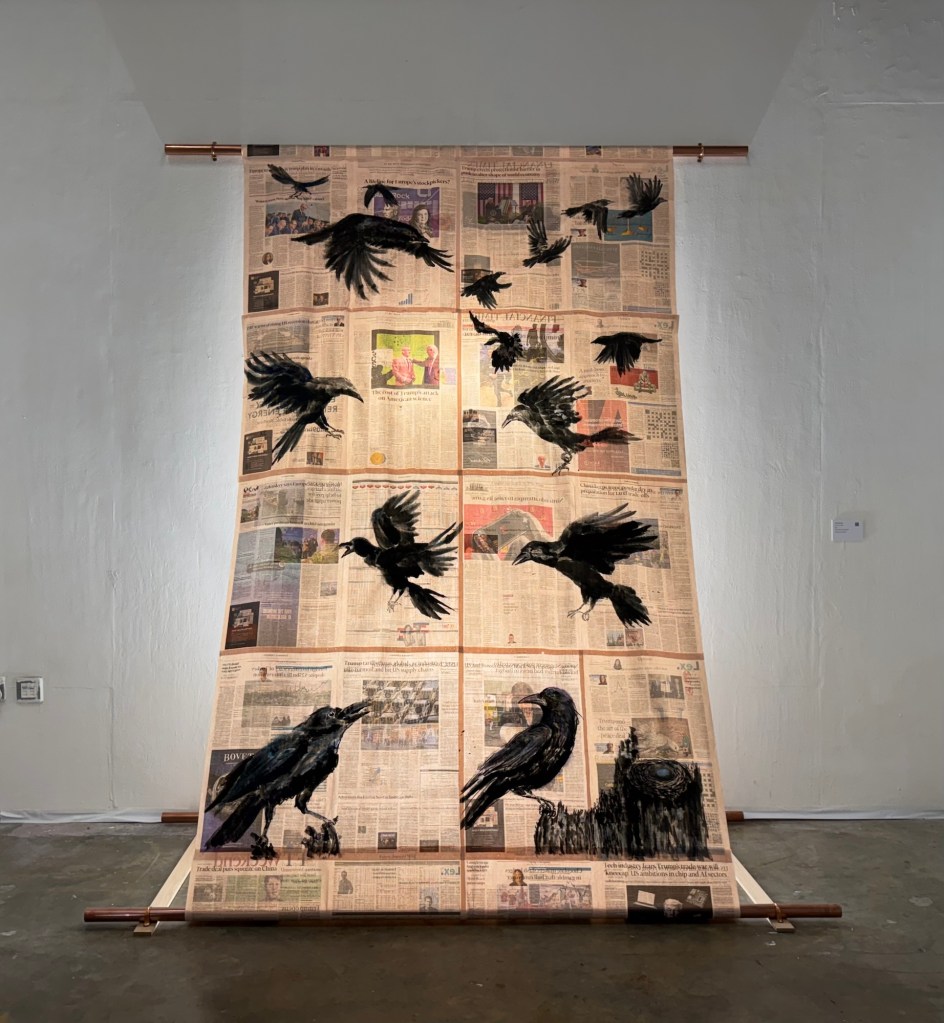
The completed installation:
––
The artwork label stated the name of the art work and that it was painted with my non-dominant hand because I received some feedback that the non-dominant hand element was lost in the piece and I should make that clearer. Hence I decided to state that on the label.
REFLECTIONS
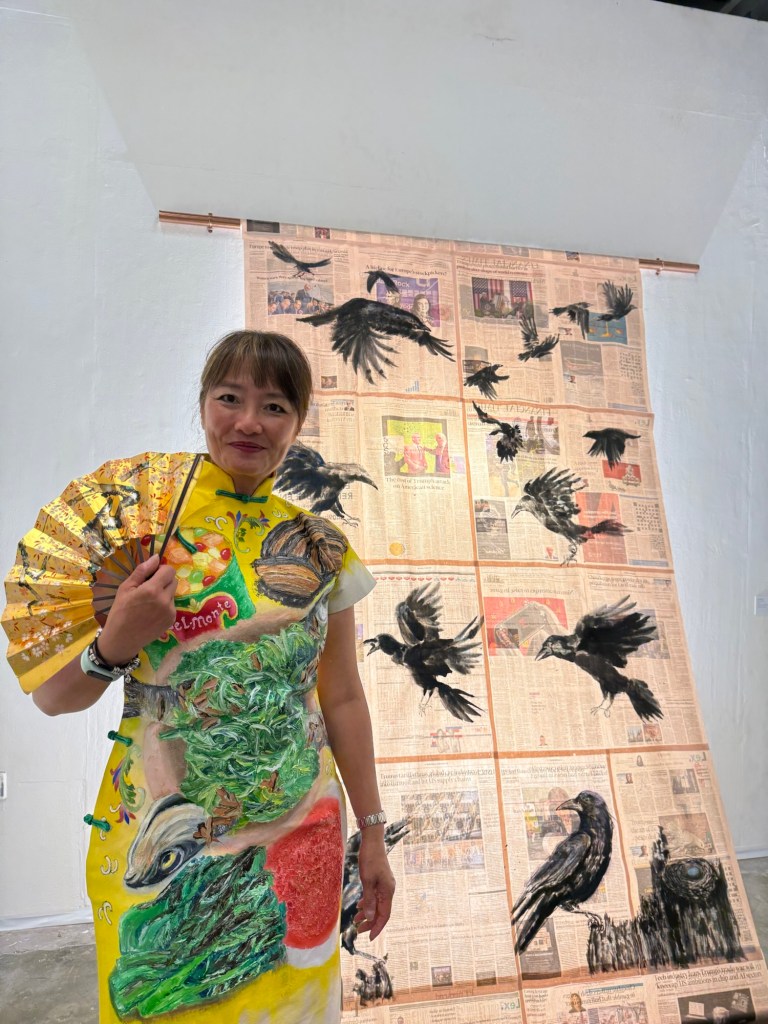
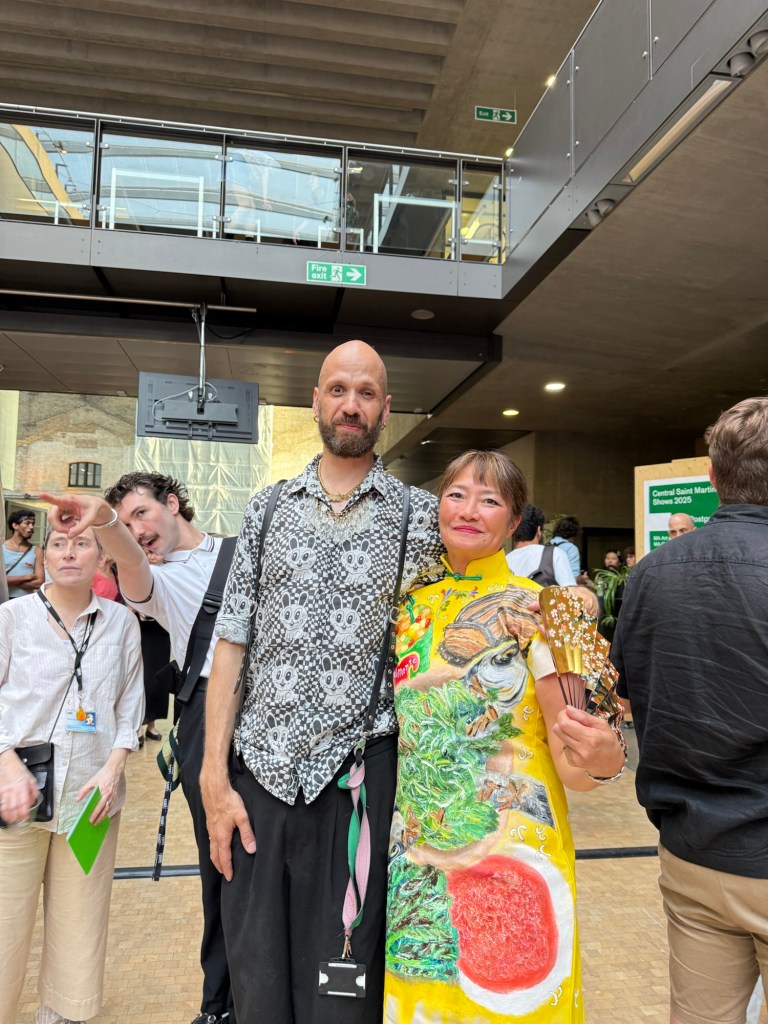
I have thoroughly enjoyed the show – both the install and the show. I wore my Family Dinner Cheongsam painting on the PV night and I enjoyed the compliments and the feedback. During the show, I have at times stood back from my News work and observed visitors looking at my work. It was satisfying when they stopped by, looked carefully and closely to the work. The experience confirmed to me that I enjoyed showing my work. Not necessary wanting people to say ‘it’s amazing’ but I wanted people to think it’s a thoughtful or clever idea, more so than ‘it’s a beautiful painting’ because it was never intended to be.
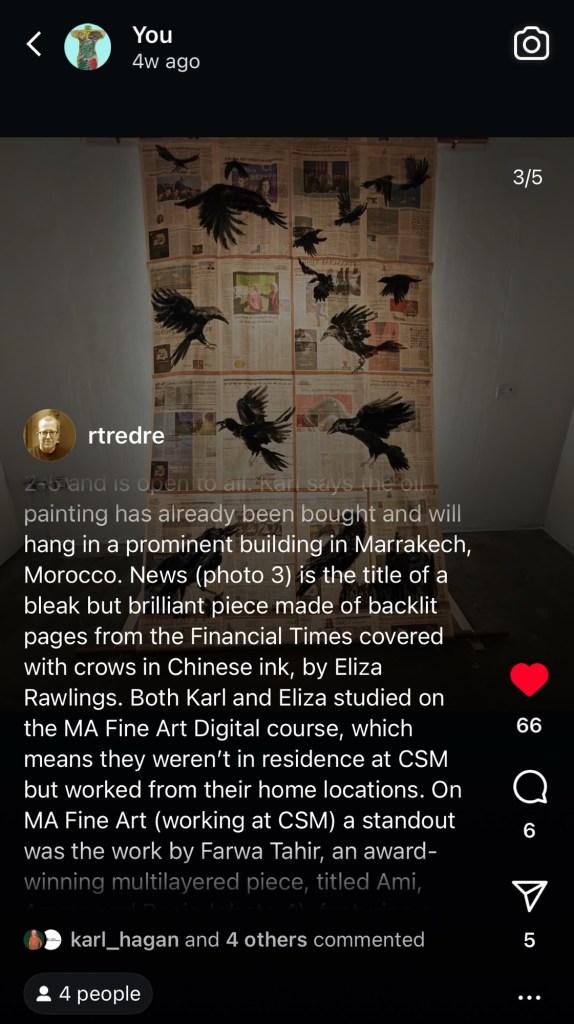
The most satisfying feedback I received was from this person ‘rtredre’ (a CSM MA course leader) on his Insta account. He described my piece as ‘bleak but brilliant’ and I was one of four pieces of work that he picked out from the show. I was delighted by this feedback and his description was exactly what I wanted – it was meant to be bleak and I was flattered that he thought it was brilliant.
I had a few conversations with visitors, excluding friends and family, the following conversations were the most notable:
-A curator/culture manager who was working on his PhD in London. He had a good look at the piece then asked me to explain to him which I did. His feedback was that he got what I wanted to convey from the work itself and my explanation just reinforced it which was good to hear. He also advised me, as a curator, to spend time making work and be true to myself, I.e. not to let anyone (galleries etc.) to push me in specific directions.
-A management consultant who enjoyed arts and talking to artists. She liked my work and encouraged me to start collecting email addresses to form a database for circulating newsletters or inviting to future shows. She gave me her details for us to stay in touch.
-A CSM tutor who liked the way I painted with Chinese ink and she felt my use of the non-dominant hand was very interesting and worth further exploration.
-Another CSM tutor who talked to me about Iain McGilchrist’s work on the divided brain – again referring to my use of the non-dominant hand as an interesting area.
I feel that the overall show was a success and I was happy about how everything went. I was pleased with the preparation I did beforehand and minimised any last minute panics on site. I feel that many other artists were much more relaxed and left a lot of decisions till they were on site. I think in the short term, I would still work the way I have because not being completely prepared might cause me too much stress. Being prepared helped me to enjoy the experience and I guess that’s just who I am.
As for my work, I feel there is still much work to be done on ‘News’ and I have not reached the end of this project yet. With much of the world still in turmoil, I feel there is still more to say for me and I will continue. Perhaps think about a more ambitious way of showing the work from an installation perspective. I feel that my engineering and metal fabrication experience could enable me to do a more complex installation.
LEARNING
-I enjoy showing my work and talking to visitors about my work. I think I was at times still talking like a student or ‘beginner’ and didn’t convey the confidence that I should feel or that I actually felt deep down. I should find opportunities to talk about my art and develop a confident way of talking about my work.
-Some of the conversations with visitors were encouraging in that they talked about my future shows like it was a given that I would do more shows. That was very encouraging.
-My work was picked out by a CSM MA course leader among three others – two of them were winners of top awards from the show. That gave me a new level of confidence as an artist.
-With several people mentioning that my use of non-dominant hand was interesting from an academic research perspective, I felt excited by those conversations and I will explore the subject further as part of my practice research.
-I feel there is still much work to be done on my project ‘News’ – perhaps choose another topic to focus on for a change but remaining with the ‘News’ concept. Use my engineering knowledge to design more complex installations.
NEXT STEPS
-Create opportunities to talk about my work in a more professional way. Perhaps start with talking to artist friends. Or do more videos where I talk about my work. I have been used to talking professionally about my business in my ‘previous corporate life’. I would never have talked in an ‘uncertain or apologetic way’, so perhaps I could channel some of those skills for talking about my art. I am a professional artist now after all!
-Research about the use of my non-dominant hand – both in practice research and academic reading. Explore more non-dominant hand vs dominant hand making – study myself to see what I find. For academic reading – start with Iain McGilchrist’s work.
-Continue to make more ‘News’ work, explore other news topics.
-Explore more ambitious way to show the work in terms of installation – use my engineering skills.
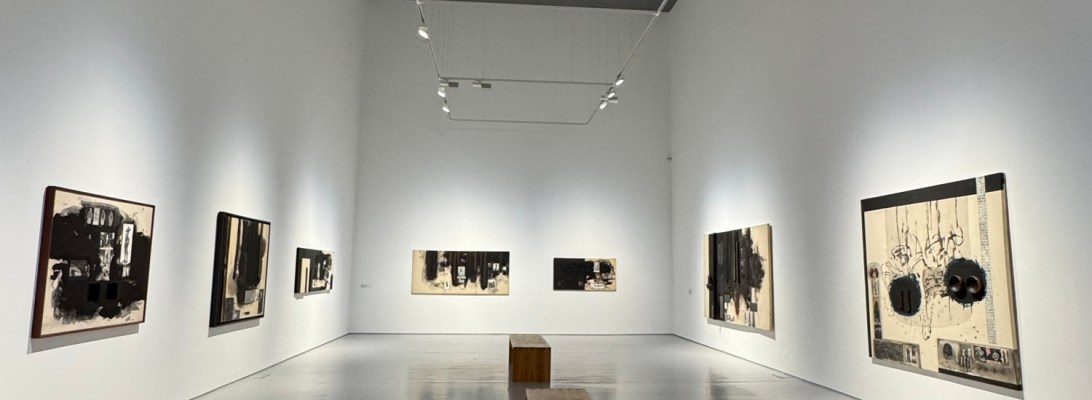
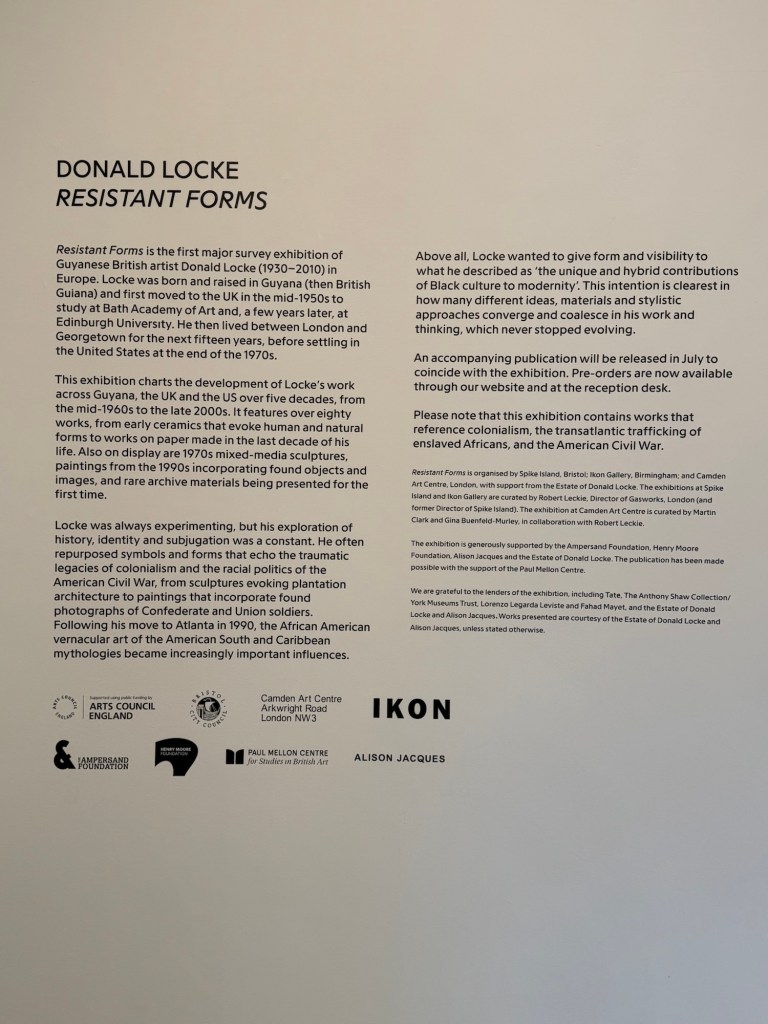
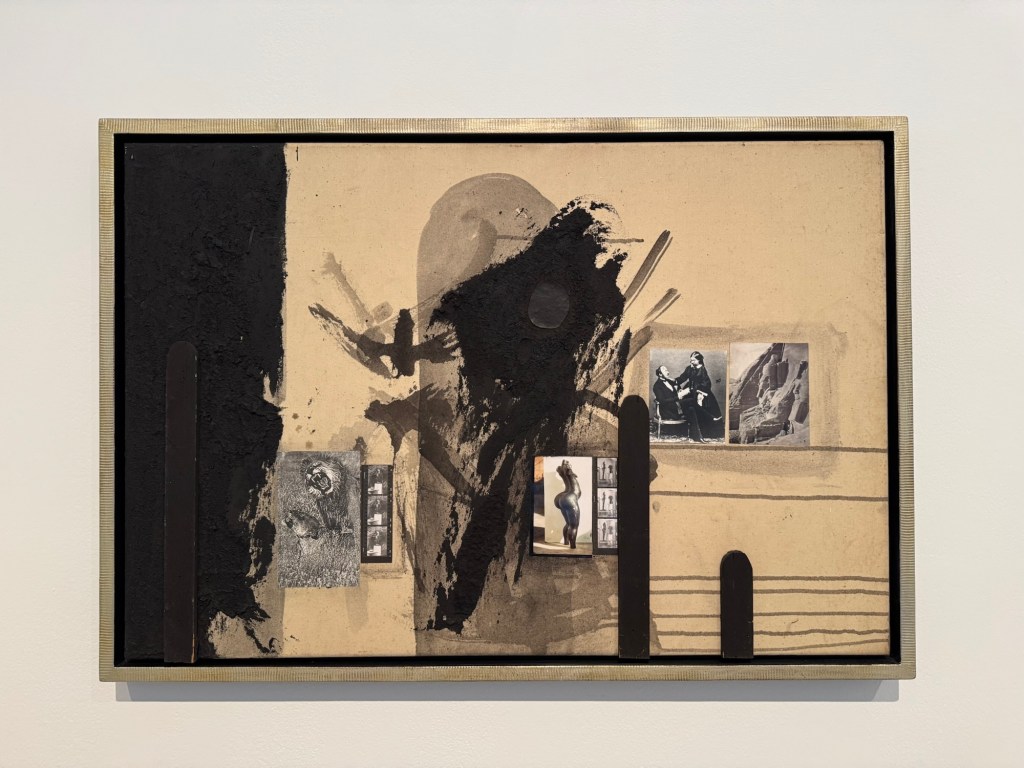
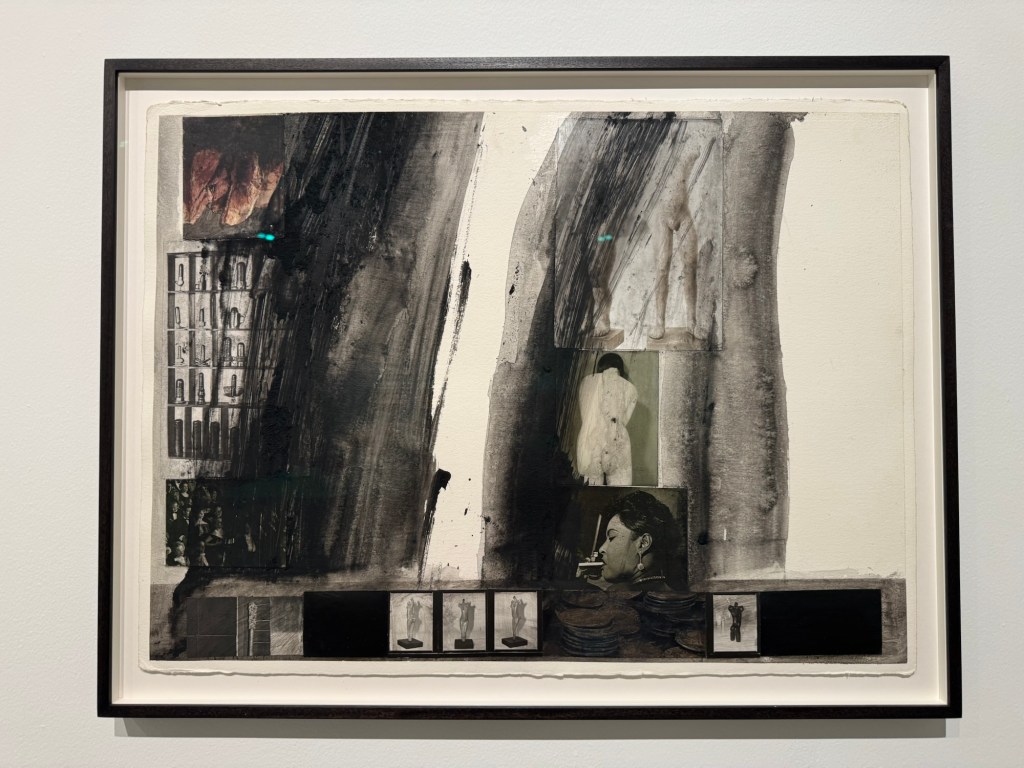
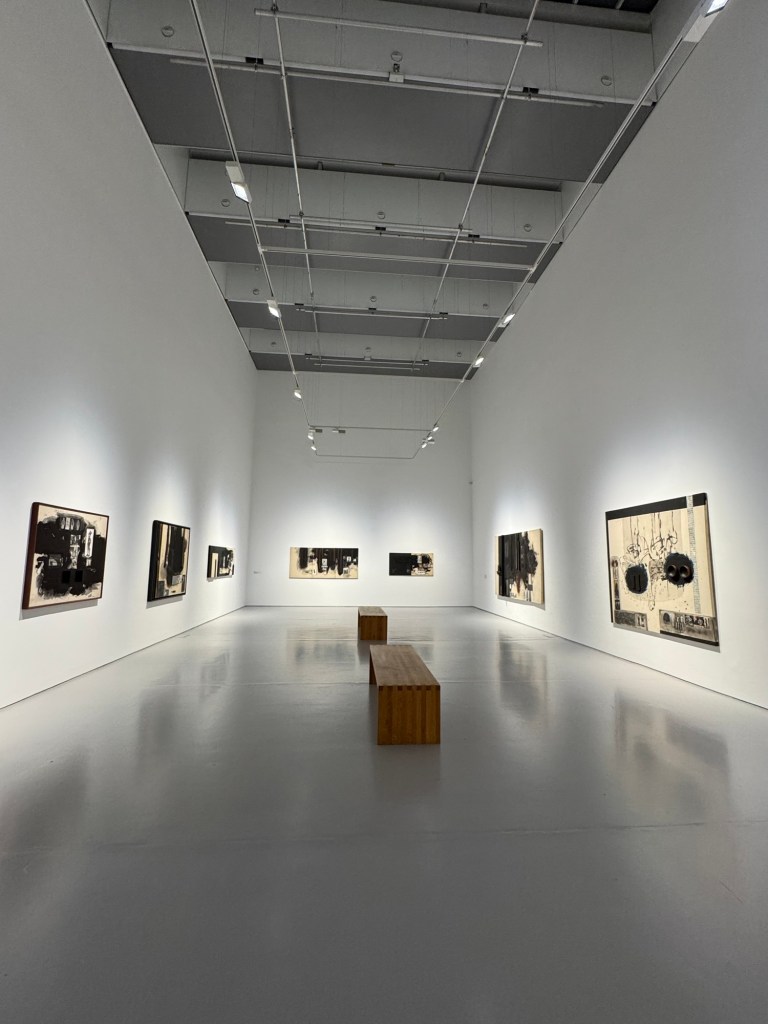
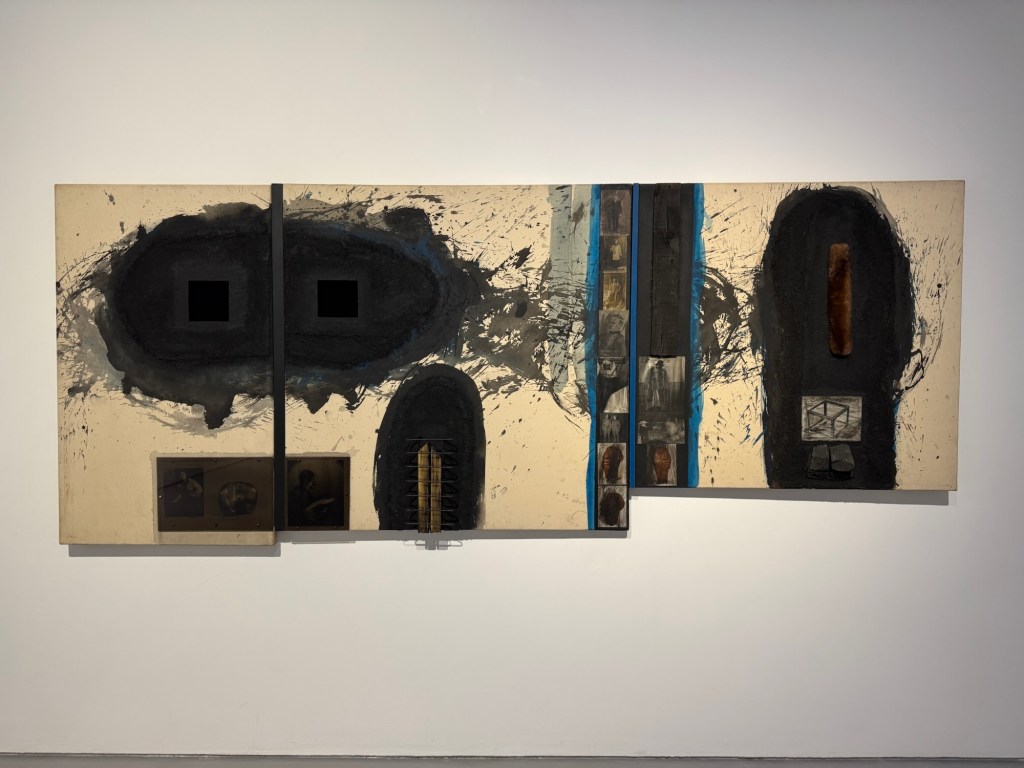
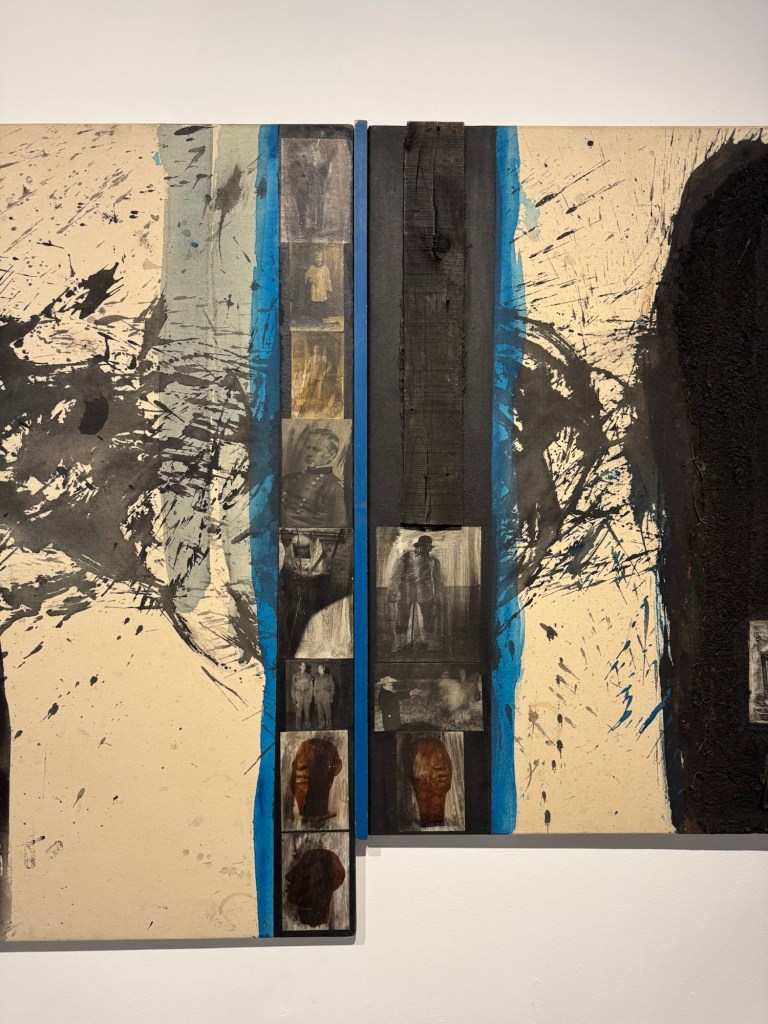
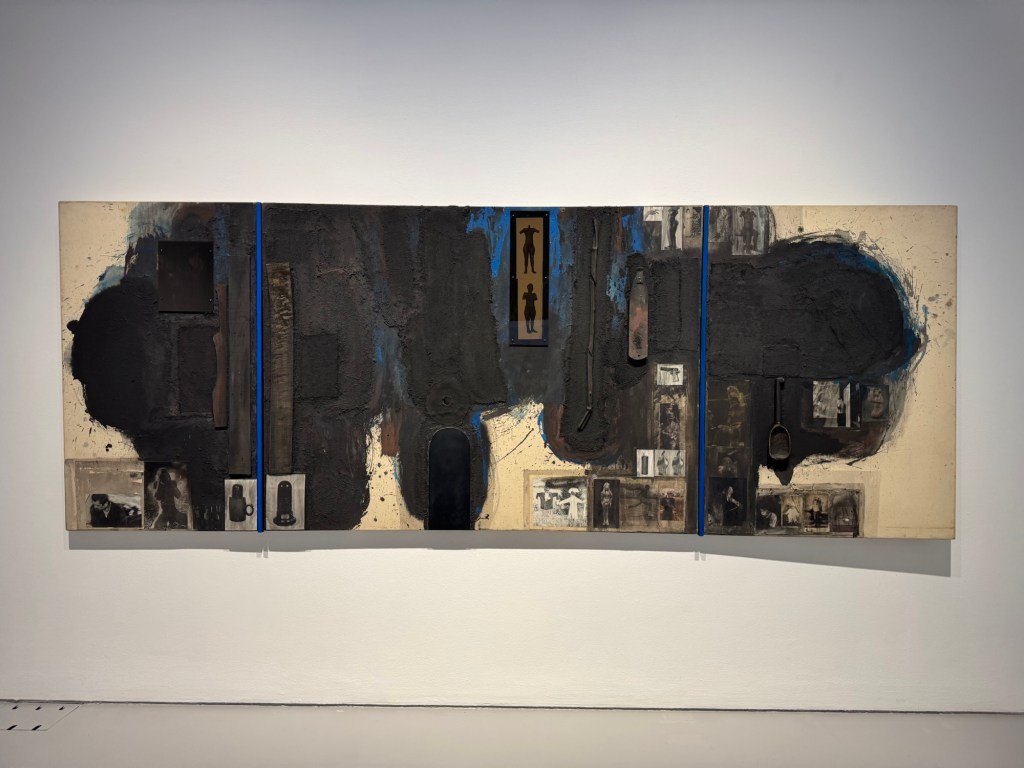
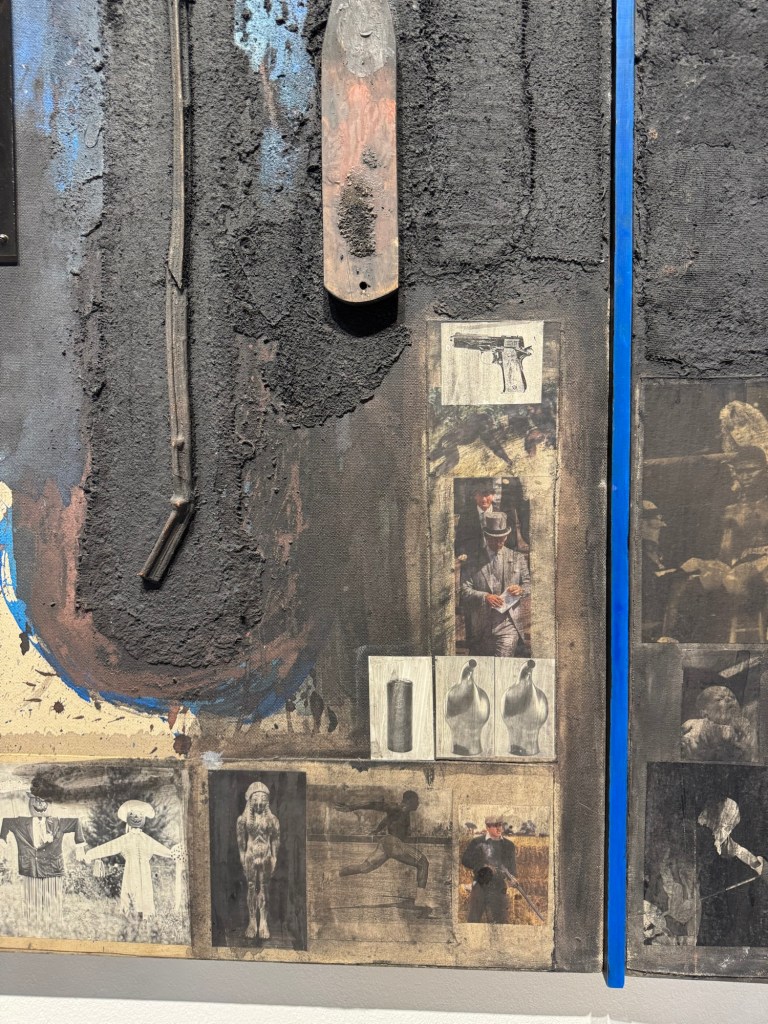
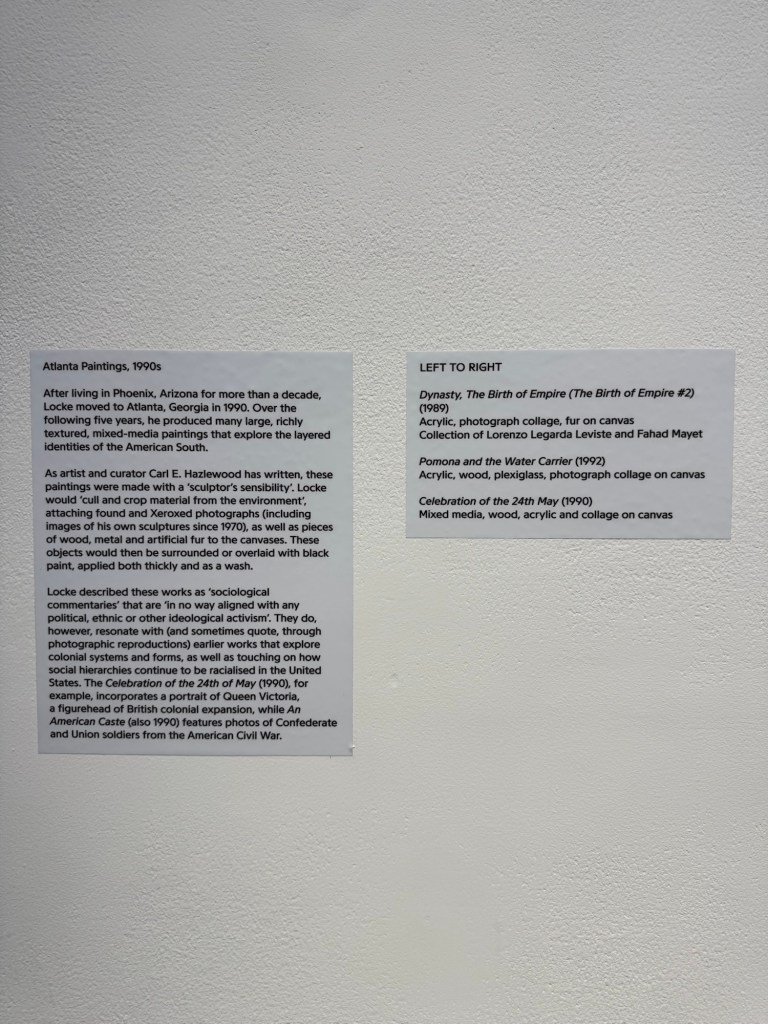
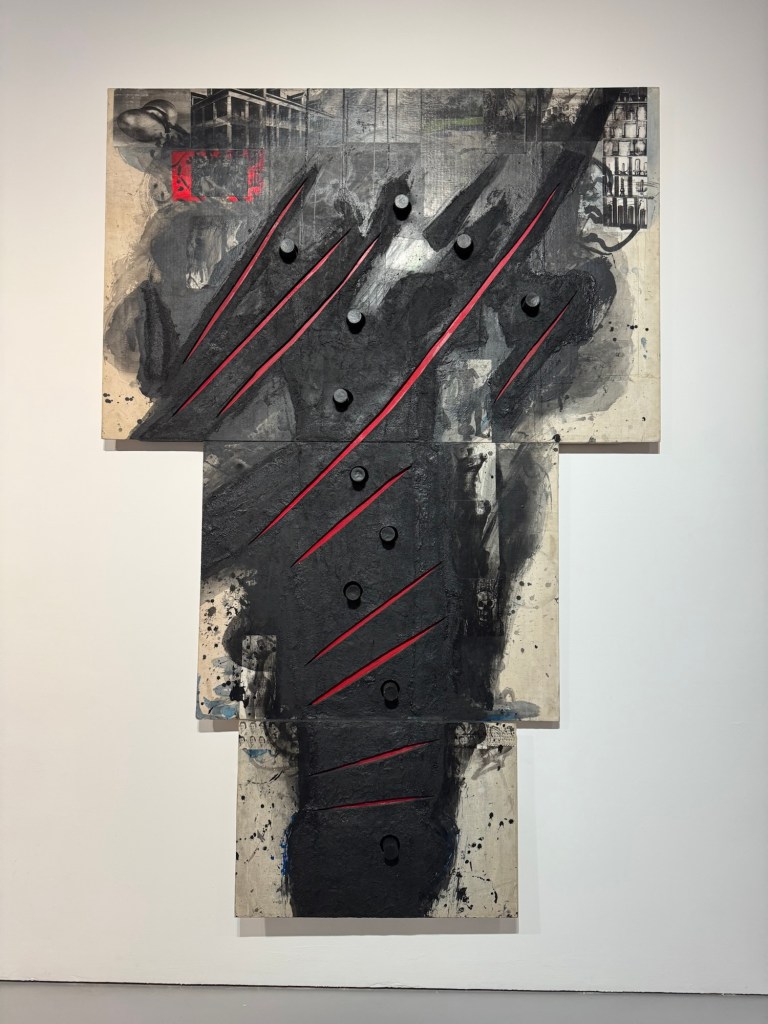
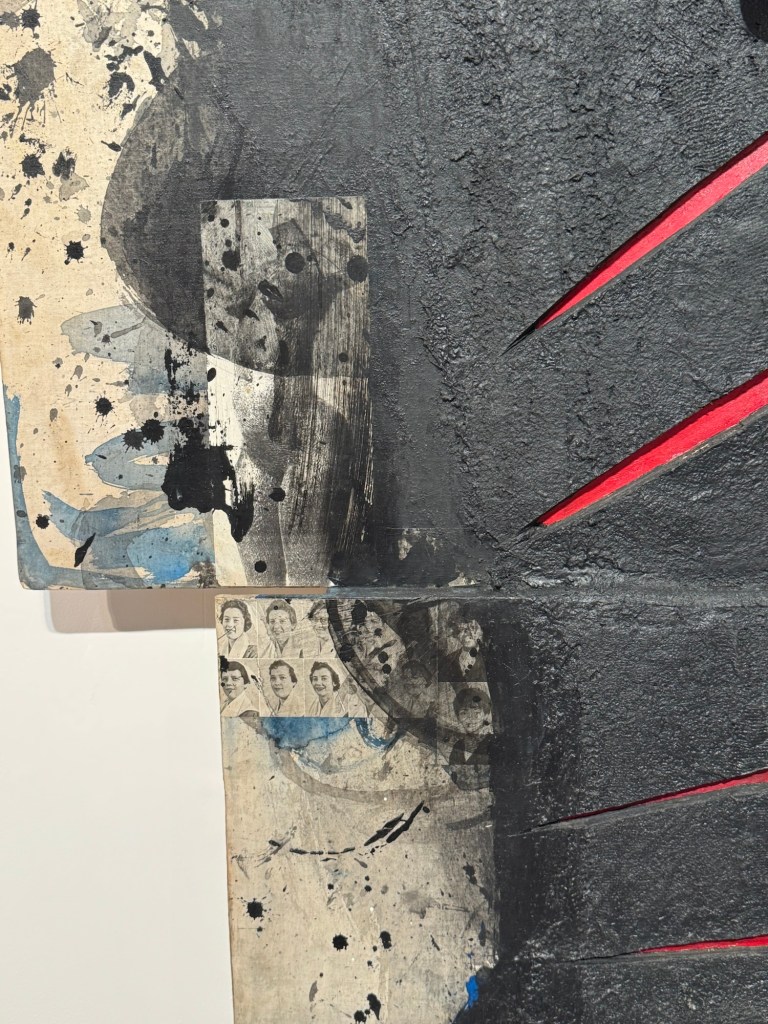
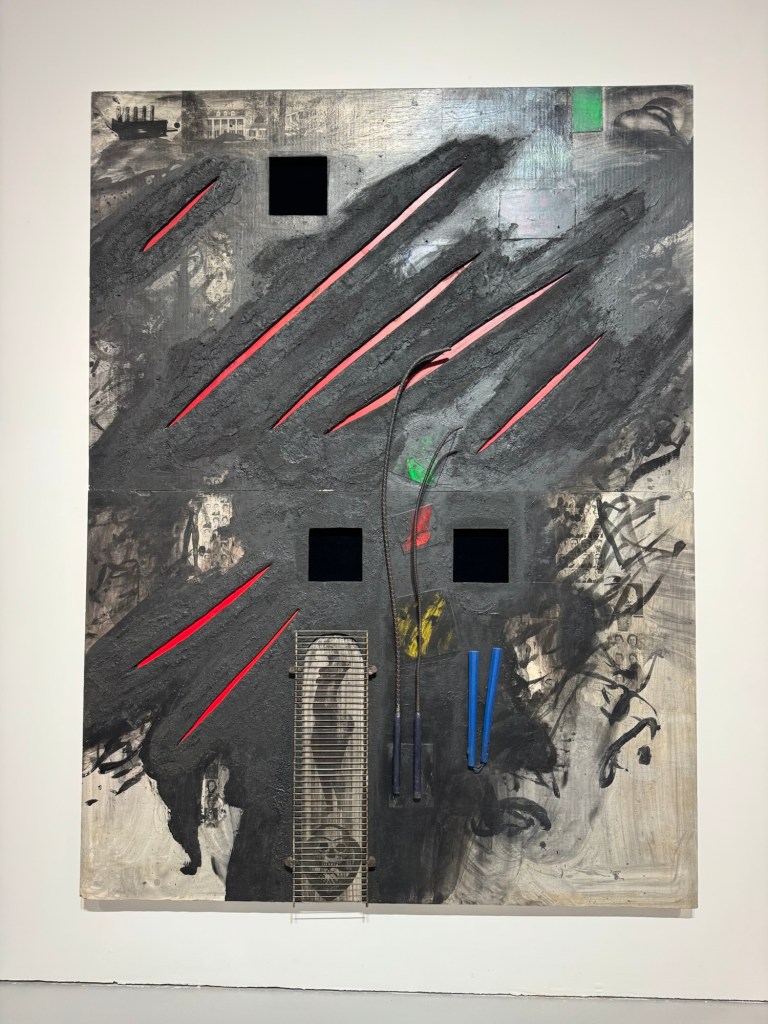
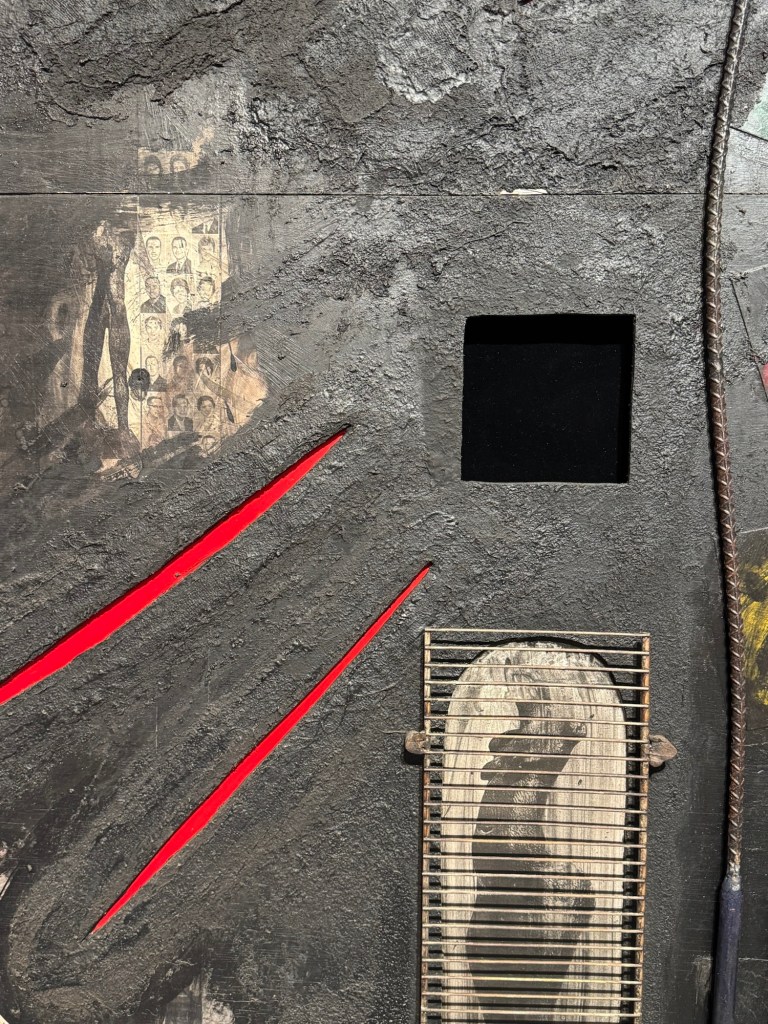
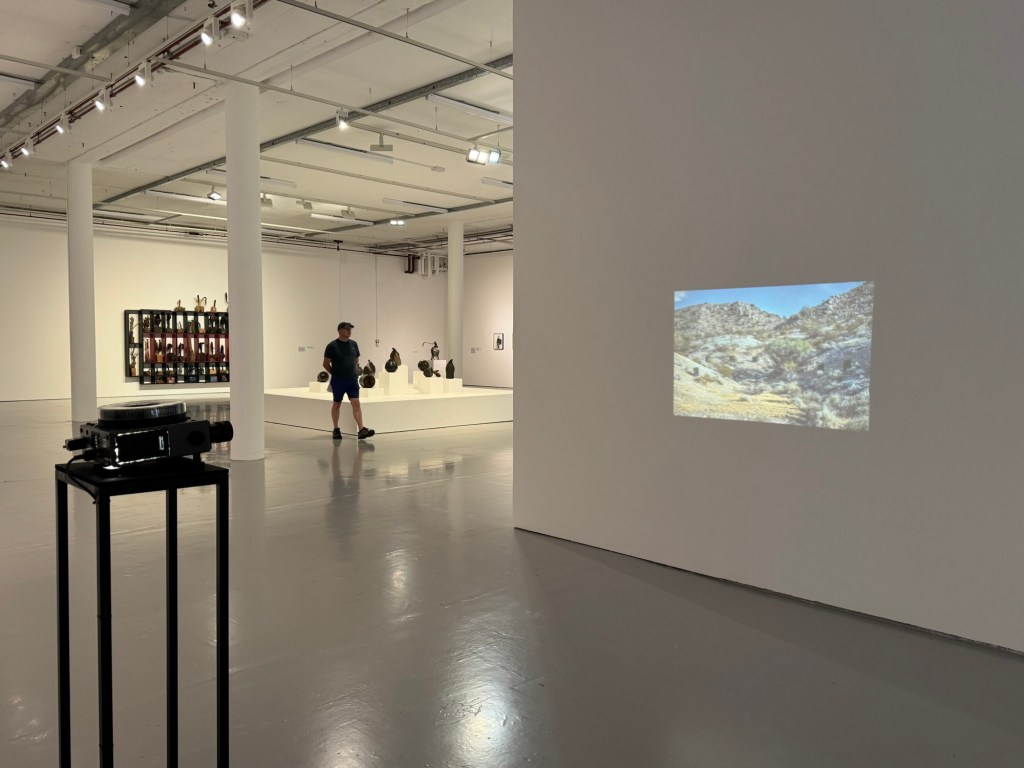
Today I visited Donald Locke’s exhibition Resistant Forms’ at Spike Island Bristol. Below are some of the photos I took to remind me of the work that I found particular resonance with.
Use of collage, image looks like a crowUse of acrylic in a way that resembles inkAmbiguous use of photosLarge scale paintings with presence and energyClose up of the above showing photos collageUse of mixed media including metal grill mounted onto painting Placement of projector and understated size of projected image
REFLECTIONS
I want to capture ideas that came to me during the visit that made me think about how I could learn from Locke and build on my practice.
Use of mix media techniques:
On some of his paintings, the use of acrylic paint with ‘dry brushing’ to create the flying white effect like in Chinese painting energised the painting. It gave me the idea of trying my crow paintings in other medium, such as dilute oil, to see how that works. The use of different materials to create collage was also interesting. I could use ripped up newspapers to create collage effect on a canvas then paint on top. Locke also used items like metal grills to good effect. I can consider what objects, metal or otherwise, that could be incorporated to add meaning and texture to the work.
Use of photos:
Some old photos were used in the collage. I have many old family photos that I have been considering how to incorporate into my work. The way Locke used the photos were more random – a few here and there. Whereas I have tried too hard in the past; I could just use small images in a few places – I don’t need to tell the whole story in one painting. I must remember this. Also, he had just pasted / stuck the photos (copies of) onto the canvas. I always felt that I should photo-transfer the images onto the canvas – this is not necessary. Locke also used images or photos of his own work (sculptures) in his paintings – those images (e.g. female nude) appeared on multiple paintings and acted as a link to join the works together.
Use of projector understatedly
The projector was projecting at waist height with a not too large image. It was understated and effective. I often feel that projection has to be big and has to fill a wall. It clearly doesn’t have to at all. The projection was also placed in a way that you have to walk through the beam to get past. It was an interesting positioning which makes the viewer interact with it.
LEARNING
There are no major learning from the visit and mainly just ideas that came to me as I studied Locke’s work. The main take away for me was to think about experimenting beyond just painting on the whole piece of newspaper. The news headlines remain important to the body of work (News), but through the use of collages, the newspapers could be incorporated to maintain the theme while opening up the materials that I can use. Locke’s extensive use of black was very effective which resonated with me.
NEXT STEPS
Start to think about how I can start to make more complex and ambitious work with multi media materials yet remaining connected to the topic of News.
‘News’ in Chinese ink painted with chicken feather brush
As I am making more and more paintings on The FT, I want to consider more carefully how to display the work and also making the newspaper art archival.
METHOD
1- Online research
I have been researching online for ideas. There have been all kinds of suggestions. I find this post useful as there are different suggestions to try.
However, none of the suggested solutions are truly archival due to the nature of the newspaper material. One of the comments said that newspapers were a museum curator’s nightmare. I think that sums it up. The only suggestion that is truly archival is to make digital images and gyclee prints. That is something that I will consider.
2- Ask an expert
Another investigation route that I pursued was to ask a paper conservation specialist at UAL. His reply was as follows:
“Newsprint is made using mechanical wood pulp for the paper fibres. These are naturally rich in a chemical called lignin.
Lignin is not particularly stable. It breaks down with time with 2 effects:
Some breakdown products are strongly coloured, making the newsprint go increasingly yellow and eventually brown.
Some breakdown products are acidic, leading to the paper becoming increasingly fragile over time.
This breakdown will still happen in dark conditions, but the energy from light makes the breakdown progress much more quickly. Ultraviolet has more energy than visible light, so can do damage more quickly.
It’s not possible to make newsprint archival.
UV-proof glazing would be beneficial if the paper is to be displayed in a window where it’s subject to sunlight.
If the artwork is illuminated using artificial light, UV exposure will be less. Fluorescent lights and halogen spot lights emit some UV. LED lights typically emit no UV.
Most acrylics will filter out some UV due to being made with UV-stabilisers to help make the acrylic last longer.
Last time I checked (which was ages ago…) framers quality UV-filtering acrylics and glasses were similar in price.
For storage, I’d recommend keeping the papers between unbuffered, acid-free boards. Many archival boards are calcium carbonate buffered, which helps neutralise the acids created as lignin breaks down, but alkaline conditions can also increase the yellowing of lignin (through a different mechanism than the breakdown route).
Sandwiching newsprint between glass/plastic offers some benefits in isolating the paper from various environmental effects, but might also lead to a surrounding microclimate rich in acidic breakdown products.”
– End of expert’s reply –
This was a very helpful reply and the sentence that I highlighted in bold again confirms that there is no way of making newspaper archival which is a pity.
REFLECTIONS
After doing this research, I have to accept that it is not possible to make newspaper archival. I feel rather sad about that and the engineer in me thinks ‘there must be a way, it just has not been found yet!’ However, I need to employ a solution now to manage or show the work that I have been creating while continuing to find a long term solution which may or may not be possible. If museums around the world have not found a solution then maybe I won’t be able to either – not in the short to medium term anyway.
Making digital images and then gyclee prints is a very good and viable solution. I will definitely pursue that and learn how to photograph my News paintings properly. As a start, I will need a light box frame that I can wall mount.
I have also considered sandwiching the News paintings between UV proof acrylic panels and mounting it away from the wall with spacers to let light in from behind – this solution also requires further experimentation.
The above are ways to present the paintings for photographing. Once I have found a way of photographing the work then I can consider making limited edition gyclee prints from them.
Other ideas that I have had are photographing the news page, then printing it on silk or other thin fabric, then painting or embroidering on the image.
LEARNING
The main learning was that there was no known way of making newspaper archival. I have to accept that and consider how to find ways to capture the image and reproduce in archival materials. Also, if I were to sell the original work on newspaper then what advice should accompany the sale? How should it be framed, mounted and what life time is to be expected? Perhaps letting the News painting degrade over time is one of its unique feature? As long as it can stay safely in a frame then what harm is there? It will go yellow or brown over time – perhaps that adds value like a vintage bottle of wine or whisky!
The key is to have clarity of how to manage the life of the paintings and offer archival alternatives to the originals. Not that I am planning to sell my work at the moment, but if someone were to enquire then I need to have prepared a professional response.
NEXT STEPS
Immediately:
Investigate ways to mount the prints for displaying and photographing. E.g. light box frames or ‘acrylic sandwich’ mounted on spacers.
Investigate ways to take good quality digital photographs of the mounted work.
Investigate ways to make archival gyclee prints of the photographs – what method of printing and what paper would be best? Best options for framing?
Consider what advice to give with any original art work – recommended ways to mount and likely life before degrading occurs. Think of ways to articulate the value of a degrading or degraded piece of News art. i.e. make the non-archival nature of the art a feature of the work.
Longer term:
Investigate options to print on fabric then paint on the fabric or embroider to create original art. Or print painted News images on silk as an alternative to paper – need to think why use silk or fabric though.
After receiving my Unit 3 assessment feedback, I want to reflect on and respond to one of the points raised as I feel it is essential for progressing my current body of work ‘News’.
REFLECTIONS
Below is an extract from my assessment feedback that posed a question about my use of the crow as a metaphor:
‘…You talk about the crows being a metaphor for the awful events that are happening in today’s world but does a metaphor need to be more than that? In a novel or film it might be the timing of a crows arrival and departure in relation to events happening that turns it into a metaphor. Or in a poem it might be a detailed description of a crows behaviour? How might this impact on the way you continue painting crows? In what way, if at all, does the pose of each crow relate to the headlines on the actual page, either the front of the page or the reverse side that might be revealed by a light source behind?‘
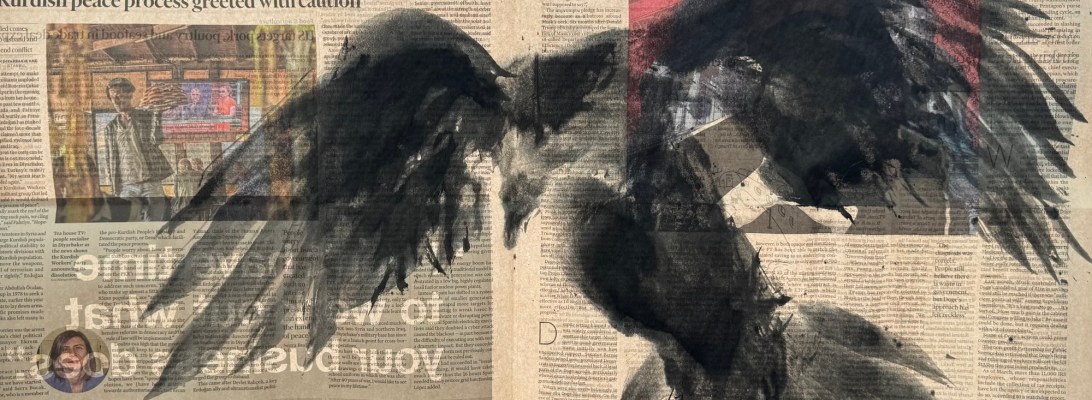
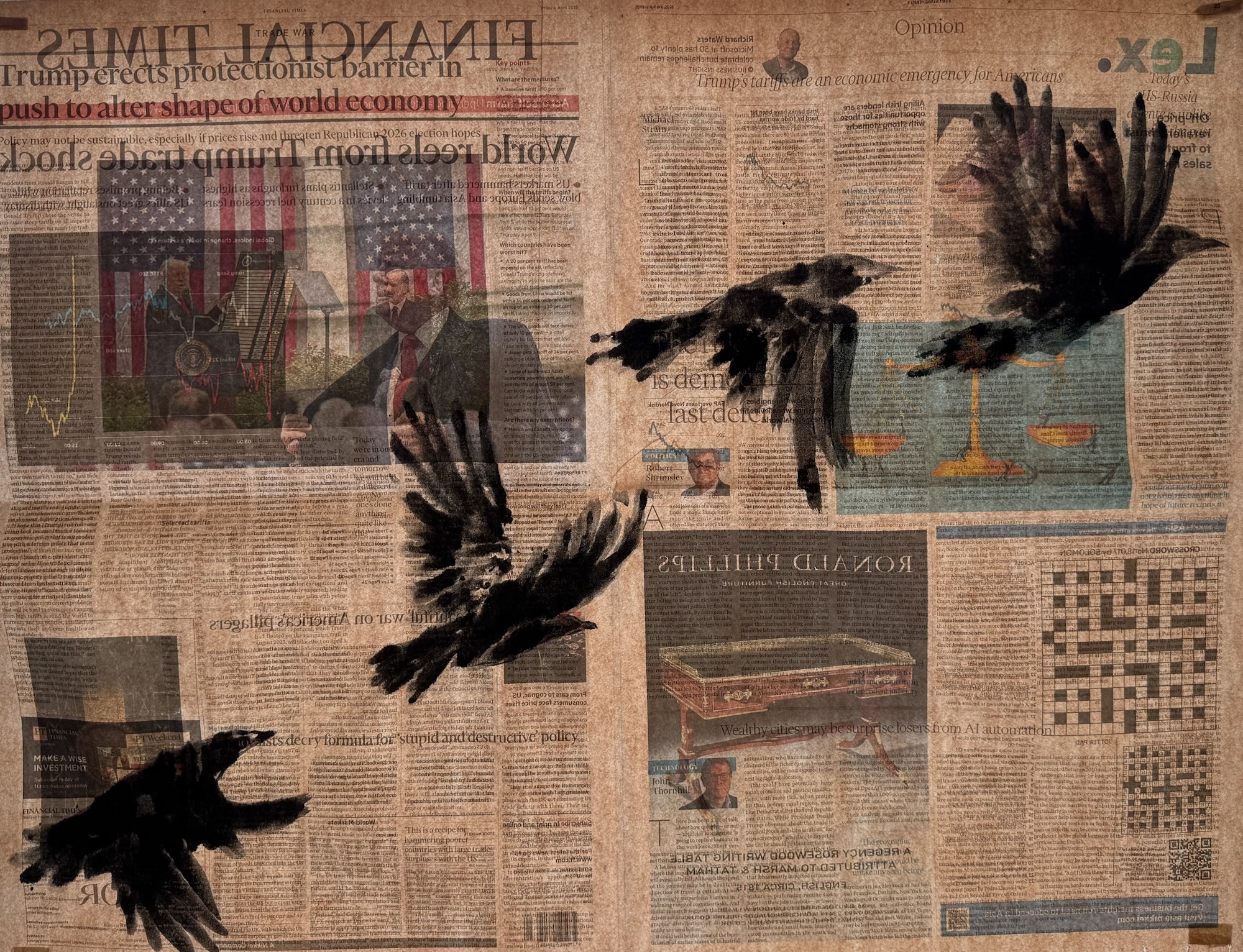
The timing of this question was very appropriate because I have been thinking about this a lot. I chose the crow as a metaphor for my grief for the loss of a world order that I understood. The crow was inspired by the book ‘Grief is the thing with feathers’ by Max Porter. When I started this series of work, I just wanted to paint something as I felt a sense of urgency and the book came to mind with the crow as a metaphor for grief. Hence I started there. The black feathers worked well with my chosen medium of Chinese ink and the characterful crows gave me lots of ideas to work with. I started without thinking too much about the pose or the composition of the pieces, I just wanted to paint and express how I felt. Then I started to locate the bird more purposefully next to headlines or images and experimented with compositions. Now that I have done many such paintings, I started to get an idea of what I wanted to achieve with this body of work and with the crow.
I want to use the crows to bring attention to certain news headlines. I noticed that when people look at my News paintings, they usually start with the crow. They would study it for a while, then their eyes would wander around the news headlines or images nearby and then focus on the articles. It was important for me to choose a neutral or as unbiased as possible a newspaper because I don’t want to tell or preach to the viewer what they should think about the news piece; I want the viewers to decide for themselves and to show a factual headline or news article to trigger their thinking is my intention.
Reflecting on the questions posed in my feedback, I believe my use of the crow has several roles. Like in the novel I referred to, the crow as a metaphor revealed itself to me when I started to despair about situations in the world – that was when the crow ‘entered stage’ as in a theatre. In the last few weeks, there were times when I felt perhaps it was time to move on from the crow as perhaps world events were settling down. That feeling lasted at most a day when something else happened that enrages me again and I had to bring the crow back to centre-stage. There seems to be an endless supply of headlines at the moment which is energising for my art but absolutely draining for me as a human.
As for the point about the pose of the crow, it has been an interesting development and revelation for me. I remember when I first started studying art, a tutor at the time said that how we felt would inevitably come through to our work; our work was influenced by our subconscious. I didn’t quite believe that at the time but was happy to keep an open mind. Of course, I have since experienced that many times. There have been a few News paintings where some unconscious expressions came through that I only noticed afterwards. Below are two examples.
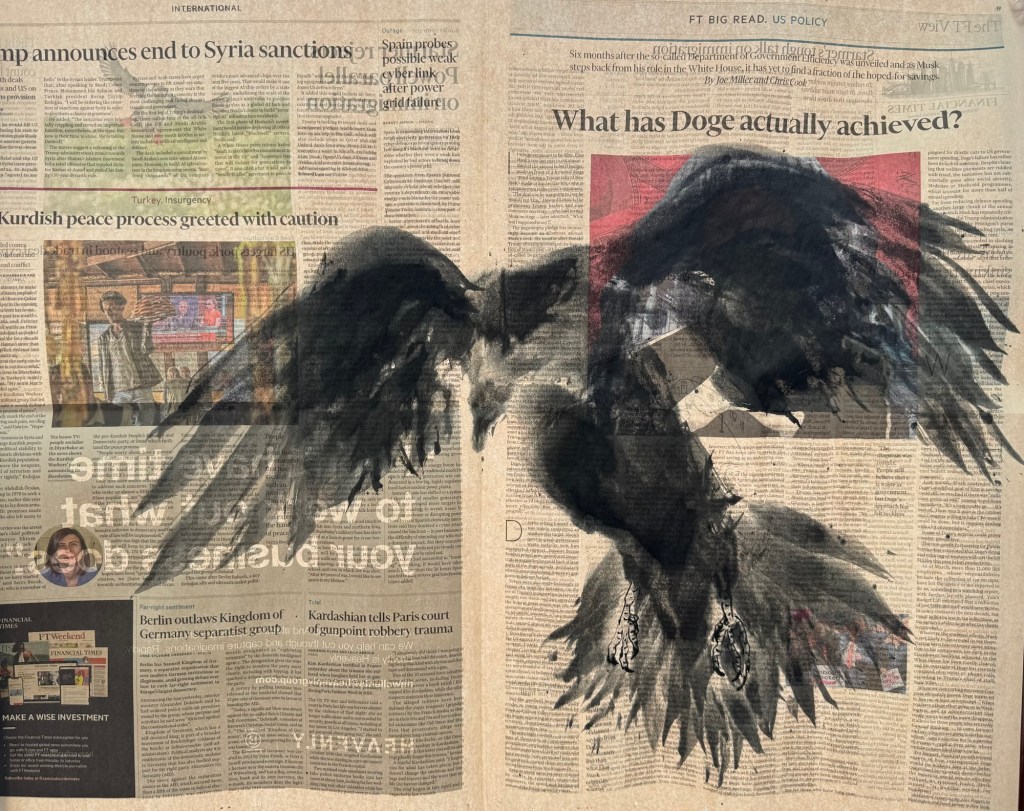
Example 1 –
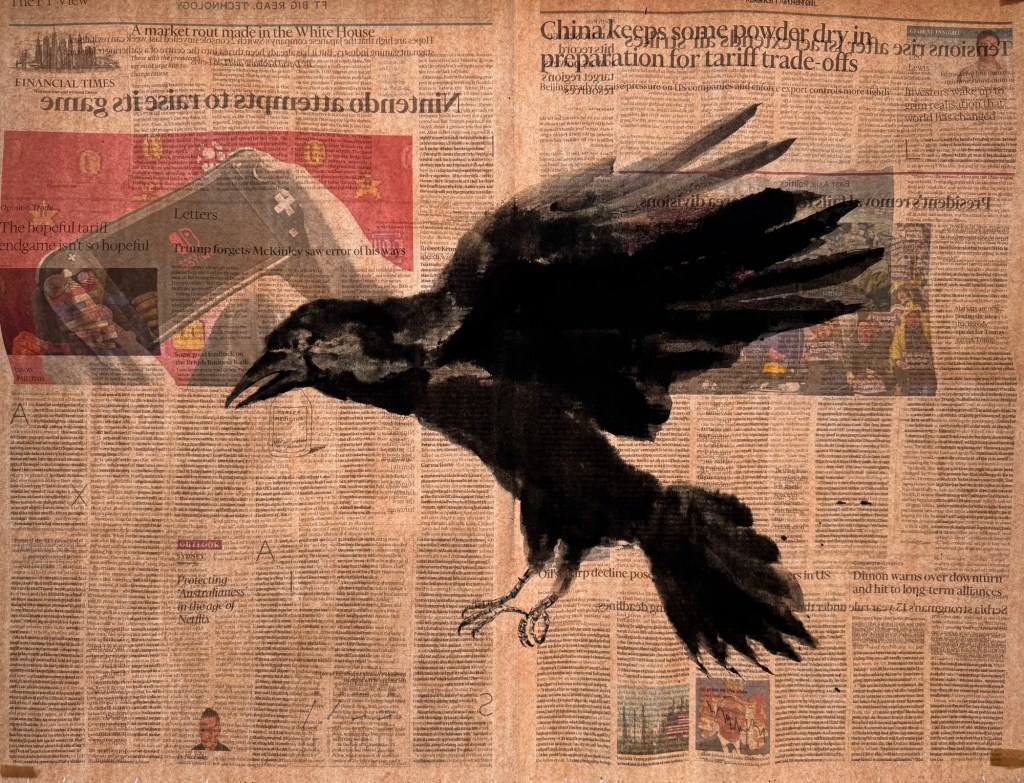
In the painting below, I wanted to position the crow to look like it was going for the bottle of ‘tariff medicine’. But since I do not do a mark up drawing on the page (not anymore) and I just leave the painting to chance, I do not have control of exactly what comes out especially as I’m painting with my non-dominant hand. In this case, the crow ended up overshooting the medicine bottle and it ended with an ‘uh-oh’ or ‘oh no…’ expression which was not my intention but highly appropriate.
–
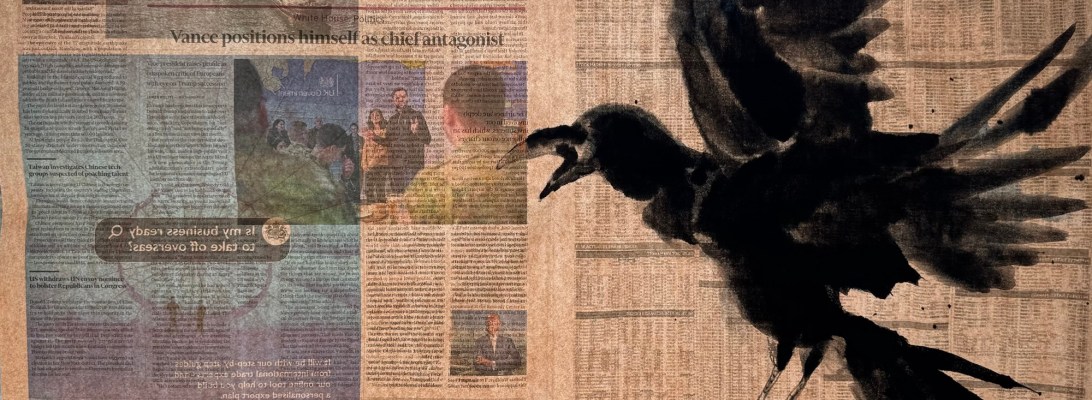
Example 2 –
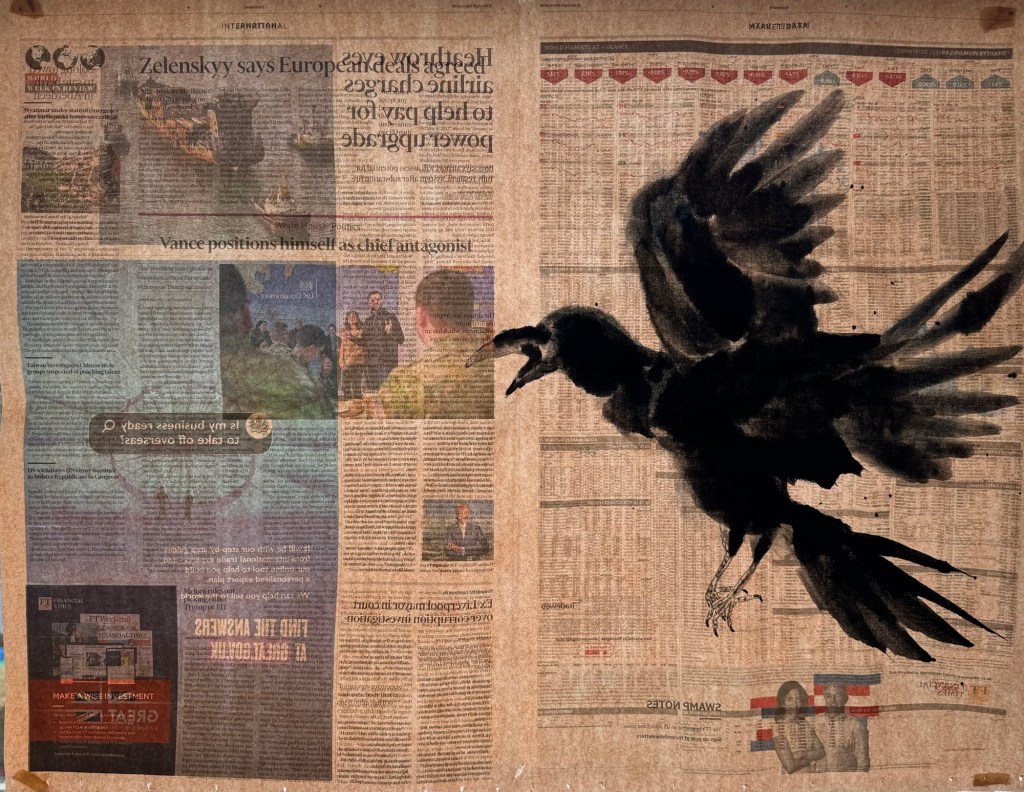
In this case, the chosen headline and image on the newspaper was about the US VP. I intended to bring in the crow from the right hand side (enter stage right) pointing towards the photo image. Again, I didn’t have too much control over the exact depiction but the crow came out screaming at the photo and its feathers somewhat ruffled. It seems to reflect what goes on in my consciousness.
–
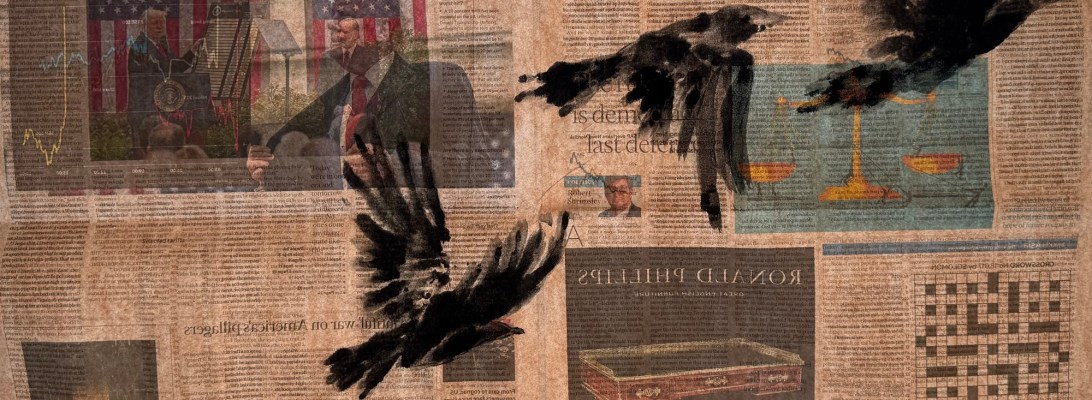
As for the back lighting of the images and what they reveal – I tried at one point to place the bird purposely to align with images on the reverse side, but they rarely work out satisfactorily. So now I choose a newspaper page where there are headlines that I want to respond to on the front and although I do look at the reverse side to make sure there is something interesting on the back, I tend to locate the bird according to the front page and then leave the reverse side to chance. This means I don’t pose the bird according to the reverse image purposely and just wait to see what happens when the painting is finished. By not being overly deliberate, it has provided some interesting compositions. It also contributes to the notion of uncertainty that continues to form a large part of this body of work.
Final reflections regarding using the crow as a metaphor… as I was writing this blog, I have started to use theatre stage language to describe how I use the crow and I feel that is appropriate. The crow has become my actor on stage to carry a message, it has been on stage throughout this series of work. It comes in and out of the spot light depending on what it wants to draw attention to. It accompanies me as I navigate the ‘new world order’ and represents me when I want to say something. One day, when the world is right again (I remain hopeful) then perhaps Crow would exit stage left. I have started exploring bringing in other creatures to broaden the repertoire. I have enjoyed using the Chinese ink as a medium and I have thought about using a rat but that seems to be very controversial. I have also thought about spiders because I was inspired by Louise Bourgeois’ spiders and how she used them to signify strength. I certainly feel that I need as much strength as I can summon up everyday just to read the horrendous news at the moment. This idea is only at an early stage. I will keep thinking.
LEARNING
In writing my reflections and response to the Unit 3 feedback, it has helped me to crystallise my reasons for using the crow in my work – why I use it and how I use it. I feel there is still much to achieve with my crow and there is still some way to go on this journey. So I will continue with it but will be more mindful of how and why I’m using the crow as a metaphor as I progress. I sense that the metaphor has already shifted somewhat and has gone beyond just grief. It is becoming my voice which is also an appropriate metaphor because the crow is intelligent (can read my mind) and vocal (speak for me). Also, in many cultures and mythologies, crows and ravens are depicted as messengers, not necessarily from another world, but rather from between different realms of existence. So using the crow as my messenger has become part of the metaphor.
I will continue to explore other creatures that has a metaphorical meaning for me and that works well with my chosen media of Chinese ink on newspaper. Spiders are one possibility that I am considering.
NEXT STEPS
Continue to use the crow in this series of work, News.
Consider more deeply about the metaphors that I use – how they apply as a metaphor and how they evolve along the journey.
Explore other creatures or metaphors to bring into the work. Be sensitive to what they mean and think broadly to avoid unintentionally offending people.
I have been planning how to continue to develop my art practice after I finish my MA. The key for me is to ensure I work in a way that maintains my interests with variety and balance to keep up the momentum so that it is sustainable in the long term.
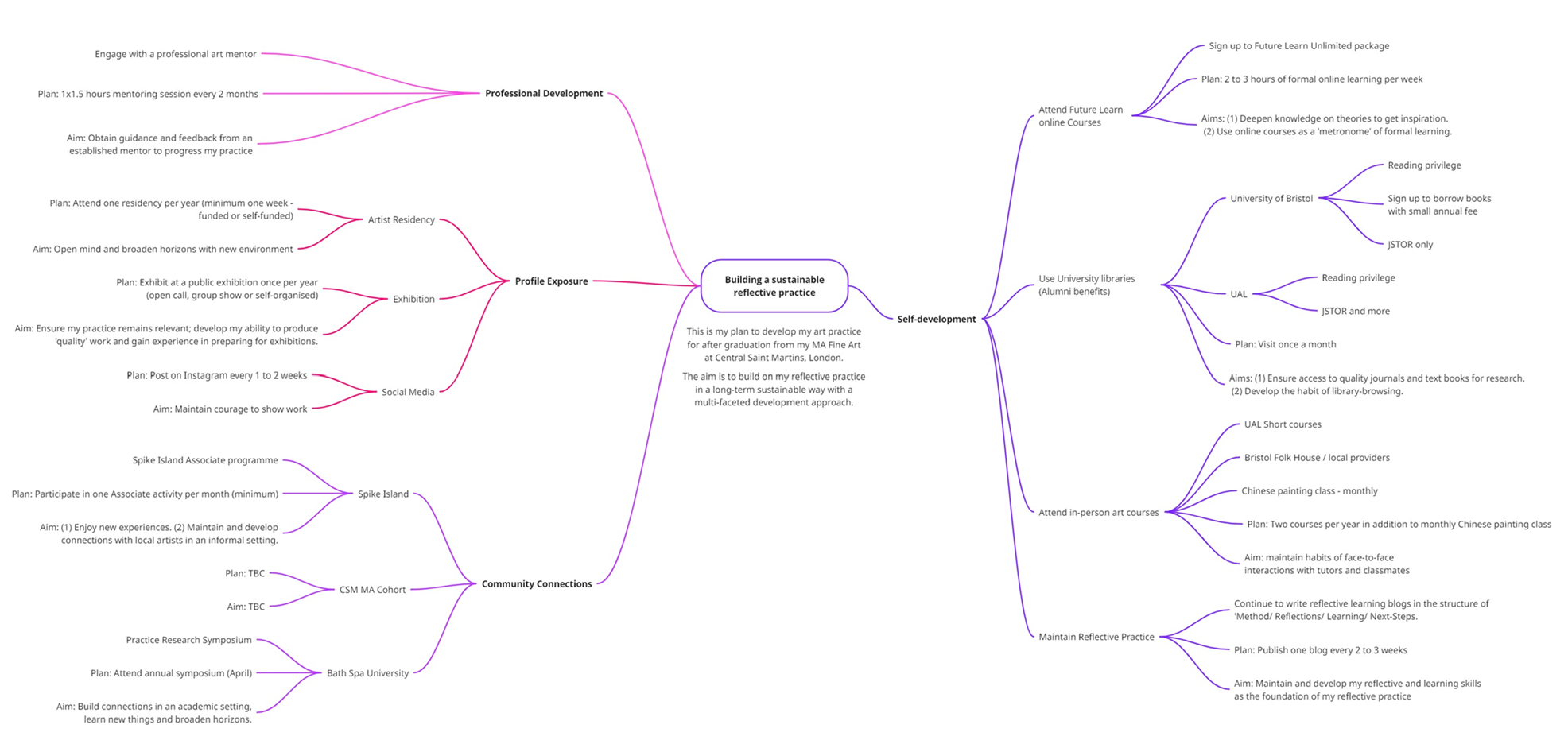
As a starting point, I have created a MindMap where I have captured my aims as well as resources that are available to me. I have tried to create a balanced plan covering the following areas with a structure that I hope will help to establish a rhyme after my MA:
– Personal / Self-development: Attend in person classes, e.g. continuing my monthly Chinese painting lessons, as well as online learning. I have identified around one year’s content (with 3 to 4 hours per week starting with cultural theories) on Future Learn that I have just subscribed to and I plan to attend those online modules every Thursday afternoon in place of the MA weekly classes to keep up a learning rhythm.
– Reflective practice: A key part of my self-development has been my reflective practice. The structure that I have built into my blogs has been invaluable in helping me to develop my practice. It offers a safety framework that I can return to especially when I feel a bit lost or uncertain. Writing the reflective blogs has put me back on track time and again when I have been stuck. So I plan to continue with the blogs because they help me immensely and I have set myself a goal in the frequency of blogging.
– Professional development: I plan to engage with an art mentor having a session once every two months. I have been recommended a mentor used by several Spike Island Associates and I have connected with him. It’s my way of holding myself accountable and forms part of the rhythm.
– Profile exposure: I need goals to work towards in order to maintain my momentum and I have set myself targets such as attending one artist-residency per year – this could be self-funded if I do not get accepted onto a competitive one as I don’t want to give myself an excuse to not do it. I feel the act of attending a residency, making art away from my environment, would open my mind and expand my horizons. In addition, I want to show my work as a way to keep my thinking and my work ‘current’. I will look out for Open Calls that are aligned with my work and if that doesn’t work out then I would create my own ‘show’. That could be in whatever capacity, even just displaying my work in a park in my neighbourhood – the purpose is to have an event of some kind for me to make work for and aim towards.
– Community connections: Although I enjoy my own company and can happily make work in my studio without seeing anyone. I appreciate that being connected with other artists is important for my development and well being. Hearing others talk about their work always gives me inspiration. Talking about my work to others is also a healthy thing to do. I am fortunate to live in Bristol where there are many artist communities that I have always found to be friendly and supportive. So I will definitely continue to connect with them regularly (e.g. attend events with Spike Island Associates).
Below is my first draft MindMap plan showing my plans and aims for each element. Items within the map are there to feed into my art-making; to give me inspiration, to deepen my knowledge and to help me think.
The plan is work-in-progress and I will continue to build on it over time. I may not even fully follow it, but having a plan in place is important for me to have a starting point, so that I am not faced with a blank calendar and feeling lost the day after graduation!
I will follow the plan for as long as I enjoy it; if I stop enjoying it then I will revise it. I hope as I travel on this journey, other things will come up and the plan will evolve as my needs change. I will be very sad when my MA course ends but I am very excited to continue the journey with all the new skills, knowledge and friends that I have gained on the programme.
–
REFLECTIONS
A few things that were said to me recently have got me thinking about my MA…
A very good artist friend said that she noticed I have been talking about ‘my practice’ and about ‘being an artist’. I remember when I first joined the MA course, I would only describe myself as ‘an art student’. When asked if I were an artist, I would reply, ‘not really, I am just an art student’. Then sometime during the last two years and I don’t remember exactly when, I have started to talk about being an artist. I had not noticed it until my friend pointed it out to me and I am pleased to say that I feel comfortable about referring to myself as an artist now when I was certainly very hesitant two years ago. I believe it’s the MA course that has given me the confidence and encouragement to do so.
Another comment came from a photography tutor. I have attended a few one-off photography workshops locally and have got to know the tutor well. Earlier this year, she asked what I was planning to do after my MA and at the time I said I wasn’t sure – it was before I created the above MindMap and I was considering doing another taught MA. She said, ‘I am sure you are going to do something because you can’t waste an MA from Central Saint Martins.’ That really made me reflect on what an opportunity and a privilege it has been to do this course (in fact, to do further education of any kind). I do not have ambition to be a famous artist or to have gallery representation, that was not what I came here for. I came here to develop myself and to learn. I have thoroughly enjoyed the course and I am loving making art. So I am just going to keep on making and be true to myself in my art – as David Bowie said, ‘don’t make art to please other people’. I hope that is enough to not ‘waste’ this excellent learning opportunity that I have had the privilege to enjoy.
LEARNING
In addition to making art, I will continue to explore how I can use ‘my voice as an artist’ and I hope the MindMap plan will help me with this. I have always wanted to broaden my practice to examine societal issues so I plan to build on my ‘News’ art – my ambition is to make large scale industrial-style ‘News’ art installations. I am excited to see where all these will take me.
NEXT STEPS
– Follow the MindMap plan after graduation – revise it if needed. But always have a plan to maintain the rhythm.
– Explore how I can use ‘my voice as an artist’.
– Continue to make ‘News’ art – scale up.
– Keep on making art, be true to myself and keep on enjoying it!
One of the key learning from my MA is to think carefully about our choice of materials and the content of our work. Especially if it is to be exhibited in public. We need to be sensitive to the audience and have reasons for the choices that we have made in our making. When I first started thinking about making work on newspapers, an important decision was which newspaper or newspapers to use. I have become very disillusioned with the news media in recent years so it was hard to choose. I have had a long relationship with The Financial Times (FT) because I always felt it was more balanced and factual than most media channels – it’s one of a few newspapers that I could bear to buy or read. I used to use The FT a lot for work when compiling economic reports about the UK for international meetings. I was happy to stand by its facts and figures as they were considered credible. I am increasingly tired of unsubstantiated claims by news media as well as those in public life, hence I crave a news channel that I feel I can trust. I wanted a non-controversial newspaper as I don’t want the choice of newspaper to dominate the conversation rather than the art.
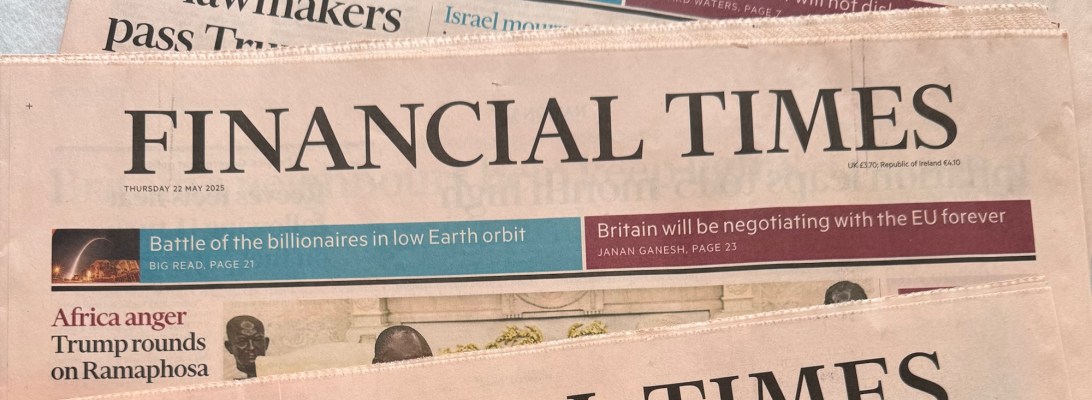
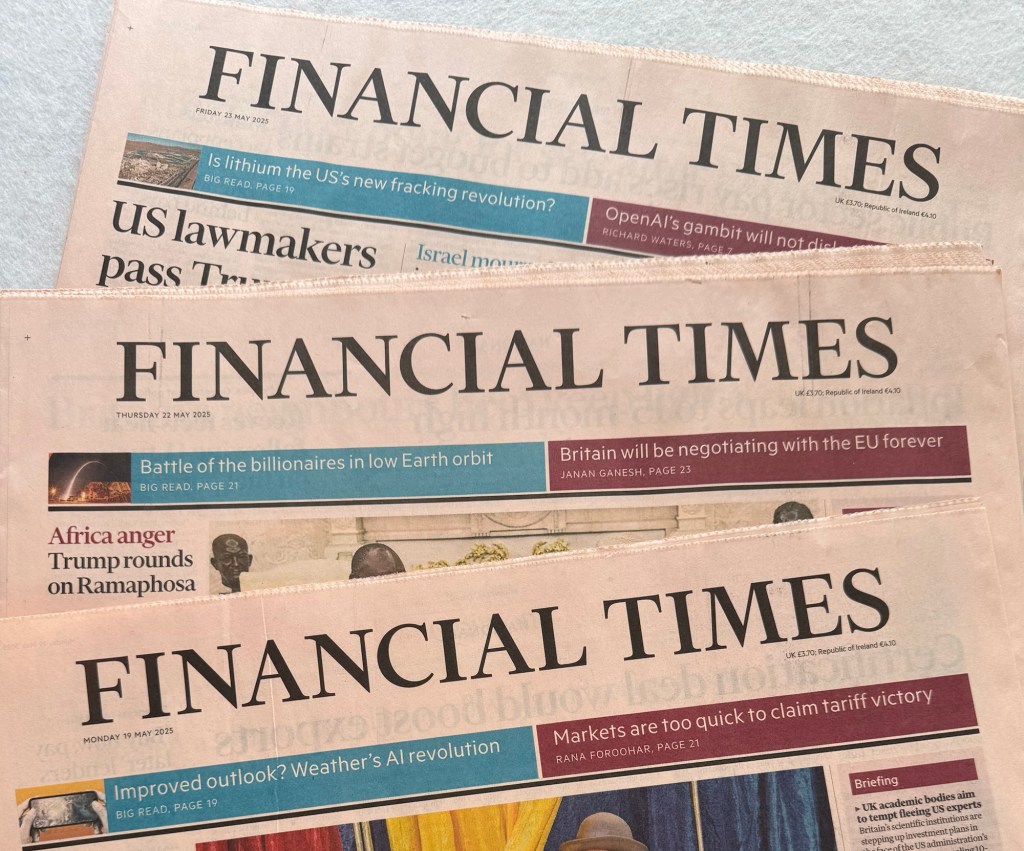
Also, the salmon colour of the paper works very well with the Chinese black ink. I believe aesthetically it works better than the usual white newsprint paper. Hence I started to paint on The FT.
Now that the ‘News’ body of work is growing and I am committed to using The FT so much so that I have purchased a print-subscription, I feel I should do some more background research to ensure I have chosen the correct newspaper.
METHOD
I have become very aware that I should have a reason to choose certain materials in my making. Since the choice of newspaper is such a key part of this body of work, I feel I should retrospectively verify that my instinctive choice of The FT was correct.
I should start by considering what I would want from the newspaper in this body of art work:
– Trusted: My aim is to express my grief for the lost world order in recent months and to share the grief of those close to me whose lives have been deeply affected. I do not intend to be overtly political – my art is not a political campaign in an activism-way. I want to look for news headlines that are to do with this topic and bring attention to them but I will leave the viewers to decide for themselves how they feel about it. To do this, I need news headlines and articles that I can trust to be as factual as possible as I just want to present facts and figures. I am not planning to influence the viewers’ judgement. That means quality journalism with substantiated facts. I cannot fact-check every article, so I need a journal that I can trust in general. I don’t want to be anyone else’s mouthpiece.
– Uncontroversial / unbiased: I am despaired by the political polarisation that exists in our society and I do not want to contribute to that as it is not the aim of this body of work. Therefore, I want to choose a newspaper that is not too controversial, perhaps as politically-central and unbiased as possible accepting that it is not possible to be 100% unbiased when a newspaper has contributions from many people. The aim of the art work is to share what has caused my grief. If the newspaper has to have a leaning then a liberal leaning would be preferred especially regarding the topics in question.
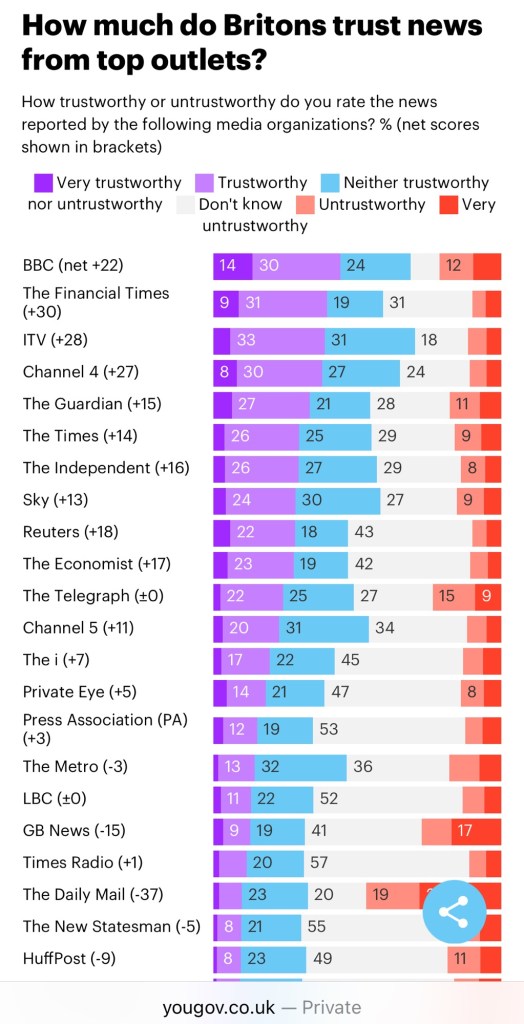
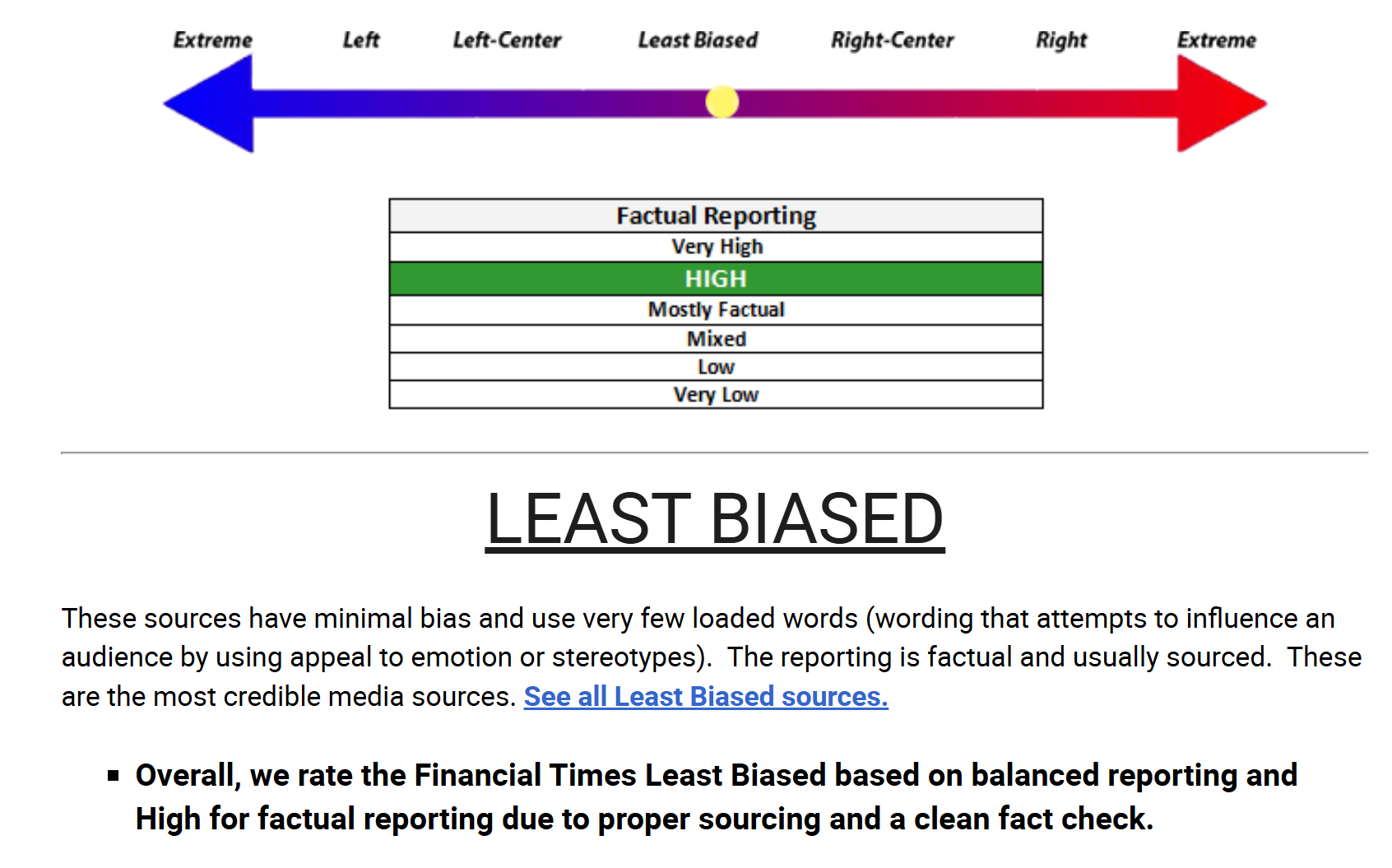
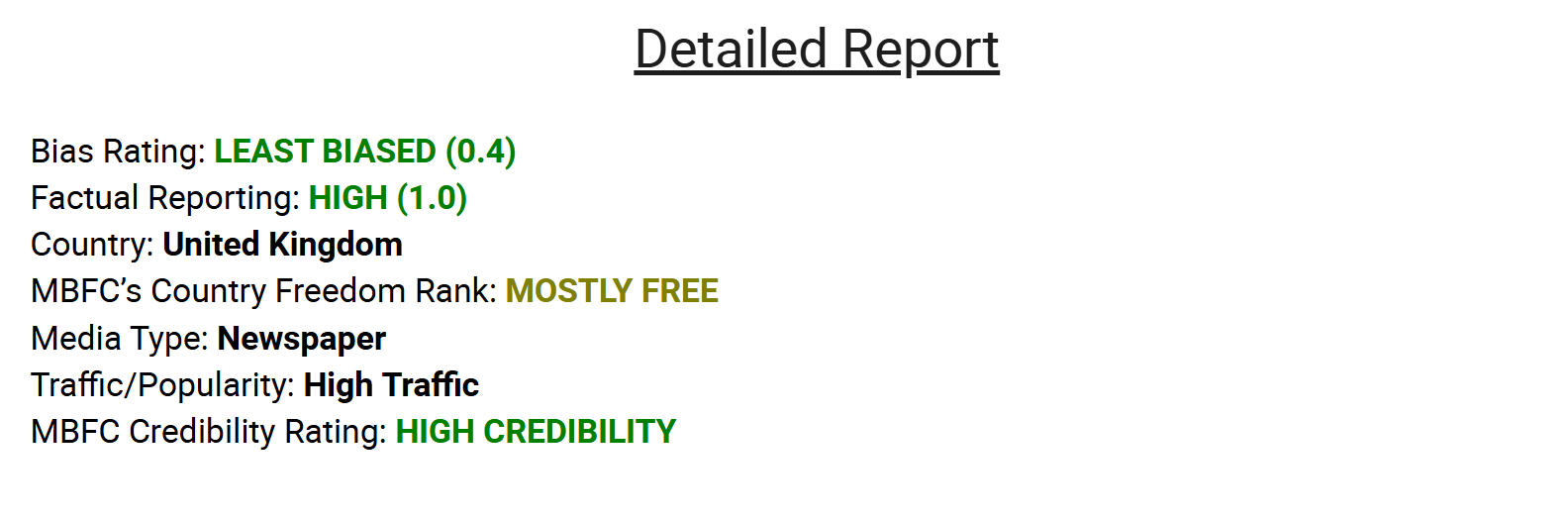
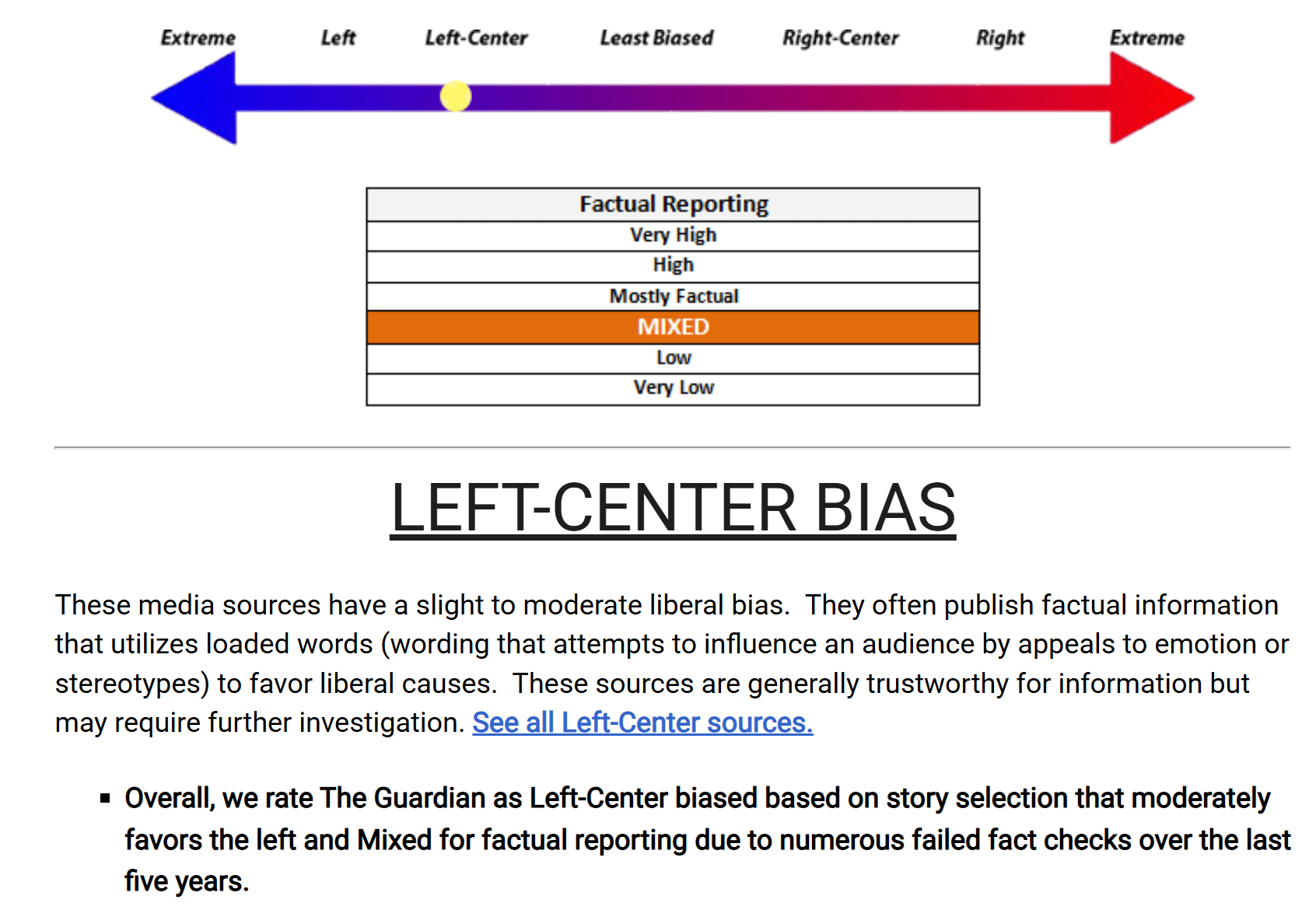
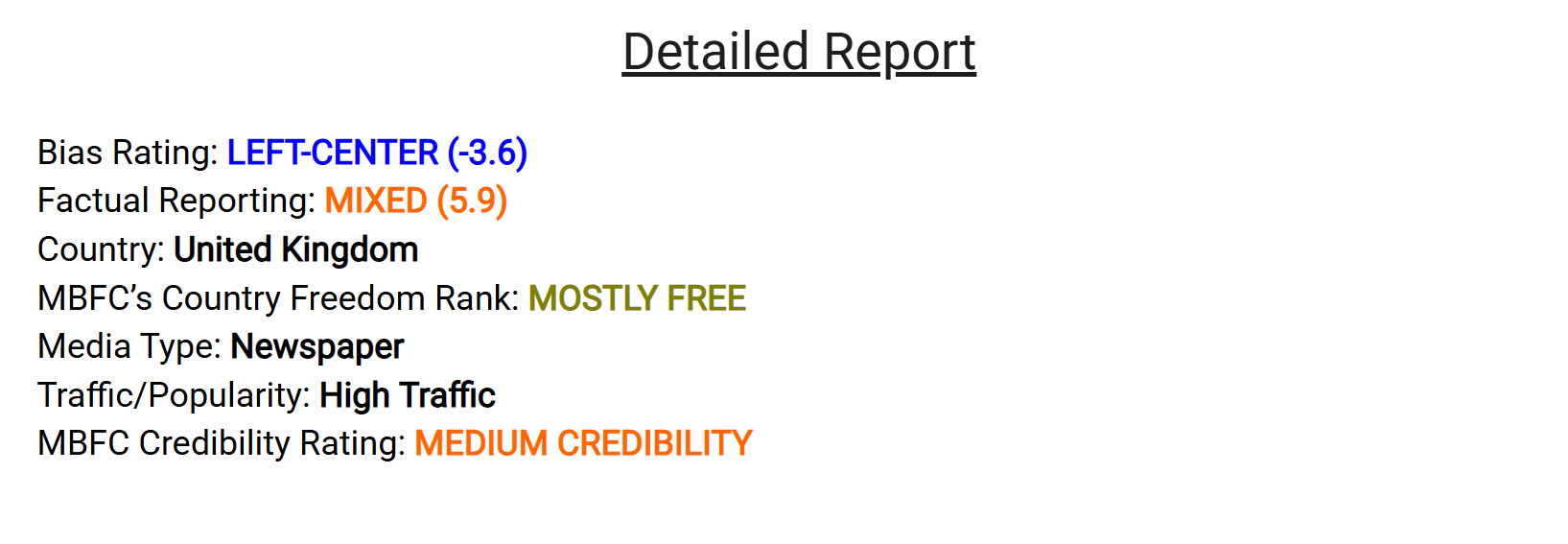
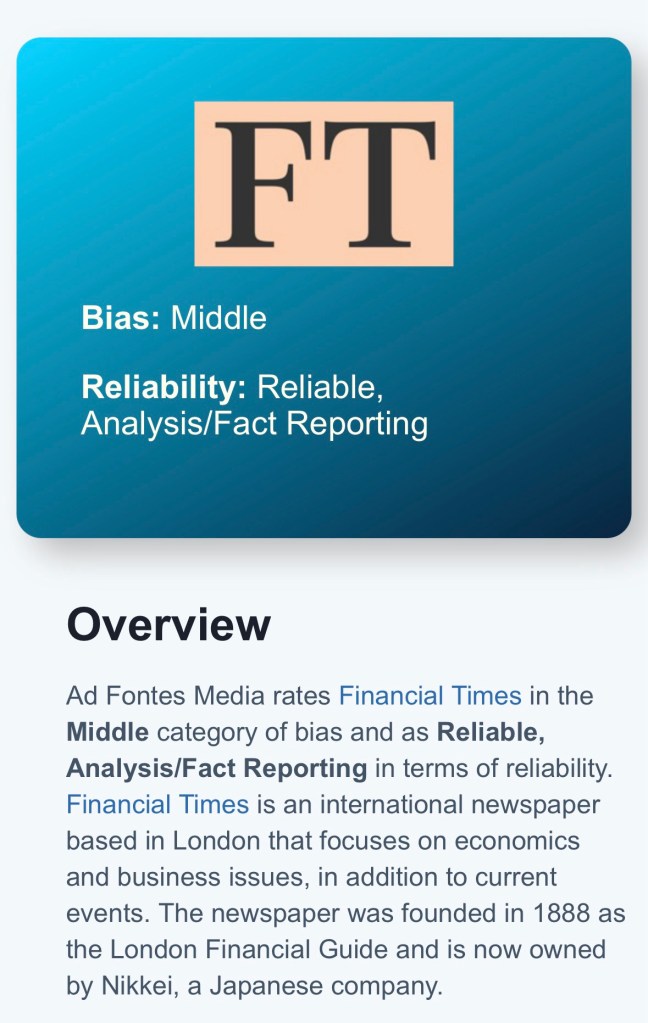
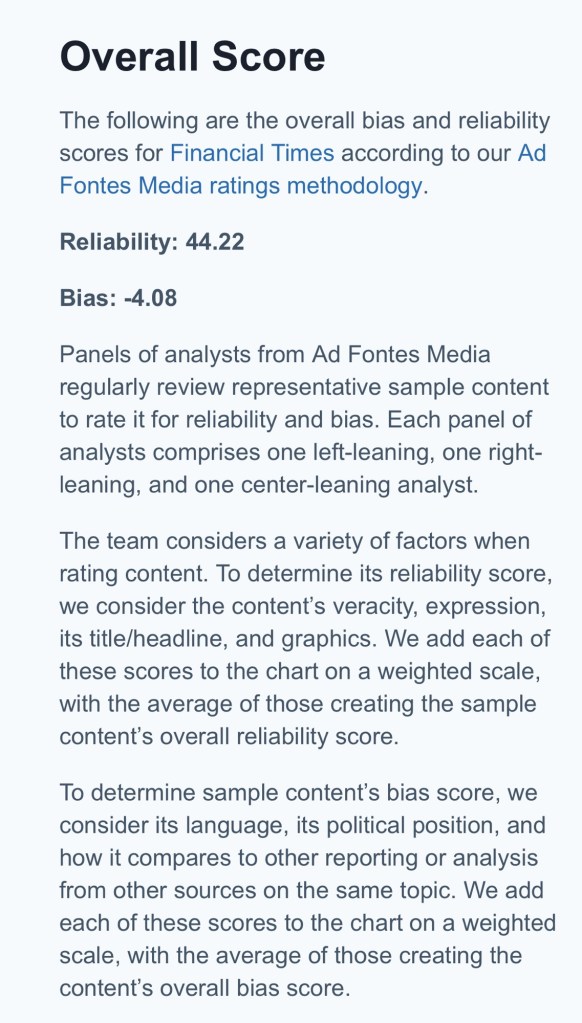
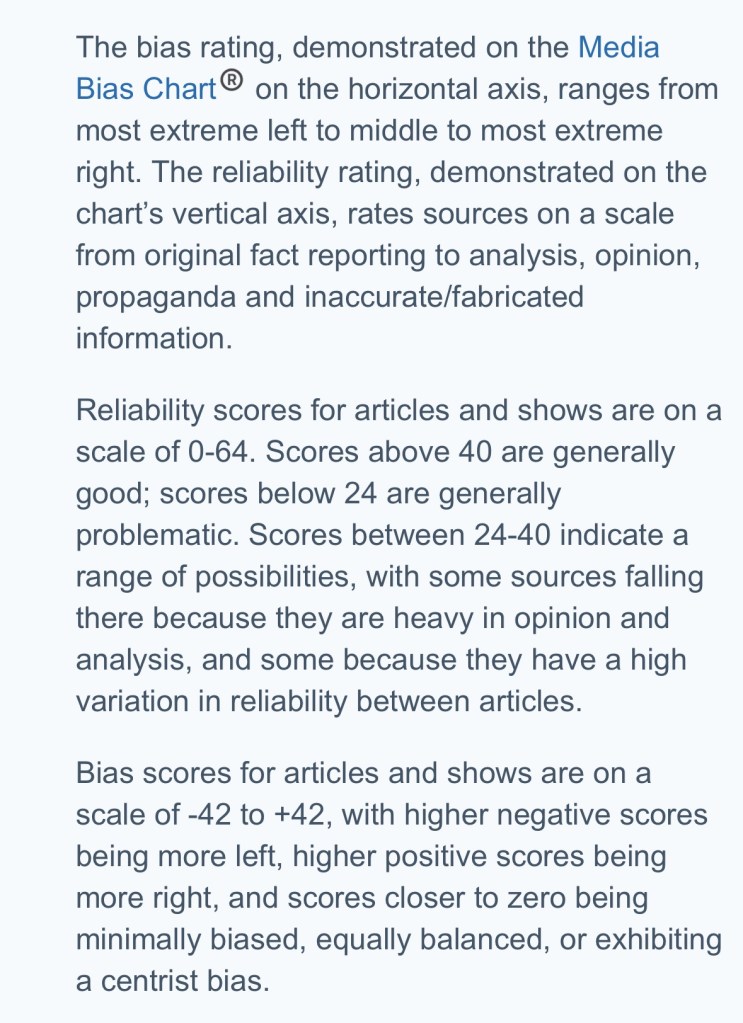
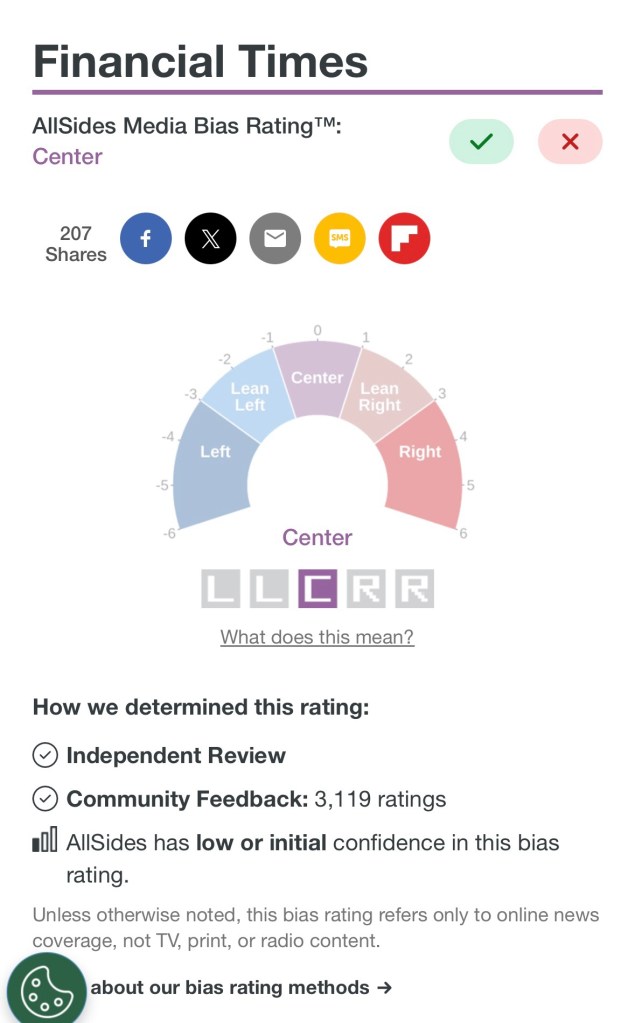
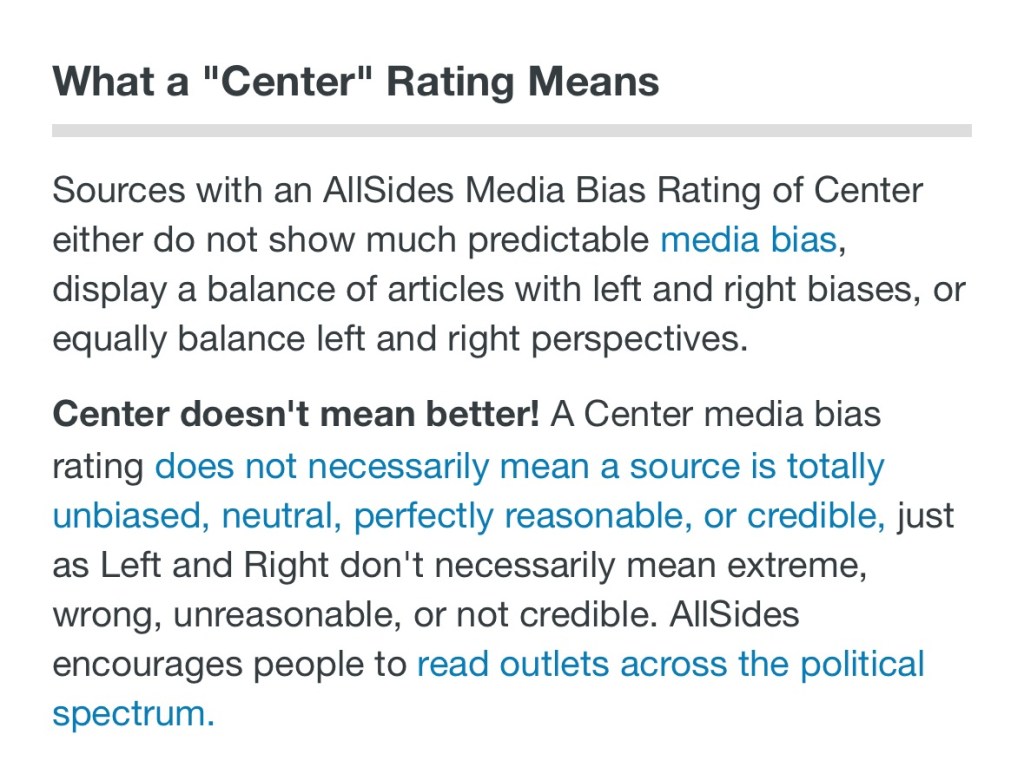
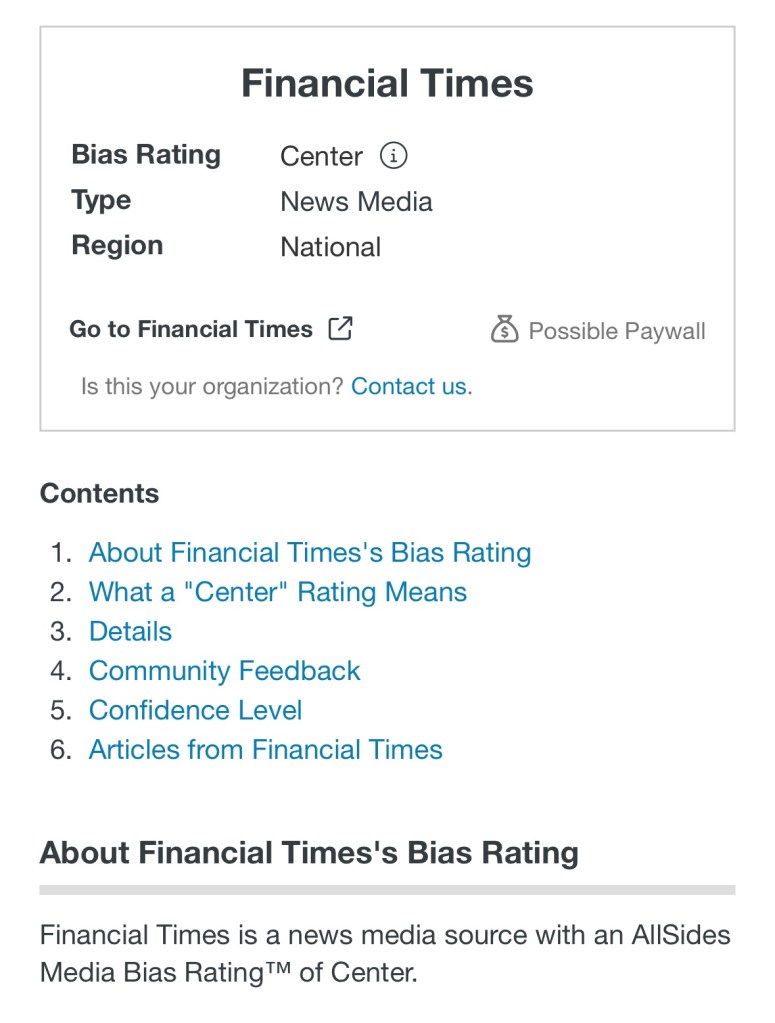
To start my research, I did several Google searches – for the most trusted and unbiased news media channel in the UK. Below are screen captures of some of my findings.
There are additional supplementary reports on The FT that largely reflect this finding and they are shown at the end of the blog.
From this quick online research, the findings showed that The FT was found to be the most trusted and unbiased UK newspaper relative to other newspapers (relative position as derived from the YouGov poll) with a central position politically.
REFLECTIONS
This research was done as a sense-check to ensure I have chosen the correct newspaper for the purpose of my art work – I believe I have because The FT findings showed that it addresses my requirements for a newspaper for this body of work.
However, as one of the reports said ‘central does not mean it is good’ and I feel that is an important point. It is not my intention to make this body of work overtly political, hence requiring a centrally positioned newspaper with a balanced view. One could argue that could contemporary art be truly central? I think my position on that point is that I am not ready to pick a political fight with the world – yet. I want to find my way into this part of the art world in a way that I feel I can manage especially given a lot of my ‘News’ art has been about my emotions and grieving – I need to process and make sense of that first. I am not ready for political debates. Hence remaining central is a stance that I want to adopt – for now. The most important thing is the trustworthiness and unbiased reporting of the newspaper which I believe I have with The FT.
Also, it is salmon colour. So I am relieved with my findings and satisfied with my choice. I will continue to use The FT whilst continuing to monitor its credibility.
LEARNING
I am glad I carried out the research. I believe that if I am going to show my art in a public place (Degree Show), I need to be doubly careful about the content and my reasons for choosing the materials. So this research has partly been to prepare me for the Show as I anticipate someone would ask me ‘Why The FT?’.
The main learning here is that researching all aspects of the materials used is essential. Especially when the subject matter could be sensitive, political or emotionally-triggering in any way. If I want to take my art practice onto addressing societal issues as I do, then I need to be more careful, considered, informed and mindful in these respects. I don’t want to rush into something that I am not ready to handle or my credibility as an artist could be called into question. Hence research and preparation is important. This is a key learning for me.
NEXT STEPS
– Continue to use The FT for my News art.
– Carefully consider all aspects of the materials I choose for my work and be thorough especially with exhibited work.
–
ADDITIONAL RESEARCH RESULTS
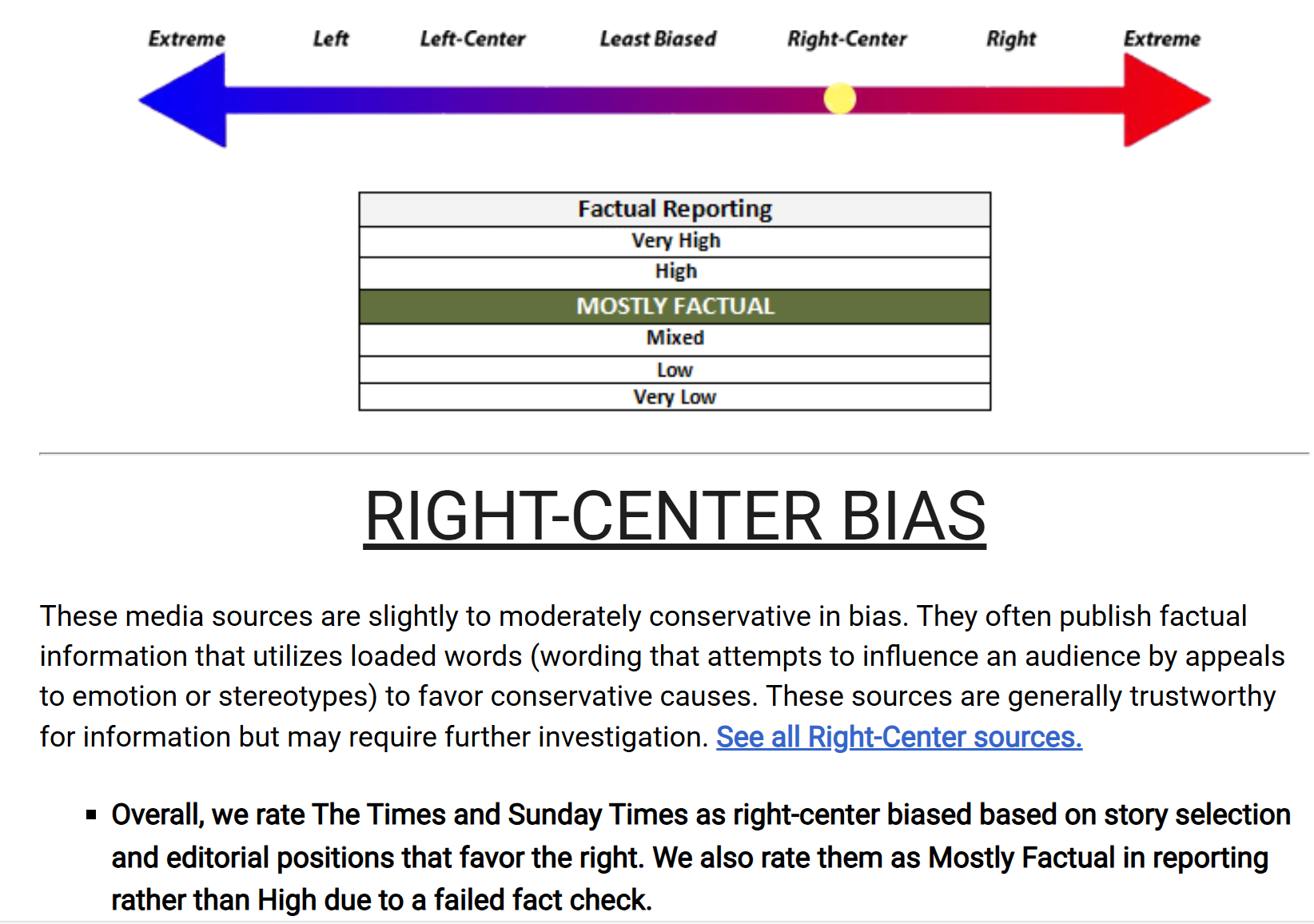
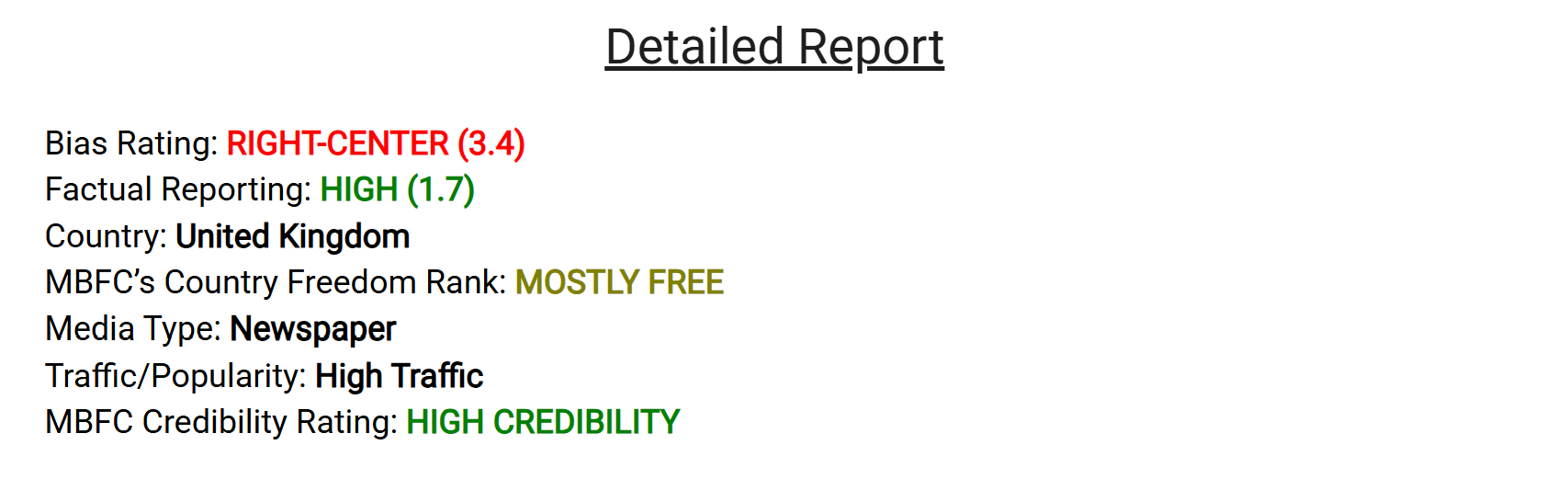
Below are additional reports found online on The FT.

 elizarawlings