I introduced the idea of drawing or painting with my non-dominant hand whilst developing my body of work ‘News’. I did that as a way to challenge myself and to introduce uncertainty / vulnerability into the process to reflect how I felt about the state of the world at the time. Since then, I have become fascinated by the subject and I have been reading the book ‘The Master and his emissary’ by Iain McGilchrist on the divided brain. I read about Divergent Artistic Behaviour which states that:
Truly creative art can only result from divergent artistic behaviour – behaviour that was previously unknown or often unexpected and unexplored.
Divergent behaviour demands something from you that you have not been taught or that is not part of the suggested or normal steps in solving a problem.
That understanding has reinforced my desire to explore using my non-dominant hand to draw and paint as that has been unexplored up to now.
In this research experiment, I want to gain a deeper understanding of what the difference is between the work that is produced by my dominant hand right vs my non-dominant left hand.
METHOD
I have previously done an exercise with both hands drawing together simultaneously and one of the outcome of that was to consider whether I needed to have both hands drawing simultaneously and whether I had to have my eyes closed. My conclusion after some consideration was that no, I didn’t need to do either. If my objective is to research the difference between how the two sides of the brain produce work through my hands then there is no need to do it simultaneously or have my eyes closed. In a way, those parameters could confuse because there were too many variables introduced at the same time. Therefore, in this exercise, I’m going to just draw with each hand and compare the outcomes.
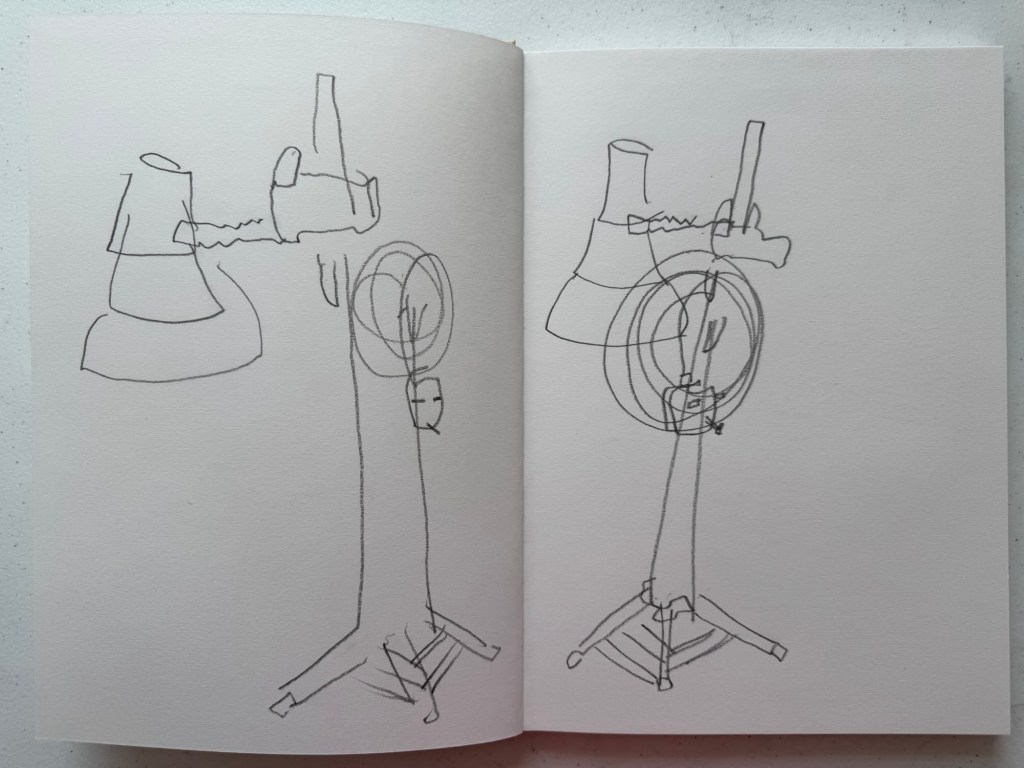
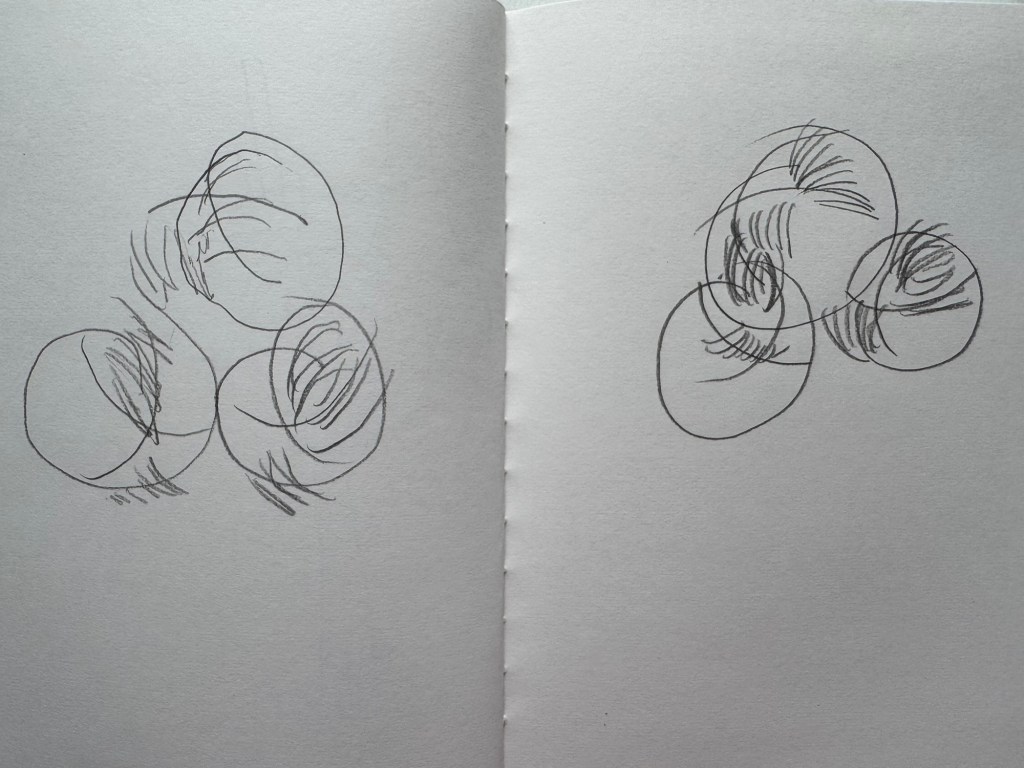
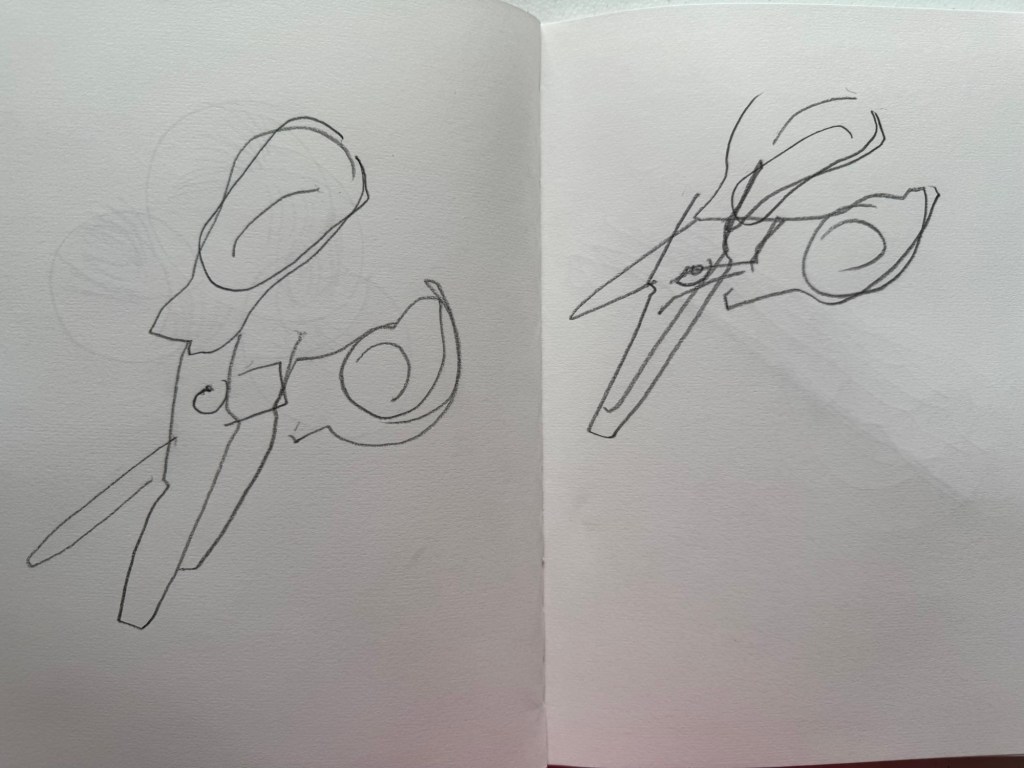
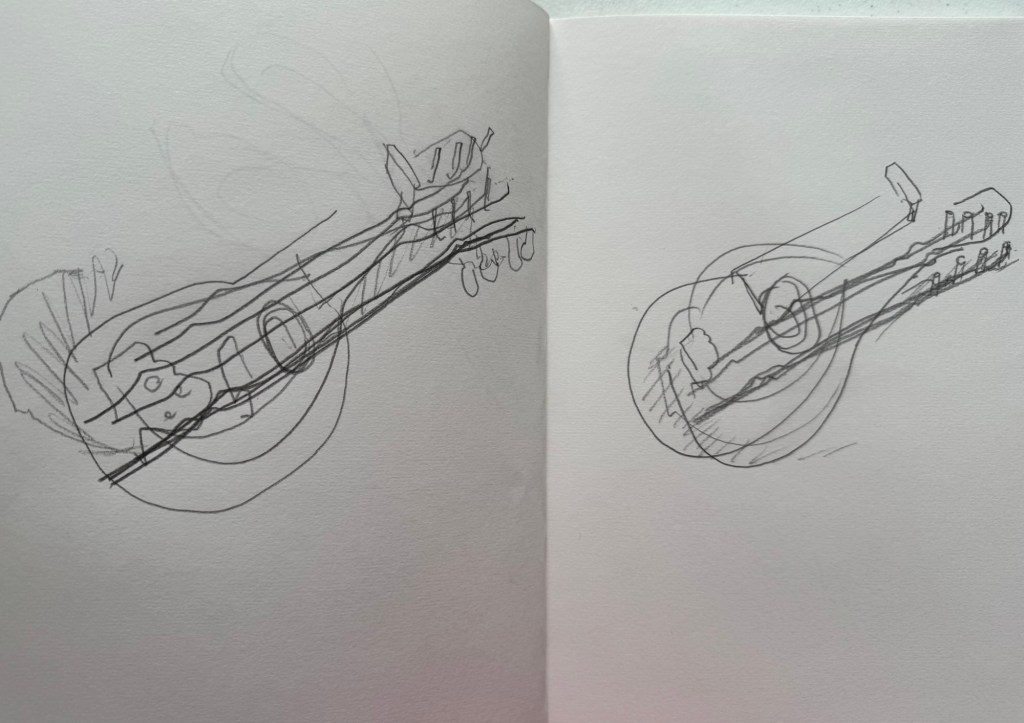
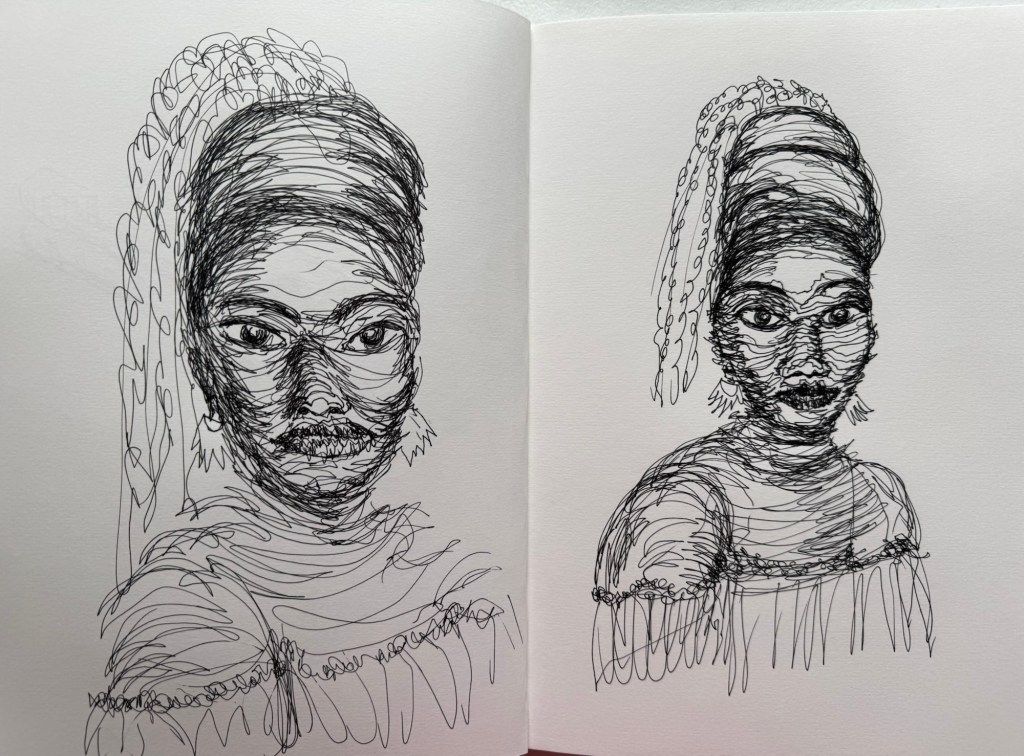
I used the method of ‘blind contour drawing’ – drawing with eyes looking at the object and not looking at all at the drawing. Below are some of the items I drew in my studio with the left page drawn by my left hand and the right by the right hand.
Studio lightJuggling ballsScissors Miniature Chinese lute – Pipa
Cross-contour drawing –
A woman’s face
REFLECTIONS
It has been an interesting exercise. Firstly, I feel that there was no need to draw simultaneous like I had done in the previous experiment. The key is to study the difference at this stage and not the difference when drawing simultaneously. One step at a time.
The images drawn with my left hand were consistently larger than those drawn with my right hand. I have observed this before in other similar experiments. I am able to be more loose when drawing with my left hand. The right hand seems to be naturally more tight, as though there are invisible boundaries on the page that I had to work within. Whereas with my left hand – I don’t feel the boundaries and therefore am not confined by it.
The left hand drawings are less accurate compared to the right hand, but there is sufficient likeness to be recognisable as the piece.
I am increasingly ‘addicted’ to drawing with my non-dominant left hand and increasingly less satisfied with my right hand because the latter is a constant reminder of my inability to push boundaries – I get pulled back into being too tight and constrained when making art with my right hand, it’s like muscle memory that I cannot erase. Whereas the lack of control in my left hand enables me to, or grants me permission to just make and not think too hard as there is no expectation for the outcome to be good. With my non-dominant hand, I am often pleasantly surprised whereas with my dominant hand I often feel disappointed.
LEARNING
I am more able to create freely with my non-dominant left hand because there is no expectation and the lack of control enables me to push myself, often ending in pleasant surprises. I enjoy this way of making with my left hand and would like to pursue it further. Perhaps even make it a key aspect of my practice.
NEXT STEPS
Keep creating and pushing boundaries with my non-dominant left hand.
Continue to explore the differences between making with my left and my right hands.
Try writing or calligraphy to see how the left hand performs on that.
At some point, I need to consider more deeply why I am drawn to this way of making. I must not ignore this point because I feel there is a link to who I am and how I am evolving. So I must come back to this point when I feel ready.
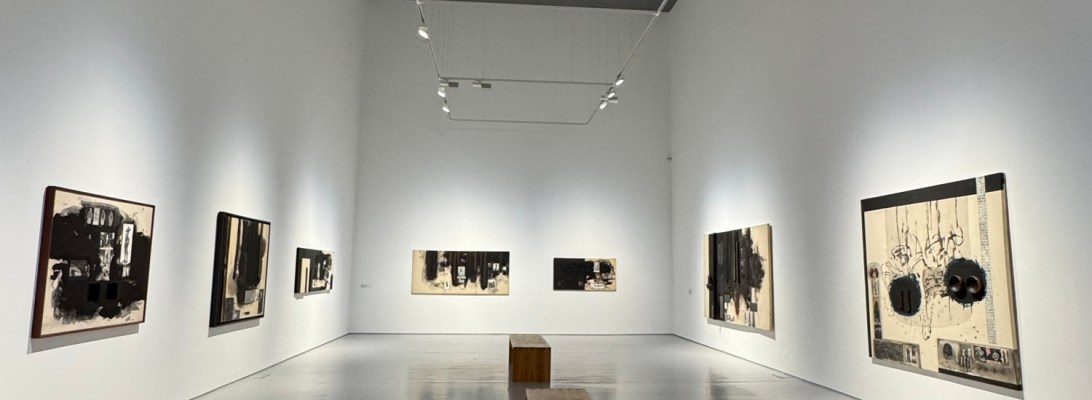
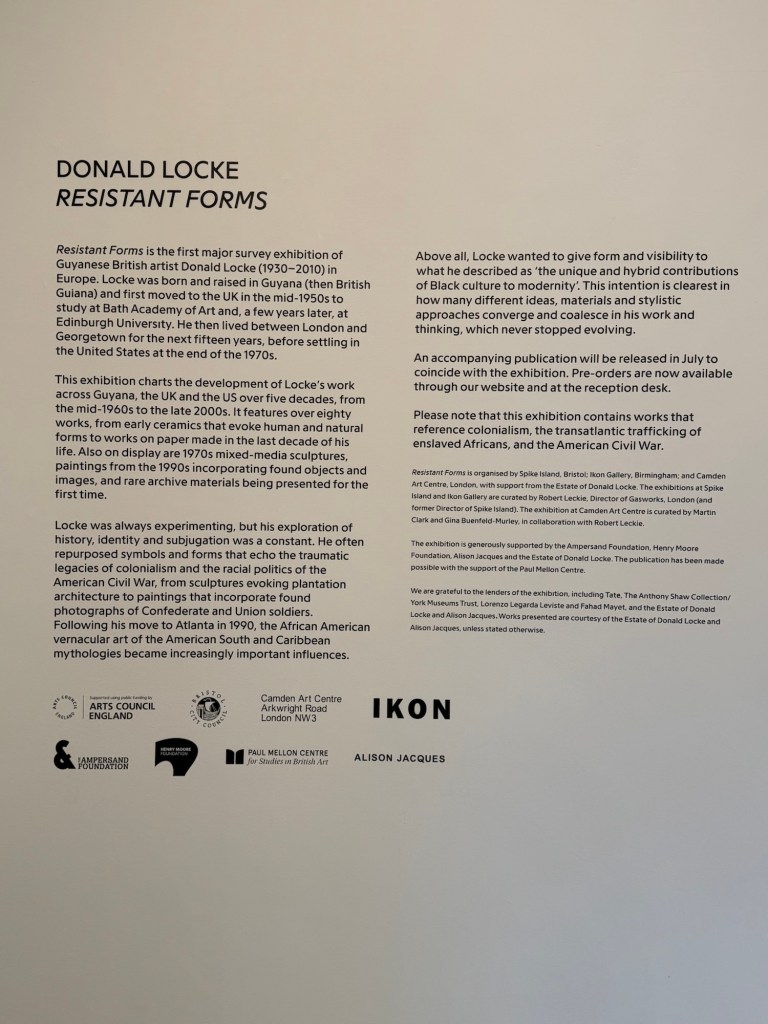
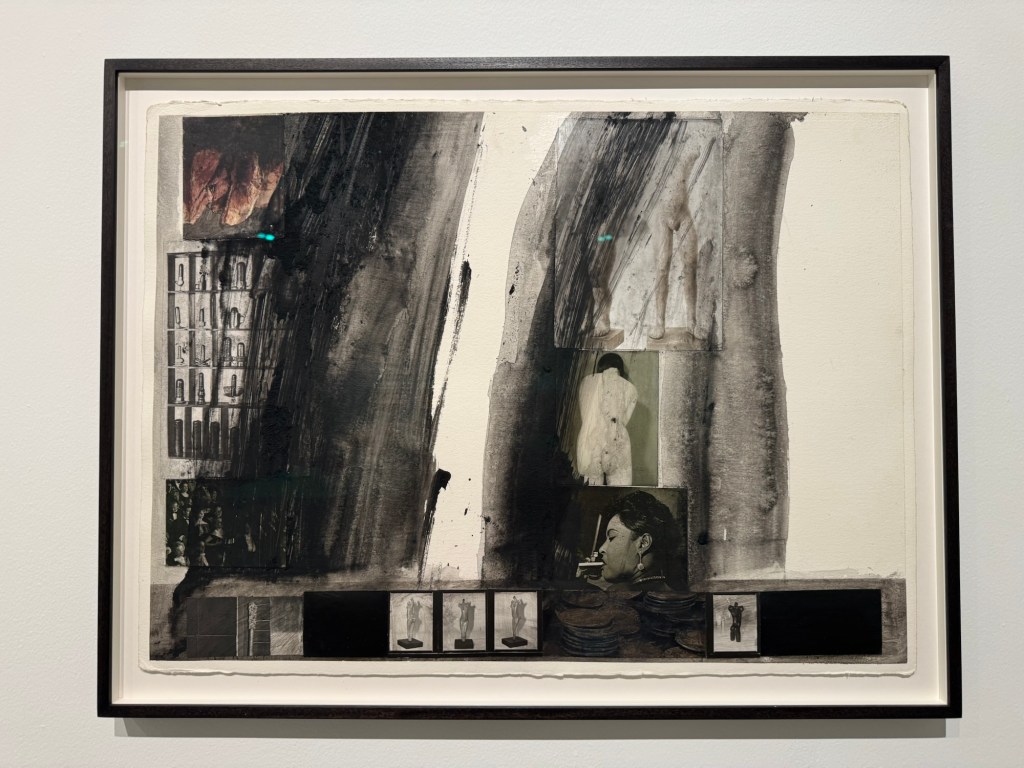
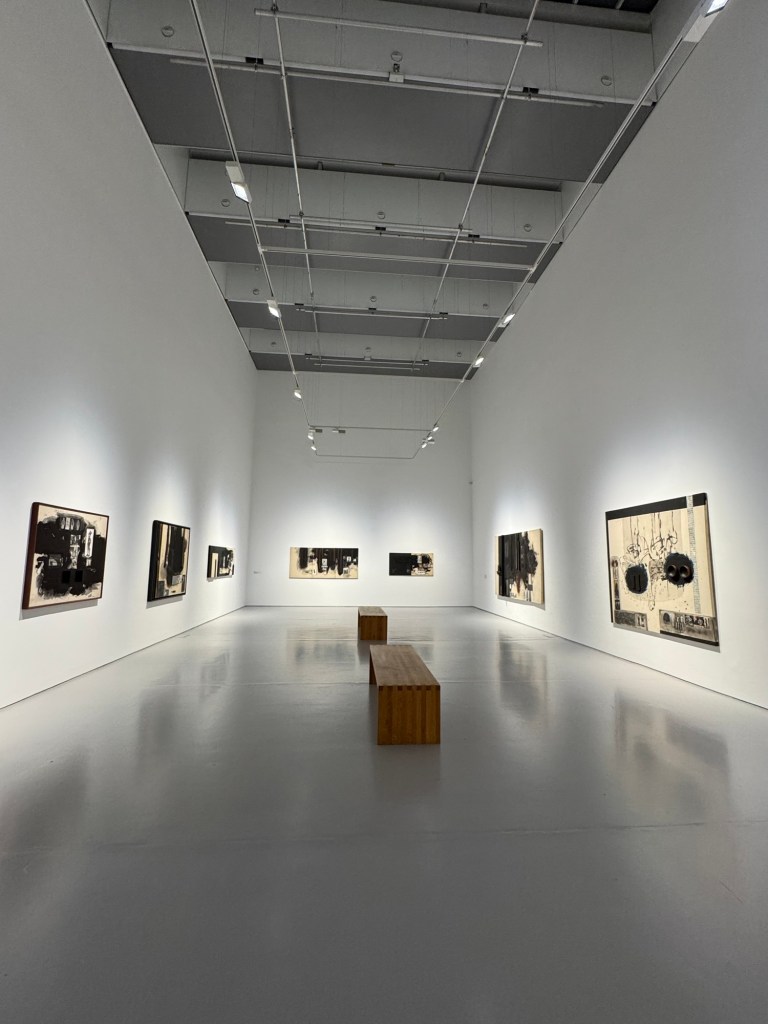
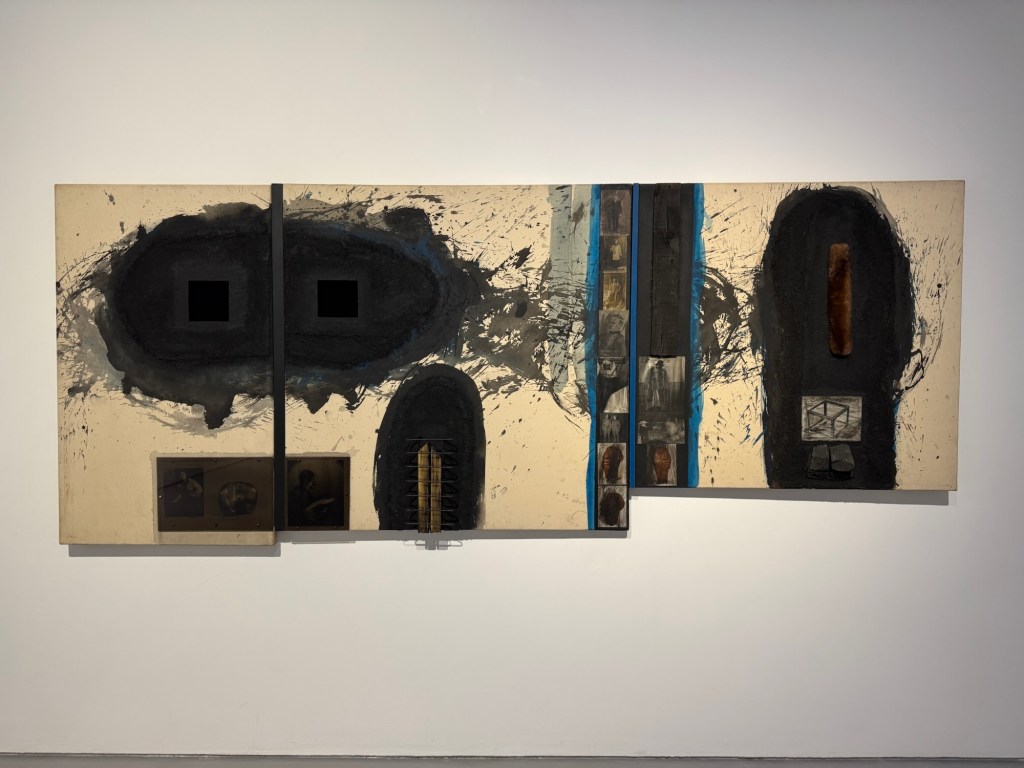
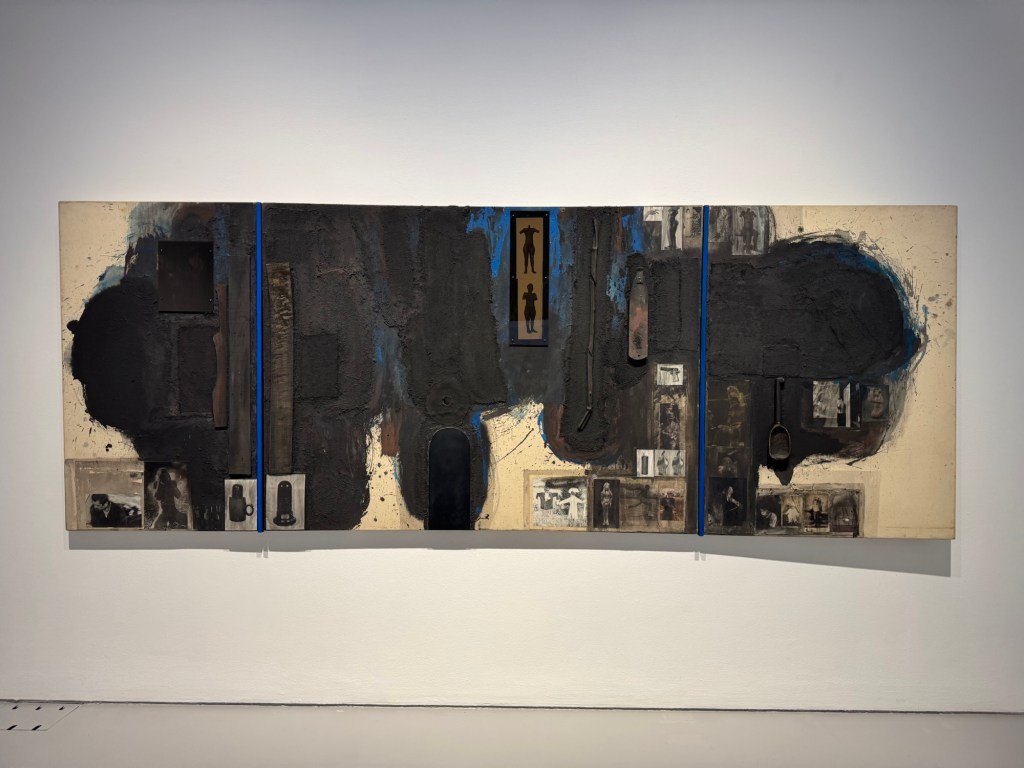
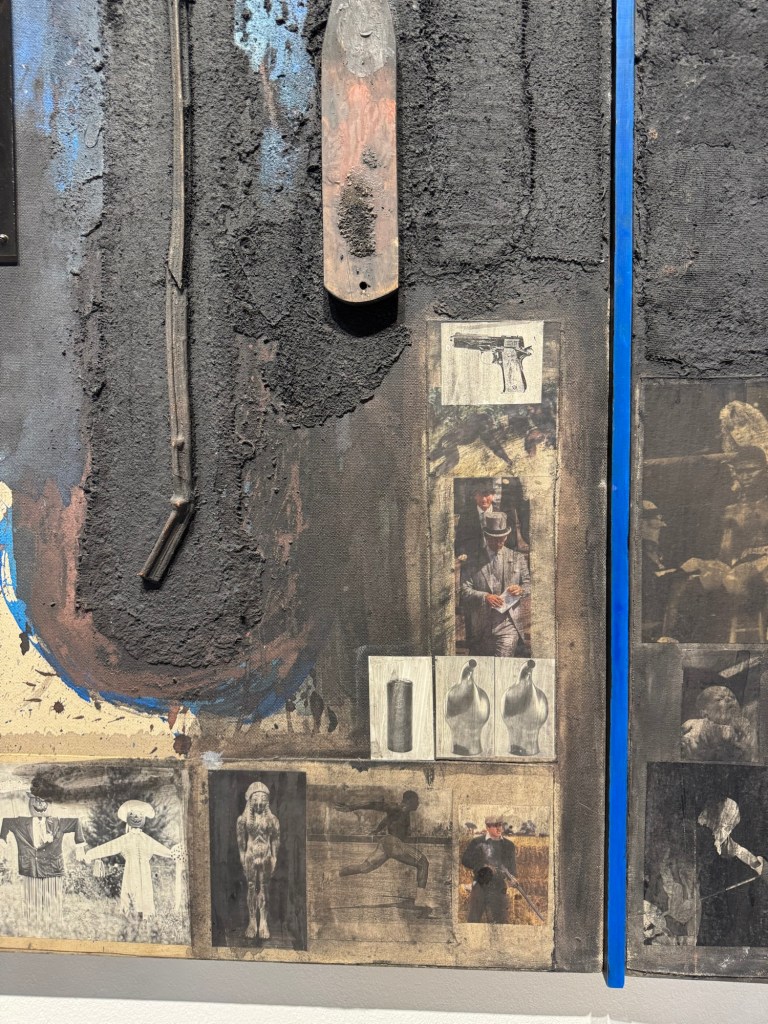
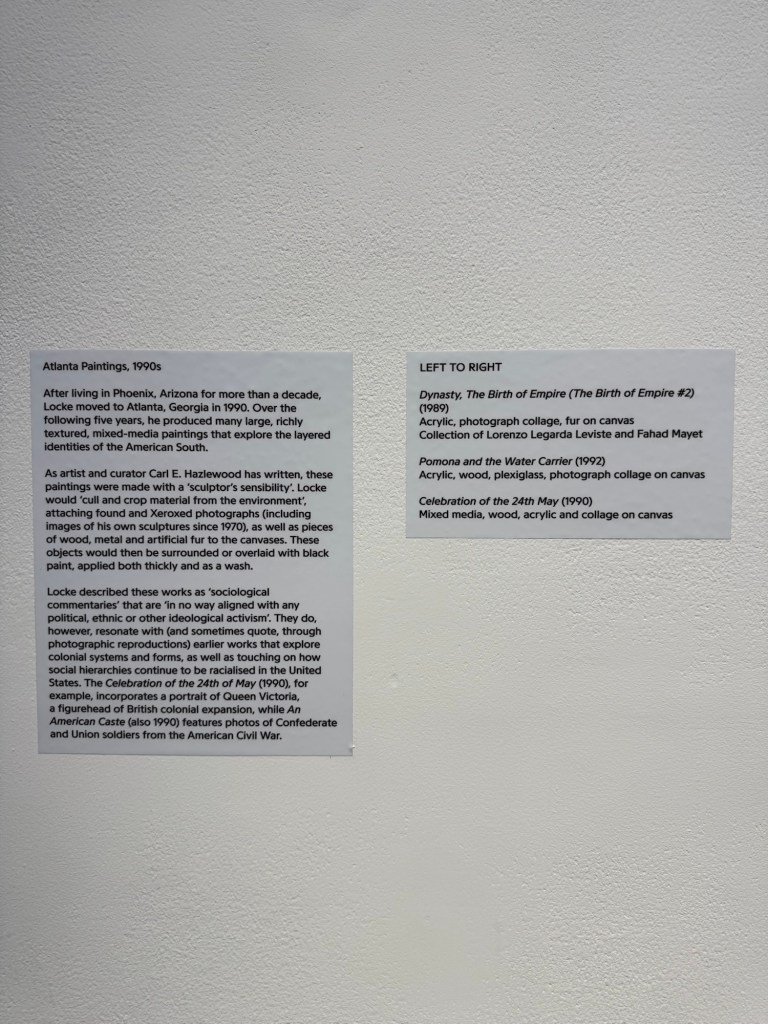
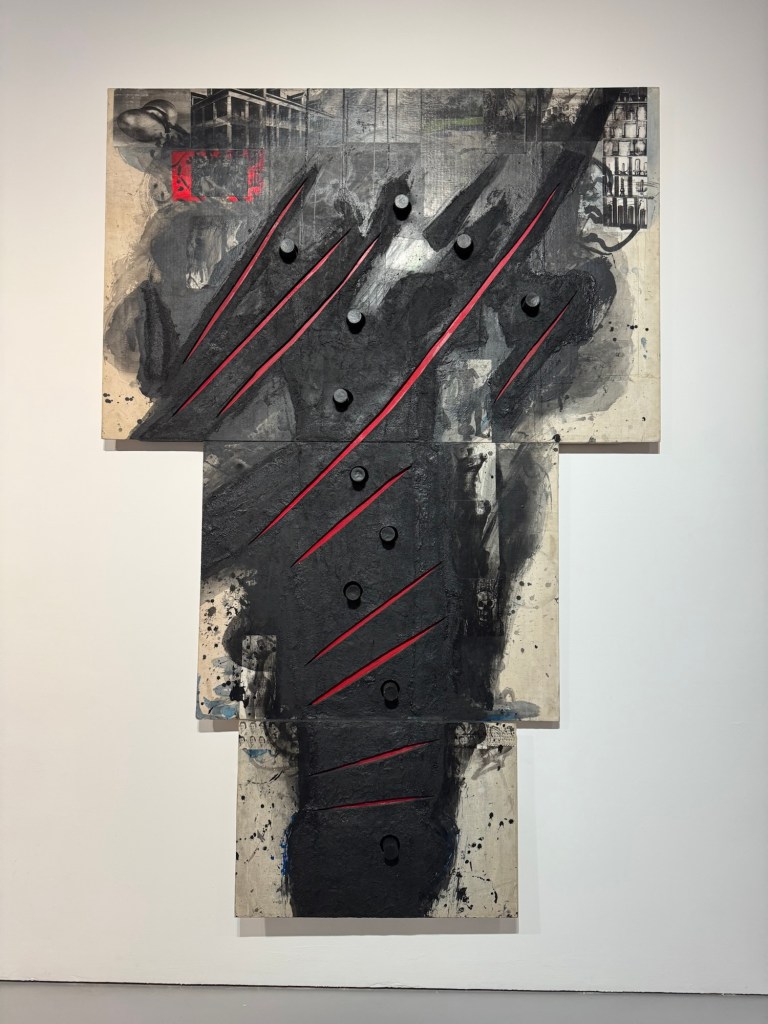
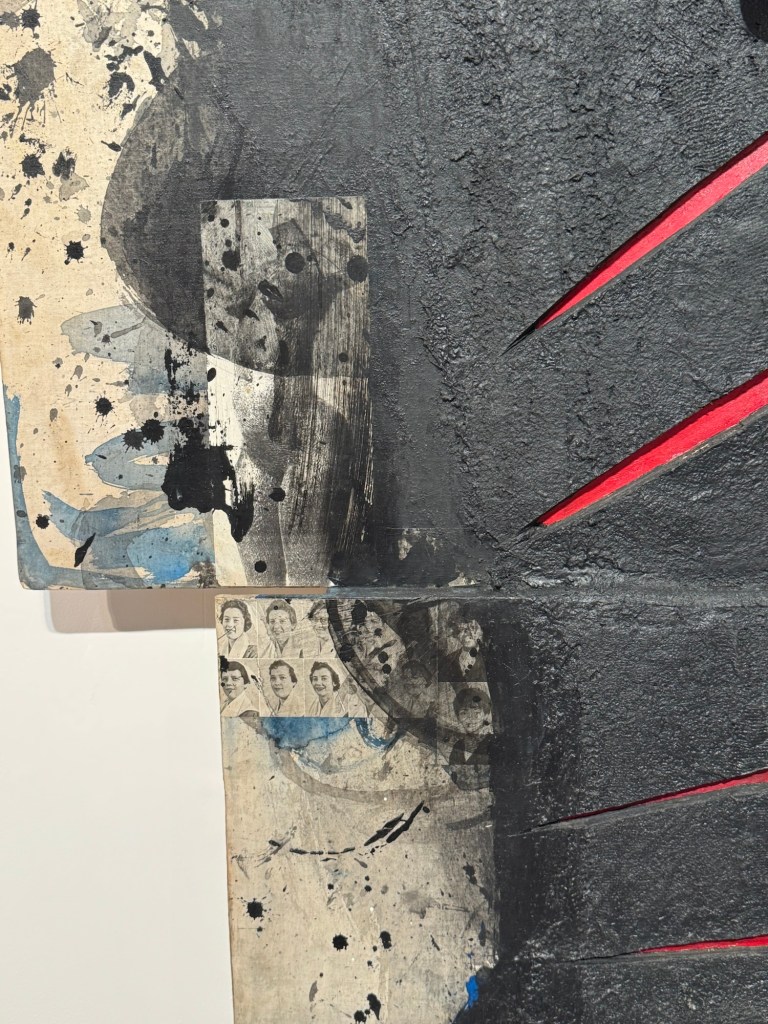
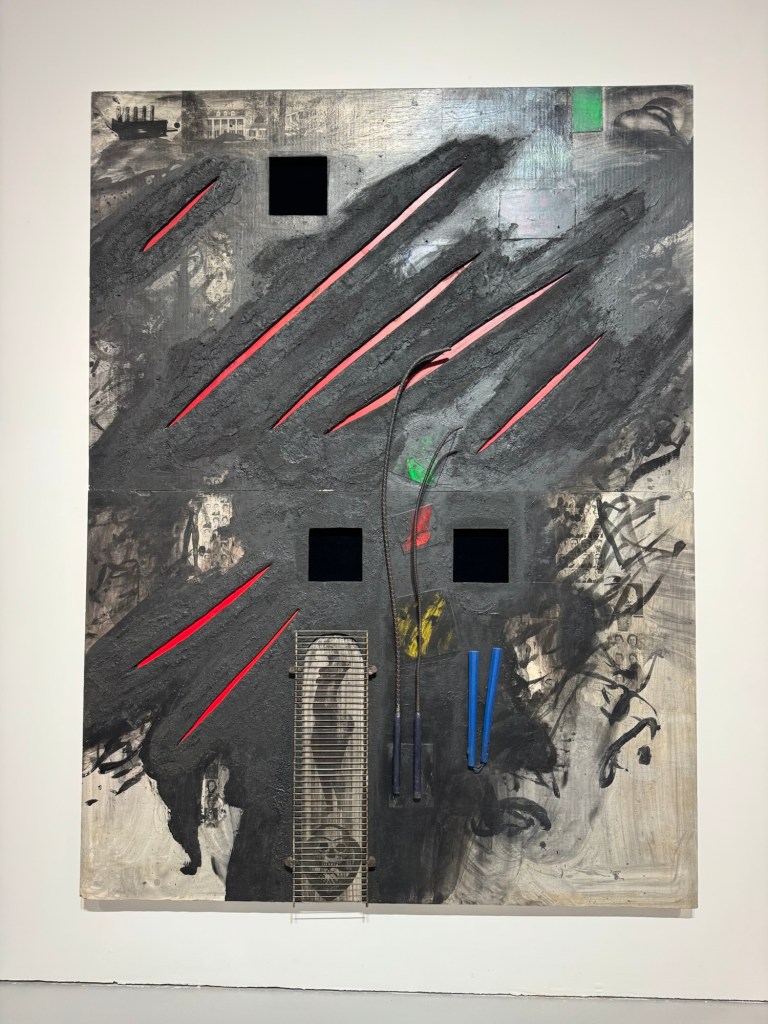
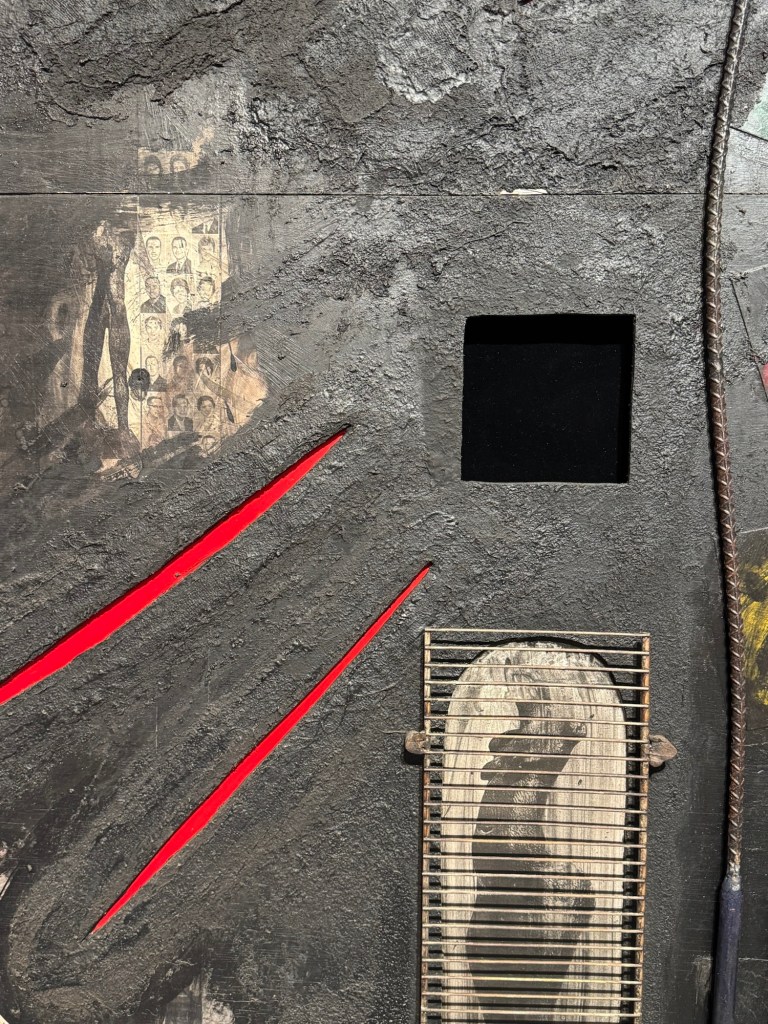
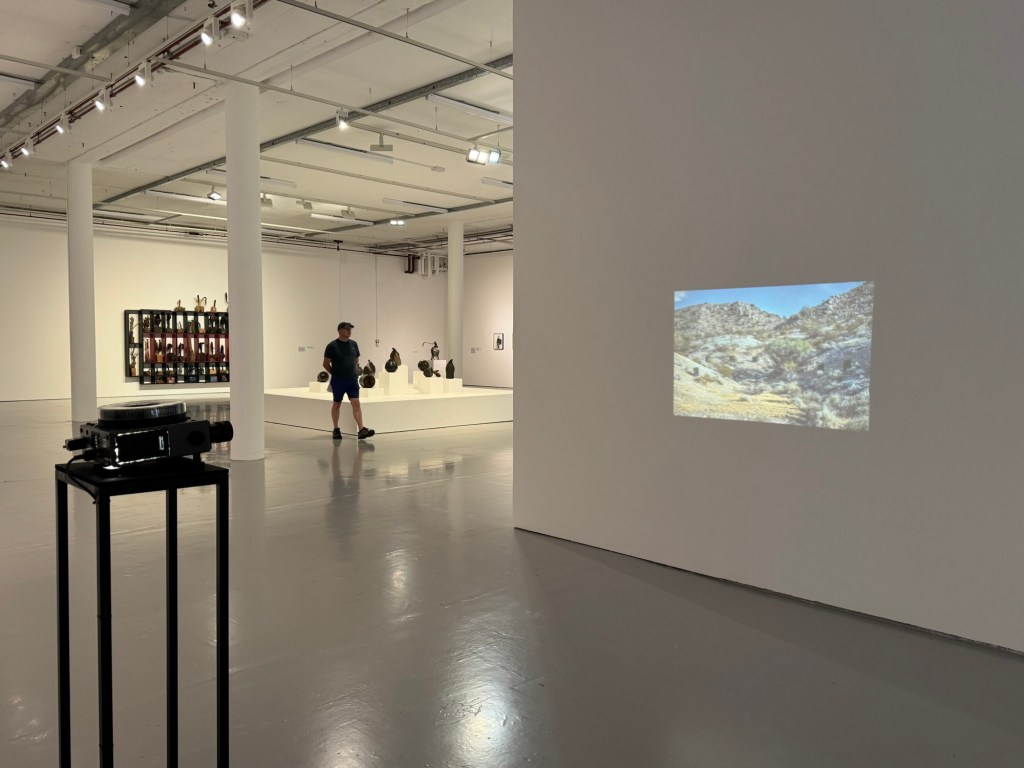
Today I visited Donald Locke’s exhibition Resistant Forms’ at Spike Island Bristol. Below are some of the photos I took to remind me of the work that I found particular resonance with.
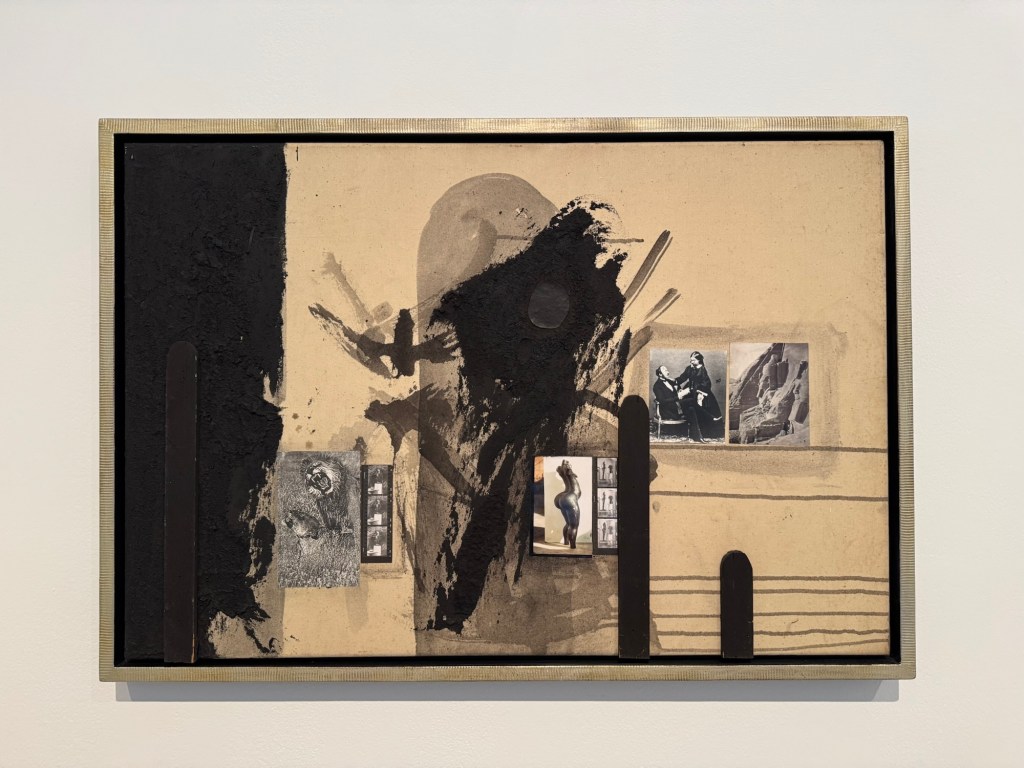
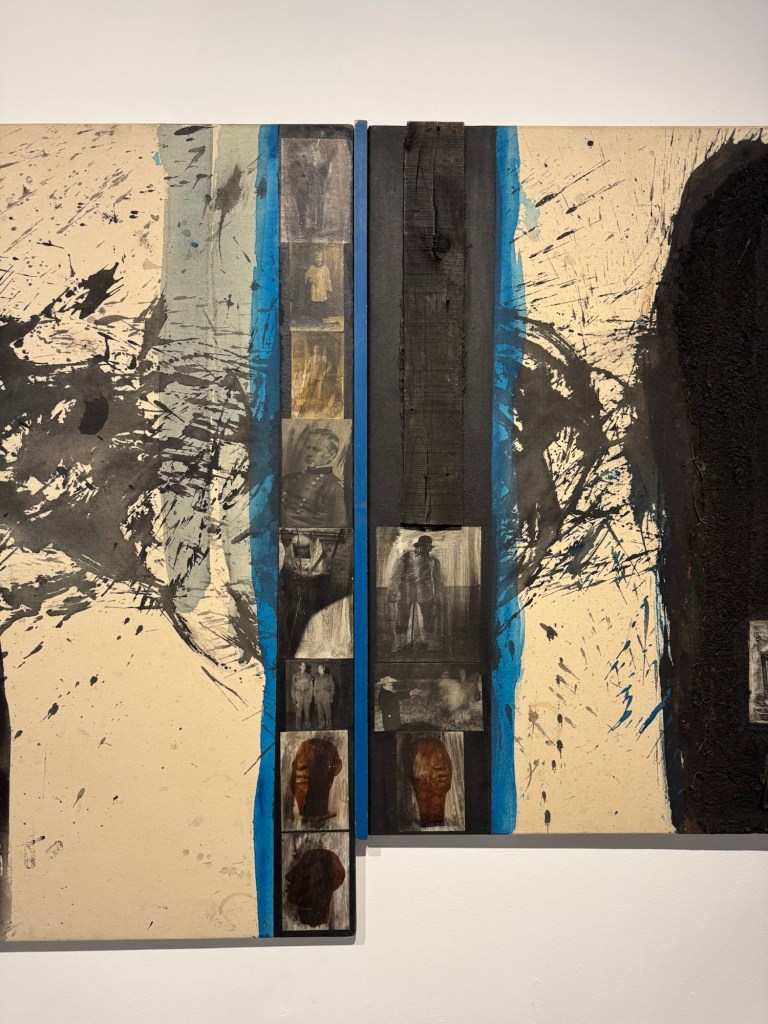
Use of collage, image looks like a crowUse of acrylic in a way that resembles inkAmbiguous use of photosLarge scale paintings with presence and energyClose up of the above showing photos collageUse of mixed media including metal grill mounted onto painting Placement of projector and understated size of projected image
REFLECTIONS
I want to capture ideas that came to me during the visit that made me think about how I could learn from Locke and build on my practice.
Use of mix media techniques:
On some of his paintings, the use of acrylic paint with ‘dry brushing’ to create the flying white effect like in Chinese painting energised the painting. It gave me the idea of trying my crow paintings in other medium, such as dilute oil, to see how that works. The use of different materials to create collage was also interesting. I could use ripped up newspapers to create collage effect on a canvas then paint on top. Locke also used items like metal grills to good effect. I can consider what objects, metal or otherwise, that could be incorporated to add meaning and texture to the work.
Use of photos:
Some old photos were used in the collage. I have many old family photos that I have been considering how to incorporate into my work. The way Locke used the photos were more random – a few here and there. Whereas I have tried too hard in the past; I could just use small images in a few places – I don’t need to tell the whole story in one painting. I must remember this. Also, he had just pasted / stuck the photos (copies of) onto the canvas. I always felt that I should photo-transfer the images onto the canvas – this is not necessary. Locke also used images or photos of his own work (sculptures) in his paintings – those images (e.g. female nude) appeared on multiple paintings and acted as a link to join the works together.
Use of projector understatedly
The projector was projecting at waist height with a not too large image. It was understated and effective. I often feel that projection has to be big and has to fill a wall. It clearly doesn’t have to at all. The projection was also placed in a way that you have to walk through the beam to get past. It was an interesting positioning which makes the viewer interact with it.
LEARNING
There are no major learning from the visit and mainly just ideas that came to me as I studied Locke’s work. The main take away for me was to think about experimenting beyond just painting on the whole piece of newspaper. The news headlines remain important to the body of work (News), but through the use of collages, the newspapers could be incorporated to maintain the theme while opening up the materials that I can use. Locke’s extensive use of black was very effective which resonated with me.
NEXT STEPS
Start to think about how I can start to make more complex and ambitious work with multi media materials yet remaining connected to the topic of News.
After receiving my Unit 3 assessment feedback, I want to reflect on and respond to one of the points raised as I feel it is essential for progressing my current body of work ‘News’.
REFLECTIONS
Below is an extract from my assessment feedback that posed a question about my use of the crow as a metaphor:
‘…You talk about the crows being a metaphor for the awful events that are happening in today’s world but does a metaphor need to be more than that? In a novel or film it might be the timing of a crows arrival and departure in relation to events happening that turns it into a metaphor. Or in a poem it might be a detailed description of a crows behaviour? How might this impact on the way you continue painting crows? In what way, if at all, does the pose of each crow relate to the headlines on the actual page, either the front of the page or the reverse side that might be revealed by a light source behind?‘
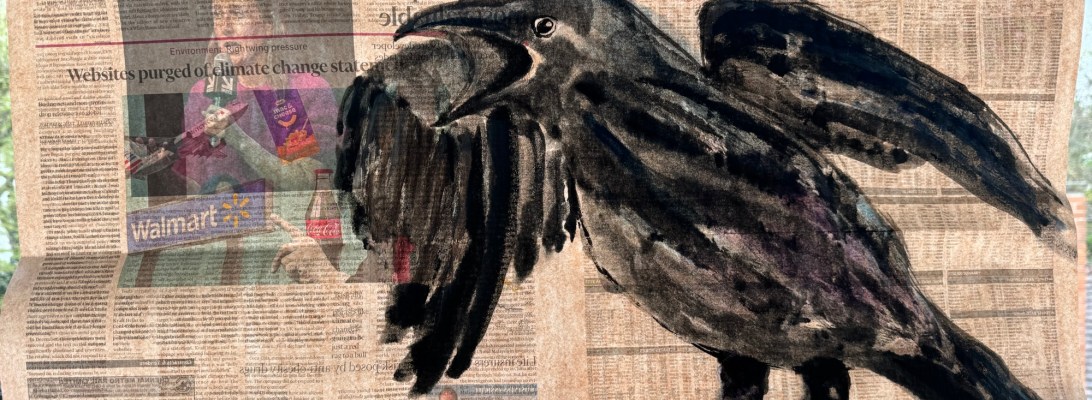
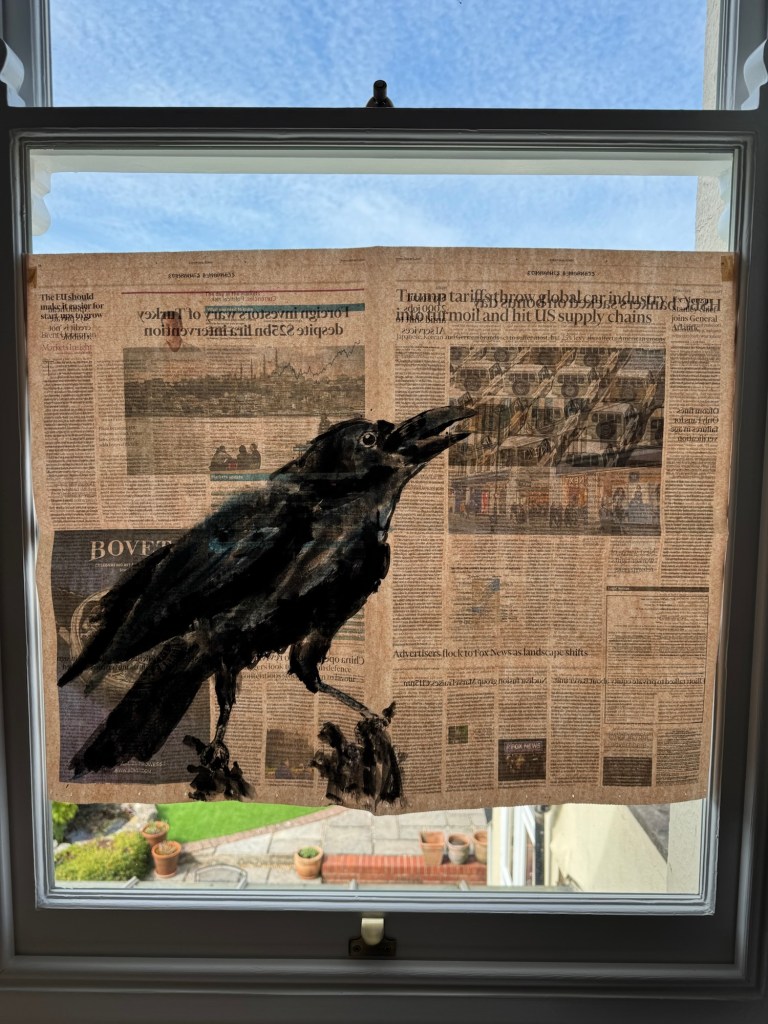
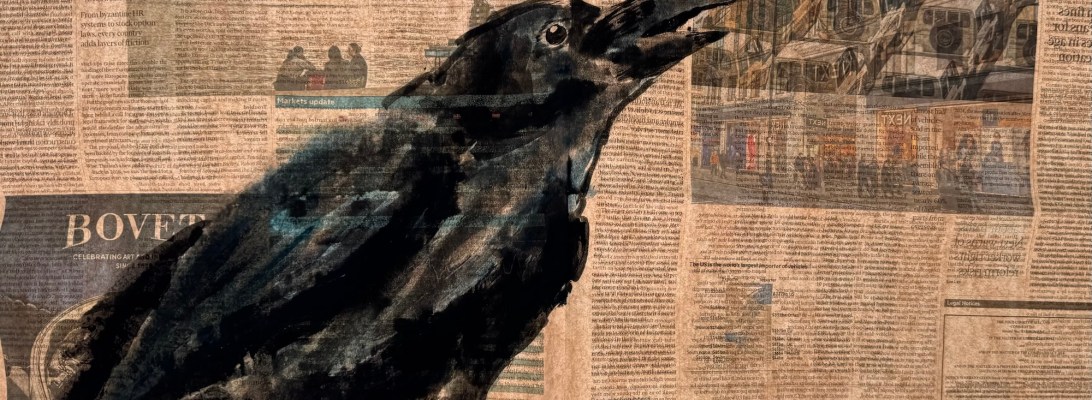
The timing of this question was very appropriate because I have been thinking about this a lot. I chose the crow as a metaphor for my grief for the loss of a world order that I understood. The crow was inspired by the book ‘Grief is the thing with feathers’ by Max Porter. When I started this series of work, I just wanted to paint something as I felt a sense of urgency and the book came to mind with the crow as a metaphor for grief. Hence I started there. The black feathers worked well with my chosen medium of Chinese ink and the characterful crows gave me lots of ideas to work with. I started without thinking too much about the pose or the composition of the pieces, I just wanted to paint and express how I felt. Then I started to locate the bird more purposefully next to headlines or images and experimented with compositions. Now that I have done many such paintings, I started to get an idea of what I wanted to achieve with this body of work and with the crow.
I want to use the crows to bring attention to certain news headlines. I noticed that when people look at my News paintings, they usually start with the crow. They would study it for a while, then their eyes would wander around the news headlines or images nearby and then focus on the articles. It was important for me to choose a neutral or as unbiased as possible a newspaper because I don’t want to tell or preach to the viewer what they should think about the news piece; I want the viewers to decide for themselves and to show a factual headline or news article to trigger their thinking is my intention.
Reflecting on the questions posed in my feedback, I believe my use of the crow has several roles. Like in the novel I referred to, the crow as a metaphor revealed itself to me when I started to despair about situations in the world – that was when the crow ‘entered stage’ as in a theatre. In the last few weeks, there were times when I felt perhaps it was time to move on from the crow as perhaps world events were settling down. That feeling lasted at most a day when something else happened that enrages me again and I had to bring the crow back to centre-stage. There seems to be an endless supply of headlines at the moment which is energising for my art but absolutely draining for me as a human.
As for the point about the pose of the crow, it has been an interesting development and revelation for me. I remember when I first started studying art, a tutor at the time said that how we felt would inevitably come through to our work; our work was influenced by our subconscious. I didn’t quite believe that at the time but was happy to keep an open mind. Of course, I have since experienced that many times. There have been a few News paintings where some unconscious expressions came through that I only noticed afterwards. Below are two examples.
Example 1 –
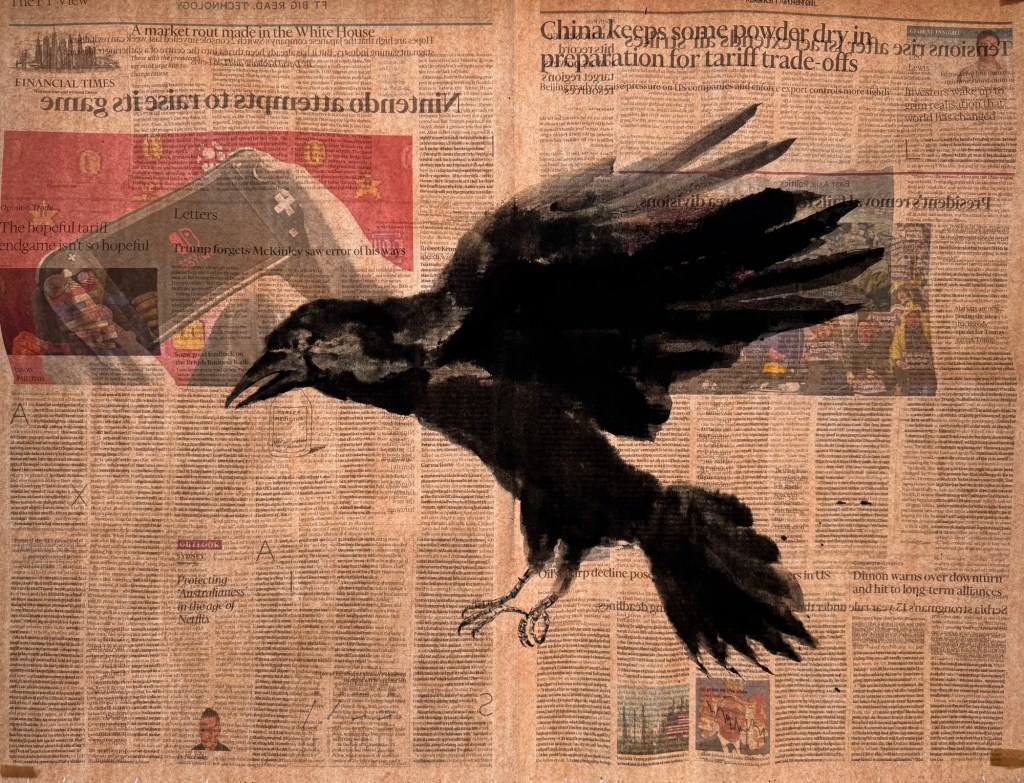
In the painting below, I wanted to position the crow to look like it was going for the bottle of ‘tariff medicine’. But since I do not do a mark up drawing on the page (not anymore) and I just leave the painting to chance, I do not have control of exactly what comes out especially as I’m painting with my non-dominant hand. In this case, the crow ended up overshooting the medicine bottle and it ended with an ‘uh-oh’ or ‘oh no…’ expression which was not my intention but highly appropriate.
–
Example 2 –
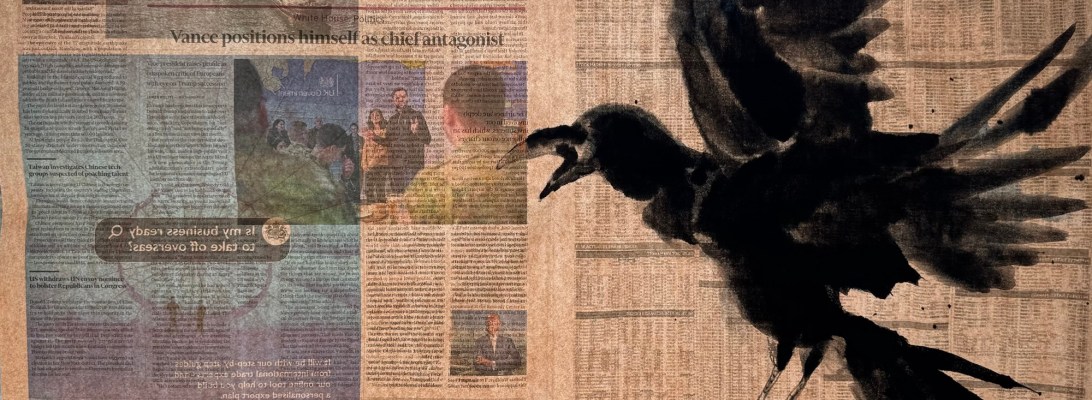
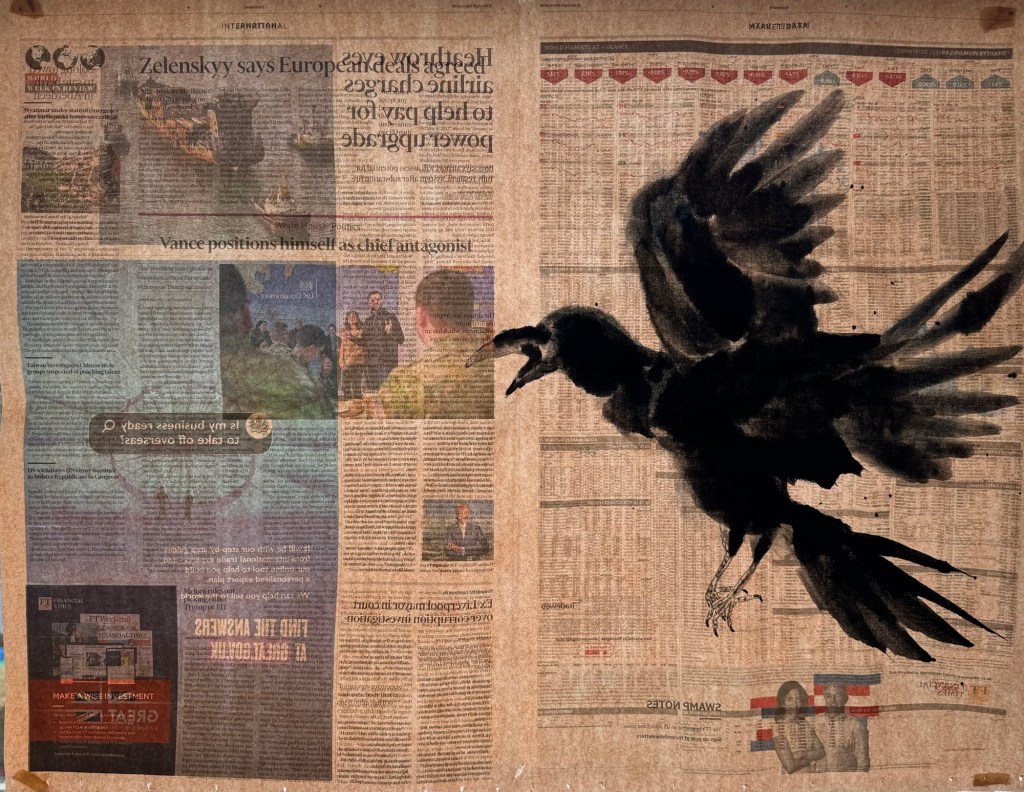
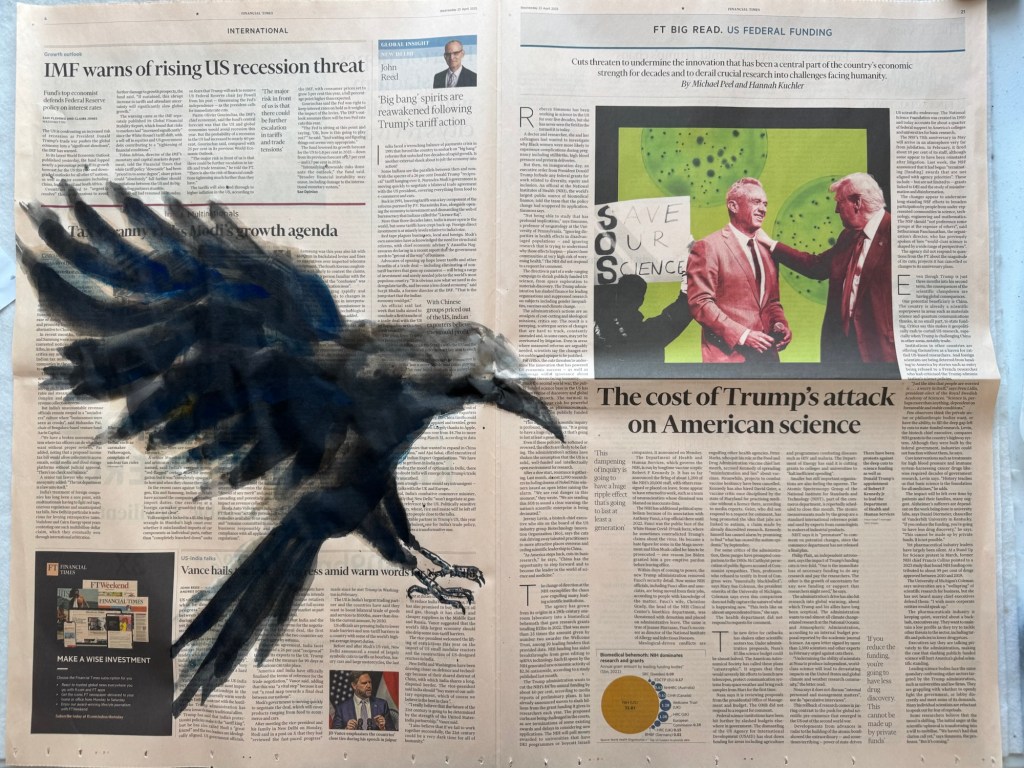
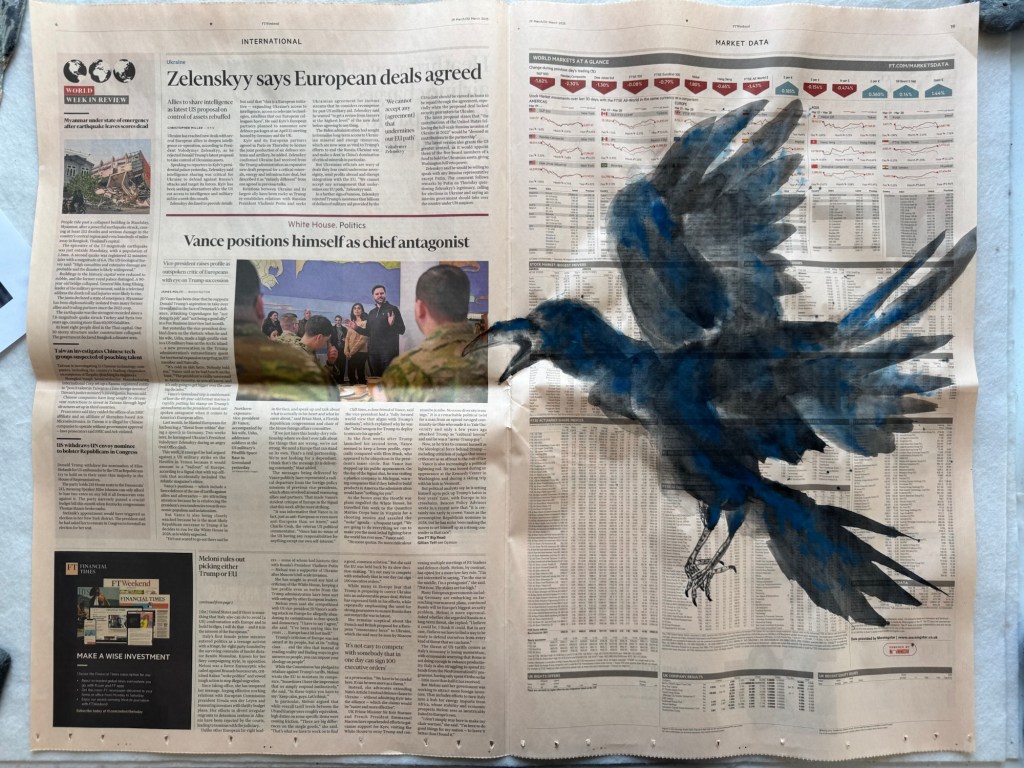
In this case, the chosen headline and image on the newspaper was about the US VP. I intended to bring in the crow from the right hand side (enter stage right) pointing towards the photo image. Again, I didn’t have too much control over the exact depiction but the crow came out screaming at the photo and its feathers somewhat ruffled. It seems to reflect what goes on in my consciousness.
–
As for the back lighting of the images and what they reveal – I tried at one point to place the bird purposely to align with images on the reverse side, but they rarely work out satisfactorily. So now I choose a newspaper page where there are headlines that I want to respond to on the front and although I do look at the reverse side to make sure there is something interesting on the back, I tend to locate the bird according to the front page and then leave the reverse side to chance. This means I don’t pose the bird according to the reverse image purposely and just wait to see what happens when the painting is finished. By not being overly deliberate, it has provided some interesting compositions. It also contributes to the notion of uncertainty that continues to form a large part of this body of work.
Final reflections regarding using the crow as a metaphor… as I was writing this blog, I have started to use theatre stage language to describe how I use the crow and I feel that is appropriate. The crow has become my actor on stage to carry a message, it has been on stage throughout this series of work. It comes in and out of the spot light depending on what it wants to draw attention to. It accompanies me as I navigate the ‘new world order’ and represents me when I want to say something. One day, when the world is right again (I remain hopeful) then perhaps Crow would exit stage left. I have started exploring bringing in other creatures to broaden the repertoire. I have enjoyed using the Chinese ink as a medium and I have thought about using a rat but that seems to be very controversial. I have also thought about spiders because I was inspired by Louise Bourgeois’ spiders and how she used them to signify strength. I certainly feel that I need as much strength as I can summon up everyday just to read the horrendous news at the moment. This idea is only at an early stage. I will keep thinking.
LEARNING
In writing my reflections and response to the Unit 3 feedback, it has helped me to crystallise my reasons for using the crow in my work – why I use it and how I use it. I feel there is still much to achieve with my crow and there is still some way to go on this journey. So I will continue with it but will be more mindful of how and why I’m using the crow as a metaphor as I progress. I sense that the metaphor has already shifted somewhat and has gone beyond just grief. It is becoming my voice which is also an appropriate metaphor because the crow is intelligent (can read my mind) and vocal (speak for me). Also, in many cultures and mythologies, crows and ravens are depicted as messengers, not necessarily from another world, but rather from between different realms of existence. So using the crow as my messenger has become part of the metaphor.
I will continue to explore other creatures that has a metaphorical meaning for me and that works well with my chosen media of Chinese ink on newspaper. Spiders are one possibility that I am considering.
NEXT STEPS
Continue to use the crow in this series of work, News.
Consider more deeply about the metaphors that I use – how they apply as a metaphor and how they evolve along the journey.
Explore other creatures or metaphors to bring into the work. Be sensitive to what they mean and think broadly to avoid unintentionally offending people.
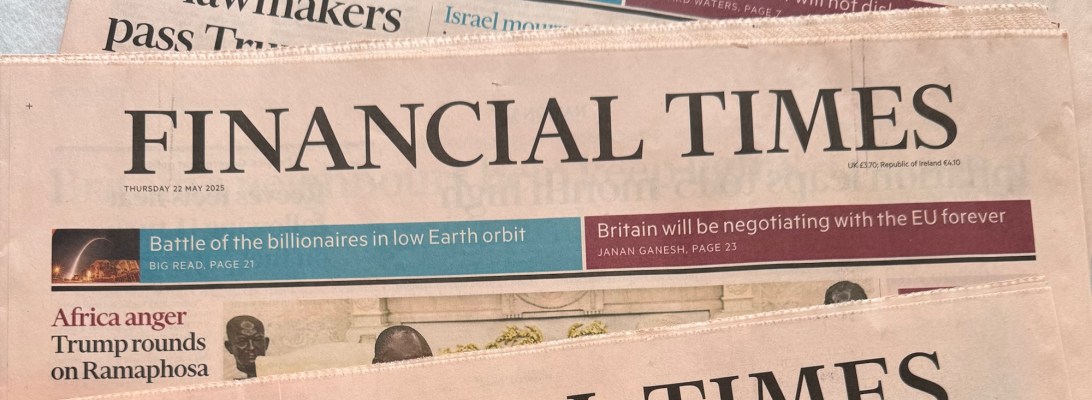
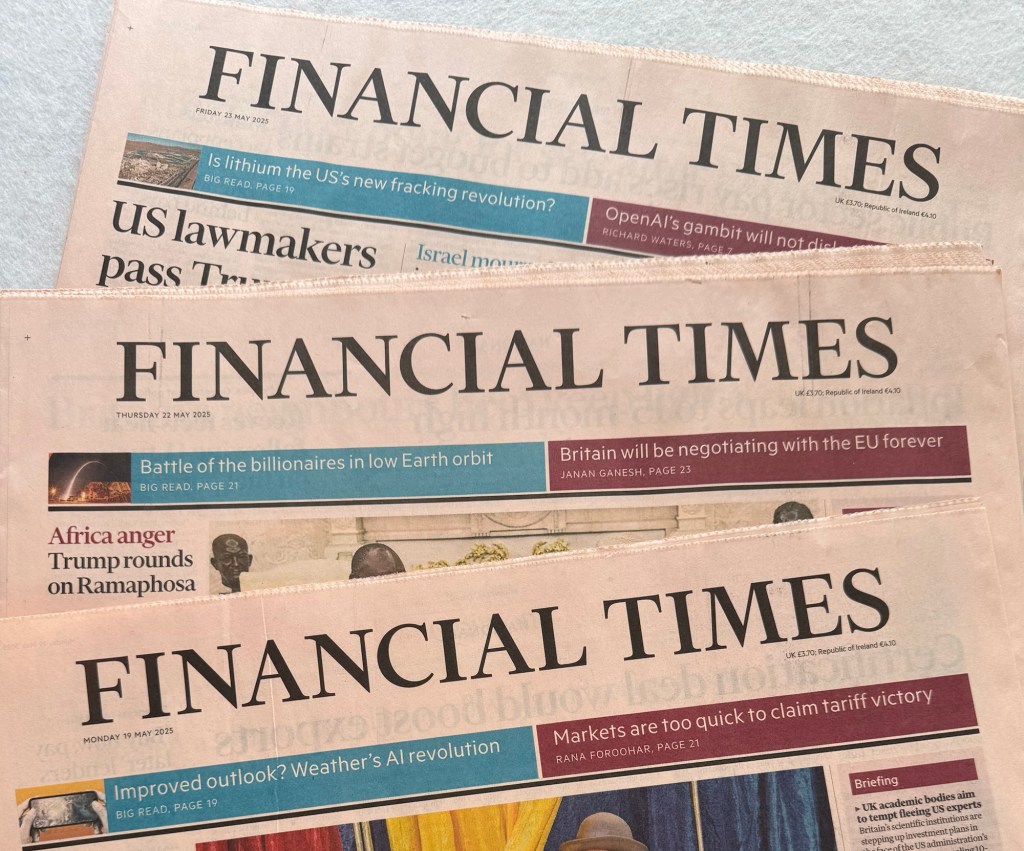
One of the key learning from my MA is to think carefully about our choice of materials and the content of our work. Especially if it is to be exhibited in public. We need to be sensitive to the audience and have reasons for the choices that we have made in our making. When I first started thinking about making work on newspapers, an important decision was which newspaper or newspapers to use. I have become very disillusioned with the news media in recent years so it was hard to choose. I have had a long relationship with The Financial Times (FT) because I always felt it was more balanced and factual than most media channels – it’s one of a few newspapers that I could bear to buy or read. I used to use The FT a lot for work when compiling economic reports about the UK for international meetings. I was happy to stand by its facts and figures as they were considered credible. I am increasingly tired of unsubstantiated claims by news media as well as those in public life, hence I crave a news channel that I feel I can trust. I wanted a non-controversial newspaper as I don’t want the choice of newspaper to dominate the conversation rather than the art.
Also, the salmon colour of the paper works very well with the Chinese black ink. I believe aesthetically it works better than the usual white newsprint paper. Hence I started to paint on The FT.
Now that the ‘News’ body of work is growing and I am committed to using The FT so much so that I have purchased a print-subscription, I feel I should do some more background research to ensure I have chosen the correct newspaper.
METHOD
I have become very aware that I should have a reason to choose certain materials in my making. Since the choice of newspaper is such a key part of this body of work, I feel I should retrospectively verify that my instinctive choice of The FT was correct.
I should start by considering what I would want from the newspaper in this body of art work:
– Trusted: My aim is to express my grief for the lost world order in recent months and to share the grief of those close to me whose lives have been deeply affected. I do not intend to be overtly political – my art is not a political campaign in an activism-way. I want to look for news headlines that are to do with this topic and bring attention to them but I will leave the viewers to decide for themselves how they feel about it. To do this, I need news headlines and articles that I can trust to be as factual as possible as I just want to present facts and figures. I am not planning to influence the viewers’ judgement. That means quality journalism with substantiated facts. I cannot fact-check every article, so I need a journal that I can trust in general. I don’t want to be anyone else’s mouthpiece.
– Uncontroversial / unbiased: I am despaired by the political polarisation that exists in our society and I do not want to contribute to that as it is not the aim of this body of work. Therefore, I want to choose a newspaper that is not too controversial, perhaps as politically-central and unbiased as possible accepting that it is not possible to be 100% unbiased when a newspaper has contributions from many people. The aim of the art work is to share what has caused my grief. If the newspaper has to have a leaning then a liberal leaning would be preferred especially regarding the topics in question.
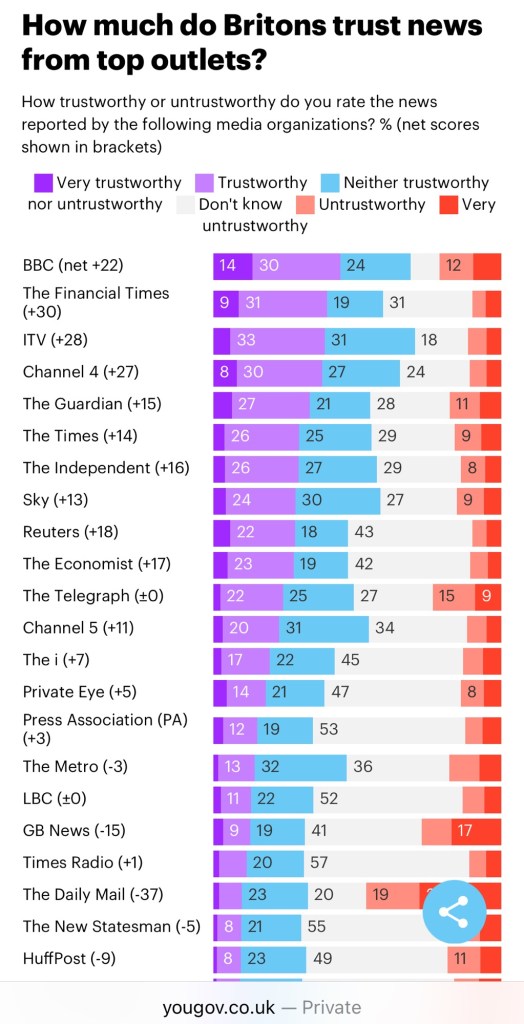
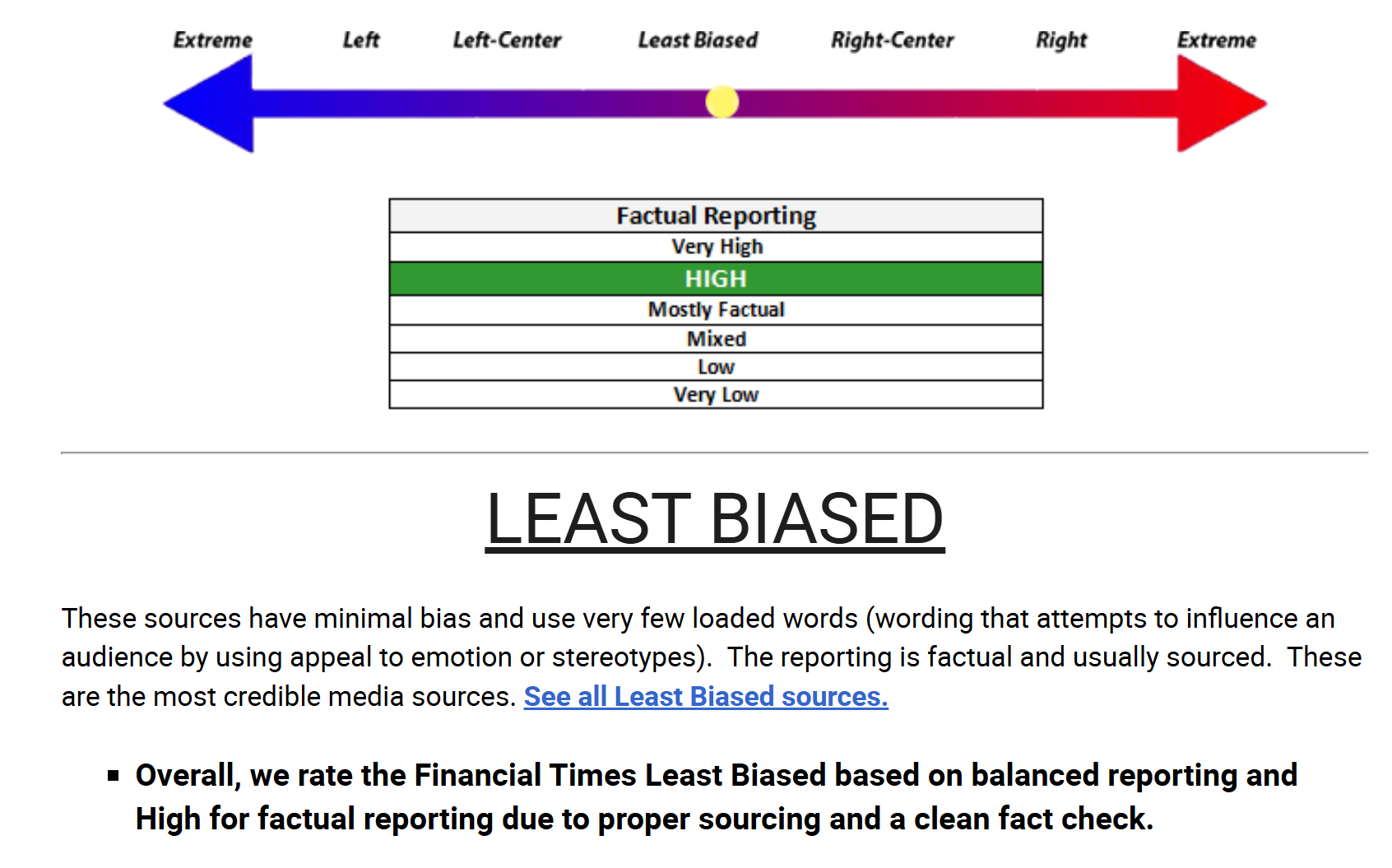
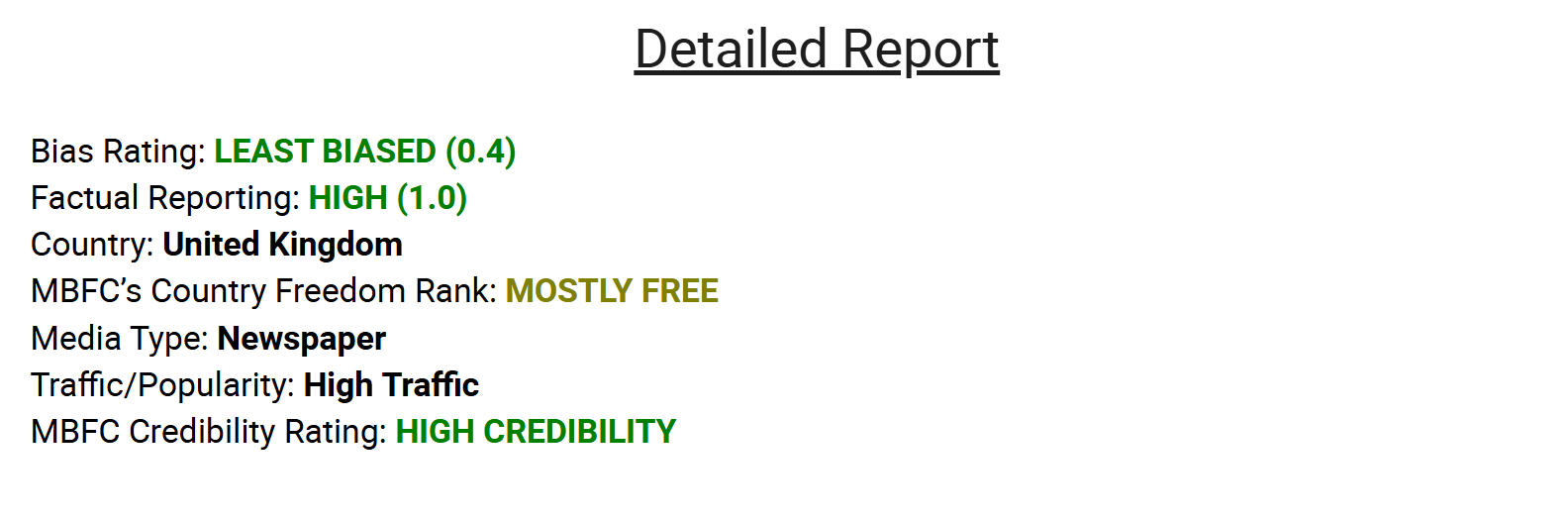
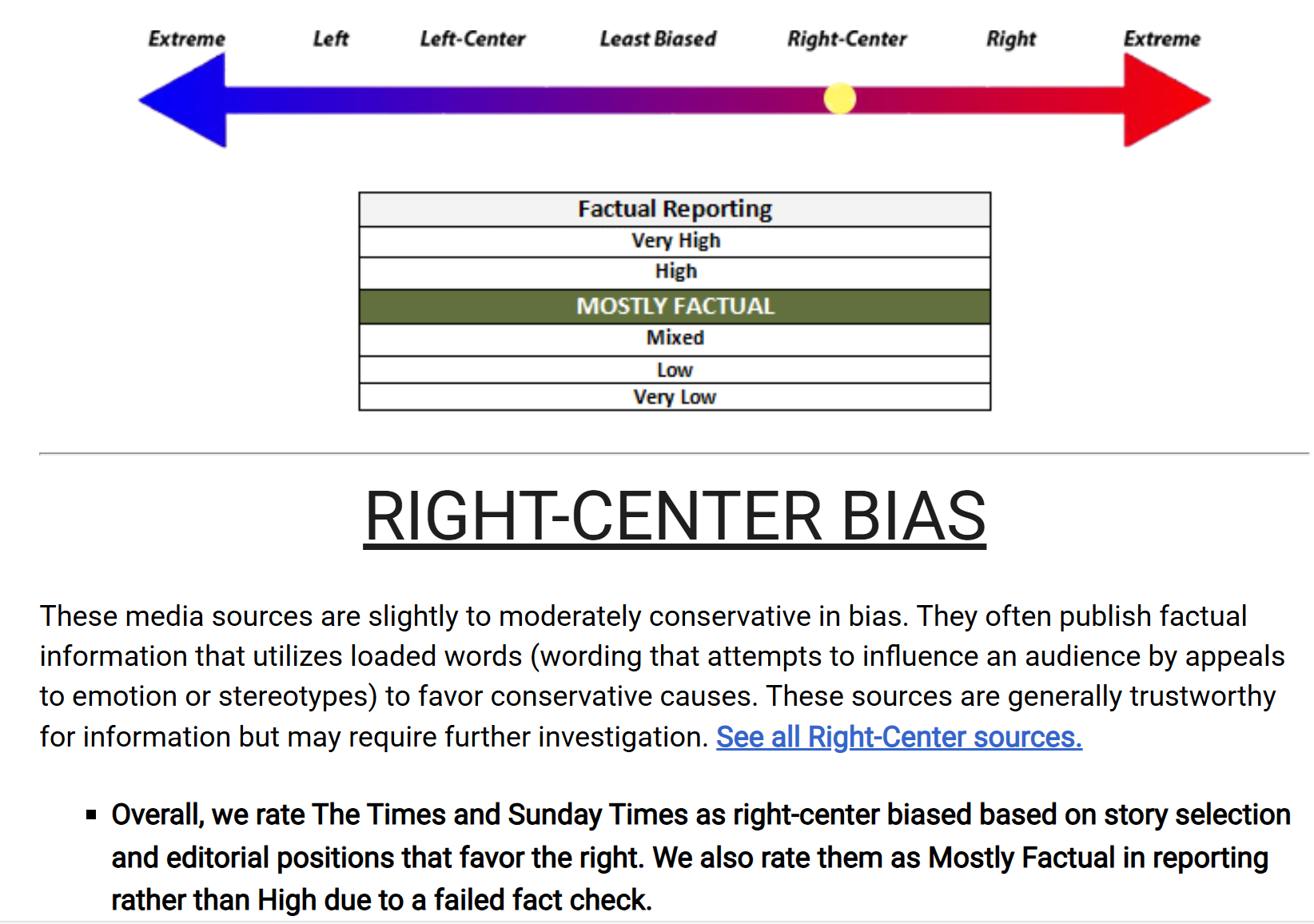
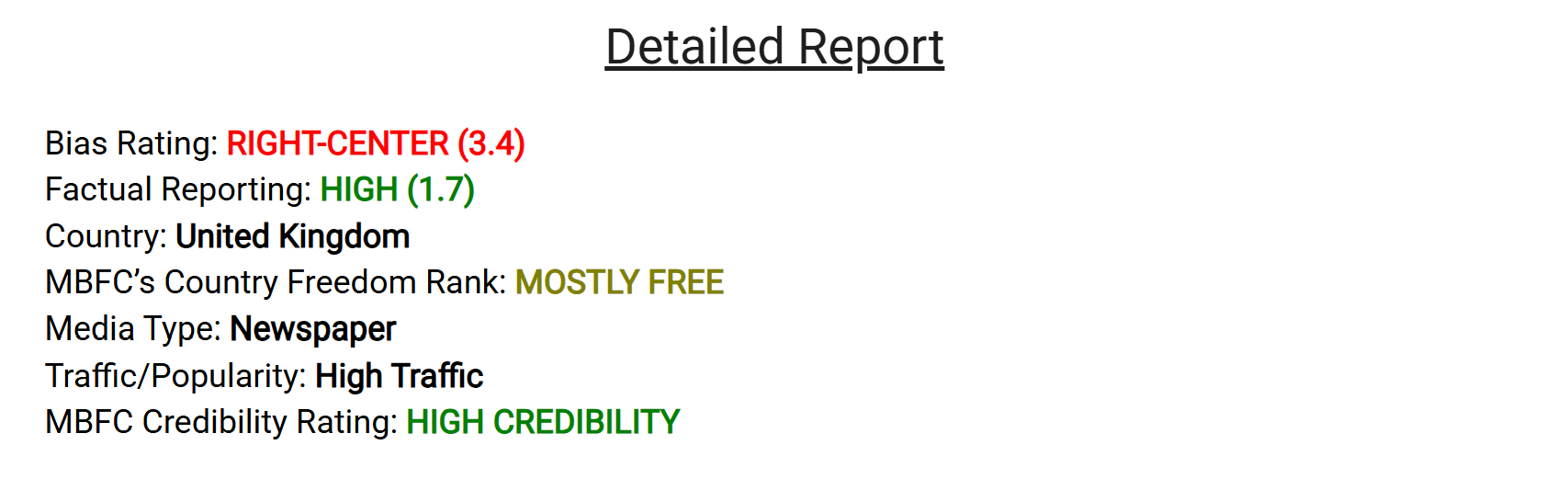
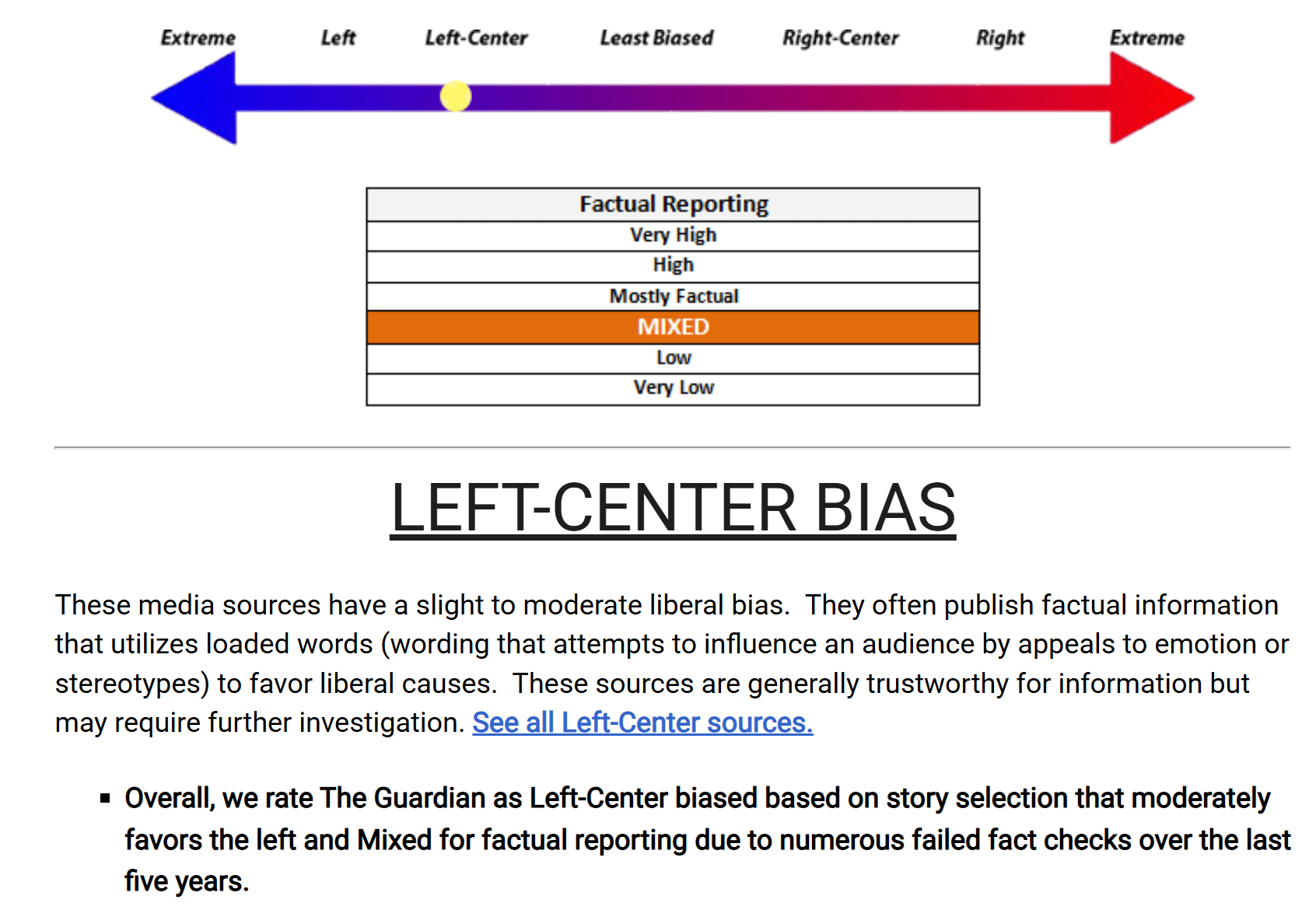
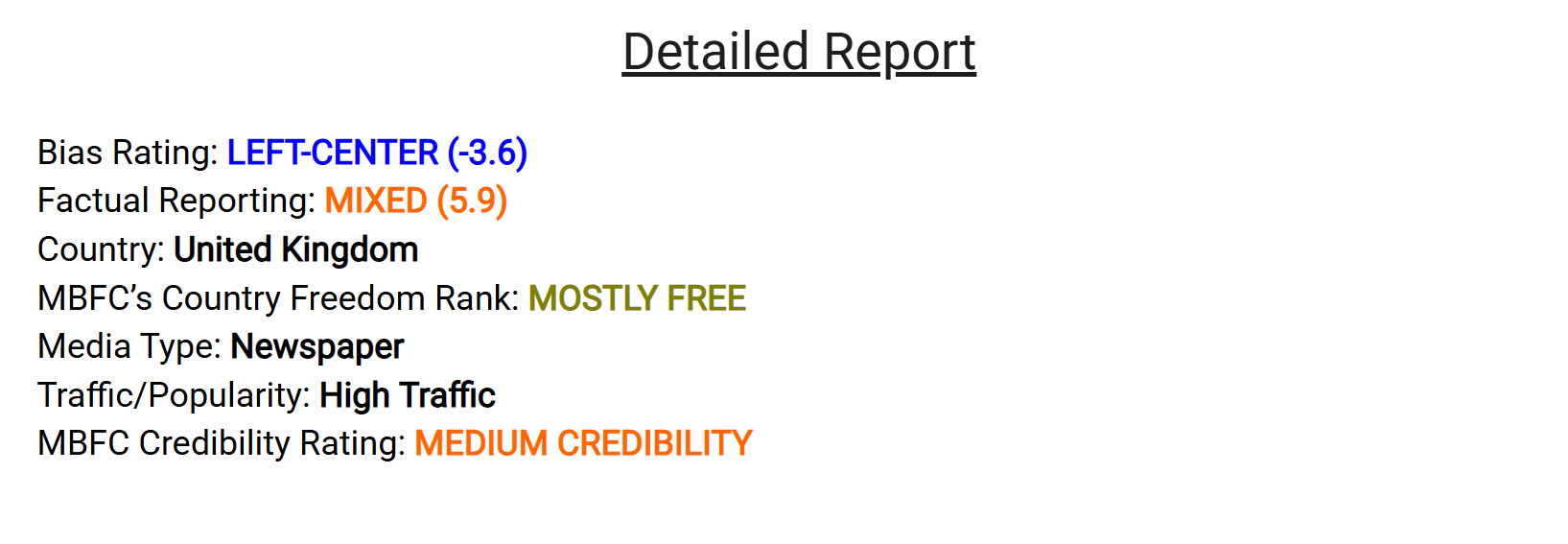
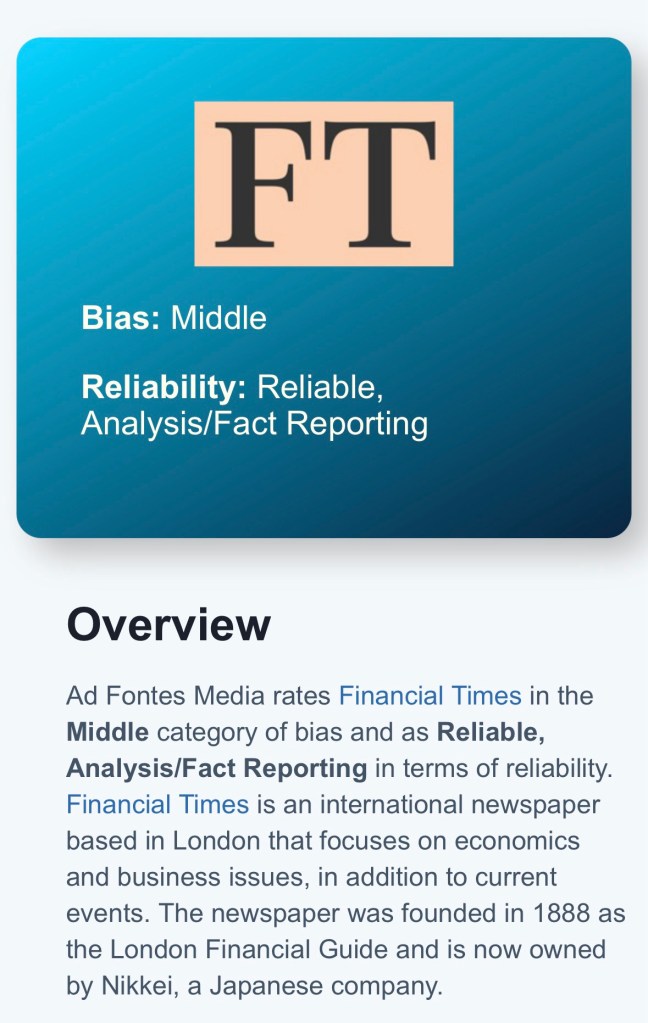
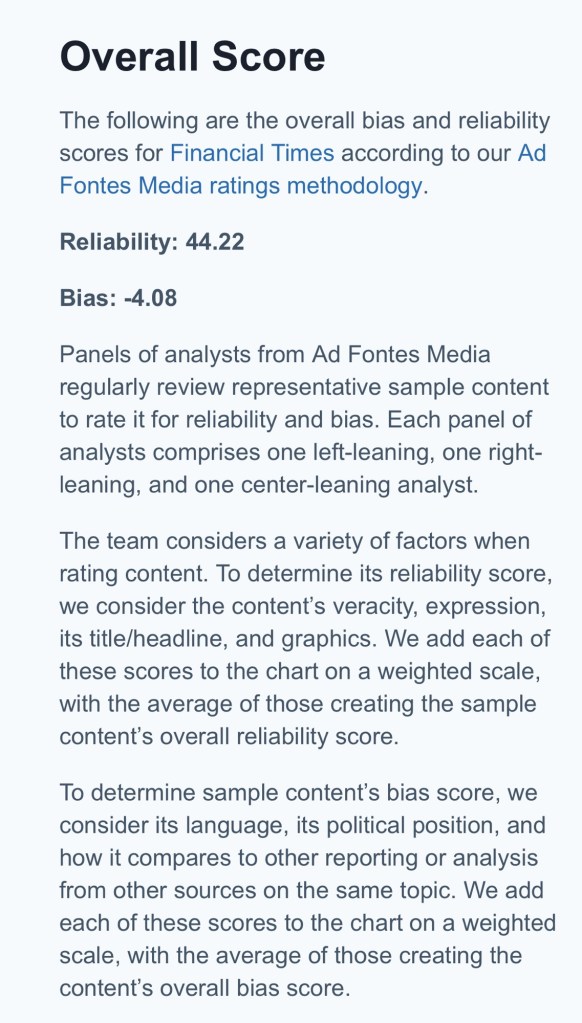
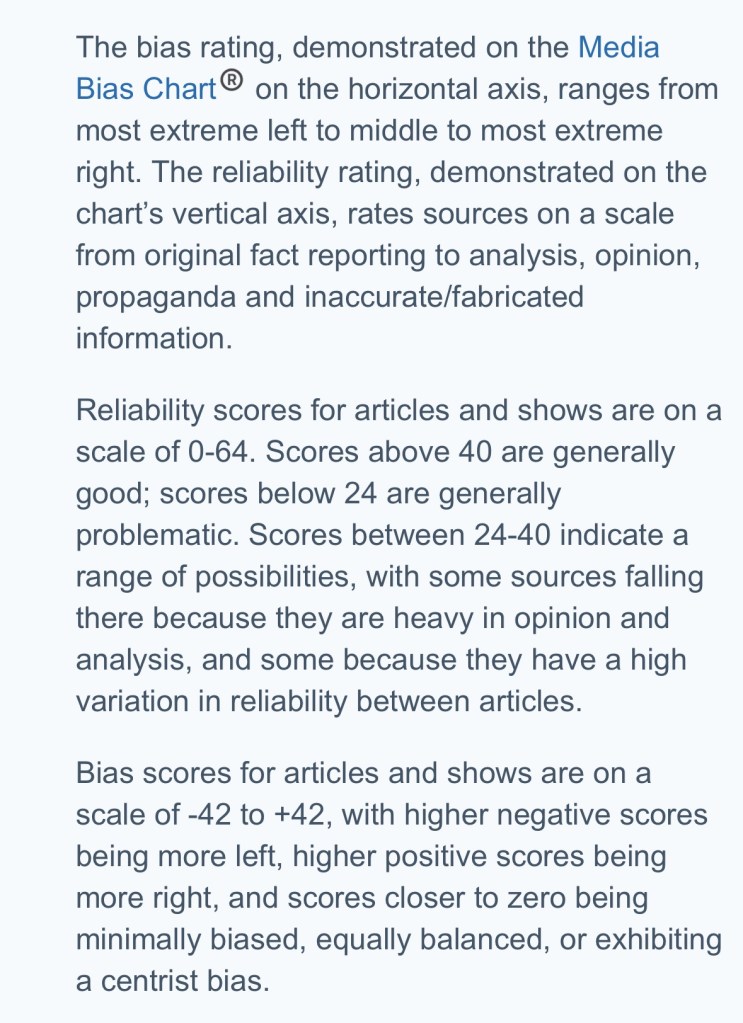
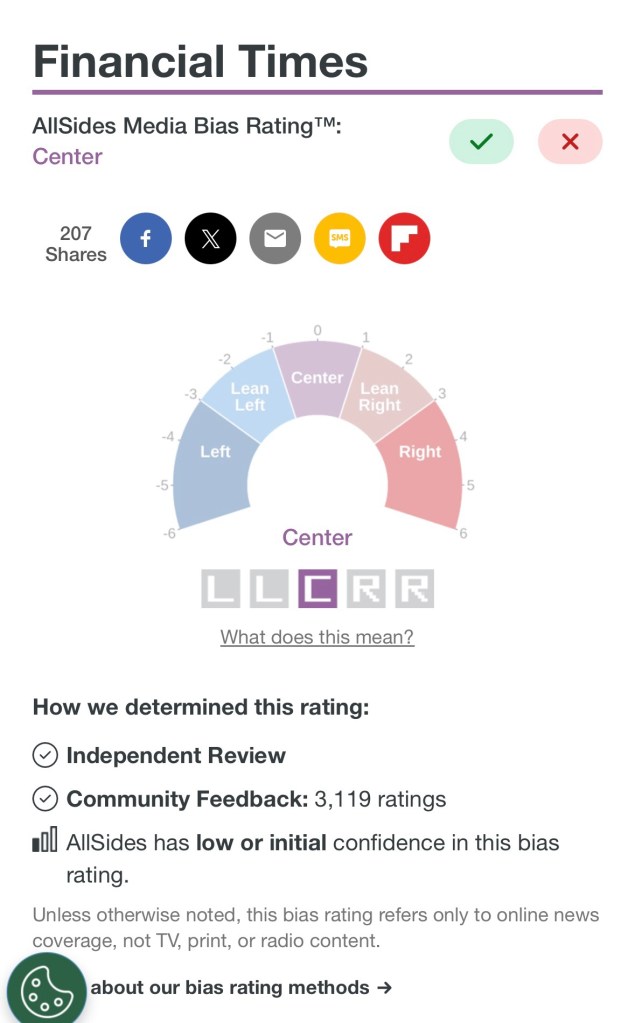
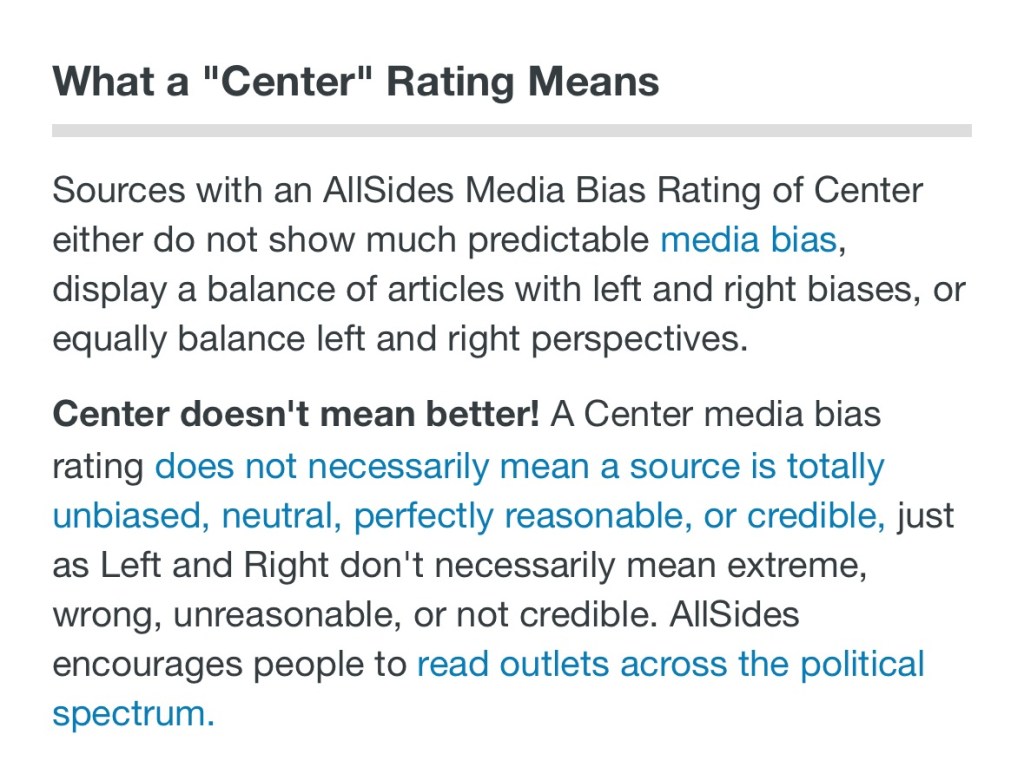
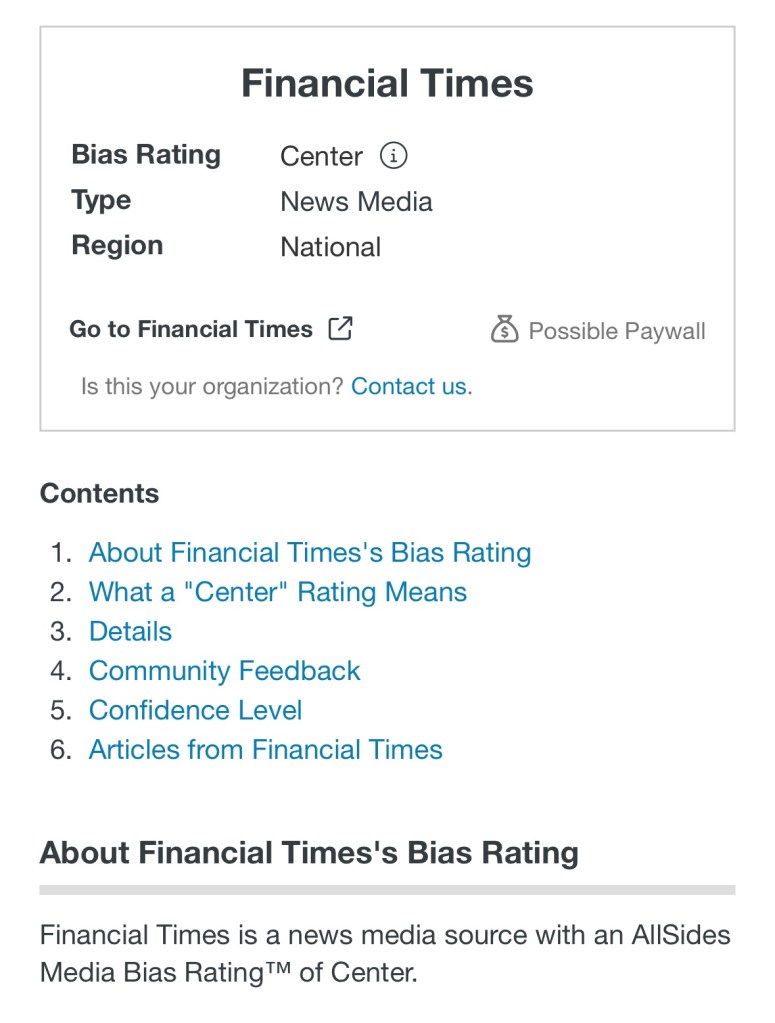
To start my research, I did several Google searches – for the most trusted and unbiased news media channel in the UK. Below are screen captures of some of my findings.
There are additional supplementary reports on The FT that largely reflect this finding and they are shown at the end of the blog.
From this quick online research, the findings showed that The FT was found to be the most trusted and unbiased UK newspaper relative to other newspapers (relative position as derived from the YouGov poll) with a central position politically.
REFLECTIONS
This research was done as a sense-check to ensure I have chosen the correct newspaper for the purpose of my art work – I believe I have because The FT findings showed that it addresses my requirements for a newspaper for this body of work.
However, as one of the reports said ‘central does not mean it is good’ and I feel that is an important point. It is not my intention to make this body of work overtly political, hence requiring a centrally positioned newspaper with a balanced view. One could argue that could contemporary art be truly central? I think my position on that point is that I am not ready to pick a political fight with the world – yet. I want to find my way into this part of the art world in a way that I feel I can manage especially given a lot of my ‘News’ art has been about my emotions and grieving – I need to process and make sense of that first. I am not ready for political debates. Hence remaining central is a stance that I want to adopt – for now. The most important thing is the trustworthiness and unbiased reporting of the newspaper which I believe I have with The FT.
Also, it is salmon colour. So I am relieved with my findings and satisfied with my choice. I will continue to use The FT whilst continuing to monitor its credibility.
LEARNING
I am glad I carried out the research. I believe that if I am going to show my art in a public place (Degree Show), I need to be doubly careful about the content and my reasons for choosing the materials. So this research has partly been to prepare me for the Show as I anticipate someone would ask me ‘Why The FT?’.
The main learning here is that researching all aspects of the materials used is essential. Especially when the subject matter could be sensitive, political or emotionally-triggering in any way. If I want to take my art practice onto addressing societal issues as I do, then I need to be more careful, considered, informed and mindful in these respects. I don’t want to rush into something that I am not ready to handle or my credibility as an artist could be called into question. Hence research and preparation is important. This is a key learning for me.
NEXT STEPS
– Continue to use The FT for my News art.
– Carefully consider all aspects of the materials I choose for my work and be thorough especially with exhibited work.
–
ADDITIONAL RESEARCH RESULTS
Below are additional reports found online on The FT.
Since my recent re-evaluation of my art practice to enable me to respond to what has been happening in the world, I have been making a new body of work – ‘News’. I feel the urge to show my new work at my MA Degree Show. This blog is about the development of ideas and a plan for the Degree Show.
METHOD
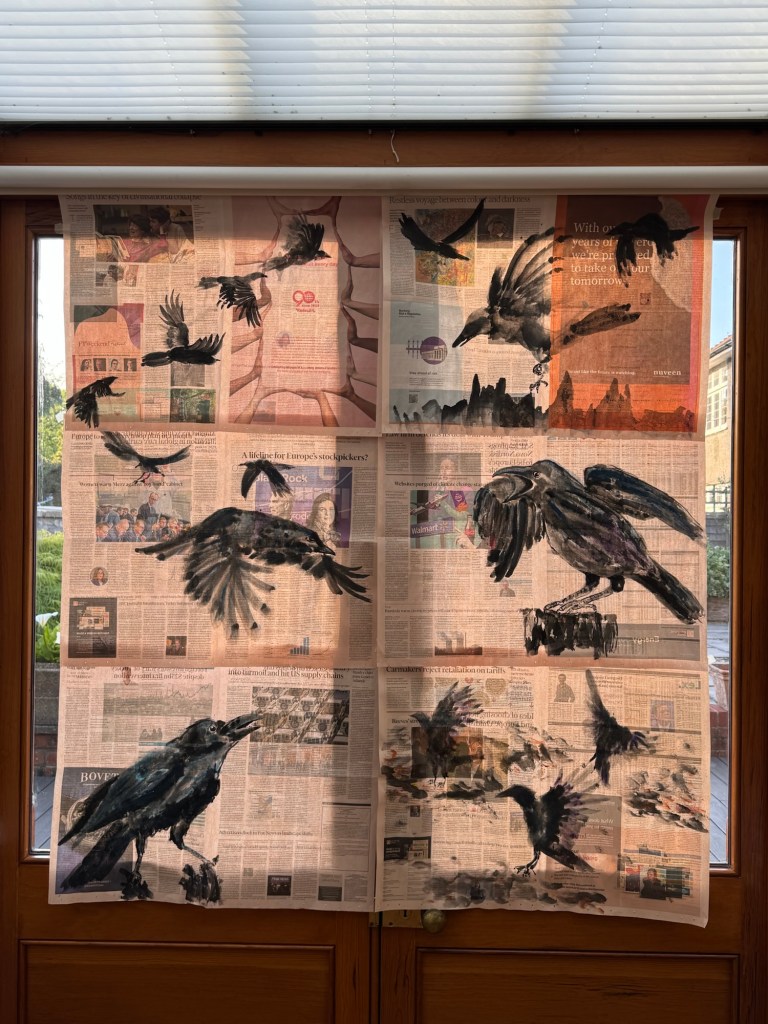
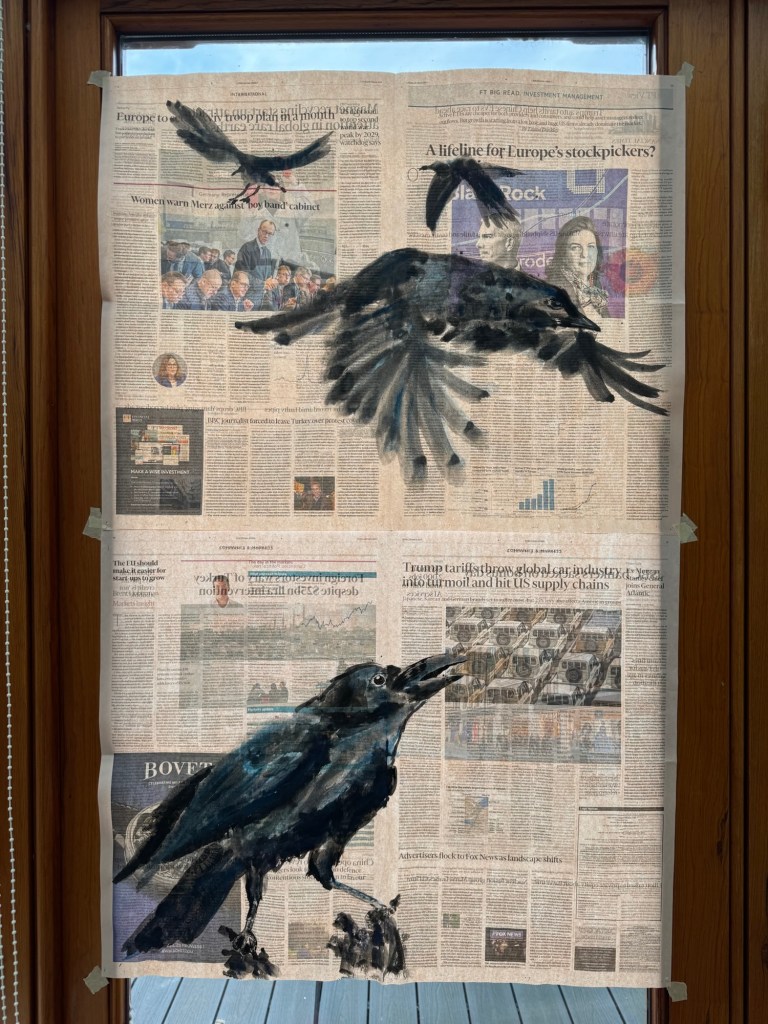
Firstly, I wanted to explore if combining multiple sheets of ‘News’ would make a good composition. Since each sheet was made as an independent painting, I needed to see if they would ‘make sense’ together. So I stuck together a few paintings and put them up against two glass doors to see how I felt. I was encouraged by what I saw and felt there was potential in the concept. I then proceeded to design the installation – how should the paintings be presented?
–
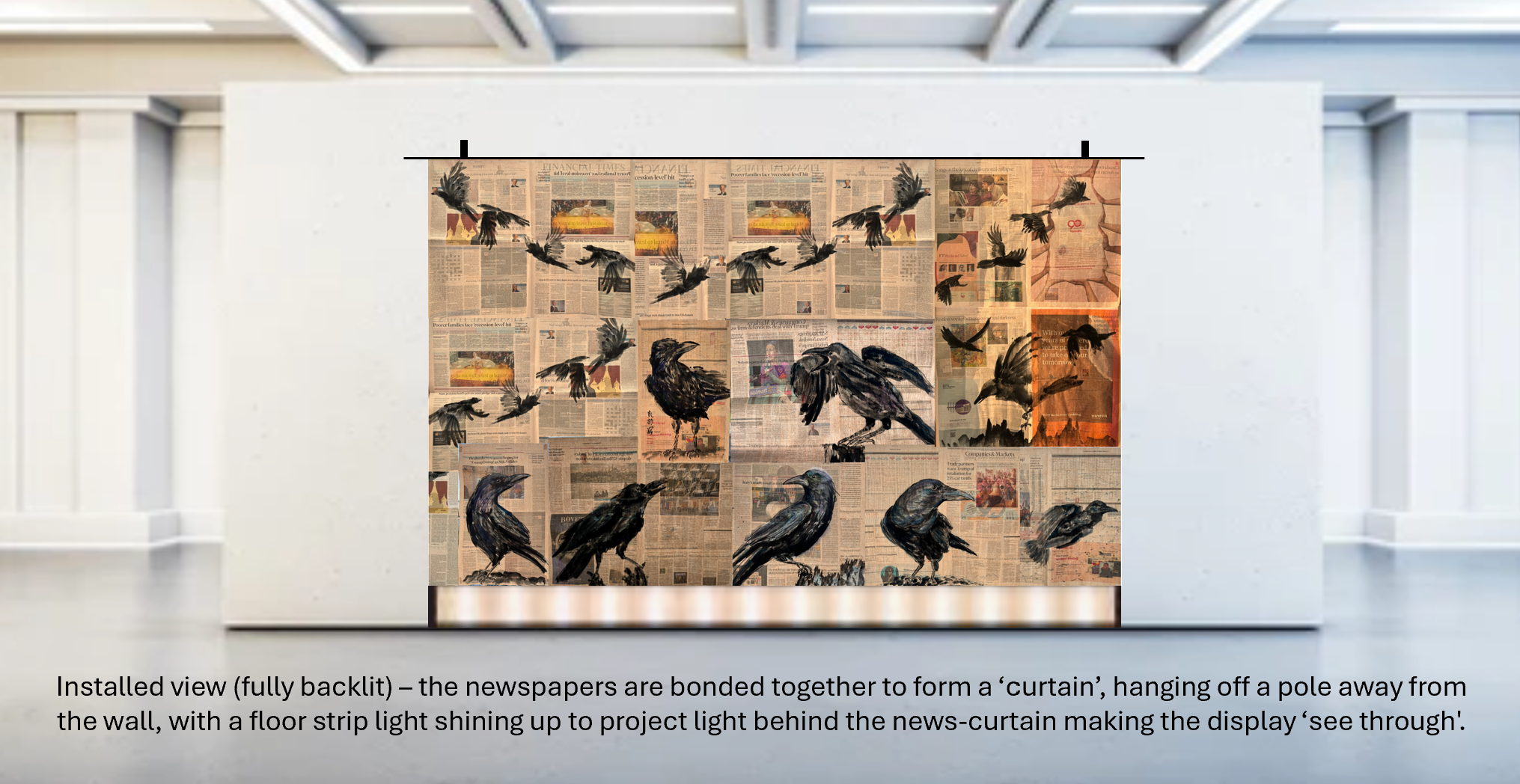
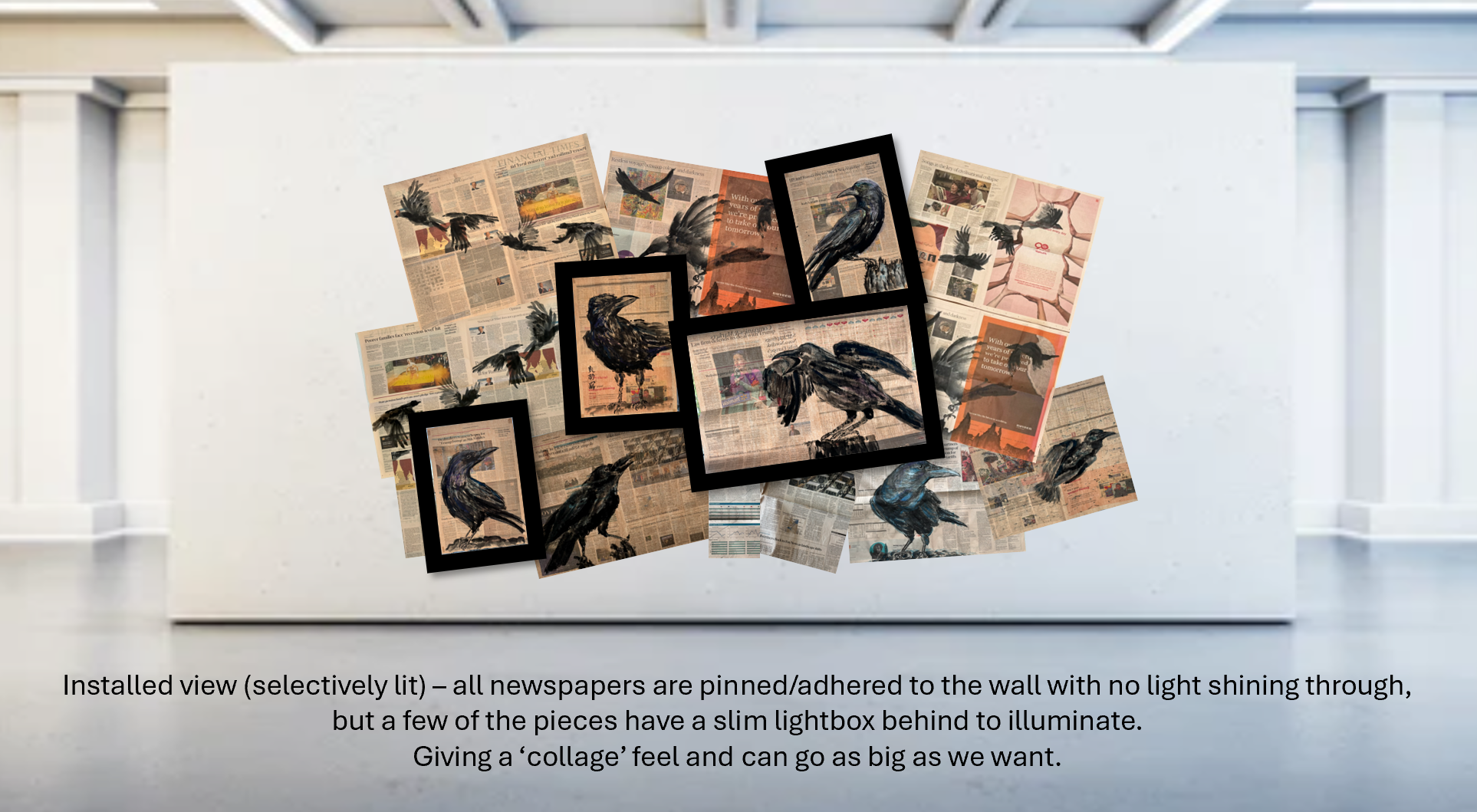
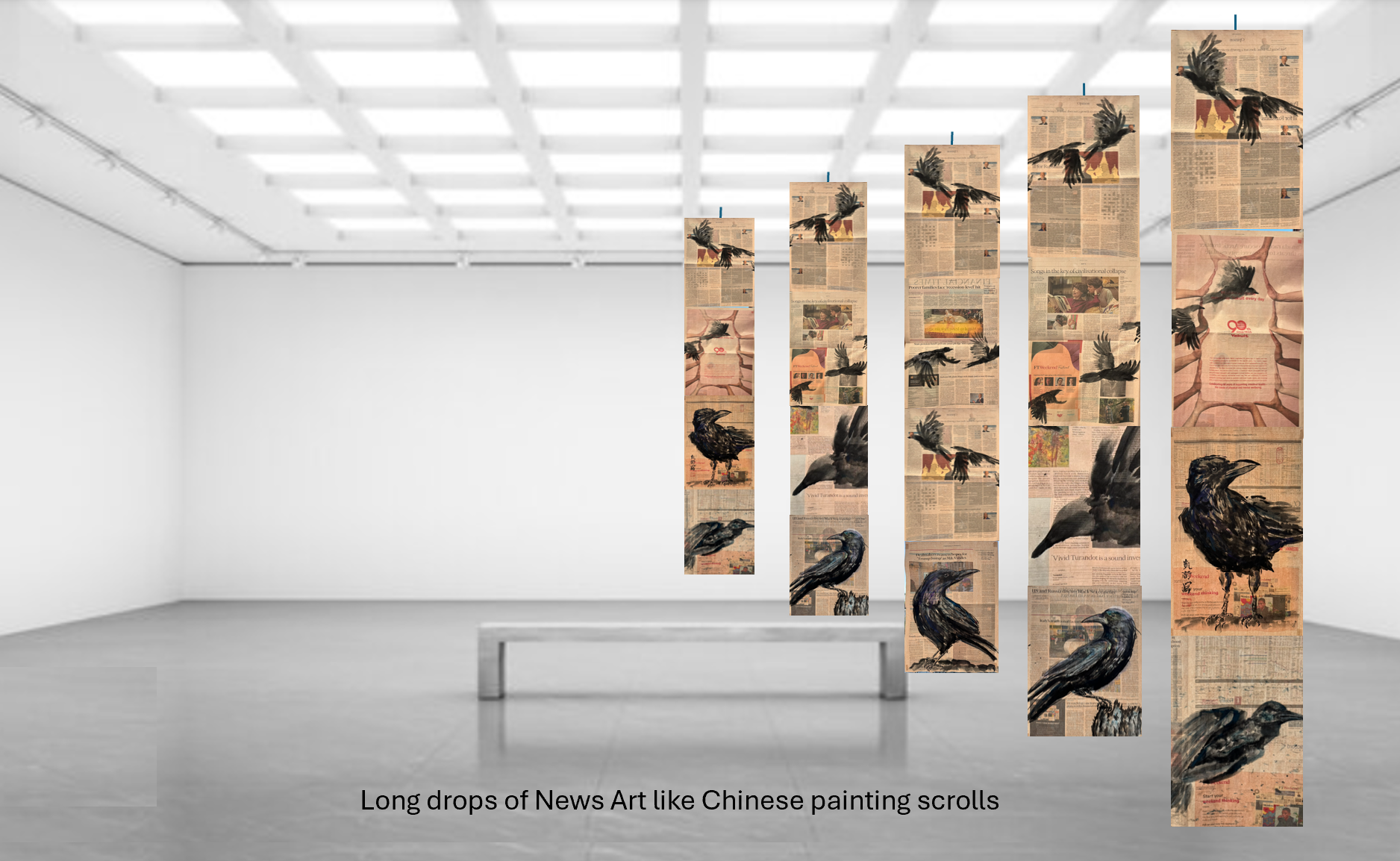
Below are some mock up ideas that I prepared to discuss with my tutor:
–––
After discussing with my tutor, we felt that the first option had the most potential for the CSM site. So I proceeded to think about how to create one large painting by combining multiple newspaper paintings together that would be appropriate for the Show both in demonstrating the concept and that is robust enough for a public exhibition.
My tutor showed me an installation by a previous student who stitched together pieces of paper to form a long drop. I liked the idea of stitching together the pieces rather than just taping because I think it would be more robust and also reflect my wish to mend what’s happening in the world through my work – somehow.
–
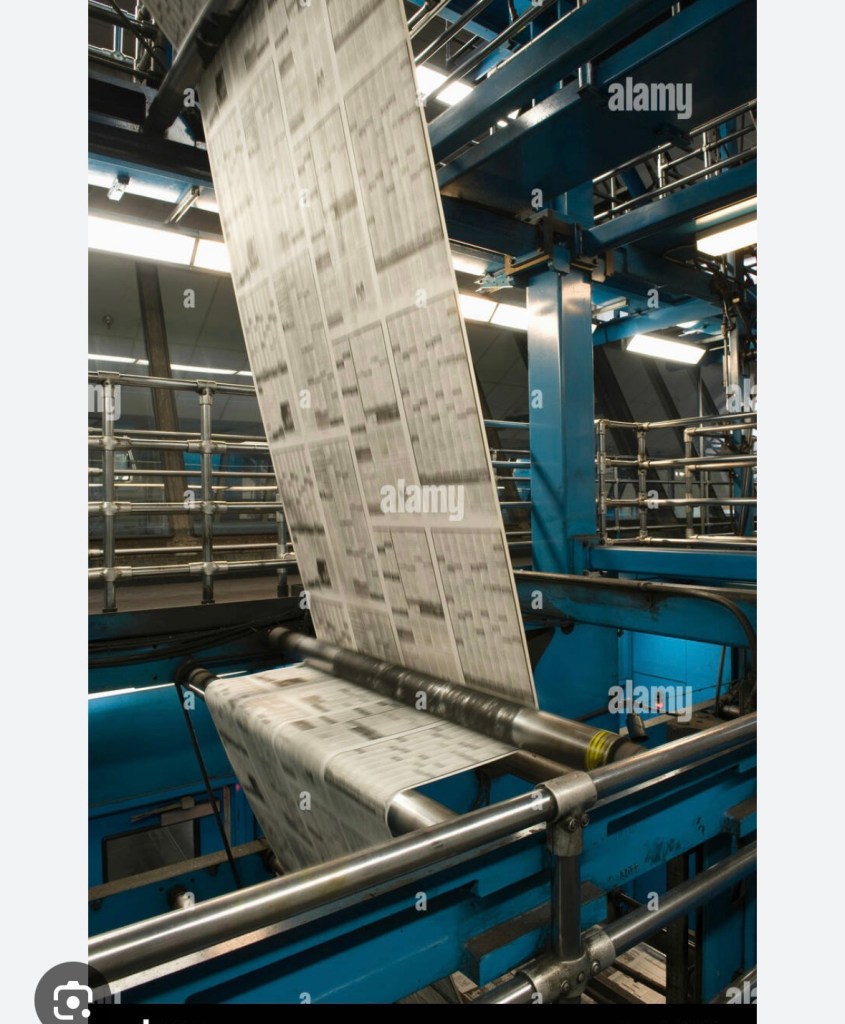
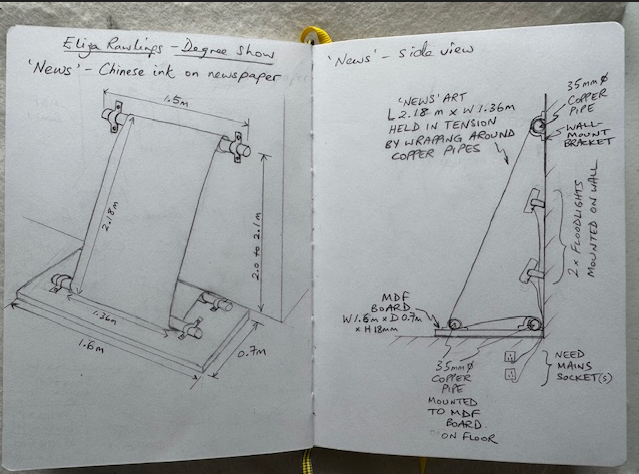
I then tried out different ideas on my sketch book and decided a narrower long drop (rather than a wide one as in the original idea) could work well to resemble how newspapers are printed and processed in the factory. Working so intensely with newspapers and examining newsprint so closely has reminded me of my time as a young engineer working on control systems for newspaper printing presses including many Fleet Street titles. I remember vividly how exhilarating and awe-inspiring it was to see the newspaper webs flying at high speed between feeder rollers around the monumental machines (see example image below). Since my art practice is about exploring my identity and engineering has been such a large part of my life (35+ years), I wanted to make an installation at the degree show that incorporated elements of my memory from those days.
–
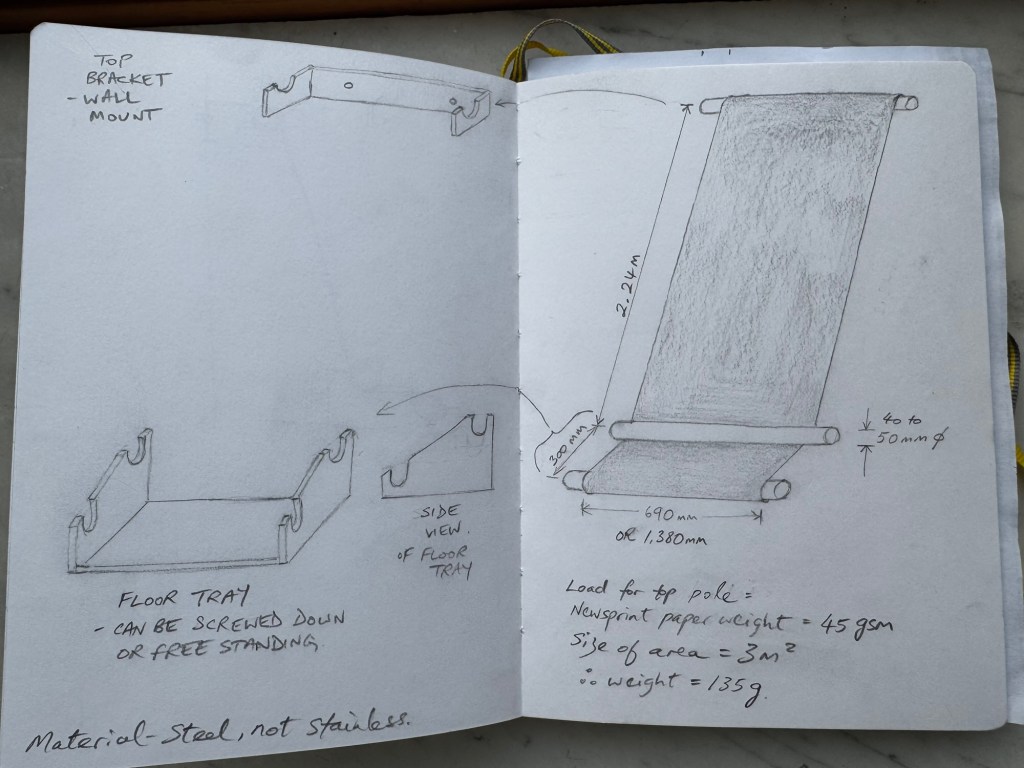
I experimented with the ideas of using three tubes to represent parts of the printing machine. Initially, I looked into buying used feeder rollers from printing press refurbishment companies but they were costly. Then I considered using mild steel tubes (not stainless steel as they would be too shiny). Below is an initial design idea which I used to get some costing. A key objective was the ease of installation knowing how busy the build up would be with such a big student show.
–
Then I wondered if three tubes would be too many and considered a two tubes design. In all cases, one or more flood lights would be used to illuminate the artwork from behind. Here is a two tubes design:
–
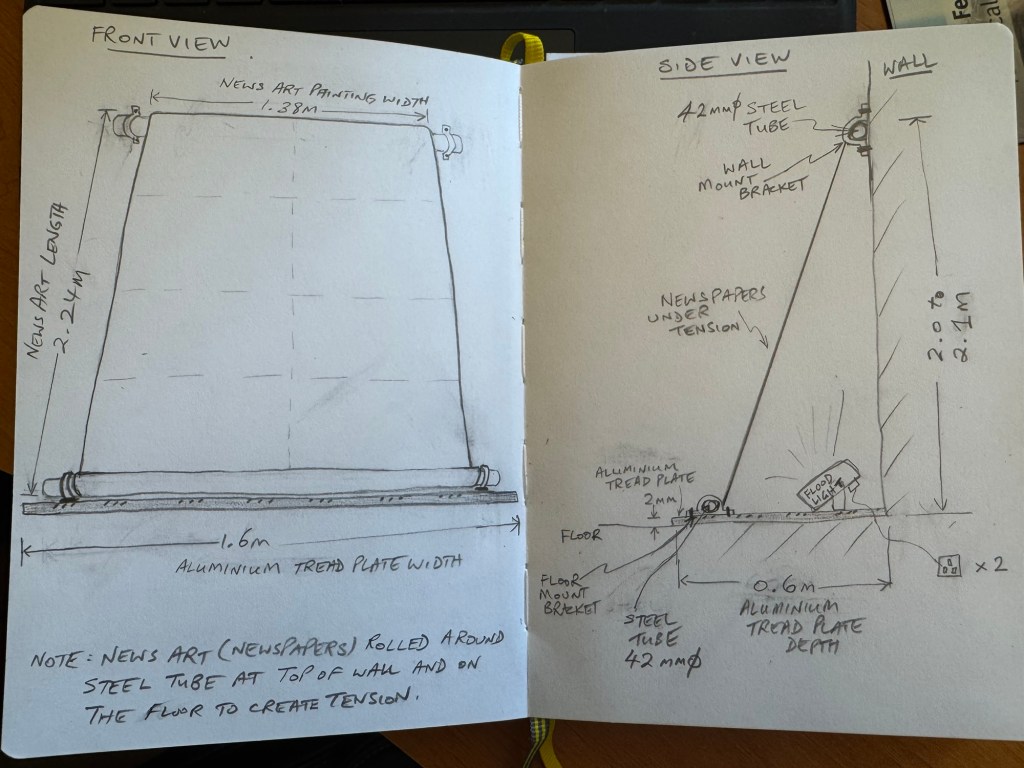
After further discussions and advice from my tutor, the final design was to use 3 x copper plumbing pipes as the copper colour would complement well the Financial Times’ salmon paper. The second pipe on the floor would be placed behind the painting giving the look of the newspaper feeding into the wall. I considered using two small flood lights, but I might go with a dimmable flood light instead because I have found that the back-illumination light level could be critical – too bright and the images became saturated and if too dim then the reverse side images would be hardly visible. Hence a dimmable unit would give more flexibility for an unfamiliar site with unknown ambient light level. Here is the final design:
–
The next task was to test out the stitching and the wrapping of the newspaper around a pipe to see how the paper behaved. Also to determine the optimum pipe diameter to use.
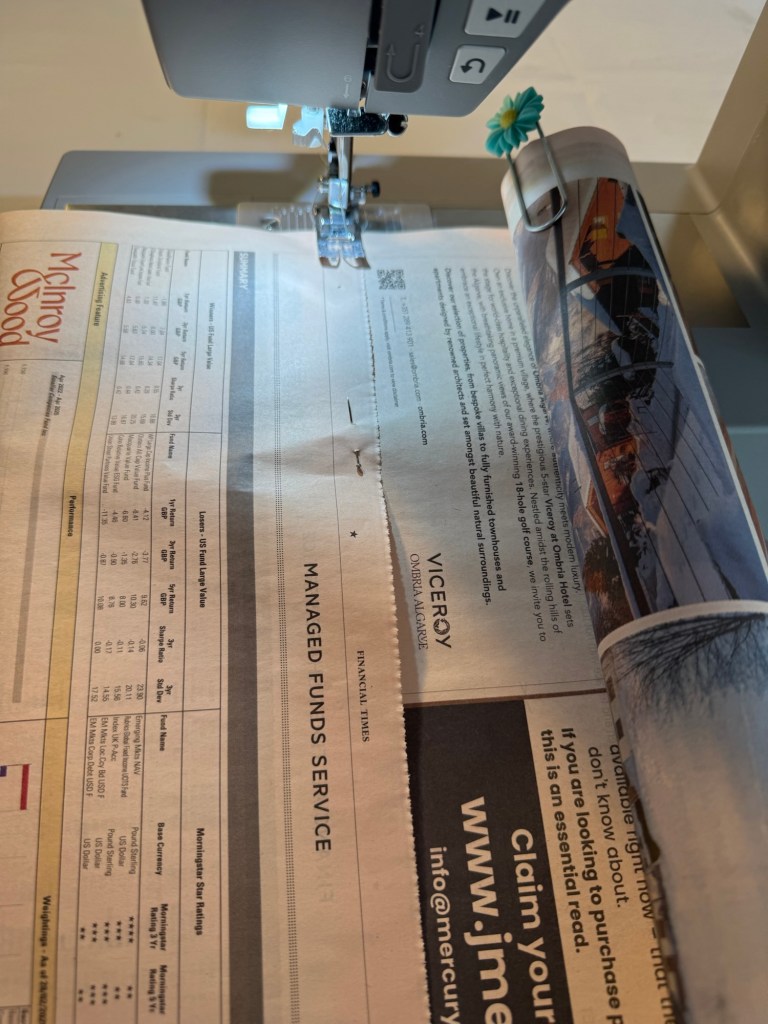
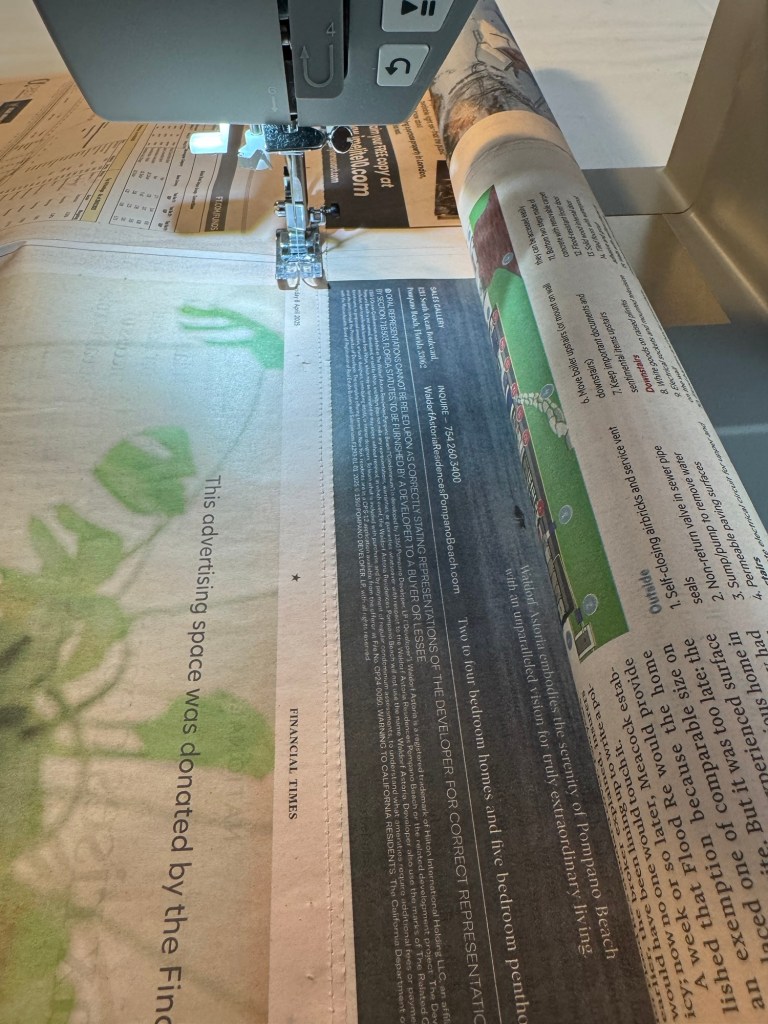
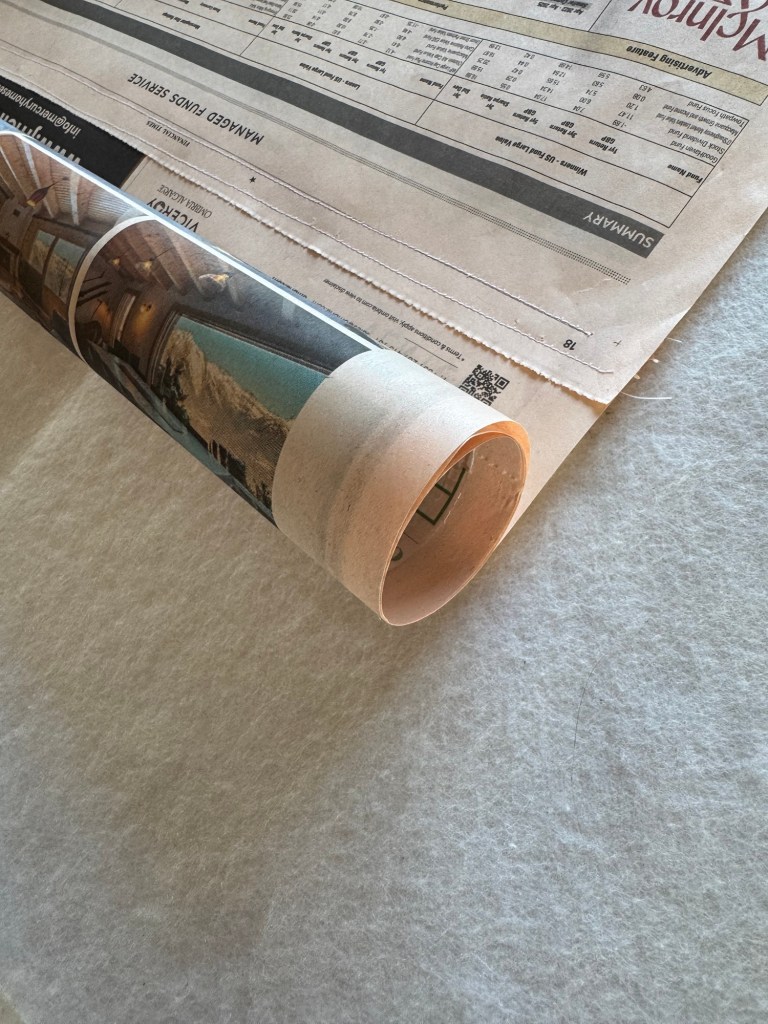
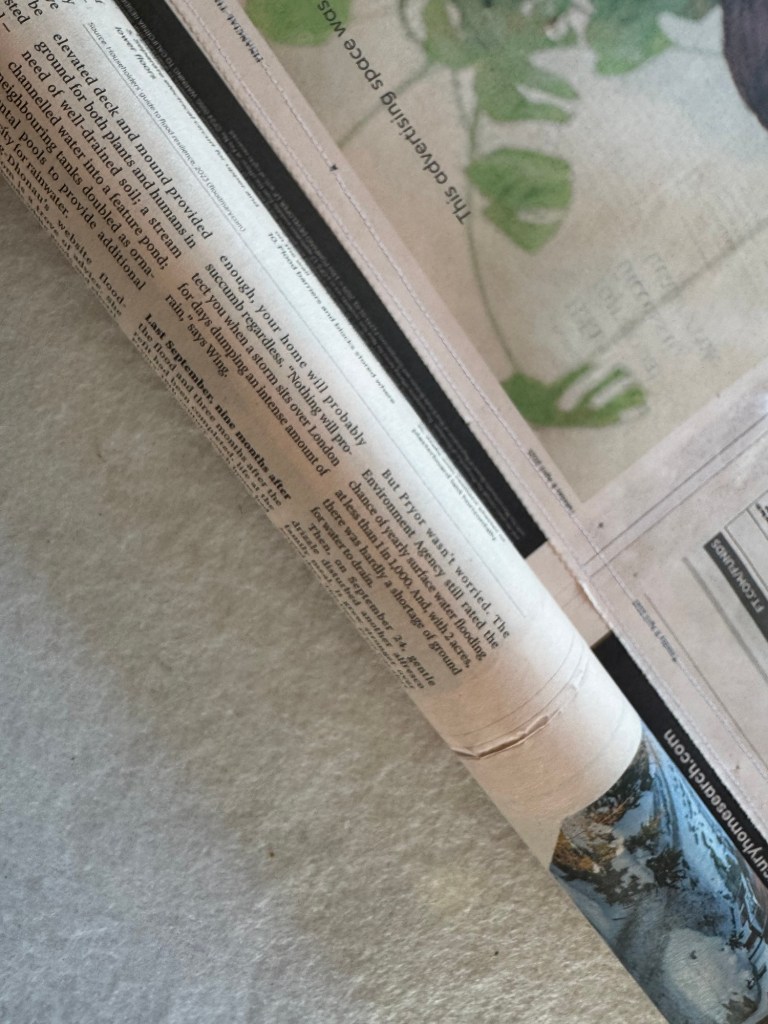
Using a sewing machine for large sheets of paper could be challenging because unlike fabric, the paper could not be bunched up to fit around the sewing machine body. Hence I rolled up the newspaper around a plastic tube and held the roll in place with a large paperclip so that it could be fed into the machine without damaging the paper. The two sheets of newspapers were held together using dressmaking pins just like I would do when binding fabrics.
–
The machine settings were as follows with the stitch size fairly small for strength but not tiny as it might rip the paper:
–
The paper was then fed slowly into the machine for sewing. Two rows of stitches were made to ensure strength of the bind:
–
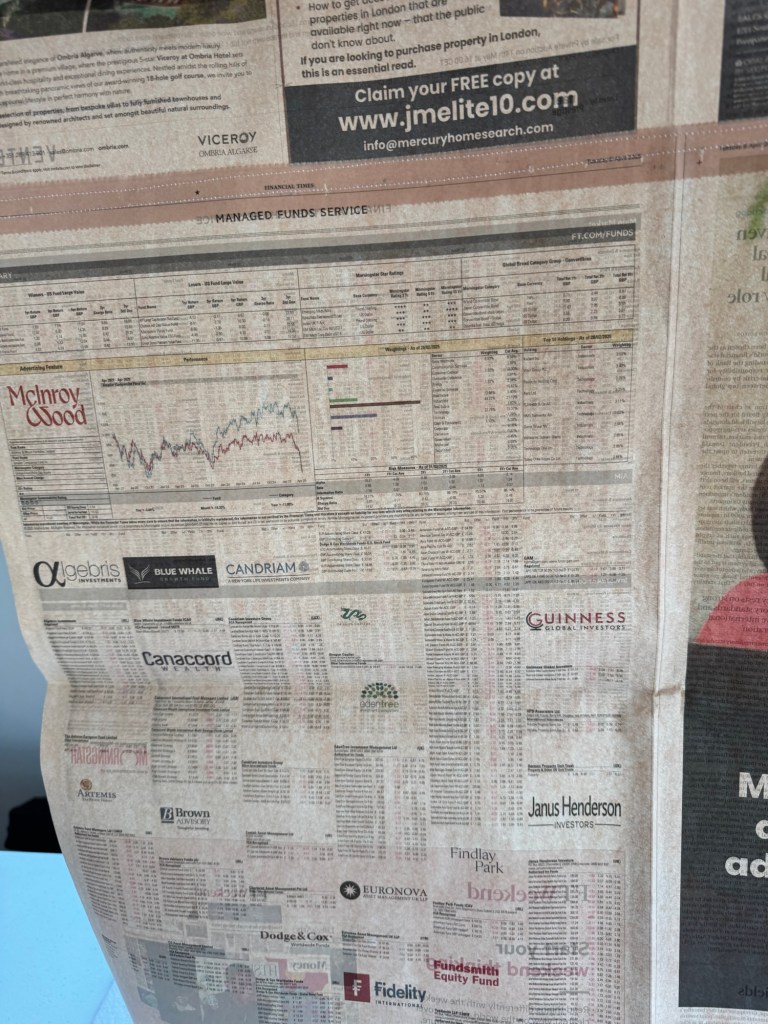
Completed sewing and with paper hanging vertically:
–
Below are close up images of the stitching and how the paper wrapped around the tube. This tube was of 40mm diameter and the paper wrapped well around it:
–
I tried wrapping around a smaller diameter tube (22mm) and it felt too tight and obviously would require more revolutions of wrapping and I felt that would introduce more risk in the paper not aligning and looking untidy:
–
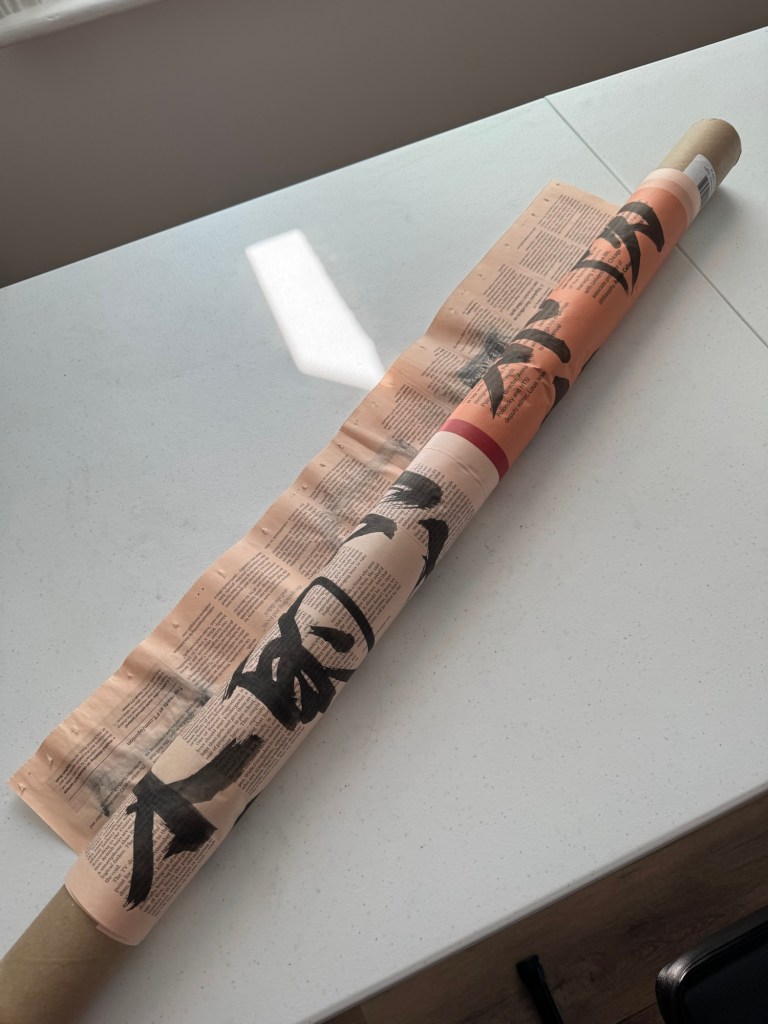
Another example of paper wrapped around a tube. This time with painted paper only as an experiment because the installation for the Show would only use unpainted paper to wrap around the tube.
–
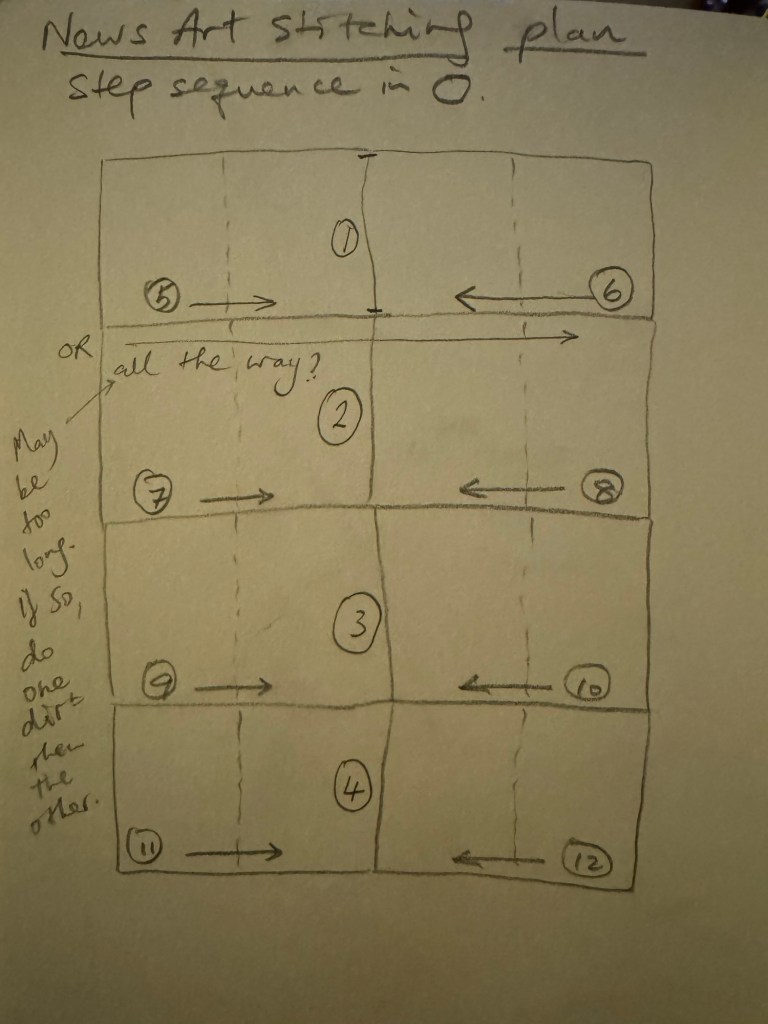
Since I am planning to create a painting size of 2 x double page spread broadsheets, that is approximately 1.36m wide and it would be difficult to feed into the sewing machine in one go, I created the following stitching plan to do the stitching half way, then turn around and do the other half from the opposite direction. I might try to do it all the way with some spare newspaper as an experiment to start with.
–
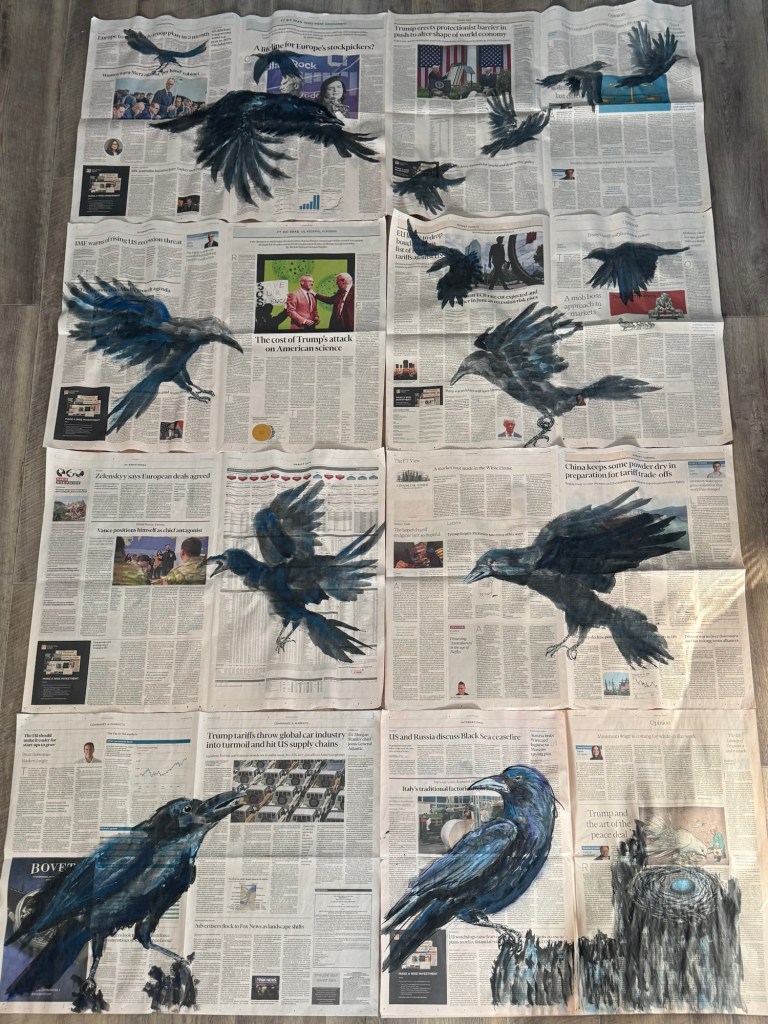
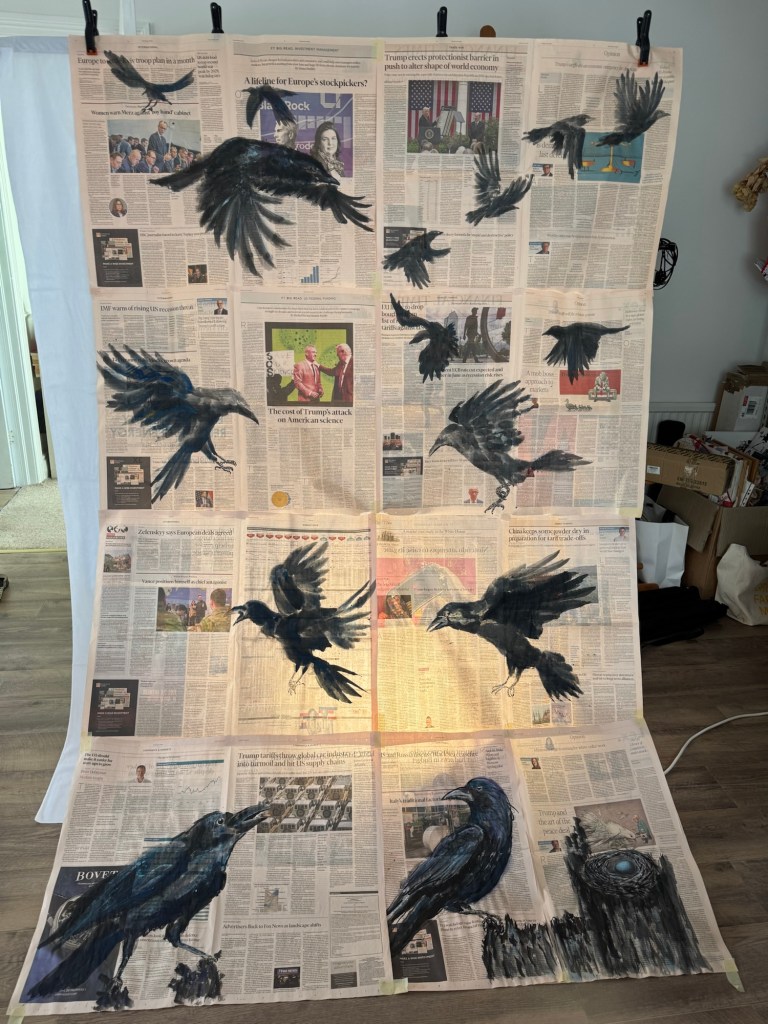
Final selection of eight paintings to form a composition for the Degree Show:
–
Mock up in front of flood light to test concept:
–
–
REFLECTIONS
I started to re-evaluate my art practice just before the Low Res in March and I started to make ‘News’ art at the end of March which is less than two months ago. I cannot believe how much has happened and that I am planning to show this new body of work at the Degree Show. During my recent tutorial, my tutor said that everything I have been doing as well as my commitment to interrogation have been leading to this and it does feel that way to me. I am feeling a momentum that I had not felt before and I am very excited (and somewhat nervous but in a good way) about showing this work at the Show. I do not know if it would work out or if it would present itself as I imagined. But I take confidence from what David Bowie said in this video where he was giving advice to artists:
My main takeaway from Bowie’s video was when he said, ‘…Always remember the reason you initially started working, you felt there was something inside yourself that if you could manifest it in some way then you would understand more about yourself and how you co-exist with the rest of society… If you feel safe then you are not working in the right area. Always go a little out of your depth, when you feel your feet are not quite touching the bottom then you are just about in the right place to do something exciting.’
I sincerely hope that Bowie is right and I look forward to finding out!
Another point that I have been reflecting on is that this new body of work is aesthetically and topically very different to my last body of work, The Cheongsam Series, where I was making oil paintings on dress-shaped canvases to explore my transcultural journey.
Much of my work in the last two years have been about my transcultural identity, but I knew that at some point I would want to go beyond just talking about my transcultural journey onto issues about society – issues that are still related to me, my lived experience but about other aspects of my identity. I mentioned this in my Study Statement from Unit 1 as my intention, but as I was making my transcultural work I have at times felt bounded to that topic and I was unsure of how to progress or transition onto the next body of work without seeming incoherent. Then when the ‘calling’ came to make work about the rapid change in world order and how people close to me were being affected, my urge to move onto the next body of work felt like a natural progression. Of course, there was much time spent on reflecting, agonising, experimenting, observing and reflective-writing that led me to making ‘News’ art. I am very pleased that I have gone through the transition process from one body of work to the next while I was still on the MA programme. This is because I felt safe and secure in trying something completely different in a supportive environment and I made it happen. I have learnt that I could do it and it wasn’t as scary as I thought it might be. Guided by my reflective process and taking it step by step meant that I felt in control of the transition – not necessary in control of the making but in control of the change process which gave me a solid platform to take risks in the making. This learning experience has been very important for me as I now feel confident to do that again independently after the course. I feel I can move onto the next body of work when the next ‘calling’ comes. I know I can rely on my instincts guided by my reflective process to make it happen. I expect I will return to my transculturality work at some point because there is still much to explore and I certainly have not exhausted the subject yet – far from it.
LEARNING
I have learnt that I now feel able to transition from one body of work to the next and take risks along the way. I will follow my instincts and use my reflective process to guide me. This has been an important realisation as I go forward to develop my practice.
As for the Degree Show, there has been a lot to think about in planning for the show and I have really enjoyed the challenge. Especially looking at sourcing the right materials for the installation – I learnt a lot in that process, such as to consider the materials’ behaviour, the aesthetics and planning for a site that I am not familiar with including all the contingencies to consider. It’s all good experience for any future exhibitions. Creating the paintings is only half the work, presenting it properly and all the site considerations require just as much work which is something to bear in mind in the future. Planning and allowing plenty of time is key!
I have also learnt that I needed to introduce a new process of organising my materials – namely the newspapers! Especially considering news has a life span. My ‘News’ artwork needs to be about the here and now and can’t be left on the shelf for too long or the news story would have expired. So I needed to create a system to sort the newspapers so they don’t end up piling up in my studio. I decided to organise my newspapers as follows.
I found it helpful to have a specific topic for selecting the newspapers to paint on. In this case, it’s about the sudden change in world order due to the US Government’s drastic roll out of damaging policies.
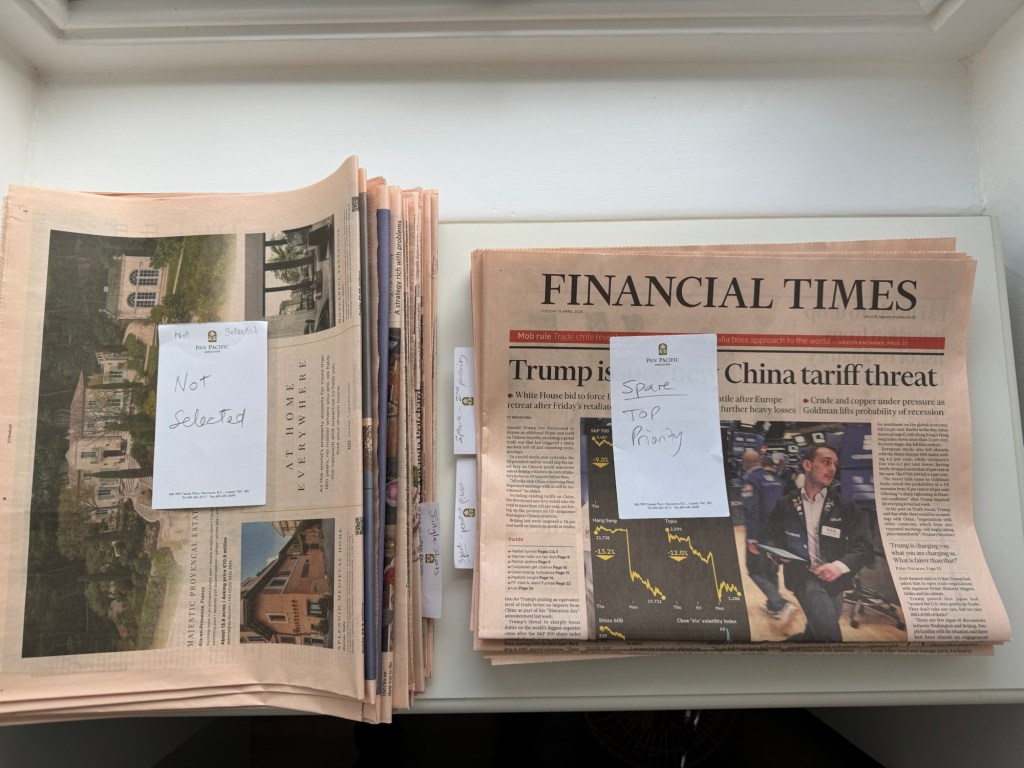
So when I get a copy of the newspaper, I sort the pages into the following categories:
– Selected pages for painting – with the appropriate headline, perhaps an interesting image and not too much advertising especially not big dark blocks.
– Spares: top priority / second priority / good for practicing
– Not selected
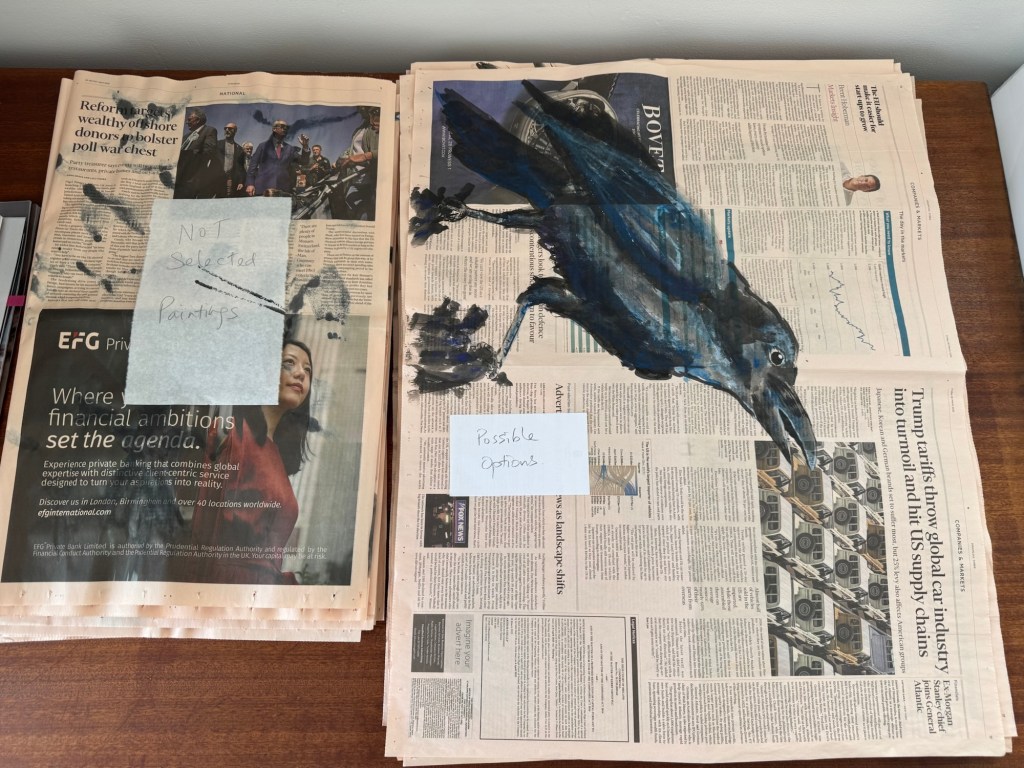
Out of all the ‘News’ paintings that I have created, they were sorted into ‘possibles’ for the show and ‘not selected’. Then I continued to make more paintings until I had enough ‘good’ ones that I was happy with for the Show.
––
NEXT STEPS
Make it happen for the Show!
Always remember Bowie’s advice!
Maintain my confidence, follow my instincts and reflective process to develop future bodies of work.
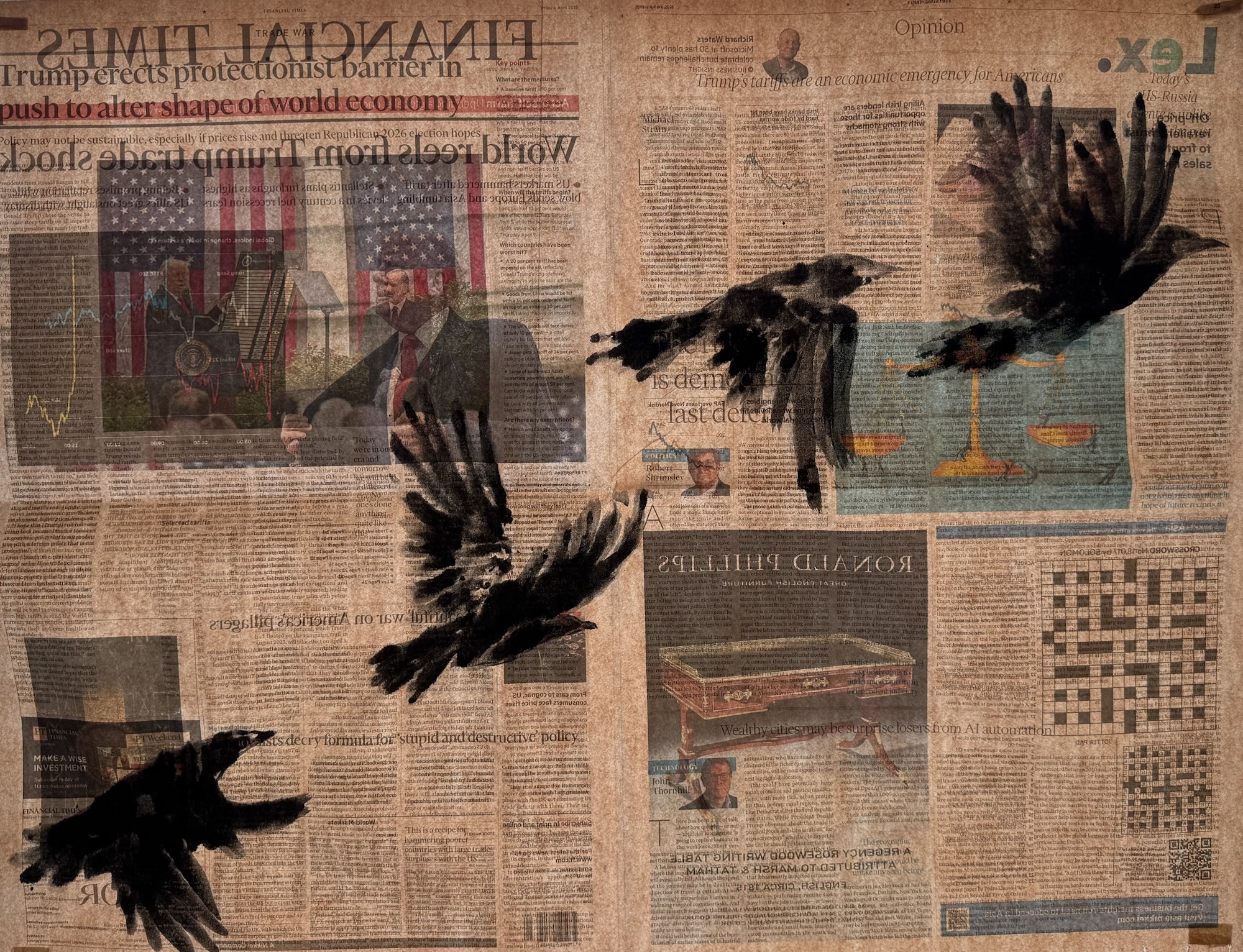
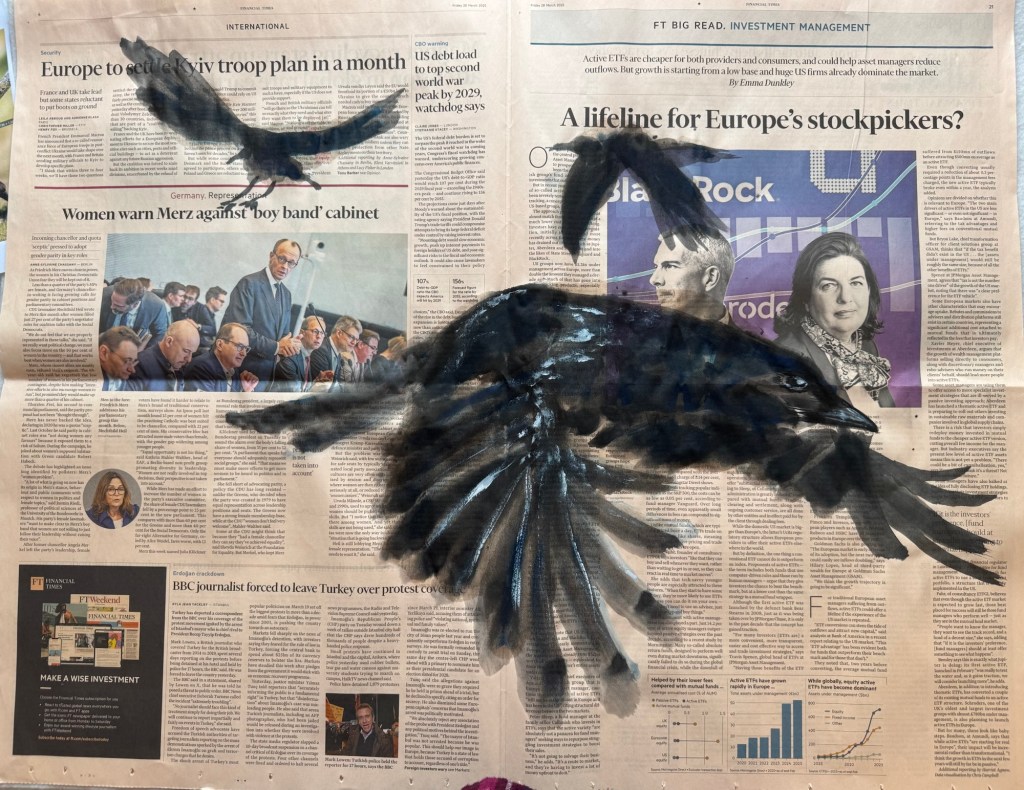
I have continued to work on my latest body of work – ‘News’. I decided to explore different crow expressions to use in my compositions. In particular, more expressive, angry or ones in flight. So that I have a wider variety of expressions to choose from when responding to news articles that I see.
METHOD
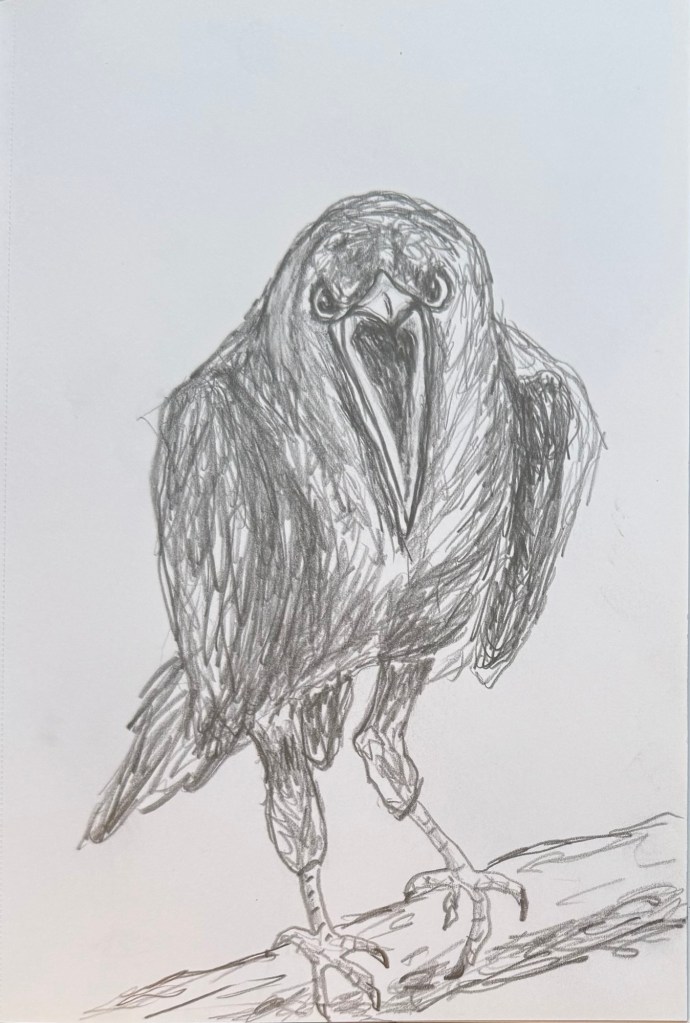
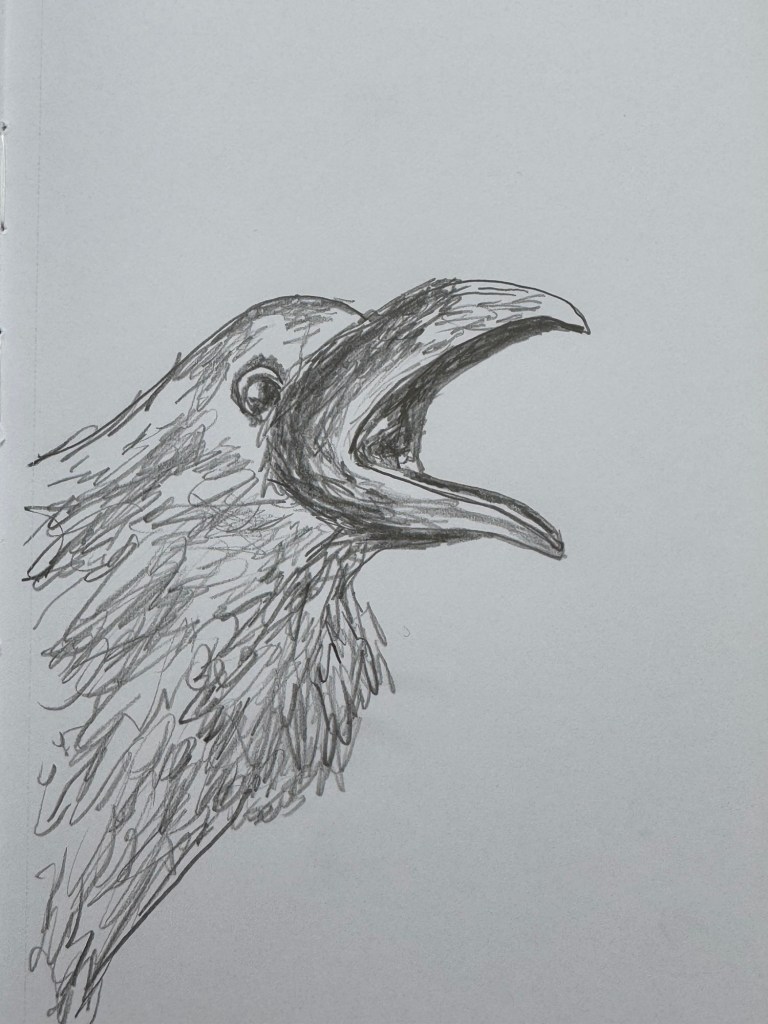
Lately, whenever I feel unsure about how to proceed then I have been returning to drawing. I find the process comforting and grounding. So I started with a few drawings on expressive crows using my non-dominant hand.
Angry crow:
–
This one was meant to be angry but actually looked anxious:
–
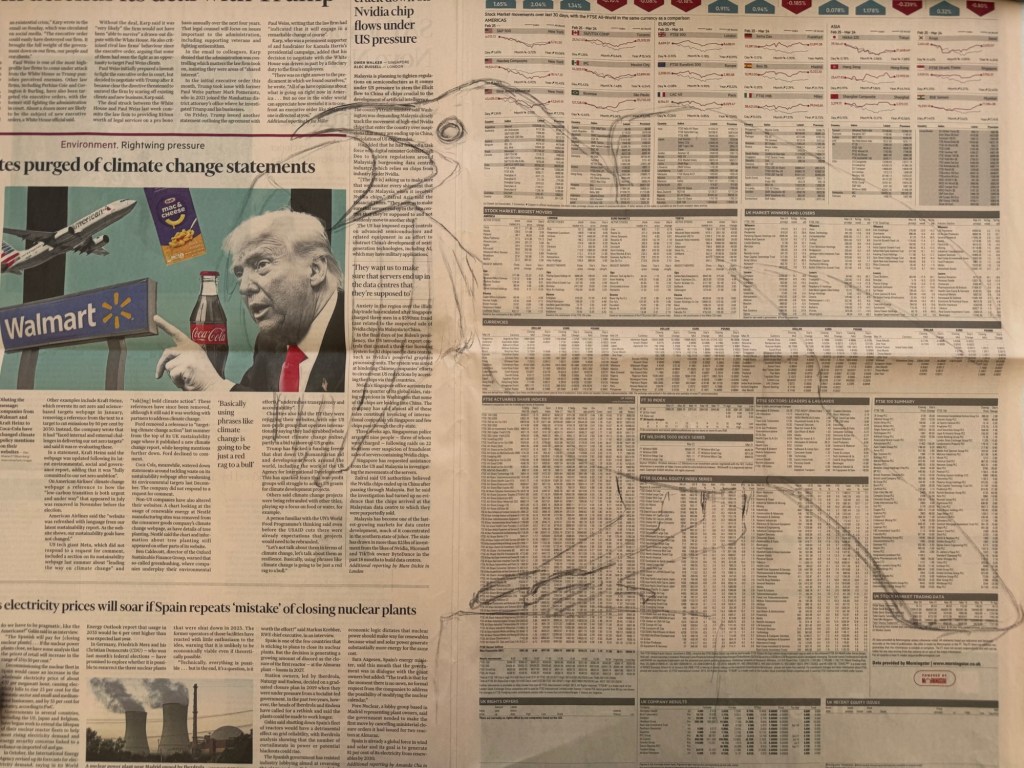
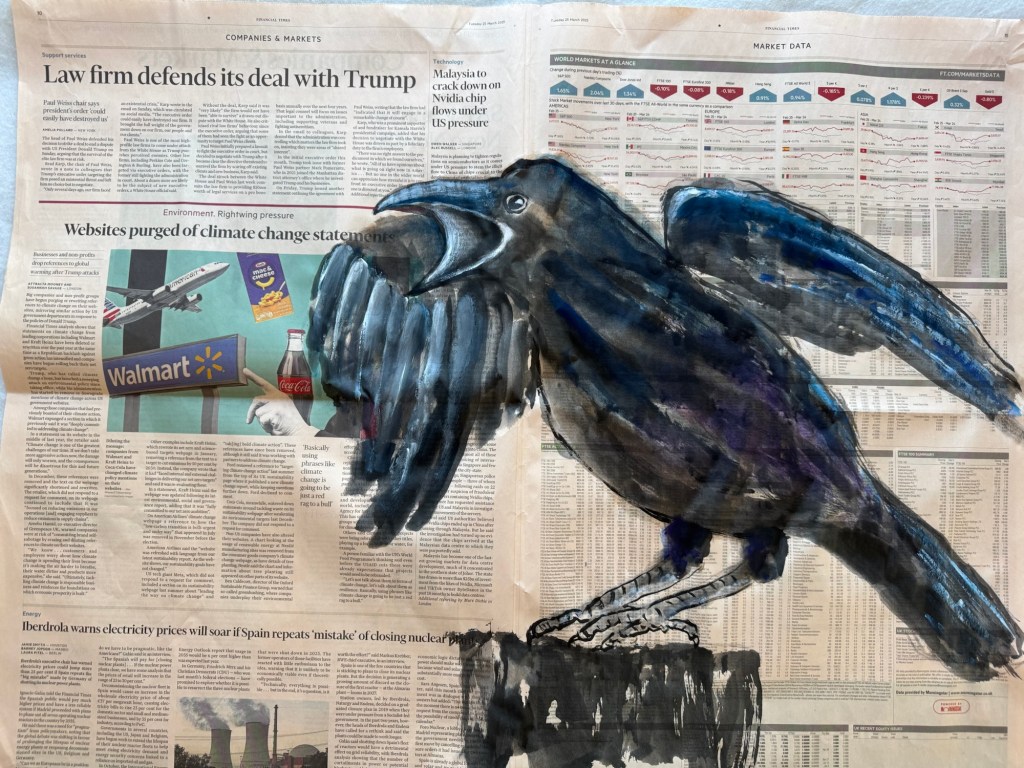
I then went onto painting on newspaper. I used charcoal to mark the outline of a crow that I wanted to paint. The newspaper was chosen especially for this composition – a shouting crow:
–
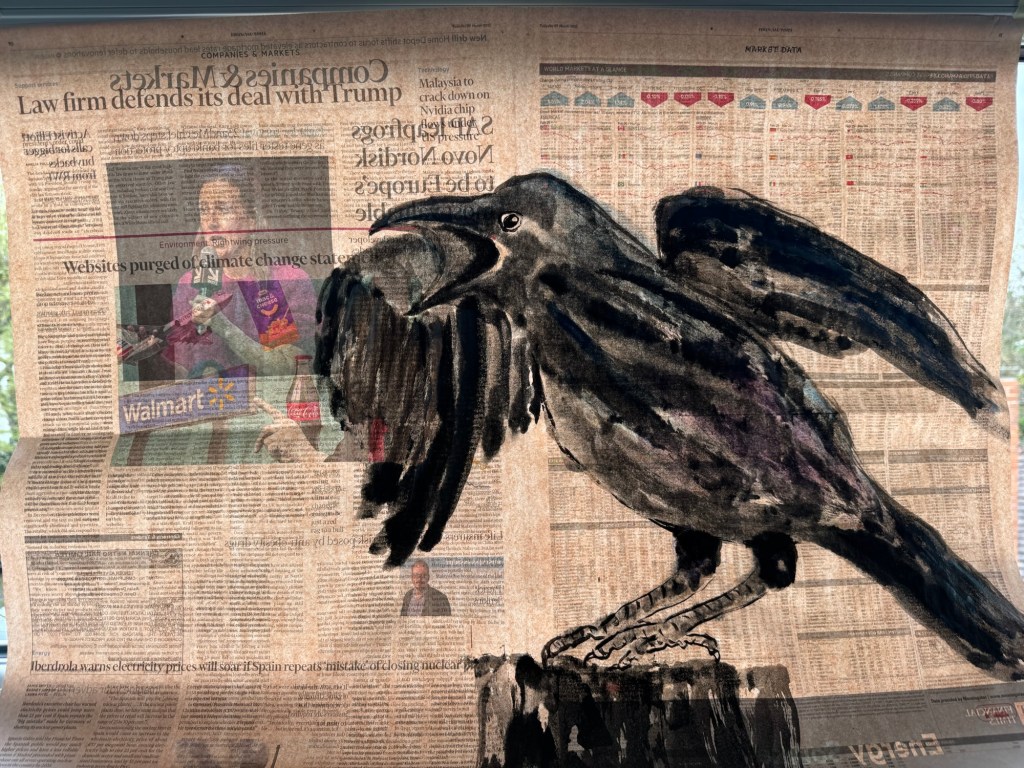
I then painted the crow – staying with my non-dominant hand. I was going to paint the wing behind the man’s head. But then decided to cover up the head. This was the finished work:
–
The painting was held up to the light. The man’s head was slightly visible despite being covered. What came through was a woman speaking on a microphone on the reverse side of the newsprint which made the composition more interesting.
–
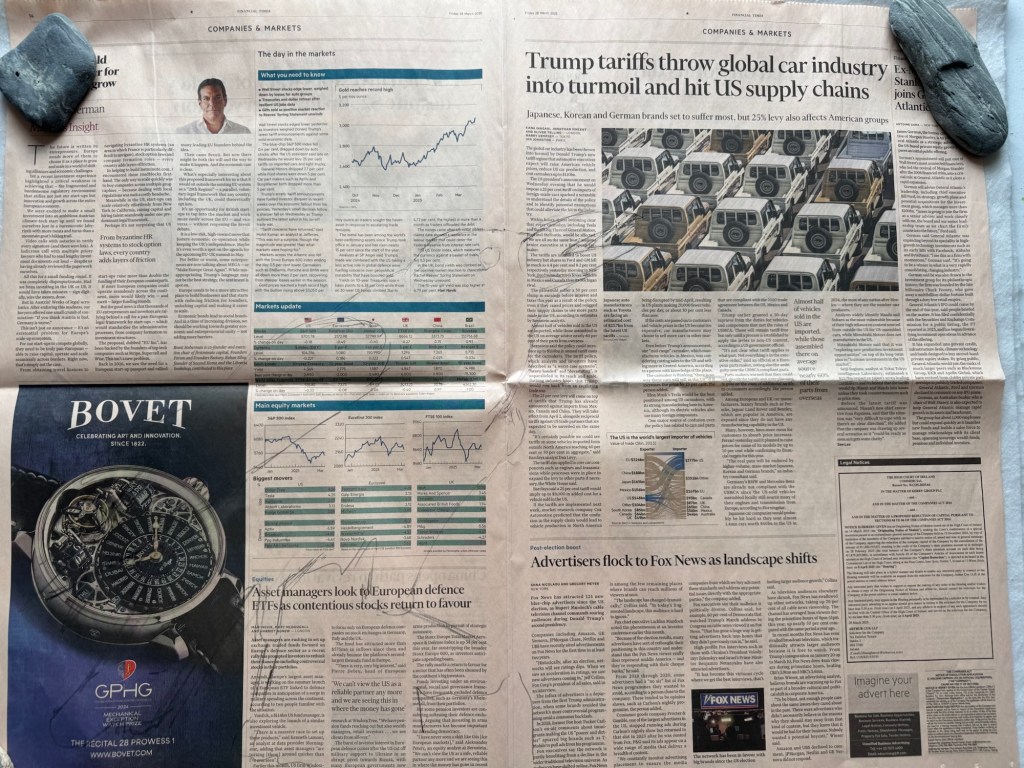
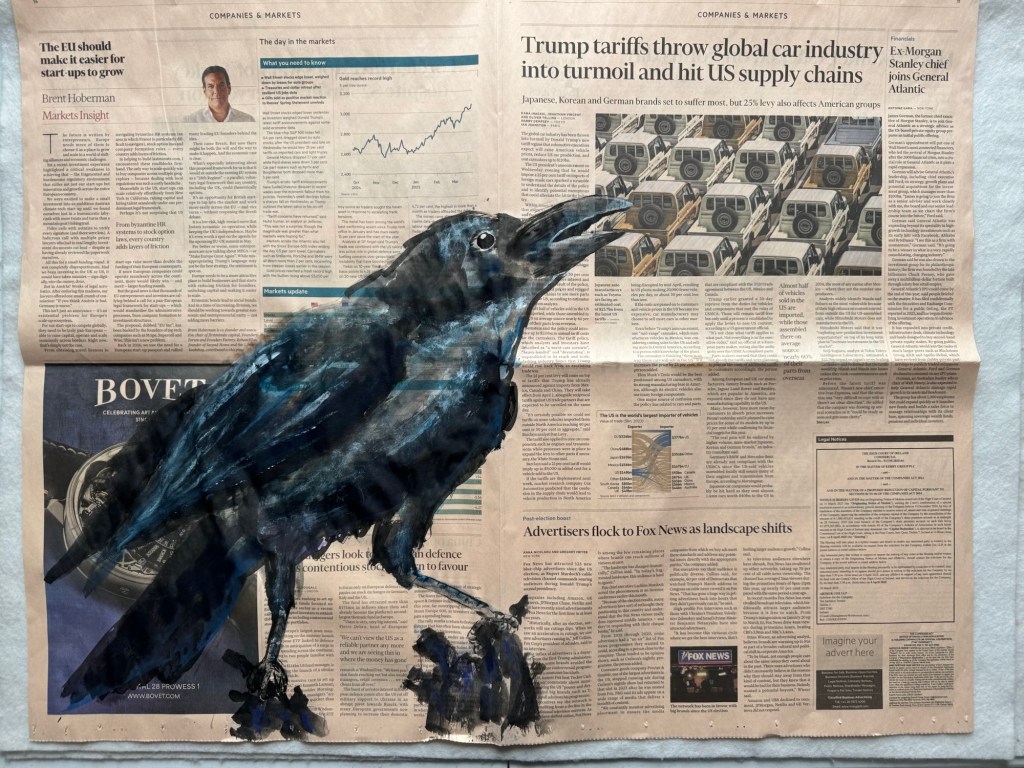
Then I experimented with a crow looking in despair up to an article about the tariff trade war. Perhaps it was not totally in despair, but certainly questioning what’s going on:
––
Again the finished painting was held up to the light as a metaphor for holding someone to account. The images on the reverse side made the photograph of the cars under the trade tariff headline more ambiguous.
–
Crows in flight going in different directions:
–
Putting together paintings to start exploring combined composition:
–
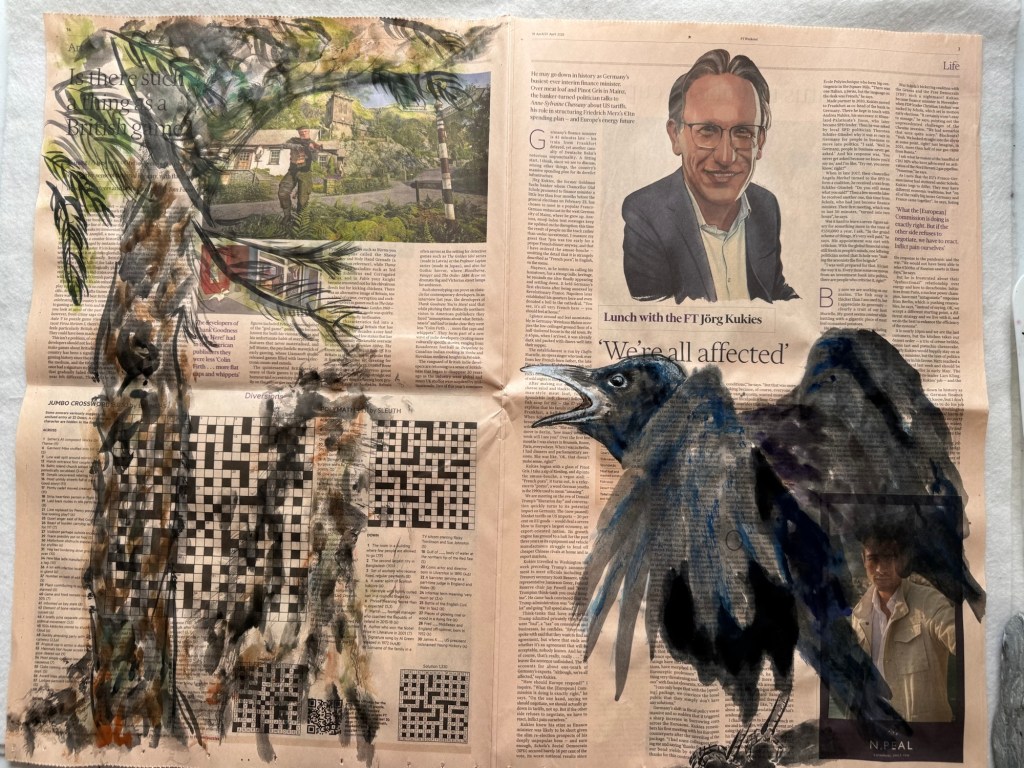
Another shouting crow under the headline ‘We are all affected’. The crow was in line with the gun held up by the man on the left page. Then I noticed a large capital letter ‘O’ on the crow’s body – like it had been shot by the man in the photo. I added a pine tree around the greenery on the photo on the left, but I don’t think it worked. It distracted too much from what the crow was going through.
–
A few landing crows:
–
A large landing crow going for a prey:
–
A screaming crow in flight aiming at a photo:
–
REFLECTIONS
As I made more work, I became more confident about this new body of work. My confidence increased in both the concept and the process. My recent tutorial was very useful in helping me to reflect on my thinking behind the work and the progress so far. My increased confidence meant I was able to go for a more freestyle approach to my Chinese ink painting in the work listed above. The freestyle approach enabled me to be more expressive and spontaneous. The last few paintings shown here were done without needing to use charcoal upfront to mark out the composition which I was pleased about.
I was not happy with every outcome here, some of the depictions were more aligned with my intentions, some not so. But I was trying not to overthink it at this stage. Just wanted to keep making as I know from my Chinese painting class that it would get better with practice.
I continue to find Chinese ink painting ‘unforgiving’. I have written about this before and it still has not changed – it is just part of that medium and again, practice helps. ‘Just keep making’ is the key.
Also, I believe painting with my non-dominant hand has helped me to not agonise over my work too much because it’s not meant to be perfect. It will be what it will be! I have found it liberating to paint in this way and I plan to continue this exploration.
LEARNING
I am gaining confidence in the making process through practise and more importantly – I am pleasantly surprised by my confidence in tackling a completely new body of work that is very different from my previous transcultural work. I am happy that this major change happened during my MA course because the guidance available gave me the courage to do something completely new and experimental.
Also, the structure of my reflective practice has really helped me to realise the concept knowing that if I got stuck then the reflective process would help me to find answers or a way forward.
I feel very excited about this new body of work and I am really enjoying this way of making. It continues to help me to respond to what’s happening in the world through my practice which is very important for me right now.
To build on this, I want to think more about why painting with my non-dominant hand has become so important to me. Also I want to understand more about my overall process – from buying the newspaper to completing a painting.
NEXT STEPS
Think more about my reasons for using my non-dominant hand – especially think about this as I paint.
Start to be more considered when moving from one step to the next in my process to better understand the process with the aim of future improvement and development.
Keep making and think about what to do for the degree show.
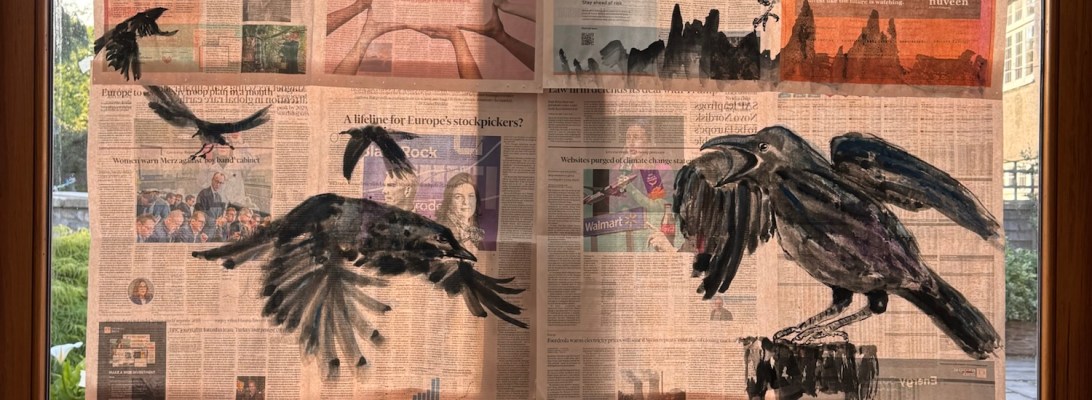
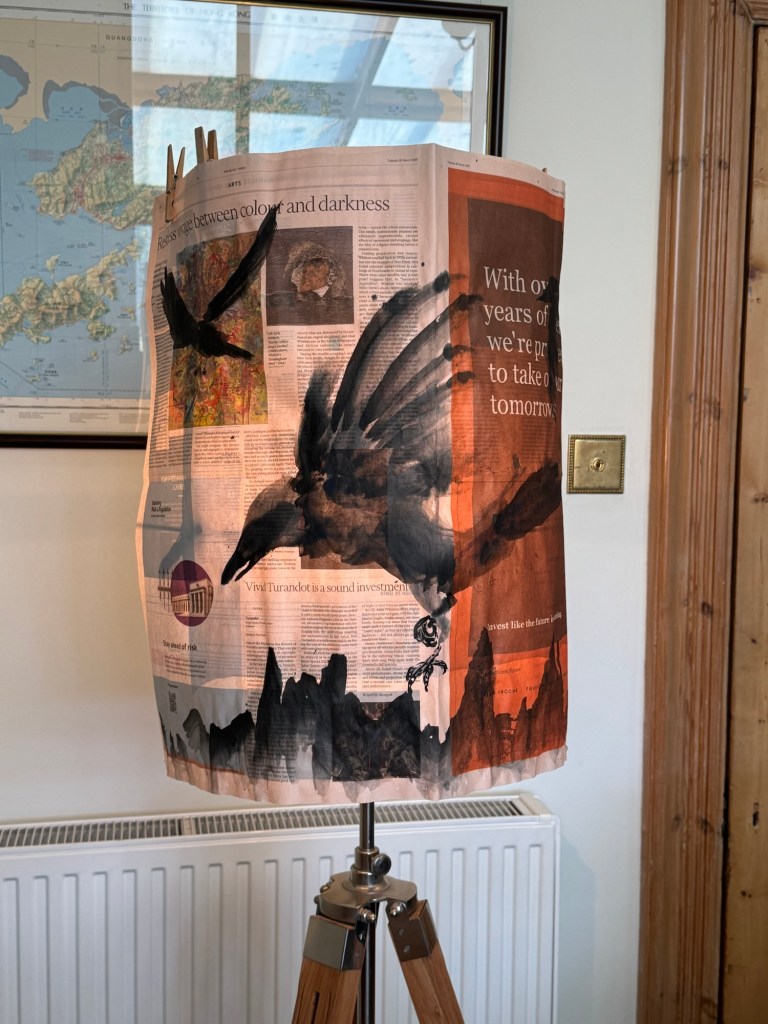
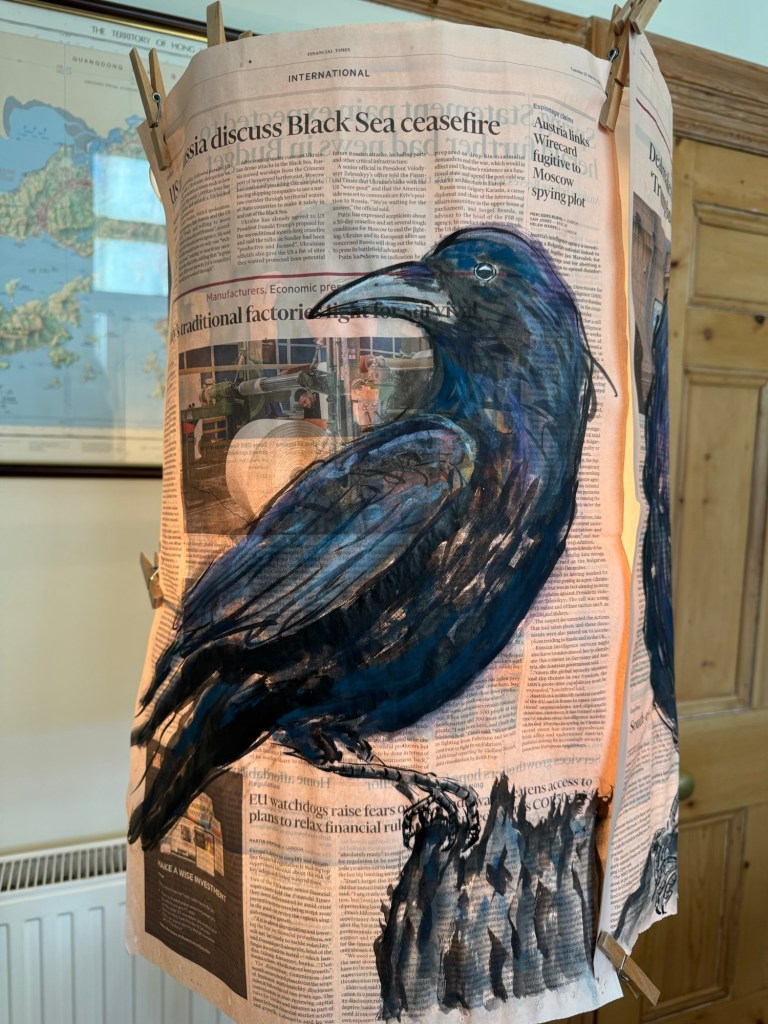
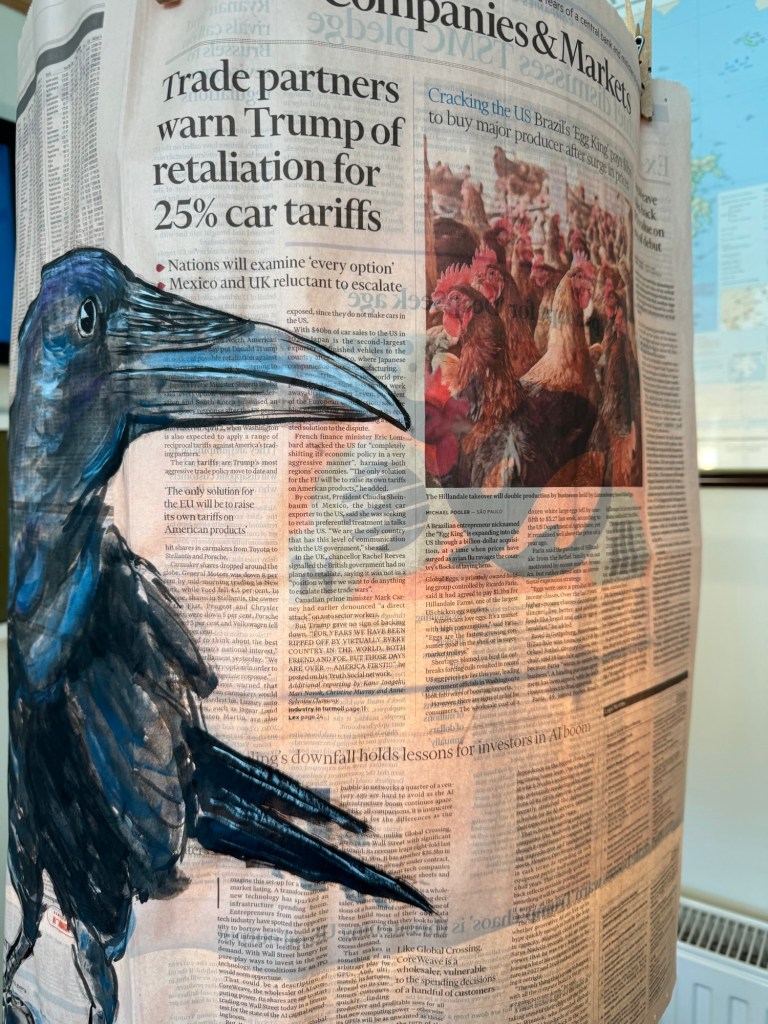
When I first showed my News Art to my tutor, we talked about the way I photographed the paintings in front of a window and letting the light shine through was a metaphor for ‘holding the news up to the light’.
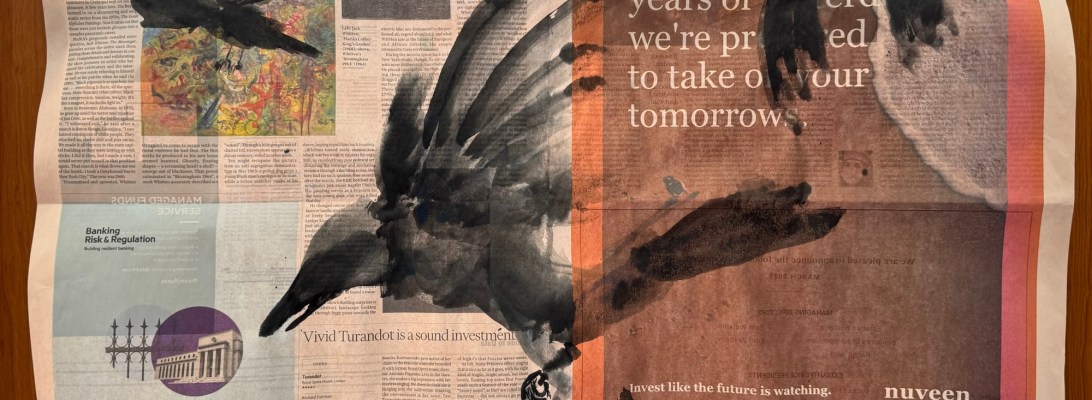
As the saying goes, if you are ‘holding something up to the light’, you see through and understand the true nature of it more clearly; or you hold something to account. I felt it was a good metaphor and if I were to show my News Art then I would want to hold it up to the light. This way of showing also reveals the images on the reverse side of the newspaper adding more intrigue and ambiguity to the overall composition.
METHOD
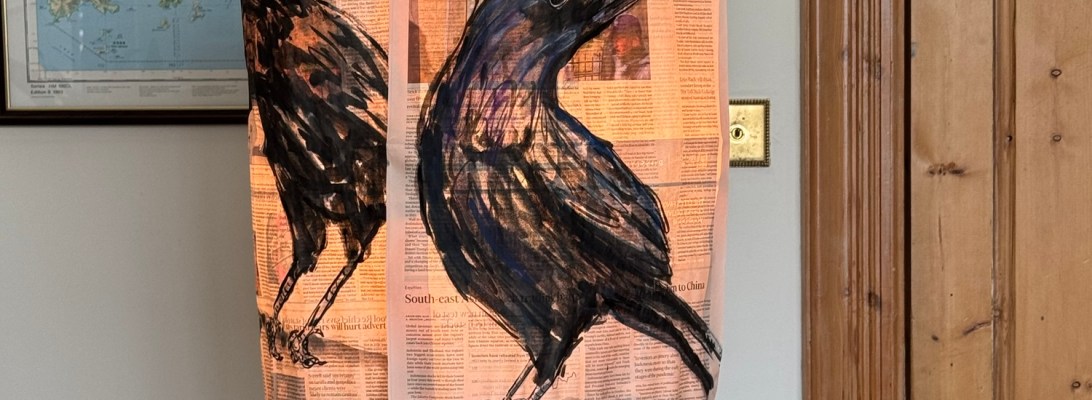
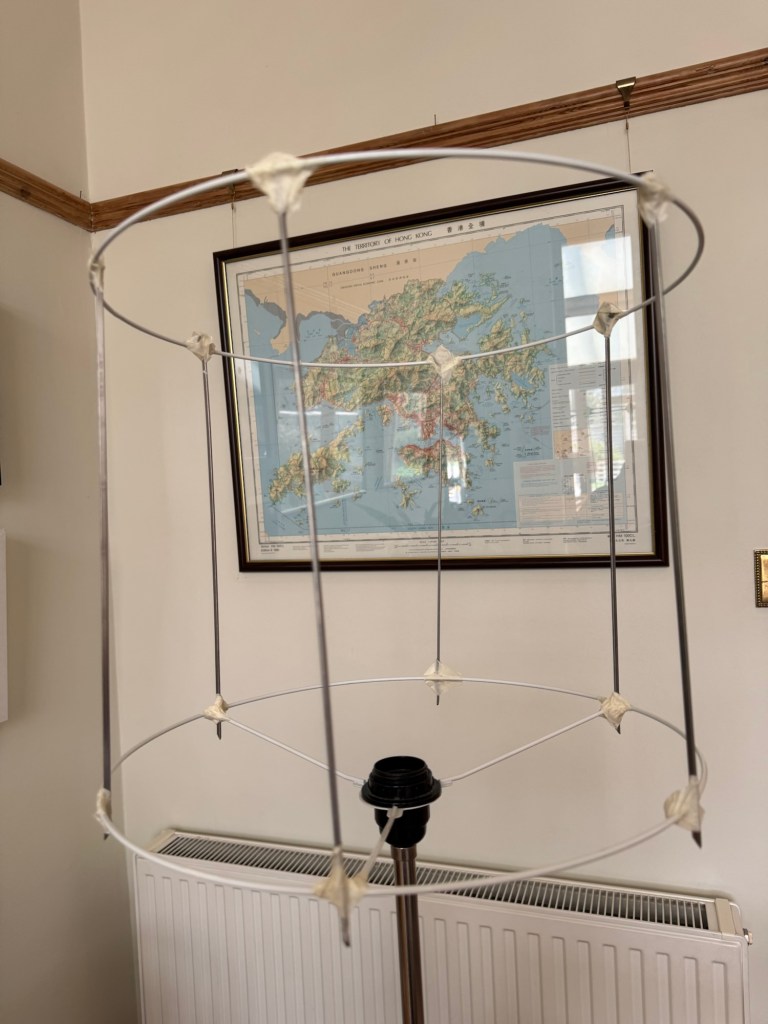
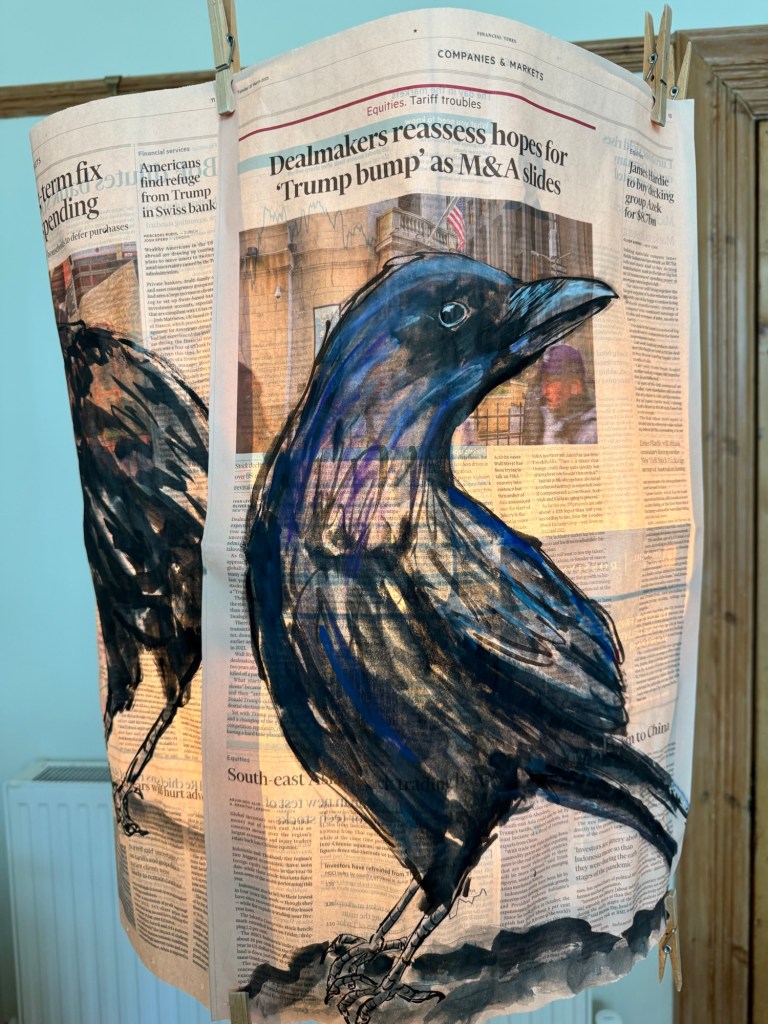
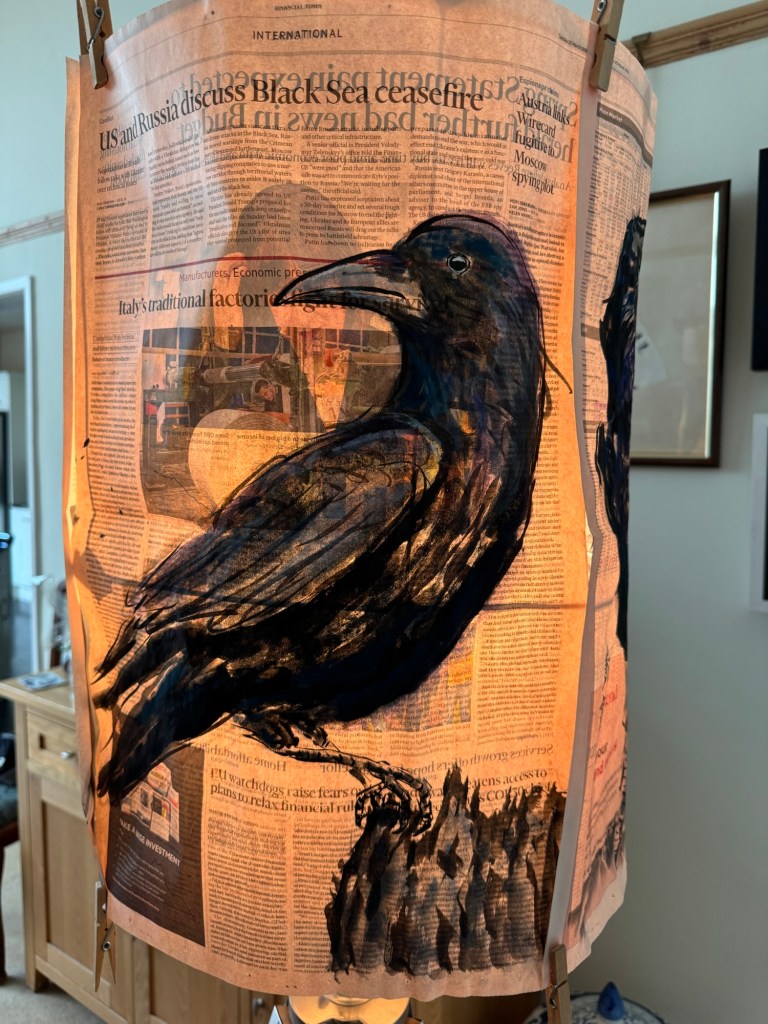
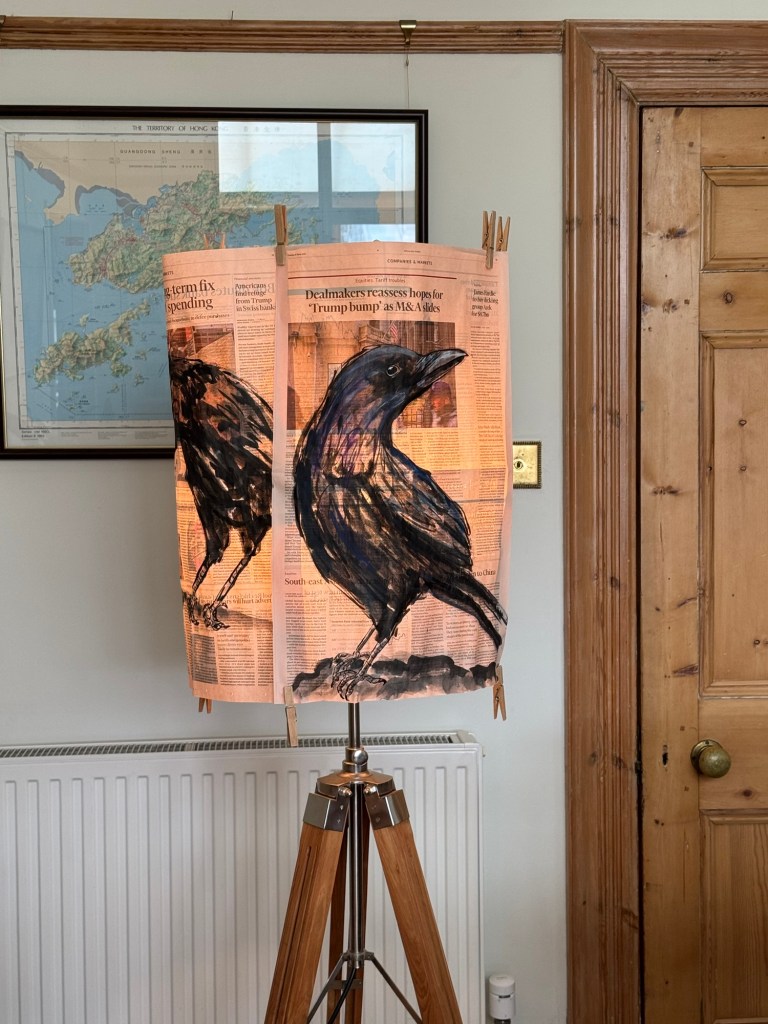
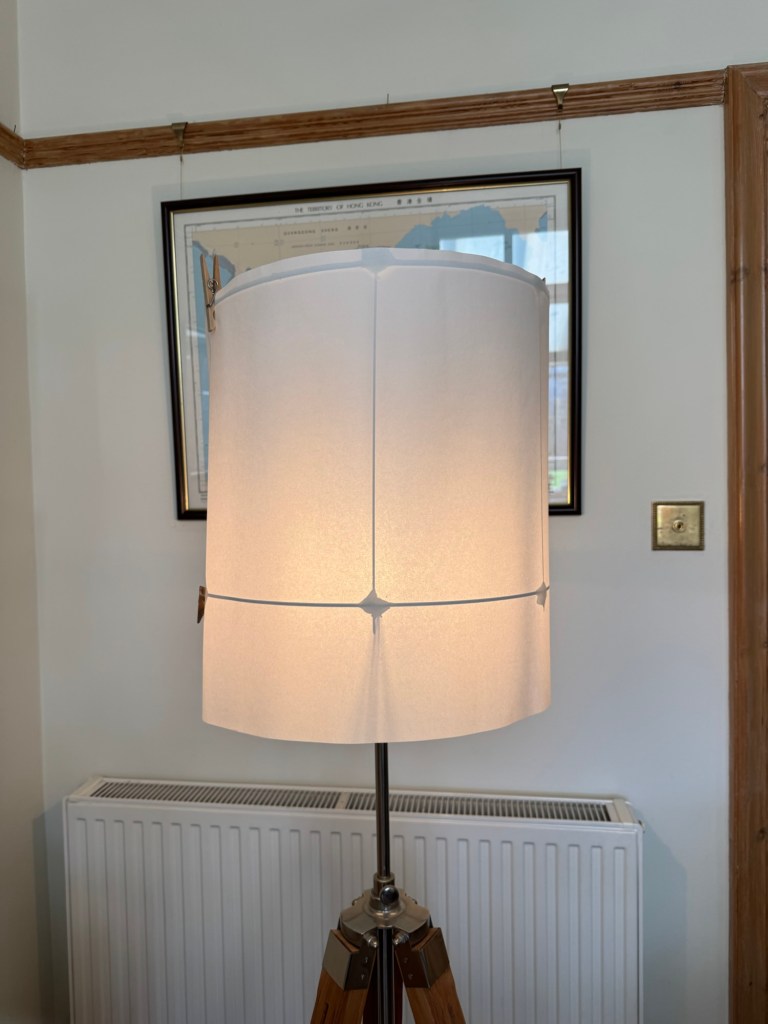
To find ways of showing the News Art with light shining through – it is necessary to not rely on having a window or sunshine for an installation. So I created a mock up lampshade frame to test how it would work if the light source was a light bulb.
Mock up lampshade frame
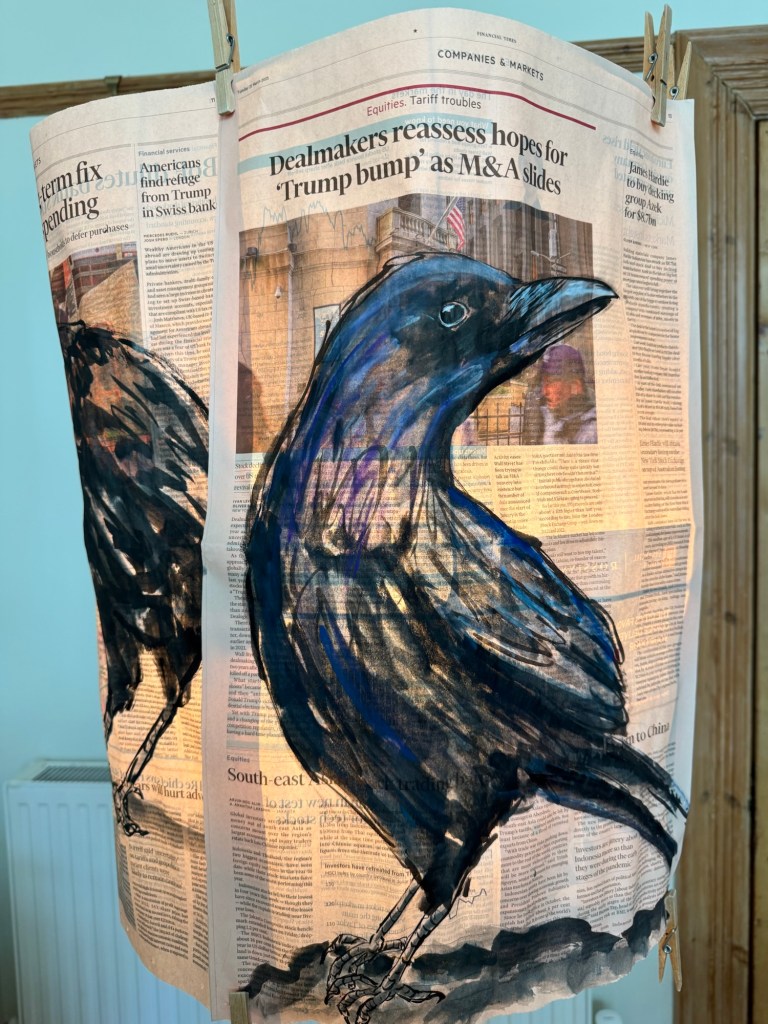
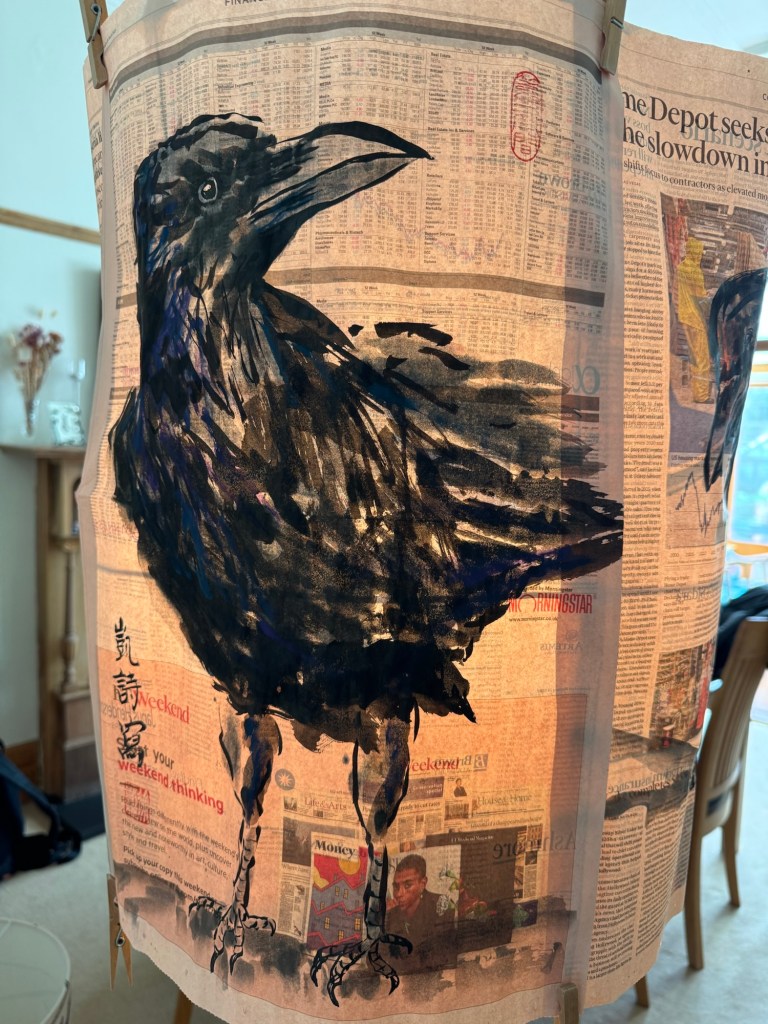
Then clipped the News Art to the frame with the light turned on:
–
Tried a few different images:
–
This showed the reverse side images were coming through well:
–
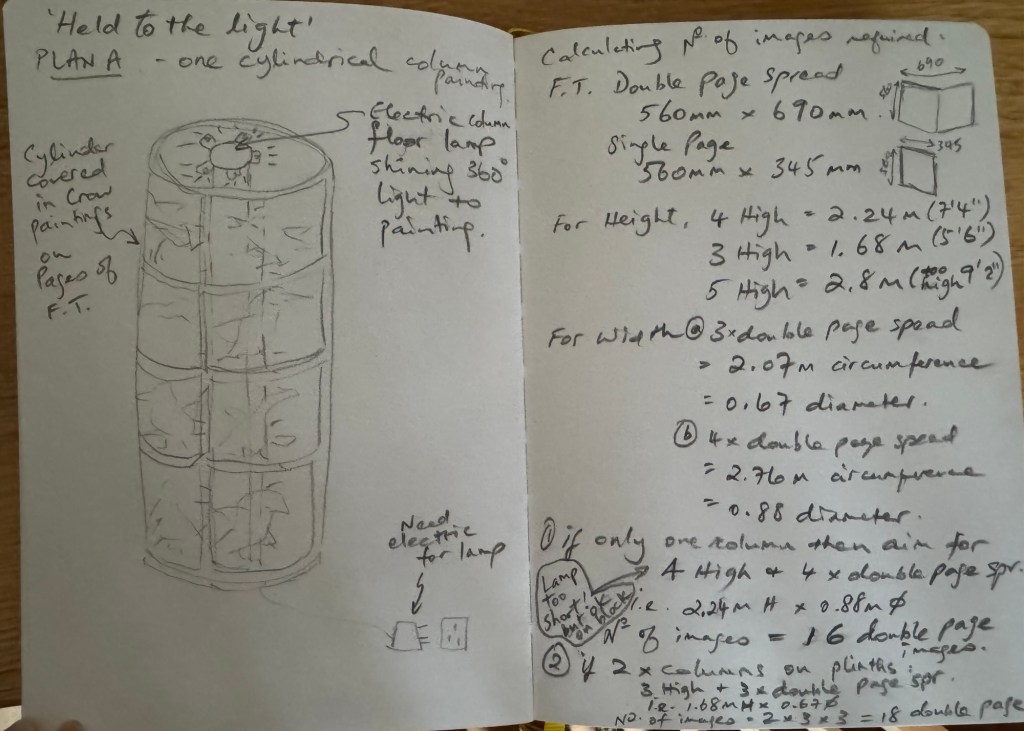
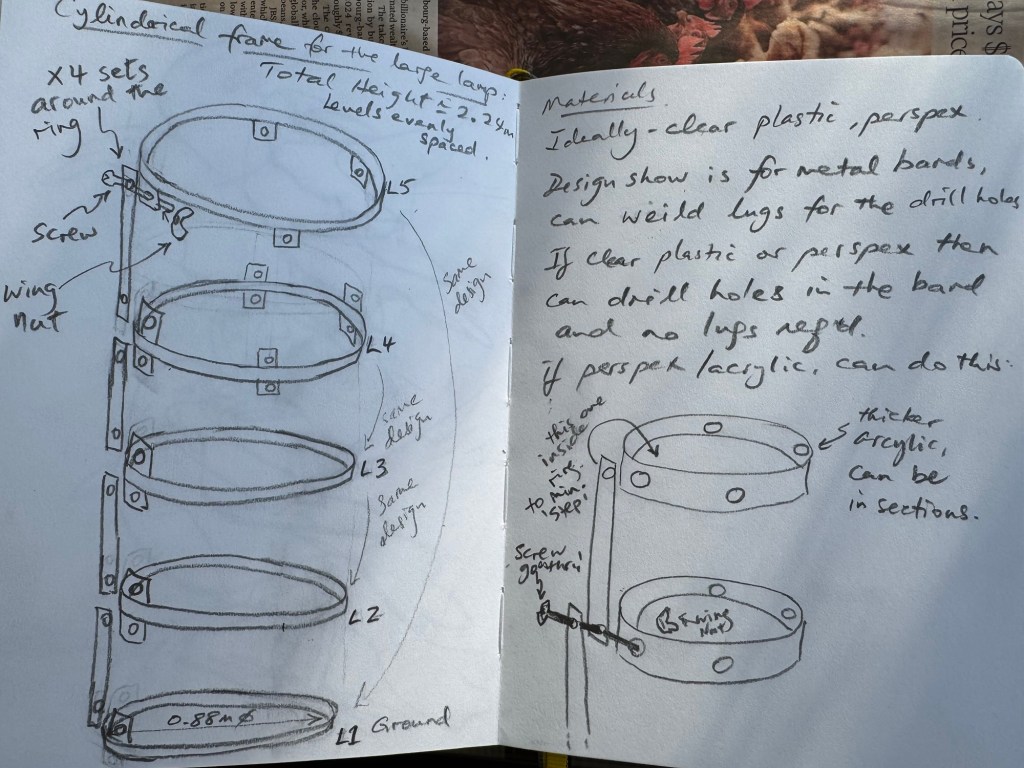
Then I considered a design for a cylindrical light tower to display the paintings in an installation:
–
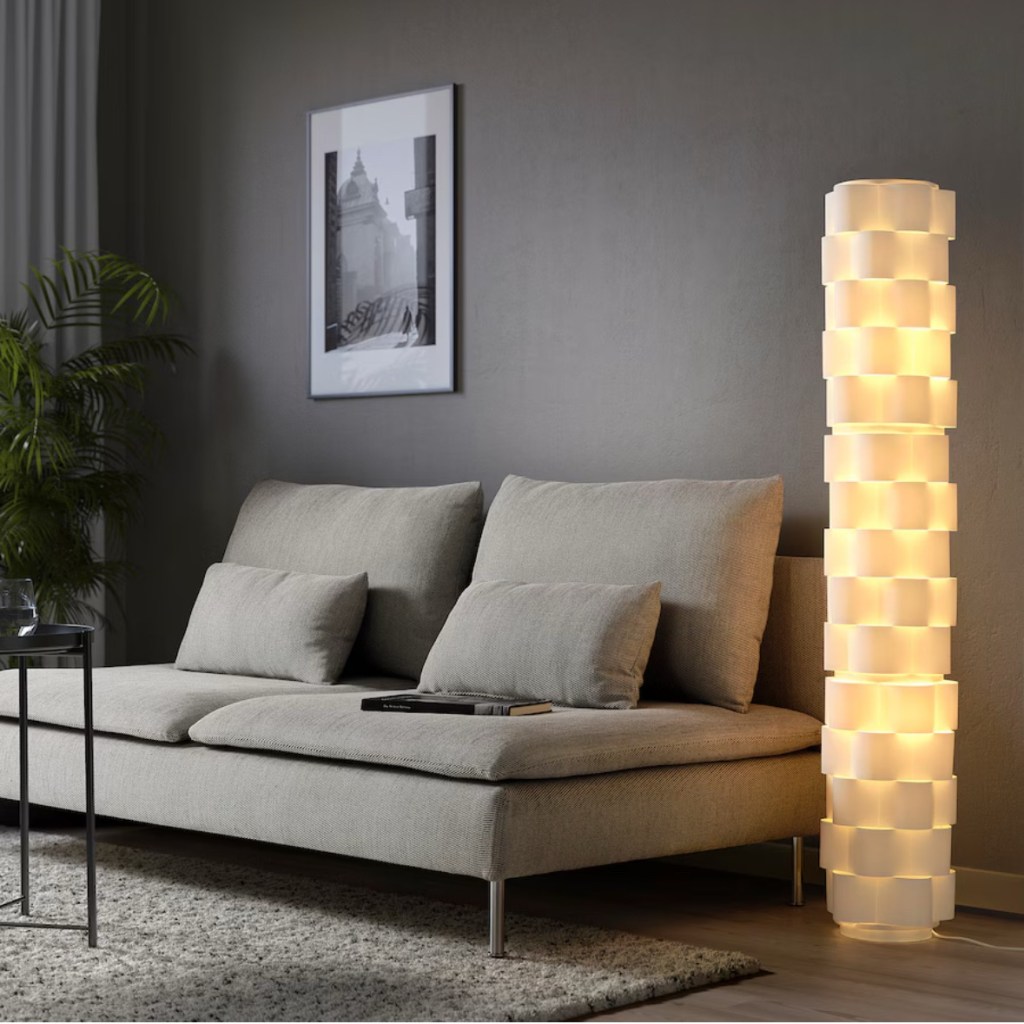
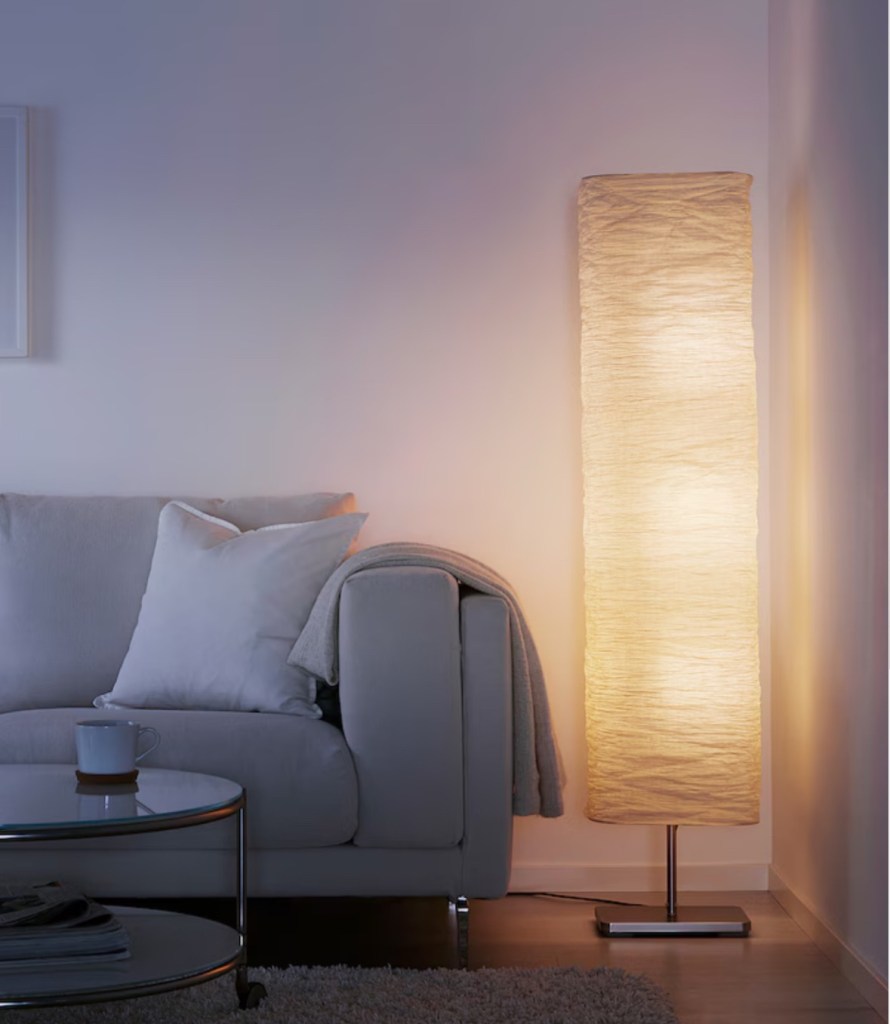
Some ideas were found online at places like IKEA with floor standing lamps that could be used instead of a custom made frame with the latter being a potentially costly option.
–
As an example, for the rectangular shade in paper shown above – it can take 2 double page spread of The FT at 3-high. It has more area than the circular one so would be better. This means 6 double page spreads per lamp. For a 3 lamp installation then that would mean 18 double page spreads in total. The rice paper lampshade could be slashed or torn to represent violence that is happening at the moment.
–
However, the rice paper shade around the lamp might block too much of the light. Hence more tests were done with the mock up lampshade and rice paper.
Mock up lamp with rice paper shade
There was sufficient light coming through the rice paper lampshade to reveal the images on the reverse side of the newspaper:
–
REFLECTIONS
The experiment was successful in demonstrating that a light bulb can illuminate the newspaper sufficiently to reveal the reverse side images, even with a layer of rice paper in between. This means the IKEA lamps could be used if I wanted a cylindrical installation.
A cylindrical installation means the viewer would have to walk around the lamp to see the whole composition. This maybe fine and could be a good way to install in the middle of a room with multiple floor standing lamps. However, if I wanted a large and flat composition like one large painting, then that would need to be hung on a wall or from the ceiling. If against a wall then I would need a light curtain of some kind to throw light onto the back of the newspaper. Ideally an enormous light panel or light box would be ideal but they tend to be very expensive. More to think about…
LEARNING
The experiments so far showed that a lamp with just one bulb was sufficient to show the reverse side images. Of course it would also depend on the distance between the light source and the newspaper. But the results were encouraging and I will continue to think about different ways to install my News Art work.
NEXT STEPS
Think of different ways to illuminate the art work in preparation for coming up with ideas for the degree show.
After reflecting on the News Art that I made in response to news headlines directly, I decided to be more subtle in the way I respond to the headlines. I decided to explore a more abstract way to express my feelings. What started my creating of News Art was the grief that I felt for the state of the world and my choice of using crows, inspired by the book ‘Grief is the thing with feathers’. So I returned to just painting some crow images as ideas came to me and not to overthink or be too deliberate.
METHOD
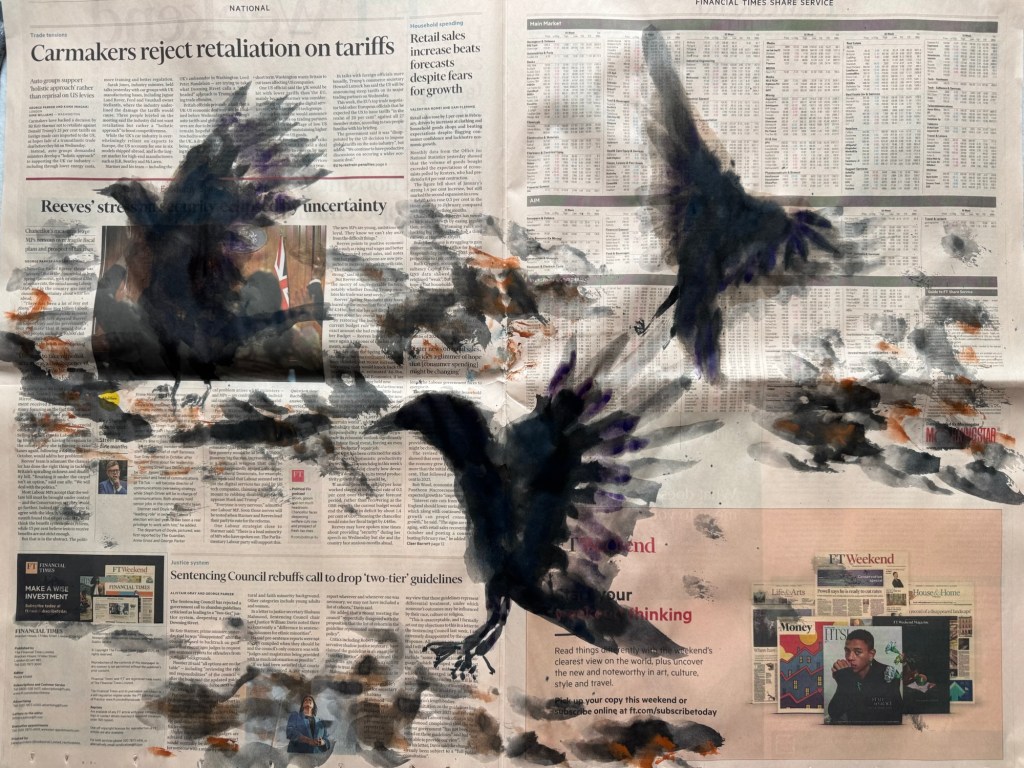
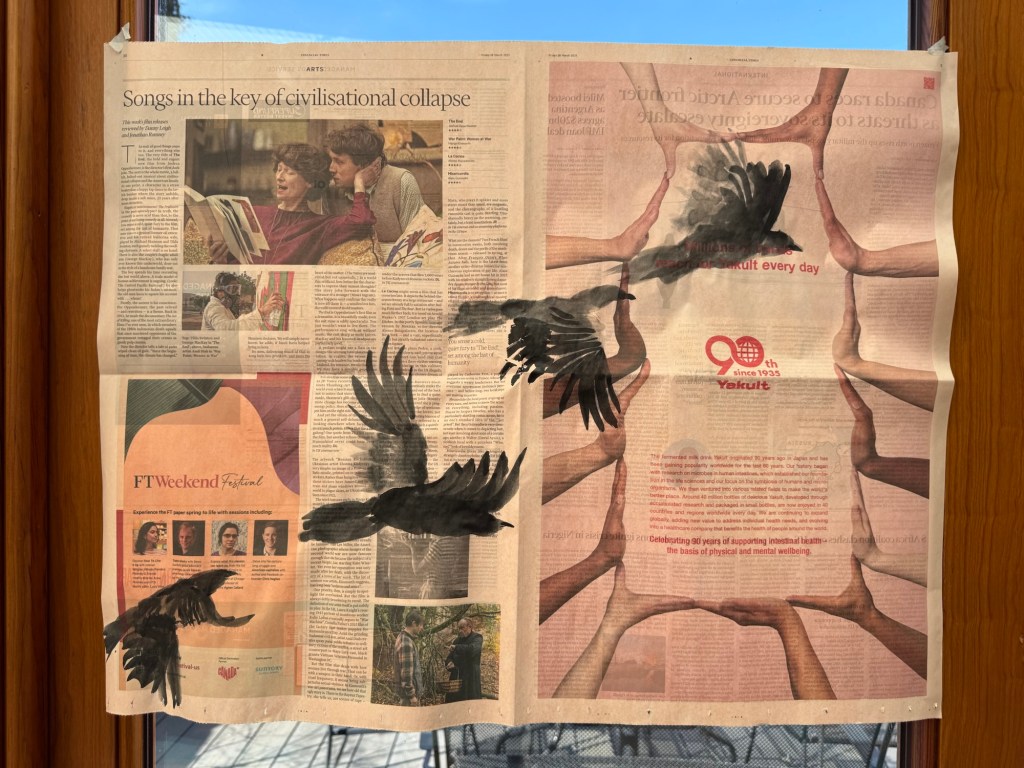
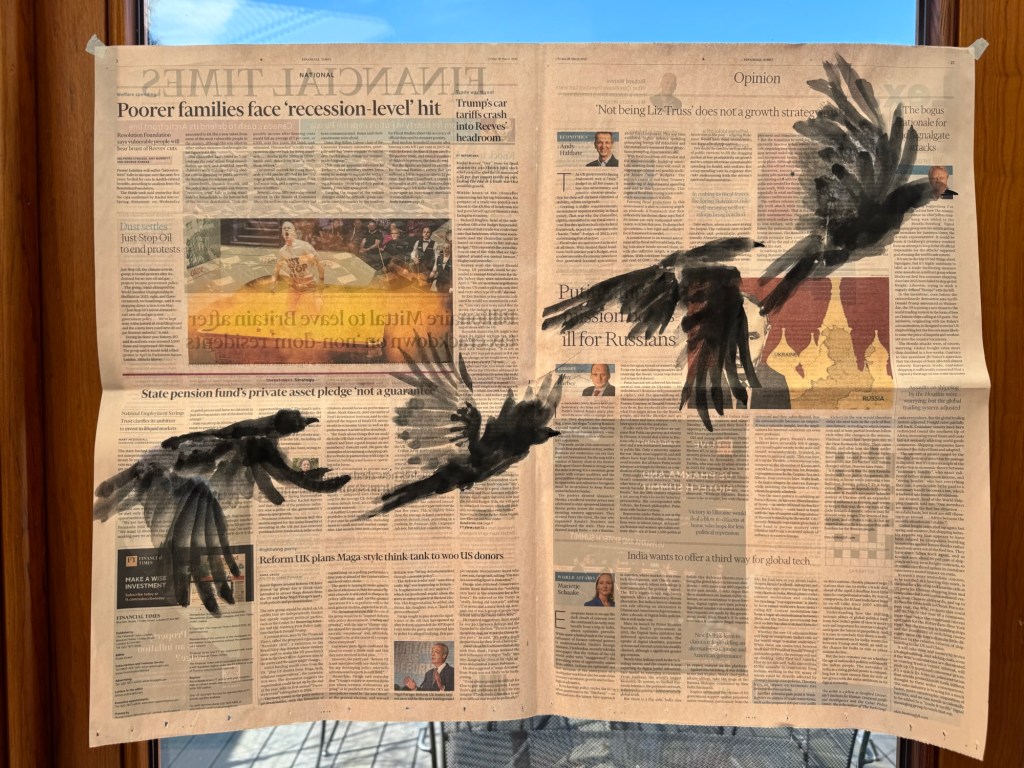
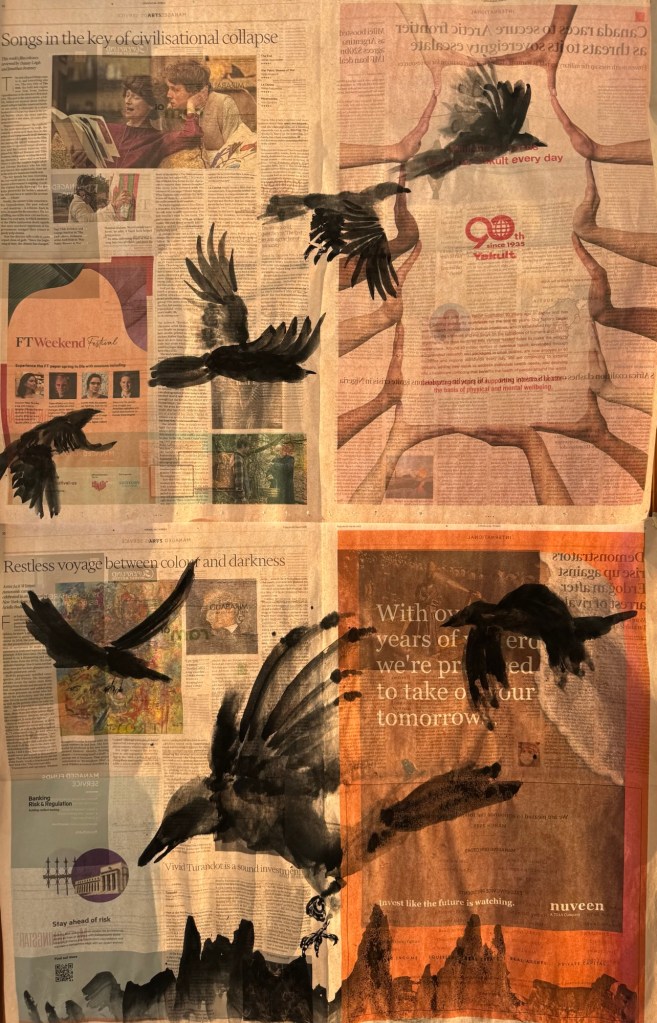
Without too much planning or thinking, I painted a few crows in flight using Chinese brush and ink in a free style Chinese painting approach. Then I held the painting up to the light:
–
Another painting done in the same way with a similar composition:
–
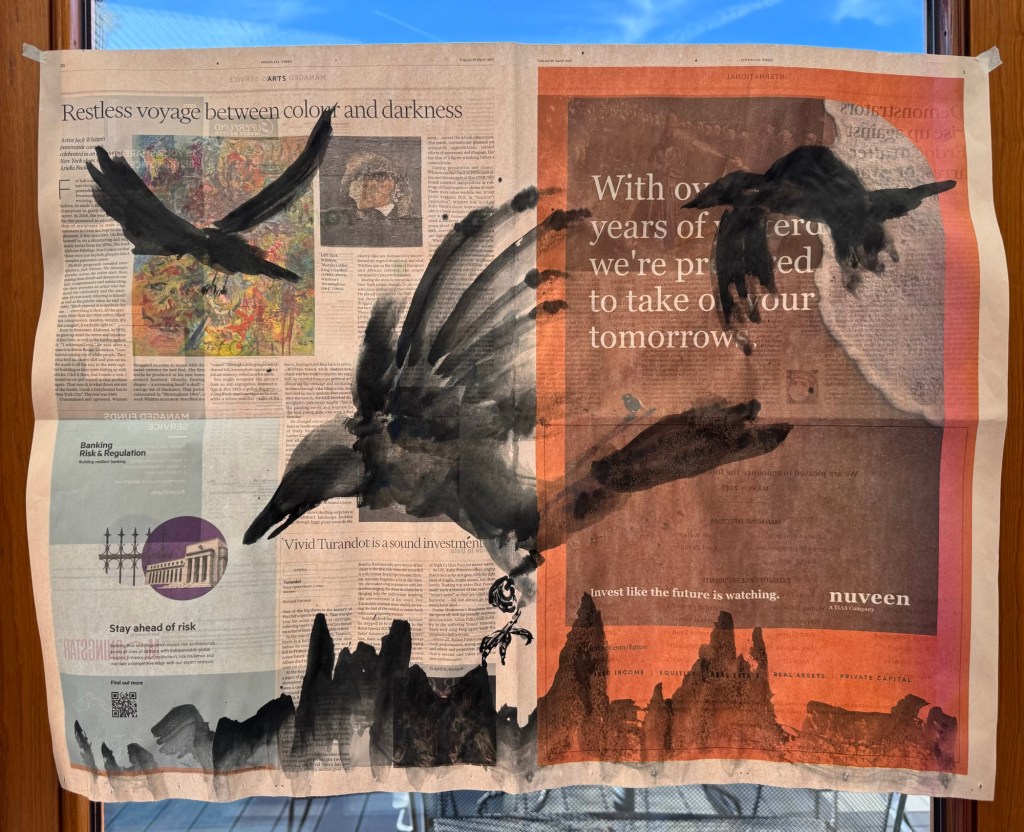
A more close-up view of a crow coming down for its prey with two others in the sky:
–
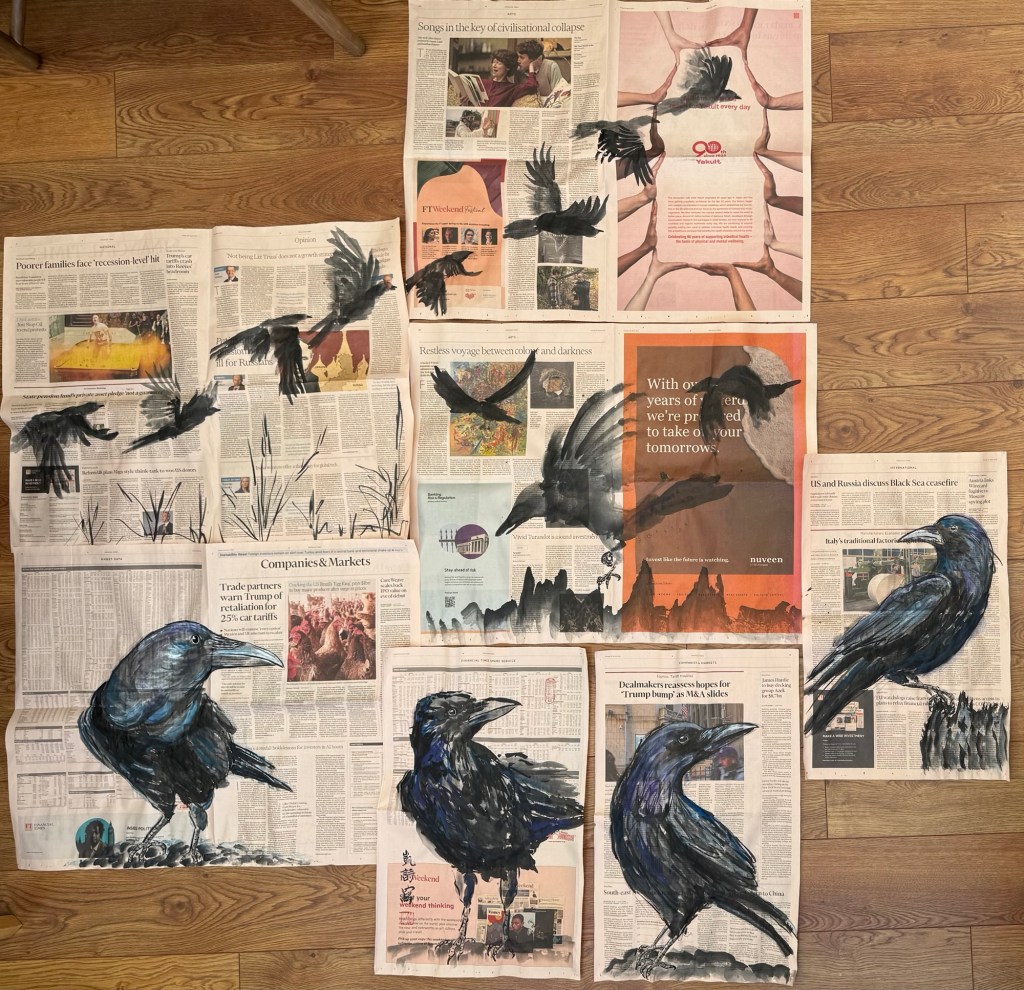
Since I had done quite a few of the crow paintings, I laid them out to see how they would look as a larger composition to get ideas on how to install these paintings as a group:
–
I finished by selecting two silhouette paintings that went well together and held them up to the light as one composition:
–
REFLECTIONS
I am pleased with the silhouette paintings. I like painting in Chinese free style. Some of the crow bodies were not quite right but overall the wings have worked out well. I feel they do give a sense of movement in flight. I am also happier with the more subtle and abstract approach to the news headlines selected. I also purposely chose the ‘ring of hands’ for the crows to fly through, like an escape route for them. We all need one of those at the moment!
Doing my newly discovered News Art has given me a reason to read the newspaper when I have felt inclined to avoid the news. Looking through the newspaper to pick out headlines to respond to has given me courage to face what’s happening in the world in a way that I didn’t expect.
LEARNING
I feel excited by my new discovery of making art in this way. I am gradually developing a process and as I get to know more about the newsprint material, I feel able to push things further such as how wet I could make it (very wet, surprisingly). I really like painting on the newspaper because it is not a blank canvas and the contents and images on each page give me so many ideas which is great.
One thing to bear in mind is that newsprint is not archival. This would be a problem if I continue to pursue this way of making. I need to look into ways to preserve the artwork especially if I’m thinking about showing these work at some point. Proper research is needed including asking specialists at CSM.
Overall, the main learning is to just keep making more work to explore this way of making. Ideas flood in as I make.



 elizarawlings