This is a piece of short reflective writing after discussing with my tutor about my sense of voicelessness as an artist given recent world events. I’m pleased that things do not feel as bleak after thinking it through hence I felt it was important to capture my thoughts here. I feel a new sense of purpose.
REFLECTIONS
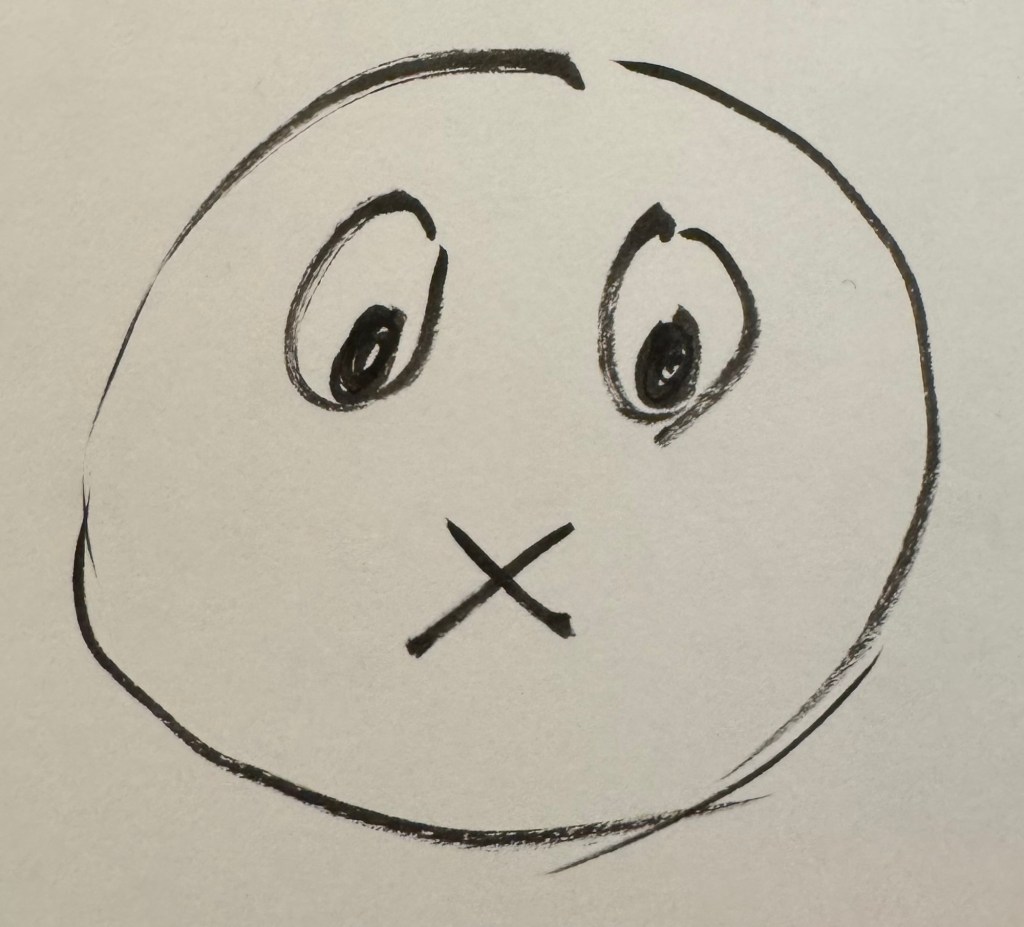
Voicelessness… or is it?
With the rapid change in world order, I have become acutely aware of my voicelessness as an artist.
In my previous life… in any crises be it the financial crisis, Brexit or Covid pandemic, I always had a voice through my corporate platforms. Those at the top of a hierarchy have a voice by default whether they have anything to say or not. What helped me to get through those crises was the sheer amount of work involved in getting the business and all the people I was responsible for through the challenges. There was little time to think how I felt about it all.
Opting out of the system for me meant giving up the structures that provided a scaffold for the coping mechanism. But having a voice in that environment was an immense responsibility. Every word and every pause mattered; there were too much and too many at stake.
Opting out and giving up my previous voice was my choice, it was my very reason for choosing because with voicelessness comes immense freedom. Freedom in turn releases an even more powerful voice. I feel a new kind of responsibility and a new purpose.
For the tutorial, I would like help with the following topics please:
a) An update from me – a personal situation leading to a mindset change which will influence how I approach my practice.
b) To determine a direction for my practice with the mindset change, possibly incorporating photography, ‘weaving paintings’ and the broader perspectives of my identity, whilst maintaining the objective of producing a coherent body of work. How to incorporate these new ideas into my ongoing practice without seeming incoherent?
*Note: Reflections captured in topic items 2 and 5 listed above are useful for tutorial discussion.
NOTES FROM TUTORIAL
1. Qi’s idea of ‘painting between likeness and unlikeness’ was discussed especially with unlikeness coming from the heart. Other similar ideas are ‘heart sight’ and ‘inner landscape’.
2. I explained my ‘new mindset’ regarding my thoughts and views on the current global issues. Also how I approach my practice (in the short term at least) will need to be re-evaluated to reflect my current state of mind because I cannot separate my art from how I feel. We discussed the fluid boundary between my ‘retreat’ and ‘assertive’ modes and what causes the drifting between modes.
3. The meaning of ‘a body of work’ was discussed as I asked for help on how to maintain a coherent practice with a potential change in direction. A ‘body of work’ is something that is authentically from an artist. The link between my work is therefore ‘me’.
4. In considering the direction going forward, I should give myself space and time to think and make. Keep making. Don’t obsess about having answers straight away.
5. Think about ‘what is it about me that manifests into my work’ to understand how ‘I’ provide the link between different pieces within my ‘body of work’. E.g. think about why I was more interested in film photography as part of my practice rather than digital photography because the latter is too quick to get results.
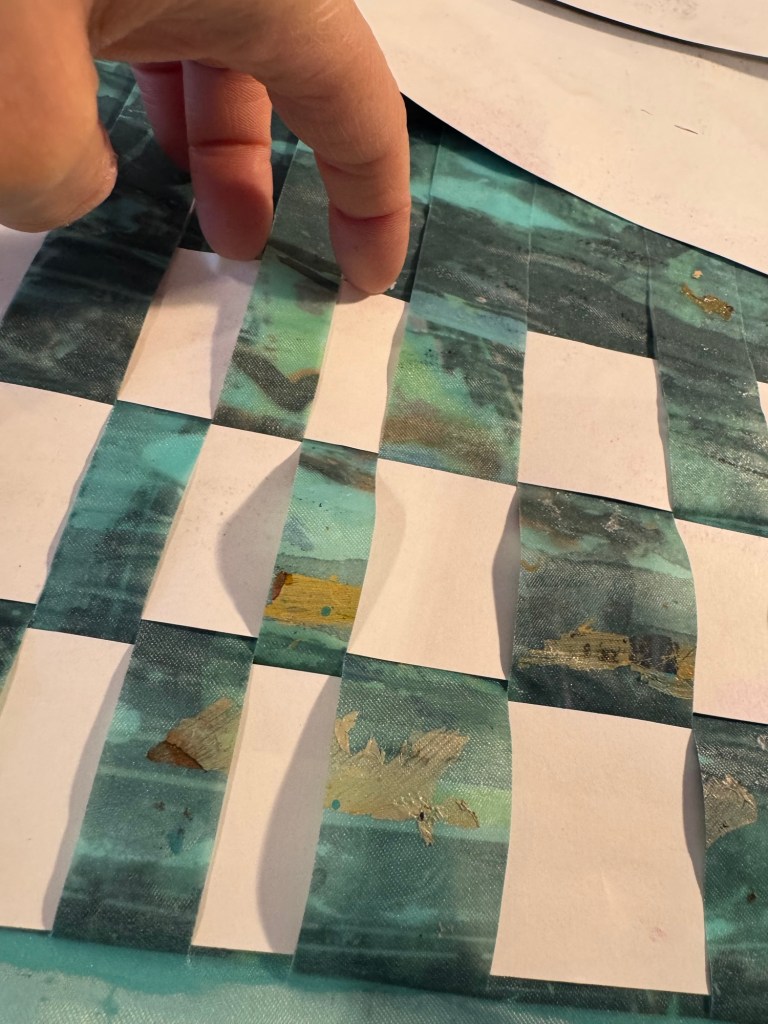
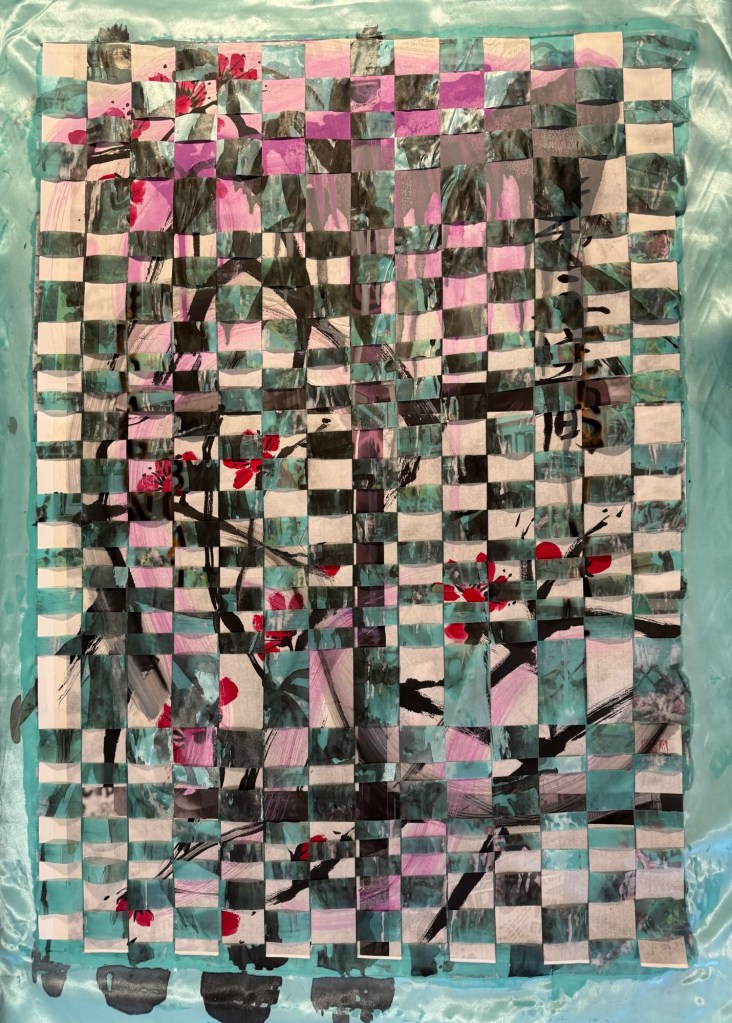
During my recent presentation on my research paper to my fellow students, I was asked why I talked about being transcultural and not intercultural. I talk about my transculturalism because I see it as a fusion process (as borrowed from physics) where two cultures come together and something completely new emerges (as per the definition by Homi K Bhabha). However, interculturalism is also applicable where I believe is when different cultures come together and intersect. It’s a process of weaving together rather than a fusion. I have not explored much about weaving cultures together although that is very much what I also do to navigate life. So I decided to investigate ways to weave my art to explore the idea of intercultural vs transcultural.
METHOD
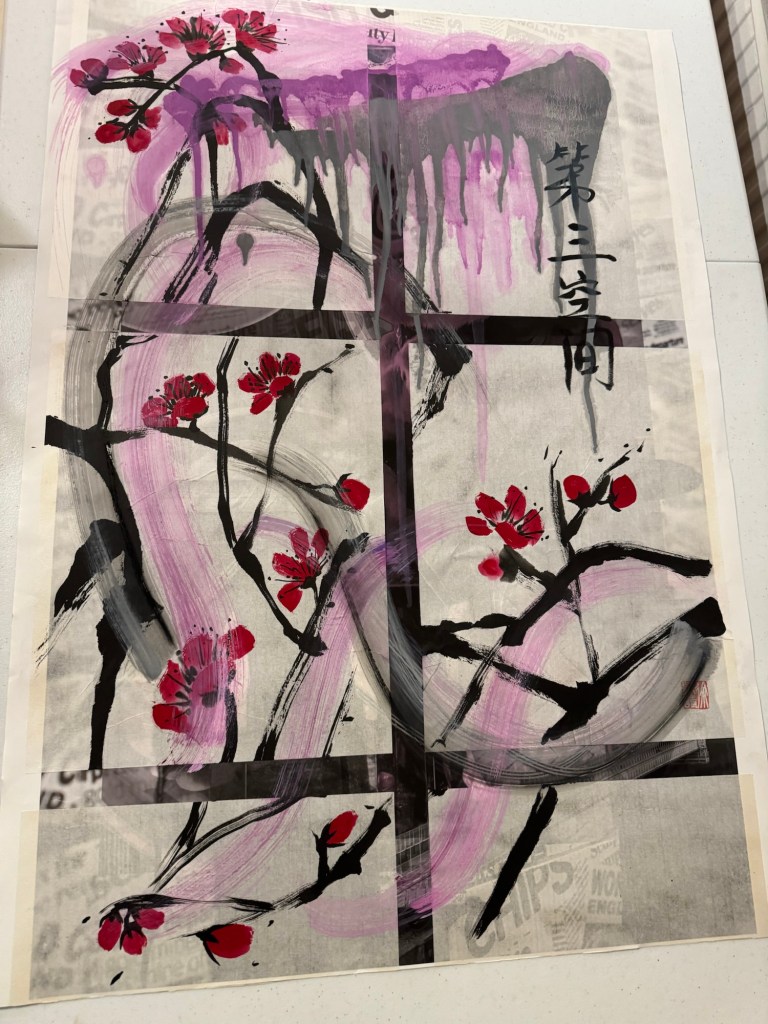
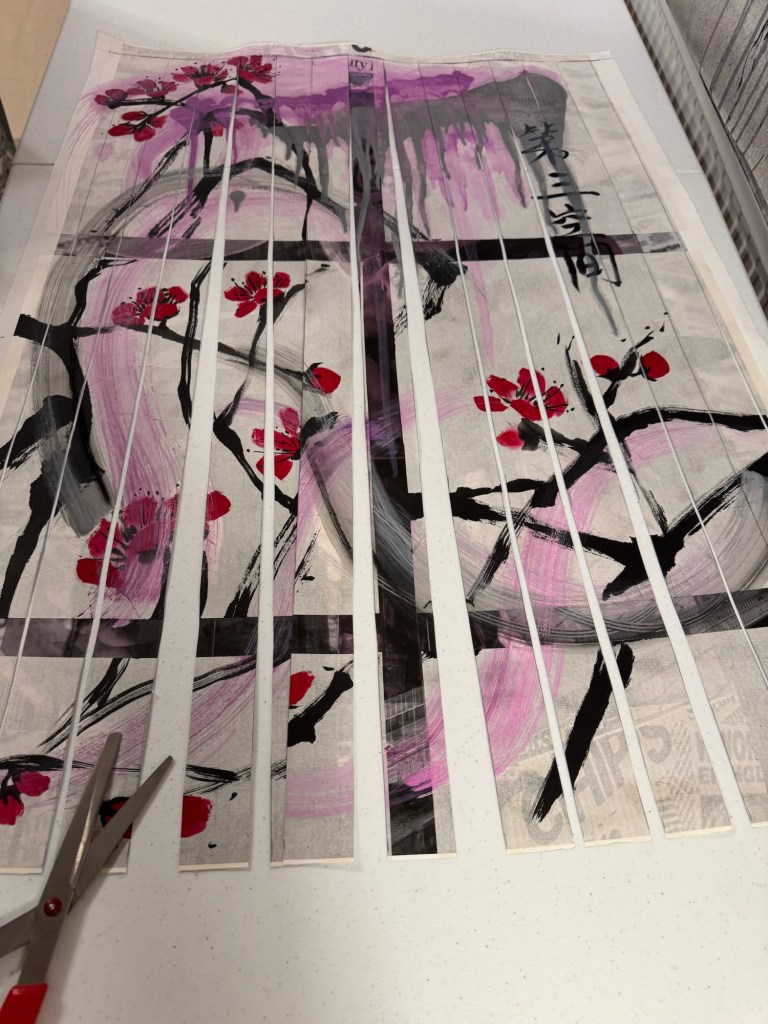
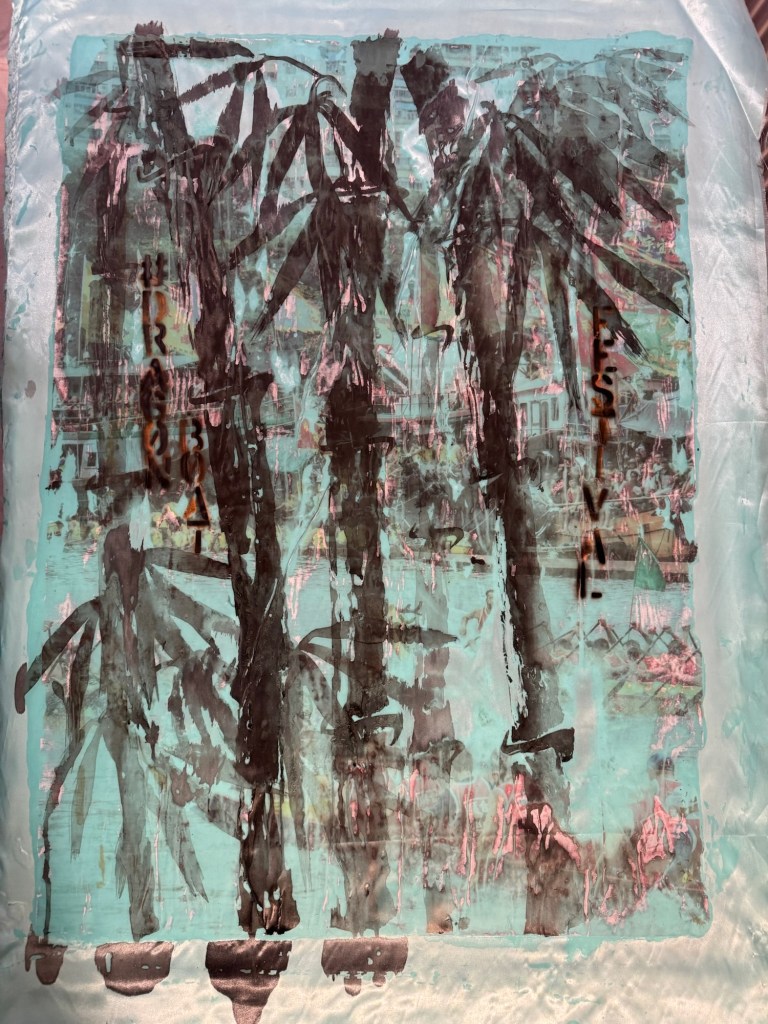
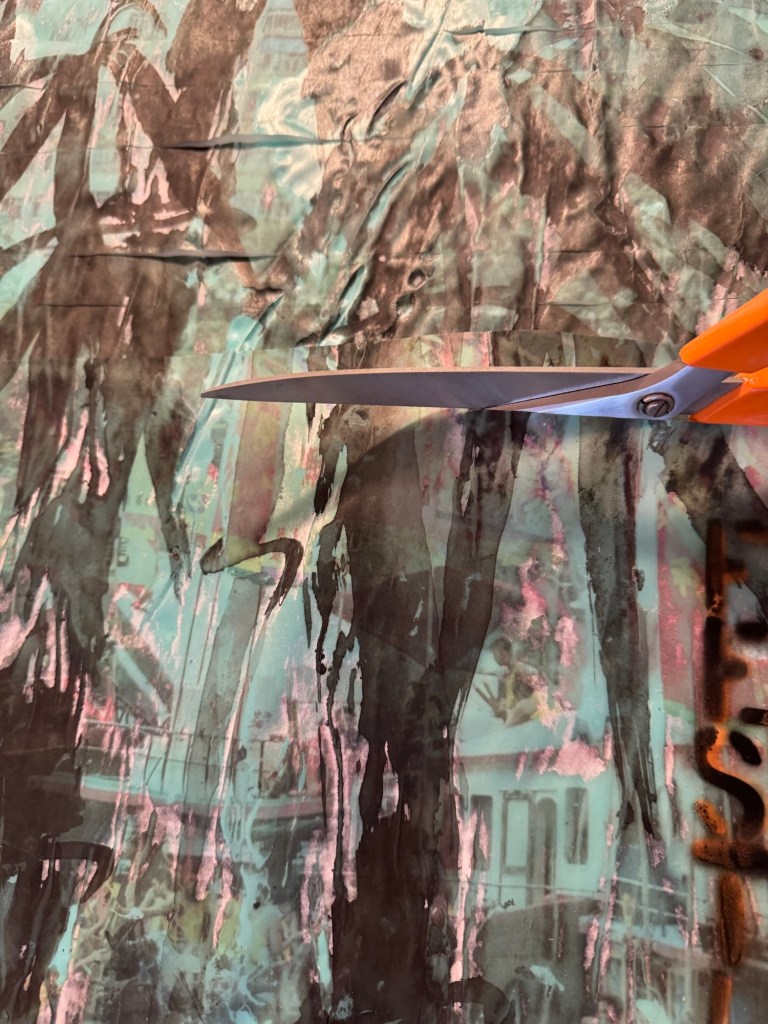
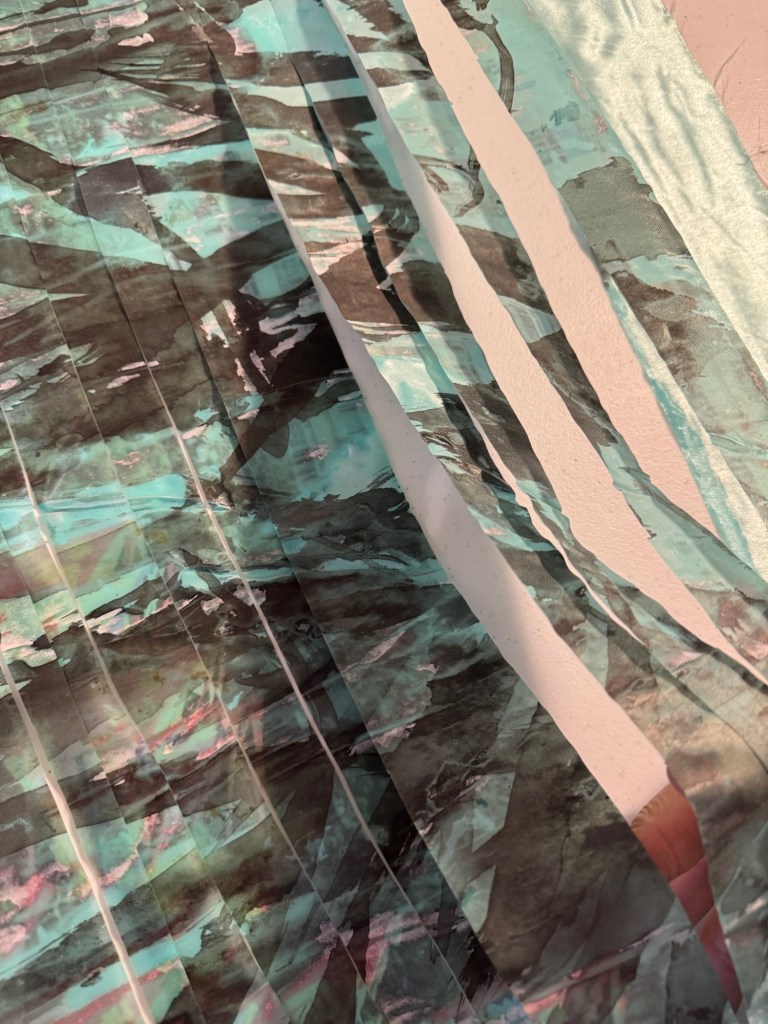
I chose two of my existing paintings for this project. To weave them together, I would need to cut them up first.
First chosen painting for cutting up – a piece of work from three years ago, Chinese ink on rice paper on inkjet printed paper:
I did some quick research on the definition of intercultural. The Spring Institute said, ‘Intercultural describes communities in which there is a deep understanding and respect for all cultures. Intercultural communication focuses on the mutual exchange of ideas and cultural norms and the development of deep relationships.’ Many definitions describe intercultural as the coming together of a group of people of different cultures. From the quick research, I did not find any reference to the intercultural experience occurring within one person. I.e. when one person experiences and navigates different cultures within their daily existence.
To help explain my thinking about intercultural vs transcultural, I need to borrow an analogy from A Level chemistry – the definition of a mixture vs a compound.
Mixtures are heterogeneous forms of matter. The composition of a mixture is variable with each components retaining its characteristic properties. Its components are easily separated. Examples of Mixtures: soil, ocean water, air, the cytosol of a cell.
In contrast, compounds are homogeneous forms of matter. The components of a compound do not retain their individual properties. E.g. both sodium and chlorine are poisonous; their compound, table salt (NaCl) is absolutely safe and essential to life. Another example of compounds is water (H2O).
It takes large inputs of energy to separate the components of a compound. Similarly, I have previously used the fusion concept from physics to explain the forming of transcultural characteristics. Fusion takes an immense amount of energy to take place. So learning from the analogies from science, I believe that for a transcultural person to go through the cultural transmutation process, it takes much energy and also time for the process to take place. Whereas I do believe that one can start to adapt to an intercultural life more readily. For example, an immigrant child moving to the UK with her family from say, Asia, could be adopting a full British style life at school during the day, then go home after school and be immersed back in her original culture in the home environment. That in my opinion is a form of an intercultural life.
REFLECTIONS
So where am I going with this?
Although I’m using science as analogies to explain intercultural vs transcultural, I am not asserting those thoughts as a definitive explanation, that would be grossly generalising and reductive. They are just ways of sense-making for me and to help me to think through the different cultural concepts. I could do more in depth academic research on the subject and I may well do so later. But for now, I am enjoying the thinking process based on my own experiences as I make art. I don’t believe I am anywhere near having answers, but I have started the thinking process on the subject.
How about the weaving? What did I get out of it?
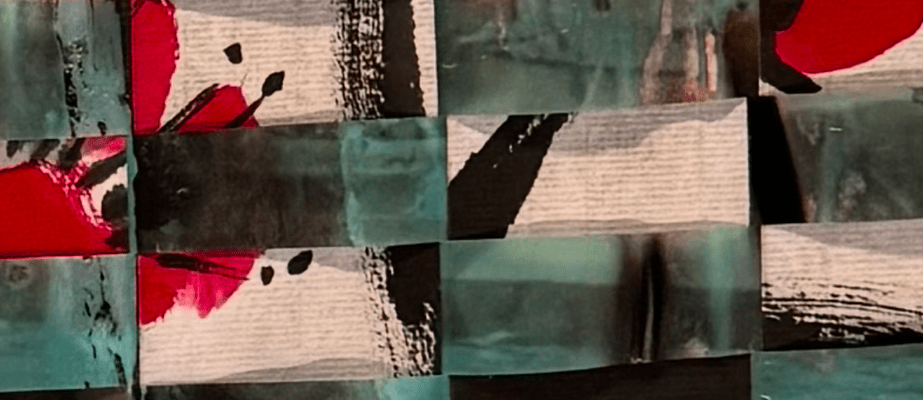
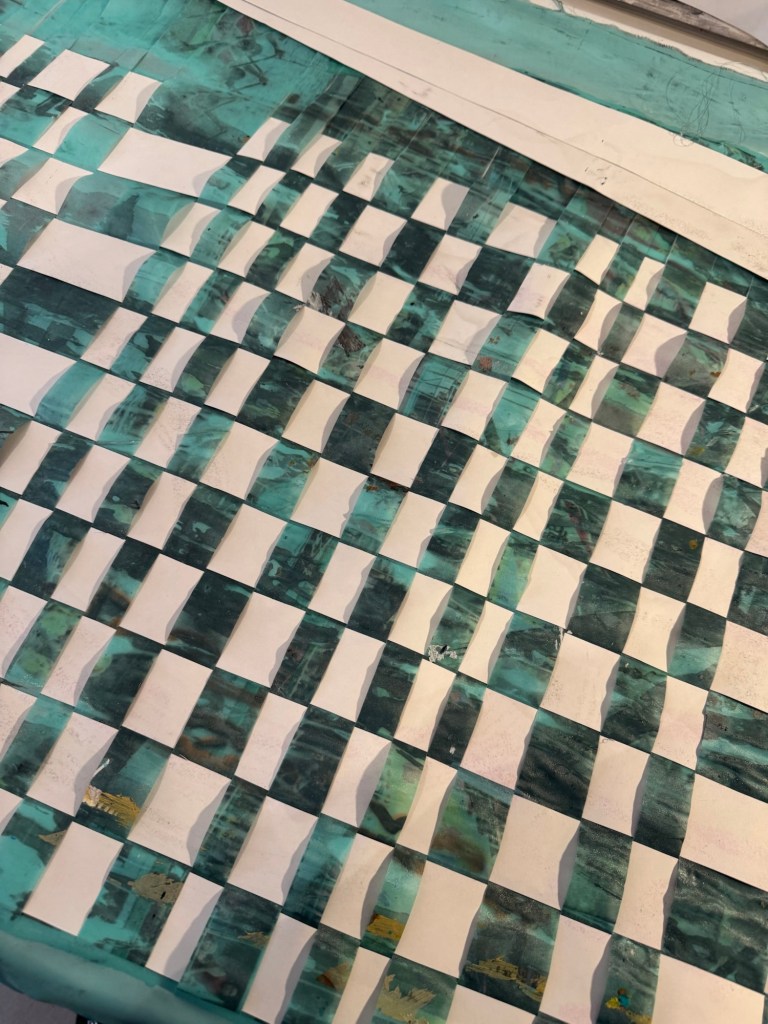
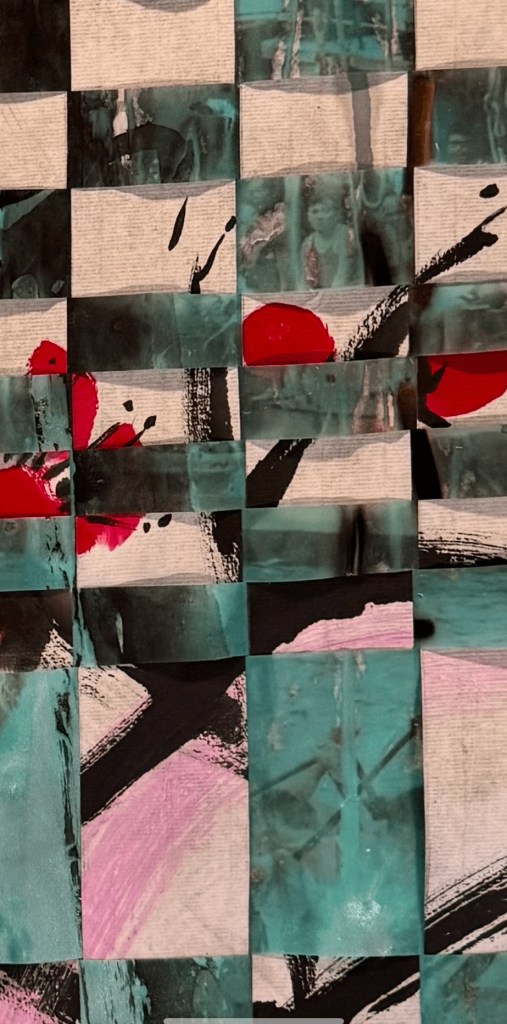
My weaving experiment here was more of a technical exploration to see what happens when two paintings were woven together with a view of taking the learning to future works. Some questions that I asked myself in reflection were:
– How was the weaving process? It was quite easy and straightforward to execute, but that was because the width of each strip was fairly wide so quite easy to handle. I would like to try and weave with narrower or more irregular strips to challenge the process and create a less uniform pattern.
– What did I think of the outcome aesthetically? I wanted to see if the individual painting images would still be present but more ambiguous. I think I could say yes to this – I could make out the two original images but with missing details adding intrigue.
– How about the cutting process? That was very interesting! The cutting up of my paintings felt brutal but liberating. To not feel too precious about one’s work was definitely liberating. In previous blogs I’ve talk about how I valued the process of making more than the outcome. Once a piece of work is made, I usually feel quite detached about the piece of work. So I hope I will be prepared to cut up more paintings to investigate the weaving of work. Also, the cutting process helped me to release some of the anger and despair that has been building up for me regarding certain global issues going on right now.
– What am I really trying to achieve by the weaving process? I have struggled for some time to express my transculturality through my art. I have written about this before calling it the elusive ‘green’. I kept painting with blue and yellow (metaphorically) but couldn’t yield a satisfactory green. Meaning that I couldn’t come up with something that represented my transcultural / fusion process. When I was asked by my classmate ‘why not intercultural ?’, it occurred to me that interculturalism is also applicable to me, perhaps if I start with that, I might get more insight into the transculturality that I want to express. Imagine if the width of the cut-up painting strips were so narrow that the two images eventually became one, then that would be like a fusion process, or a ‘chemical compound’ would have been created where it’s no longer easy to separate or decipher the two original images. Hence like something new emerging in the third space.
Taking this idea further, I have in the last two years explored much about my transculturality, however, that is only a part of my identity. I consider myself a Hong Kong born British Chinese engineer artist woman business-leader and mother. In examining my identity as a transcultural person, I have not yet explored the dynamics between the engineer and the artist; or the experience of a woman and mother; or my voice as a business-leader vs that as an artist. In an earlier blog, I talked about wanting to re-explore an area that I have found comfort in the past (new objectivity industrial art). How do I combine that desire/need with my ongoing transcultural practice? They seem very different but are all part of me and my identity.
LEARNING
Since I exist in the intersection of multiple aspects of my life, I need to consider how I broaden my identity exploration beyond the current transcultural perspective. I cannot think of how I can express the different identity elements whilst remaining coherent. Perhaps I can make paintings about the different elements and then weave them together to see what images emerge. E.g. weaving together a Bristol streetscape with a Chinese ink painting, or an oil painting of my childhood family dinner with my expression of womanhood. What would that look like? This means instead of creating one image that embodies the different aspects of my intersectionality (like in Akunyili Crosby’s work as described in my research paper) which I have struggled to create satisfactorily, I can create multiple images and weave them together to see what comes out. This doesn’t mean I will adopt the weaving of paintings as a main process for my practice, but it might give me ideas and inspiration to create images (more abstract and ambiguous images) to express my overall identity. Importantly, it gives me a way forward when I’m feeling somewhat stuck with the complexity of too many ideas.
NEXT STEPS
– Cut up two more paintings with narrower strips then weave them together to see how the overall image develops. Use smaller size paintings like A4 so the experimental process can be quicker.
– If the above experiment is successful, then think about what to paint to really explore the different aspects of my identity and then weave the works together to see what comes out.
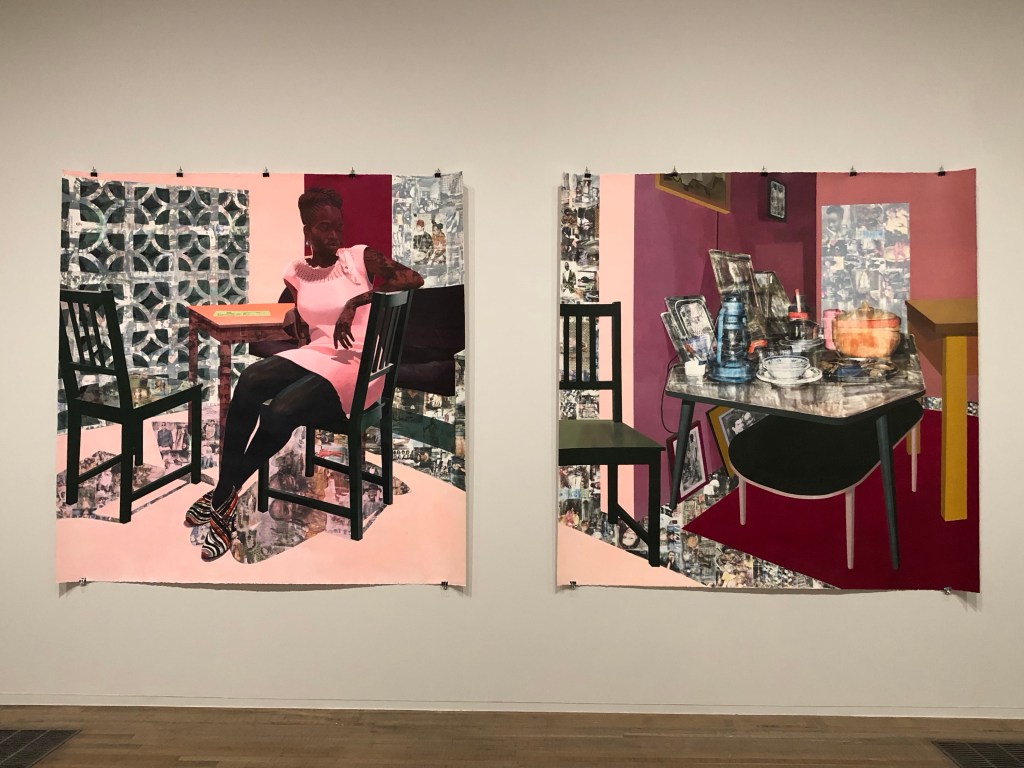
I had a tutorial with an Academic Support tutor from CSM and we discussed painting. I talked about one of my favourite transcultural artists Njideka Akunyili Crosby. I talked about how in awe I felt when I saw her large diptych at Tate Modern last year. The tutor suggested that I made a painting to respond to the work.
Akunyili Crosby’s work at Tate:
–
METHOD
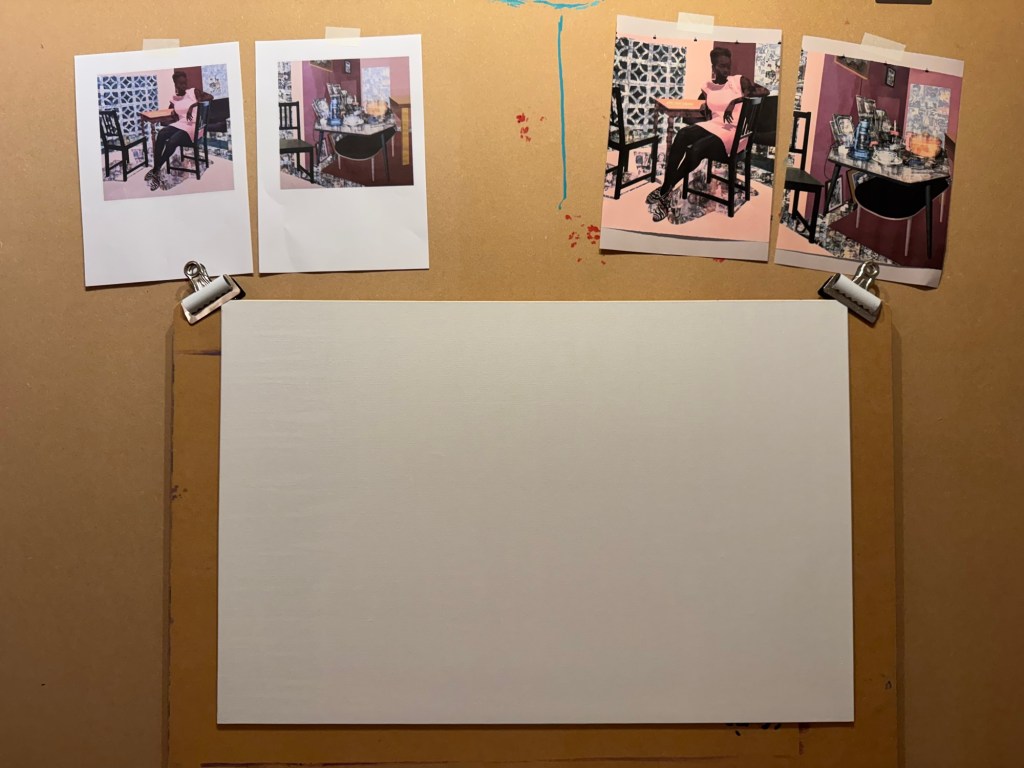
I printed out Akunyili Crosby’s work to give me inspiration. A board canvas was chosen.
–
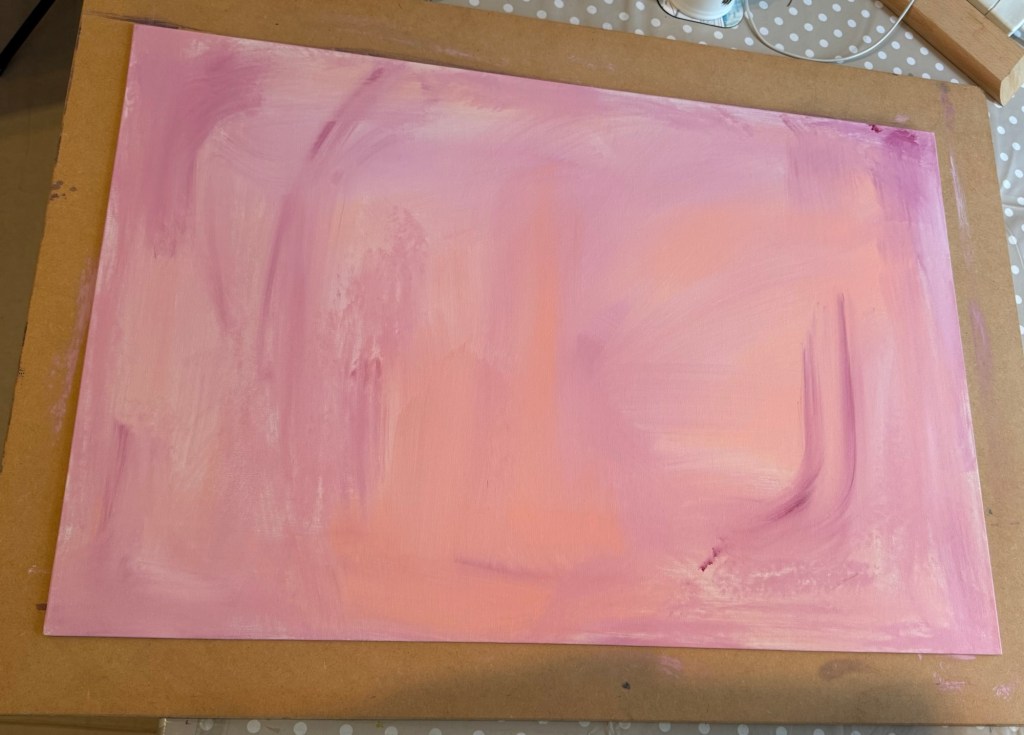
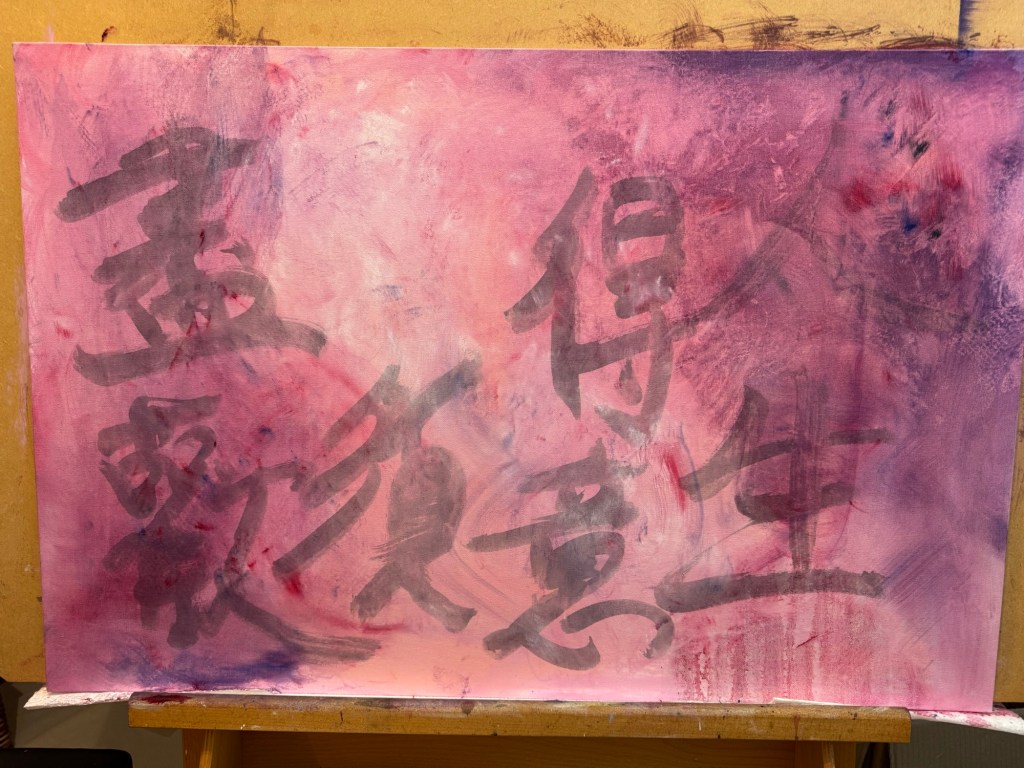
A thin acrylic wash of mixed colours was applied to cover the canvas.
–
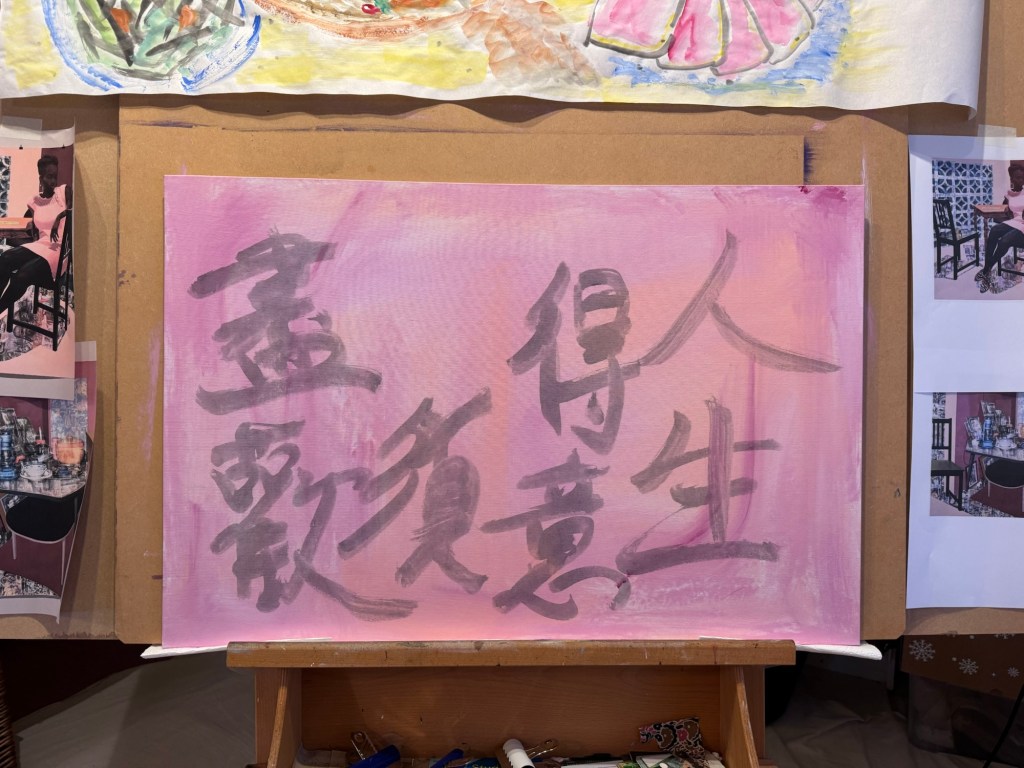
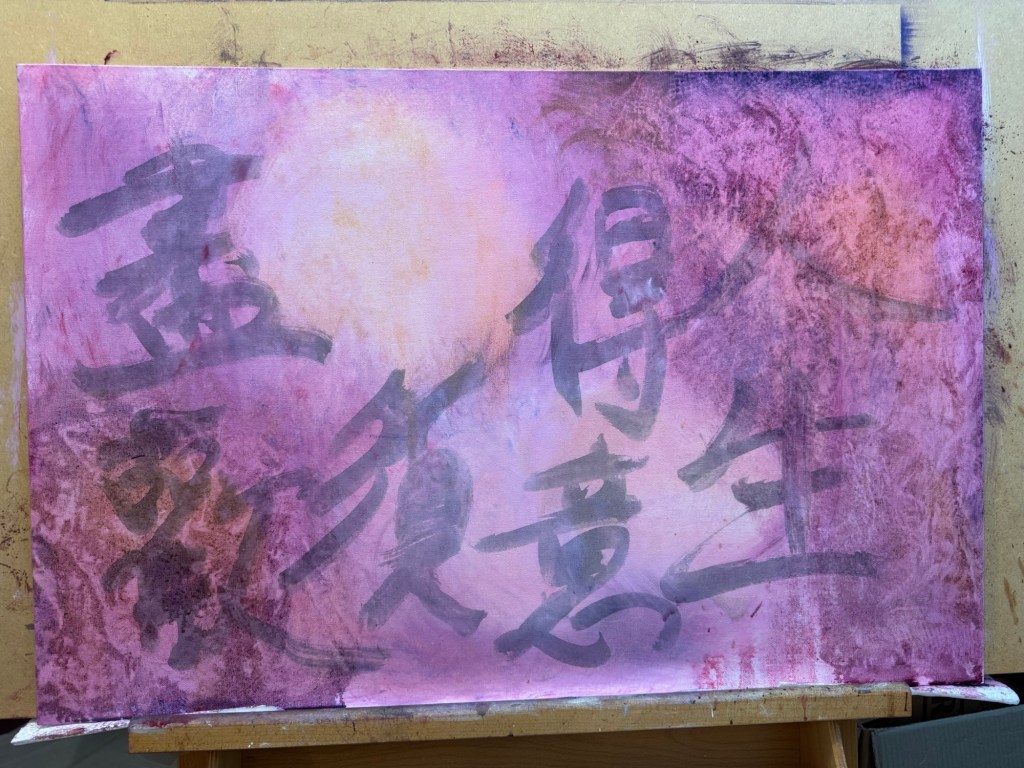
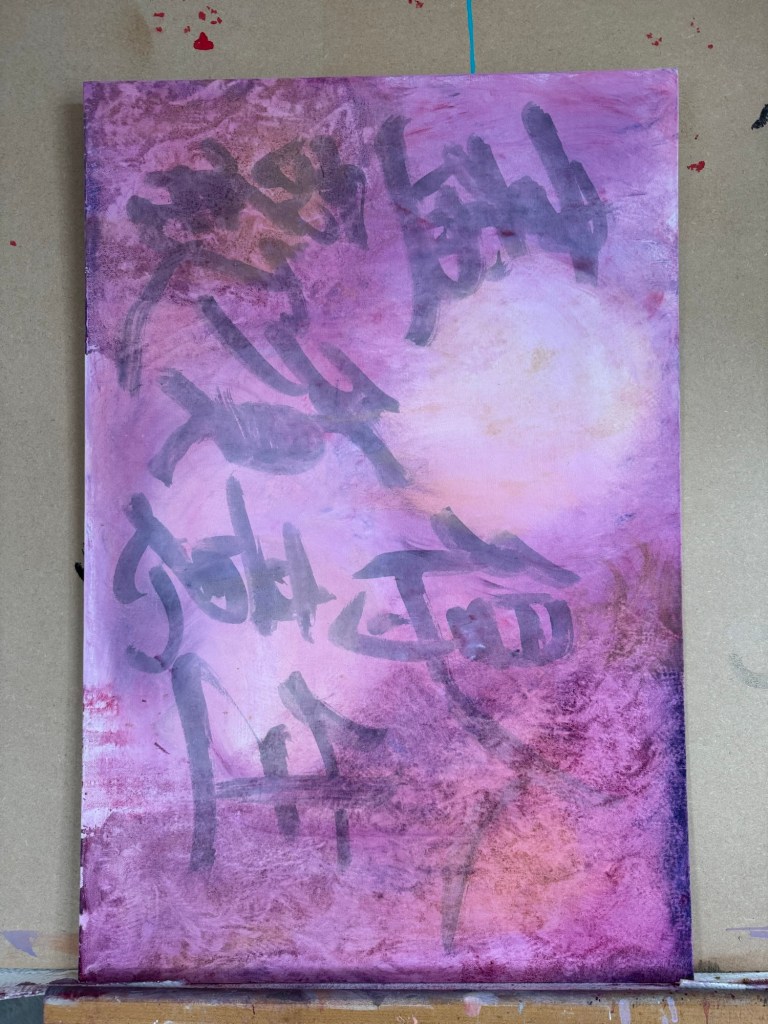
A line from a Chinese Tang Dynasty poem was chosen and written onto the canvas in Chinese ink to add some extra images onto the background. The line translates as – in life, when times are good, really celebrate.
–
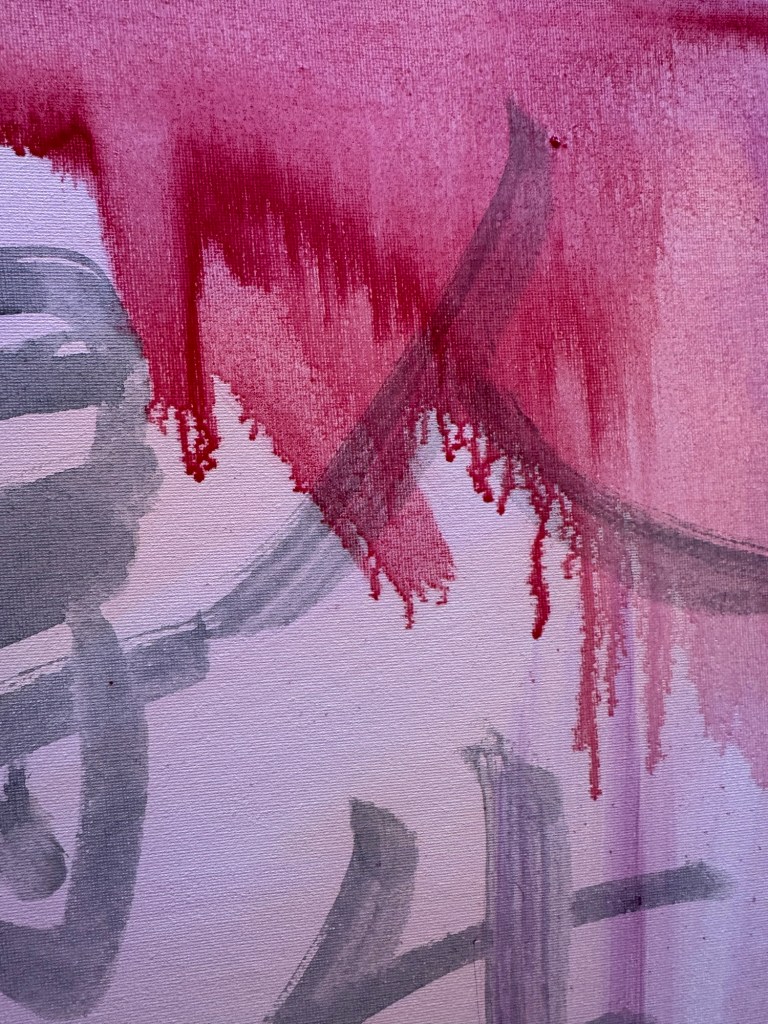
Then very thin layers of oil paint were applied loosely with brushes. The canvas was kept vertically for the paint to run down.
–
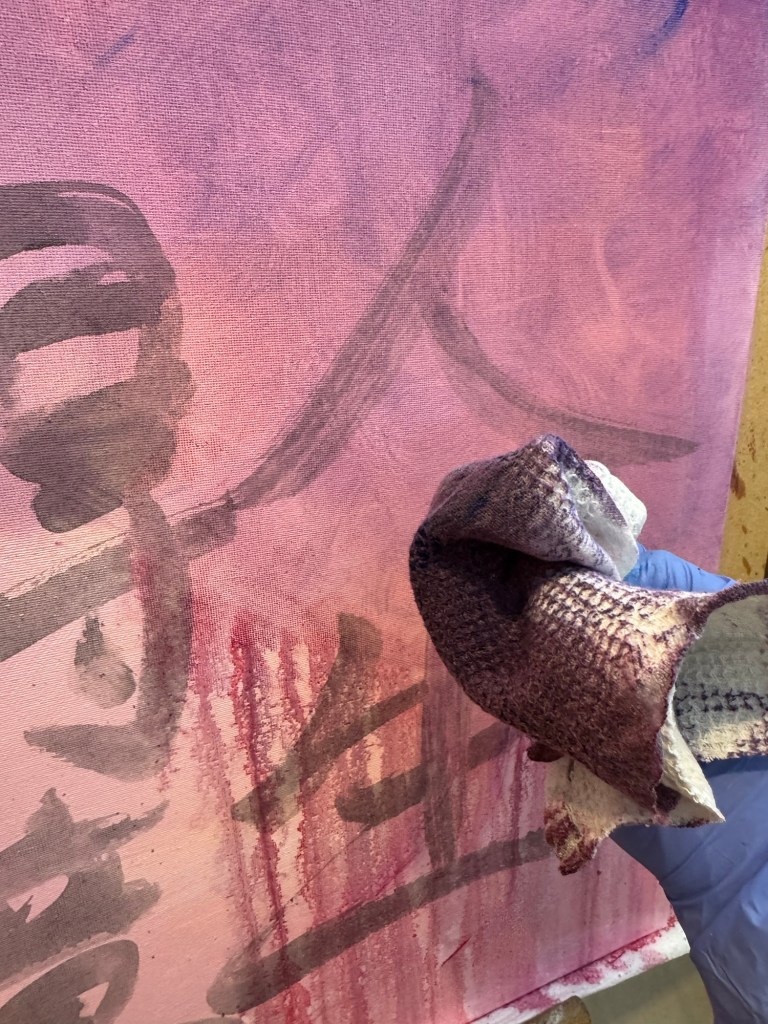
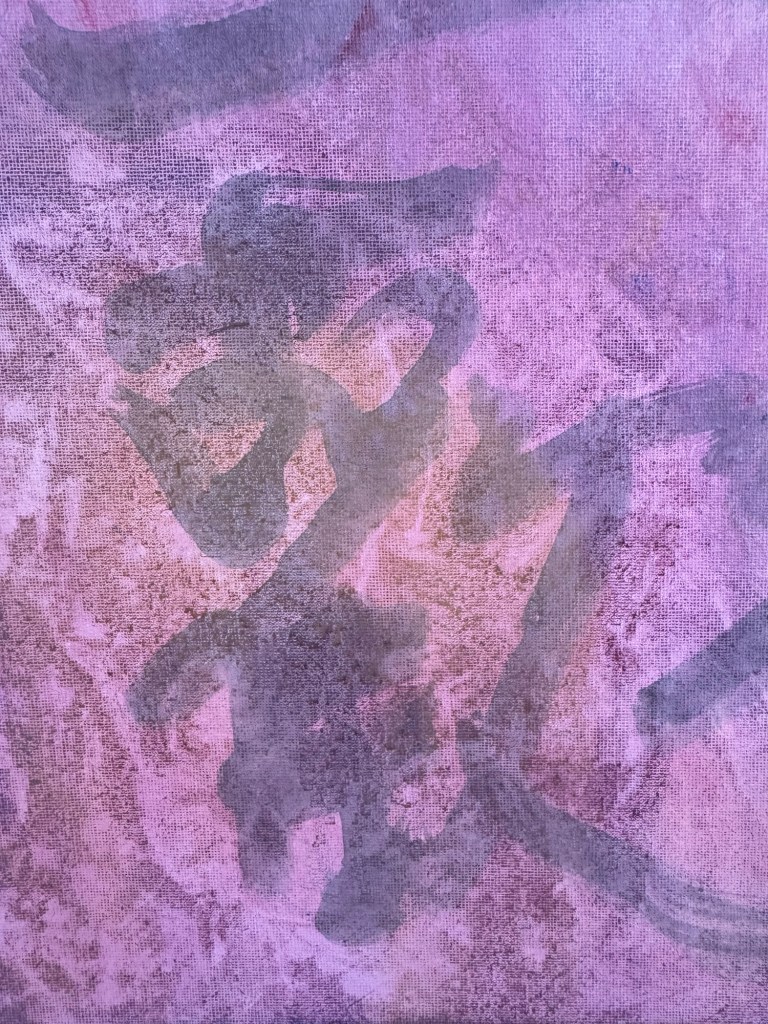
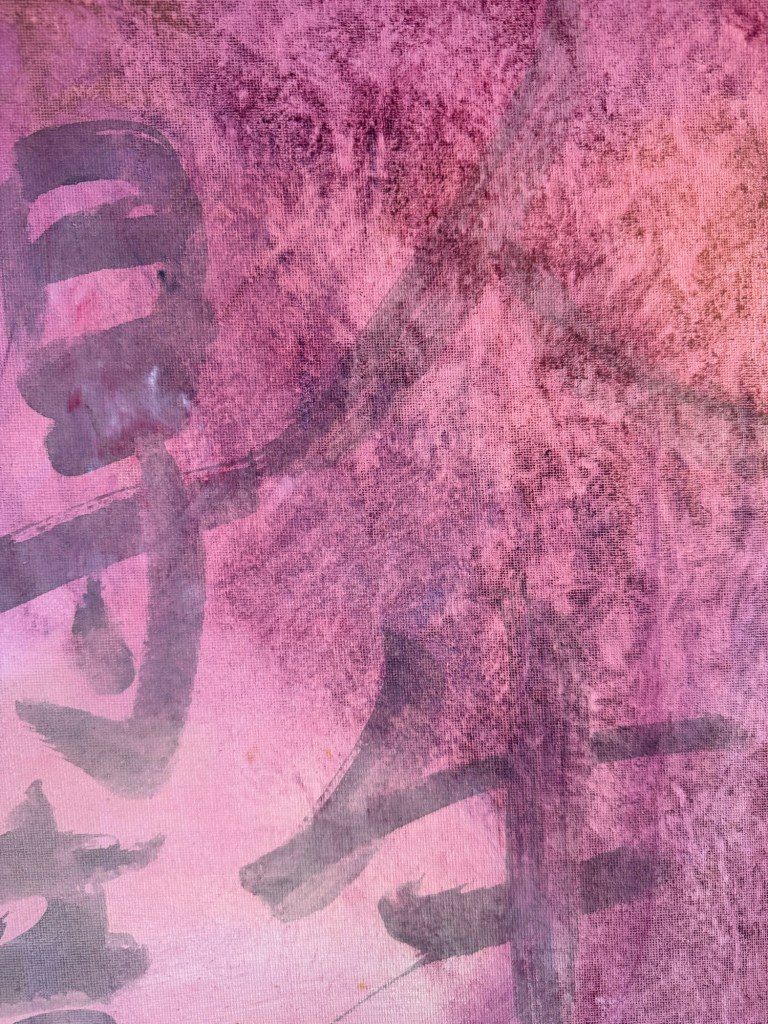
A piece of textured rag was used to experiment with creating patterns:
–
Work in progress, playing:
–
Playing some more:
–
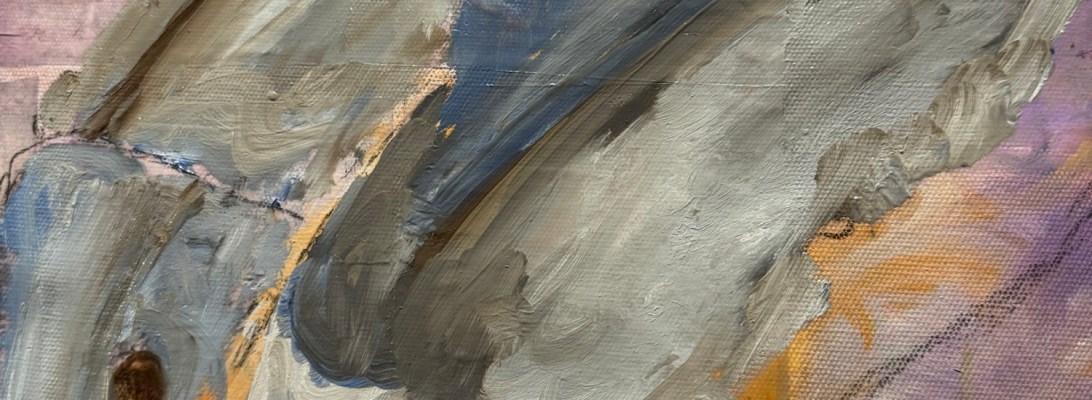
Close up images to show the ragging effect. The oil was so thin that the background images were still coming through:
–
But what to paint?
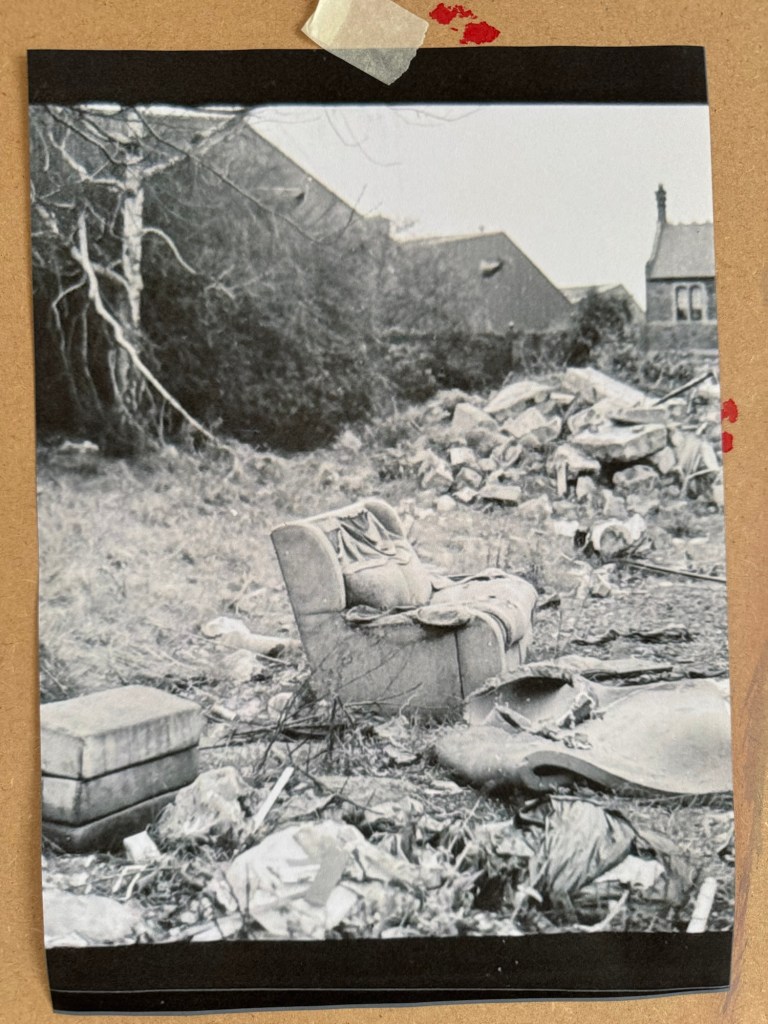
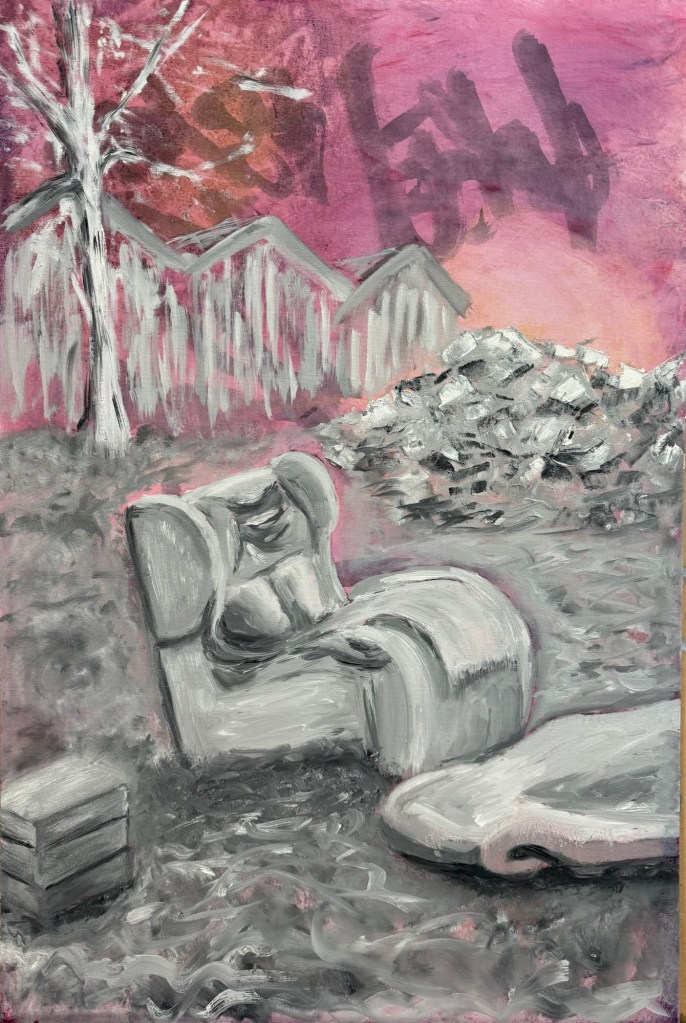
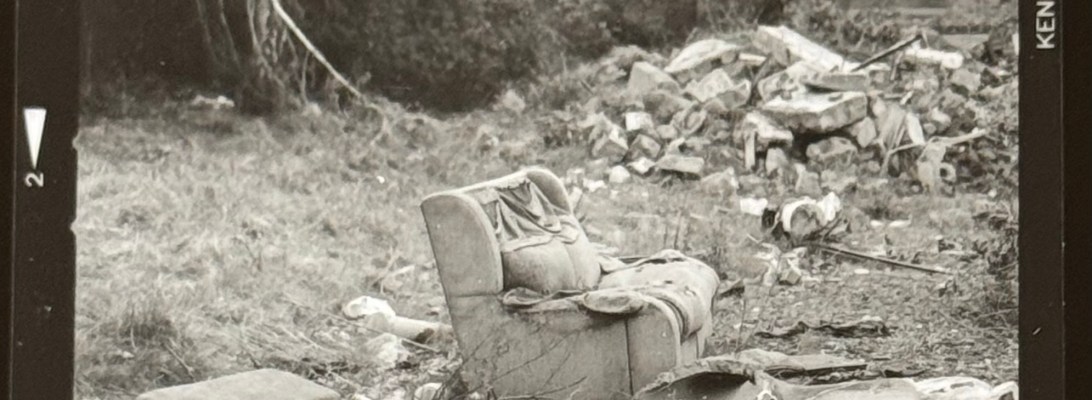
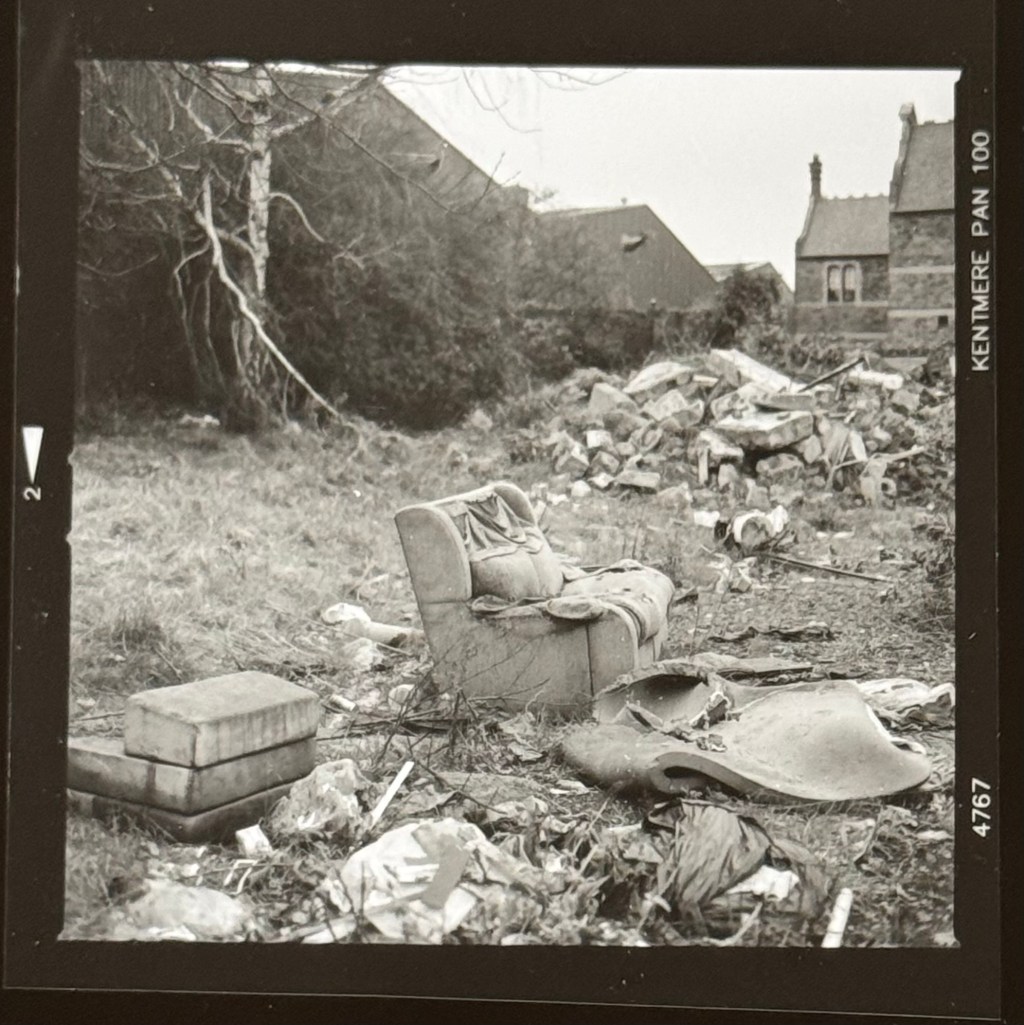
I decided to paint the ‘lone sofa’ photograph that I took when I went on a photography walk-about in Bristol. That was my favourite photo of the trip.
–
The canvas was put into portrait orientation.
–
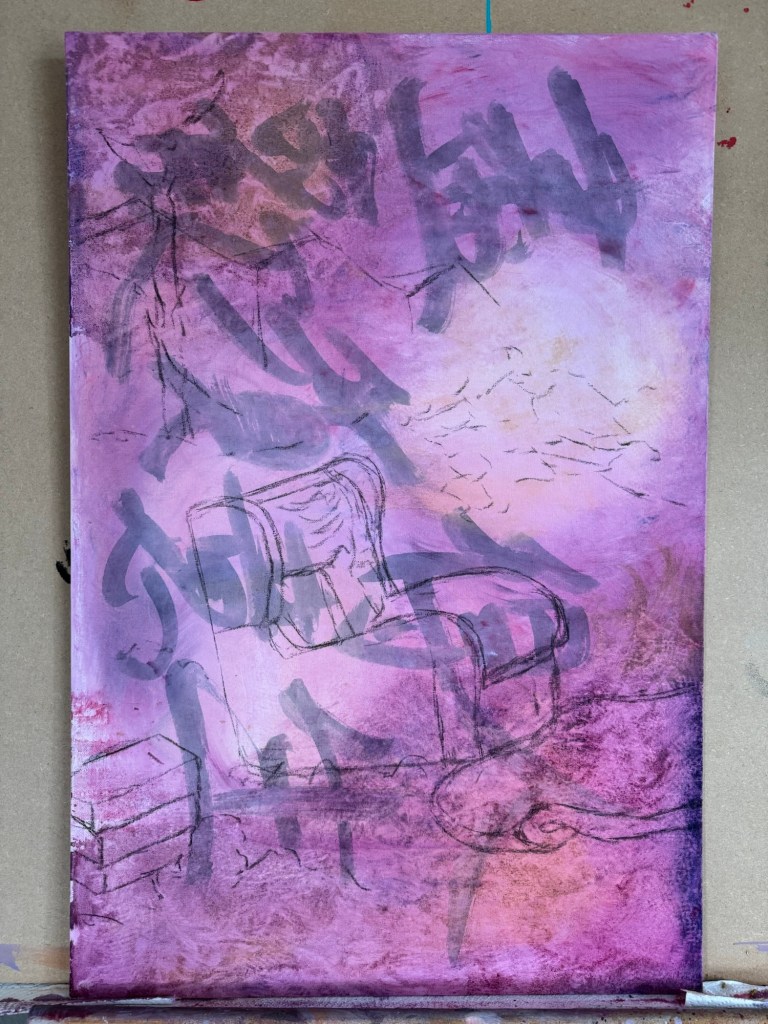
Charcoal was used to layout the composition, choosing what to keep and what to leave out from the photo image.
–
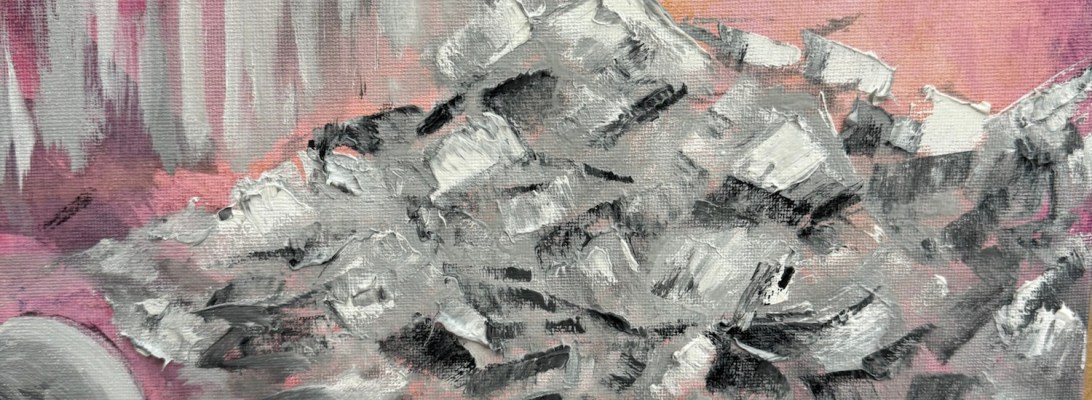
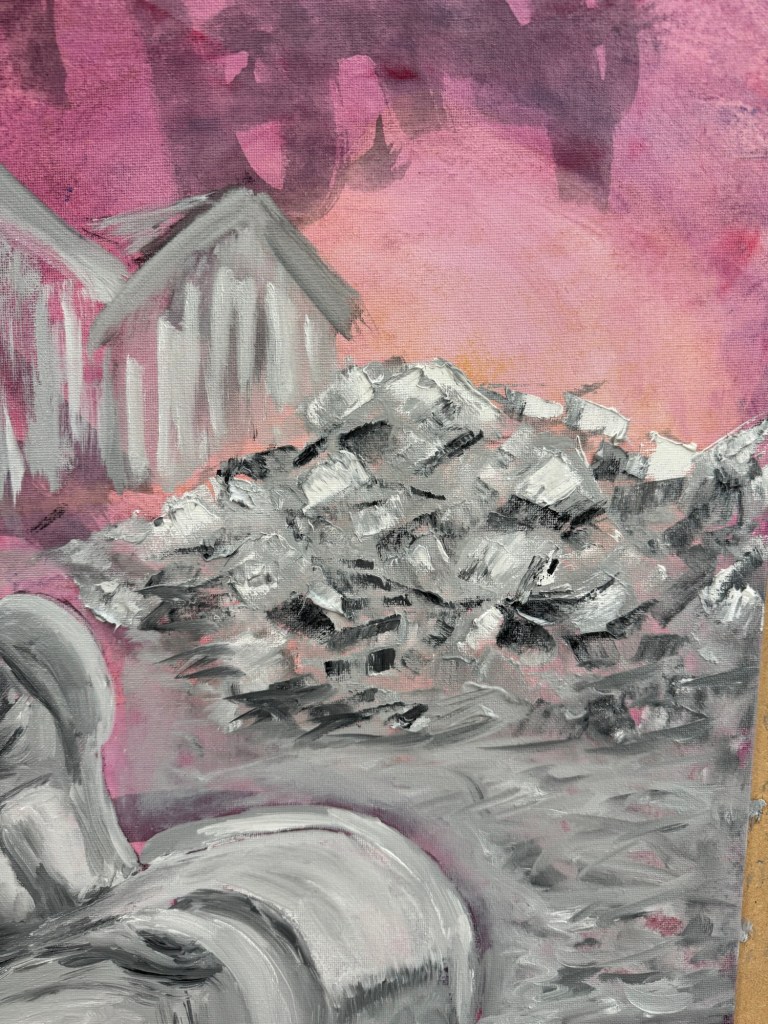
Close-up of areas of the finished painting:
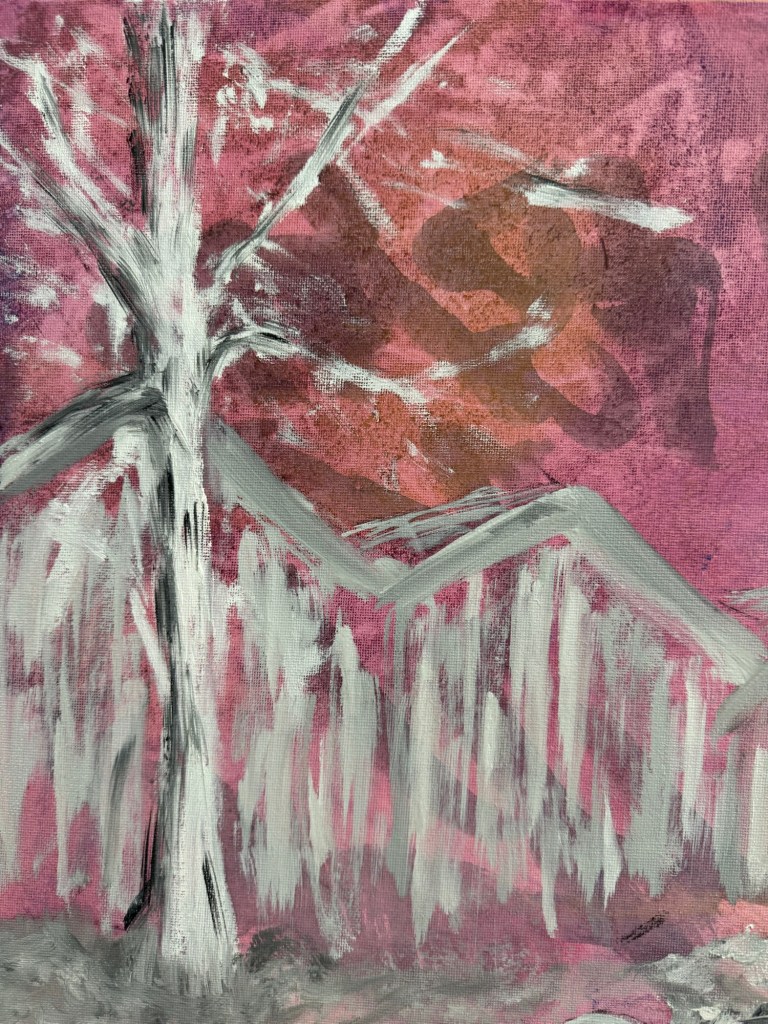
A pile of rubbleA tree in winter
Finished painting:
–
REFLECTIONS
The oil experiments were not as useful as I had wanted – the outcomes were pretty much as expected and I can’t say I made much new discovery. So I need to do more research on this rather than just play.
The Chinese characters in the background were mostly hidden in the end. Again I could have used thinner oil. Or in this case, I feel it’s fine to obscure the background and use the Chinese characters as abstract patterns rather than to convey specific meaning.
The sofa scene – I mentioned in the last blog that I wasn’t feeling colourful so I opted for muted grey tones. That feels appropriate for this scene especially given the original photo was monochrome. I enjoyed the painting process which I tend to do most of the time. It was useful to focus on what to take out from the image composition, trying the less is more approach.
The piece of folded torn foam mattress on the floor was quite successful and also the pile of rubble. I think what was going through my mind was a dystopian scene and I wanted to create a dystopian effect to reflect my despair about the rapid change in world order, not sure if I really got that effect.
Although I started with wanting to do a response to Akunyili Crosby’s work. The outcome was quite far from that original intention. I think it’s because I made this painting over several weeks and my state of mind changed over that period and what I started off wanting to do didn’t seem relevant in the end. So I am comfortable with the change in direction.
LEARNING
To get more out of my exploration of oil, I need to do some research work, either online (YouTube) or books to gain new knowledge so I can take my experimentation to the next level.
It was only when I reflected afterwards that I was going for a dystopian theme. Perhaps if I had thought of that at the start then I could have created more of a dystopian atmosphere. I can research more about dystopian art. But how does that fit in with my transcultural practice? Should I go off on this tangent right now to risk having an incoherent body of work?
NEXT STEPS
Do research on oil painting techniques to learn new ways to use oil.
Do research on dystopian artists to see if that’s the vibe that I want to reflect my state of mind right now.
Following on from my Unit 2 feedback, I wanted to explore more ways of using oil. Also, from some photography work, I wanted to incorporate more photos into my work. So I started a new piece of work without knowing what I was going to do.
METHOD
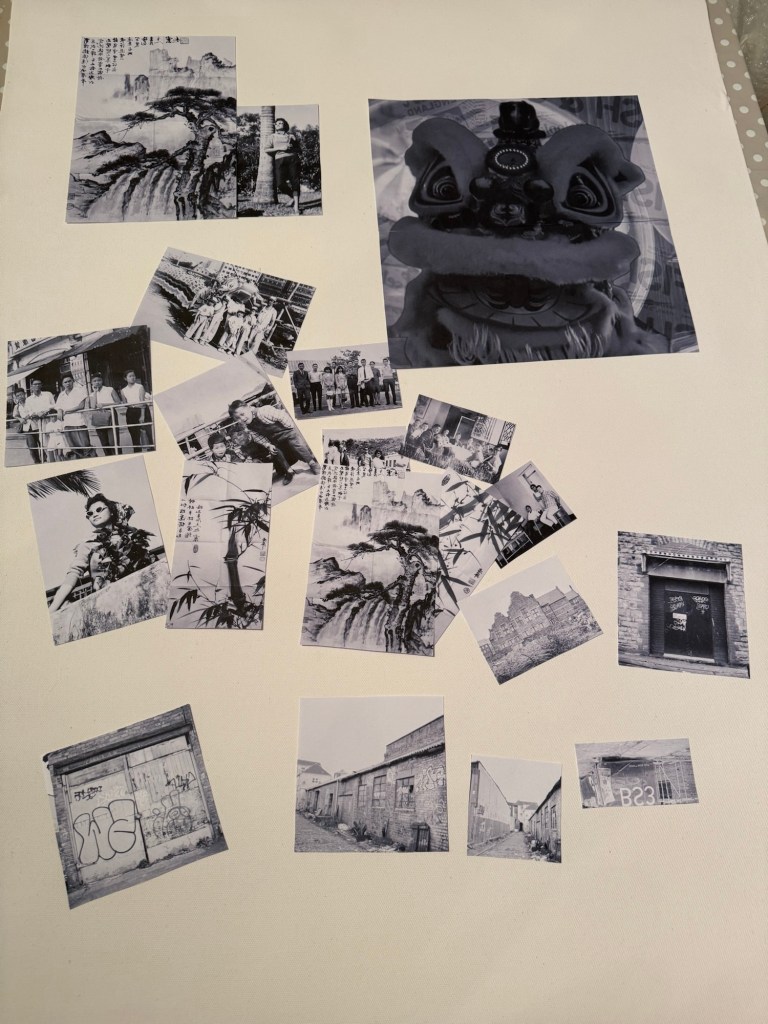
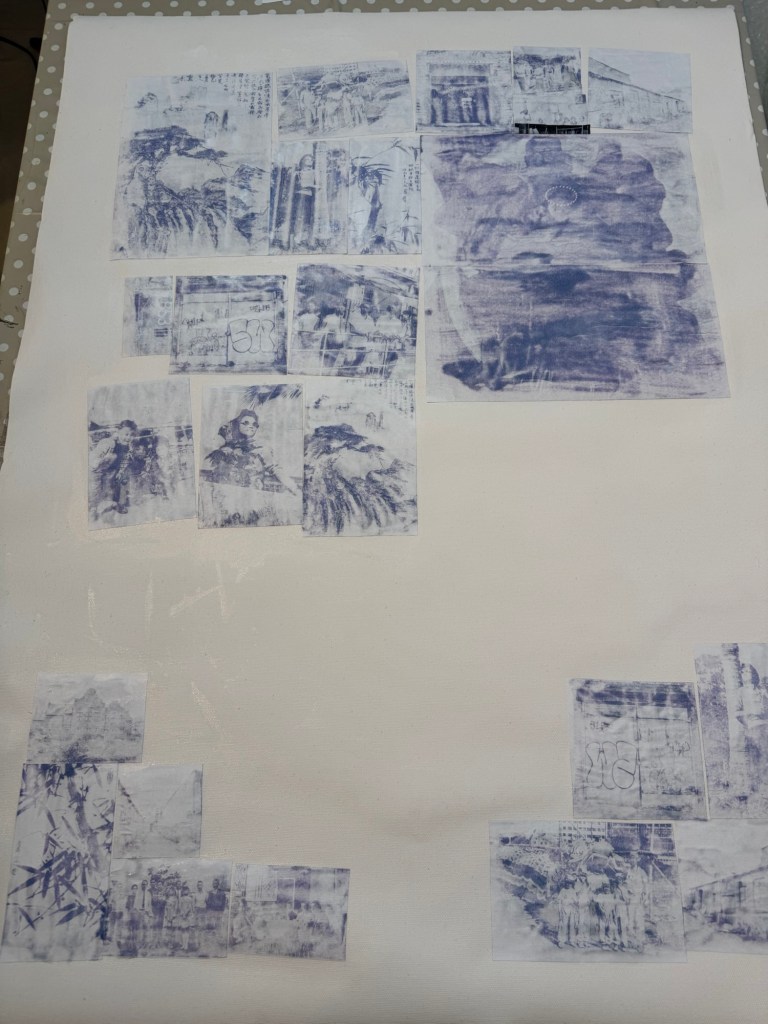
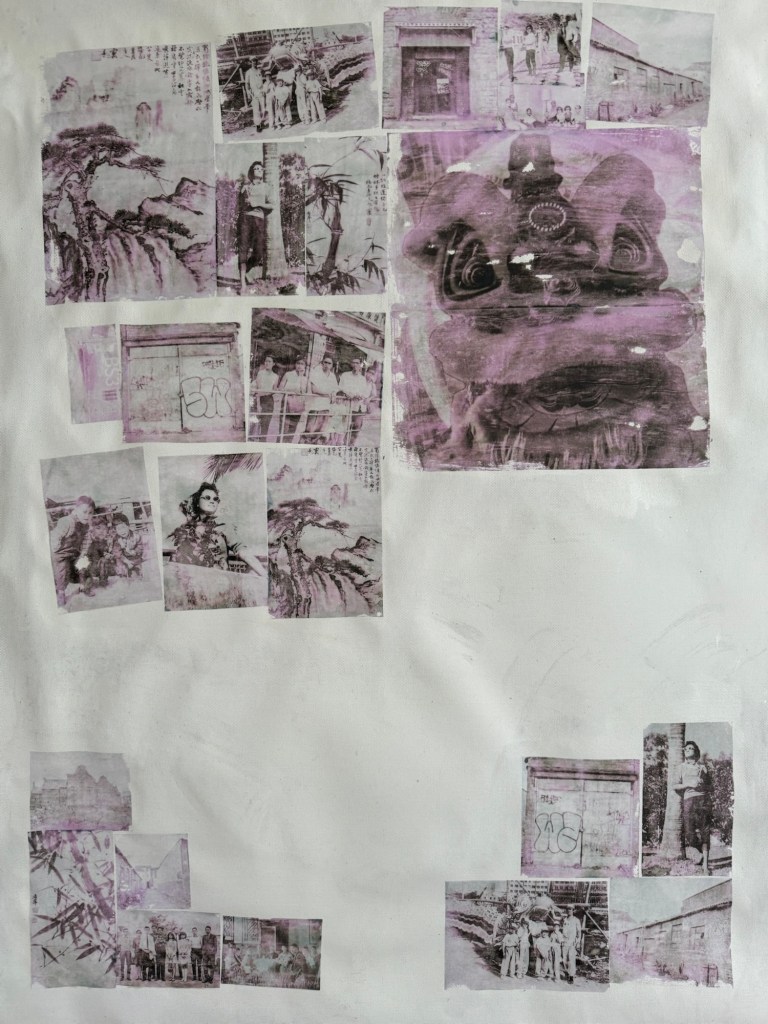
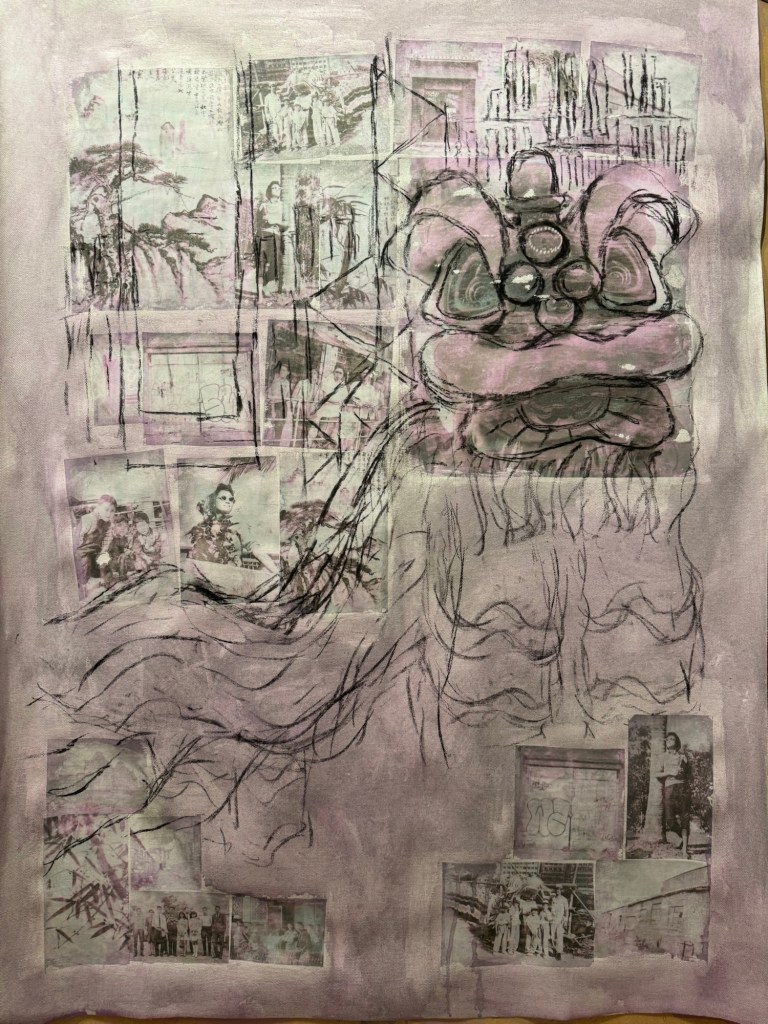
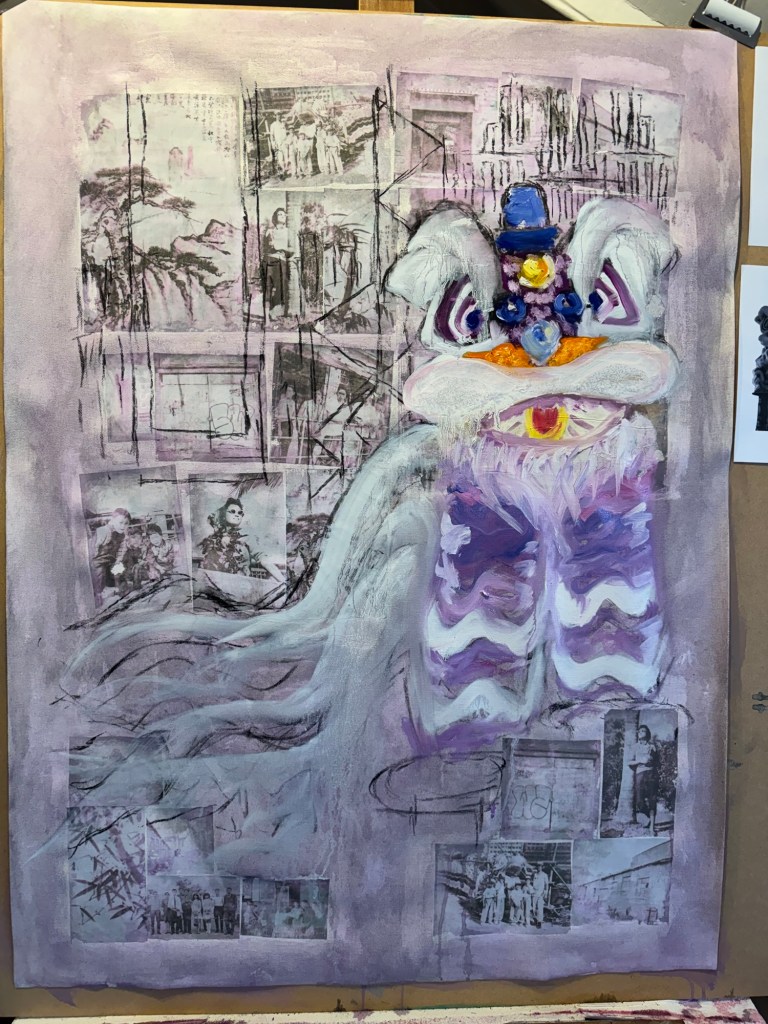
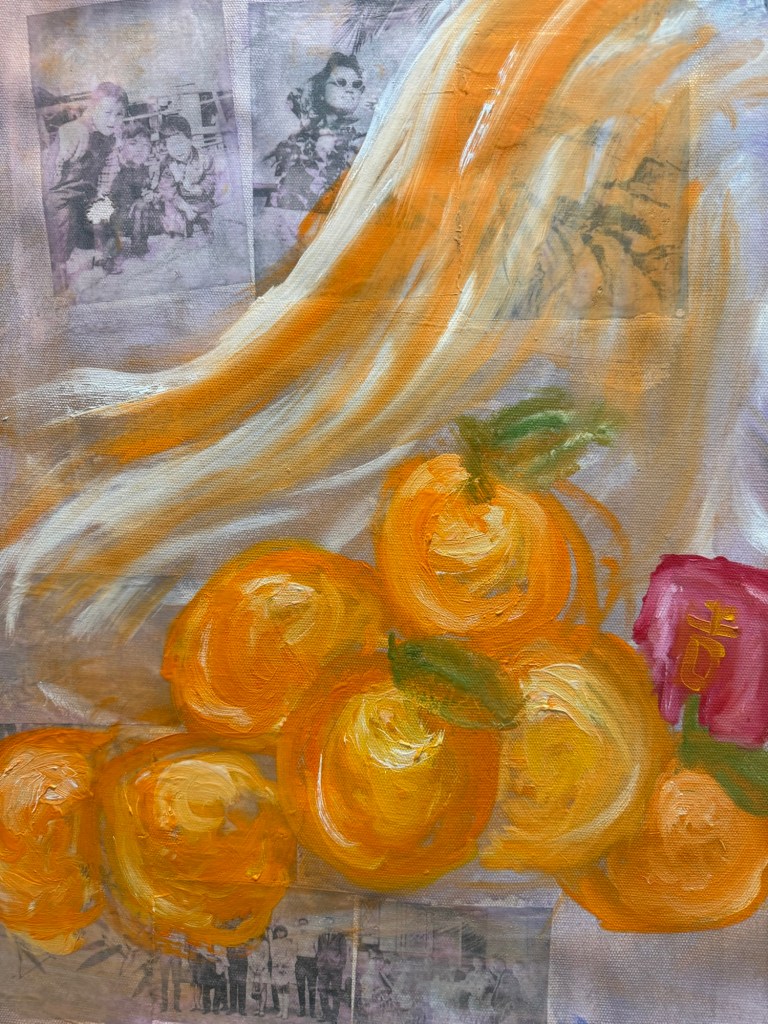
I made some black and white inkjet prints of various photos, some old family photos from Hong Kong and some recent Bristol streetscapes that I took with a medium format camera. Since it was around Chinese New Year time, I put in an image of a traditional Chinese Lion used for festive lion dance. I wanted to make that a dominant feature of the composition for the new year.
–
I used dispersion liquid to transfer the images onto a primed canvas:
Prints being stuck down using dispersion liquid
Printed images transferred onto the canvas. Due to the inkjet printer image, there was a pink / magenta tint to the transferred images.
–
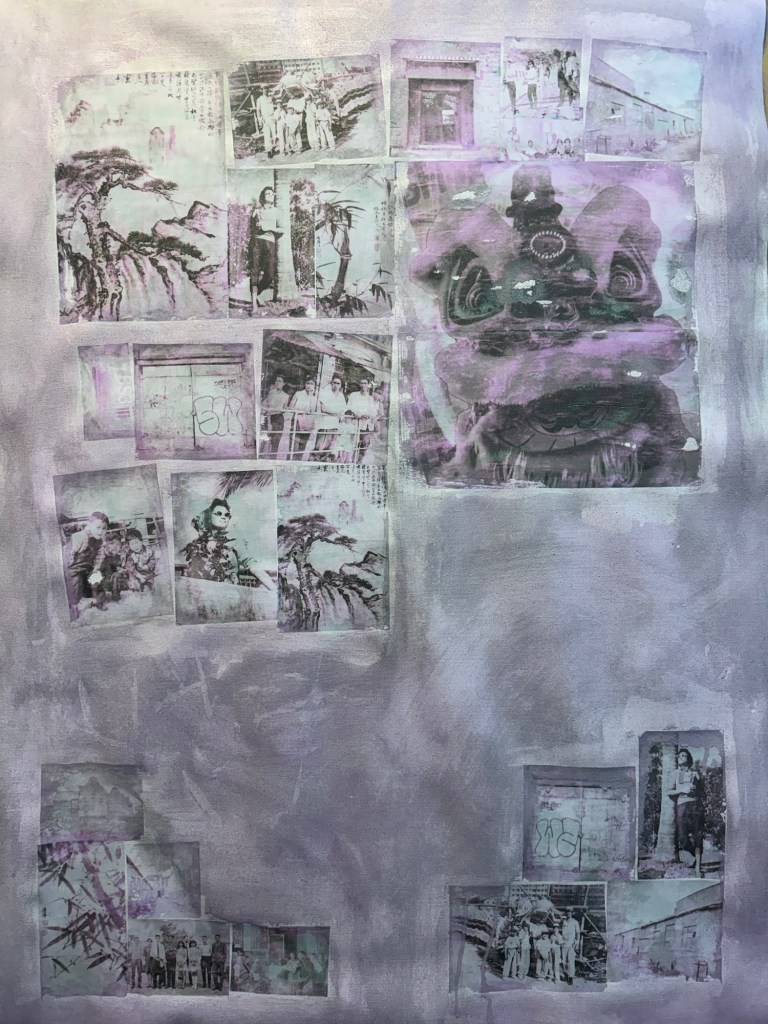
The canvas was covered in a thinned down acrylic wash:
–
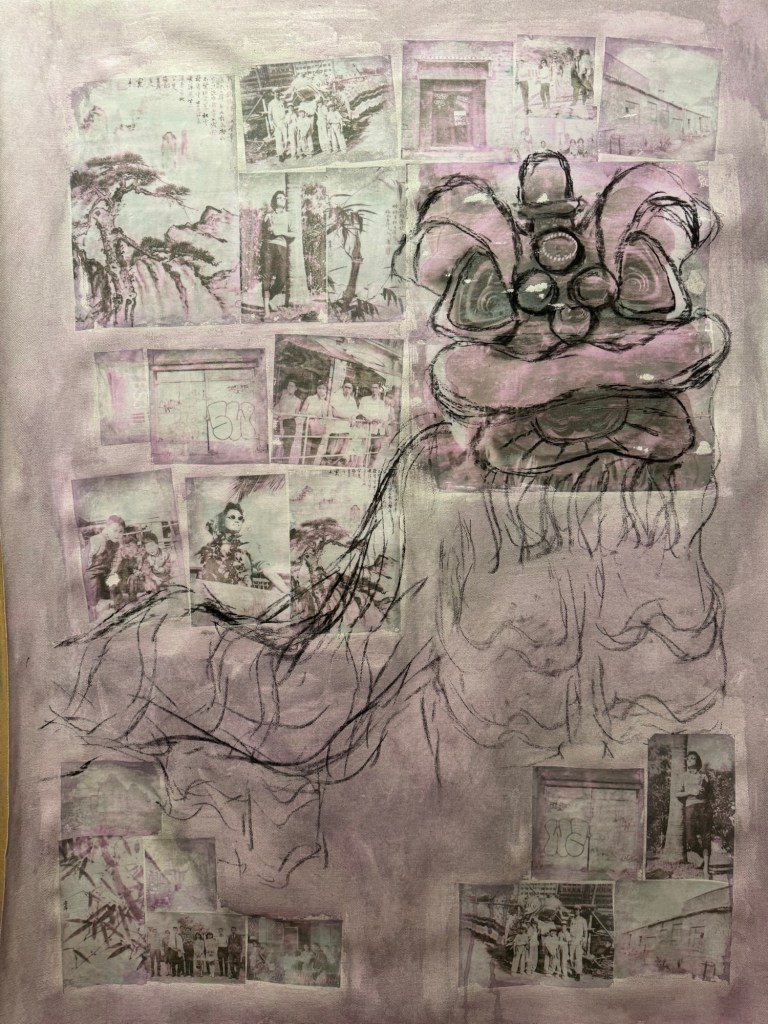
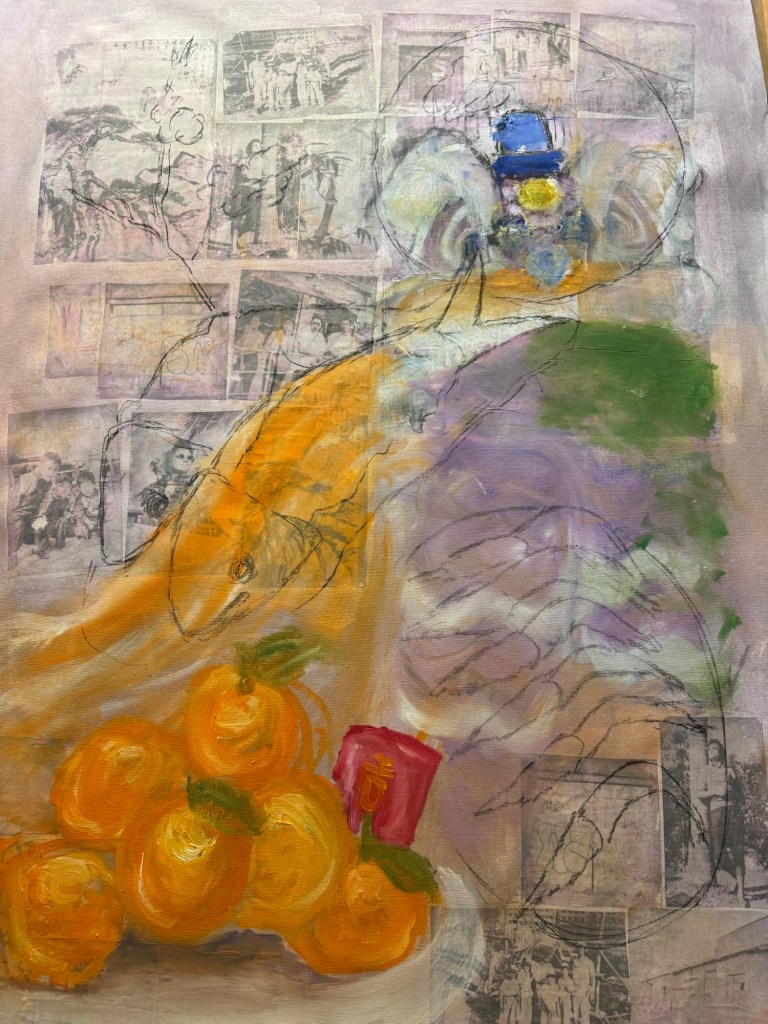
Charcoal was used to mark out the composition with the Lion being prominent.
–
Some iconic buildings from my childhood Hong Kong were added to the background.
–
The lion head was painted in oil. But I was not happy with it, it looked too ‘cute’.
–
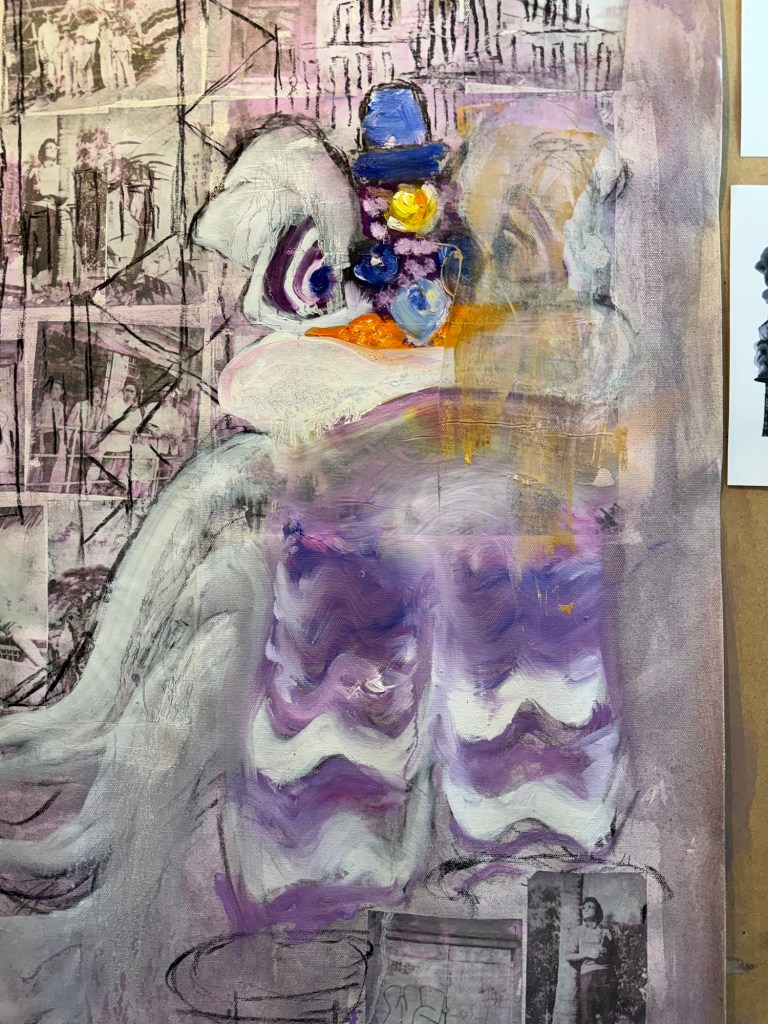
Since this was an experiment in oil, I started to wipe off parts of the image to create different effects.
–
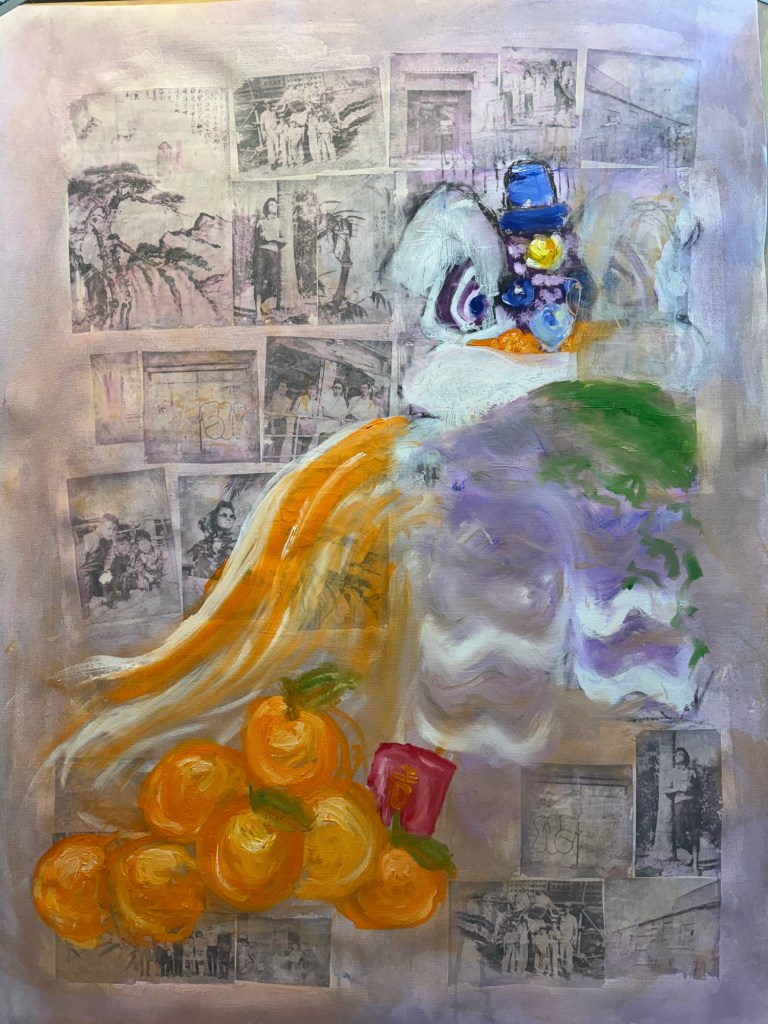
A pile of mandarin oranges were added as a traditional Chinese custom during New Year. I wanted to add typical Chinese New Year food to the composition in response to my decision after the Cheongsam series to do some Chinese food painting on a ‘normal’ 2D canvas:
–
I experimented with using looser brushstrokes and some thinned oil for the oranges:
––
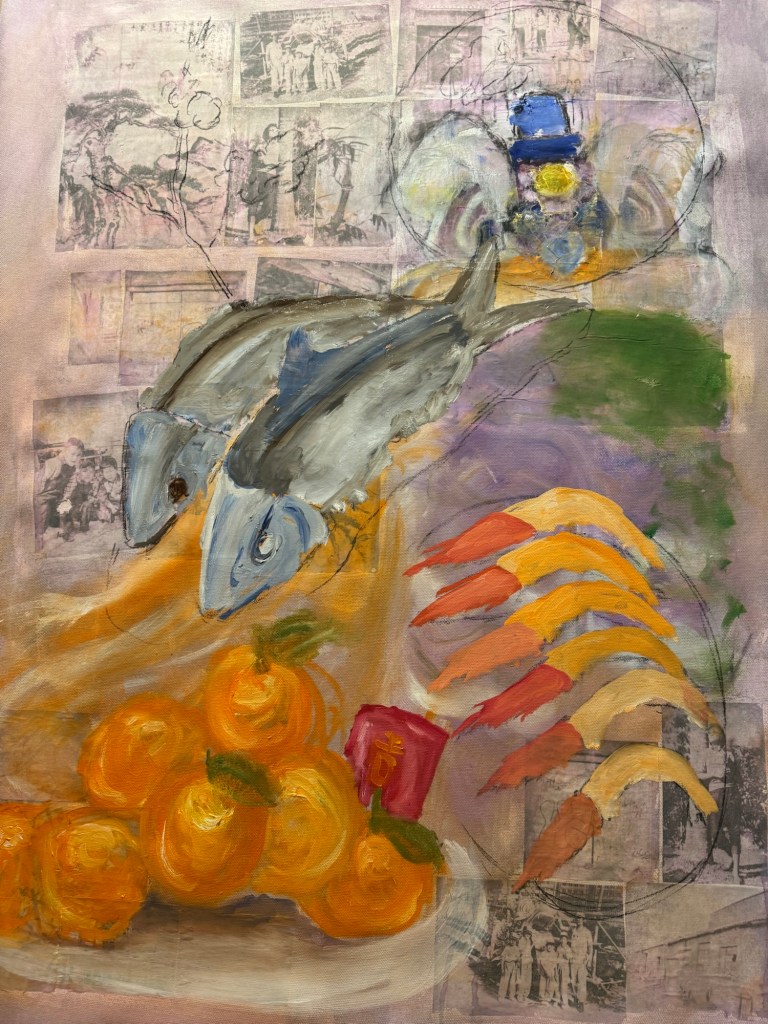
I was still very unhappy with the lion and decided to replace it with a complete family dinner with symbolic dishes for Chinese New Year.
Charcoal marks for New Year food dishes
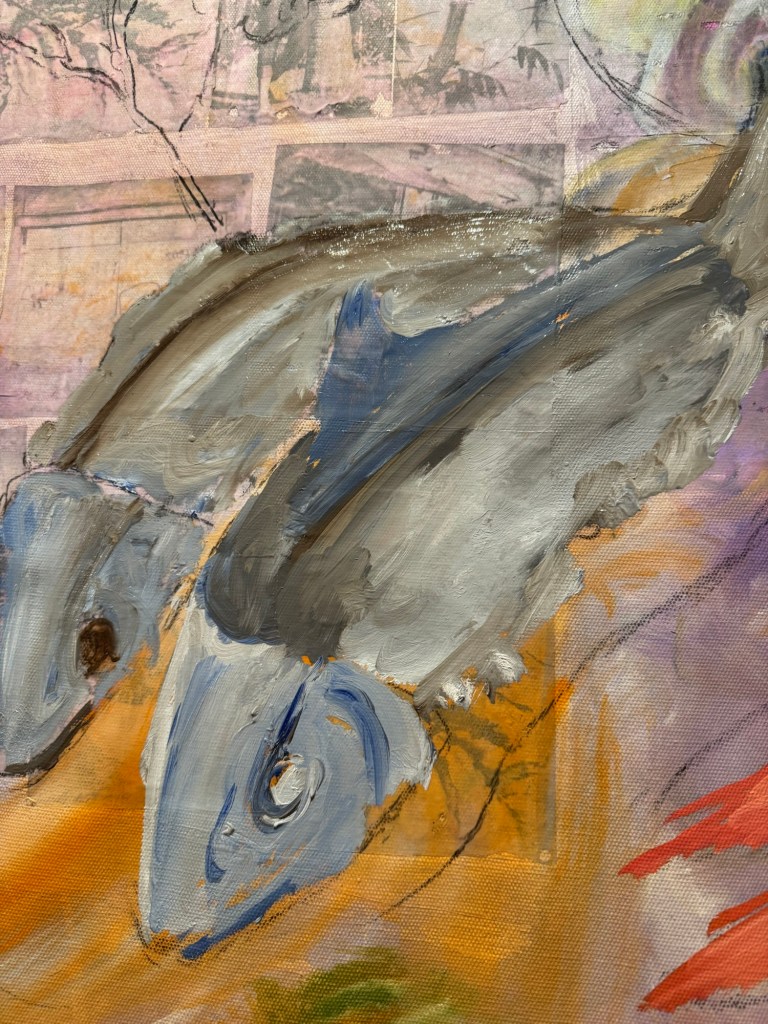
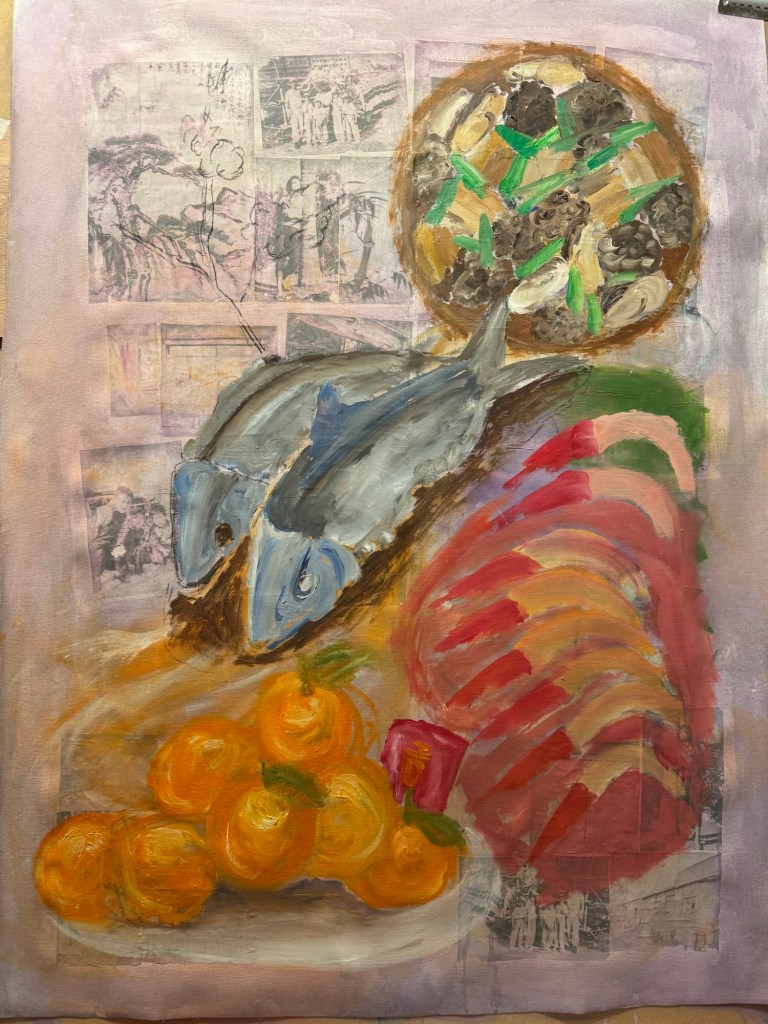
Thinned oil paint was used to mark out the shapes of the various dishes. Then more details were added to the fish first:
–Close up of fish (stuffed dace fish)
Other dishes were added:
–
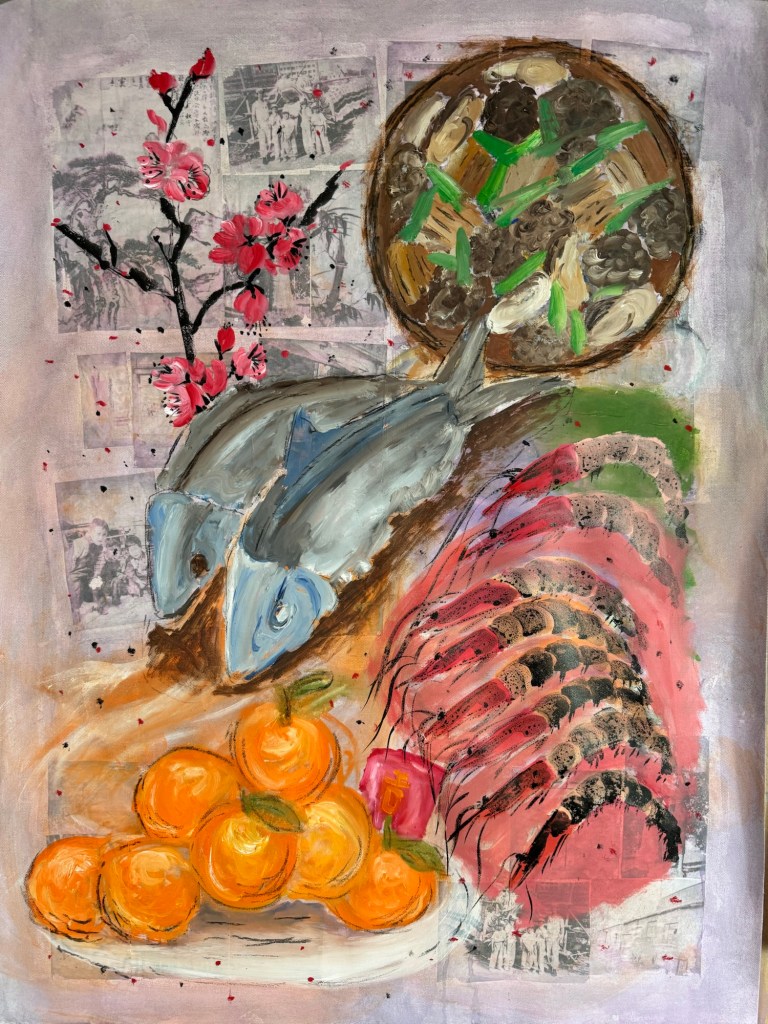
The prawns’ details were finished with Chinese ink and a peach blossom branch was added (also in Chinese ink) as it was traditional to have this plant at every home in Chinese New Year.
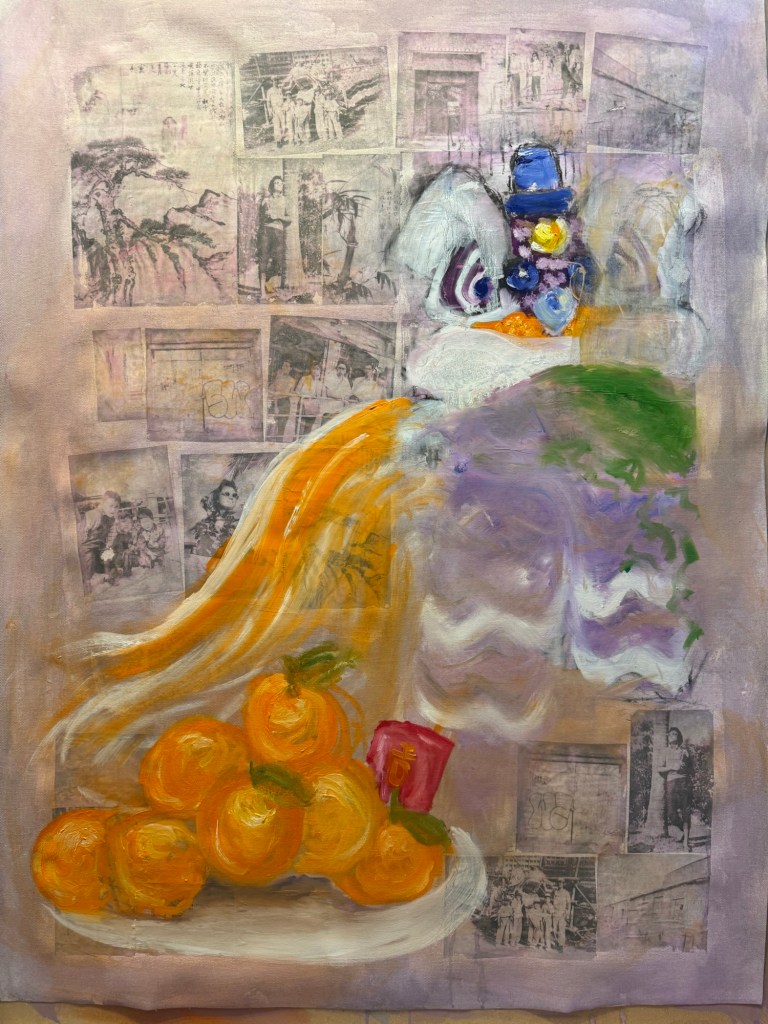
Finished painting – Chinese New Year dinner:
Mixed media on canvas. Size 102×75 cm
Menu:
Centre – stuffed dace fish. Symbol for having surplus meaning never falling short (of money). The word ‘fish’ sounds like surplus.
Top right – stew of shiitake mushrooms, dried oysters, pork belly and spring onions in fermented bean sauce. A traditional new year dish, a large pot is usually made and eaten over several days. ‘Dried oyster’ sounds like ‘good things’ meaning good things will happen.
Bottom right – prawns. Symbol for happiness. ‘Prawn’ sounds like laughter.
Bottom left – mountain of mandarin oranges with a red money packet (lai see), the phrase sounds like ‘gold mountain’ meaning good fortune.
Top left – peach blossoms, the blossoms opening signifies good luck and good fortune.
REFLECTIONS
I am glad I didn’t continue with the lion. It was not how I wanted as it was too detailed and cute. I was happier when the Chinese dinner idea started to develop. I was mindful that I wanted to experiment with Qi Baishi’s idea of painting between likeness and unlikeness. I was hoping the thinner paint and looser brushstrokes would give me more scope to express the unlikeness. I think I made some progress compared to the Family Dinners on the Cheongsam canvases, but there’s still some way to go.
I experimented with incorporating photographs but I think in the end they didn’t really add anything as most of the images were covered up. Perhaps even thinner oil would have left the photo images still partially visible.
I have never managed to combine oil and Chinese ink satisfactorily, I think using the combination on the prawns worked out well. I believe the thinned down oil helped the combination to work so worth bearing this in mind.
LEARNING
Try experimenting with even thinner oil paint and other techniques to apply paint.
Think more about what I want the photos to do (e.g. how much to be revealed) if incorporating photo images, then dilute the paint accordingly to achieve the effect. The experiment here was not fully thought through as I was just playing, but it provided good insight into how easily it was to fully obscure the photos.
Overall the painting was looser and less organised compared to Cheongsam Family Dinners, but I need to be more courageous about achieving unlikeness. Add more of myself to it and think about what feelings and intentions I have – not intentions regarding the composition, but what I’m trying to say.
NEXT STEPS
Experiment more with oil and different applications.
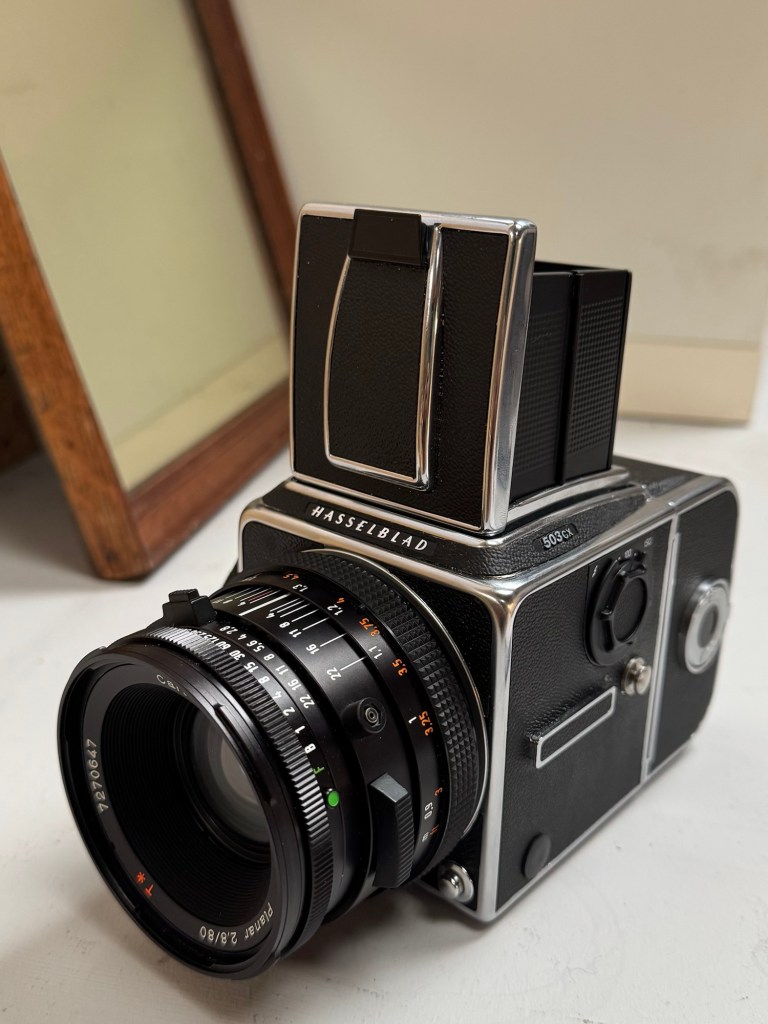
A few months ago, I was given a Hasselblad 503CW medium format camera by my late father-in-law. He was a keen photographer and this camera was his pride and joy. So it is very meaningful for me to have this beautiful and iconic camera. I have recently started to explore incorporating photography into my practice, hence I decided to attend a one day workshop in Bristol to learn how to use this camera properly to make the most of it.
EXPERIENCE
This is the Hasselblad 503CW film camera:
–
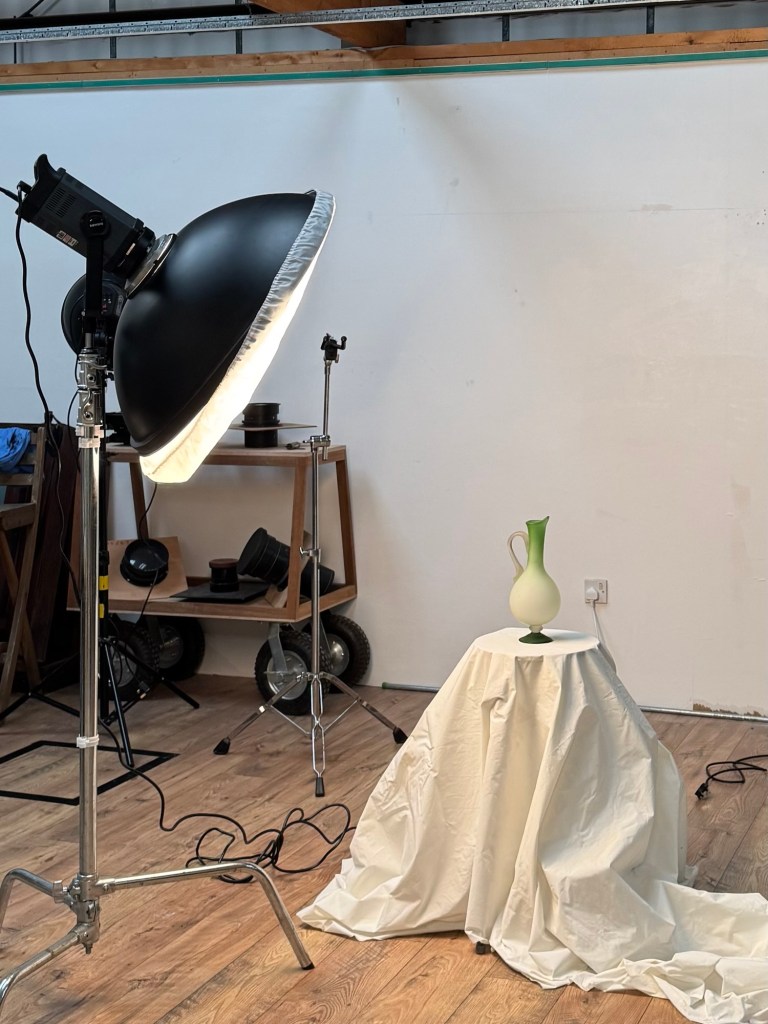
The workshop started with some indoor still life work in the studio.
–
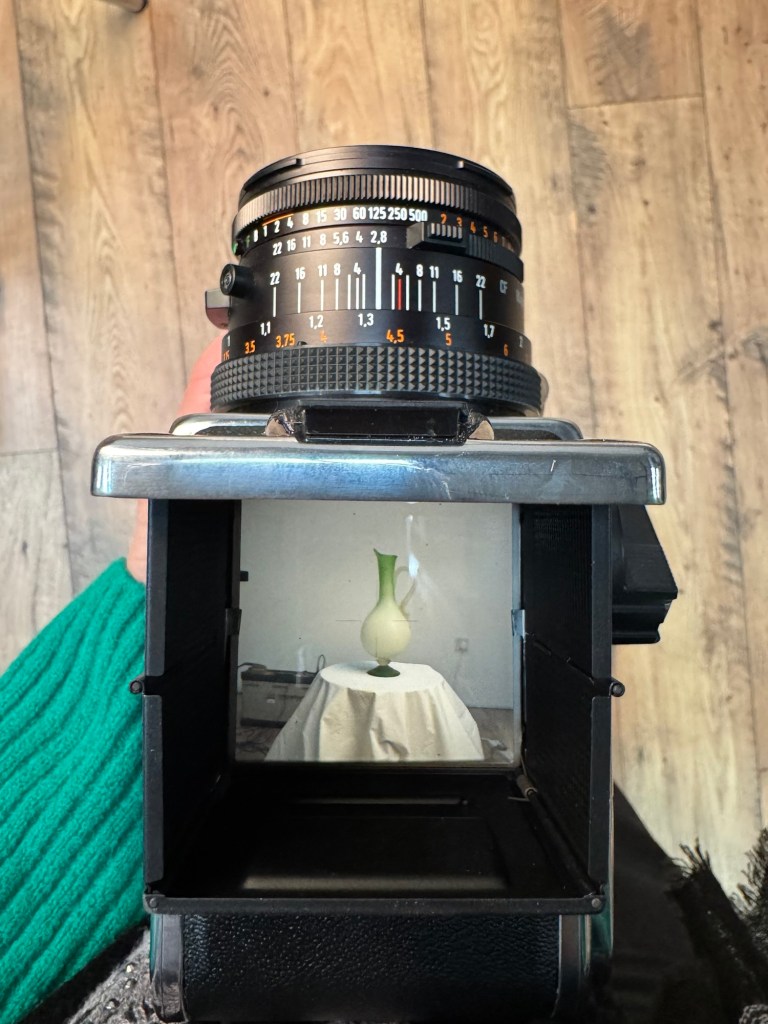
The camera has a default waist level view finder. It also came with an eye view finder and I experimented with both. I was very interested in the waist level view finding approach as it’s unique to this type of cameras.
–
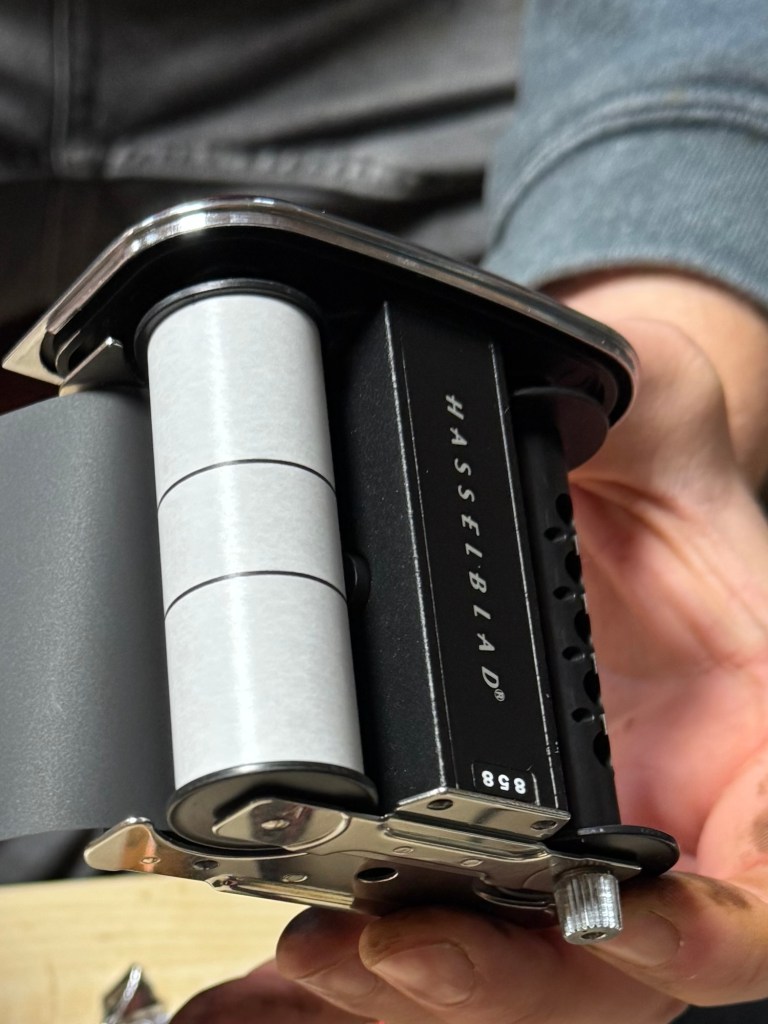
Learning to load the film was very important because I have not loaded a film for decades since I started using digital cameras.
–
The afternoon started with a walk about in the nearby area to take some outdoor streetscape photos. The studio was in the backstreet of an industrial area. The kind of ‘forgotten’ streetscape that really appeals to me. I took 12 photos (the film was a 120 with 12 exposures per film). Below are a few photos and a video showing all 12 that I compiled paired with a soundtrack ‘London calling’ by The Clash that particularly resonates with me at the moment with what’s going on in the world.
The first shot was an abandoned sofa. The studio is based in a warehouse that was previously a large furniture shop/warehouse and I have been there many years ago looking for a low cost sofa when my husband and I were young. So I was excited to see this sofa and I had to take a shot. Was it a left over from the warehouse or just coincidence that it’s there? Was someone trying to make a home there?
–
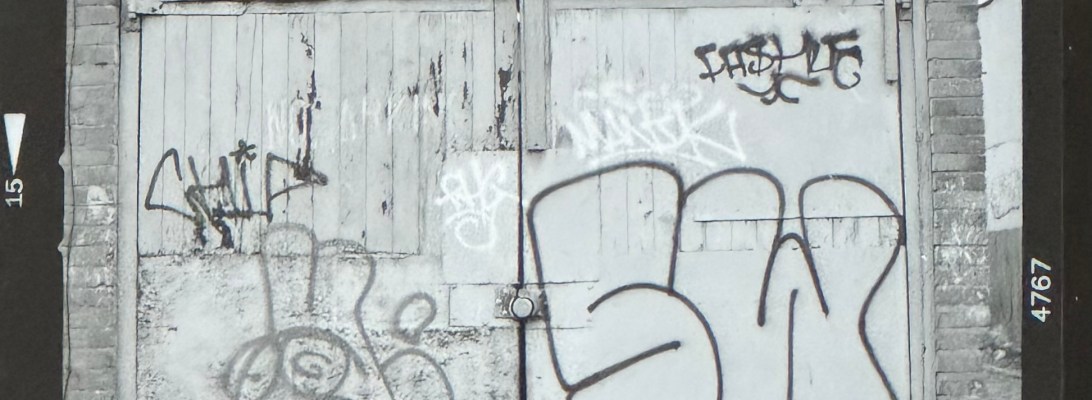
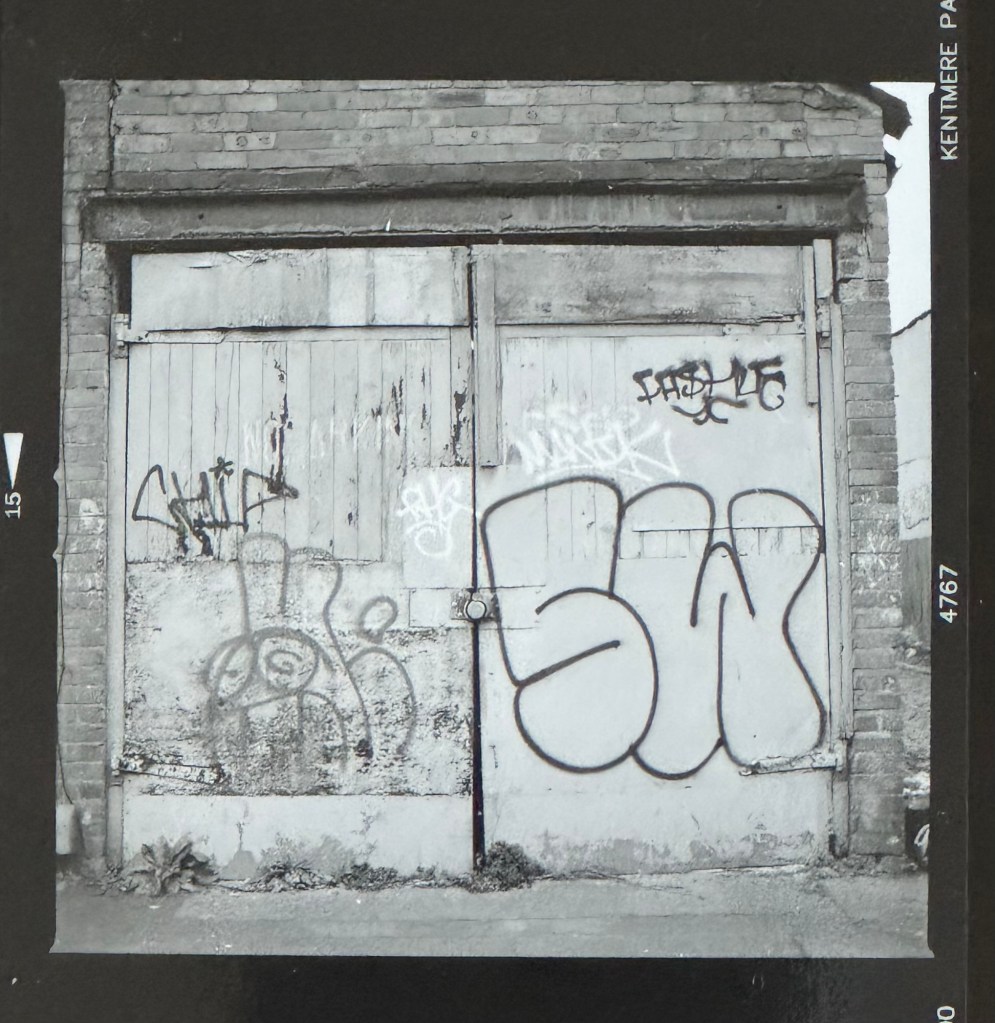
Graffiti on a door. Graffiti is such a large part of the Bristol street culture and I have always had a thing about doors, I love doors:
–
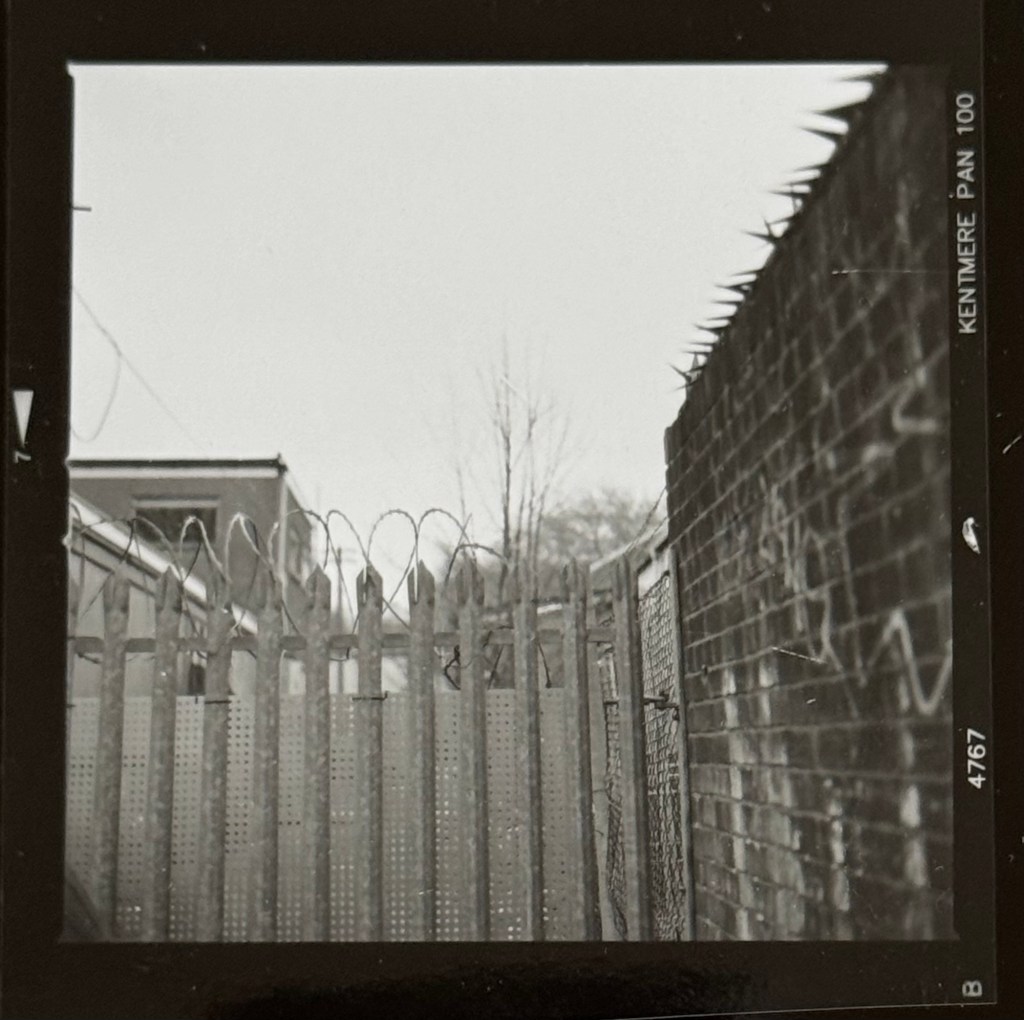
There are three different types of barb wire in this shot. What kind of world needs three types of barb wire in one place?
I was very happy with the workshop and felt confident to use the camera as a result. It was a great studio run by an enthusiastic couple and there are excellent dark room facilities that I can use in the future for developing and printing photos. I can also print photos onto canvas there which is great.
I loved going around the industrial area in Bristol. It reminded me of my love for industrial heritage landscapes – that was my passion before I started exploring transcultural art. I think it relates to my engineering background. I have lived my life in industry and engineering for 30+ years and my history is equally deeply rooted in industry as it is in my transculturality.
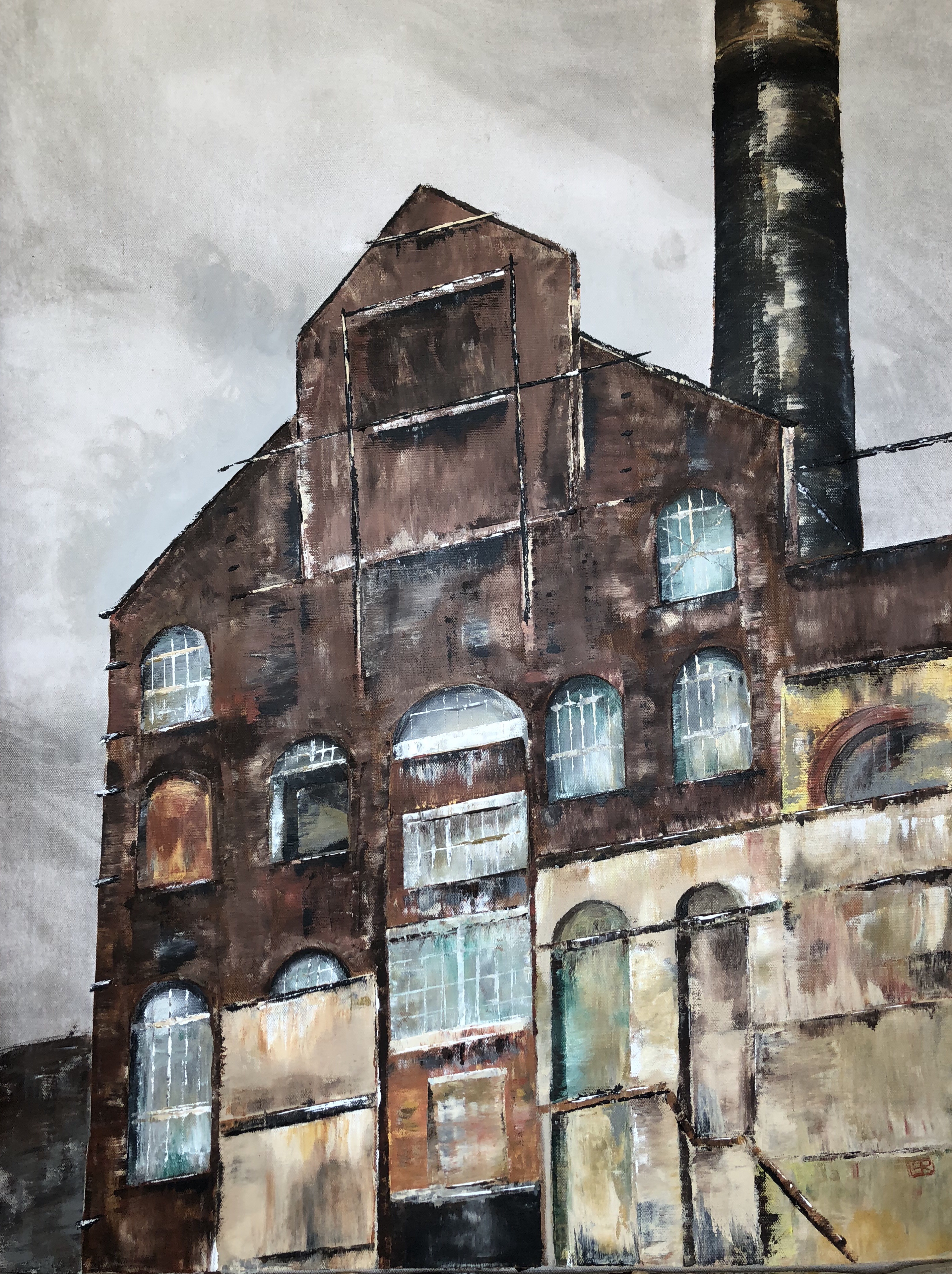
Doing the ‘forgotten’ streetscape photography reminded me of projects that I had done in 2018 when I first started learning to paint. I particularly like and am fascinated by late 19th/early 20th century disused power stations – for me, they are monumental industrial cathedrals. Seeing them or any industrial sites especially power stations make my heart sing.
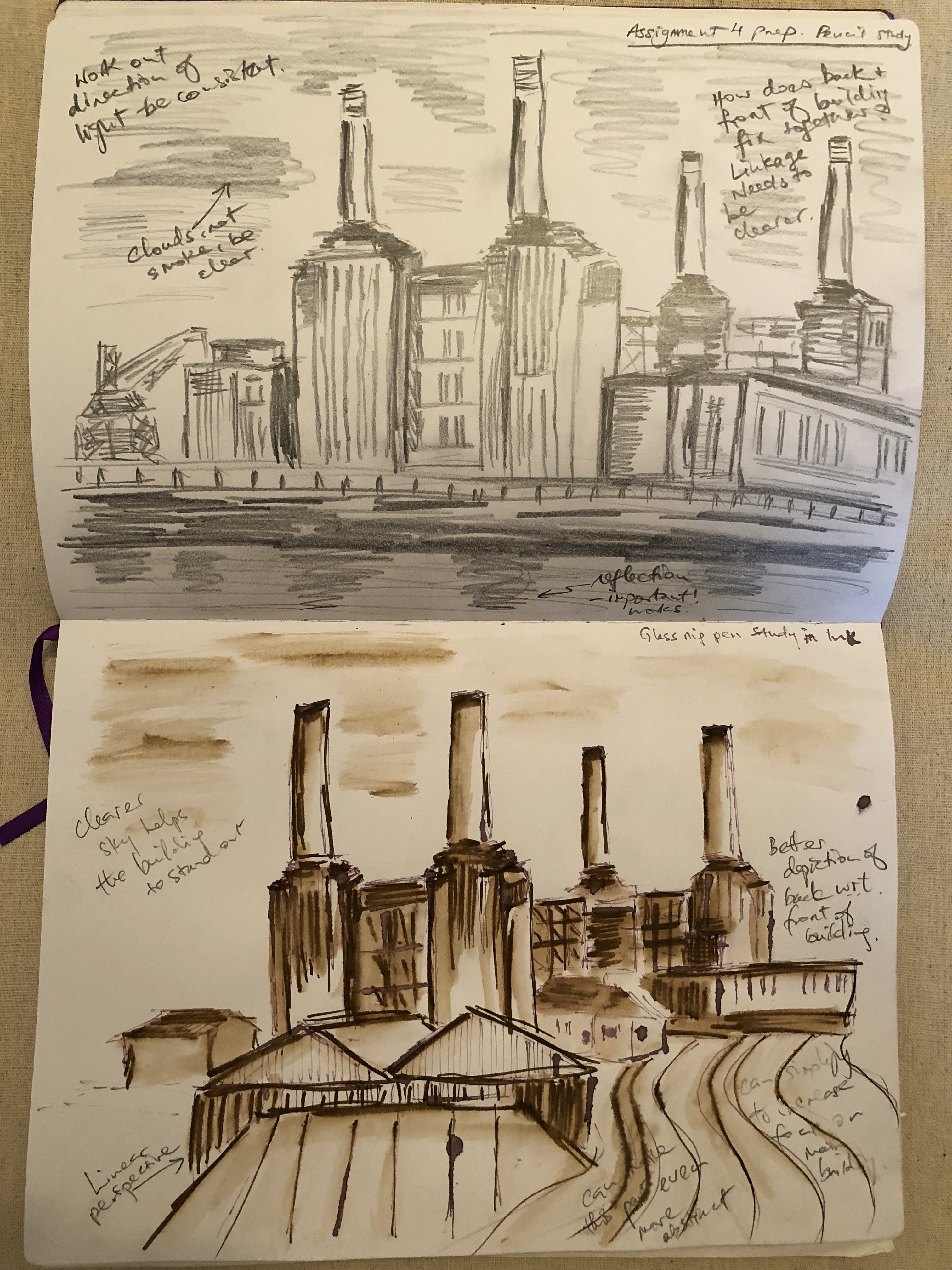
My 2018 drawings study of Battersea Power station:
–
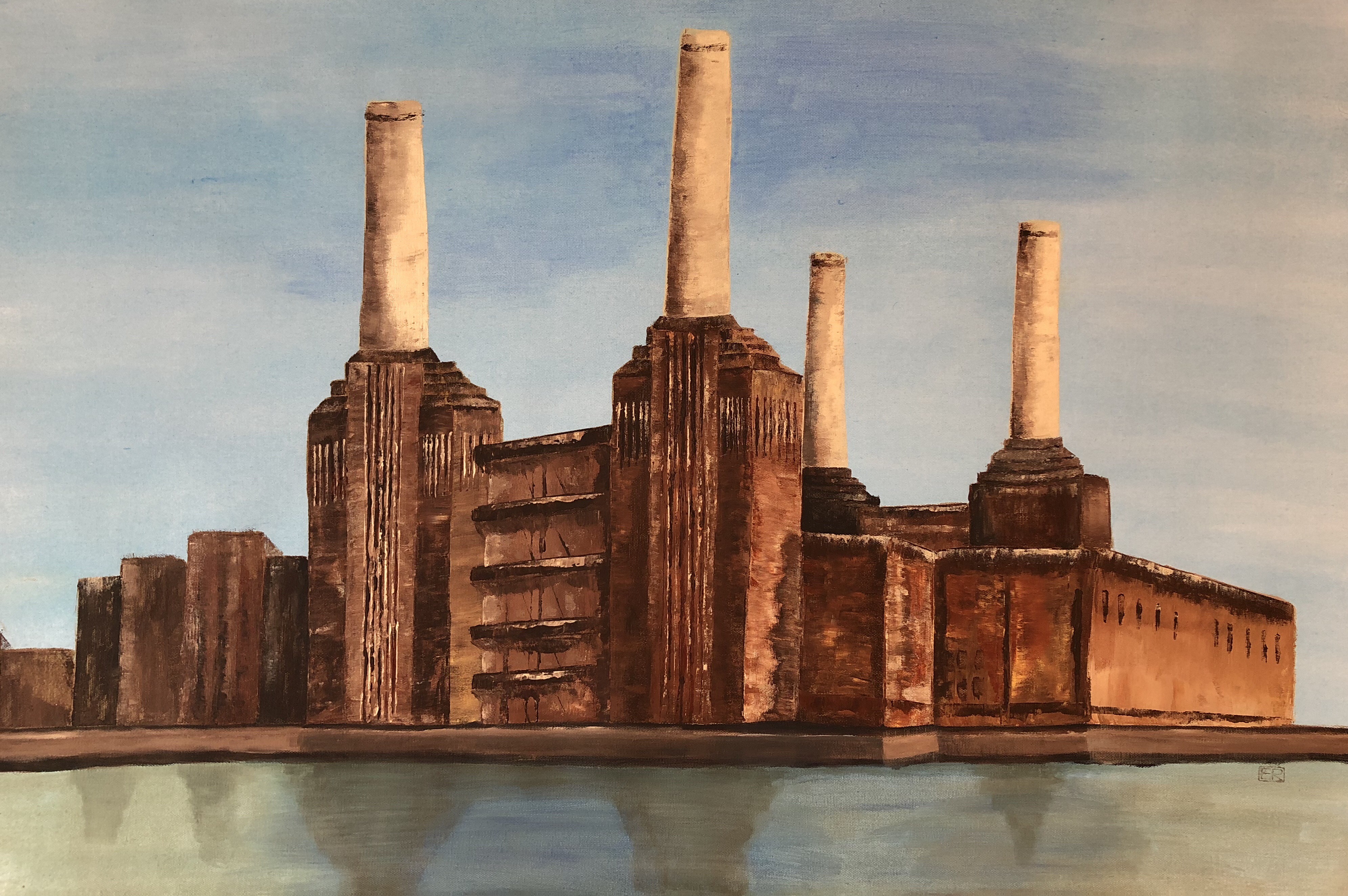
A study of Battersea Power Station (before all the recent year’s’ development). Acrylic on canvas:
Battersea Power Station (2018)
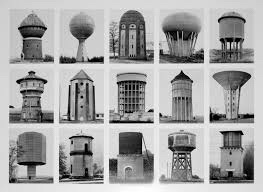
My work in this area was inspired by two German photographers, Bernd and Hilla Becher, of the Düsseldorf photography school. I admire their New Objectivity style:
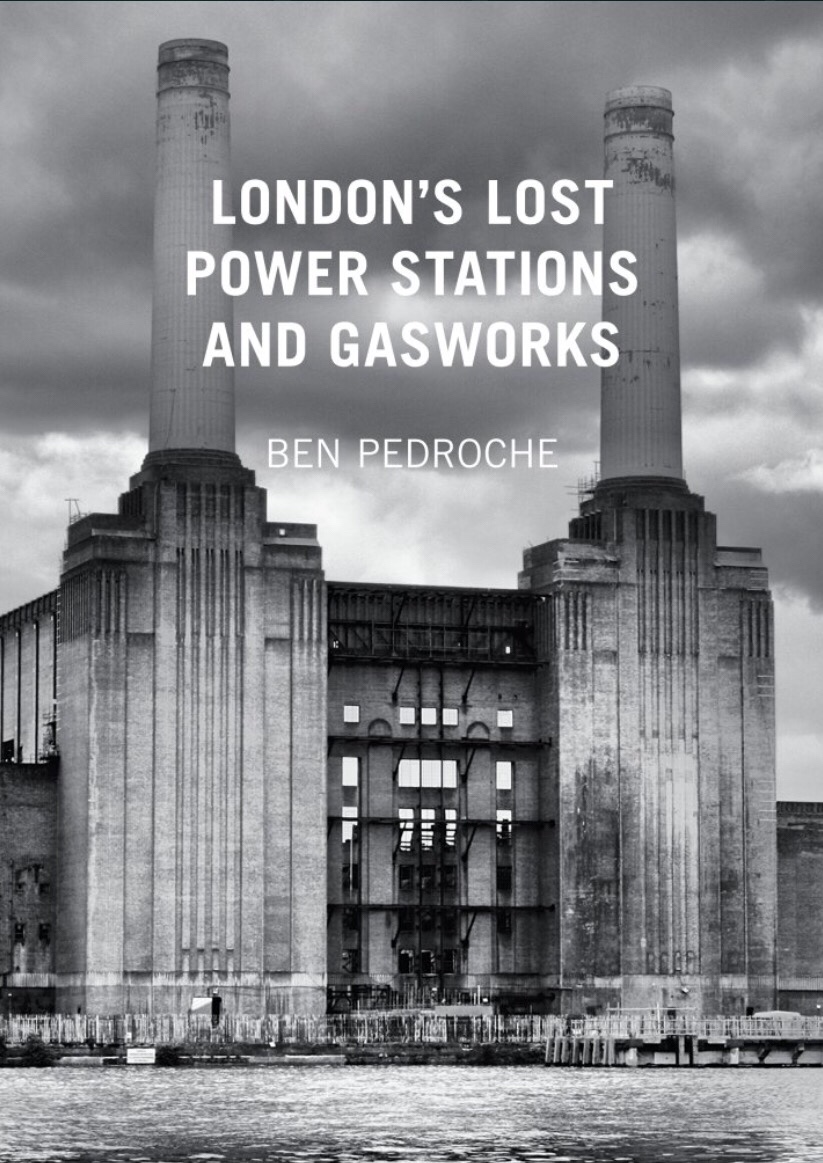
This book was also very useful to help me in historical insights and locating sites in the UK:
–
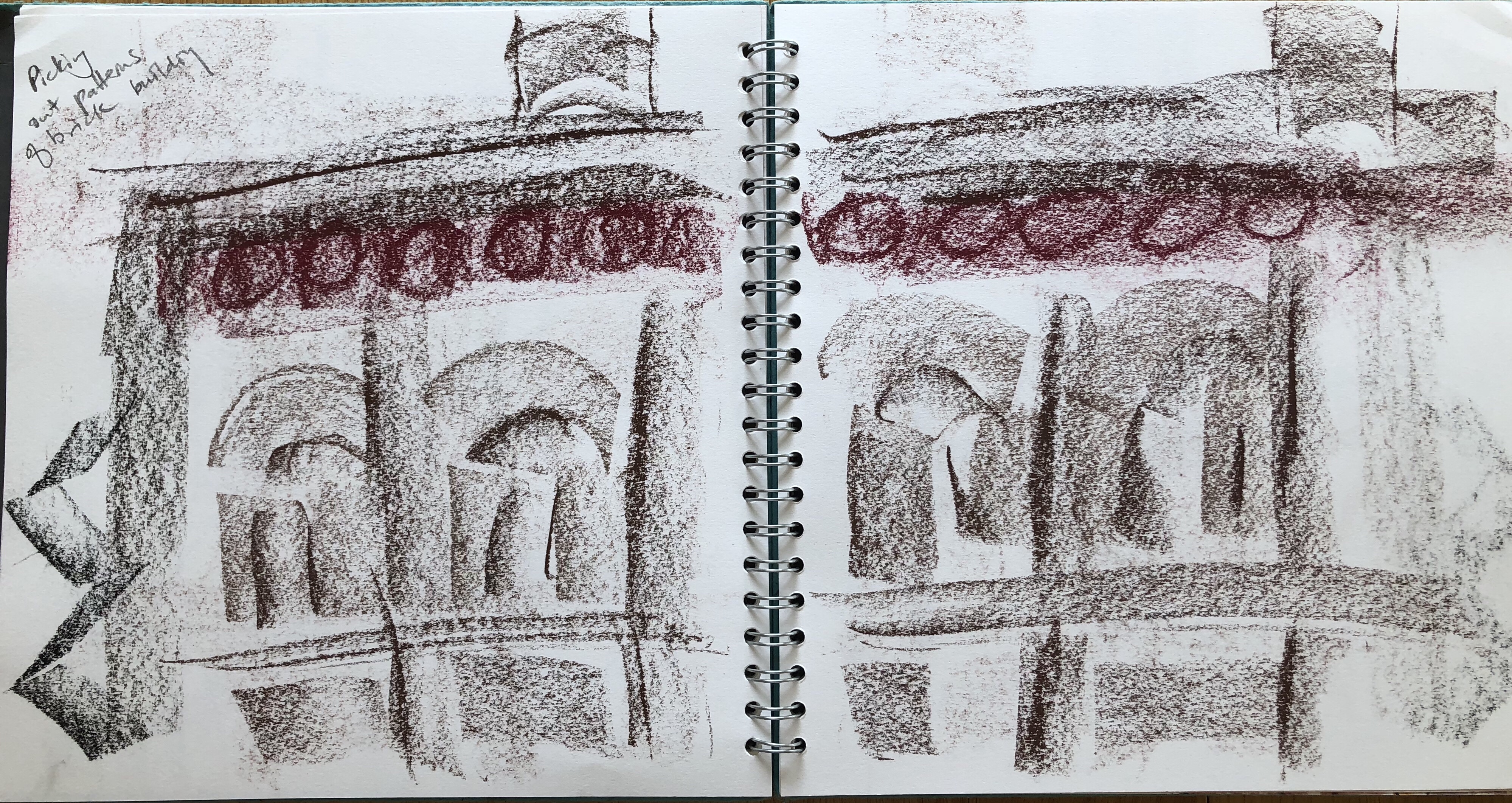
After reading the book, I visited Lots Road Power Station in Chelsea, London. It was originally built to power the whole of the London Underground and subsequently decommissioned. My on site study drawings:
–
My 2018 painting of a partly boarded up frontage of the Lots Road power station:
London Lots Road Power Station (2018)
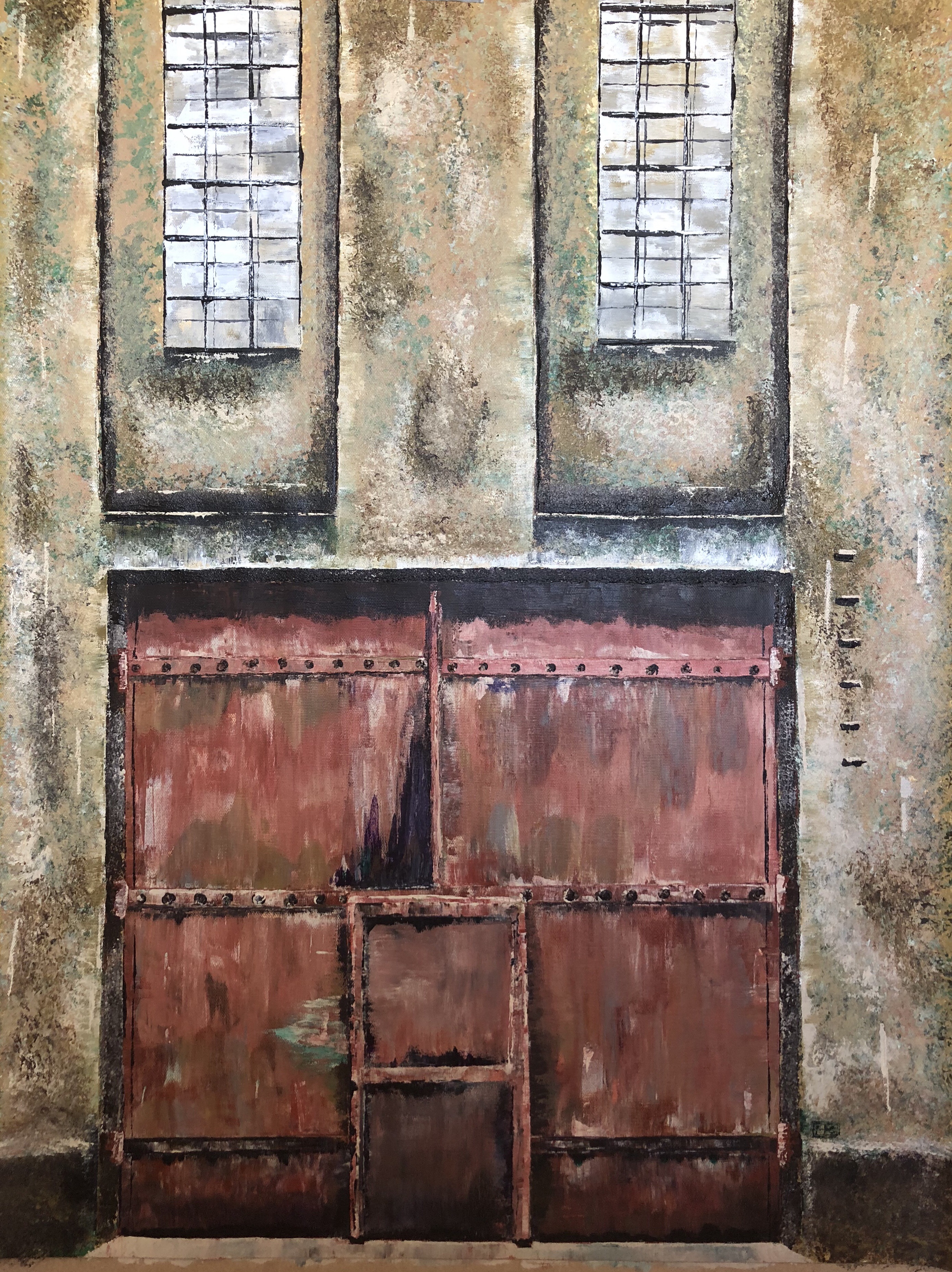
Through a work trip, I had the chance to visit the Rotweil power station in southern Germany. It powered the gun powder manufacturing locally.
Here is an acrylic painting of a door at Rotweil:
Rotweil Power Station (2018)
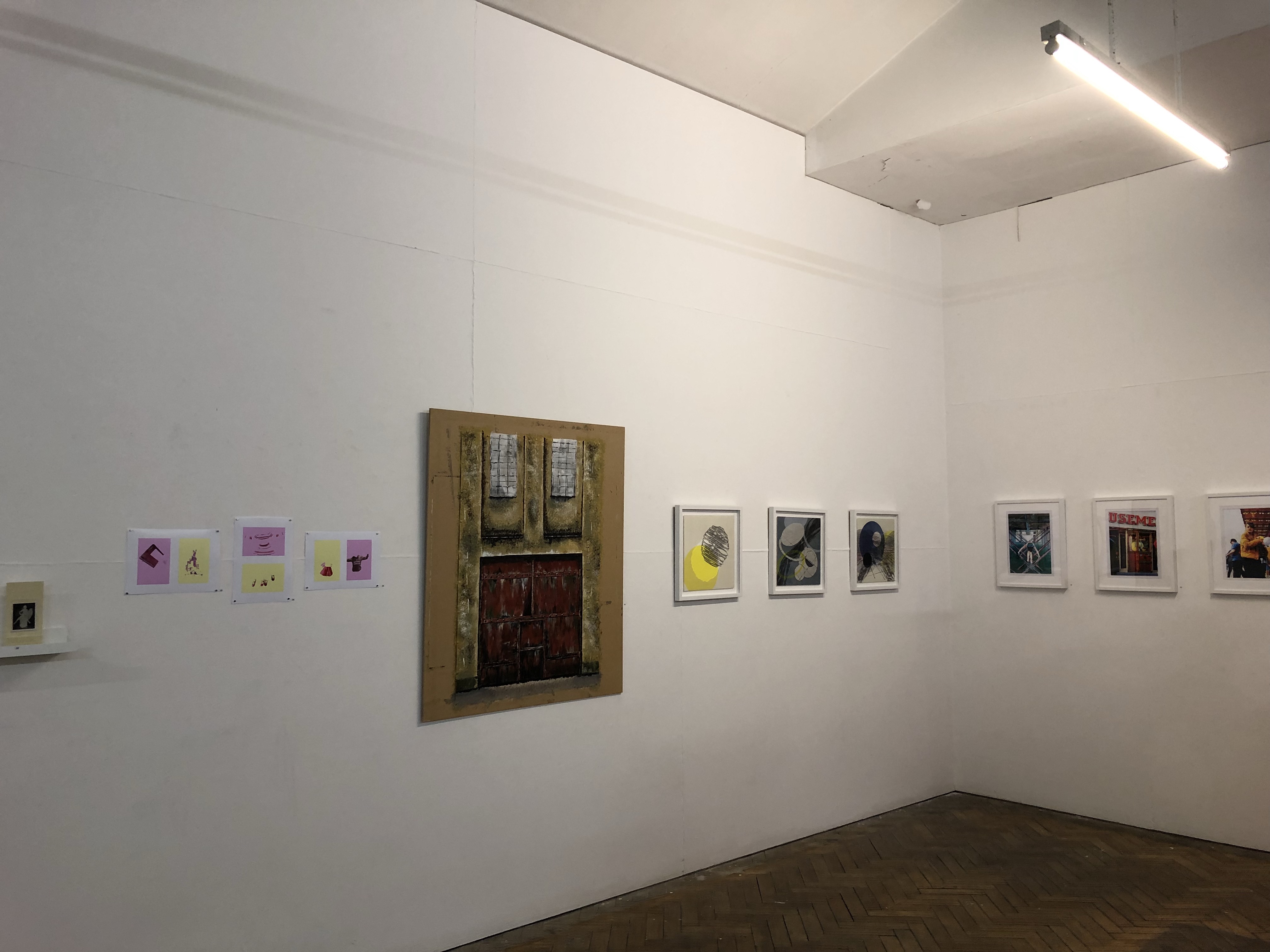
This painting was subsequently part of a group exhibition:
–
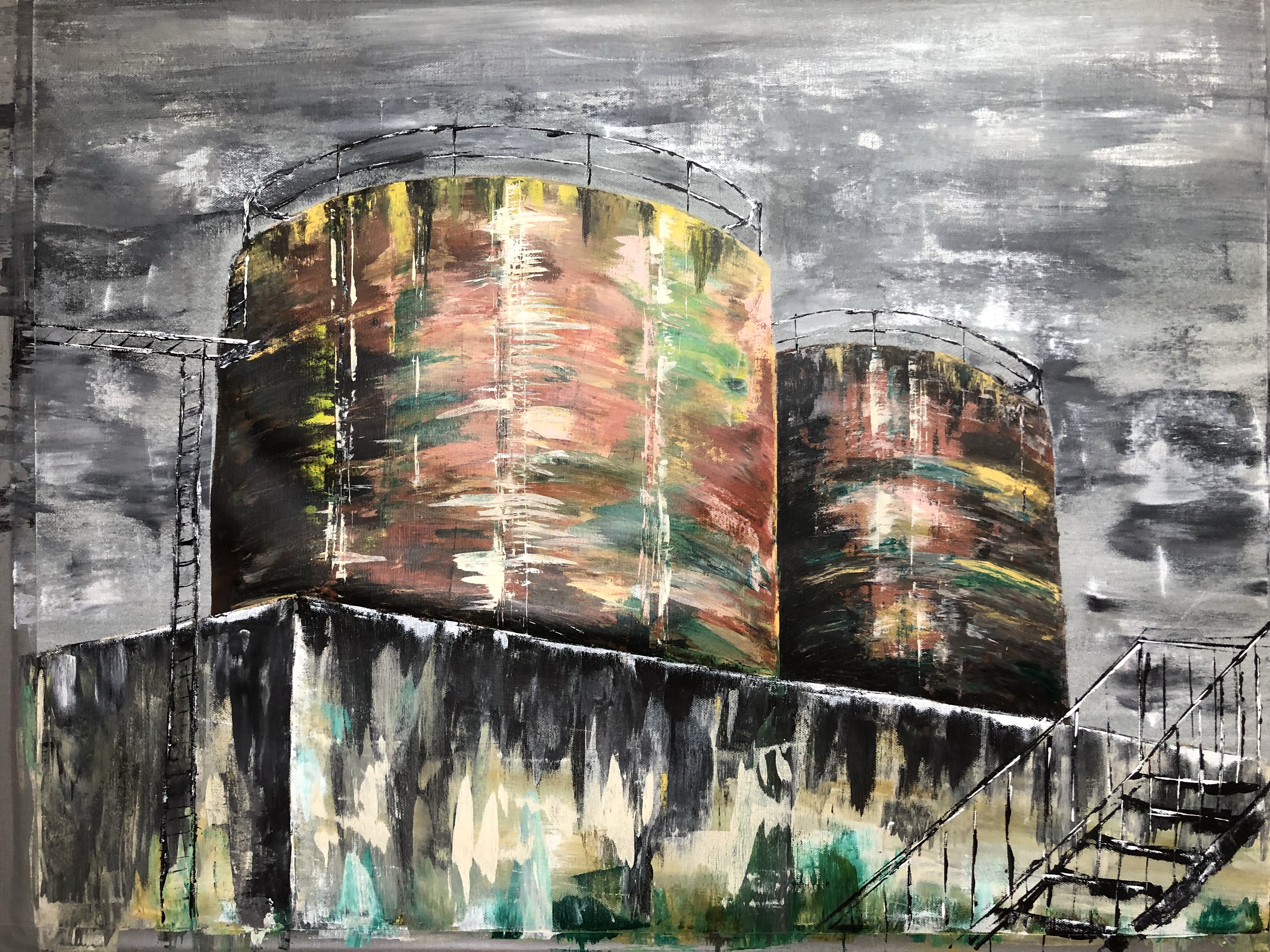
The tanks at Rotweil power station:
Rotweil Power Station (2018)
FURTHER REFLECTIONS
I have been reflecting on what made me reconnect with my ‘forgotten’ industrial landscapes work. I think it’s because:
– Having done several Cheongsam paintings where I have used bright colours to depict food as cultural metaphors and childhood family dinners based on memory, I am right now not feeling in the right state of mind to paint more colourful paintings. They seem frivolous given what’s happening in the world.
– I have been enjoying painting in bright colours – not sure whether I naturally have a preference or I purposely chose bright colours to mask unpleasant childhood memories. Bright colours and humour are great ways to put a certain slant to the story and perhaps it’s my way of taking control of the narrative. However, exercising that control and the way of storytelling take a lot of energy. It can be energising and draining at the same time. Perhaps it’s a form of renewal like a snake shedding its skin.
– However, I have recently been feeling angry and despair with global politics drastically changing our world order and I don’t think I can do cheerfully bright colours right now.
– Perhaps forgotten and industrial streetscapes somehow make me feel secure. There is no pretending – it is what it is, there is nothing to hide. The anti-aesthetic approach really appeals – just like the photos from the Düsseldorf photography school of New Objectivity. I find those images comforting. Bernd and Hilla Becher’s work are described as ‘focusing on precise, methodical documentation of industrial structures, often using a detached and objective approach’.
– Perhaps I am right now looking for detachment and objectivity. I can’t take anymore unsubstantiated claims, confusion and uncertainties – I need facts. The world needs facts.
– I am ranting.
LEARNING
I appear to be at another junction in my practice. This one I hadn’t planned for as I believe it has arisen due to recent world events. I don’t know exactly how or where I want to take my thinking here. I want to somehow incorporate this ‘no frills’ approach with my transcultural work, but how? I definitely want to do more with the film photography and I need to think how to incorporate that into my practice.
I need to discuss this with my tutor.
NEXT STEPS
Continue to think about where to go from here for my practice. Discuss with my tutor.
Do more streetscapes with the Hasselblad camera and think about how to incorporate photography into my practice to expand my visual arts ‘tool kit’.
In my monthly Chinese painting class, we recently learnt to mount work that has been painted on rice paper. This blog documents the step-by-step process so that I can refer to it at a later stage.
Process of mounting Chinese painting onto mount board:
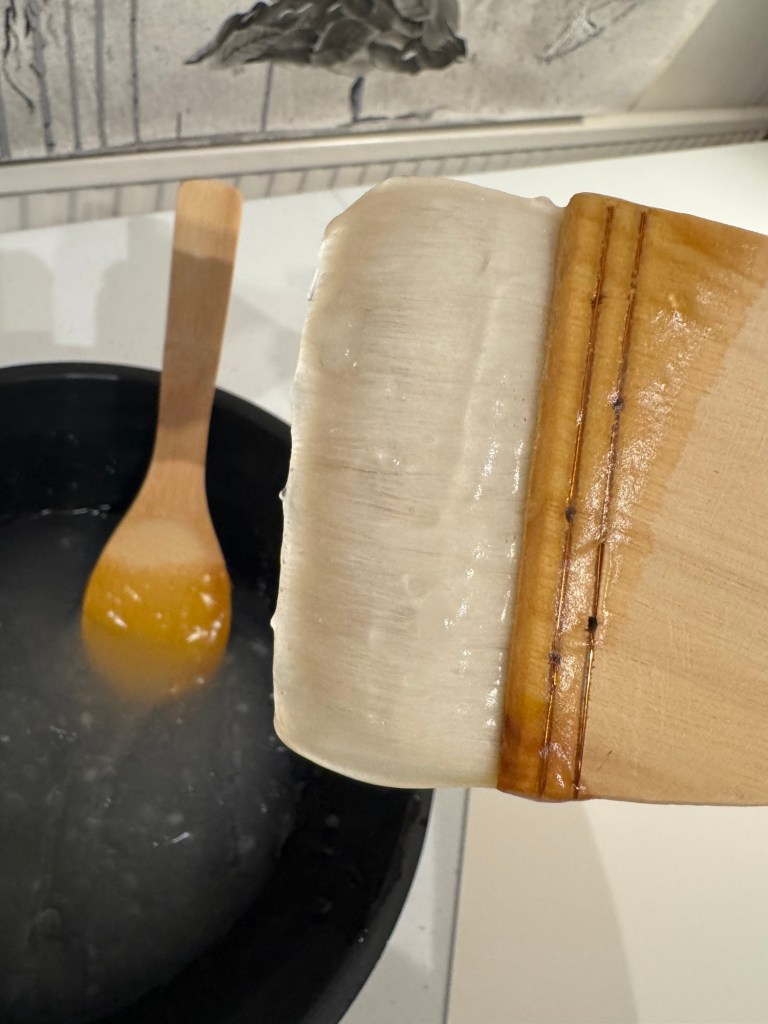
Make the glue – mix four tablespoons of wall paper paste powder to one pint of water in a bowl. Mix to a smooth paste. Leave to one side.
–
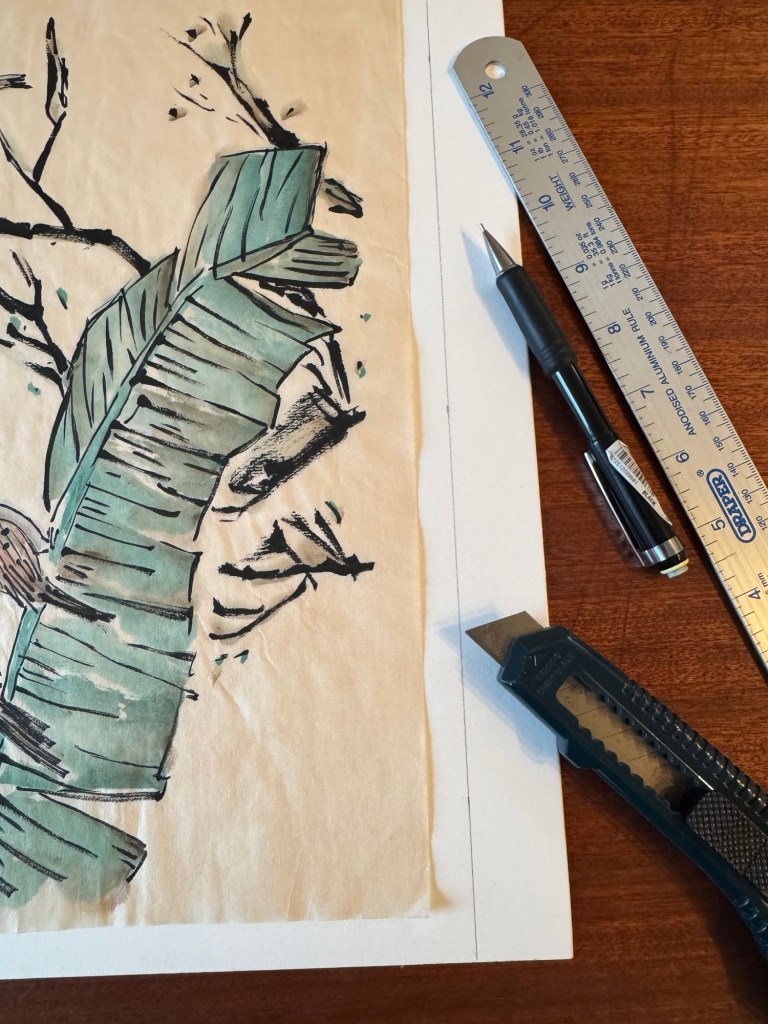
Use a pencil to mark the mount board leaving 1 to 2 cm border around the four edges of the painting.
–
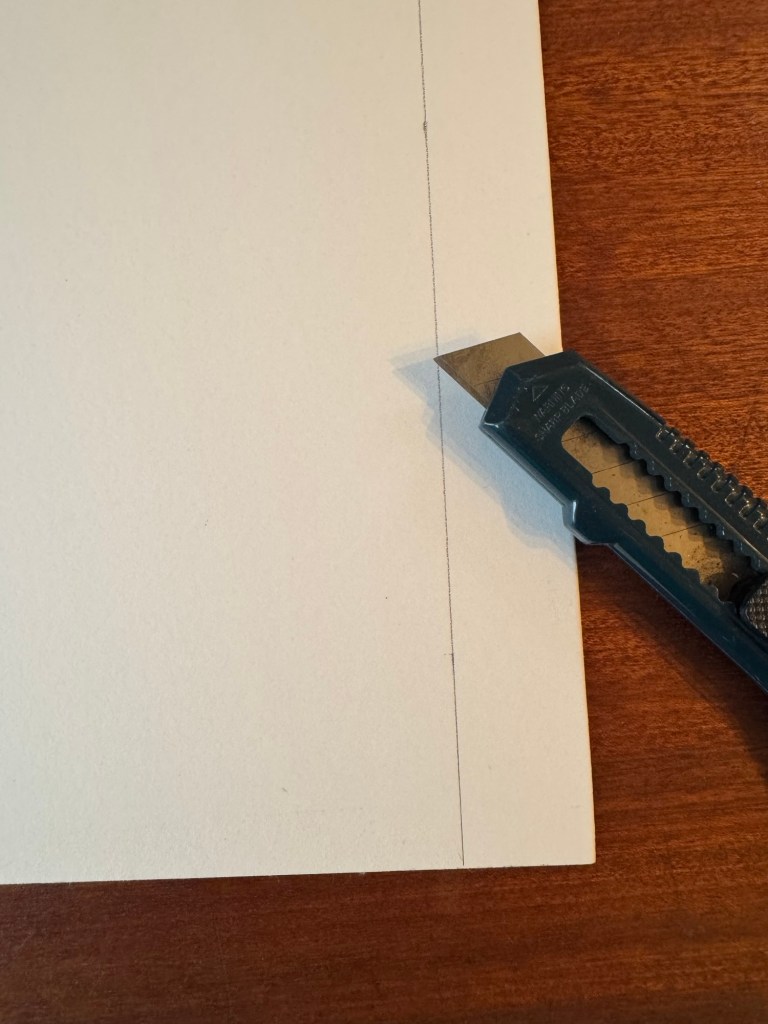
Cut the mount board along the pencil lines. Leave to one side.
–
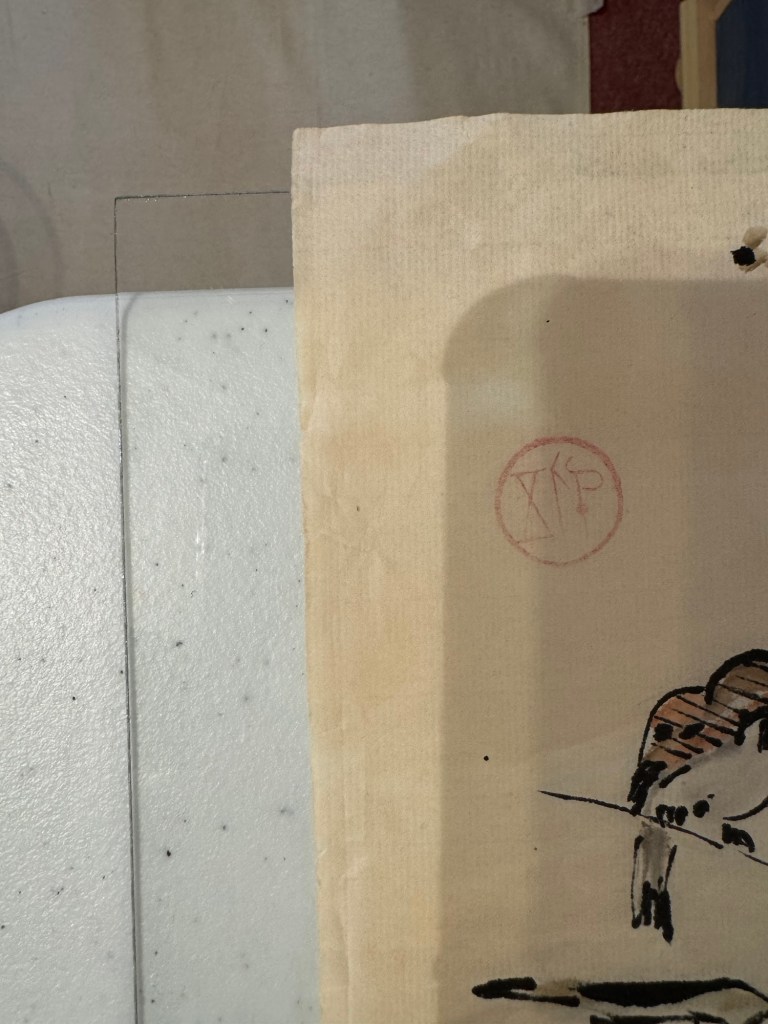
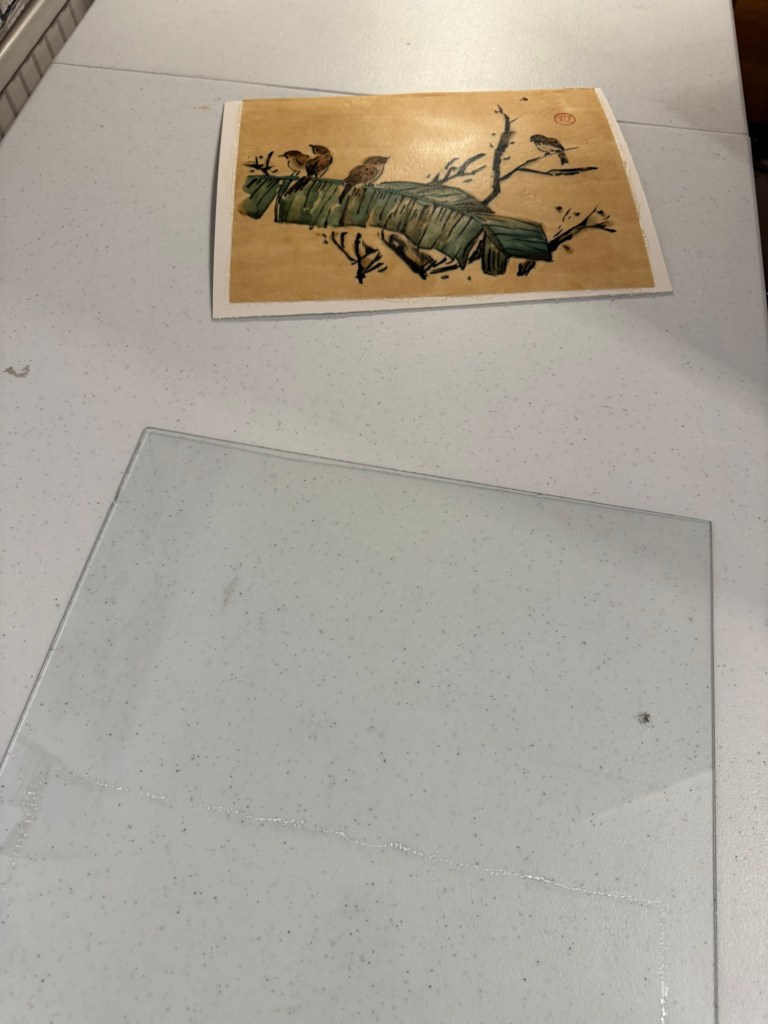
Place a piece of glass (or thick Perspex) on a table. Wipe clean the glass thoroughly and dry. Place the painting on the glass with the ‘good side down’ leaving a 1cm edge of the painting overhanging the glass.
–
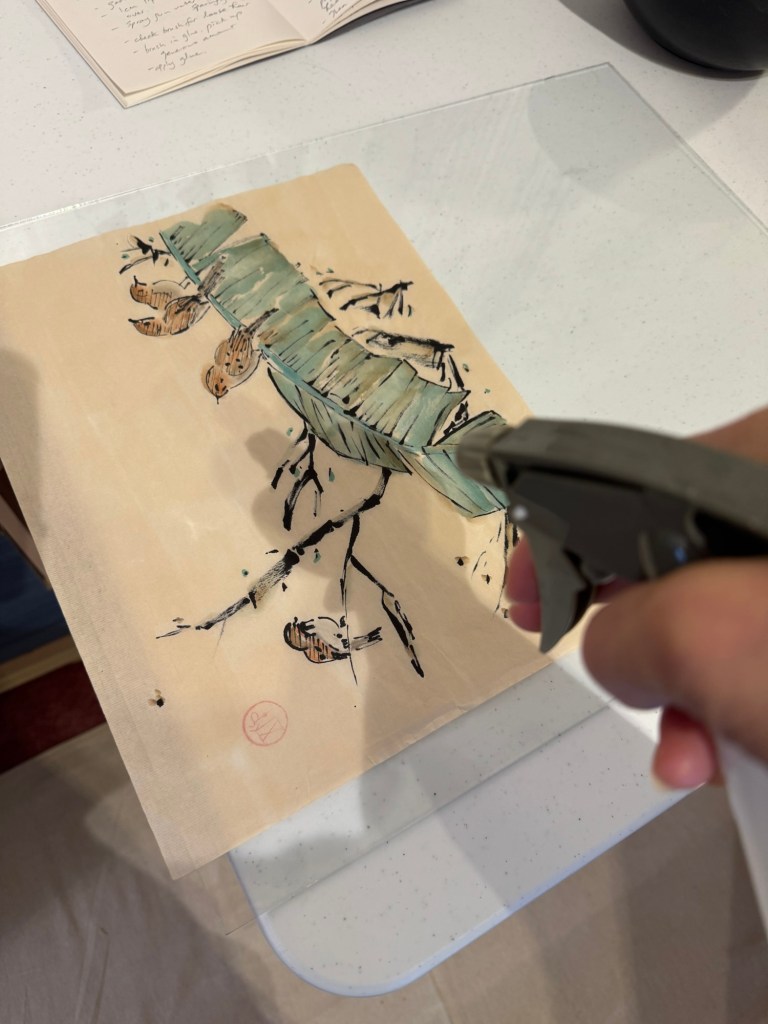
Spray the painting with water sparingly to wet it slightly.
–
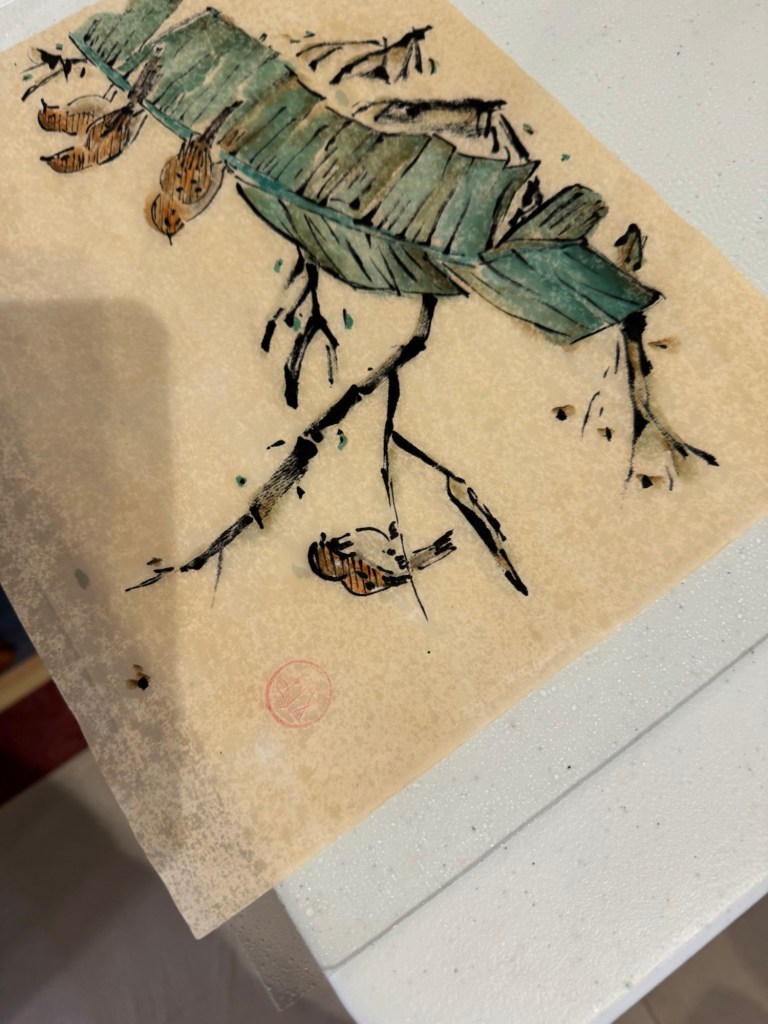
Painting sprayed with water:
–
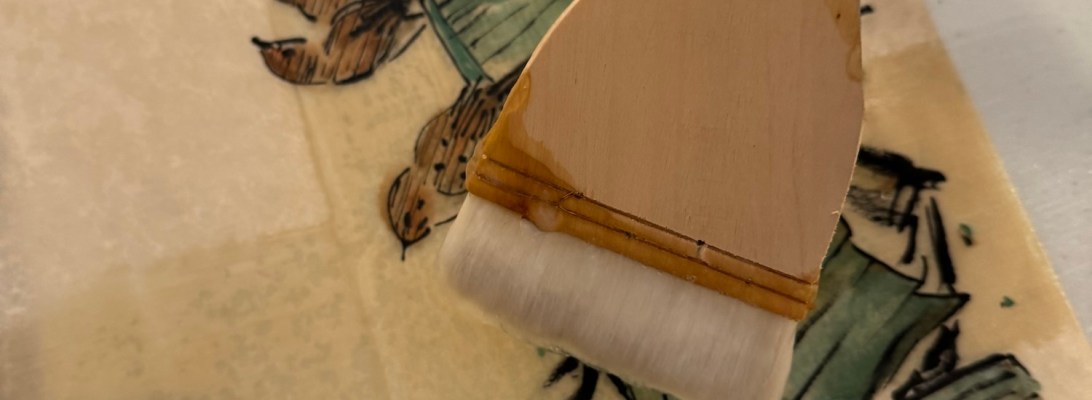
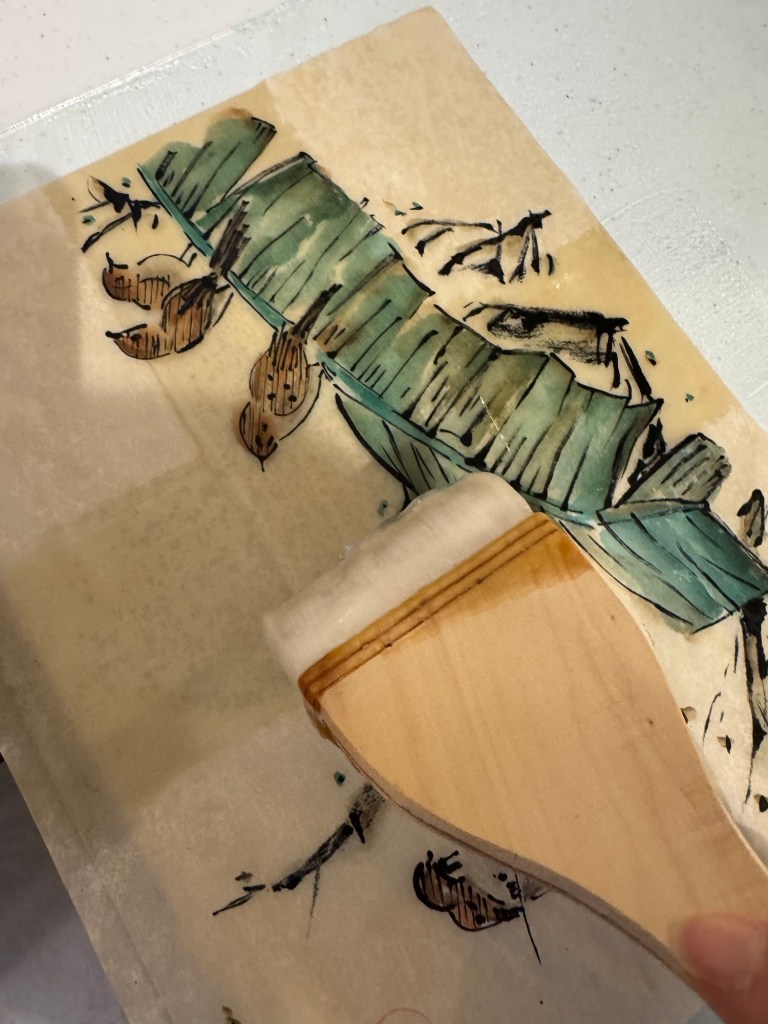
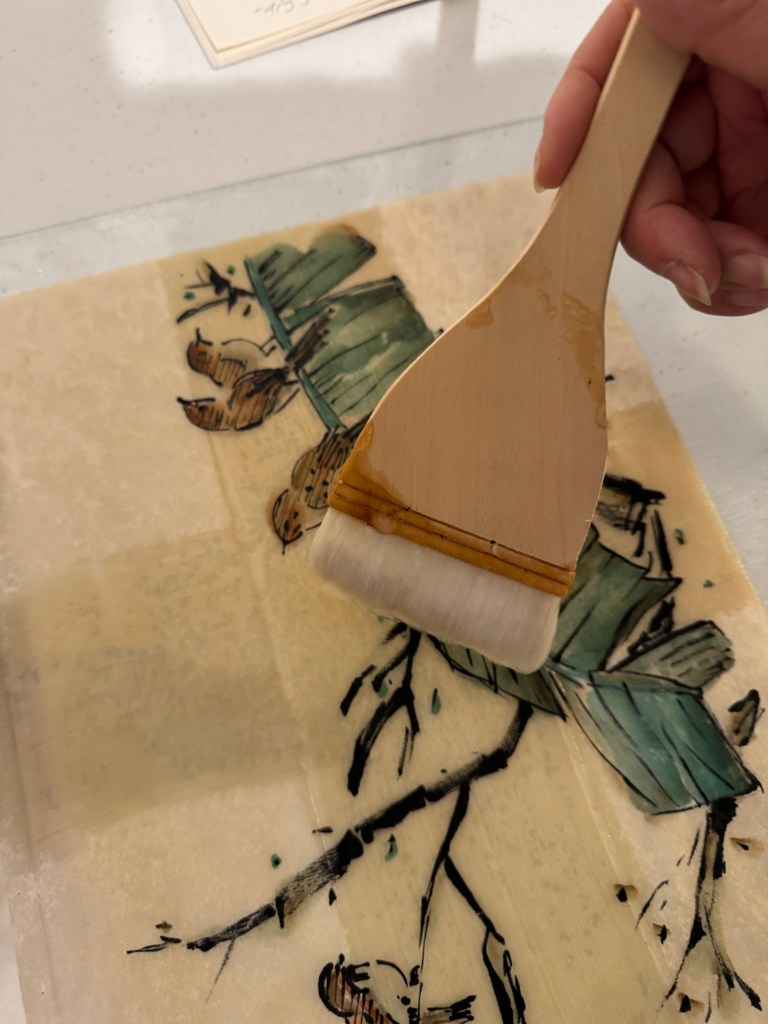
Apply the glue using a 3 to 4 inch wide soft hair brush (such as a goat hair brush seen here). Dip brush in glue to pick up plenty of glue paste. Check for loose hair. Start applying glue – every stroke always from the centre. Do the cross ‘+’ from the centre to each of the four sides.
–
Then apply glue from the centre diagonally to the four corners like the Union Jack flag. Continue to apply glue from the centre outwards until the whole painting is covered in paste. Make sure the 1cm of painting overhang that is protruding the top edge of the glass is also covered in paste.
–
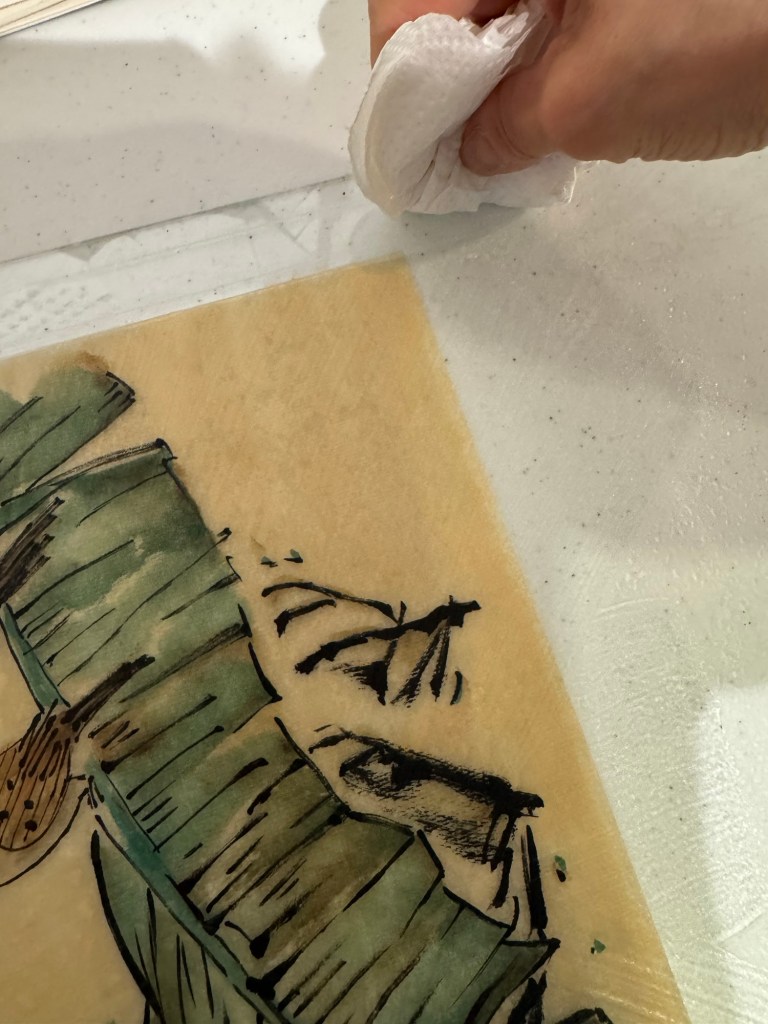
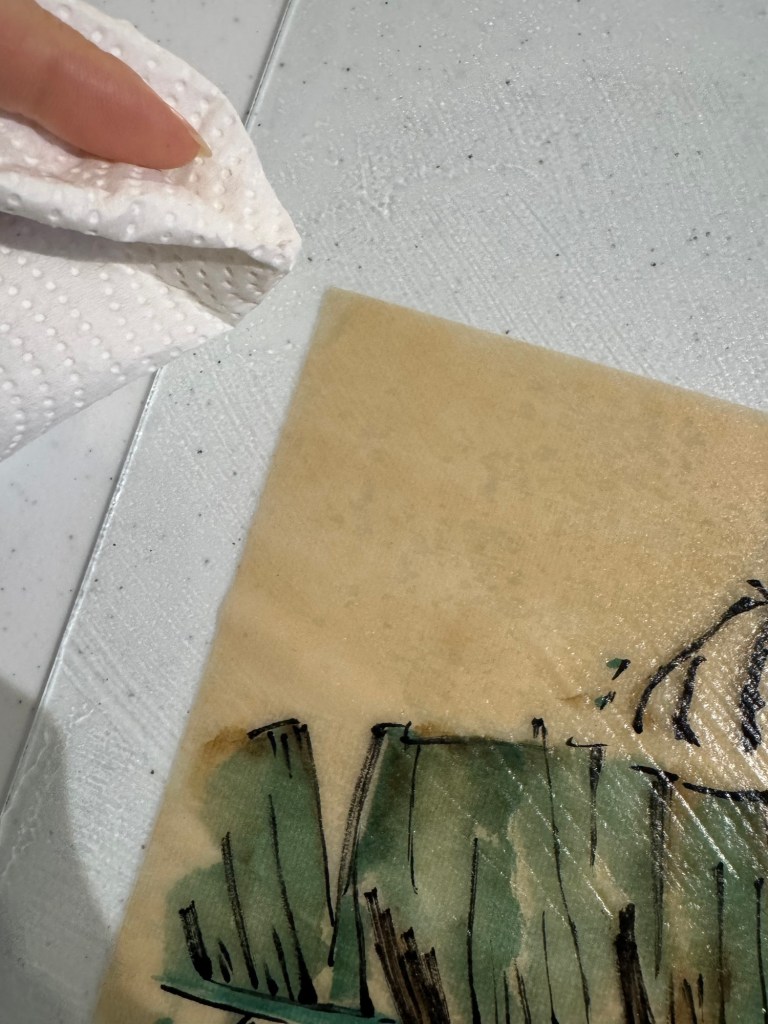
Use paper towel to wipe off excess glue on the glass around the painting.
–
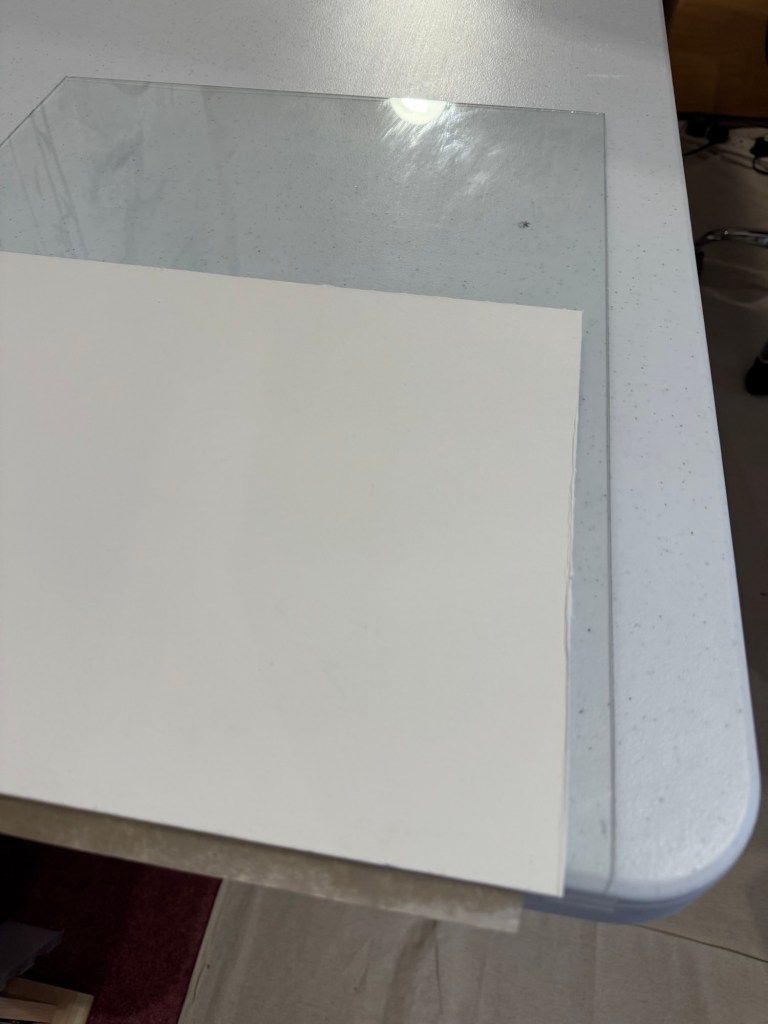
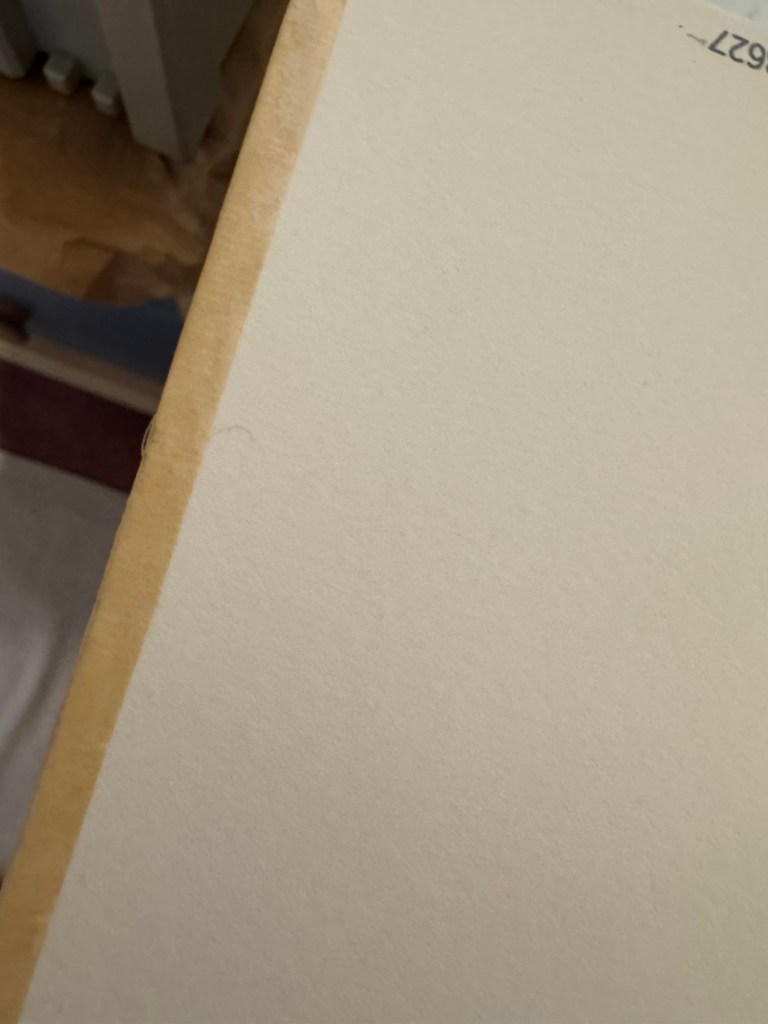
Place the mount board centred onto the painting leaving the 1cm overhang of the painting exposed.
–
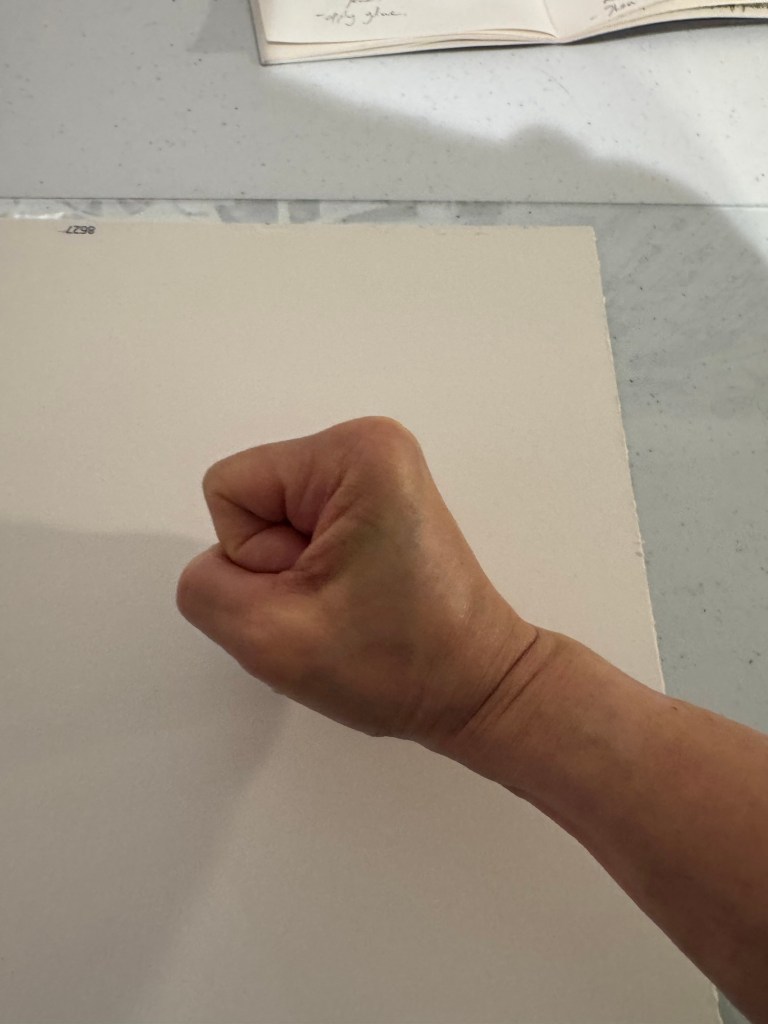
Apply pressure onto the board with a tight fist, repeating the Union Jack pattern starting with the cross then the diagonals. Work outwards from the centre (always this way) until the whole board has been pressed. Run fingers along the four edges to ensure the edges are completely pressed down.
–
Fold over the overhang. Press down firmly.
–
Confidently and quickly flip the painting away from the glass. Stand so that the flip action is towards (and not away from) the person’s body – this makes the flip action more robust. Clean the glass thoroughly to remove all glue.
–
Leave the painting to dry flat for several days (minimum two days). The mounted painting will warp when dried, place clean paper between dried paintings (if mounting more than one) then put heavy weights on top (e.g. several thick books) for one week or more to flatten.
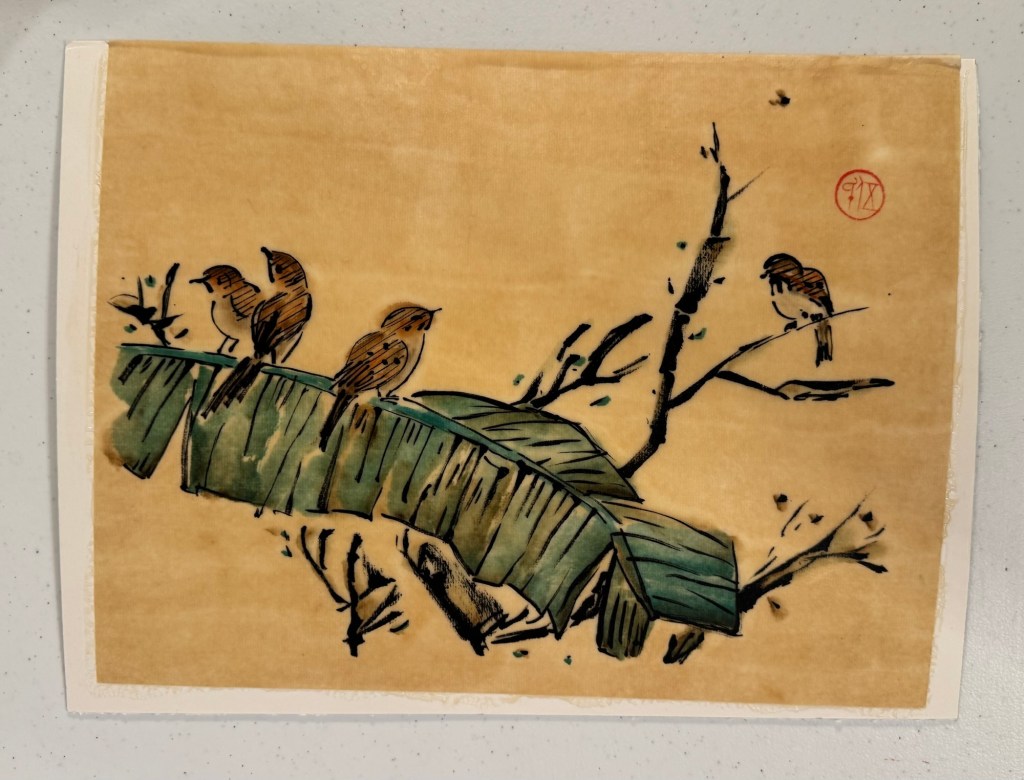
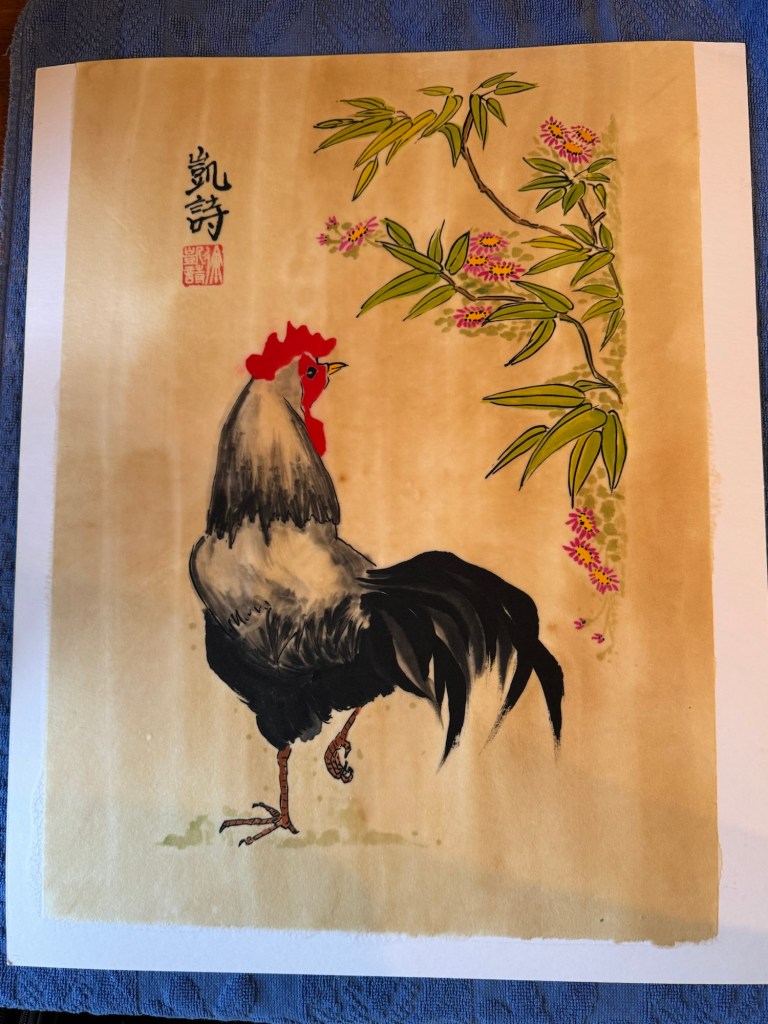
Mounted painting of sparrows Mounted painting of cockerel
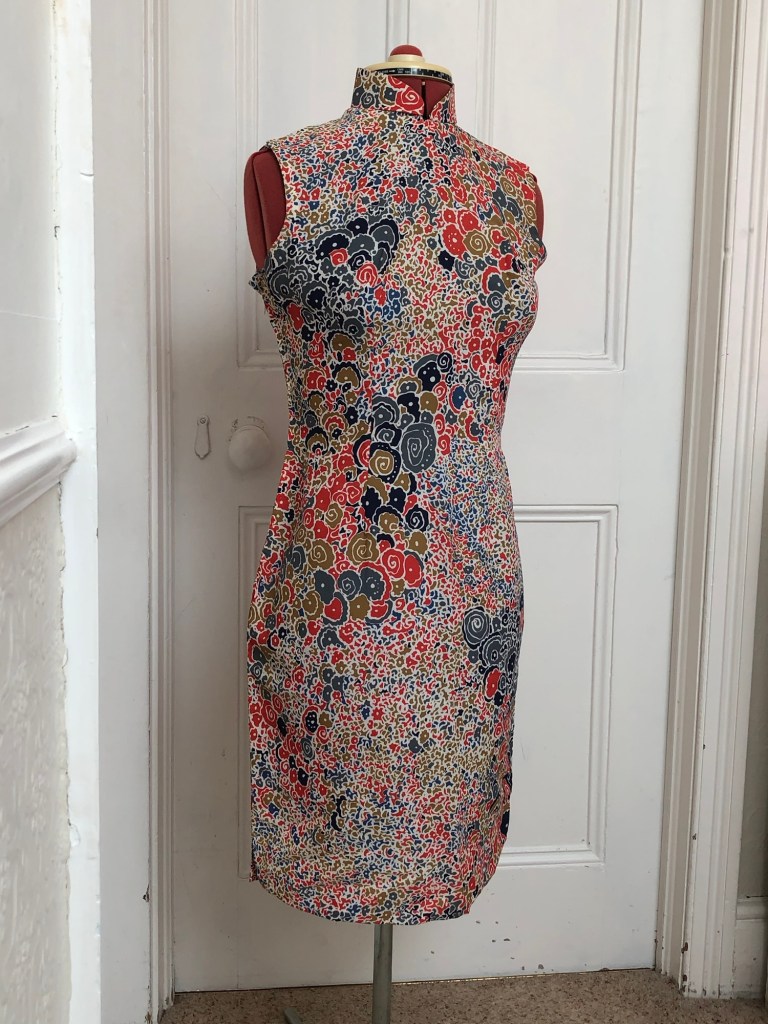
In the last few months, I have been making paintings on Cheongsam shaped canvases. The idea came to me when I accidentally found my mother’s Cheongsam in my attic. The shape of the dress is so iconic and I am so fond of the Cheongsam that I felt compelled to do something with it.
My mother’s Cheongsam
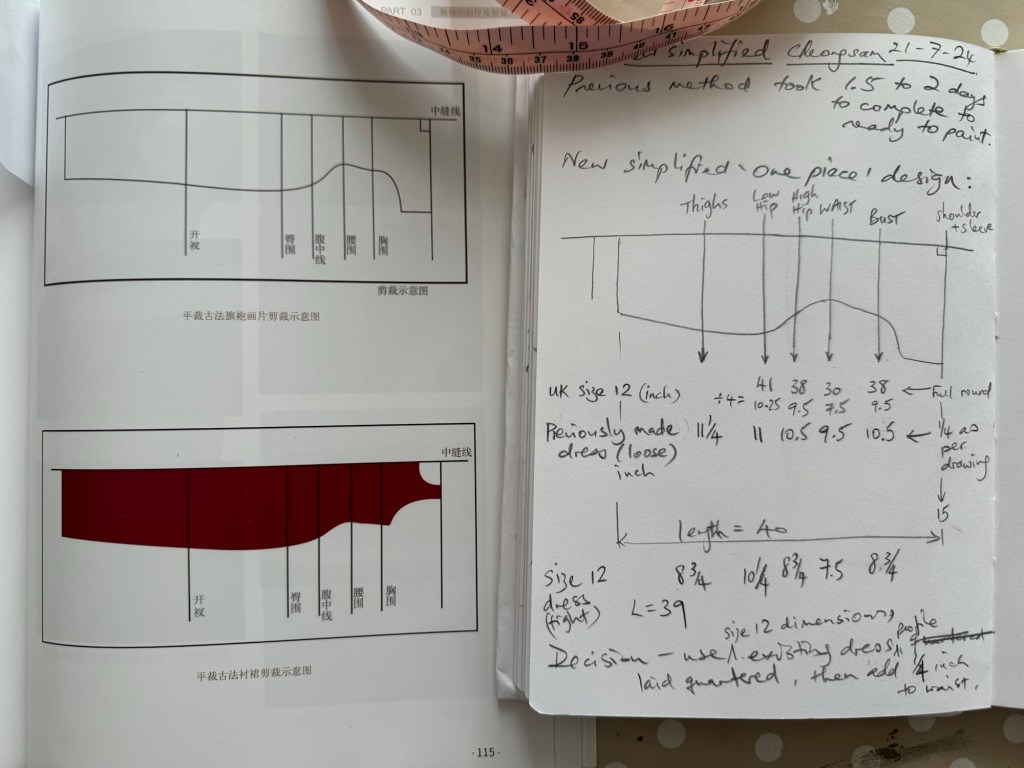
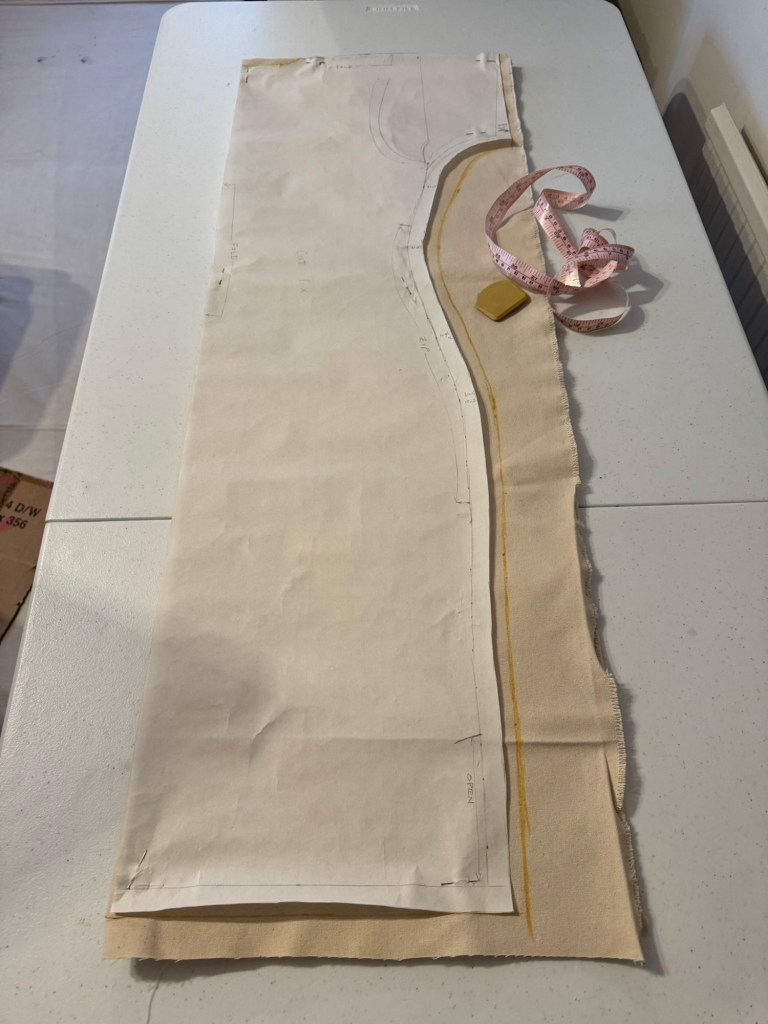
I made painting canvases in the shape of a Cheongsam and developed the dress pattern over time to create a design that was quick and easy to make.
Measurements for my patternCutting the painting canvas to the pattern
Below are the Cheongsam paintings that I made and each has been documented with its own blog, so I will not elaborate on the background and my reflections. It’s just a quick list and recap here.
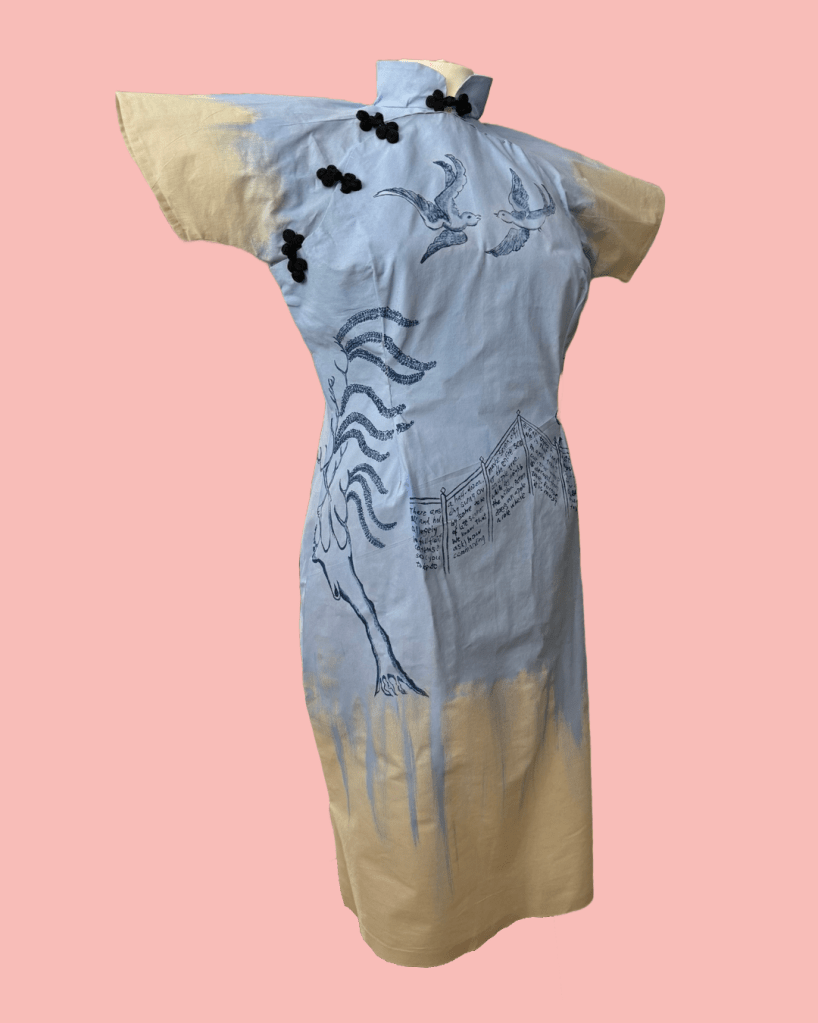
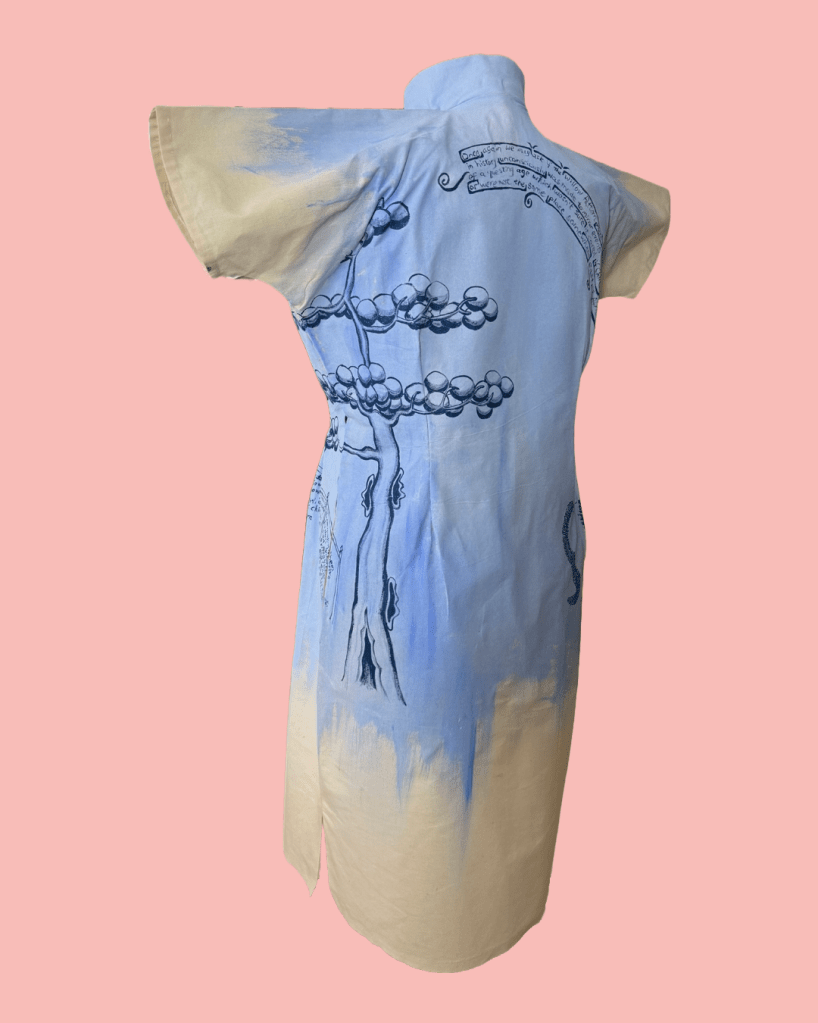
The first Cheongsam painting was my response to the traditional Blue Willow pattern. It was painting in acrylic on calico canvas:
Blue Willow – front viewBlue Willow – back view
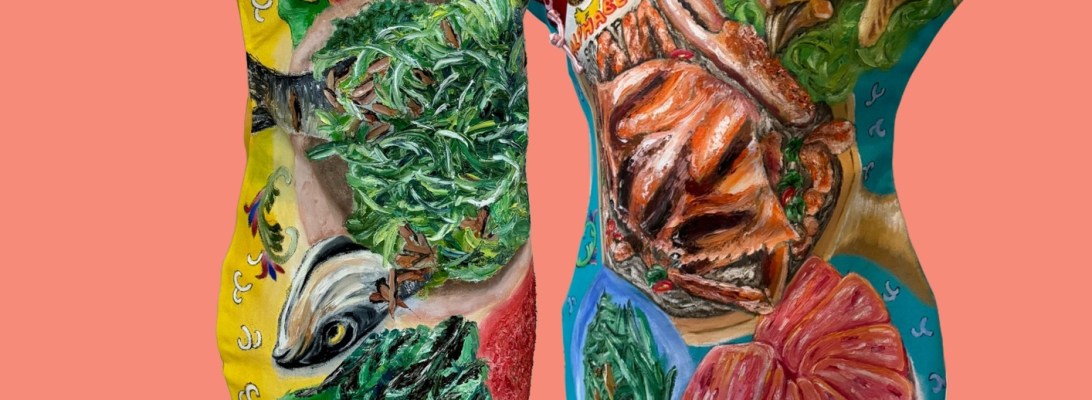
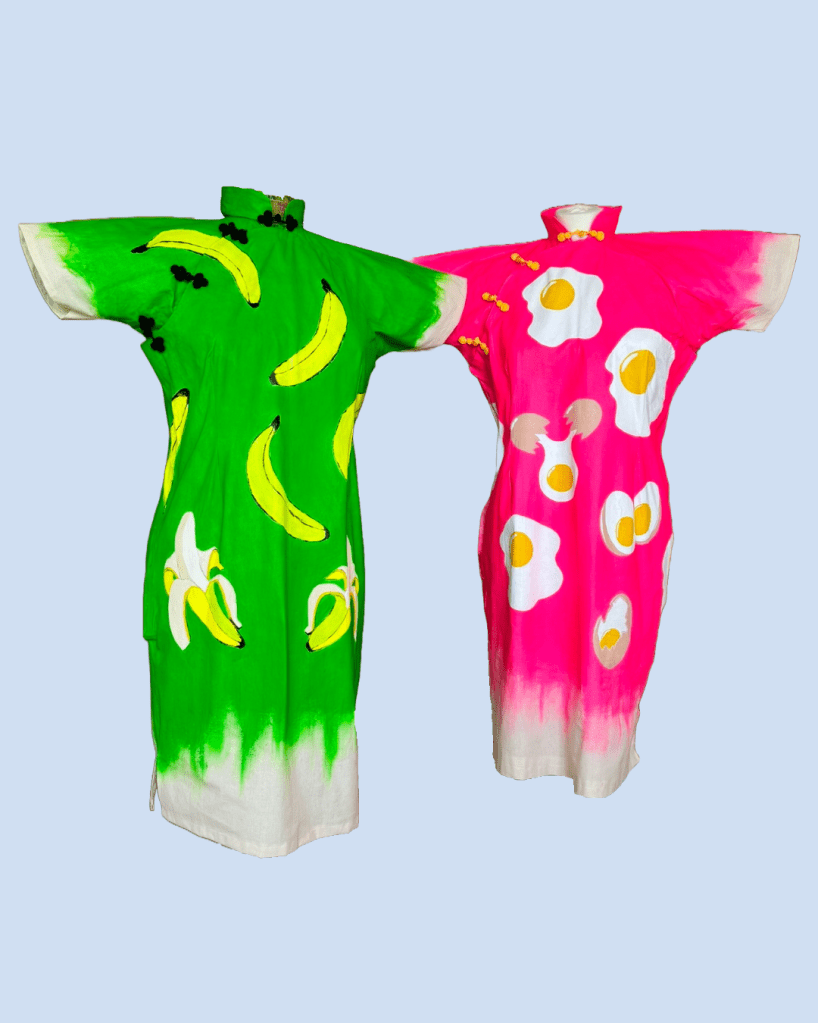
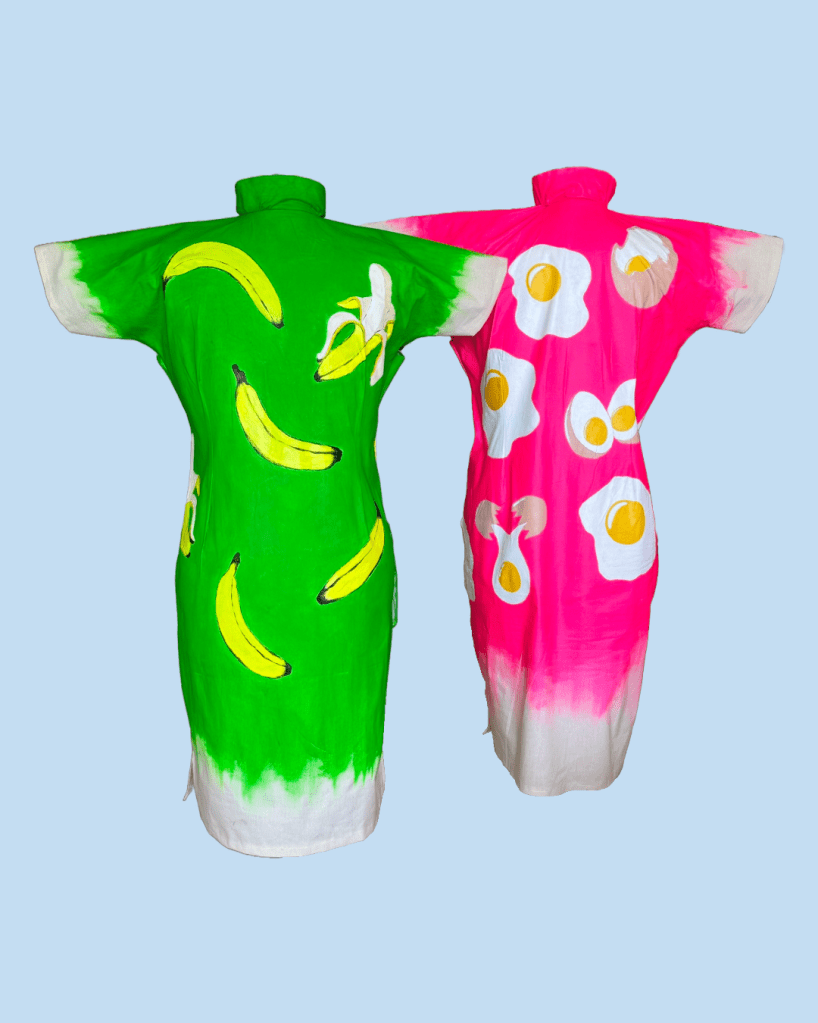
The second and third Cheongsam paintings are also acrylic on calico canvas and are intended to be shown as a pair (diptych). They depict food used as a racial identity metaphor. One is called ‘You’re a banana’ and a response to it called ‘No, I am an egg’.
Front view of ‘You’re a banana’ (left) and ‘No, I am an egg’ (right)Back view
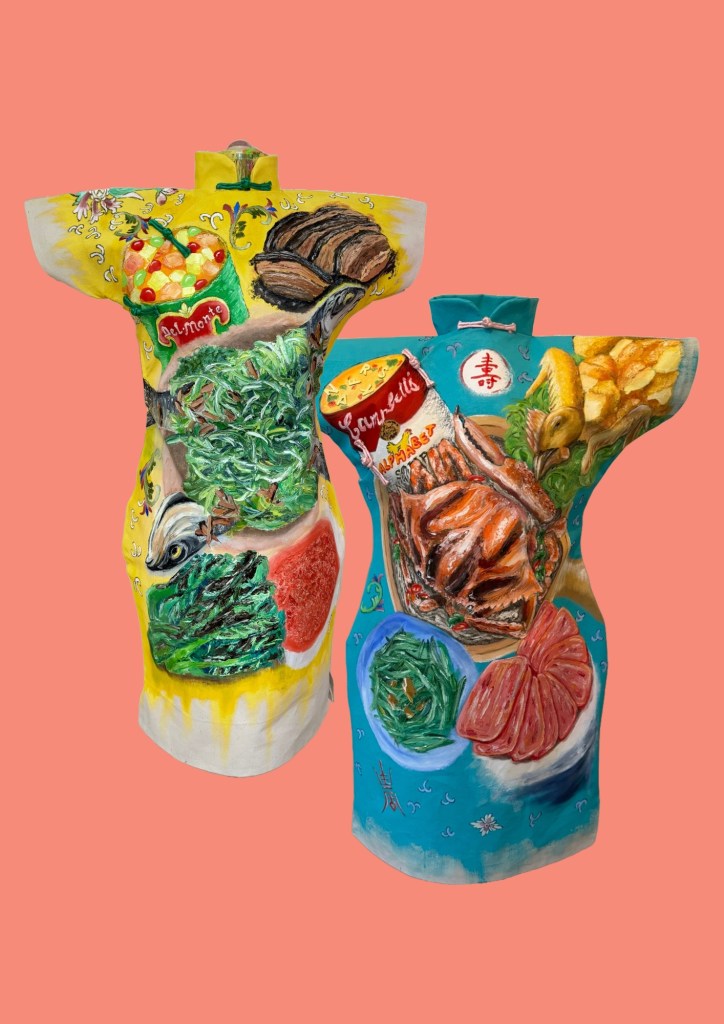
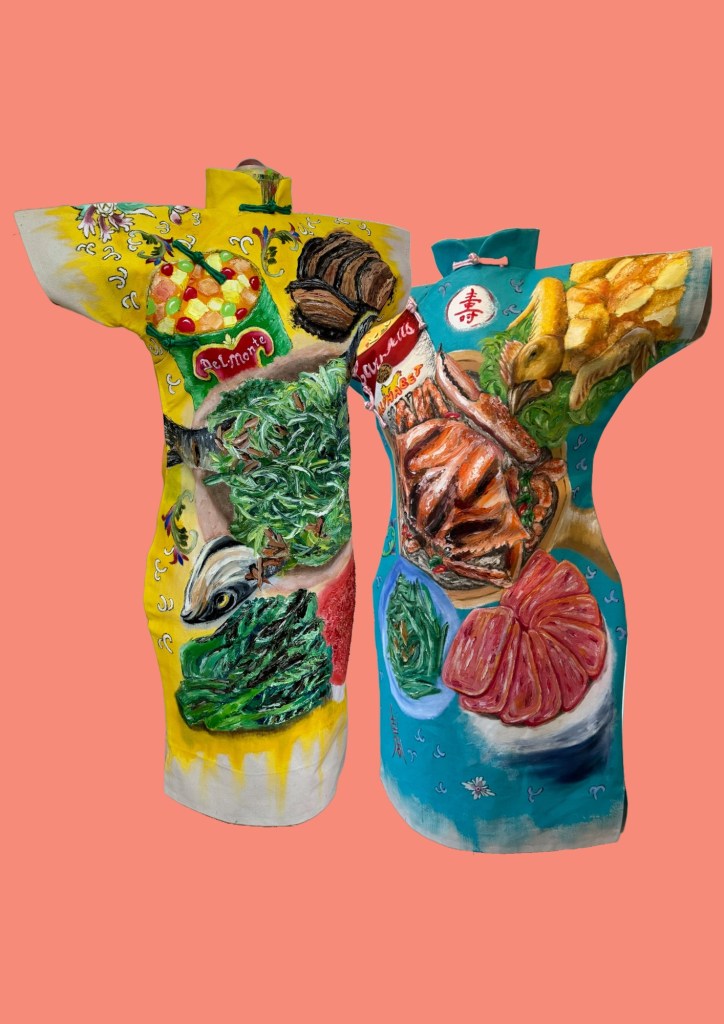
The final pair of Cheongsam paintings are Family Dinners #1 and #2, depicting my childhood family dinners while growing up in Hong Kong. Both are oil on cotton canvas.
Front view – Family Dinner #1 (left) and Family Dinner #2 (right)Slanted front view
REFLECTIONS
I have thoroughly enjoyed making the Cheongsam paintings because:
– They are something different. They brought a new dimension and energy to my practice.
– I felt they could help me to make my work recognisably mine. This was an objective I set for myself in my study statement.
– I have enjoyed the dressmaking element. The technical discovery has been rewarding. The process of dressmaking reminds me of my childhood watching my mother making dresses. Brought back many memories.
– I enjoyed the challenge of making 3D paintings. I had previously explored the subject of expanded painting and I was pleased to return to that kind of work.
– I enjoyed exploring food as identity metaphor. It has opened a whole can of worms that has required more thinking and research that are ongoing.
– I enjoyed painting the dinners very much. I love painting in oil and food brings me much pleasure – both eating and painting them. Food is such a large part of my Hong Kong Chinese culture that painting them onto a Cheongsam canvas felt particularly meaningful. Afterall the trigger for painting on Cheongsam canvases came from finding my mother’s dress and she was the one who created all the lovely dishes that we ate. Cooking dinners for her family was such a large part of her daily life that it would be impossible to think about her and my family without thinking about her food. When I meet up with my sister nowadays, we mostly seem to talk about food and each dish would lead us into reminiscing about different stories from our childhood.
– I had intended to make more and more Cheongsam dresses for the remainder of my MA course to build up a collection for the final year degree show. However, my thinking has changed since receiving my Unit 2 feedback.
– My Unit 2 feedback made me think more deeply about why I am painting on Cheongsam dresses. Why dresses? Why Cheongsam and is the time well-spent in making dress-canvases? Shouldn’t I spend more time painting? There was a lot to think about and reflect on from the Unit 2 feedback and I have written a dedicated blog on that.
So where does that leave me and my Cheongsams?
I think I should pause on my Cheongsam paintings, because:
– I know I can make Cheongsam shaped canvases. I feel I have developed a good process for that. So I can return to that any time.
– However, I should spend more time on developing my painting techniques. Part of the Unit 2 feedback was about exploring different ways to apply oil. I have started experimenting with that and I should concentrate on that to build up my ‘painting vocabulary’. I do feel that I need to expand my vocabulary to take my work to the next level of expression.
– Part of my plan to expand my vocabulary is to understand more about Qi Baishi’s motto of ‘the marvel of painting exists between likeness and unlikeness’. This requires painting with sight as well as the heart.
– Right now, I feel that I would like to return to making Cheongsam canvases at some point, but I will pause that for now and focus on developing my painting techniques.
LEARNING
There has been much technical learning from the dressmaking that I will take to future projects, especially if I return to making Cheongsam canvases.
I have really enjoyed making the Cheongsam paintings, but that does not mean I have to keep doing them. It’s ok to do something else.
I should spend more time refining my painting skills and challenge myself in that area in order to progress my practice. Once I reach a higher level then I can apply those skills in so many different ways, can be on Cheongsams or anything else.
NEXT STEPS
Continue to build up my ‘painting vocabulary’ by expanding the ways I use oil.
Continue to research the meaning of Qi’s motto – working between likeness and unlikeness.
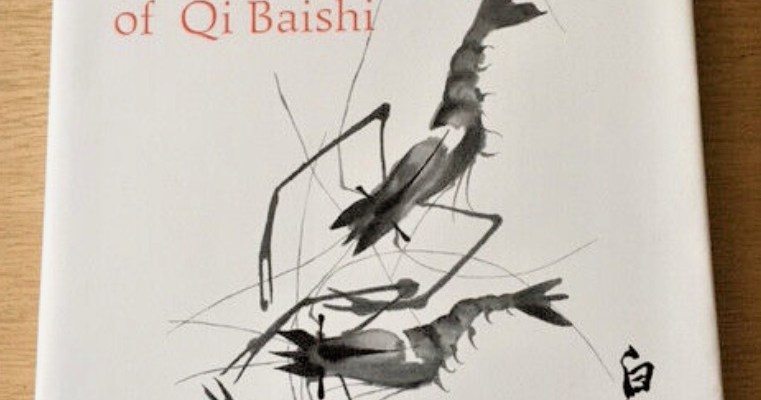
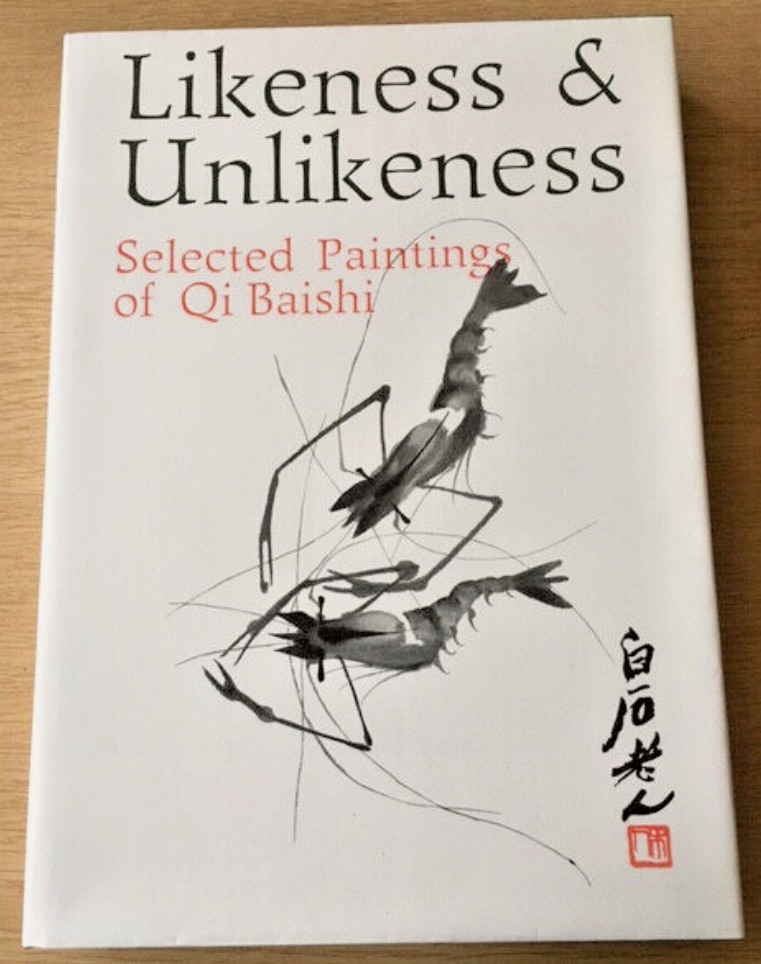
As part of my research to progress my painting practice, I am reading this book about Qi Baishi’s artwork and philosophy:
–
Below are some key points and notes I made from reading the text.
Poetry and soul in painting:
Within poetry there is painting; within painting, poetry.
A poet loves the moon and plum blossoms because his heart exists in moonlight and flower fragrance. Moon and plum blossoms are things on which he pins his heart and soul.
The mood of the painting comes from thinking which in turn comes from images.
The limited brush work in the painting evolves and extends continuously according to the logic of life and imaginative logic.
The artist’s mood cannot be fully expressed in the painting; only in part does it locate in the painting, and in part beyond it.
Rules of Chinese painting composition:
Concise, concise and concise – the characteristics of Chinese poetry and freehand brush painting.
Conciseness differs from simplicity. In conciseness, images are refined from complex and detailed phenomena.
Play of space and levels of meaning engage the imagination and intellect and stimulate them.
Conciseness is the law of composition in Chinese freehand brushwork.
Concise images are used to abstract and condense.
Omit irrelevant features and represent with a few strokes. Based on understanding of form.
Likeness and Unlikeness:
Traditional Chinese painting relies on painting from memory and feelings. Unlike western art that encourages sketching on site.
So the flowers in Qi’s works are flowers of both reality and imagination. They are flowers which have been assimilated by the painter’s heart and are permeated with emotional colours and the light of the painter’s ideal.
Qi’s motto: ‘The marvel of a good painting lies between likeness and unlikeness.’
Likeness means the concomitance of an actual object with the painter’s understanding of it. Unlikeness refers to the artist’s abstraction of the object in his treatment of it.
Unlikeness is a phenomenon of sight, likeness of the heart. [Note: I believe the translation of this has swapped the sentences. I think it should be ‘Likeness is a phenomenon of sight, unlikeness of the heart.’]
Concise composition depends on both sight and heart, and also on the combination of realism and romanticism.
Regarding the rendering of light – it is derived from the mind’s eye of the artist thus represent a synthesis. Whatever stands out is bright, obscured is dark.
More on composition:
The opposition and unity in contradictions.
Utilising contrasts.
Qi contrasts sparse and dense, a few scattered twigs on which appear an abundance of fruits and flowers.
Contrasting – large splashes of heavy black ink against large white spaces.
Sturdy pines contrast with tender, delicate grasses; quiet rocks with chirping birds. Wisterias spreading randomly with flowers in neat arrays.
Composition is the specific application of dialectics in its combination of images. Both opposite and complementary to each other. Each shining more brilliantly in the other’s company.
Qi’s motto in fullwith explanation:
‘The marvel of a good painting lies between likeness and unlikeness. If it is an exact likeness, it is catering to vulgar tastes, but no likeness is simply cheating.’
My analysis of some of the work from the book:
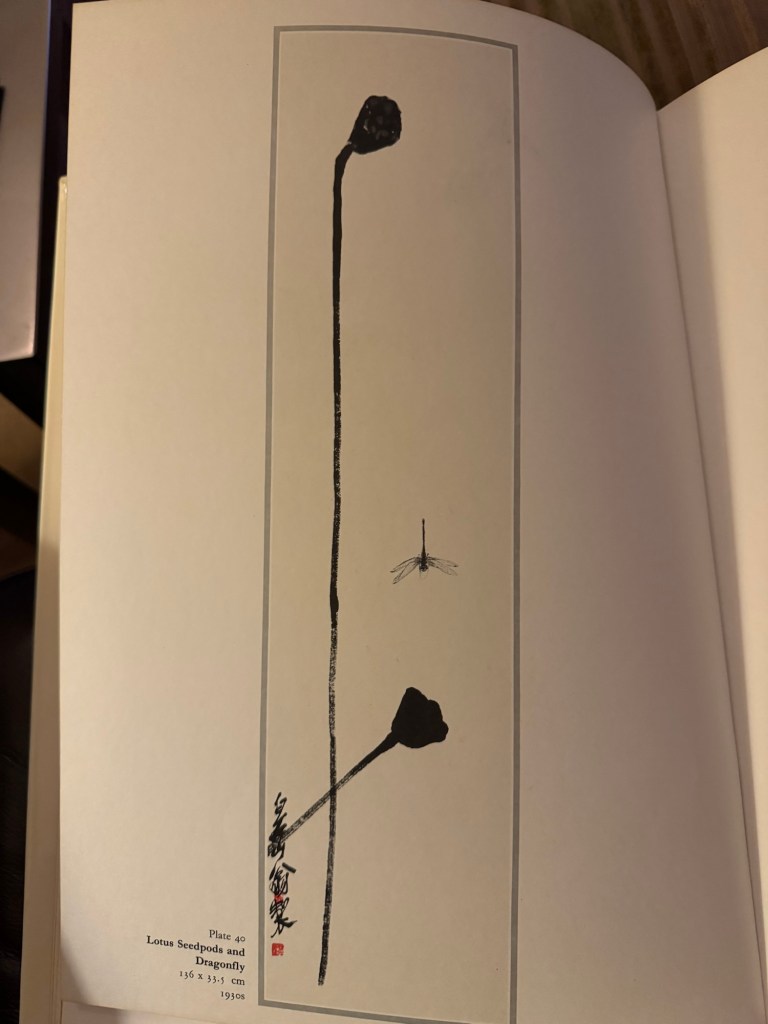
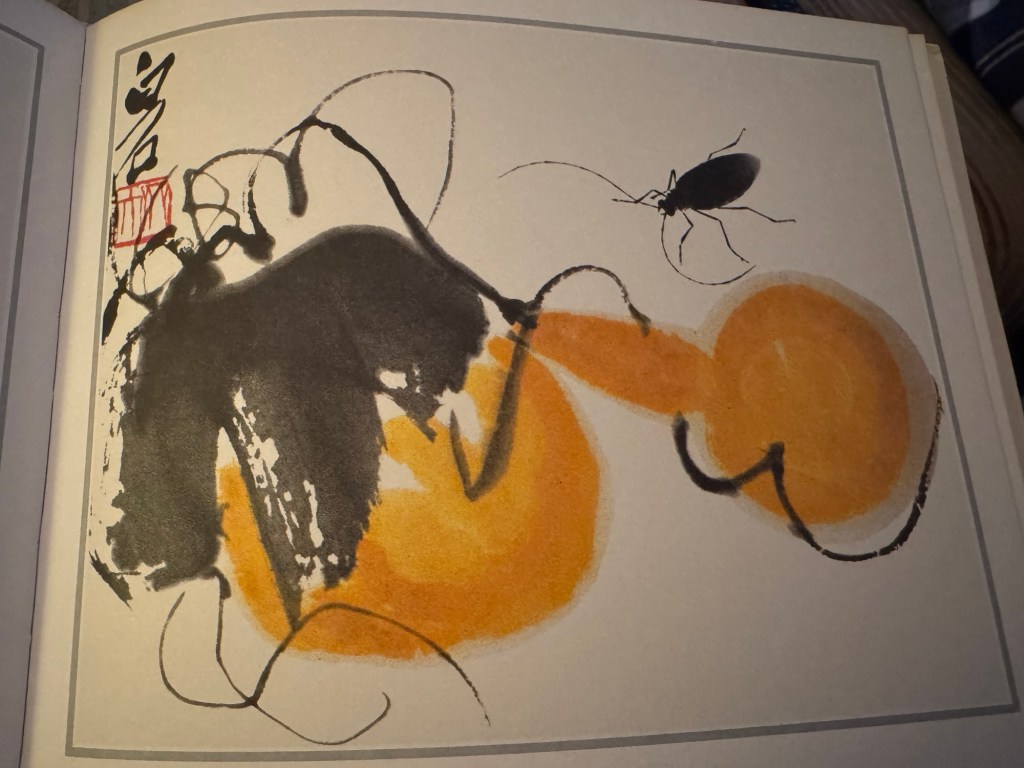
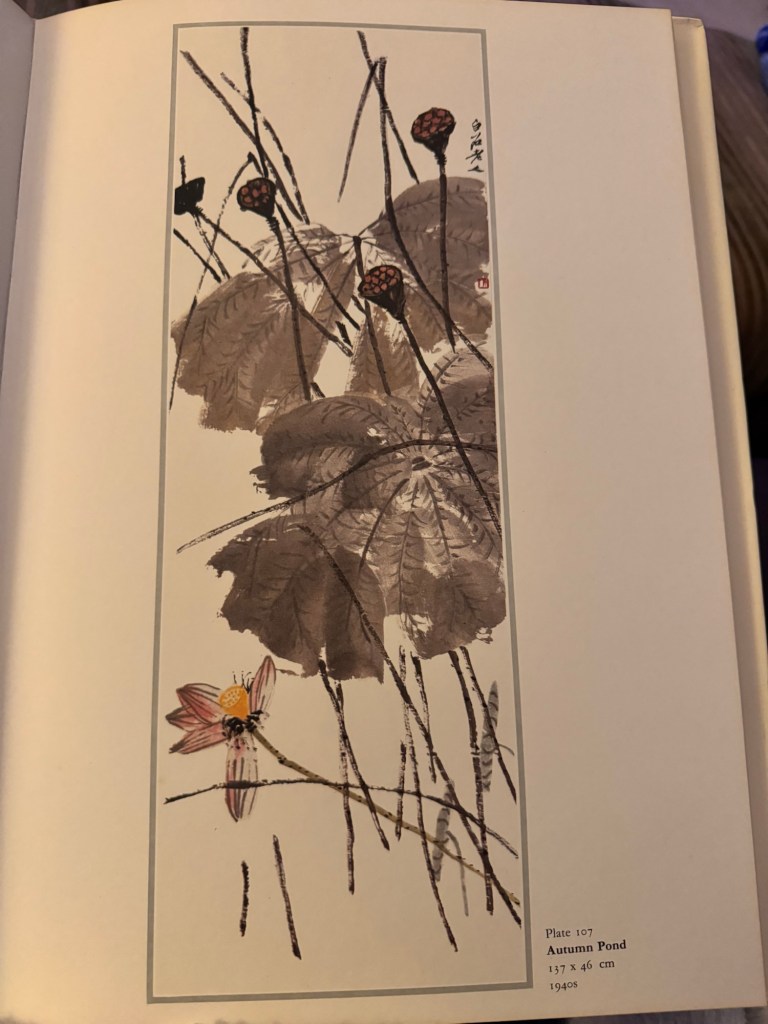
Composition – extensive use of negative space as a form of conciseness, removing the irrelevance.. Contrasting the lack of details (abstraction) of the lotus see pods to the detailed dragonfly.
–
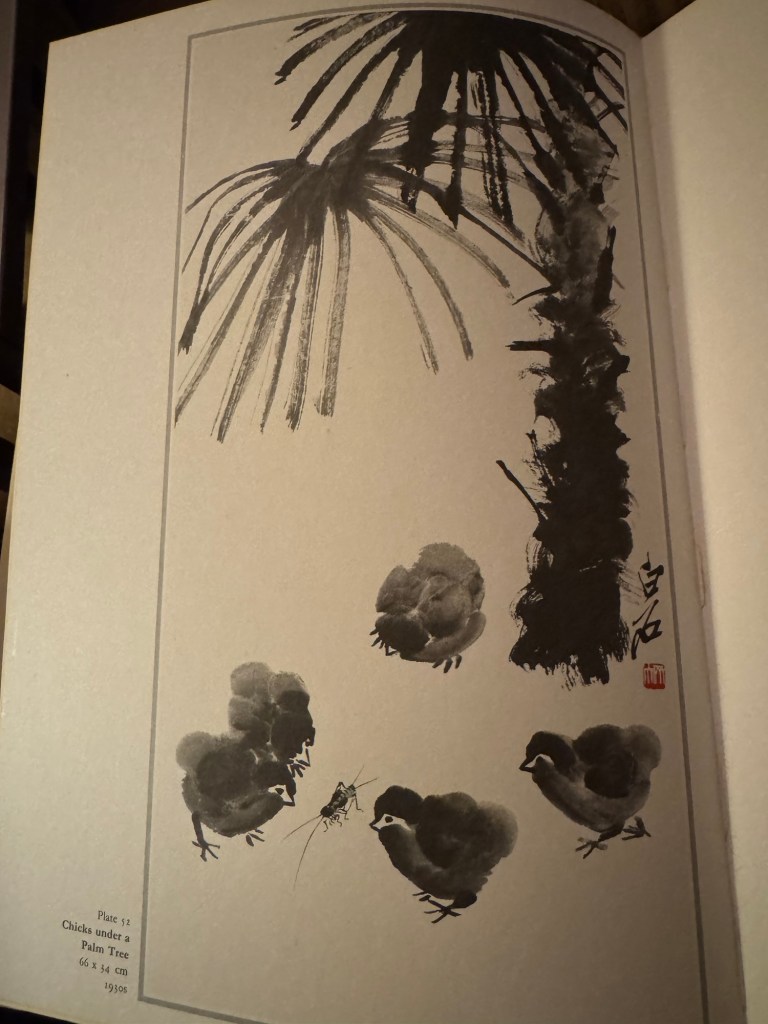
The conciseness in the depiction of the tree especially the leaves. The chicks are also reduced to a few round shapes with soft edges but the insect is detailed. All other background has been eliminated.
–
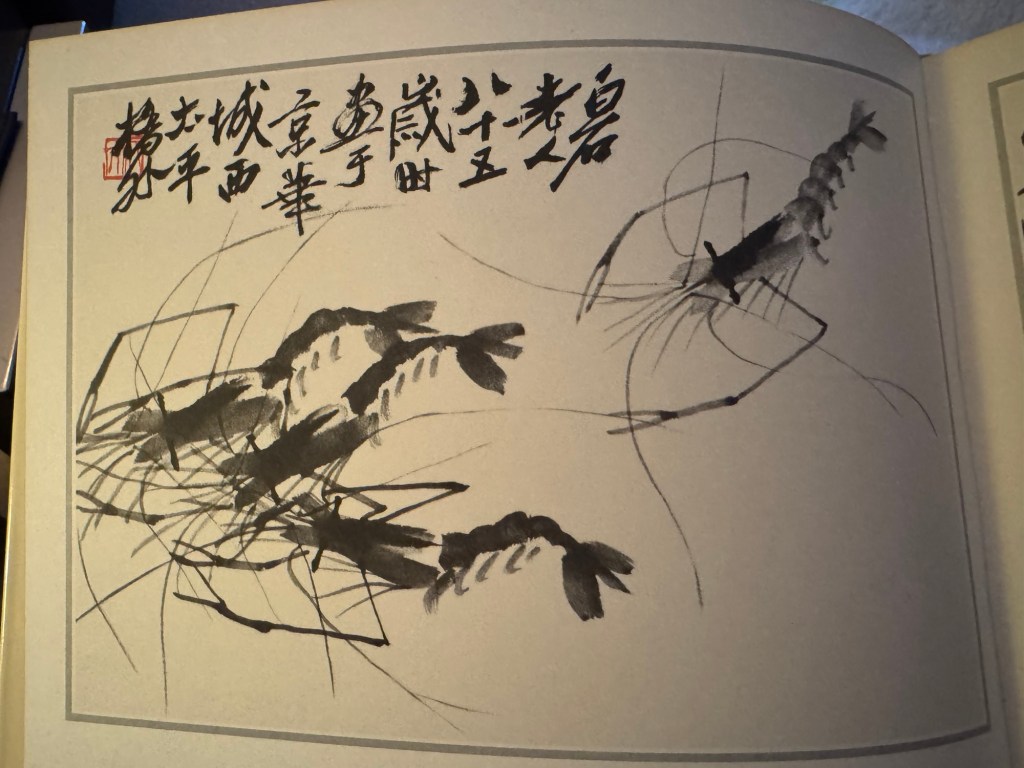
Shrimps are one of Qi’s most famous images. There is no background depicted, water, plant life or sea/pond beds have all been eliminated. But there is no doubt that the shrimps are in water and in movement. The depiction of the shrimps’ pincers and tentacles gives the sense of movement. The clustering (3+1) and distribution of the shrimps give a sense of an ongoing story where his painting is a snapshot in time. Qi has spent hours observing shrimps and their movements then painted them from memory thereby adding his own interpretations.
–
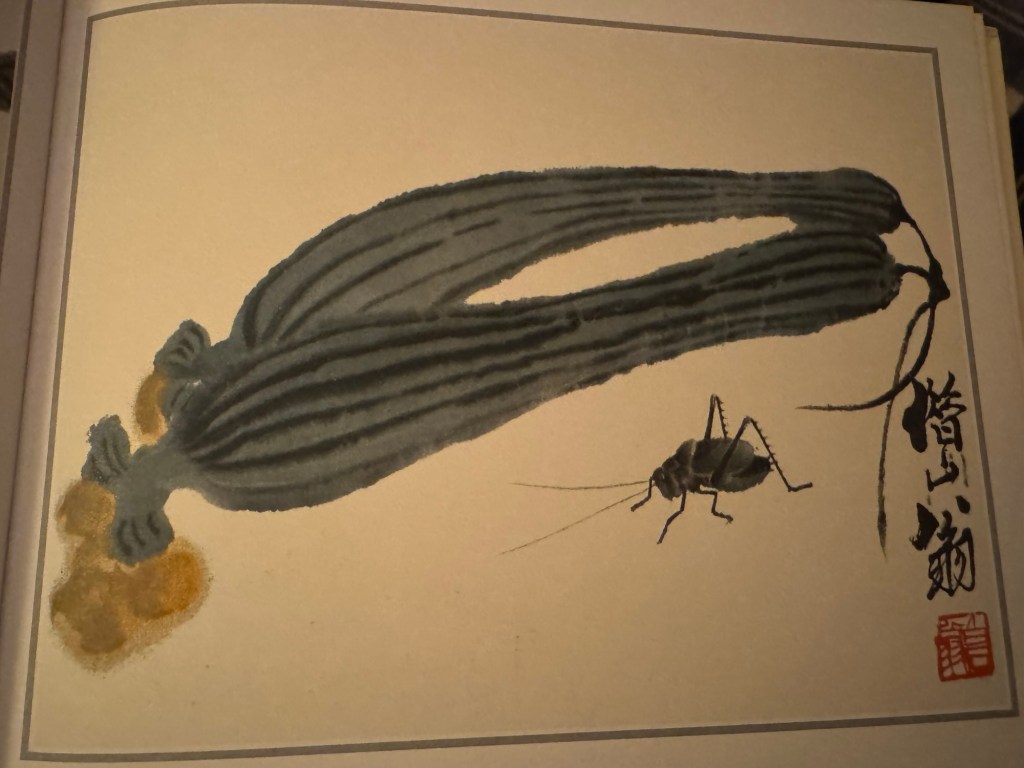
The three paintings below all show highly abstract plant or fruit with more precisely depicted elements such as insects:
–
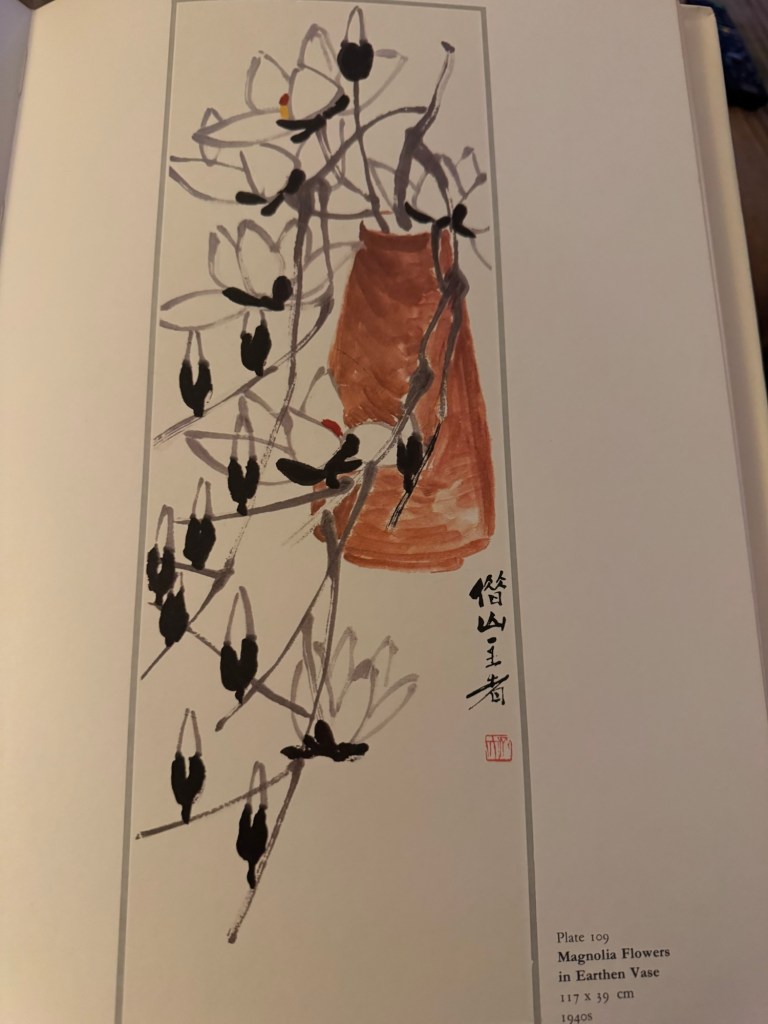
Neatly laid out flowers all point up among random branches.
–
Contrasts of neat streams of flowers among expressive and random branches:
–
REFLECTIONS
What has been useful is the confirmation that there is nothing ‘magical’ about painting; there isn’t some kind of concept on a higher level that only certain ‘blessed or gifted’ artists can achieve. As for talent, that is subjective – I believe. Like art, a ‘talented’ abstract artist may produce art that is undesirable in some people’s eyes yet totally desirable for others. Hence I believe talent is subjective.
But painting is difficult – this was said to me by one of my fellow MA students who is an experienced painter. I couldn’t agree more. That’s also why I like painting. It’s a challenge that can be rewarding or frustrating – both are equally energising. Thinking about painting and art making consumes my mind and that must be why I only allowed myself to get deep into it after retirement. Perhaps I knew it would become like this.
I recently started learning about photography, I thought about incorporating that into my practice or even developing that into a main part of my practice – photography is an artistic as well as scientific subject hence I thought it would appeal. I attended a six week course to learn digital photography. I enjoyed the learning very much but I wasn’t as ‘bothered’ as I thought I would be. I think it’s because creating an image was too easy – doesn’t mean the image was any good, it was just too ‘quick and easy’ to get an outcome. Especially with a good digital camera (I bought a used Canon EOS 77D for the ‘new hobby’). The photography tutor was excellent and we did some good walkabout photography exercises in town. Within 20 minutes of walking around, I could produce a large number of images to choose from and there would typically be a couple that felt satisfactory. That’s too quick for me. There was little agony, self doubt or deliberation involved. Perhaps it’s my rebellion against the instant gratification culture that so dominates modern life and I want to exclude myself from that culture. It’s not because I think that’s wrong or want to judge, I just need a slow and drawn out agony to feel alive! In writing this paragraph, I have just come to realise why I paint.
Having said all that, I was recently given my late father-in-law’s treasured Hasselblad medium format film camera. It is a work of art in itself and the quality of engineering (all mechanical) is beyond words. I feel so privileged to have it. I have written another blog to capture my first experience with using it. I think analogue film photography is a different game to digital photography and the slowness of the process feeds my need for the excitement from a ‘drawn out agony’. All the anticipation. I am captivated.
Back to painting and likeness and unlikeness… I learnt a lot about composition in Chinese painting. That was very helpful. However, I also work extensively with composition in western art which is a different approach. So once again there is conflict in how I would bring the two together. Another opportunity to explore the third space where two cultures come together to create something new…
Another key learning is the likeness coming from sight and unlikeness coming from the heart. The latter being the artist’s influence or interpretation of the reality – this I have not done so much of and I need to work on this aspect a lot more. I recognise that I often rush into a painting because I’m so excited about a new idea. I have learnt that I need to take time to think about what and how I feel about the subject, what I’m painting and let that feeling play out more on the canvas with the subject I’m painting being the ‘carrier’ of that sentiment. Whoa! Easy to say!
Perhaps I can do some free writing before starting a painting to get insight into my thinking and feelings about whatever I’m making.
LEARNING
– Use conciseness and negative space to create impact and tension on the canvas.
– As I approach a painting (or any artwork), think more about how I feel about the topic and less about the detail of the representation. Incorporate more the heart and less of the sight to achieve a better balance of likeness and unlikeness.
– I have learnt about why I paint through this research and my reflections.
– I have yet to resolve the conflict between the different approaches between Chinese and Western art composition. What does transcultural mean in terms of composition when they are so different?
NEXT STEPS
– Take my learning forward to my next painting especially the part of applying the heart more to create unlikeness.

 elizarawlings