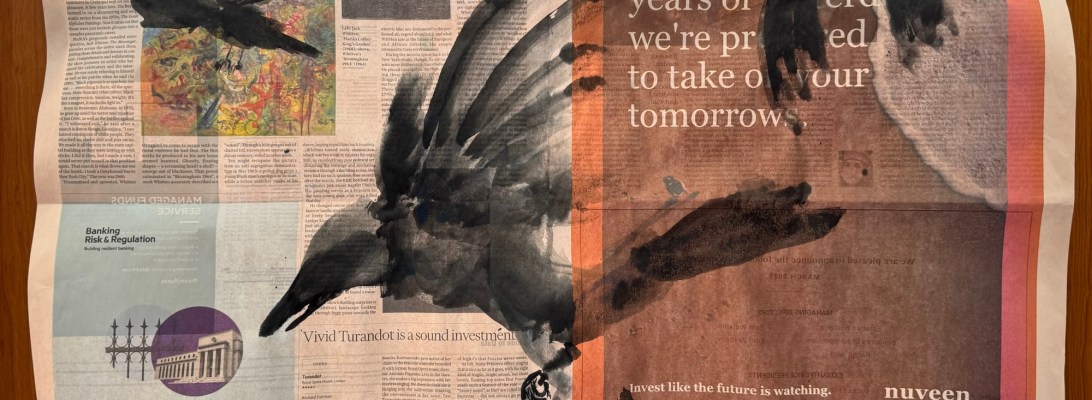
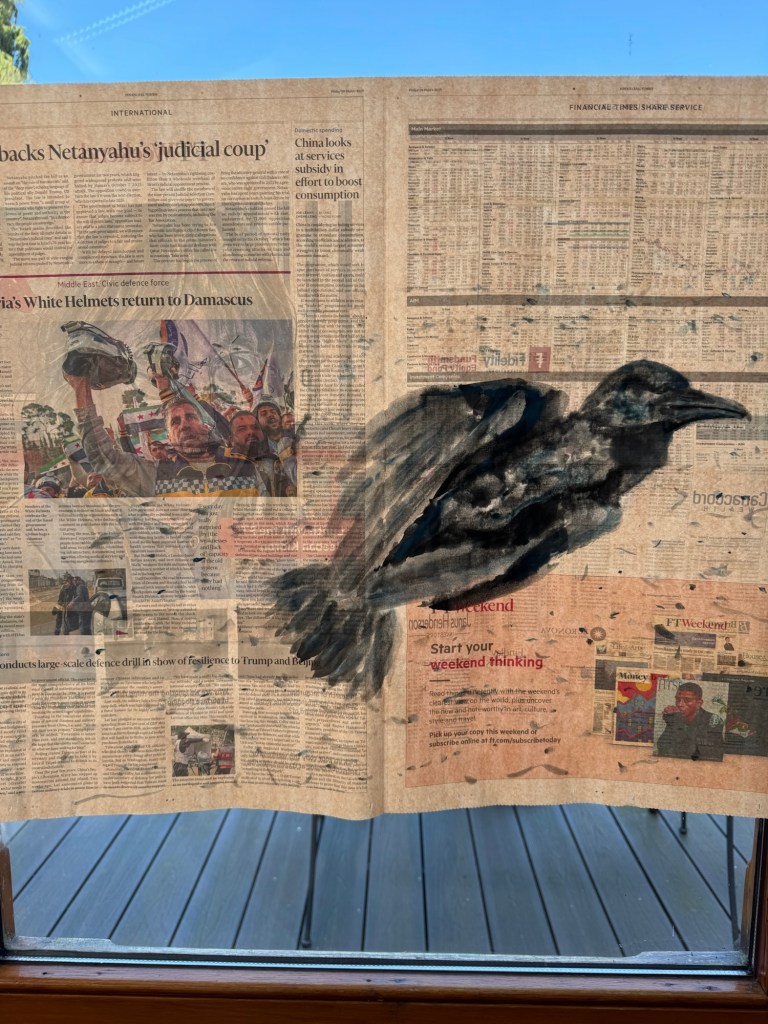
When I first showed my News Art to my tutor, we talked about the way I photographed the paintings in front of a window and letting the light shine through was a metaphor for ‘holding the news up to the light’.
As the saying goes, if you are ‘holding something up to the light’, you see through and understand the true nature of it more clearly; or you hold something to account. I felt it was a good metaphor and if I were to show my News Art then I would want to hold it up to the light. This way of showing also reveals the images on the reverse side of the newspaper adding more intrigue and ambiguity to the overall composition.
METHOD
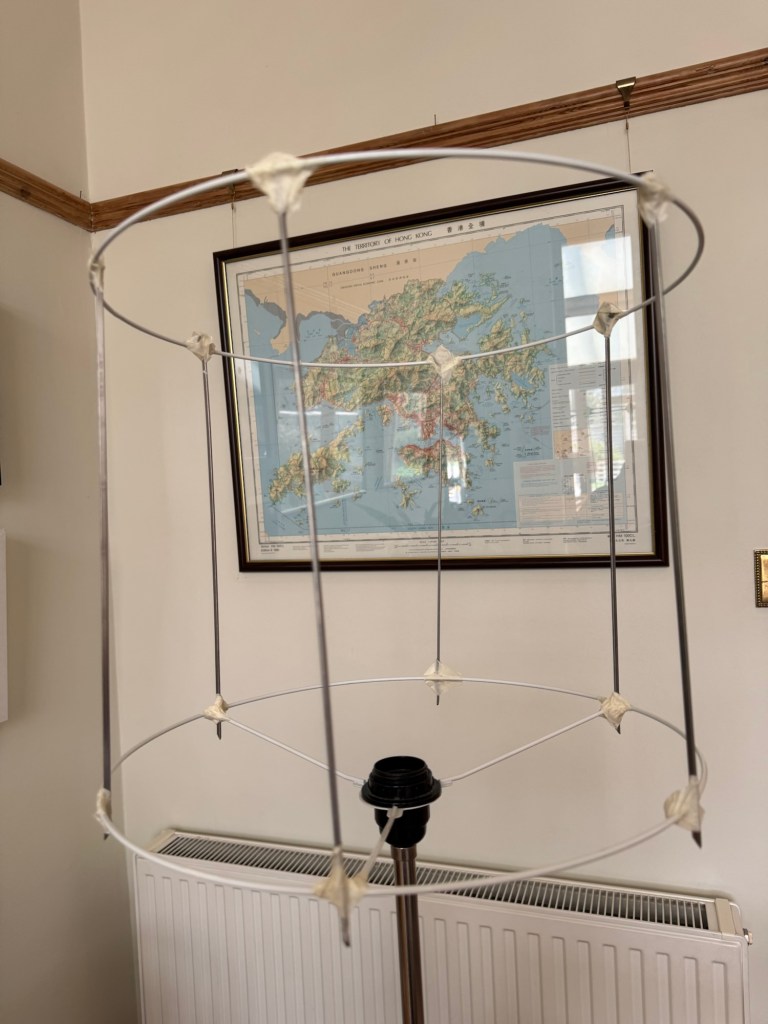
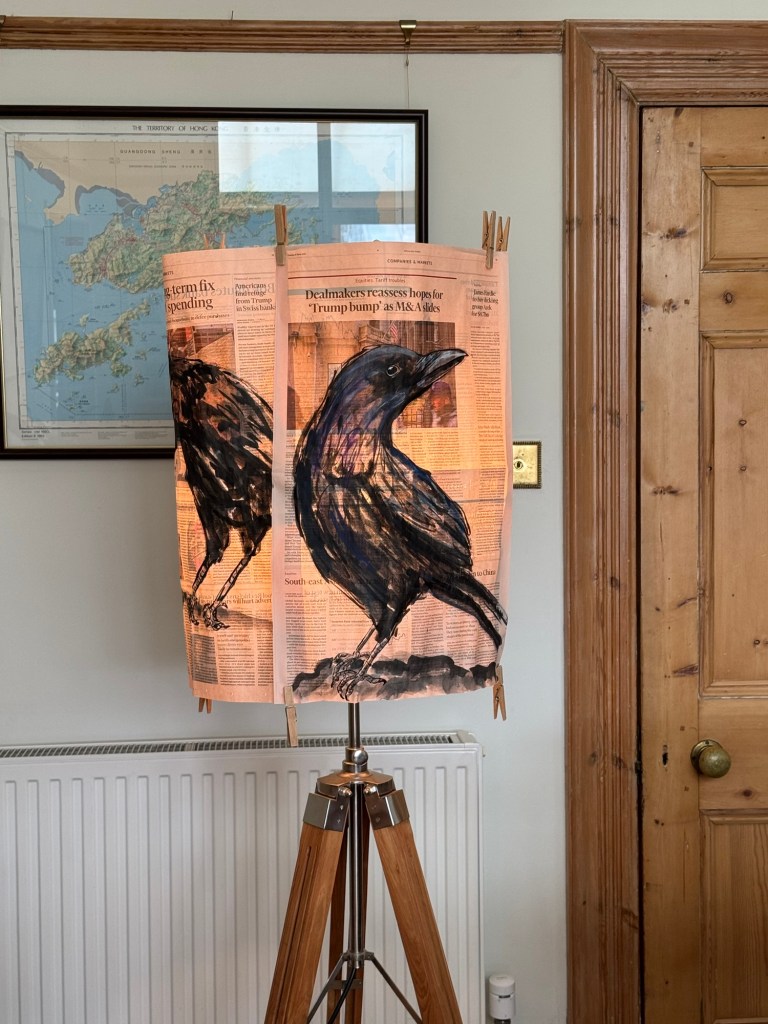
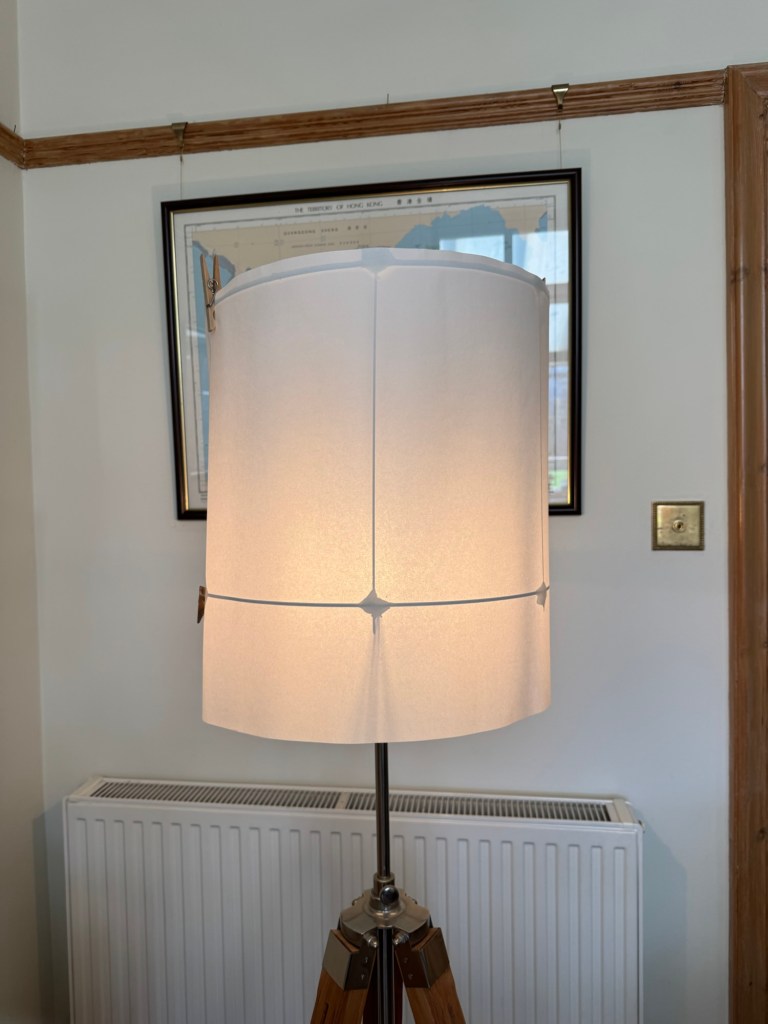
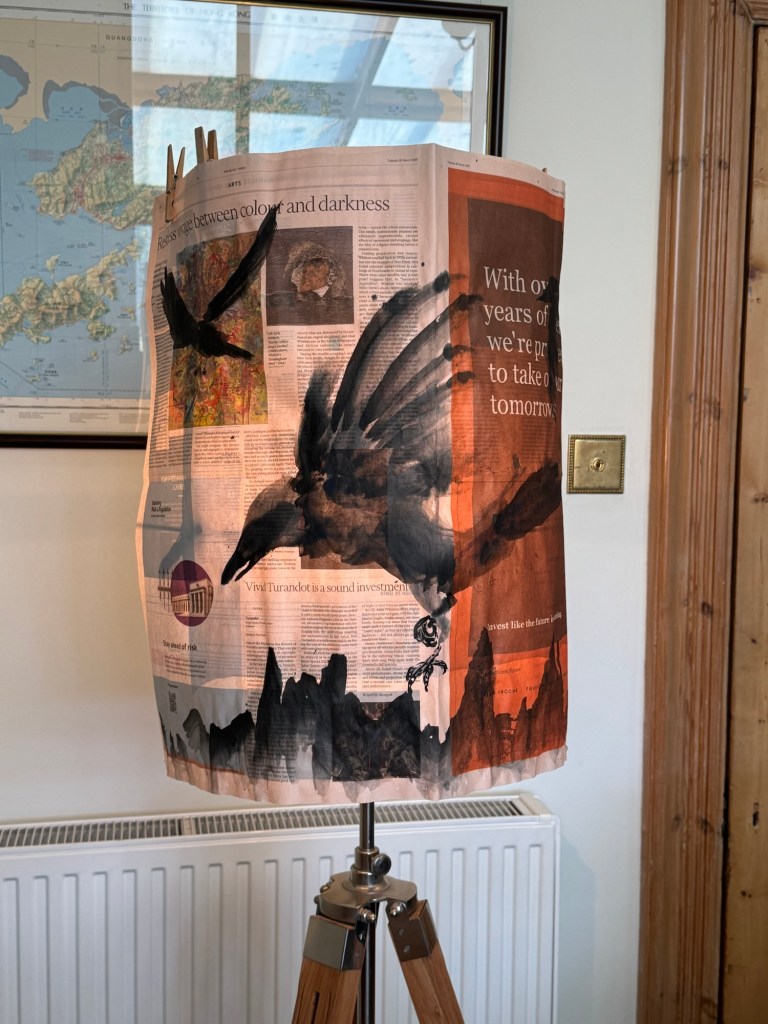
To find ways of showing the News Art with light shining through – it is necessary to not rely on having a window or sunshine for an installation. So I created a mock up lampshade frame to test how it would work if the light source was a light bulb.
Mock up lampshade frame
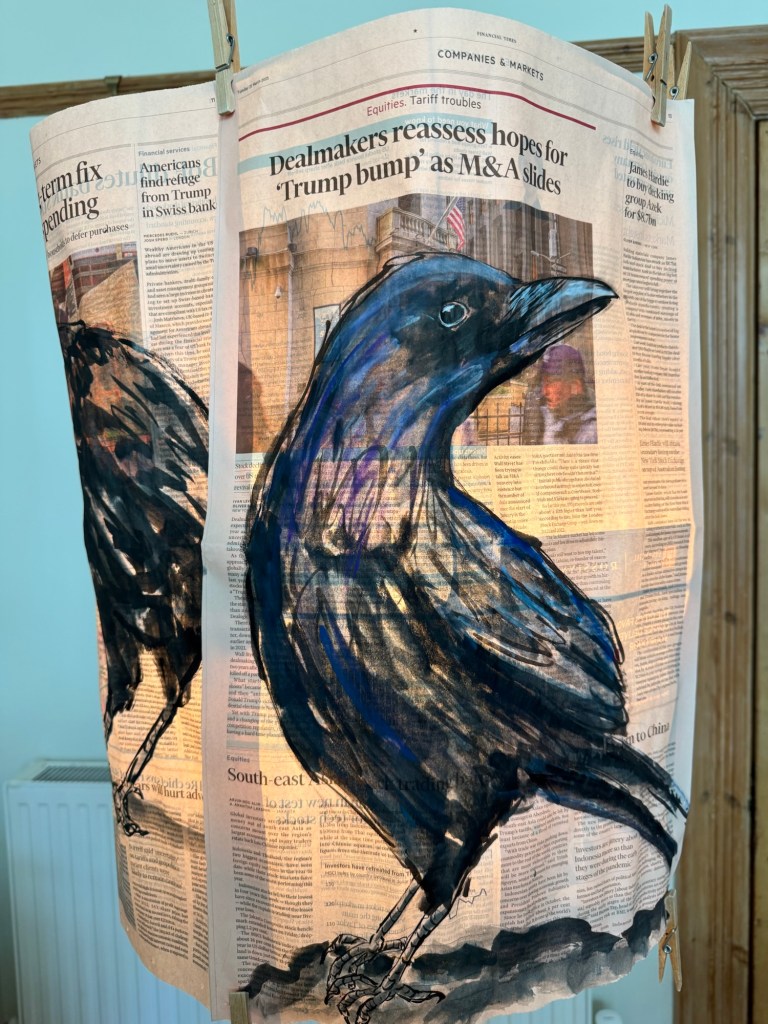
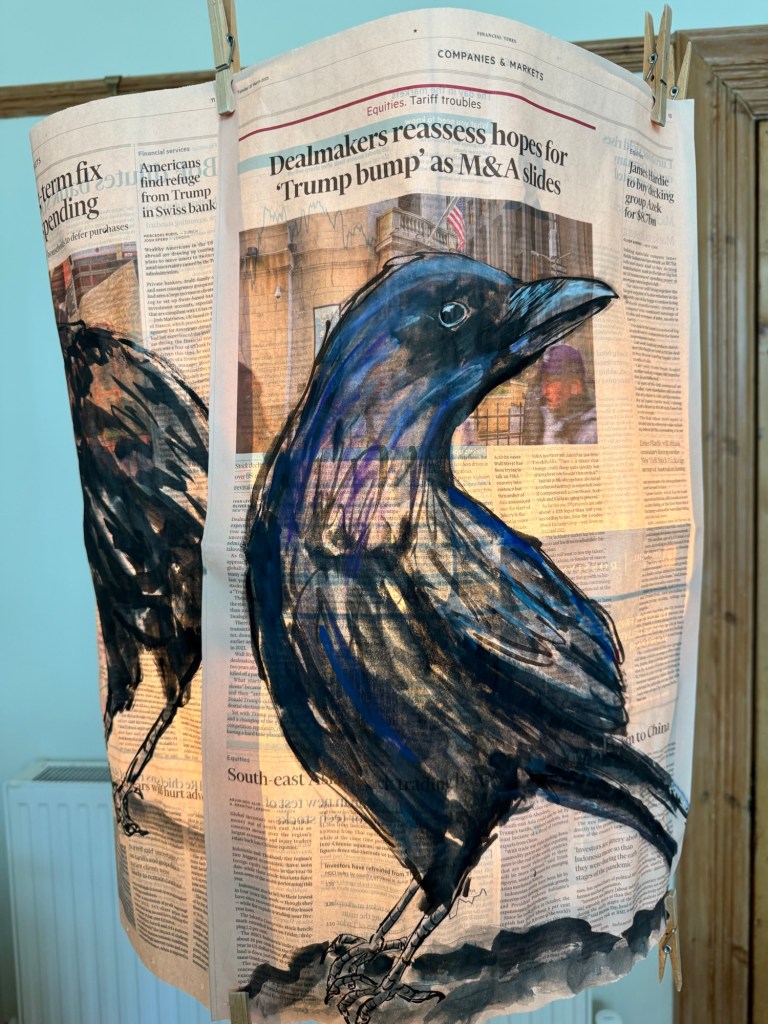
Then clipped the News Art to the frame with the light turned on:
–
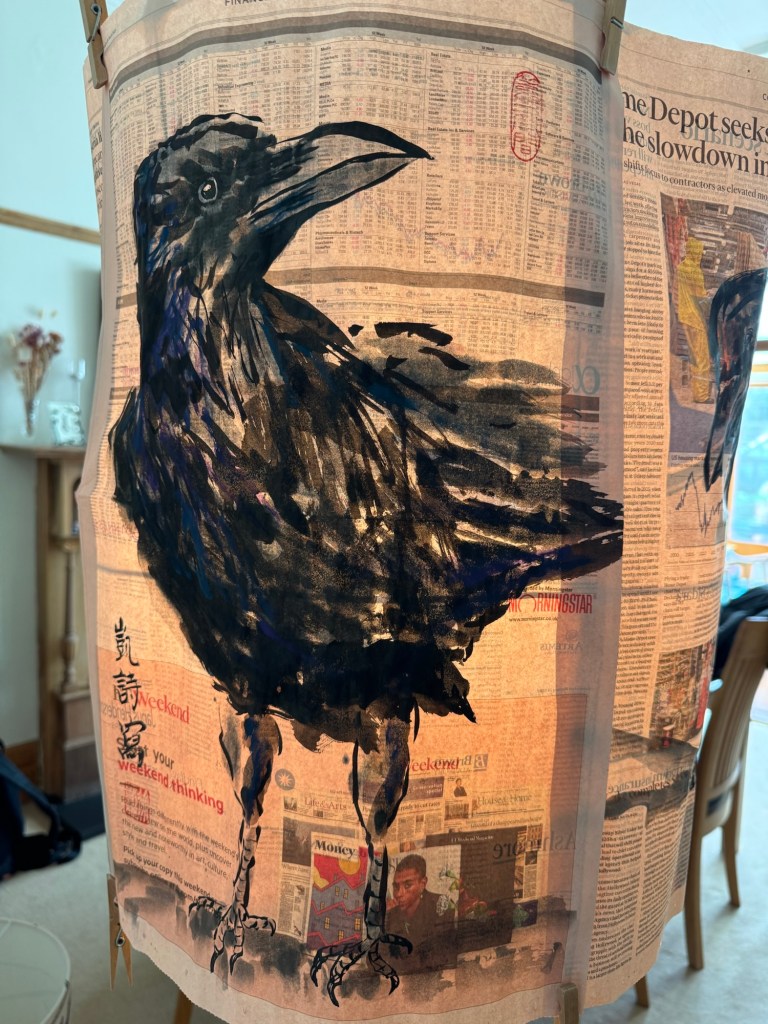
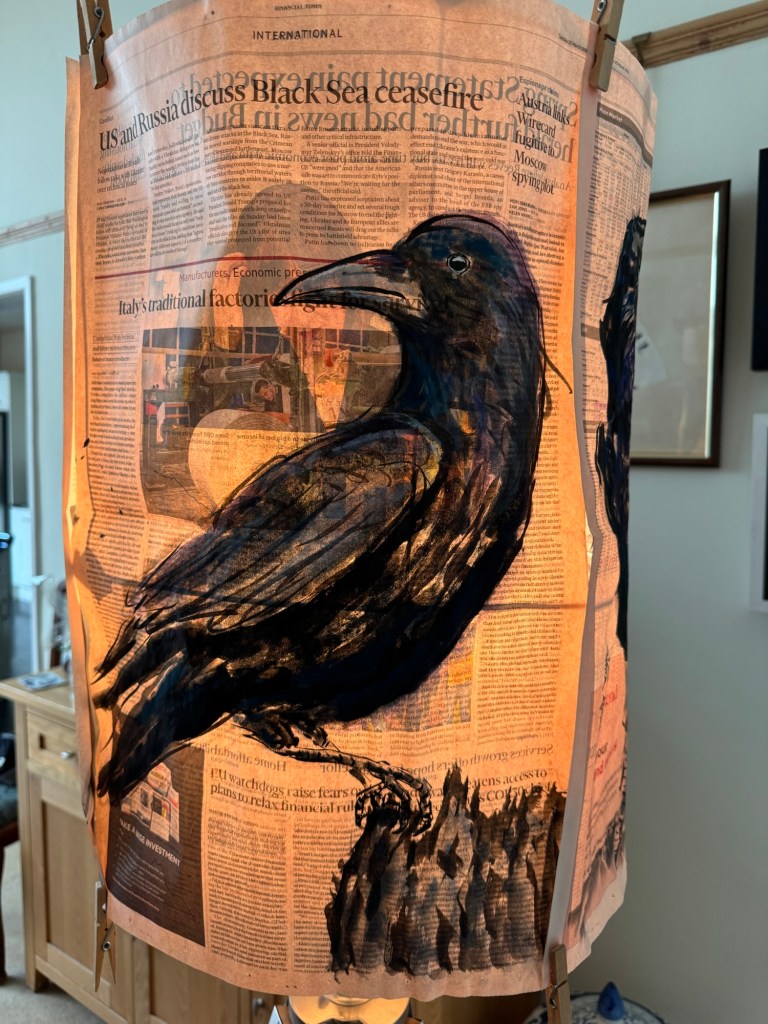
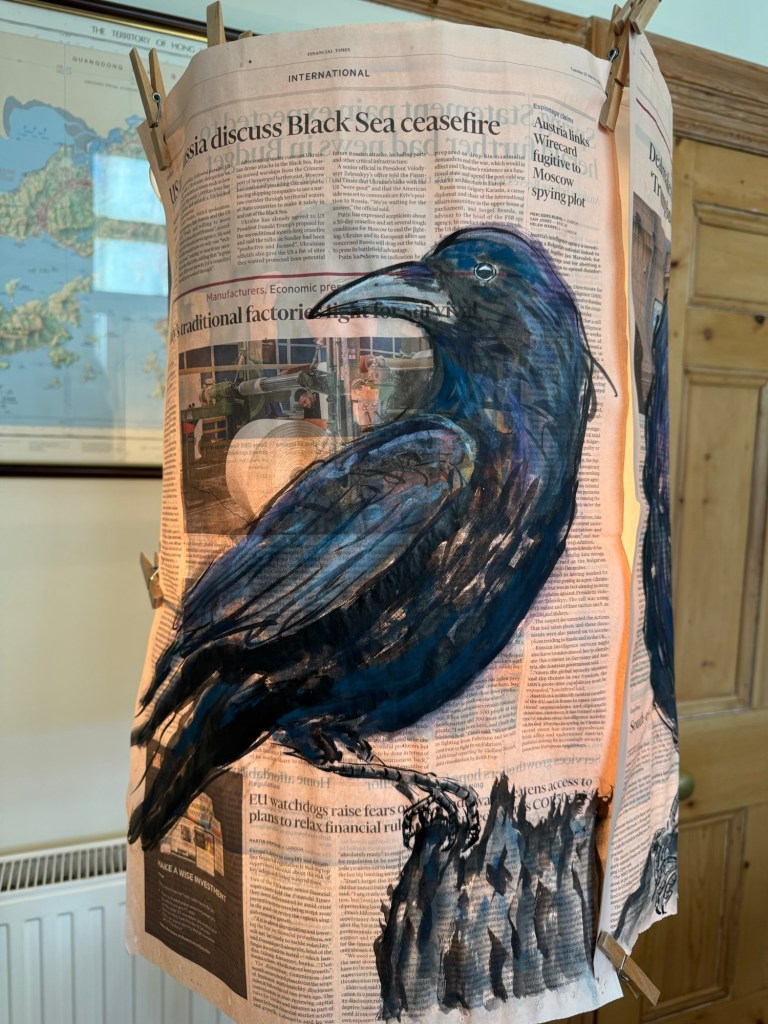
Tried a few different images:
–
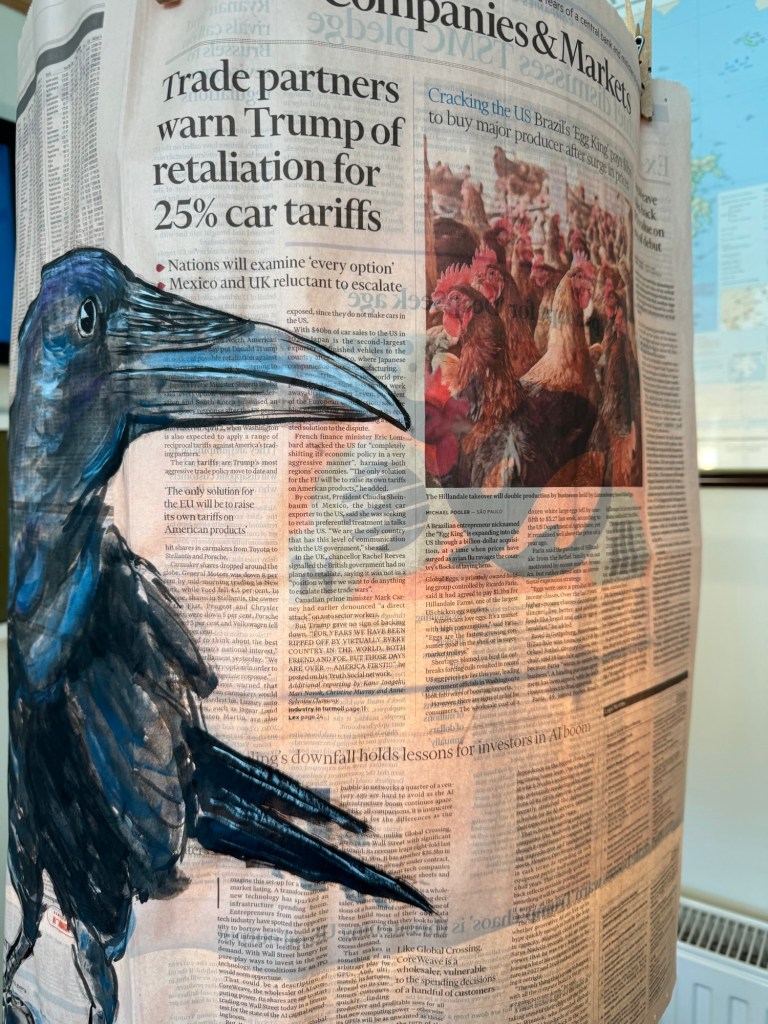
This showed the reverse side images were coming through well:
–
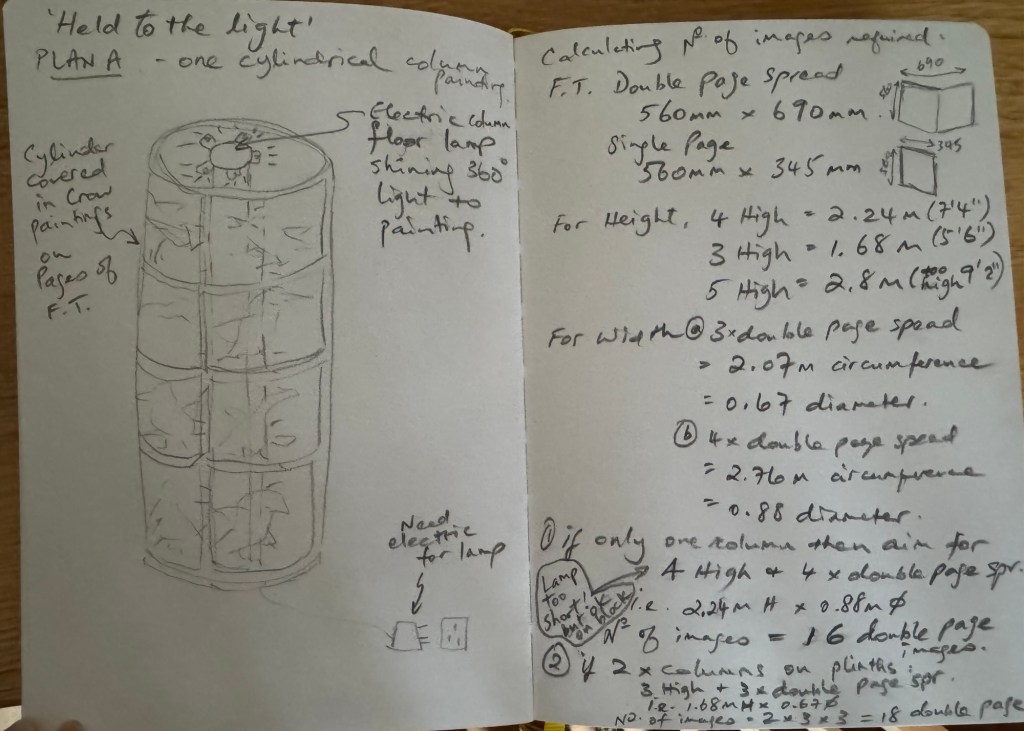
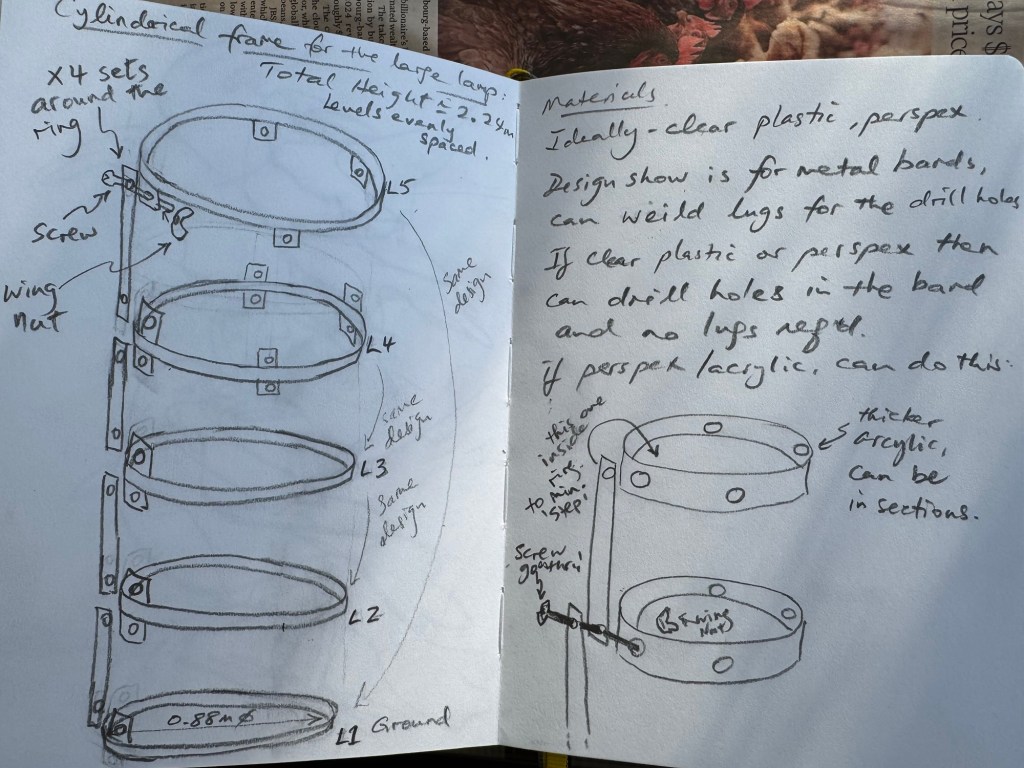
Then I considered a design for a cylindrical light tower to display the paintings in an installation:
–
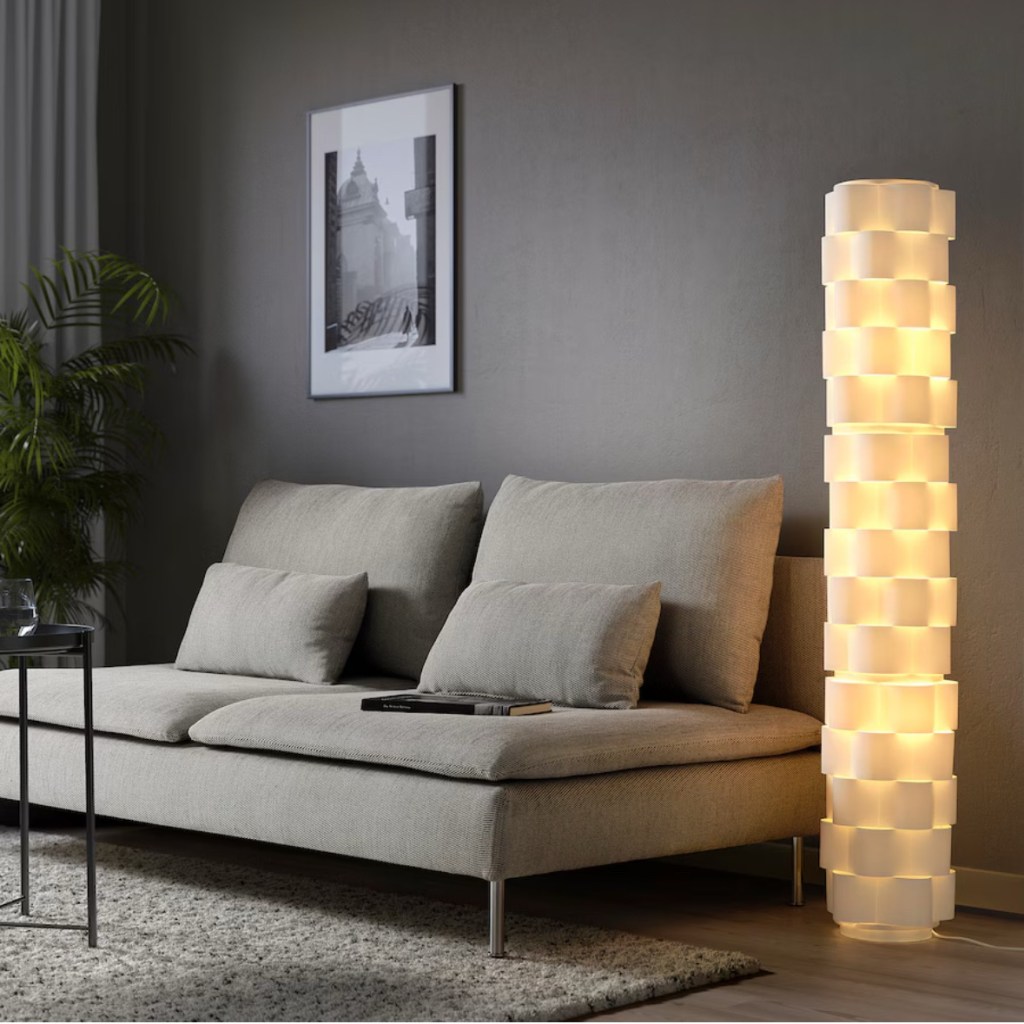
Some ideas were found online at places like IKEA with floor standing lamps that could be used instead of a custom made frame with the latter being a potentially costly option.
–
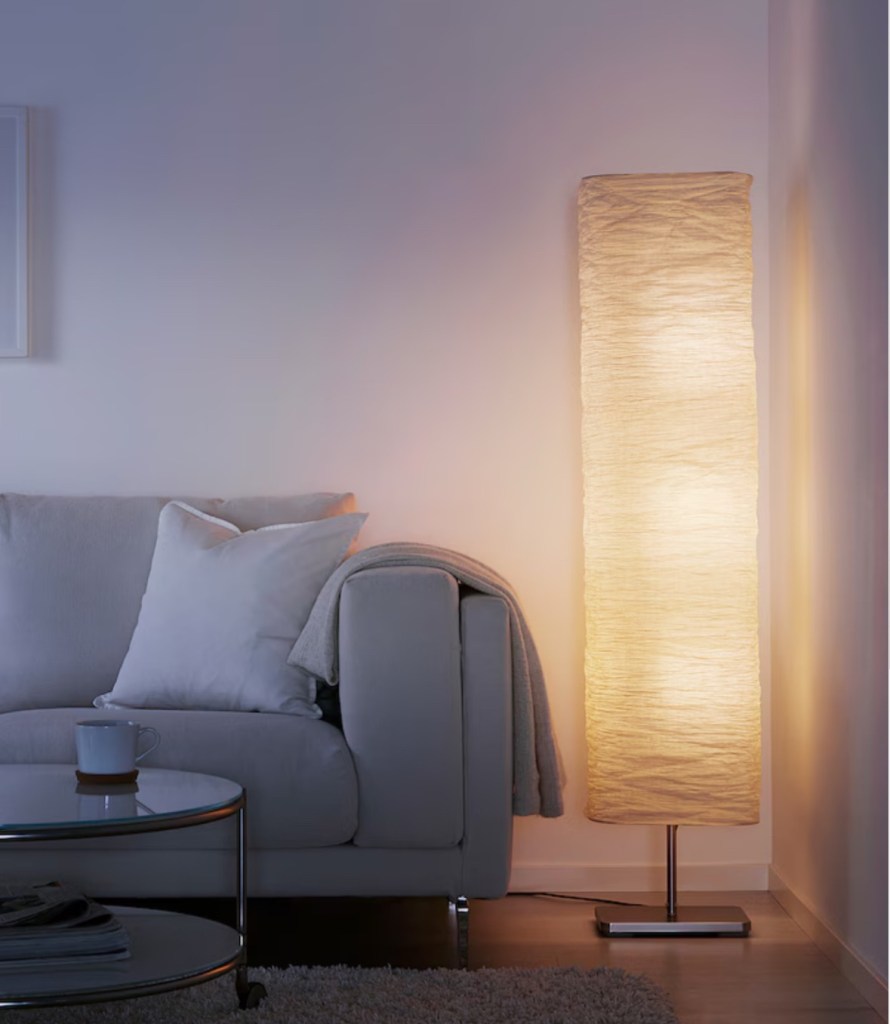
As an example, for the rectangular shade in paper shown above – it can take 2 double page spread of The FT at 3-high. It has more area than the circular one so would be better. This means 6 double page spreads per lamp. For a 3 lamp installation then that would mean 18 double page spreads in total. The rice paper lampshade could be slashed or torn to represent violence that is happening at the moment.
–
However, the rice paper shade around the lamp might block too much of the light. Hence more tests were done with the mock up lampshade and rice paper.
Mock up lamp with rice paper shade
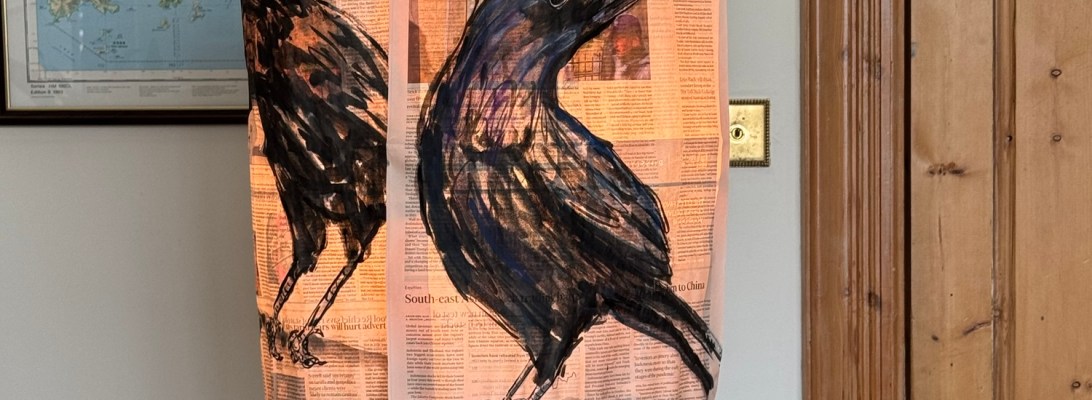
There was sufficient light coming through the rice paper lampshade to reveal the images on the reverse side of the newspaper:
–
REFLECTIONS
The experiment was successful in demonstrating that a light bulb can illuminate the newspaper sufficiently to reveal the reverse side images, even with a layer of rice paper in between. This means the IKEA lamps could be used if I wanted a cylindrical installation.
A cylindrical installation means the viewer would have to walk around the lamp to see the whole composition. This maybe fine and could be a good way to install in the middle of a room with multiple floor standing lamps. However, if I wanted a large and flat composition like one large painting, then that would need to be hung on a wall or from the ceiling. If against a wall then I would need a light curtain of some kind to throw light onto the back of the newspaper. Ideally an enormous light panel or light box would be ideal but they tend to be very expensive. More to think about…
LEARNING
The experiments so far showed that a lamp with just one bulb was sufficient to show the reverse side images. Of course it would also depend on the distance between the light source and the newspaper. But the results were encouraging and I will continue to think about different ways to install my News Art work.
NEXT STEPS
Think of different ways to illuminate the art work in preparation for coming up with ideas for the degree show.
After reflecting on the News Art that I made in response to news headlines directly, I decided to be more subtle in the way I respond to the headlines. I decided to explore a more abstract way to express my feelings. What started my creating of News Art was the grief that I felt for the state of the world and my choice of using crows, inspired by the book ‘Grief is the thing with feathers’. So I returned to just painting some crow images as ideas came to me and not to overthink or be too deliberate.
METHOD
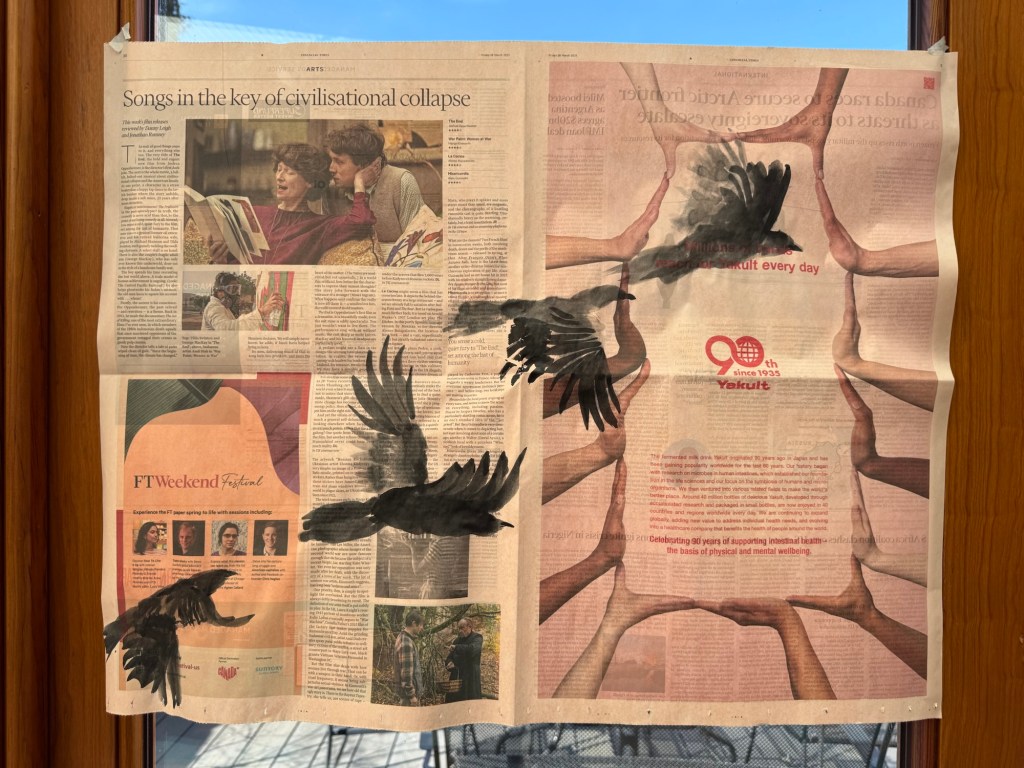
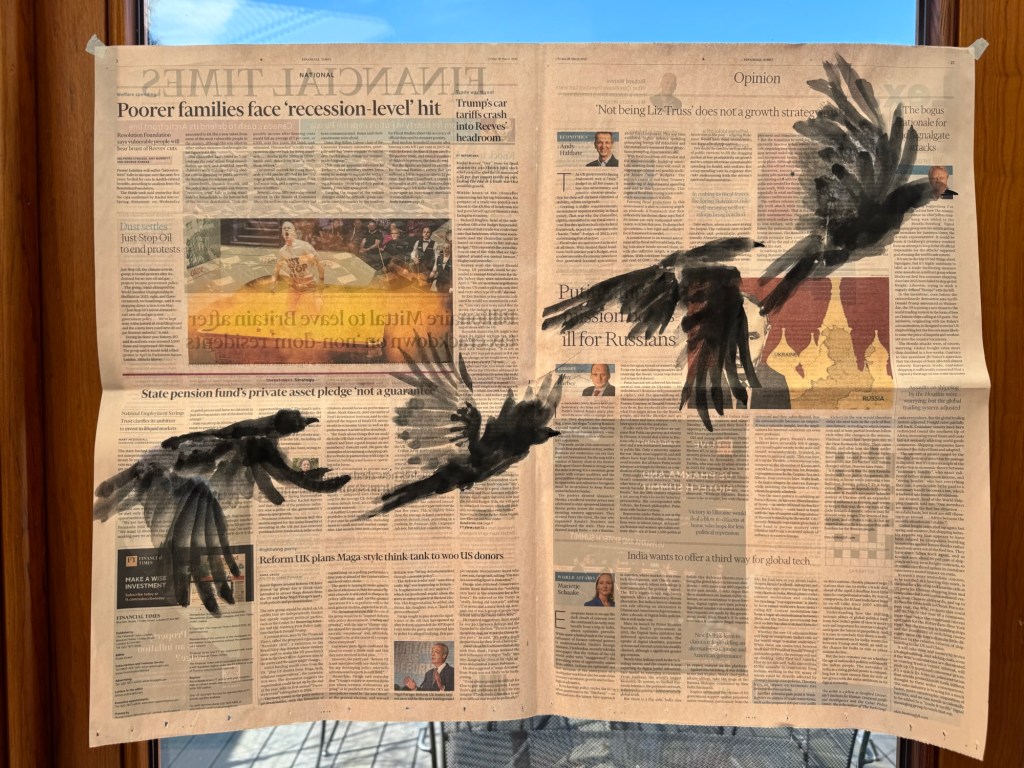
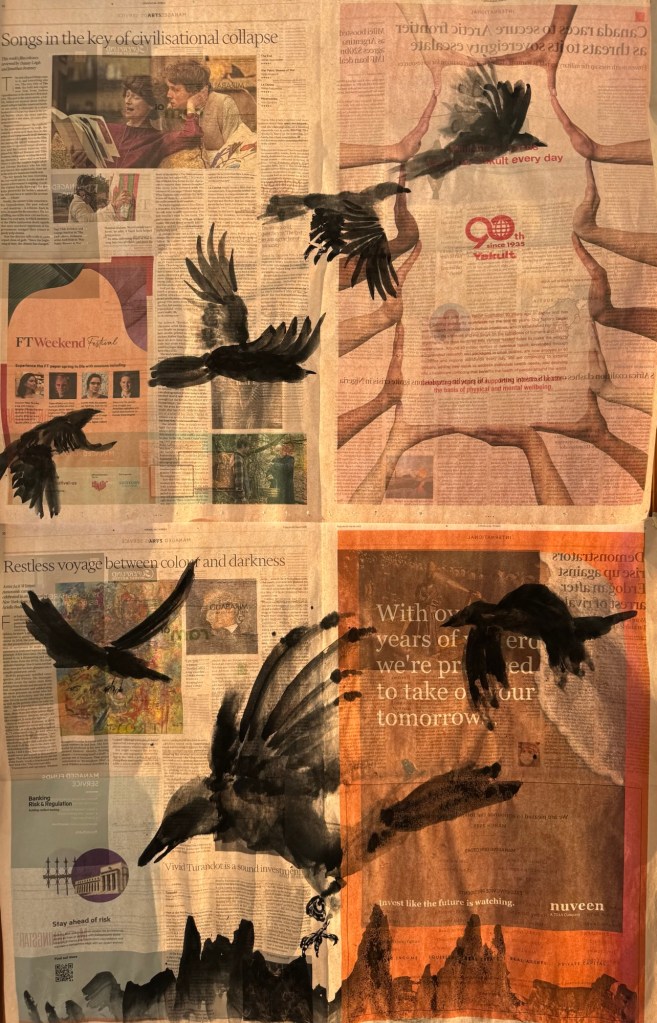
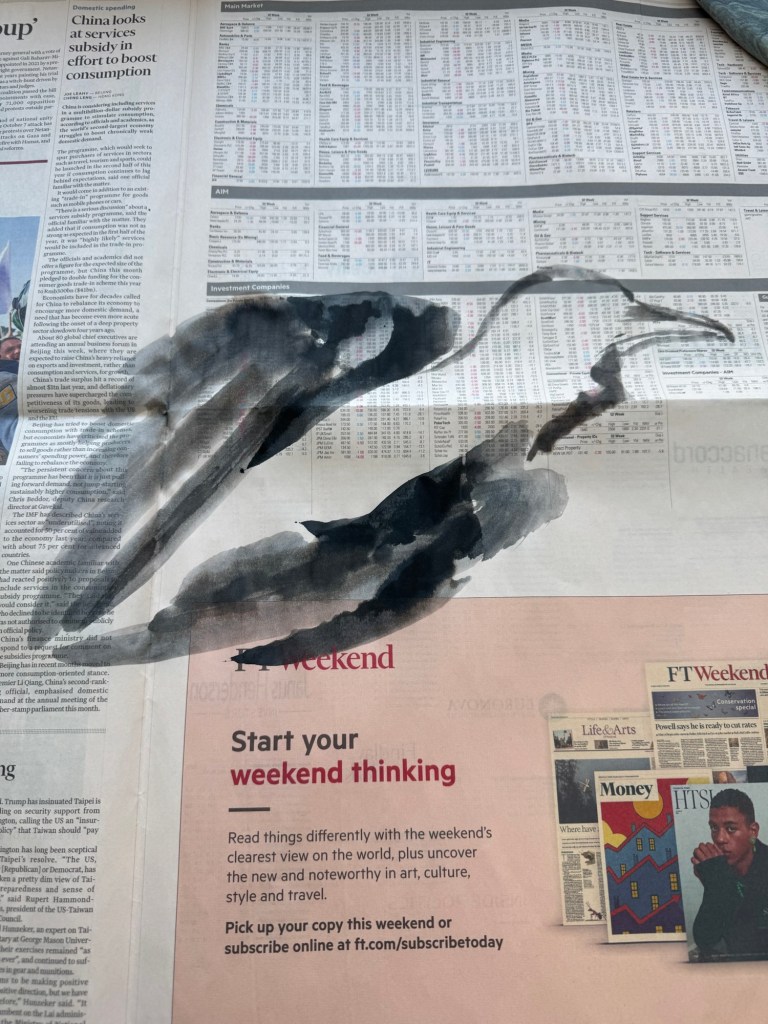
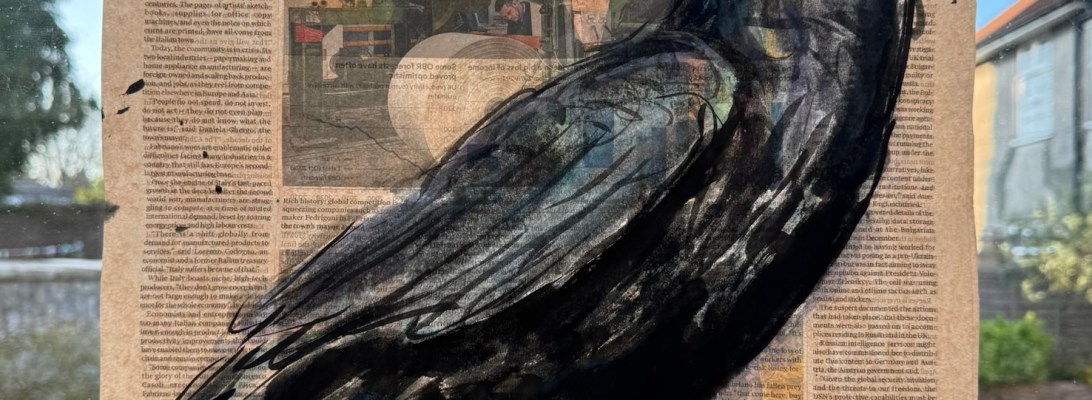
Without too much planning or thinking, I painted a few crows in flight using Chinese brush and ink in a free style Chinese painting approach. Then I held the painting up to the light:
–
Another painting done in the same way with a similar composition:
–
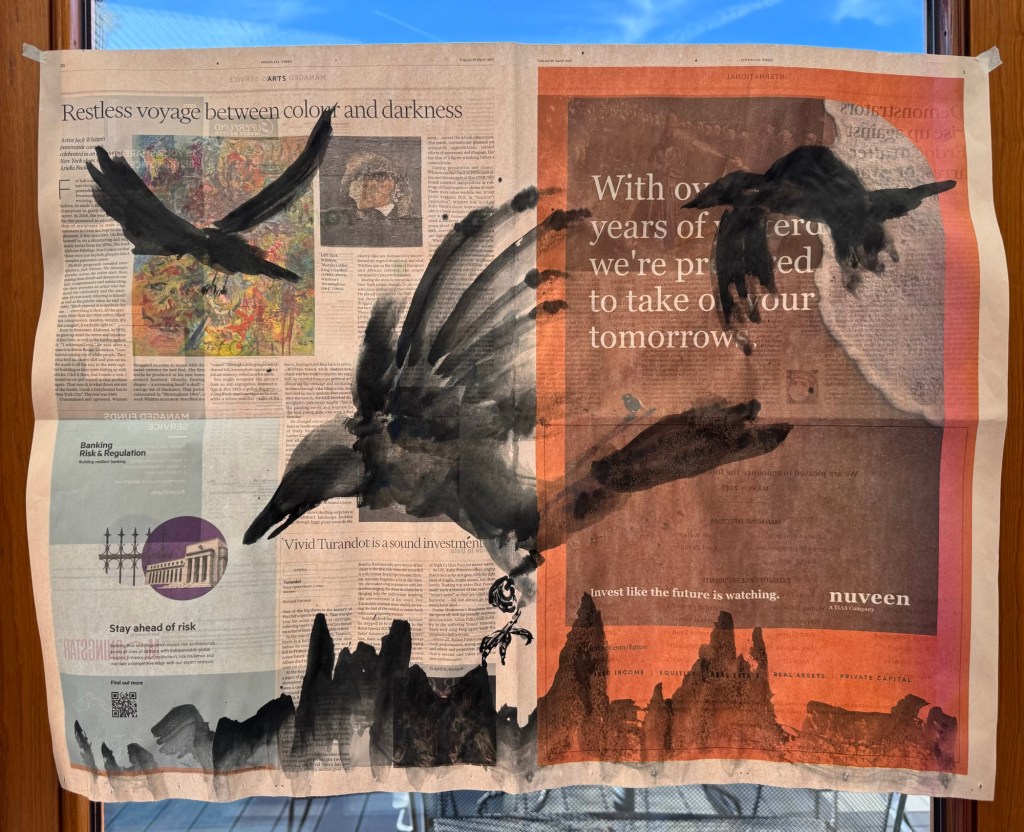
A more close-up view of a crow coming down for its prey with two others in the sky:
–
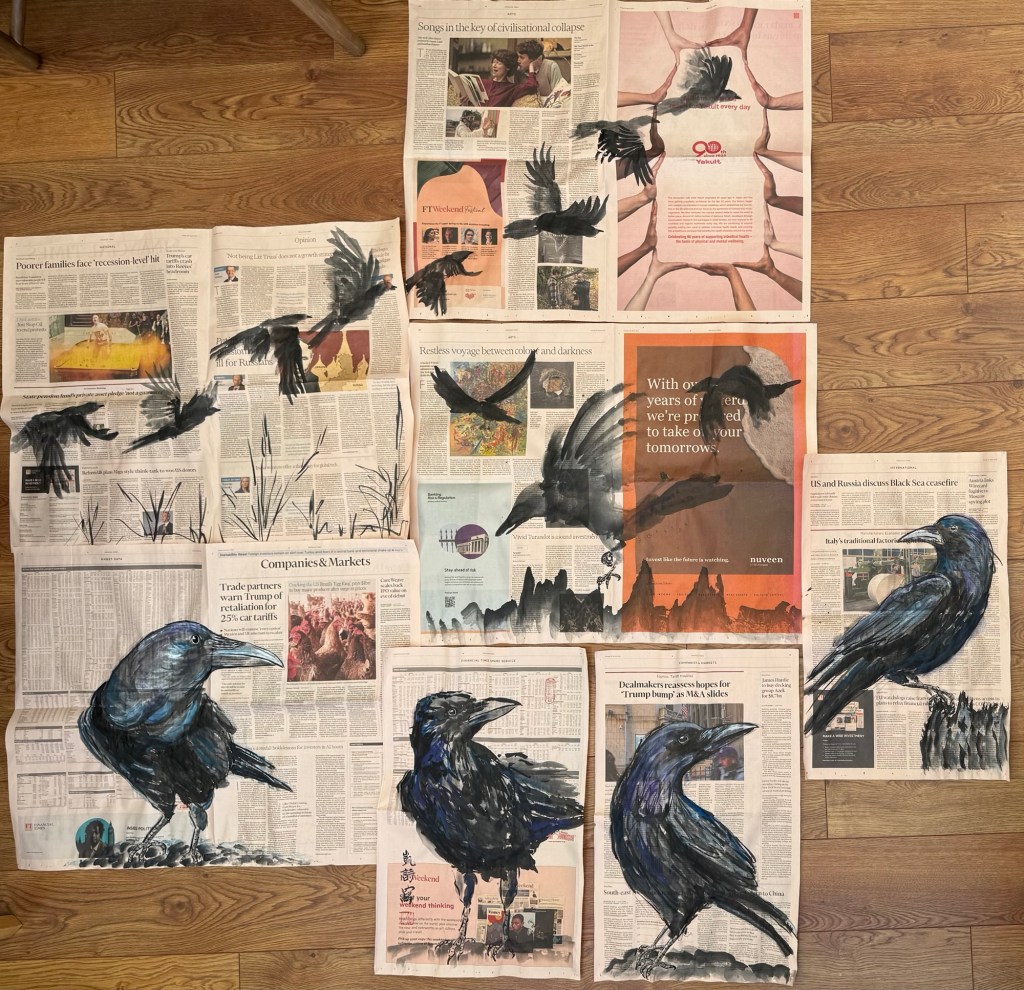
Since I had done quite a few of the crow paintings, I laid them out to see how they would look as a larger composition to get ideas on how to install these paintings as a group:
–
I finished by selecting two silhouette paintings that went well together and held them up to the light as one composition:
–
REFLECTIONS
I am pleased with the silhouette paintings. I like painting in Chinese free style. Some of the crow bodies were not quite right but overall the wings have worked out well. I feel they do give a sense of movement in flight. I am also happier with the more subtle and abstract approach to the news headlines selected. I also purposely chose the ‘ring of hands’ for the crows to fly through, like an escape route for them. We all need one of those at the moment!
Doing my newly discovered News Art has given me a reason to read the newspaper when I have felt inclined to avoid the news. Looking through the newspaper to pick out headlines to respond to has given me courage to face what’s happening in the world in a way that I didn’t expect.
LEARNING
I feel excited by my new discovery of making art in this way. I am gradually developing a process and as I get to know more about the newsprint material, I feel able to push things further such as how wet I could make it (very wet, surprisingly). I really like painting on the newspaper because it is not a blank canvas and the contents and images on each page give me so many ideas which is great.
One thing to bear in mind is that newsprint is not archival. This would be a problem if I continue to pursue this way of making. I need to look into ways to preserve the artwork especially if I’m thinking about showing these work at some point. Proper research is needed including asking specialists at CSM.
Overall, the main learning is to just keep making more work to explore this way of making. Ideas flood in as I make.
I have been continuing my experiments with making art on newspapers as a way to respond to what’s happening in the world. In previous blogs, I have talked about using crows to express the grief and the sense of loss that I have been feeling.
This blog captures the experiments where I have responded more directly to the news with the painted images. I have also tried to think more carefully about the process of this way of making. Through trial and error, I believe I have developed a more systematic process of producing these paintings which I have documented below.
METHOD
My response to some recent news about innocent people being killed in a war was to explore painting dead crows. I have often seen dead birds on the road or pavement, but I have never studied them closely. So the start of the making process was to research online images of dead crows.
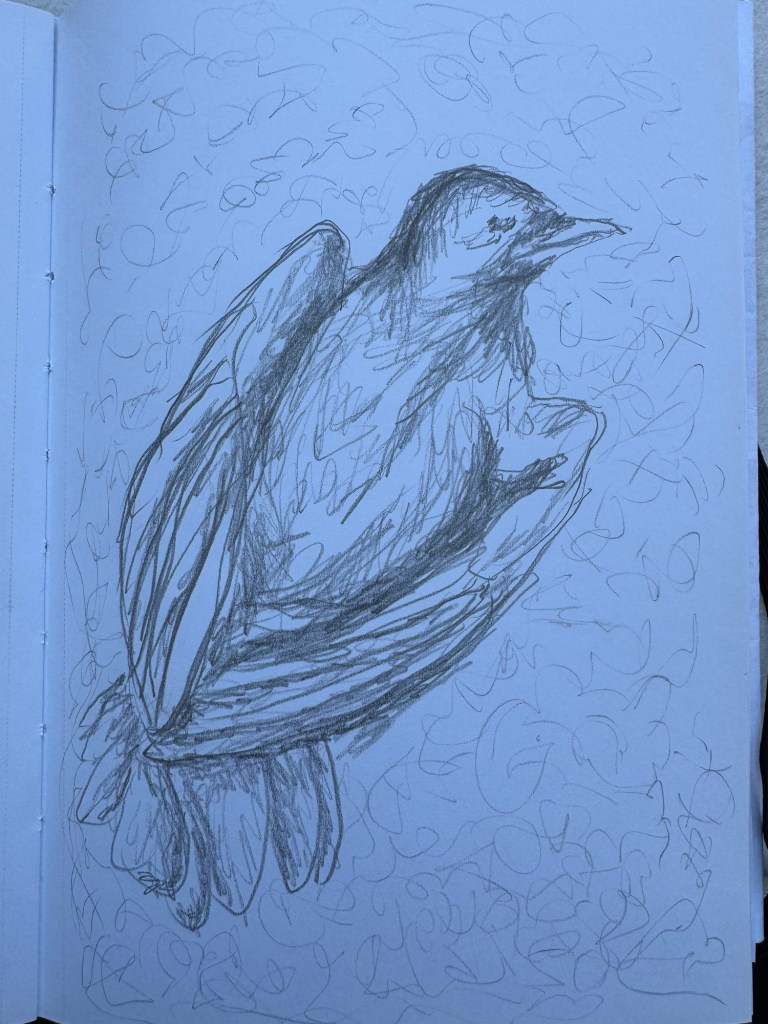
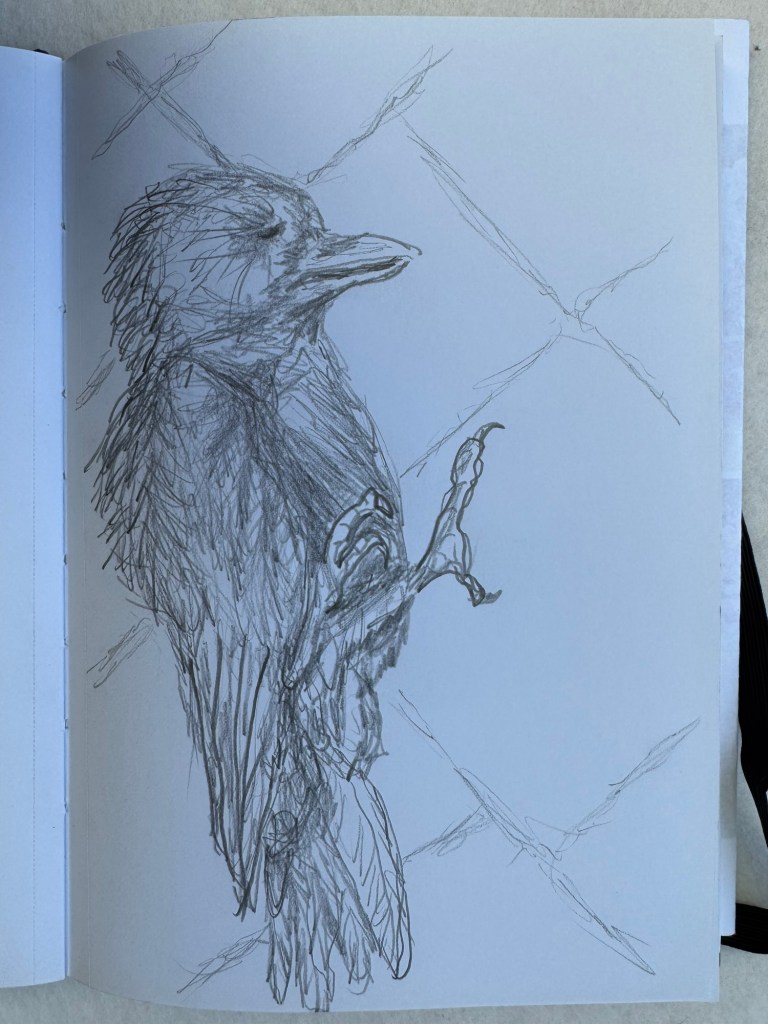
Once I found a desired image, I would do a drawing in my sketchbook with my non-dominant hand. I have previously documented my wish and need to use my non-dominant hand to be more expressive while experiencing that feeling of not having complete control of what was happening.
Drawing of dead crow lying on its back
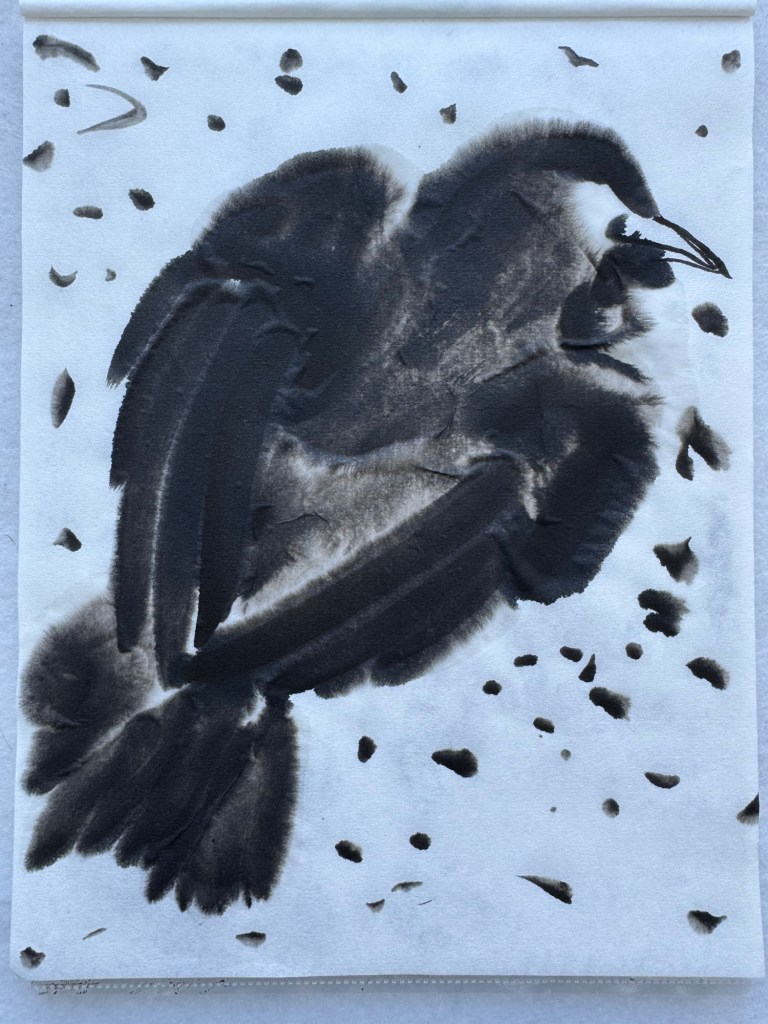
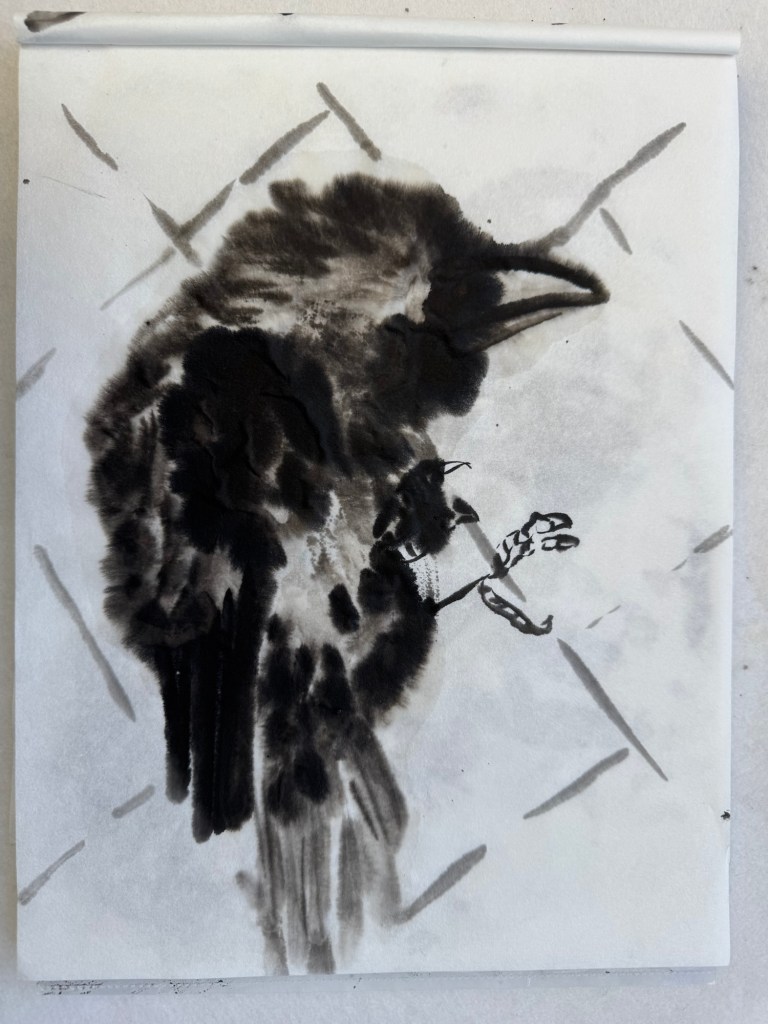
I then did a Chinese ink study of the same dead crow composition on a piece of A4 rice paper:
Chinese ink study of crow composition – A4
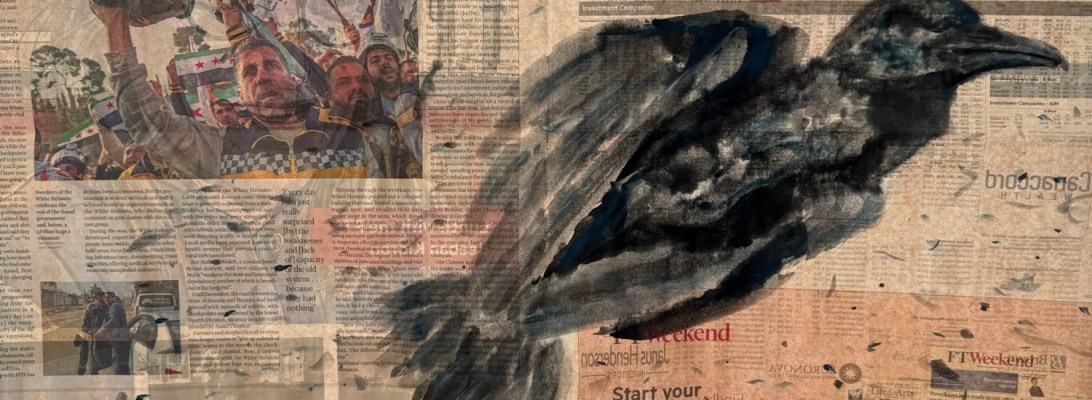
I then choose the newspaper and started to paint the chosen composition:
Finished dead crow:
–
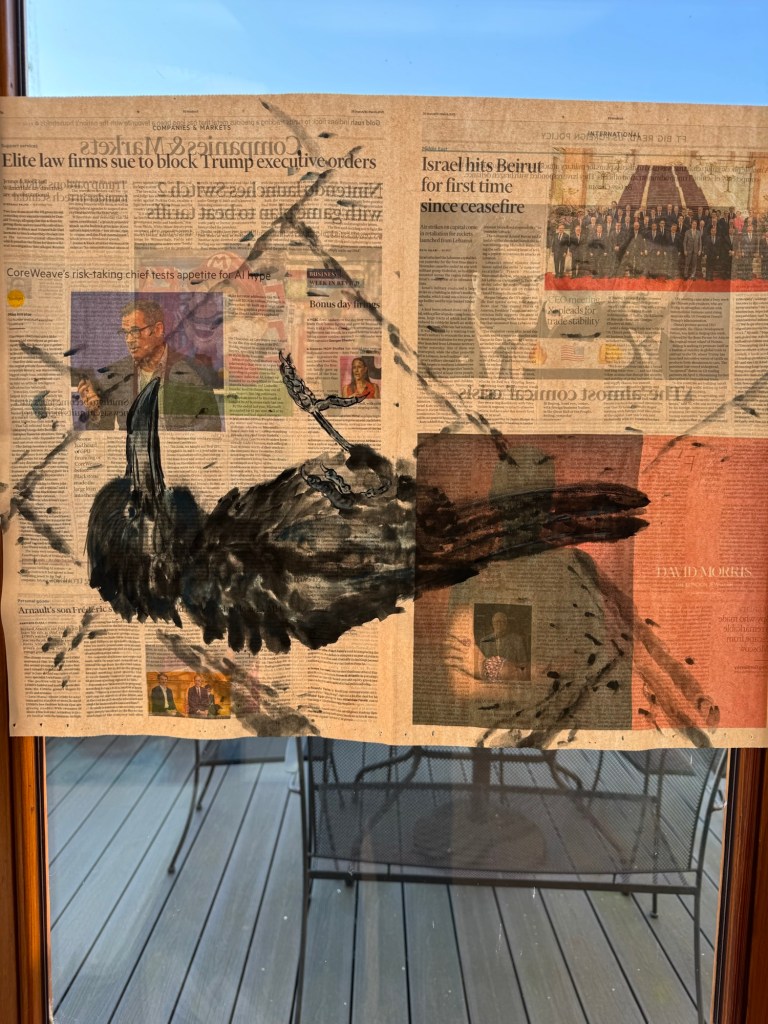
Painting held up to the light, taped to a glass window:
Finished painting – dead crow
A second experiment with a different dead crow was done following the same process, but with an added step of making a faint charcoal outline sketch on the newspaper of the crow before painting. This step was added because brush painting with ink on paper is unforgiving, hence having a sketch of the shape helps to ensure the composition is largely in the right place.
Sketchbook drawing of the second dead crow:
Sketchbook pencil drawing
Chinese brush painting study of crow body:
Chinese ink on rice paper – A4
Charcoal outline was drawn prior to painting to mark out the composition:
–
Completed painting of dead crow lying on its side on pavement, held up to the light.
Painted dead crow on The FT
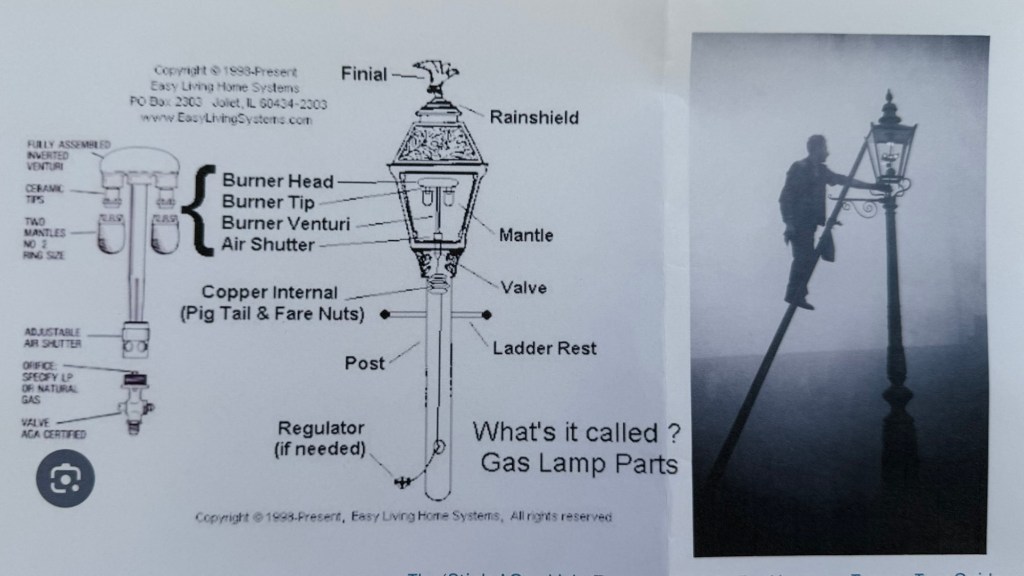
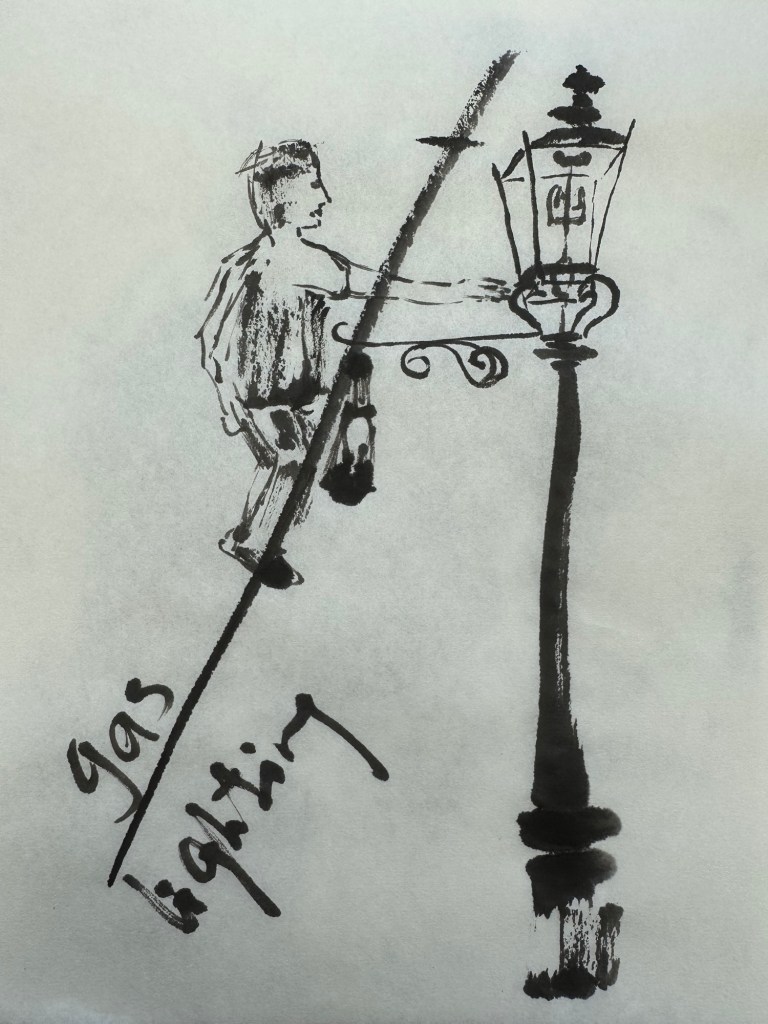
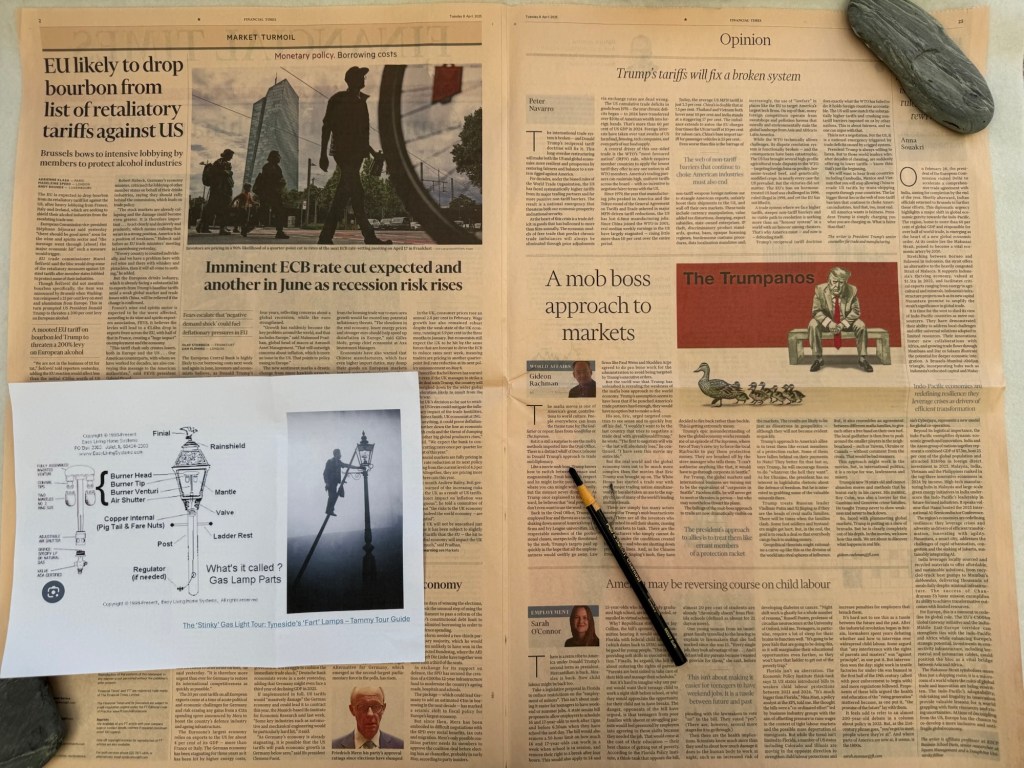
The last experiment on responding to the news involved an image of a man lighting a gas lamp. It was important for me to research how a street gas lamp worked so that I knew what I was drawing. The diagram below was very helpful.
–
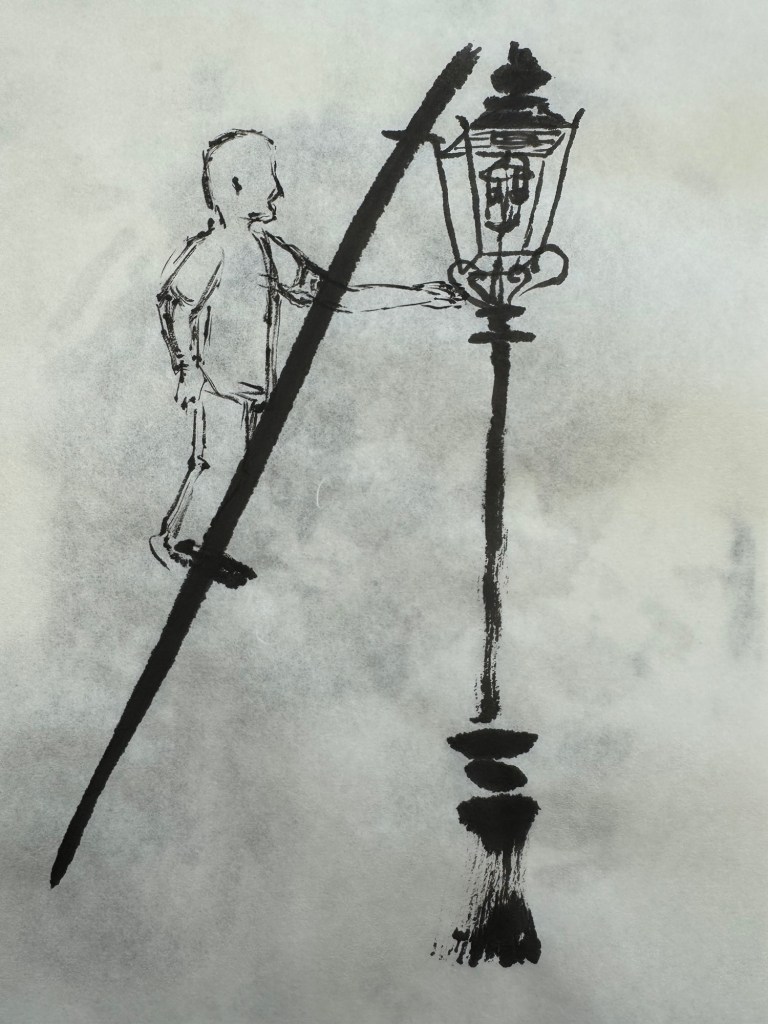
This time, I did two ink sketches as initial study to test the composition:
–
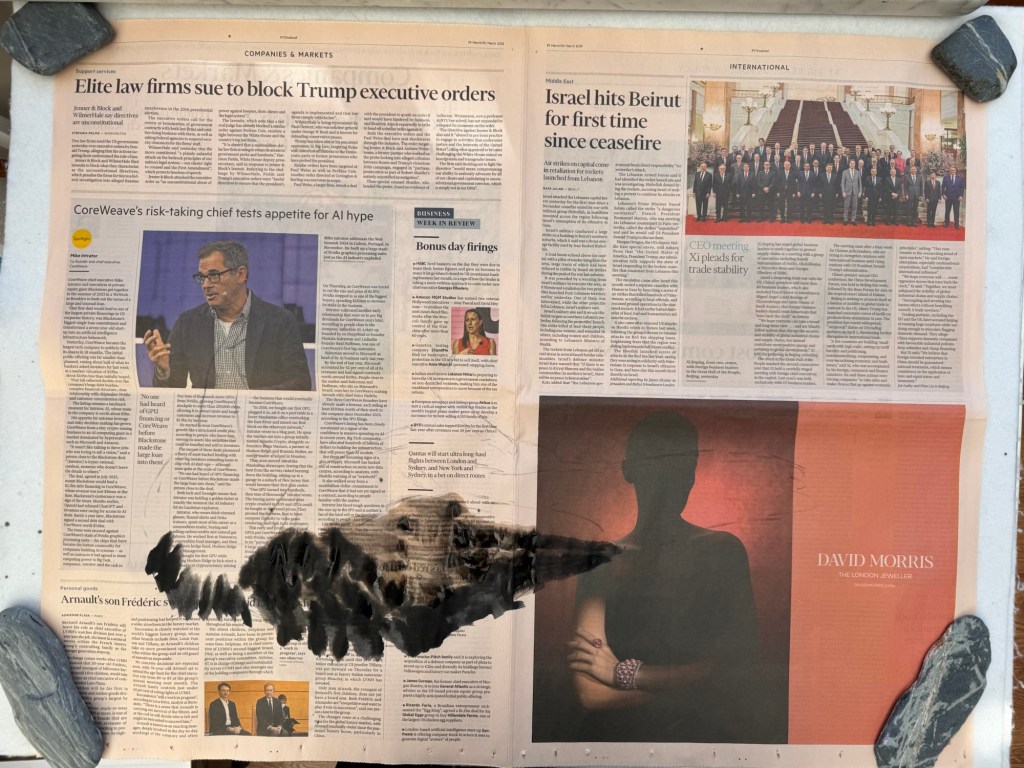
The chosen newspaper page that I wanted to respond to was laid flat and a rough charcoal drawing of the composition was made:
–
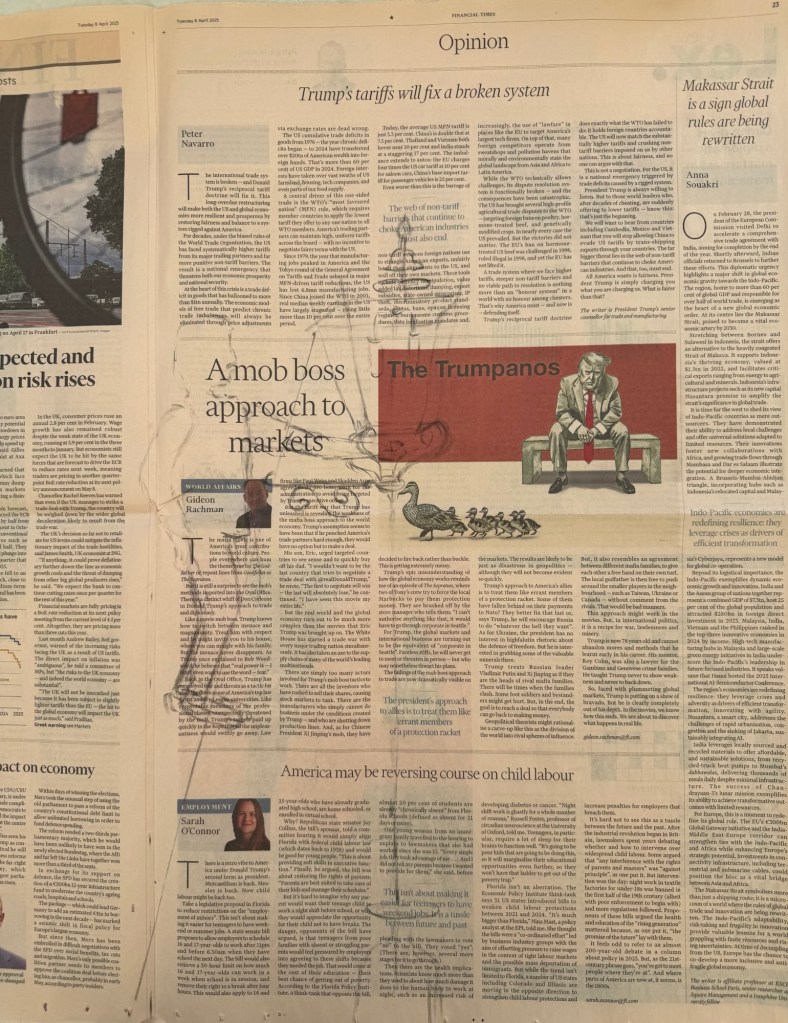
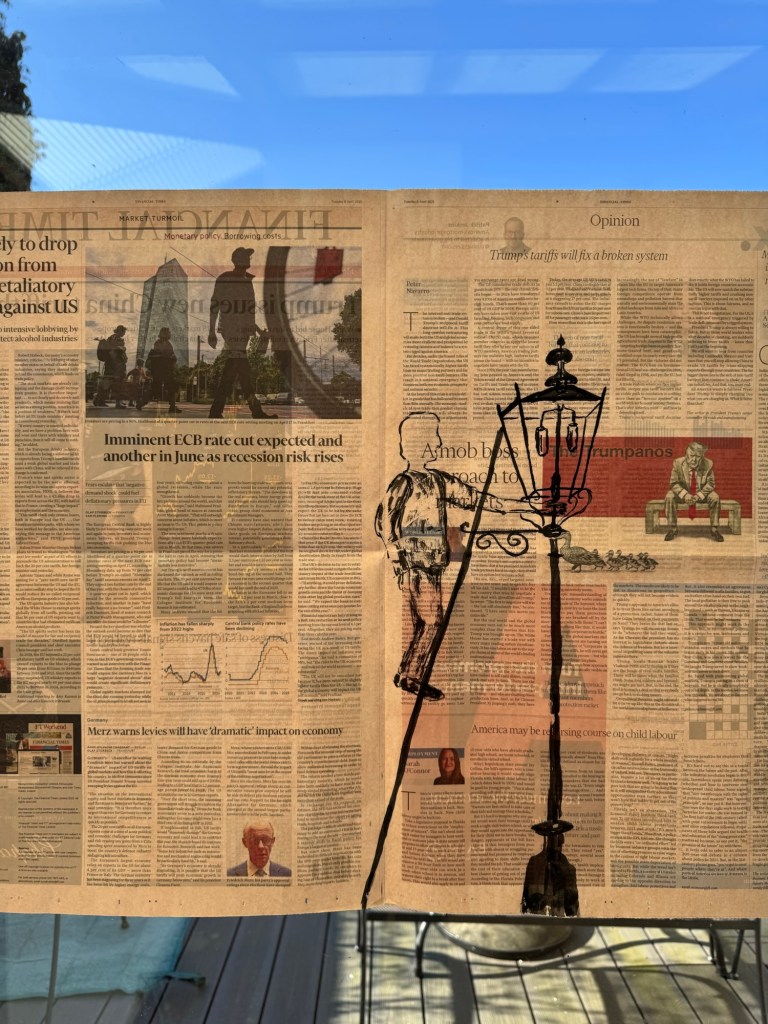
Then the painting was done and held up to the light. Gaslighting – Chinese ink on newspaper:
–
REFLECTIONS
It was cathartic to directly respond to the news. So I enjoyed making these pieces of work. However, looking at them now, they feel rather literal and obvious. Dead crows to respond to innocent paramedics being killed and a man lighting a gas street lamp to respond to the gaslighting going on in many places. All seemed too obvious.
These paintings were made using my dominant hand – I think it was because these composition ideas were very new and I wanted to be more confident in my depiction. However, I believe the outcomes are less satisfactory than the previous ones where I used my non-dominant hand. The mark making here seemed too deliberate and lacking the energy that I had achieved previously.
Although the artistic outcome was not completely satisfactory, the process of responding to the news by directly calling it out was satisfying. It was like ranting without actually ranting. Also, I gained clarity and tested out the process in a more conscious way. So all was not lost.
LEARNING
The initial drawing and sketching step was helpful for new compositions. But I don’t feel it’s an essential step, depending on how familiar I am with the subject.
Using charcoal to mark out the composition on the newspaper was very useful and is an essential step that I should use.
Responding directly with images may end up being too literal or obvious. So use with care.
NEXT STEPS
Try different approaches to composition and images. Experiment with more abstract images.
On 3rd October 2023, I wrote my first blog for my MA Fine Art (Digital) course. It was about my intention to structure my blogs in a way that would help me to create a sustainable reflective practice.
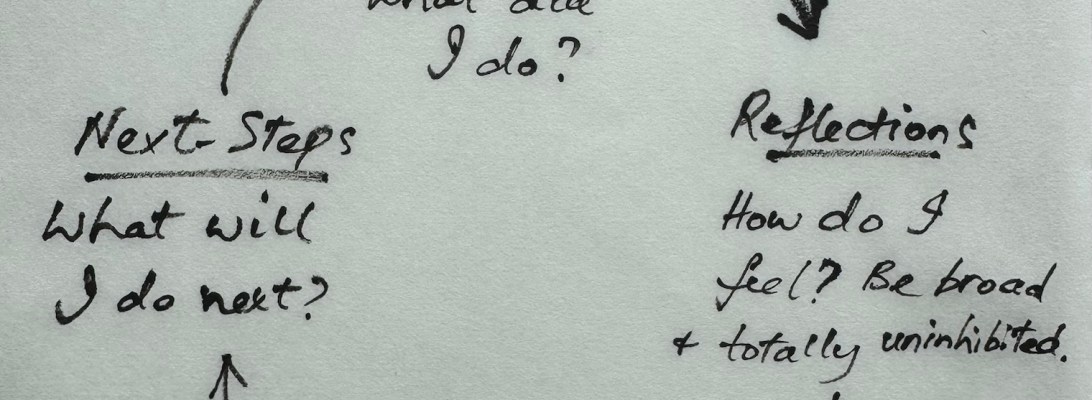
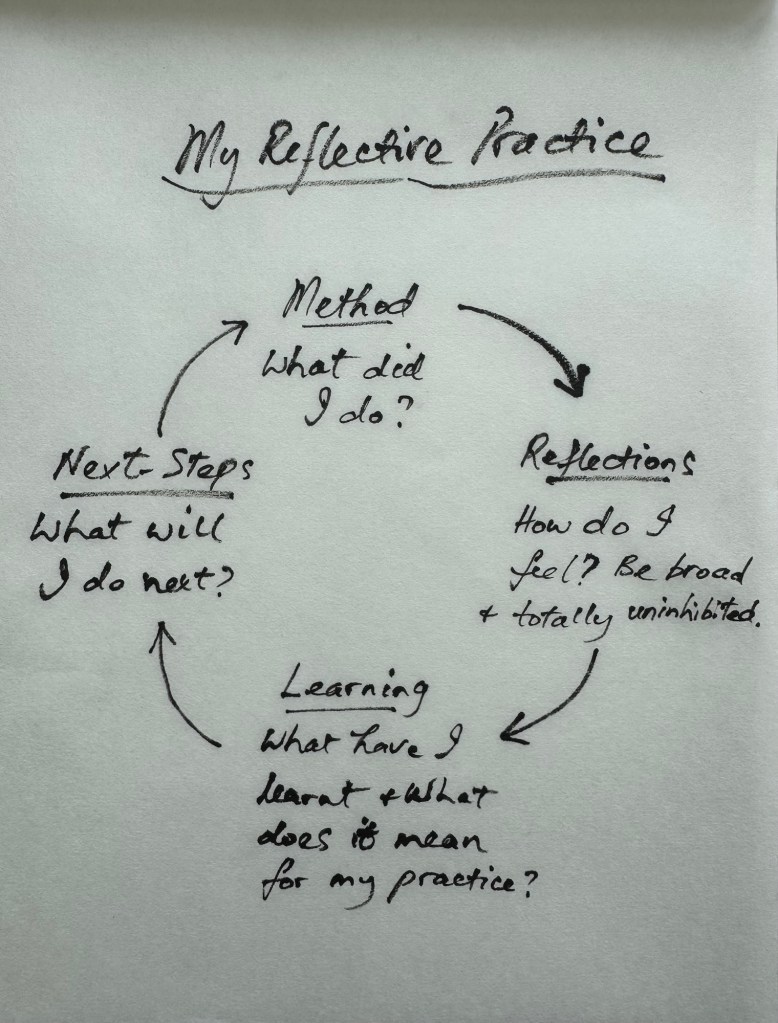
In the blog, I talked about my intention to base my blogs on Kolb’s learning cycle and as a result, I have created the following 4-stage structure and I have been using it for all my blogs throughout my MA course:
1. METHOD (Experiencing stage)
– To capture my making process and decisions along the way.
2. REFLECTIONS (Reflecting stage)
– To capture all my thoughts, feelings, reflections and personal insights throughout as well as after the making process. The aim is to think as broadly and be as uninhibited as possible to ‘open up the horizons’ and/or to ‘dig deep’.
3. LEARNING (Thinking stage)
– To bring my reflections back to the context of my art practice – what have I learnt and what does it all mean for my practice? Also to capture any emerging intentions if appropriate.
4. NEXT STEPS (Acting stage)
– To summarise ‘what to do next’ in clear actions to give direction to progress my practice.
Below is my reflective process in a diagram.
My reflective process
It will be referred to as The ‘MeReLeNe’ process for short from here on.
REFLECTIONS
Writing my blogs in this ‘MeReLeNe’ structure during my two year MA programme has helped me to cement a structured approach and develop my reflective practice. I have been an engineer all my life before coming to the arts and I need an underlying structure in order to liberate me to explore freely and safely, knowing that if I ever felt lost or ‘wobbly’ then I could come back to a tried and tested structure that would give me security and guidance. Since this is a structure that I have developed for myself and tested over a two year period, I feel that I can trust and rely on my process to progress my practice making it sustainable as I feel very committed to it. I have come to realise that it is much more than a safety structure… At times during the last two years, I have felt unsure about what direction to take or felt lost about what to make. Then inevitably I would realise that I have not written my blog for my last piece of work yet, hence I felt lost. Without exception, once I reflected properly in my blog and captured my learning in the context of my art practice, the next-steps would then reveal themselves naturally in the process. Sometimes the next-steps could be simply to ‘make some more’ and that simple statement may seem generic, but I would know where to take it as a result of going through the reflective process.
I am excited about having tested and embedded this structure into my practice. It is now such a fundamental part of my practice that I cannot image working without it because I would soon become lost.
Furthermore, in the last two years, at times I have felt unsure of what my ‘process’ was, was it painting with oil, oil and cold wax, making Cheongsam canvases or painting on newspapers? I found it hard to explain to people when asked about my practice, especially for anyone not familiar with contemporary art. People would ask if I painted landscapes or portraits; watercolour or oil. It’s impossible to give a straight answer when my medium and methods would vary depending on what I was trying to say. It might vary from project to project, but writing this blog has brought clarity to what my art practice is about:
‘My contemporary art practice is about exploring my identity and my environment through narratives. I use whatever medium that is appropriate to help me express what I want to say. My reflective practice is my process.’
LEARNING
I have learnt that I definitely need a structure to thrive in my practice. It provides a safe environment for me to wander and explore freely knowing I can ‘come home’ to this process to consolidate my learning and progress.
The key revelation for me is having the clarity that ‘My reflective practice is my process’. I believe my tutor has allured to this several times recently and I now know what he means.
NEXT STEPS
Continue to use and embed the ‘Method-Reflections-Learning-NextSteps’ (or MeReLeNe) process for my reflective practice.
Start to acknowledge that my reflective practice is my process. Own it.
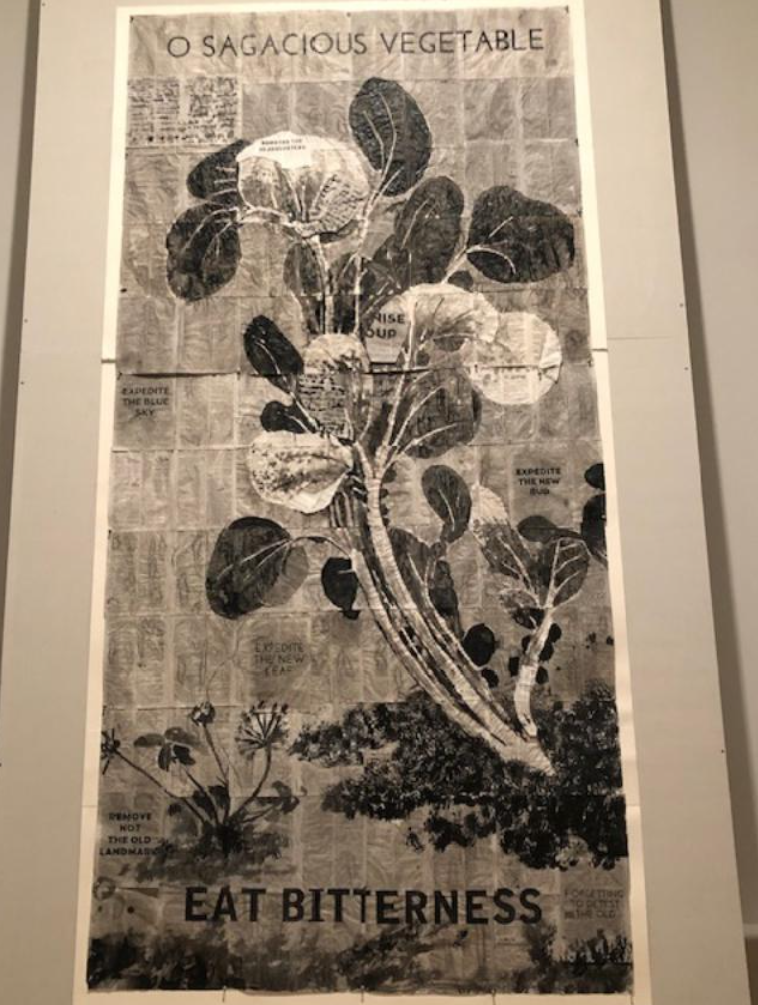
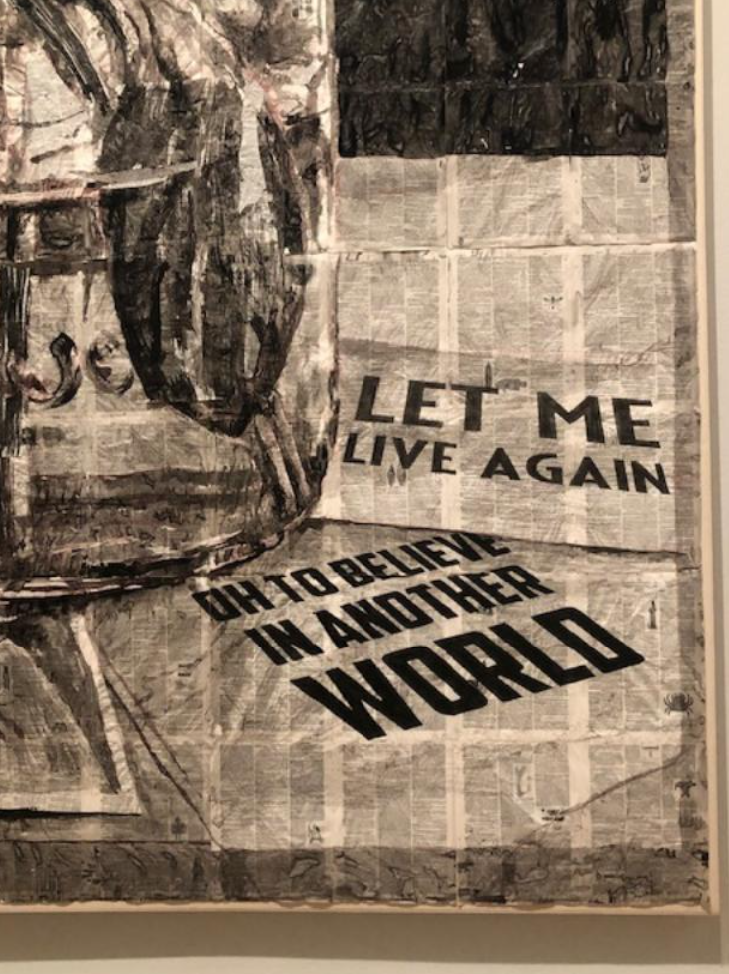
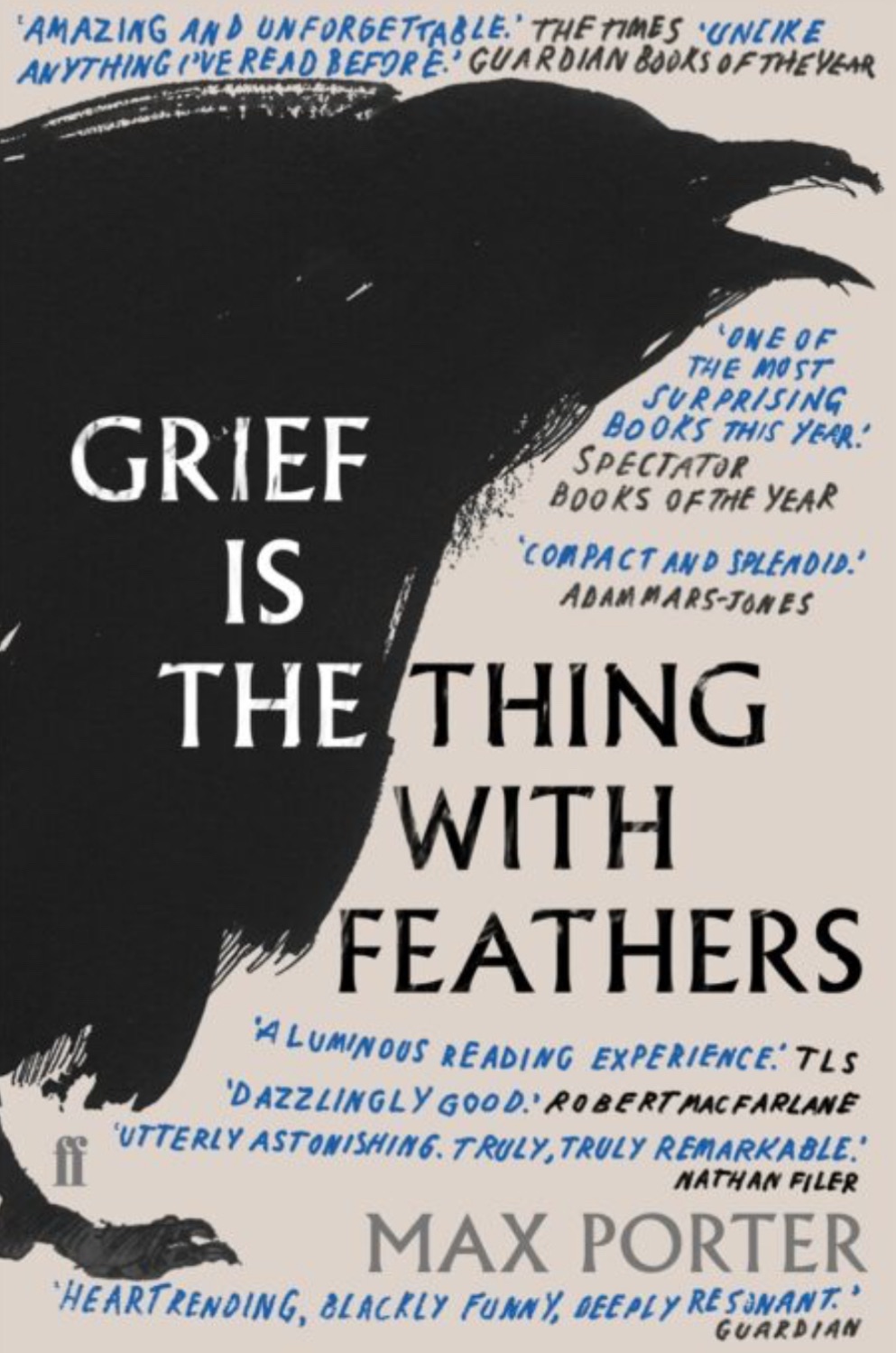
Continuing with my exploration of the grief and sense of loss that I feel about the change in world order, I have decided to make some paintings with crows inspired by the book ‘Grief is the thing with feathers’ by Max Porter. The use of newspaper as a canvas for painting as I have done here was first inspired by William Kentridge’s work that I saw at his exhibition at the RA in 2022, where he made some monumental drawings on printed materials. Some examples below:
–
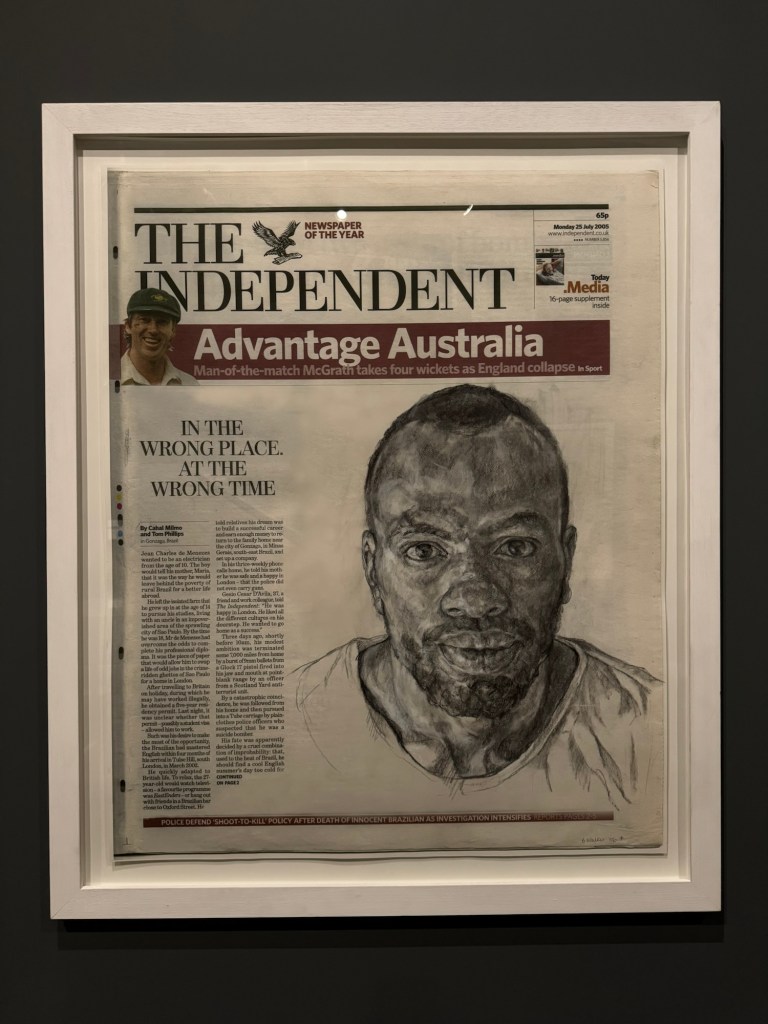
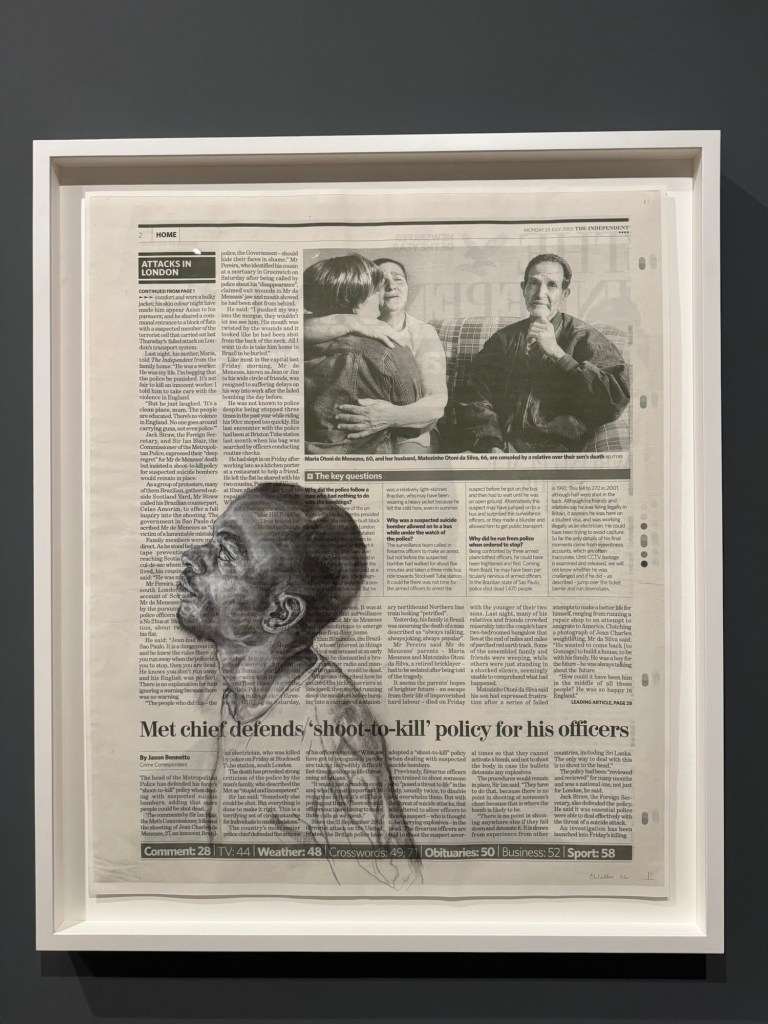
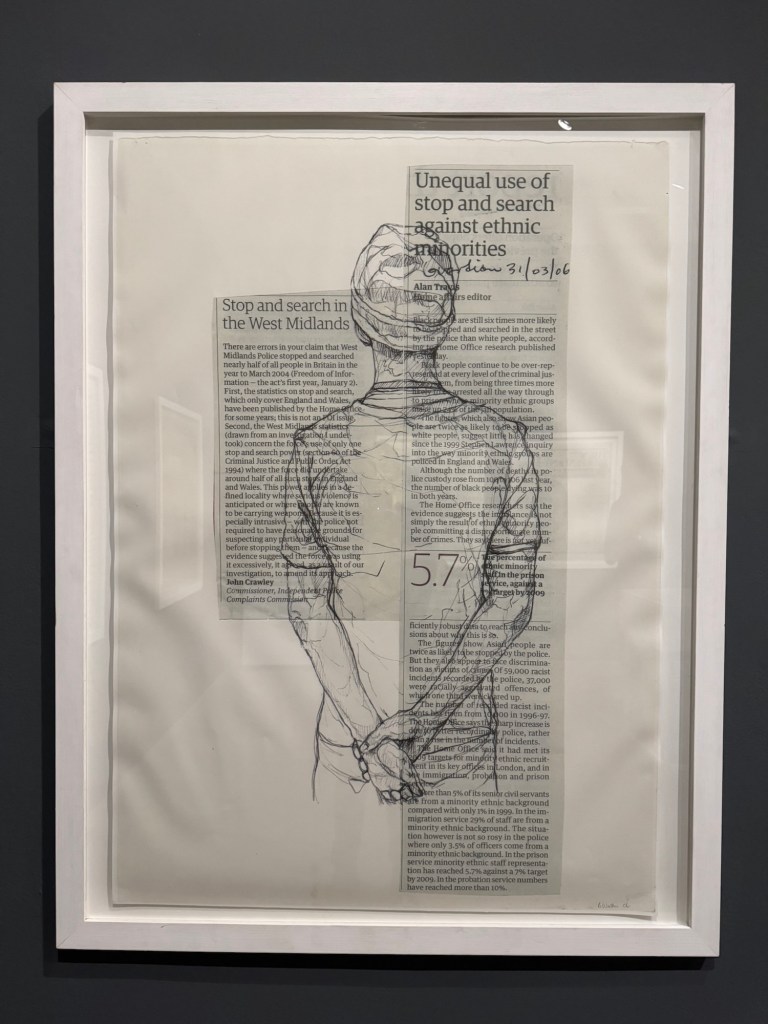
I have recently seen an exhibition by Barbara Walker where she used printed documents extensively in her work. Below are some examples of her use of newspapers:
–
Walker uses newspapers with content that directly links to her subject matter of social injustices whereas Kentridge is more subtle and often you cannot easily read the printed text in his work although I have read in the description of his work that there is always relevance in the text.
METHOD
Since my studio is out-of-action at the moment due to building work, I have set up a temporary studio in a different room and I am using Chinese ink on paper instead of my usual oil paint on canvas because of the limited facility that I have.
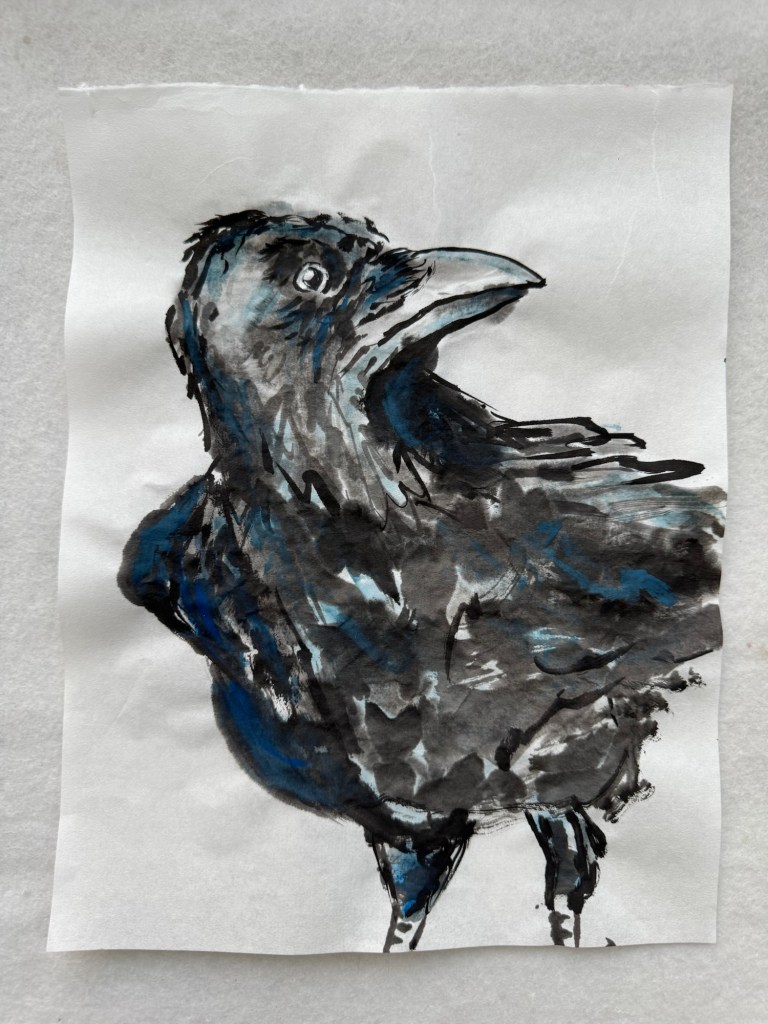
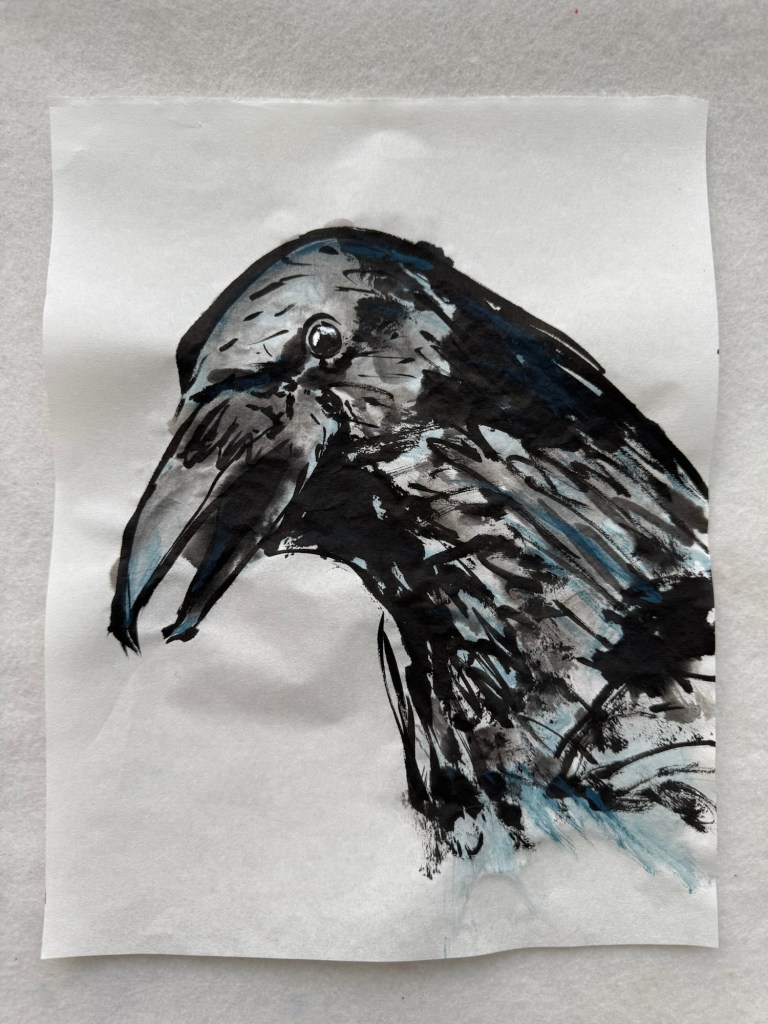
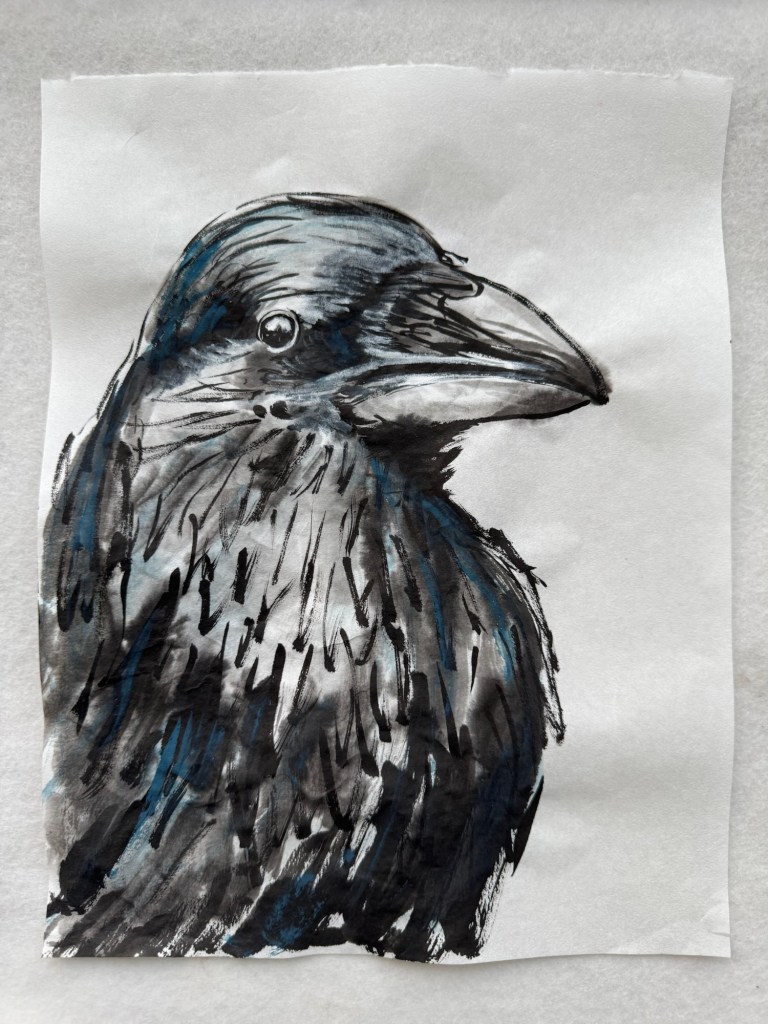
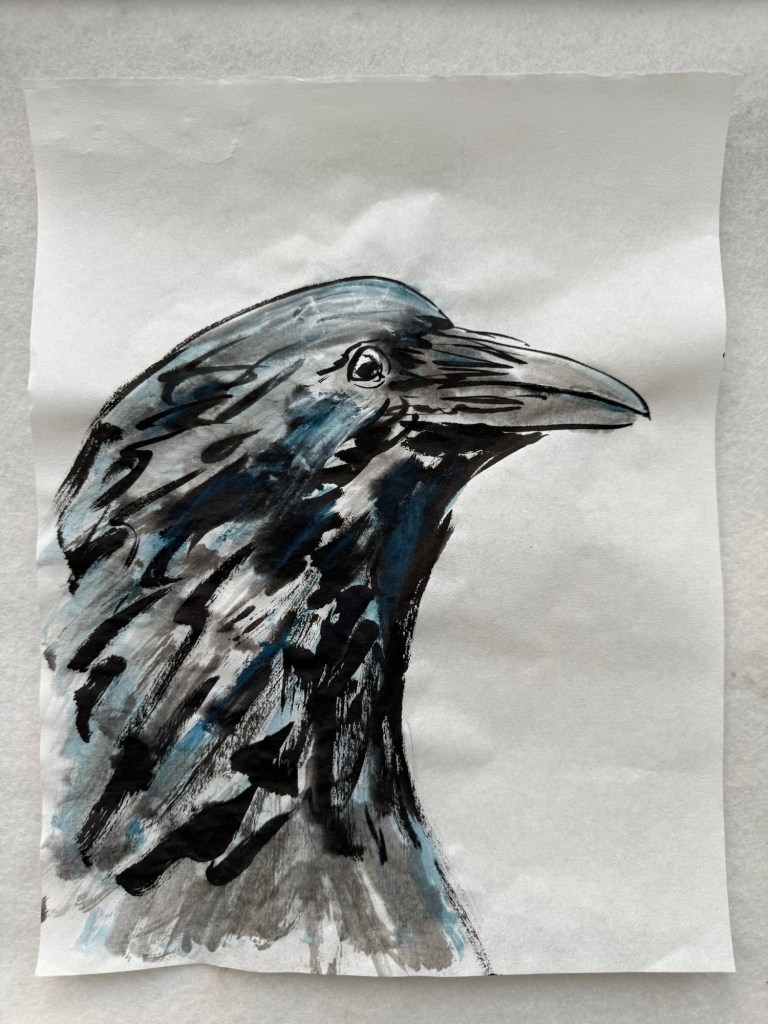
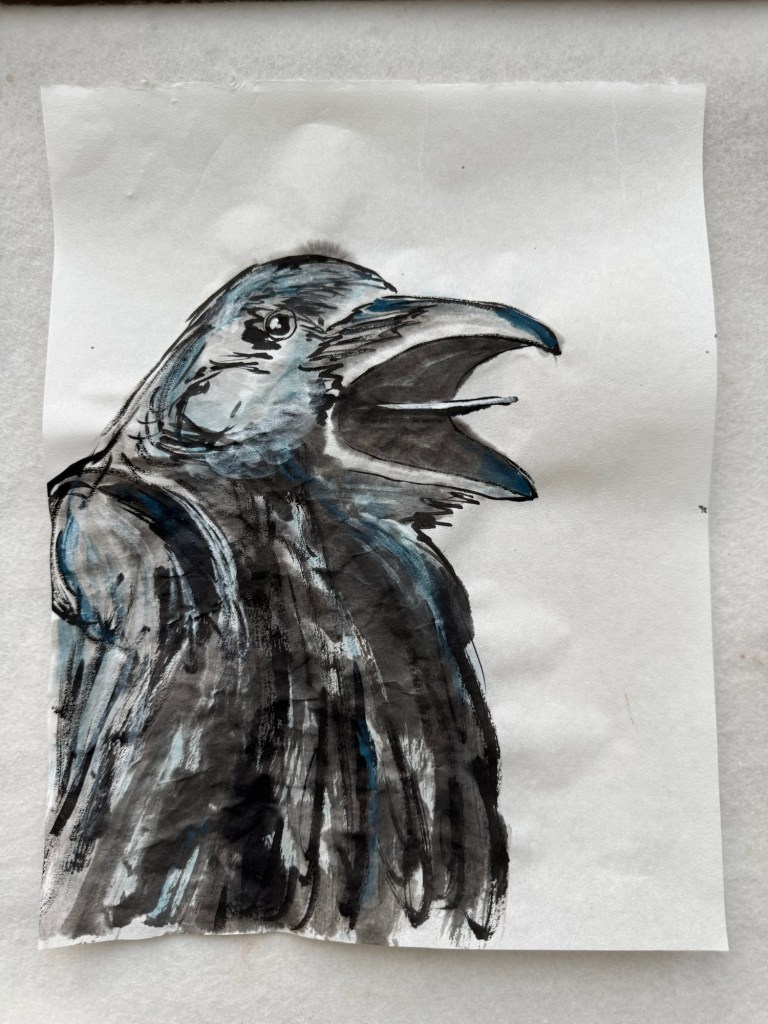
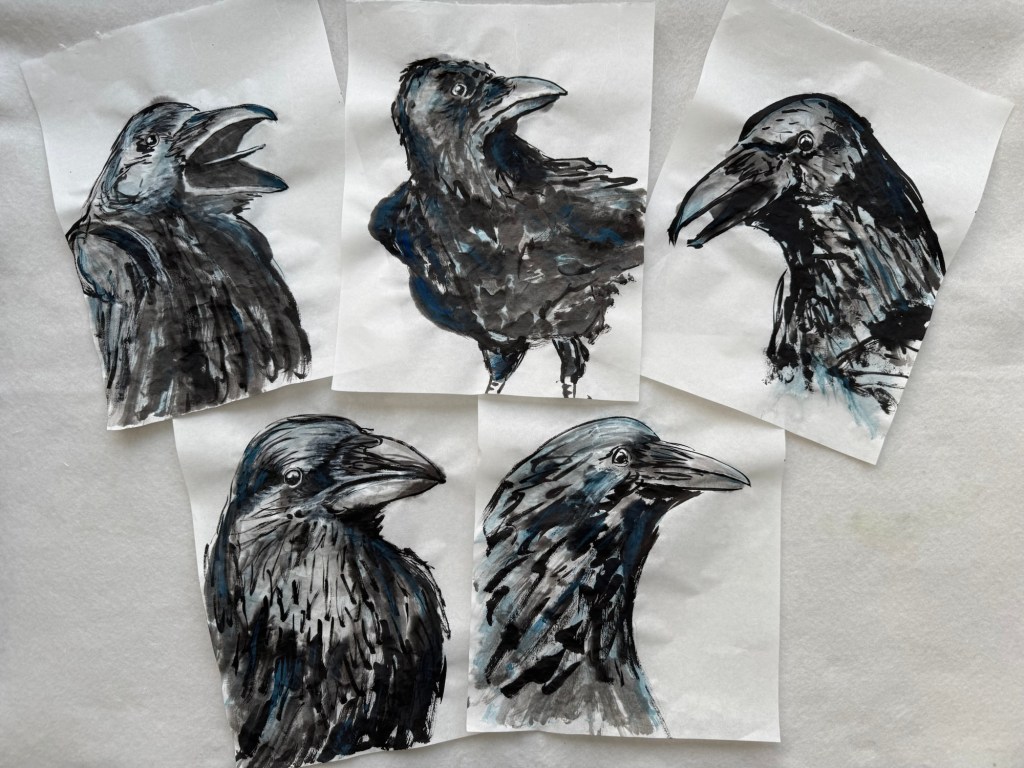
Learning from the crow drawings that I did with my non-dominant hand, I decided to use my non-dominant hand for the paintings here. Below are the paintings on Chinese rice paper, all A4 size done with my non-dominant hand except the one with the crow sticking out its tongue – that was done with my dominant hand for comparison.
––
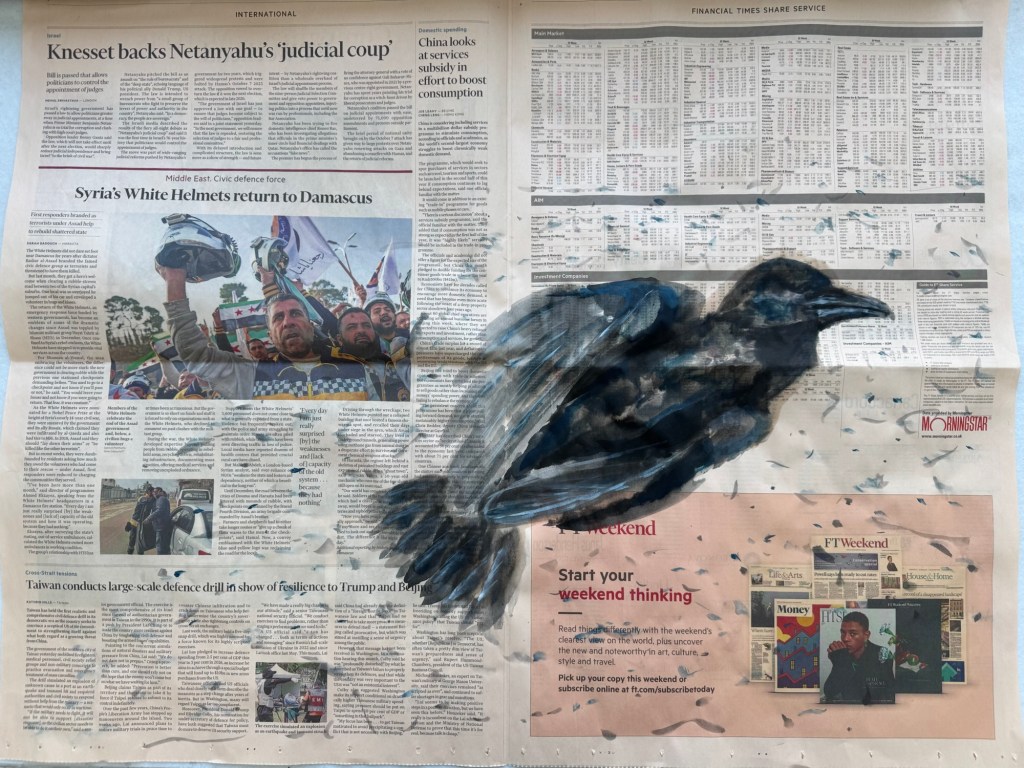
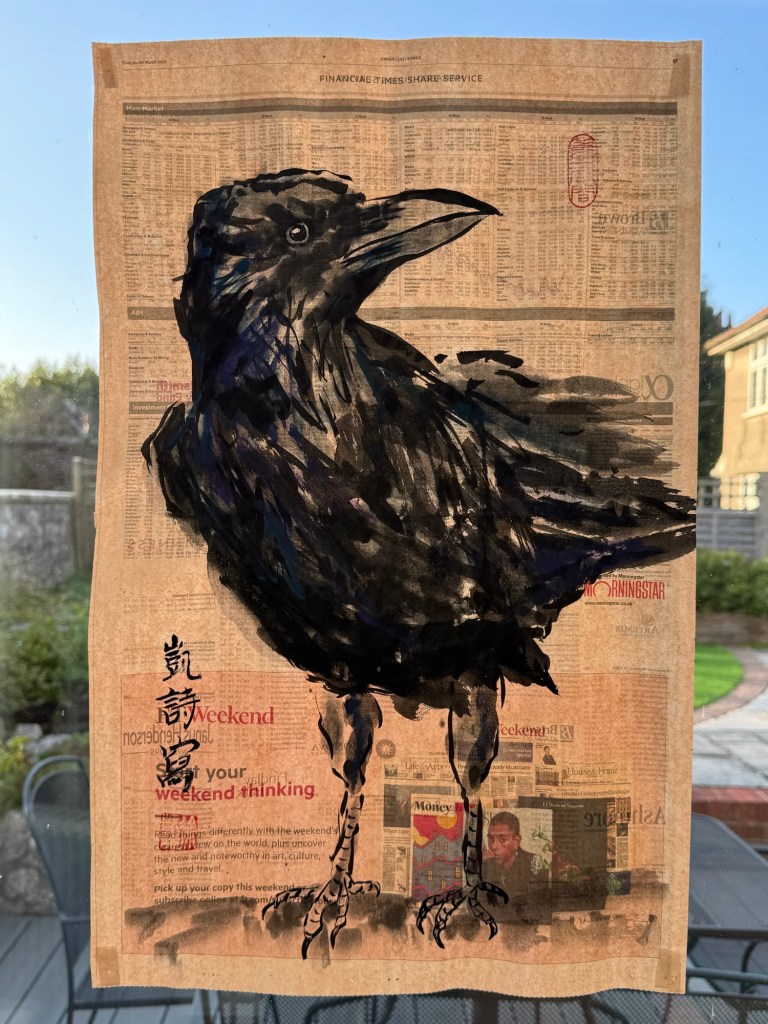
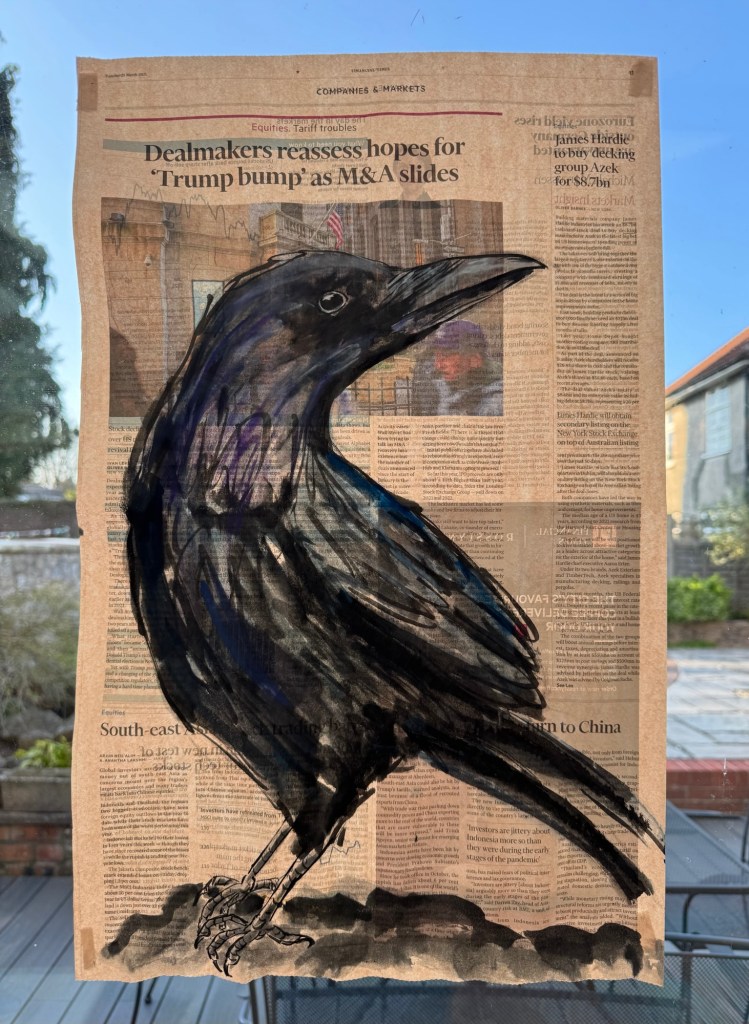
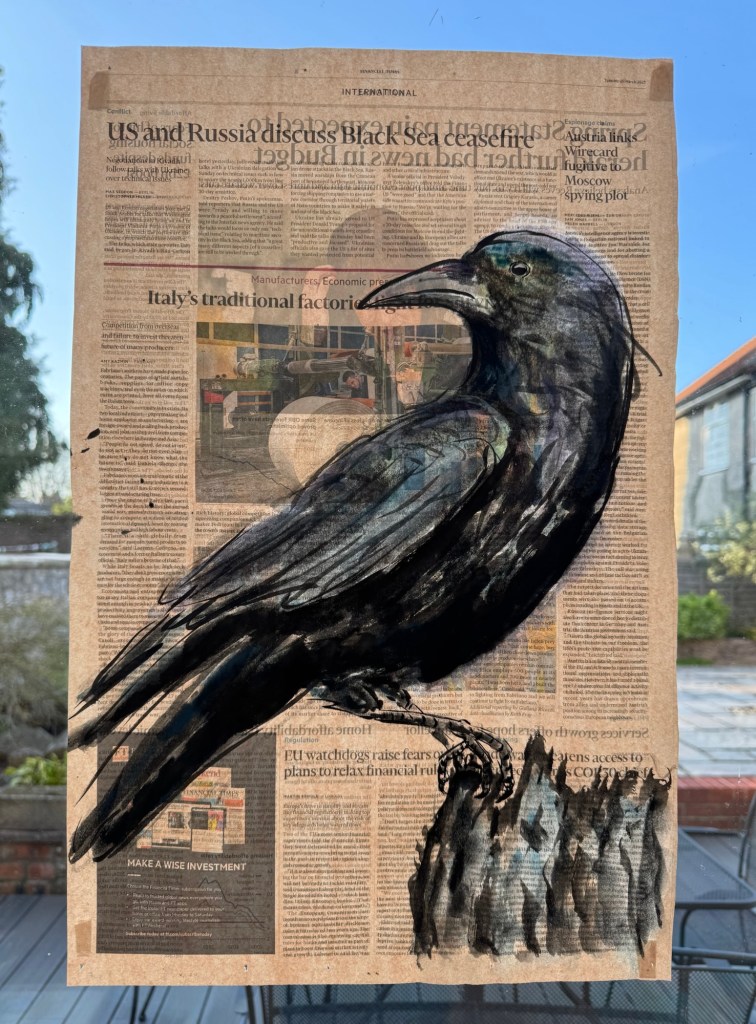
Then I decided to paint on a newspaper and I chose The Financial Times because it is one of the few newspapers that I can bear to read given my general frustrations with the biases in the news media. I have painted on the FT in the past and found the ’45 gsm salmon newsprint’ paper absorbency to be at a level that responded well to Chinese ink. I also like the salmon colour against the black Chinese ink. All three paintings below were mostly done with my non-dominant hand with some details such as the shape of the beak and the claws done with my dominant hand.
–
Below is a video clip that I made using Instagram:
–
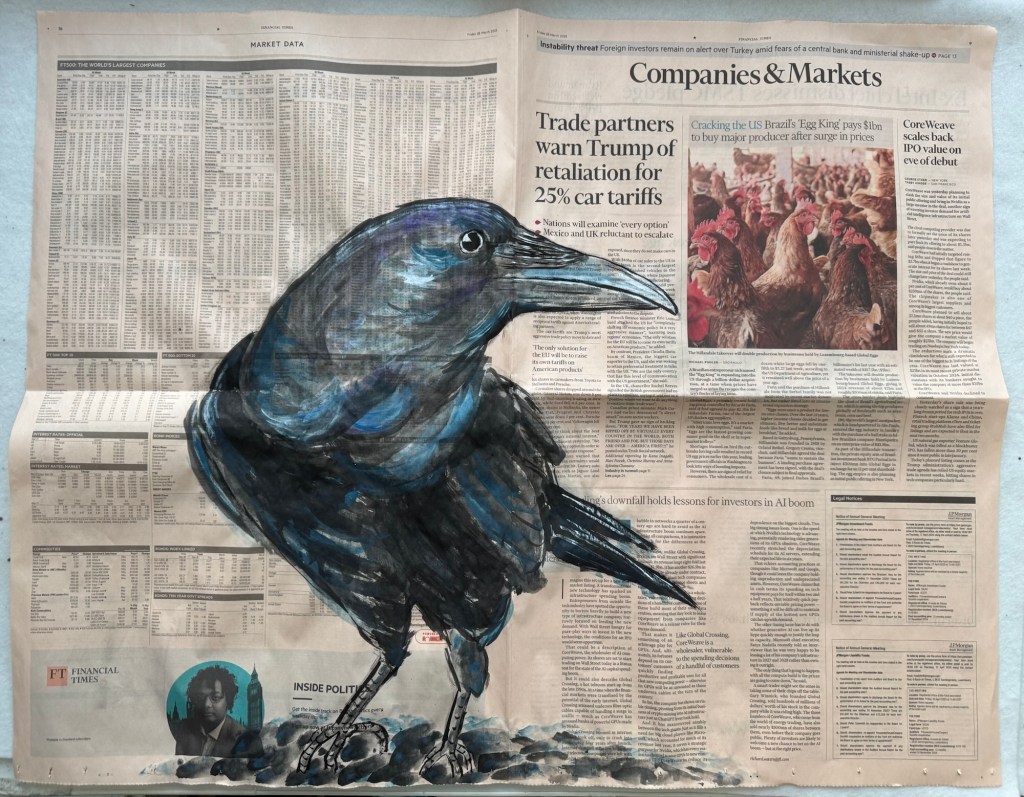
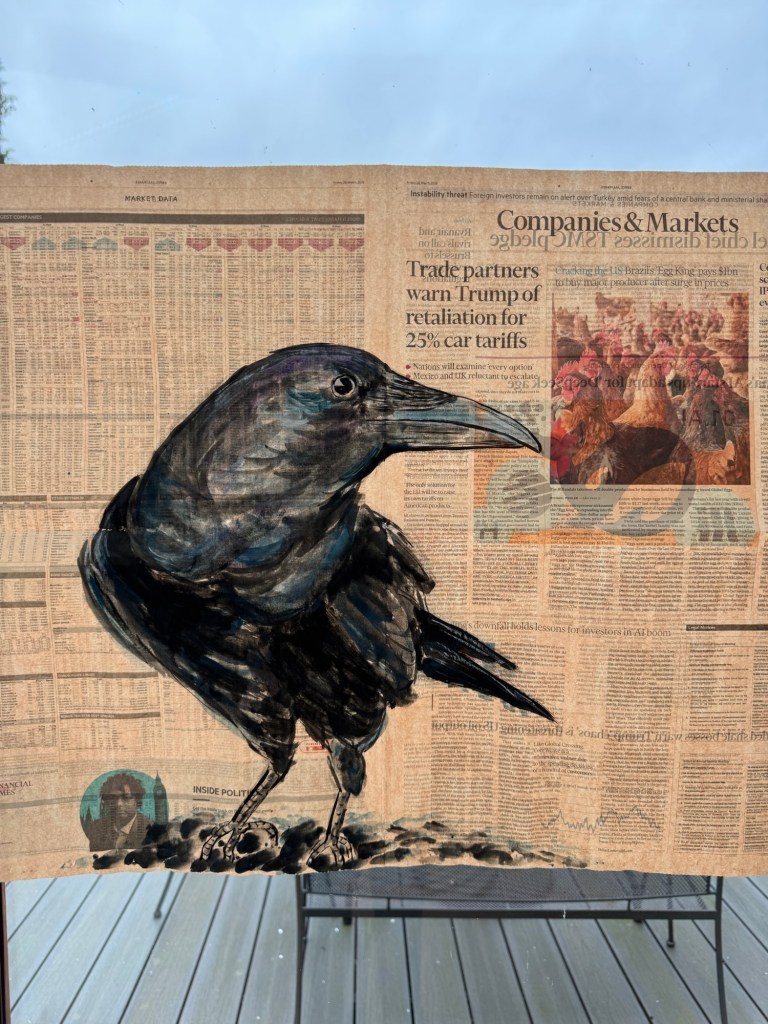
Below is a crow painting on a double page spread of the newspaper where the previous ones were on a single page. The page here was chosen for the photograph of the chickens (about egg prices in the USA) with the painted crow looking in and one of the chickens staring back:
Below is the painting held up to the light:
REFLECTIONS
I have enjoyed developing a new process for painting on the newspapers. I find the paper works well with the Chinese ink, not overly absorbent and has enough material integrity to stay intact even if it gets very wet.
I have continued to enjoy painting with my non-dominant hand as the brush strokes were more expressive with less control. During the painting process, I constantly asked myself which hand I should use, e.g. with the more detailed work such as the curvature of the beak where more control was required, or highlighting the white in the eyeball, then I switch to my dominant hand for those details. I wanted to use as much of my non-dominant hand as possible because I prefer the marks made and it was a good metaphor for the helplessness I and many people feel about the world events at the moment.
Part of the process of this way of making involves buying a newspaper, something that I haven’t done for a long time since I mostly read the news online/on my phone nowadays. I enjoy the physicality of opening and turning the news pages, then reading the printed text and selecting the pages with headlines that stir me in some way.
Examining the newspaper so closely also reminded me of my early engineering career when I worked extensively on automating newspaper printing presses for Fleet Street as well as local newspapers with ‘cutting edge technology’ for that time period of the early 1990s using fibre optic based digitally synchronised ‘electronic line shaft’ control systems. The presses were enormous and ran at very high speed. It was exhilarating to work on those projects and machines especially as a young engineer. Decades later, I am now studying newsprint closely again for a different purpose – I used to scrutinise the print registration of the colours (poor registration would cause ghosting) and I would respond to the results by varying the control parameters for correction. Now I scrutinise the news content and respond by painting on the newspaper. I can say that the former was a lot easier – I felt completely in control of what was happening. Whereas I rarely feel in control of my painting process and I continue to feel zero control over what is happening in the world – all I can do is to read about them in the newspapers. This has become an interesting juxtaposition of my relationship with newspapers over the decades.
As I work more and more on these newspaper paintings, I have become calmer compared to when I first started as I have documented in some of my earlier blogs about voicelessness and going through the grief curve. I wonder if this is because the world situation has improved (no), or I have become desensitised by the constant revelations of world disasters (possibly) or having a way to respond to and express myself through paintings on the newspapers has given me a route to release my anger therefore making me feel that I am doing something about it. I think definitely ‘yes’ to the latter point, the painting process has certainly helped me to channel my thoughts and feelings.
LEARNING
I have developed a new process of painting on newspapers as a way to respond to what’s happening in the world. I have continued to use crows as a symbol of the grief that I feel about the loss of or change in world order. Working with newspapers reminded me of how my relationship with newspapers has changed over the decades since I was a young engineer. I feel this is the beginning of an exploration and I want to continue and do more because it gives me a way to respond to the world at the moment.
One point that I discussed with my tutor was how I ‘held the newspaper up to the light’ as an accidental discovery when I stuck the newspaper paintings to the glass window for photographing. It is a good metaphor for ‘exposing’ the news and also the light shining through the other side of the print revealed additional images therefore making the overall composition more ambiguous.
NEXT STEPS
Continue to make more paintings in this way to explore, to develop my ideas and the process.
Experiment with holding the painted newspaper to a light or lamp to see how it could work as an indoor installation.
Continuing with my exploration of the grief and the sense of loss that I feel for the drastic change in world order, I did some printmaking during my low residency week at CSM in London and I continued with the theme of crows as inspired by the book ‘Grief is the thing with feathers’ by Max Porter.
METHOD
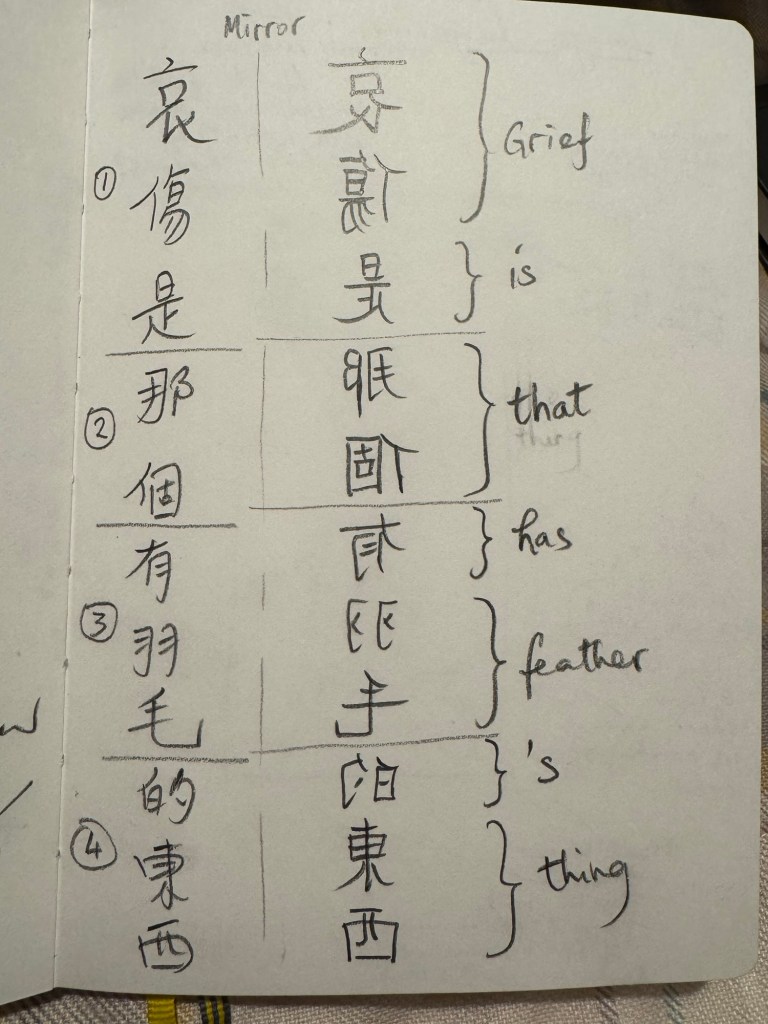
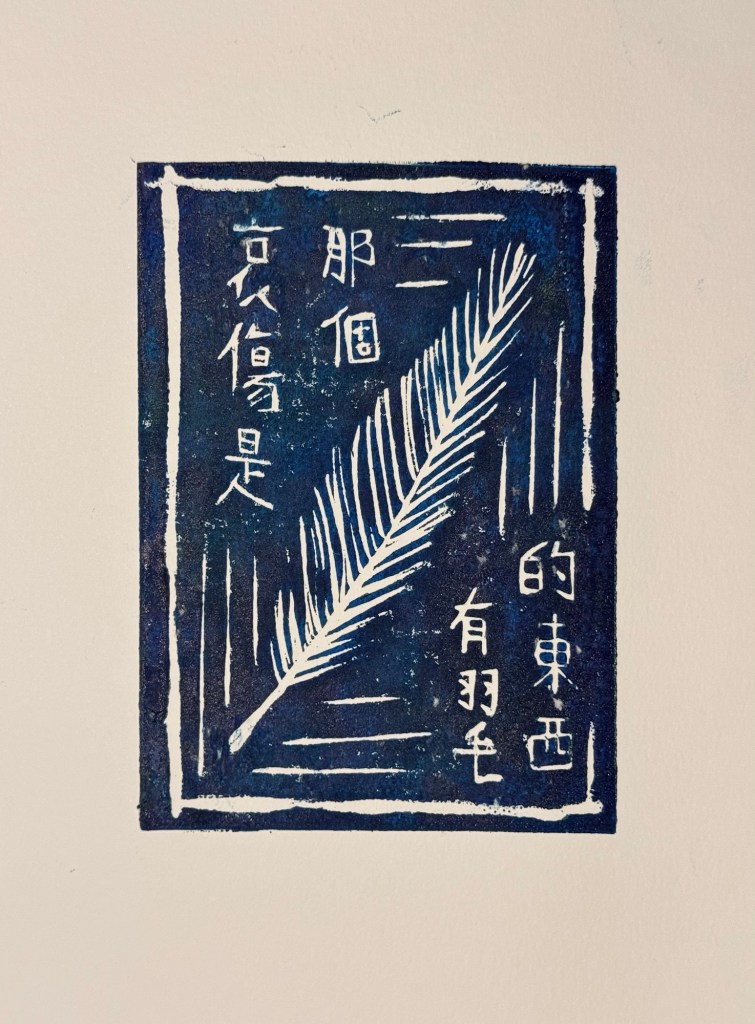
During the low residency at CSM in London, we had a lino printing workshop. I created an image with a feather and translated ‘Grief is the thing with feathers’ into Chinese. I then had to write out the mirror-image of the characters for the printmaking process:
–
We made prints in different colours and the blue one came out best for me:
–
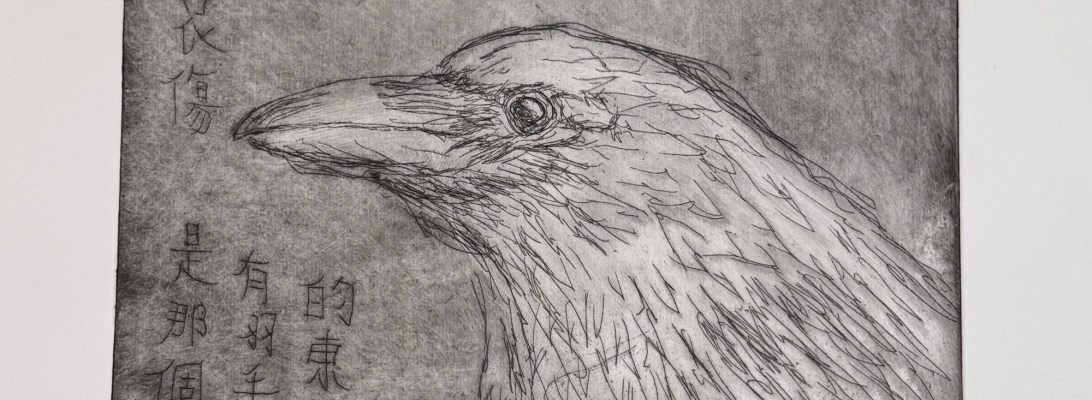
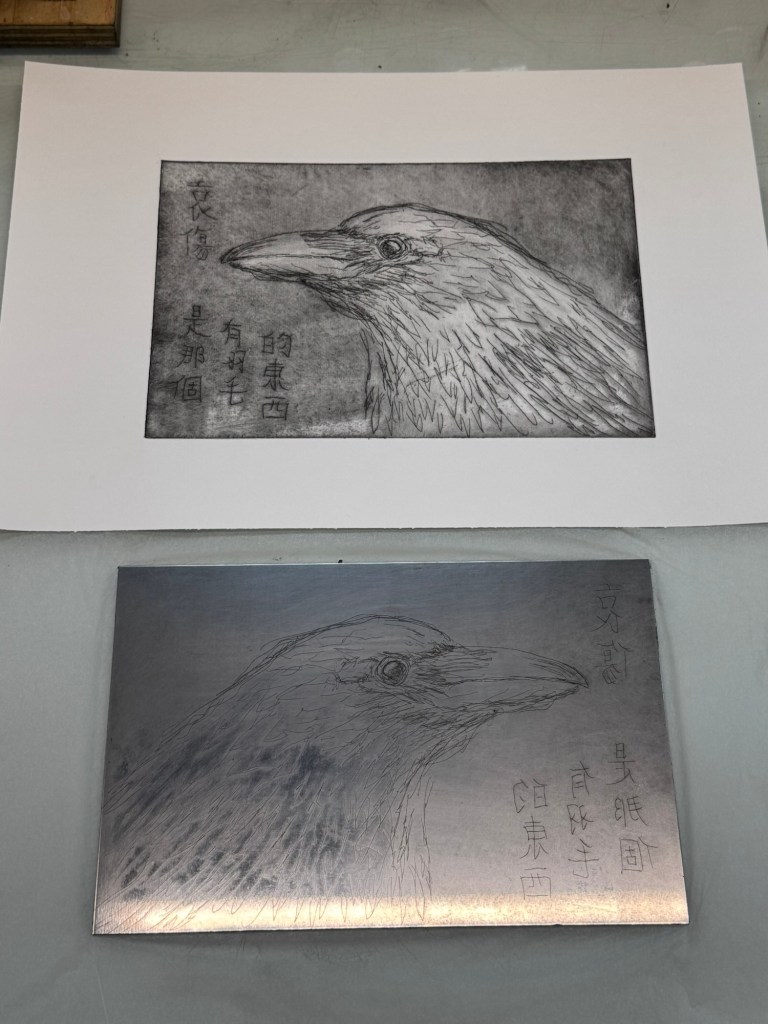
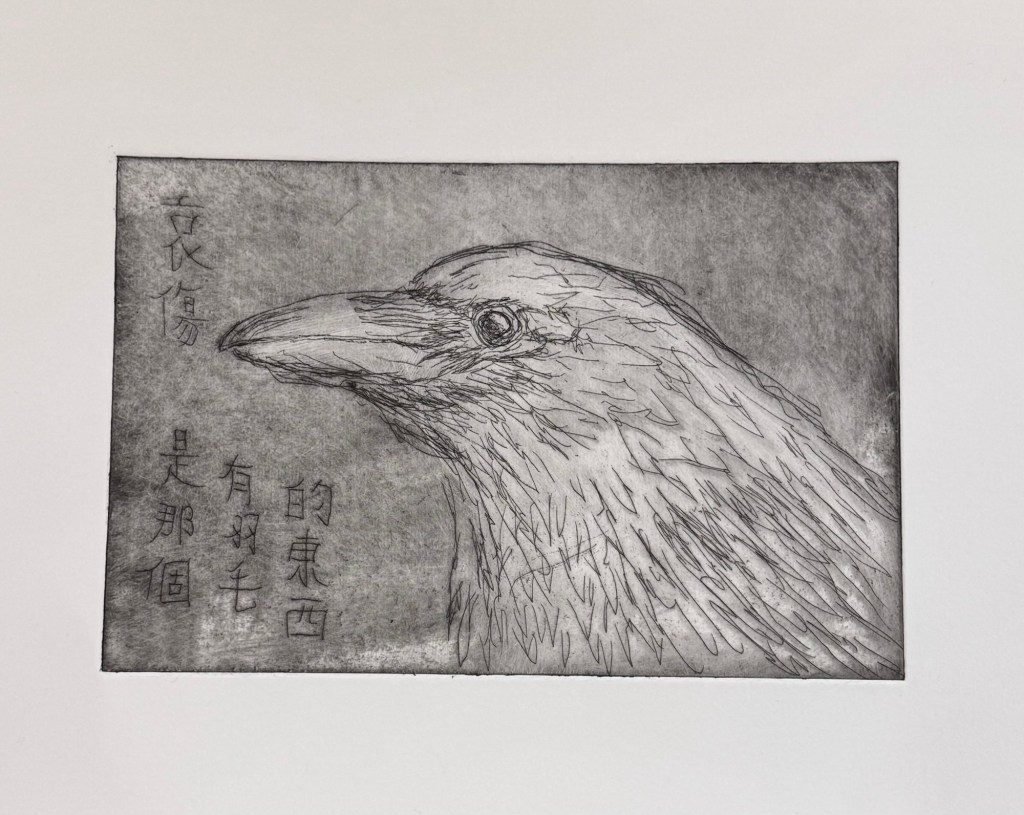
I then attended another printmaking workshop where we made some etched prints. I did the etched drawing of the crow with my non-dominant hand, but did the mirror-image Chinese writing with my dominant hand as writing Chinese backwards required the utmost control!
–
First trial print to test the etching on the plate:
–
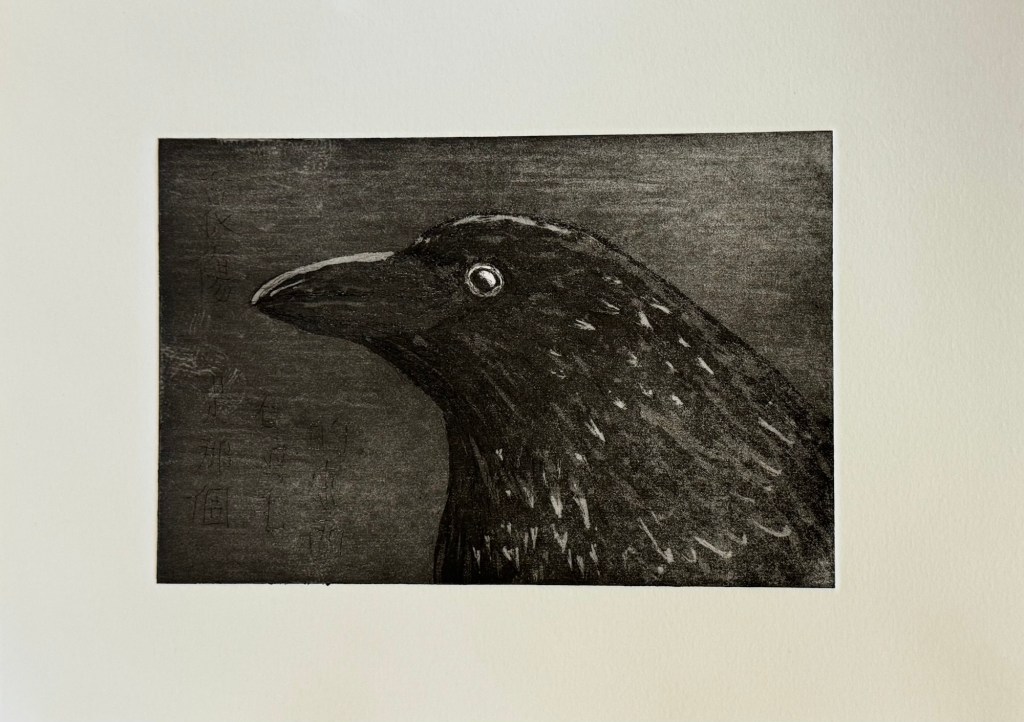
Then I tried the aquatint process to add tone to the print:
–
REFLECTIONS
I have enjoyed both workshops very much and I mostly learnt that printmaking is not easy! The lino print was easier as I am familiar with the process so I mostly knew what I was doing. The fact that it was a simpler process also helped for a printmaking novice.
The etching process was much more complex for me. It was my first time. The tutor was very patient with all of us and very helpful. The etching of the plate was fine, but the aquatint process was much more involved and clearly required good experience to create the desired effect. I thoroughly enjoyed the workshop but I don’t think I will be rushing to make more prints because I like to make art intuitively and that requires a good understanding of the process and the materials. For me to achieve that and make prints intuitively would require a lot of time investment to make it part of my practice. So I think I will leave it for now and may be investigate printmaking after I finish my MA when I have more time. Printmaking is something that I have often thought about because of the good facilities at the print studio locally at Spike Island in Bristol and they run courses for beginners.
Out of the prints made, I was happier with the image of the lino print. The etched crow turned out too cute like a plush toy and not really reflective of the grief that I wanted to portray. Also, the Chinese writing mostly disappeared in the aquatint process. I should have thought more about how to ‘protect’ that part of the plate in the process. Something to bear in mind in the future.
LEARNING
I have often admired printmaking artists’ prints and wondered about how the process works. Now I have gained more of an insight into the complexity involved and I very much respect what they do! For me, since I am still developing my practice and I often feel self-conscious that I am wanting to include more different disciplines (e.g. photography and film making), it is therefore useful to know that I don’t want to pursue printmaking (not in the near future anyway) because of the time investment required and I don’t think the process ‘speaks to me’ yet due to my lack of experience. I am equally inexperienced in photography and film making, but I find it easier to get to grips with those processes.
Overall, they were very enjoyable workshops and I learnt a lot. I may still do some lino prints for fun and I may treat myself to a printmaking course one day at Spike Island.
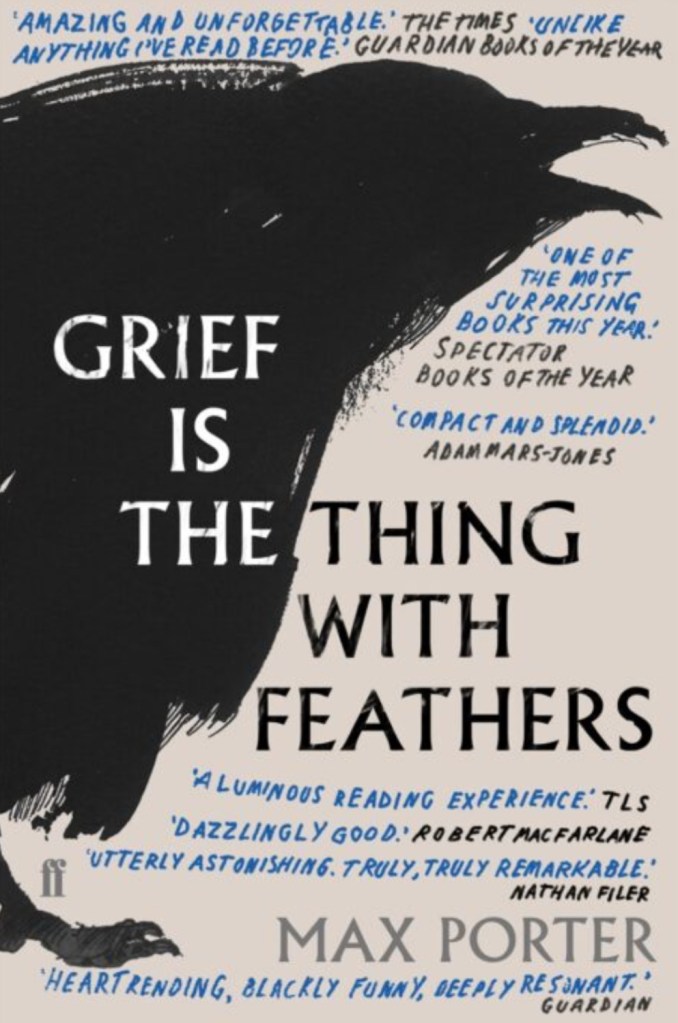
After reflecting on my practice and how I am feeling about the world at the moment, I have decided to express my grief through my art. I was very touched by the book ‘Grief is the thing with feathers’ and the author describes a crow that comes to visit as a metaphor for grief. So for the time being, I am going to work with crows and feathers.
–
METHOD
When rethinking and reflecting on my practice, I realised that drawing was a comforting process for me so I started with some drawings of crows. I decided to draw with my left/non-dominant hand because:
– I enjoy it because I feel energised by the feeling of not being fully in control in my making;
– I want the mark making to be more loose and expressive which I find easier to achieve with my non-dominant hand;
– The feeling of not being in control is a good metaphor for how I feel about the change in world order at the moment.
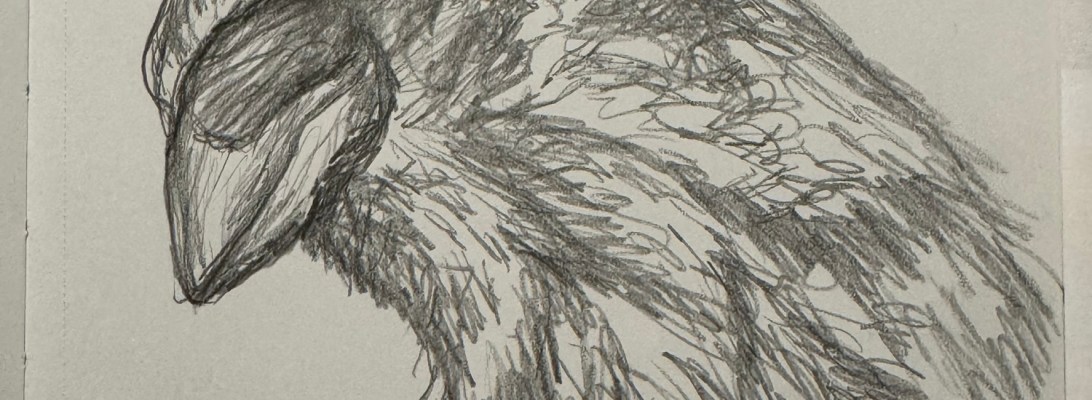
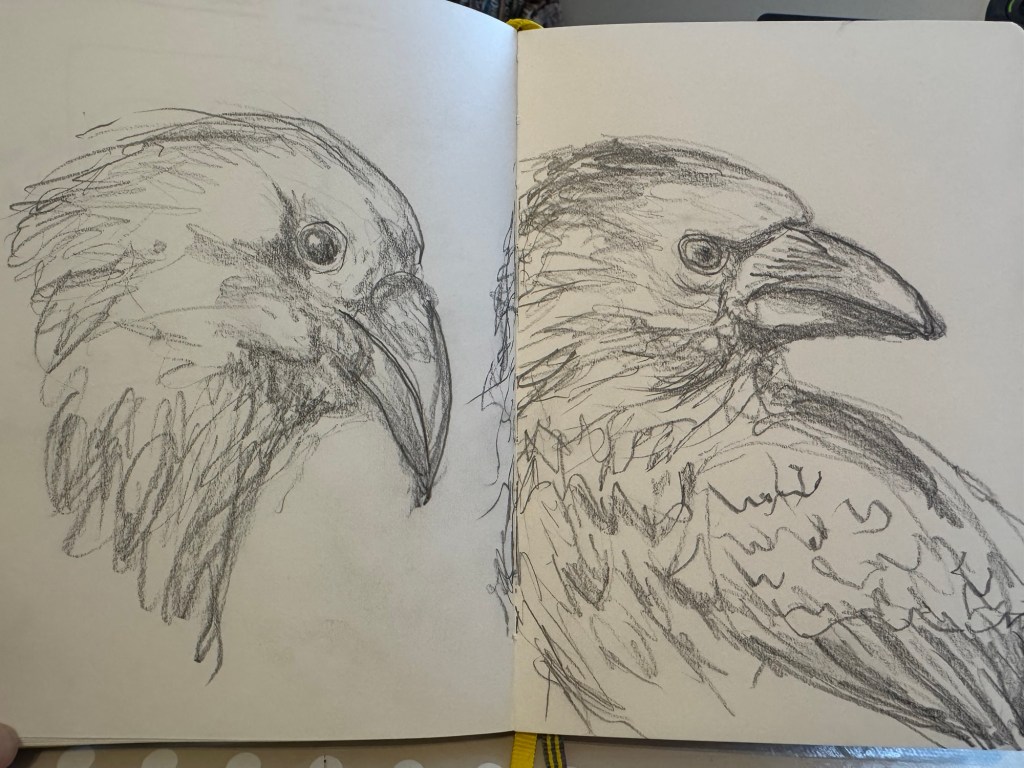
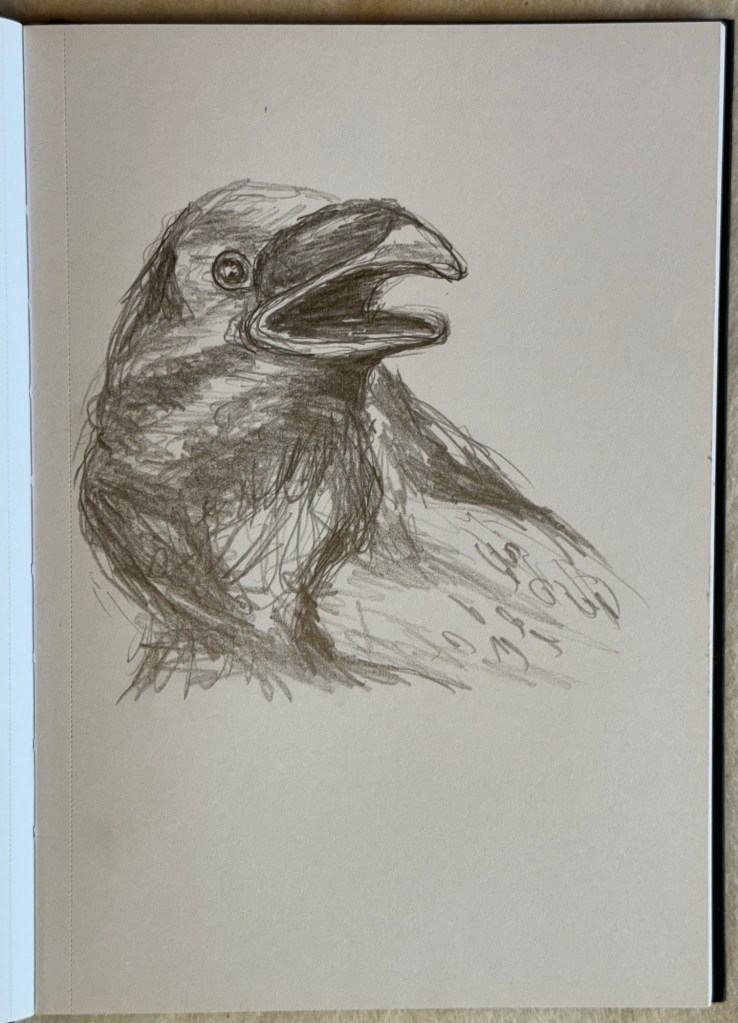
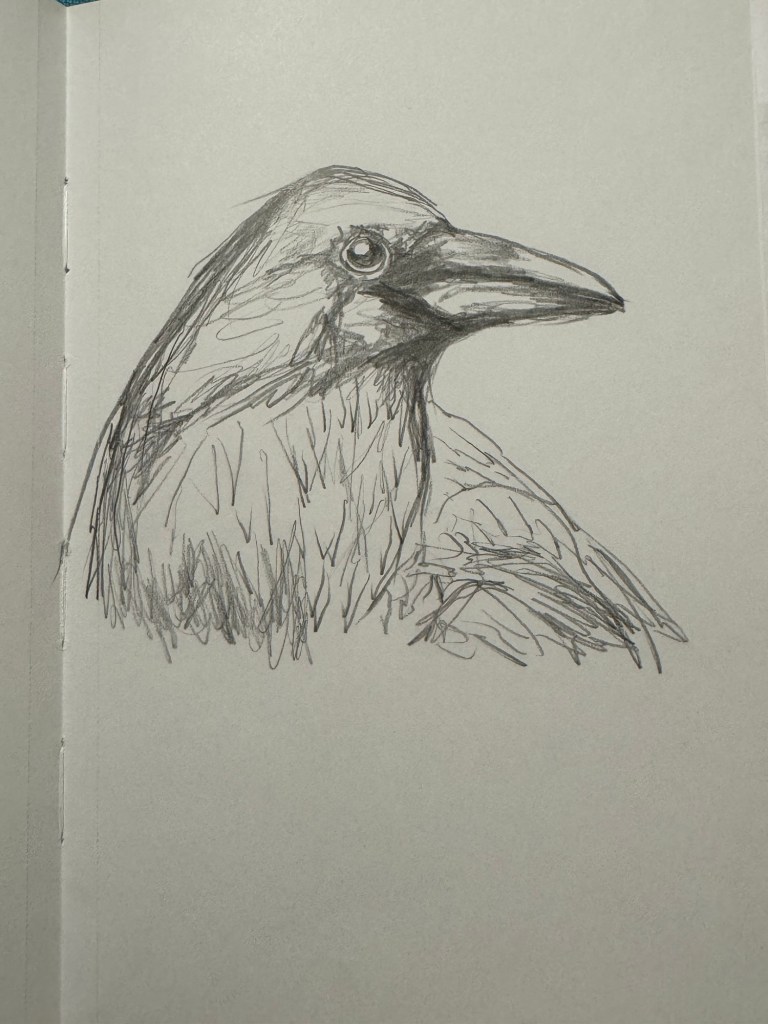
Another reason for drawing crows was to study their faces and anatomy as preparation for future work. Below are some crow drawings made with my non-dominant hand:
–
I then made one in Chinese ink but with my right/dominant hand:
–
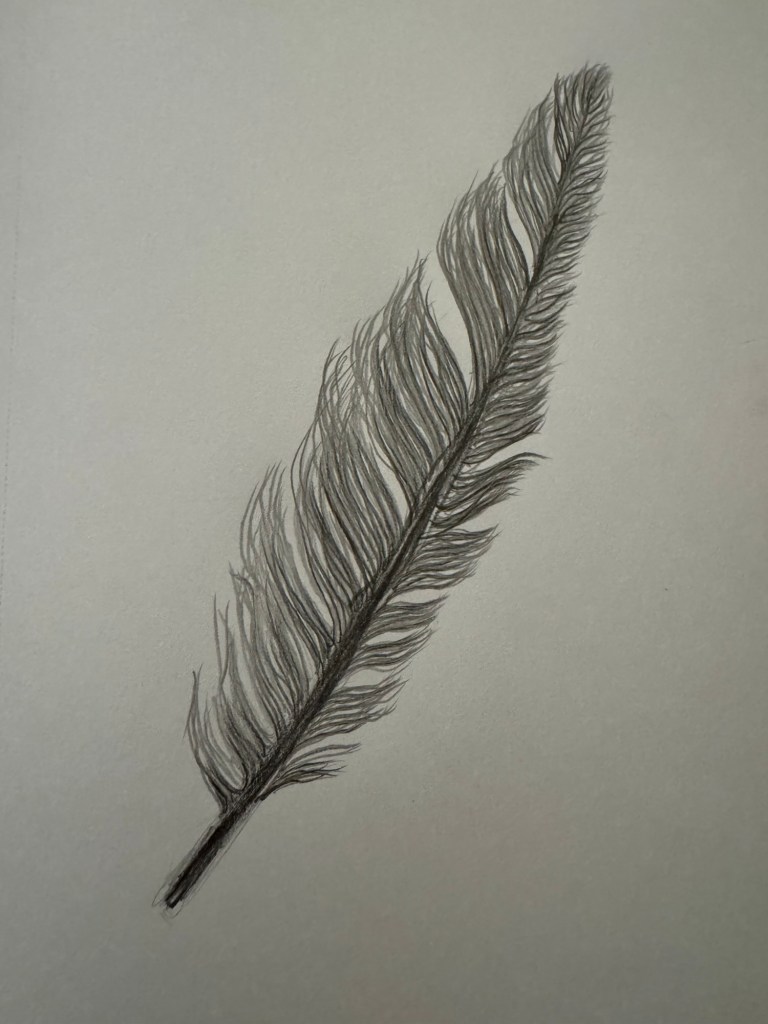
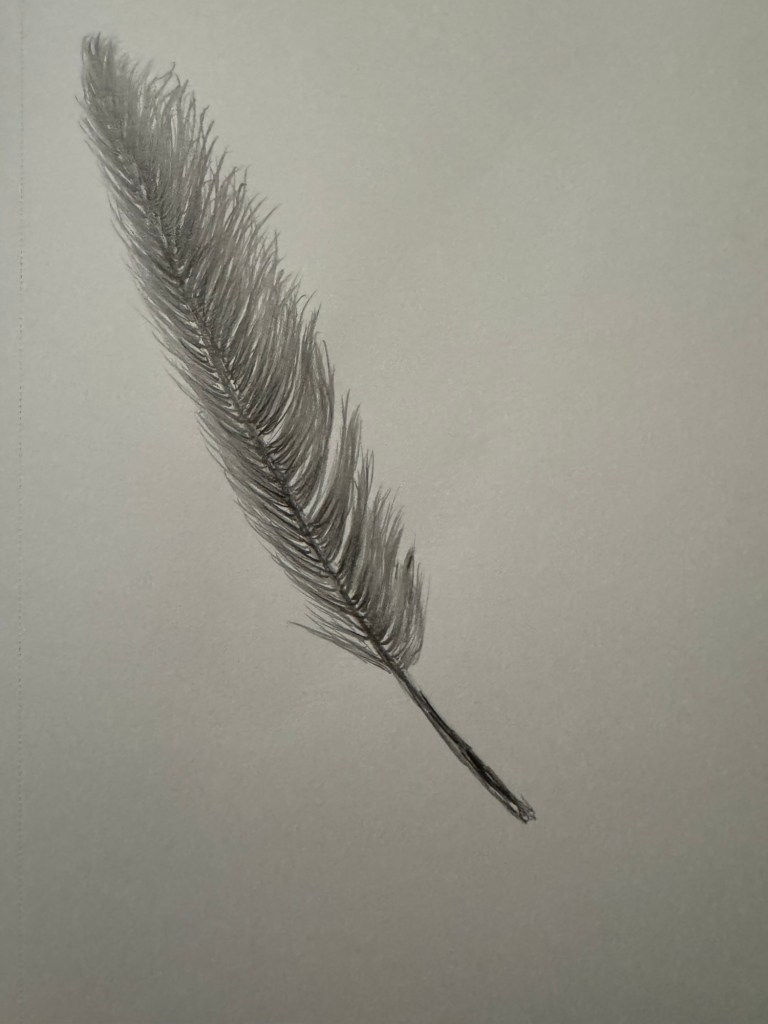
Two study drawings of crow feathers with my dominant hand:
–
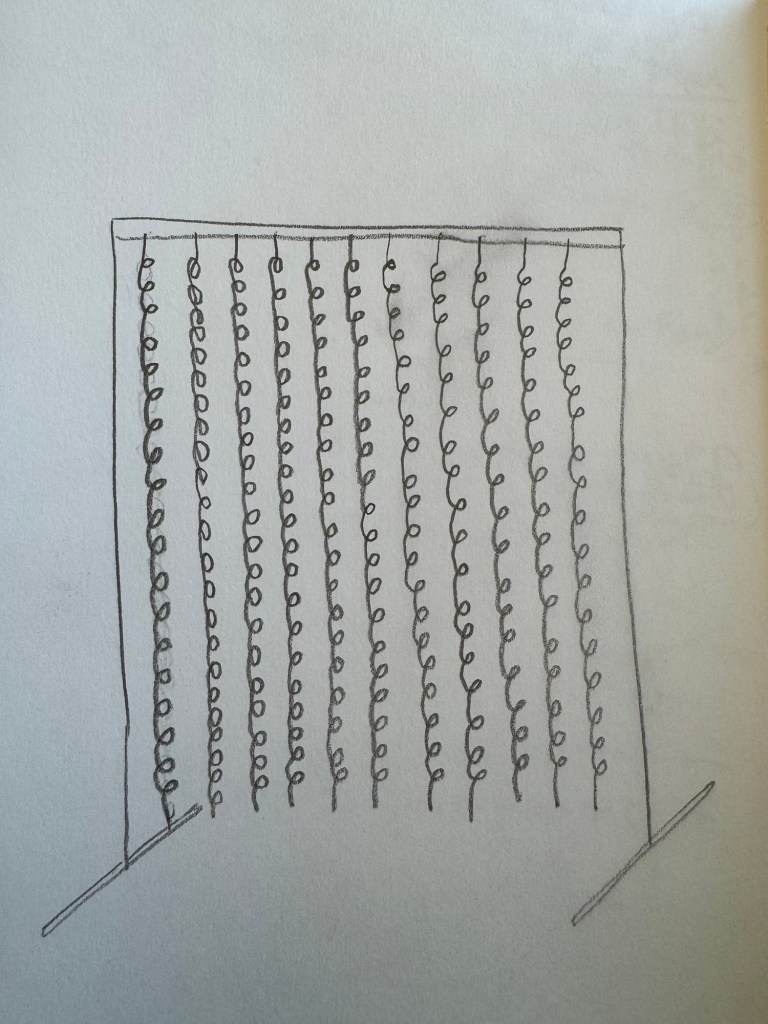
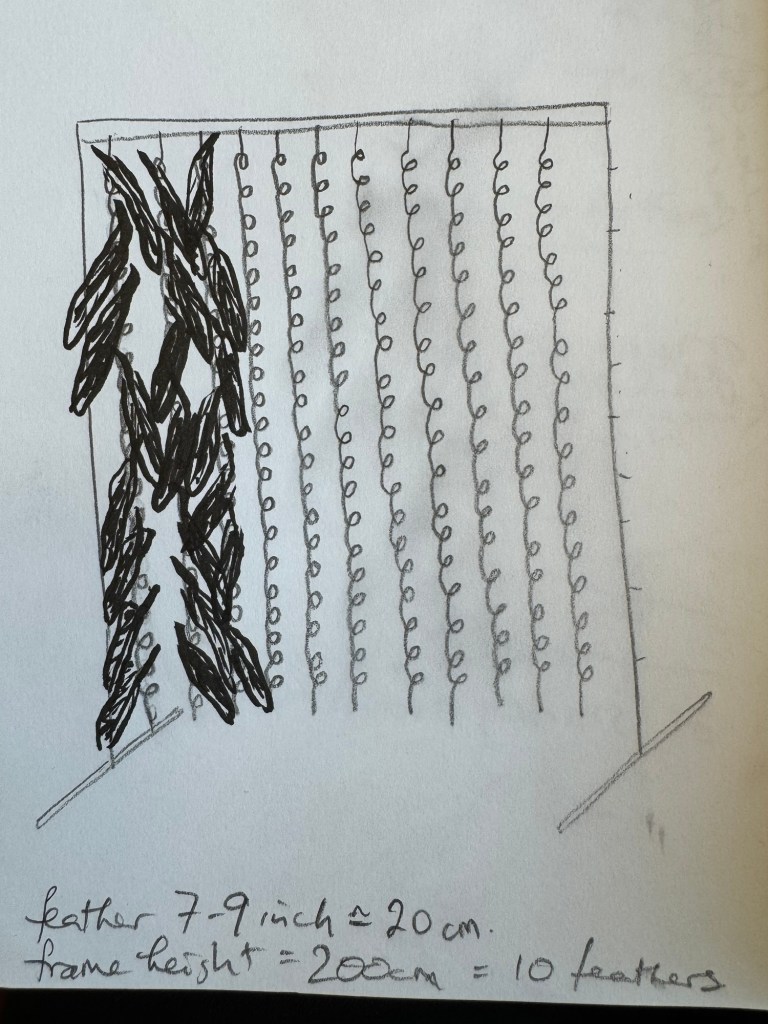
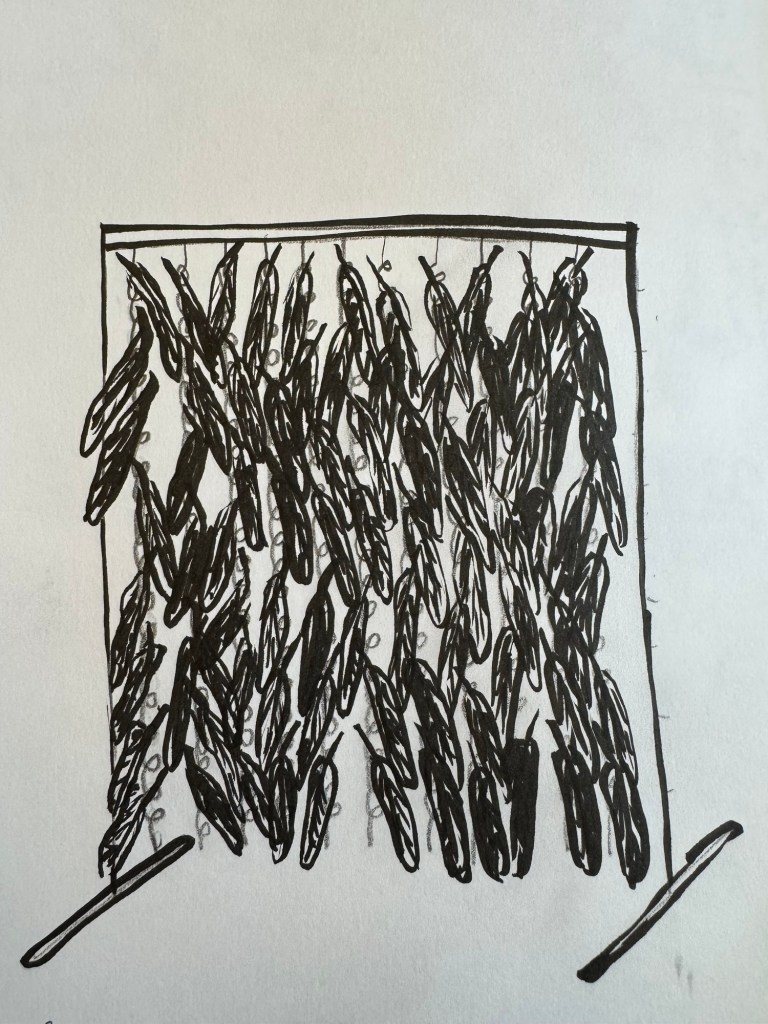
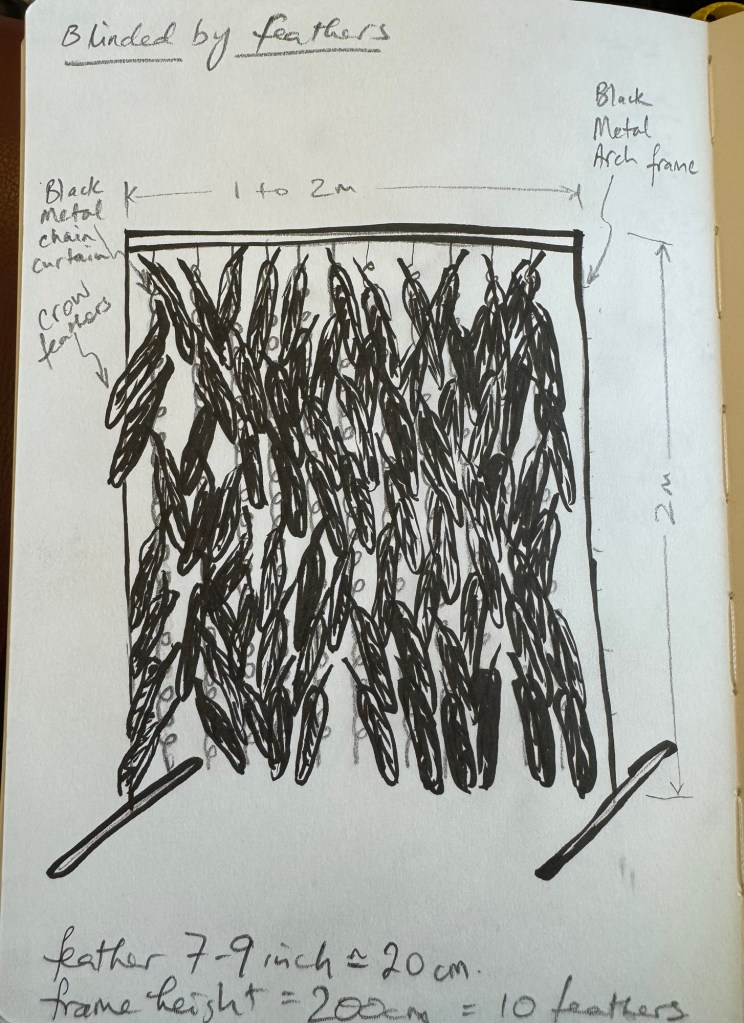
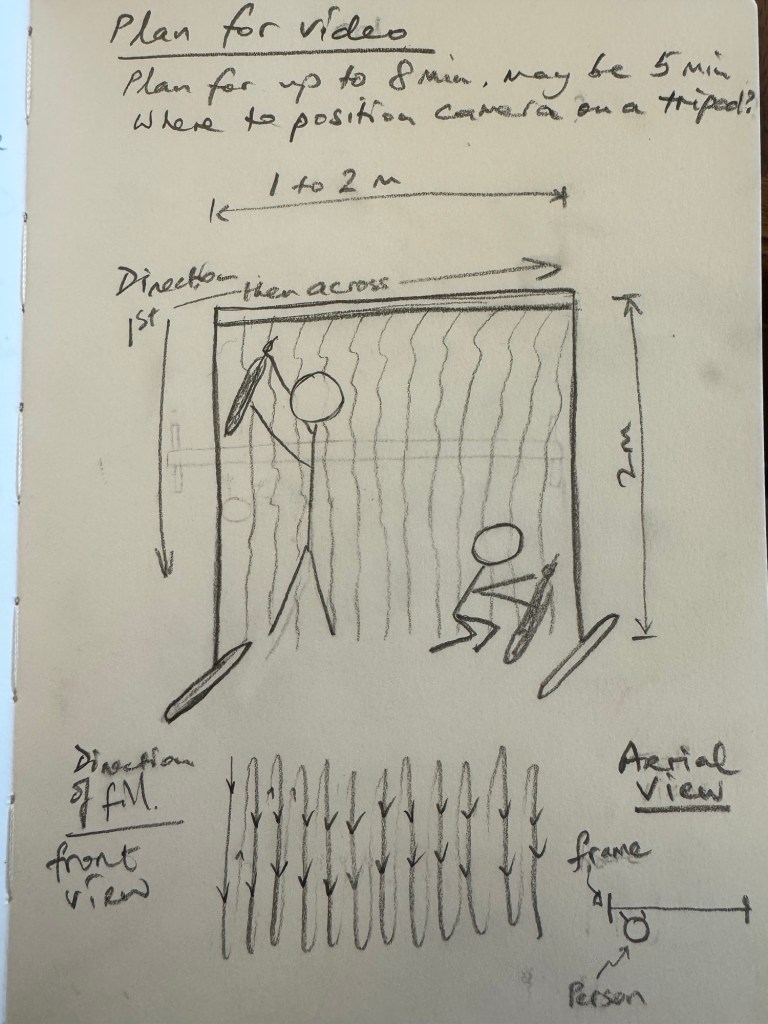
As I was drawing the feathers, I thought about making an installation with feathers. I thought of a crow feathers curtain reflecting my obscured view as a result of the grief I feel at the moment. Below are my sketches about this idea:
–
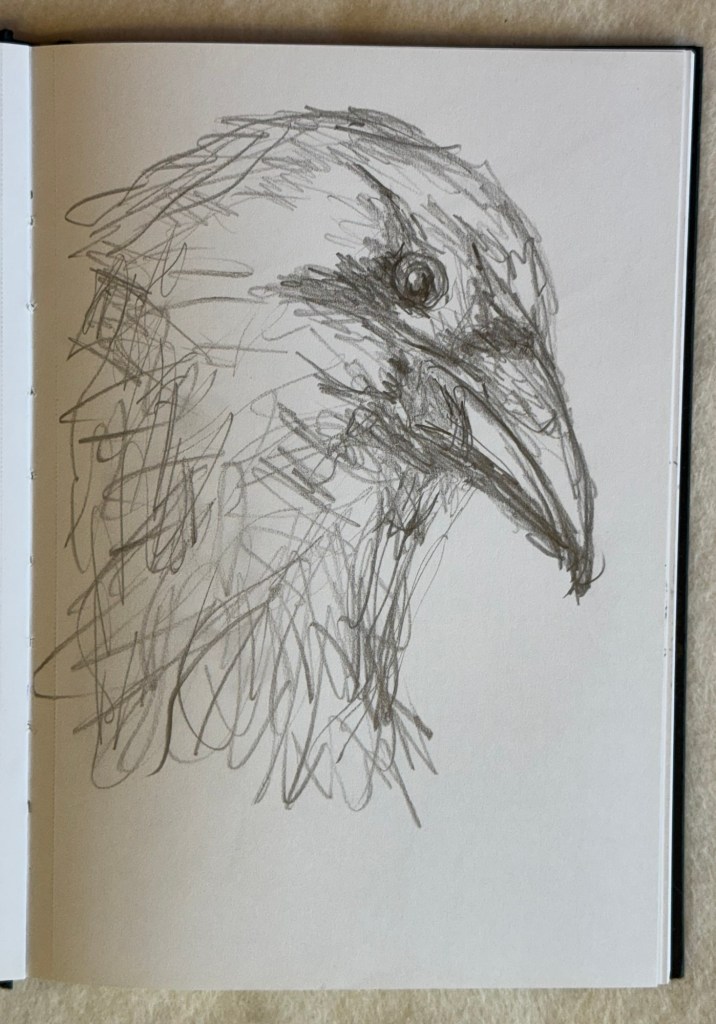
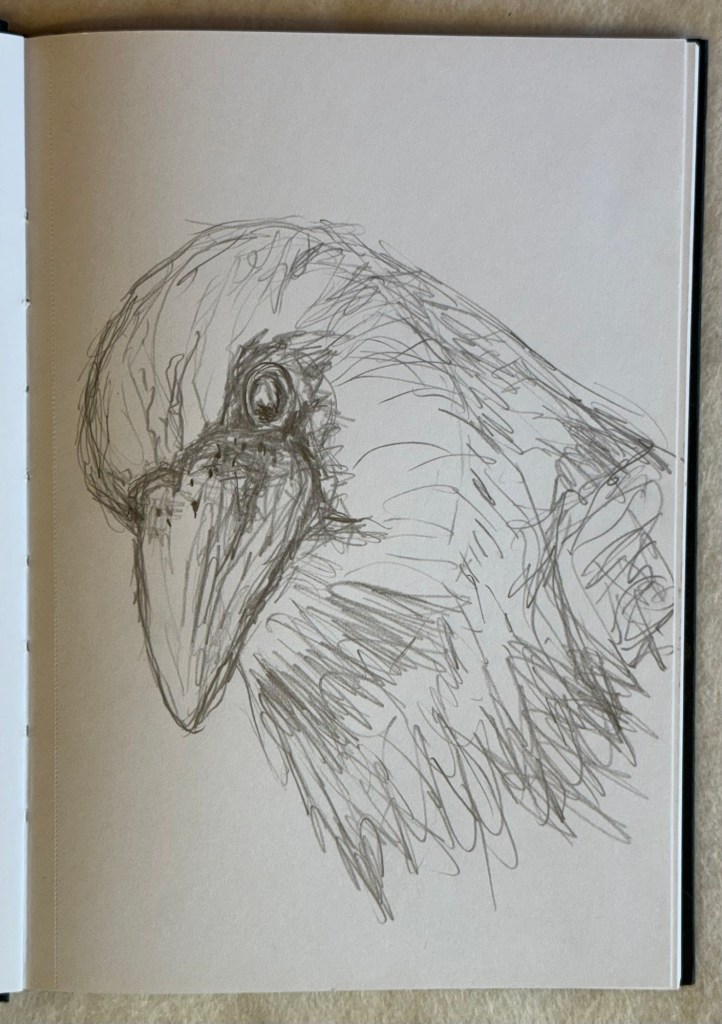
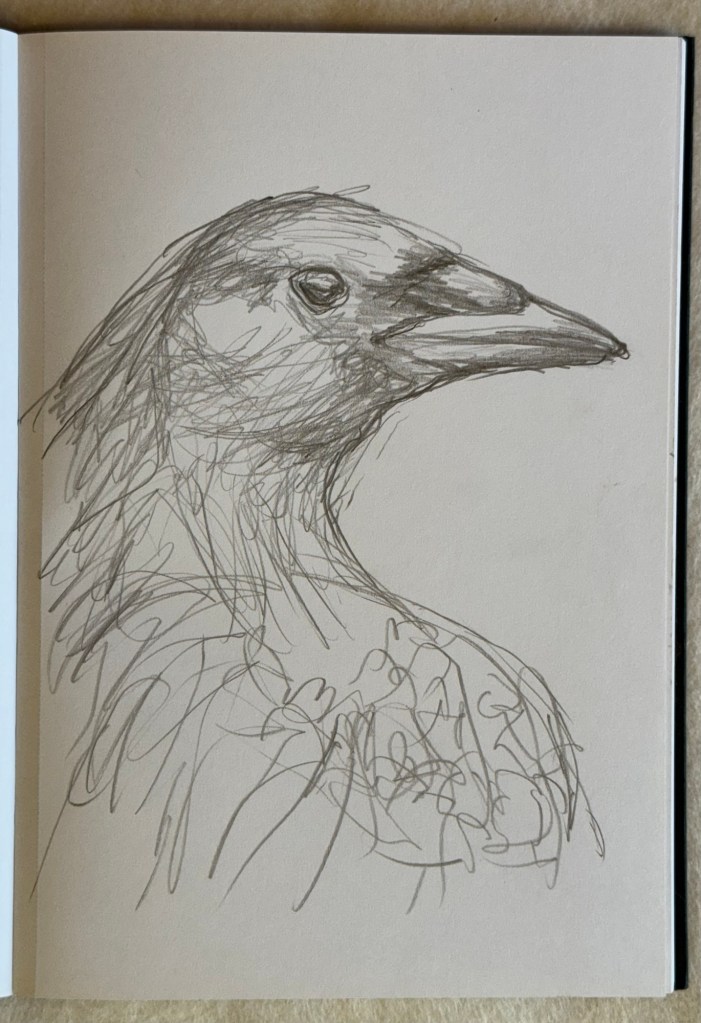
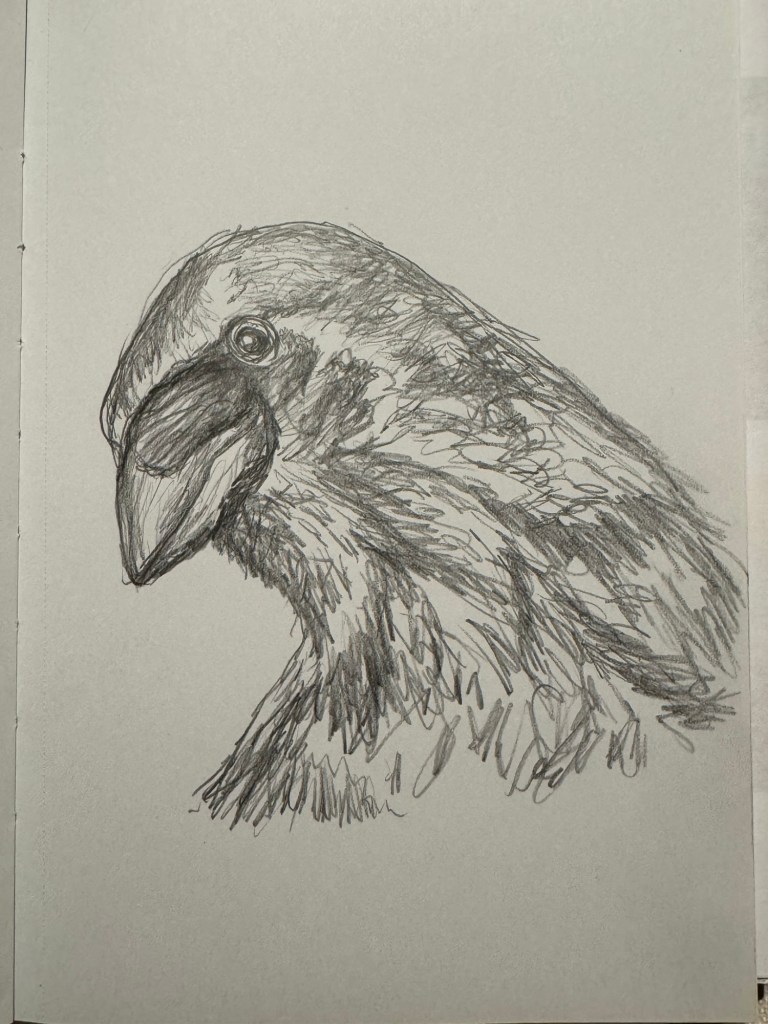
Then I returned to more crow drawings:
–
REFLECTIONS
I have enjoyed the drawings and indeed found the process comforting. I liked the outcome of the non-dominant hand drawings but was not so happy with the Chinese ink painting made with my dominant hand. The latter came out too neat and didn’t have the energy of the non-dominant hand drawings. This was an outcome that I expected and remain deeply frustrated about – I just cannot seem to achieve the same looseness with my dominant hand. I think I have to accept that and consider how I use both of my hands in different situations to create different effects. But I am concerned that as my non-dominant hand becomes dominant through practice then it would lose that ‘magic’. I know I am overthinking now and I shall deal with it as I go along.
I have thought a lot about the idea of the ‘grief curtain’ installation. I have researched the materials to be used, such as a chain curtain, a walk-through frame to hand the curtain and also where to source crow feathers. The latter in particular is an area that I am not familiar with at all. During the low residency week, one of my course mates suggested an artist for me to look at:
MccGwire is well known for her sculptures made of feathers. I will take more time to research and study her work.
LEARNING
This is the start of a set of new work as a result of rethinking my practice after my recent tutorial where we discussed how I was feeling about the drastic change in world order. I have chosen grief as a topic to reflect the sense of loss that I feel. I have chosen crows and feathers as a way to express the grief inspired by the book ‘Grief is the thing with feathers’. I started with drawings as a form of comfort as I ‘ease’ into this new exploration for my practice.
The drawings have confirmed that I prefer the expressive mark making done by my left hand and remain frustrated with the neatness of my right hand! Thinking about which hand to use for which part of my making adds complexity but it’s a new way of thinking and making that I think I will enjoy.
This is a start and I will continue to explore the topic. I am still interested in the ‘grief curtain’ concept and will keep it in my ‘ideas bank’ for now.
During my recent tutorial, we discussed how the world events are affecting how I felt about my art practice. The change in world order made me not want to do bright and colourful paintings like my recent Family Dinner paintings as they now seemed frivolous with the destructions going on. I also talked about my sense of helplessness as an artist. Therefore, I am in the stage of reconsidering my practice – what do I want it to be about? I have always positioned my art practice as about identity exploration, starting with my personal identity and I started (chronologically) from my childhood in Hong Kong (e.g. the Cheongsam and Family Dinners etc.).
REFLECTIONS
– The feeling of ‘Voicelessness’ as an artist – see separate blog. I think I have worked through that one for now. Briefly – I believe my choice of being an artist (vs my previous position as a business leader within a commercial organisation) gives me much more freedom but with an unknown and unpredictable audience as there is no defined platform for communication. So having reflected on that, I do really value the freedom of voice that I have now. I just need to work out what to do with it.
– How to deal with the current feelings of despair for the change in world order? I can’t ignore it but I don’t want to directly confront it in my art practice because I would risk ranting and being too in-your-face rather than communicating and expressing sensitively and intelligently.
– So I thought about satire and actually went through the process of creating character metaphors that I would use ( one is a turkey eating French fries and the other a loaf of cheap white bread) but I decided against satire because it would require me to closely study those characters which I don’t want to do as I need to preserve my sanity.
After much thinking and reflecting, I decided to focus on how I feel instead which is anger, heartbreak and grief. Grief for the loss of a world order with values that I understood. It was not perfect at all but there was at least an established sense of right and wrong (usually according to the law); where helping the needed was applauded. I grieve for the loss of all that and more. I grieve for all the vulnerable people who will suffer even more or lose their lives and I grieve for those who have made it their mission to help but are now suddenly left helpless and scrambling for themselves. I am not against change and efficiently, but the destructive way of execution has been brutal – unnecessarily.
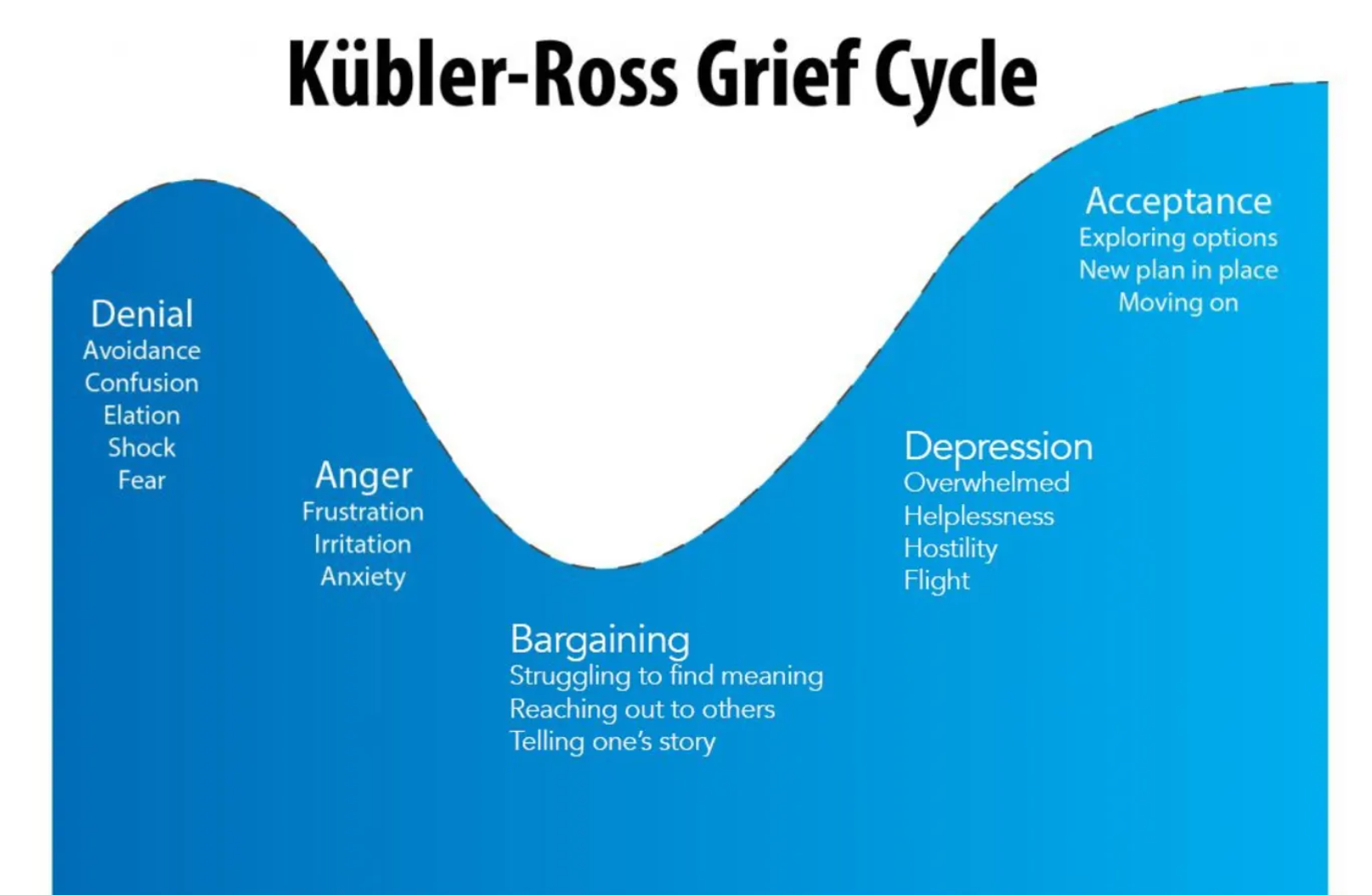
I am likening my feelings and others that I know who are going through the ‘world order change process’ as going through the Kubler-Ross grief cycle.
I find myself oscillating around Anger, Bargaining and Depression depending on what new (and shocking) information comes to light on a particular day. But unlike grieving for the loss of a loved one, I feel it’s not acceptable to reach acceptance which is a problem because I am therefore stuck in the perpetual grief cycle until ‘the show is over’.
So I decided to use my art practice to express the grief that I am feeling. I know (and hope) that it is just a temporary state because I believe I am a naturally optimistic person and I want to return to feeling hopeful about the future of humankind.
I remember the book ‘Grief is the thing with feathers’ by Max Porter where a father and two young boys grieved for the death of their lost wife/mother. Grief was portrayed as a crow. The short novel was written creatively in a way that helped me to picture the crow vividly. Inspired by the novel, I want to do something with crows and feathers in my art practice to express the grief I’m feeling right now for the world.
Other reasons for choosing crows:
– They are intelligent (compared to other bird species and mammals) but ‘voiceless’ as they can only caw (according to the human ears). I feel that is a good metaphor for how I feel as a ‘voiceless’ artist and perhaps how many artists feel in the world right now.
– Crow feathers are interesting in colour and texture. I want to explore further in my art making.
– I have always been fascinated by crows and they were once the subject of a personal project in my Chinese painting practice. So somehow I feel a connection with them.
LEARNING
So what does it all mean for my art practice?
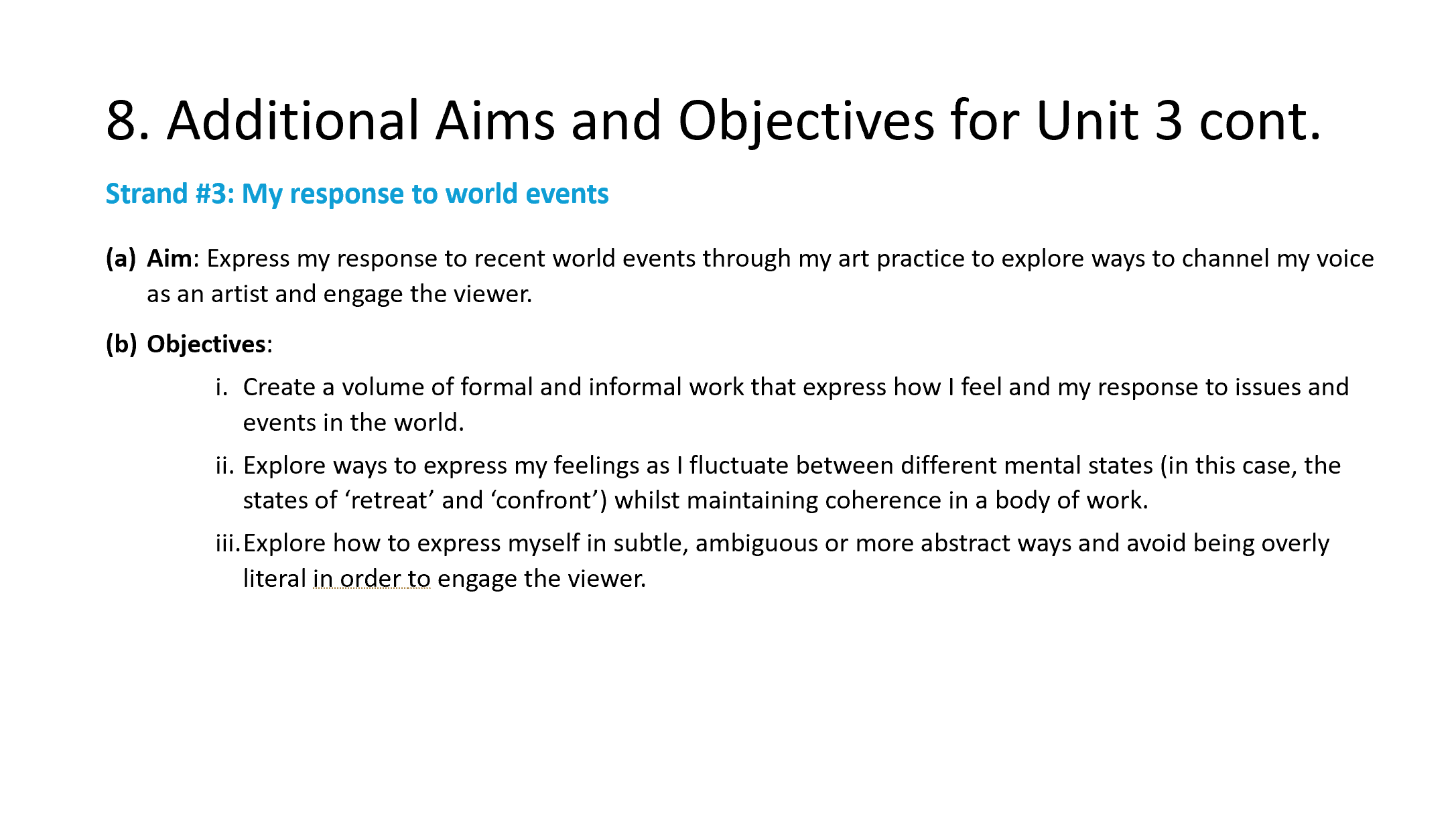
It would be useful to think about ‘the fluid circle’ that was discussed during my tutorial – I go in and out of a fluid circle depending on how able I feel in responding to the world events.
– Inside the circle is retreat mode – coming inside the circle to hide from the world and have time-out. When I’m in that mode, I want to work on things that are simpler or more familiar for comfort. I can do drawings which I find comforting, or explore photography and the new objectivity approach to give relief through working with facts and an established process; letting the process take control momentarily.
– Outside the circle is confront mode – where reality is faced and dealt with. It could be energising but likely to be draining. The most useful and manageable thing to work on there right now is dealing with that feeling of grief and work out how to channel that into my work. Therefore I have been thinking about doing art with crows and feathers.
Is this a deviation from my main practice? I have been thinking about this a lot. If my practice is about identity, then I believe reflecting on one’s state of mind is a key part of that identity exploration. So having done much thinking about this, I feel comfortable that what I am doing here remains part of my soul searching – just instead of exploring the past (my heritage), I am exploring the ‘right here’ and ‘right now’ for me.
What about the Cheongsam dresses? I have had such positive feedback from my MA course mates during the low residency week that I feel I should do some more with the dresses especially for the degree show. Perhaps make a dress with crow feathers? Many Cheongsam dresses are decorated with dragons and phoenix, so perhaps a crow instead?
NEXT STEPS
– Just make art depending on how I feel in the moment. Do something with crows and feathers to release and express the grief as well as create time to think about the future.
– Keep thinking about what else I can do with feathers, perhaps Cheongsam dresses and possible installations.
– Give space and time for the thinking.
ADDITIONAL NOTES – CONSIDERATIONS FOR MY STUDY STATEMENT
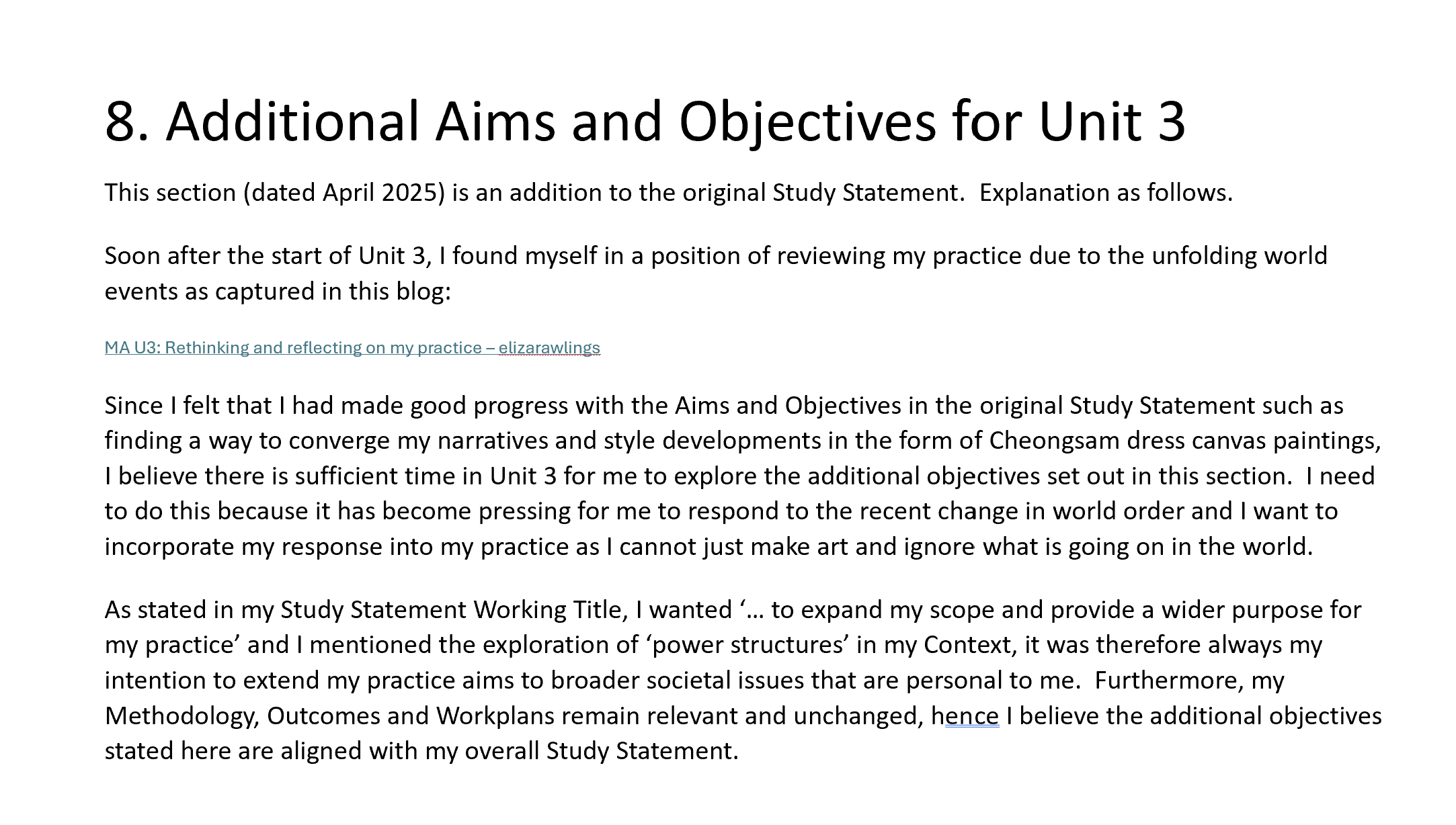
Since I am rethinking my practice, I revisited my Study Statement to see how my new exploration proposed here would impact my planned study. I feel that my Methodology and the Outcomes would remain unchanged. My aims and objectives were strongly focused on transculturalism and the work proposed here (exploring my currently feeling of grief and loss of world order) would not fall into that topic. However, within my Study Statement, my main goal was to explore my identity and I believe exploring my current state of mind falls well within that – it is all part of me and my lived experience. In my Statement, I also referred to wanting to expand my practice to explore wider societal issues including feminism and power structures – I believe my response to the current global political situations falls within this remit. To incorporate the new exploration into my study, I should consider adding some new ‘aims and objectives’ to ensure I remain on track with my study goals.
After reflecting on the overall work plan, I believe it remains valid and on track. One of the key aims of my study was to find convergence in my practice with the parallel development of my narrative and style that I started the course with. I believe I have achieved that (or at least have found a way to achieve it) in my Cheongsam series of work and I had written in my blog at the time stating that I was delighted to have found a way to converge the two strands through the Cheongsam dress canvases. Therefore I believe there is room in Unit 3 to accommodate an additional set of aims and objectives that have now become pressing for me.
NEXT STEPS
Consider additional aims and objectives for the newly proposed exploration.
COMPLETED ADDITIONAL OBJECTIVES
The following two pages have been added to my Study Statement:
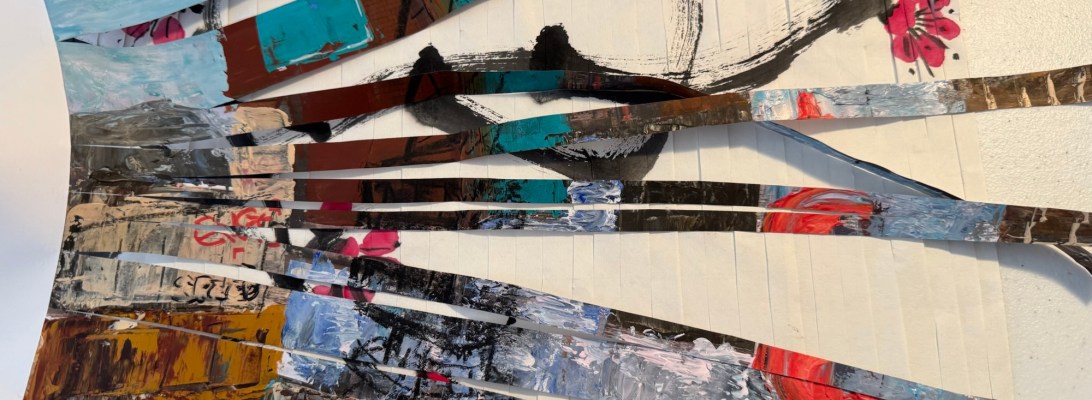
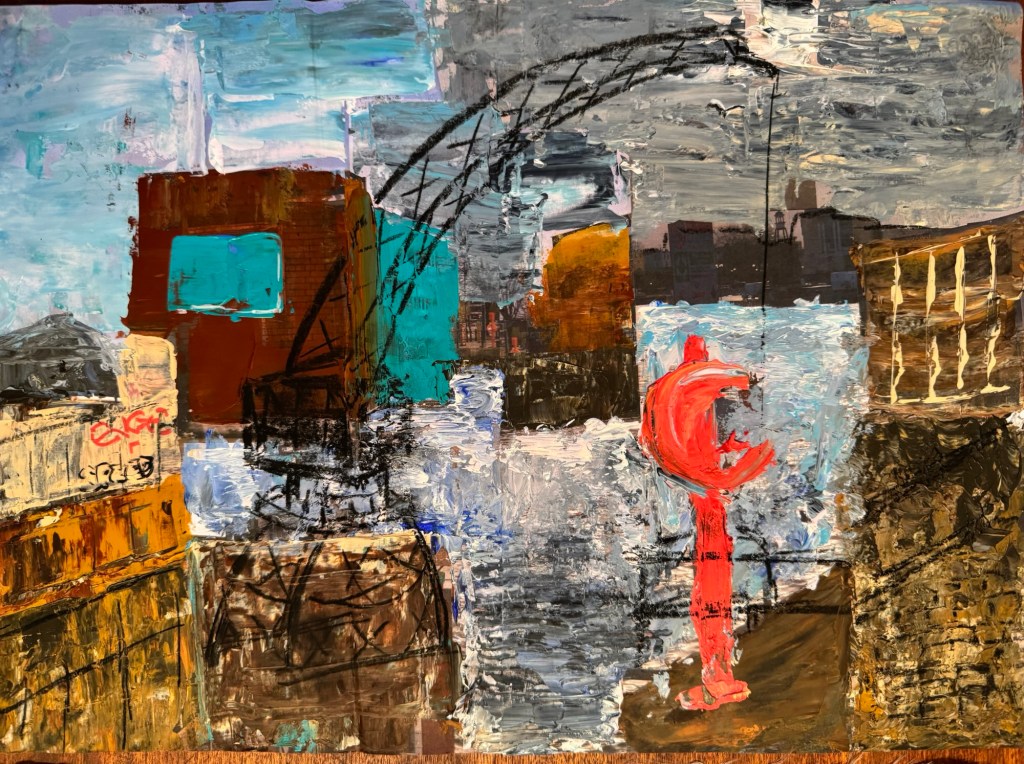
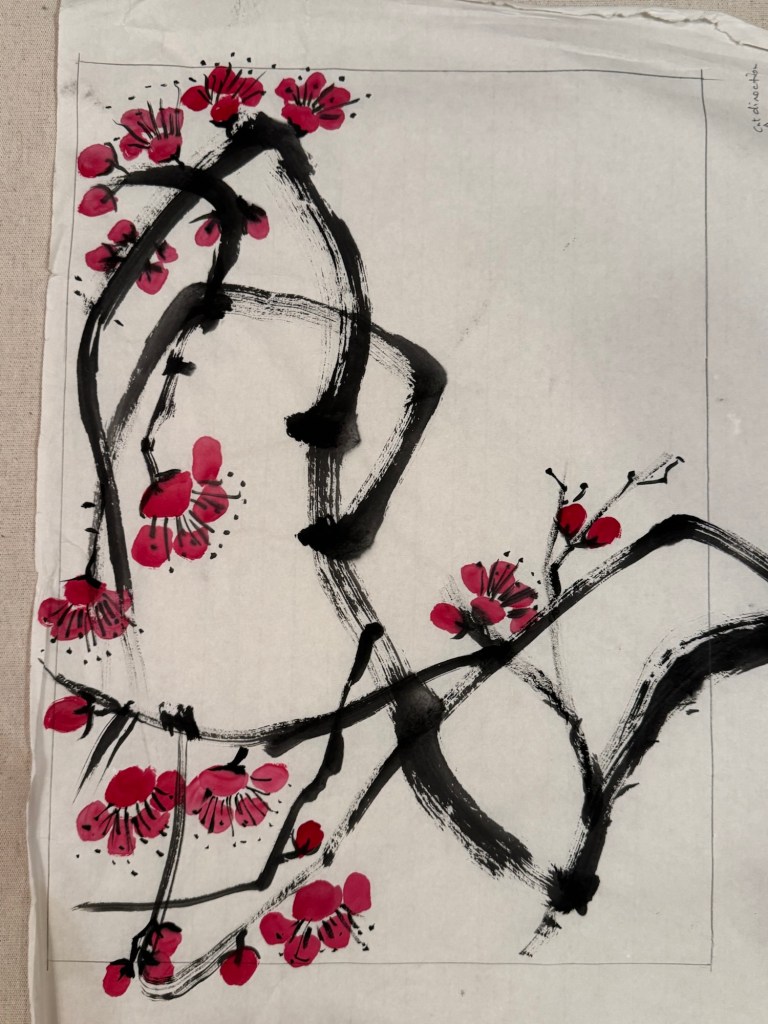
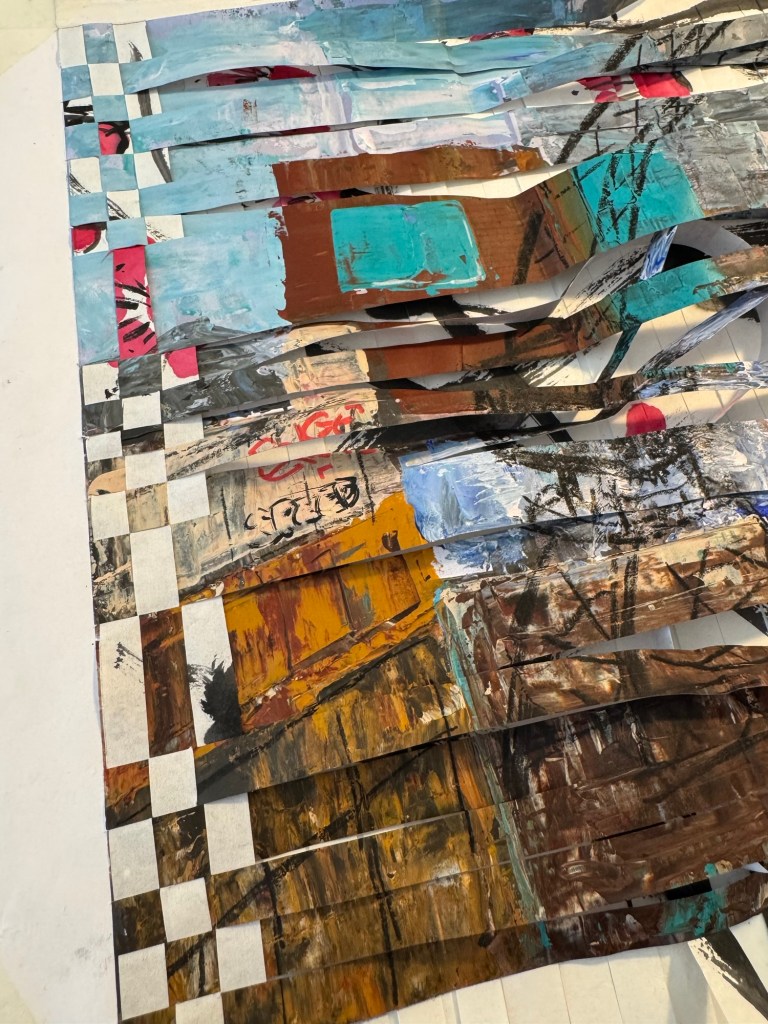
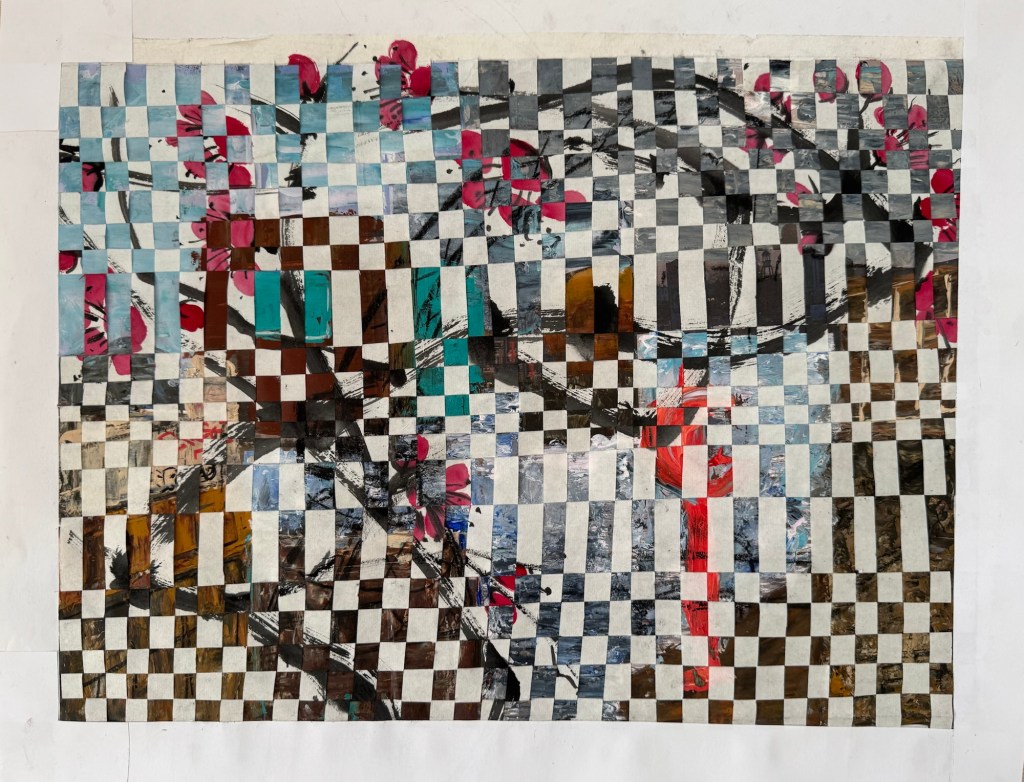
After the first experiment on weaving narratives (see link below), I decided to do a second experiment, this time with two paintings that were more representative of the different cultural narratives that I want to weave together and also very different style of work just to see what happens. Also, an action from the last experiment was to choose smaller paintings to speed up the experiment.
Plum blossoms, Chinese brush painting – ink on rice paper, cut to size A3.
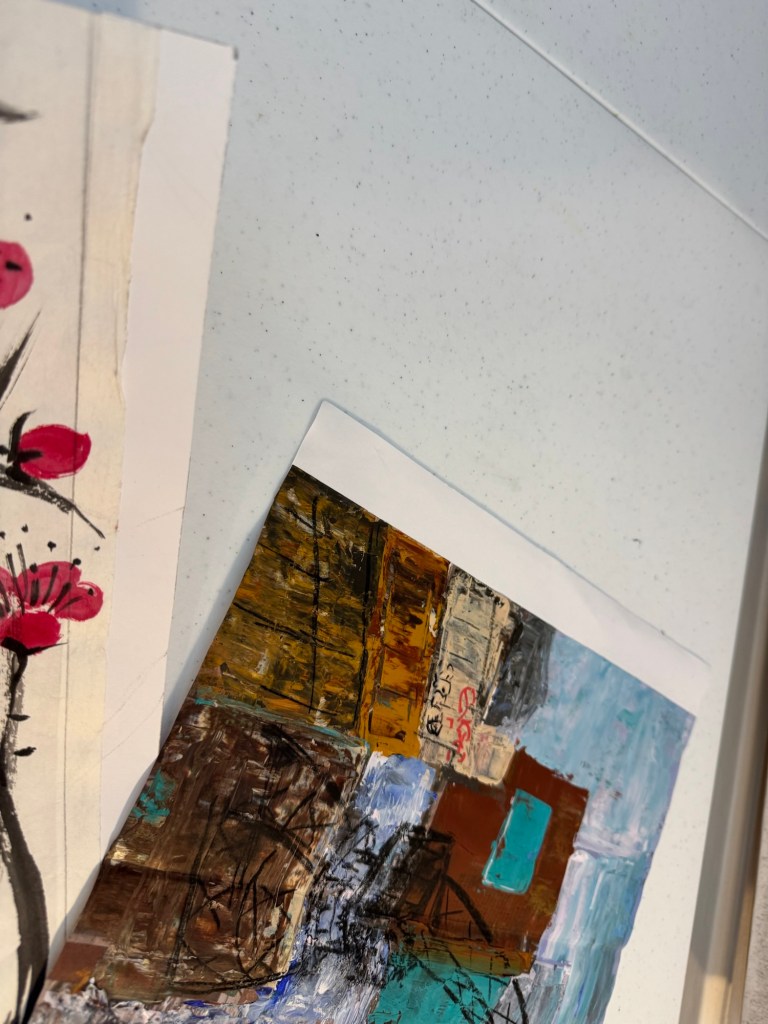
Paper edges were added to both paintings so that the cuts could be made up to the edge of the image whilst keeping all the strips together at one end in a neat order. This makes the weaving process easier.
Video of cutting the acrylic painting which seemed to have attracted more views on my social media than other work. Also, four times more non-followers seemed to have engaged with this clip than usual.
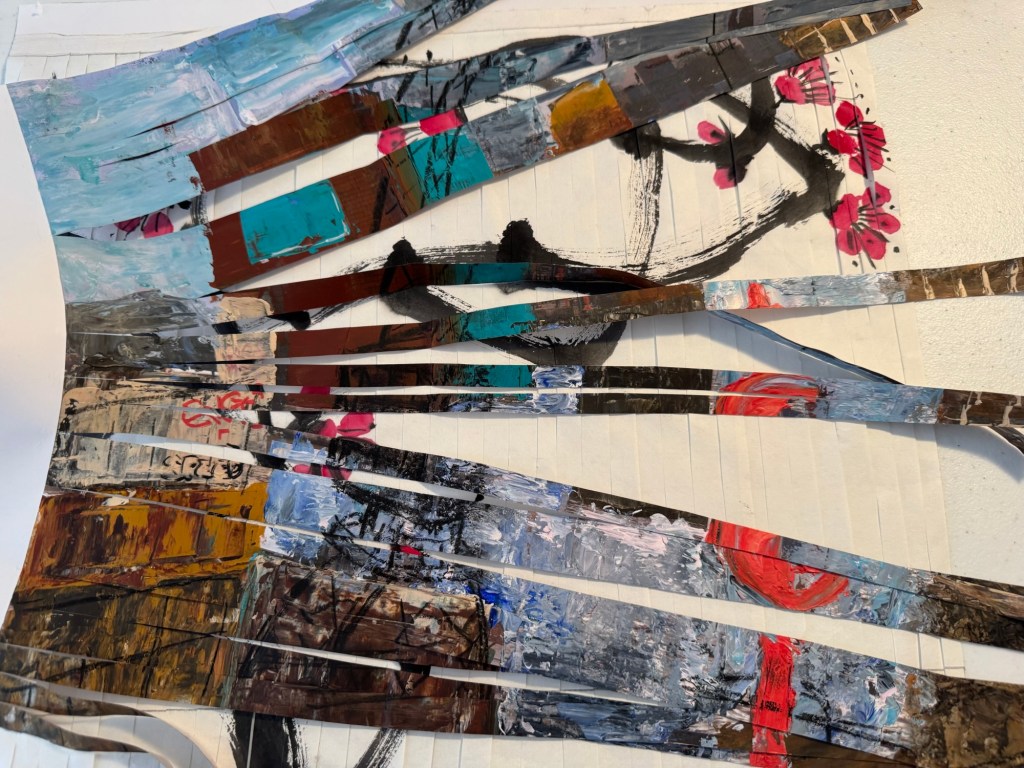
I enjoyed the cutting process very much. It felt brutal but energising, liberating and renewing. The weaving process was enjoyable for me as it involved crafting with my hands. The delicate manoeuvring of strips of my painting during the weaving felt very different to the cutting process. It was strange to feel that I had to be very careful during the weaving when I have just taken a big pair of scissors to the work minutes earlier. The juxtaposition of the different feelings was interesting.
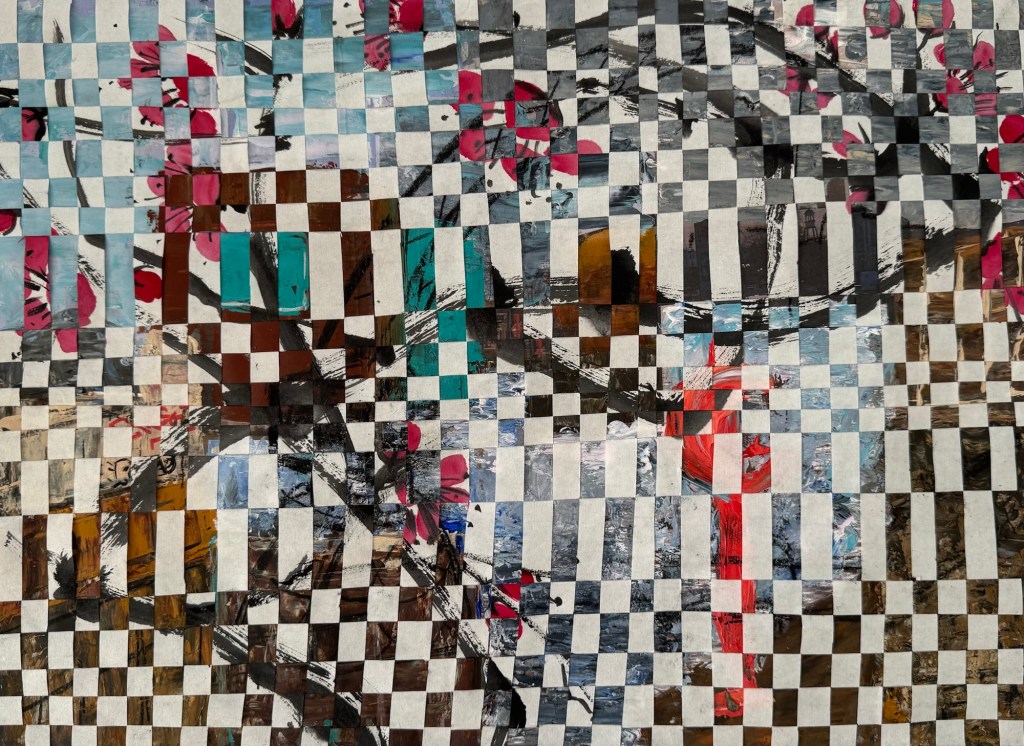
I am not too excited about the outcome though. I don’t think the woven painting created the interesting or intriguing effect that I had hoped for. The negative space from the Chinese painting introduced a lot of white into the image and obscured much of the harbour-scape rendering it not recognisable but without introducing intrigue.
Reflecting on this and the previous woven painting experiment, I am not sure if I want to pursue the weaving part much further. To really make something of it, I would need to have a good think about how the two images need to come together, how the negative spaces and colour palettes would combine to create a coherent image – even if it’s not coherent aesthetically, it needs to create intrigue or tension. As it is, I feel the images don’t provide enough to engage me, let alone a viewer. However, I feel there is good potential with the cutting process. It was an exciting process that I would like to explore further.
After cutting the paintings into strips, I played with waving or jangling the strips and they danced on the table. That was fun and I liked the images from the movements. However, once they were woven together, the images became ‘flat’ and ‘too neat’. Perhaps I can explore the dancing of the strips and do something with either just one painting or multiple paintings and then let the strips just fall down together and see what happens. Perhaps I can make videos of them dancing and collapsing together. As a metaphor, from my experience as a transcultural person, bringing together two different cultures is rarely neat and tidy, it requires improvisation and often people and situations are just ‘thrown together’ and one never knows what might happen. So perhaps the neat weaving was not such an appropriate metaphor as it seems too restrictive in hindsight.
LEARNING
It has been a good learning experience to weave together paintings. I learnt that I enjoyed the cutting up process, I enjoyed the weaving process but I am not taken by the outcome. The outcome appeared too neat and restrictive for the subject. Therefore, I don’t think I will do anymore ‘neat’ weaving of cut up paintings. Unless I am stuck for something to do in between projects and want to keep busy because it is a good way of keeping busy to enable some thinking time while making. I find the crafting processes are very enabling in a way to create thinking space and time.
What I will continue to explore is the cutting up process because I find that energising and renewing. I want to explore what else I could do with strips of painting, just play and explore and let them dance. I could do some video of their movements and create images from that. E.g. I can pile several paintings together and see how they fall together, or let each strip free-fall individually from height and film their movements in slow motion. It would be good to just to explore without any prior agenda. That can be liberating. I can try a filming project with an already cut up painting (to save cutting up another painting for the moment), I can un-weave one of the woven paintings then letting the strips free-fall, like untangling narratives and then setting them free. I can think about a narration to accompany the video or pair with music.
Think about using the green satin bamboo painting because the soft and light materials could float nicely onto the ground. Think about what background – white cube or outdoors? Perhaps an industrial background from the old Bristol docks? The delicate satin materials could be a good juxtaposition with the old heavy duty cranes by the harbour. The strips could fall inside the intricate metal structure of the cranes.
NEXT STEPS
Pause the ‘neat’ weaving of paintings for now, unless I want to use the process to enable thinking time.
Untangle a woven painting, set the strips (narratives) free in a free-falling way. Film their falling and piling up on the ground, if possible, do outdoors e.g. by the old Bristol dock.
Continue to explore cutting of paintings and see what that could add to my practice.



 elizarawlings