I have been learning Chinese painting for three years in parallel to my other courses such as the MA Fine Art programme at Central Saint Martins. Collectively, they help me to develop my transcultural art practice.
My latest learning was about the use of seals. Here is some information from the Hong Kong Art Museum about the use of seals on painting and calligraphy:
The seal is applied at the end of the painting process. Since the seal paste is usually a permanent colour of Vermillion (cinnabar red), it cannot be erased hence its placement has to be considered and applied carefully. Otherwise, it could ruin the painting composition.
For Chinese artists, they can use different types of seals. They typically have one or more name-seals and other optional mood-seals. My late mother left behind several of her seals that I have been studying and using for my paintings. I asked my Chinese painting tutor whether it was appropriate for me to use another artist’s (i.e. my mother’s) seals. My tutor said, ‘she was your mum, I don’t think she would mind. Anyway, who is going to check?’ Since my mother was an established painter, her seals were beautifully carved from quality stones. I have enjoyed discovering them and playing with them.
Since my last lesson, I have been practicing signing my name in Chinese calligraphy and then putting two seals on paintings. These experiments have been challenging in a fun way.
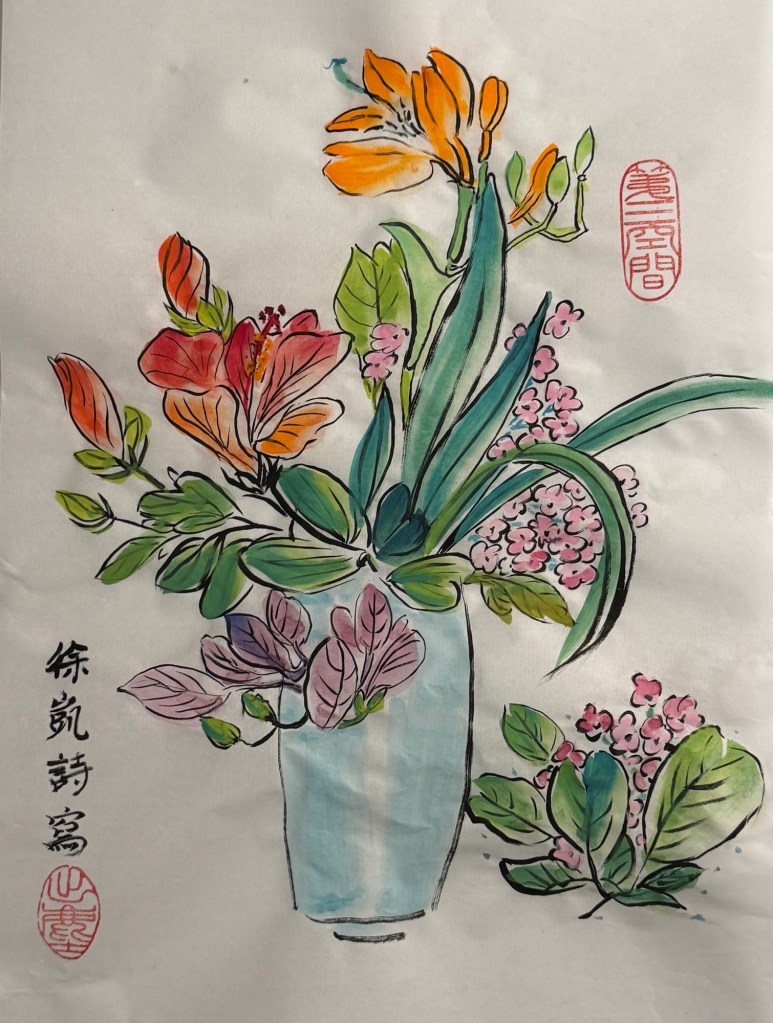
1. A vase of flowers in Chinese ink on Xuan (rice) paper. The calligraphy says it is by me (my full name with surname) and there are two seals:
– The seal at the bottom left corner belonged to my mother. It is a mood-seal with the meaning of ‘transcendence’ – a spiritual state of moving beyond physical needs and realities.
– The seal at the top right is my new mood seal that I ordered from Hong Kong through my tutor. It means ‘third space’ and is a fundamental element of my art practice – exploring the ‘third space’ which describes my existence. Third space here is as described by Homi K. Bhabha in his book ‘The Location of Culture’.
–
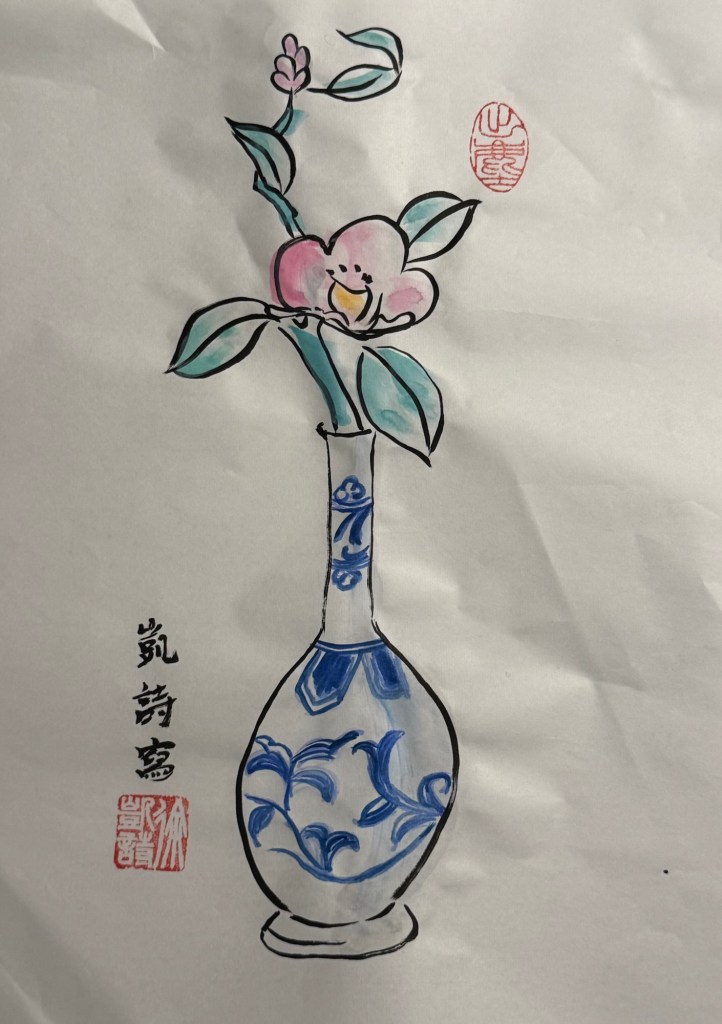
2. A simple painting of a flower branch in a small vase. The calligraphy says it is by me (name only, no surname) with two seals:
– bottom left: my full name seal with surname.
– Top right: ‘Transcendence’.
–
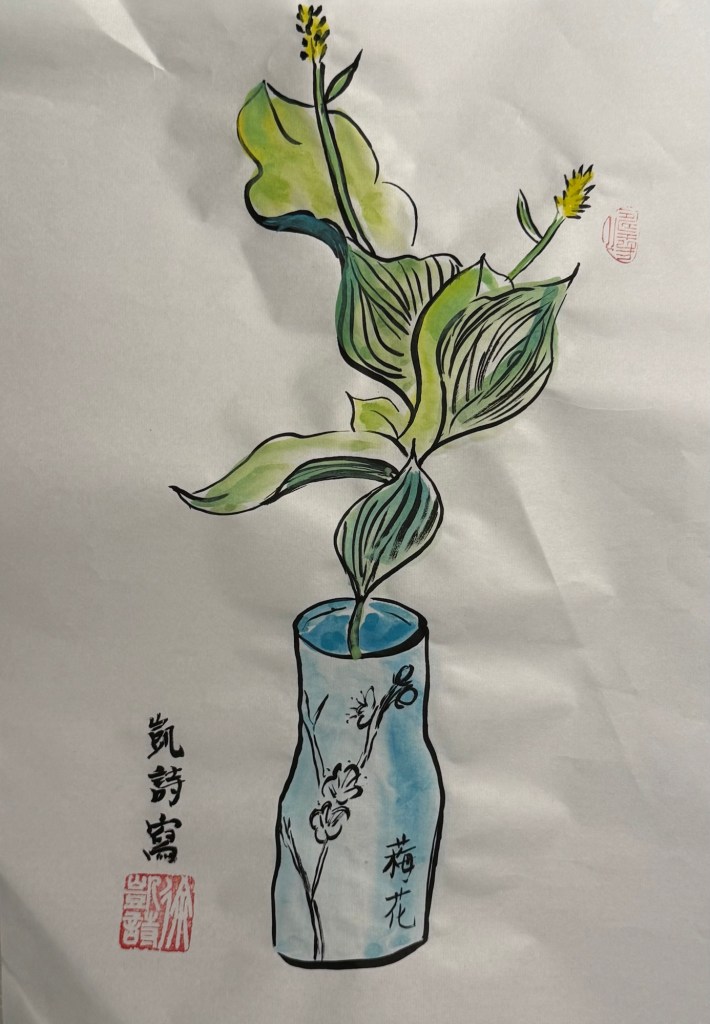
3. A small vase with a branch and leaves. My name in calligraphy with two seals:
– Bottom left: my full name.
– Top right: one my of mother’s seals but I do no know what it says! It is of an ancient script and beyond my knowledge. I will keep researching to see if I can find out. I have subsequently found out by seeing on one my mother’s paintings that I have put it upside down!
–
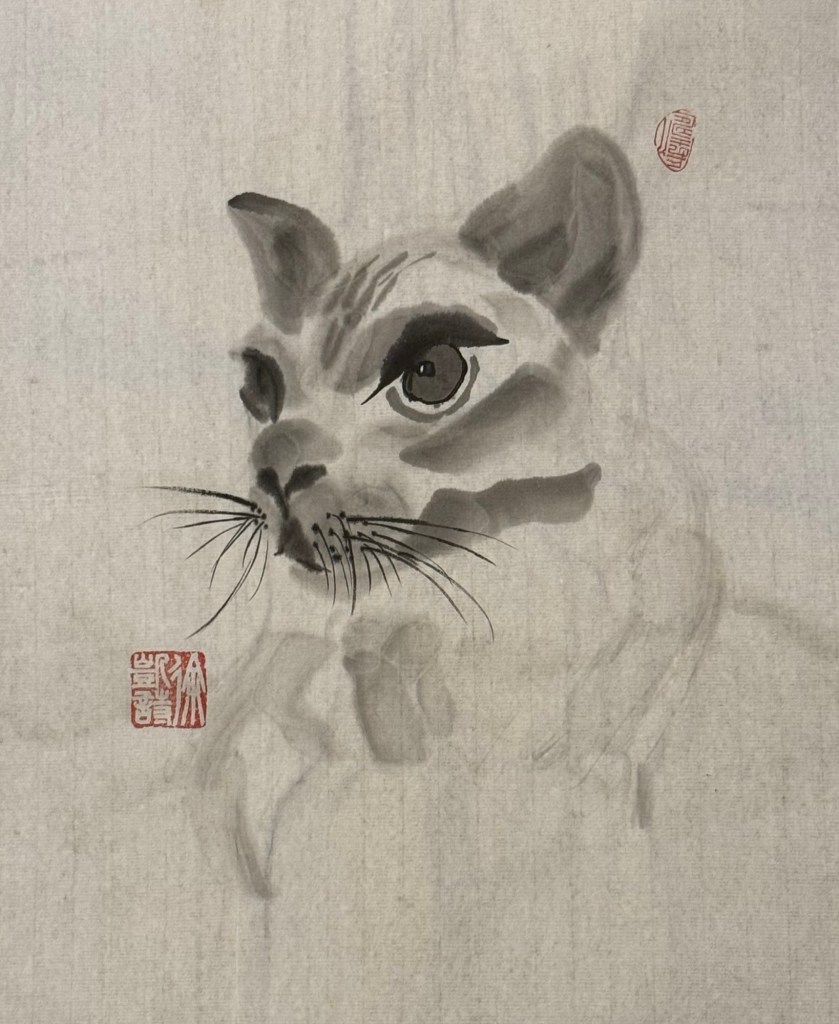
4. My cat Tom who is sadly not with us anymore. No calligraphy with two seals:
– My full name and the upside down seal!
–
LEARNING
Using the seal properly is an art form that requires skills which comes with experience. The placement of the seal as well as how it is applied are both important. Too much paste would ‘flood’ the carving giving a red mess, too little paste would make part of the seal invisible, i.e. an incomplete image. So it needs to be just right.
The placement is even more challenging. The use of negative space is critical in Chinese painting – my Chinese painting tutor said the extensive use of negative space was a key differentiation between Chinese and ‘Western’ art. Placing the seal after the painting is completed means the seal interrupts the negative space hence it needs to be done in a way that maintains the harmony of the composition whilst enhancing the composition. While writing this I realise it is impossible to articulate how to do it! What I have learnt from the above paintings are that if I am using two seals then place them diagonally on the composition and use one large and one smaller seal, i.e. do not use two seals of the same size. The non-uniformity makes the composition more interesting.
My tutor said the only way to learn was to keep doing it, keep practicing, then eventually it would come naturally. I have to take her words for it as I don’t have any other options! I used to only put seals on paintings that I was happy with, but my tutor said I should do it on every painting in order to practice. So that is what I will do!
NEXT STEPS:
– Keep practicing using seals on all my Chinese paintings.
– Pay more attention to how other Chinese artists use their seals – study my mother’s paintings and my painting books more carefully.
 elizarawlings