I have been learning Chinese painting for three years in parallel to my other courses such as the MA Fine Art programme at Central Saint Martins. Collectively, they help me to develop my transcultural art practice.
My latest learning was about the use of seals. Here is some information from the Hong Kong Art Museum about the use of seals on painting and calligraphy:
The seal is applied at the end of the painting process. Since the seal paste is usually a permanent colour of Vermillion (cinnabar red), it cannot be erased hence its placement has to be considered and applied carefully. Otherwise, it could ruin the painting composition.
For Chinese artists, they can use different types of seals. They typically have one or more name-seals and other optional mood-seals. My late mother left behind several of her seals that I have been studying and using for my paintings. I asked my Chinese painting tutor whether it was appropriate for me to use another artist’s (i.e. my mother’s) seals. My tutor said, ‘she was your mum, I don’t think she would mind. Anyway, who is going to check?’ Since my mother was an established painter, her seals were beautifully carved from quality stones. I have enjoyed discovering them and playing with them.
Since my last lesson, I have been practicing signing my name in Chinese calligraphy and then putting two seals on paintings. These experiments have been challenging in a fun way.
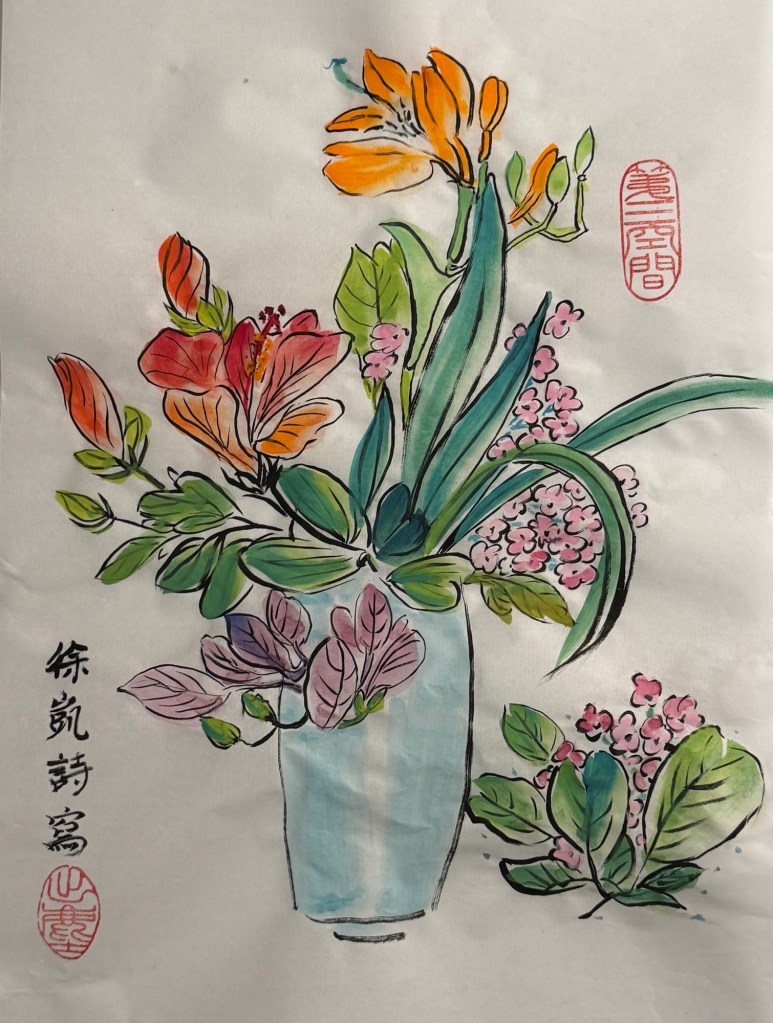
1. A vase of flowers in Chinese ink on Xuan (rice) paper. The calligraphy says it is by me (my full name with surname) and there are two seals:
– The seal at the bottom left corner belonged to my mother. It is a mood-seal with the meaning of ‘transcendence’ – a spiritual state of moving beyond physical needs and realities.
– The seal at the top right is my new mood seal that I ordered from Hong Kong through my tutor. It means ‘third space’ and is a fundamental element of my art practice – exploring the ‘third space’ which describes my existence. Third space here is as described by Homi K. Bhabha in his book ‘The Location of Culture’.
–
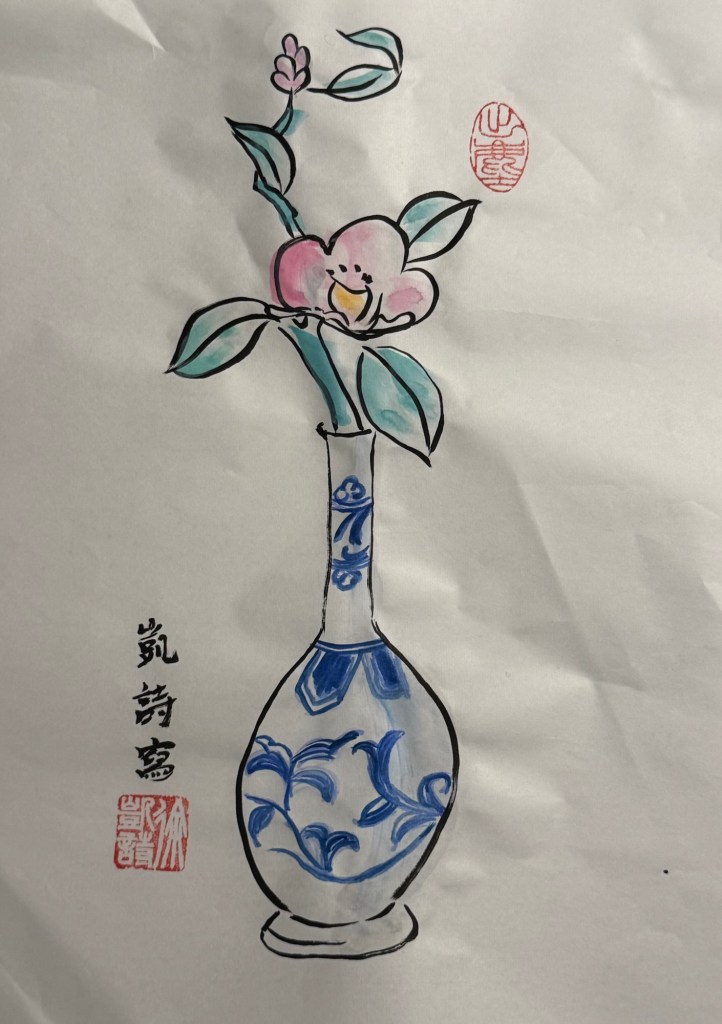
2. A simple painting of a flower branch in a small vase. The calligraphy says it is by me (name only, no surname) with two seals:
– bottom left: my full name seal with surname.
– Top right: ‘Transcendence’.
–
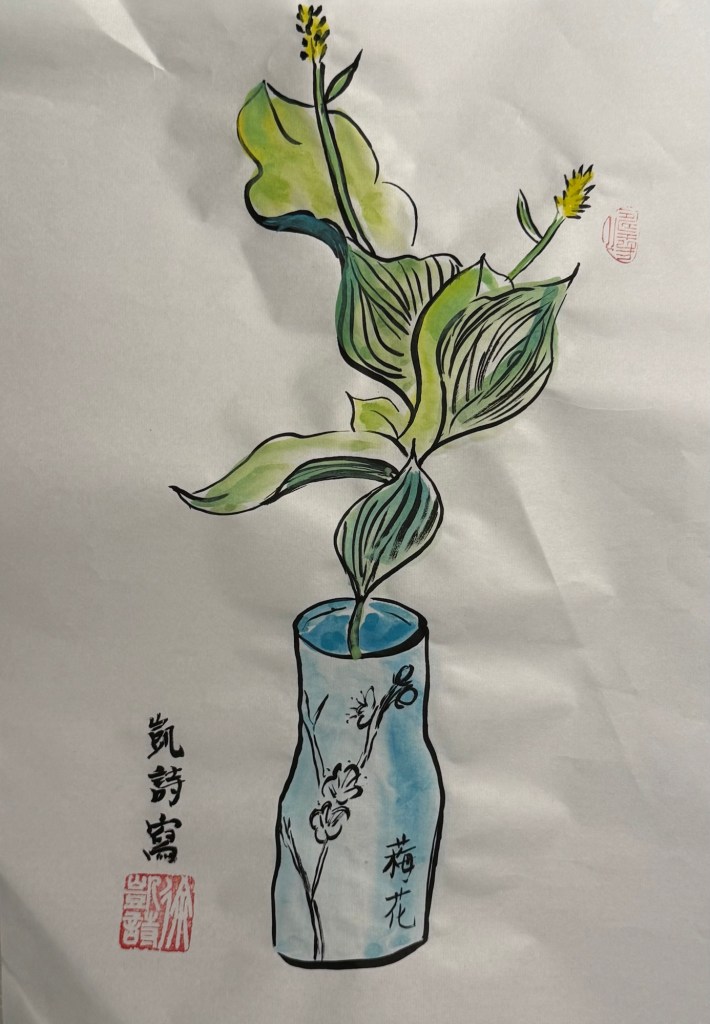
3. A small vase with a branch and leaves. My name in calligraphy with two seals:
– Bottom left: my full name.
– Top right: one my of mother’s seals but I do no know what it says! It is of an ancient script and beyond my knowledge. I will keep researching to see if I can find out. I have subsequently found out by seeing on one my mother’s paintings that I have put it upside down!
–
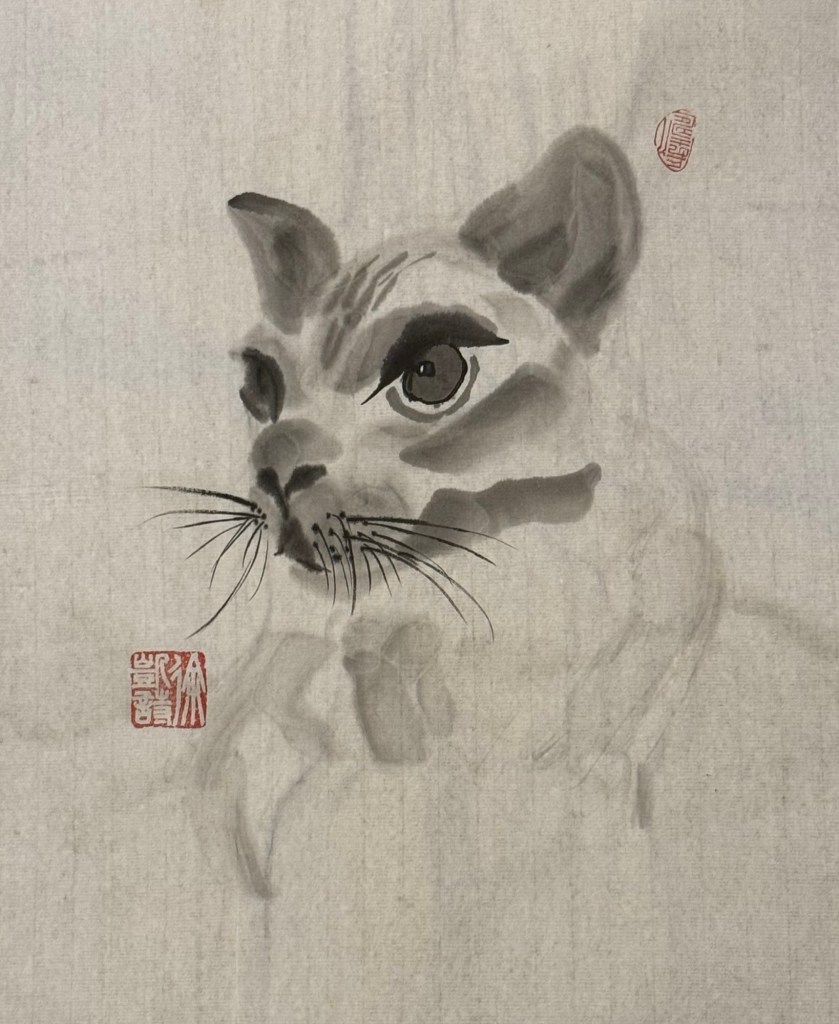
4. My cat Tom who is sadly not with us anymore. No calligraphy with two seals:
– My full name and the upside down seal!
–
LEARNING
Using the seal properly is an art form that requires skills which comes with experience. The placement of the seal as well as how it is applied are both important. Too much paste would ‘flood’ the carving giving a red mess, too little paste would make part of the seal invisible, i.e. an incomplete image. So it needs to be just right.
The placement is even more challenging. The use of negative space is critical in Chinese painting – my Chinese painting tutor said the extensive use of negative space was a key differentiation between Chinese and ‘Western’ art. Placing the seal after the painting is completed means the seal interrupts the negative space hence it needs to be done in a way that maintains the harmony of the composition whilst enhancing the composition. While writing this I realise it is impossible to articulate how to do it! What I have learnt from the above paintings are that if I am using two seals then place them diagonally on the composition and use one large and one smaller seal, i.e. do not use two seals of the same size. The non-uniformity makes the composition more interesting.
My tutor said the only way to learn was to keep doing it, keep practicing, then eventually it would come naturally. I have to take her words for it as I don’t have any other options! I used to only put seals on paintings that I was happy with, but my tutor said I should do it on every painting in order to practice. So that is what I will do!
NEXT STEPS:
– Keep practicing using seals on all my Chinese paintings.
– Pay more attention to how other Chinese artists use their seals – study my mother’s paintings and my painting books more carefully.
After completing two Cheongsam paintings (‘You’re a banana’ and ‘No, I’m an egg’), I wanted to revisit the first Cheongsam painting I made – ‘Appropriation. Appropriation.’ because I felt it was an unfinished piece. I knew it was unfinished at the time but I was eager to move onto the banana and egg paintings, so I left it. After some time had passed, I felt the urge to finish it off. The areas that I was not happy about were:
– The lack of depth in my representation of what I was trying to say.
– In fact, it wasn’t clear what I was trying to say and how it was relevant to my practice.
– It felt like an unfinished or abandoned piece of work.
I am not always bothered about abandoning work, but so much effort had already gone into this piece, the making of the dress, sewing and painting etc.. I felt it would be worthwhile finishing it.
Below is the unfinished work from earlier and the original blog about my feelings towards the Blue Willow pattern:
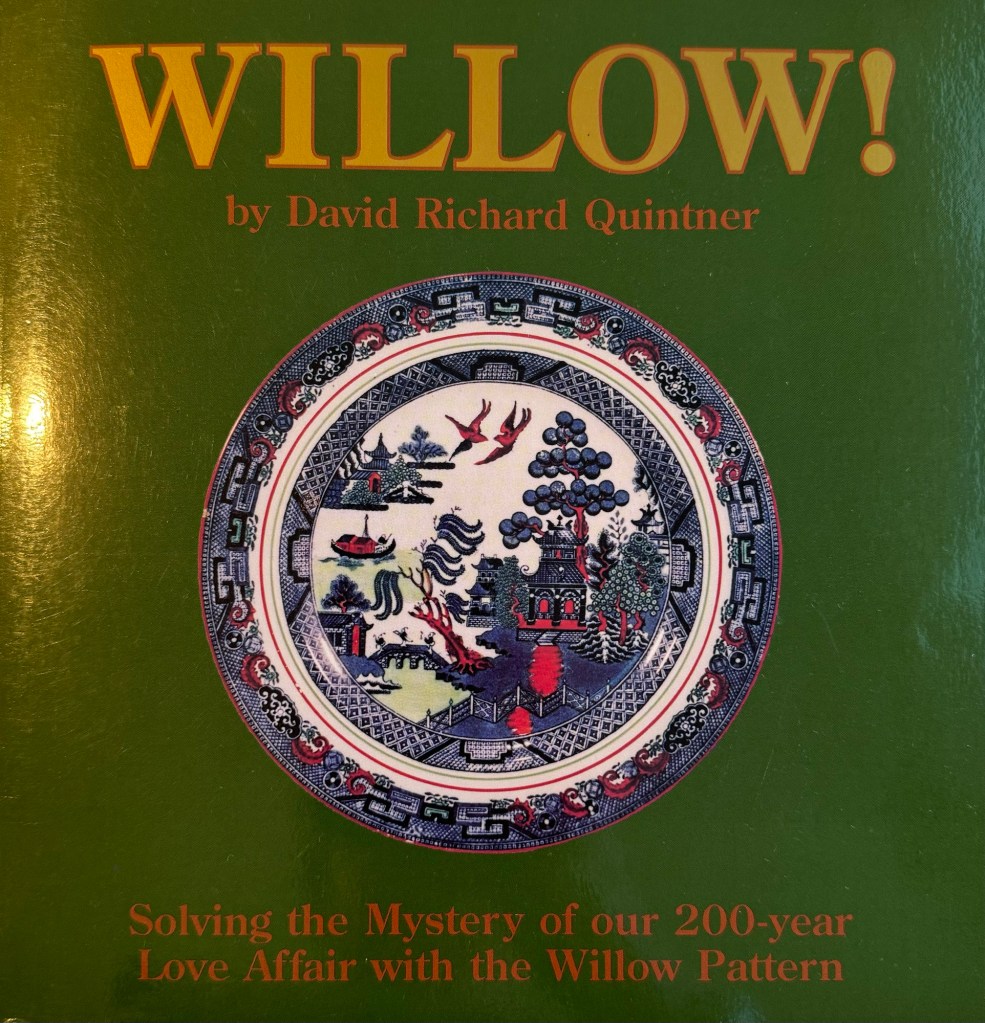
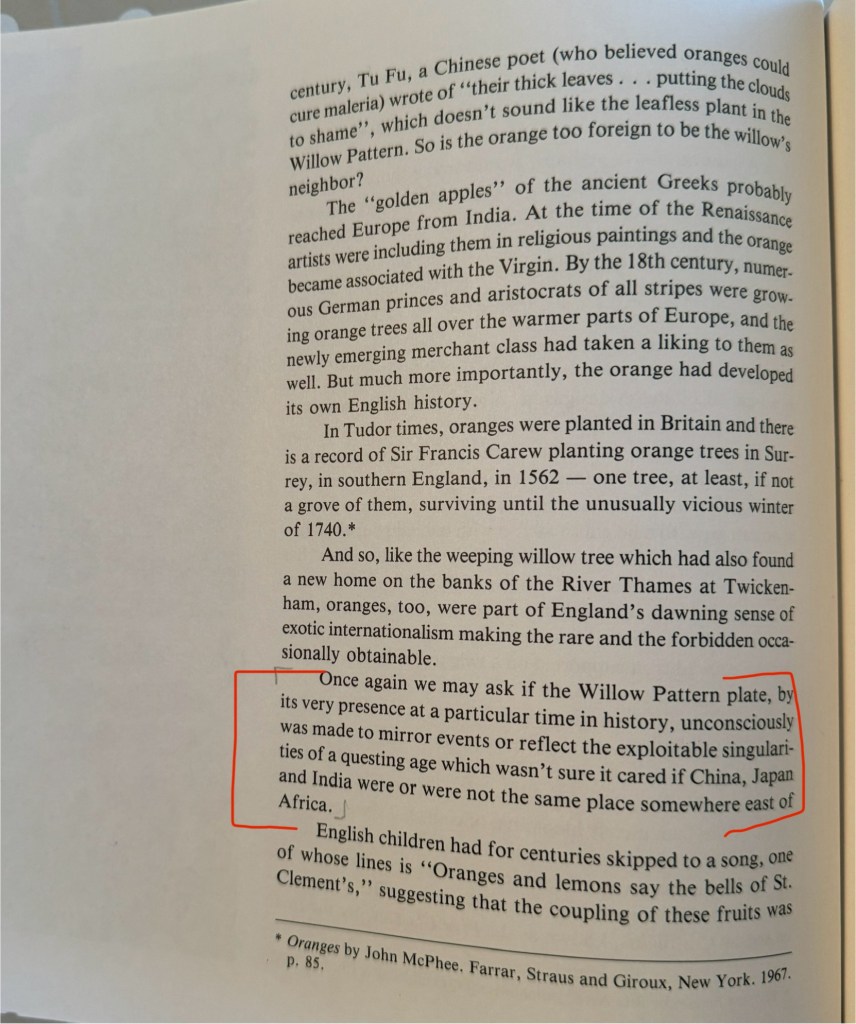
In carrying out additional research for this piece of work, I referenced a book about the Willow pattern:
–
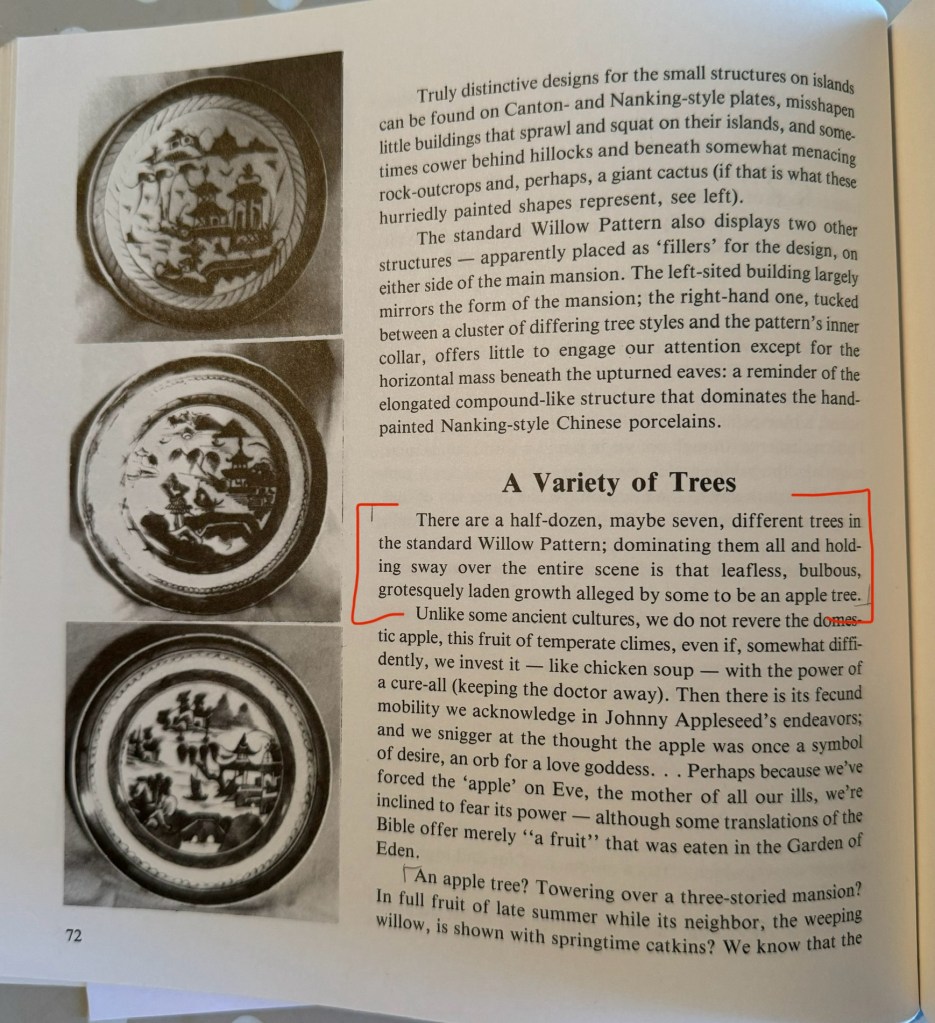
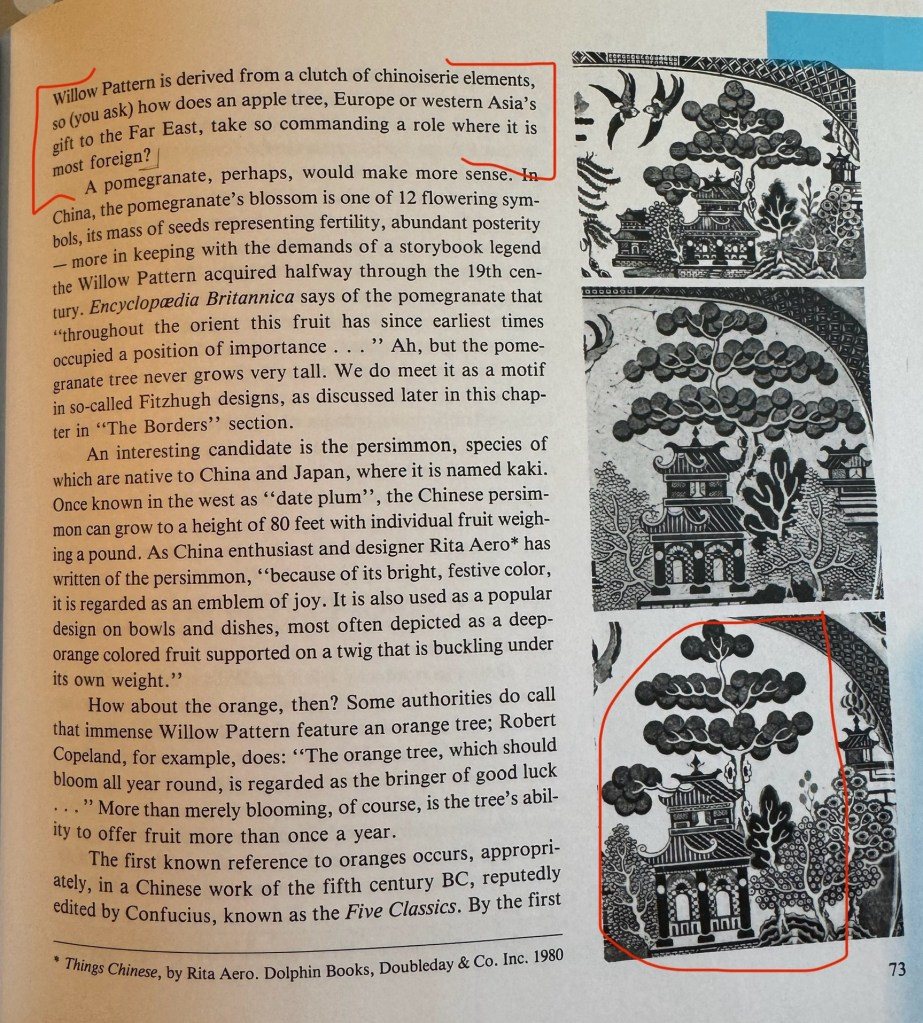
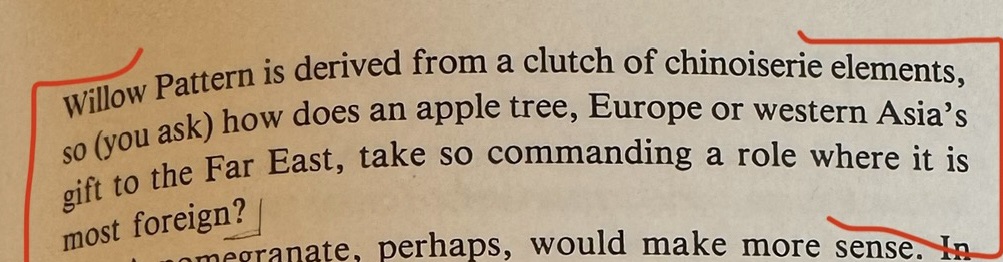
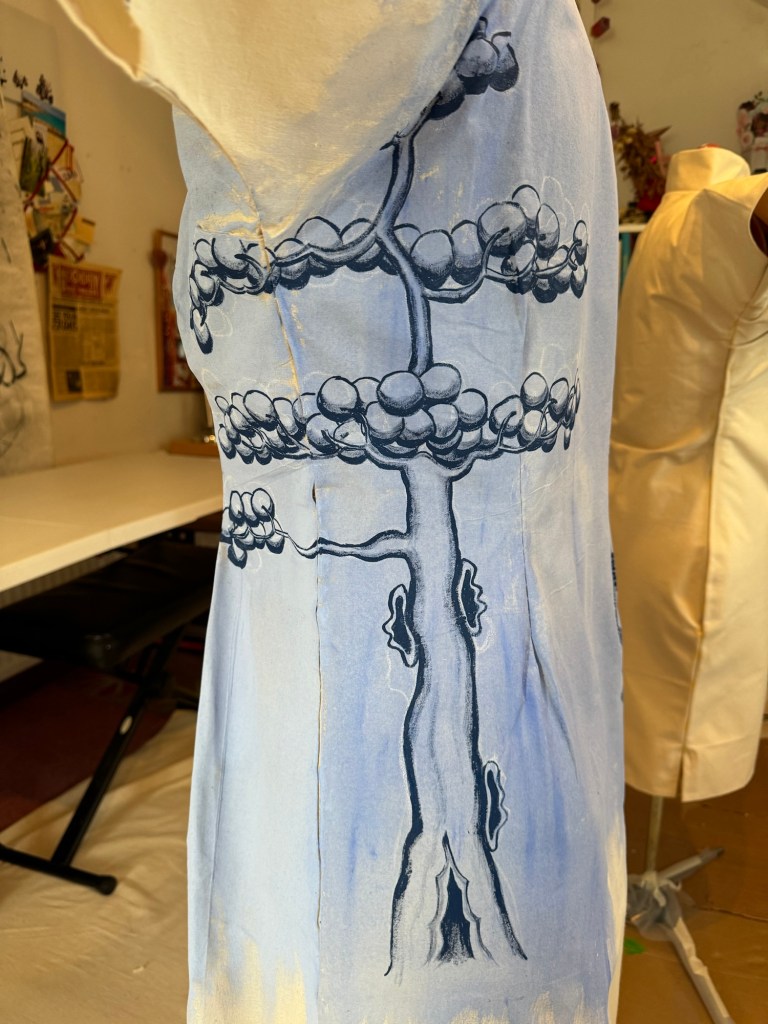
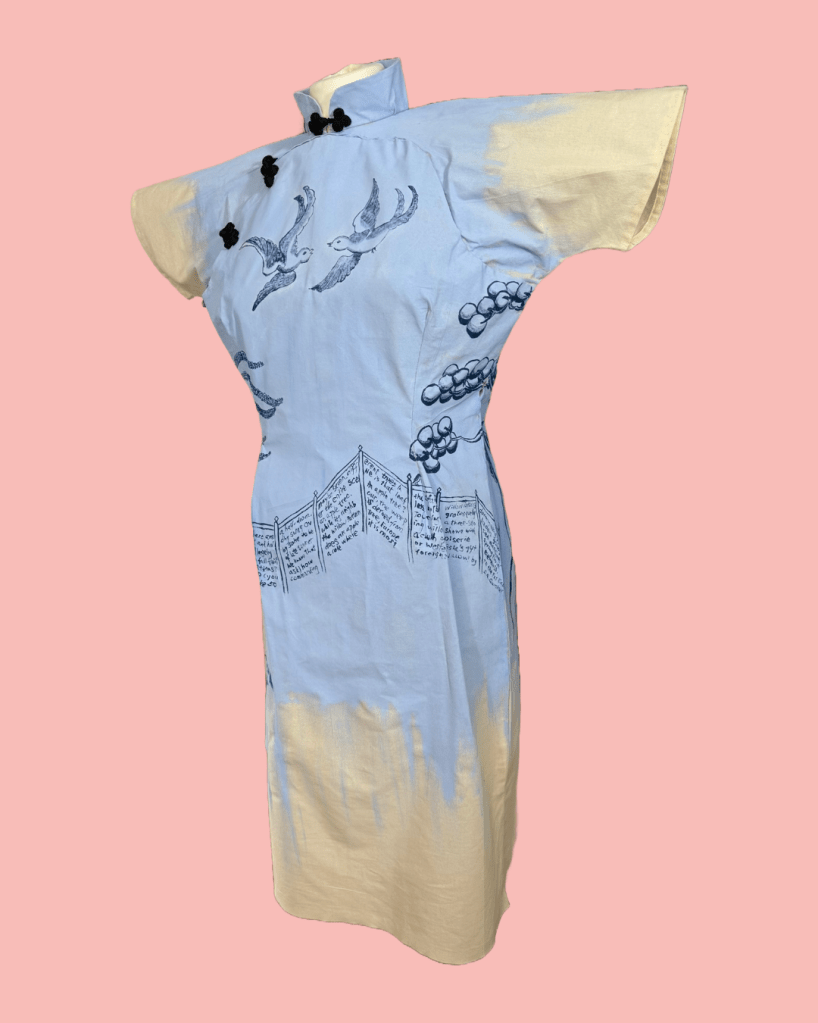
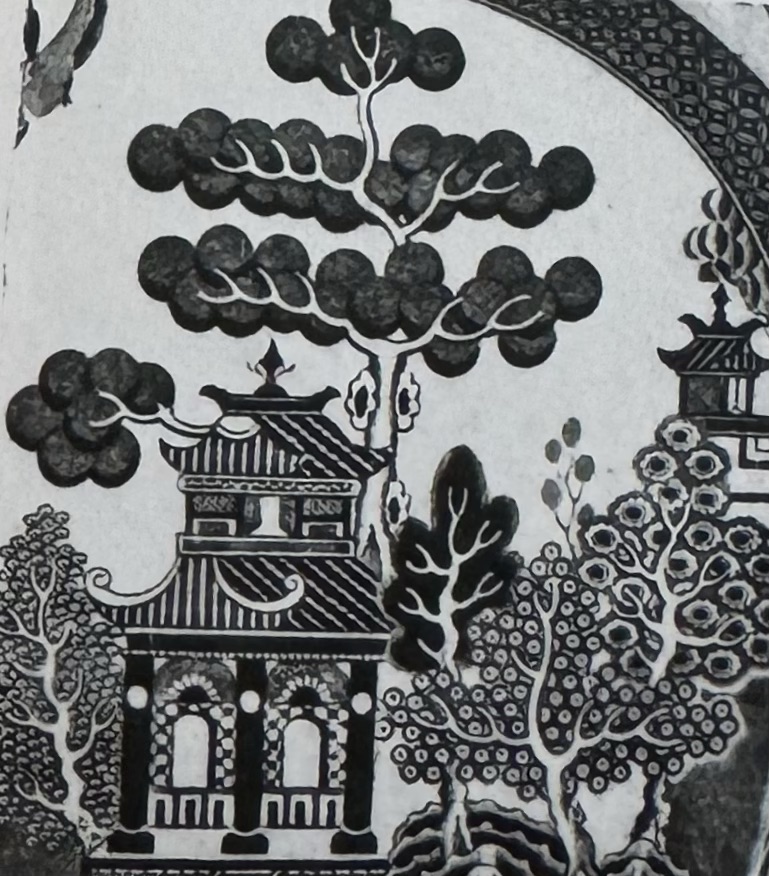
In my earlier blog, I talked about the incorrect depiction of a tree on the Willow design. What should have been a large pine tree that was common in Chinese paintings, was instead depicted in a way that led many to believe it to be a disproportionally large fruit tree. This particular tree was discussed extensively in the ‘Willow!’ book with many suggestions of the different types of fruit tree that it could have been, but without any clue about what tree it really was. So to expose this classic example of an appropriation of something without having basic understanding of what was being appropriated, I decided to add the said tree to my Cheongsam painting and copied some texts from the book to highlight such cultural challenges.
–
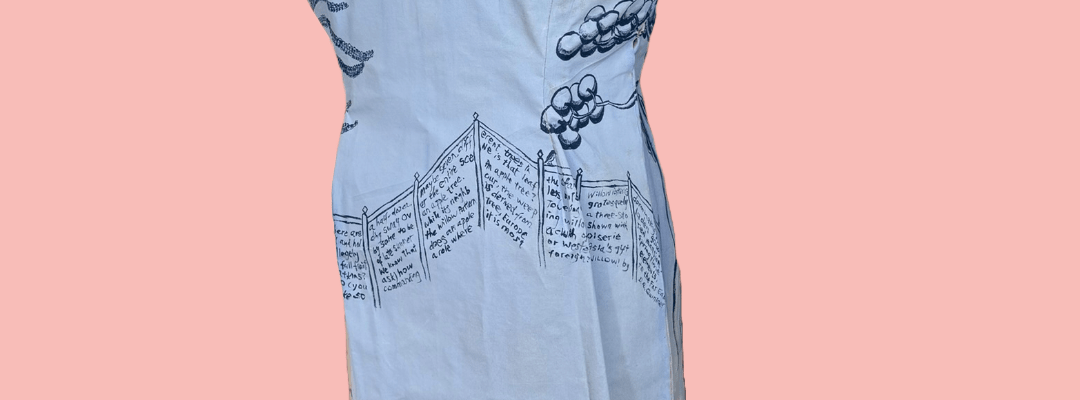
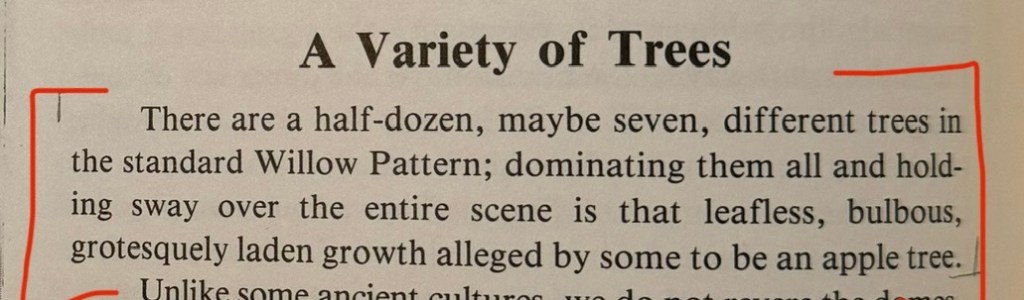
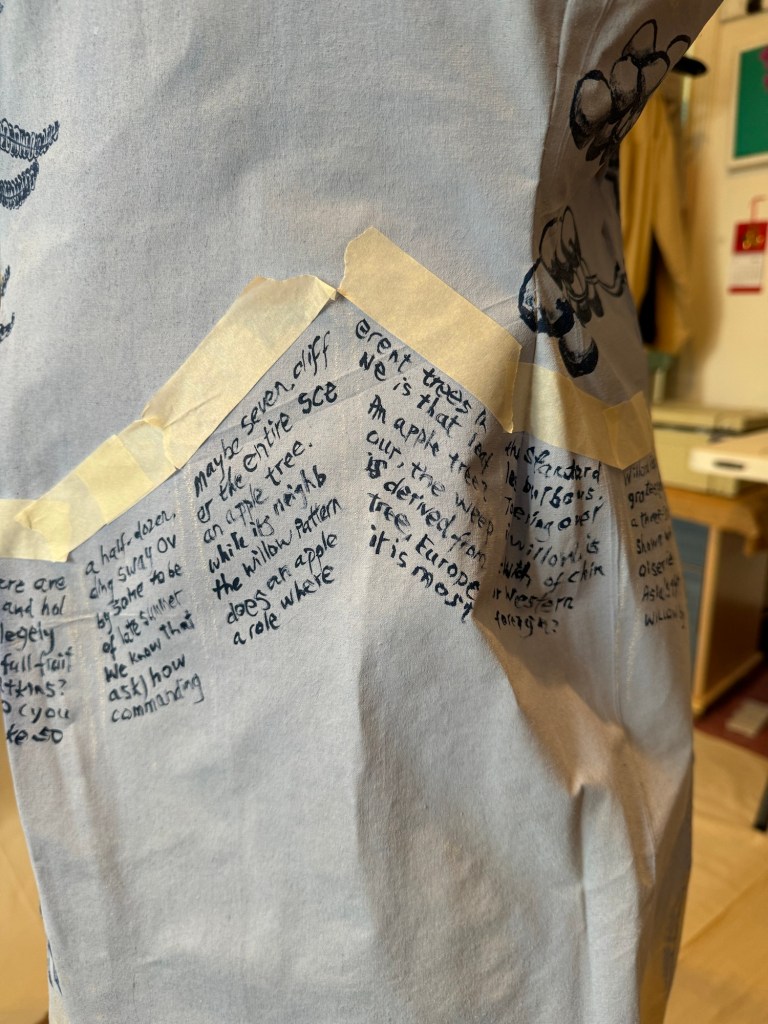
Texts that were added as part of a fence on the painting were copied from the above pages describing the (pine) tree as leafless, bulbous, grotesquely laden… apple tree. Close up of the texts copied are as follows:
–
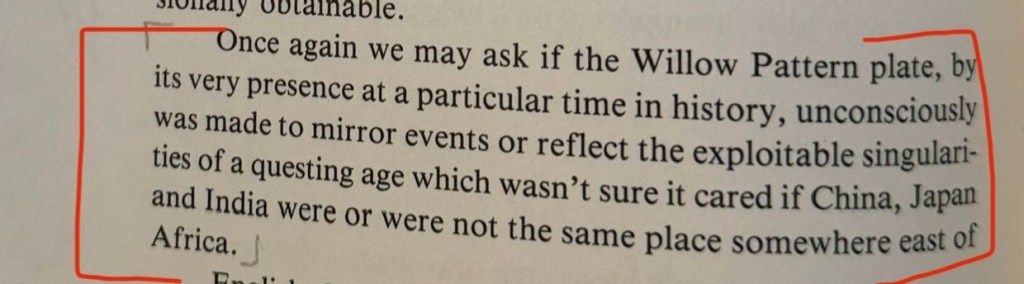
Another paragraph was copied onto my painting which gave insight into the attitude towards Asia during the time when the Willow pattern was designed:
–
Close up of the texts copied:
–
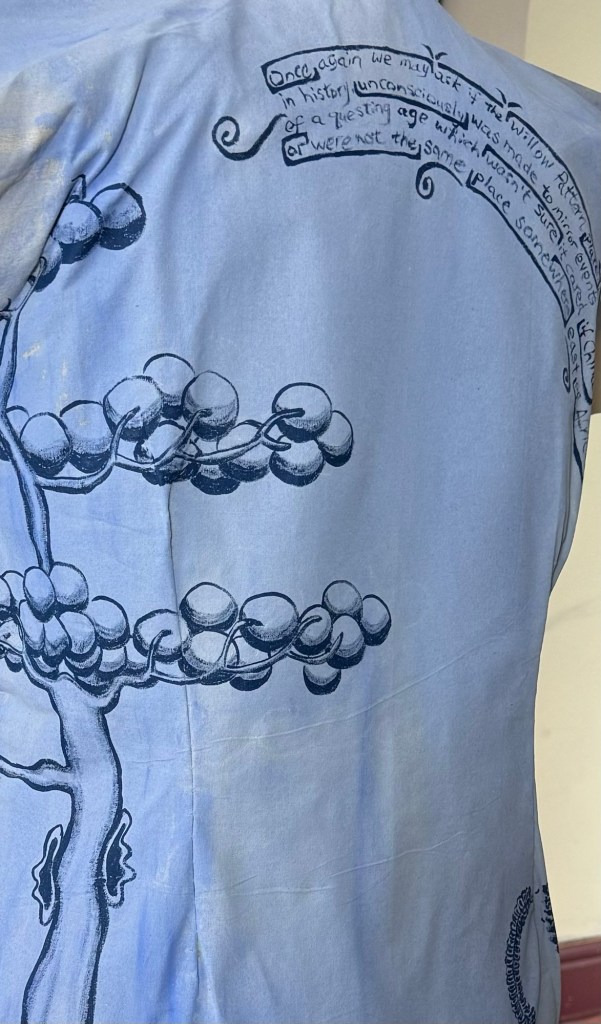
The ‘bulbous and grotesquely laden fruit tree’ was added to my painting:
–
Masking tape was used to mark out the shape of the fence for the texts:
–
The second set of texts was added on the back of the painting next to the large tree with some ornate borders like those on the edge of some Willow plates:
–
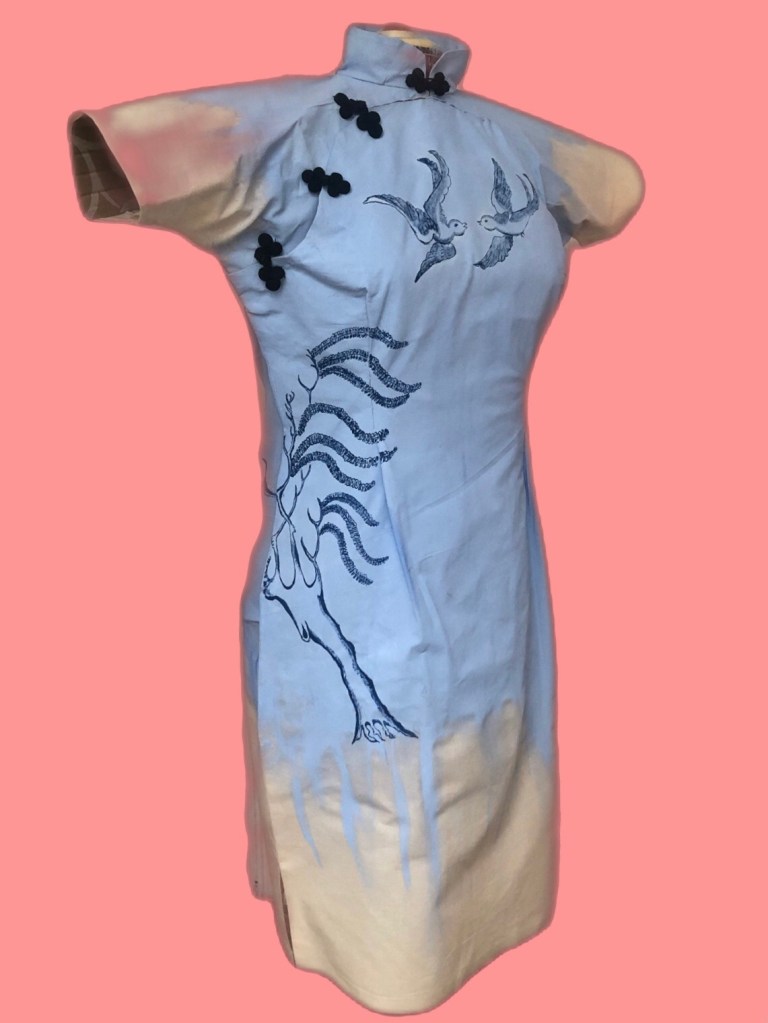
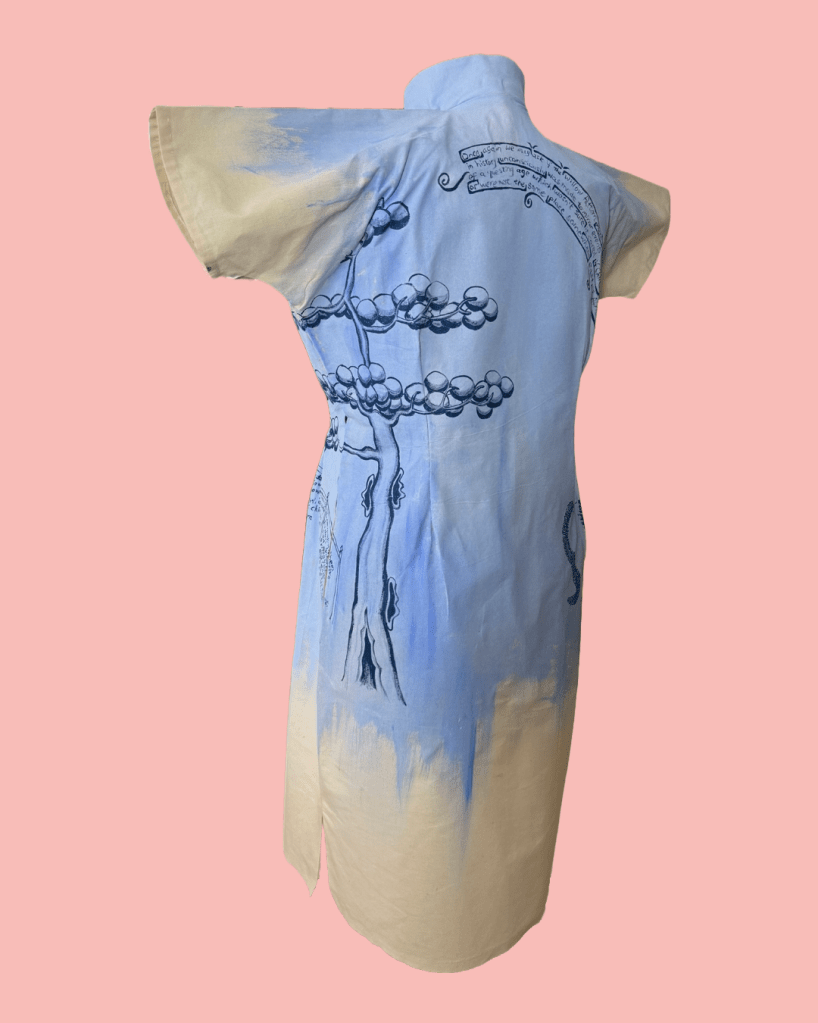
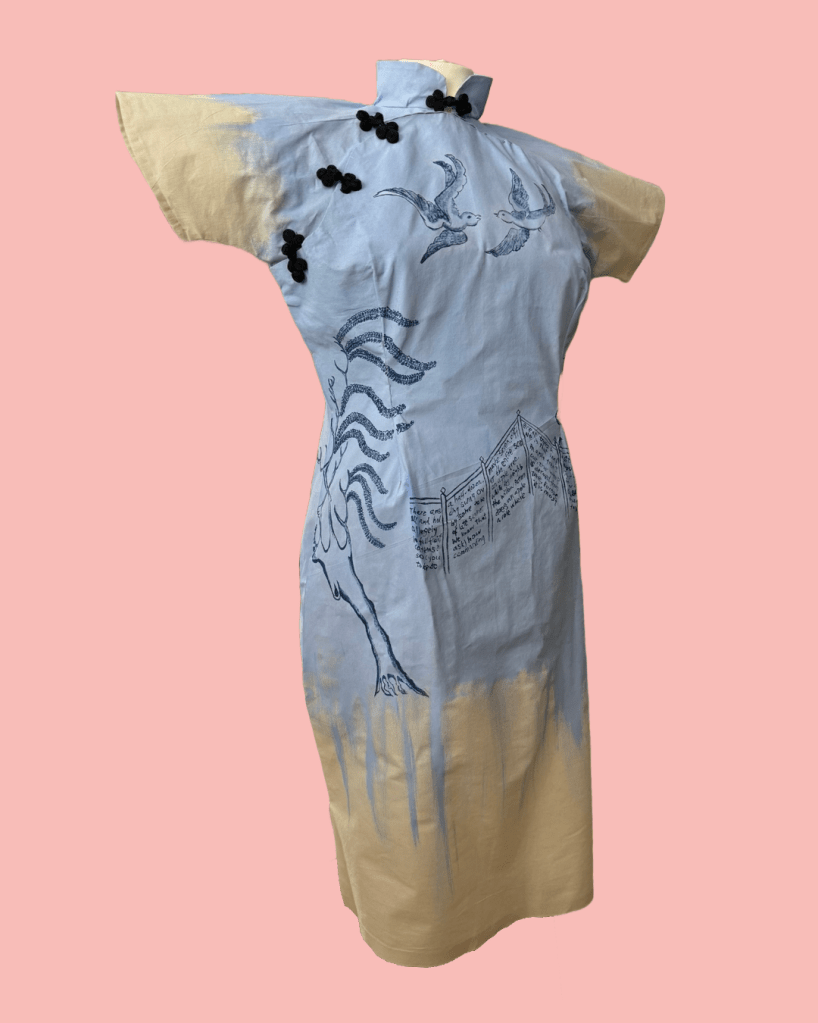
The finished painting:
Back viewFront view – leftFront view – right
REFLECTIONS
I am pleased that I have reworked this painting because my practice is not just about making work, it is also about examining issues relating to my identity which includes understanding my heritage. In the case of the Willow Pattern, it highlighted the casual and incorrect appropriation of Asian art during the colonial era. My original idea for this piece was always to highlight the mistakes made in the Willow Pattern appropriation. In particular, the pine tree. I have researched numerous design texts about the Willow Pattern and most of them express puzzlement about the disproportionally large ‘fruit tree’ towering over the building. The debate surrounded what kind of fruit it was, apple, pomegranate, peach etc.. All acknowledging that no fruit tree could grow to several storeys high hence description such as ‘grotesquely laden’ was used here. I am certain that if any Chinese artists were asked, they would have said it was a (badly depicted) pine tree.
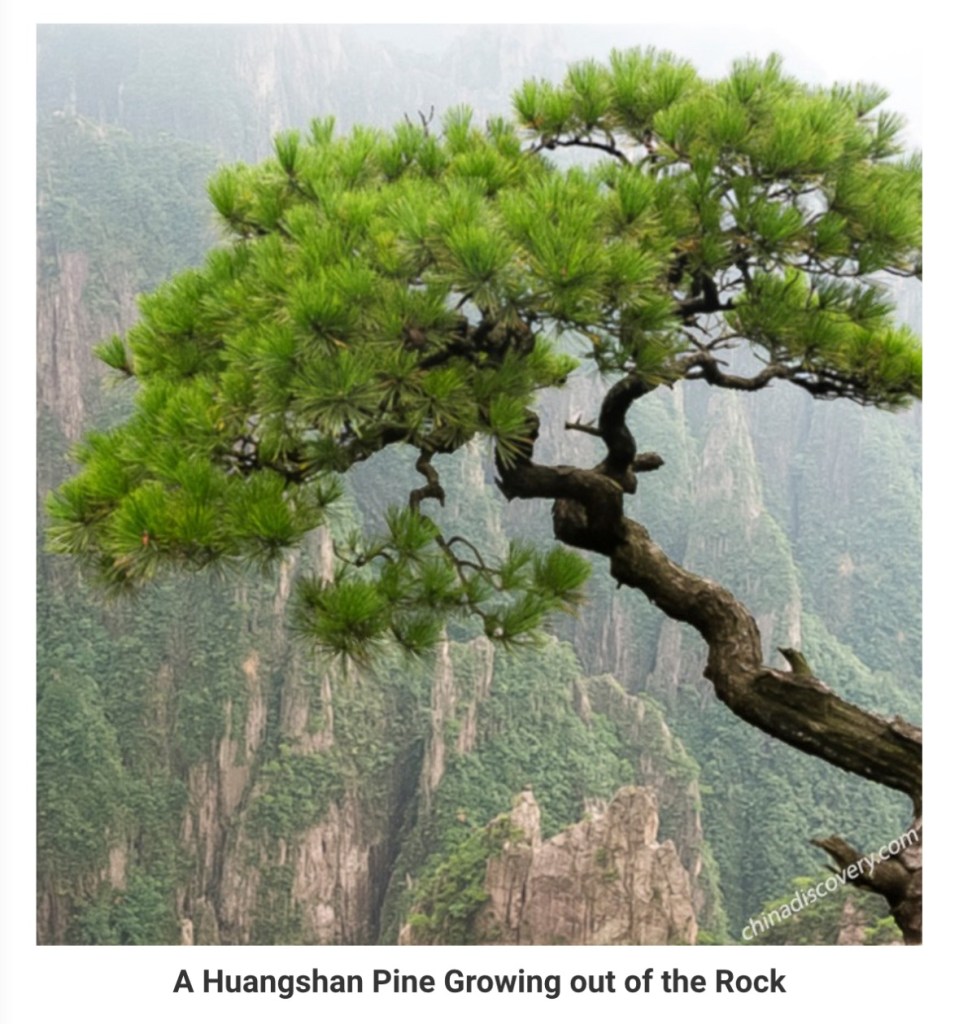
My research shows that there are many species of pine trees in China. Ranging from the common Pinus tabuliformis which can be 20-30 metres tall, to the famous Pinus hwangshanensis (or Huangshan pine) with some being 1,500 years old. Pine trees are often depicted in Chinese paintings. The pine needles are typically formed in dense round clusters:
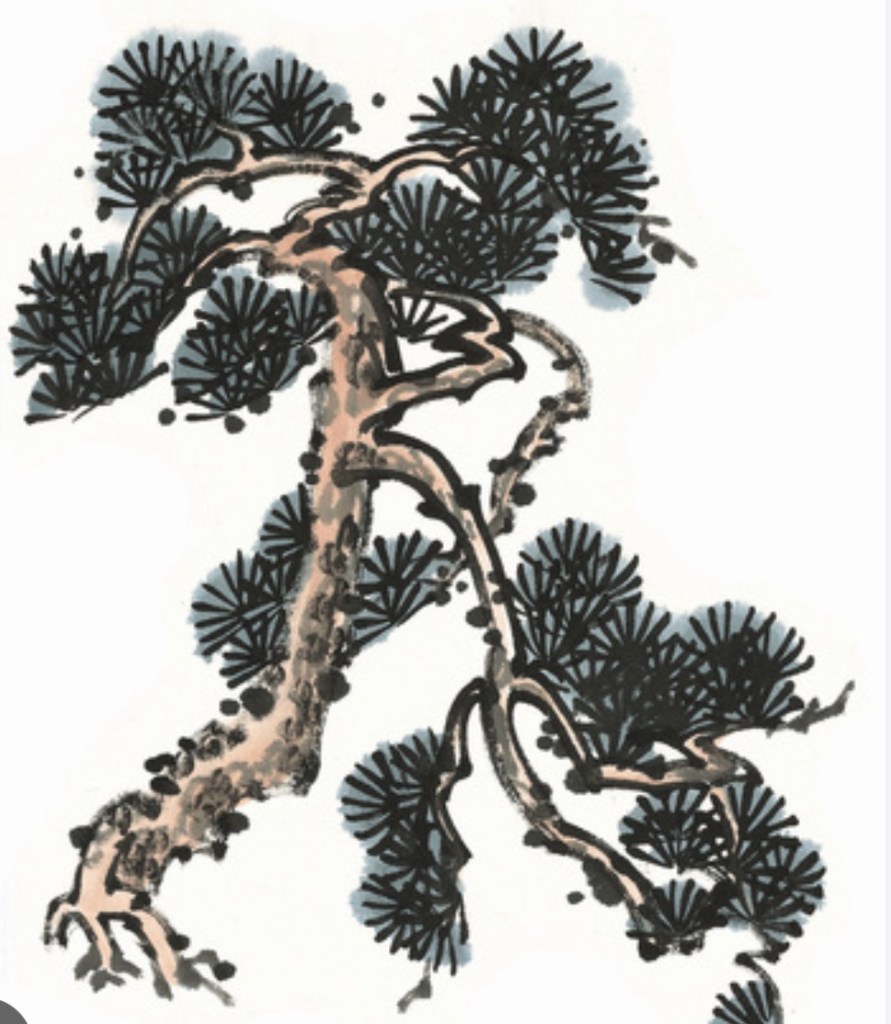
The pine needles are often depicted as below in traditional Chinese paintings with a few needles radiating from the centre of the cluster and a thin wash of colour (usually green) to give a sense of the overall round shape of the cluster of needles.
–
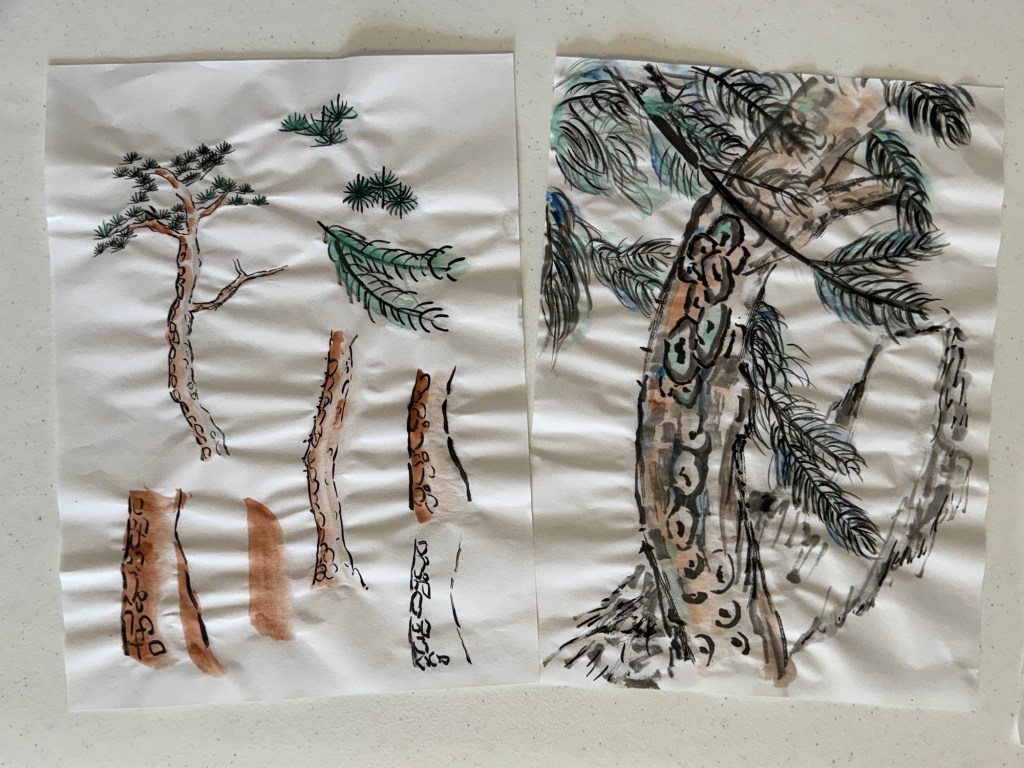
Here are my pine tree paintings that I made in one of my Chinese brush painting lessons, the left hand image shows the round clusters of needles with a green wash:
My Chinese pine tree paintings
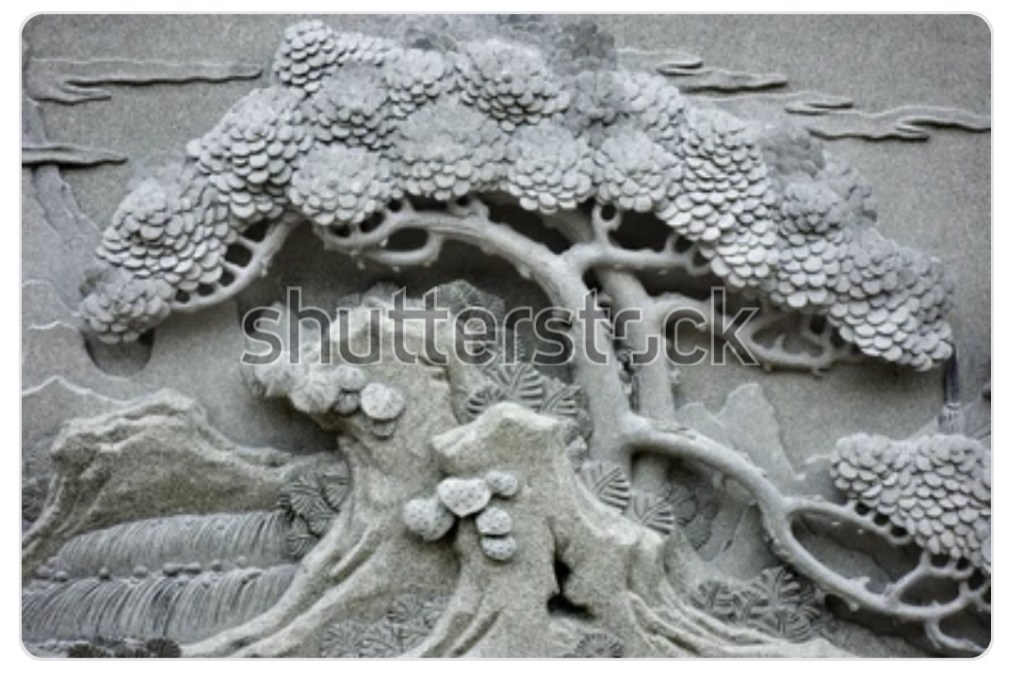
Carvings of pine trees often take on a more accentuated round shape such as this example:
–
The Chinese pine tree was depicted as follows by the Williow Pattern designers:
–
The Willow Pattern became very popular in Britain as a result of demands generated for Chinese artefacts during the British colonial period. Subsequent generations of people who buy or study the Willow Pattern have wondered what tree that was and due to the rounded shapes coming off the branches, they concluded it was a fruit tree of some kind – such as the hypothesis in the ‘Willow!’ book even though they all acknowledged the disproportionate size.
When I made the discovery of the mistaken identity of the tree on so many design documentation, I wanted to do something to capture my findings and expose the lack of research that I have witnessed. I am not a design historian, nor a botanist, nor am I that experienced a Chinese painter, even I could tell that it was meant to be a pine tree. So it shouldn’t have been difficult to deduce. I could only conclude that people just didn’t really care enough to find out. Even those who were writing books or papers on the Willow design didn’t seem to make that extra effort to find out and just accepted that it was a strange fruit tree or badly depicted overly large and grotesque fruit tree. Hence I wanted to make a painting to express this example of our casual laziness towards other people’s culture. The second set of texts that I copied from the book aptly acknowledged the ‘couldn’t care less’ attitude towards Asia at the time.
When I first did the painting, I stopped before putting in the pine tree. This was because I felt the painting was turning out to be a bit ‘twee’. I didn’t like it. In hindsight, what did I expect when I was copying from a design that was a bit twee! So I left the piece at the time and went onto make two other paintings. I am very pleased that I returned to finish this painting because I had spent much time in researching the Willow Pattern, especially the mystery surrounding the pine tree; I really wanted to say something about it. Hence I am pleased that I returned to complete the pine tree as well as copy some texts that confirmed the casual approach taken towards other people’s culture.
LEARNING
I have learnt a lot about the history of the Willow Pattern. That also helped me to understand more about the British Empire and its history at the time. I am not really that offended by the poor appropriation of the design, it amused me more than anything. However, it highlighted how easy it is to poorly appropriate and that is usually out of laziness, ignorance or not being thorough in research. That is good learning for me and has helped to make me more mindful about my work – if I were to borrow ideas from other cultures, or my own culture, I need to pay more attention to get my facts right. It is often not difficult, just takes a little more time to ask or research. Otherwise, I would be just as bad as those that I’m criticising here.
NEXT STEPS
With completing this painting, I have now done three Cheongsam paintings. I have several ideas of other Cheongsam paintings so I will get on and make some more!
–
RESEARCHBACKGROUND – WILLOW PATTERN
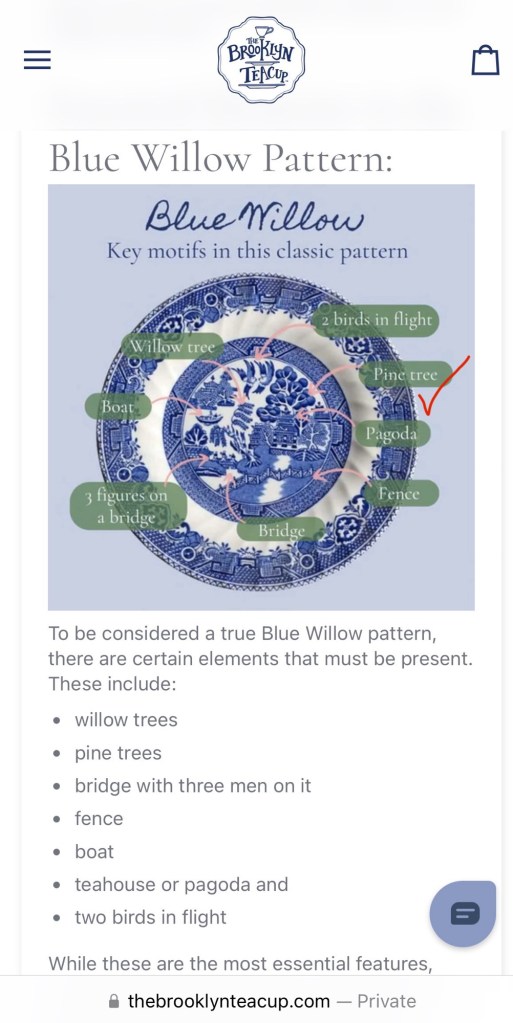
Below are some examples of mistaken identification published for the large pine tree in the Blue Willow pattern. The examples shown here assume the tree is a fruit tree.
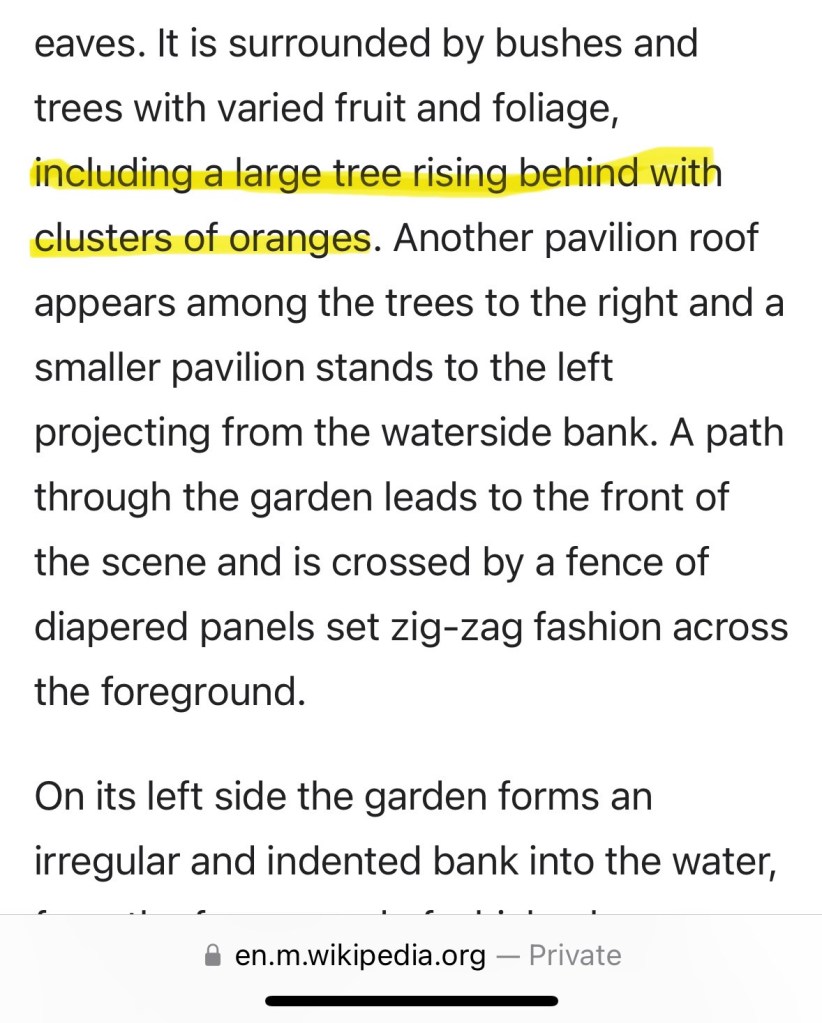
Wikipedia describes the tree as an orange tree even though orange trees do not grow that tall and if the round shapes were fruit then it would have been a leafless fruit tree.
–
Example 2: Liverpool University – Victoria Gallery and Museum
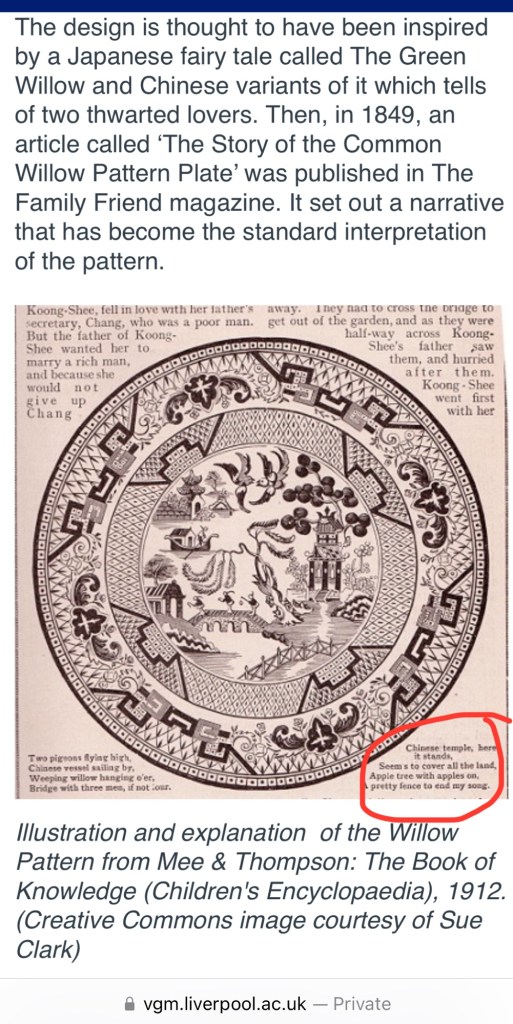
Liverpool University’s Victoria Gallery and Museum has a blog dedicated to the Blue Willow design. It details the key elements of the design but does not mention the largest tree depicted. It does, however, include an insert of an illustration stating that the large tree was an apple tree – did they really think that it could be a leafless apple tree that was nearly twice the size of a three storey building?
–
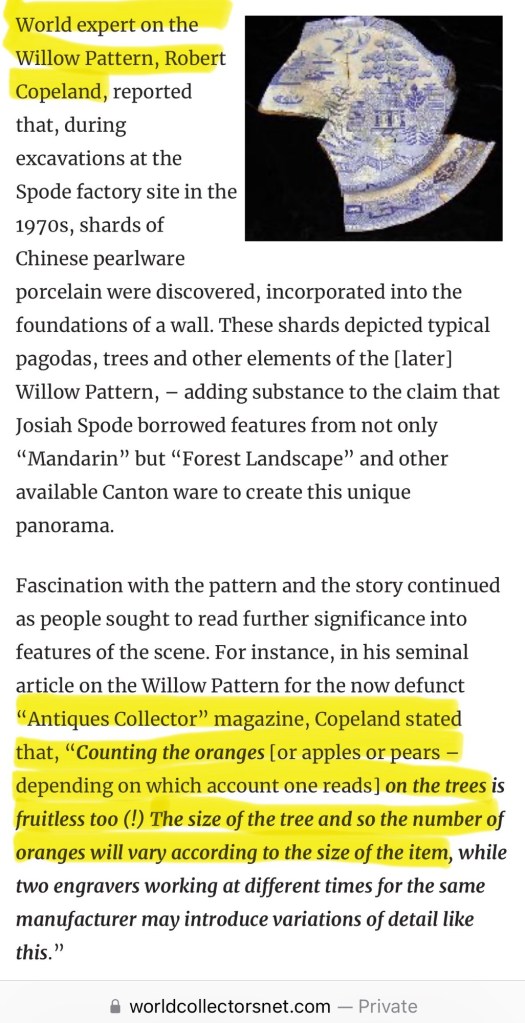
Example 3: Quote from ‘Antiques Collectors’ magazine by ‘World expert on the Willow Pattern’
This article includes a quote from a ‘World expert on the Willow Pattern’ talking about the oranges on the tree, whilst acknowledging that there are accounts of other fruits such as apples or pears being published.
–
Example of a correct identification!
Finally, the example below correctly identifies the tree as a pine tree:
Following on from Cheongsam Series #2, the plan was to create a wearable painting in the form of a Cheongsam. I have little experience in dressmaking but I remember watching my mother make dresses when I was young. She was a very talented dressmaker and I used to enjoy watching her work. I vaguely remember my grandmother being a dressmaker, too, so I guess my mother must have been inspired by her mother. I also learnt sewing at school so I have some knowledge of the process. I started to research how to make a Cheongsam.
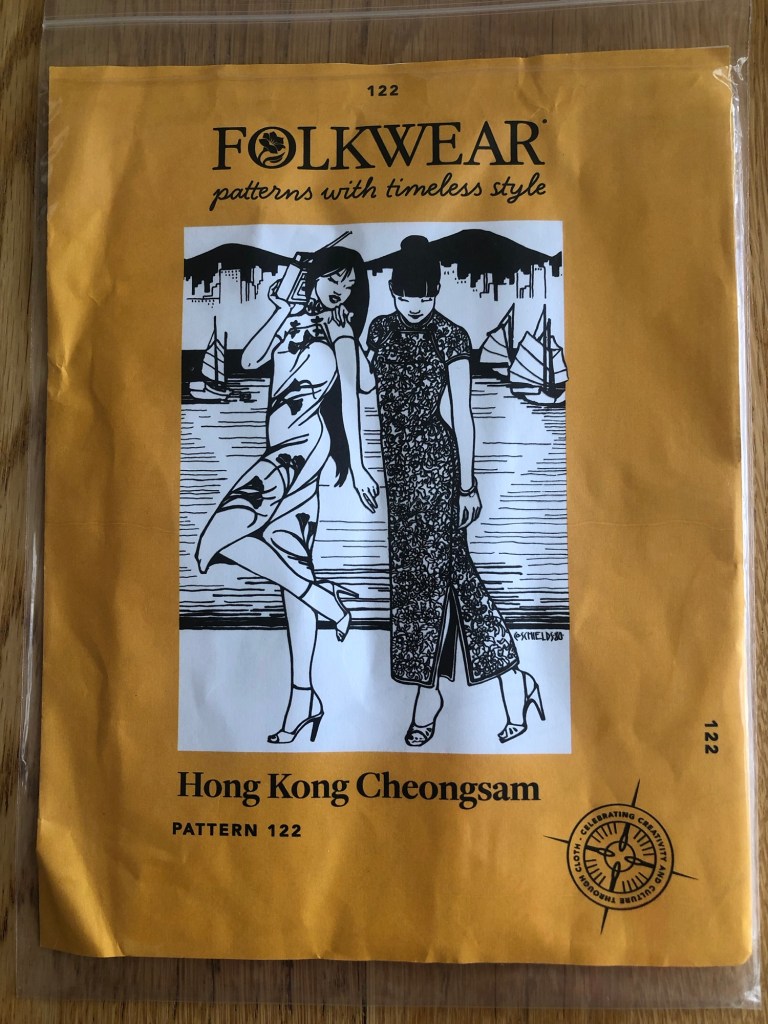
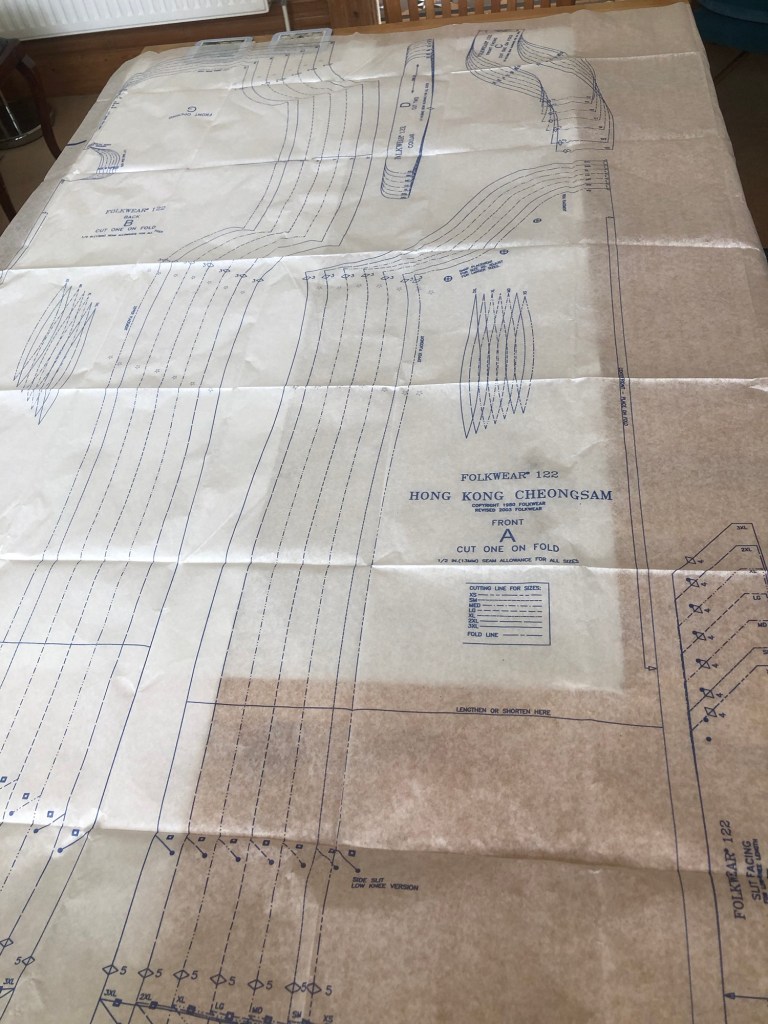
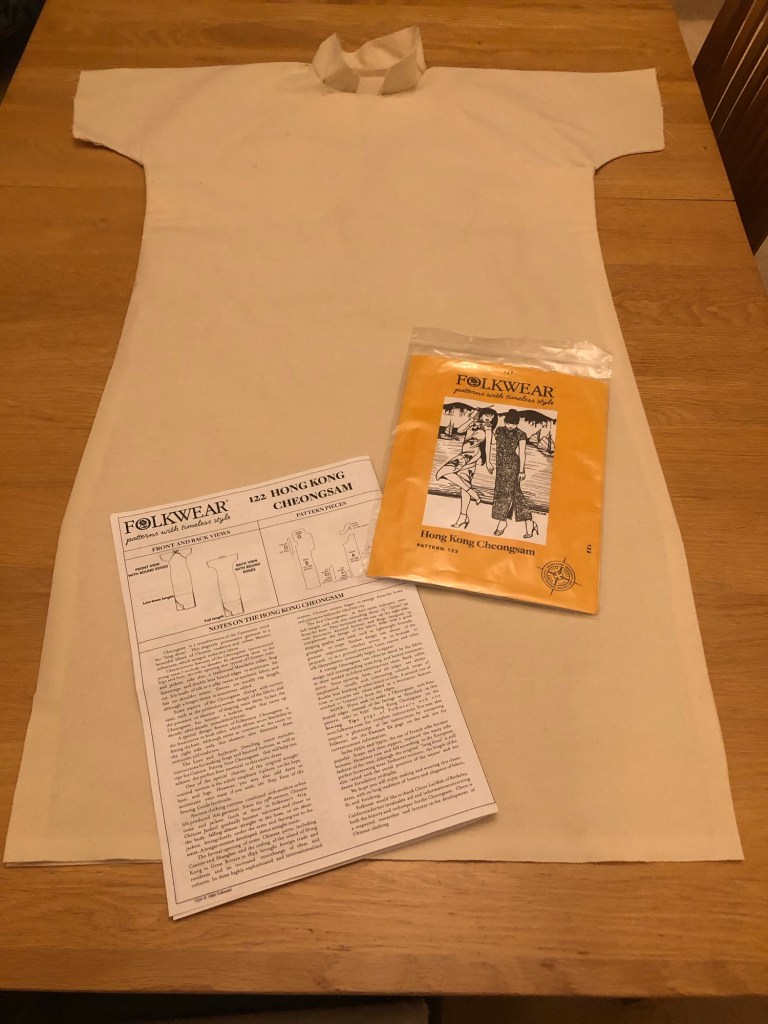
I researched different sewing patterns online looking for one that’s not too complicated and I managed to find one. The reviews of the pattern suggested it was easy to make and I ordered one.
METHOD
–
The pattern seemed straightforward and simple which was a great way for me to learn to make a Cheongsam. I measured myself and chose a size on the pattern.
–
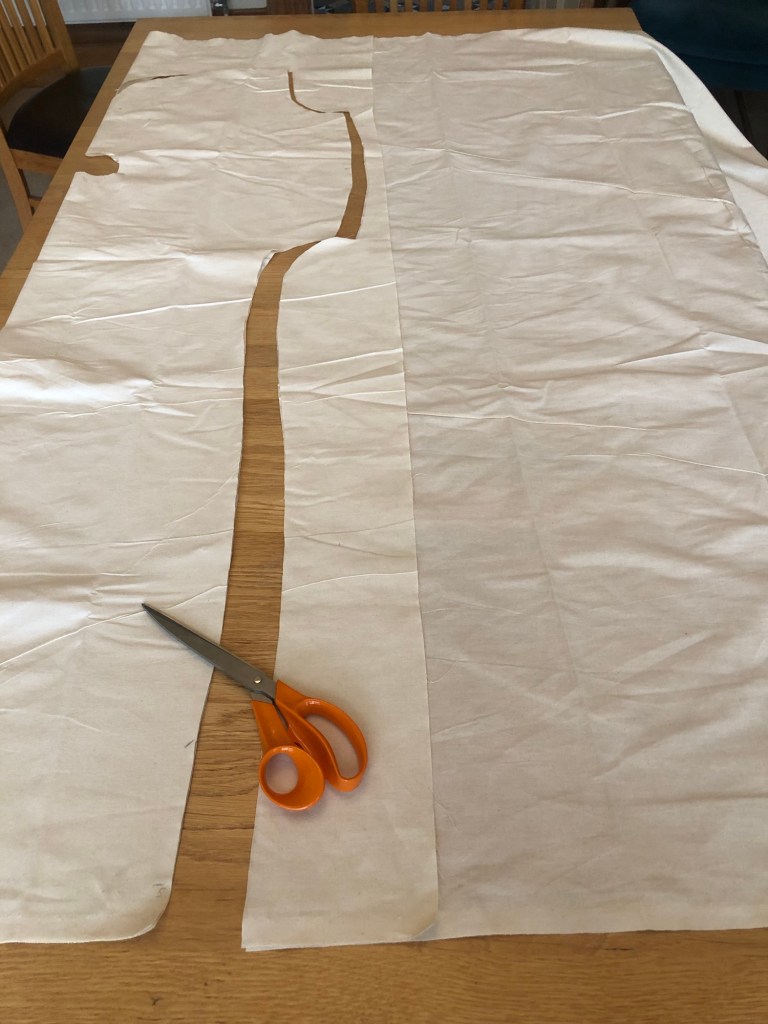
The fabric I used was a light weight calico cotton canvas material. I felt the light weight yet tough texture of the fabric was suitable for a wearable painting.
–
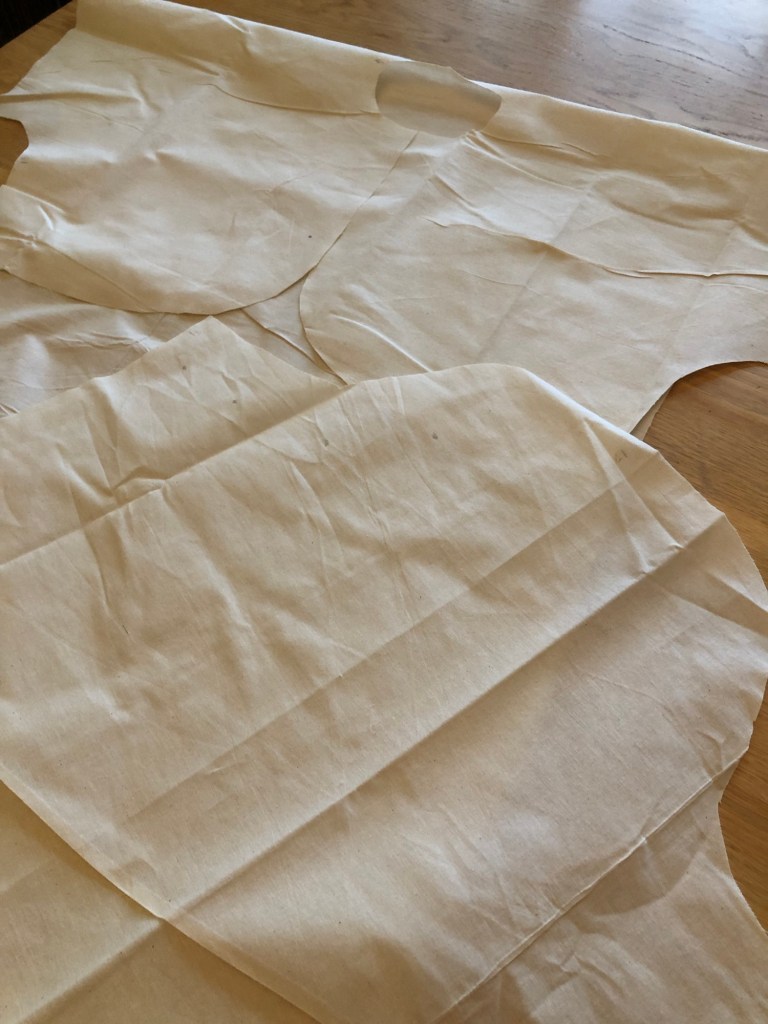
Pieces of canvas material was cut according to the pattern.
–
My 40 year old sewing machine which has not been used for many years refused to work due to years of neglect. So I had to hand sew the dress.
–
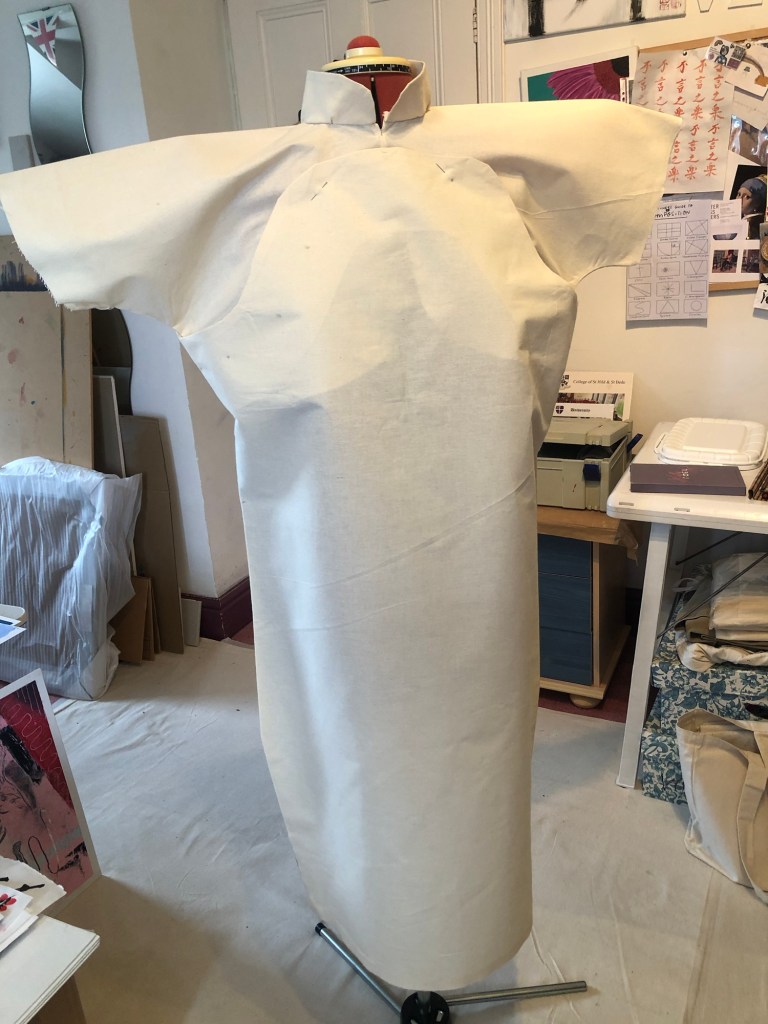
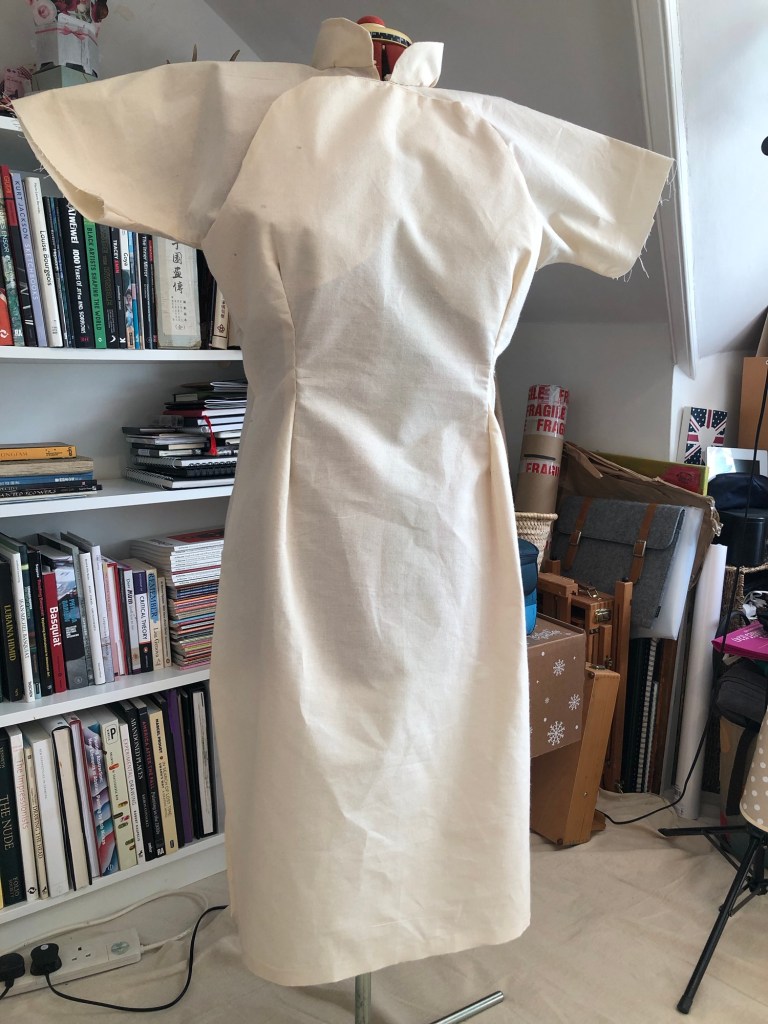
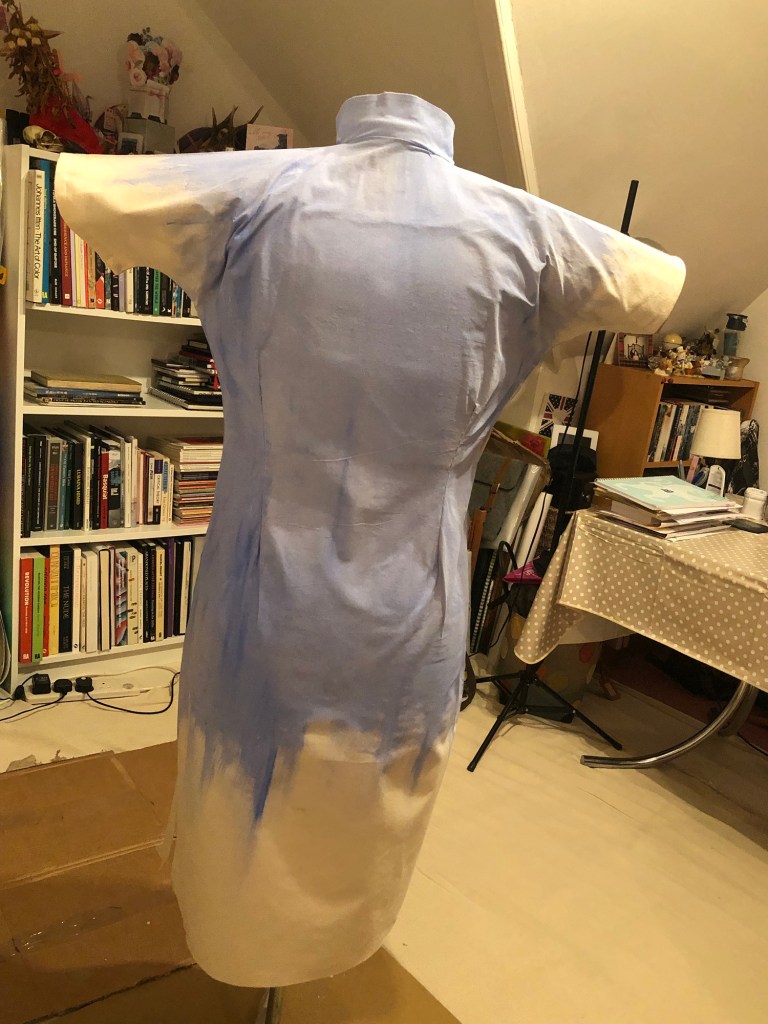
The canvas dress was put onto a dress maker’s mannequin for finishing.
–
I was overly generous in my fabric cutting so the dress felt very large. The sewing pattern had provision for darts for a tighter fit. So I marked those out and sewn darts onto the front and back.
–
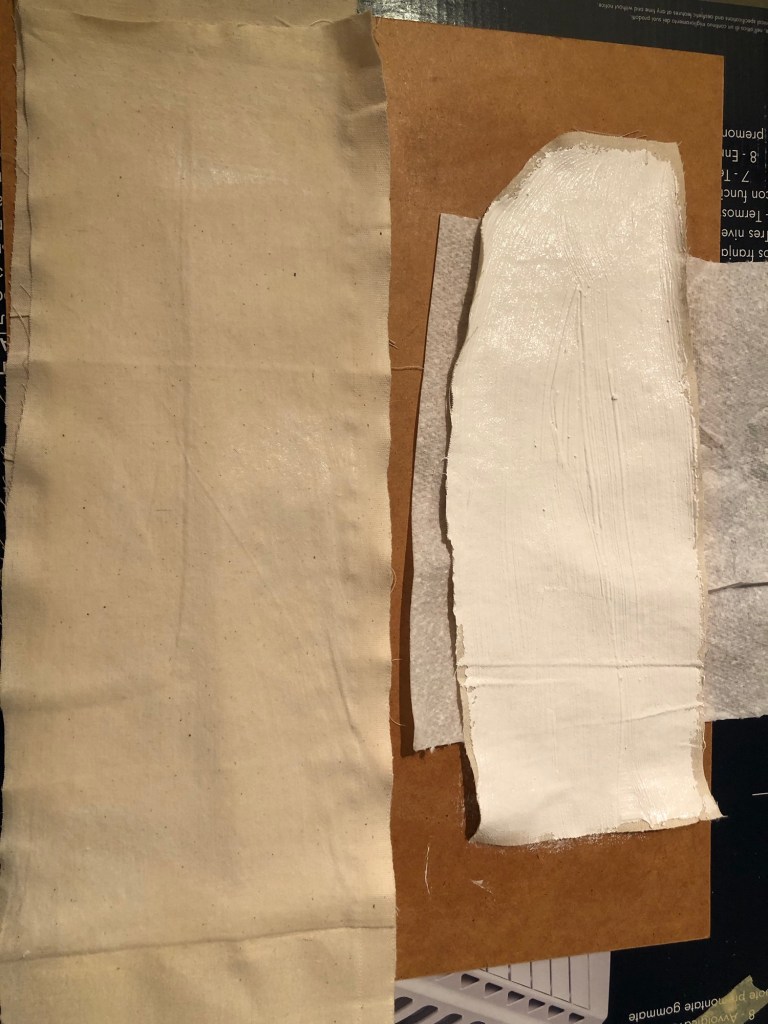
To decide on a primer for the canvas dress, both gesso and diluted white acrylic paint were painted onto fabric samples as experiments.
–
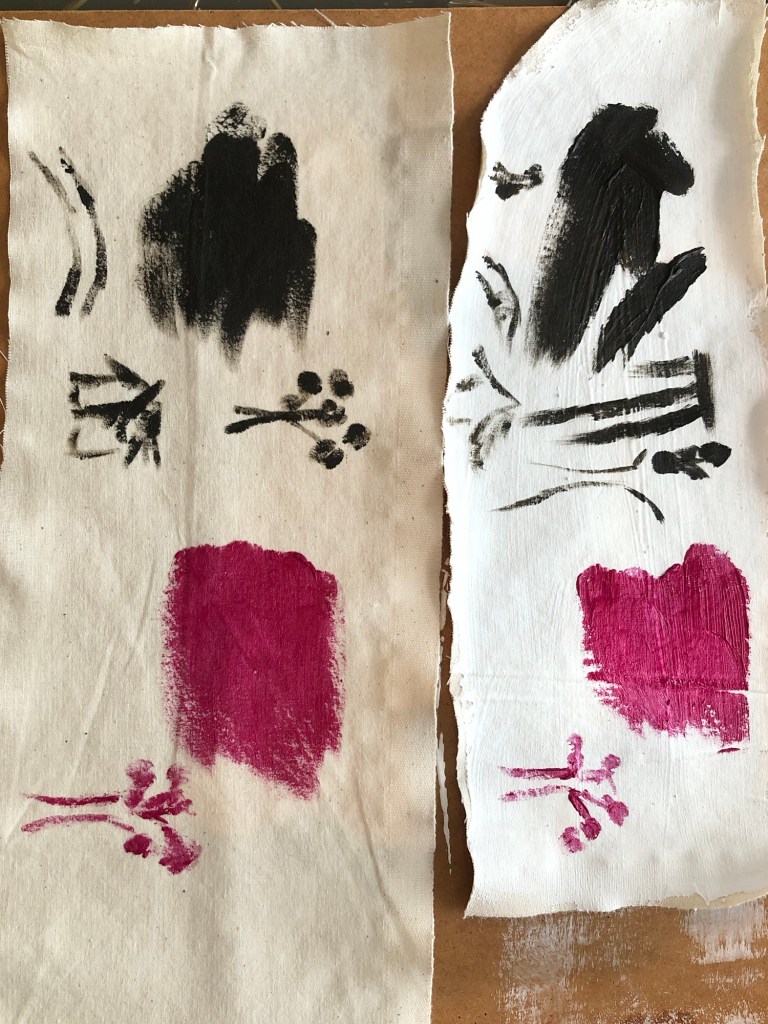
Once dried, acrylic paint was applied to both surfaces to see which would perform better. The gesso was preferred because it provided a smoother surface.
–
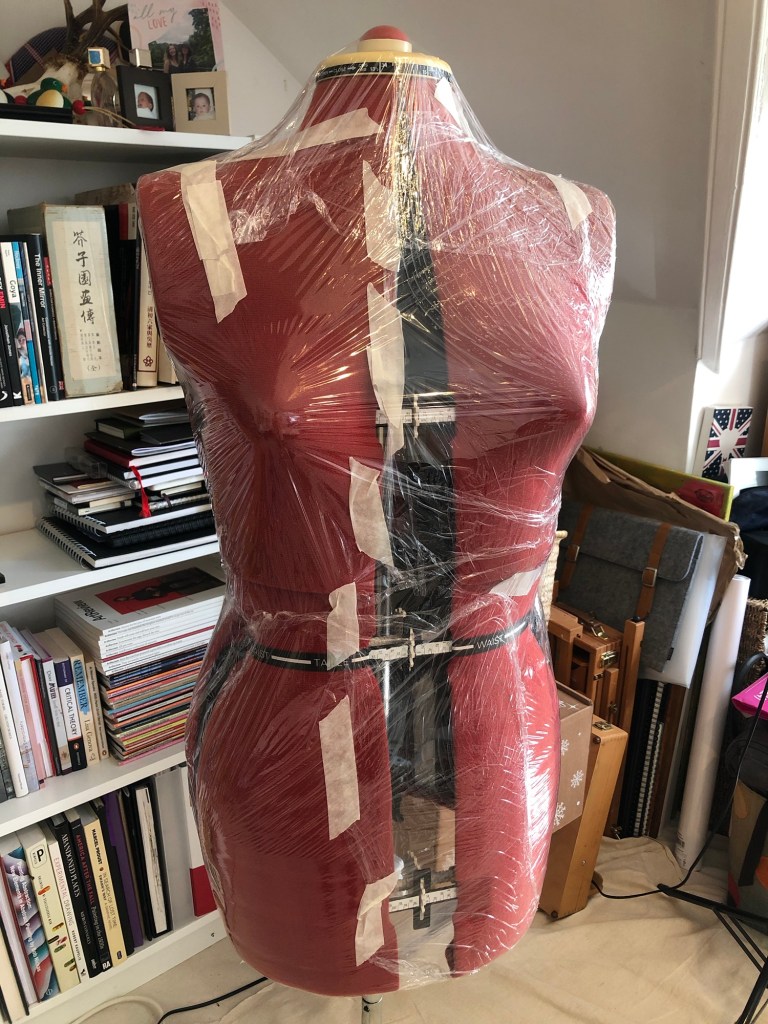
Since the fabric was light weight, the mannequin was wrapped in clingfilm for protection from the painting process.
–
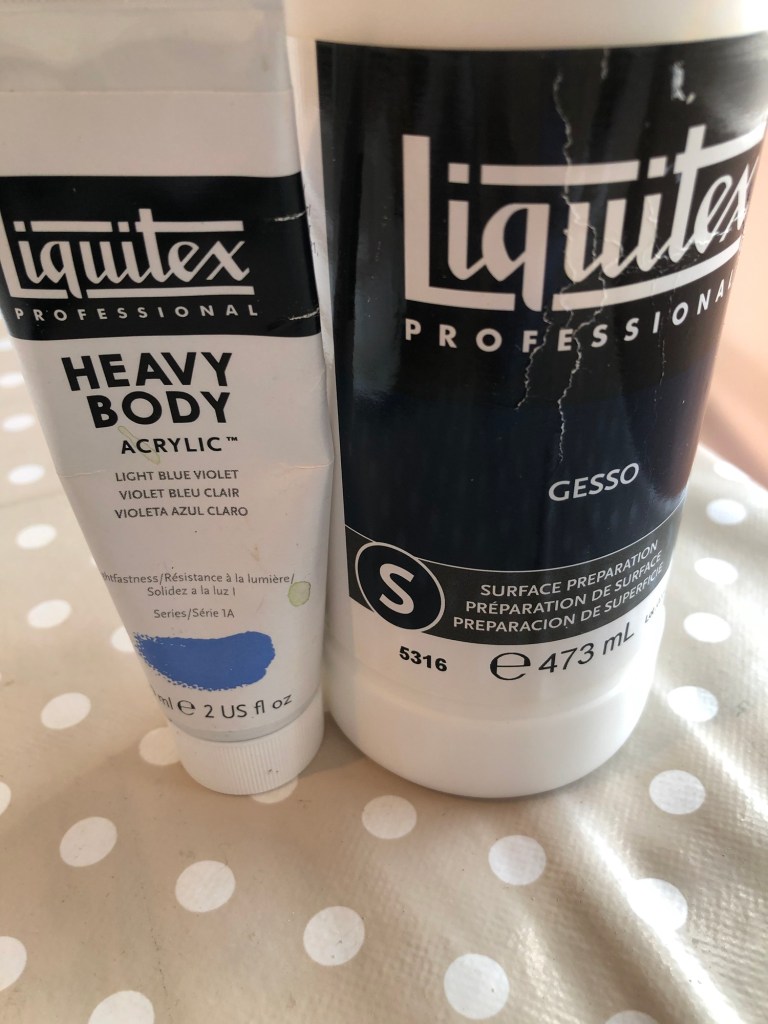
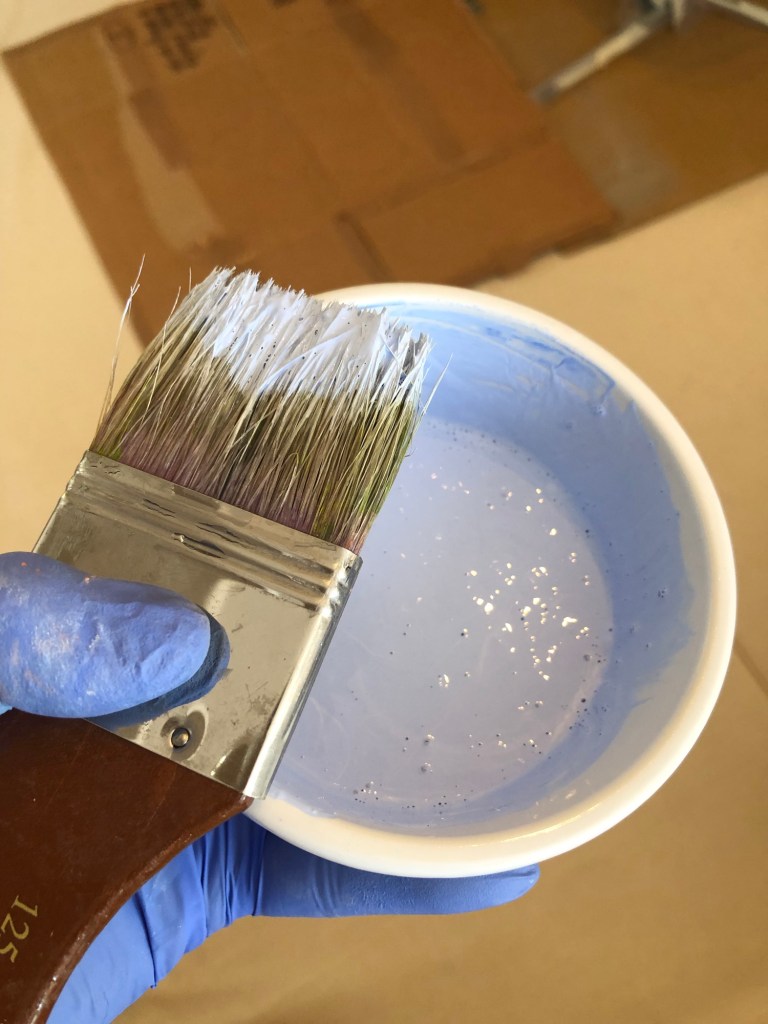
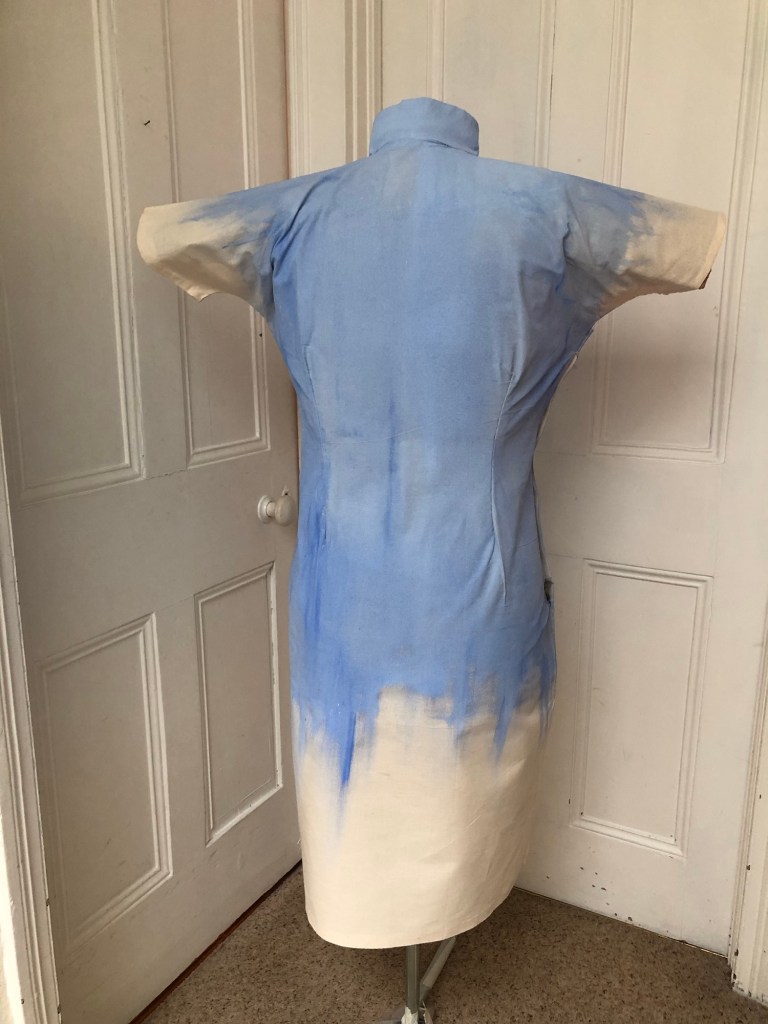
White gesso with acrylic blue tint were diluted as primer.
–
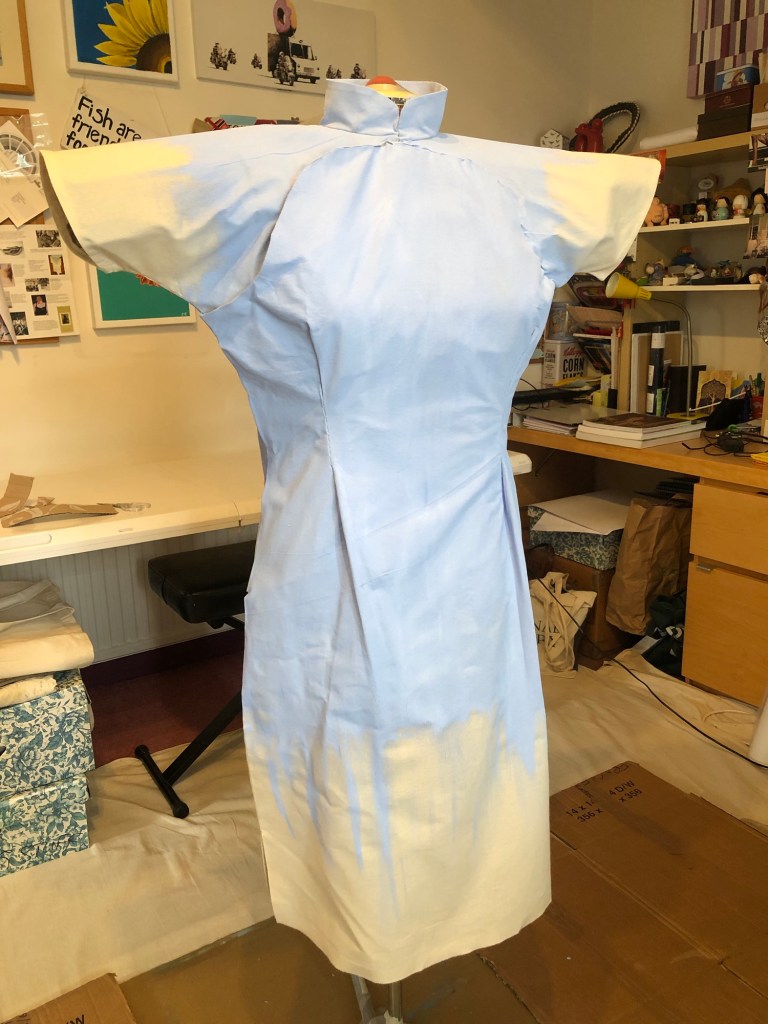
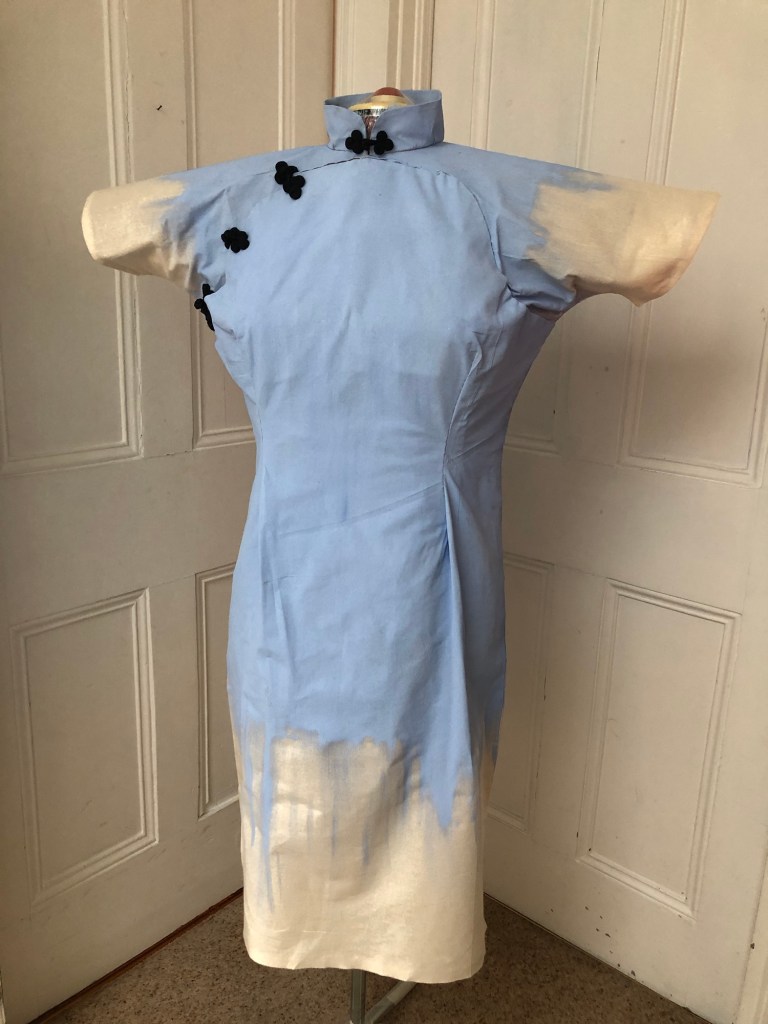
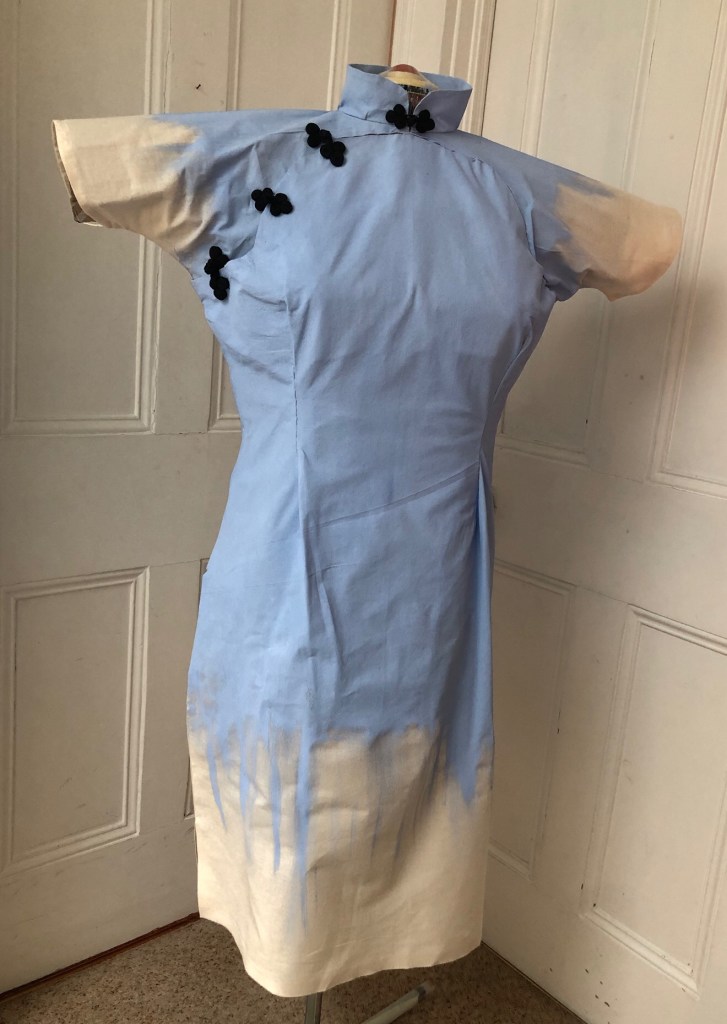
The canvas dress was primed on both sides. The tint worked well and I could use that as the background for the painting.
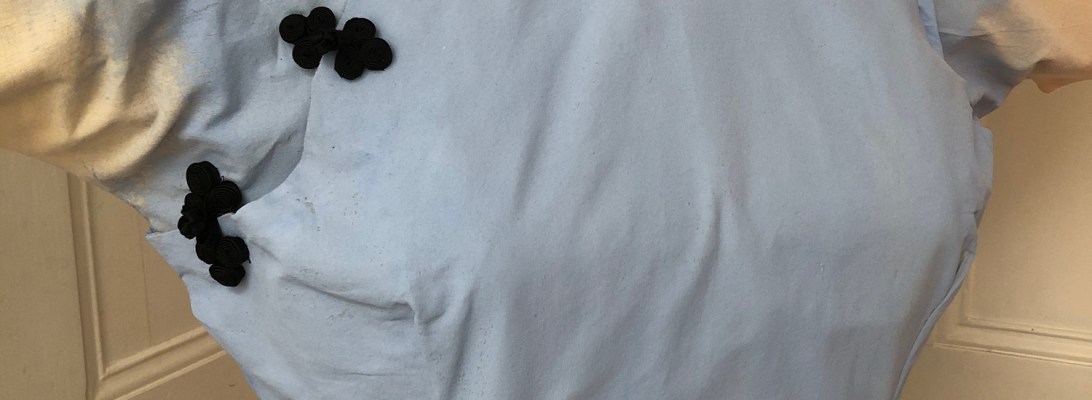
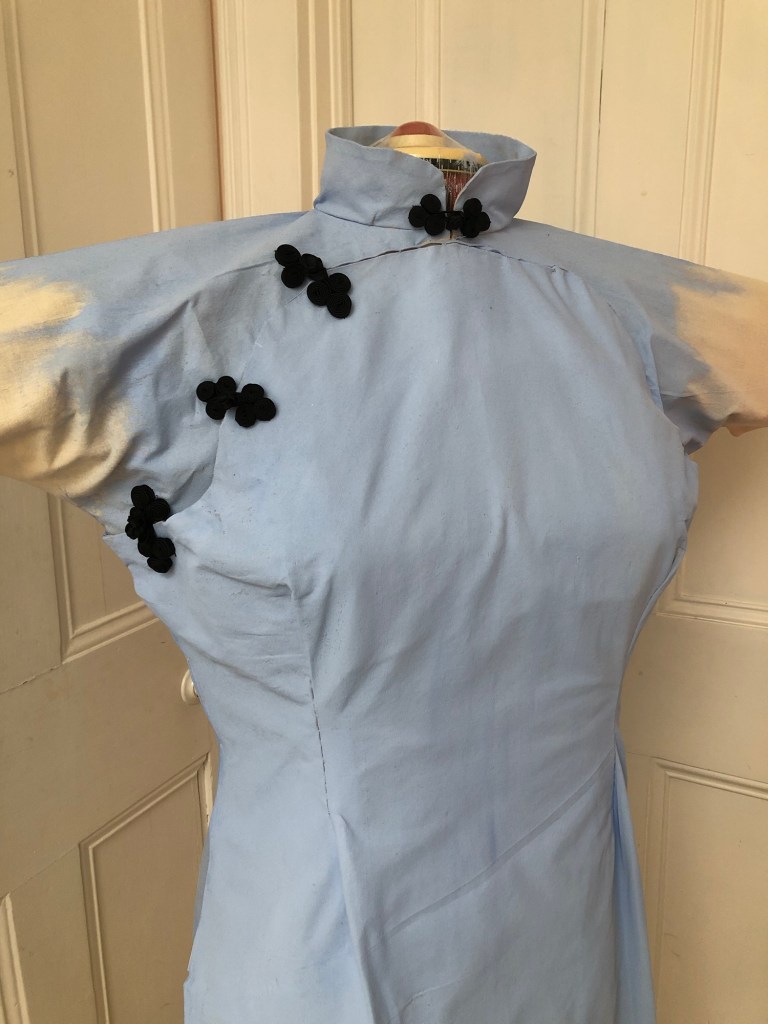
The final finishing step was to add the frogs (tradition fabric buttons or fasteners).
–
REFLECTIONS
I am pleased with the fact that I managed to make a canvas dress using a bought sewing pattern. This experience has given me confidence to take on other sewing or textile projects which will provide an addition dimension to my practice which I feel excited about. For now, I have made a 3D canvas in the shape of a Cheongsam and primed it. Although the painting was not yet finished, I wanted to pause and reflect on the progress so far and take time to consider what to paint on the dress.
The Cheongsam series started as a result of me finding my mother’s old Cheongsams in my loft, which triggered intrigue and inspiration for me to make work on the Cheongsam subject. I know little about the Cheongsam and I am starting to research about its history especially its evolution and how the style changed over time partly due to influences from the West. E.g. the Cheongsam started off as a loose fitting garment, however, as European designers such as Christian Dior marketed more figure-hugging dresses that were pinched at the waist, the Cheongsam started to evolve as Chinese women wanted to emulate European fashion. From around mid-20th century, the Cheongsam started to evolve as a result of the two cultures coming together and the new figure-hugging silhouette emerged which lasted till today. To this end, I believe the modern Cheongsam is a form of a Third Space phenomenon which fits in well with my overall research topic based on Homi K Bhabha’s book, The Location of Culture. My knowledge on the Cheongsam is very limited and I will be borrowing several books on the subject from CSM library. I look forward to finding out more to inform my Cheongsam series of work.
Having established that the modern Cheongsam is potentially a Third Space phenomenon, I would like to use the 3D canvas dress made here for a painting to show something about the Third Space, perhaps another Third Space phenomenon. I am considering making a series of Cheongsam canvases, each painted with a Third Space phenomenon and all as wearable paintings. I want to make them wearable so that they are metaphors for the uniform that transcultural people wear and the roles that they play as they navigate the different cultures in their environment. This work can help to inform my transcultural identity and heritage research.
LEARNING
I have learnt various techniques while making the dress and the experience will be useful as I go onto making other garments to feed into my practice.
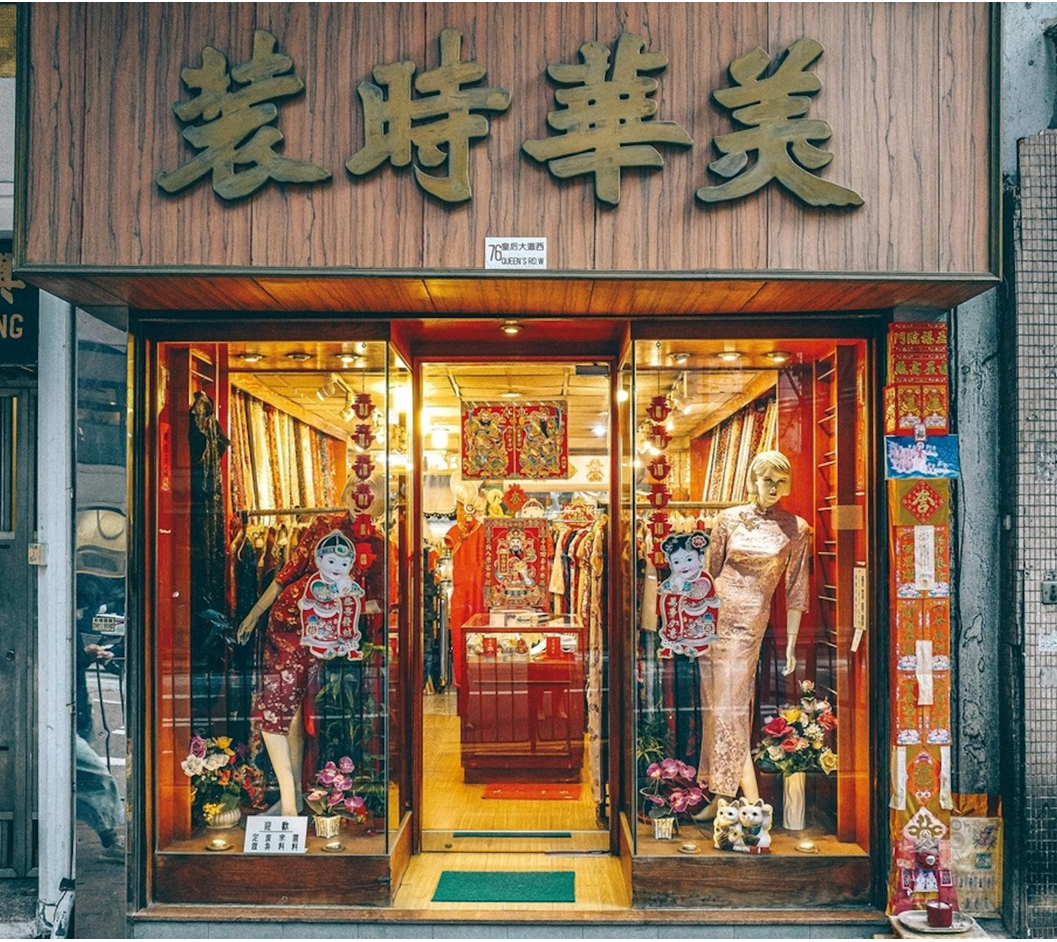
I need to learn more about the history of the Cheongsam because it intrigues me and is an interesting part of the Hong Kong heritage that will help inform my art practice. Especially with my late mother being a skilful dressmaker and I remember clearly the dress that I found being in her wardrobe for many years. My older sister remembers visiting the tailor’s shop with my mother to order the dress. In fact, she has recently found the history of the shop for me – it still exists in Hong Kong.
–
NEXT STEPS
Decide what to paint on the canvas and do the painting.
Research about Cheongsam to build on the series of work.
 elizarawlings