BACKGROUND
As part of my style development work, I have just completed a series of media exploration where I experimented with combining oil and cold wax with various ways of overlaying Chinese brush paintings on top without compromising either medium. I now want to progress onto exploring aesthetics starting with colours.
Despite having attended workshops on colour mixing over the years and researched how colours work together, I have always used colours intuitively in my paintings rather than follow any strict rules. However, I often feel that I should be more considered when using colours for my work. I attended an exhibition of London based Columbian artist, Ofelia Rodrigues, where I was inspired by her use of colours and images to express her culture giving a strong sense of place for her narrative.
For my art practice, I have reached a point where I want to re-evaluate and hone how I use colours, especially when my aim is to express my stories and narrative through my work. Also, my wish is to go towards semi-abstraction for my narrative work and I believe the use of colour is key. This is the first blog of the series on exploring the use of colour to express a sense of place for my transcultural narrative.
METHOD
To begin with, I needed some visual inspiration. I started by gathering books that I have on contemporary Chinese artists as well as chinoiserie style art. Although chinoiserie art has deep roots in political historical, its origin is not part of the research here. In my view, chinoiserie is an example of art in the ‘Third Space’ – where two cultures come together and something new emerges that has characteristics of the original cultures. Although the chinoiserie style of art does not appeal to or resonate with me, their use of colours is worth examining for my research purpose.
My aim here is to look through images in the books and choose one that resonates. Then mix the colours and explore similar colours as a ‘back to basics’ exercise to get my thought process going and to see where it takes me.
Books that I gathered:
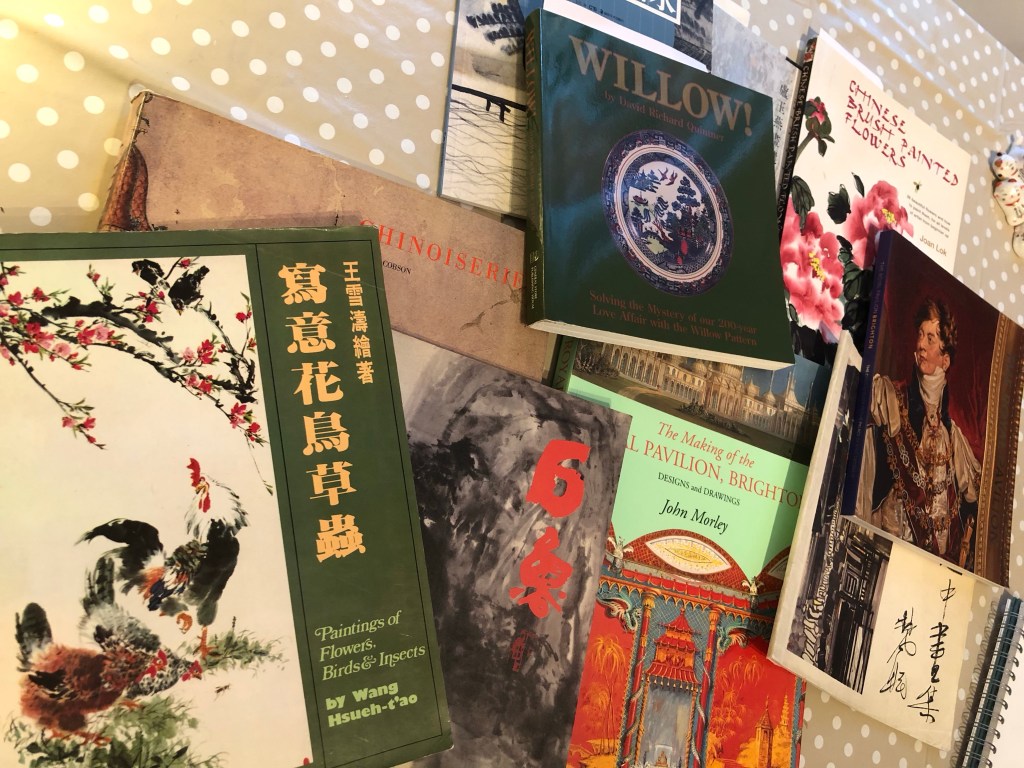
The book that I have chosen for this exercise is by a contemporary Chinese artist, Wu Guan Zhong. The link below gives a good summary about the artist:
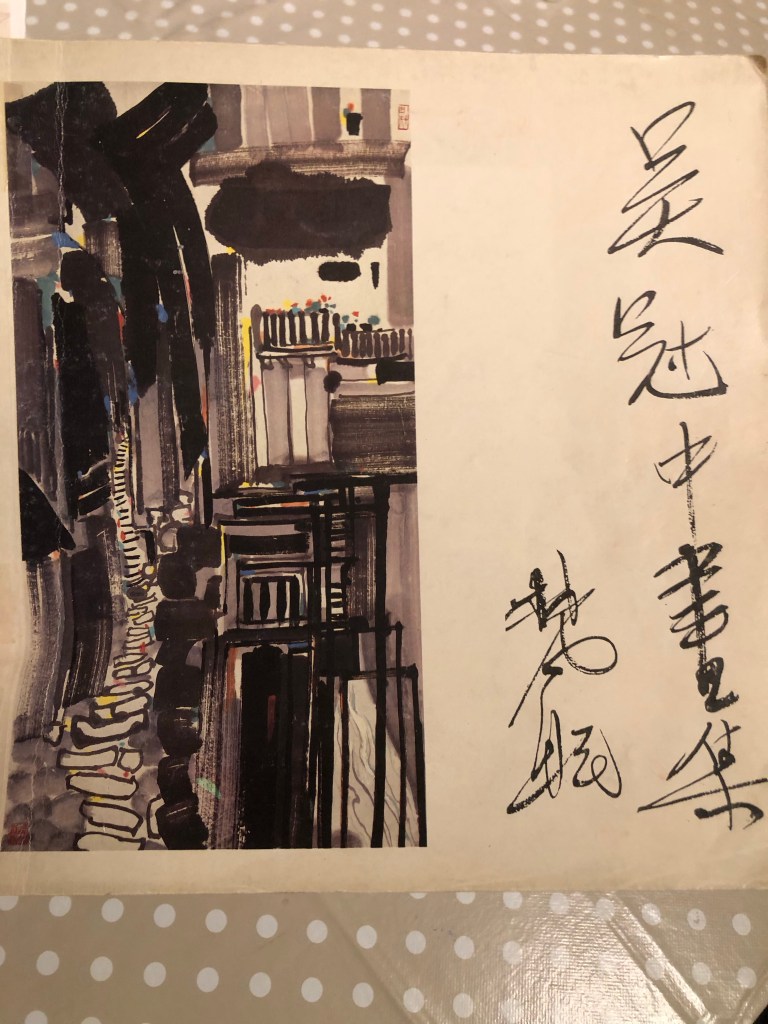
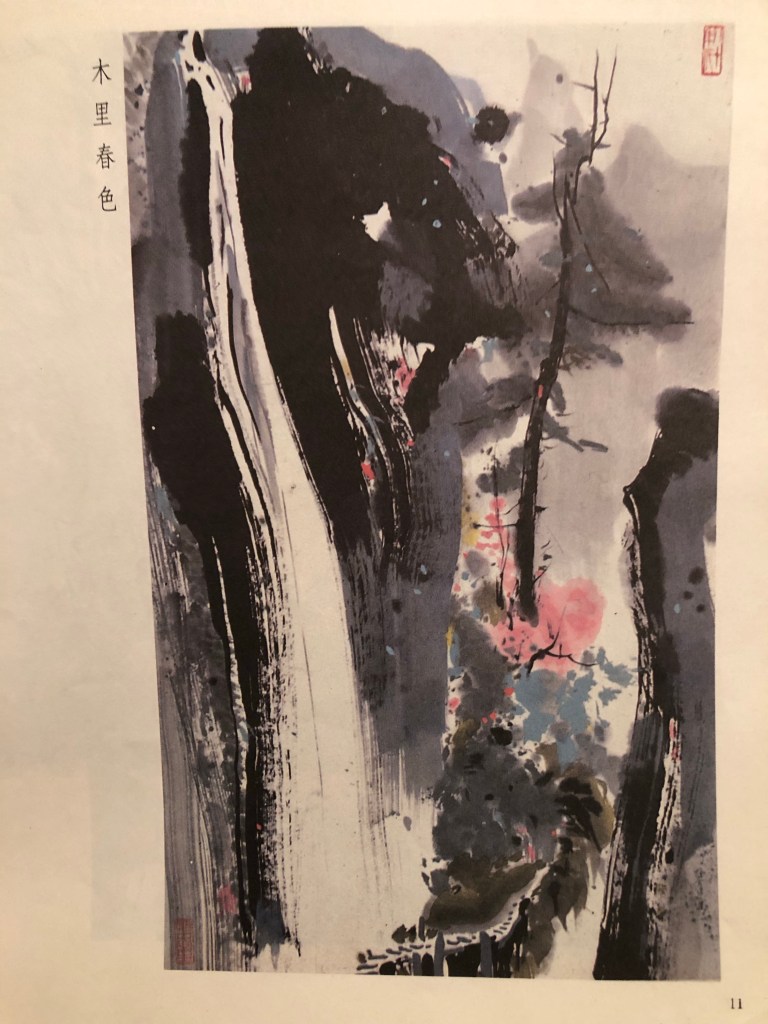
The painting that I have chosen to kick start my colour exploration:
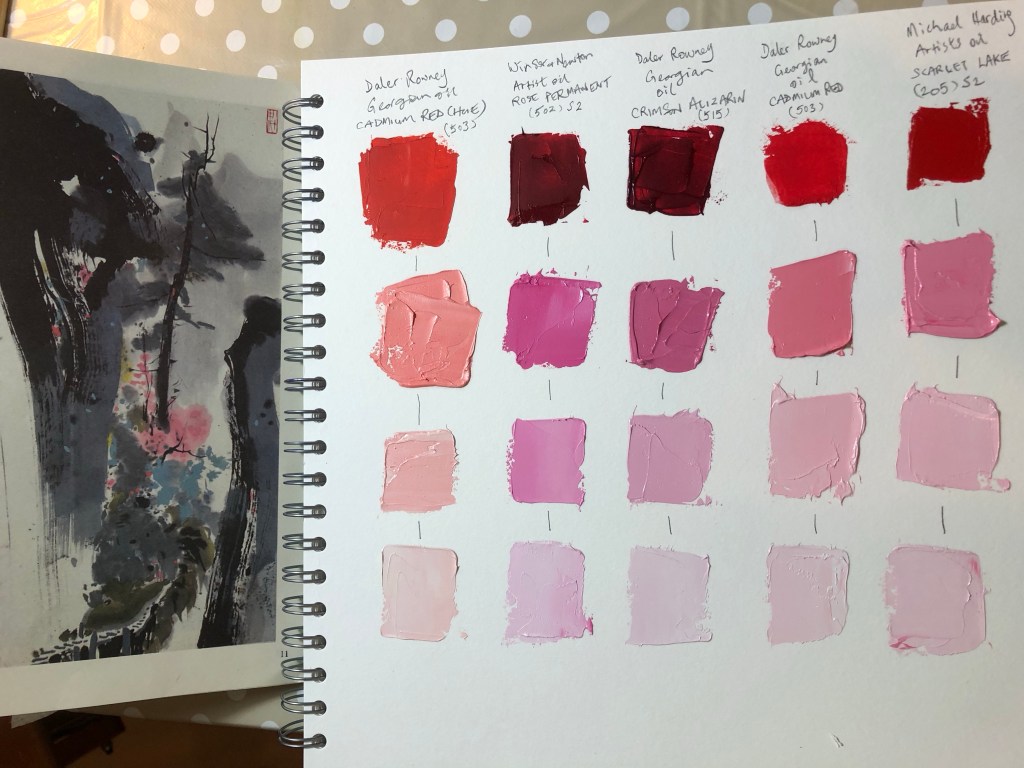
I got out all my various red oil paints and increased the lightness of each by tinting with titanium white:
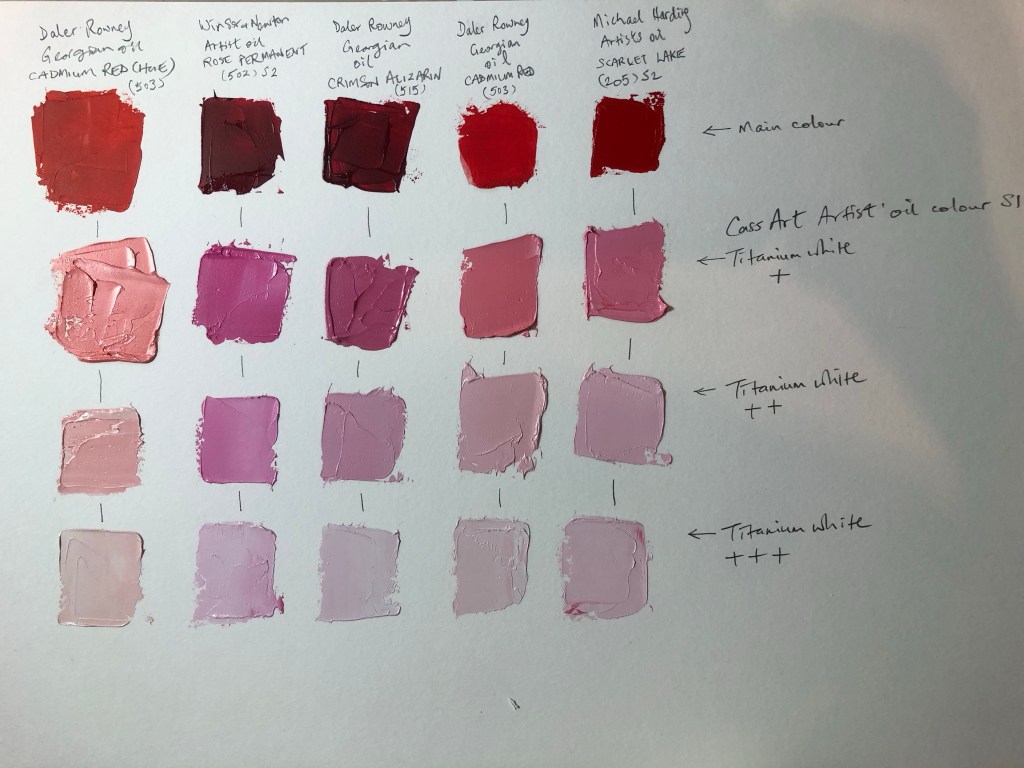
Several matching possibilities came up in my ‘red’ chart:
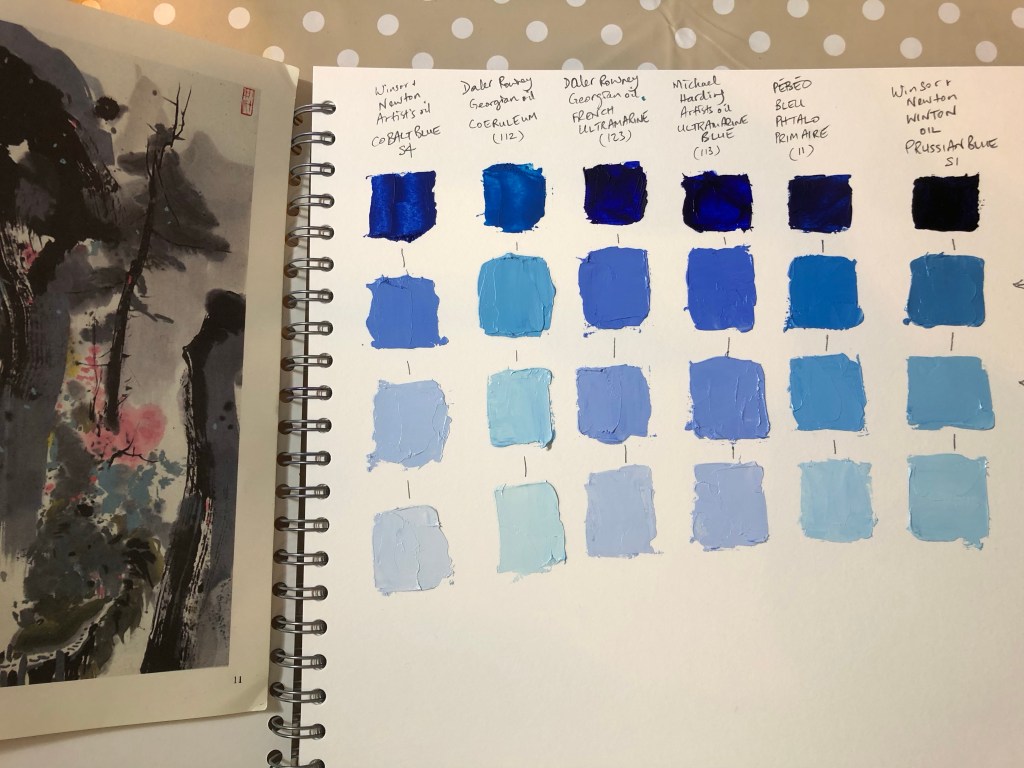
Then the same exercise was repeated with all my blue oil paints:

Various matching possibilities came up:
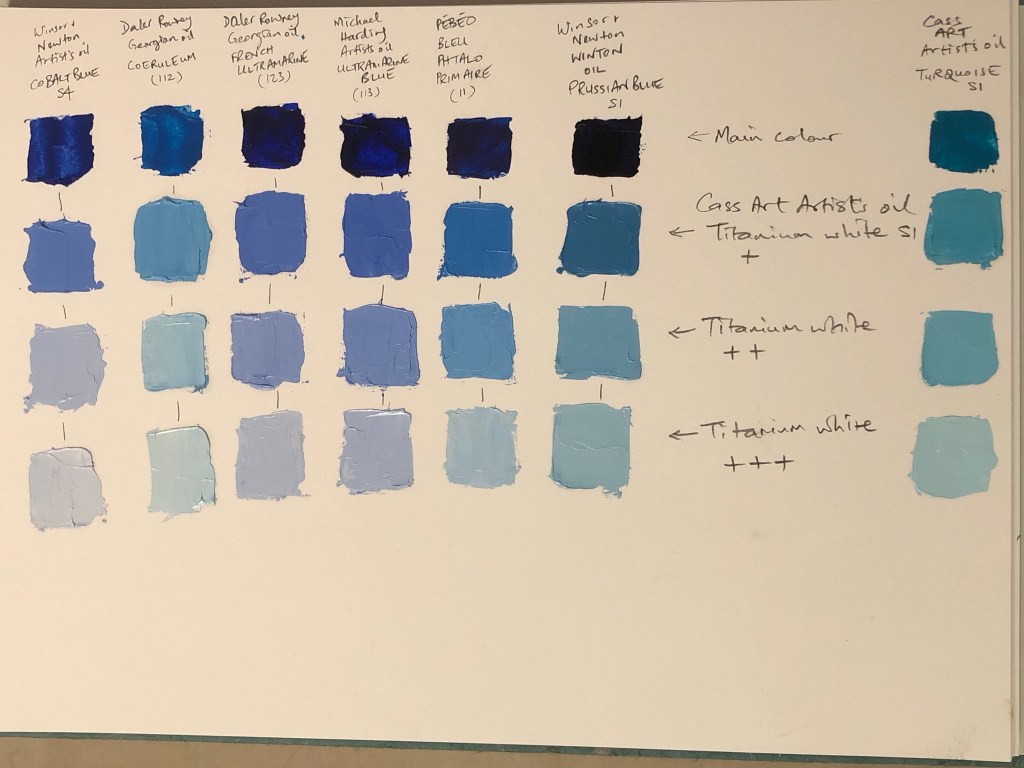
I added a new turquoise paint that I bought recently to the chart:
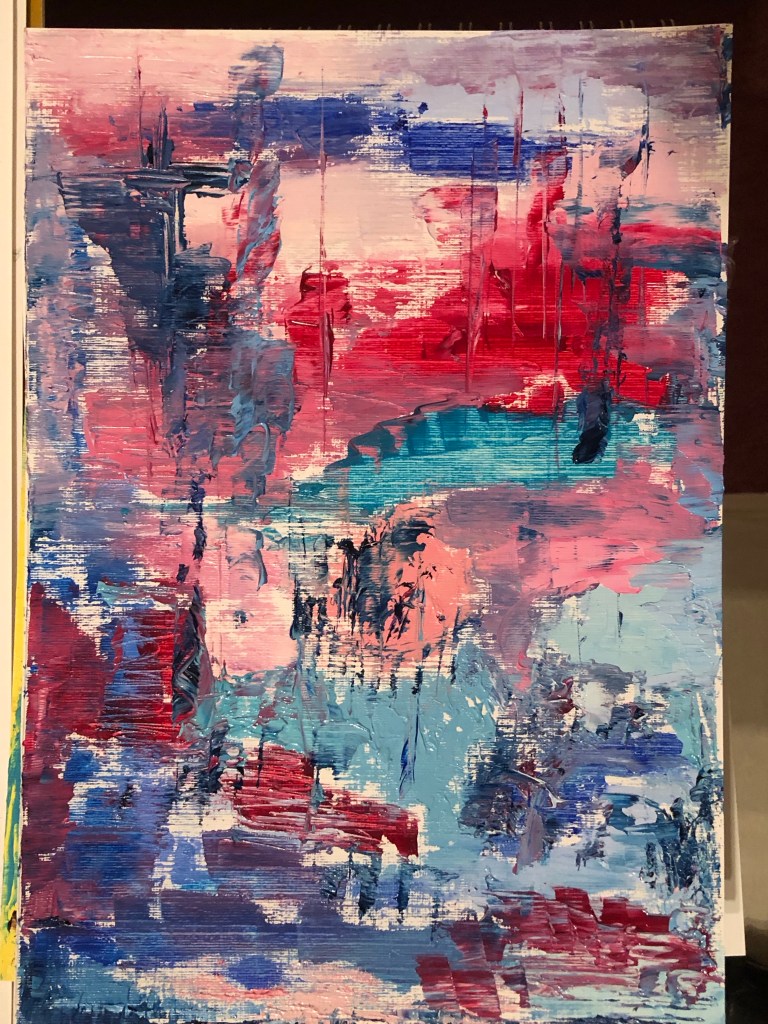
An abstract painting was made with all the left over paint:
–
REFLECTIONS
– Although it was not the intention, it turned out to be a useful inventory exercise for my oil paint. Since I often default to certain favourites, I have neglected others that have turned out to be ‘gems’ in the tinting process.
– There were also new findings about the different brands. I want to capture my thoughts here as a reminder for the future:
1. Michael Harding oil paint is always my favourite and this exercise reminded me that they deserve that top spot with the buttery consistency, pigment quality and load concentration.
2. Winsor and Newton artists oil was once a favourite before I went onto Michael Harding. This exercise reminded me of the quality of their pigment load, colour and how well they mixed. A solid product that I should not have neglected.
3. Daler Rowney Georgian oil was a brand that I used when I first started learning to paint in oil. It was sold to me as student grade oil. However, I recently read some reviews by artists saying they use it as their go-to oil so I decided to try them again. They are good value and I recently bought a batch ready for some larger scale oil experiments and they are just right for that. Pigment load is not as good as the above two but definitely good enough for some of my experiments where I plan to use a lot of oil. The ones I used for this exercise stood up well enough in the tinting process and produced some interesting colours.
4. I was introduced to Cass Art artist’s oil when I was in their shop. It’s a range that I have not tried before. It was sold as good value artist grade oil and better quality than the Daler Rowney Georgian oil that I was buying at the time. So I bought some to try, e.g. the turquoise in the last column of the blue tinting exercise. I was somewhat disappointed because the consistency was not as good as the other brand’s artist grade or even the DR Georgian oil performed better in this respect. I was also disappointed with the pigment colour and load. So I don’t think I will buy this brand again.
5. I have had a set of PEBEO oil for years and rarely use them despite the good range of vibrant colours. I got them out for this exercise and was pleasantly surprised. I always considered them as student grade quality and although it didn’t compare well to Nos. 1 and 2 above, it performed well in mixing and pigment load. The paint appeared more flat and matt compared to the other oils but it is certainly good enough for day-to-day projects. The wide variety of colours in the PEBEO set is a bonus that I have been neglecting.
– This was a good back-to-basics exercise that I needed to do to restart my colour exploration. I don’t know exactly what I’m looking for but I want to continue this with other colours.
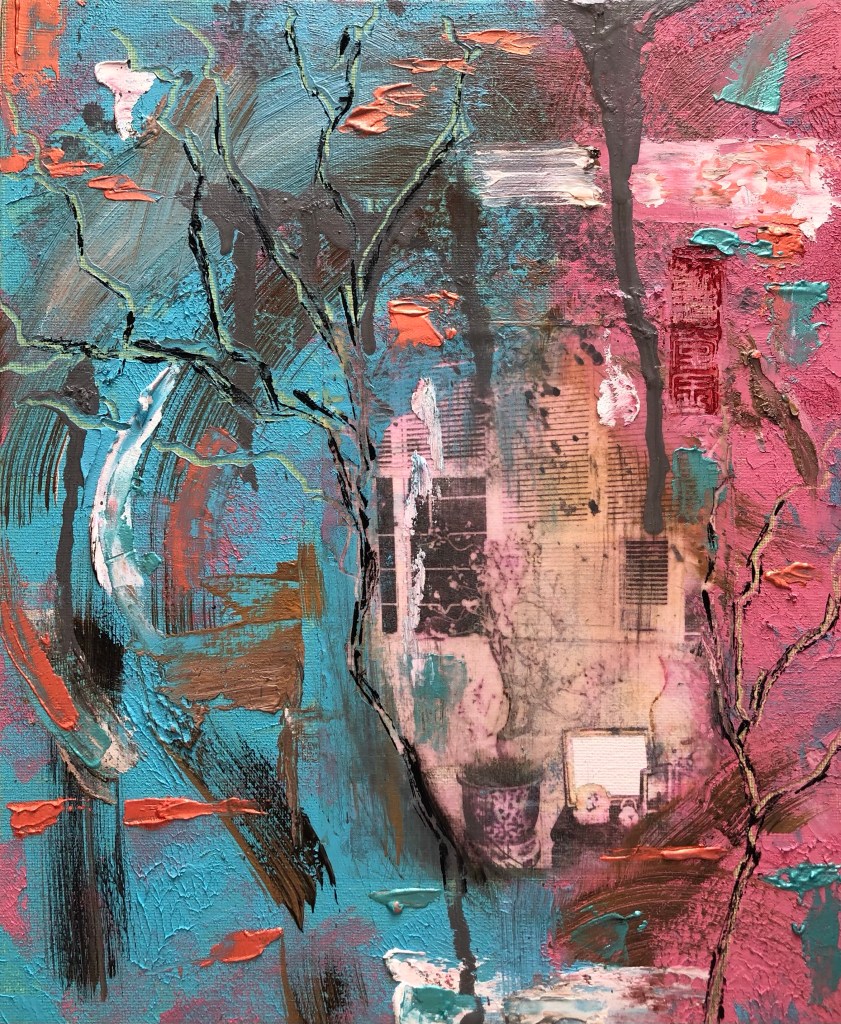
– It occurred to me at the end of the exercise that I recently made a painting using similar colours to those in Wu’s painting. My painting was started by finding an old photograph of my parents’ lounge during one Chinese New Year when they were both alive many years ago. I don’t know why these two colours speak to me whenever I want to make narrative work. I also remember that I showed this painting at a crit session and I struggled to explain it. I need to think more about this…
–
LEARNING
– Some good discoveries of tinted reds and blues for me to consider using when determining colour palette for future narrative work.
– The colours in Wu’s painting and some of the tints in this exercise clearly speak to me but I don’t know why yet. Interrogating this might reveal more clues and help to develop more depth for my narrative.
– I have not studied Wu’s work before and researching his work showed that he also worked with oil and Chinese ink. This is a useful finding as that’s what I am trying to do as well. Since Wu is a European (French) trained artist (painter) of Chinese origin, we have some common backgrounds and I will add Wu to my list of artists to research, especially about his chosen media and process.
NEXT STEPS
– Do another tinting or colour mixing exercise – find another painting for inspiration.
– Think more about why the colours in Wu’s painting speak to me.
– Add Wu to my list of artists to research.
 elizarawlings