MA Y1 U1: Exploring colours – Part 1 – red and blue

BACKGROUND

As part of my style development work, I have just completed a series of media exploration where I experimented with combining oil and cold wax with various ways of overlaying Chinese brush paintings on top without compromising either medium. I now want to progress onto exploring aesthetics starting with colours.

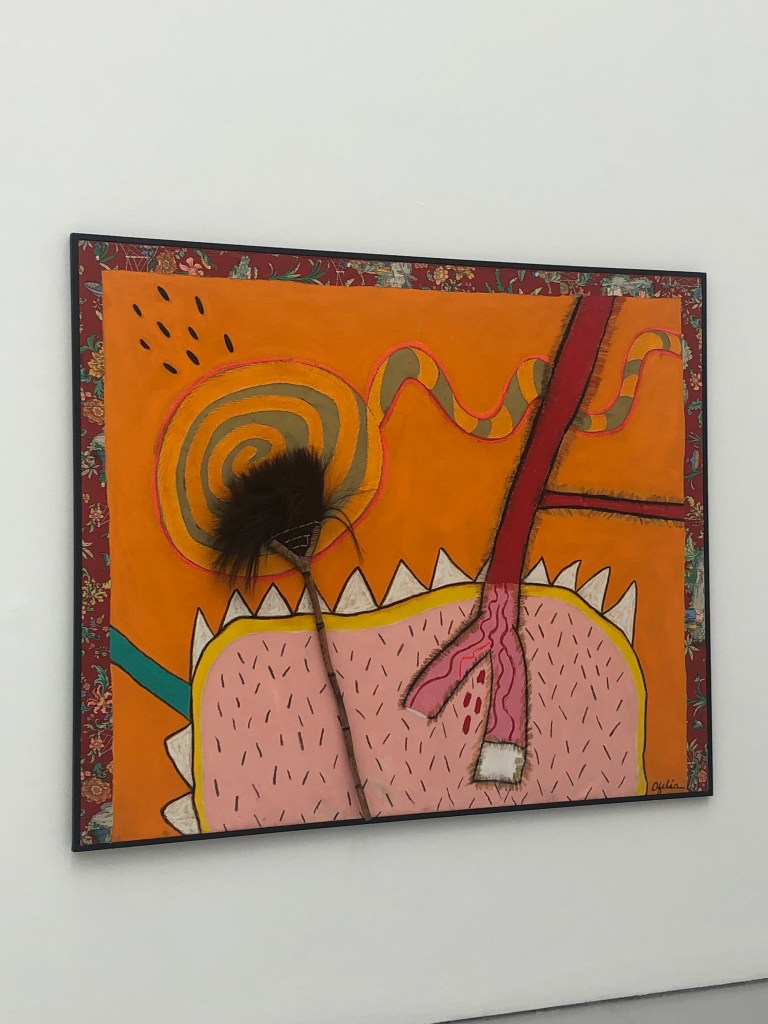
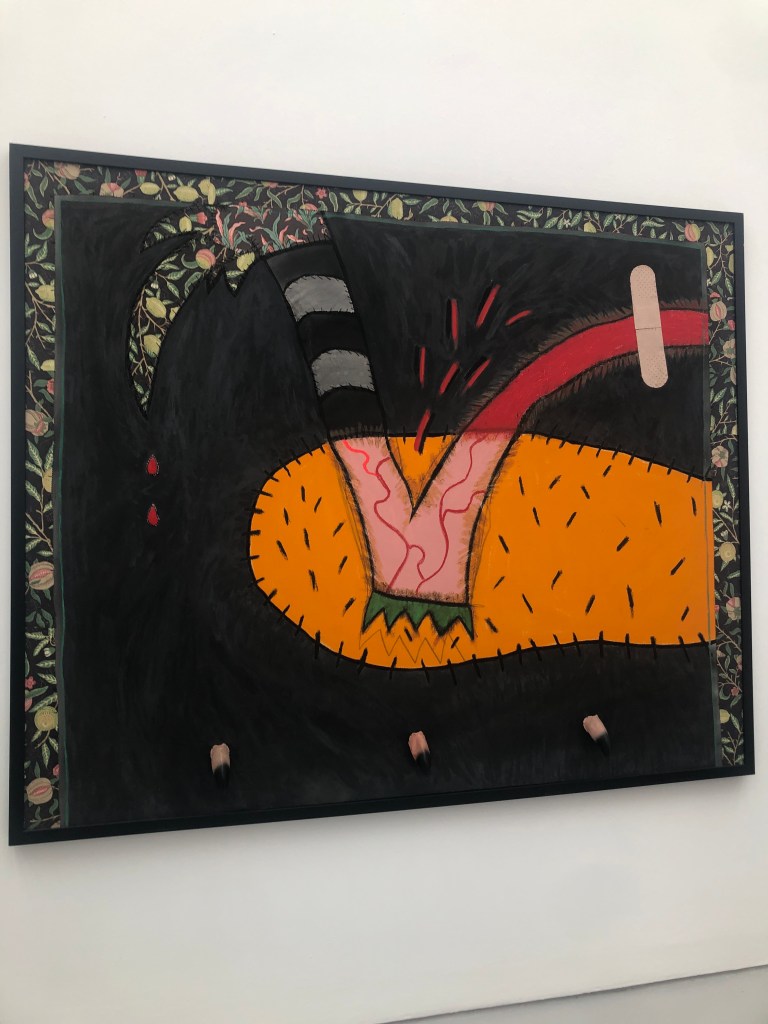
Despite having attended workshops on colour mixing over the years and researched how colours work together, I have always used colours intuitively in my paintings rather than follow any strict rules. However, I often feel that I should be more considered when using colours for my work. I attended an exhibition of London based Columbian artist, Ofelia Rodrigues, where I was inspired by her use of colours and images to express her culture giving a strong sense of place for her narrative.

For my art practice, I have reached a point where I want to re-evaluate and hone how I use colours, especially when my aim is to express my stories and narrative through my work. Also, my wish is to go towards semi-abstraction for my narrative work and I believe the use of colour is key. This is the first blog of the series on exploring the use of colour to express a sense of place for my transcultural narrative.

METHOD

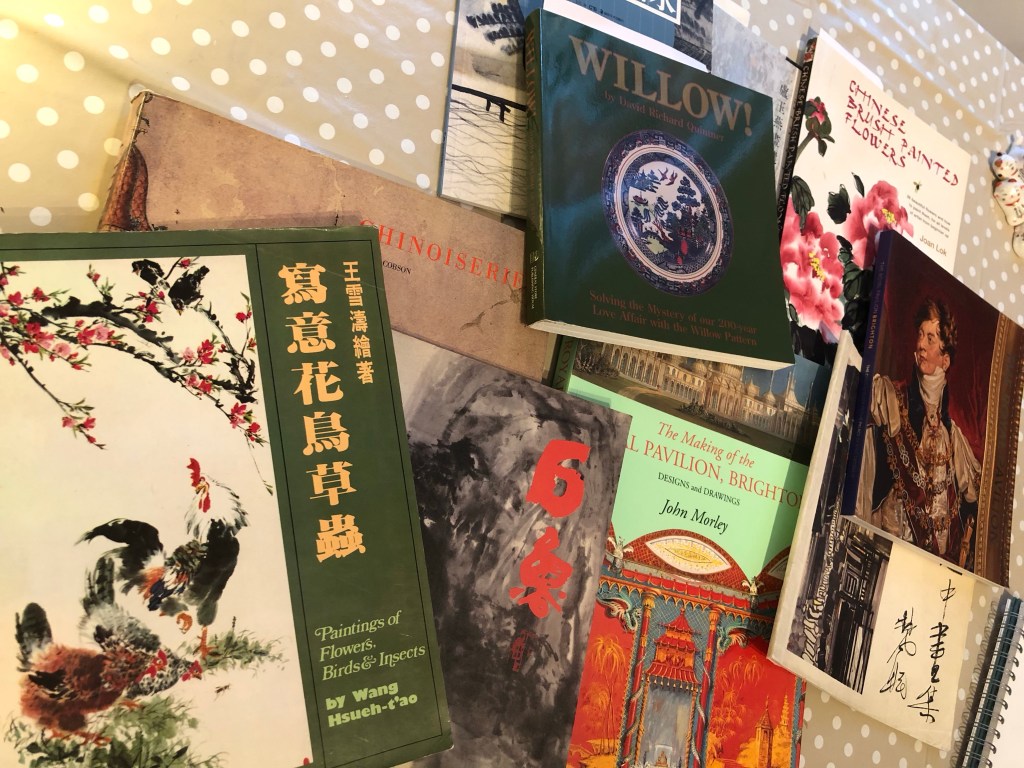
To begin with, I needed some visual inspiration. I started by gathering books that I have on contemporary Chinese artists as well as chinoiserie style art. Although chinoiserie art has deep roots in political historical, its origin is not part of the research here. In my view, chinoiserie is an example of art in the ‘Third Space’ – where two cultures come together and something new emerges that has characteristics of the original cultures. Although the chinoiserie style of art does not appeal to or resonate with me, their use of colours is worth examining for my research purpose.

My aim here is to look through images in the books and choose one that resonates. Then mix the colours and explore similar colours as a ‘back to basics’ exercise to get my thought process going and to see where it takes me.

Books that I gathered:
The book that I have chosen for this exercise is by a contemporary Chinese artist, Wu Guan Zhong. The link below gives a good summary about the artist:
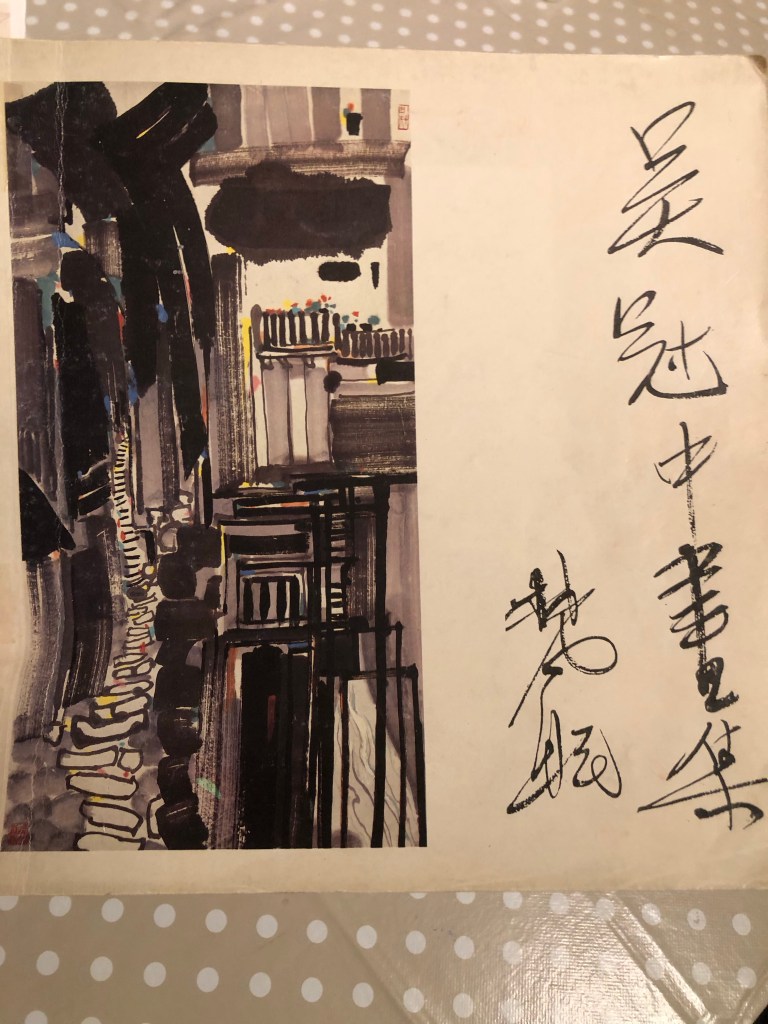
https://www.christies.com/en/stories/wu-guanzhong-an-artist-of-feeling-rather-than-fact-dd97ec0d995d47eb9c56753e3c280e41

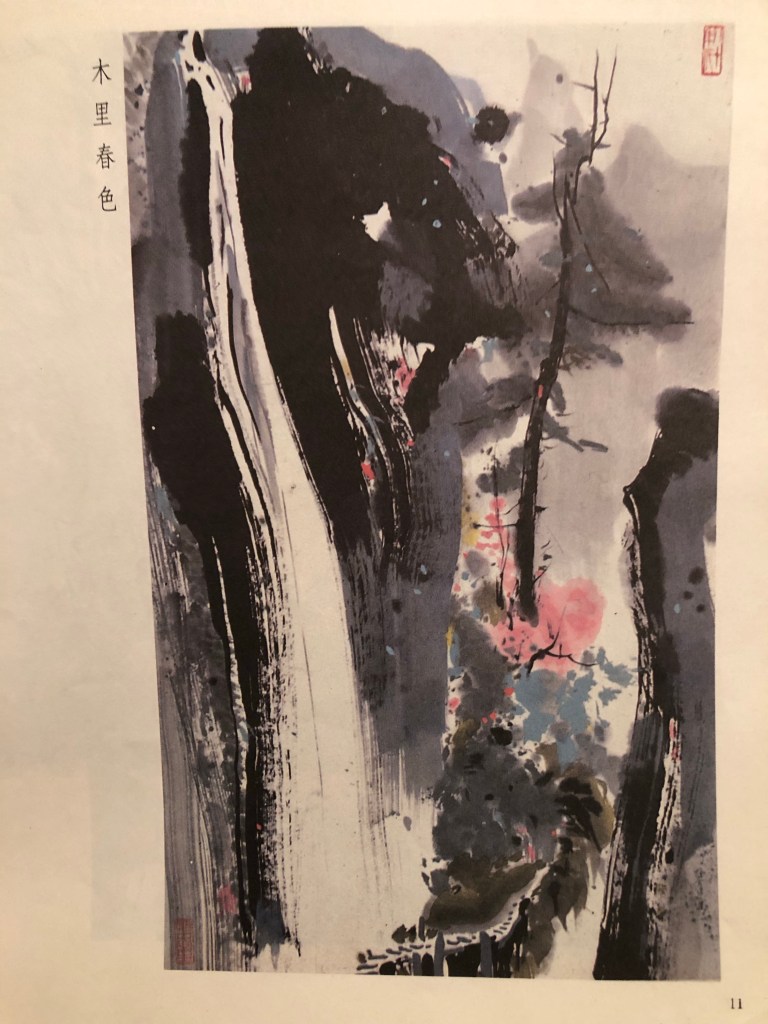
The painting that I have chosen to kick start my colour exploration:
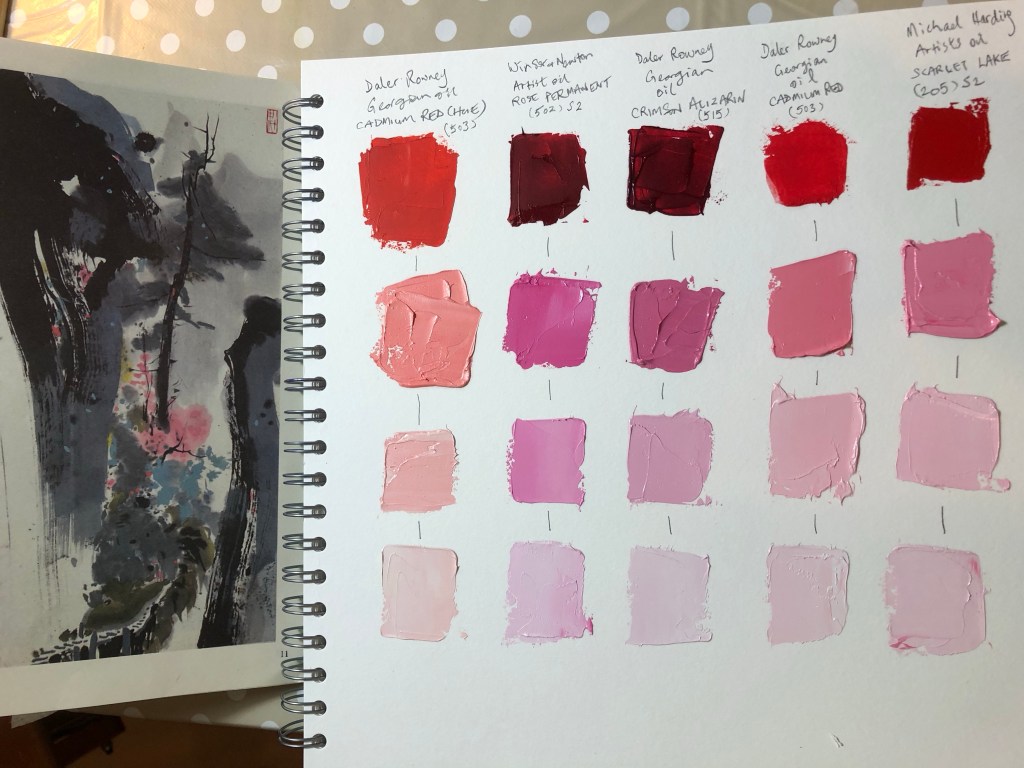
I got out all my various red oil paints and increased the lightness of each by tinting with titanium white:
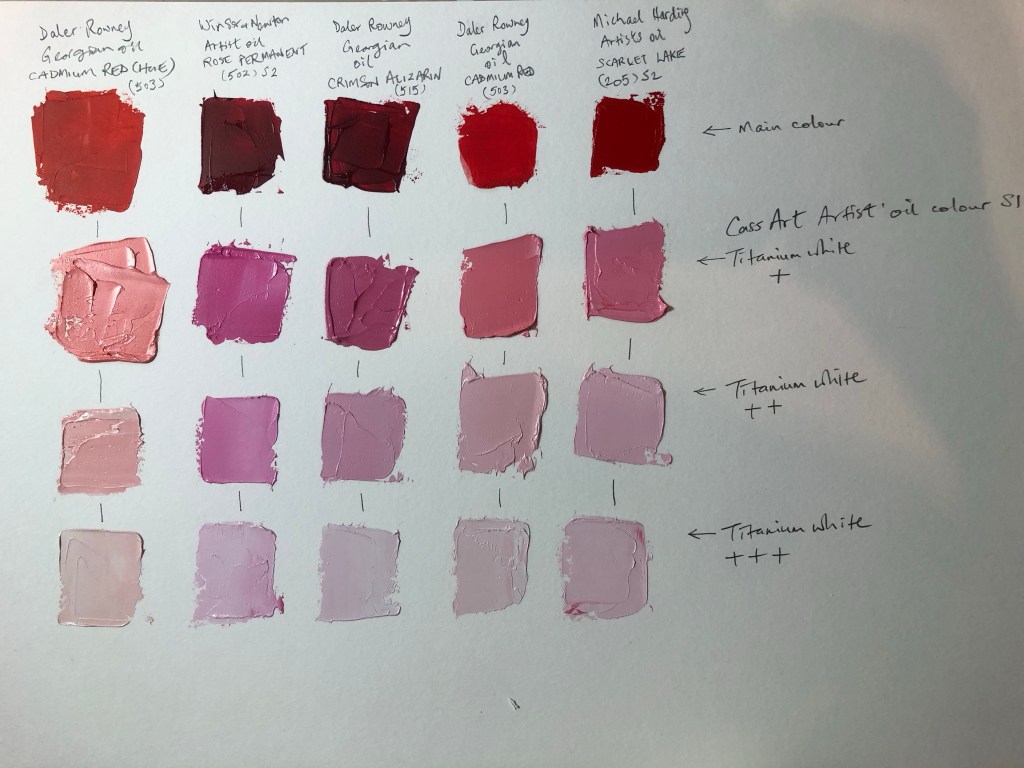
Several matching possibilities came up in my ‘red’ chart:
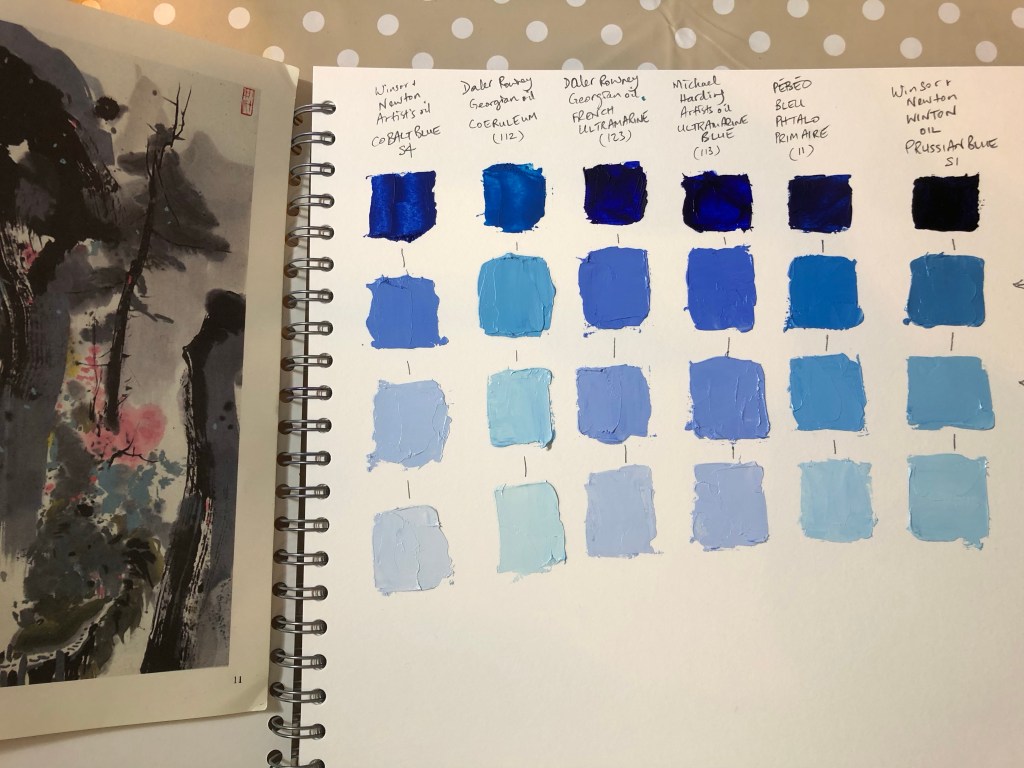
Then the same exercise was repeated with all my blue oil paints:

Various matching possibilities came up:
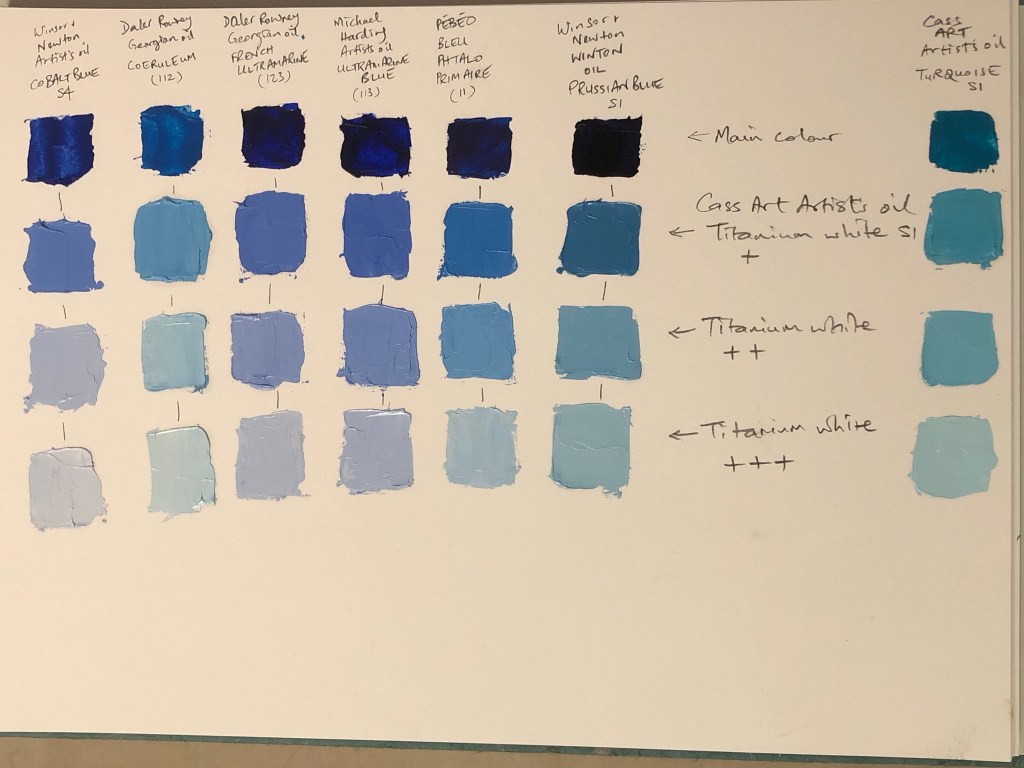
I added a new turquoise paint that I bought recently to the chart:
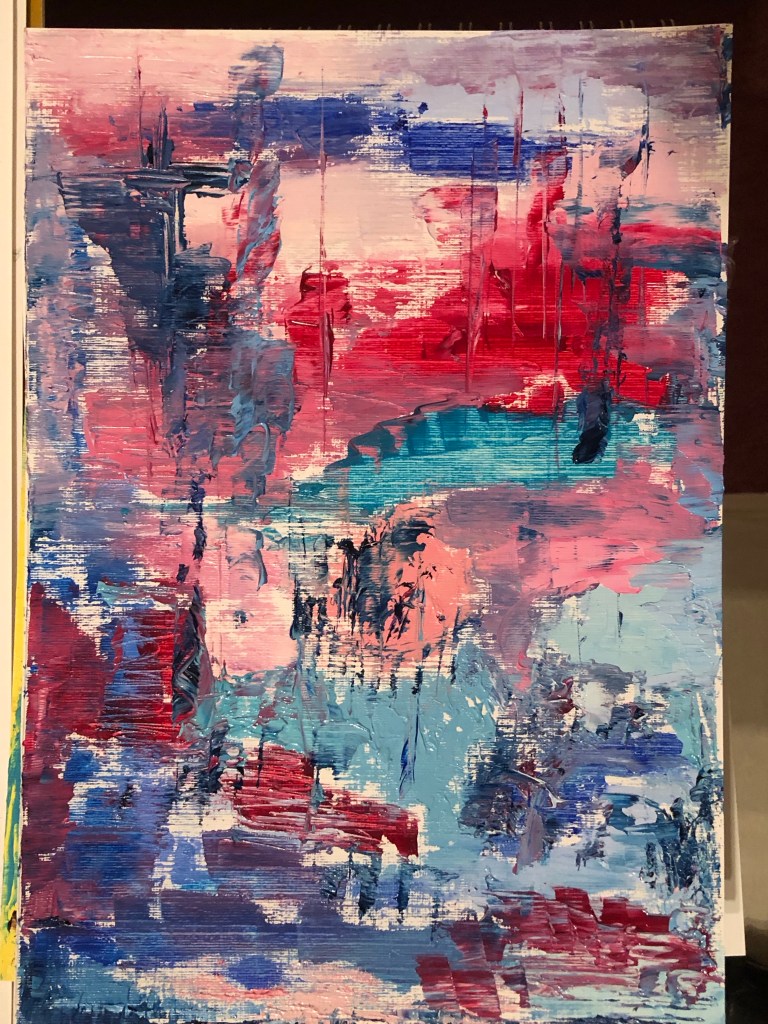
An abstract painting was made with all the left over paint:
REFLECTIONS

– Although it was not the intention, it turned out to be a useful inventory exercise for my oil paint. Since I often default to certain favourites, I have neglected others that have turned out to be ‘gems’ in the tinting process.

– There were also new findings about the different brands. I want to capture my thoughts here as a reminder for the future:

1. Michael Harding oil paint is always my favourite and this exercise reminded me that they deserve that top spot with the buttery consistency, pigment quality and load concentration.

2. Winsor and Newton artists oil was once a favourite before I went onto Michael Harding. This exercise reminded me of the quality of their pigment load, colour and how well they mixed. A solid product that I should not have neglected.

3. Daler Rowney Georgian oil was a brand that I used when I first started learning to paint in oil. It was sold to me as student grade oil. However, I recently read some reviews by artists saying they use it as their go-to oil so I decided to try them again. They are good value and I recently bought a batch ready for some larger scale oil experiments and they are just right for that. Pigment load is not as good as the above two but definitely good enough for some of my experiments where I plan to use a lot of oil. The ones I used for this exercise stood up well enough in the tinting process and produced some interesting colours.

4. I was introduced to Cass Art artist’s oil when I was in their shop. It’s a range that I have not tried before. It was sold as good value artist grade oil and better quality than the Daler Rowney Georgian oil that I was buying at the time. So I bought some to try, e.g. the turquoise in the last column of the blue tinting exercise. I was somewhat disappointed because the consistency was not as good as the other brand’s artist grade or even the DR Georgian oil performed better in this respect. I was also disappointed with the pigment colour and load. So I don’t think I will buy this brand again.

5. I have had a set of PEBEO oil for years and rarely use them despite the good range of vibrant colours. I got them out for this exercise and was pleasantly surprised. I always considered them as student grade quality and although it didn’t compare well to Nos. 1 and 2 above, it performed well in mixing and pigment load. The paint appeared more flat and matt compared to the other oils but it is certainly good enough for day-to-day projects. The wide variety of colours in the PEBEO set is a bonus that I have been neglecting.

– This was a good back-to-basics exercise that I needed to do to restart my colour exploration. I don’t know exactly what I’m looking for but I want to continue this with other colours.

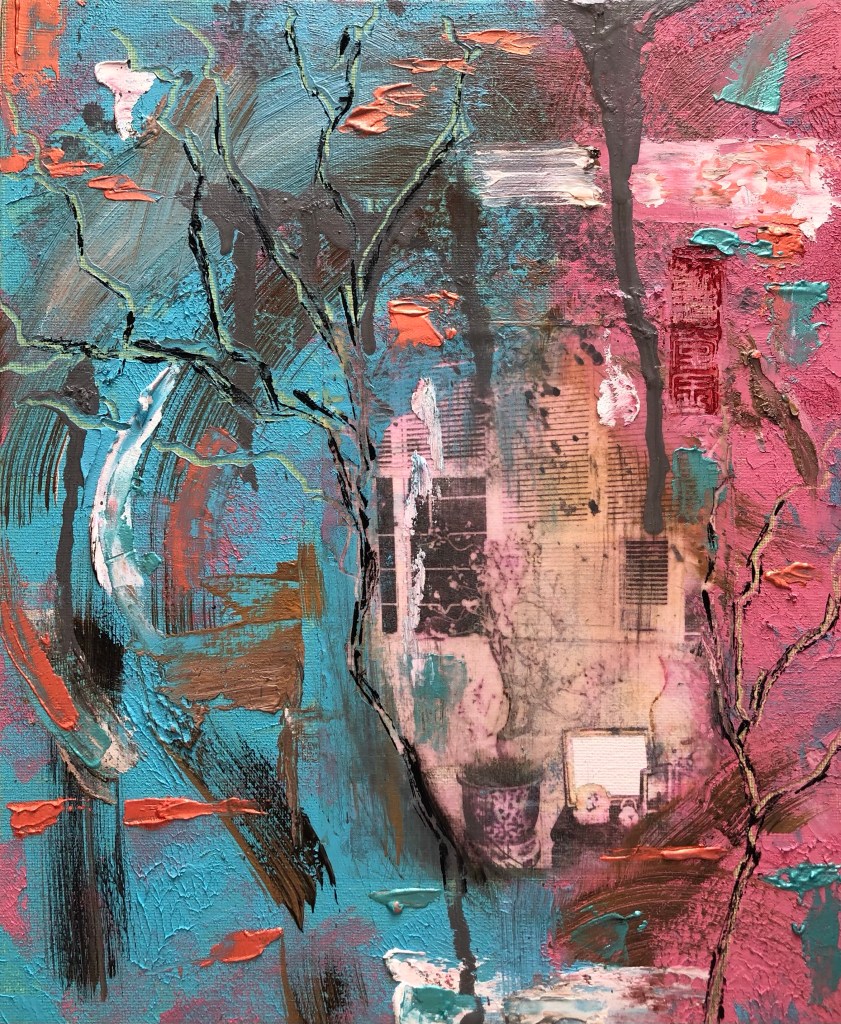
– It occurred to me at the end of the exercise that I recently made a painting using similar colours to those in Wu’s painting. My painting was started by finding an old photograph of my parents’ lounge during one Chinese New Year when they were both alive many years ago. I don’t know why these two colours speak to me whenever I want to make narrative work. I also remember that I showed this painting at a crit session and I struggled to explain it. I need to think more about this…
LEARNING

– Some good discoveries of tinted reds and blues for me to consider using when determining colour palette for future narrative work.

– The colours in Wu’s painting and some of the tints in this exercise clearly speak to me but I don’t know why yet. Interrogating this might reveal more clues and help to develop more depth for my narrative.

– I have not studied Wu’s work before and researching his work showed that he also worked with oil and Chinese ink. This is a useful finding as that’s what I am trying to do as well. Since Wu is a European (French) trained artist (painter) of Chinese origin, we have some common backgrounds and I will add Wu to my list of artists to research, especially about his chosen media and process.

NEXT STEPS

– Do another tinting or colour mixing exercise – find another painting for inspiration.

– Think more about why the colours in Wu’s painting speak to me.

– Add Wu to my list of artists to research.
Chinese painting: Sumi-e painting – animal

BACKGROUND

At my monthly Chinese painting class, we have started to learn Sumi-e painting. Sumi-e means ‘water ink’ and water ink painting originated in China around 300AD. Zen Buddhist monks from China introduced this style of ink art to Japan in the 14th century where over time the brush strokes were reduced in number and simplified forming the Japanese Sumi-e style painting of today.

At a previous lesson, we started to paint leaves by copying from worksheets and this lesson we practiced some more.

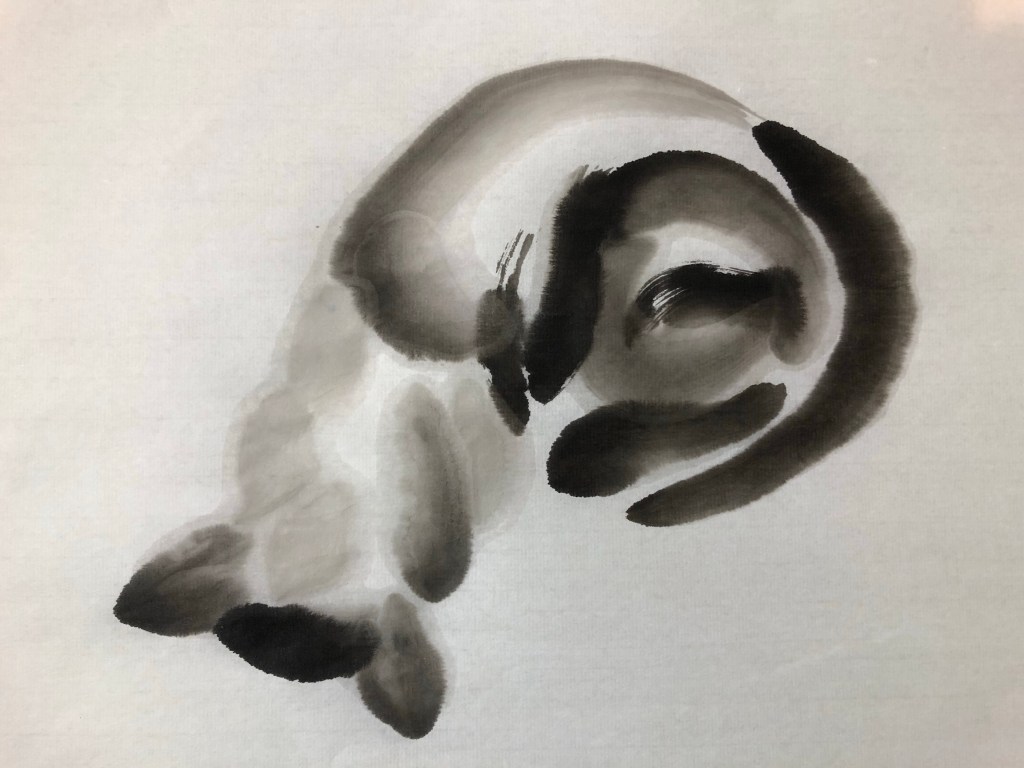
The homework this month was to paint an animal such as our pet. No worksheets were given and we had to work out how to create our simplified style Sumi-e animal painting (without looking online for hints). This blog records the method I used for the homework.

METHOD

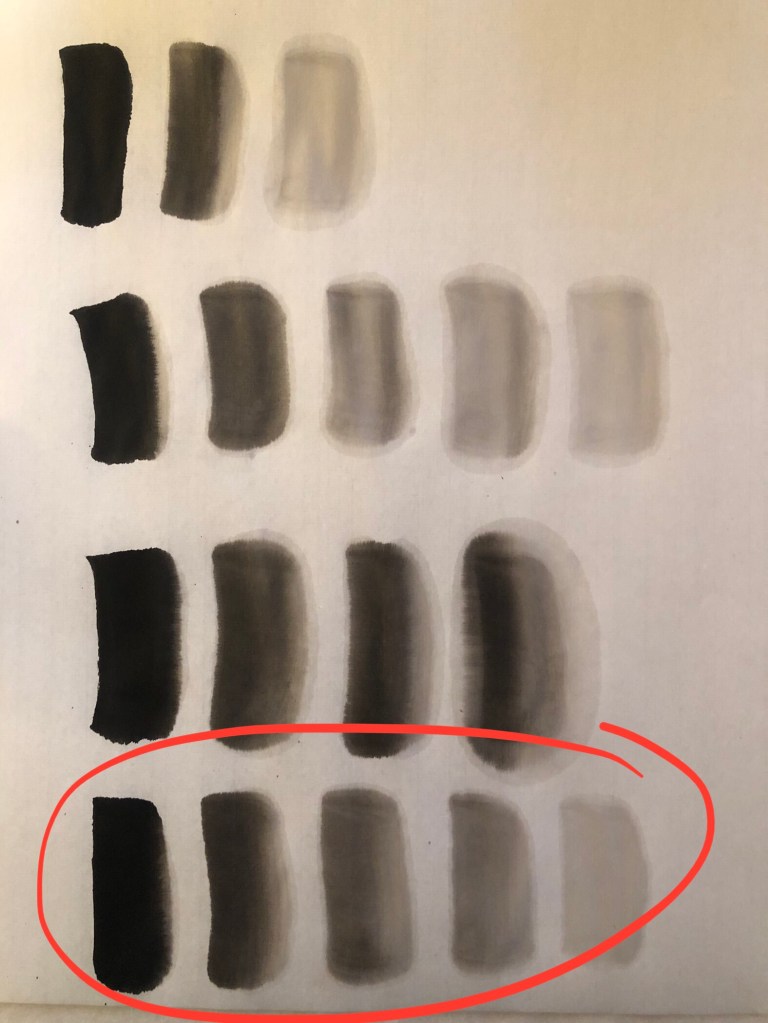
As a warm up exercise, I mixed the Chinese ink with water to ‘find’ the five shades that would be needed to depict tone in the painting. It took a few attempts to get the right result.

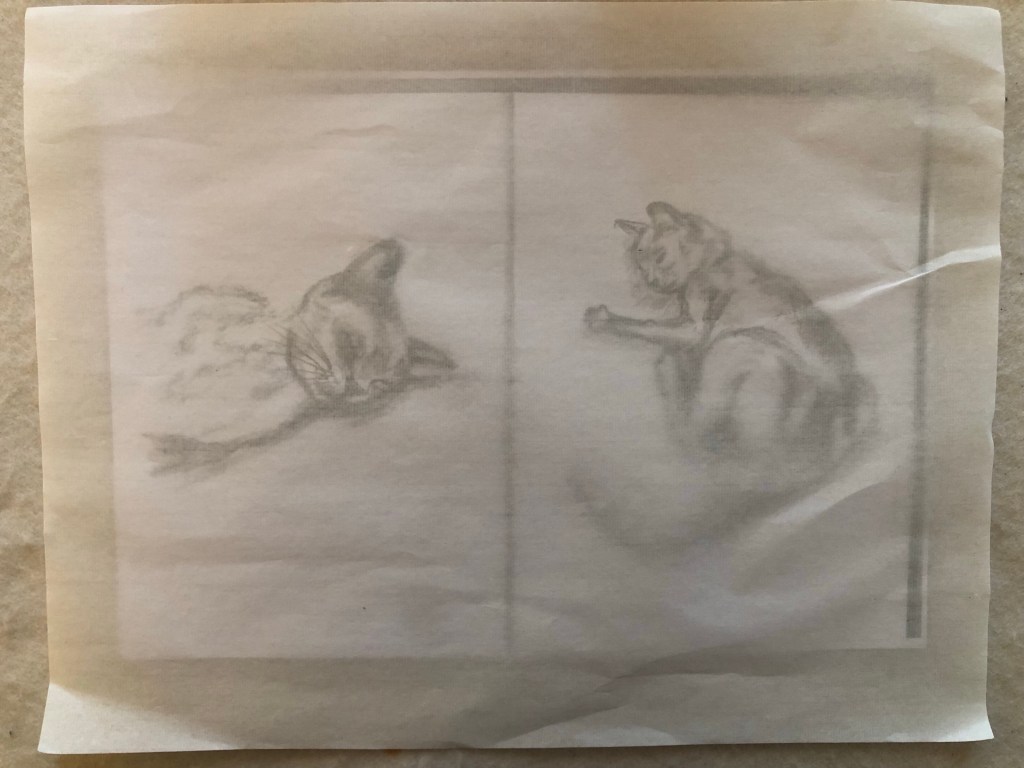
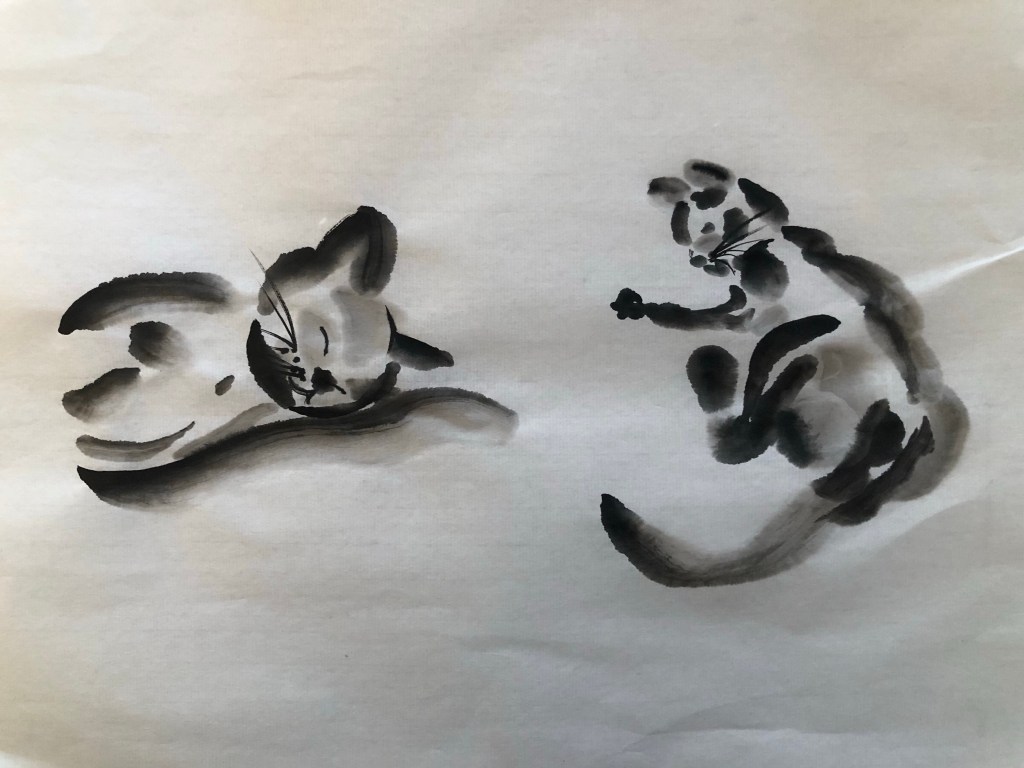
I made some pencil tonal sketches from photos of my sadly departed cats. Then overlaid the Xuan (rice) paper on top for painting.

Result:

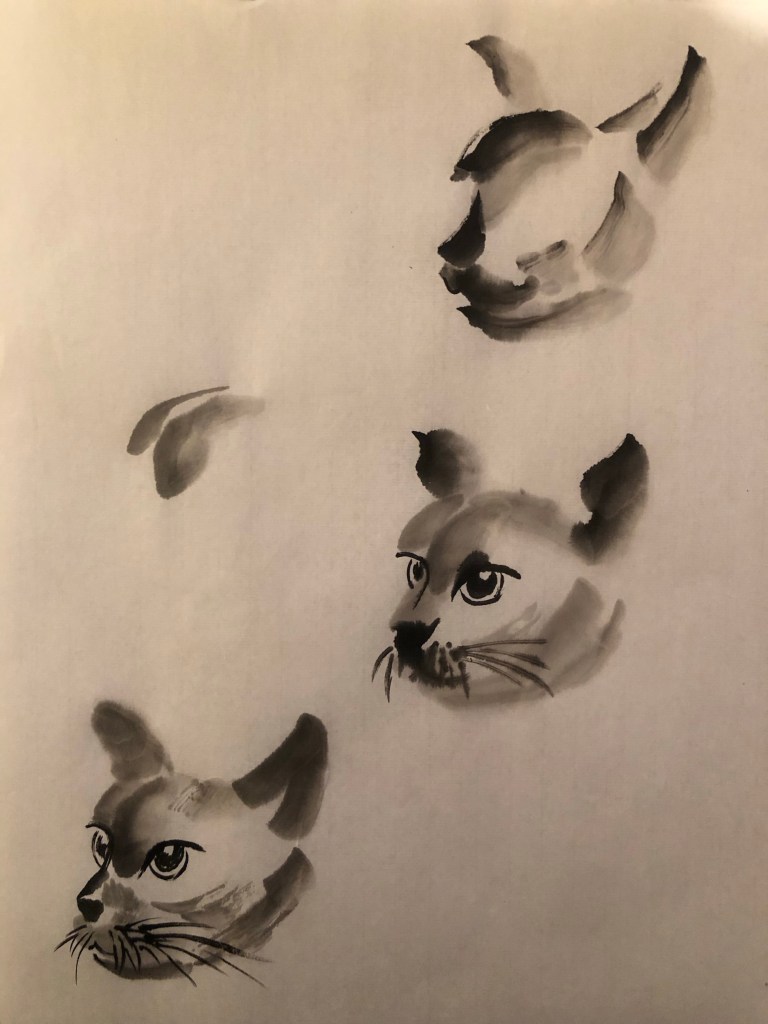
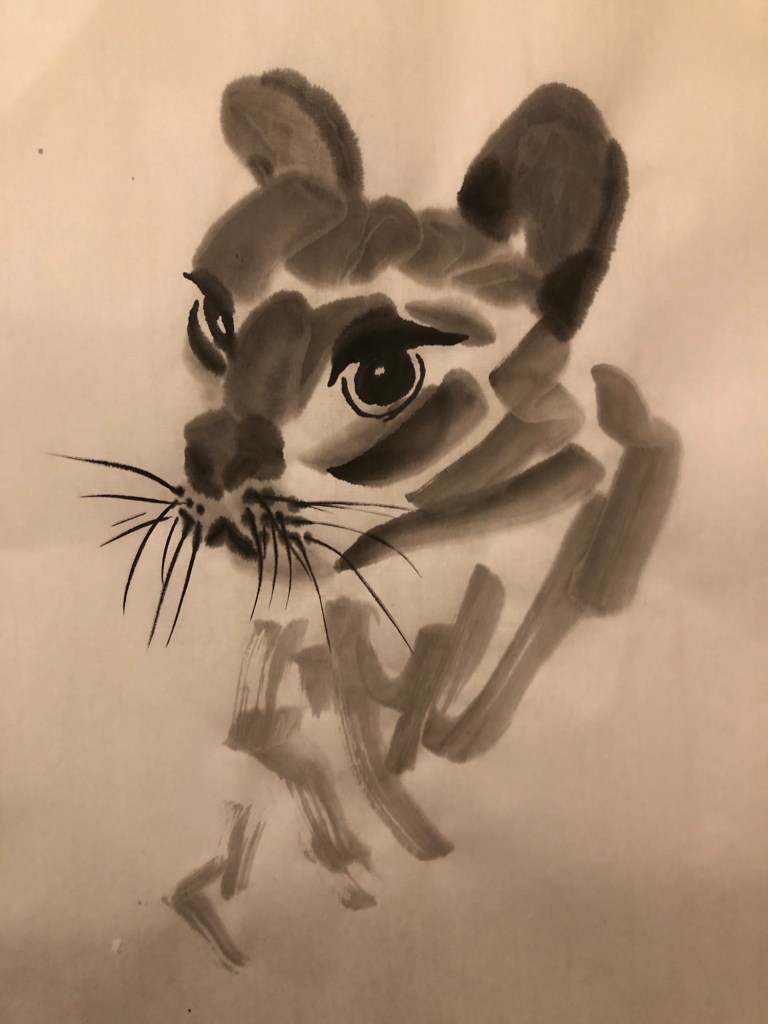
Using the same method, a few close up portraits were painted:

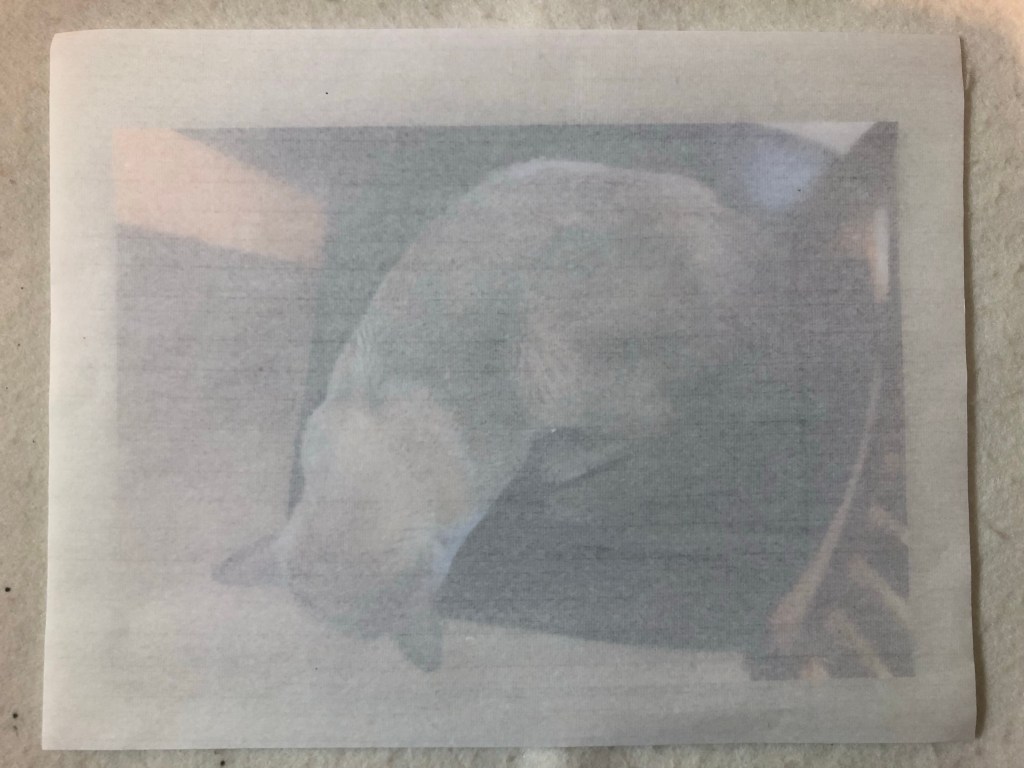
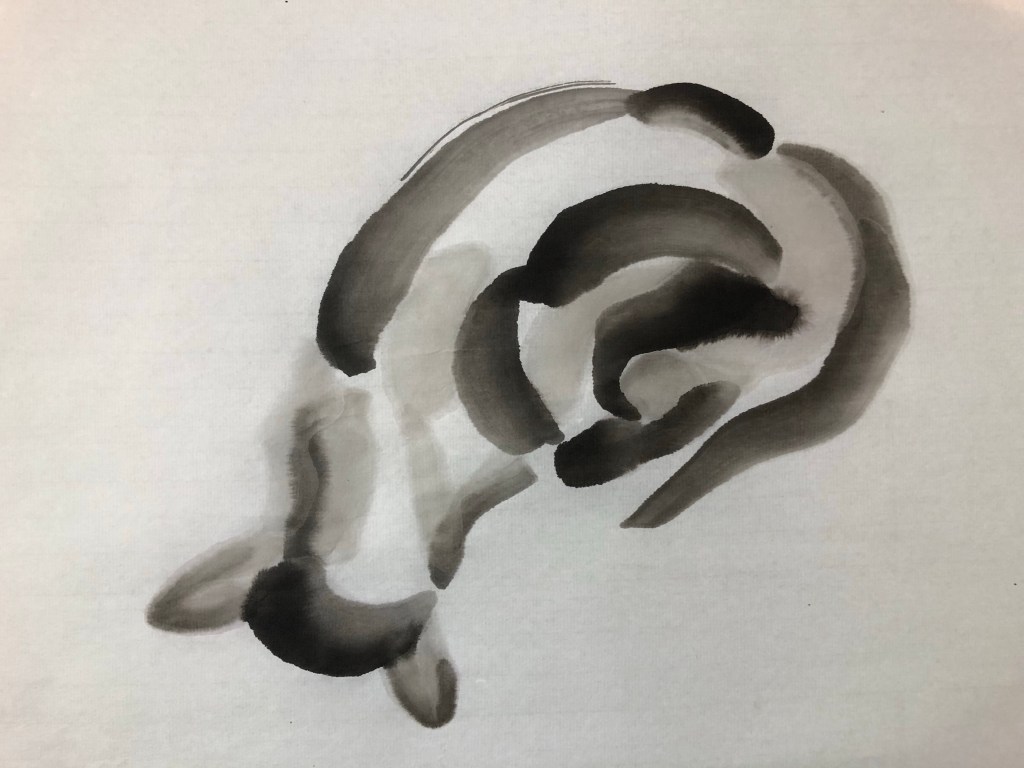
Then I used a photograph and overlaid the Xuan paper on top to paint/trace the tonal areas:

First attempt of ‘tracing’
Second attempt of ‘tracing’

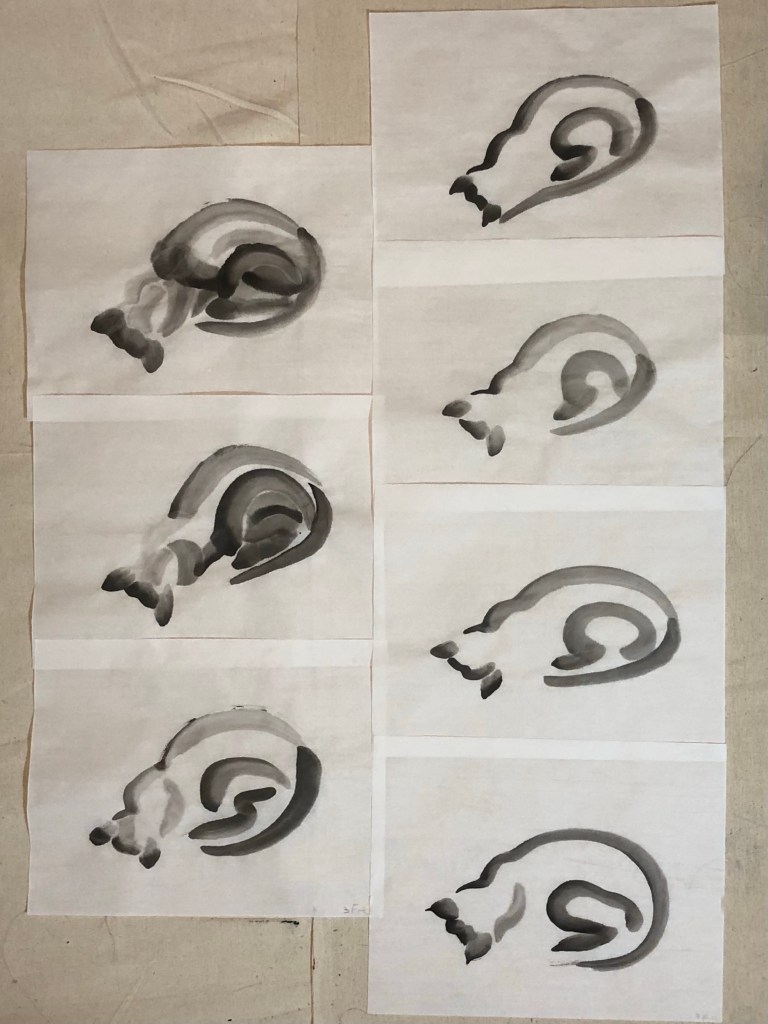
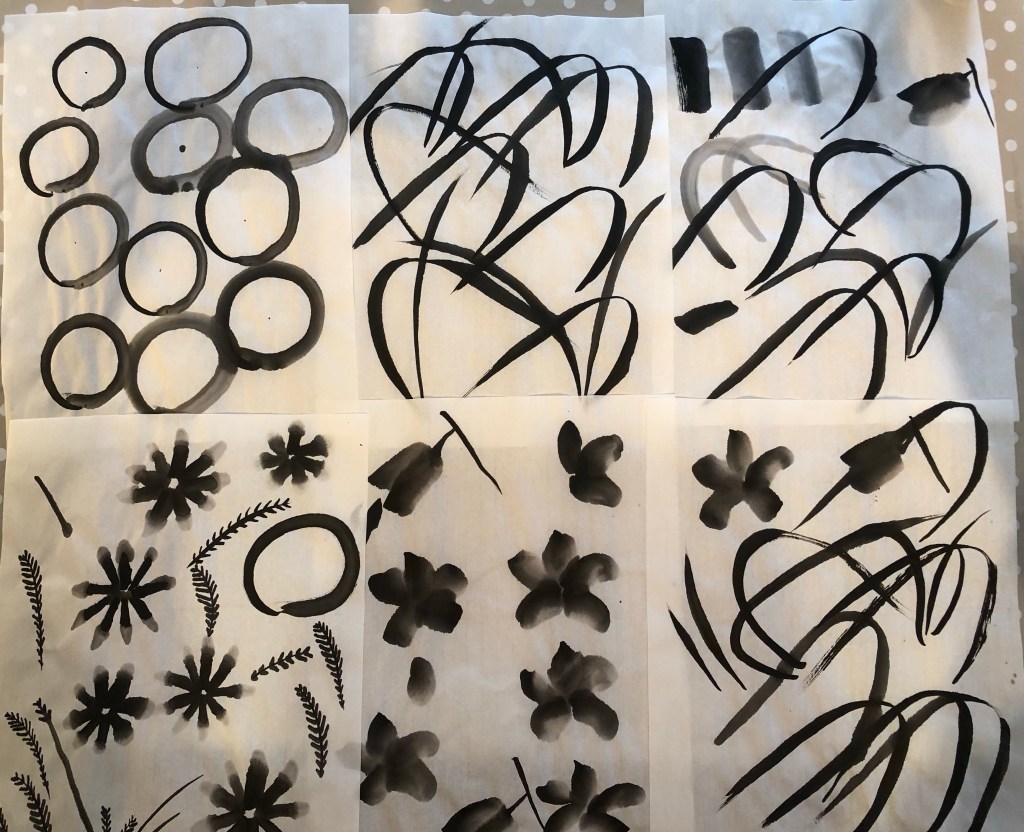
Then I started painting freehand without tracing. I had seven attempts and each time reducing the number of brushstrokes and simplifying the image.

Seven attempts at freehand painting

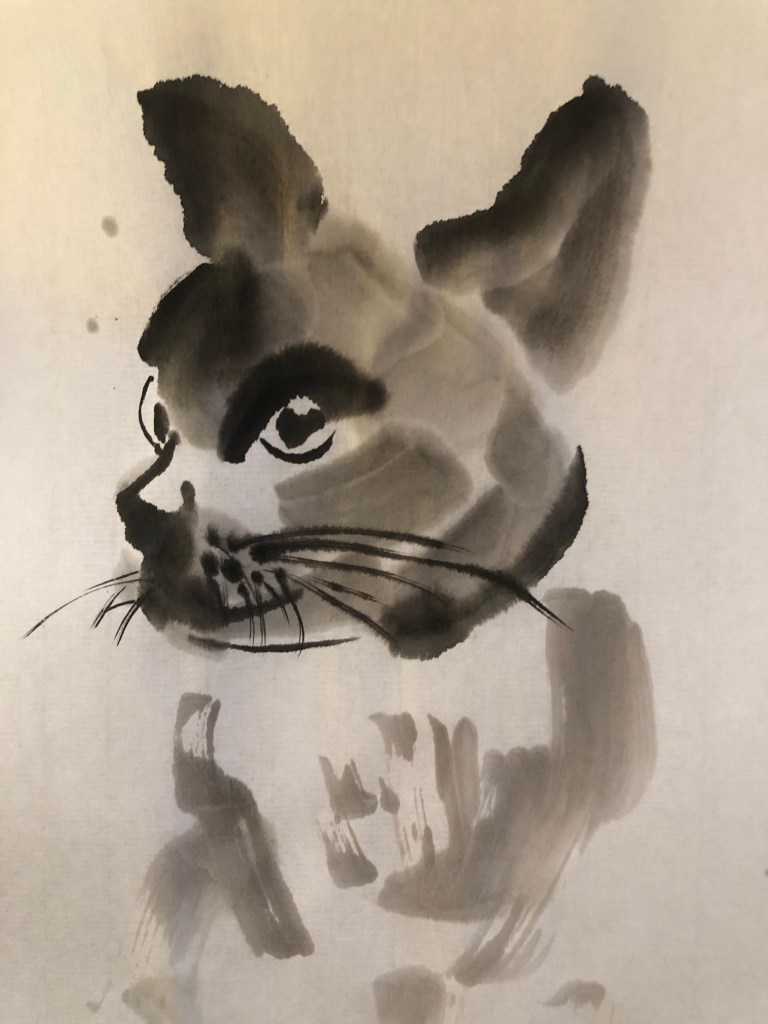
Close up of the seventh and final attempt:

REFLECTIONS

I have been wanting to learn Sumi-e painting because I see it as a way towards semi-abstraction in Chinese brush painting which is something that I’m interested in. I enjoy the thinking that is involved in this making process.

I enjoyed the exercise and was pleased with the outcomes as early attempts. I do find Chinese water-ink or Sumi-e painting very challenging. It is the most unforgiving style and painting medium that I have used. With oil and acrylic, one can correct mistakes by wiping off or painting over. Even watercolour can be corrected to a certain extent. Since the depiction in Sumi-e is done by one stroke and going over a stroke makes it look clumsy, therefore everything has to be as perfect as possible for each stroke, such as:

– Water/ink pigment balance for the tone.

– Amount of water/ink on the brush (and depending on the type of hair for the brush) to match the absorbency of the type of Xuan paper used for each stroke. The paper or silk is usually highly absorbent which makes it challenging.

– Placement of each stroke and the pressure along the travel.

It is very challenging and I love it. I feel the tension within myself in a way that is unlike any other painting media. I expect it’s also because I am so new to this and I need a lot more practice. The process of simplifying was also challenging like solving a puzzle which added to the pleasure of this way of making.

LEARNING

– Mixing the five tonal shades at the start and having plenty of ink of each shade made up really helped. However, I still find myself mixing as I went along especially for the ‘double loading’ technique.

– Tracing over tonal drawings or photos helped to give confidence at the practicing stage. Practicing in this way helped me to progress onto freestyle painting.

– Understanding the structure or anatomy of the subject is essential for the simplification process to work.

NEXT STEPS

– Keep practicing to build knowledge of the materials and process.

– Try other animals or objects.

– Start to think about how to incorporate this approach into my transcultural style development work.

UPDATE

Below is an update on Sumi-e painting progress since the session detailed above.

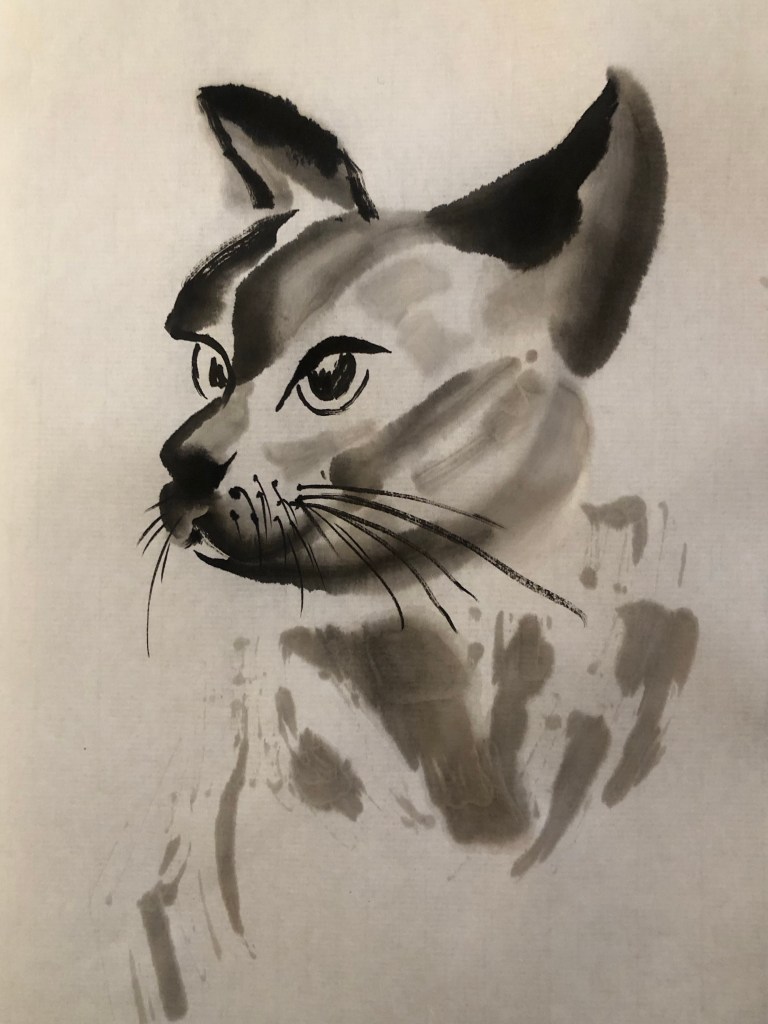
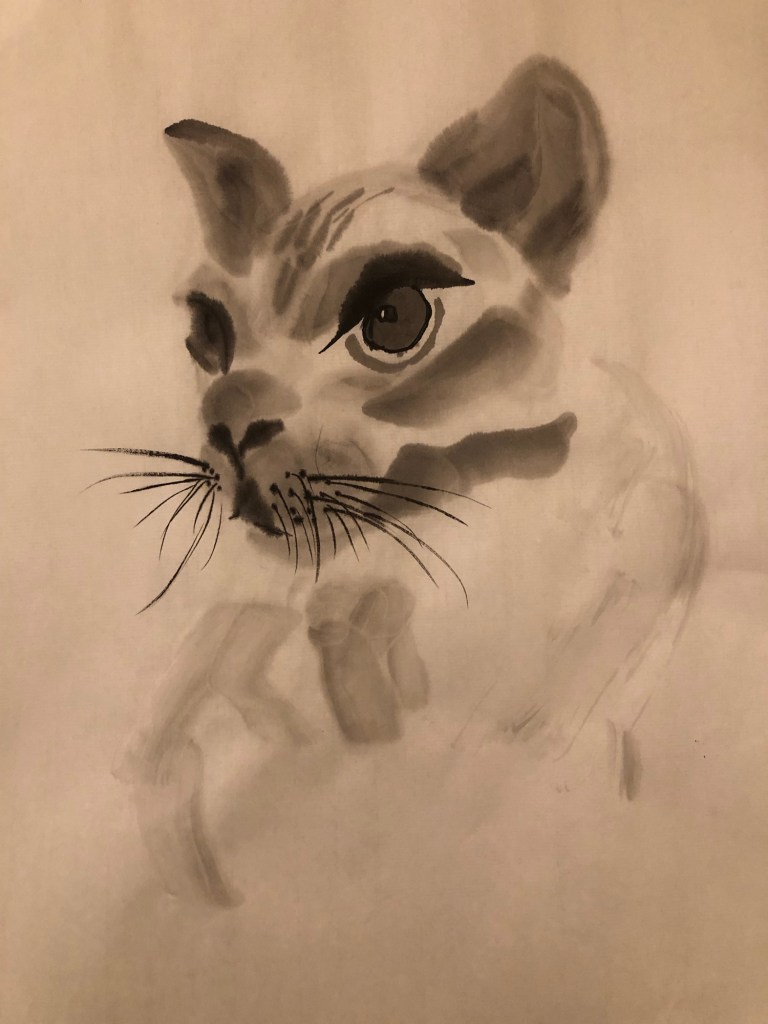
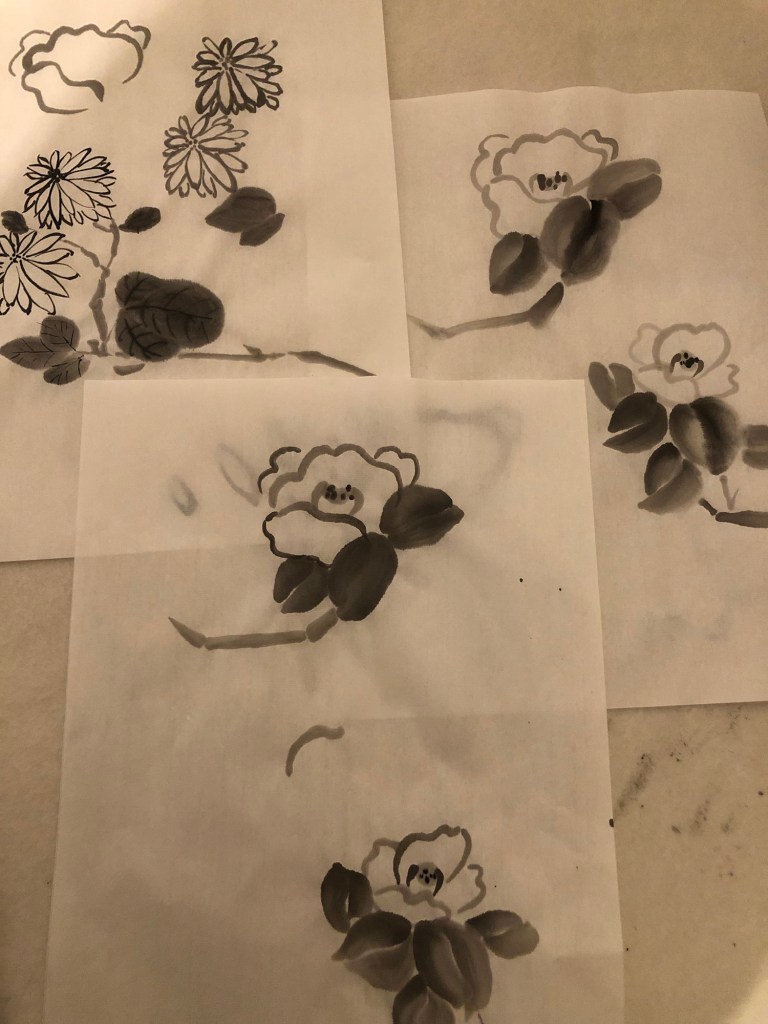
My tutor asked me to do a free-hand cat portrait without using any pencil drawings as guide under the Xuan paper. Below are the outcomes:

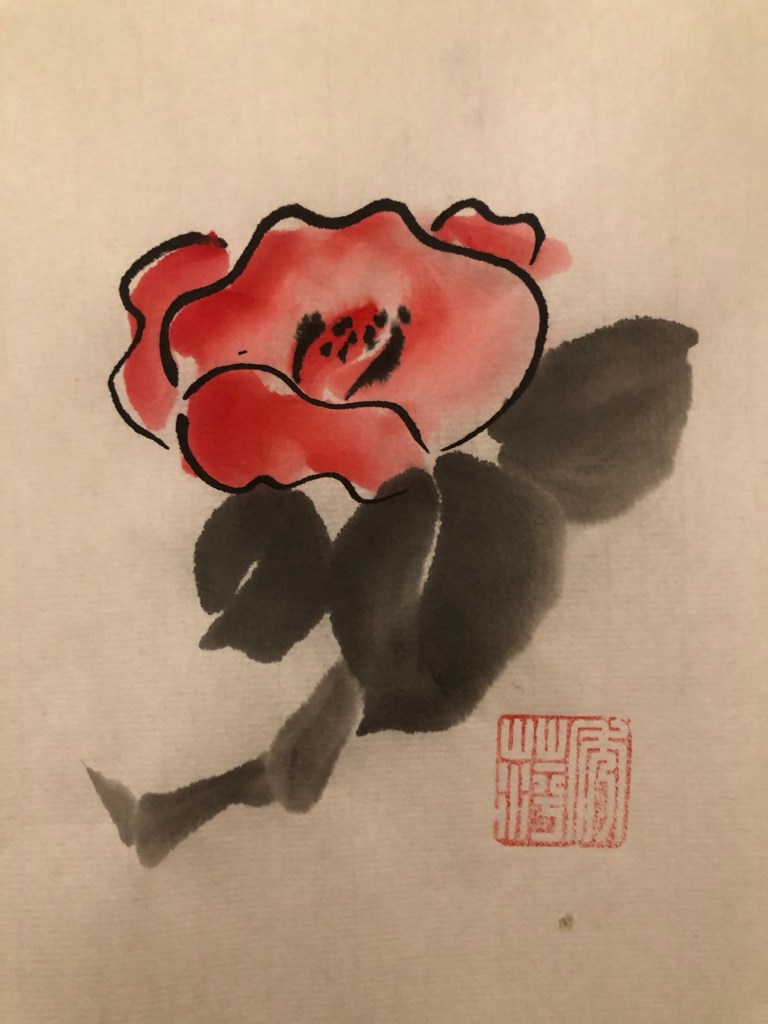
The following lesson was on Sumi-e flowers:

REFLECTIONS

I have enjoyed Sumi-e painting because I am more interested in free style Chinese painting (techniques are akin to Sumi-e) than the meticulous style. So these paintings have been good practice for me. The key is to keep practicing in order to master the skills required in applying paint having understood how the materials work together with the painter.

MA Y1 U1: Exploring media – Oil and cold wax – Part 6

BACKGROUND

I want to use this experiment to explore the Next Steps that were identified in Exploring Media – Oil and Cold Wax Part 5.

https://eliza-rawlings.com/2023/12/24/ma-y1-u1-exploring-oil-and-cold-wax-part-5/

The actions were to:

-Try out more Chinese brush paint collage onto oil and cold wax to refine this part of the process.

-Try exposing a larger area of the background image to see if that can work with the abstraction approach on the top layer. Experiment to find the right balance between revealing the base layer image without losing the sense of abstraction on the top layer.

-Try spray painting on top of the oil and cold wax surface – try when wet and then when dried.

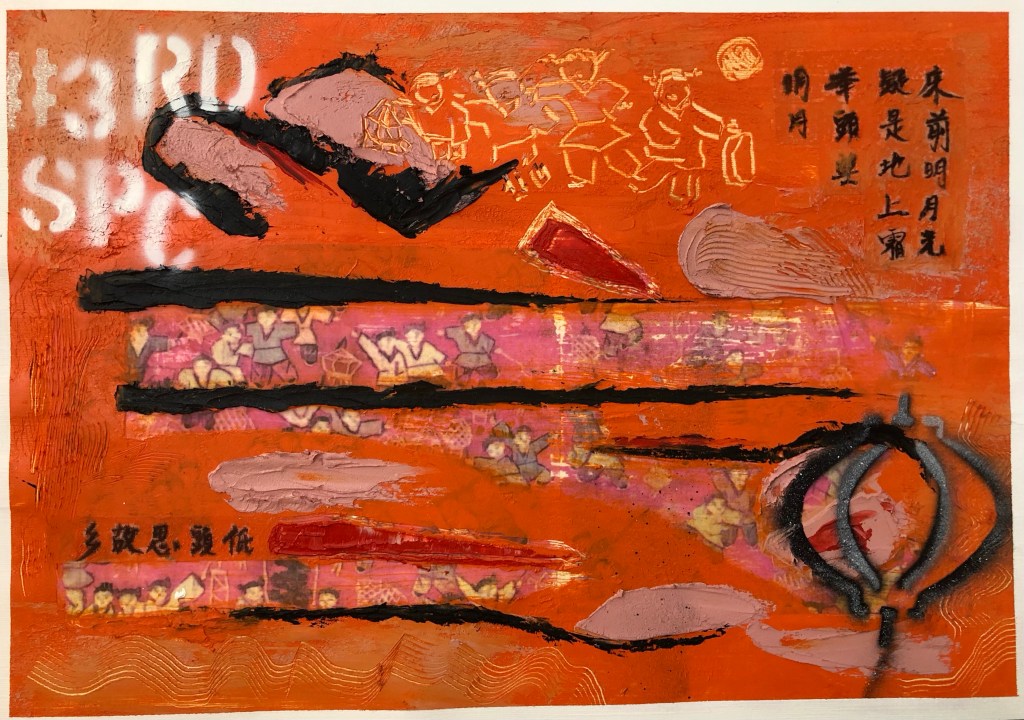
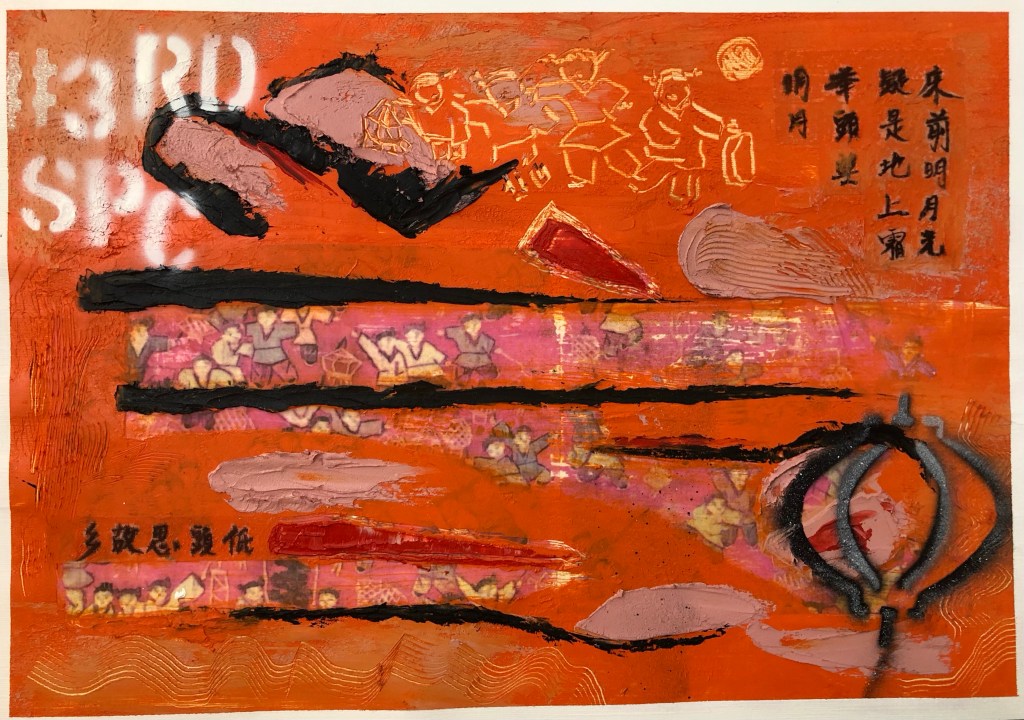
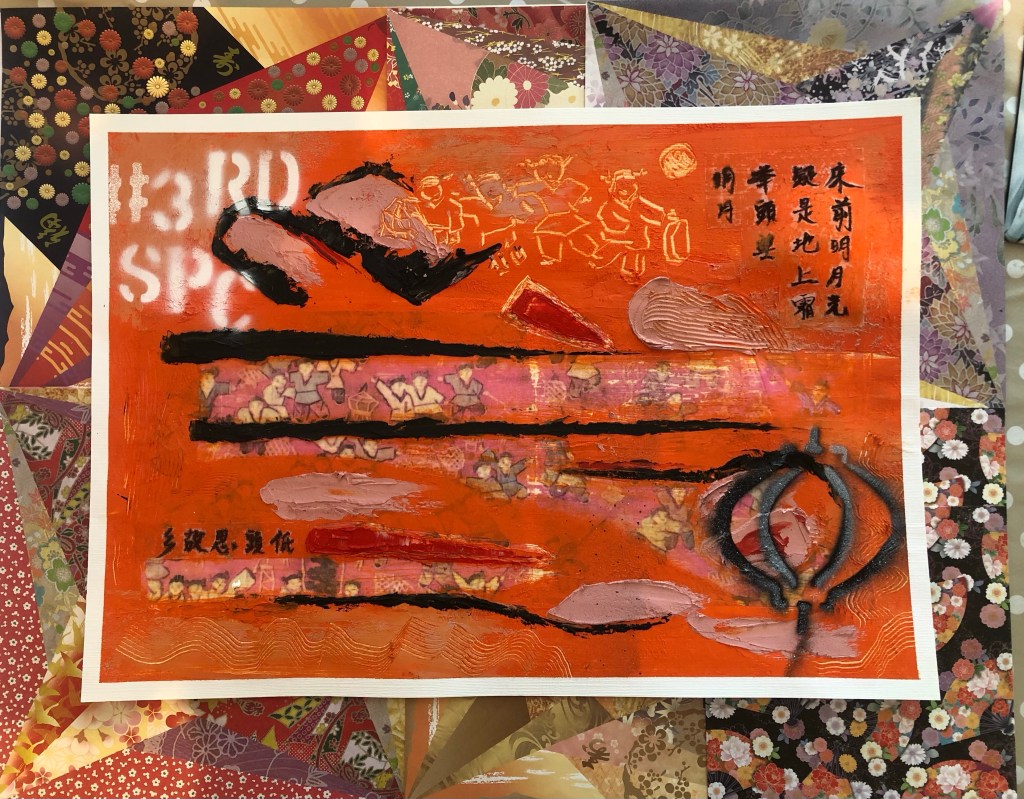
Finished work for Part 6:

Mixed media on paper, A3

METHOD

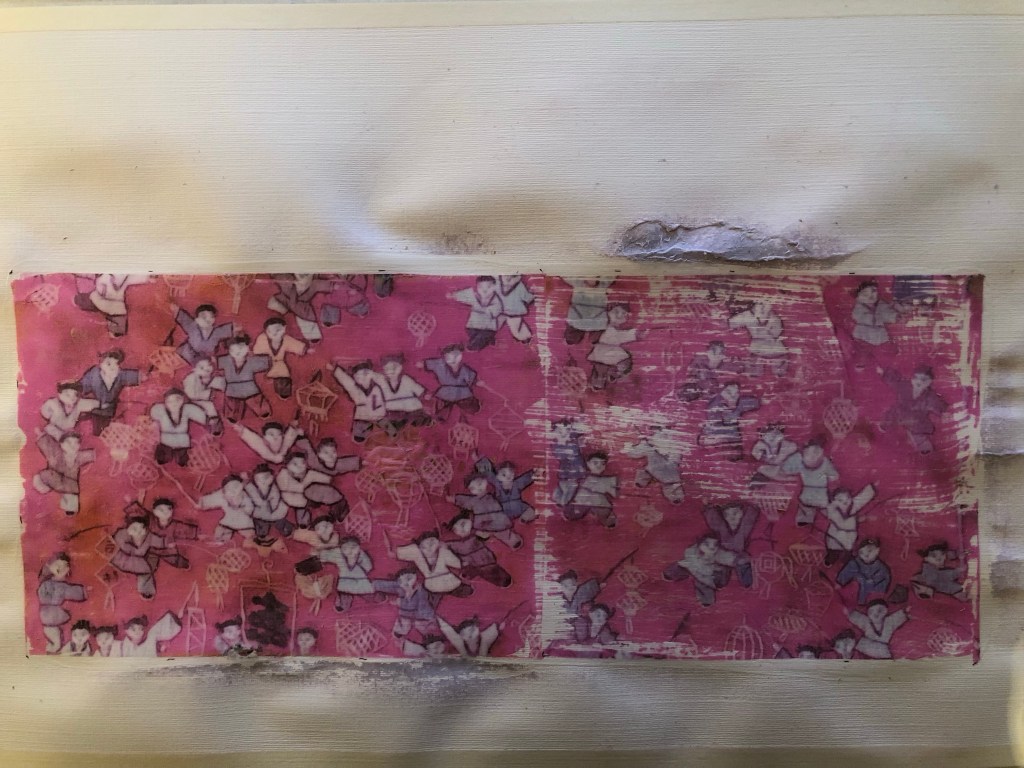
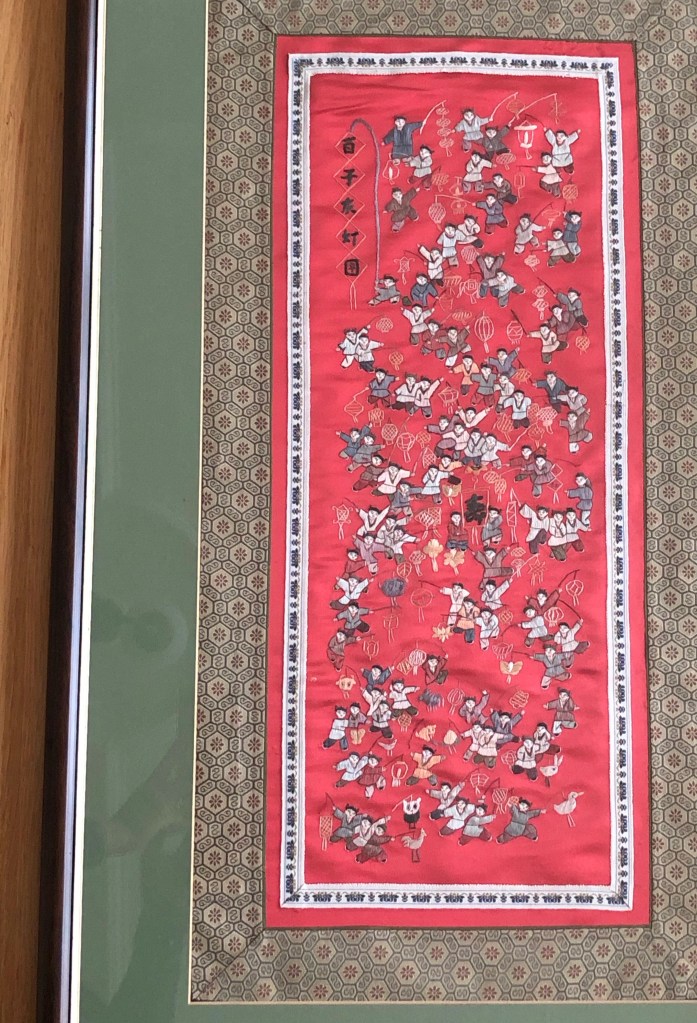
A printed photo image of a tapestry that was gifted to me by my brother many years ago was used as the based image for this piece. The image was transferred onto a paper canvas using dispersion liquid. The paper used was 250 gsm oil paper.

After the dispersion liquid dried, the printed image was rubbed off with a wet sponge to reveal the transferred image on the canvas. This was the first time a paper canvas (as opposed to a cotton canvas) was used in this series of experiments and it was clear that the paper canvas was not robust enough for the process. See below image for damage to paper. However, there was sufficient integrity in the paper canvas to continue the piece. I was hoping that a thick layer of oil and cold wax would hide the damaged areas. There was also excessive buckling on the paper canvas.

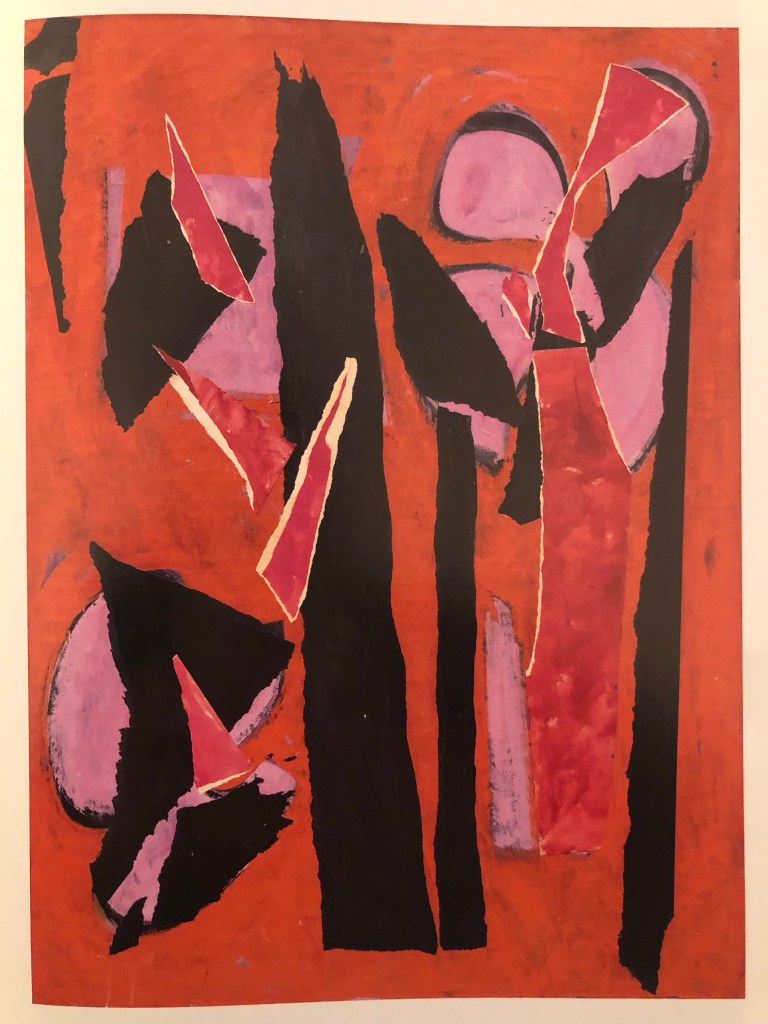
Recalling my disappointment with the colour palette that I chose for Part 5 (pink and grey), I decided to research into abstract paintings that I like to learn from the colours used. One of my favourite abstract artists is Lee Krasner and below is the painting that I decided to study and learn from in terms of the colour palette used.

Desert Moon (1955):

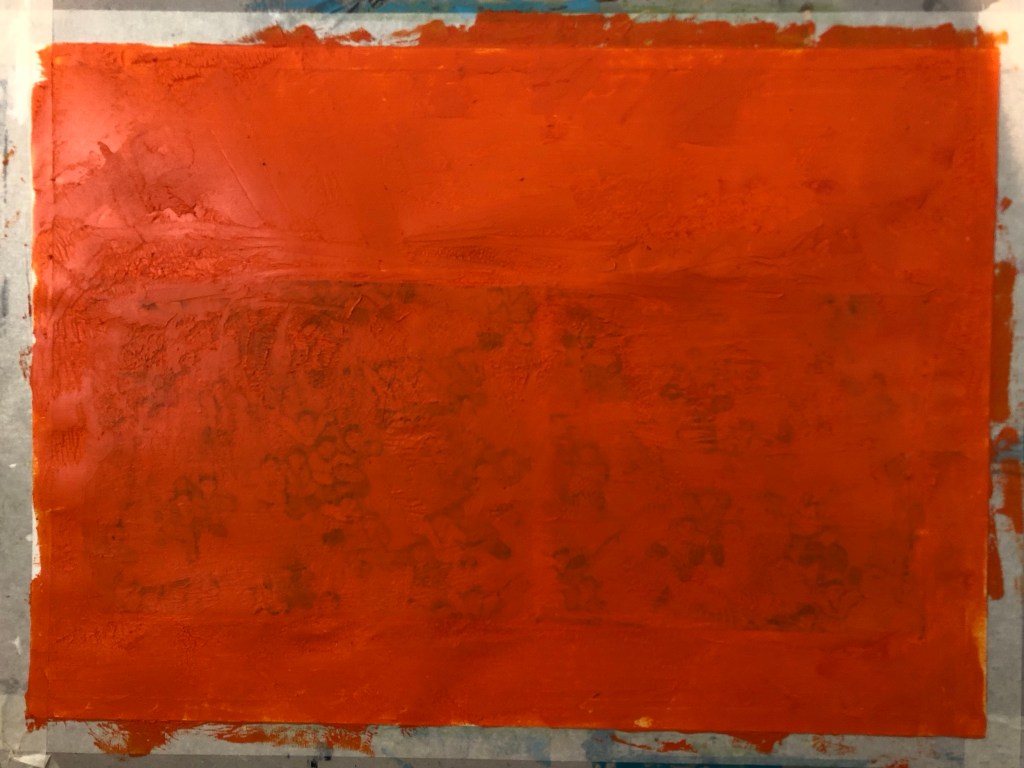
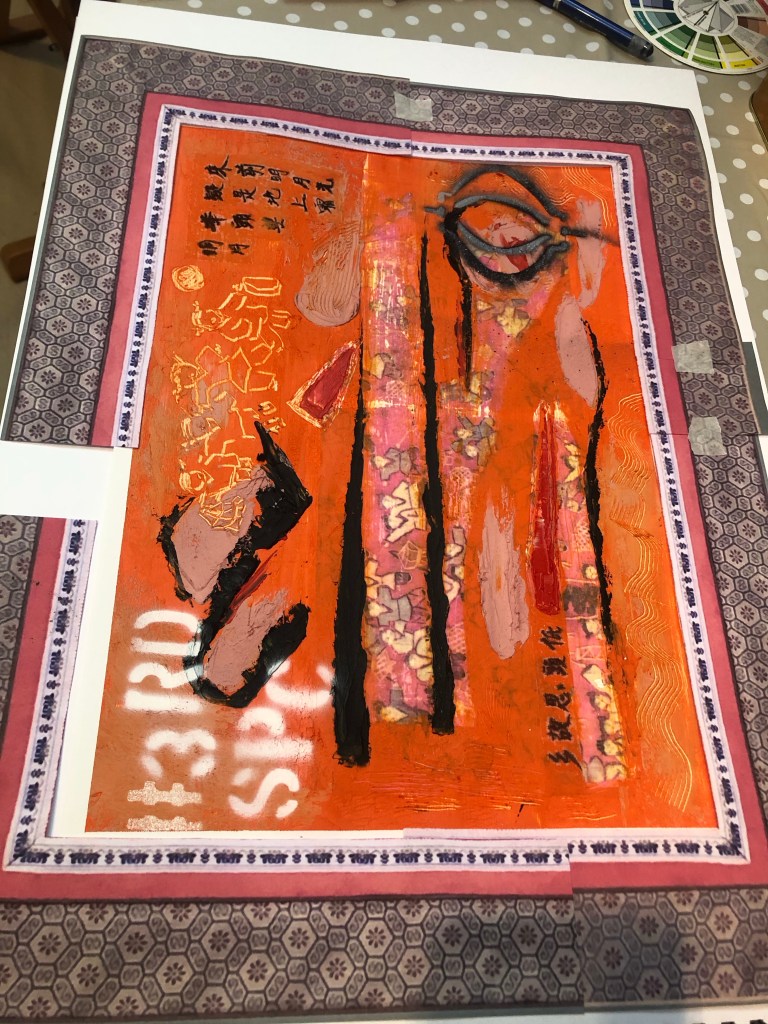
A layer of oil and cold wax was then applied to the canvas:

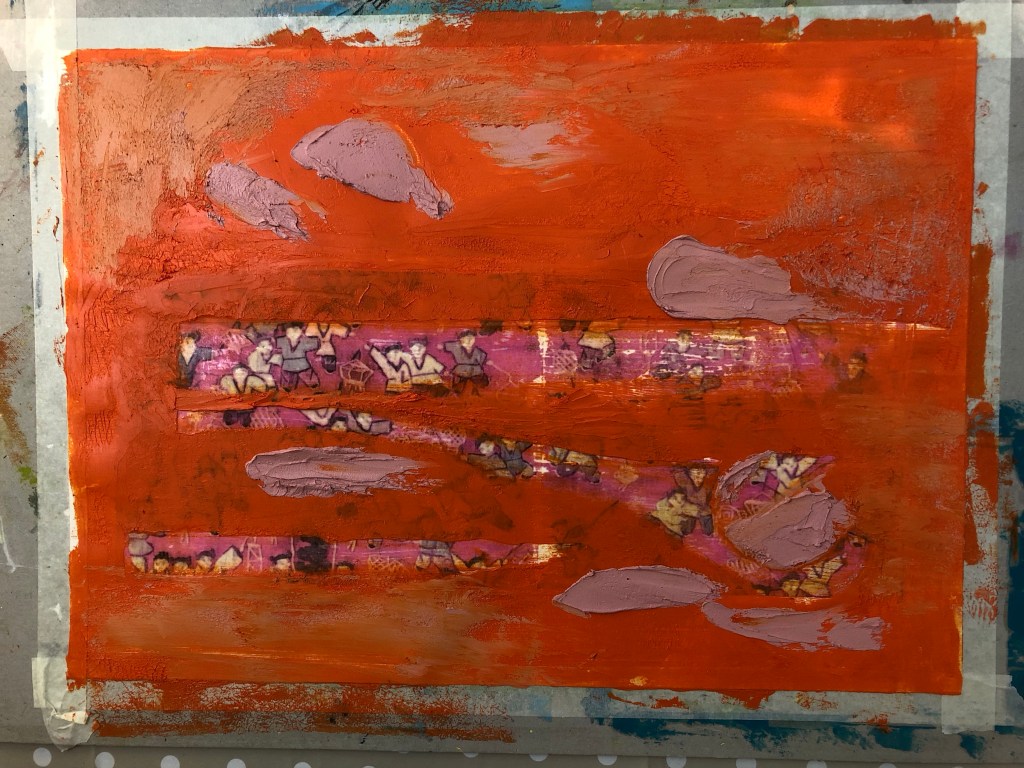
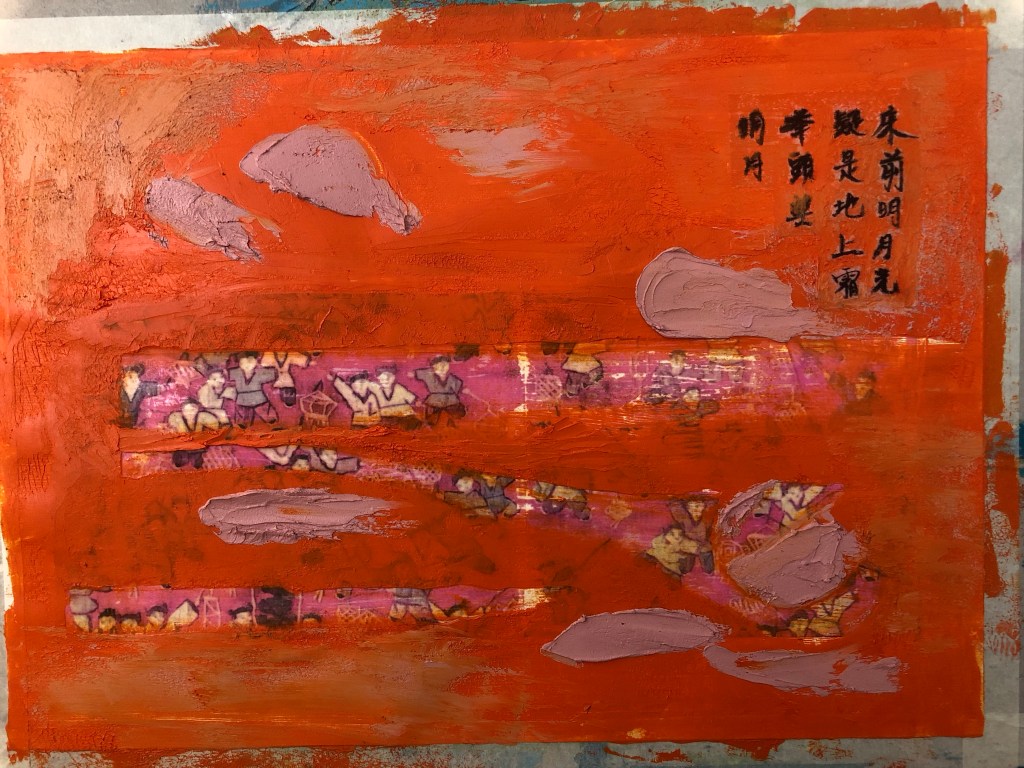
Areas were scraped off to reveal the base tapestry image. Learning from Part 5, I wanted to reveal a larger area so that it was clear what the base image was about. Then additional oil and cold wax colours were added:

For the Chinese brush calligraphy, I chose a delicate silk fabric as a substrate that was almost transparent because I wanted the substrate to become as invisible as possible.

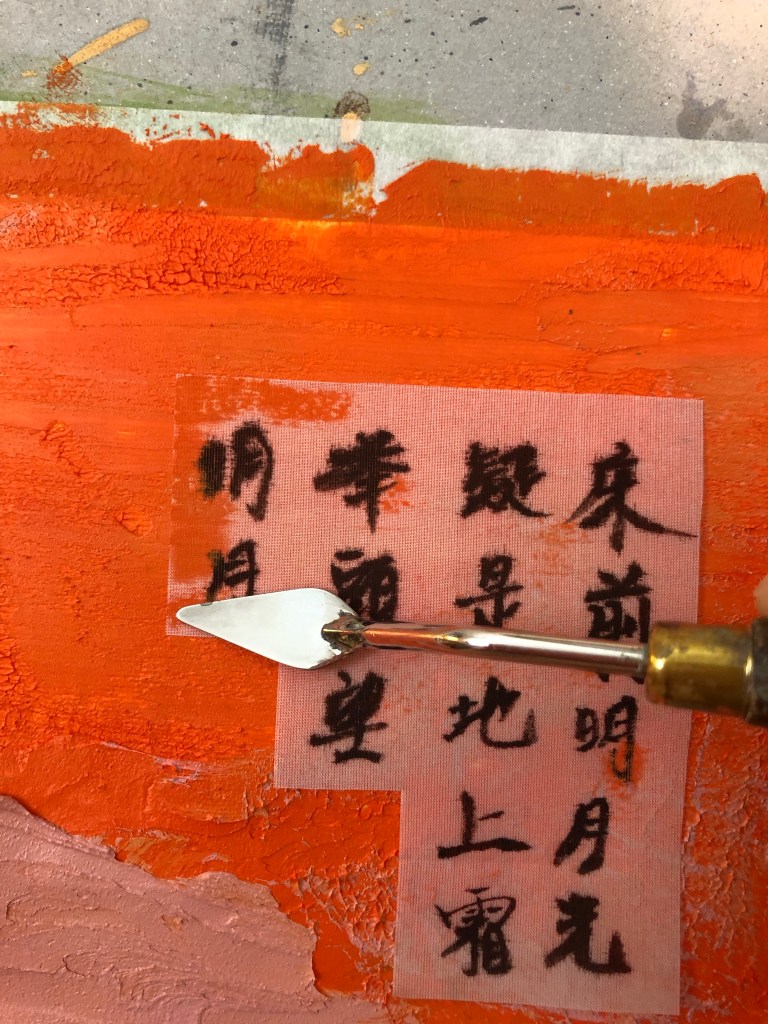
After writing the Chinese calligraphy onto silk, it was cut out and carefully pressed onto the oil and cold wax layer.

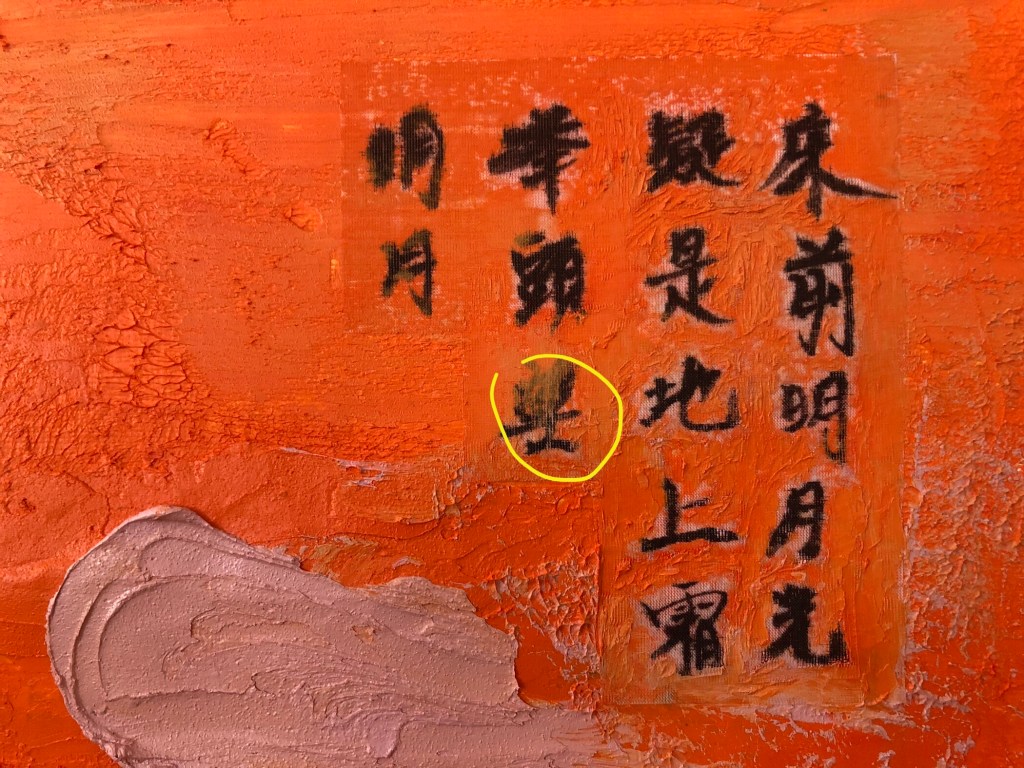
A small palette knife was used to press the silk into the oil and cold wax, taking care to avoid pressing the areas of the calligraphy characters which was challenging due to the complex shape of the characters. The yellow circle shows where part of the character was pressed into the oil and cold wax, partly obscuring the writing.

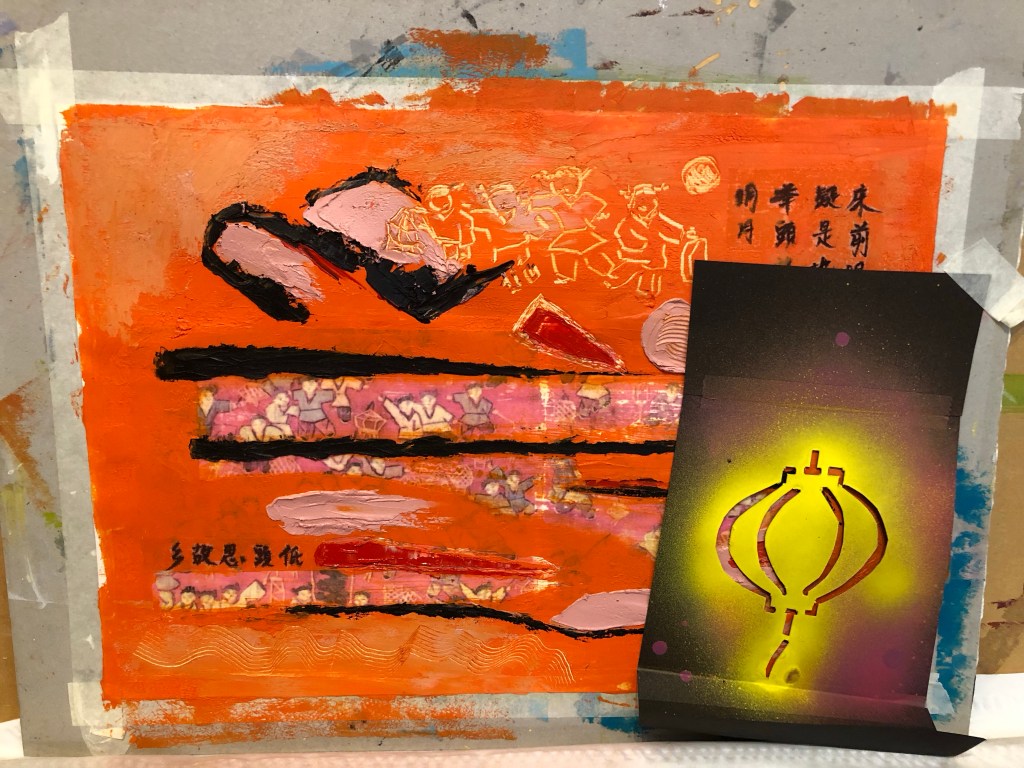
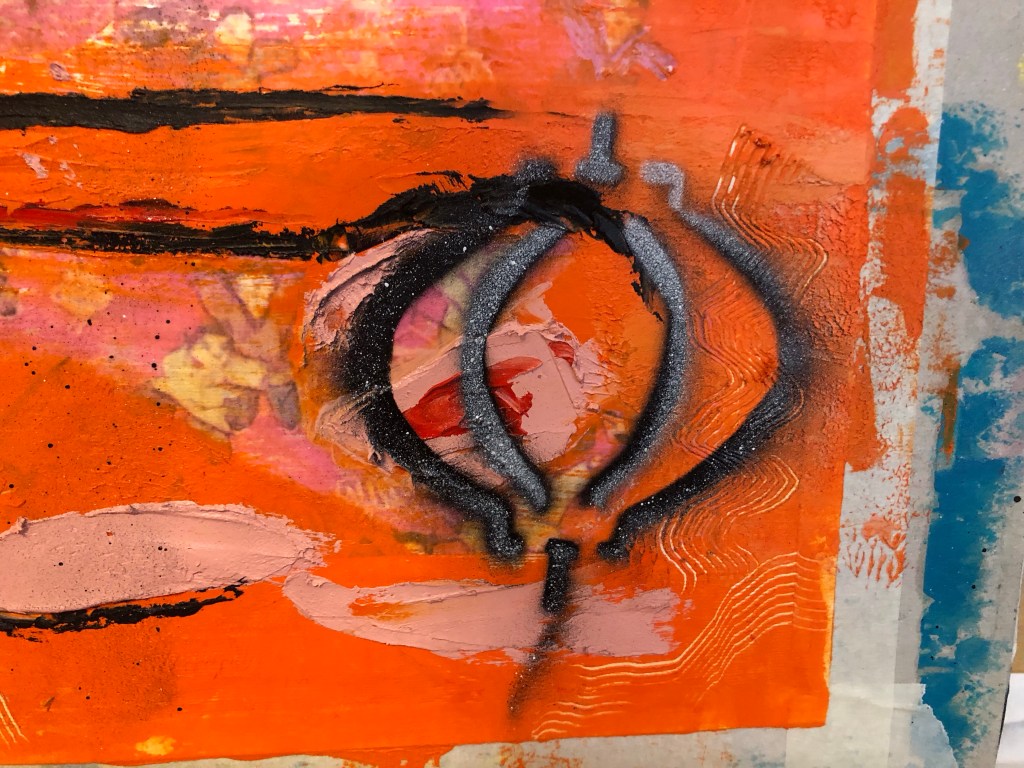
Additional marks were made – some were painted on and some were scratched off. The tapestry image was about children playing with lanterns and I have a lantern stencil that was made for previous work. So I wanted to experiment with spray painting onto wet oil and cold wax to see the effect.

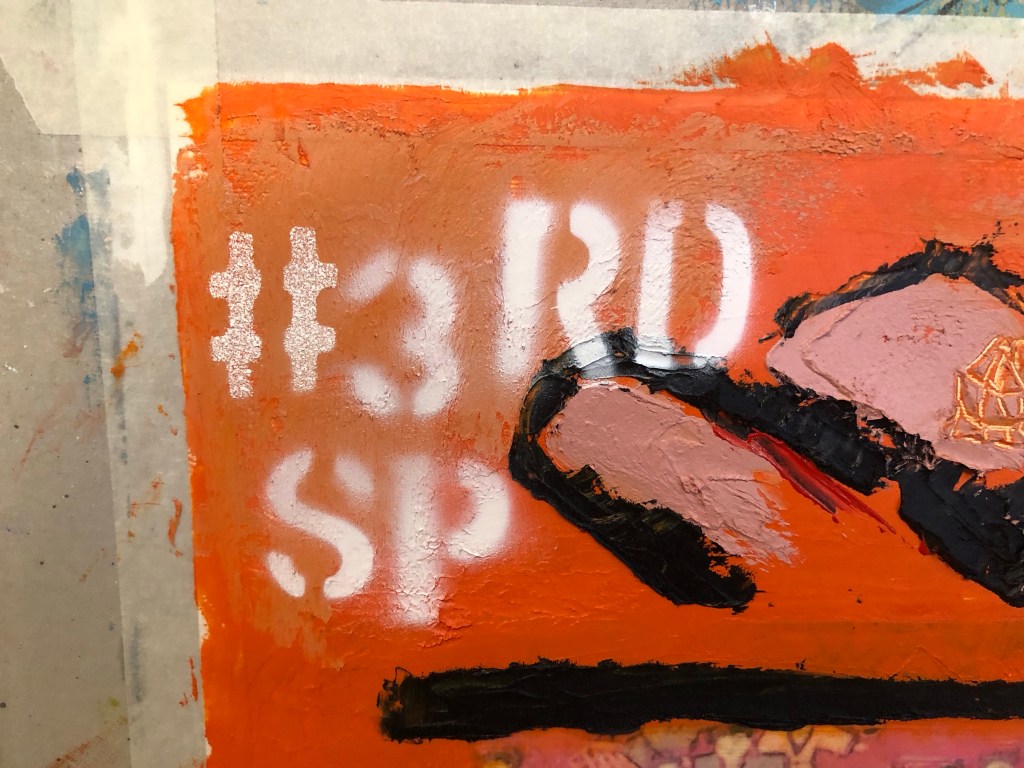
Further spray painting was done – the phrase #3RD SP (for third space) was sprayed onto a dryer corner of the painting. All spray paint used were Montana GOLD 312g aerosol cans as popularly used by street artists:

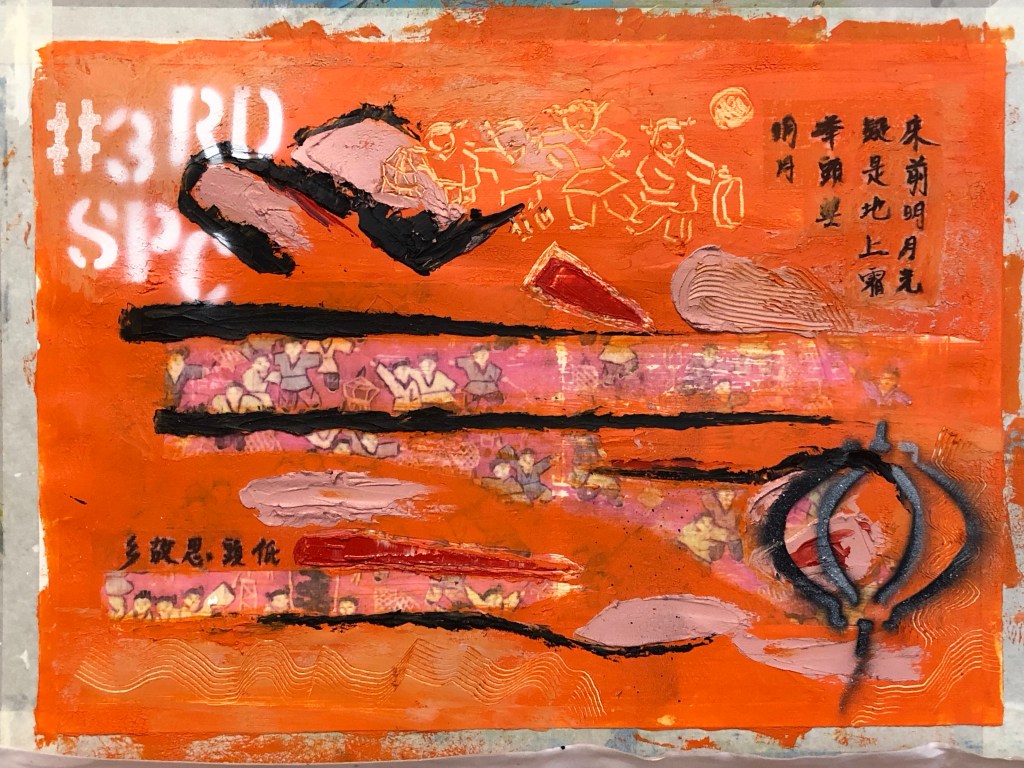
Finished work with border tidied up:

REFLECTIONS

I am happy with:

– The colour palette. I am much happier with this painting than the previous one in Part 5. A more considered approach in selecting the colour palette paid off here.

– The experiment with using an almost transparent substrate for the Chinese brush art worked well. The pieces (there were two in total) adhered well to the painted surface. Although the substrate was not completely invisible, it was acceptable as a solution.

– The scratched mark making especially the part at the top to echo the revealed based image of the children playing with lanterns.

– The overall look of the spray painting, especially the words – they added a contemporary feel to the piece which was what I was looking for.

– Feeling more confident using oil and cold wax as a medium.

I am not so happy with:

– The paper canvas, it was not robust enough. Although the damage by the image transfer process was covered up with oil and cold wax, it was clear that this would be the wrong material to use for this process.
– The spray painting of the lantern – it was sprayed onto very wet oil and cold wax. The outcome was not satisfactory – it felt and looked ‘gooey’ and not the intended effect. I believe this was partly due to my reluctance to place the stencil close to the wet oil paint as I didn’t want the back of the stencil to pick up the oil paint, causing the spray paint to loosely disperse around the stencilled image.

– Although I was happier with the colour palette, I felt there was more that could be done to add more complexity to the palette to increase depth to the piece.

General comment: the Chinese calligraphy is a famous ancient Chinese poem about being homesick. It is one of the few Chinese poems that I know as most children growing up in Hong Kong in my era were made to learn it, partly because it is a good poem and very easy to remember. Going forward, I feel that if I were to use more Chinese calligraphy then I should learn more about Chinese poetry so that I can use a wider variety of content in this respect. It will also help me to understand more about my Chinese heritage.

Other thoughts that came to me some time after completing this painting:

– Throughout the making process, my mind kept going back to celebrating the Mid Autumn Festival when I was a child in Hong Kong. The highlight as children was to be given a lantern each to play with. The choosing and buying of the lantern in preparation was always a source of excitement. The lanterns were lit with small candles. The children would use a long stick as handle for the lantern and go around the neighbourhood exploring with their lanterns, just like the children in my painting. The Mid Autumn Festival celebrated the fullest moon of the year and celebrations would only begin after dark when the full moon came out. Since we were not usually allowed out at night, it made the Festival especially popular with children. At times a lantern would catch fire which added much excitement. There would be lots of fruit and snacks laid out that were specific for the festival. I remember one year when we were older children (over ten years old), my brother and I went to a local park, sat on the swings and chatted all evening. It was when my family was going through a difficult period and to share that moment with him was very special, especially when we ended up spending most of the rest of our lives living in different countries. He gave me the children’s tapestry that I used for this painting which evoked all those memories while making this piece of work.

LEARNING

– More work is required to develop my sense in choosing an appropriate colour palette for the piece. This is increasingly important because my work is about storytelling as well as narrative and I believe having an appropriate colour palette helps to tell a story. So more research and experiments should be done in this respect.

– The silk substrate worked well for the Chinese calligraphy. However, I know there is a wide range of other delicate Chinese substrates and I will experiment with different materials to find the optimum.

– Layering the Chinese substrate onto oil is a risky process – as seen in the image with the yellow circle highlighting the part obscuring of the brush painting if pressed too much into the oil. To help with this, further experiments are required to improve this process. E.g. paint a barrier layer, such as a masking fluid that dries clear, onto the back of the Chinese brush painting or calligraphy to shield the image from the oil seeping in from underneath.

– Spray painting, especially words, adds a contemporary feel to the image which is a style that I want to incorporate into my work. This is relevant to me because I take much inspiration from the extensive street art scene in my home city of Bristol where many famous street artists work or have worked.

– Using the tapestry image evoked many memories, perhaps I could explore that more.

NEXT STEPS

– Research into colour palettes for the type of stories that I want to tell. Build confidence in this area.

– Continue to build experience and explore using oil and cold wax.

– Experiment with other transparent Chinese substrate materials to find one that is as close to invisible as possible when layered onto oil.

– Experiment with a barrier or masking fluid to prevent the oil from seeping into the Chinese brush painting images.

– Experiment with more spray painting – be bold and push boundaries.

– Ongoing learning – research into Chinese poetry to find more poems that resonate with me to use in future work.

– Explore the evoked memories.

ADDITIONAL WORK

After visiting the exhibition of Ofelia Rodriguez again at Spike Island in Bristol, I was inspired by the way she used fabric as a border to her paintings.

This gave me the idea to try that with my work, especially to use Chinese imagery border for a recent piece of work to add to the transcultural narrative.

I started with some patterned paper that I had to make a collage frame. But I was not happy with the effect. It seemed too busy and rather random as an idea.

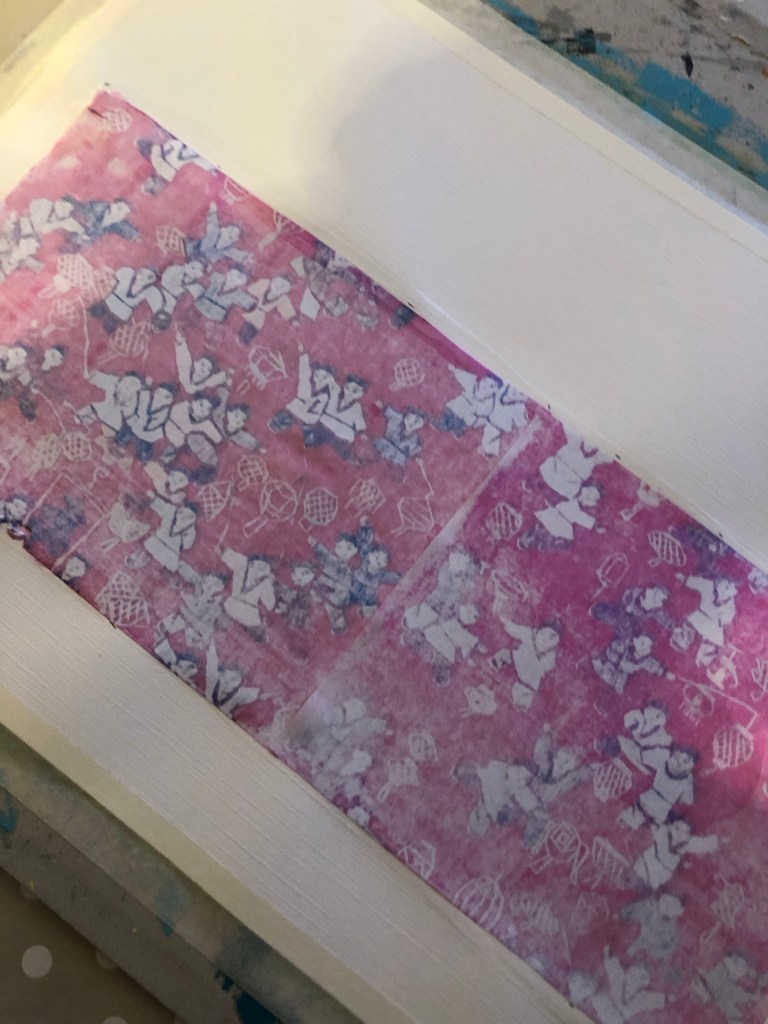
I then returned to the original tapestry that I used as the base image for the painting. It was a tapestry that was gifted to me by my brother many years ago.

Image to show the border of the tapestry

It is a typical border for small scale tapestries of this type. Then images of the border were printed and cut out to create a collage border for the painting:

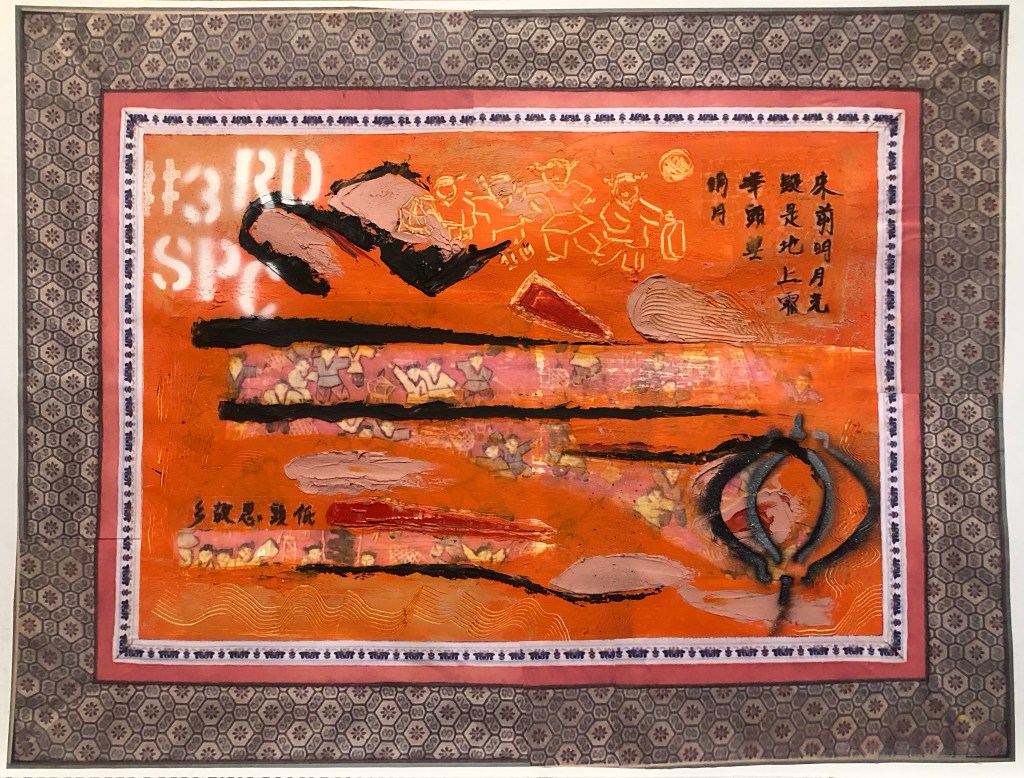
Final finished work:

Mixed media on paper, 54 x 41.5 cm.

REFLECTIONS

I am very happy with the outcome of this experiment inspired by Rodrigues. It has completed the painting for me and added a more transcultural feel alongside the painted images such as the spray painted words.

To improve this approach, I would spray paint the # words to partly cover the tapestry image frame. I think that would increase the contemporary feel for the piece juxtaposing the traditional Chinese tapestry border.

MA Y1 U1: Developing narrative – Bowling lawn incident

BACKGROUND

Following on from a previous piece of digital art work where I researched and experimented with Procreate and Adobe Fresco, I chose to use Adobe Fresco for this piece of work because I found using my MS Surface Pro with the MS Stylus worked well; it was an enjoyable way to create art that is new to me.

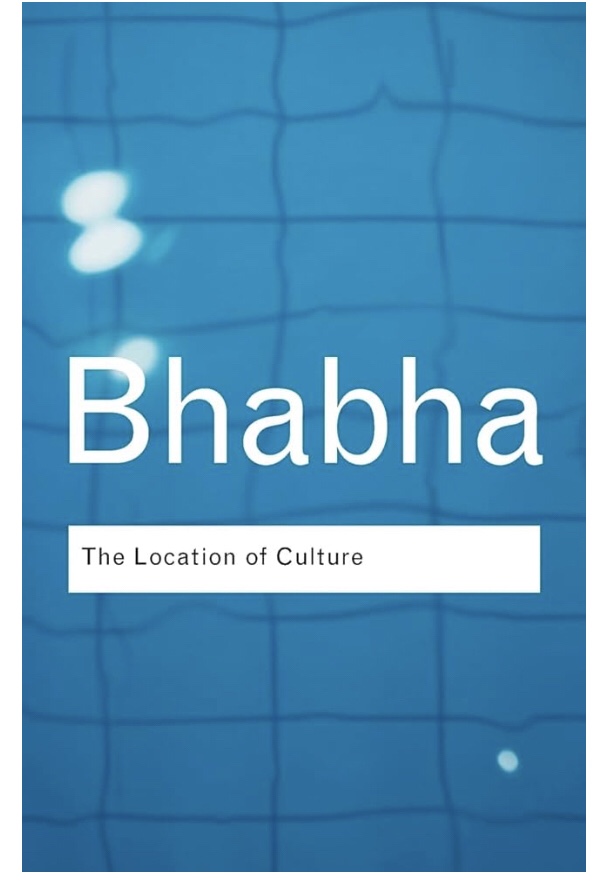
This is part of my narrative development work from memory, where I make work when thoughts or scenes come into mind. In this case, it was a childhood memory. The trigger for this memory came from researching into Homi K. Bhabha’s book, The Location of Culture, where he talked about ‘mimicry’. Bhabha asserts that the colonised people would try to mimic the behaviour and culture of the coloniser in order to be more accepted by those in authority. According to Bhabha, the coloniser wanted the colonised to mimic them because it was a form of imposing soft power making the colonised adopt the coloniser’s culture and habits as a higher standard. To reinforce the power structure, the coloniser would demonstrate their power by judging good and bad mimicry. The coloniser did not want the colonised to be great at mimicking because it was important to maintain a differentiation between the two to justify the act of colonising.

Understanding Bhabha’s explanation of ‘mimicry’ reminded me of an incident that happened in my childhood in Hong Kong on a bowling green… It was a case of bad mimicry and I got into trouble for it.

There was a pristine lawn bowling green in front of our apartment block where the British would bowl on sunny weekend afternoons. As local kids, we were not allowed to go onto the green – it was forbidden. However, it was too tempting so one day, my siblings and I (three of us) went to play on the lawn. We were soon shouted at by a white British man. We didn’t know what he was saying but he was clearly shouting for us to get off (shouting and waving his arms dismissively). Kids innocently playing on grass where they shouldn’t do was no big deal, it happened all the time everywhere in the world. But on this occasion, our father who worked for the British HK Government was angry when he heard about what we did. He wouldn’t usually get involved with discipline for us and certainly not for something so trivial, that side of parenting was left to our mother. But he personally told us off as soon as he was home from the office. The fact that he scolded us as soon as he got home meant that he was informed of the incident at work; the news somehow reached him through an official channel. Now in hindsight, I believe we made him look bad at work because we showed that his family were poor mimics, we didn’t respect the bowling green like good British people would. Our poor mimicry as kids must have undone the good mimicry work that my father was working so hard to portray at his work. We were bad kids and made him look bad in front of his superiors.

Researching into Bhabha’s idea on mimicry reminded me of that incident and I wanted to make a piece of work about it.

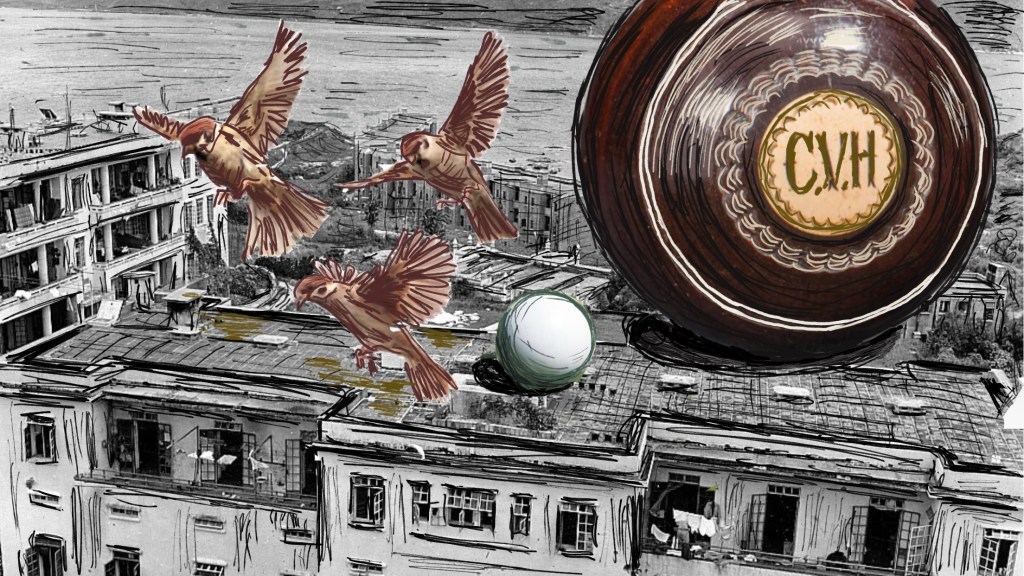
Finished work:

METHOD

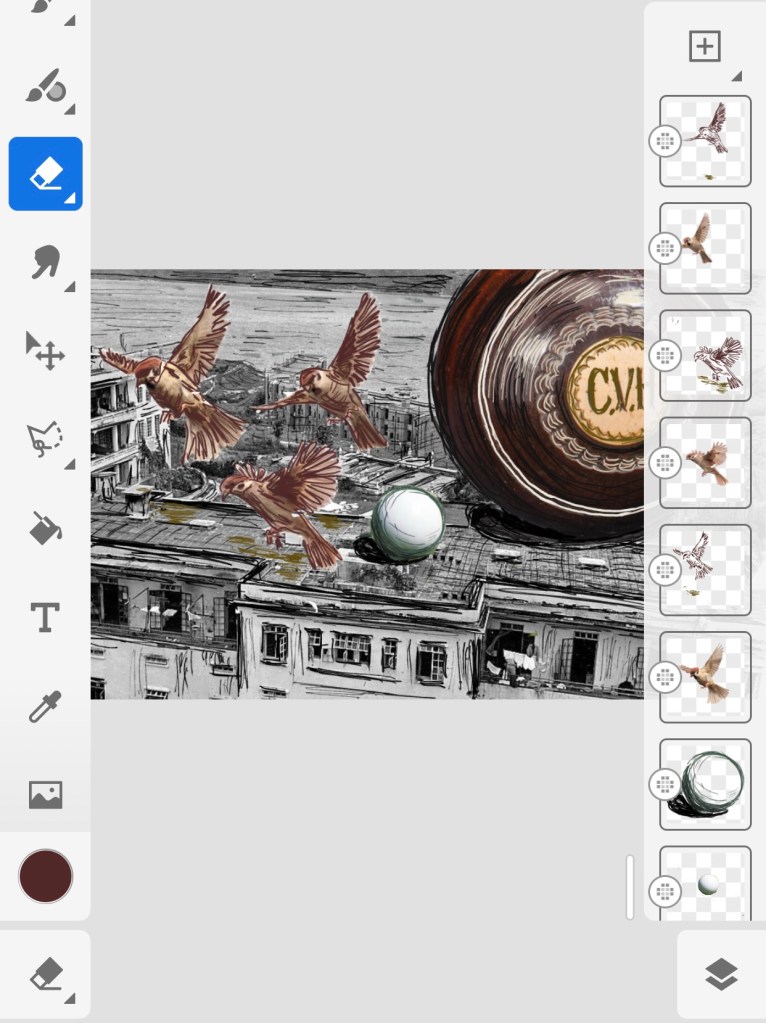
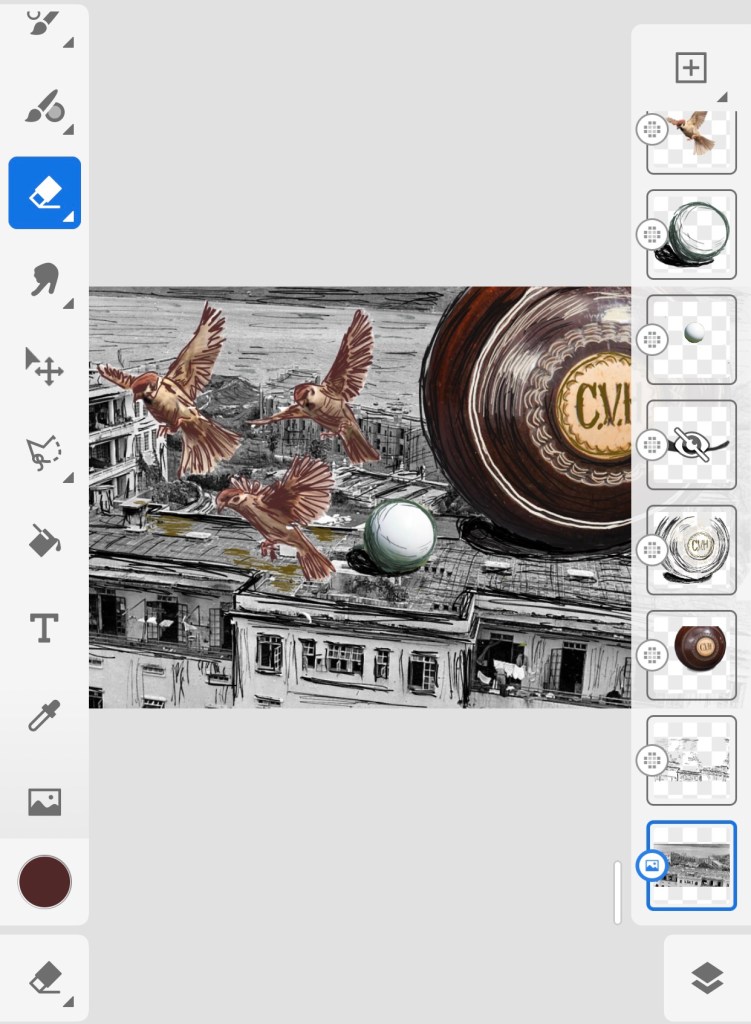
Adobe Fresco was used for this work. Below are images showing the layers that were created – some were imported images and others were painted or drawn using the software. The three little sparrows were metaphors for me and my siblings. There were always lots of small tree sparrows on our balcony when we were young and I like using that as a metaphor for me as a child in my narrative art work.

The base layer image was a scene I found online of the said bowling lawn dated back to WWII during the 1940s – the lawn in the image is mostly obscured by the Prison Officers’ Club house in the foreground. My father worked for the HK Crown Prison (Correctional) Service and the apartment block on the left was where we lived – it was called Block K. Out flat was on the middle floor on the left side of the block. Seeing the photo brought back so many memories of my childhood at Flat No. K3.

The base layer photo was found in this blog and the blog details some very interesting history about the area which was used as a POW camp during WWII and our Block K housed Dutch and Norwegian POWs.

http://battleforhongkong.blogspot.com/2016/12/december-2016-diary.html?m=1

REFLECTIONS

I have found Bhabha’s book, The Location of Culture, very insightful and I continue to enjoy using his theories to help me to make sense of my lived experiences as a transcultural person. This incident was an example of how this part of my learning worked.

I also enjoyed working with Adobe Fesco. I found the tool straight forward to use. I particularly like the fact that I can work on my phone on the go, then refine and build on my work when I’m at home with my Surface Pro. So I’ll continue to use Fesco as my go-to digital art tool.

Researching Bhabha’s theory of mimicry helped me to understand the incident and why my father was upset by what was a rather trivial act by his kids. A question I am asking myself is – how does doing narrative art work like this one help me? I do not have an answer yet but I want to note down this question as an ongoing enquiry.

LEARNING

Researching Bhabha’s work has inspired me to make work to develop my narrative. This is what I had hoped would happen so I’m happy with this progress and will continue this path of learning.

Adobe Fresco is a useful tool that I like, I should continue to explore its functionality.

I was unable to answer the question that I posed myself ‘How does my narrative work help me?’ – Why am I doing it? I need to give this more considered thoughts.

NEXT STEPS

– Keep going with research on The Location of Culture.

– Do another piece of work using Fresco, perhaps try the painting functions and not just drawing.

– Start to articulate my thoughts on how my narrative work helps me. I expect this to be a slow enquiry process…

UPDATE ON ENQUIRY

I have been thinking a lot about the above since posing those questions to myself ‘How does my narrative work help me?‘ and ‘Why am I doing it?’. In a recent Group Tutorial during our weekly MA online session, my group helped me to explore those questions. They also asked some additional useful questions, such as ‘Who am I doing it for?’ and ‘Has art ever solved any other problems for me?

Reflecting on the Group Tutorial, my latest thoughts are:

Firstly, ‘who am I doing it for?‘ My immediate answer was ‘for me, I am doing this for me’. 

Why am I doing it? My response was that the exploration helped me to understand more about myself, my behaviour and response to situations. 

How does my narrative work help me and has art ever solved any other problems for me? For this, my answer during the Group Tutorial was that art had never solved any problems for me but there have been cases where by exploring my narrative through my art practice, it had helped to crystalise or pinpoint a problem and brought better clarity. However, after the group discussion, I reflected further and felt that in fact on occasions, my art and practice research have helped me to find answers. Such as this case of the ‘bowling lawn incident’ – through my art making and research, I had a better insight into the colonial soft power structure that my father had to work in therefore giving me a better understanding of his environment and helped to explain some of his behaviour that impacted us all.  

Although I have made some progress, I am aware that these answers are still quite close to the surface and I want to take more time to continue this line of enquiry, hence it is still ongoing…

MA Y1 U1: Developing narrative – Self-portrait #3

BACKGROUND

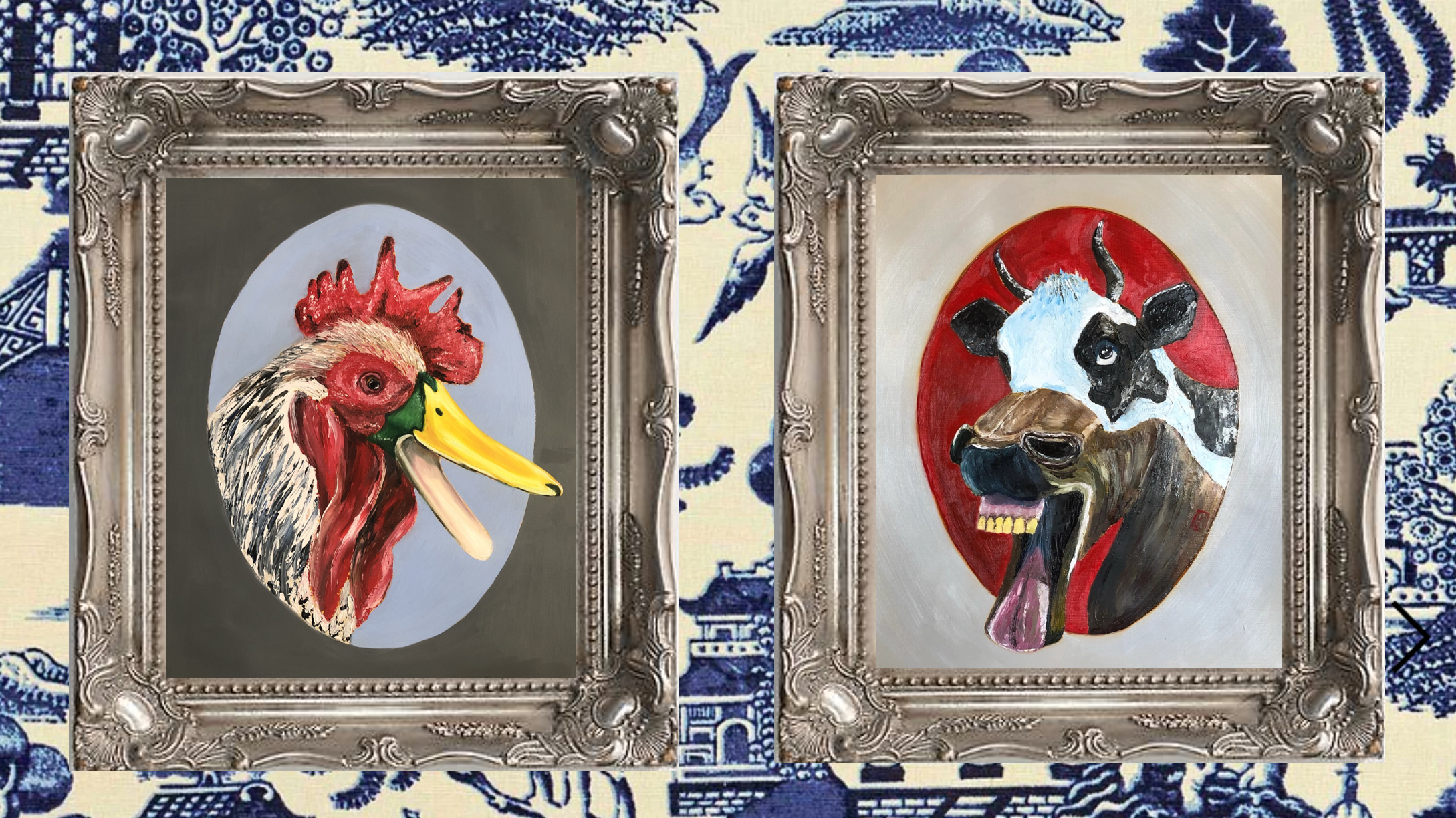
As part of my narrative development work, I have previously done two self-portraits as metaphors that reflected my transcultural lived experiences – an image of them is at the bottom of this blog. These self-portraits are a combination of two different creatures reflecting the conflicts that I experience at times within my mind.

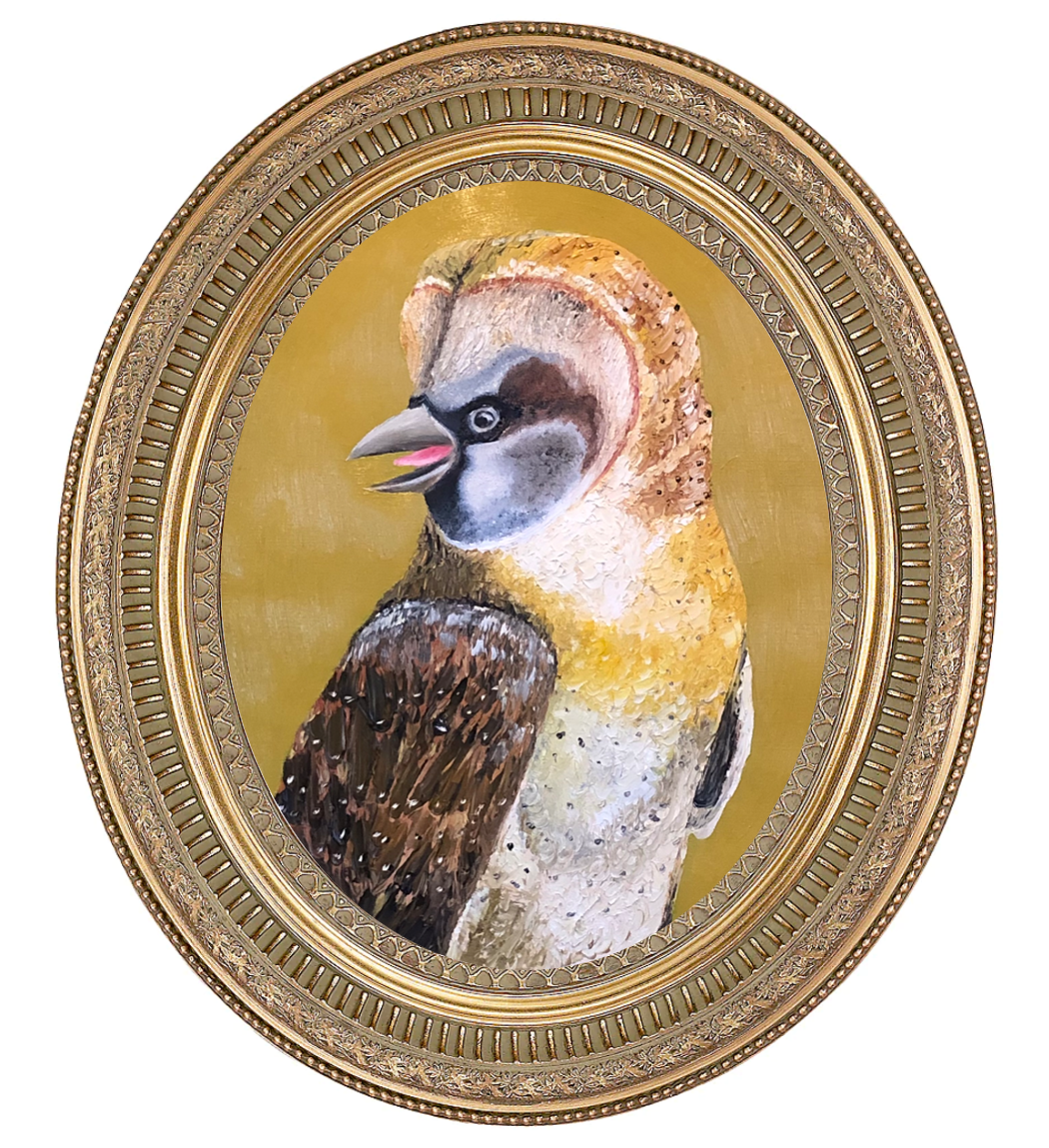
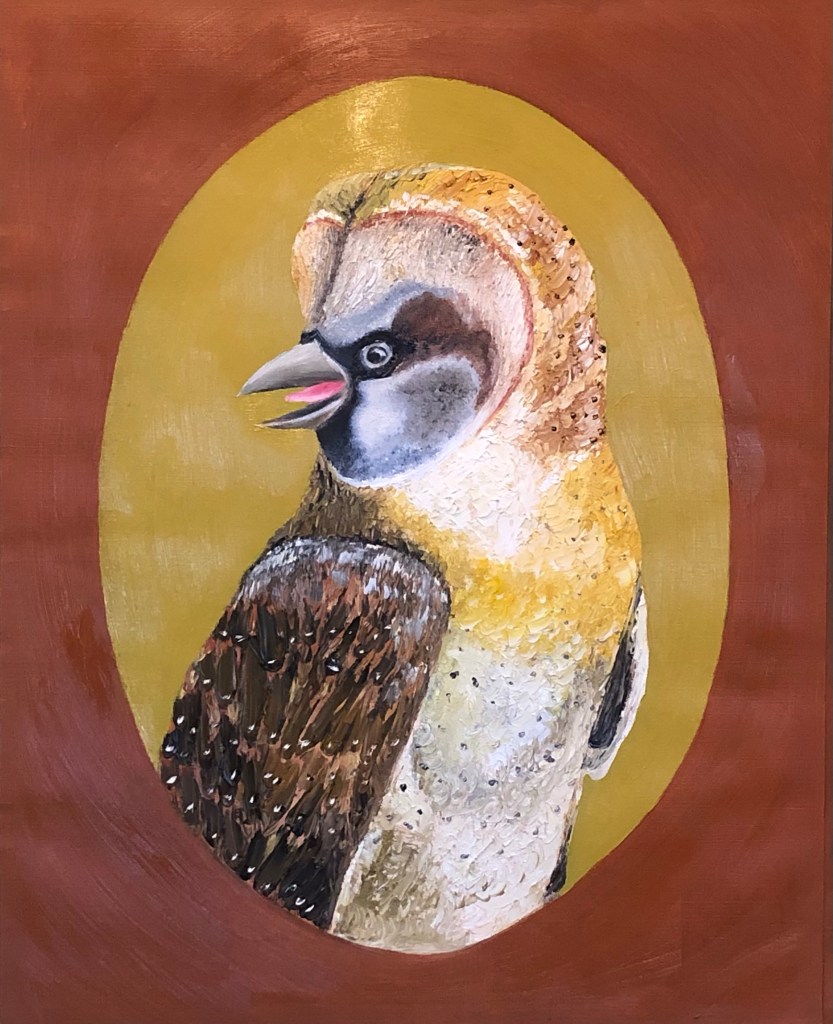
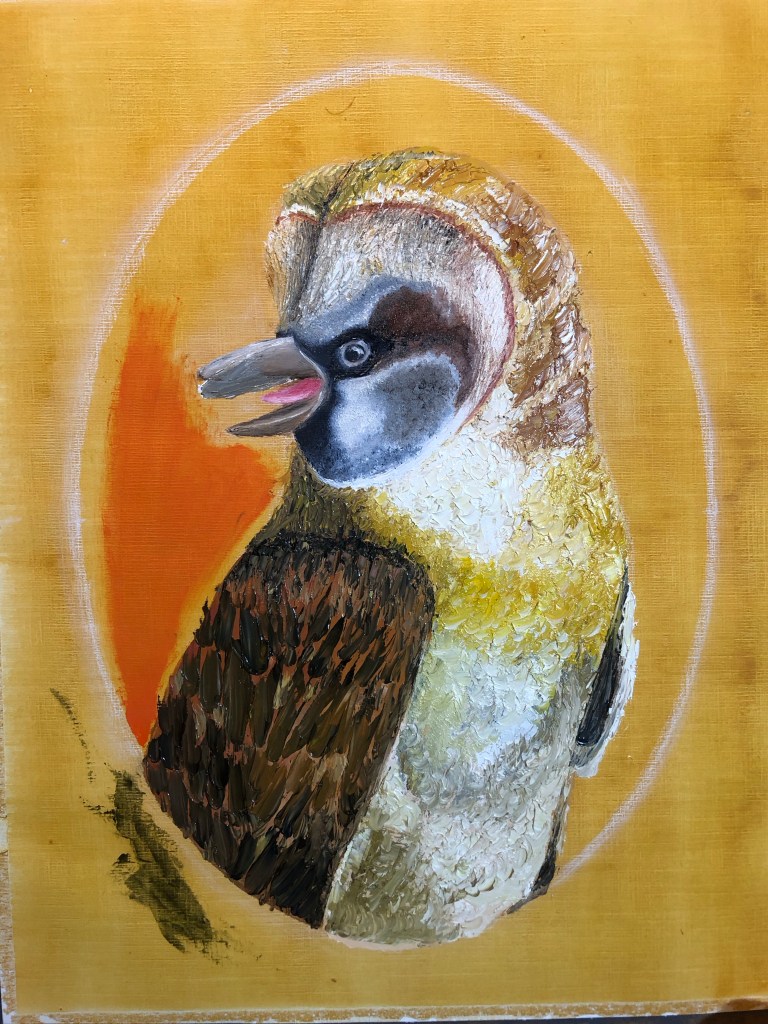
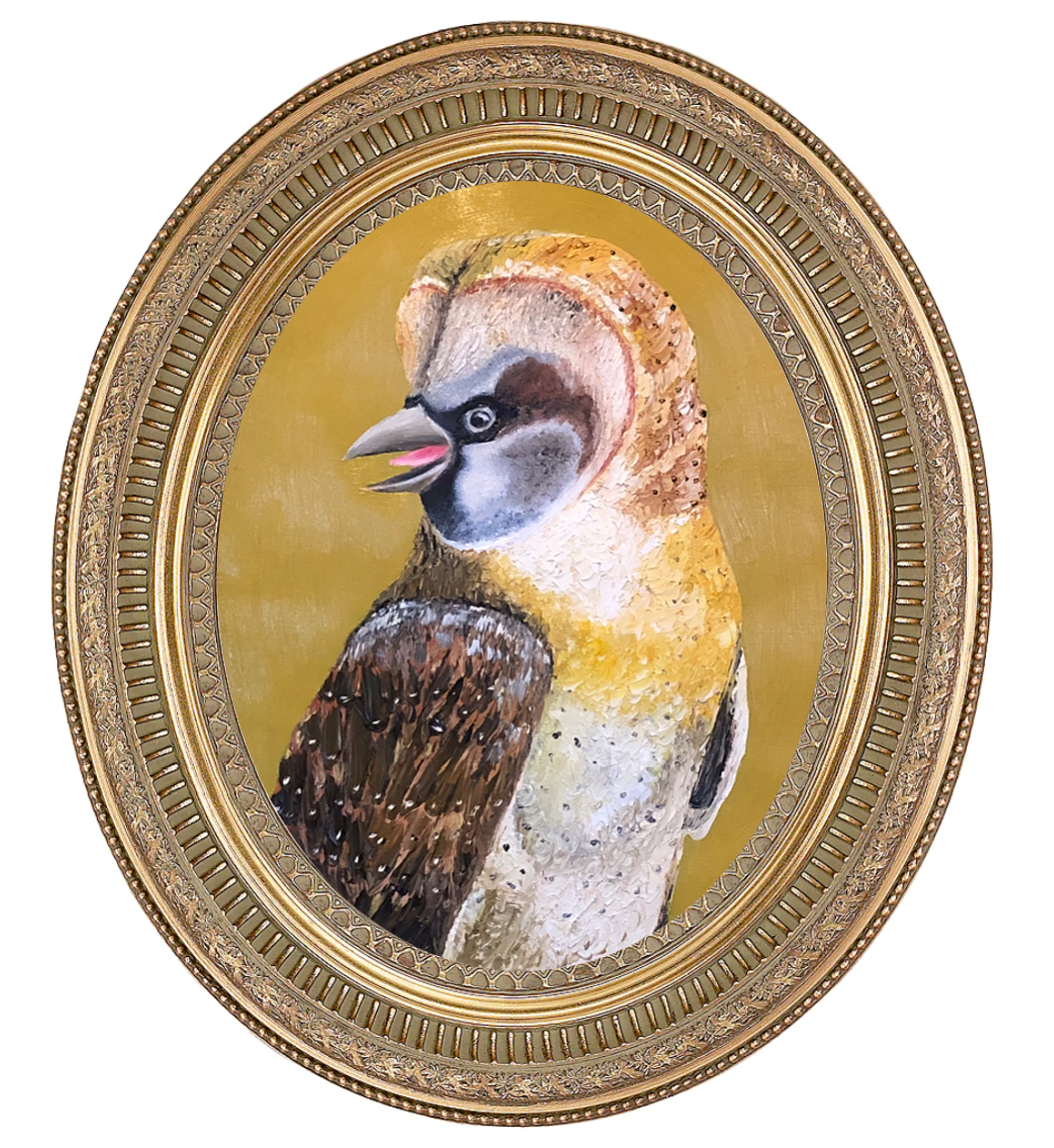
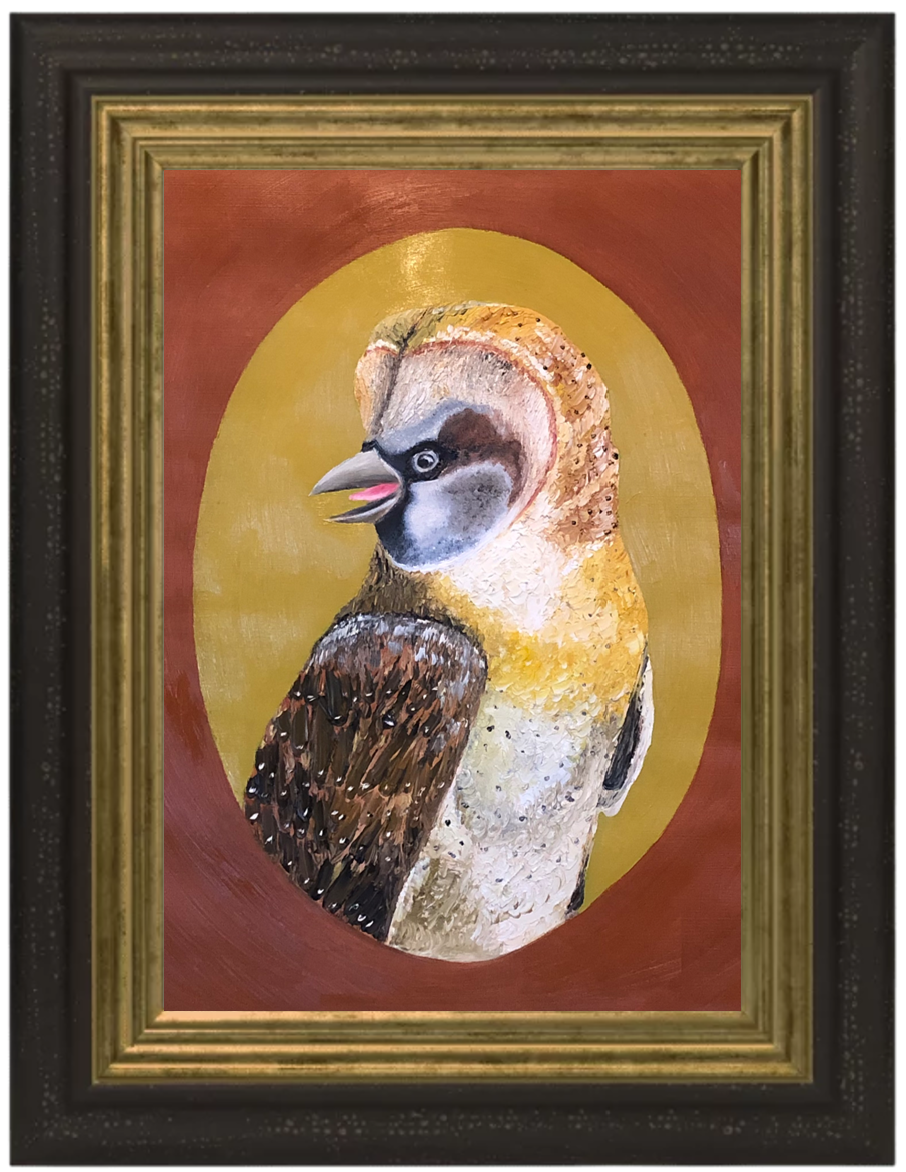
Self-Portrait #3: The Owl-sparrow

Finished painting simulated with frame:

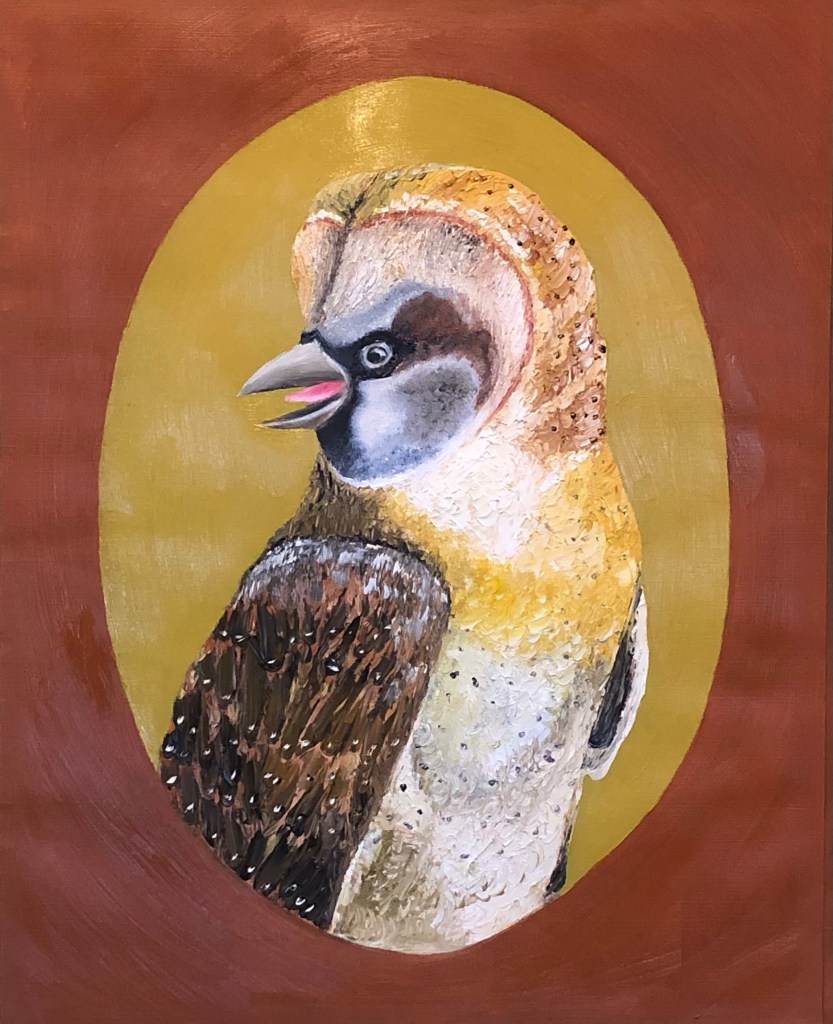
Finished painting, unframed – oil on paper, size 51×41 cm

METHOD

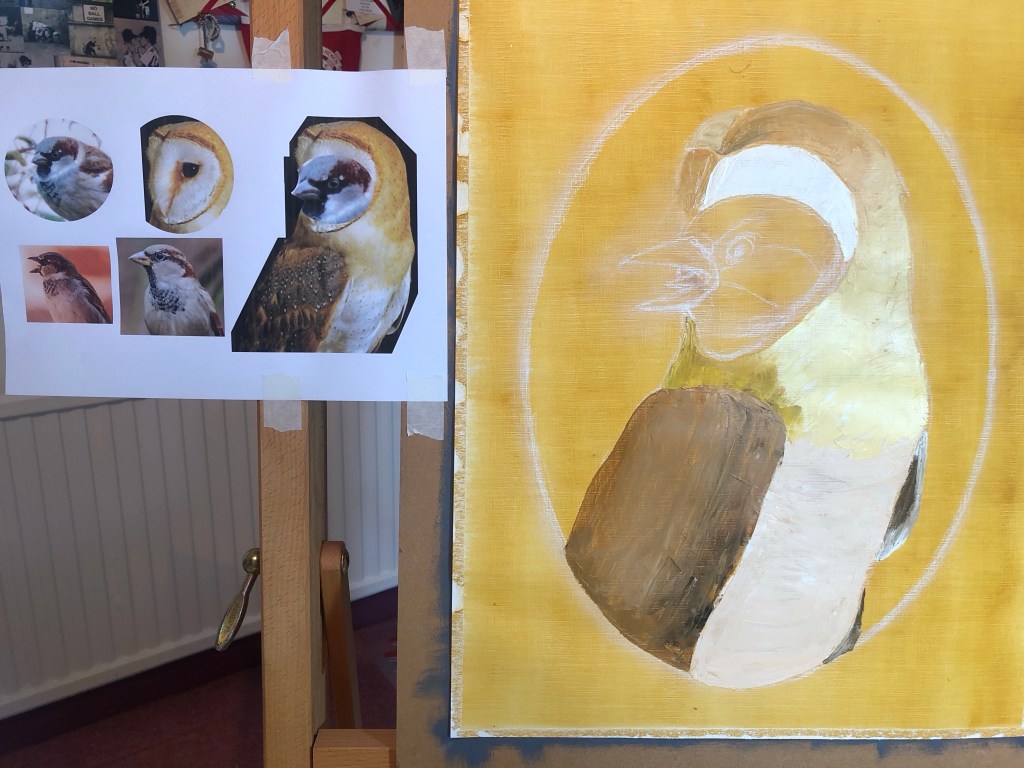
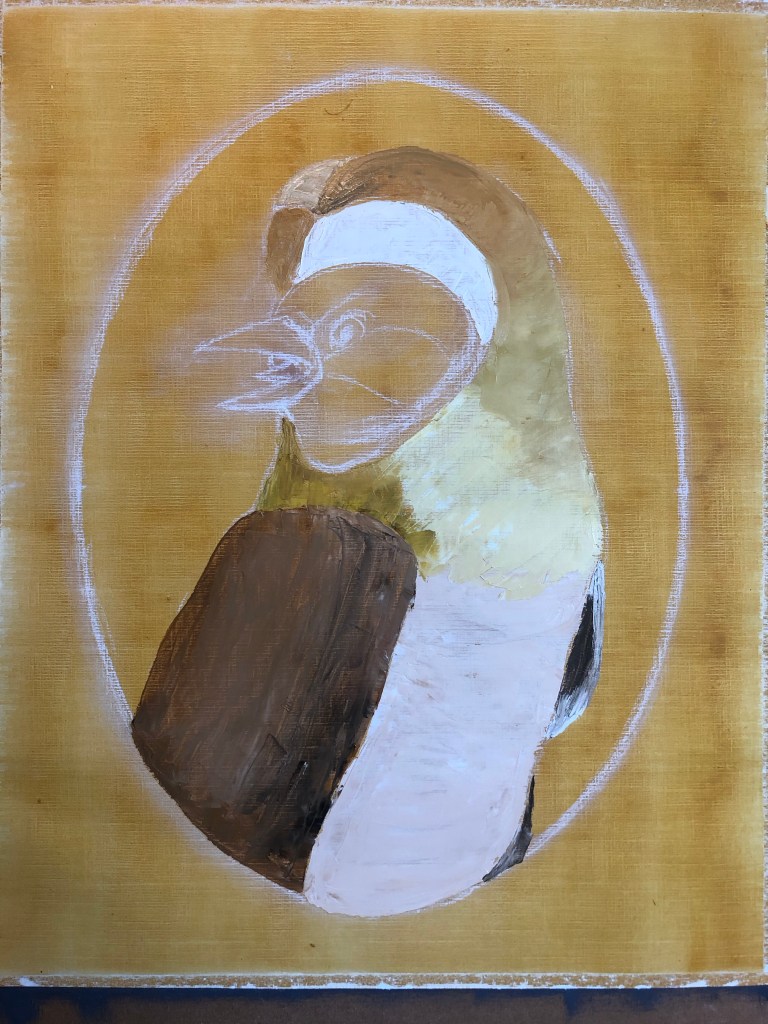
This is the third painting of this kind that I have done so I am working with a familiar process. Firstly, I consider the creatures that metaphorically represent the two sides of my conflicting feelings. Then I research images of the chosen creatures online – I usually have in mind the posture that I want for the painting which helps to narrow down the images that I choose. I then use paper cutting as a way to combine the creatures so that the image overall makes sense anatomically. Then I chalk the outline and block in the colours in oil. At this stage, I also decide on the finer details of the facial features, e.g. mouth open or closed etc..

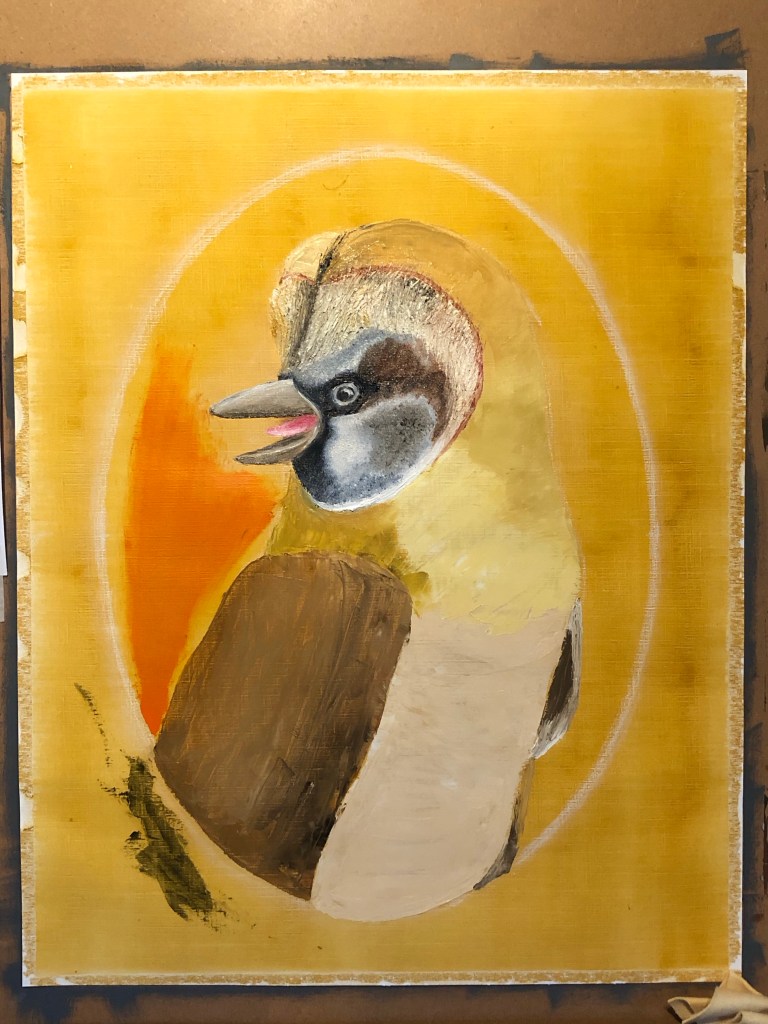
As I paint, I start to consider the background colours:

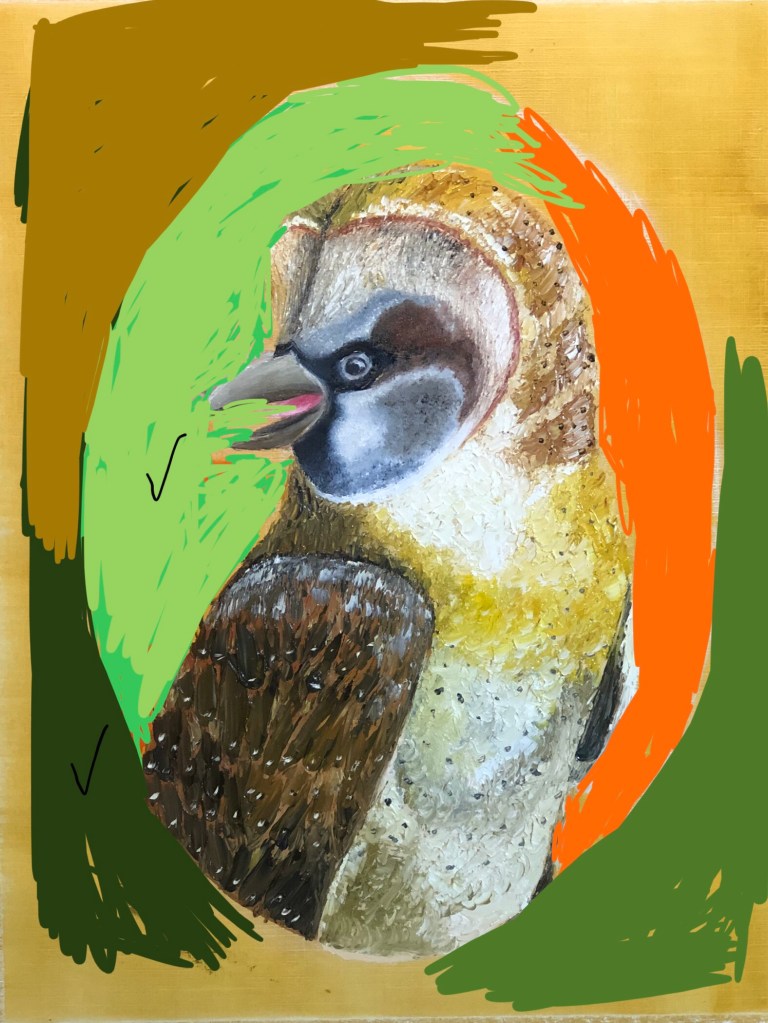
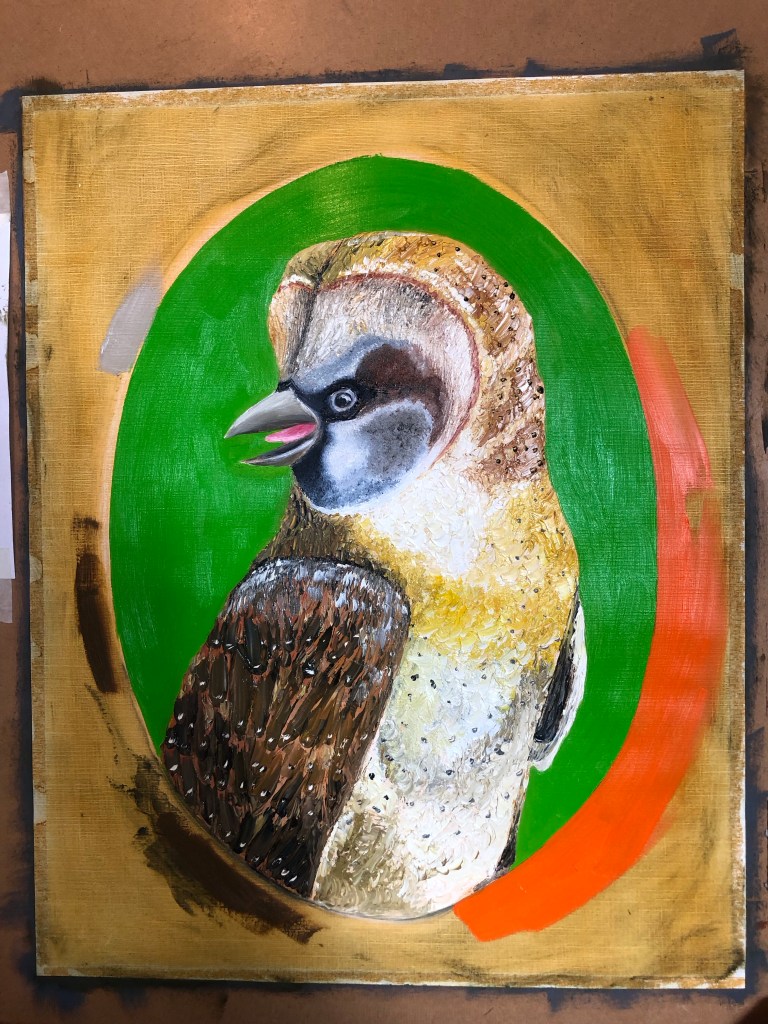
Recently, I have started using my iPhone to colour in the background so I can easily make changes and experiment. In this case, I chose a light green for the oval background and a darker green for the mount.

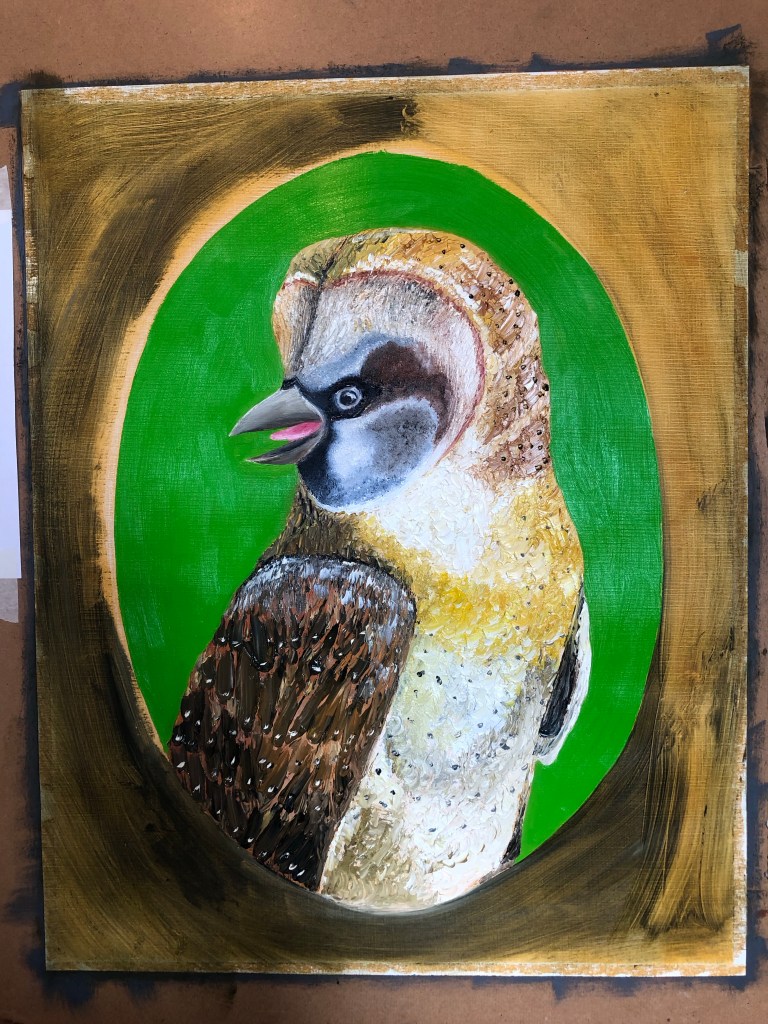
Once the creature was complete, the background was painted.

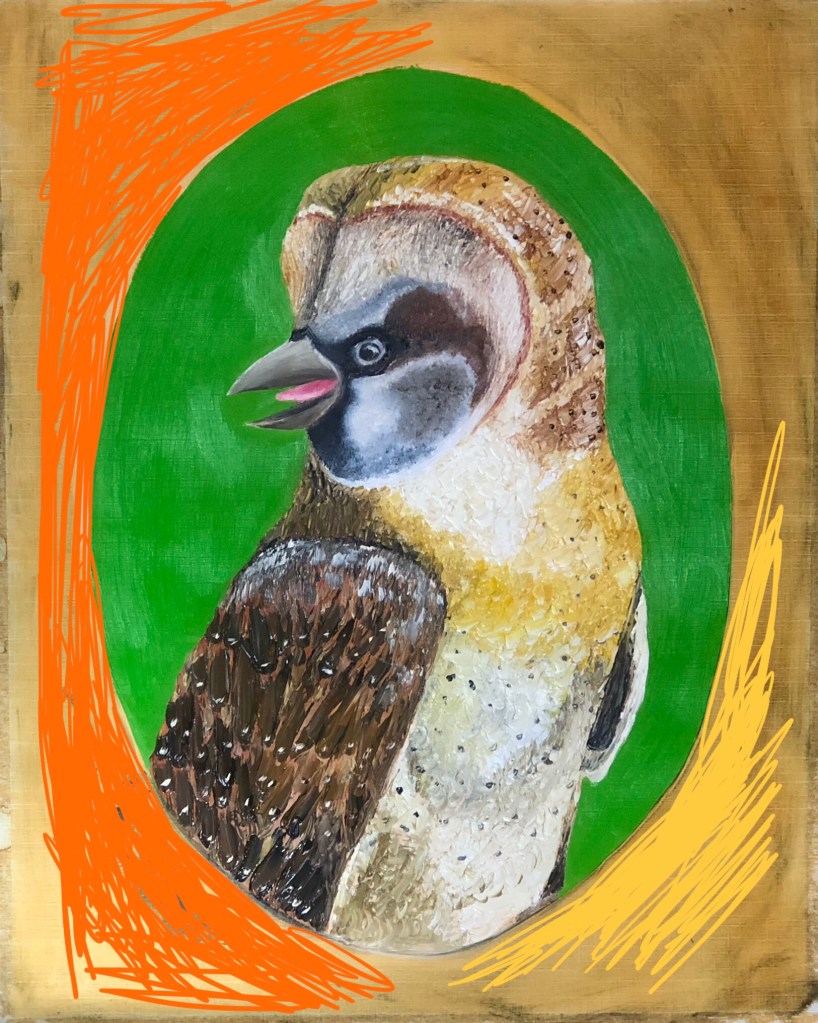
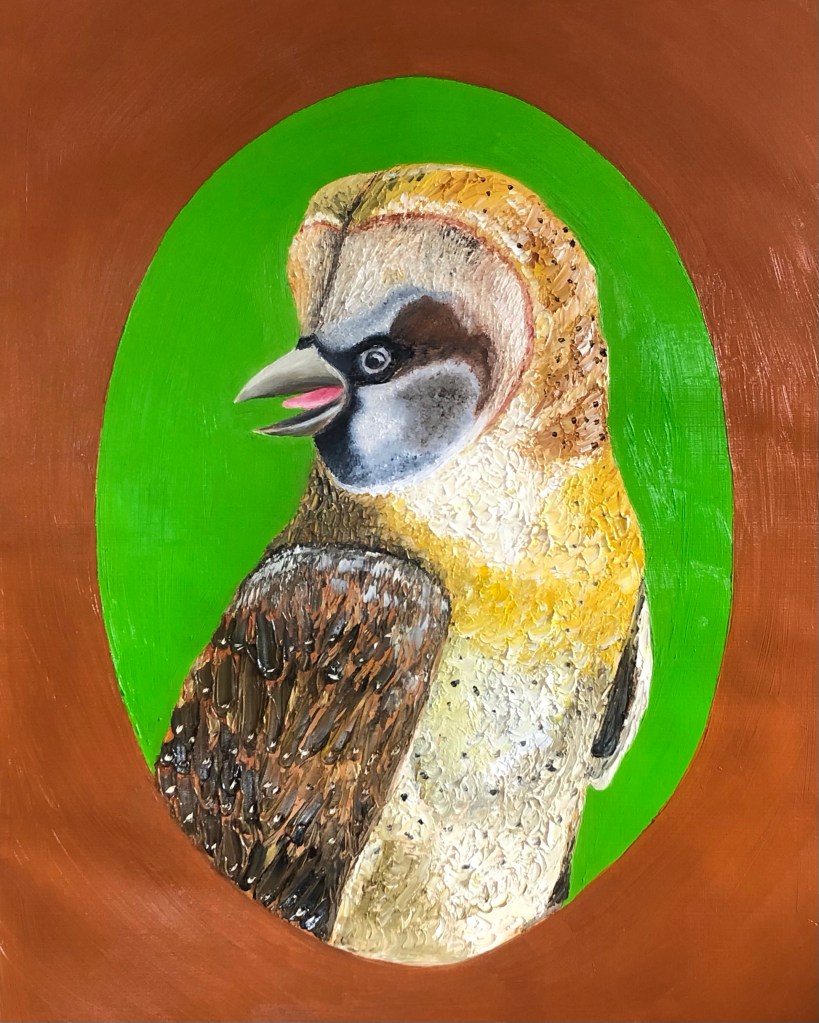
I was not happy with the mount colour above, hence I returned to my iPhone to try out other colours:

Having chosen orange on the iPhone simulation, I did not like the effect when I started painting the mount because I felt the natural colours of the bird and the bright background were not well harmonised.

In the end, I settled for raw sienna for the mount which I was satisfied with. However, I was not happy with the green background because the brightness over dominated the bird.

I changed the bright green background to a light sage colour and below was the final outcome.

Different picture frames were tried with the image to give it a finished portrait look:

REFLECTIONS

The idea for this portrait came about as a result of a question that I was asked during the first ‘accountability 3’ session. I was asked what I thought of HK nowadays. I always feel a sense of awkwardness and my pulse quickens when I am asked to comment about HK. This has been the case for many years since the early 1990s when it was clear that HK would be handed over in 1997. Since I’m from HK, I believe there is an expectation that I would say something insightful. However, to be truthful, I never know what to say because I left HK in 1980 and have not lived there since. Although I have been back for the occasional holiday once every few years, I did not and do not feel in any way qualified to make any sensible comments. I do not like expressing opinions without facts that I can trust. All the information about the HK situation that I know would have come from the media which I believe to be biased as all press from all sides tend to be. I don’t have means of getting up-to-date first hand experience there which makes me feel helpless. As a result, there is a void of knowledge that I subconsciously didn’t want to acknowledge because acknowledging that would mean acknowledging the distance between me and my heritage. Perhaps there is also the ‘insider or outsider’ feeling. Many years ago, when I was asked the HK question, I had given the answer ‘I don’t know what will happen in Bristol tomorrow, why would I know what will happen to HK in x years’ time?’ I know that reply was not so friendly. I guess I was tired of waffling again and again to sound knowledgeable whilst feeling like an outsider from all sides.

I had never given this matter much thought until I was asked about HK recently during the ‘accountability 3’ discussion. It prompted me to reflect deeper why I always felt awkward with those types of questions. I wanted to do a painting to capture those thoughts and use the making process to help explore my feelings.

So I did another self-portrait. I painted an owl with the face of a sparrow. The owl symbolises wisdom and knowledge meaning that my appearance makes people think I should have insight, but when I speak, I can only be a sparrow. I use a sparrow as a metaphor for me as a child because when I was growing up in HK, I remember always seeing small tree sparrows on the balcony of my parents’ apartment. Hence I use that to represent me as a child.

I did the painting over three days and I was able to explore the above thoughts to gain some personal insight.

LEARNING

It has been a useful reflection process.

<<To be completed>>

NEXT STEPS

<<To be completed>>

Previous Self-portraits:

MA Y1: Research – The Location of Culture by H Bhabha

Background

This blog captures my notes and reflections as I read this book. I found much resonance in Bhabha’s text and I hope this blog will be a treasure trove of inspiration for me to make work through exploring my Third Space.

This is an ongoing blog that I plan to update as I go along as I expect to take time digesting the text and is likely to involve much re-reading over time.

Notes and reflections:

Introduction refers to novels by VS Naipaul drawing out essence to position Bhabha’s notion of ‘vernacular cosmopolitanism’ which asserts measuring global progress from the minority perspective.

The right to difference in equality.

A dual economy is not a developed economy.

‘Symbolic citizenship’ (Avishai Margalit) – surveillance culture of security… how do we tell the good migrant from the bad migrant? Which cultures are safe and unsafe?

Minority affiliations or solidarities arise in response to the failures and limits of democratic representation, creating new modes of agency, new strategies of recognition.

Poem by Adrienne Rich – An Atlas of the Difficult World (1991) has powerful images. To do: research for images

Adrienne Rich struggles to find ways to establish narrative of what lies in-between the distinct moments that allows the characters to become affiliated in the spirit of ‘right to difference in equality’.

Rich places herself at the intersections of these narratives as a cultural re-visioning of a particular history ‘of one’s own’.

No name is yours until you speak it. Your personhood cannot be denied.

The borderline engagement of cultural differences may as often be consensual as conflictual. They have confound our definitions of tradition and modernity. Realign the customers boundaries between the private and the public.

Using architecture as a metaphor with stairwell connecting rooms – this interstitial passage between fixed identifications opens up the possibility of a cultural hybridity that entertains differences without an assumed or imposed hierarchy.

Useful links on Homi Bhabha’s work

Short lecture on Bhabha’s work:

Someone reviewing the book:

1.5 hours long lecture by Bhabha:

In-betweenness by Dr. Masood Raja

Chad A Haag review series on whole book:

Update 14th Dec 2023

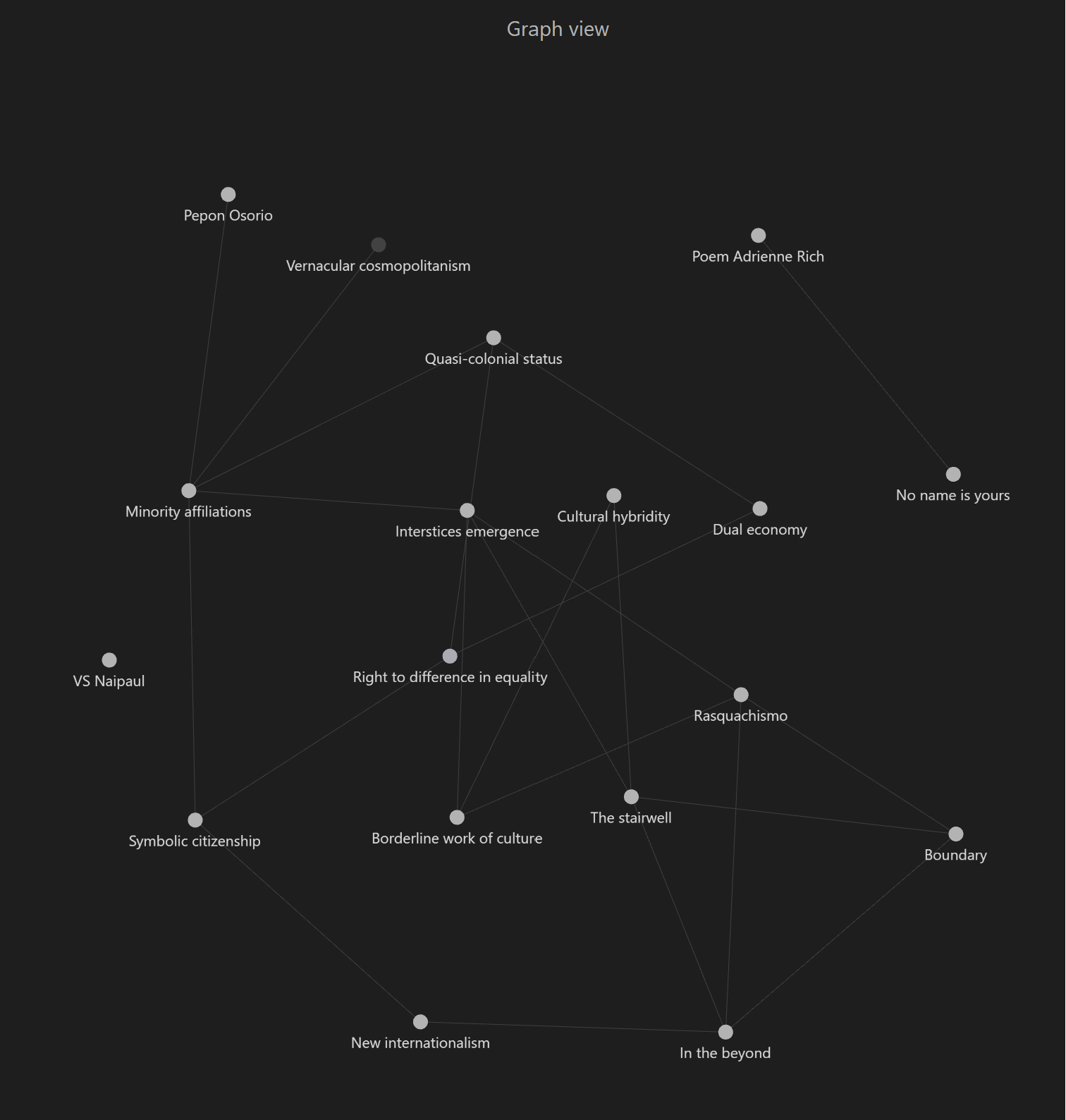
At the Unit 1 tutorial, I was introduced to a note taking tool called Obsidian. It is based on the Zettelkasten method of note taking. I have since started using Obsidian and I have found it to be very useful and powerful. It will be very helpful for me because I was starting to struggle with just capturing my notes and thoughts on a list here. I needed to structure my thoughts and the data in a better way. So from now on, I will capture my notes on The Location of Culture in Obsidian instead of listing them in this blog.

Example of the graph view of notes so far taken with Obsidian:

I have also watched all five of the Chad A Haag study notes videos on YouTube – they are excellent and have helped me to quickly get a sense of the ideas by Homi K Bhabha. It is a book that requires time to study and digest. I will continue to read the book and will really take my time to understand it because it forms the foundation of my research in my art practice.