MA U2: Working from a dream – Mending tights

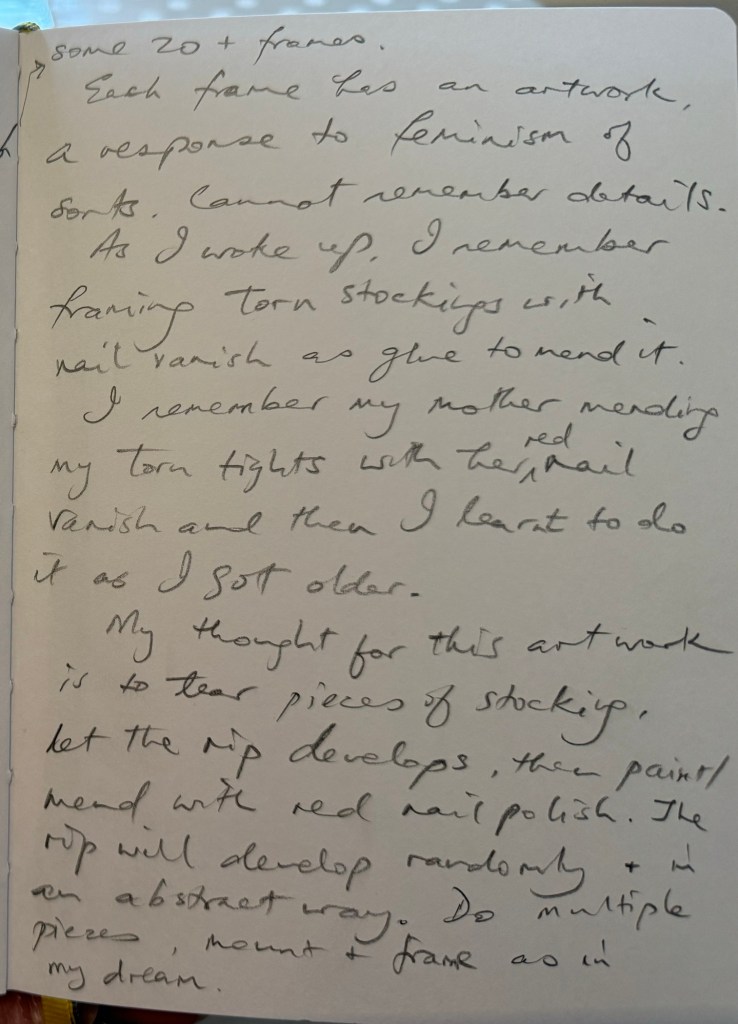
While I was on holiday in Scotland during summer 2024, I had a dream one night about making a piece of art work with pieces of laddered (torn) stockings or tights. The ladders were ‘repaired’ using nail varnish. Then each piece was framed individually in an ornate thick gold frame. It was such an unusual dream that as soon as I woke up, I captured the dream in my sketchbook in case I forgot the details as I often struggle to remember my dreams.

Mending stockings or tights with nail varnish was a technique that I learnt from my mother when I was little. If I laddered my school tights then she would mend it with her nail varnish. If the tear was small or in an area under my dress then it was fine to repair in this way without having to buy new tights all the time. Otherwise it would have been costly with an active child. In hindsight, it was ridiculous to make small children (girls) wear tights as school uniform, it was most impractical!
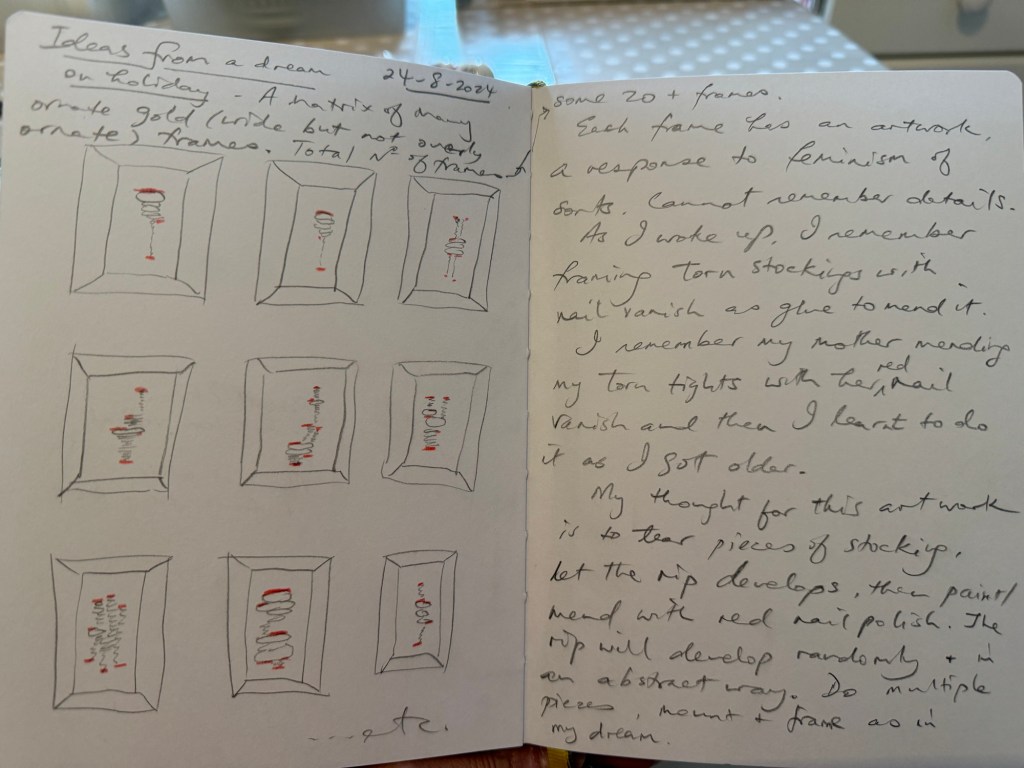
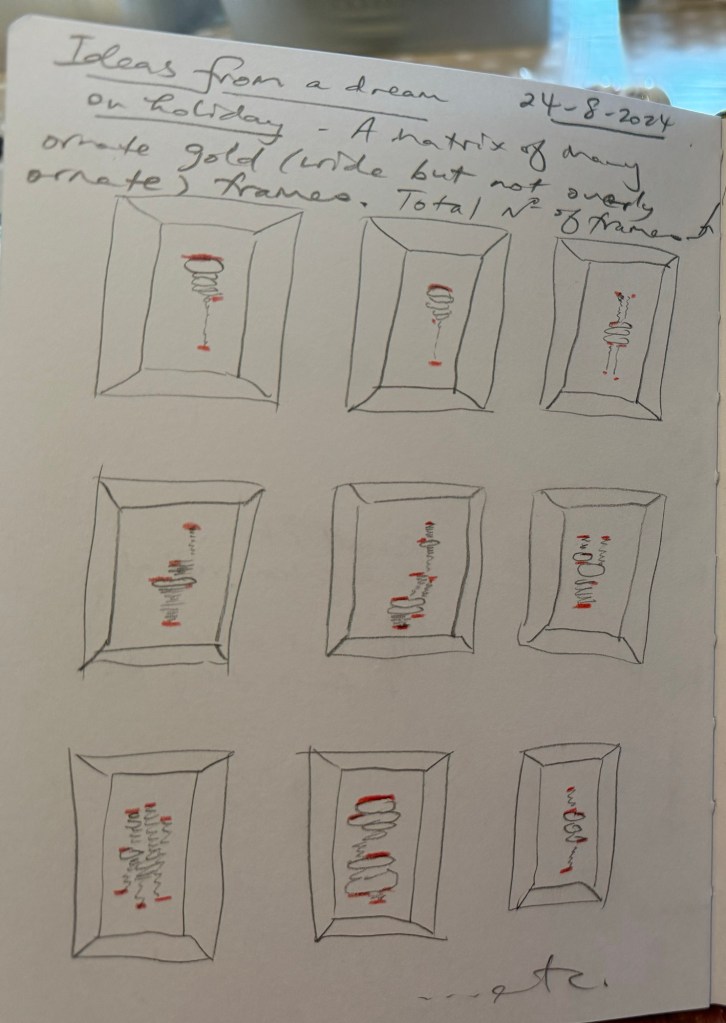
When I returned home after the holiday, I decided to realise my dream to make some art by mending a stocking.

METHOD

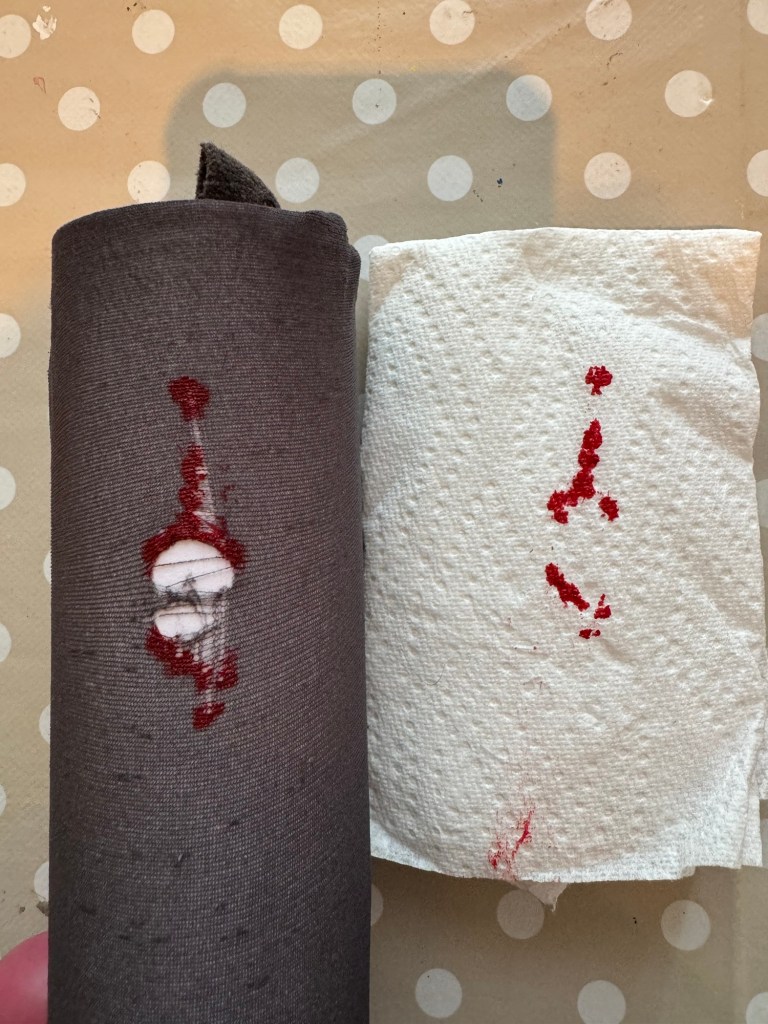
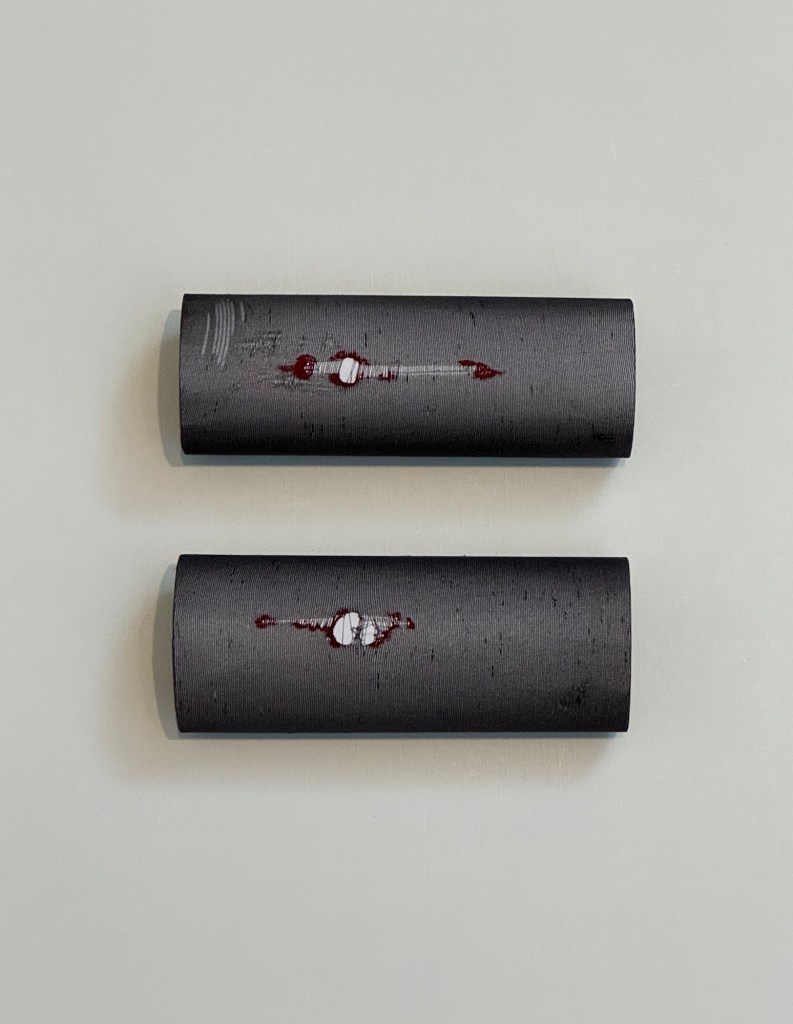
The first challenge was that tights and stockings nowadays are usually made of ladder-resistant materials which means they don’t ladder!! I had to dig out some old socks in order to find materials that would ladder. After laddering the material, a piece of white card was rolled up and inserted into the sock.
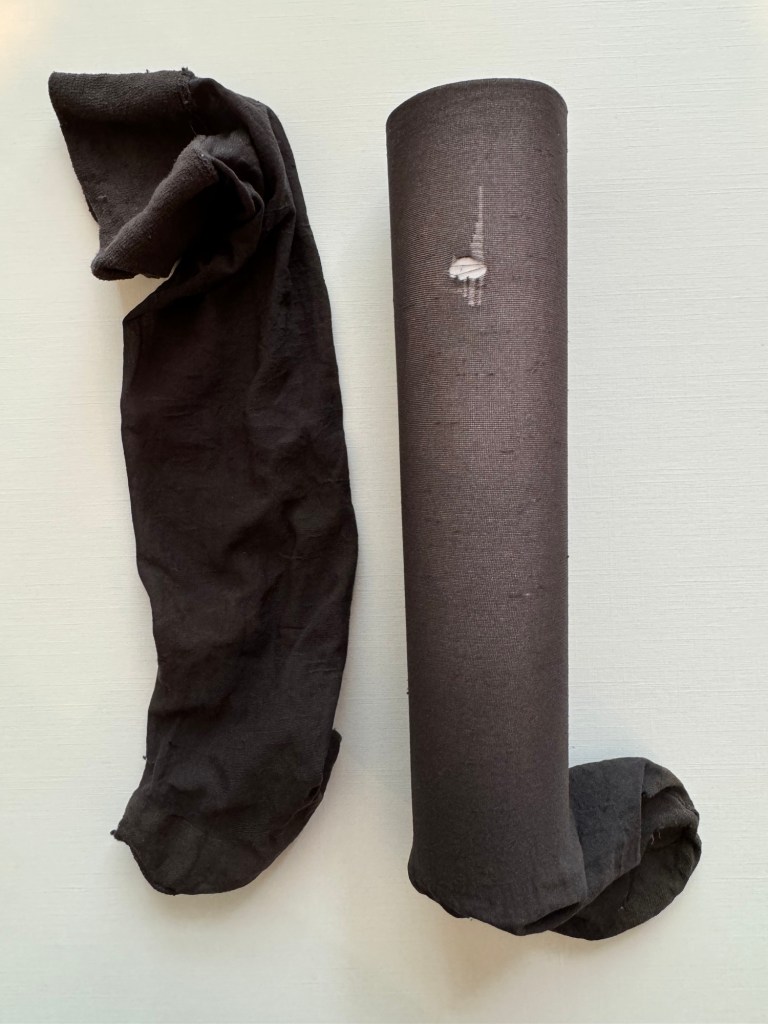
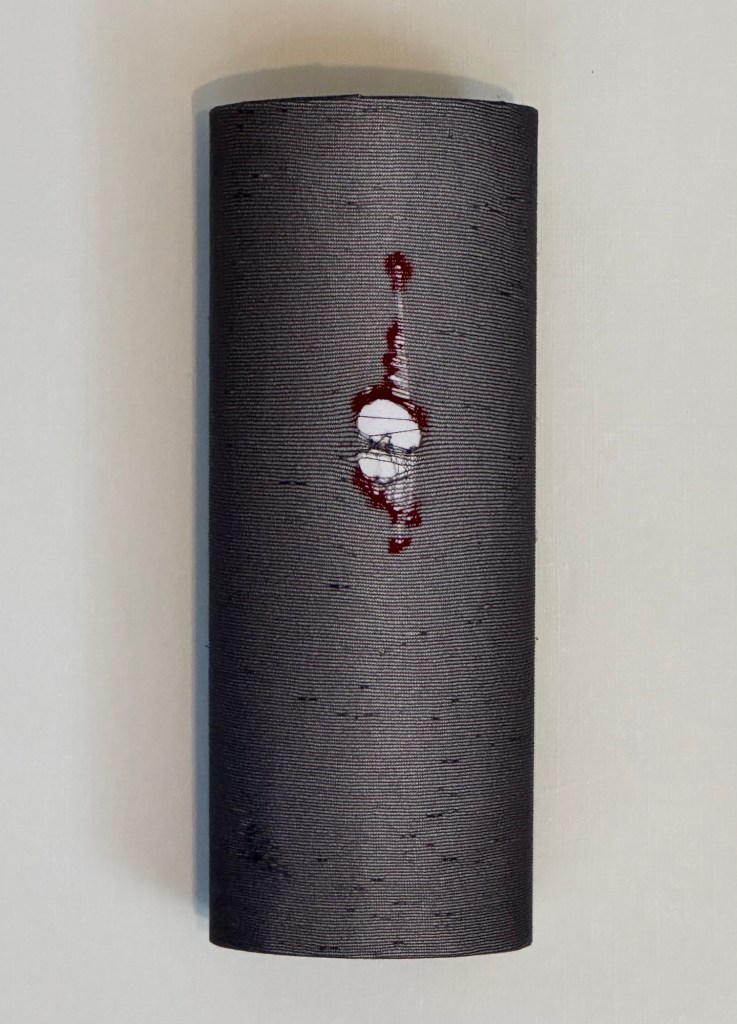
Some tissue was placed behind the ladder then red nail polish was applied at various points to stop further laddering.
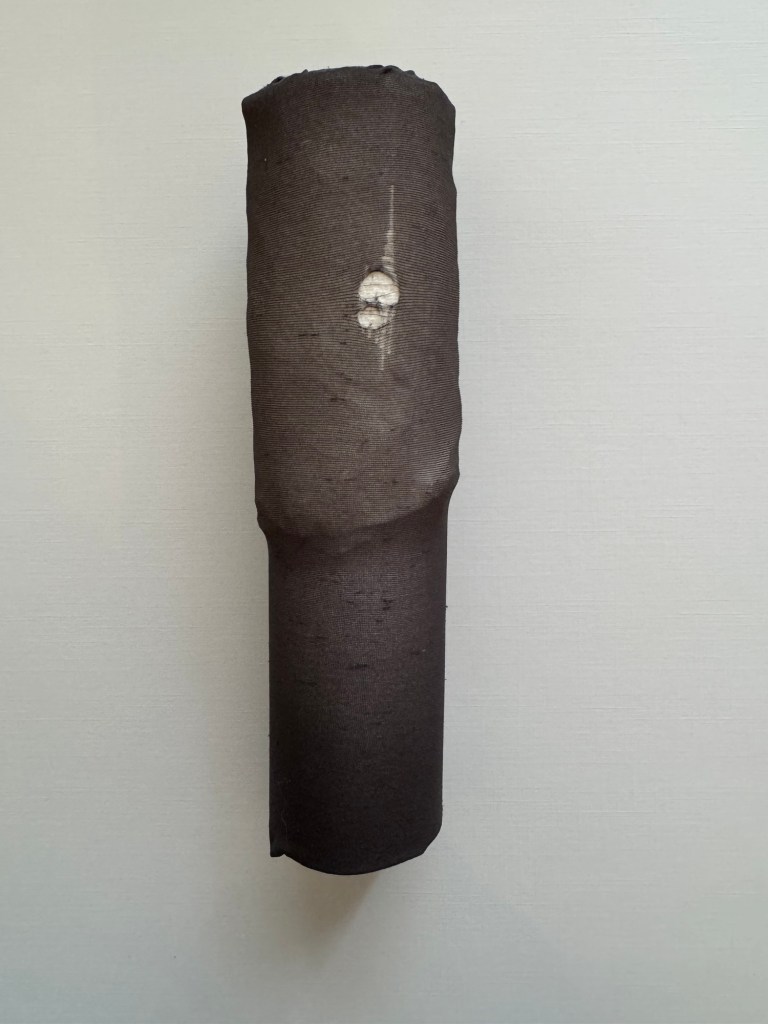
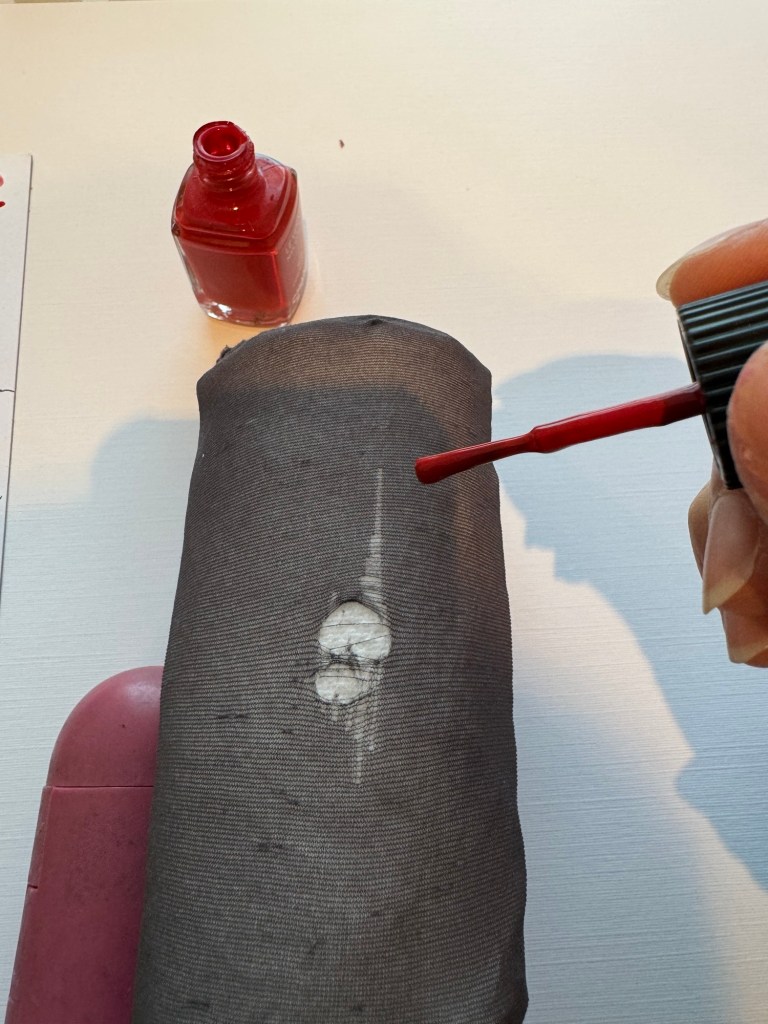
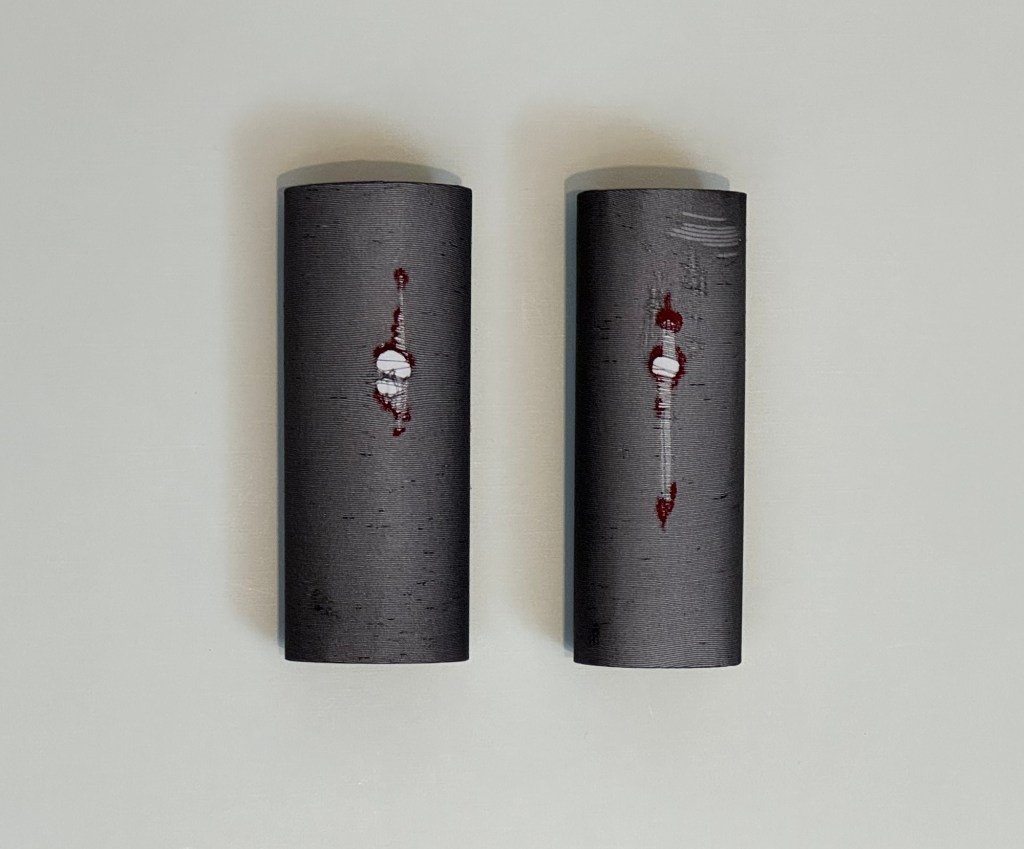
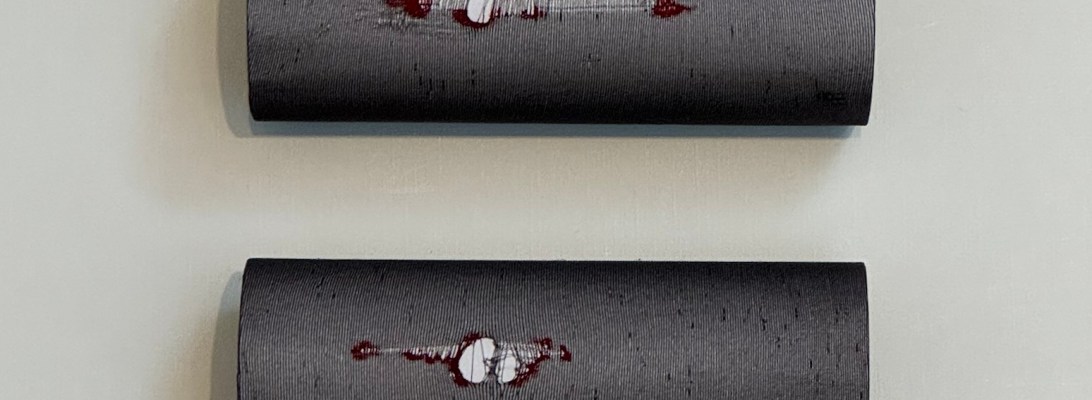
This process was repeated with a second piece to create two pieces in total:
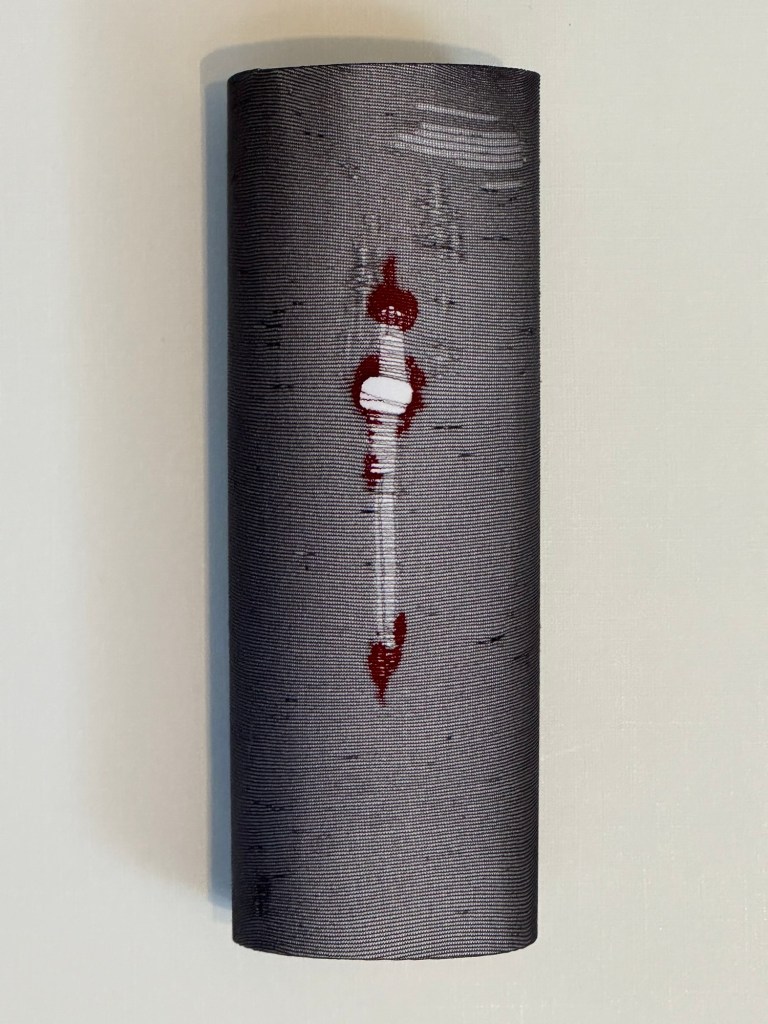
The two pieces were placed on a large piece of white card, in different arrangements, to experiment with composition:
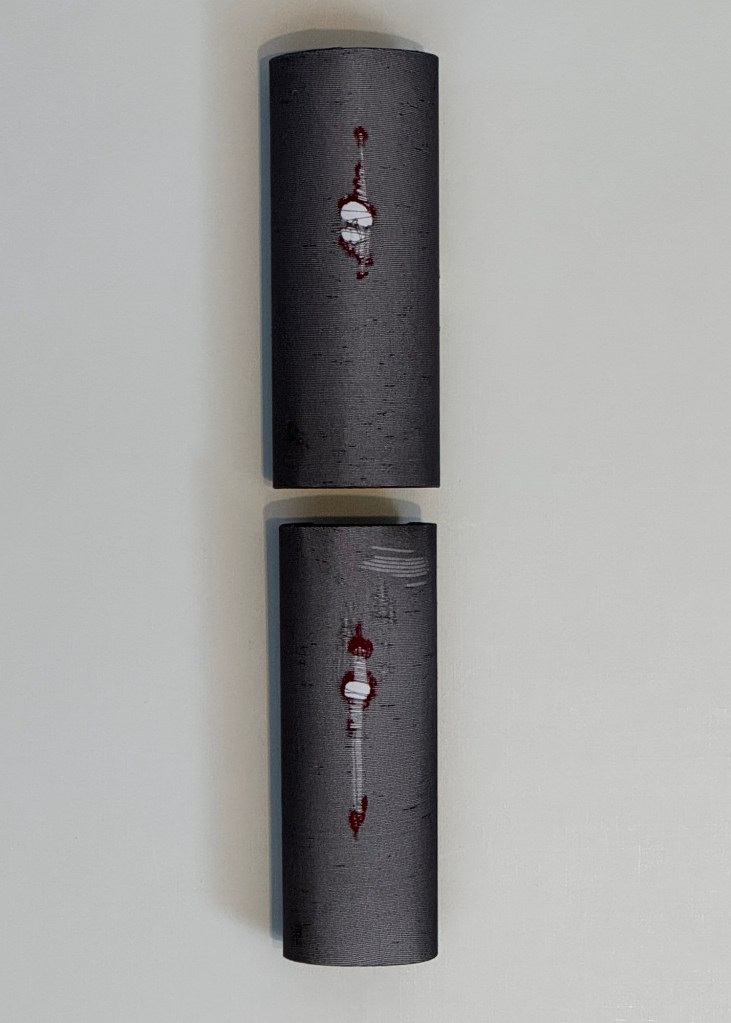
REFLECTIONS

It was such a strange dream that I could not think of what would have triggered such a memory during a holiday in Scotland. Throughout the planning and making process, I thought about all the things that we learn from our parents. My mother didn’t actively teach me to mend my tights, I just watched her and that technique was cemented in my subconscious.

During the last year when I have been making Chinese Cheongsam dresses as painting canvases, I have been thinking a lot about watching my mother dressmaking when I was little and how much I learnt from her without being conscious of it.

Thinking more about it – a week before I had the dream, I was looking at some old family photographs shown to me by a family member. Many of the photos of my parents that I had not seen for years. Perhaps seeing those images somehow unlocked the memory of mending my school tights. The act of mending tights is uniquely personal and it only happens between mother and daughter because boys do not wear school tights and it’s unlikely that fathers have nail varnish to hand. Also, a mended pair of tights hidden under a dress is a secret between mother and daughter, or between women when such techniques are passed from one to another. Those moments are precious.

It is usually at this point of reflection that I start to feel sad because I left home so young (14) and I must have missed out on so much learning from my mother, or just time with her to enjoy that unique bond, sharing secrets that only we knew about and that united us from the world. As always in life, we don’t appreciate how precious those moments are until much later.

I decided to stop after making two pieces and didn’t realise the whole dream of making multiple pieces into an installation. I may come back to it at a later stage. For now, I feel that this experiment has served its purpose in testing out the process and triggering reflections that will keep me thinking for some time. Overall, I am happy with how this quick experiment went and pleased with some of the images I produced.

LEARNING

I usually make work after lots of thinking and planning. This piece of work came from ‘left field’ (a dream) and the making was quick and experimental. I enjoyed the diversion from my main project and to get some results so quickly was enjoyable. A large painting often takes so long that having some quick work in between can help to feed my need for results as well as interrupt the agony of painting. I recently heard an artist on TV saying that painting has the word ‘pain’ in it – too true!

Also, I have become increasingly aware of the importance of my thinking during making. Before I start making work, I think a lot about how to make it. But during making, the work takes my mind to many places that I have either long forgotten about or didn’t know existed. Hence I am becoming aware of the quality thinking time that ‘happens’ when I am making art. In a recent discussion during one of our MA online sessions, we talked about process vs product. That was very helpful as I feel excited about my discovery of how important the process is for me, much more important than the product. In fact, I am usually not so bothered about the product as it is secondary to the process for me. Perhaps for me, the purpose of the product is merely to provide a process.

NEXT STEPS

– Continue to enjoy the thinking and reflecting time during my making process.

– Do not feel guilty about taking diversions from my main projects; quick diversions like this one has provided invaluable insight from my subconscious. I should value it.
MA U2: Cheongsam series – reworking Appropriation. Appropriation.

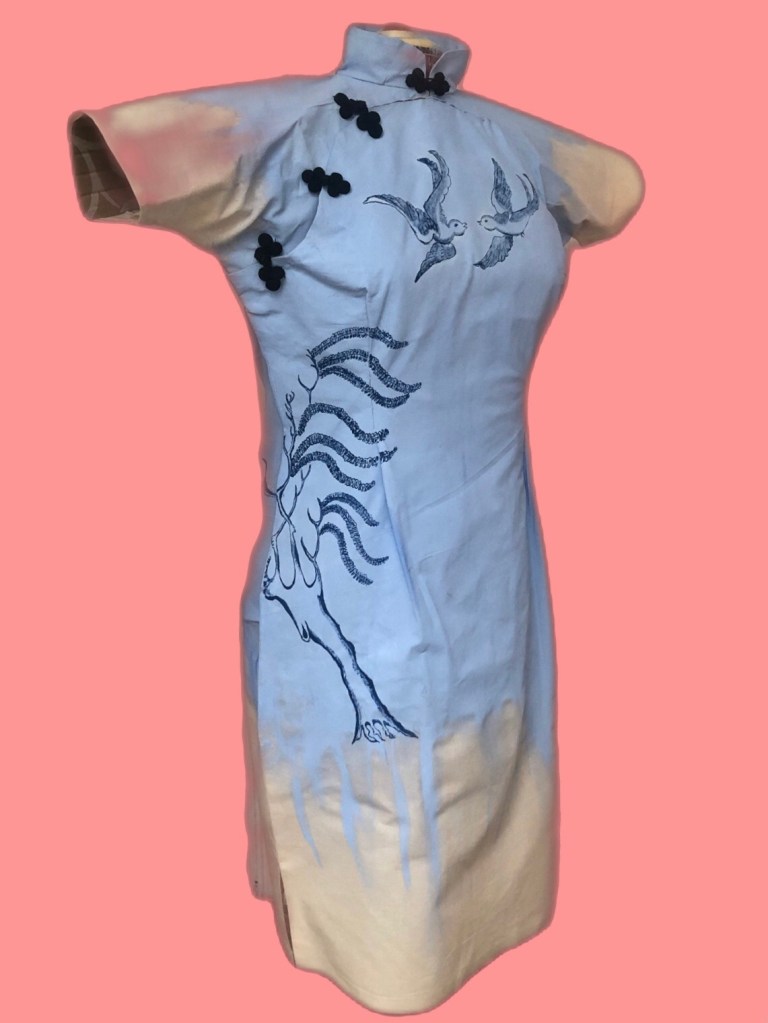
After completing two Cheongsam paintings (‘You’re a banana’ and ‘No, I’m an egg’), I wanted to revisit the first Cheongsam painting I made – ‘Appropriation. Appropriation.’ because I felt it was an unfinished piece. I knew it was unfinished at the time but I was eager to move onto the banana and egg paintings, so I left it. After some time had passed, I felt the urge to finish it off. The areas that I was not happy about were:

– The lack of depth in my representation of what I was trying to say.

– In fact, it wasn’t clear what I was trying to say and how it was relevant to my practice.

– It felt like an unfinished or abandoned piece of work.

I am not always bothered about abandoning work, but so much effort had already gone into this piece, the making of the dress, sewing and painting etc.. I felt it would be worthwhile finishing it.

Below is the unfinished work from earlier and the original blog about my feelings towards the Blue Willow pattern:

MA U2: Cheongsam Series #4 – Appropriation. Appropriation.

METHOD

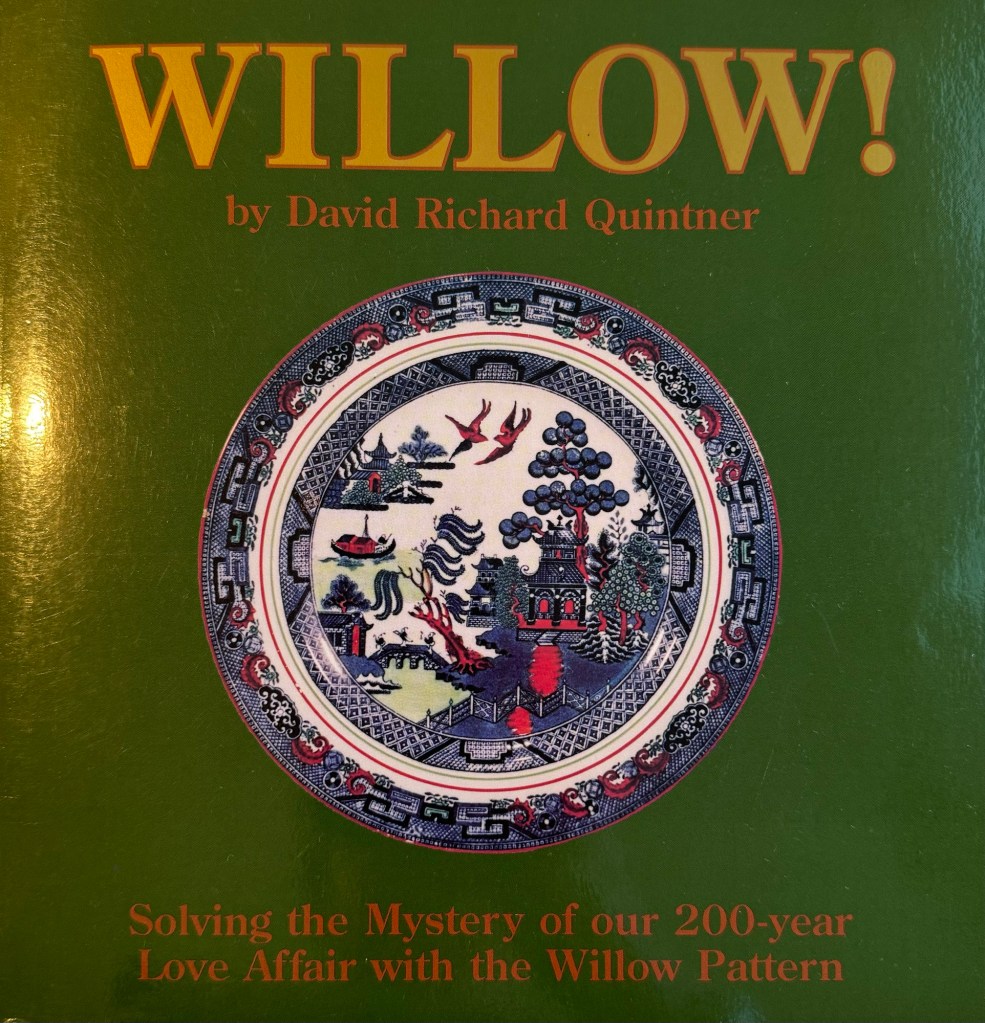
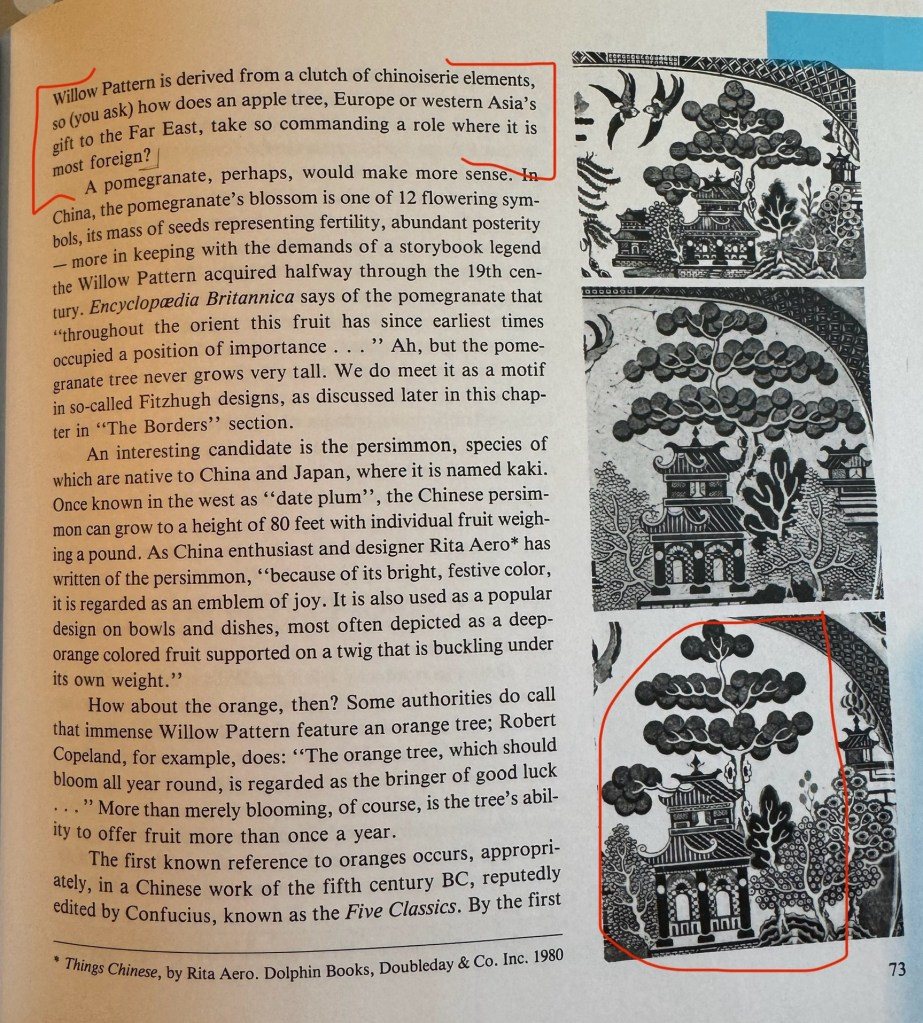
In carrying out additional research for this piece of work, I referenced a book about the Willow pattern:

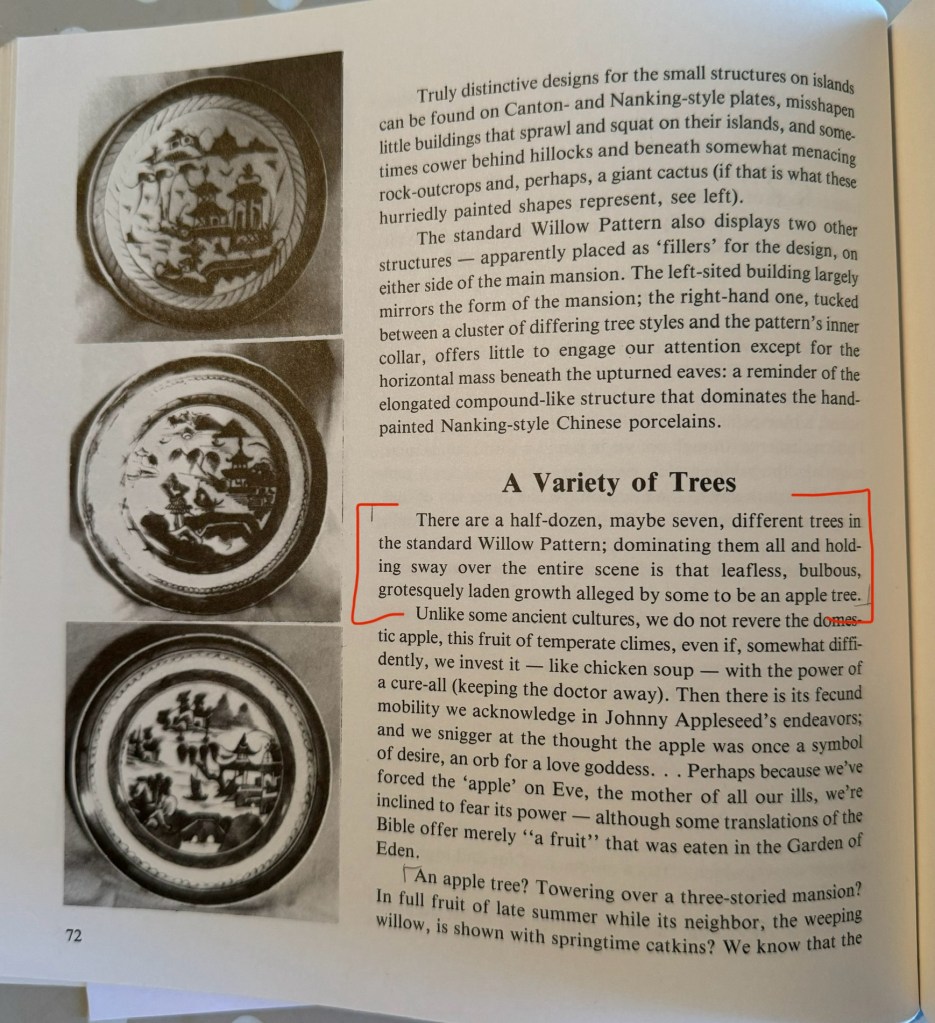
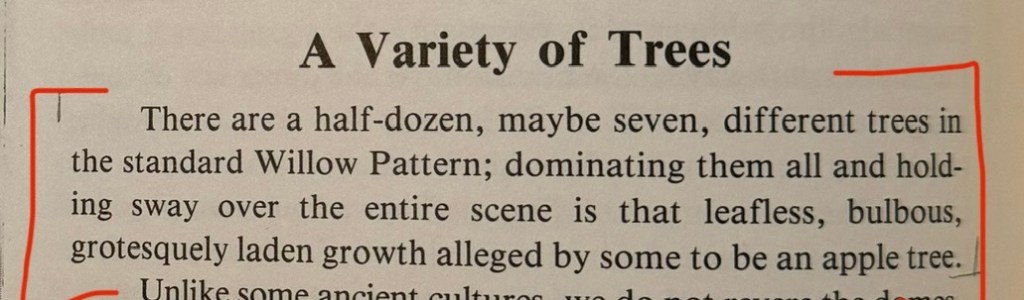
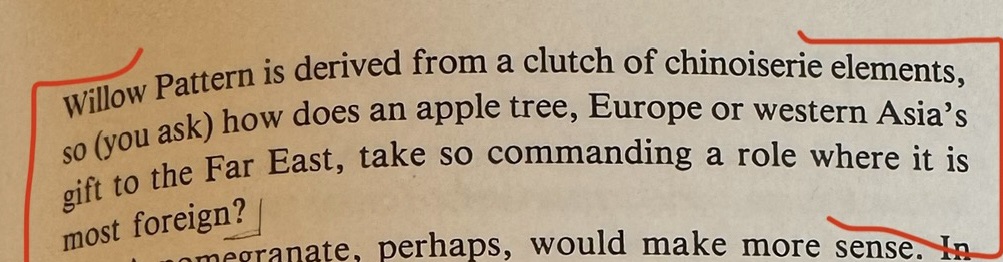
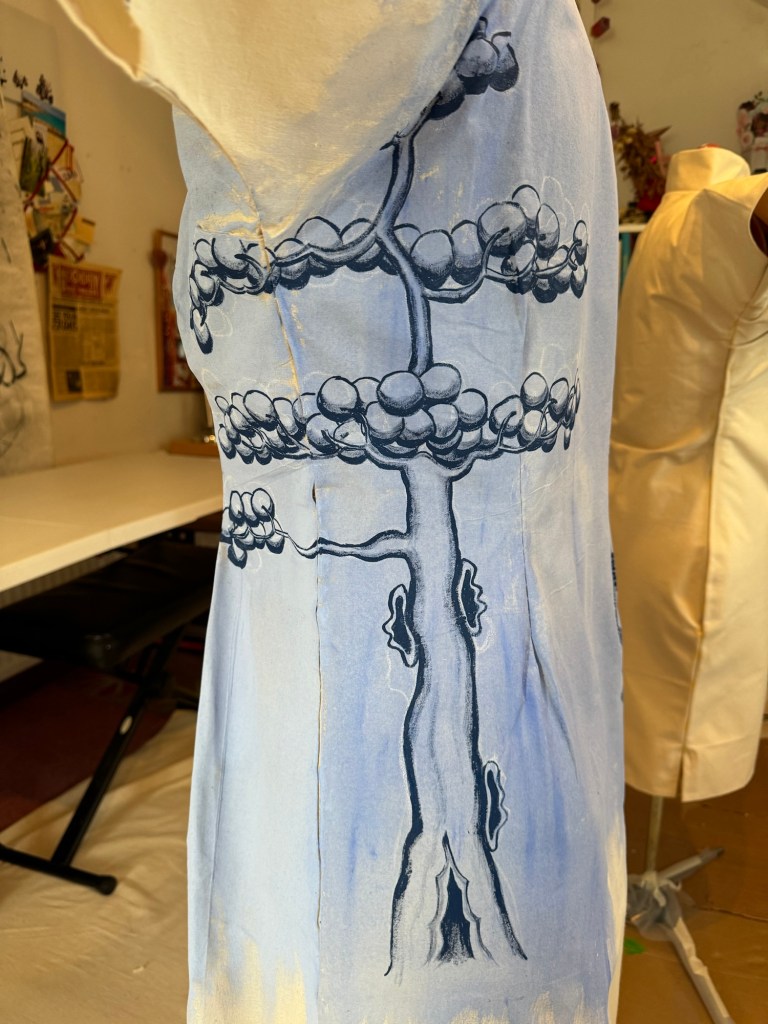
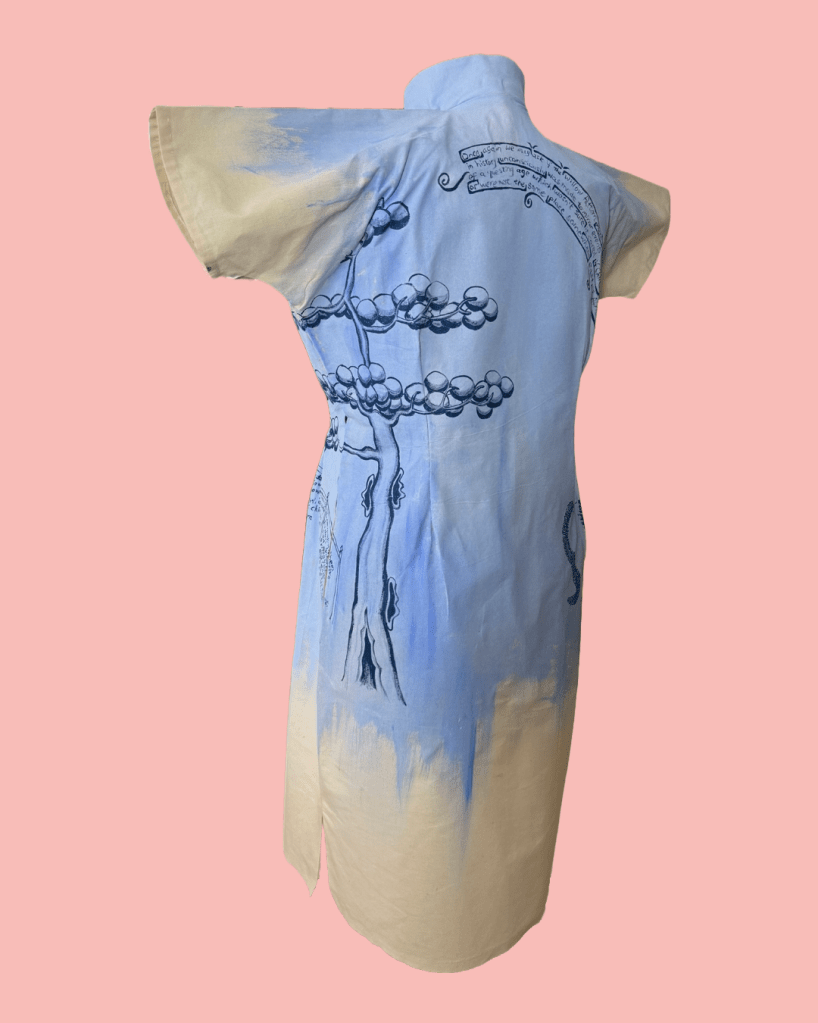
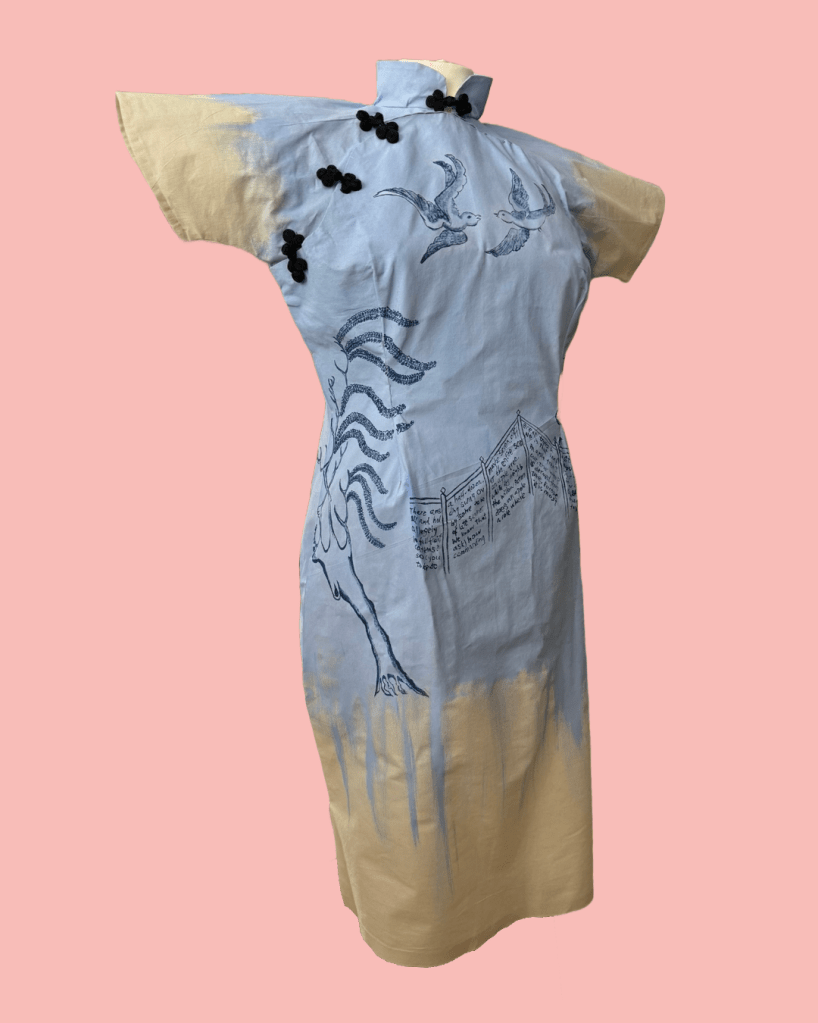
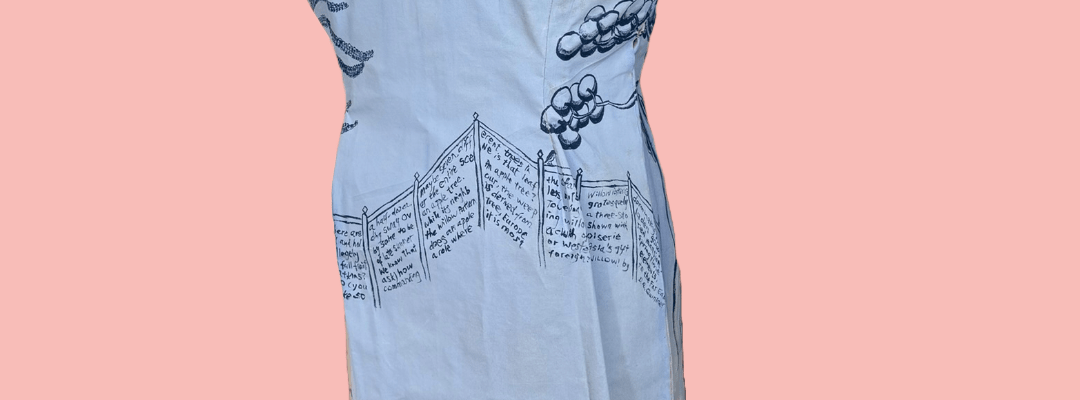
In my earlier blog, I talked about the incorrect depiction of a tree on the Willow design. What should have been a large pine tree that was common in Chinese paintings, was instead depicted in a way that led many to believe it to be a disproportionally large fruit tree. This particular tree was discussed extensively in the ‘Willow!’ book with many suggestions of the different types of fruit tree that it could have been, but without any clue about what tree it really was. So to expose this classic example of an appropriation of something without having basic understanding of what was being appropriated, I decided to add the said tree to my Cheongsam painting and copied some texts from the book to highlight such cultural challenges.

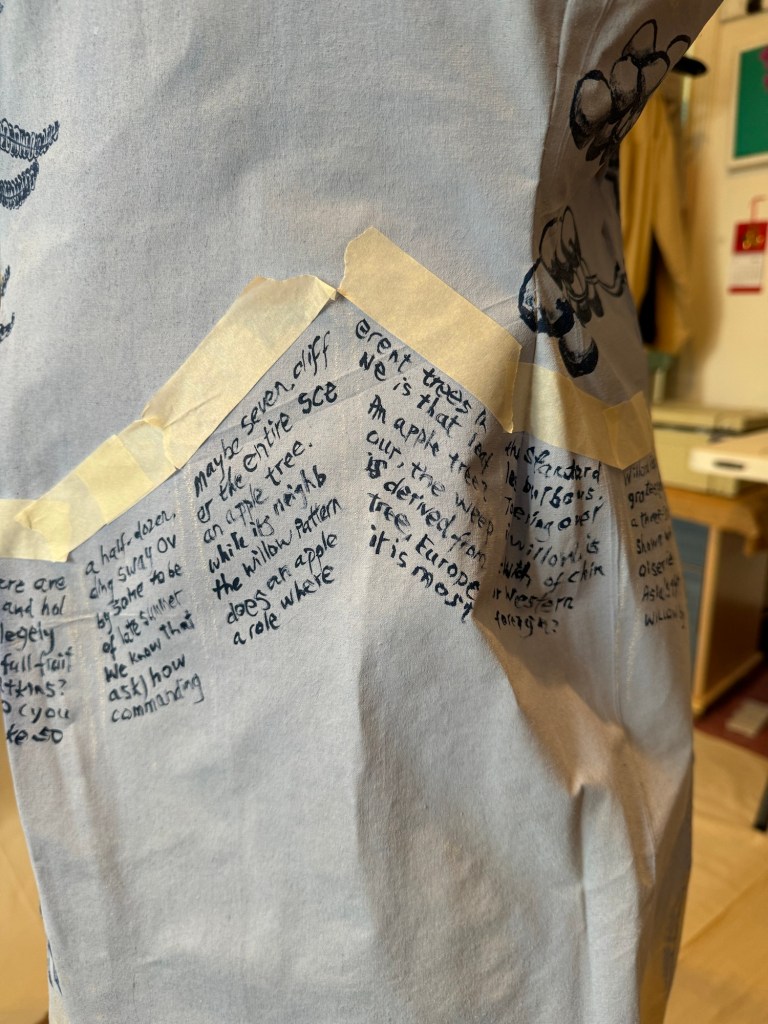
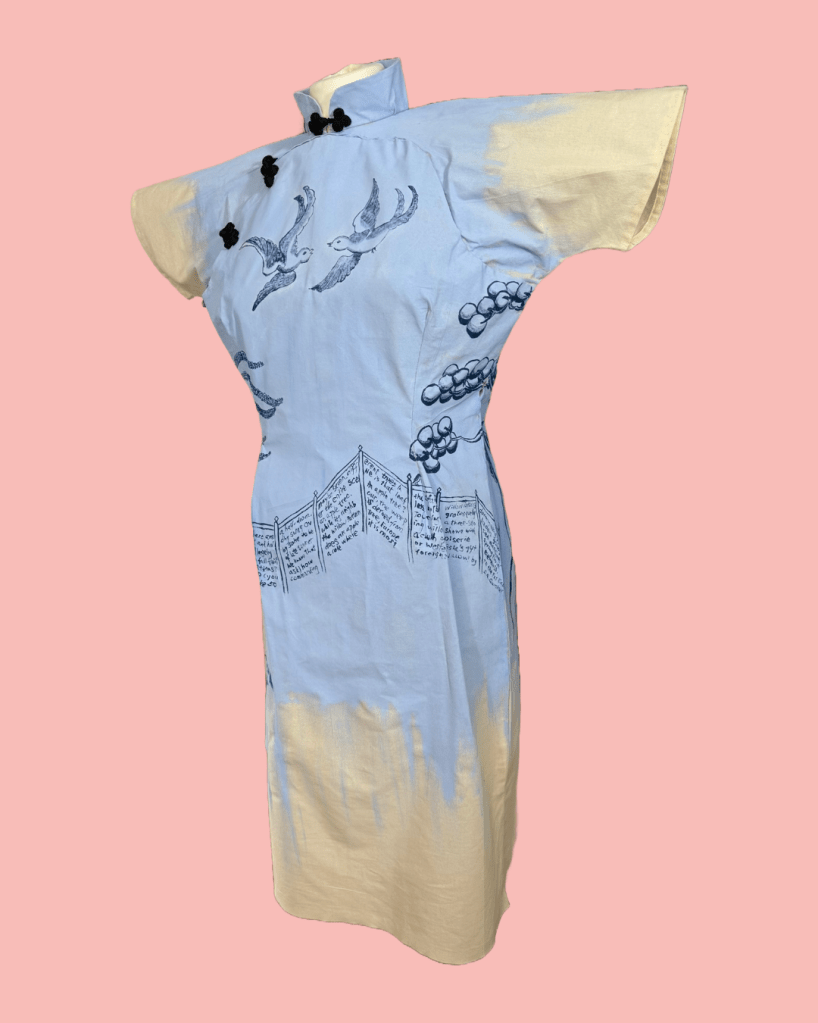
Texts that were added as part of a fence on the painting were copied from the above pages describing the (pine) tree as leafless, bulbous, grotesquely laden… apple tree. Close up of the texts copied are as follows:

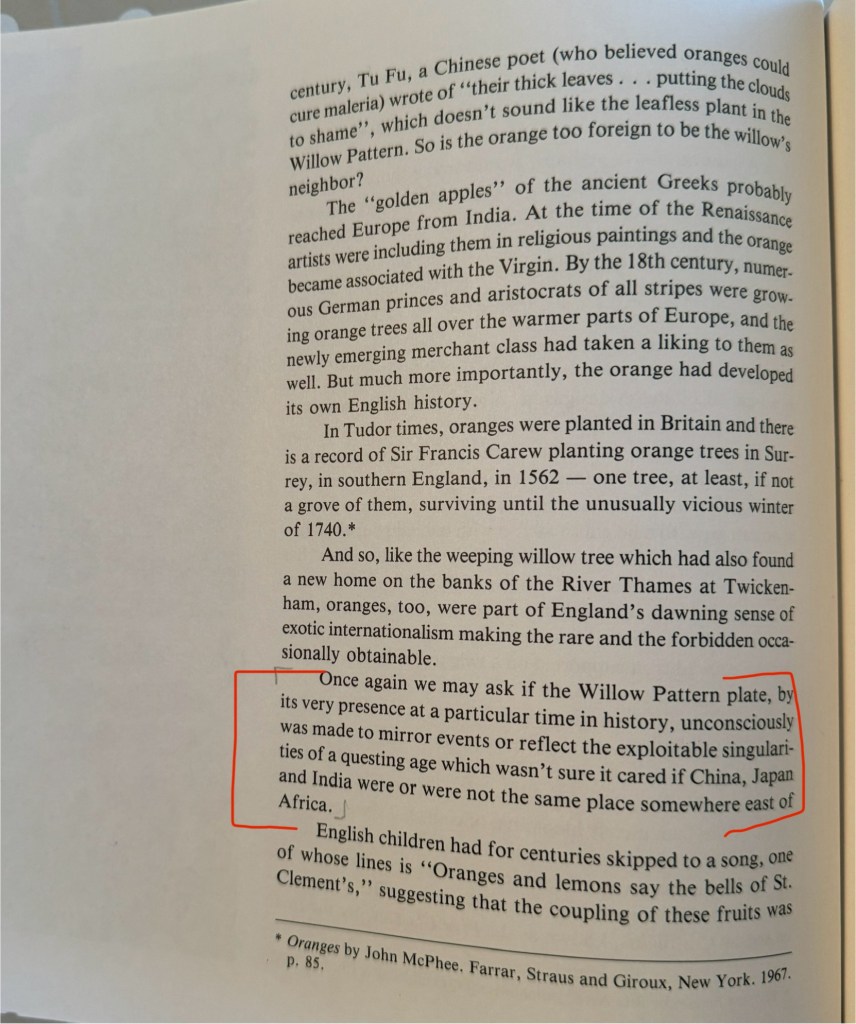
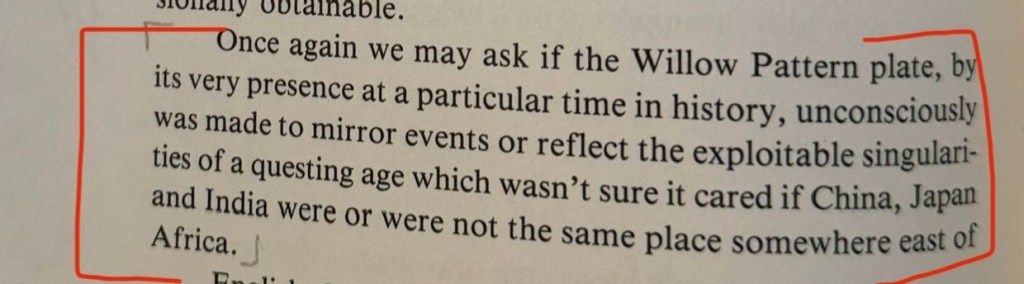
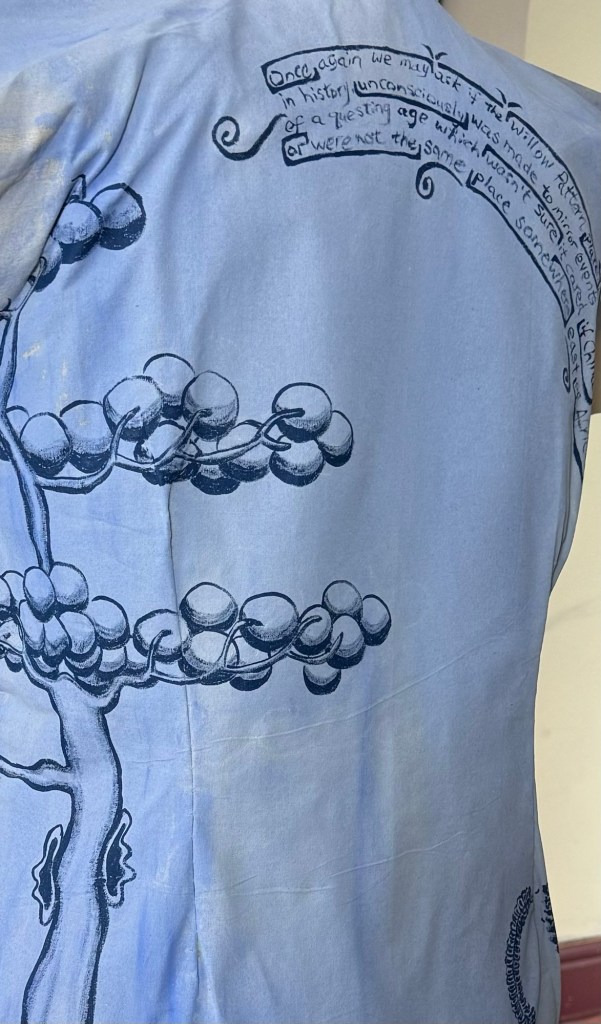
Another paragraph was copied onto my painting which gave insight into the attitude towards Asia during the time when the Willow pattern was designed:

Close up of the texts copied:

The ‘bulbous and grotesquely laden fruit tree’ was added to my painting:

Masking tape was used to mark out the shape of the fence for the texts:

The second set of texts was added on the back of the painting next to the large tree with some ornate borders like those on the edge of some Willow plates:

The finished painting:

Back view
Front view – left
Front view – right

REFLECTIONS

I am pleased that I have reworked this painting because my practice is not just about making work, it is also about examining issues relating to my identity which includes understanding my heritage. In the case of the Willow Pattern, it highlighted the casual and incorrect appropriation of Asian art during the colonial era. My original idea for this piece was always to highlight the mistakes made in the Willow Pattern appropriation. In particular, the pine tree. I have researched numerous design texts about the Willow Pattern and most of them express puzzlement about the disproportionally large ‘fruit tree’ towering over the building. The debate surrounded what kind of fruit it was, apple, pomegranate, peach etc.. All acknowledging that no fruit tree could grow to several storeys high hence description such as ‘grotesquely laden’ was used here. I am certain that if any Chinese artists were asked, they would have said it was a (badly depicted) pine tree.

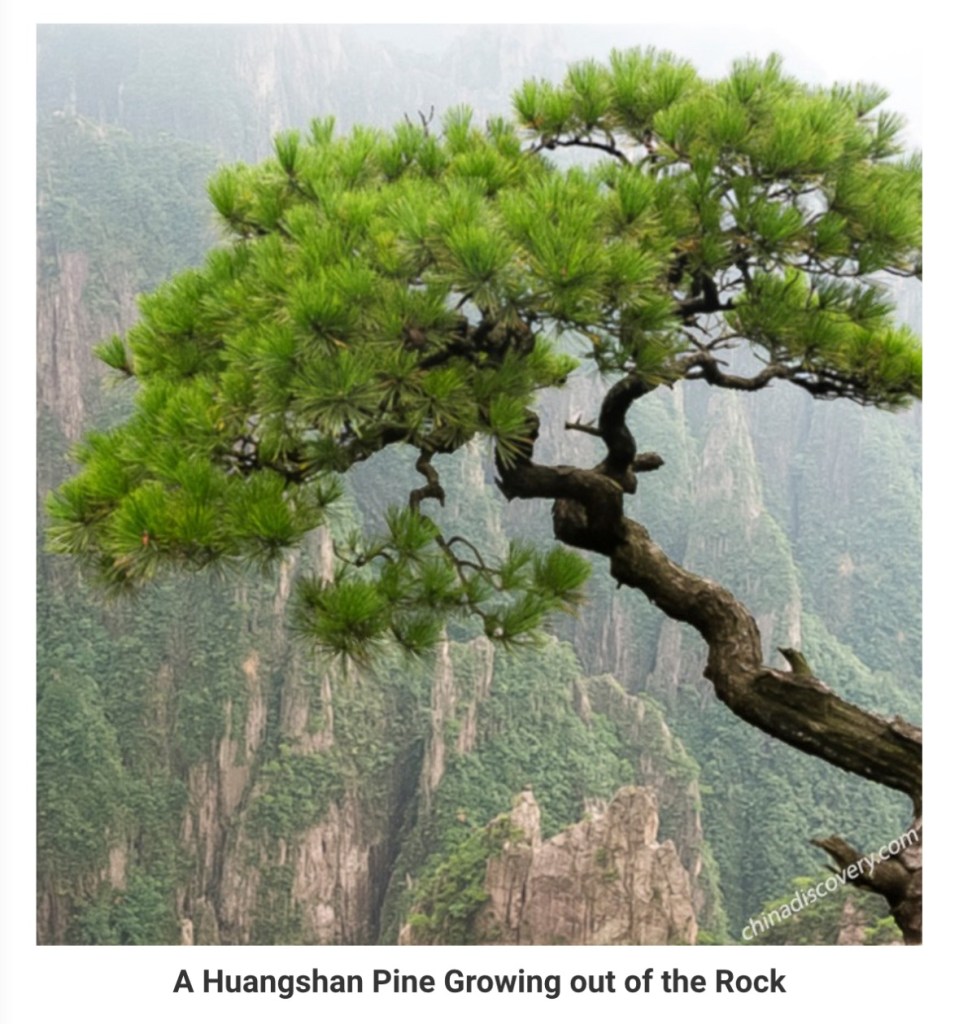
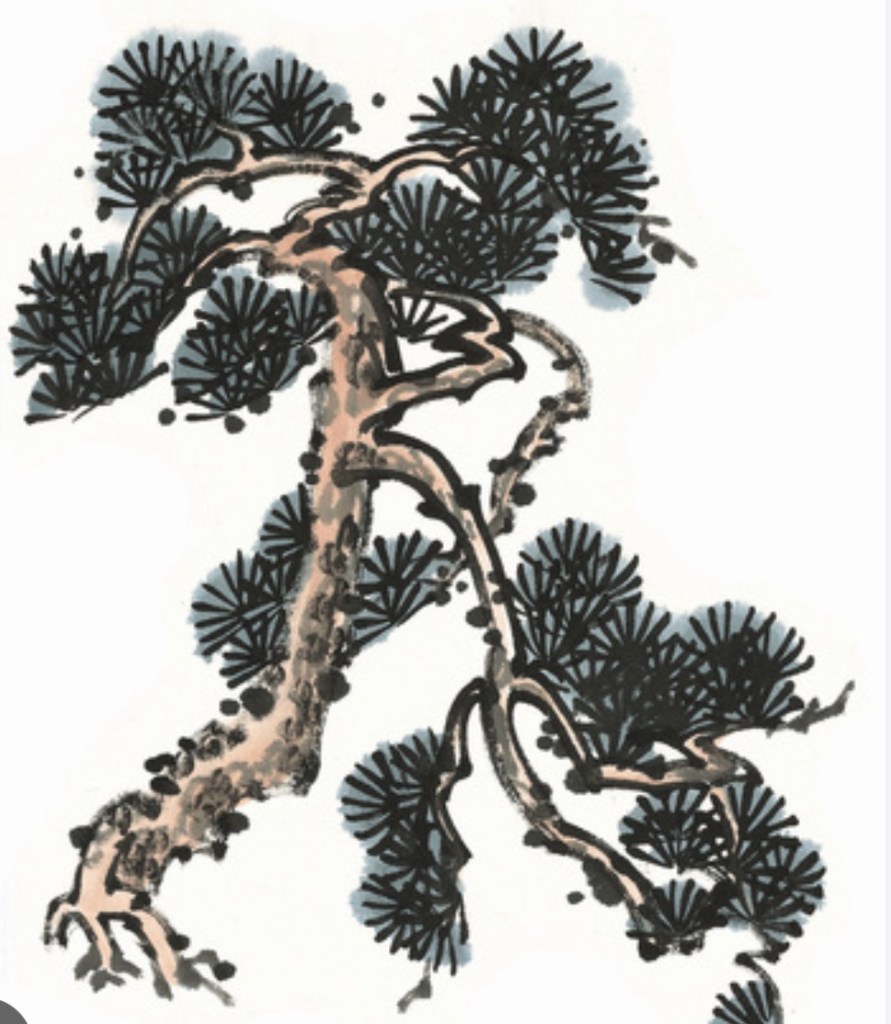
My research shows that there are many species of pine trees in China. Ranging from the common Pinus tabuliformis which can be 20-30 metres tall, to the famous Pinus hwangshanensis (or Huangshan pine) with some being 1,500 years old. Pine trees are often depicted in Chinese paintings. The pine needles are typically formed in dense round clusters:

The pine needles are often depicted as below in traditional Chinese paintings with a few needles radiating from the centre of the cluster and a thin wash of colour (usually green) to give a sense of the overall round shape of the cluster of needles.

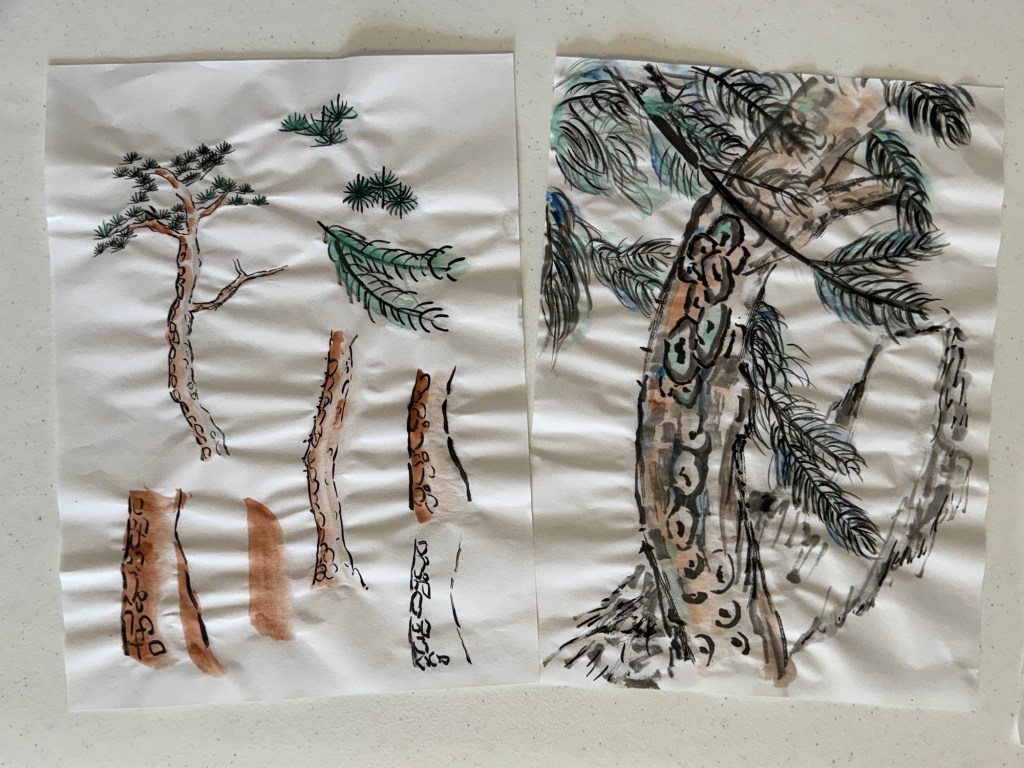
Here are my pine tree paintings that I made in one of my Chinese brush painting lessons, the left hand image shows the round clusters of needles with a green wash:

My Chinese pine tree paintings

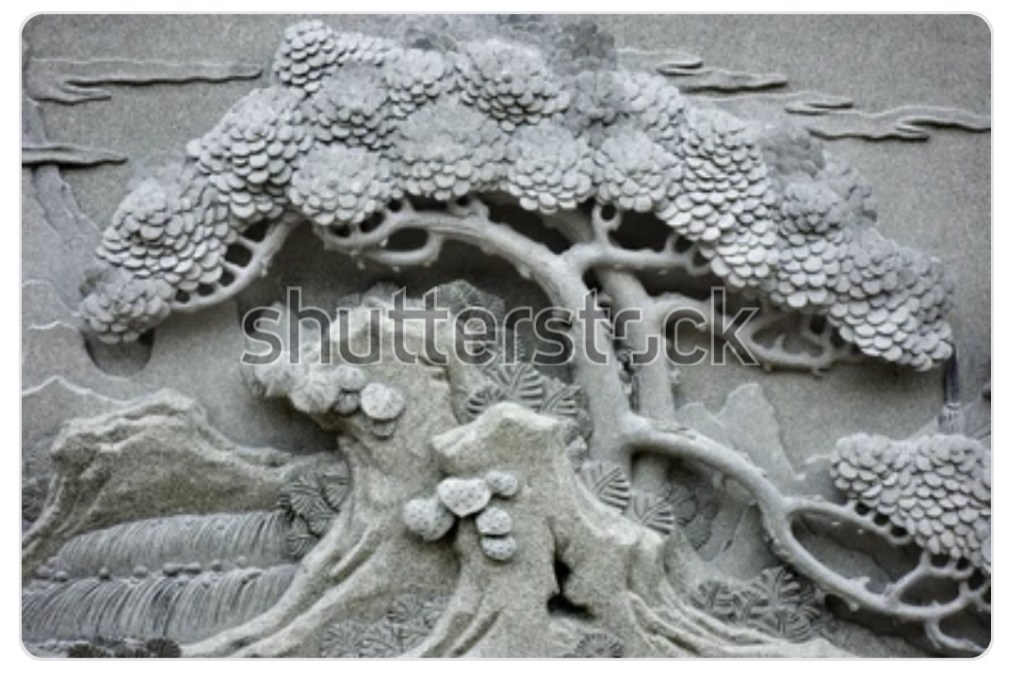
Carvings of pine trees often take on a more accentuated round shape such as this example:

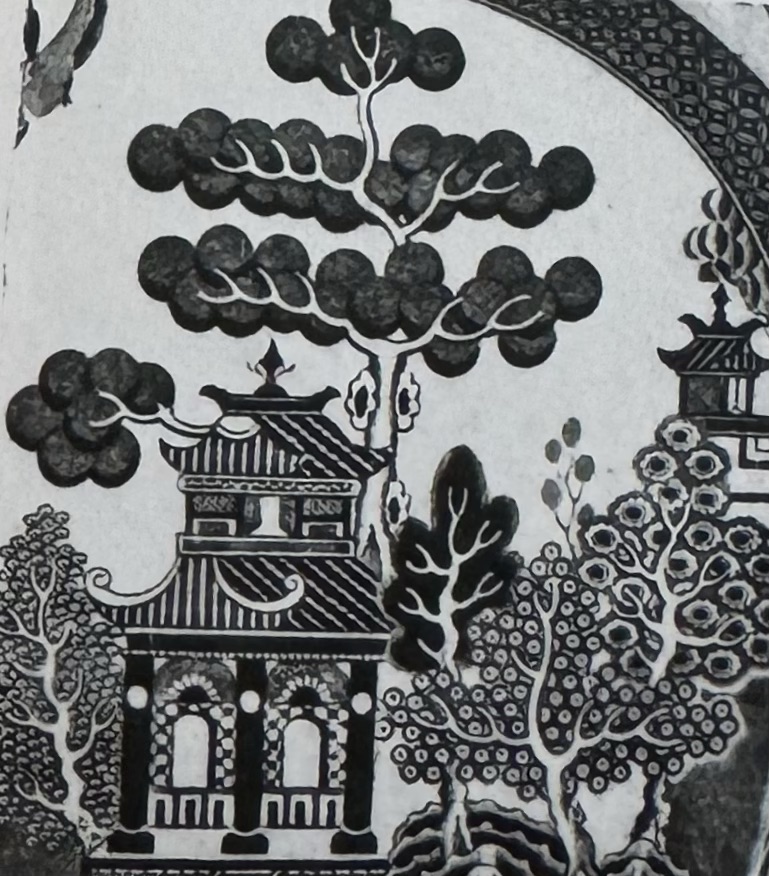
The Chinese pine tree was depicted as follows by the Williow Pattern designers:

The Willow Pattern became very popular in Britain as a result of demands generated for Chinese artefacts during the British colonial period. Subsequent generations of people who buy or study the Willow Pattern have wondered what tree that was and due to the rounded shapes coming off the branches, they concluded it was a fruit tree of some kind – such as the hypothesis in the ‘Willow!’ book even though they all acknowledged the disproportionate size.

When I made the discovery of the mistaken identity of the tree on so many design documentation, I wanted to do something to capture my findings and expose the lack of research that I have witnessed. I am not a design historian, nor a botanist, nor am I that experienced a Chinese painter, even I could tell that it was meant to be a pine tree. So it shouldn’t have been difficult to deduce. I could only conclude that people just didn’t really care enough to find out. Even those who were writing books or papers on the Willow design didn’t seem to make that extra effort to find out and just accepted that it was a strange fruit tree or badly depicted overly large and grotesque fruit tree. Hence I wanted to make a painting to express this example of our casual laziness towards other people’s culture. The second set of texts that I copied from the book aptly acknowledged the ‘couldn’t care less’ attitude towards Asia at the time.

When I first did the painting, I stopped before putting in the pine tree. This was because I felt the painting was turning out to be a bit ‘twee’. I didn’t like it. In hindsight, what did I expect when I was copying from a design that was a bit twee! So I left the piece at the time and went onto make two other paintings. I am very pleased that I returned to finish this painting because I had spent much time in researching the Willow Pattern, especially the mystery surrounding the pine tree; I really wanted to say something about it. Hence I am pleased that I returned to complete the pine tree as well as copy some texts that confirmed the casual approach taken towards other people’s culture.
LEARNING

I have learnt a lot about the history of the Willow Pattern. That also helped me to understand more about the British Empire and its history at the time. I am not really that offended by the poor appropriation of the design, it amused me more than anything. However, it highlighted how easy it is to poorly appropriate and that is usually out of laziness, ignorance or not being thorough in research. That is good learning for me and has helped to make me more mindful about my work – if I were to borrow ideas from other cultures, or my own culture, I need to pay more attention to get my facts right. It is often not difficult, just takes a little more time to ask or research. Otherwise, I would be just as bad as those that I’m criticising here.

NEXT STEPS

With completing this painting, I have now done three Cheongsam paintings. I have several ideas of other Cheongsam paintings so I will get on and make some more!

RESEARCH BACKGROUND – WILLOW PATTERN

Below are some examples of mistaken identification published for the large pine tree in the Blue Willow pattern. The examples shown here assume the tree is a fruit tree.

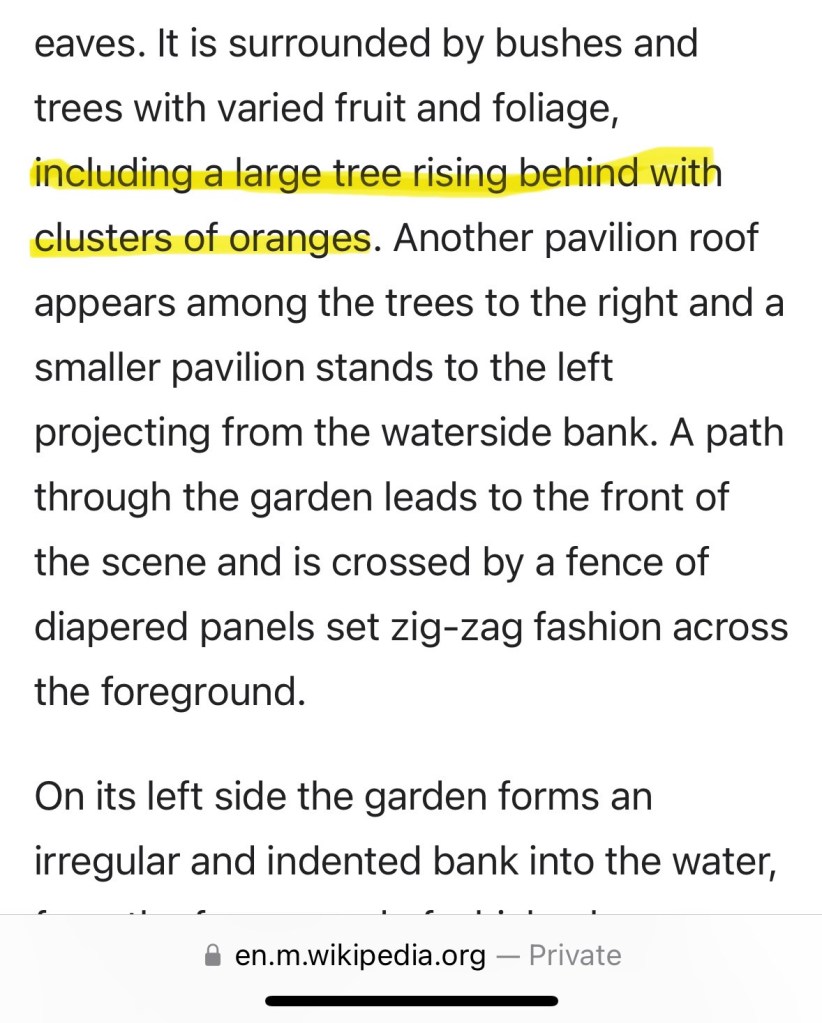
Example 1: Wikipedia

https://en.m.wikipedia.org/wiki/Willow_pattern

Wikipedia describes the tree as an orange tree even though orange trees do not grow that tall and if the round shapes were fruit then it would have been a leafless fruit tree.

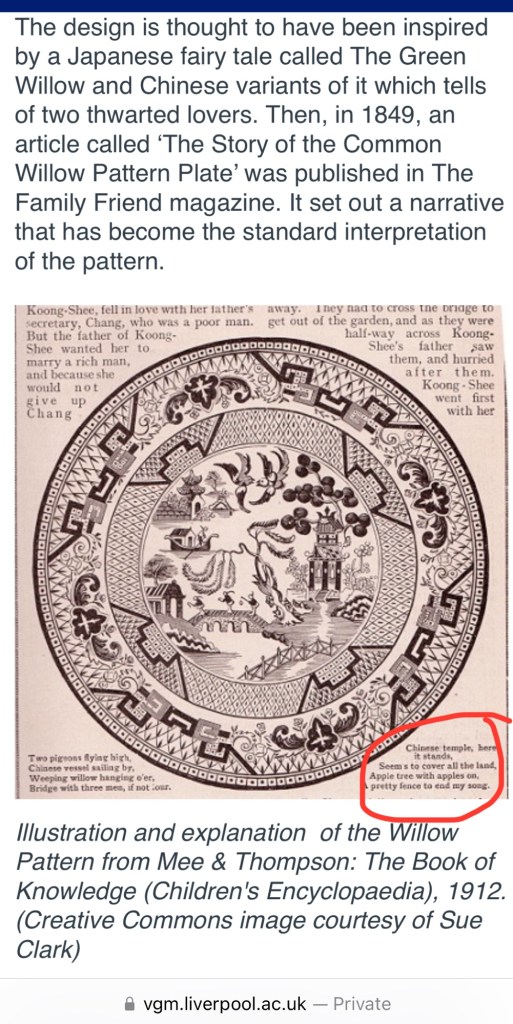
Example 2: Liverpool University – Victoria Gallery and Museum

https://vgm.liverpool.ac.uk/blog/2021/willow-pattern/

Liverpool University’s Victoria Gallery and Museum has a blog dedicated to the Blue Willow design. It details the key elements of the design but does not mention the largest tree depicted. It does, however, include an insert of an illustration stating that the large tree was an apple tree – did they really think that it could be a leafless apple tree that was nearly twice the size of a three storey building?

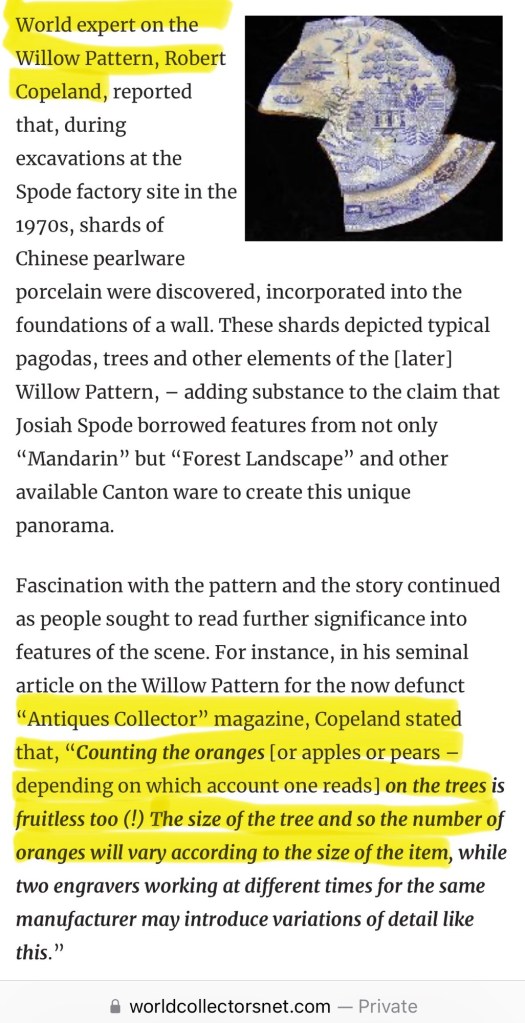
Example 3: Quote from ‘Antiques Collectors’ magazine by ‘World expert on the Willow Pattern’

https://www.worldcollectorsnet.com/articles/willow-pattern/

This article includes a quote from a ‘World expert on the Willow Pattern’ talking about the oranges on the tree, whilst acknowledging that there are accounts of other fruits such as apples or pears being published.

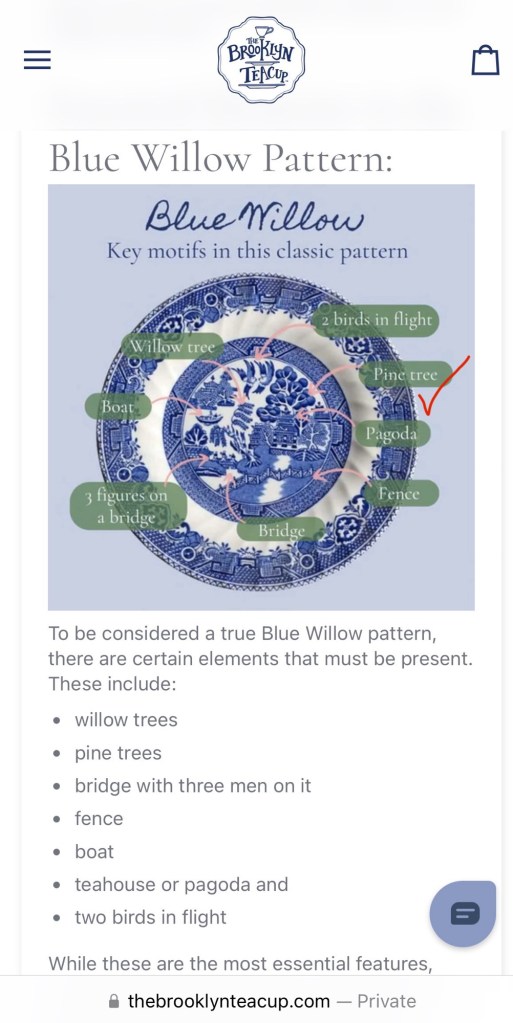
Example of a correct identification!

Finally, the example below correctly identifies the tree as a pine tree:

https://thebrooklynteacup.com/blogs/blog/blue-willow-china-pattern?srsltid=AfmBOoqLrjlC-ILPuRDrVdf2hHF-jvthiO5xCl6CQV2aTv2vazJg_Xtt

Chinese painting – shrimps, sunflowers, pine trees and more

EXPERIENCE

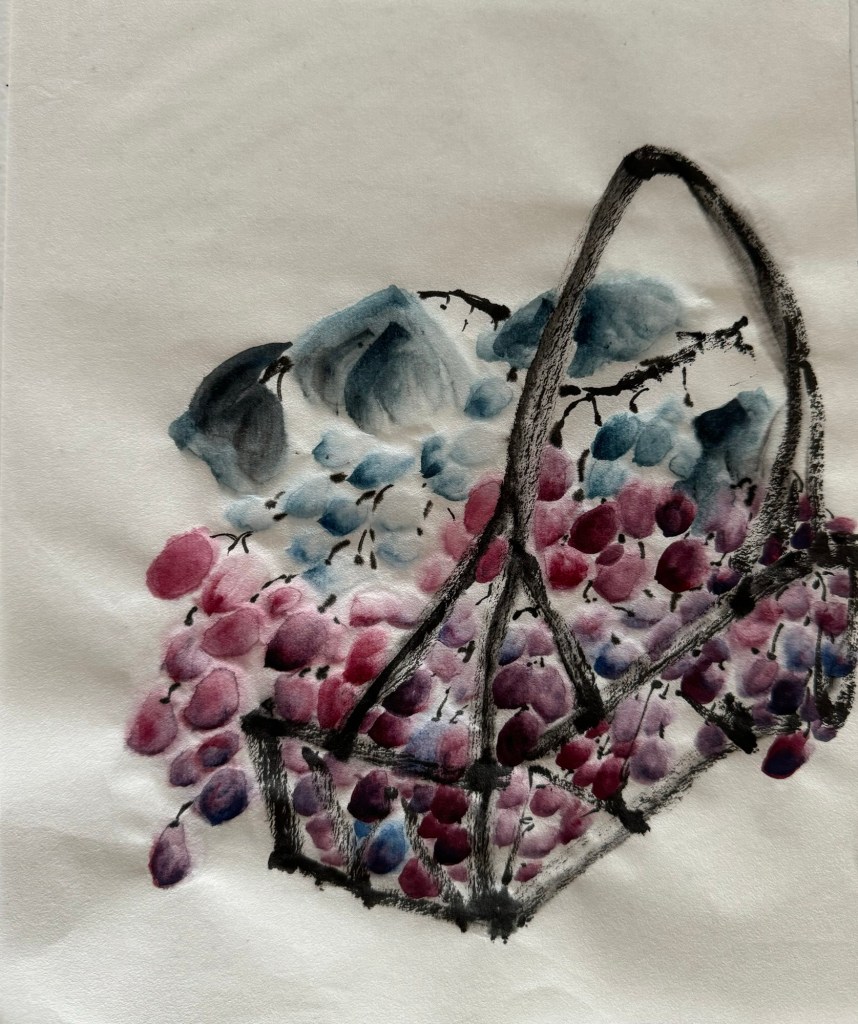
I have been learning Chinese brush painting in parallel to doing my MA Fine Art Digital course. I am new to Chinese painting and there is a lot to learn. So practicing is key. Below are some of my latest Chinese paintings, some of them are copies from books and worksheets that my tutor gave me. I believe it is important to periodically capture my progress but I do not plan to reflect extensively on these paintings because they were mostly learning exercises.

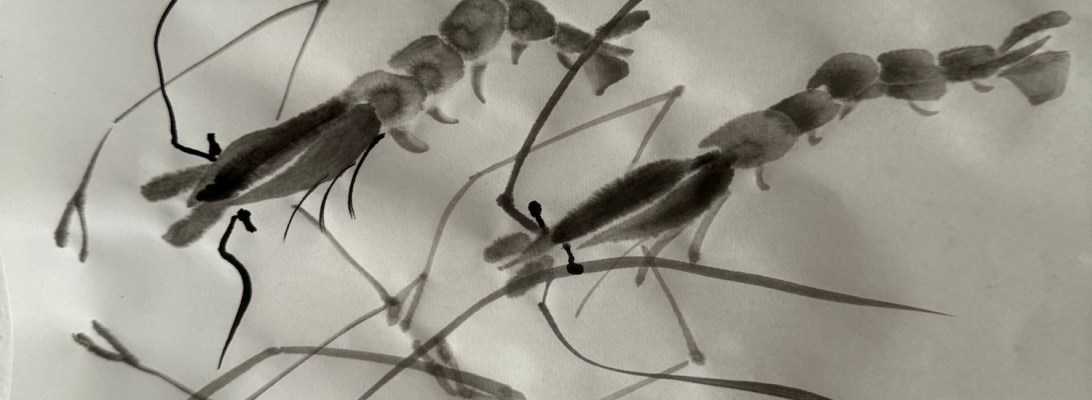
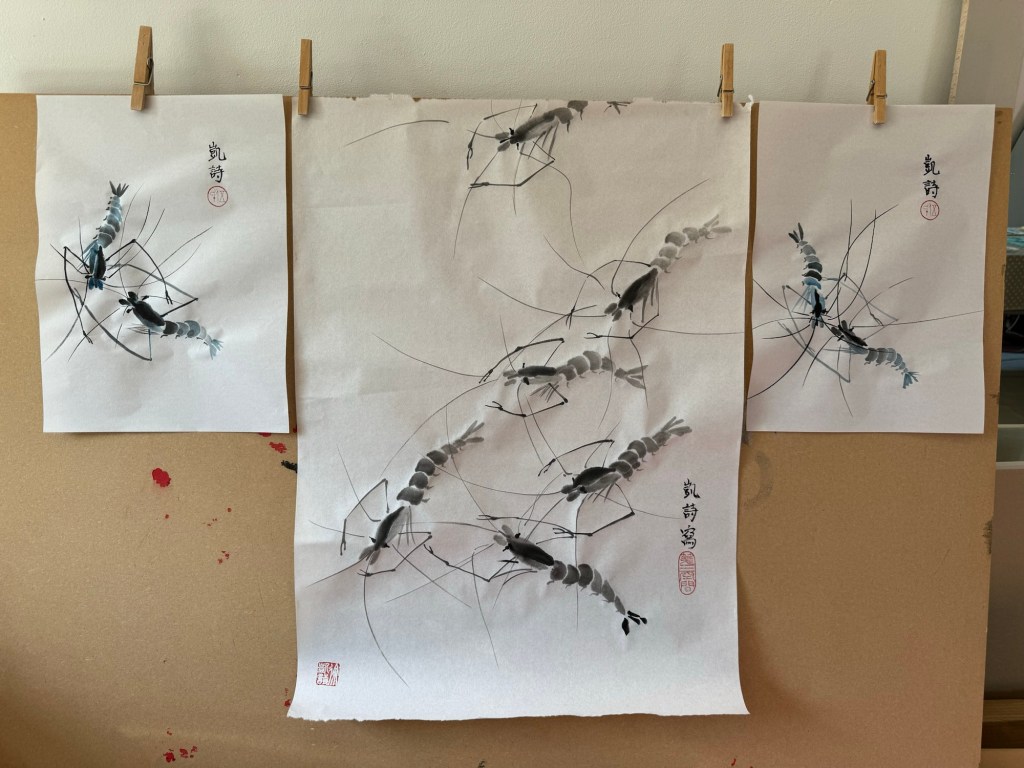
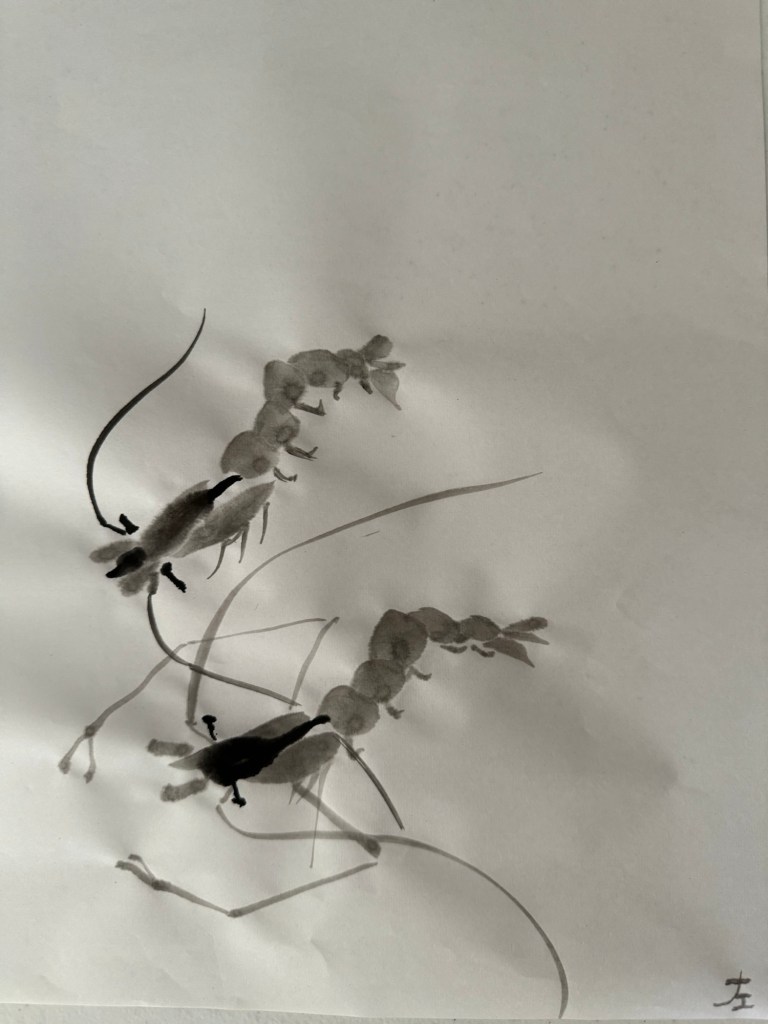
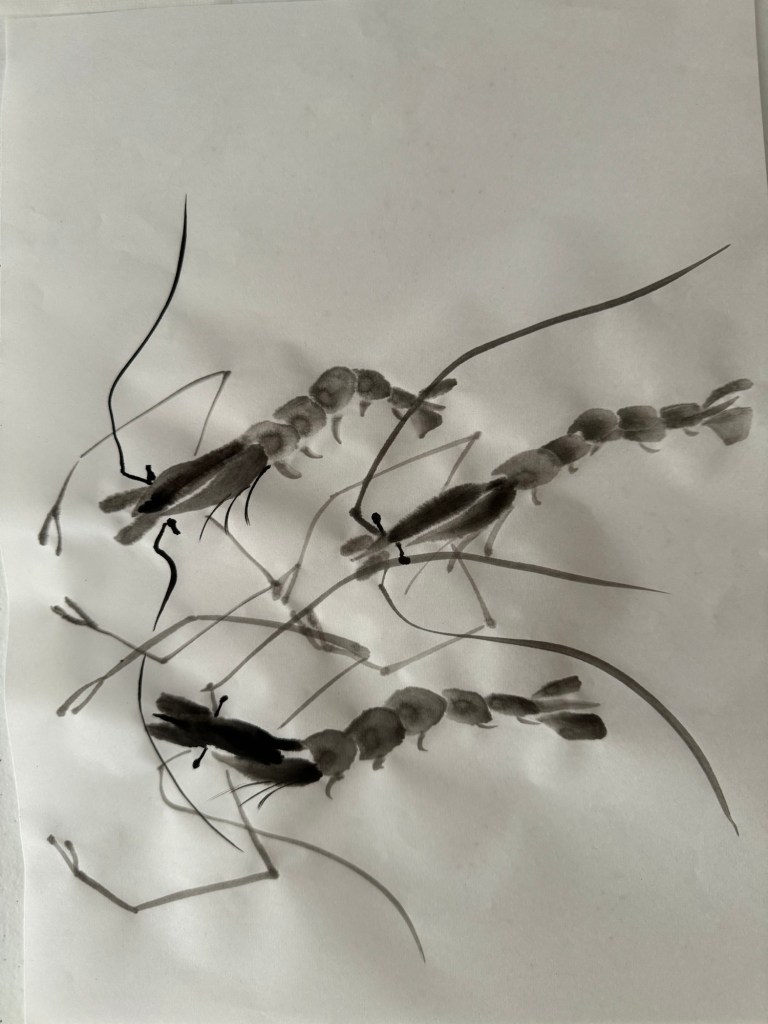
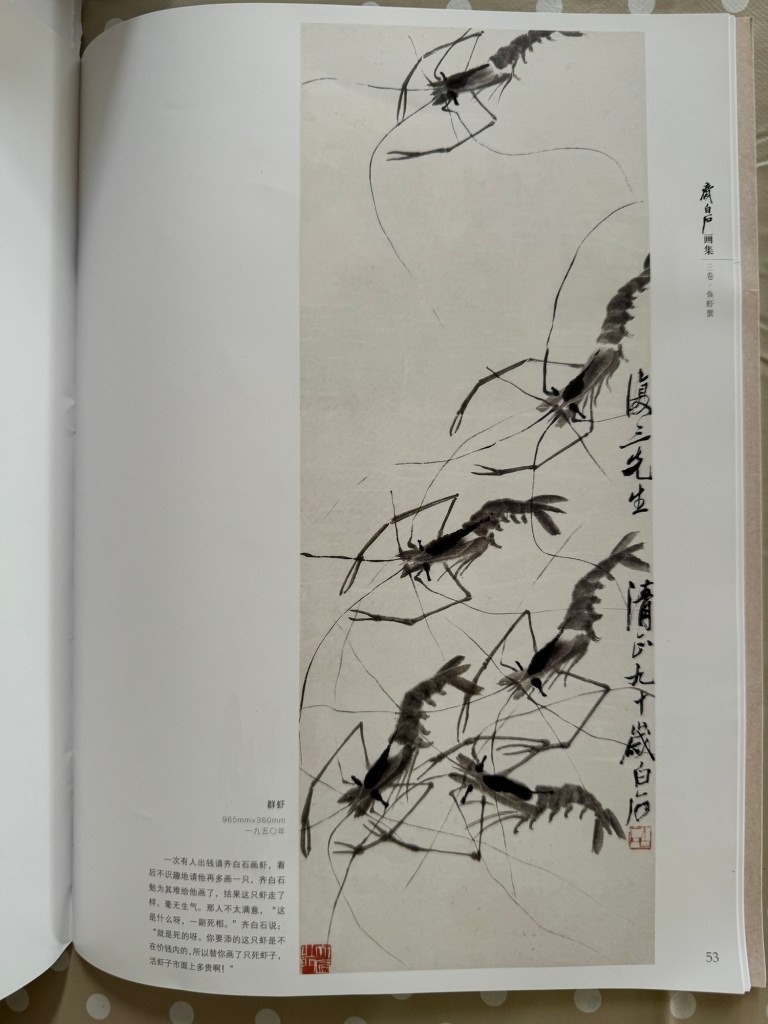
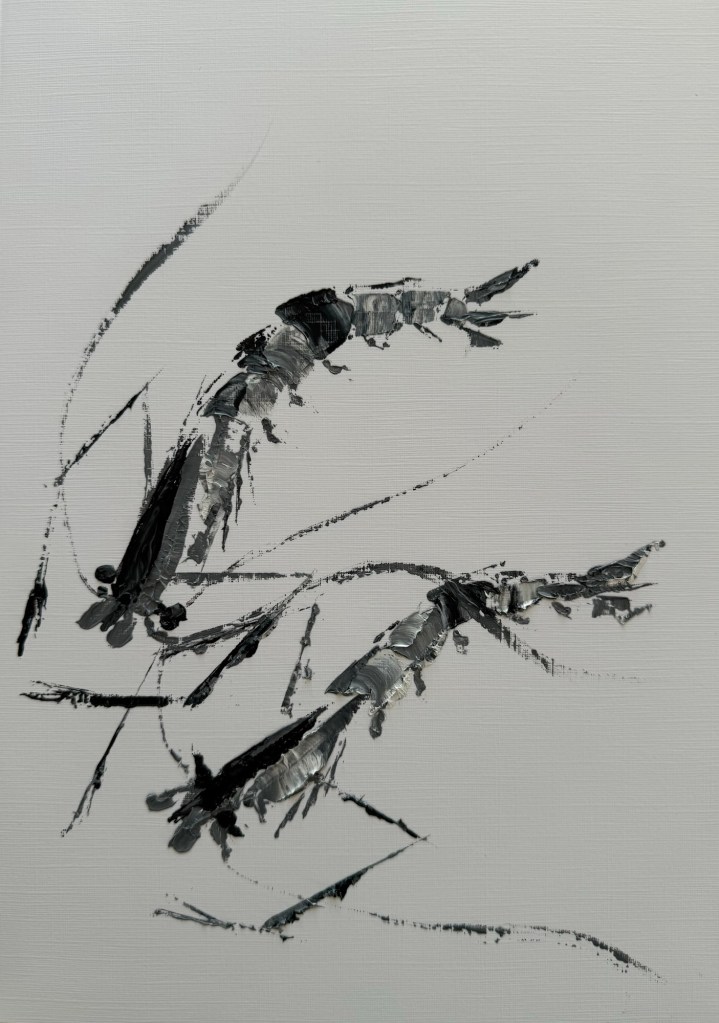
Shrimps – inspired by Qi Baishi

Trying out different compositions, colours and canvas sizes:

Image of one of Qi Baishi’s famous shrimps paintings:

I also tried to paint them in oil to compare the process and effect:

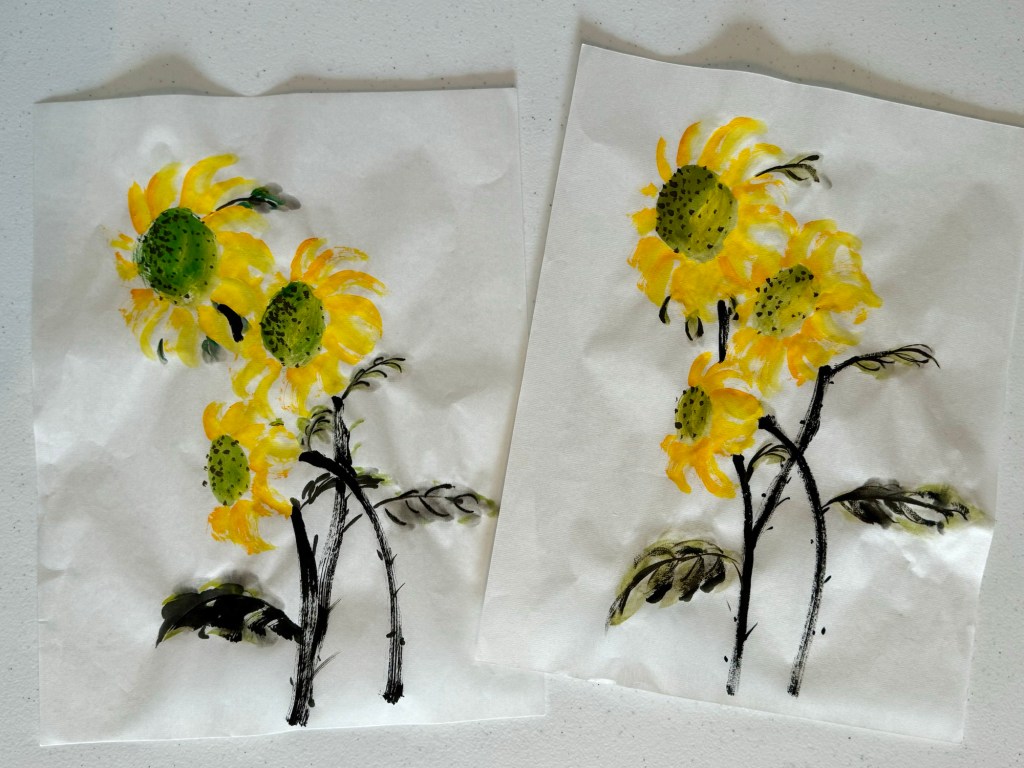
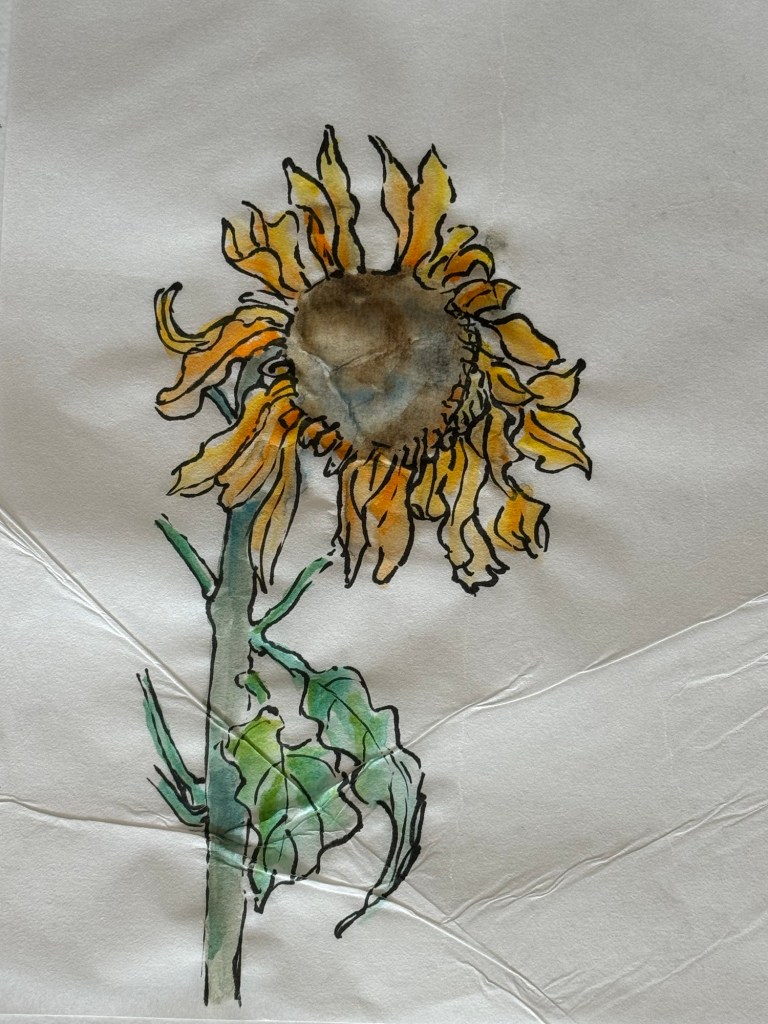
Sunflowers

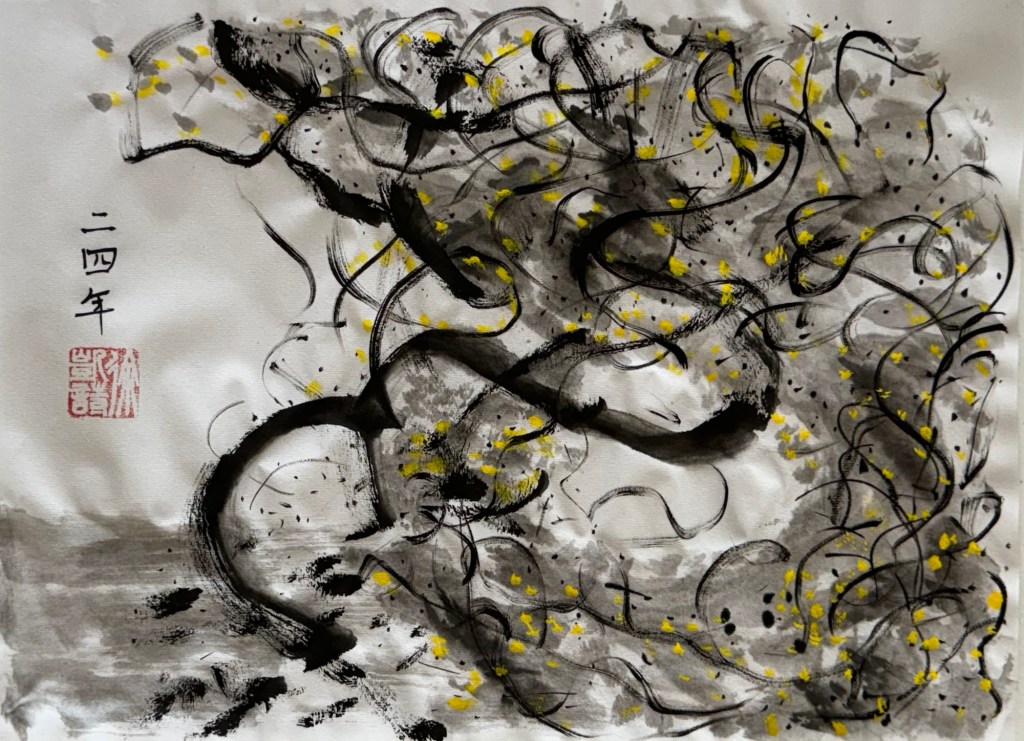
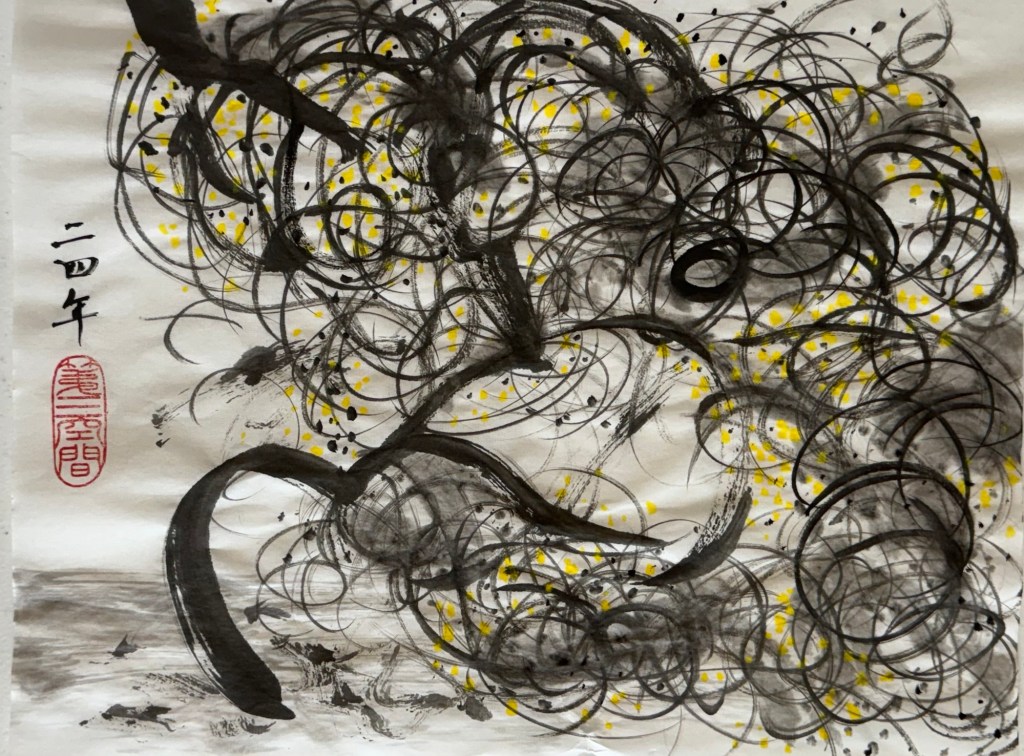
Abstract experiments

Pine tree

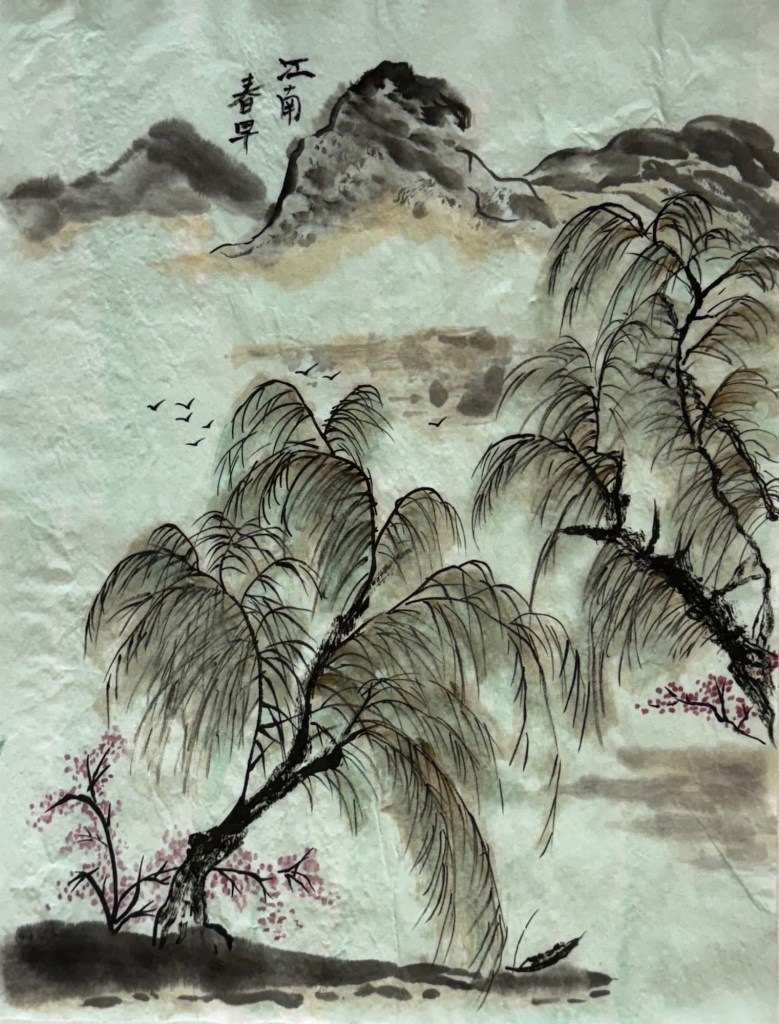
Mountain water landscape with silk wash

A basket of grapes

REFLECTIONS

– I am increasingly enjoying learning Chinese painting and have improved to a stage where I actually can enjoy it rather than get frustrated by it!

– I am particularly interested in learning more about Qi Baishi’s shrimps because I admire his style of painting. I have been advised by my Chinese painting tutor to start with understanding the fundamental anatomy of a shrimp before going free style. I will do that next.

– Much of Chinese painting involves symbolism. After researching more about the symbolic meaning of shrimps, I found (and remember) that the word shrimp in Cantonese sounds like ‘ha’ which is the sound of laughter. In Mandarin, it also sounds like the word ‘laugh’. So it symbolises happiness which is good to bear in mind for future use in my work.

– I was disappointed with how the shrimps turned out in oil. They seem clumsy compared to the ones in Chinese ink.

LEARNING

– Always start with understanding the anatomy and doing some sketches of them (in pencil or thin line paint) before going free style in Chinese painting.

NEXT STEPS

– Do the shrimp anatomy sketches in meticulously style before painting more shrimps!

MA U2: Cheongsam Series – Food as metaphor for cultural identity – Overall reflections for ‘banana’ and ‘egg’

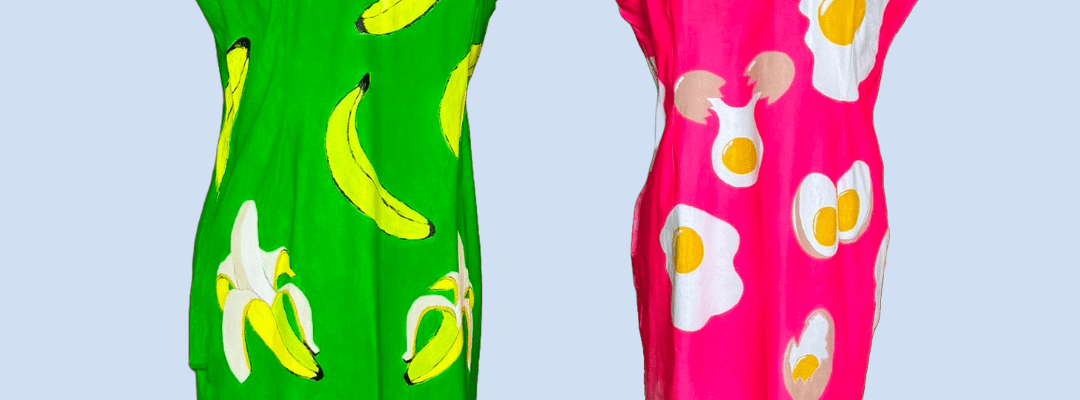
This blog details my overall reflections for the Cheongsam Series – Food as metaphor for cultural identity. I made two paintings on this topic and they are captured in the two blogs below:

https://eliza-rawlings.com/2024/08/08/ma-y2-u2-cheongsam-series-food-as-metaphors-for-cultural-identity-youre-a-banana/

https://eliza-rawlings.com/2024/08/08/ma-u2-cheongsam-series-food-as-metaphors-for-cultural-identity-no-im-an-egg/

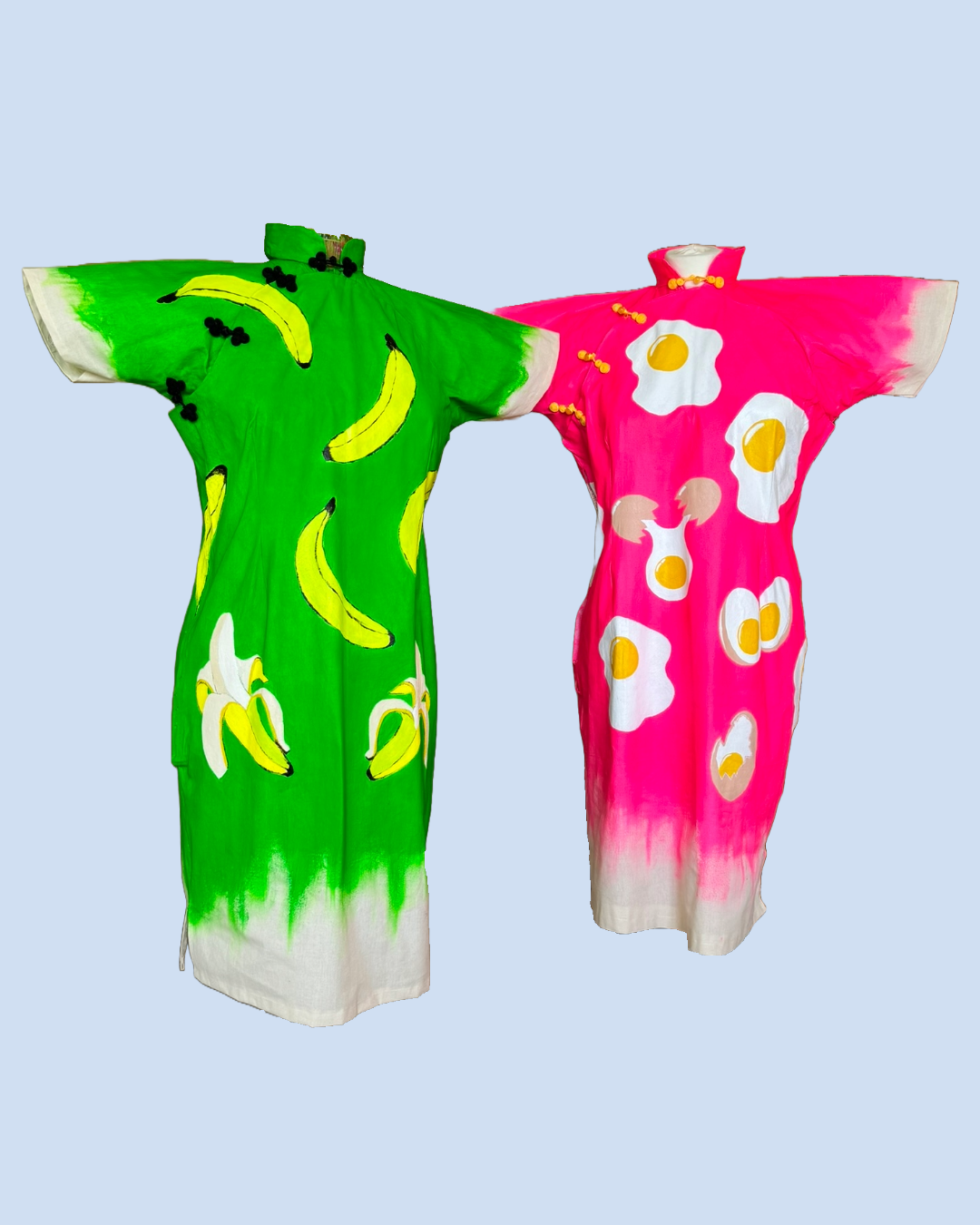
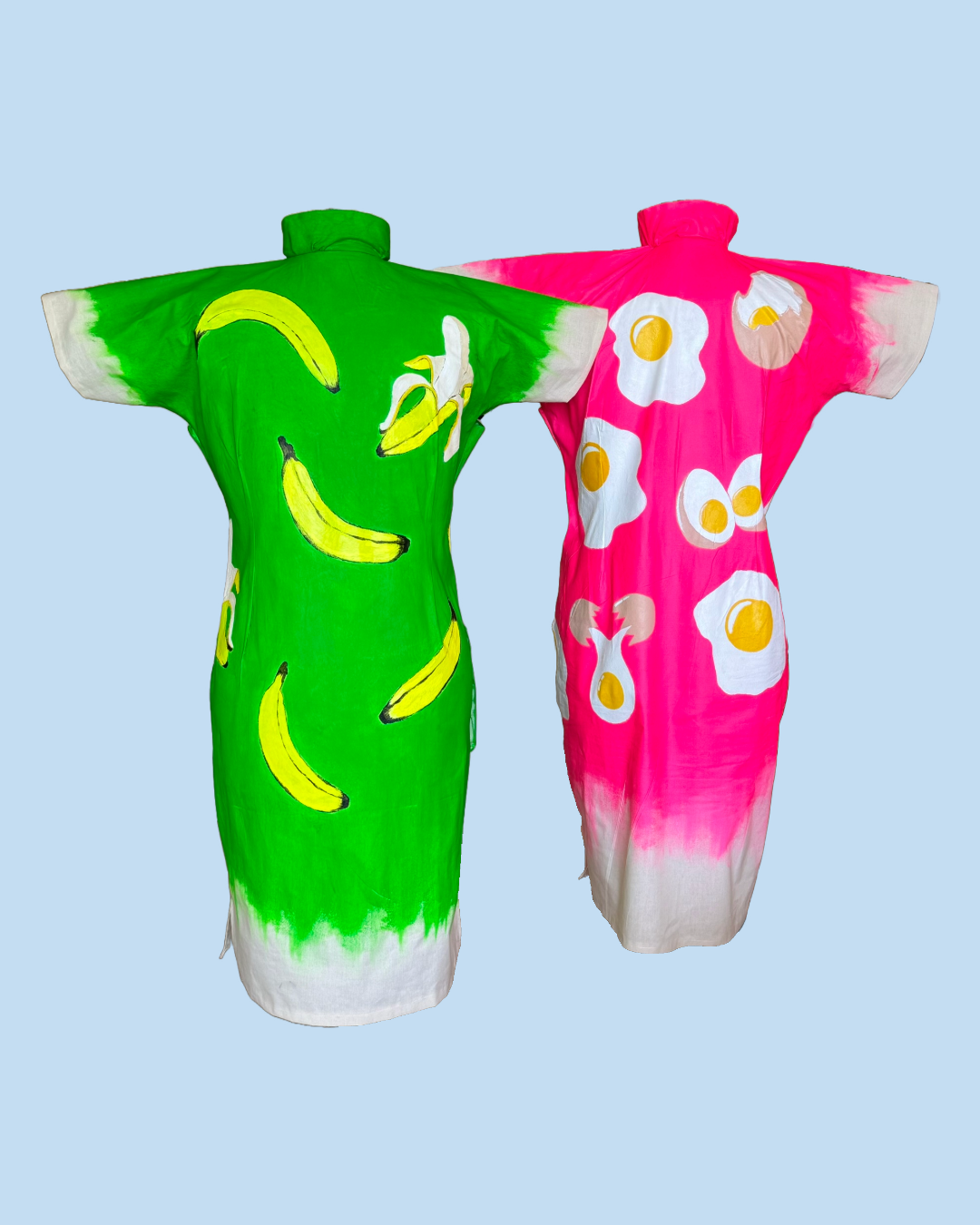
The finished paintings are intended to be displayed as a pair because they respond to each other.

REFLECTIONS

It has taken me some time to write this blog as I am not sure where to start. My reflections on the making process, composition and technical learning are captured within the individual painting blogs. This blog is meant for reflecting more deeply on what making these paintings has meant for me. I shall capture my thoughts as they come into my mind as a form of free writing.

The dressmaking part:

– Throughout the making of the Cheongsam dresses, I thought a lot about watching my mother dressmaking when I was a child. The way she designed the clothes, for herself and for her children; measuring us, making her patterns on waxy paper, chalking the cloth aided by her special yellow wooden rulers and cutting the fabric with the long sharp scissors. Then sewing using her manual Singer sewing machine with a leather belt that turned the wheel as she pedalled. I remember having fitting sessions with part-finished garments and then she would do the final finishing off. Every button was chosen with care. It’s not until I made these canvas dresses for my paintings that I realised how very clever she was. Although dressmaking is not difficult, making it well requires talents and skills just like any craft. She made evening gowns, tailored jackets and trousers! Those are very difficult items!

– One could ask, so what? Many people made and still make clothes. What’s the big deal? I reflected much about her life while making my canvas dresses because the process of dressmaking is largely unchanged therefore I could clearly visualise my mother going through all the steps that I am now replicating decades later. My mother married at 17 years old and became a mother at 19. Hong Kong in the 1950s and 60s was a very patriarchal society and she as a Chinese woman was confined to her role – wife, mother, cook, cleaner, homemaker etc.. However, it is clear on reflection that she had ambitions that were not fulfilled by her role ‘assigned’ by society. There were few avenues for a woman of her time to express herself and she chose to do it through her dressmaking. She later went onto Chinese painting and became an accomplished artist with many students. Two weeks ago I was shown the various awards that she was given as an artist by cultural institutions in Hong Kong and China – I hope to explore more about her journey as a painter at a later stage.

– As my father’s career advanced in the Colonial Hong Kong Government, my mother would accompany him to official white-tie dinner balls (British style). She would always design and make her own evening dresses. She was the only woman who made her own dresses at those events. She always sought to be different and I believe in those days, her dress design and making was where she found a channel of expression as well as solace. It gave her an escape from the shackles of societal expectations of a traditional Chinese woman.

– I left home when I was a young teenager to boarding school in England and never lived with my parents since. Sadly they both passed before I really had the time or inclination to get to know them properly. So in a way I’m reflecting on her as a stranger with fragmented information from my patchy memory. Despite that, how did I end up picking up art in later life and in a strange way walking her path? I don’t think I have the answers yet but my own artistic journey has given me insight into what she was seeking as a person, as herself.

The painting part:

– It took me a while to decide what to paint. I like using metaphors in my work and when I stumbled across an image of Warhol’s banana, it gave me the idea to paint something in pop art theme as a contrast to the traditional Chinese dress canvas – I like making work that has an undertone of incongruity because that is afterall the metaphor for myself. Furthermore, a banana was the perfect subject as a cultural metaphor – yellow on the outside and white on the inside.

– I researched the use of the word ‘banana’ to describe a westernised East Asian person and I was delighted to find many insightful and humourous articles that resonated with me. The highlight was finding the film clip from the Hollywood movie Crazy Rich Asians talking about the protagonist being a banana – it was for me an endorsement of the phrase and bringing it into contemporary popular culture.

– As I got older and started to take time to look into my heritage, I felt that ‘banana’ alone was an insufficient metaphor for me. Growing up as a child in Hong Kong, a British influenced Chinese society, it was (and still is) so culturally rich that my core is deeply rooted in that heritage. Hence when I read an article about an egg with the yellow core as a cultural metaphor, I was hooked by the idea and felt it was a good response to the ‘banana’ metaphor.

– As I was painting both dresses, I was keen to adhere to the pop art theme painted on the Chinese dress canvas to capture the incongruity, or perhaps the fusion of the different cultures that I seek to represent in my work. At the end, I felt I have largely achieved what I intended despite much time spent on getting the right ‘green’ for the banana dress.

– The most poignant moment came when I was mixing and remixing to search for the correct shade of yellow and white colours to use for the eggs and bananas. I kept asking myself – ‘Is the white ‘white’ enough?’ or ‘Is the yellow too ‘yellow’?’ The constant search for the right shade of colour to use was a good metaphor for my attempt to fit in especially in my early years as a youngster in a new culture. Like many young people in a new environment, one was always working out how to behave, how to dress, how to do the makeup, what jewellery to wear etc. in order to fit in and be an insider. Or not to be treated as an outsider. It was a mutation process over time.

– The making of the two paintings here has turned out to be a better metaphor for my cultural transmutation journey than I ever expected.

LEARNING

I believe this blog concludes the ‘Cheongsam – food as metaphor’ series of work. I want to continue to make more Cheongsam paintings including looking for a more efficient way to make the dress canvas – it is time consuming but I want to continue with the idea so I need to find better ways of making the canvas.

I will continue to use the Cheongsam canvases to explore my identity which is a fundamental part of my practice. I feel using a Cheongsam canvas is a turning point in my practice, the idea came to me just as I was struggling to find a way forward to bring my ideas together. These two paintings are just the beginning of something, not sure exactly what yet, but I feel it’s a beginning.

Since much effort goes into making these canvases, I want to revisit the first Cheongsam painting that I made with the ‘Blue Willow pattern’ to see if I could make more of it so as not to waste the piece because I was not that satisfied with the outcome at the time.

NEXT STEPS

Revisit the Blue Willow pattern painting dress to give it more meaning.

Explore more efficient ways to make the Cheongsam dress canvas.

Make more work!

MA U2: Book art – Part 1

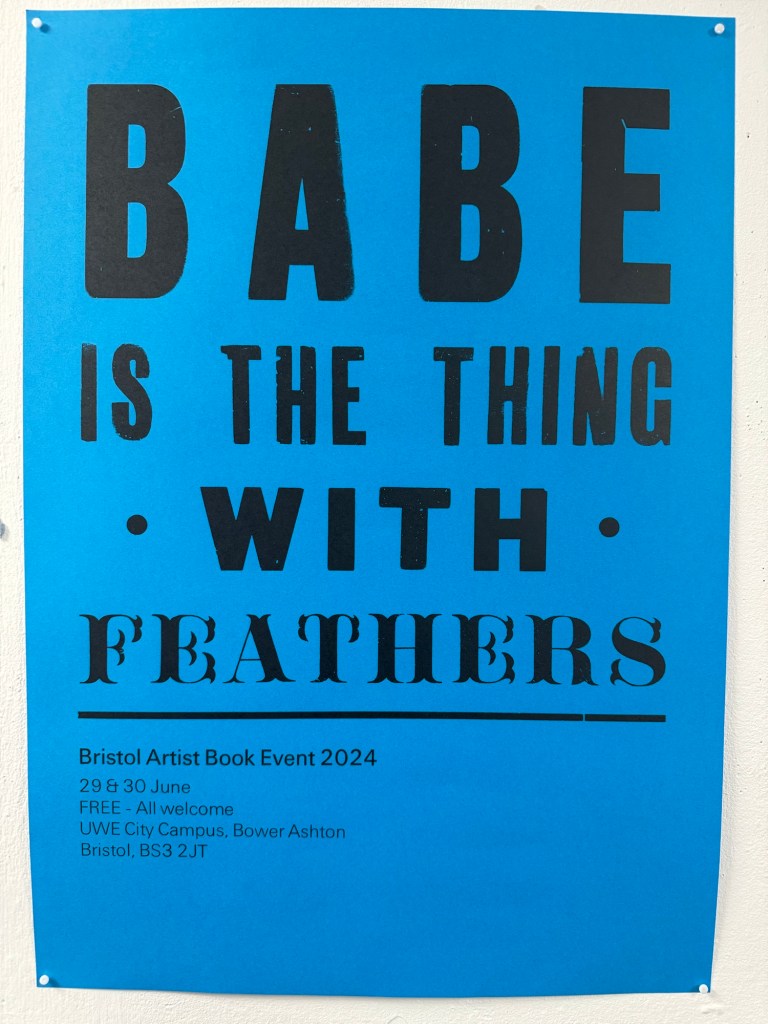
During the MA low residency at CSM in March 2024, we had a book art workshop where we learnt to make zines and some simple book. The artist hosting the session mentioned a book art event that takes place in Bristol once every few years. I was delighted to find that it was on this year and I attended the fair.

There were nearly 100 stands; it was a great opportunity to talk to and learn from experienced book artists. I came away feeling enthusiastic to try this beautiful art form.

Another reason for my enthusiasm was that I recently attended a Suminagashi workshop. Suminagashi is an ancient Japanese technique of making handmade marble paper and washi by floating water-based inks on water, then laying the paper on top to absorb the ink and water pattern. See post:

https://eliza-rawlings.com/2024/07/05/suminagashi-workshop-ancient-japanese-paper-marbling-technique/

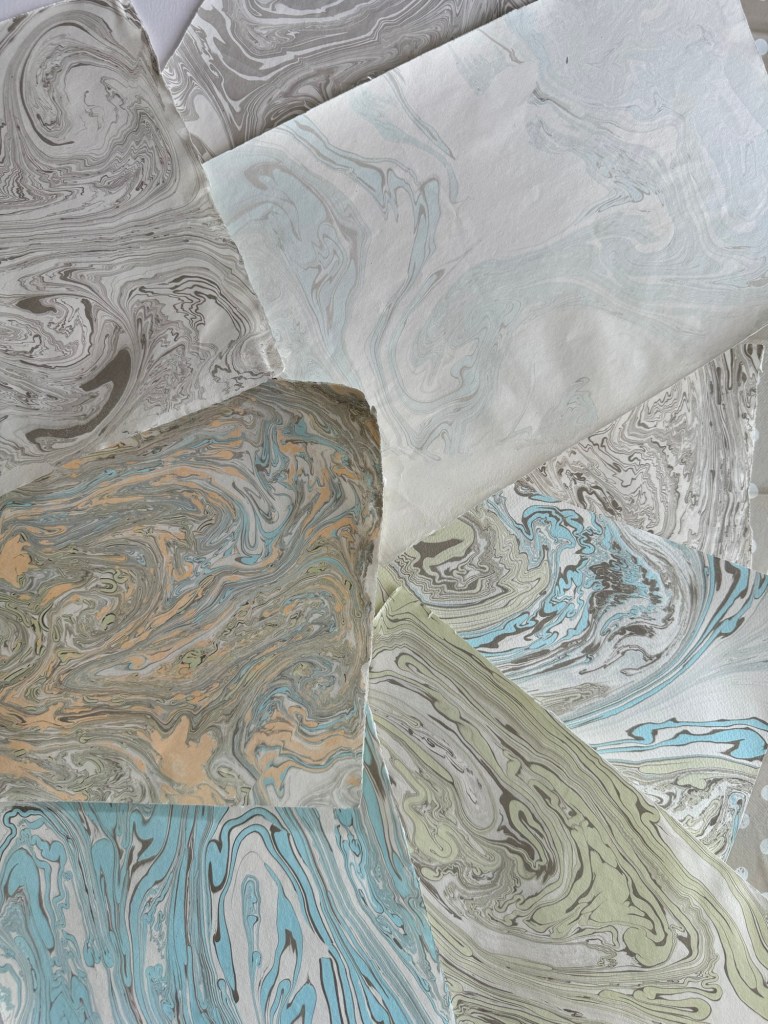
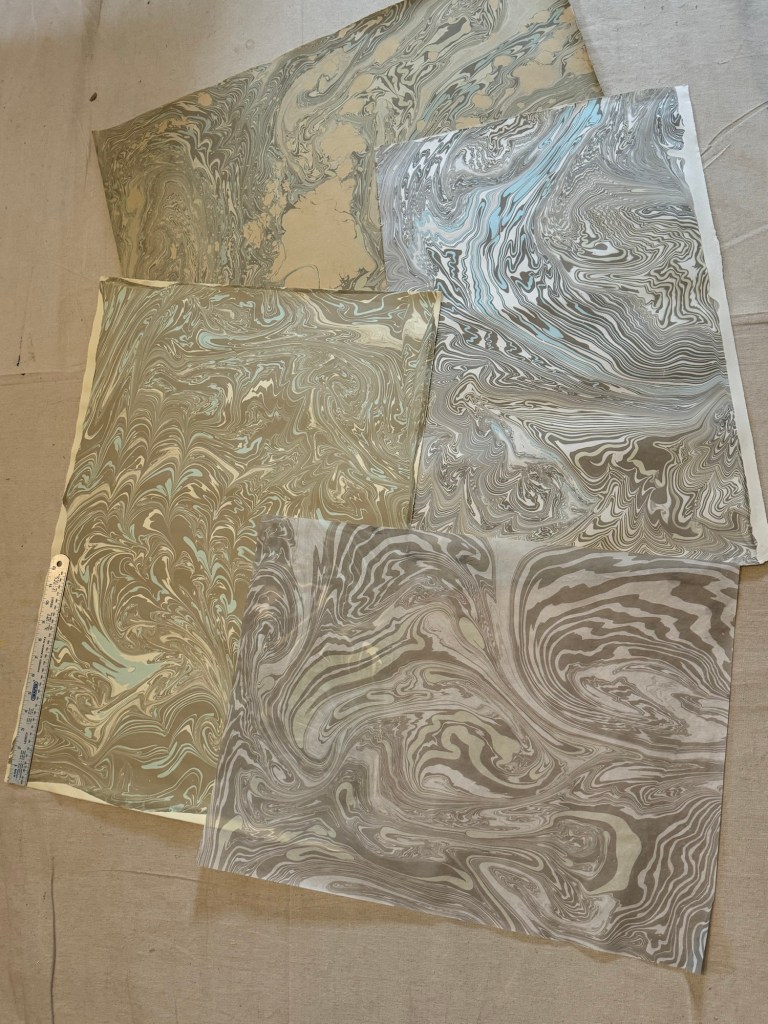
Here are some of the Suminagashi paper that I made during the workshop:

Small A4 size sheets
Larger A2 size sheets

METHOD

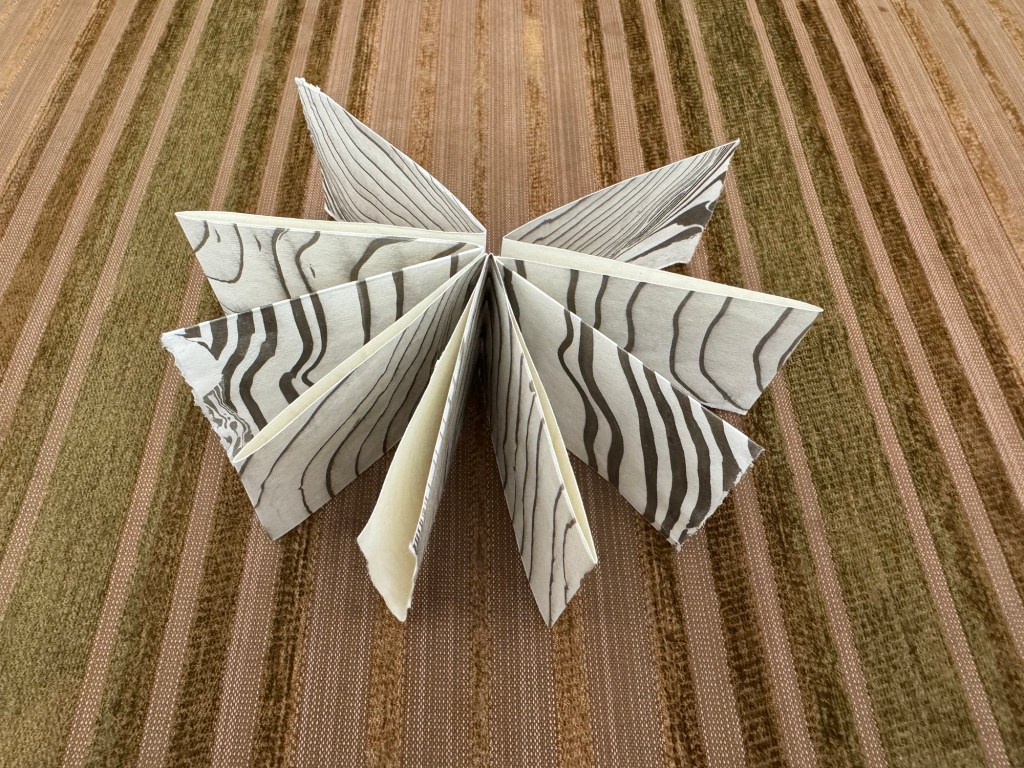
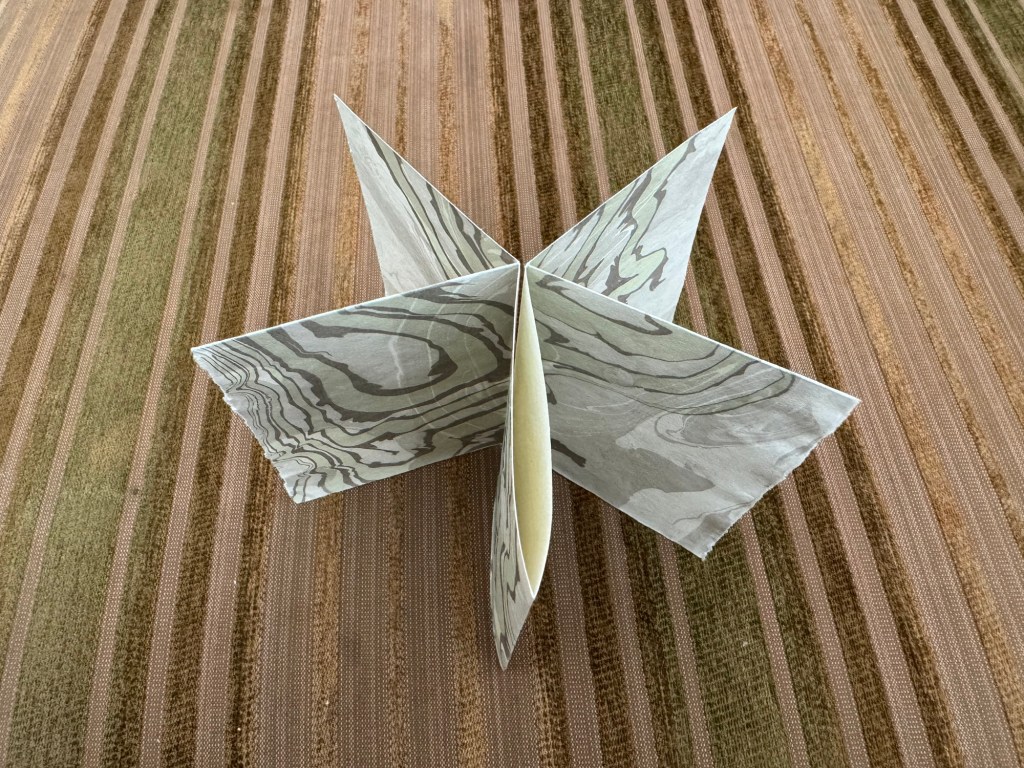
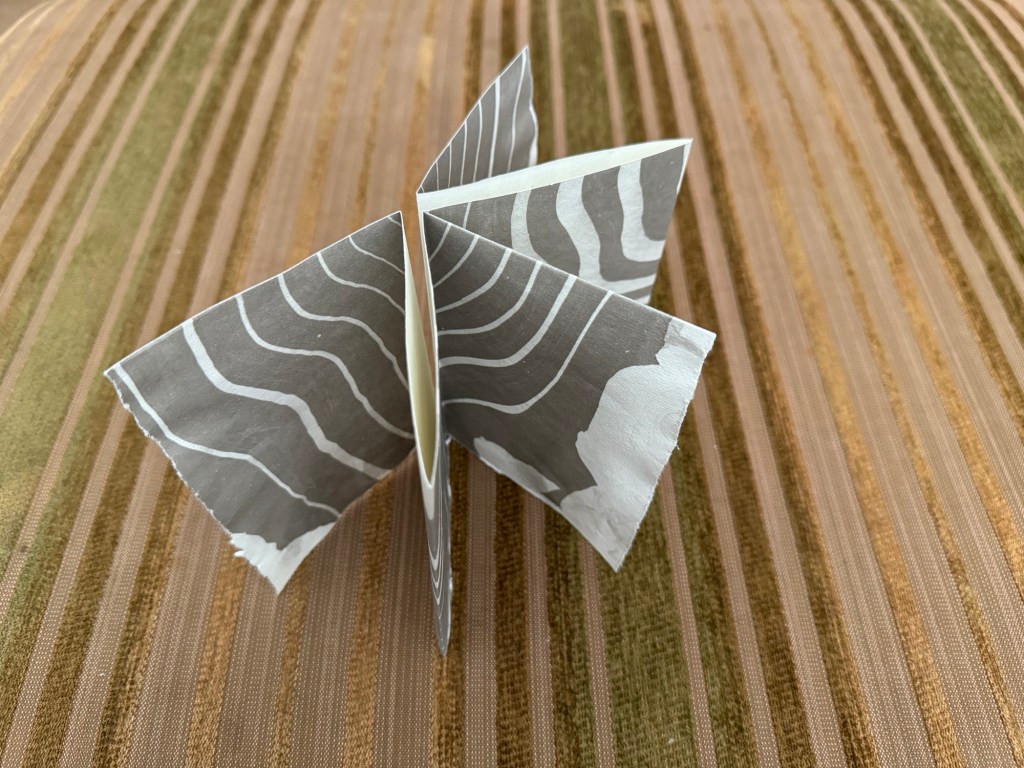
From the techniques learnt during the low residency workshop at CSM, I made a few different types of simple books using the smaller sheets of Suminagashi paper:

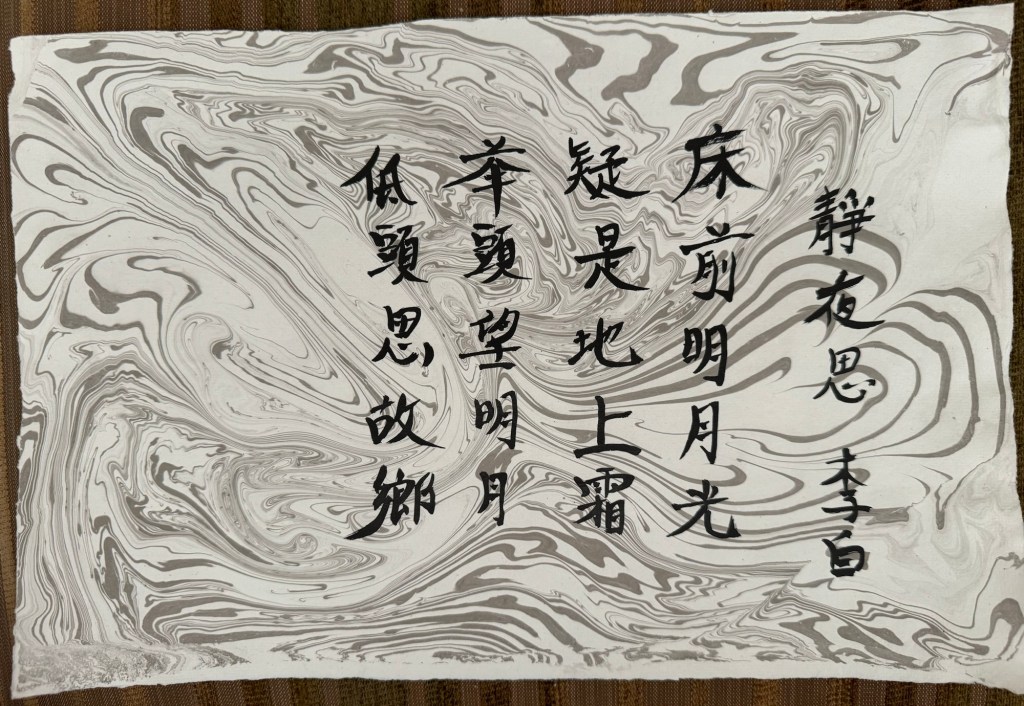
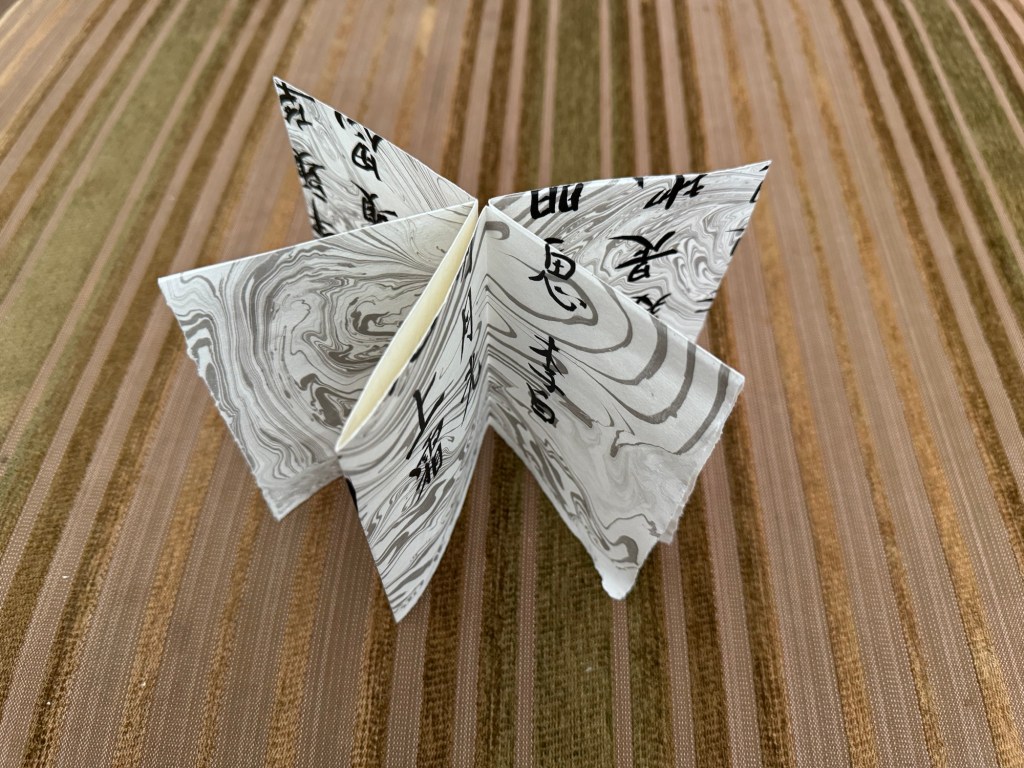
I experimented with some Chinese ink calligraphy on one sheet of paper, then folded it into a simple book:

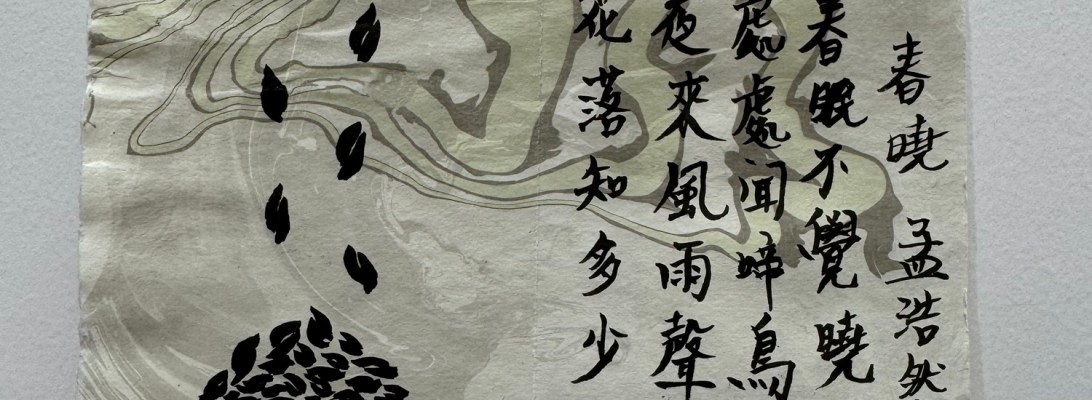
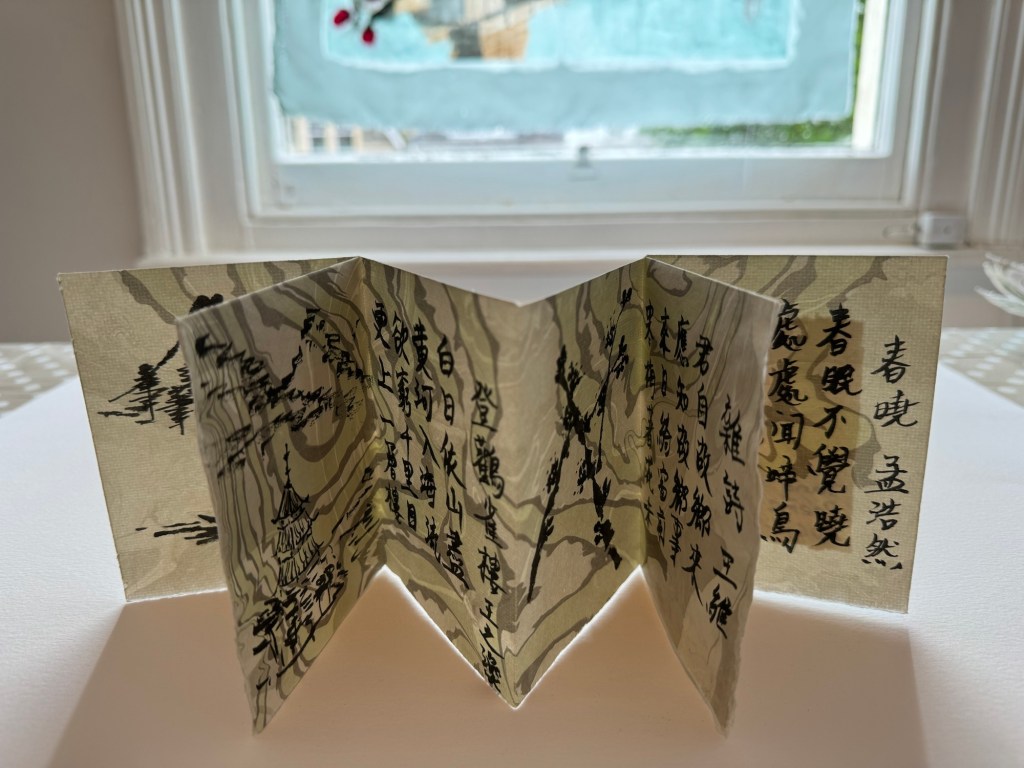
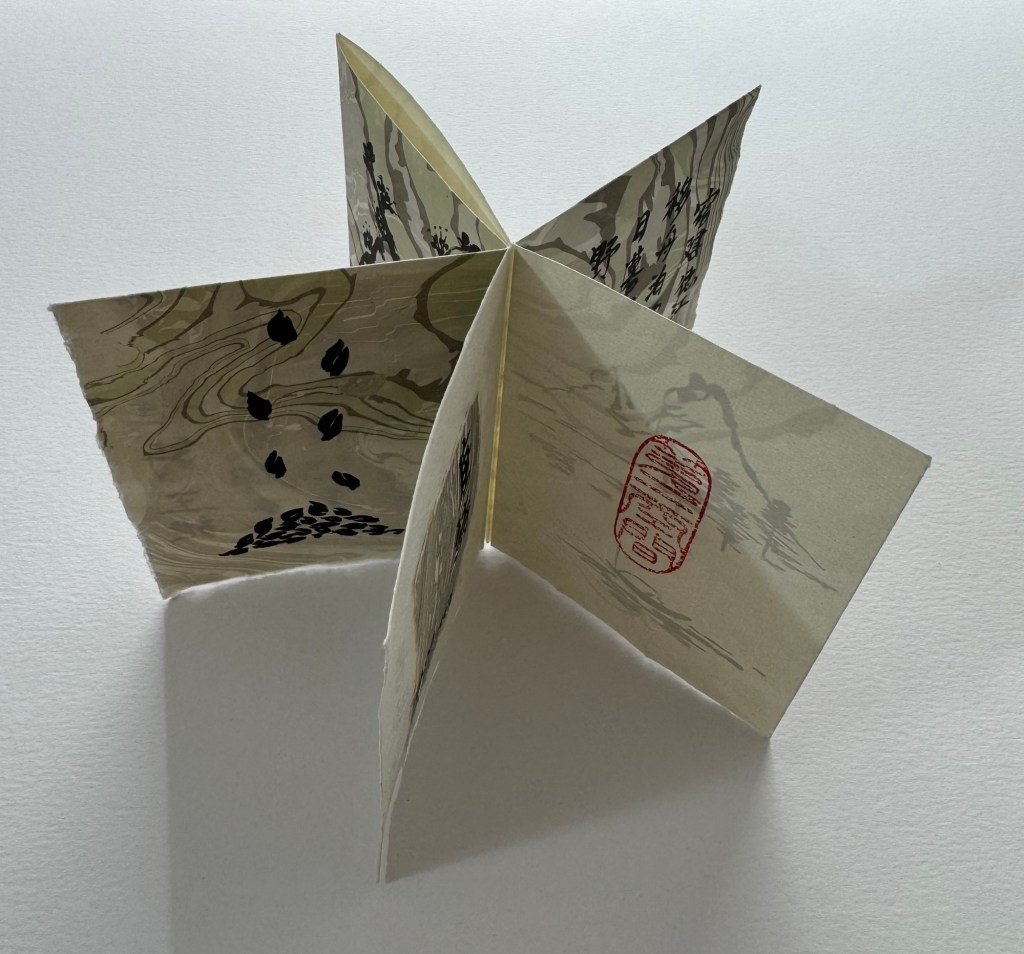
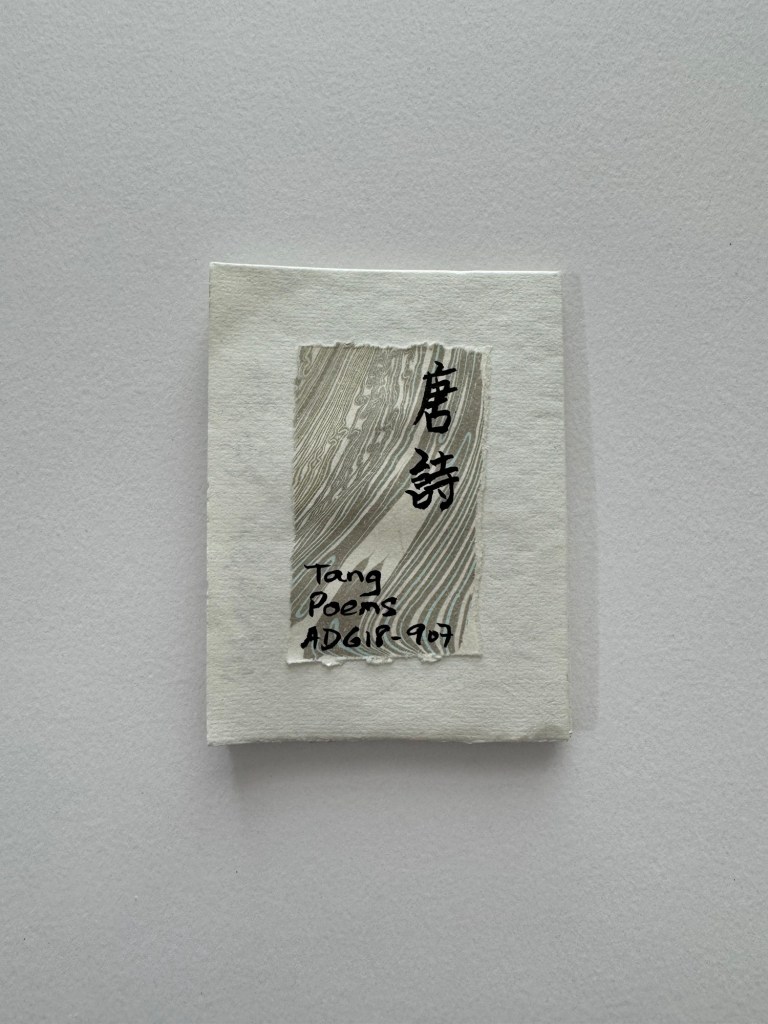
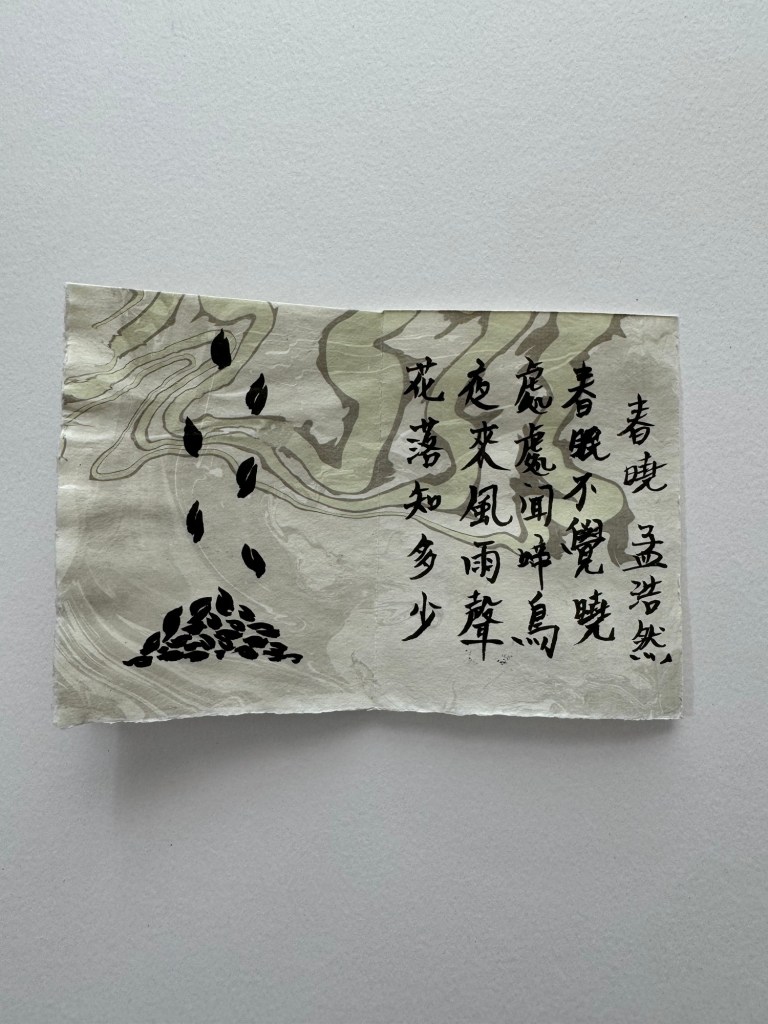
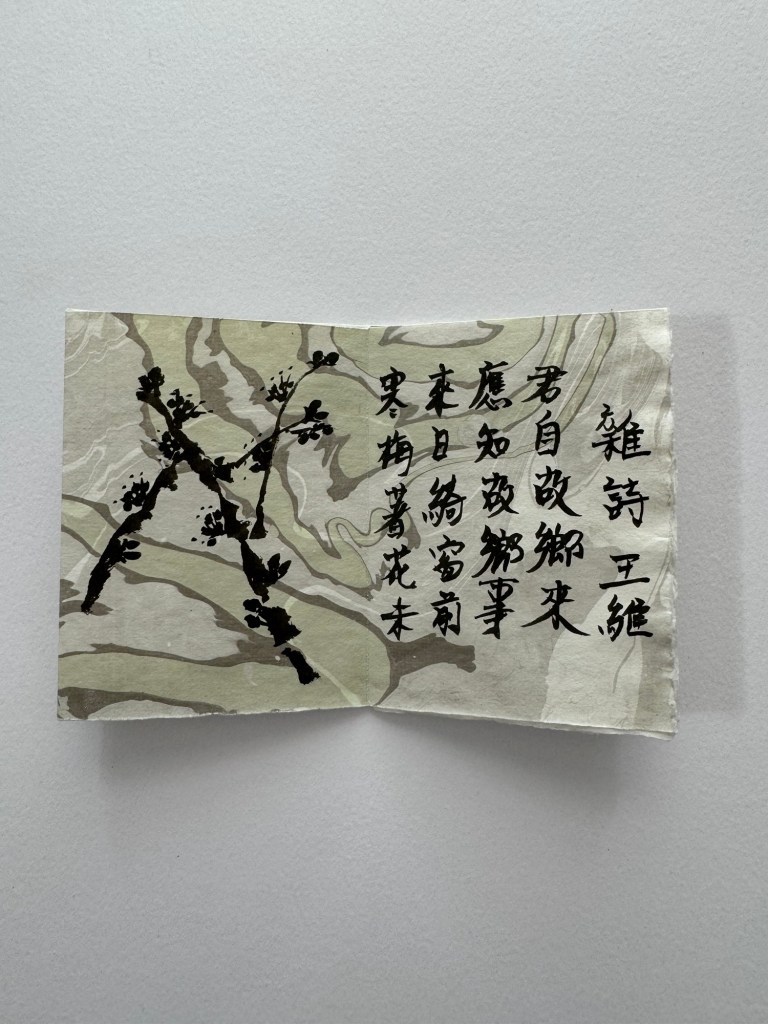
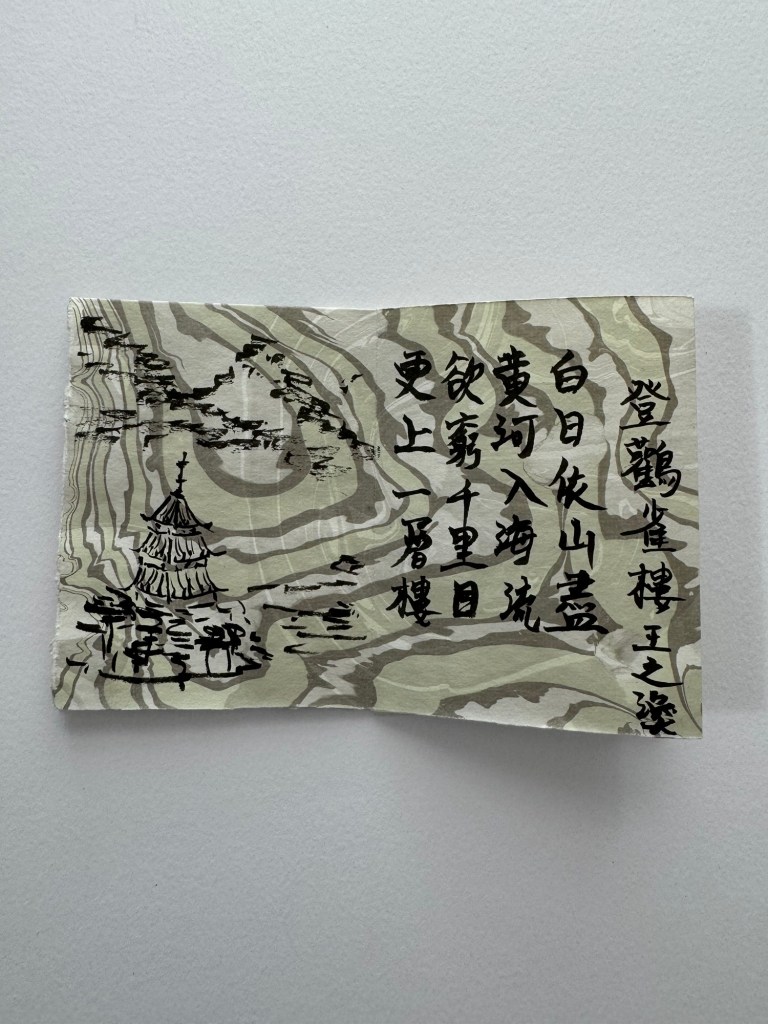
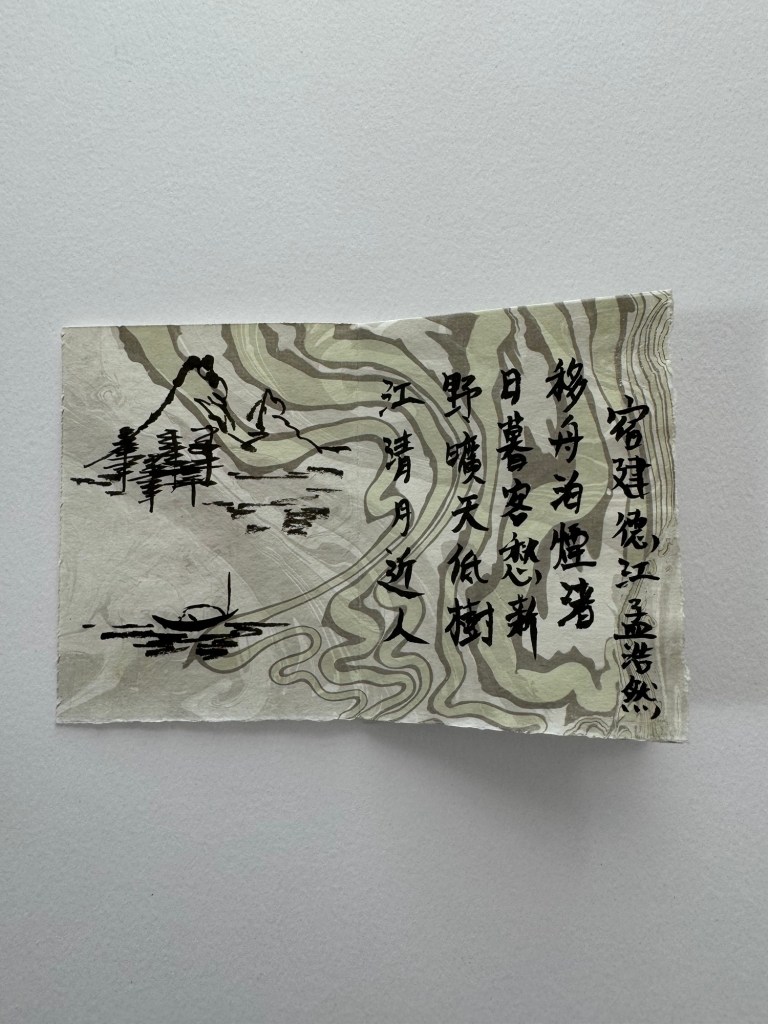
On another Suminagashi book that I made, I chose four Tang Dynasty poems and wrote them in the book using Chinese ink calligraphy, each paired with a small painting:

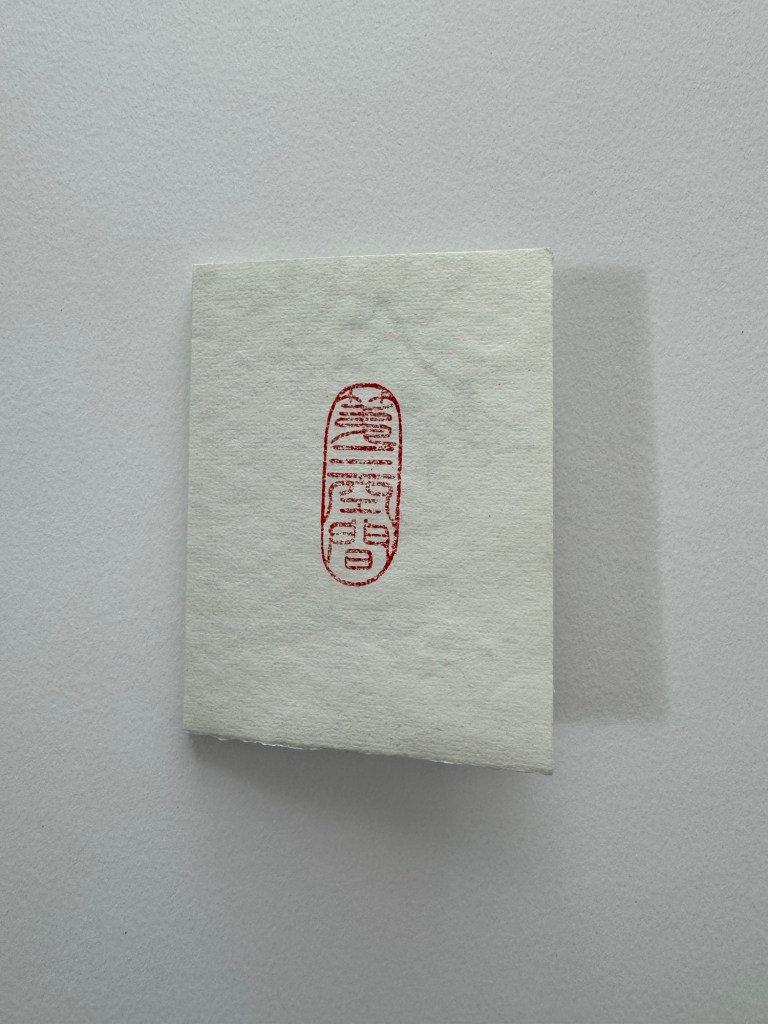
The seal on the last page of the book is a new Chinese stone seal that I designed. I managed to have it carved in Hong Kong and brought back to the UK by my Chinese painting tutor. The phrase on the seal means ‘The Third Space’, a concept that my art practice is based on so I will use it like my artist’s signature. The seal is carved in an ancient Chinese font.

Below is a video with my narration, reading out the English translation of the poems. Note that traditional Chinese books open from the opposite direction to English, Romance or Germanic language books:

REFLECTIONS

I was really inspired by the visit to the book art fair. It helped me to understand how broad the scope of this art form can be. I knew very little about book art until the low res workshop earlier this year and I am excited by it. I enjoyed making the simple books in this exploration, especially using the Suminagashi paper. Here is a summary of what I enjoyed about this exploration:
– I enjoyed the quiet pleasure in the act of folding paper carefully, especially with beautiful paper such as the Suminagashi paper. The feel of the material surface, the edges and creases all added to the meditative effect that this art form has to offer.

– I enjoyed learning a new skill in making books. Although I am only making very simple ones at the moment, I am excited by the potential complexity and scope that book making can offer. It is new knowledge and a new challenge for me.

– Once a book is made, it is like having a new canvas calling out for creativity that requires a new way of thinking compared to my other work.

For me, it is a two stage process: (1) Think about how I want ‘the canvas’ to be and realising that idea through physical making; then (2) express my art on the made canvas. The stages are similar to the Cheongsam (Chinese dress) canvases that I have been making for painting. That approach also requires creating a 3D canvas first through a step-by-step ‘technical’ process before any drawing or painting can take place.

The similarities between my book-making and dress-making to create canvases only occurred to me during the writing of the above reflections. I was beginning to feel concerned that I might be going from one thing to another too soon in my practice. I am not dropping the dress-making work, in fact, far from it – I have planned many other projects based on Cheongsam canvases. But I also want to explore book art and I now realise the similarities between the two in the context of my practice. I believe it can be explained as follows:

– The book-making or dress-making processes start by my following some guided steps, this way of making gives me a structured approach to starting a project. Meaning, it is unlike just getting out a plain sheet of paper or a pre-made blank canvas where you are immediately faced with having to decide what to paint. Through the structural and systematic start of the creative process (i.e. making a book or a dress), I can proceed to create ‘productively’ and while I am making the ‘complex canvas’, I can think about what to paint on the canvas or to finalise the ideas in my head. The process of making the canvas (which in the case of a dress can take several days) gives me quality thinking time whilst doing something productive and not just sat in front of a blank canvas feeling bad that nothing was happening.
LEARNING

Attending the book art fair taught me a lot about the scope that this art form can offer. In my own experiments, I have learnt more about the art of making books from a technical perspective – I am at a very early stage right now but I definitely want to learn more to make more complex or larger books.

My reflections above made me realise that the process of making the canvas myself (e.g. a book or a dress) has been a key part to my enjoyment in making art recently because I have been using the canvas making time and process to aid my thinking and to finalise my creative ideas. I have been doing this without consciously knowing it. I value the fact that making items such as a book or a dress are established processes and therefore give me a secure and stable route to start each piece of work. On the contrary, if I were to create a completely free-form assemblage from found items as a starting point, I would be inhibited by such an open and abstract process at the beginning of a piece of work – I would not know where to start and therefore it would be like sitting in front of a blank canvas again. This realisation is very important and useful for me because I can now think about other potential canvases that I can make from an established method in order to expand my practice.

NEXT STEPS

– Continue to make books and learn about book making to expand my knowledge.

– Think about other canvases that I can create in addition to books and dresses that would enable me to have the quality thinking time as part of my creative process and to avoid the ‘starring at a blank canvas’ problem.

UPDATE:

I made another book using a piece of Suminagashi paper folded into a small long book. In it, I wrote four short Tang Dynasty poems in Chinese calligraphy and coloured some areas using Chinese painting colour.