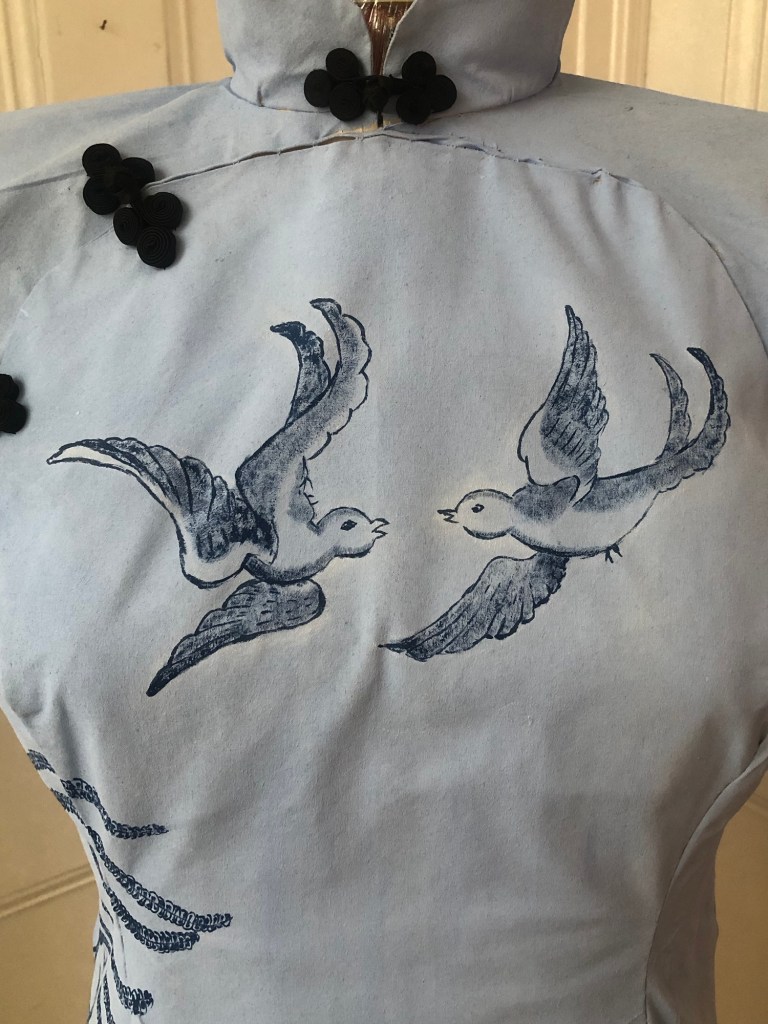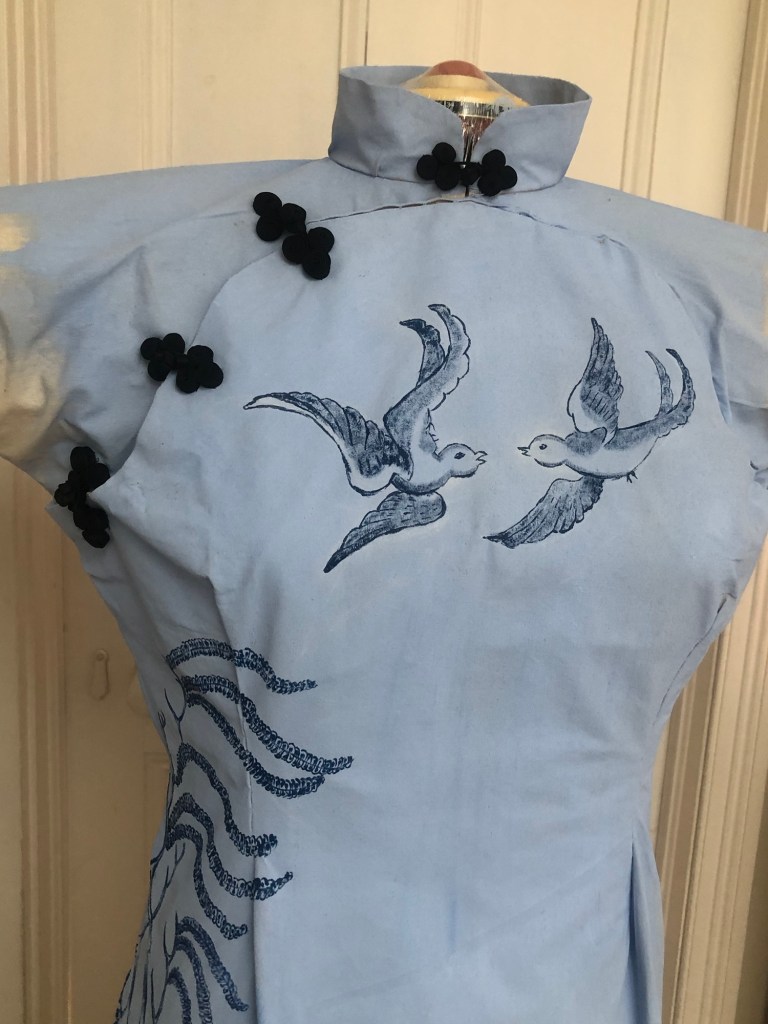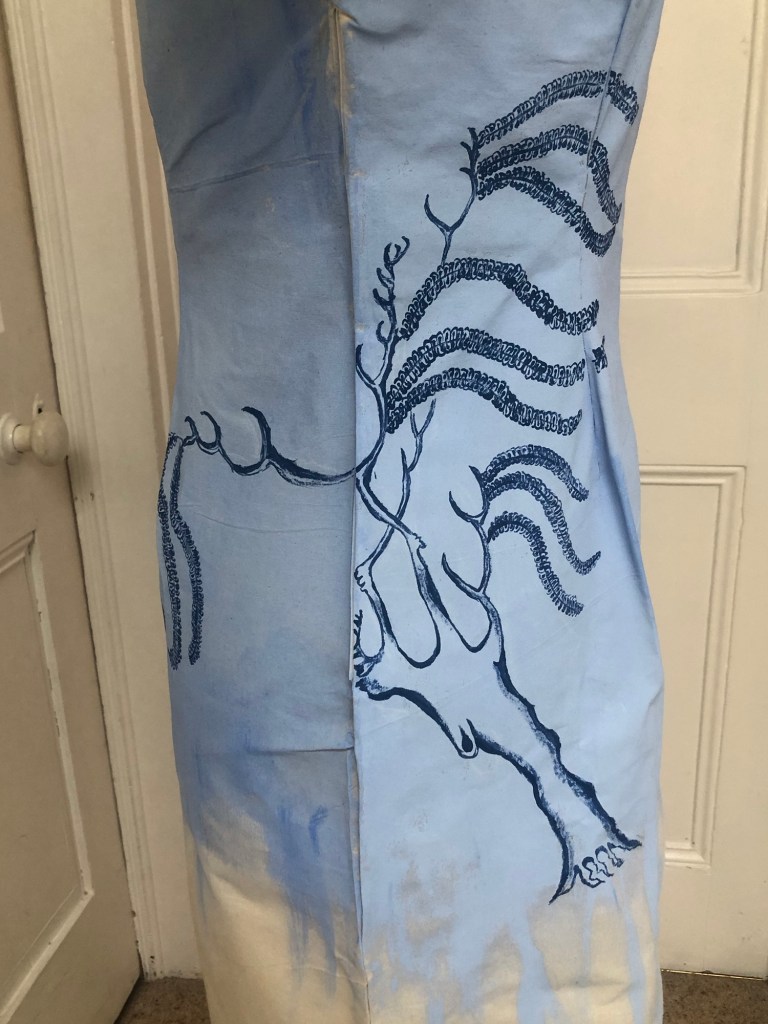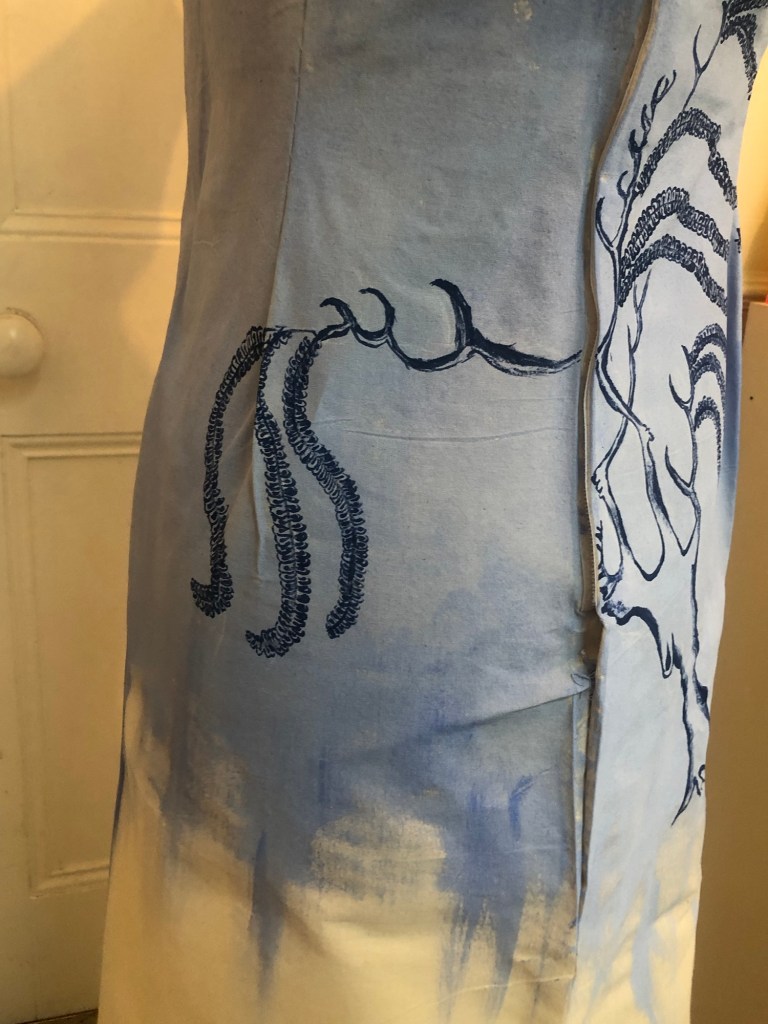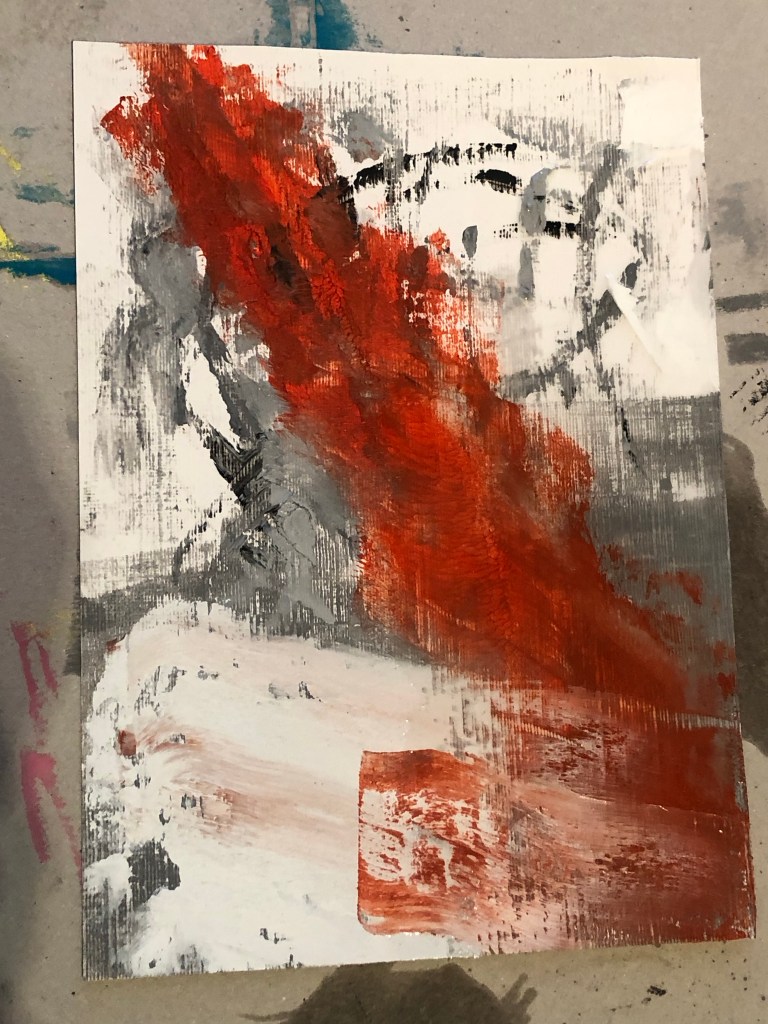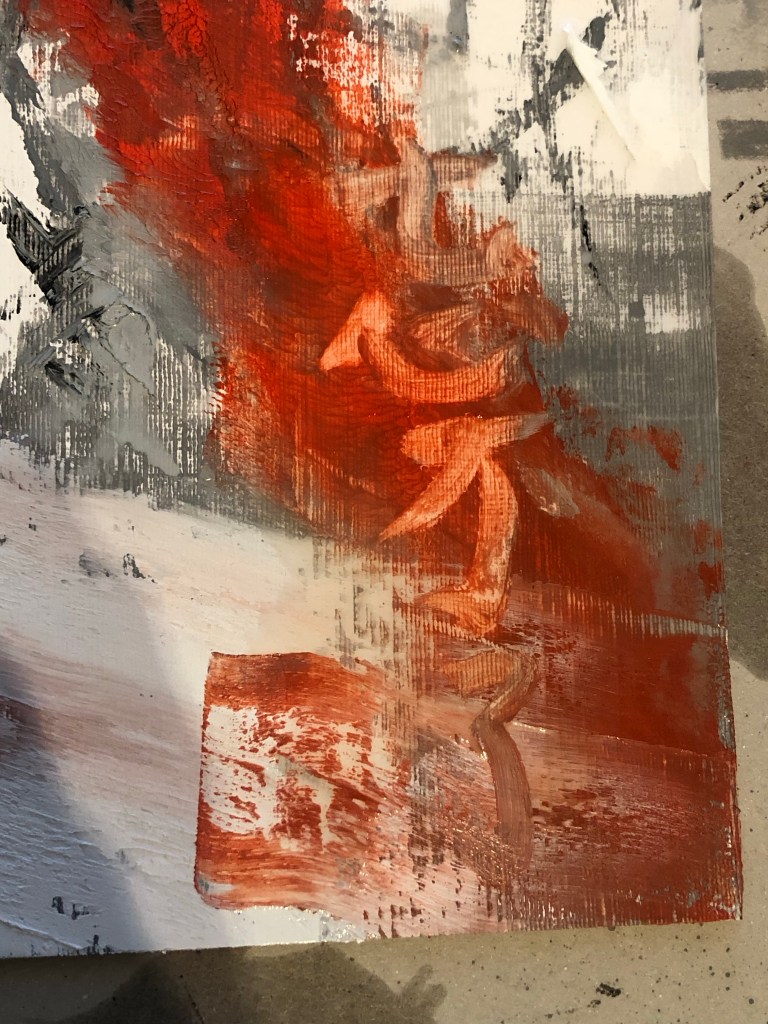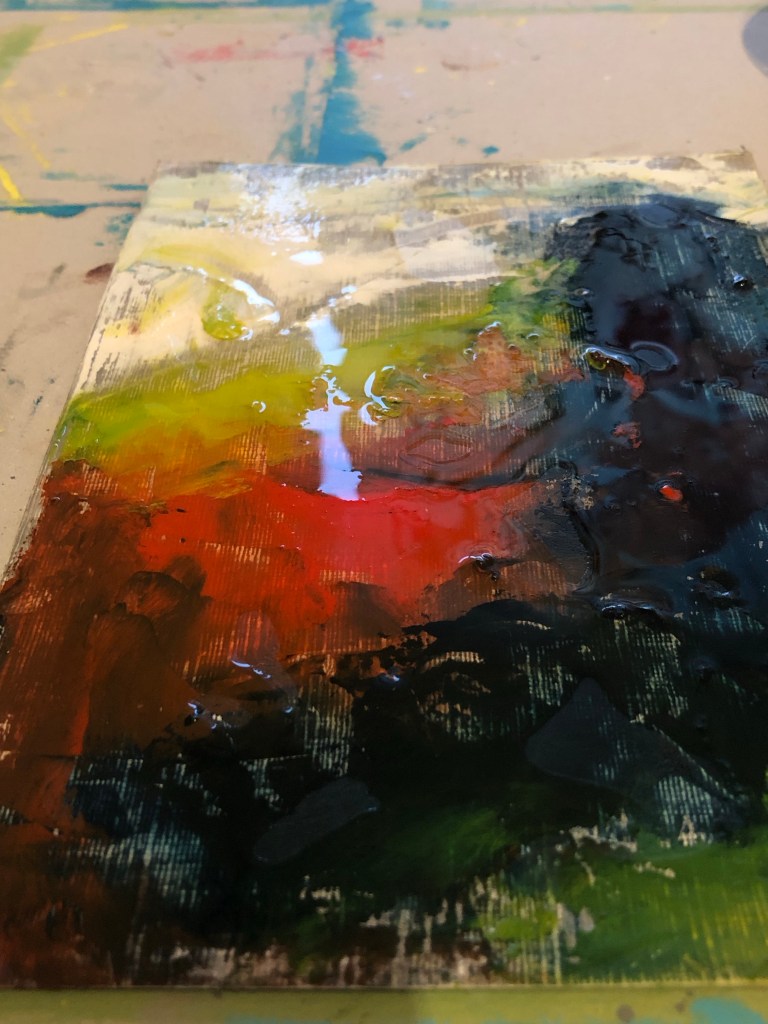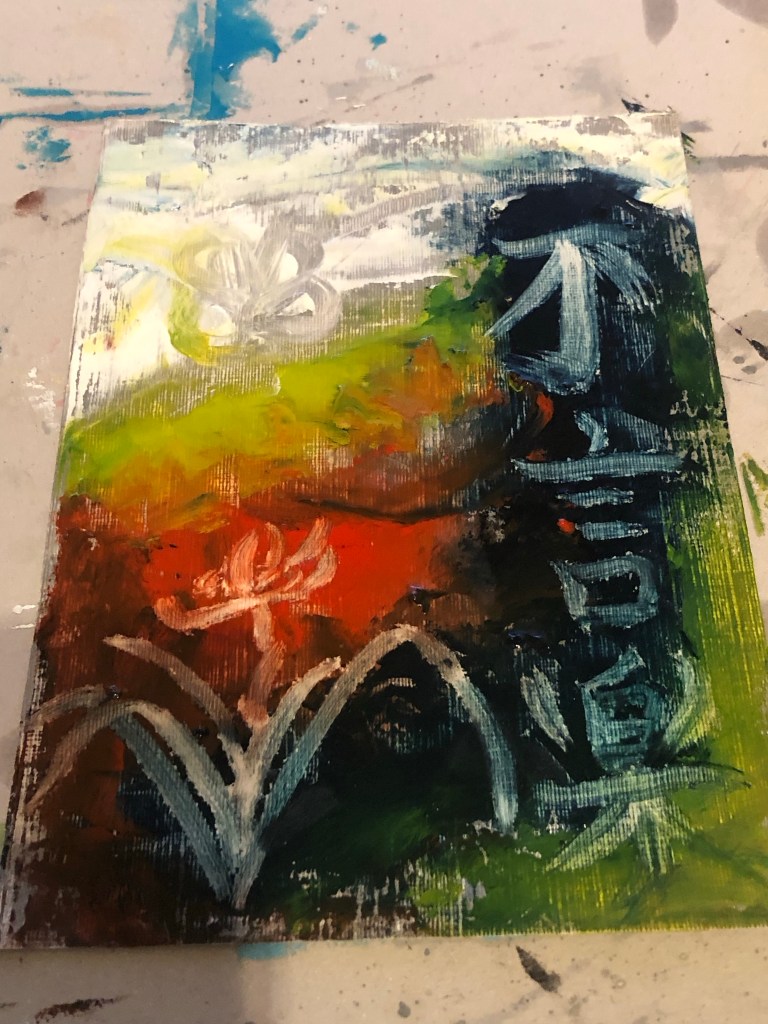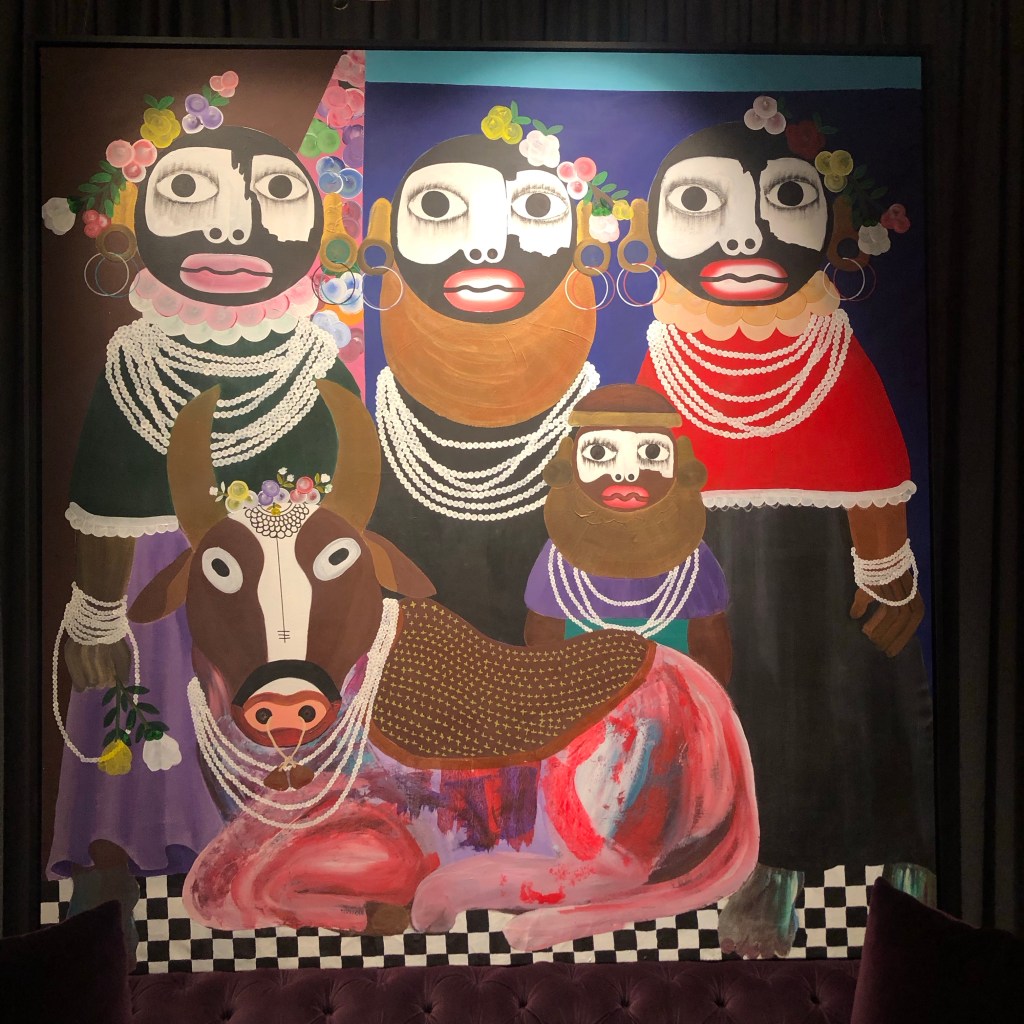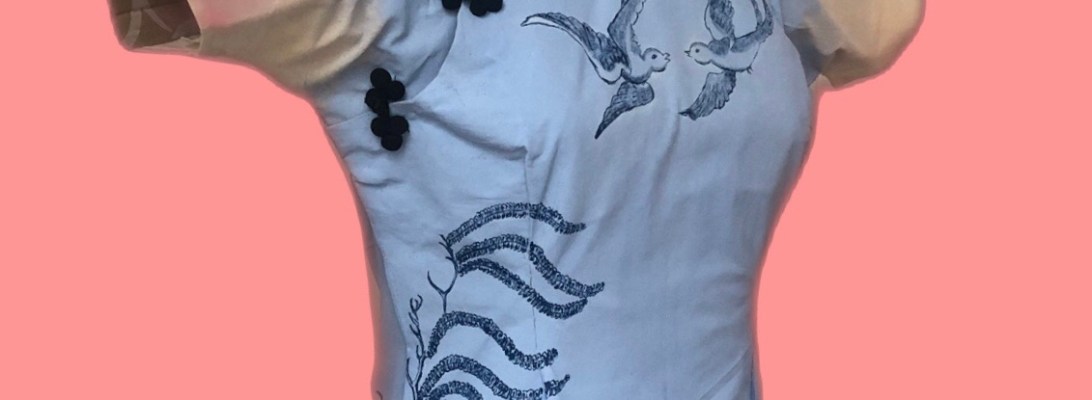
MA U2: Cheongsam Series #4 – Appropriation. Appropriation.

MY THOUGHTS ON THE BLUE WILLOW PATTERN

In my last Chinese painting blog where I painted a heron, I questioned what makes a piece of art ‘Chinese art’. Is it about the materials used or does it have to possess certain stylistic or aesthetic characteristics to be considered ‘Chinese art’? Thinking about this reminded me of how I find the Blue Willow pattern irritating. I don’t find it appealing and it irritates me that many people consider it ‘Chinese’. The Blue Willow pattern technically comes under the category of Chinoiserie art which is an European interpretation and imitation of Chinese and other East Asian artistic traditions. It started in 17th century and became popular in the 18th century. As the British Empire and its naval prowess went from strength to strength during that period, the demand for Asian and East Asian artefacts back in Britain grew rapidly giving rise to the popular Blue Willow China. I do not intend to go into the details of that part of Empire history in this blog, what I plan to capture here is my personal feelings towards the Blue Willow pattern.

For me, the Blue Willow is a poor form of appropriation. It was originally designed by English designers Thomas Turner and Thomas Minton, they both worked for the Caughly factory. Spode was believed to be the first factory to mass produce Blue Willow China around 1790. So it was an English design that was meant to look Chinese. Over the years, I have had numerous people (non-Chinese) telling me that they love Chinese art and they love Blue Willow China. It is hard to explain my ambivalence. On the one hand, it is good that someone is interested in your culture, but to quote something that does not represent said culture can be irritating. I am not irritated by those who expressed such views, but irritated by the fact that Chinese culture (I consider that partly my cultural heritage) is so widely associated for so long with an unattractive and poor quality design, especially given the concept of orientalism and the related history.

As a result of my ongoing ambivalence, I have became fascinated by the Blue Willow pattern. The more I research into its history, the more I feel amused by it. For example, a fictional story based in China was made up and marketed as the background history to the Blue Willow pattern in order to drive sales. It was apparently a successful campaign which was a clever marketing concept even in those days. I had never heard of such a story so I downloaded an e-copy to read because I was intrigued. It was not a particularly good story but it cleverly tied together all the elements of a typical Blue Willow pattern – good effort. Since starting my Blue Willow research, I have started to look out for Blue Willow China and have acquired some pieces to study from charity shops and street markets. The part that I find most amusing is the largest tree on the design bearing some large round shapes on its branches:
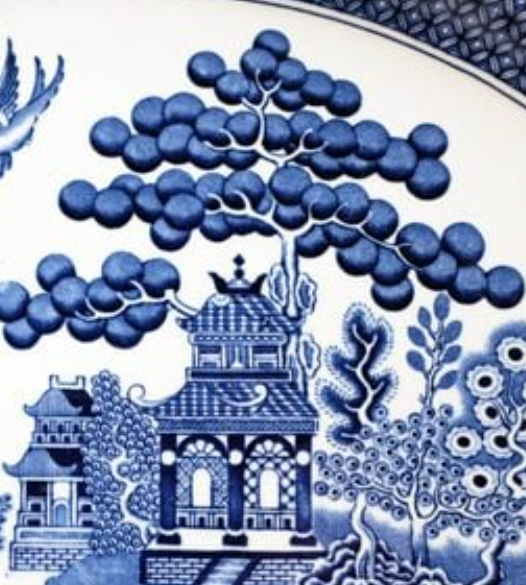
There are many theories published about what kind of tree this is – it is twice the height of a two storey pagoda, so too large for a fruit tree yet the round shapes look like fruit – so what is it? There are articles that claim it was possibly an apple, orange, pomegranate, peach or persimmon tree. None of those was really possible due to the size of the tree depicted unless it was a surrealist design which I don’t think it was. I believe it was in fact a Chinese pine tree which can grow up to 80 feet tall and were commonly depicted in Chinese paintings. The round shapes were meant to be clusters of pine needles that collectively can form a round or oval shaped silhouette. Often in Chinese paintings or carvings, pine needle clusters are done with a round or oval shadow then some individual needles are depicted to suggest their presence. It is possible that the designers of the original blue willow pattern either ignored the needles because they were so fine hence difficult to depict on porcelain, or someone who has travelled back from China having seen a similar design then described it and the original tree details got lost in translation (like a form of Chinese whispers ironically). It could also be that the tree design evolved over the years with the round shadows becoming the main form as simplification of the pine tree happened over time. As a result, the original pine tree details were lost. This is my opinion and I remain irritated that this design claiming association with Chinese art yet not much effort was made to get such basic details right. Hence my opinion that the Blue Willow design is a poor effort in appropriation; it is a case of an inferior product gaining success as a result of effective marketing to satisfy the demand for East Asian art during that period in history.

APPROPRIATION. APPROPRIATION.

As a result of my irritation as well as ambivalence towards the Blue Willow pattern and its history, I have been wanting to make a piece of work about it to explore my thoughts further. I also felt it would be ironic for me to appropriate the appropriation.

METHOD

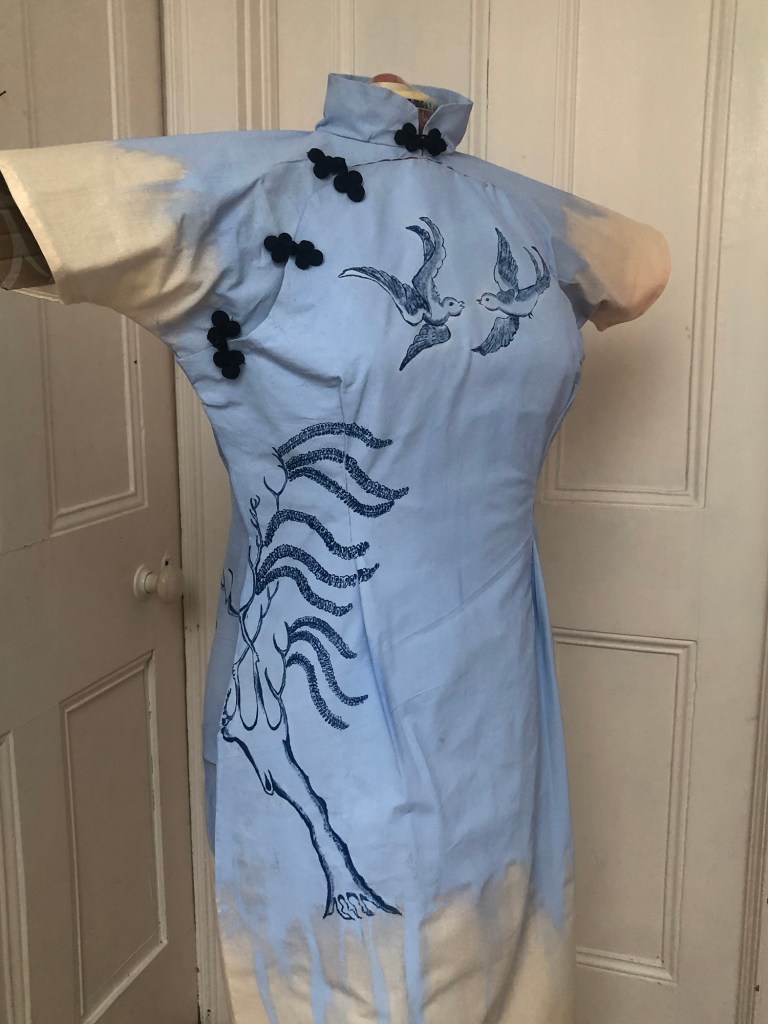
Following on from Cheongsam Series #3 where I had made a 3D canvas in the form of a wearable painting, I have decided to paint part of the Blue Willow pattern onto this canvas:

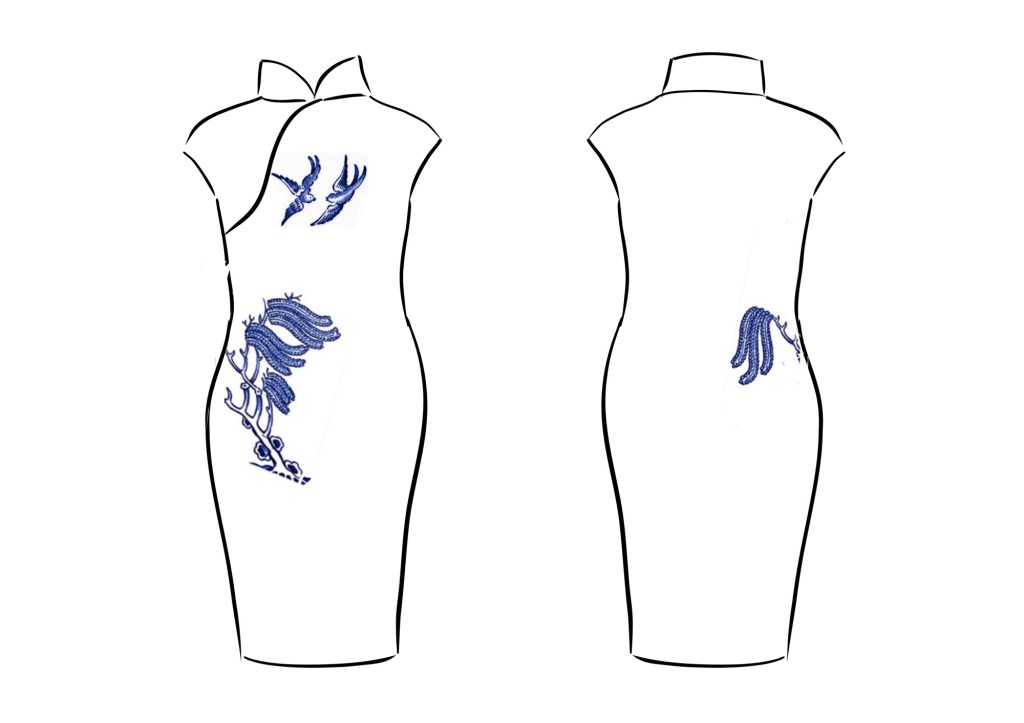
To decide where to place the images, I researched traditional Cheongsam designs and found the following images from the book In the mood for Cheongsam by Lee Chor Lin and Chung May Khuen, published by National Museum of Singapore. I particularly like these images where there are motifs on the chest and then the design runs down the right hand side of the wearer. I remember seeing such dresses when I was a child and thought the asymmetrical design was very elegant. So I want to create a similar design with this piece of work.
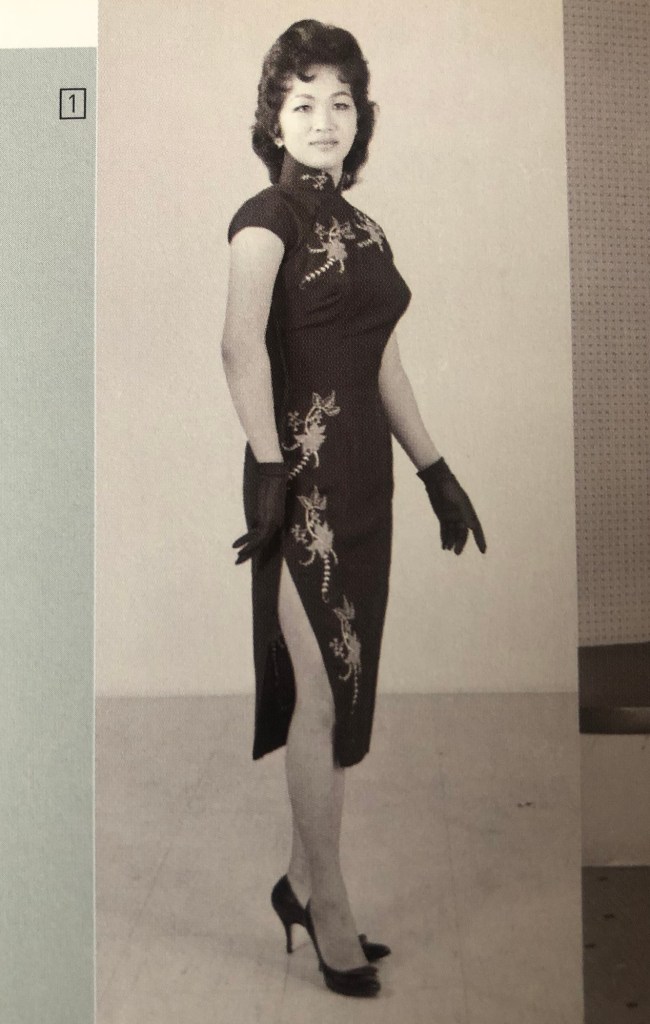
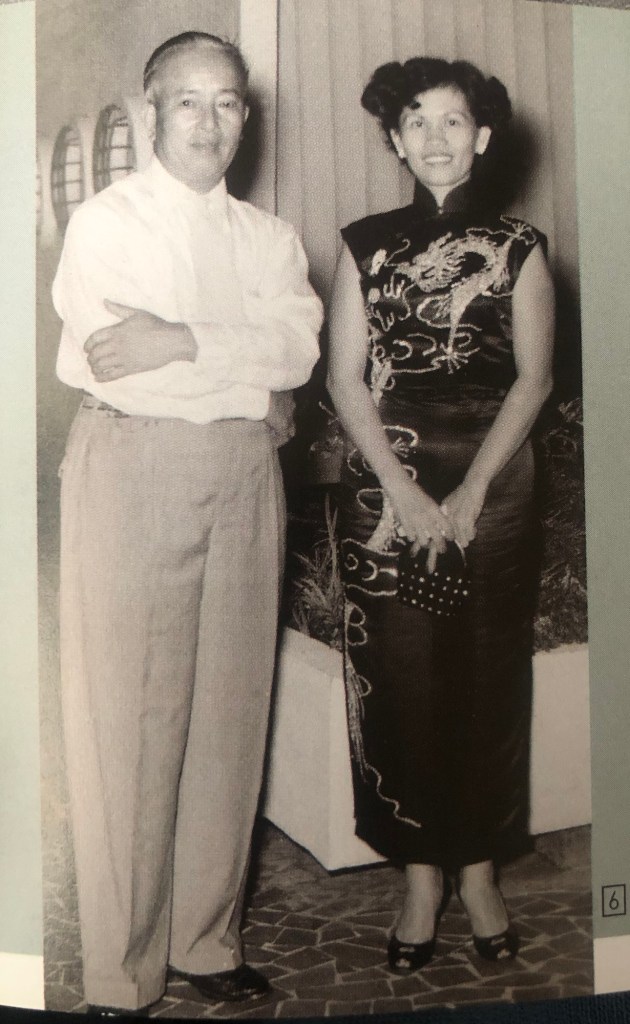
There are many variants to the Blue Willow pattern, I decided to use the one on an oval platter that I had bought at a London street market. The piece was made by Wedgewood and date stamped 1956.
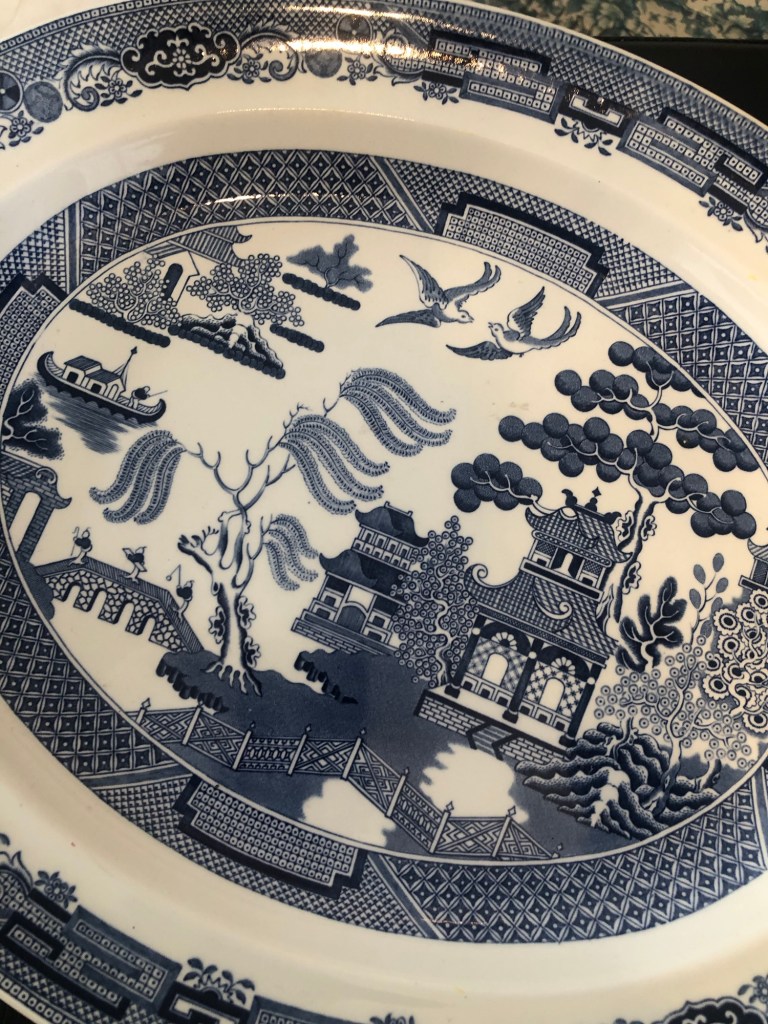
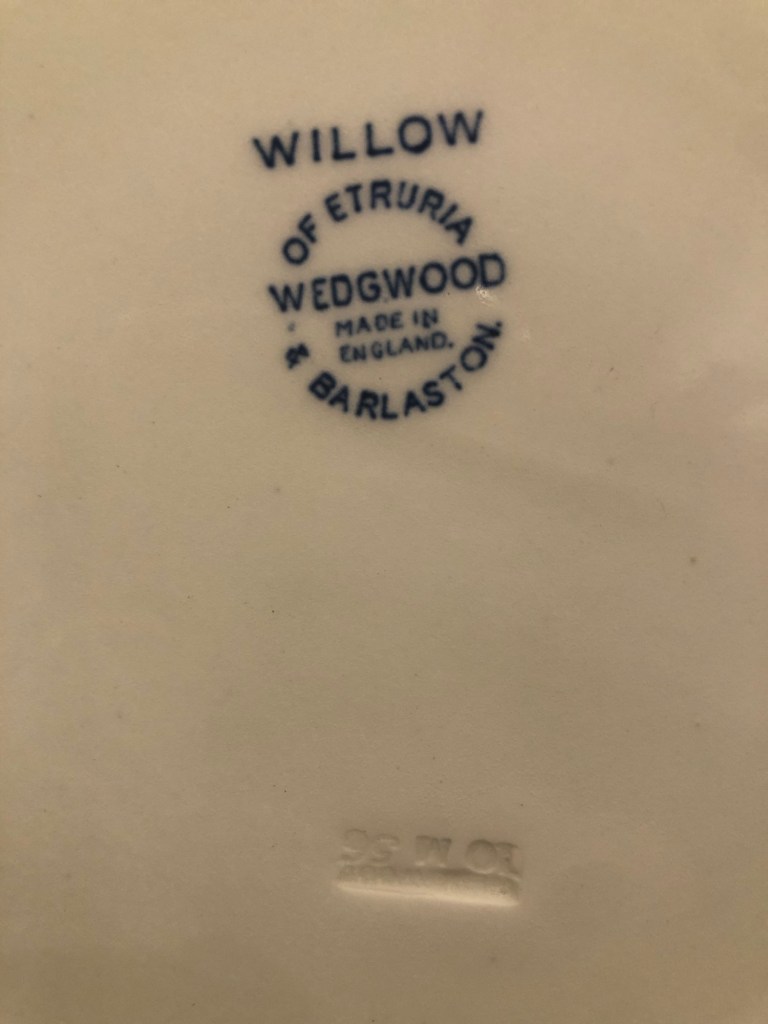
Adobe Fresco was used to explore the composition and the design below was chosen:
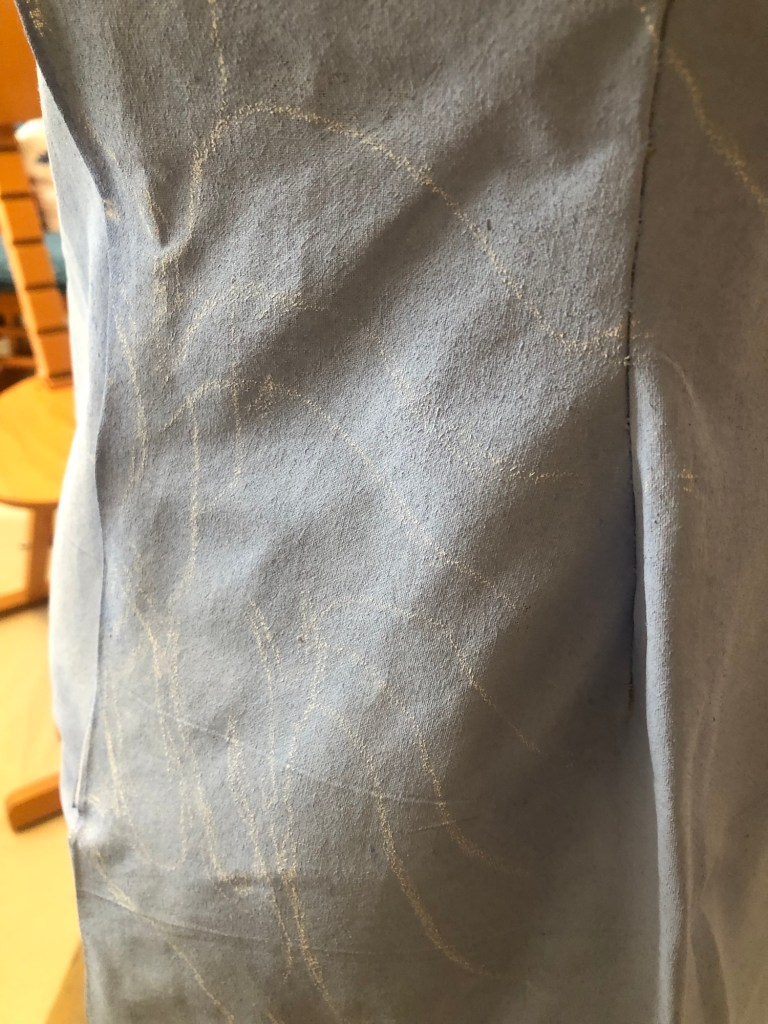
White chalk was used to mark out the design on the canvas:
Partly through this project, I contacted the CSM paint and materials lab for advice on what paint and canvas materials to use for a wearable painting. The details of the advice is recorded at the end of this blog. Based on the advice, the design was painted with Pebeo fabric paint:
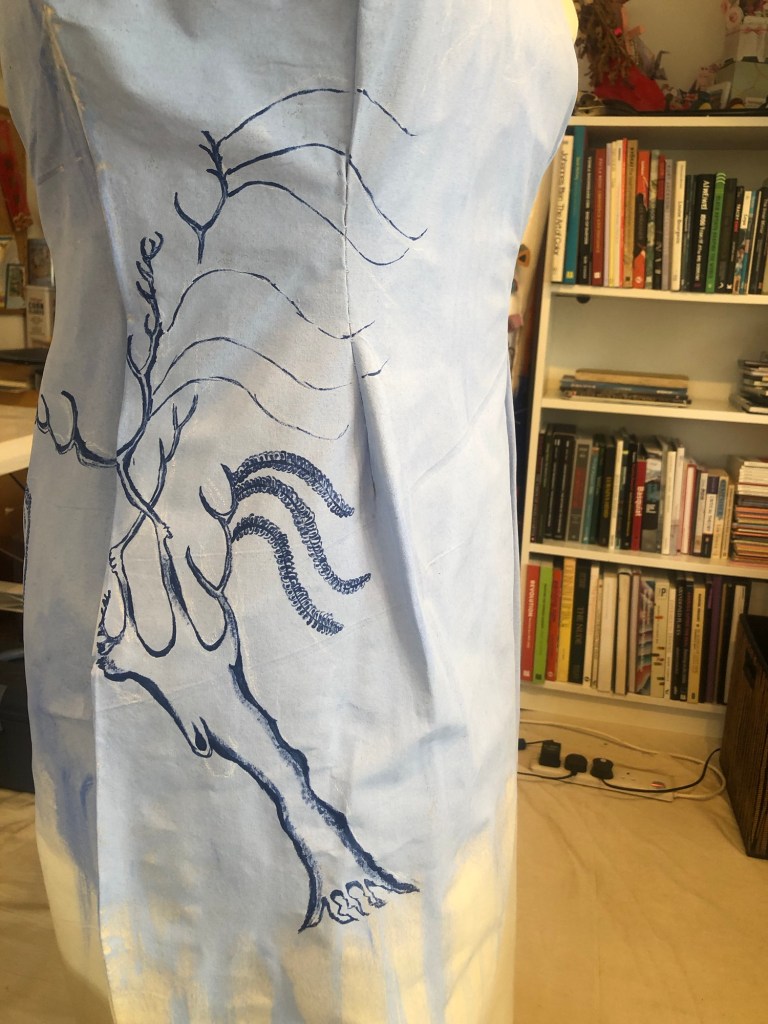
Finished painting:

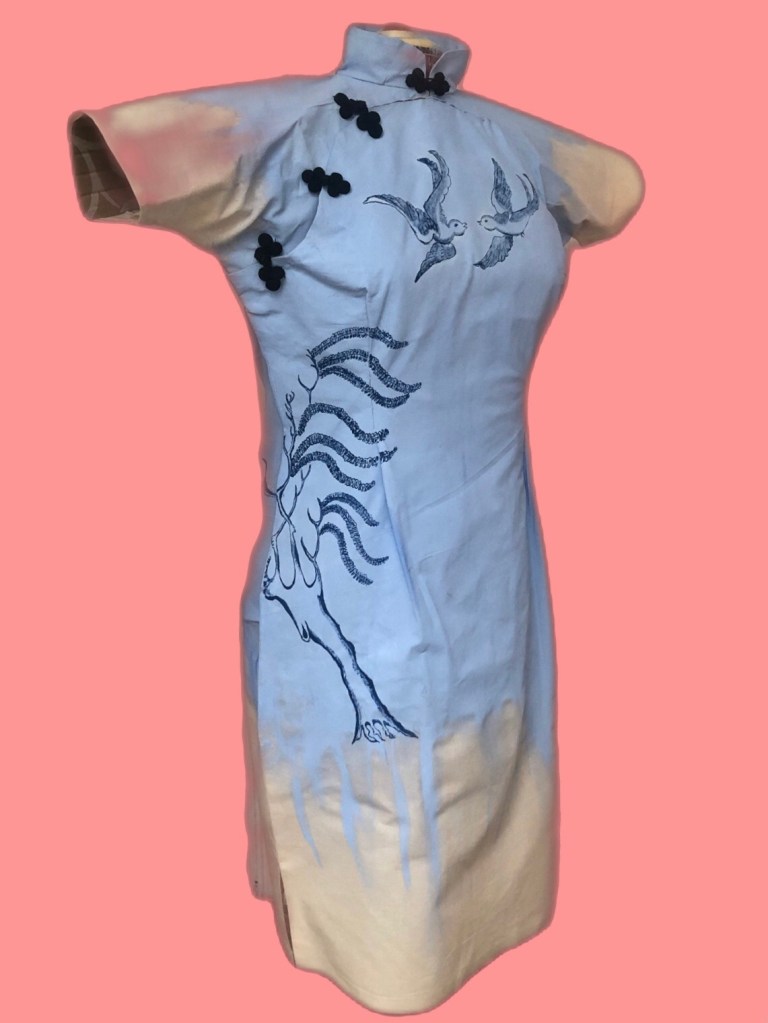
Finished work – Appropriation. Appropriation. H110 x W75 x D30cm
REFLECTIONS

I believe the Blue Willow pattern is a Third Space phenomenon because it is the combination of two cultures but it is neither one culture nor the other, i.e. neither English or Chinese, but resembling characteristics of both of the originating cultures. This realisation made it even more relevant as a topic for my work.

I considered adding the pagoda and pine tree to the back of the dress as an additional feature, but instead of painting the big round ‘fruits’, I wanted to correct them and paint a proper Chinese pine tree instead. However, after completing the willow tree and the birds, I felt I had done enough on the painting and wanted to move on – either further research about the cheongsam or make another canvas because I had thought of other designs that I wanted to do.

Overall, I have enjoyed making this painting and felt that I have learnt a lot especially about dressmaking.

For this painting – what I was happy with:

– Making a dress from scratch from a sewing pattern. I enjoyed the process because dressmaking is both a technical and an artistic endeavour. I found the creative process satisfying.

– While I was making the dress, I recalled watching my mother designing and making clothes for the family when I was young. Through the sewing, I felt I was living her experience in a way. I wonder what she would say if she were here. I expect she would be giving me advice patiently. She was always patient when she was making and when teaching us. Thinking back, I can remember how she enjoyed designing and dressmaking when she was younger, then when she went onto painting in later life.

– I can see that incorporating sewing and costume making into my practice would give me an additional dimension to explore.

– I enjoyed painting the Blue Willow design onto a 3D canvas and exploring new materials such as the new fabric paint.

What I was not-so-happy with:

– The dressmaking was a bit rough-and-ready. It was a first attempt and I have learnt a lot, so I hope to do a better job for the next one.

– Although I enjoyed the process of painting the design onto the canvas, I felt rather indifferent about the Blue Willow pattern. I didn’t care as much as I had expected; nor did I get as much out of it as I wanted. I found myself asking ‘so what?’ I expect it’s because ultimately, my feelings towards the design and its back-sorry was not that strong. My feelings towards making the cheongsam was much stronger than towards the Blue Willow pattern. Having said that, I did enjoy researching and was amused by the history of the design.

LEARNING

Since this was a first attempt of this new idea, I was keen to get feedback so I put this work in for the group crit. The group was very supportive, gave me some advice and posed good questions. My takeaway from the crit were:

– Is it really a wearable painting if I haven’t used fabric paint throughout? Meaning that if it cannot be washed then can it be called wearable? This was a valid point. My idea was that it’s an item that could be worn but really only briefly for showing or photographing. It is not really a piece of garment as such. So I need to rethink what to call this type of work, either make it truly wearable and washable or just call it a 3D dress canvas.

– Think more about how to show this work. Such as how to present the piece and in what setting.

NEXT STEPS

– Make the next cheongsam canvas and develop the process further. Consider whether to make the paintings truly wearable or not.

– Research more about different cheongsam designs.

– Think more carefully about the subject and context of the painting. Something that is relevant to my research and thought provoking enough to sustain my interest beyond the making process to give me further scope for reflection. Also something to take onto the next piece of work.

– Think about how to present such type of work.

NOTES

I sought advice from the CSM paint and materials lab on what to use for a wearable painting. Their reply is captured here –

The calico or a lightweight canvas such as 8oz , 9oz or 10oz. Is a good flexible cloth to use, it Is a lighter weight cotton duck . 

If you were using the painting workshop at Kings cross,  I would recommend spraying the acrylic paint with a gravity gun and mixing your acrylic with an acrylic fabric medium, this makes the paint more flexible and permanent if washed . 

Also paint that is thinner but highly pigmented can be more flexible, rather than using thick tube paint. I would recommend golden fluid acrylic and 

Pébéo – Fabric Paints Starter Set – 6 x 20 ml https://amzn.eu/d/dpjj9e7

If you use a white primer use a flexible primer which is not too thick like liquitex . Cheaper primers can crack . 

Always dilute paint to a single cream consistency due to thinker paint cracking . Also a flexible canvas sealer can be used if you do not want a white ground . 
MA Y1 U1: Research – Digital printing on fabric

BACKGROUND

Further to this blog:

https://eliza-rawlings.com/2023/10/10/ma-y1-u1-project-one-investigation-of-techniques-for-digital-printing-on-canvas/

I went onto the CSM campus to visit the Digital Printing Lab in January 2024 and discussed my requirements with a very helpful technician. Although the lab had great facilities, the only printer that could print onto silk is a UV printer. The effect would be very interesting but the size of the printable area is limited to around 77x33cm. The size is too small for a piece of work that I want to do for the MA interim show, but for other work, I could potentially use the UV printer and stitch together pieces of fabric which could be interesting.
So I have to turn to commercial companies for fabric printing. My MA colleagues suggested Contrado which also offers 40% student discount:

https://www.contrado.co.uk

I looked at their website and was delighted with the products and services they offer. The type of printing on silk of satin fabric that they do is Sublimation Printing. Sublimation printing explained:

https://www.contrado.co.uk/sublimation-fabric-printing

I proceeded onto finding the right fabric for this research experiment.

METHOD

I started off by ordering a collection of samples of all their materials and the relevant colour charts. Fabric samples are listed here:

https://www.contrado.co.uk/poly-satin?optionValue=3768

A large quantity of fabric samples and colour charts arrived and I sorted through them all to pick out four fabrics to proceed for testing. 

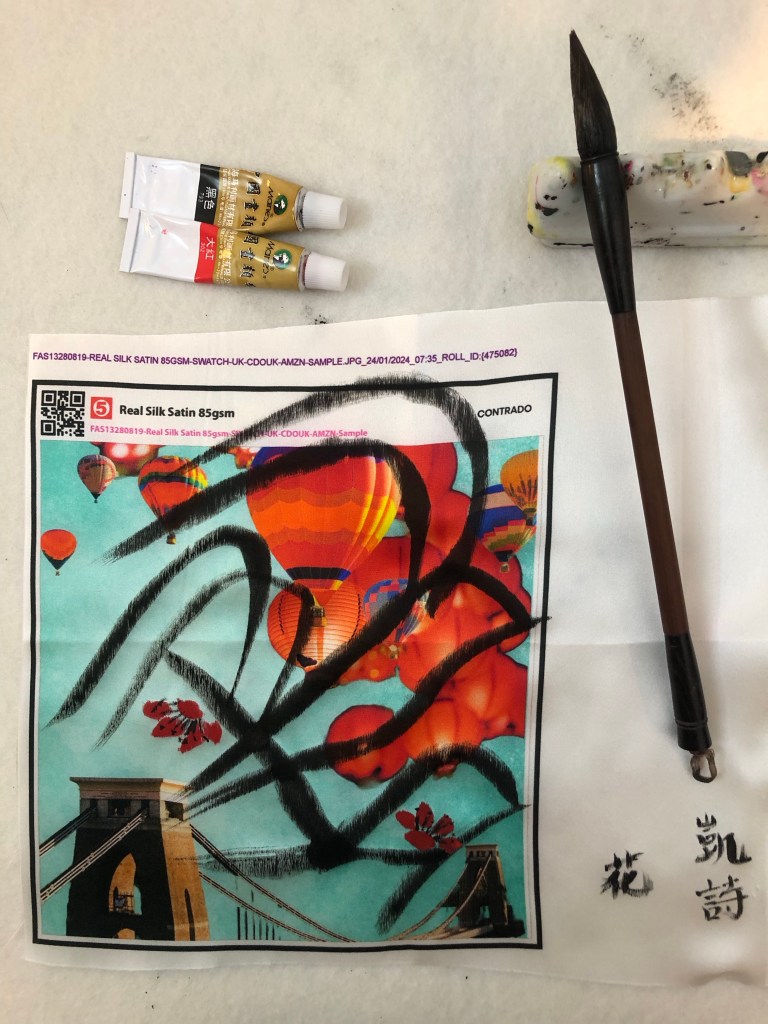
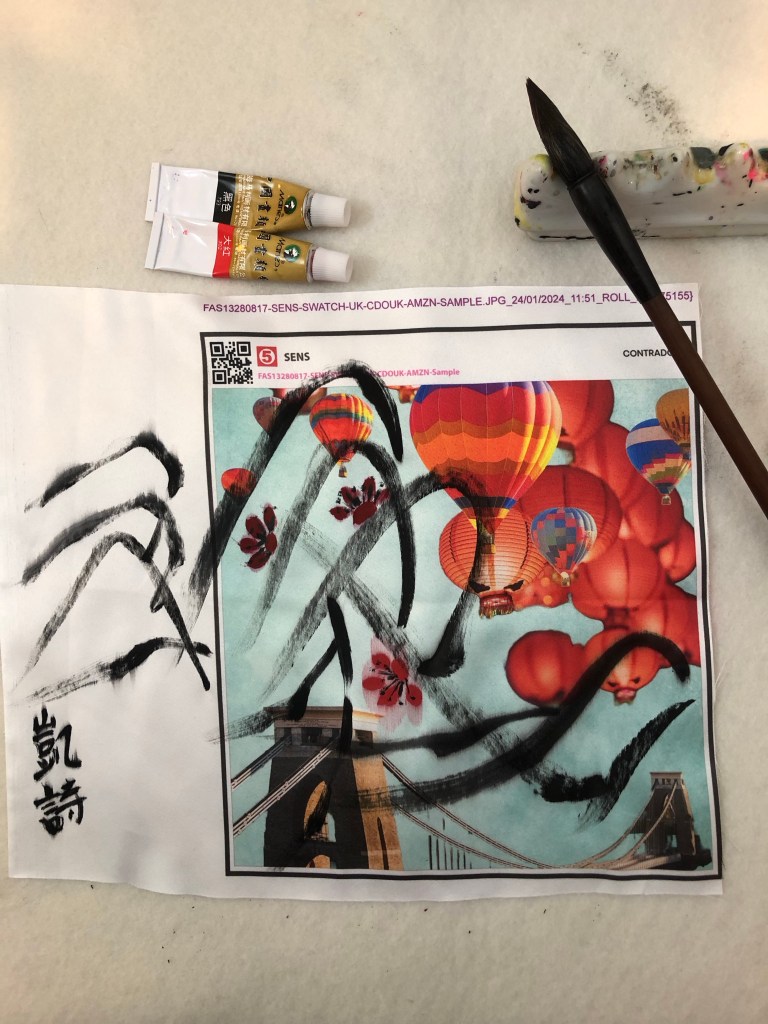
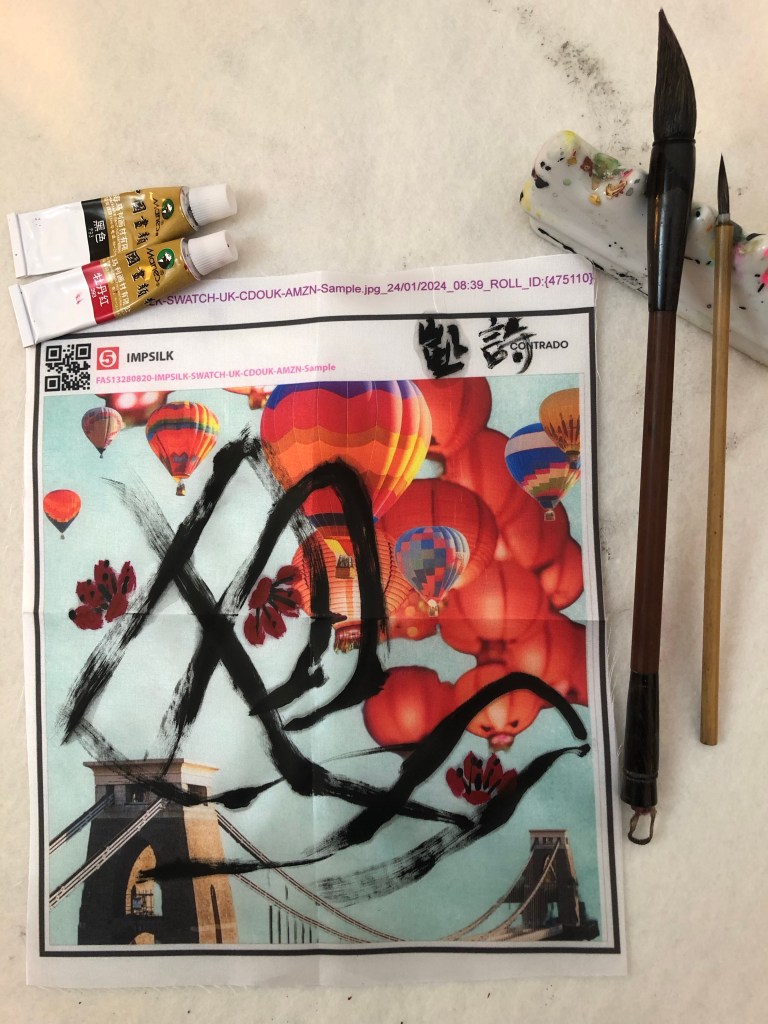
I ordered two poly satin and two natural silk materials. For the first print run experiment, I used a digital collage image that I had created previously and recently updated. One that I hope to use for the MA Interim show if this experiment works. 

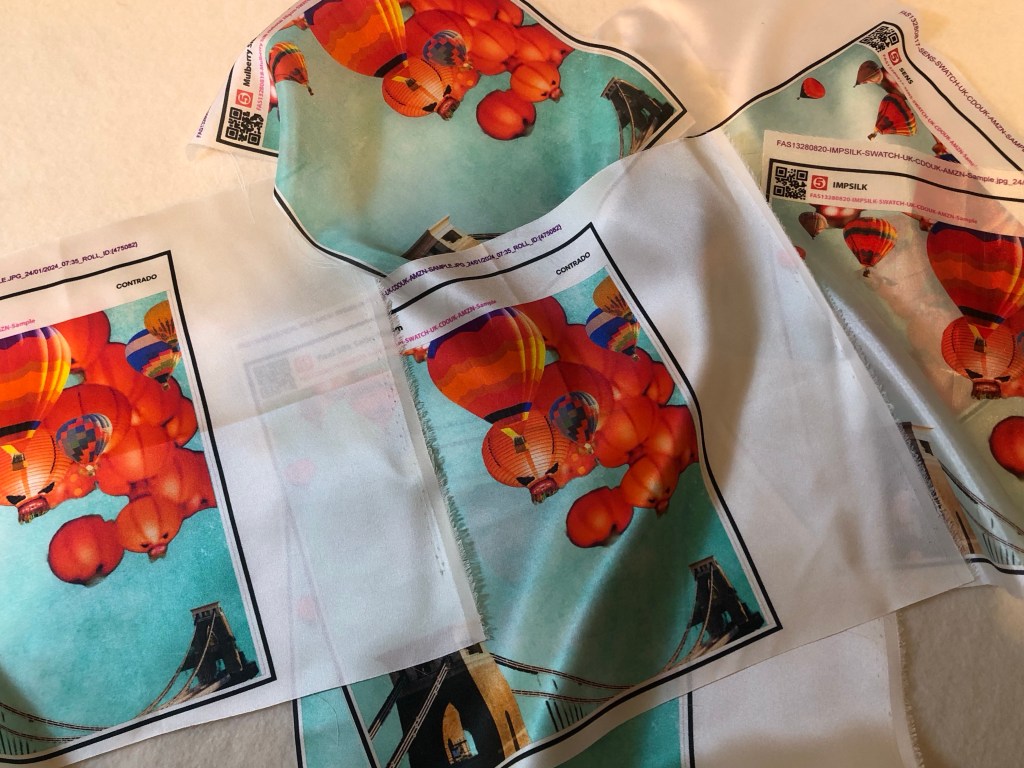
The samples arrived and Contrado gave me a couple of extra prints of one of the materials which was a bonus. They all looked good and useable:

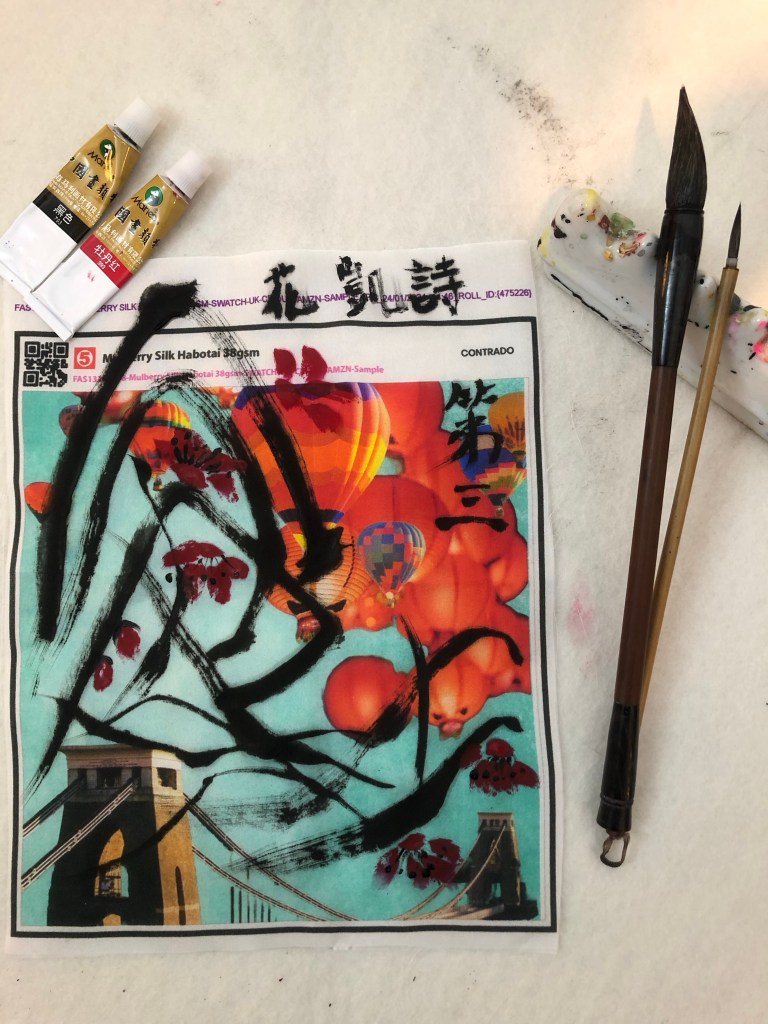
The idea is to do a Chinese brush painting of plum blossoms onto the fabric with the digital printing. The result of each experiment is show below:

Real 100% silk satin 85gsm
Silk sensation (poly) 90 gsm
Silk impression (poly) 41gsm
Mulberry silk Habotai 38gsm

REFLECTIONS

Reflecting on the results – the best outcome for me was the Mulberry silk Habotai 38gsm because:

– The material absorbency was just right. It absorbed the ink and contained the liquid well within the brush stroke. Whereas materials such as the Silk Impression (poly) was overly ‘sensitive’ in terms of absorbency; by this I meant it held onto the pigment but let the water from the ink spread beyond the painted area. This sensitivity would make it challenging to paint on because one has to carefully balance the water and pigment in the ink towards minimising the water which would make the brush flow (or glide) across the fabric difficult.

– The smoothness of the material surface, or fineness of the weave, was excellent. Meaning that the brush strokes did not pick up the weave pattern too much. Whereas Silk Sensation and Real Silk Satin both tended to show the weave too much. This would affect how the ‘flying white’ part of the brush stroke show up. For Flying White effect – see the tail end of the brush strokes in the Mulberry silk experiment where the canvas is partly shown in the stroke. The Flying White technique is important in Chinese brush painting and calligraphy because it shows the dynamism of the brush strokes.

– Area to be careful – the Mulberry silk Habotai material is quite transparent at 38gsm, so need to consider how to hang the final piece. E.g. to let light shine through or not.

LEARNING

– The key learning of the experiment is that Mulberry silk performed best and is the chosen material. I was delighted that I could find a suitable material with Contrado as they seem a good company to work with.

– I also learned a lot about how to analyse the results of Chinese brush painting on fabric – an area that is new to me.

NEXT STEPS

– Decide on the size of the piece to work on for the MA interim show and order the fabric.

– Complete the digital collage using Adobe Express – consider using old family photos.

– Practice painting the plum blossom and decide the final composition to go onto the fabric.

– Research and consider how to hang the piece, especially considering the transparency.

Research notes on the last point:

Ways to hang silk paintings –

http://www.visibleinvisible.com/pages/media/silk-paintings/silk-display.php

How to Hang a Tapestry 8 Ways

MA Y1 U1: Artist research – Njideka Akunyili Crosby

BACKGROUND

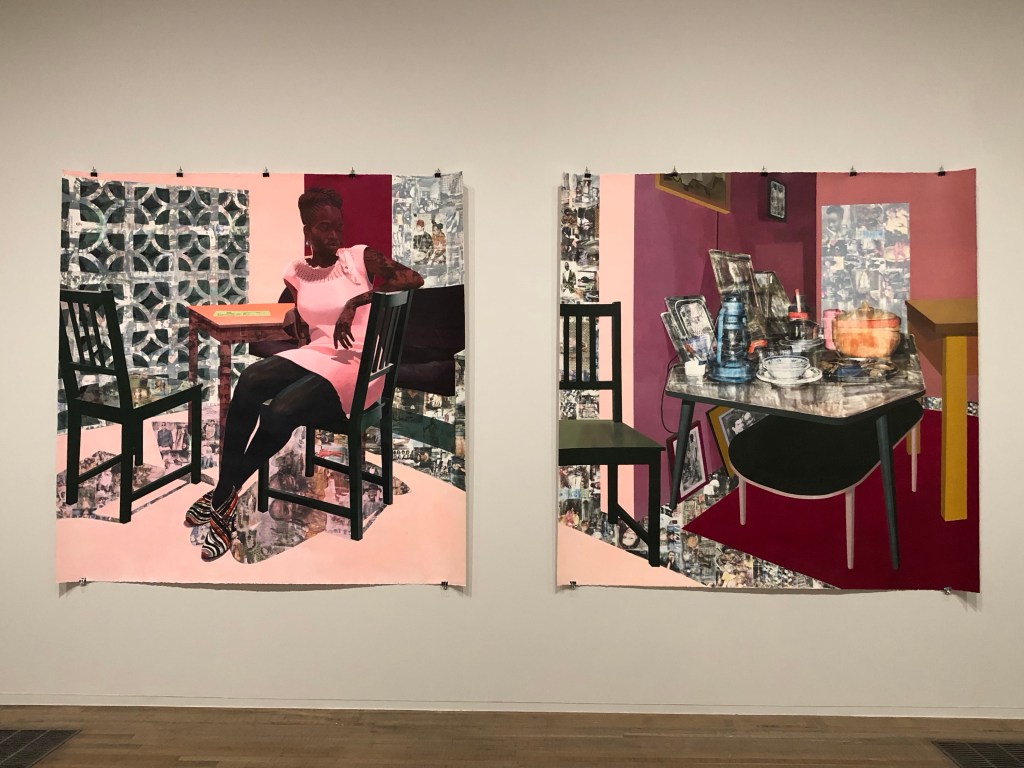
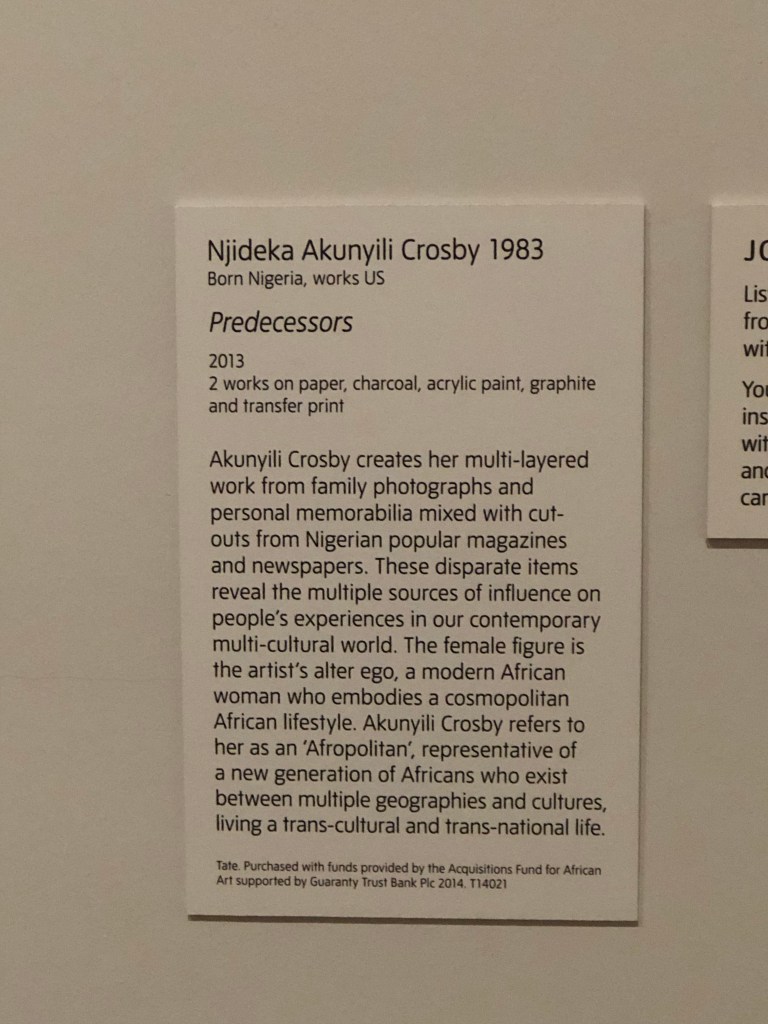
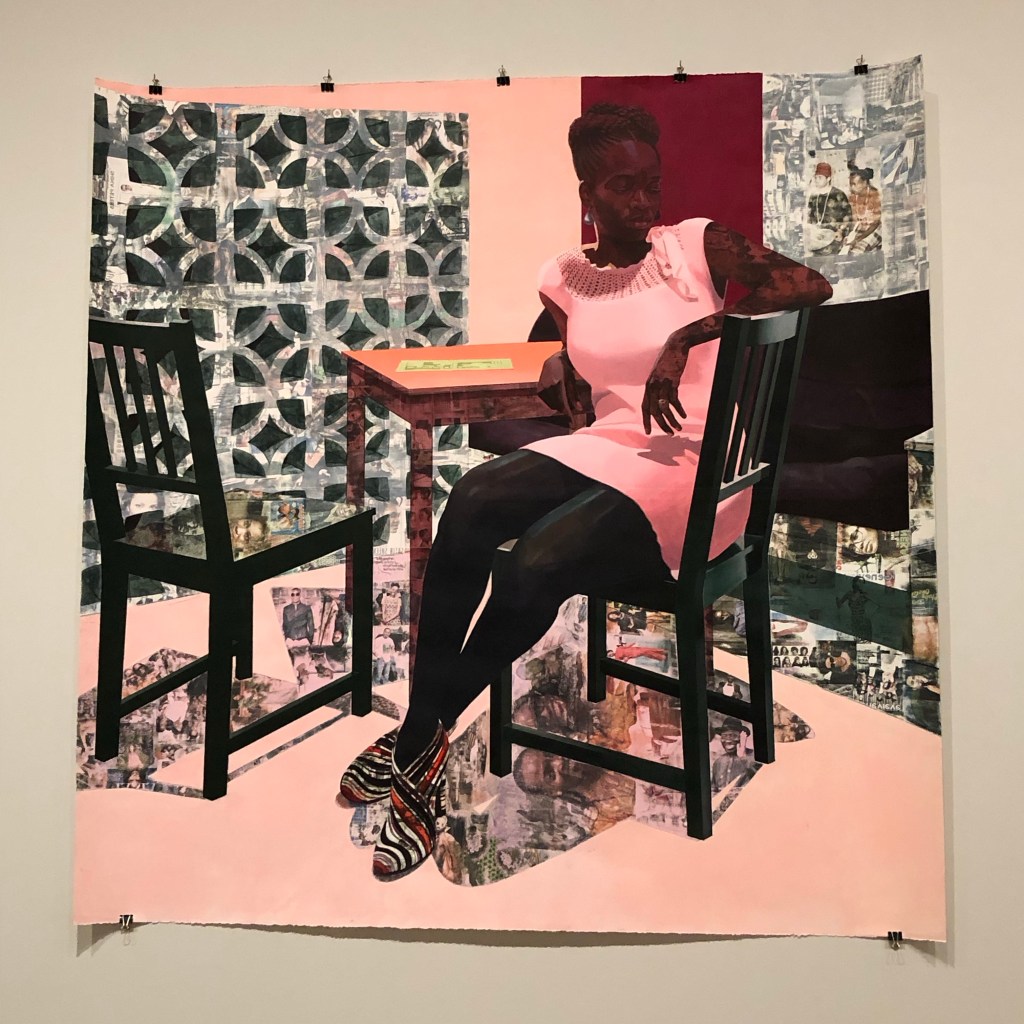
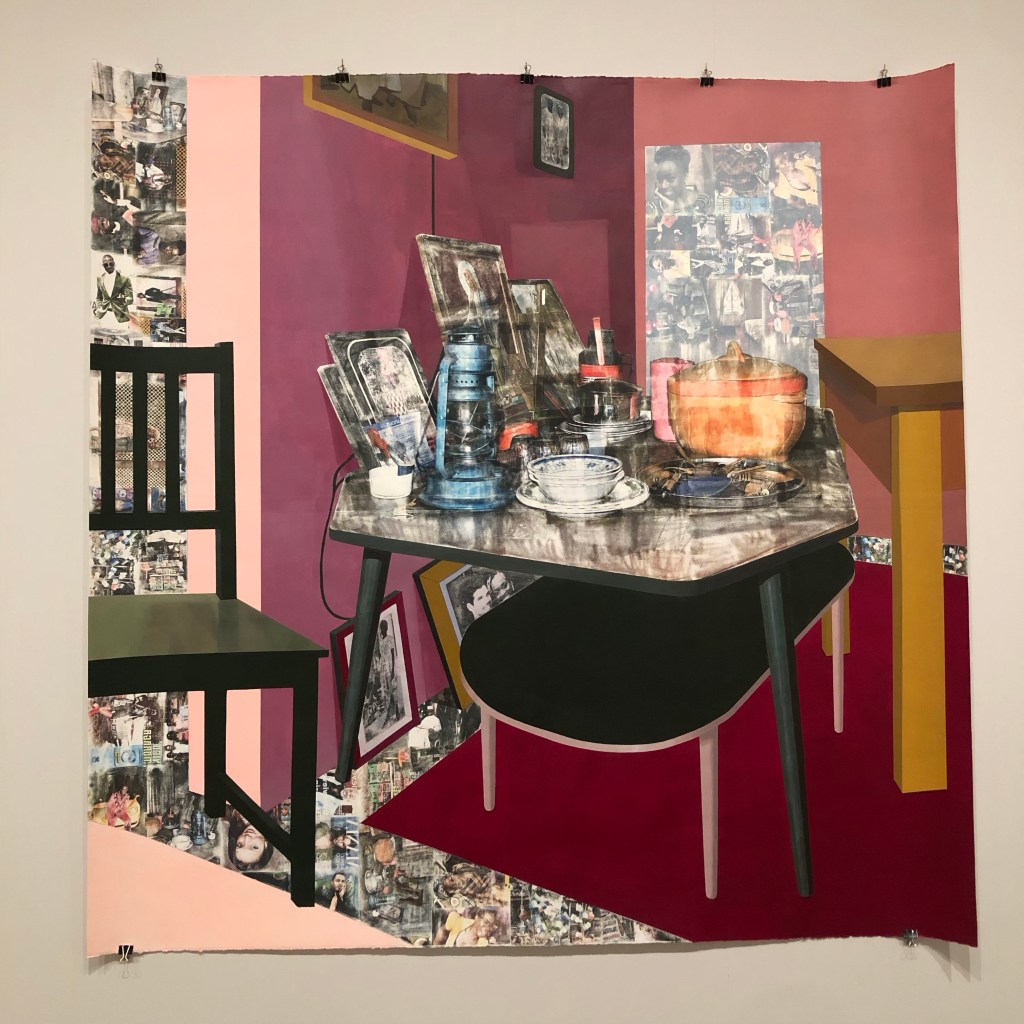
I visited the exhibition ‘Capturing the moment’ at Tate Modern. My main purpose of visiting was to see in person the work by Akunyili Crosby – a transcultural artist that I admire very much and I have learnt a lot from her work as well as her lectures. I have been researching her over the last two years and it was rather emotional seeing her large scale work exhibited at Tate Modern. This is a short blog to record that visit and to capture my feelings at the time.

Visit date: 15th January 2024

REFLECTIONS

My thoughts while analysing the work:

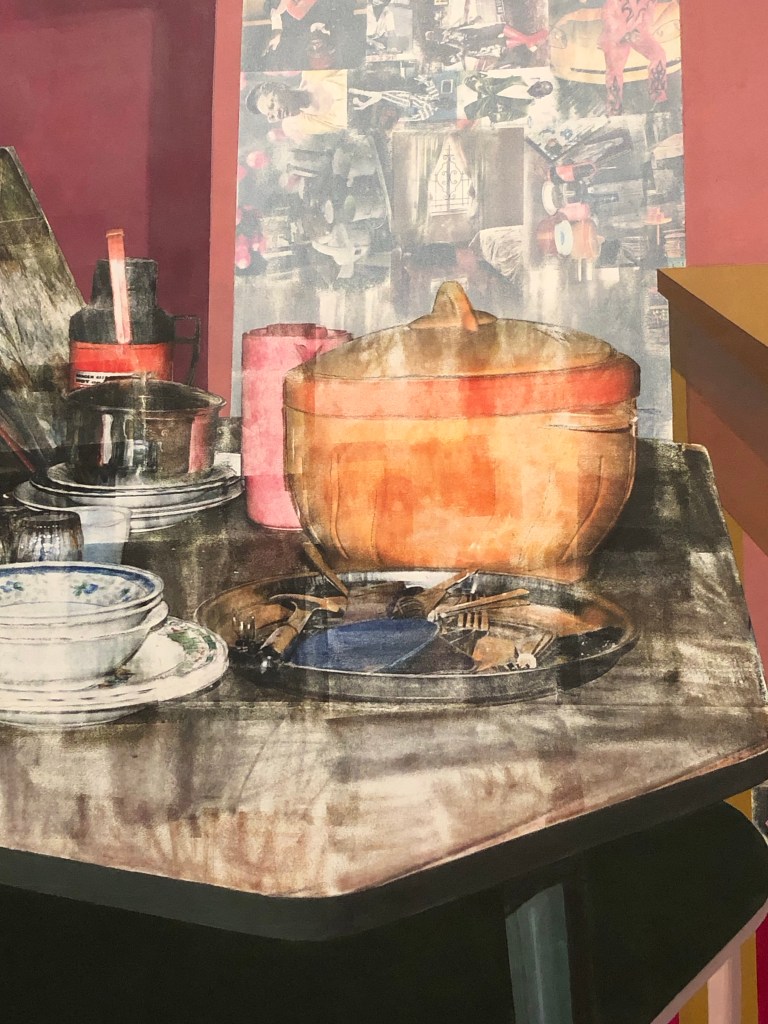
The use of photos denoting memory, mixed with hard-lined pieces of furniture such as the chairs from the reality of today is a good juxtaposition of a journey. Also items on the table with memory significance such as household items (I believe were from her grandmother’s house after the grandmother died), with faded images around photographs. A good metaphor for (fading) memories, journeys travelled and the present time.

My feelings – How do I feel seeing this in person for the first time after researching this artist for two years:

Emotional, overwhelmed, much more impactful than I ever expected, too much to take in, didn’t want to leave.

Size is much bigger than I expected: each piece is around 7ft x 7ft. Painting is on paper – I wouldn’t normally do such a large painting on paper so it was good to see how it could work and I liked the way it was hung – with clips around the edges. No framing or mounting which made the piece feel lively for me.

MA Y1 U1: Developing narrative – Time after time

BACKGROUND

One of the two parallel development strands of my practice is to develop my narrative. It is my intention to maintain complete freedom in my making in this strand. Meaning that I am not going to overthink when making work here. If an idea comes to mind or something comes up and triggers a memory, then I’ll just go with my instinct and make work. I believe that is the best way to develop my narrative and capture as much of my thinking as possible through my art practice. Whereas the other strand of developing my style is a much more structured development path with planned explorations and experiments.

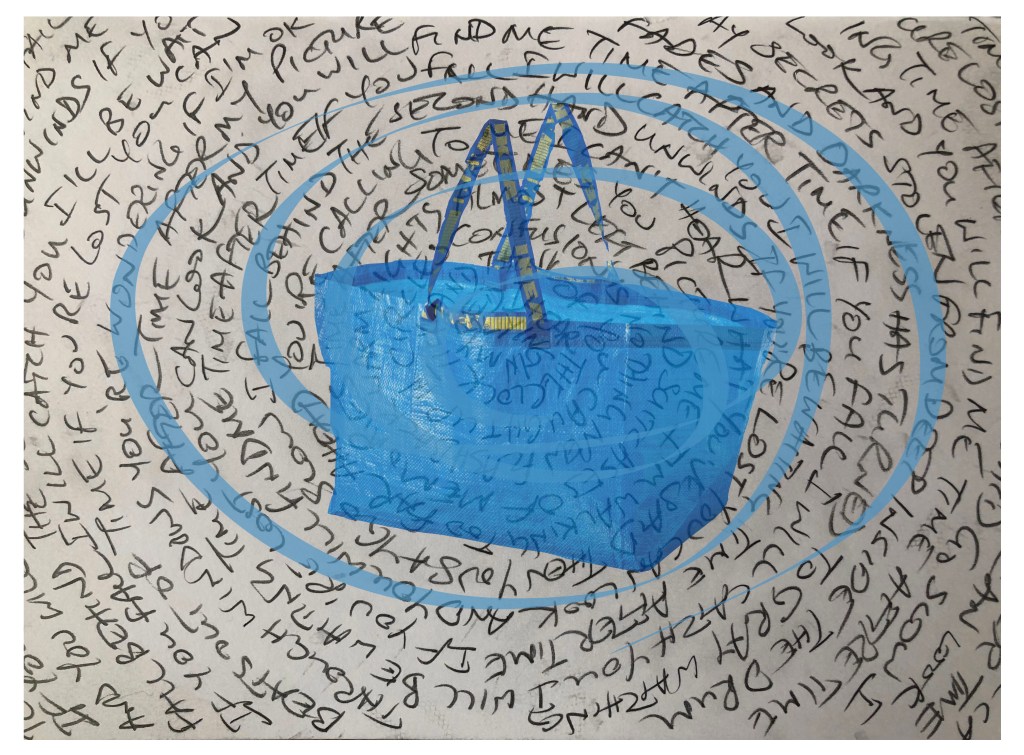
This piece of narrative work came about when I played one of my favourite songs from the 80s – Time after time by Cyndi Lauper. The song has always resonated with me. Its meaning is explained very well on this website:

https://neonmusic.co.uk/time-after-time-by-cyndi-lauper-a-deep-dive-into-a-timeless-classic/

The website describes this song as treading a fine line between hope and despair making it relatable.

This piece of work is a quick capture of an idea using my sketchbook and a digital drawing tool. This kind of work will form an ideas bank when I may come back to at a later stage to make more substantial work from.

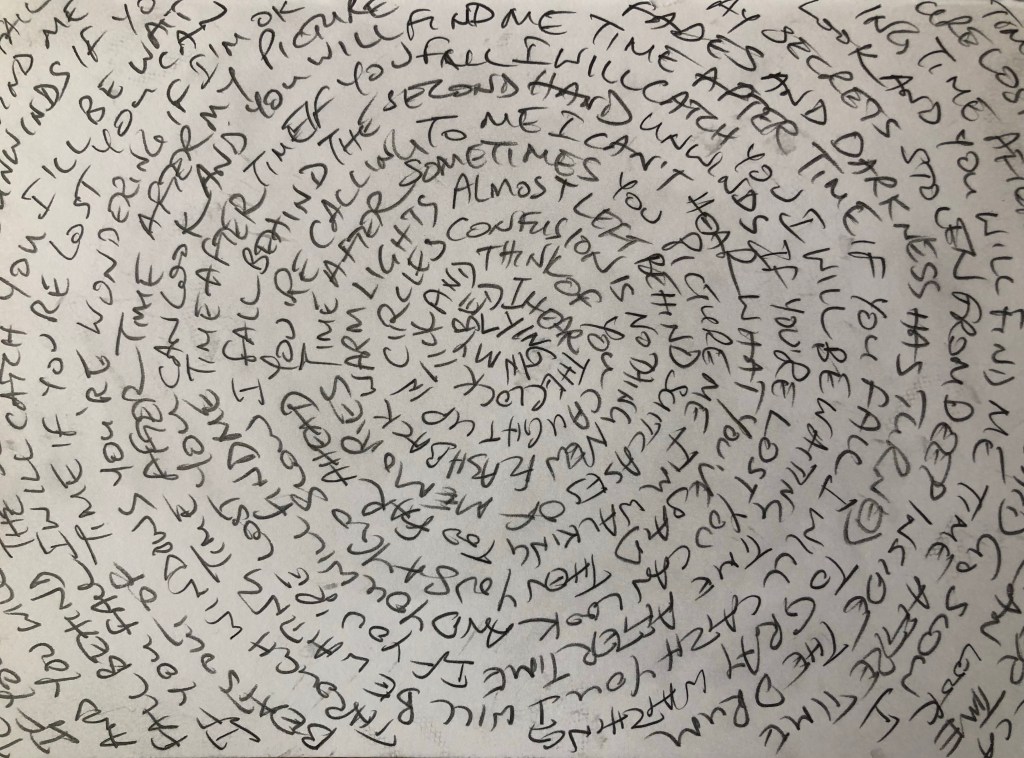
Finished ‘quick capture’ work:

METHOD

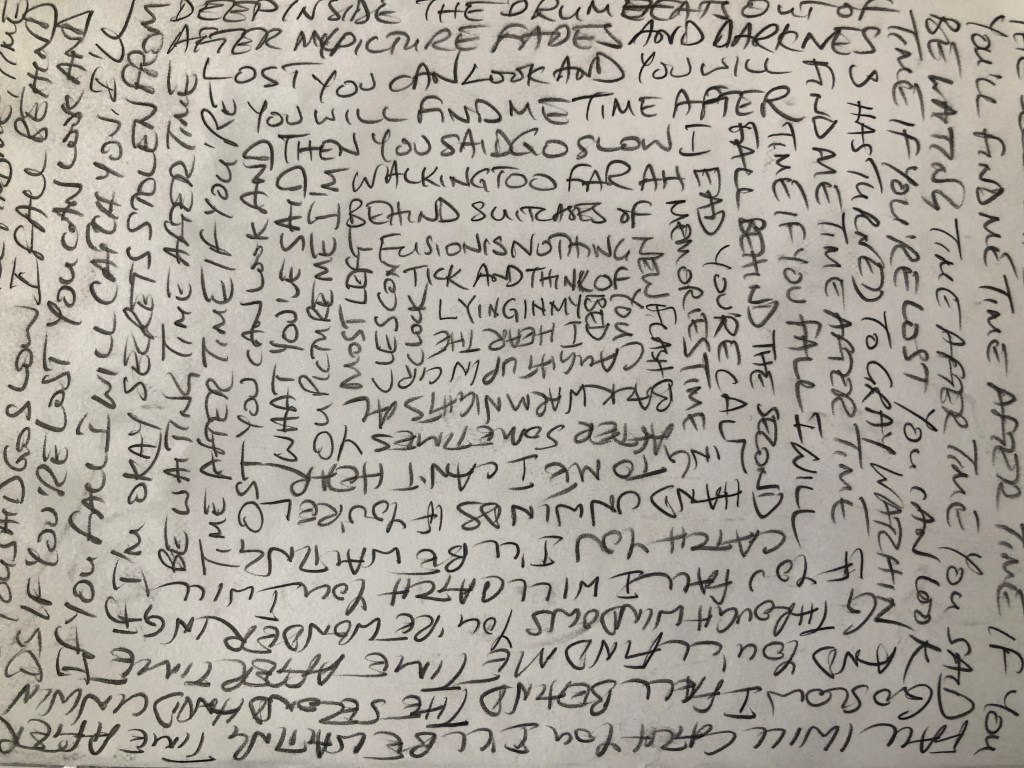
I felt compelled to write down the lyrics, it was a way to experience the lyrics. I wanted to write in a circular way to echo the time clock mentioned in the song. I experimented with two versions, one to fit the rectangular page of the sketchbook and another in a circle.

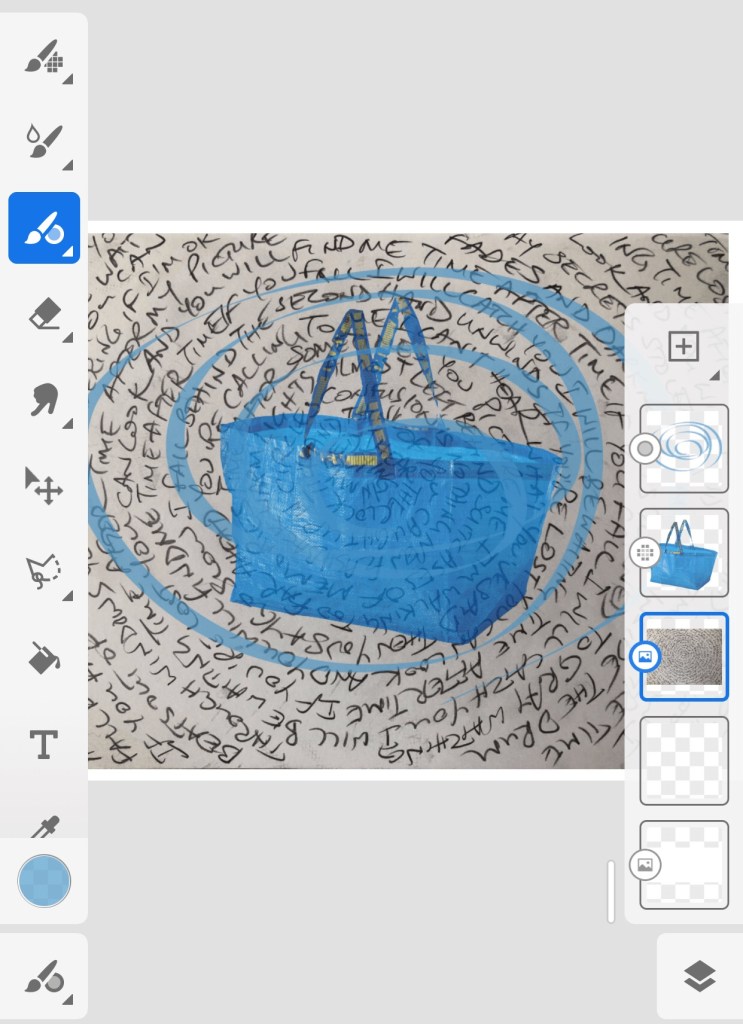
I preferred the circular version hence that image was chosen. A photo of that sketchbook page was imported into Adobe Fresco as the background of the piece. I wanted to overlay it with an image that represented the sense of moving from one place to another. I decided to use a blue IKEA bag which today symbolises moving one’s possessions around making it a contemporary and iconic image. Then a blue swirl was added using the Fresco digital paintbrush to represent the cyclical nature of my constantly moving around during that period of my life. Different parameter settings were tried for the Fresco paintbrush.

The image below shows the layers I created in Adobe Fresco for the finished work:

REFLECTIONS

– Considering the process: This was a more informal way of making compared to my usual work. I liked it as I was able to capture my thoughts quickly. Then the digital Fresco tool enabled me to capture the idea quickly to come up with the finished work. In the past, I would have drawn or painted the IKEA bag which would have taken time and perhaps if I didn’t like the idea part way through then I would have felt bad about abandoning the work. I am still getting to grips with tools like Fresco and it’s a good way to capture an idea and I may well come back to work on this more at a later stage – either to build on it digitally or create a physical painting from the idea.

– Considering my narrative: I struggled with this one. Digging deeper can be scary as it makes one feel vulnerable or remember periods of vulnerability. When this song was on the chart, I was moving between boarding schools and temporary lodgings during the holidays. I didn’t go home to my family during holidays, just because. So seeing Lauper (in the music video) going back to her Mum’s in times of troubles (in her case a heartbreak) was heart warming but perhaps heart warming was not the most accurate phrase, it seems insufficient. I recently learnt a Welsh word ‘hiraeth’ – it means a deep longing or nostalgia for something lost or departed. I wonder if I could extend it to include longing for something that one didn’t have. Hiraeth doesn’t have an equivalent English word (according to google search and the person who introduced the word to me who was a linguistic academic). I like the word hiraeth and it fits my narrative here more than any other word I could think of.

– A further thought about the use of language… when the word ‘hiraeth’ was introduced to me (by a UAL tutor), we discussed how languages can influence how we think because we can only think or describe things such as our feelings in words that we know. This made me think about the impact of the soft power of colonialism where the coloniser brought their language to the colonised and in many cases replaced the native language completely. What part of the native culture has been wiped out and lost as a result? ‘Hiraeth’ is a good example because Wales is part of the UK and English is the language spoken in most parts of Wales nowadays as the dominant language. Yet such a powerful and useful Welsh word has no equivalent in English.

LEARNING

– Using Fresco has really helped me to develop ideas quickly, especially experimenting with the different paint brush parameters was helpful. I must use this tool more.

– One of my objectives for developing my narrative is to capture as many of my stories as possible as input to my main making process. Since I’m a fairly slow maker when making physically, I am pleased to have discovered this digital tool as a quick capture tool but yet enabling me to finish the piece to a more complete state than say a traditional sketchbook drawing. It was particularly useful that in this case I could incorporate my sketchbook work as part of the piece.

– An increasing understanding of my new word ‘hiraeth’.

– For my personal narrative development, I need to have more courage in my exploration. Music has always been a good catalyst for stories, I need to explore that more.

– For a wider narrative development, more thinking and research are required in the impact of language as a colonial soft power. What words can I think of in Chinese where there are no English equivalents? E.g. words to describe food and tastes since the food culture is so different?

NEXT STEPS

– Continue to use Fresco to quickly and informally make work. Capture as many stories as possible as a key objective for developing my practice.

– Consider other pieces of music as catalyst or memory triggers for my stories.

– Research more about words that I know and feel strongly about but have no English equivalent to see if it would help me to delve deeper in my narrative.

MA Y1 U1 Exhibition visit: Spike island – Ofelia Rodriguez

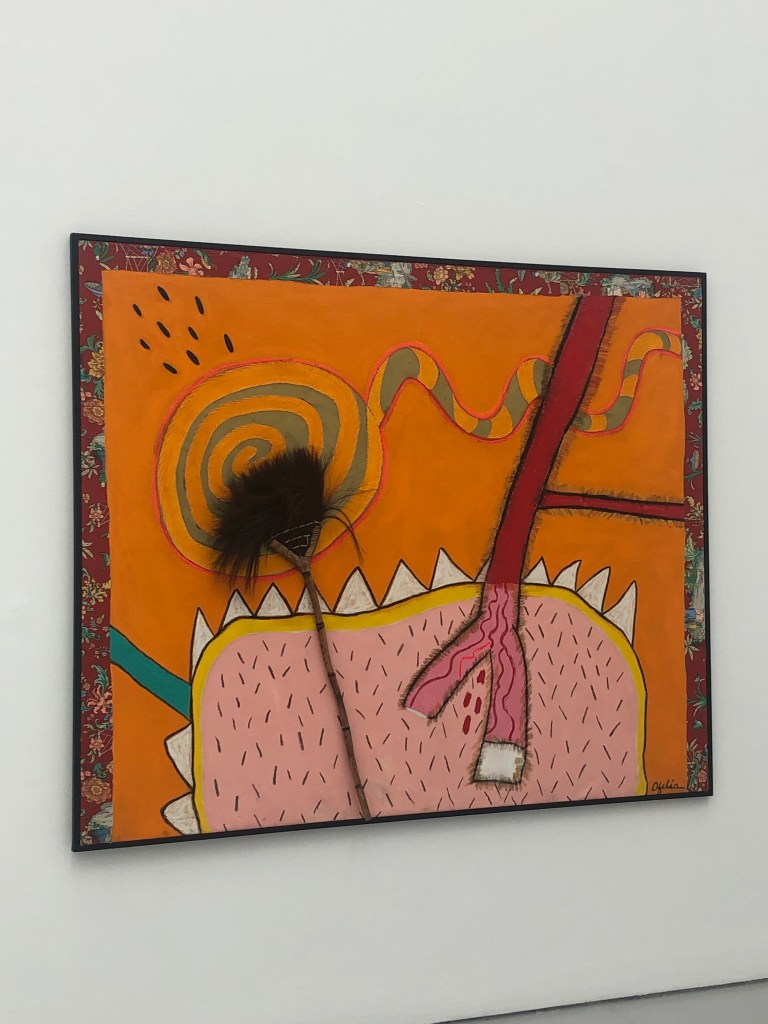
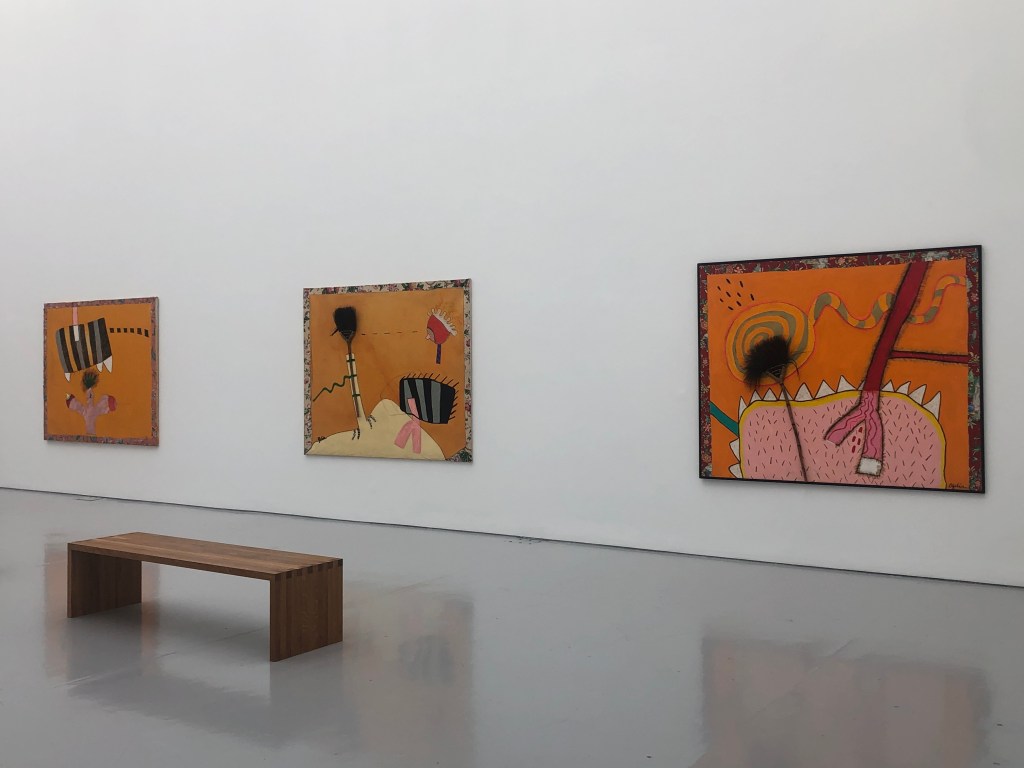
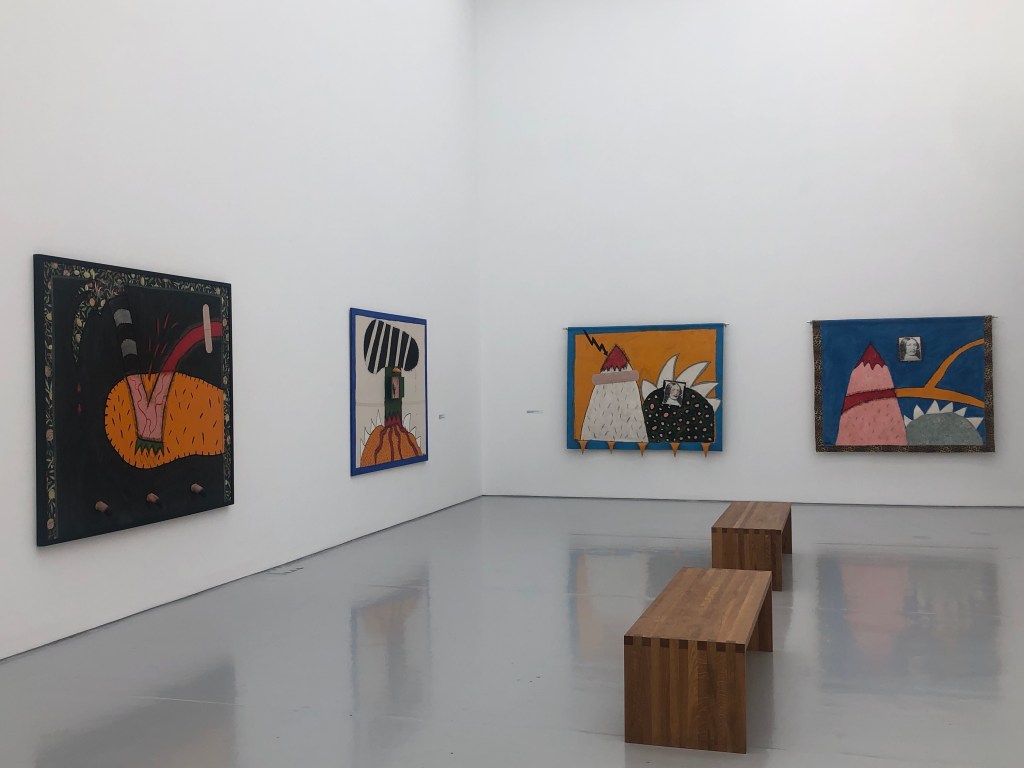
This is my second visit to this exhibition and it was a guided tour by the curator. Below are the informal notes I took on the tour. I also noted some points for personal reflection and a question I posed myself to help my search for a unique transcultural style for my practice.

Notes made during tour:

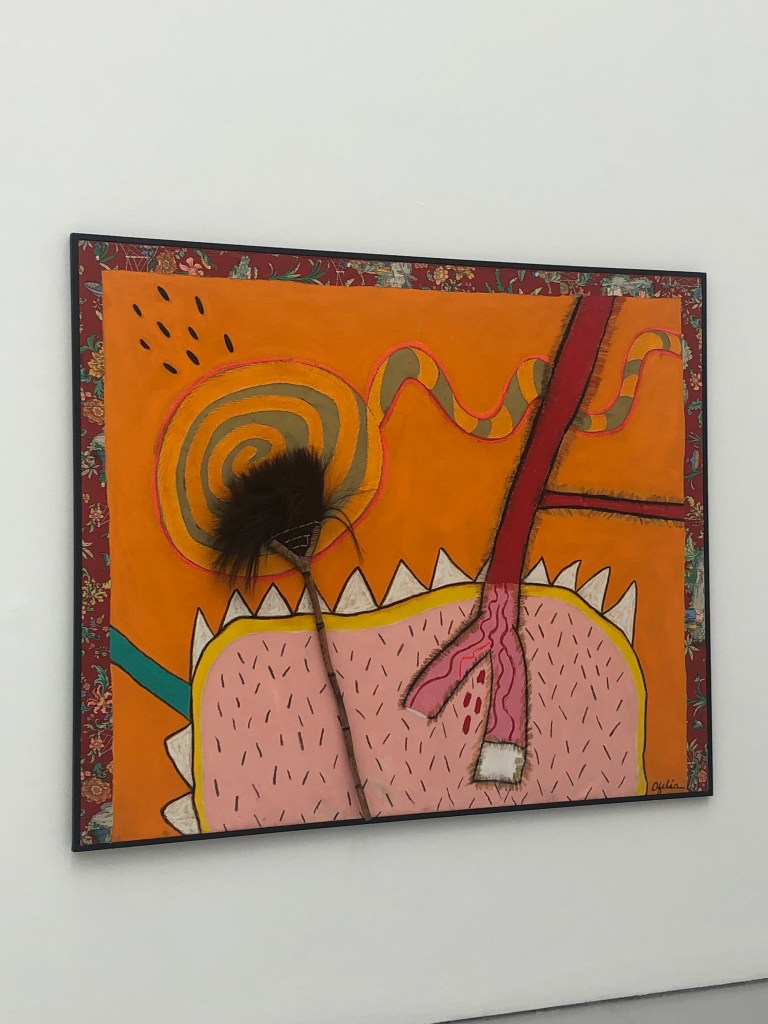
Despite using textiles and stitching for her work, she hated sewing.

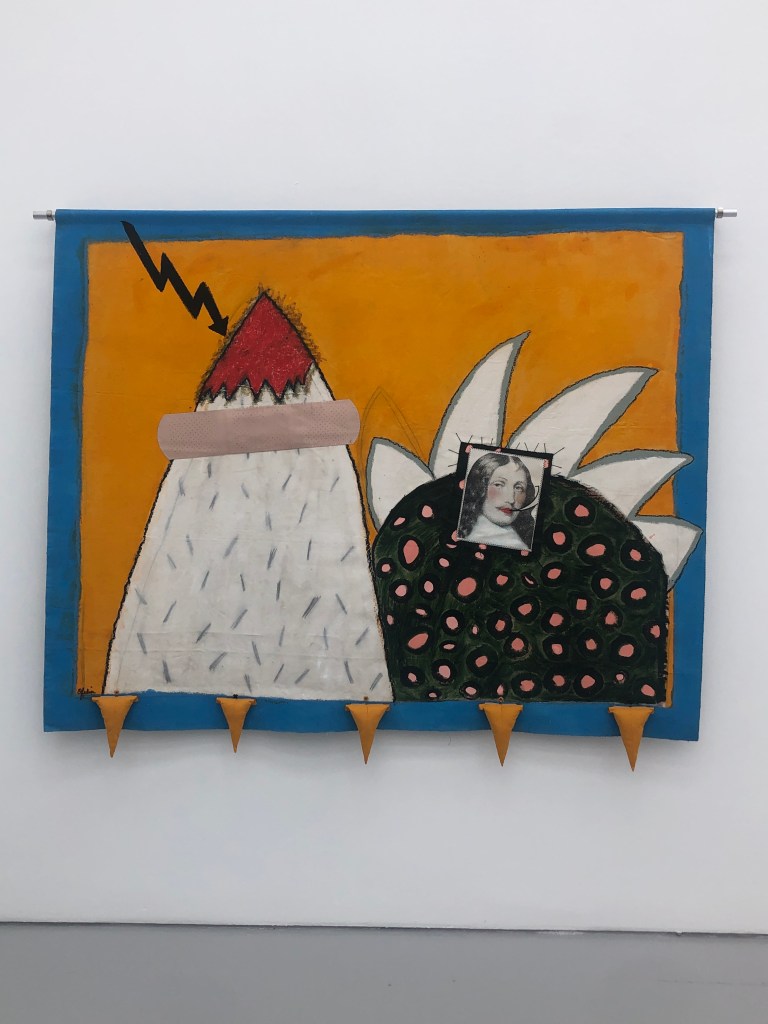
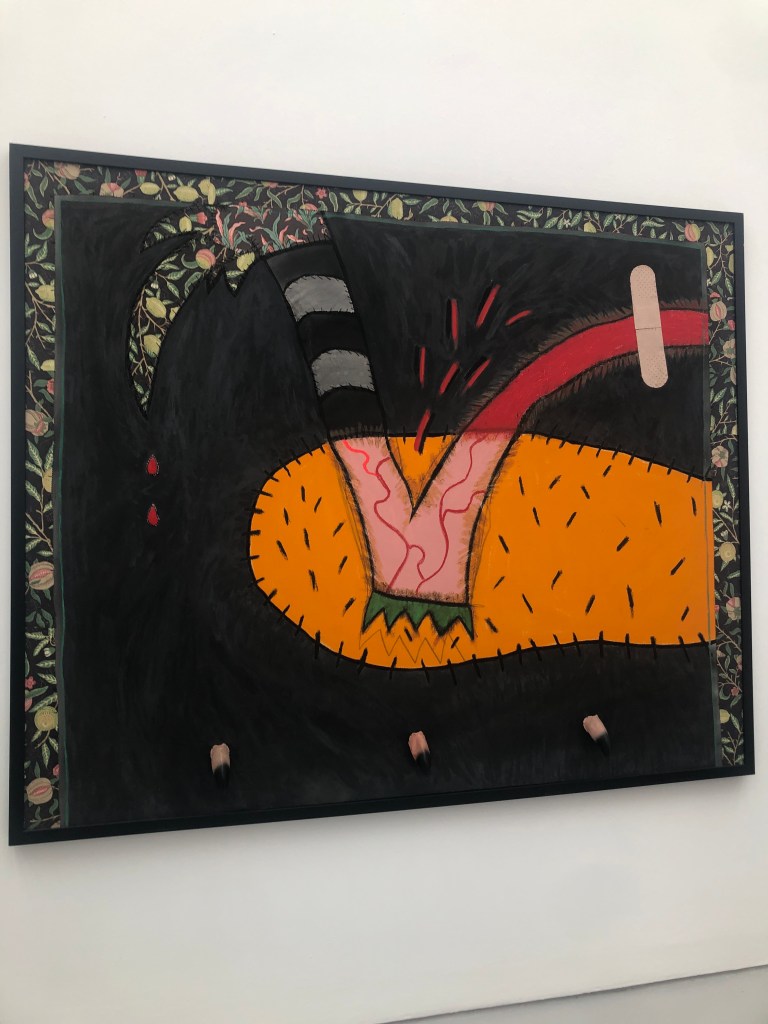
Landscape as a hostile environment. Threatening to nature:

Use trim of fabric to give cultural content (like this, note – to use for my work).

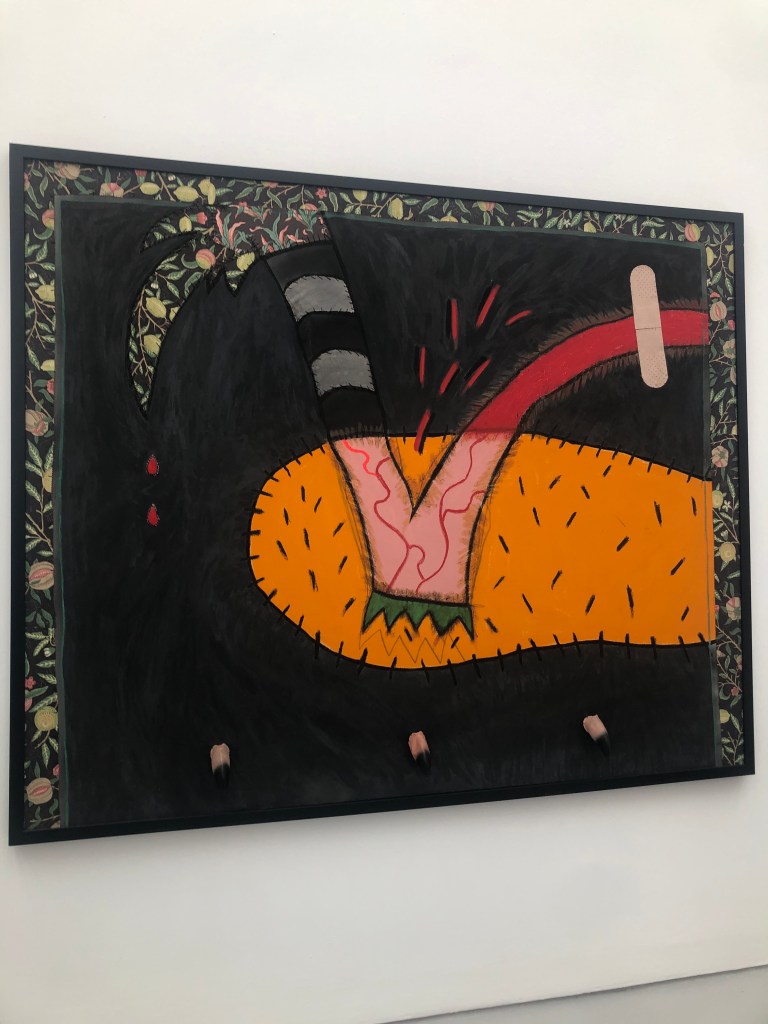
Plaster for healing. Landscape suffered violence. (Like the use of plaster, resonates with me.)

Above work has plaster also. The photo was a found image of a western morality philosopher from 17th-18th century. It was a photo she found in Times magazine and she felt the irony for the damage that had been done to the world.

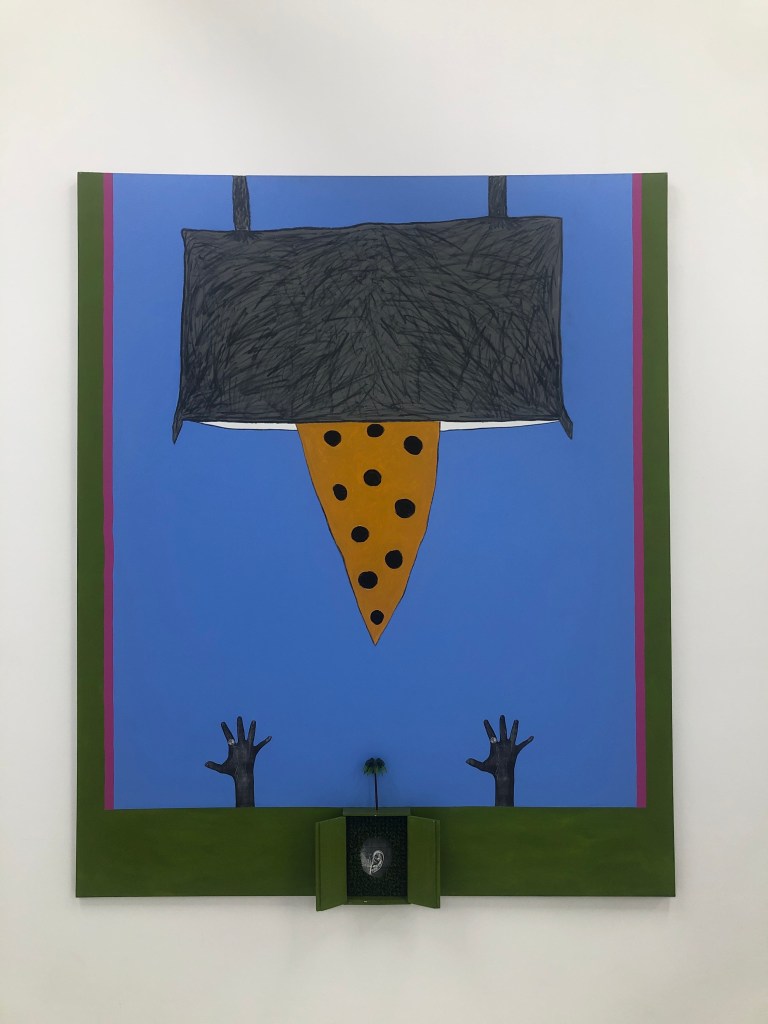
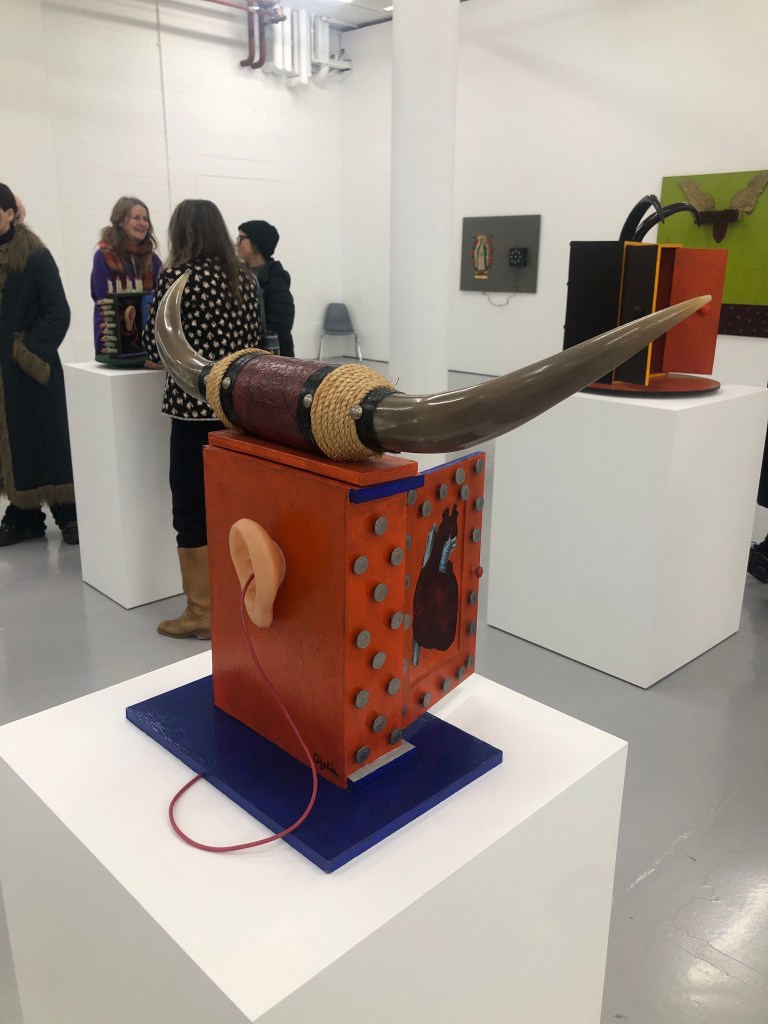
Then her work changed to flatter colours. Started to bring in her hands (holding onto something) and ears:

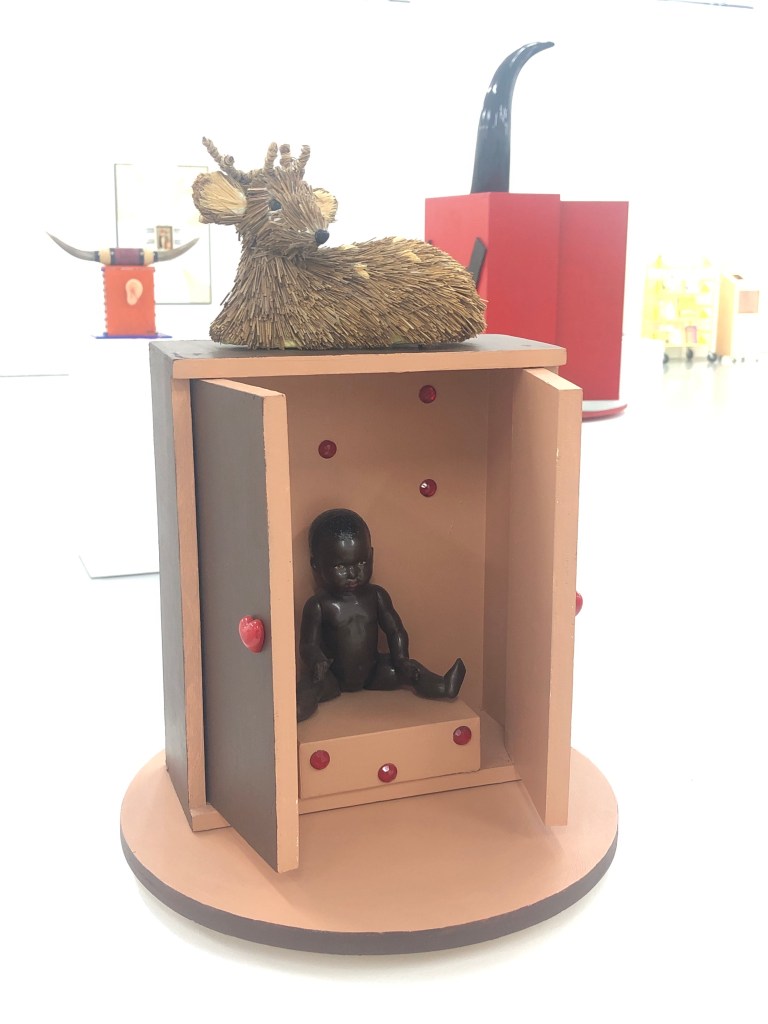
Above is a surrealist box. Note – like the idea of using a box to tell stories. Could use HK letter boxes with family photos. I can write letters or just have an envelope addressed to my family.

Idea – use my hand as image to reach out to my brother’s hand and tea in a piece of work that I had done recently.

Idea – use biology picture of heart, to take out the emotions of a symbolic ‘red heart’. A biological heart is symbolic for me.

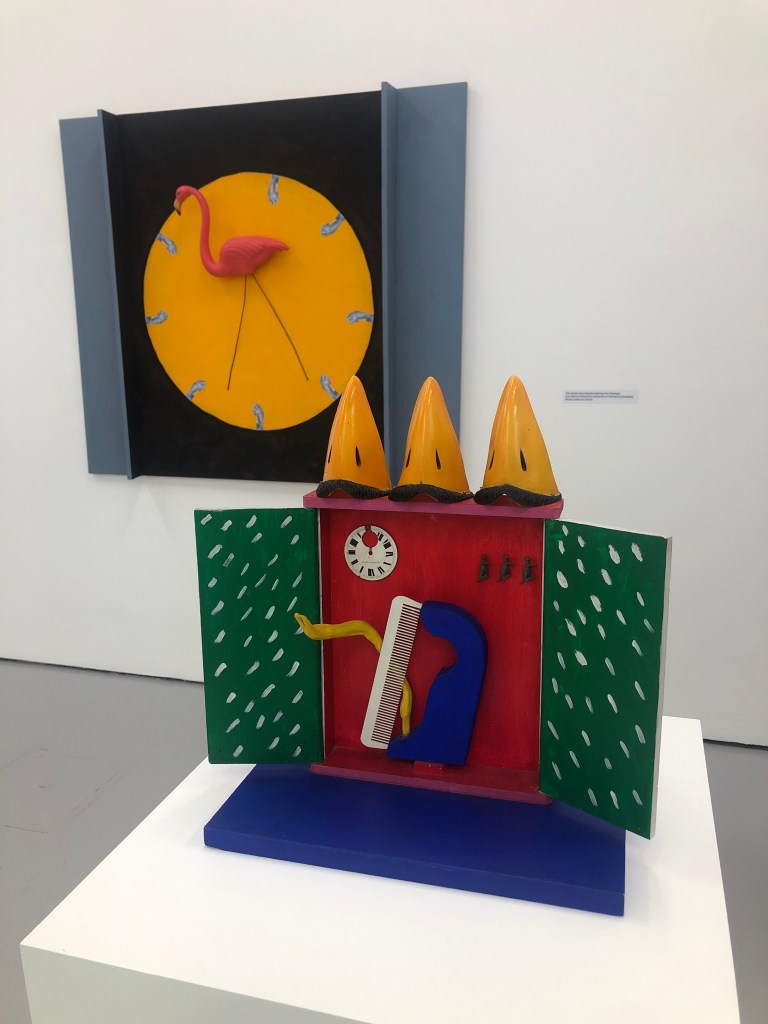
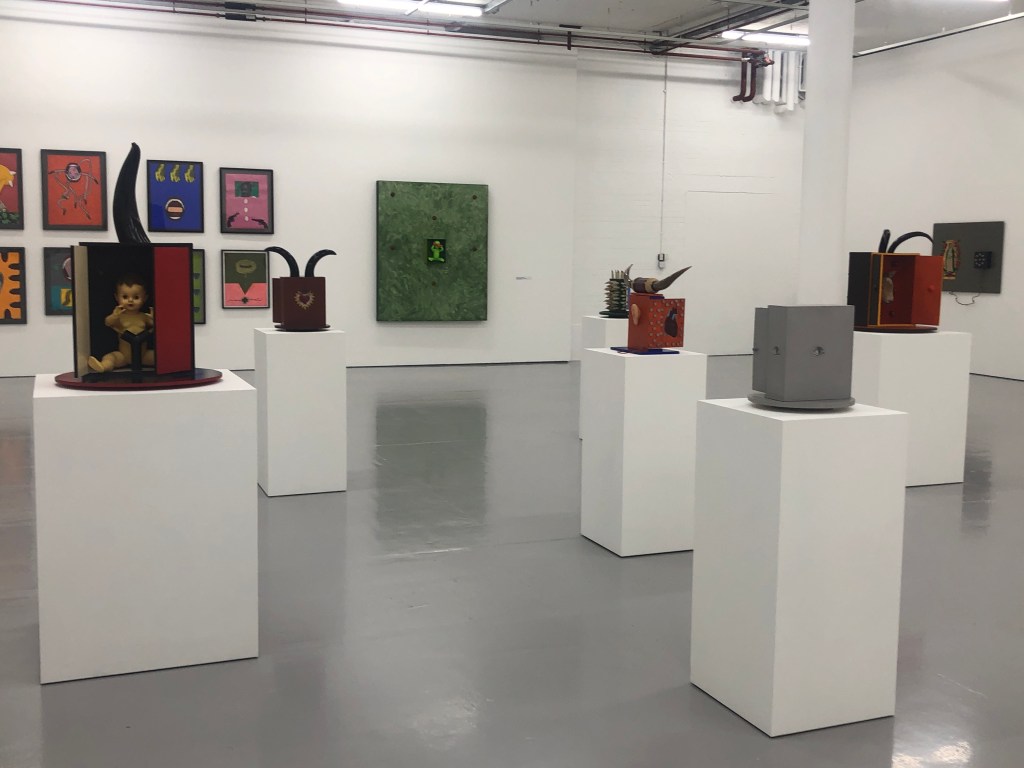
Boxes:

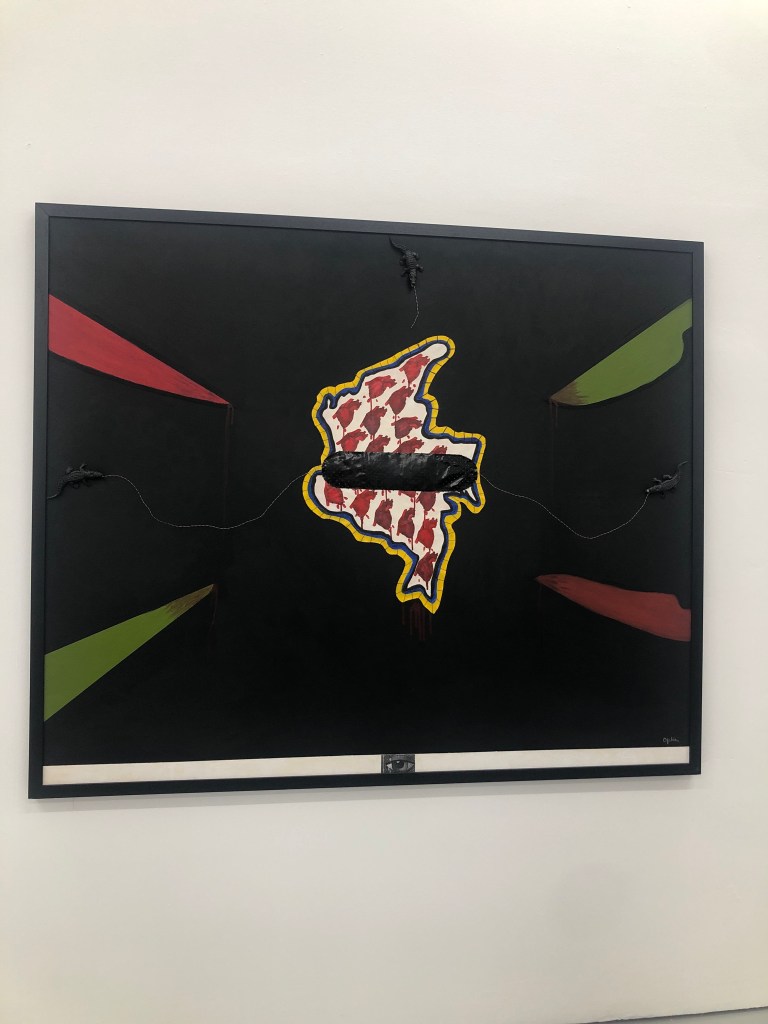
More plaster denoting healing wound in the violence in Latin America. Columbia being attacked, with God’s watchful eye (at the bottom). Bleeding heart is used a lot in her work:

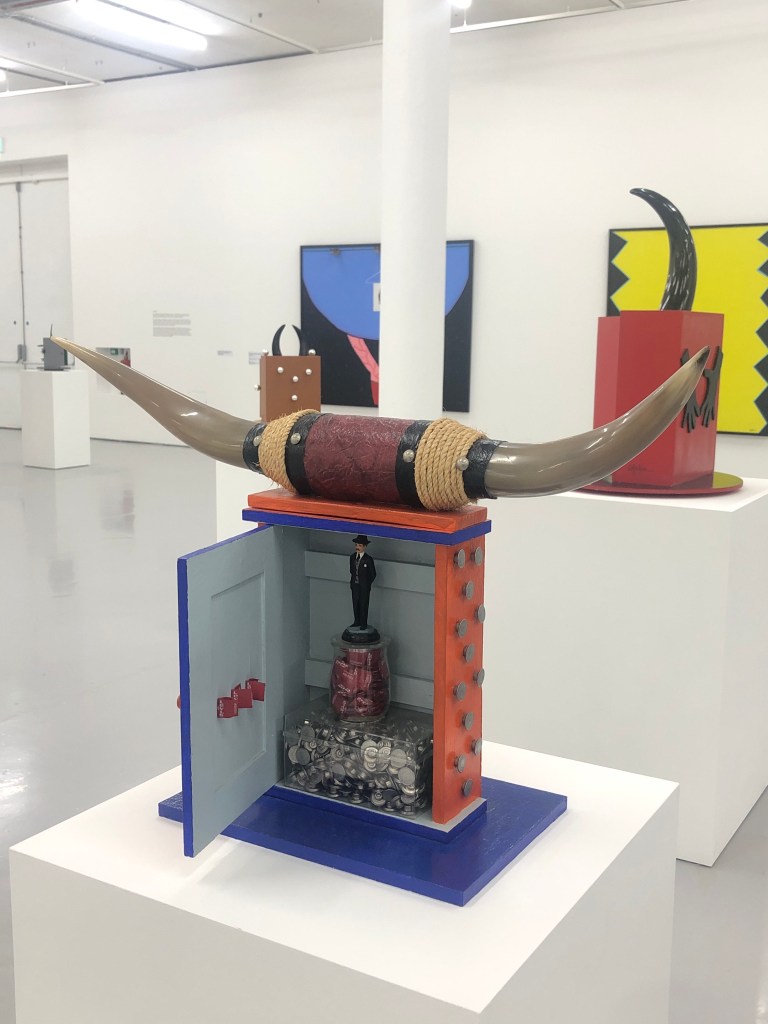
Boxes bringing objects together trying to provoke conversation, with objects found in street market:

Boxes are like shrines or alters.

REFLECTIONS – some captured within notes.

Question: (to be answered)

What makes her style her style? Look at this series of work and analyse the elements that make her style unique and recognisable, then think how those points would apply to my style development.

Further notes:

All her work was about memory then she had dementia. It was like she knew…

MA Y1 U1: Exploring media – Oil and cold wax – Part 6

BACKGROUND

I want to use this experiment to explore the Next Steps that were identified in Exploring Media – Oil and Cold Wax Part 5.

https://eliza-rawlings.com/2023/12/24/ma-y1-u1-exploring-oil-and-cold-wax-part-5/

The actions were to:

-Try out more Chinese brush paint collage onto oil and cold wax to refine this part of the process.

-Try exposing a larger area of the background image to see if that can work with the abstraction approach on the top layer. Experiment to find the right balance between revealing the base layer image without losing the sense of abstraction on the top layer.

-Try spray painting on top of the oil and cold wax surface – try when wet and then when dried.

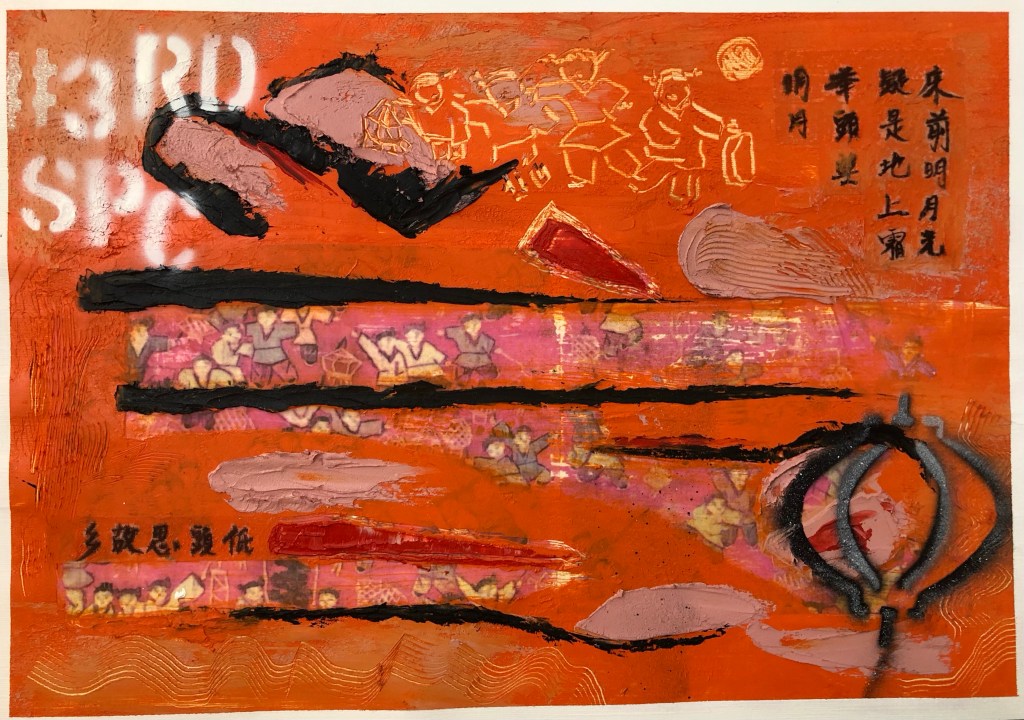
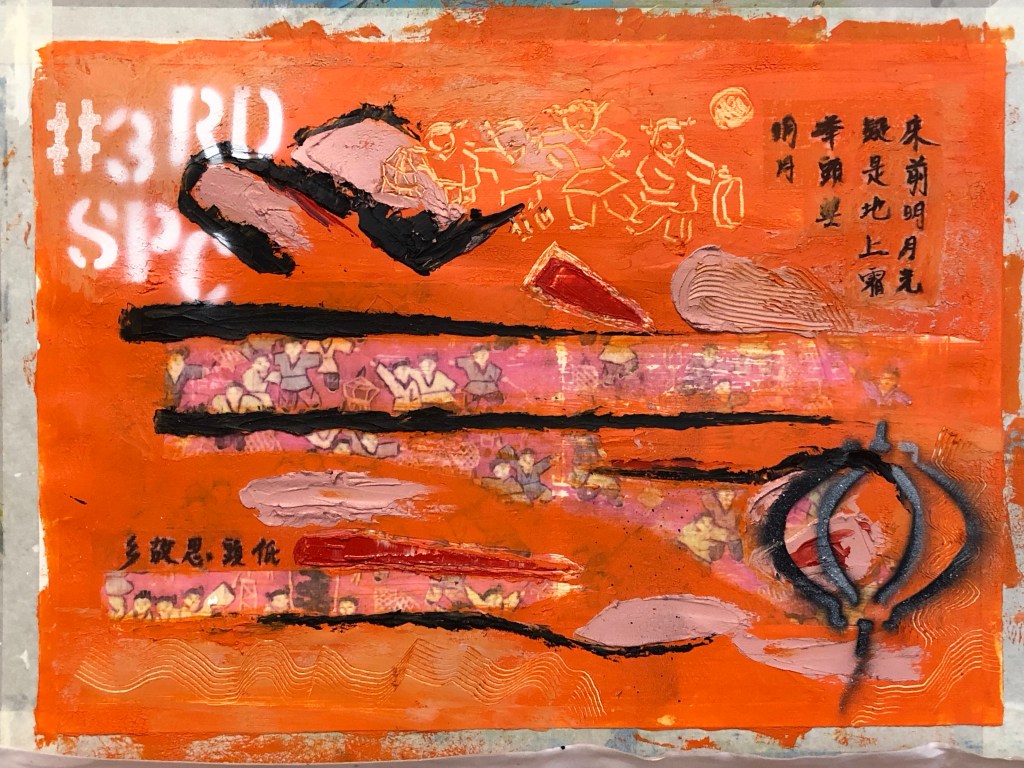
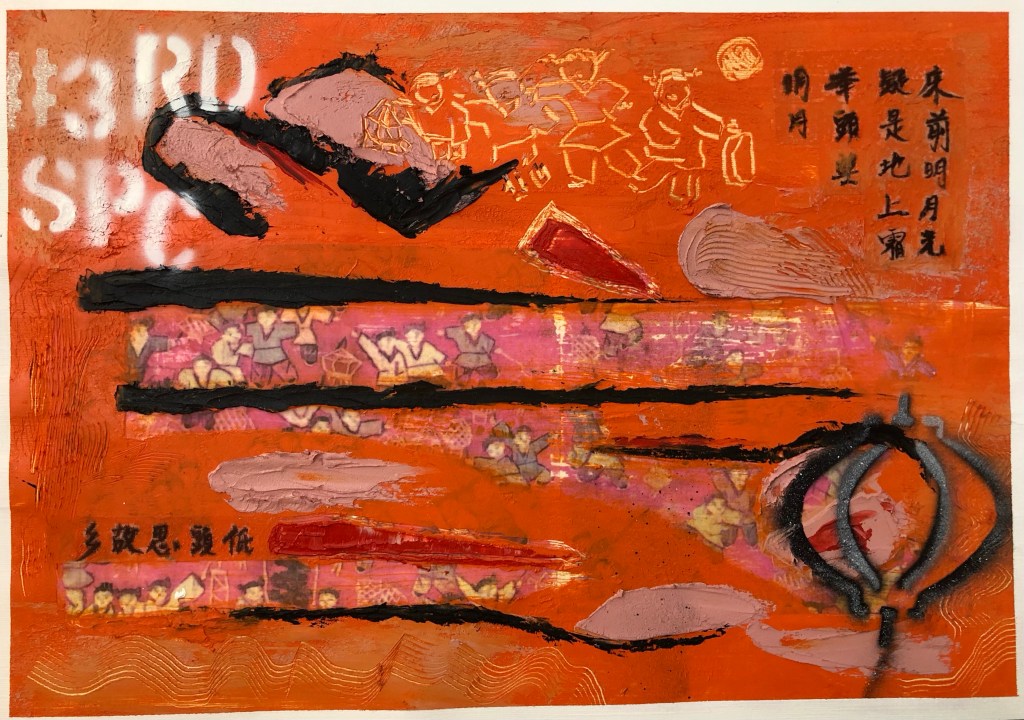
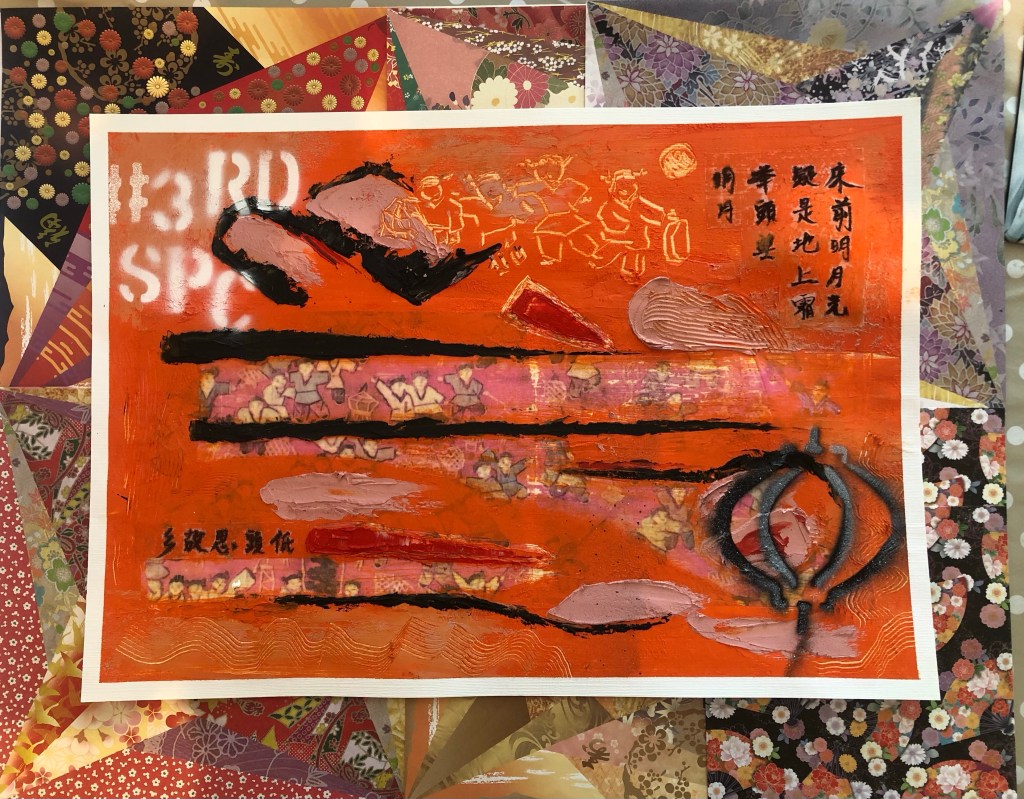
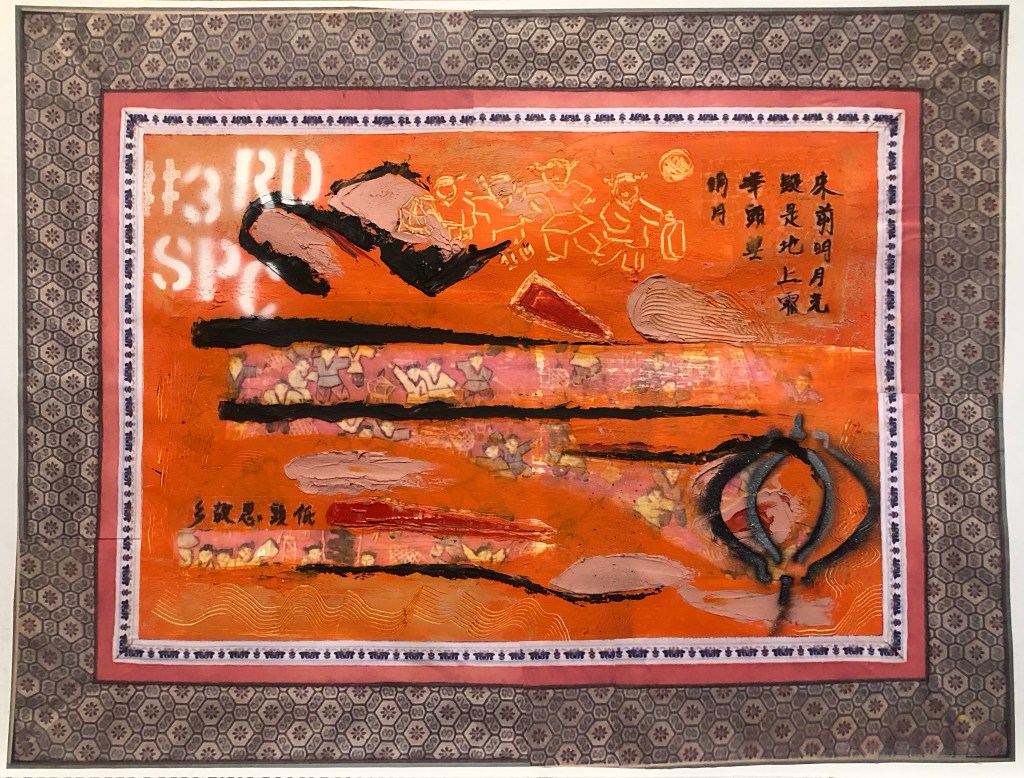
Finished work for Part 6:

Mixed media on paper, A3

METHOD

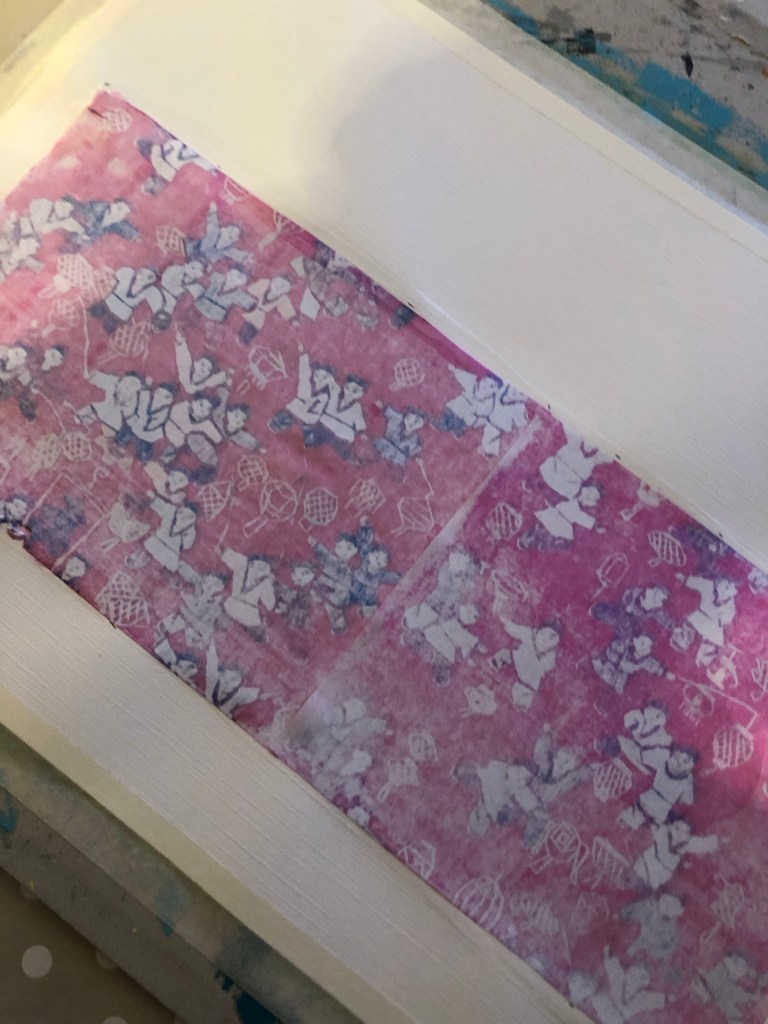
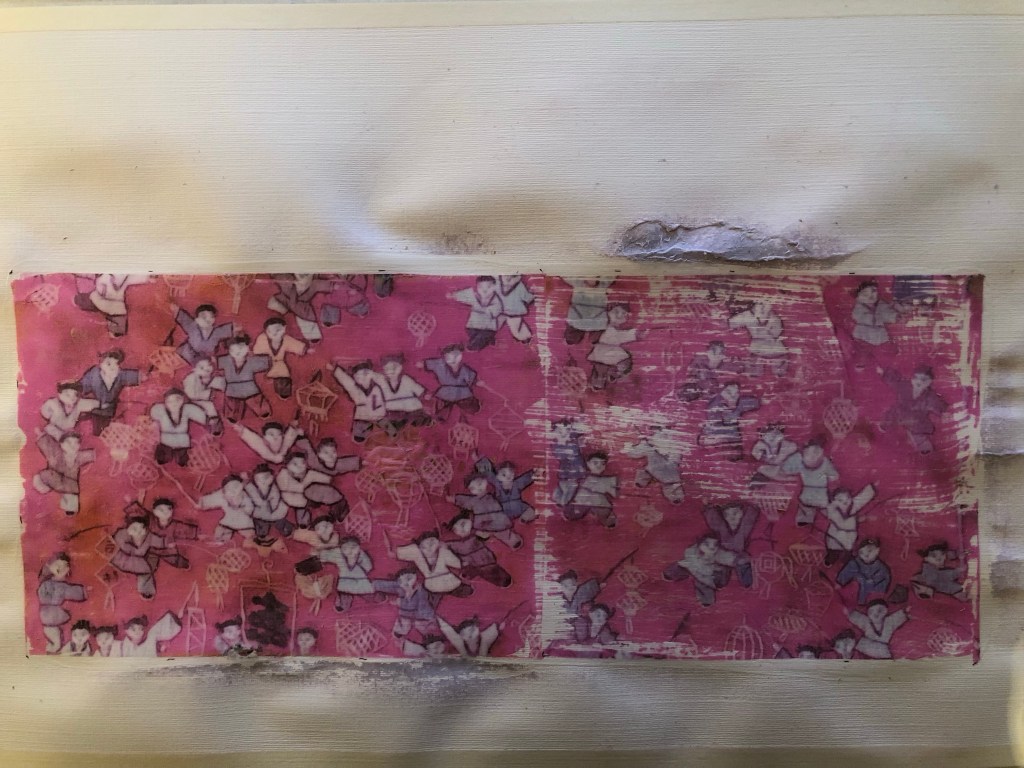
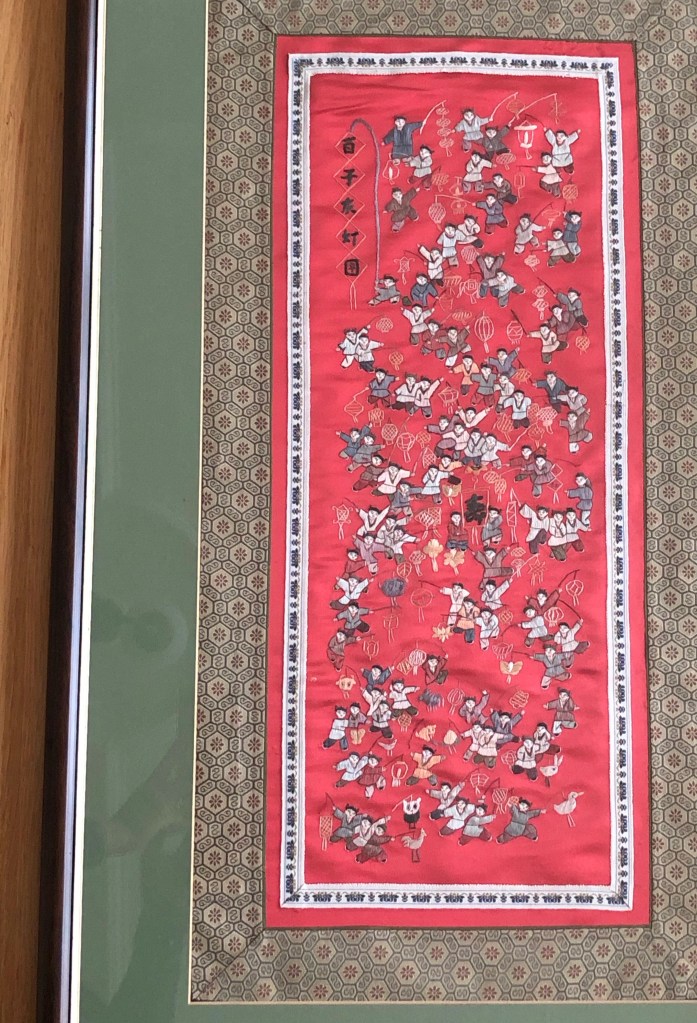
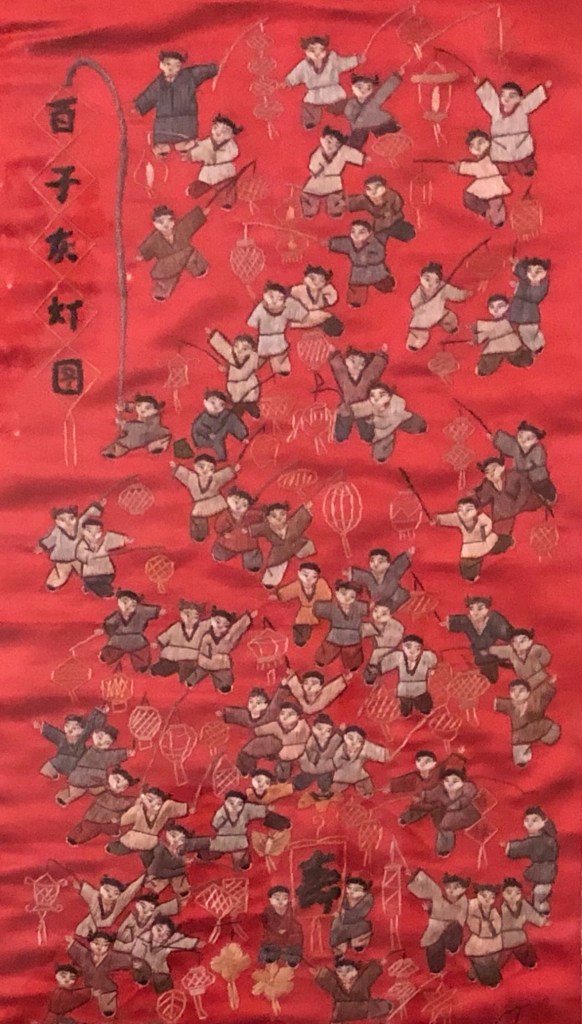
A printed photo image of a tapestry that was gifted to me by my brother many years ago was used as the based image for this piece. The image was transferred onto a paper canvas using dispersion liquid. The paper used was 250 gsm oil paper.

After the dispersion liquid dried, the printed image was rubbed off with a wet sponge to reveal the transferred image on the canvas. This was the first time a paper canvas (as opposed to a cotton canvas) was used in this series of experiments and it was clear that the paper canvas was not robust enough for the process. See below image for damage to paper. However, there was sufficient integrity in the paper canvas to continue the piece. I was hoping that a thick layer of oil and cold wax would hide the damaged areas. There was also excessive buckling on the paper canvas.

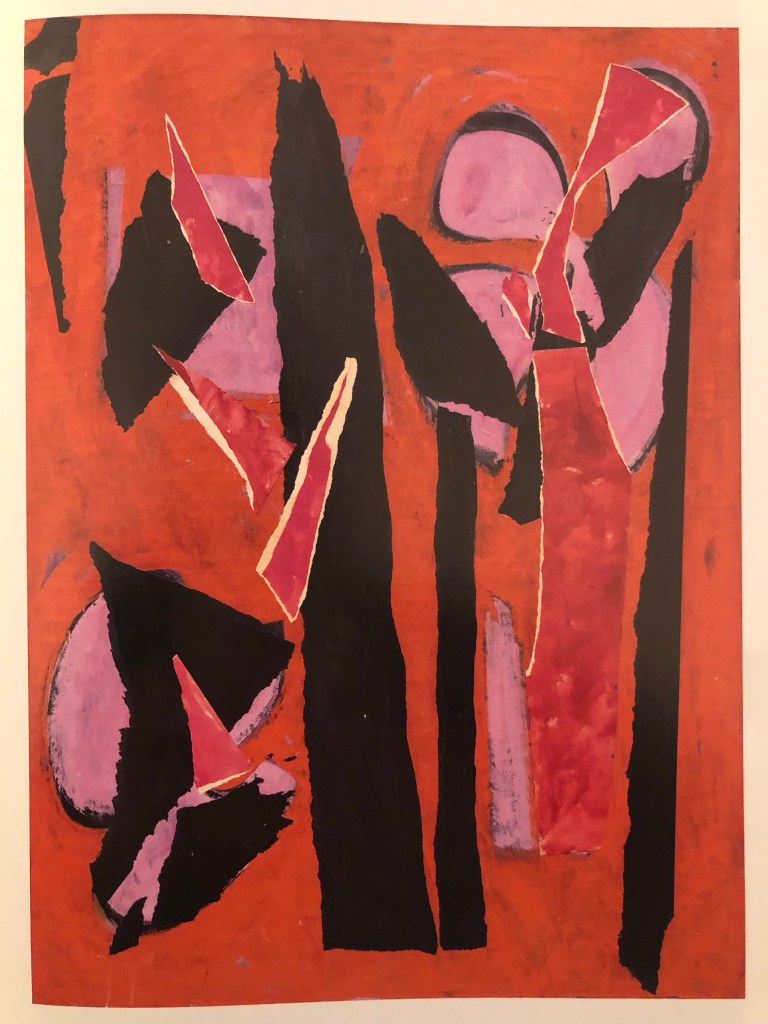
Recalling my disappointment with the colour palette that I chose for Part 5 (pink and grey), I decided to research into abstract paintings that I like to learn from the colours used. One of my favourite abstract artists is Lee Krasner and below is the painting that I decided to study and learn from in terms of the colour palette used.

Desert Moon (1955):

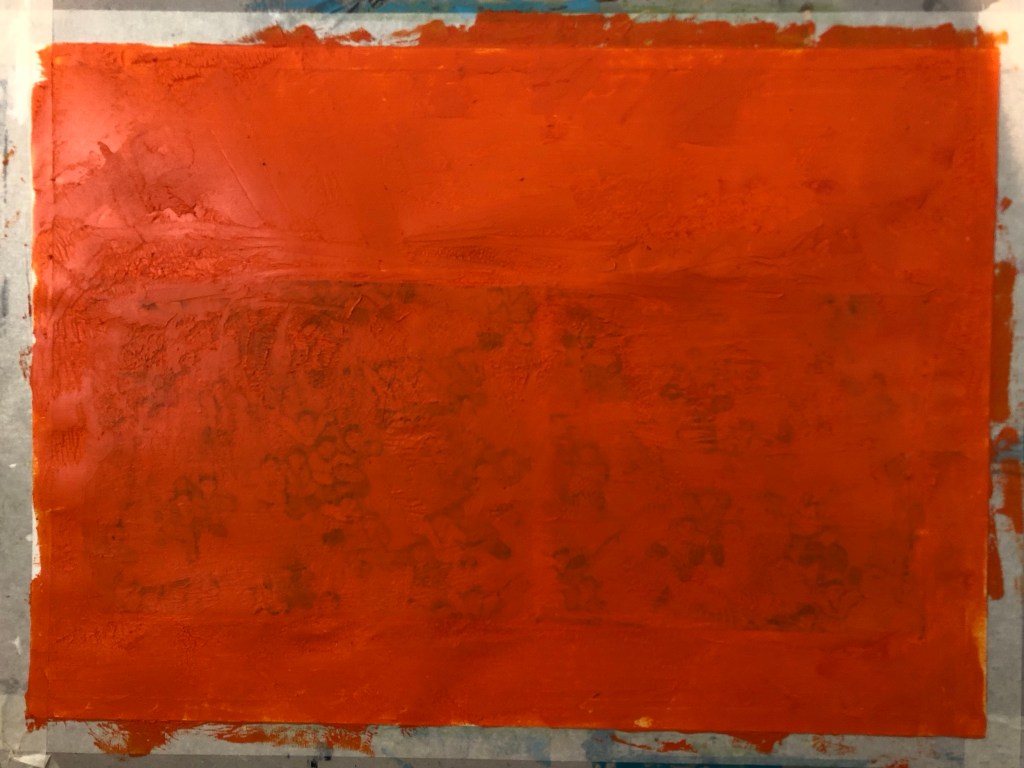
A layer of oil and cold wax was then applied to the canvas:

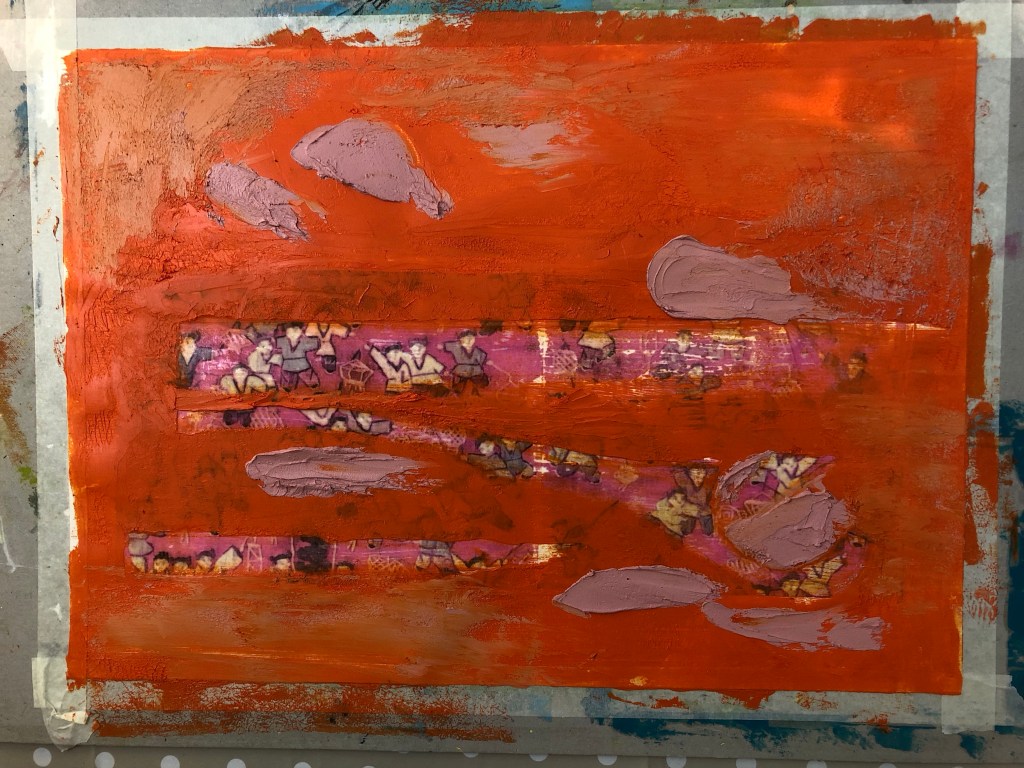
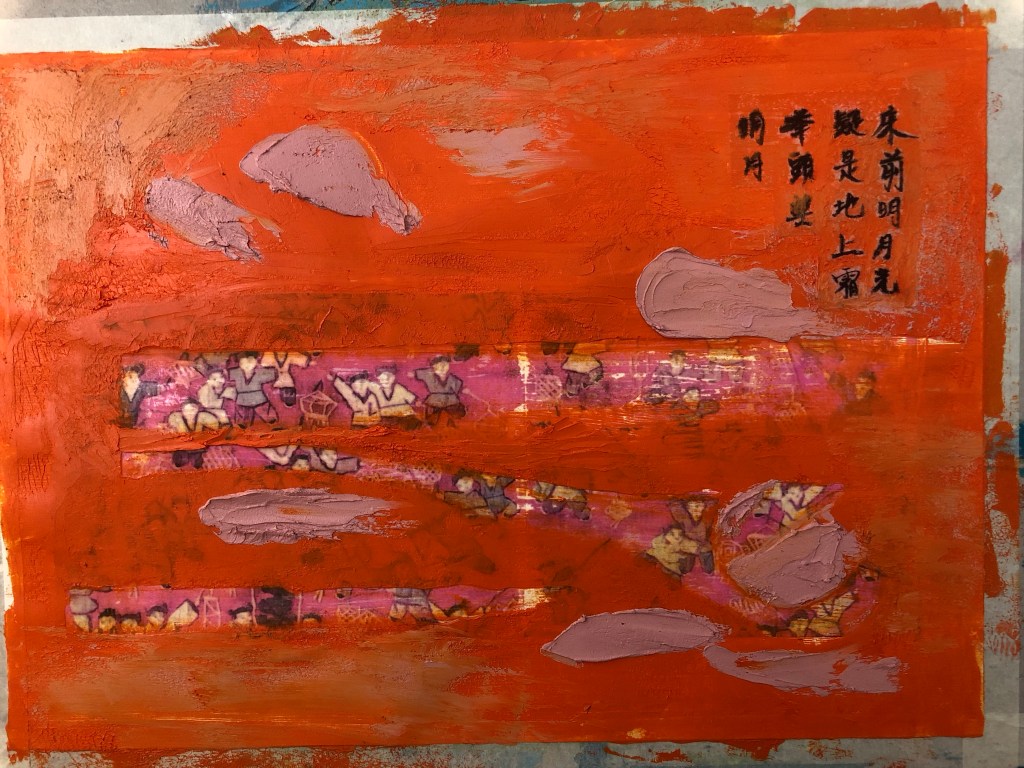
Areas were scraped off to reveal the base tapestry image. Learning from Part 5, I wanted to reveal a larger area so that it was clear what the base image was about. Then additional oil and cold wax colours were added:

For the Chinese brush calligraphy, I chose a delicate silk fabric as a substrate that was almost transparent because I wanted the substrate to become as invisible as possible.

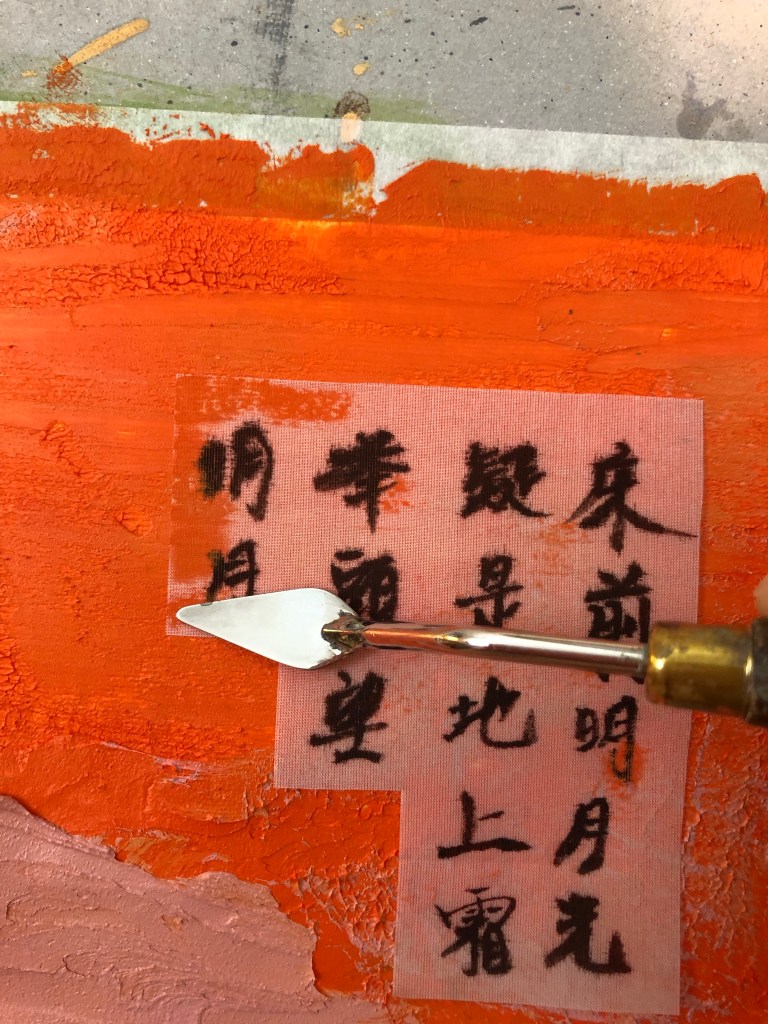
After writing the Chinese calligraphy onto silk, it was cut out and carefully pressed onto the oil and cold wax layer.

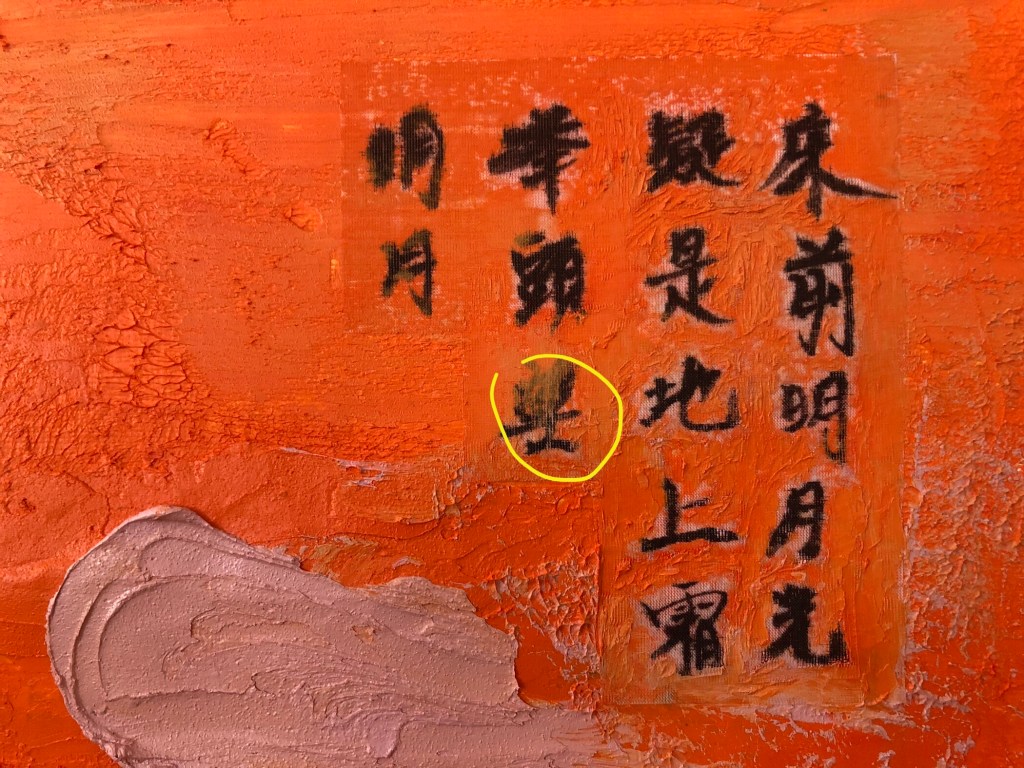
A small palette knife was used to press the silk into the oil and cold wax, taking care to avoid pressing the areas of the calligraphy characters which was challenging due to the complex shape of the characters. The yellow circle shows where part of the character was pressed into the oil and cold wax, partly obscuring the writing.

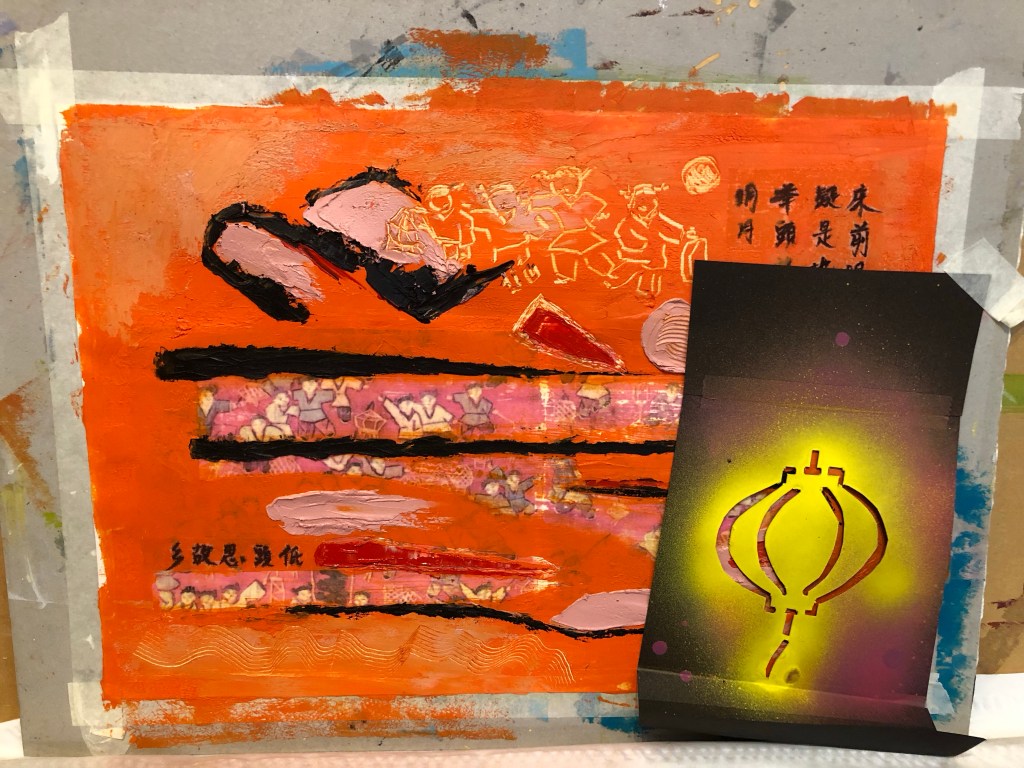
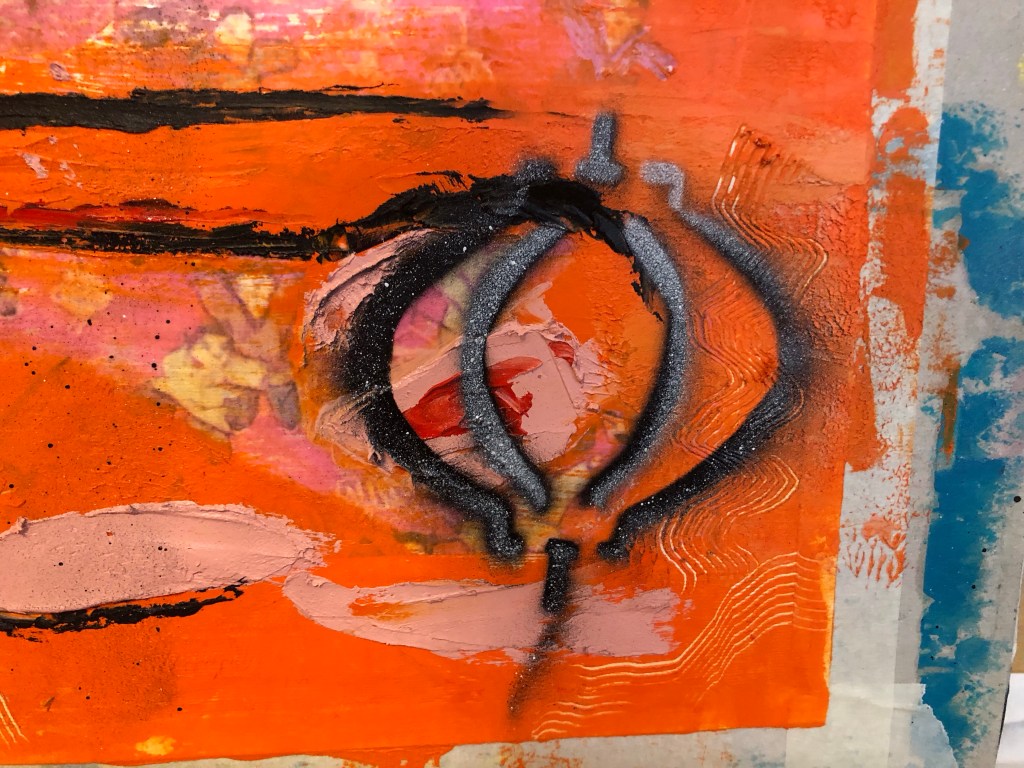
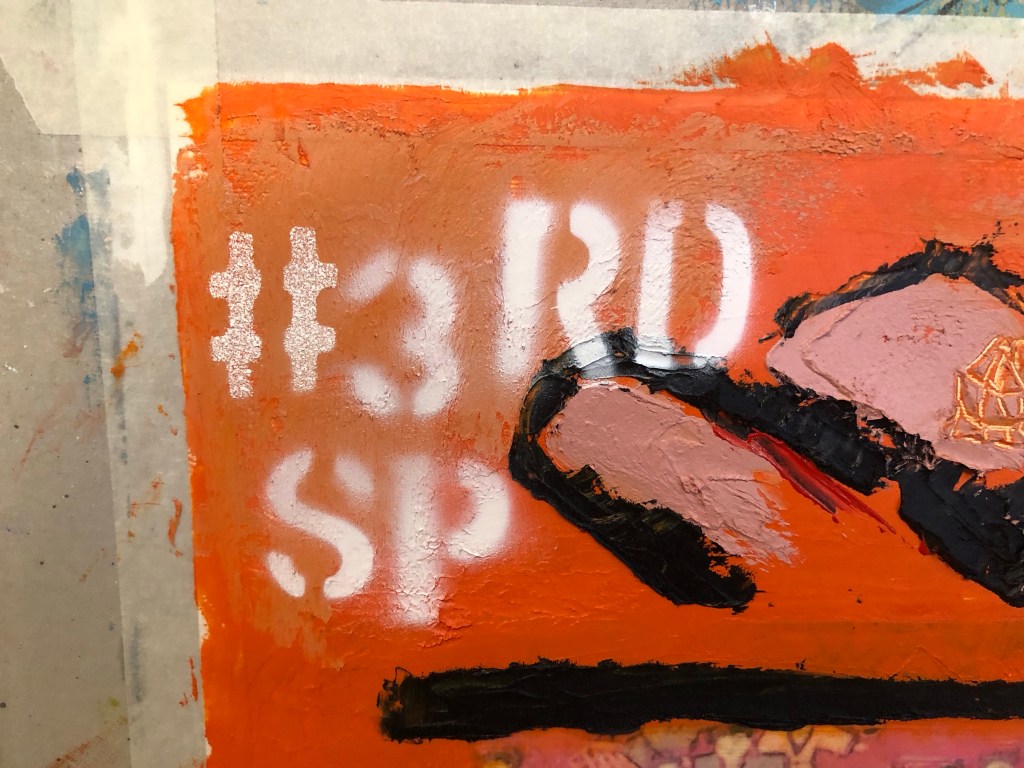
Additional marks were made – some were painted on and some were scratched off. The tapestry image was about children playing with lanterns and I have a lantern stencil that was made for previous work. So I wanted to experiment with spray painting onto wet oil and cold wax to see the effect.

Further spray painting was done – the phrase #3RD SP (for third space) was sprayed onto a dryer corner of the painting. All spray paint used were Montana GOLD 312g aerosol cans as popularly used by street artists:

Finished work with border tidied up:

REFLECTIONS

I am happy with:

– The colour palette. I am much happier with this painting than the previous one in Part 5. A more considered approach in selecting the colour palette paid off here.

– The experiment with using an almost transparent substrate for the Chinese brush art worked well. The pieces (there were two in total) adhered well to the painted surface. Although the substrate was not completely invisible, it was acceptable as a solution.

– The scratched mark making especially the part at the top to echo the revealed based image of the children playing with lanterns.

– The overall look of the spray painting, especially the words – they added a contemporary feel to the piece which was what I was looking for.

– Feeling more confident using oil and cold wax as a medium.

I am not so happy with:

– The paper canvas, it was not robust enough. Although the damage by the image transfer process was covered up with oil and cold wax, it was clear that this would be the wrong material to use for this process.

– The spray painting of the lantern – it was sprayed onto very wet oil and cold wax. The outcome was not satisfactory – it felt and looked ‘gooey’ and not the intended effect. I believe this was partly due to my reluctance to place the stencil close to the wet oil paint as I didn’t want the back of the stencil to pick up the oil paint, causing the spray paint to loosely disperse around the stencilled image.

– Although I was happier with the colour palette, I felt there was more that could be done to add more complexity to the palette to increase depth to the piece.

General comment: the Chinese calligraphy is a famous ancient Chinese poem about being homesick. It is one of the few Chinese poems that I know as most children growing up in Hong Kong in my era were made to learn it, partly because it is a good poem and very easy to remember. Going forward, I feel that if I were to use more Chinese calligraphy then I should learn more about Chinese poetry so that I can use a wider variety of content in this respect. It will also help me to understand more about my Chinese heritage.

Other thoughts that came to me some time after completing this painting:

– Throughout the making process, my mind kept going back to celebrating the Mid Autumn Festival when I was a child in Hong Kong. The highlight as children was to be given a lantern each to play with. The choosing and buying of the lantern in preparation was always a source of excitement. The lanterns were lit with small candles. The children would use a long stick as handle for the lantern and go around the neighbourhood exploring with their lanterns, just like the children in my painting. The Mid Autumn Festival celebrated the fullest moon of the year and celebrations would only begin after dark when the full moon came out. Since we were not usually allowed out at night, it made the Festival especially popular with children. At times a lantern would catch fire which added much excitement. There would be lots of fruit and snacks laid out that were specific for the festival. I remember one year when we were older children (over ten years old), my brother and I went to a local park, sat on the swings and chatted all evening. It was when my family was going through a difficult period and to share that moment with him was very special, especially when we ended up spending most of the rest of our lives living in different countries. He gave me the children’s tapestry that I used for this painting which evoked all those memories while making this piece of work.

LEARNING

– More work is required to develop my sense in choosing an appropriate colour palette for the piece. This is increasingly important because my work is about storytelling as well as narrative and I believe having an appropriate colour palette helps to tell a story. So more research and experiments should be done in this respect.

– The silk substrate worked well for the Chinese calligraphy. However, I know there is a wide range of other delicate Chinese substrates and I will experiment with different materials to find the optimum.

– Layering the Chinese substrate onto oil is a risky process – as seen in the image with the yellow circle highlighting the part obscuring of the brush painting if pressed too much into the oil. To help with this, further experiments are required to improve this process. E.g. paint a barrier layer, such as a masking fluid that dries clear, onto the back of the Chinese brush painting or calligraphy to shield the image from the oil seeping in from underneath.

– Spray painting, especially words, adds a contemporary feel to the image which is a style that I want to incorporate into my work. This is relevant to me because I take much inspiration from the extensive street art scene in my home city of Bristol where many famous street artists work or have worked.

– Using the tapestry image evoked many memories, perhaps I could explore that more.

NEXT STEPS

– Research into colour palettes for the type of stories that I want to tell. Build confidence in this area.

– Continue to build experience and explore using oil and cold wax.

– Experiment with other transparent Chinese substrate materials to find one that is as close to invisible as possible when layered onto oil.

– Experiment with a barrier or masking fluid to prevent the oil from seeping into the Chinese brush painting images.

– Experiment with more spray painting – be bold and push boundaries.

– Ongoing learning – research into Chinese poetry to find more poems that resonate with me to use in future work.

– Explore the evoked memories.

ADDITIONAL WORK

After visiting the exhibition of Ofelia Rodriguez again at Spike Island in Bristol, I was inspired by the way she used fabric as a border to her paintings.

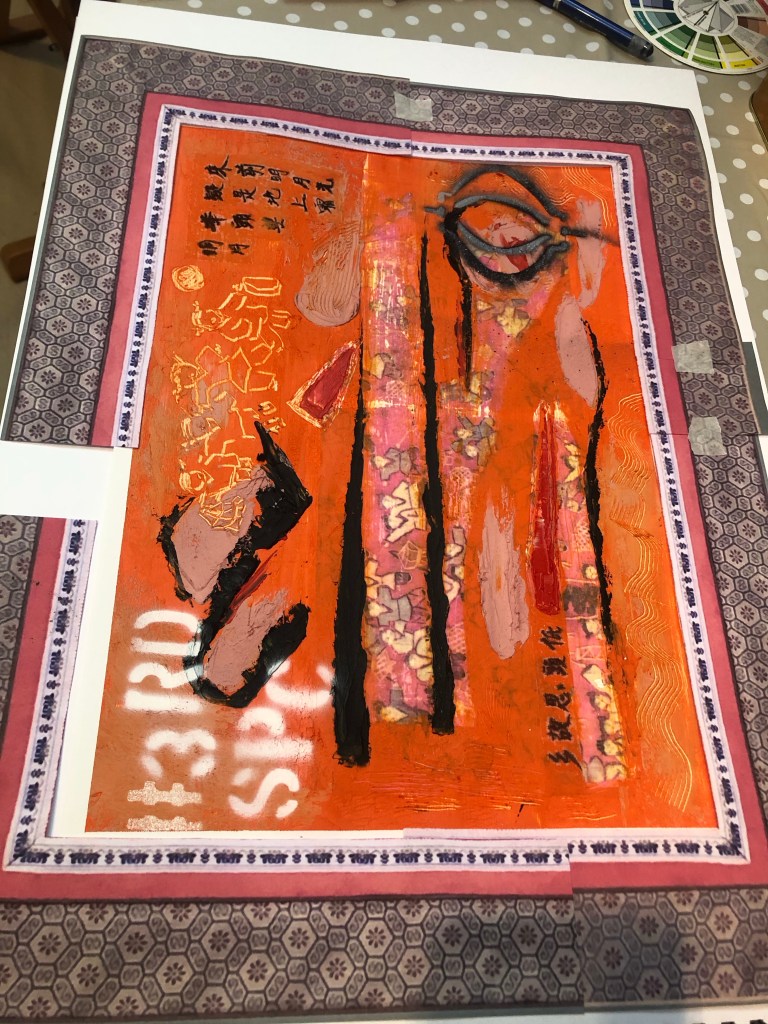
This gave me the idea to try that with my work, especially to use Chinese imagery border for a recent piece of work to add to the transcultural narrative.

I started with some patterned paper that I had to make a collage frame. But I was not happy with the effect. It seemed too busy and rather random as an idea.

I then returned to the original tapestry that I used as the base image for the painting. It was a tapestry that was gifted to me by my brother many years ago.

Image to show the border of the tapestry

It is a typical border for small scale tapestries of this type. Then images of the border were printed and cut out to create a collage border for the painting:

Final finished work:

Mixed media on paper, 54 x 41.5 cm.

REFLECTIONS

I am very happy with the outcome of this experiment inspired by Rodrigues. It has completed the painting for me and added a more transcultural feel alongside the painted images such as the spray painted words.

To improve this approach, I would spray paint the # words to partly cover the tapestry image frame. I think that would increase the contemporary feel for the piece juxtaposing the traditional Chinese tapestry border.

MA Y1 U1: Exploring media – Oil and cold wax – Part 4

BACKGROUND

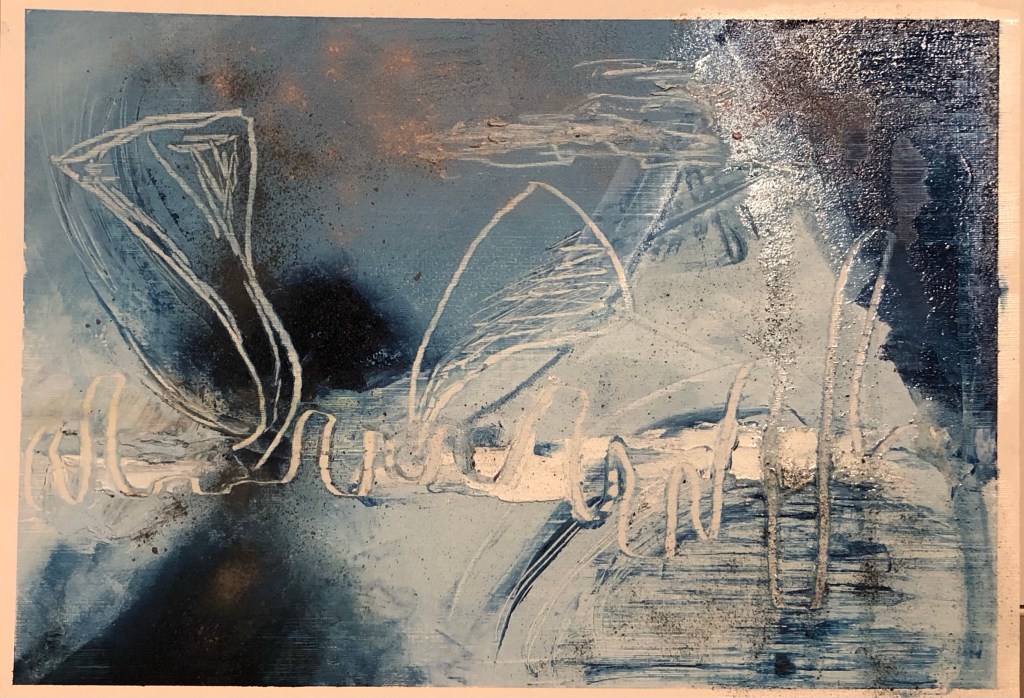
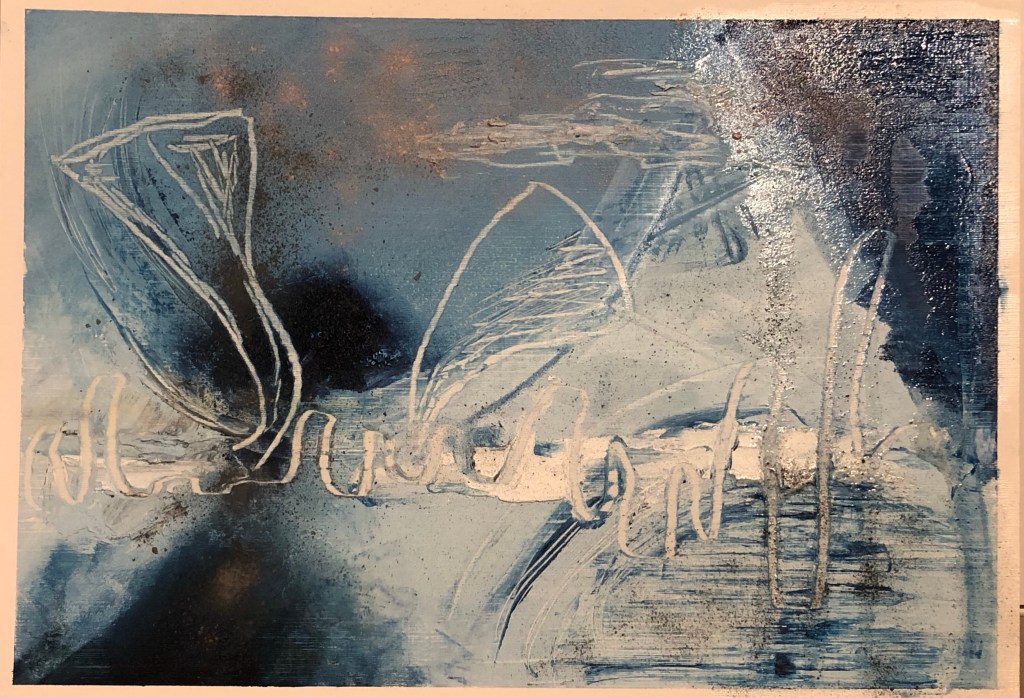
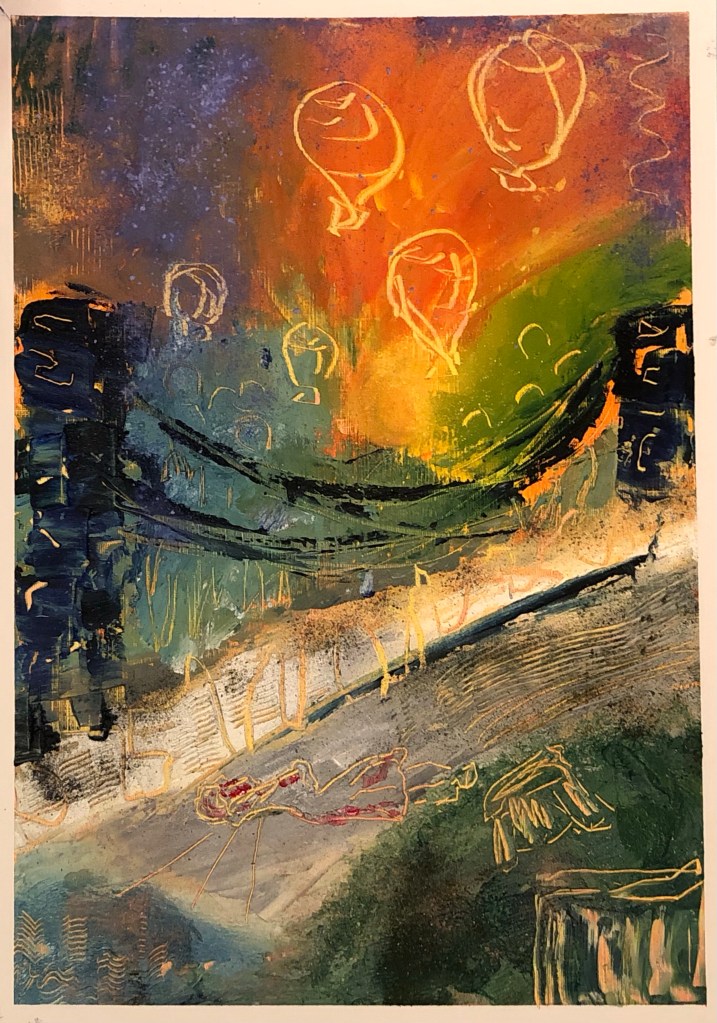
To improve my understanding of the oil and cold wax media, I started watching an online course by St Ives Painting School to learn techniques of painting with this chosen media. This is Part 4 of the series of material and media exploration. These experimental paintings were made with techniques that I learnt from the course, then adding other materials that I wanted to experiment with as I went along. Below is my favourite out of the work made during this part of the exploration.

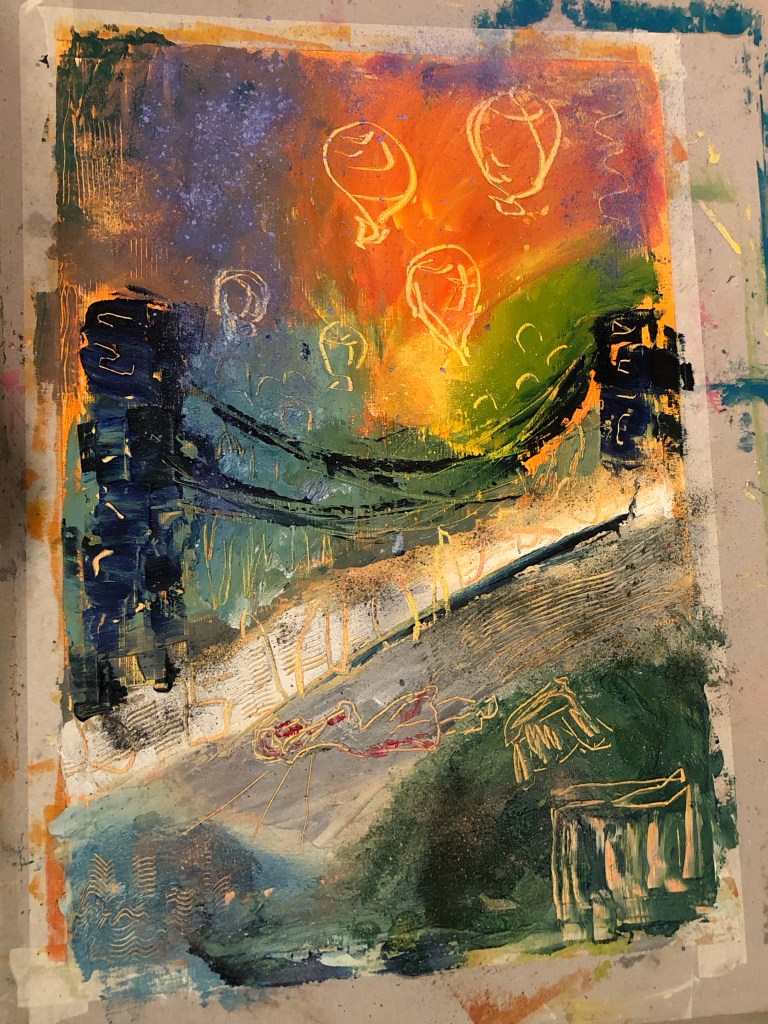
The Horn Bridge, Bristol

METHOD

Experiment 1

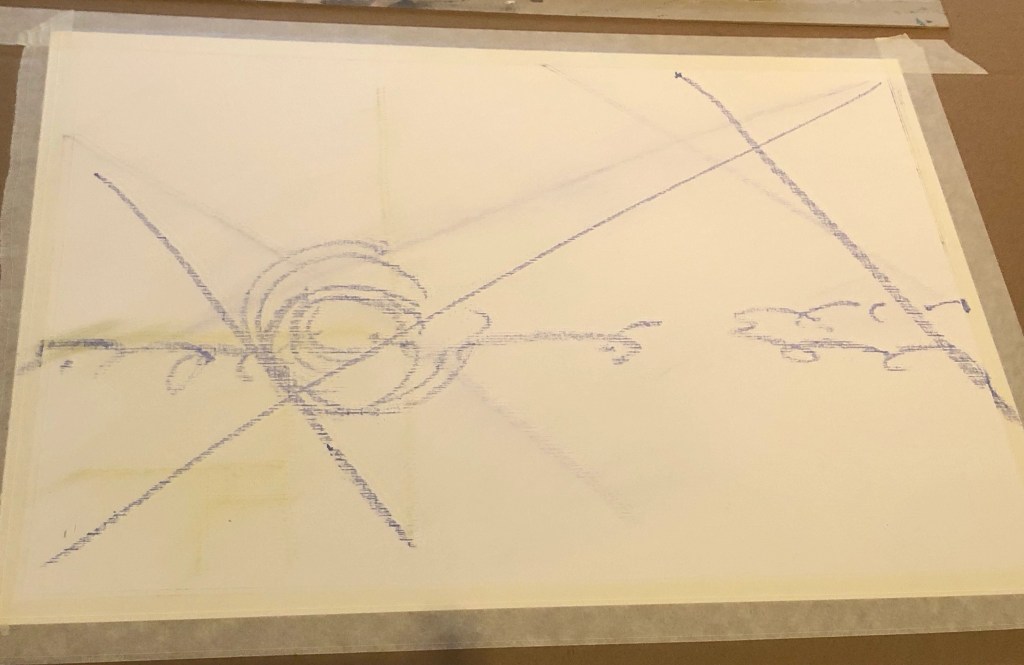
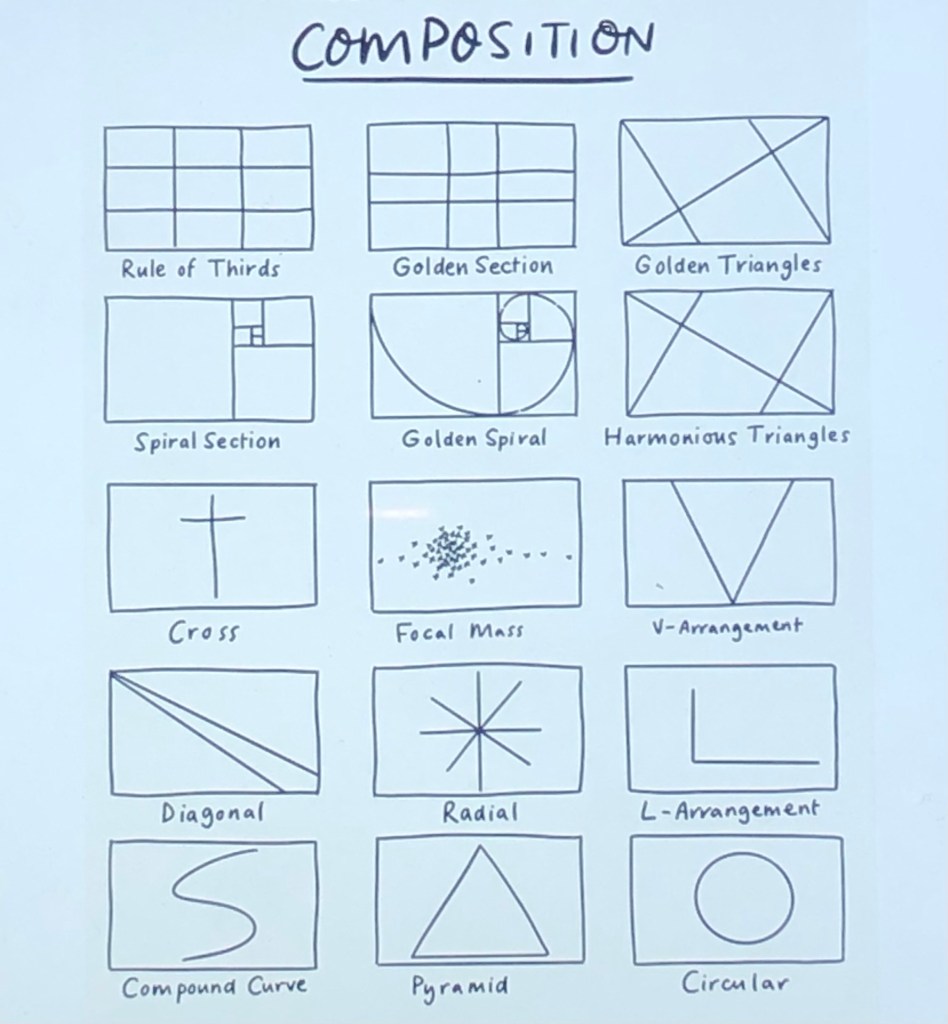
Basic composition was drawn out taking ideas from a list of compositions shared on the online course.

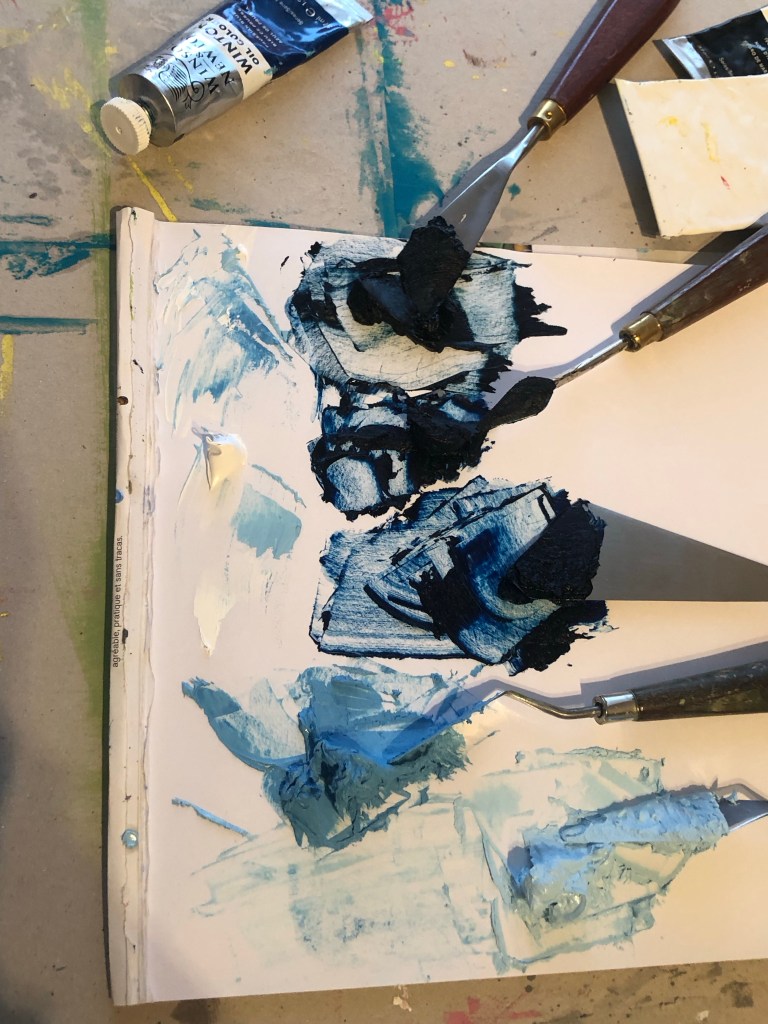
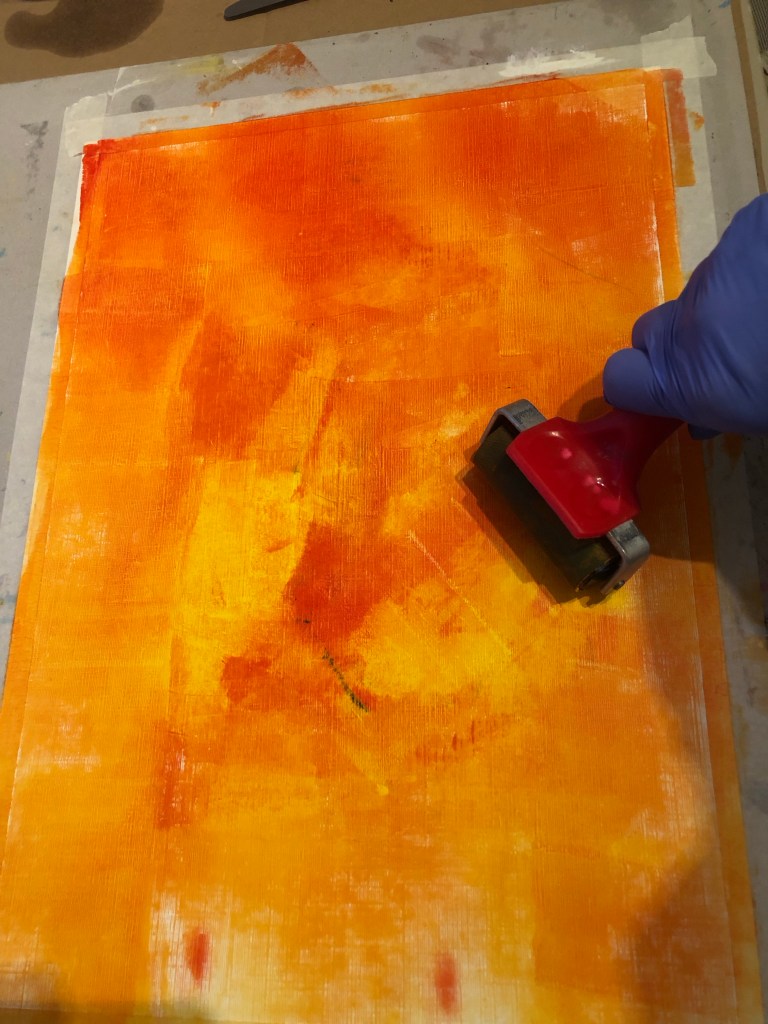
Shades of Prussian blue was mixed with cold wax:

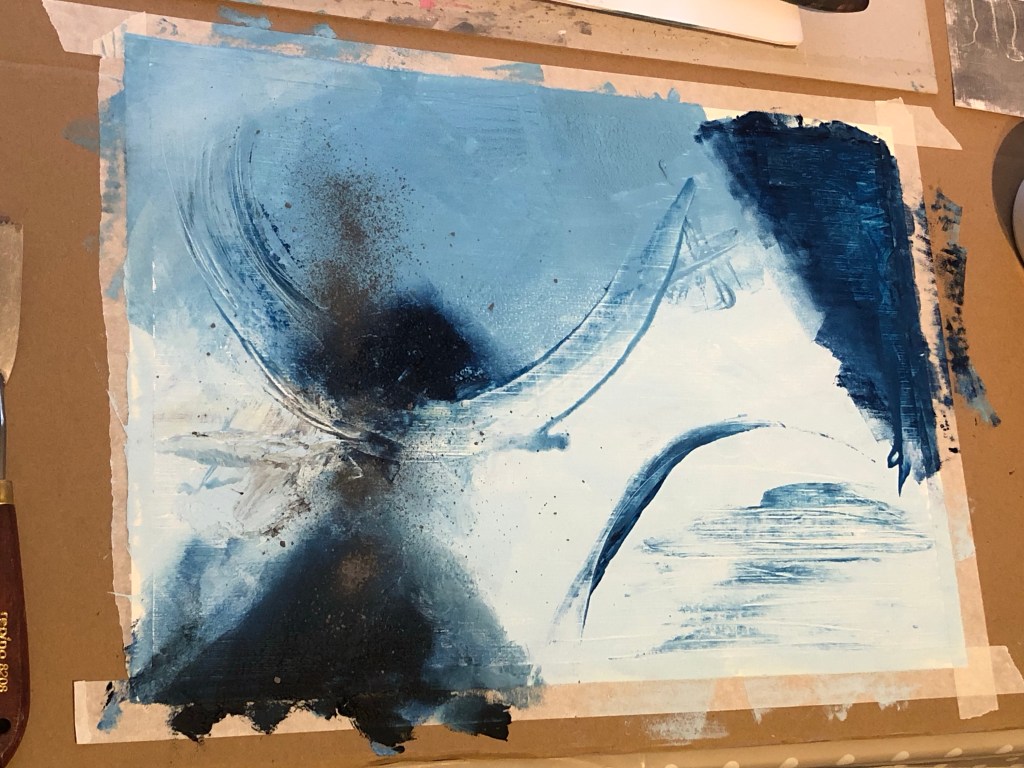
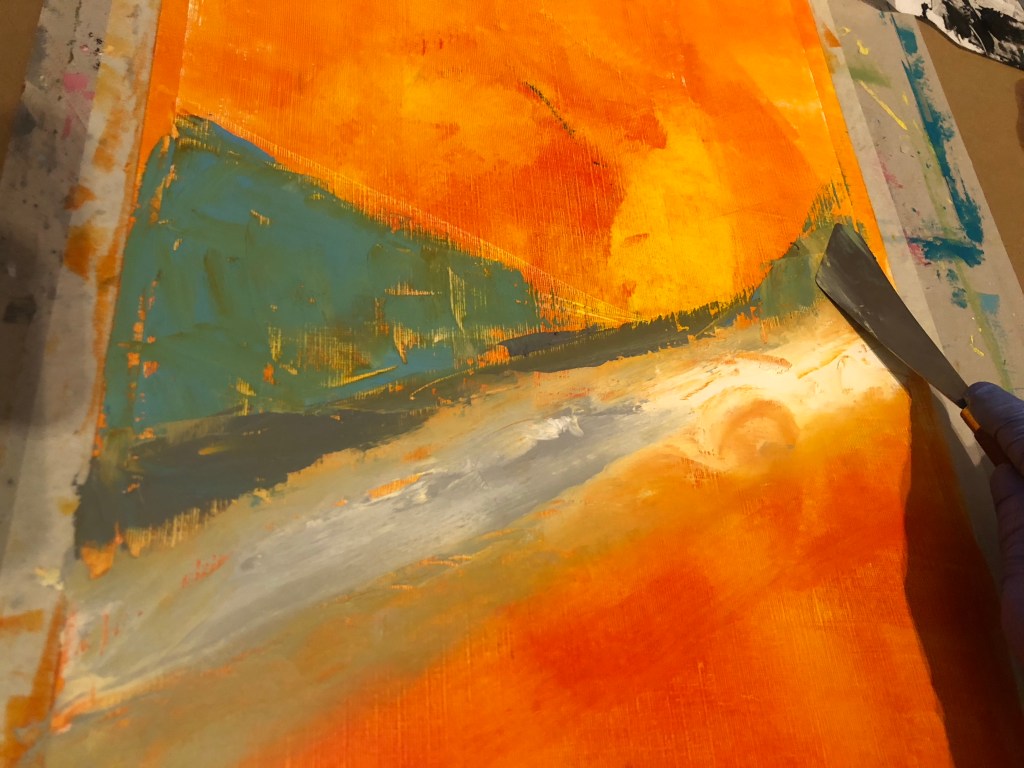
Abstraction approach was used for the painting:

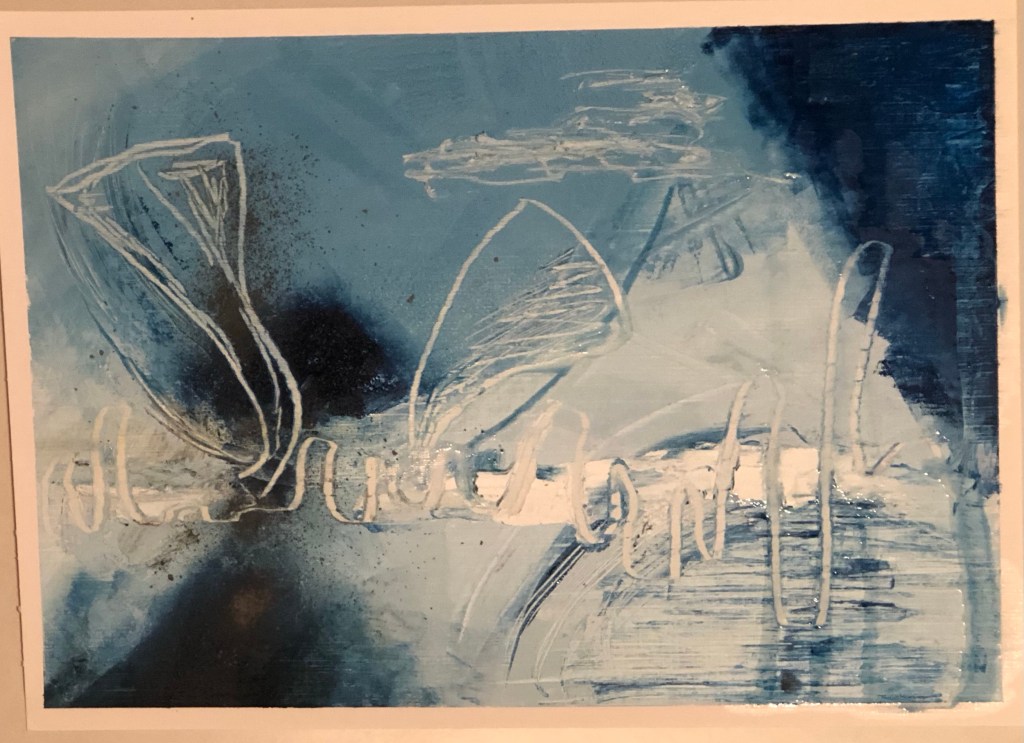
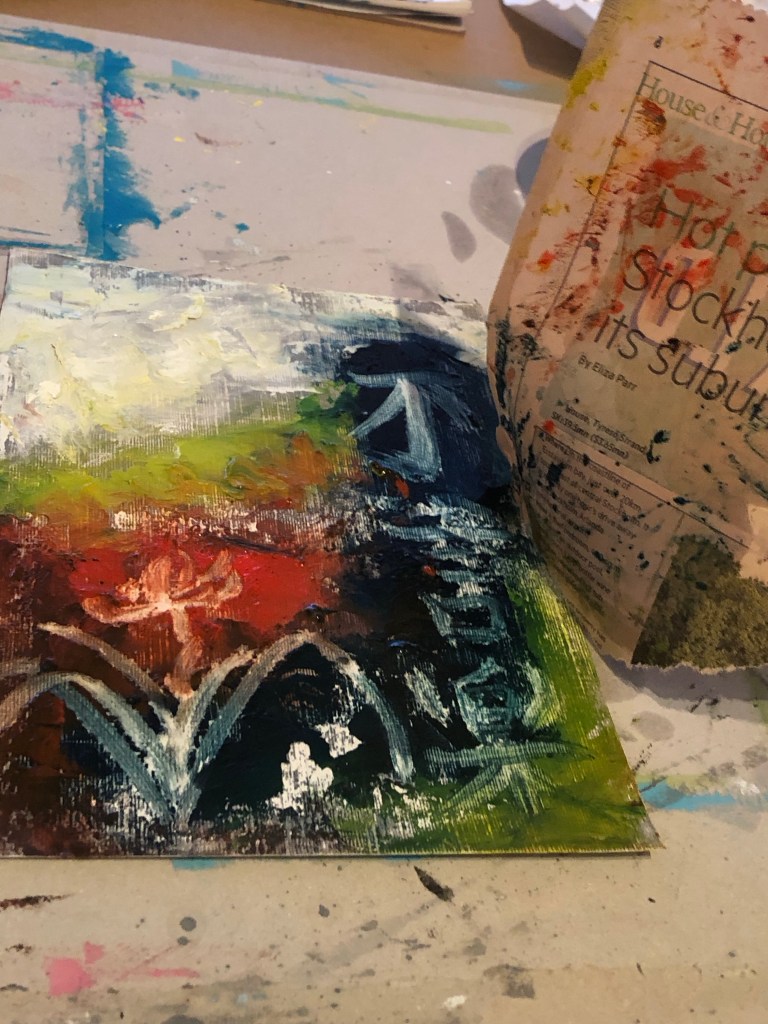
A sharp scraping tool used for clay was used to scratch The Horn Bridge image:

Experiment 2

Experimenting with solvent on the oil and cold wax to loosen the paint then used a paint brush to do Chinese calligraphy so see if this effect would work to incorporate Chinese brush painting into the oil and cold wax medium:

Another experiment of using even more solvent to loosen the oil and cold wax to test the effect of Chinese brush art:

Using newspaper ‘tonking’ method to lift the excess paint off the canvas which is a process that I have always found to be effective:

Experiment 3

Applied oil and cold wax, then painted and scraped scenes of Bristol, my home town.

REFLECTIONS

I enjoyed the experiments. I don’t think the solvent method to loosen the paint for Chinese brush art worked very well, although one could see the Chinese calligraphy characters clearly, it was coarse and I was not satisfied with the result. So this part needs further experimentation.

I was very happy with the Prussian blue Horn Bridge painting – I believe that was the best one out of this batch of work. I liked the simplicity of the colour palette and the confident and defined lines depicting the bridge.

I was not satisfied at all with the last painting in Experiment 3 because there was too much going on and the images were too representational. It lacked the ‘edge’ and refinement of the abstraction as in the Prussian blue Horn Bridge painting.

Overall I enjoyed the exploration and felt that there is plenty to take forward to the next experiment.

LEARNING

– Need to try something different to incorporate the Chinese brush art into the oil based media. Using solvent here didn’t work satisfactorily.

– Abstraction or to be more precise, semi-abstraction with symbols, is a style that I want to explore more of because the abstraction part enables me to be more free in my gestural expression and the symbols help me to tell stories and communicate my narrative.

NEXT STEPS

– Watch the last part of the online session.

– Explore other ways to incorporate Chinese brush art into oil based media such as oil and cold wax which I enjoy working with.

– Continue to experiment with semi-abstraction with symbols.

MA Y1 U1: Developing narrative – Memory, children’s tapestry, tea and digital collage

BACKGROUND

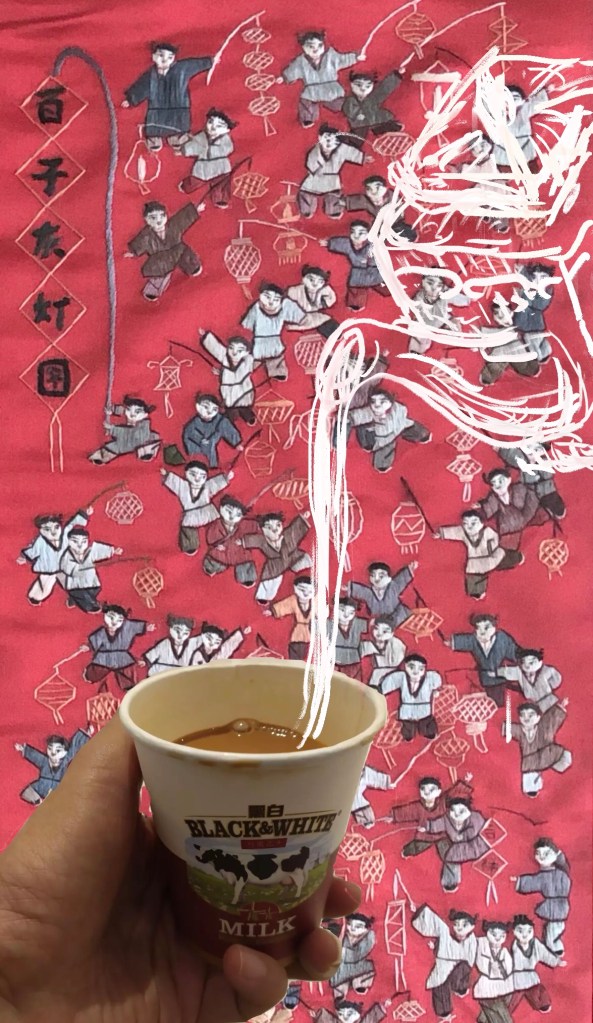
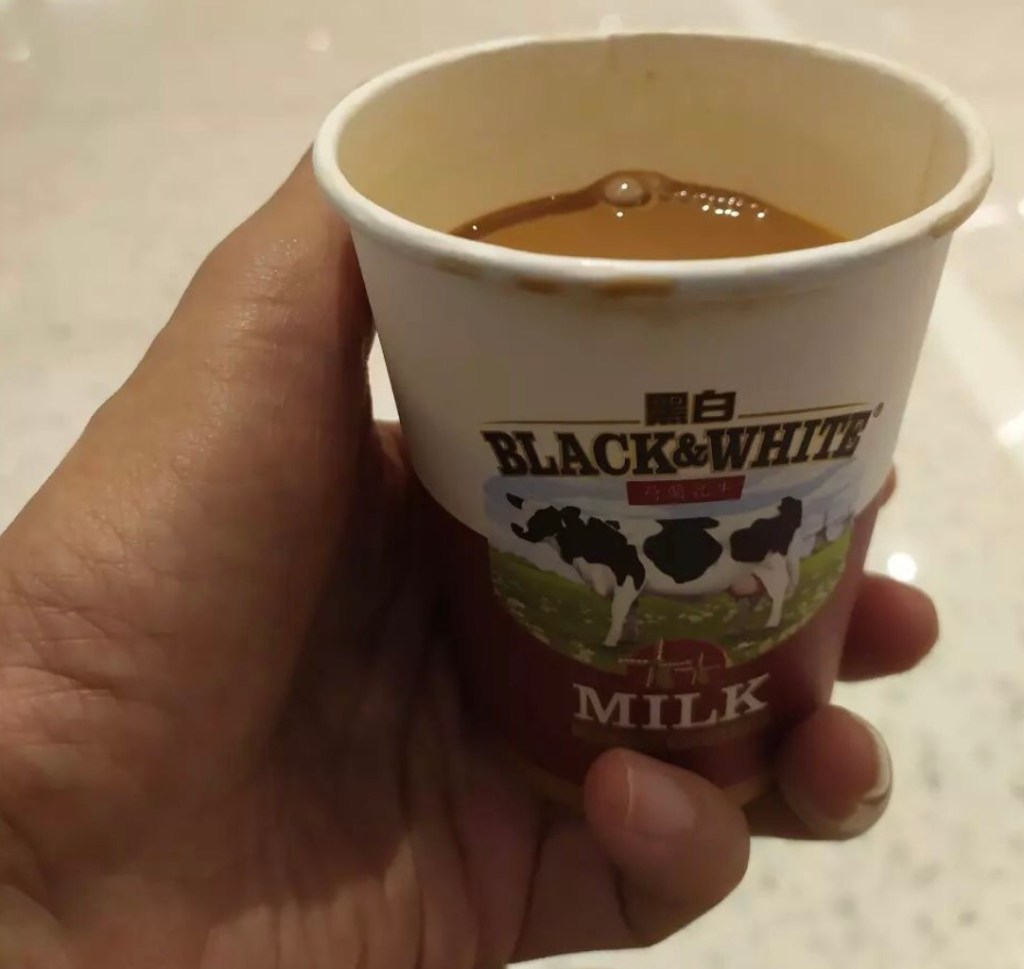
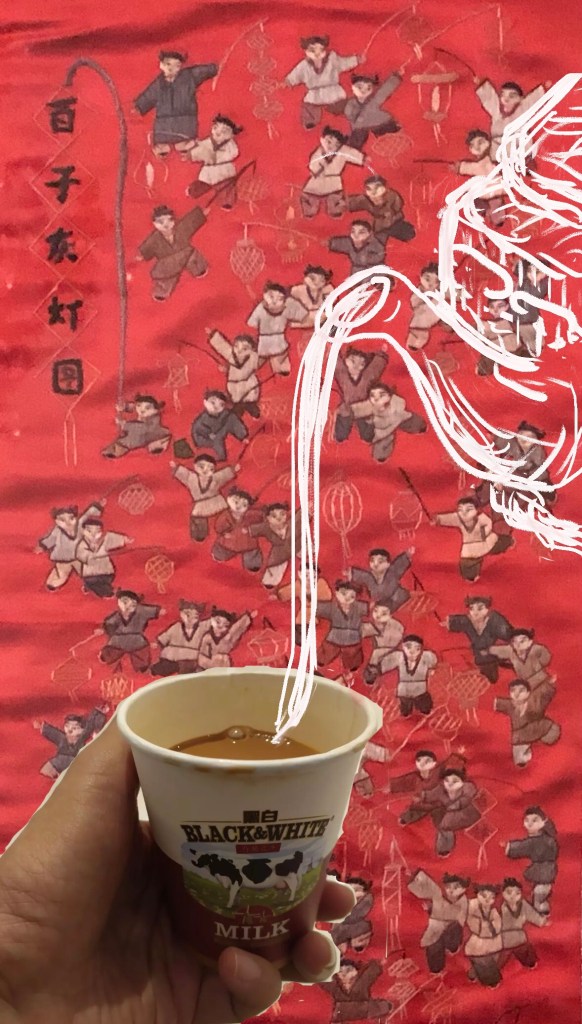
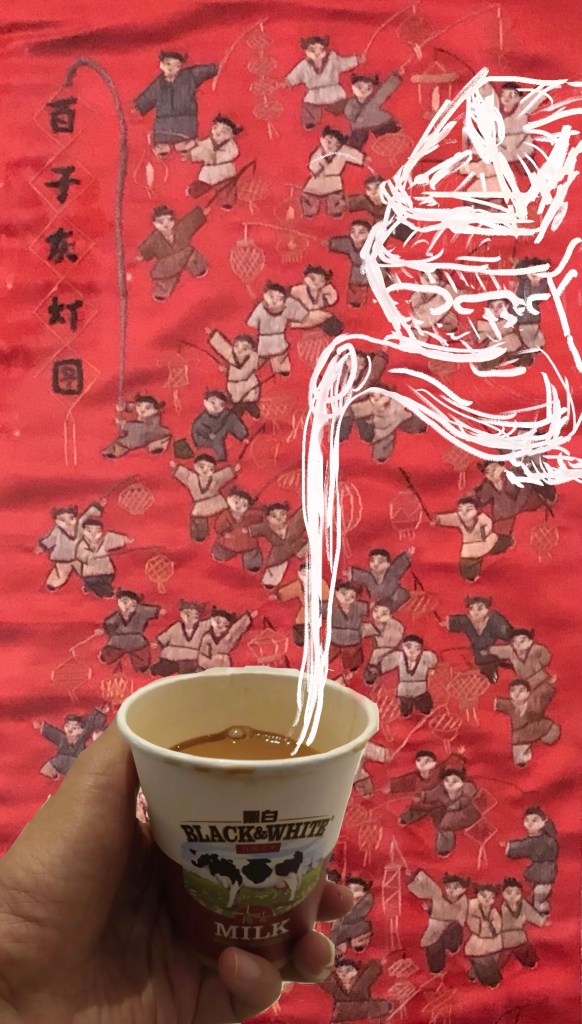
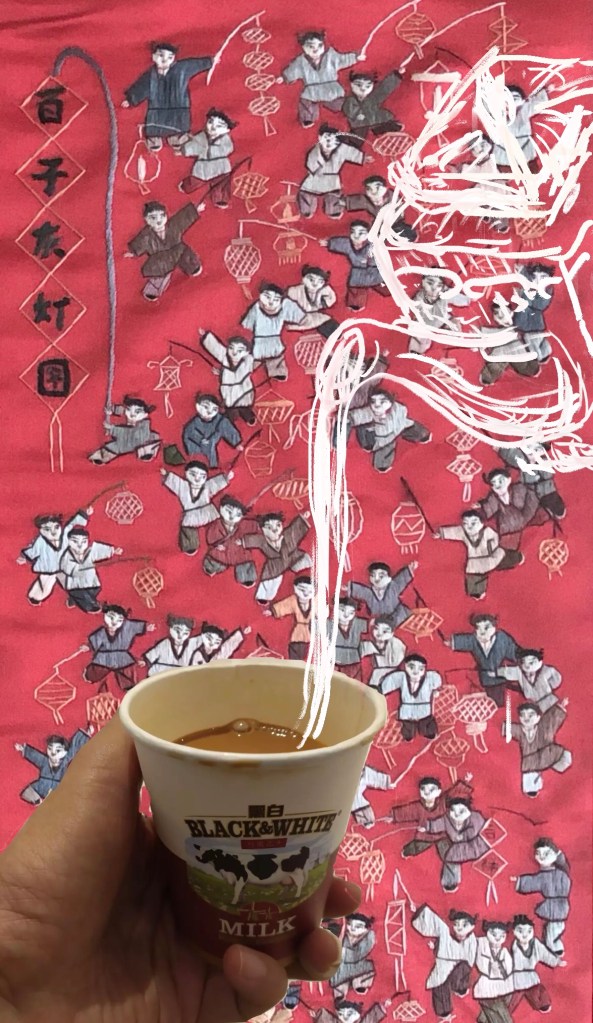
In parallel to the work on developing my style, I work on my memory to help develop my narrative such as remembering and researching stories from my childhood. Work in this area often stems from triggers – it could be encounters that remind me of something from the past or thoughts that suddenly come to me. This blog captures a piece of work that I have done as a result of seeing an Instagram post by my brother. He was holding a cup of tea and seeing his hand reminded me of our time together as children. Sadly, we haven’t see each other for many years as we live in different countries. Despite that, I remember clearly the details of his slim artist’s hand, the shape of his finger nails etc.. Seeing his post brought back many memories.

Another purpose for this piece was to experiment with digital drawing tools. During a recent discussion with my fellow MA students, they were discussing the pros and cons of Procreate vs Adobe Photoshop. I have tried Procreate in a limited way some time ago and the discussion ignited my interest to try those tools again.

FINISHED WORK

METHOD

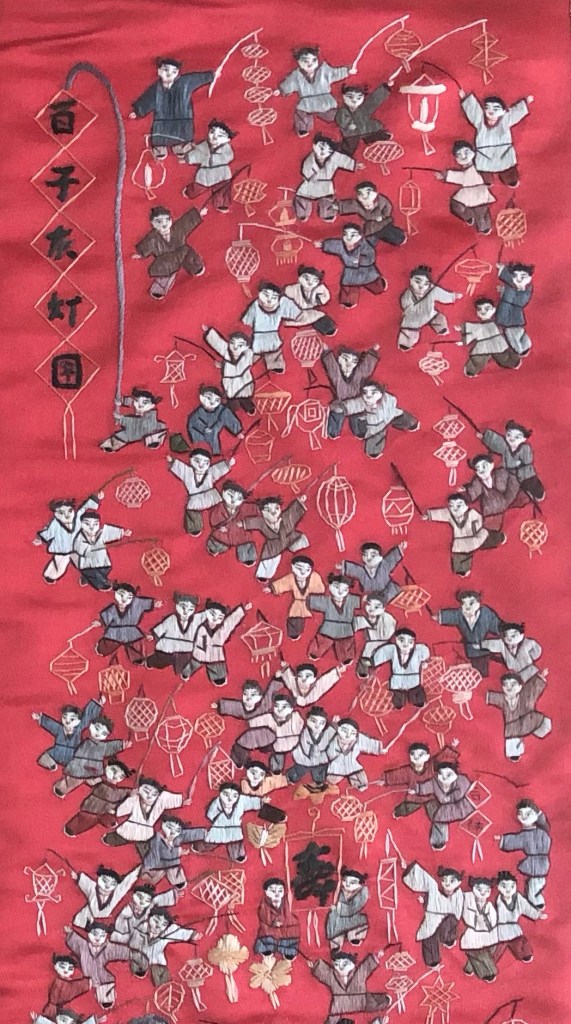
I wanted a vibrant image to use as background on the digital canvas for this piece. I have at my home a piece of Chinese tapestry that my brother gave me many years ago. It’s framed and hangs in my lounge. I took a photo of it and decided to use that as the background.

Background tapestry image

This is the image cut from my brother’s Instagram post with him holding a cup of tea that was a free giveaway from a shop and the was in the comment of his post.

I wanted to make a composite where there’s a tea pot topping up his cup of tea because if I were there then I would pour him a cup of tea.

First attempt using Procreate. The tea pot was too flat so I wasn’t happy with this:

Second attempt with Procreate with a better angle for the teapot for pouring:

I was not happy with the background image so took another photo with the tapestry in day light. I was happier with this image:

Since I purchased the Adobe Suite using my student discount from UAL, I tried for the first time using Adobe Fresco. Below was the first attempt, I wasn’t happy with the lightness of the brush stroke using ‘charcoal’ as the medium:

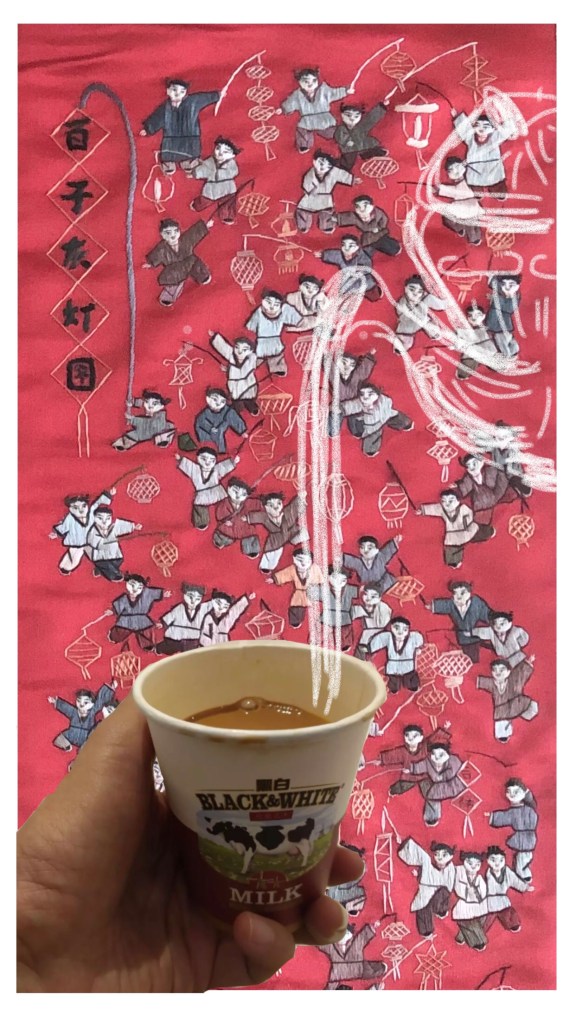
I played with the different setting for the brush selected and I was happy with this final version:

Finished work

REFLECTIONS

Out of the two digital tools I used, I was fairly happy with Procreate and I would still be happy to use it on the go, on my iPhone or iPad. However, I really like Adobe Fresco and prefer that as a digital painting tool. I like Fresco because I use it on my MS Surface Pro with a MS stylus and the response and control of that combination is excellent. The software is very flexible and intuitive to use. Procreate is even easier to use, but I feel even the Apple stylus (I borrowed one to try) didn’t give the control that the MS Stylus achieved for me. Also, since I do not own an Apple stylus, I am very happy to stay with my MS set up. I want to experiment a lot more with the tool in order to be competent with it.

I struggled to reflect on my feelings about this piece. I didn’t think too much while making the piece because my focus was on mastering the new digital tools. However, writing this blog has been a challenge for me because of the feeling of nostalgia and the sense of lost time. It took me several attempts to get this far in writing and I don’t think I’m ready to examine that too deeply yet. I hope I’ll be able to do that over time and I hope my art practice can help me with that journey of rediscovery.

LEARNING

The technical learning was about comparing the two digital drawing tools. I preferred Adobe Fresco and will continue to experiment. I plan to do a more ambitious piece of digital art next.

I have a long way to go in delving into my memory to develop my narrative. There is a lot of content buried and I will slowly dig through like an archaeologist – this was discussed with my tutor at the recent tutorial.

NEXT STEPS

As an immediate next step, I want to create another digital painting using Adobe Fresco on my MS Surface Pro with the MS Stylus.

MA Y1 U1: Gallery visit – JD Malat, London

EXPERIENCE

This was an impromptu visit as I walked past the gallery. I have previously looked at their exhibitions online because I was researching the work of an artist that they represent – Kojo Marfo, a Ghanaian artist who is now working in London. So I went in to have a look when I came walked past them by chance.

I only spent a short time there so I’ll capture some quick notes here on works that caught my attention and I’ll state the reasons for my interest.

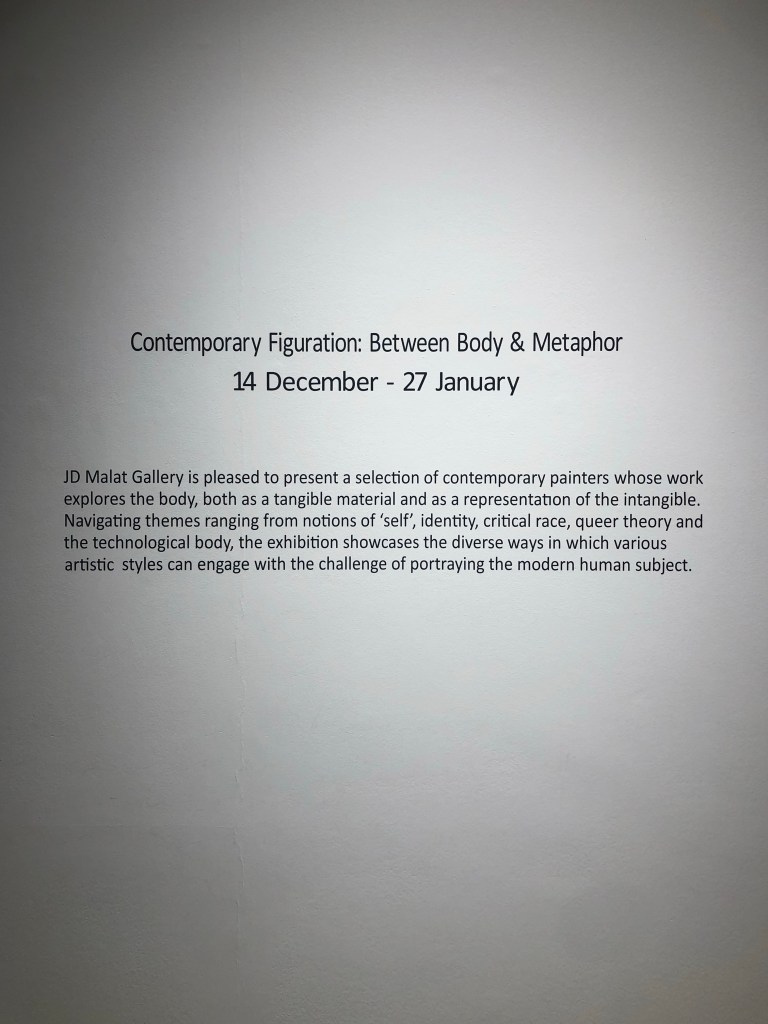
Title of exhibition

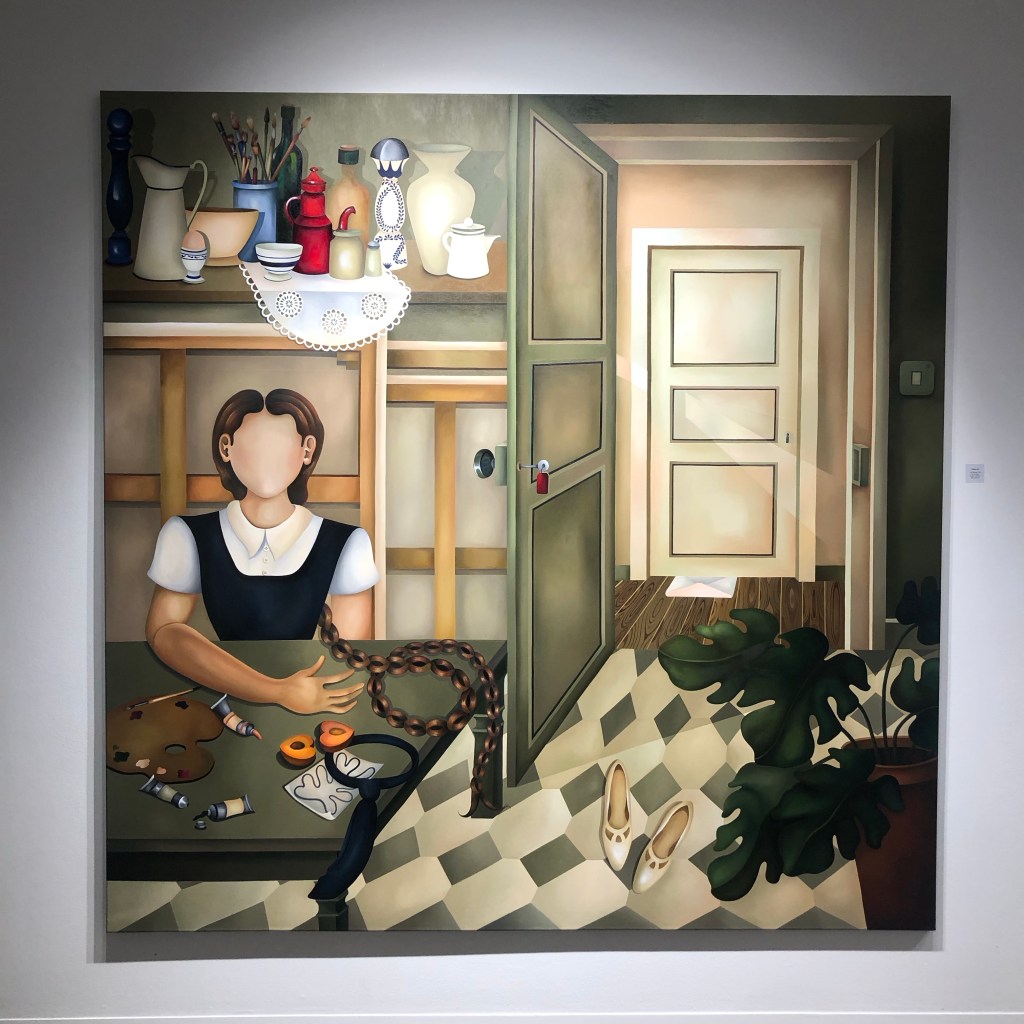
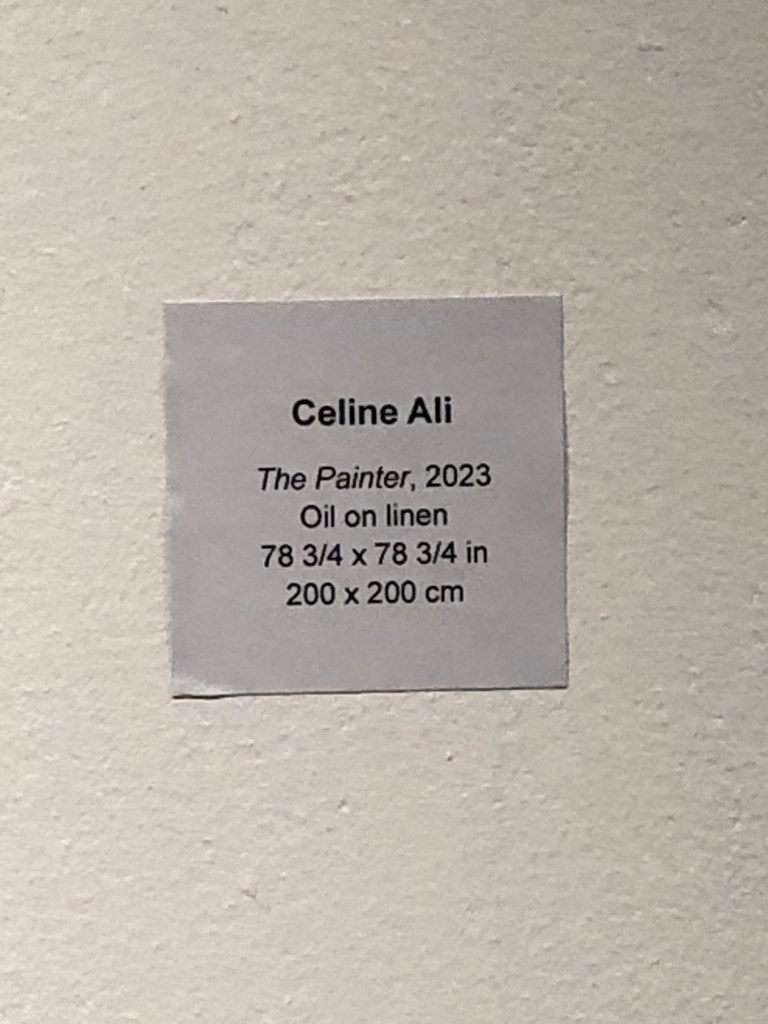
Thoughts: I often use animal or bird faces on the characters that I depict in order to anonymise the story and not make them too personal. I really like the way this artist blanked the face, I think it’s a possible way for me to achieve the anonymity that I was looking for in my story telling. So I’ll consider this approach.

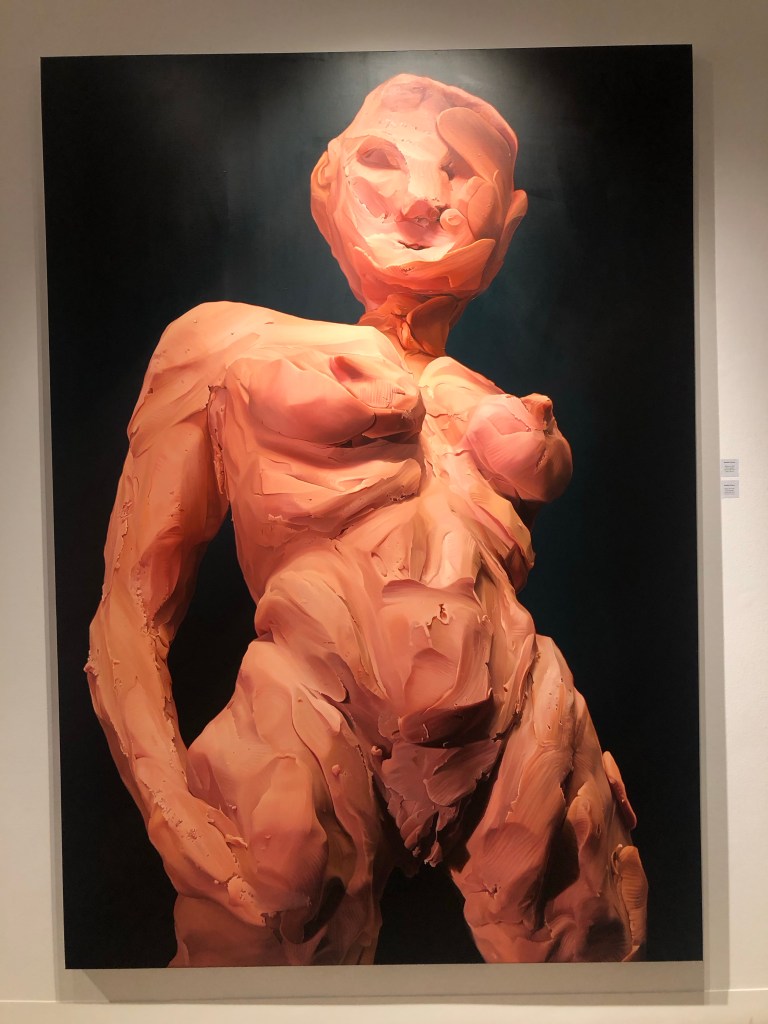
Thoughts: This was a close to photo realistic painting of a sculpture. I thought it was a digital image to start with then I saw that it was an oil painting on canvas. What I liked is the idea of making a sculpture or 3D work then making a painting of that. Something to bear in mind as an idea.

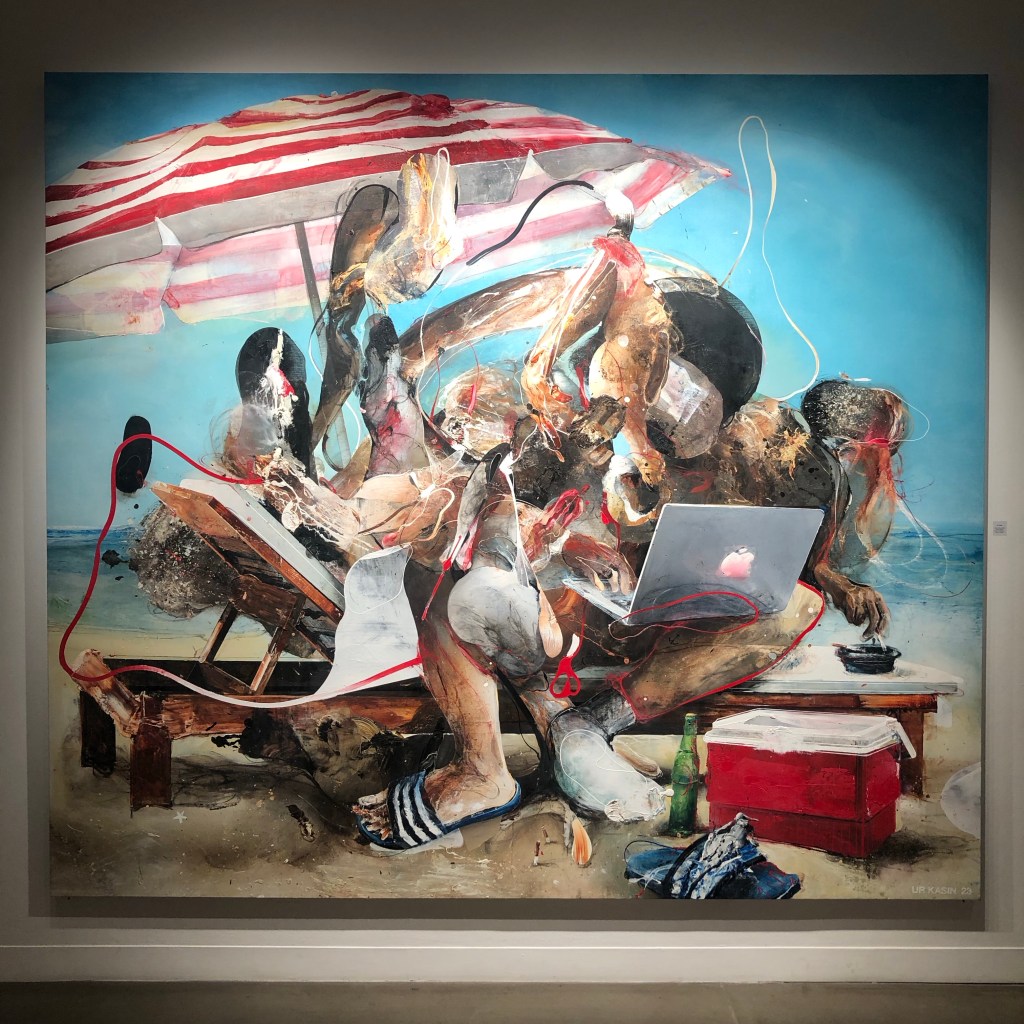
Thoughts: I liked the semi-abstract nature of this painting. There is chaos on the canvas but it’s also very well thought through. I want to make semi-abstract work but not in this way, nonetheless, this was an interesting example for me to ponder over.

There were two Kojo Marfo paintings, both large scale oil on canvas – sizes were not specified for one of them:

Estimated size 2m x 2m

Thoughts: I once did some research on this artist as part of an essay about transcultural artists. I like his use of colour, intrigue and the way he expresses his transculturalism and uses symbols in his work. Although it’s not the kind of work that I want to make, I have been inspired by his use of symbols and have at times incorporated that into my work.

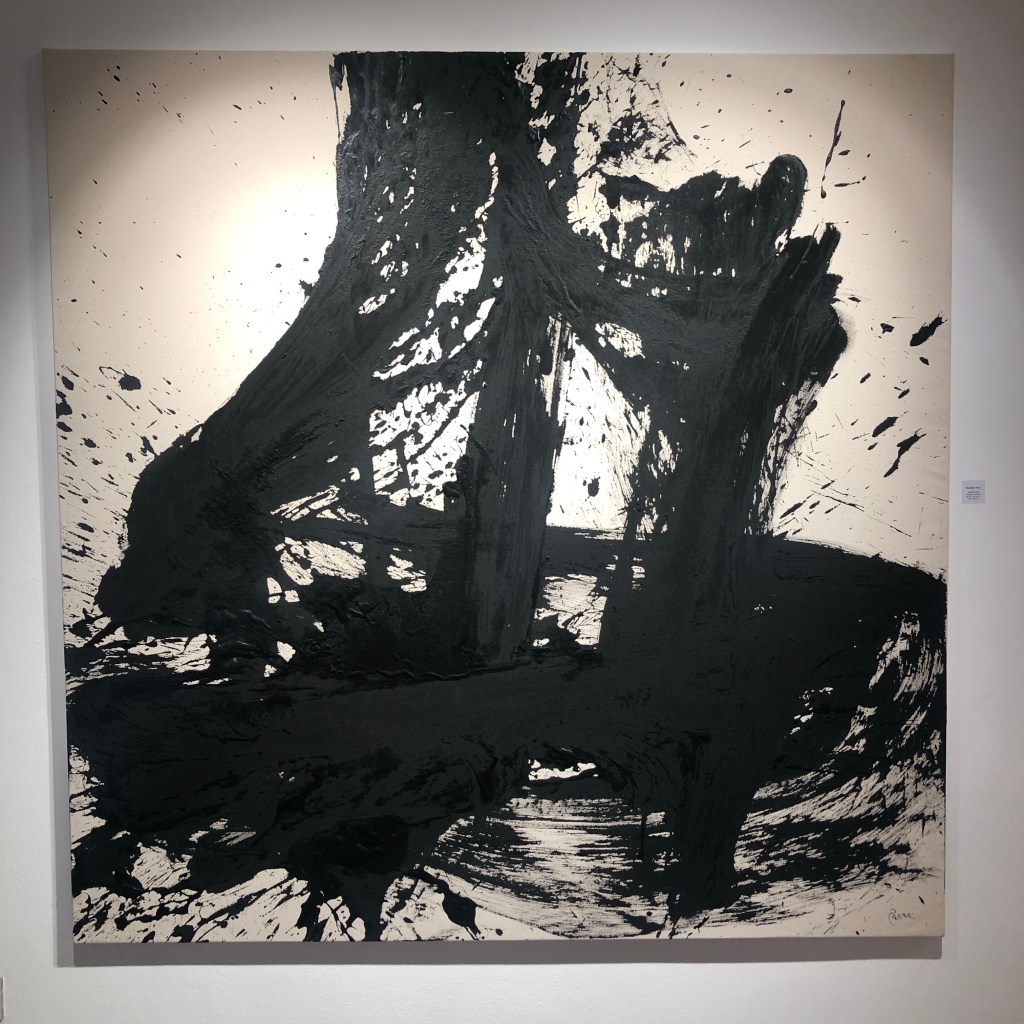
Thoughts: Out of all the works in the gallery, I was most inspired by this one. It reminded me of once seeing a video of a Chinese artist using a very large paintbrush (the size of a floor mop) and painting on the floor in black in a highly charged way. Seeing this painting reminded me of that and I want to experiment with painting in that way.

Next steps: I’ll research what can be used as an extra large paint brush and what ink or paint I would use. Then I would either use a plain background or a digitally printed canvas with a digital collage and then use the large brush to do Chinese calligraphy on the the canvas, with just one or two large characters.