In parallel to the work on developing my style, I work on my memory to help develop my narrative such as remembering and researching stories from my childhood. Work in this area often stems from triggers – it could be encounters that remind me of something from the past or thoughts that suddenly come to me. This blog captures a piece of work that I have done as a result of seeing an Instagram post by my brother. He was holding a cup of tea and seeing his hand reminded me of our time together as children. Sadly, we haven’t see each other for many years as we live in different countries. Despite that, I remember clearly the details of his slim artist’s hand, the shape of his finger nails etc.. Seeing his post brought back many memories.
Another purpose for this piece was to experiment with digital drawing tools. During a recent discussion with my fellow MA students, they were discussing the pros and cons of Procreate vs Adobe Photoshop. I have tried Procreate in a limited way some time ago and the discussion ignited my interest to try those tools again.
FINISHED WORK
METHOD
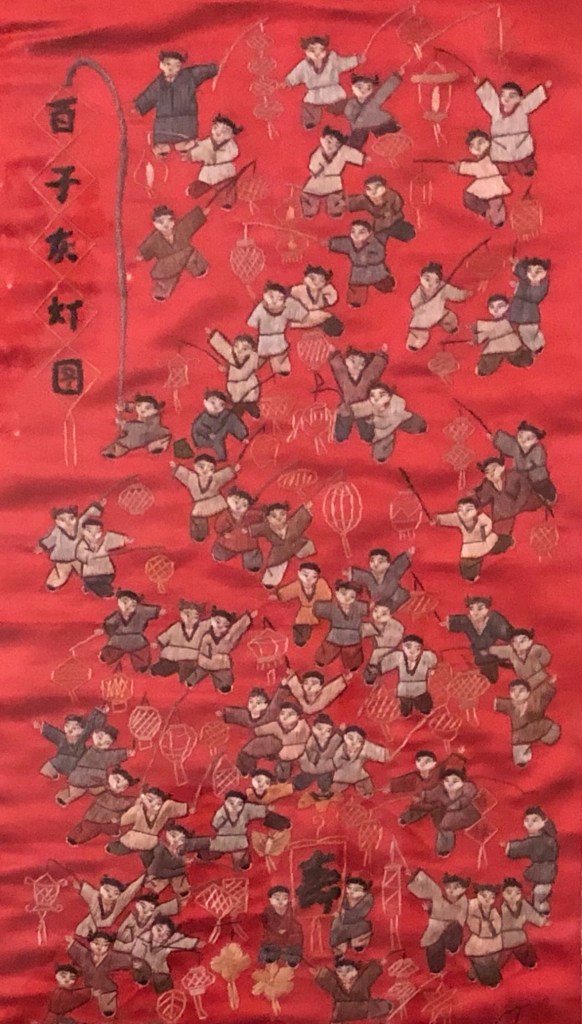
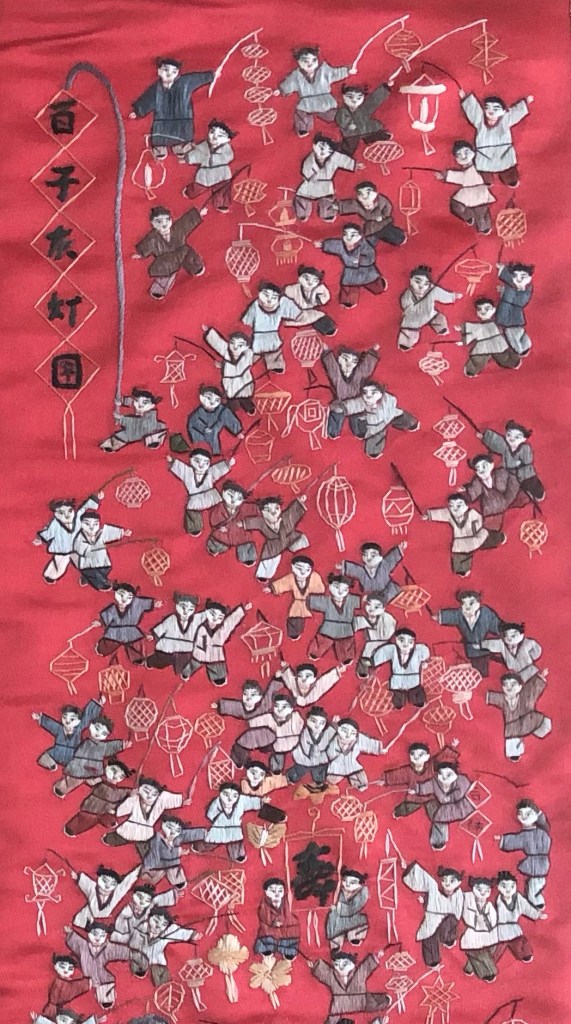
I wanted a vibrant image to use as background on the digital canvas for this piece. I have at my home a piece of Chinese tapestry that my brother gave me many years ago. It’s framed and hangs in my lounge. I took a photo of it and decided to use that as the background.
Background tapestry image
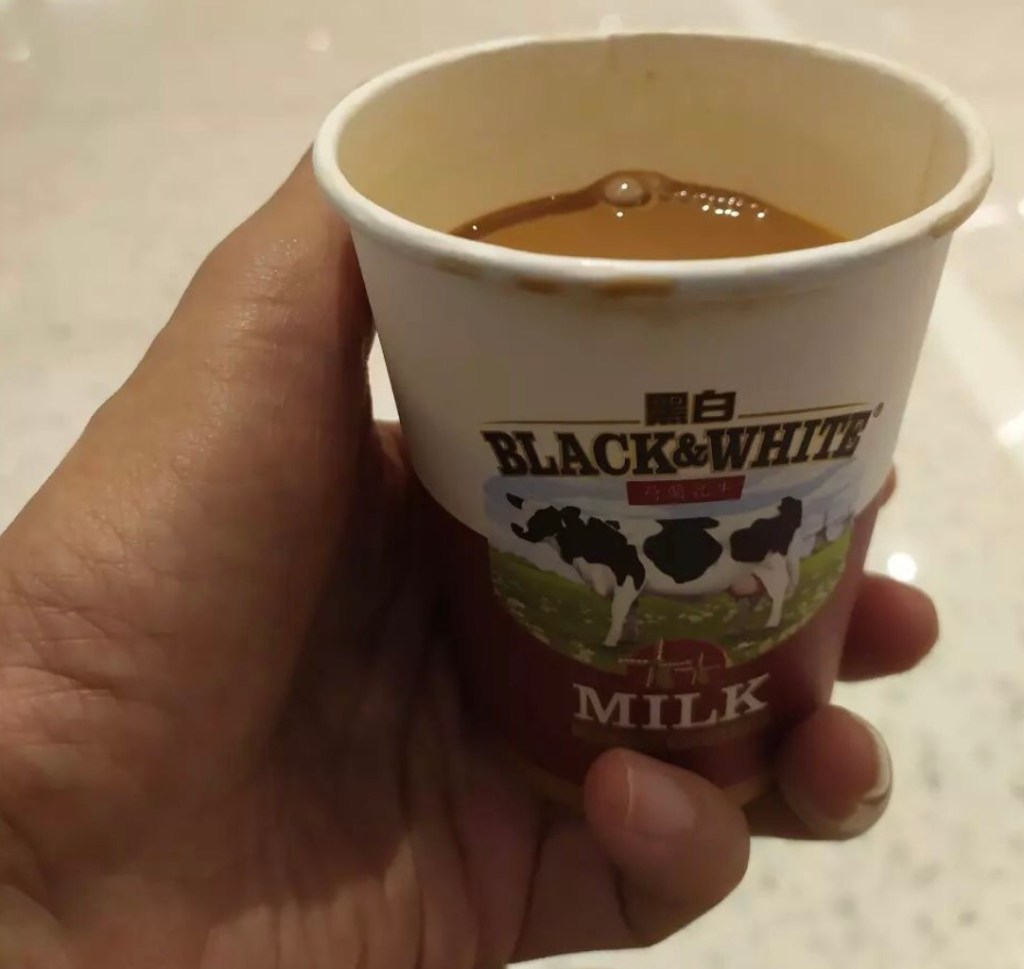
This is the image cut from my brother’s Instagram post with him holding a cup of tea that was a free giveaway from a shop and the was in the comment of his post.
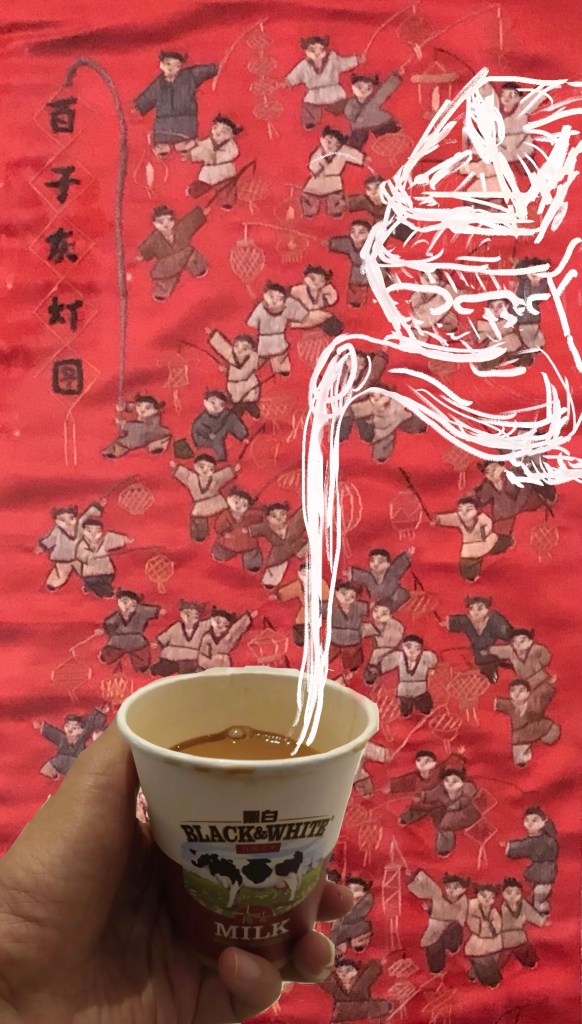
I wanted to make a composite where there’s a tea pot topping up his cup of tea because if I were there then I would pour him a cup of tea.
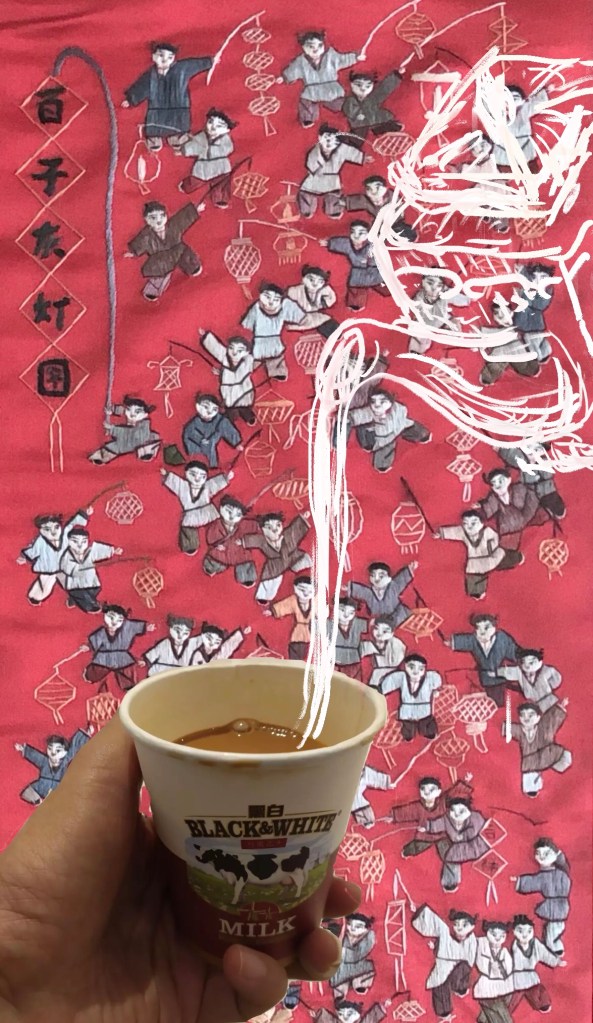
First attempt using Procreate. The tea pot was too flat so I wasn’t happy with this:
Second attempt with Procreate with a better angle for the teapot for pouring:
I was not happy with the background image so took another photo with the tapestry in day light. I was happier with this image:
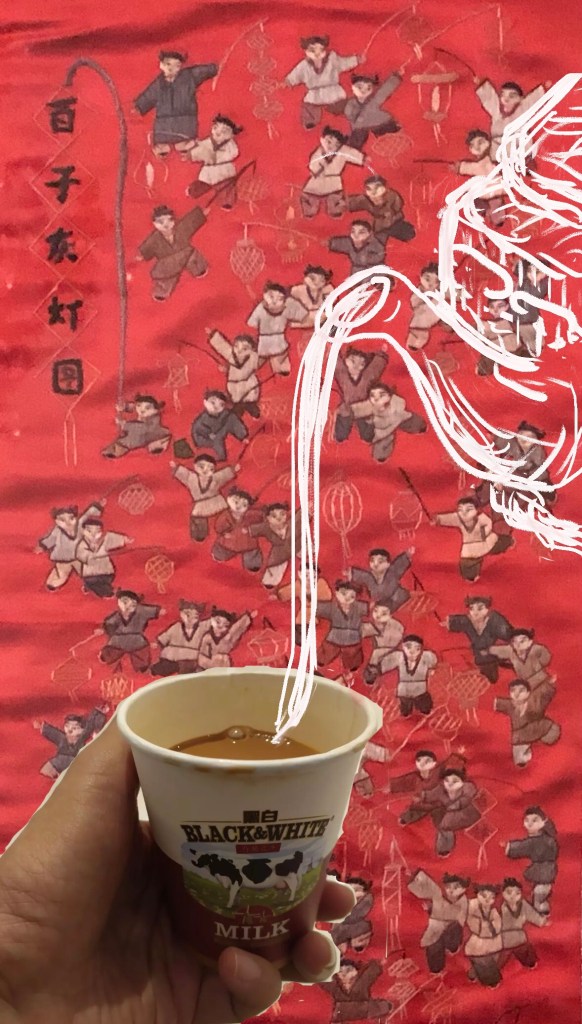
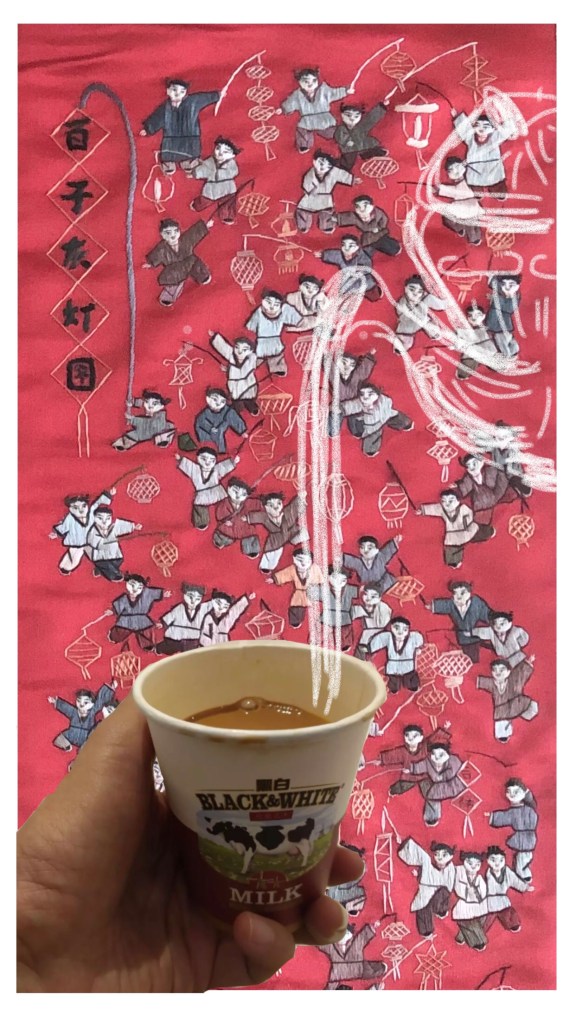
Since I purchased the Adobe Suite using my student discount from UAL, I tried for the first time using Adobe Fresco. Below was the first attempt, I wasn’t happy with the lightness of the brush stroke using ‘charcoal’ as the medium:
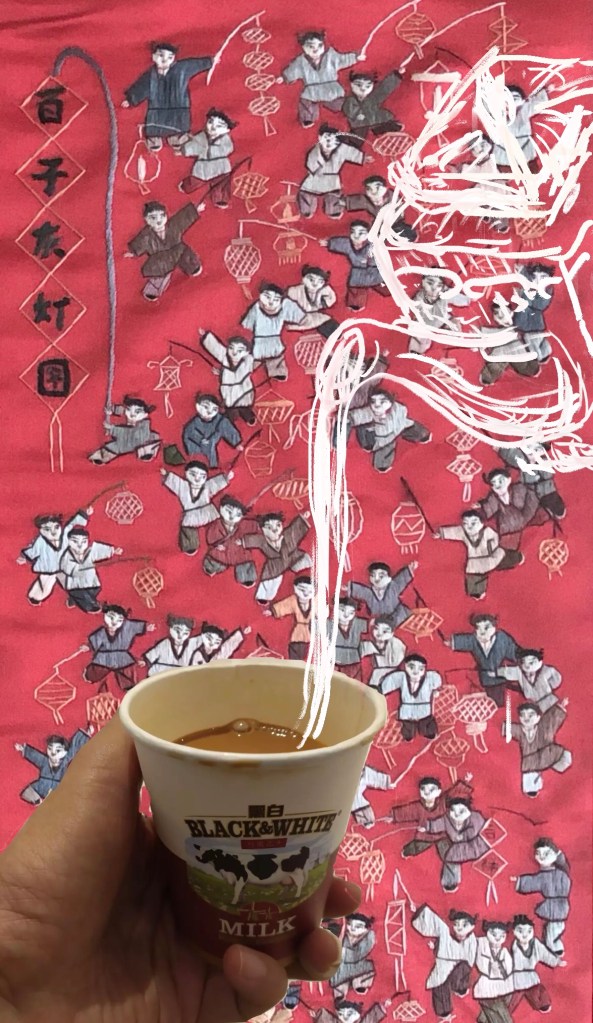
I played with the different setting for the brush selected and I was happy with this final version:
Finished work
–
REFLECTIONS
Out of the two digital tools I used, I was fairly happy with Procreate and I would still be happy to use it on the go, on my iPhone or iPad. However, I really like Adobe Fresco and prefer that as a digital painting tool. I like Fresco because I use it on my MS Surface Pro with a MS stylus and the response and control of that combination is excellent. The software is very flexible and intuitive to use. Procreate is even easier to use, but I feel even the Apple stylus (I borrowed one to try) didn’t give the control that the MS Stylus achieved for me. Also, since I do not own an Apple stylus, I am very happy to stay with my MS set up. I want to experiment a lot more with the tool in order to be competent with it.
I struggled to reflect on my feelings about this piece. I didn’t think too much while making the piece because my focus was on mastering the new digital tools. However, writing this blog has been a challenge for me because of the feeling of nostalgia and the sense of lost time. It took me several attempts to get this far in writing and I don’t think I’m ready to examine that too deeply yet. I hope I’ll be able to do that over time and I hope my art practice can help me with that journey of rediscovery.
LEARNING
The technical learning was about comparing the two digital drawing tools. I preferred Adobe Fresco and will continue to experiment. I plan to do a more ambitious piece of digital art next.
I have a long way to go in delving into my memory to develop my narrative. There is a lot of content buried and I will slowly dig through like an archaeologist – this was discussed with my tutor at the recent tutorial.
NEXT STEPS
As an immediate next step, I want to create another digital painting using Adobe Fresco on my MS Surface Pro with the MS Stylus.
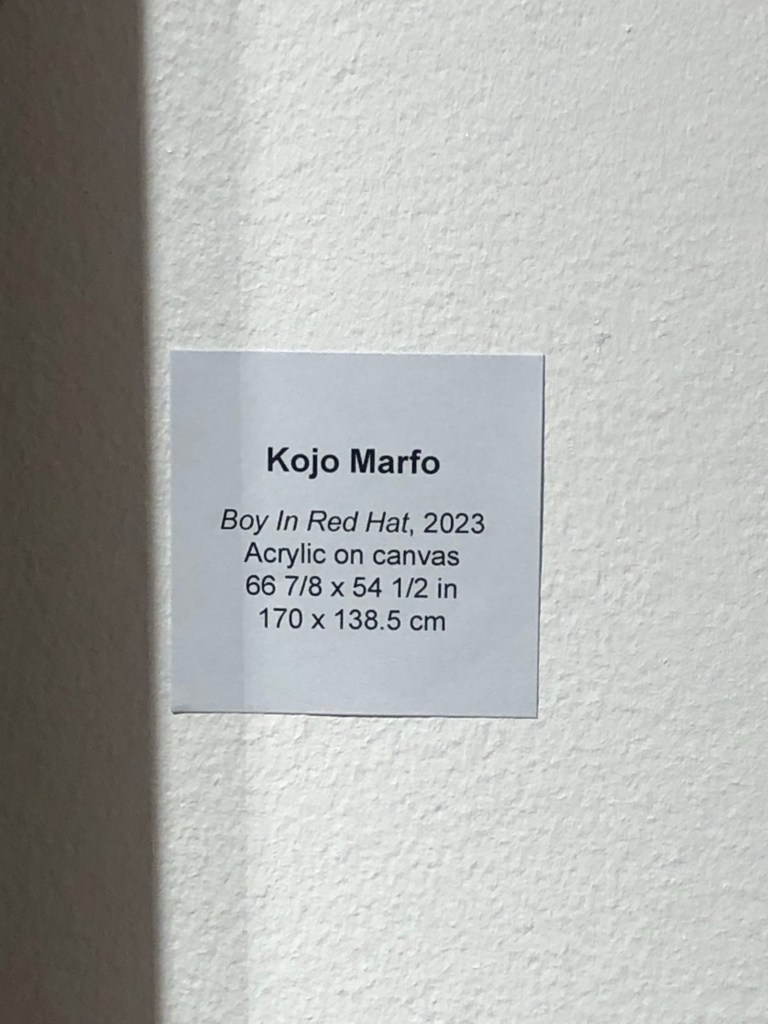
This was an impromptu visit as I walked past the gallery. I have previously looked at their exhibitions online because I was researching the work of an artist that they represent – Kojo Marfo, a Ghanaian artist who is now working in London. So I went in to have a look when I came walked past them by chance.
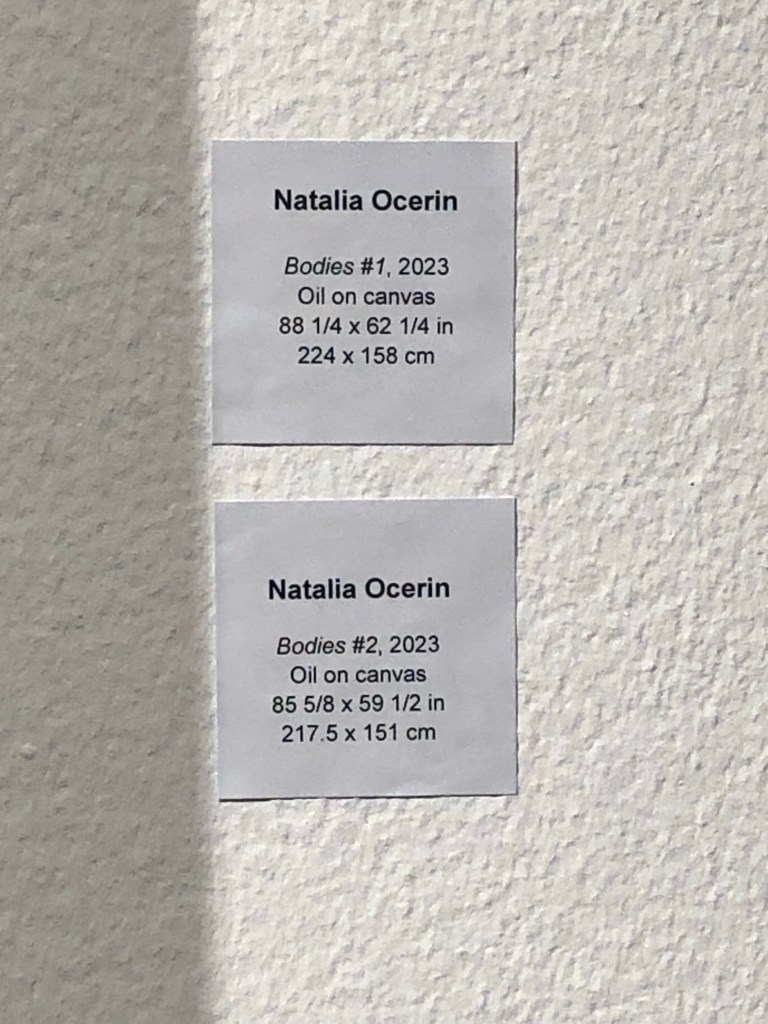
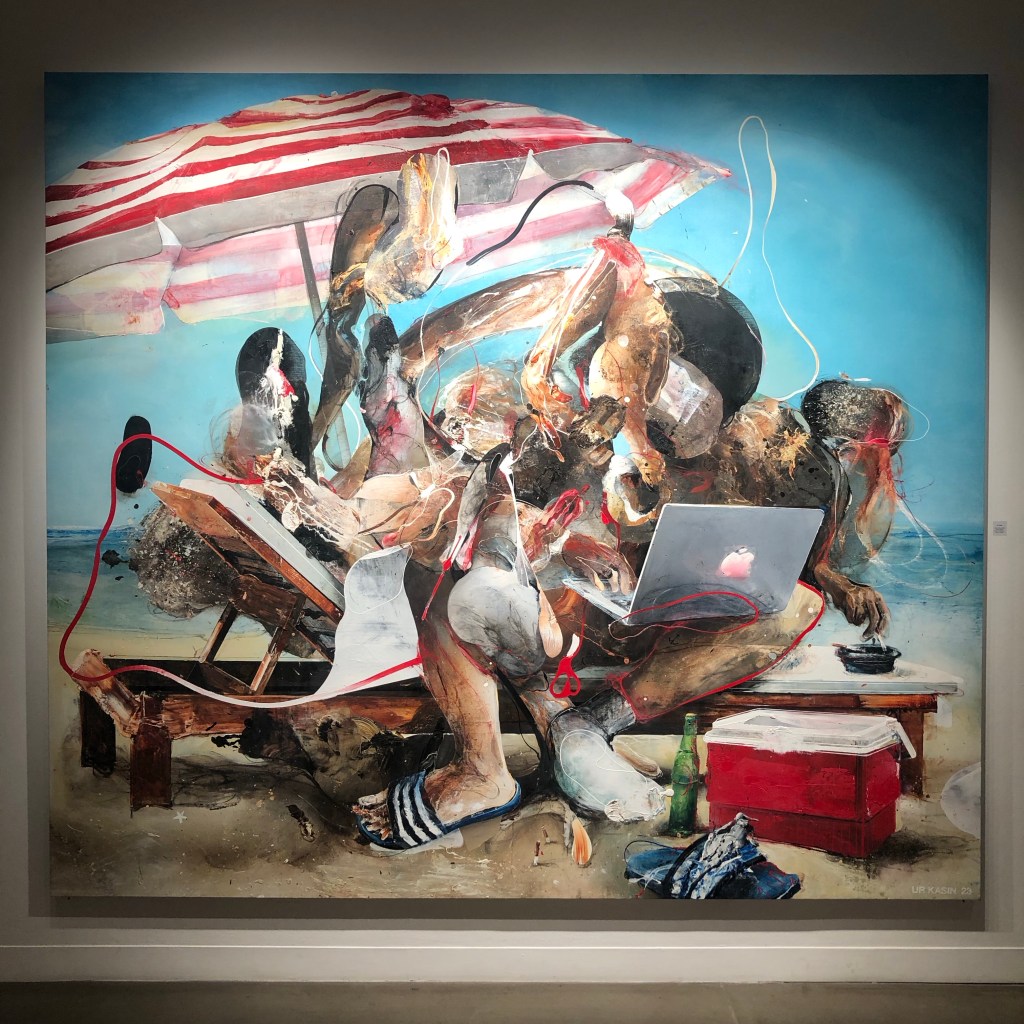
I only spent a short time there so I’ll capture some quick notes here on works that caught my attention and I’ll state the reasons for my interest.
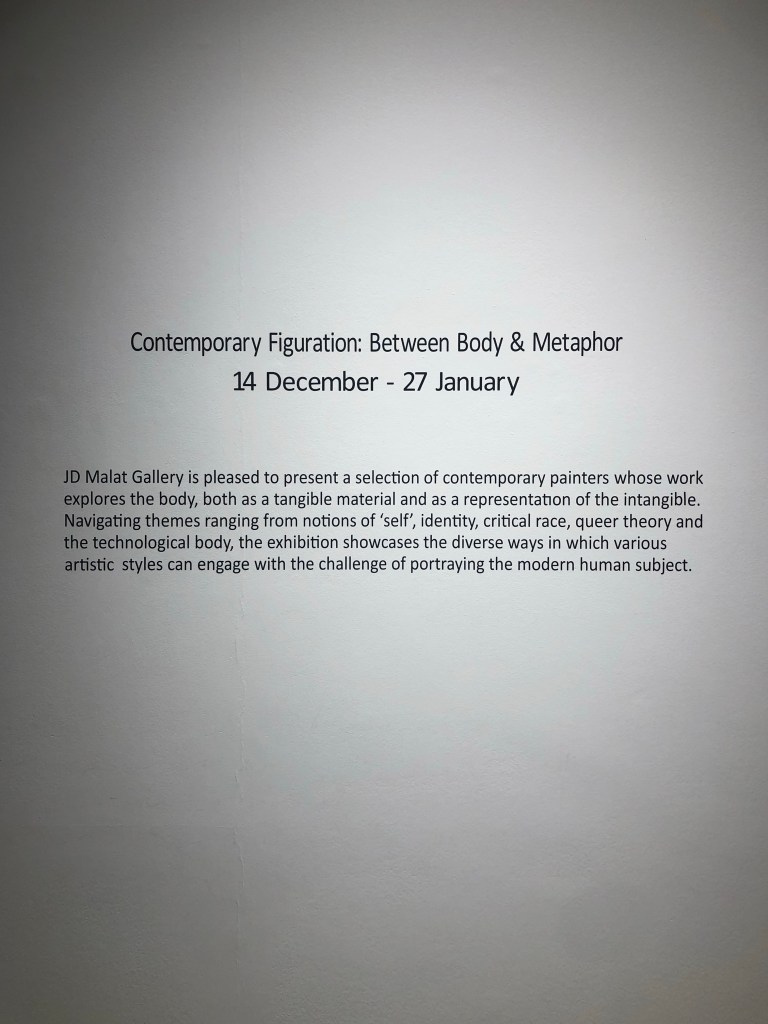
Title of exhibition
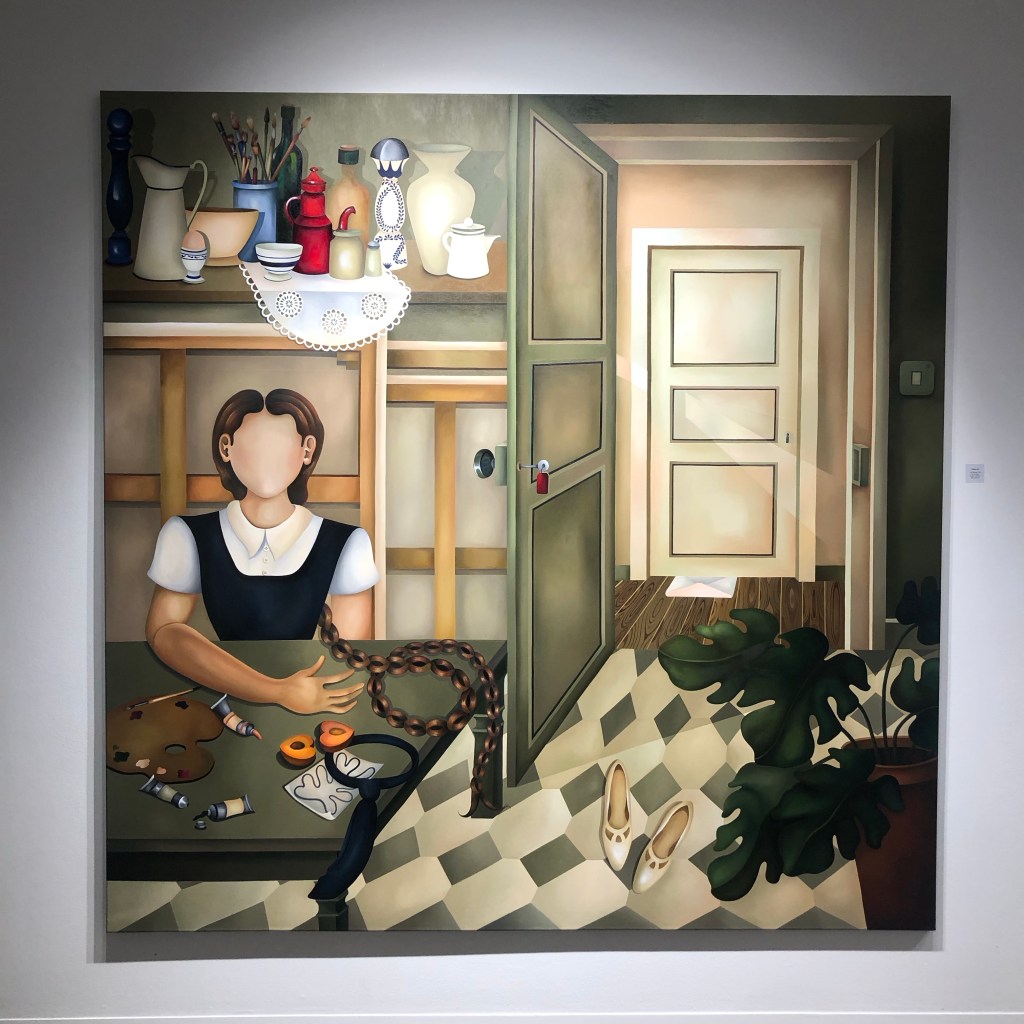
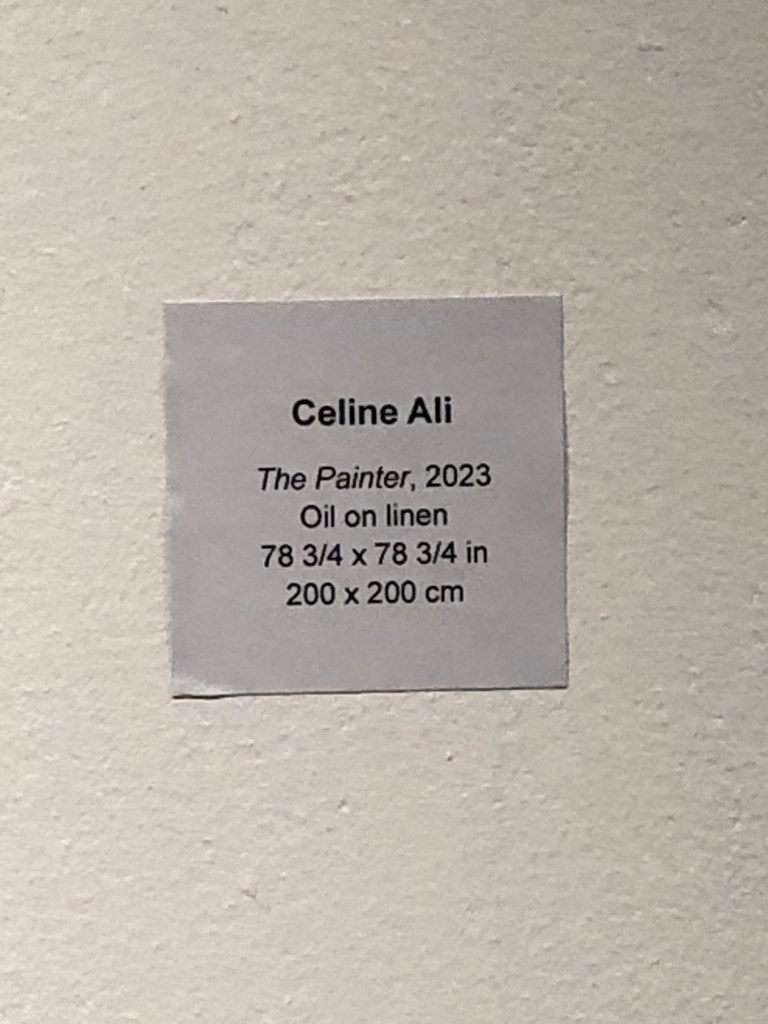
Thoughts: I often use animal or bird faces on the characters that I depict in order to anonymise the story and not make them too personal. I really like the way this artist blanked the face, I think it’s a possible way for me to achieve the anonymity that I was looking for in my story telling. So I’ll consider this approach.
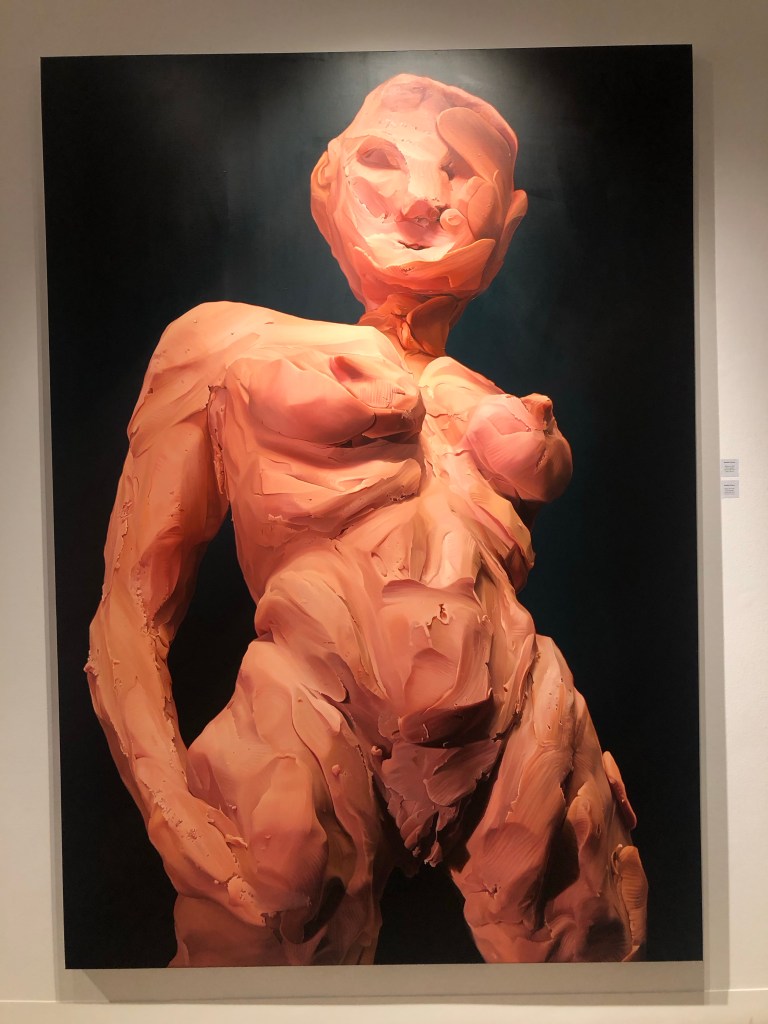
Thoughts: This was a close to photo realistic painting of a sculpture. I thought it was a digital image to start with then I saw that it was an oil painting on canvas. What I liked is the idea of making a sculpture or 3D work then making a painting of that. Something to bear in mind as an idea.
Thoughts: I liked the semi-abstract nature of this painting. There is chaos on the canvas but it’s also very well thought through. I want to make semi-abstract work but not in this way, nonetheless, this was an interesting example for me to ponder over.
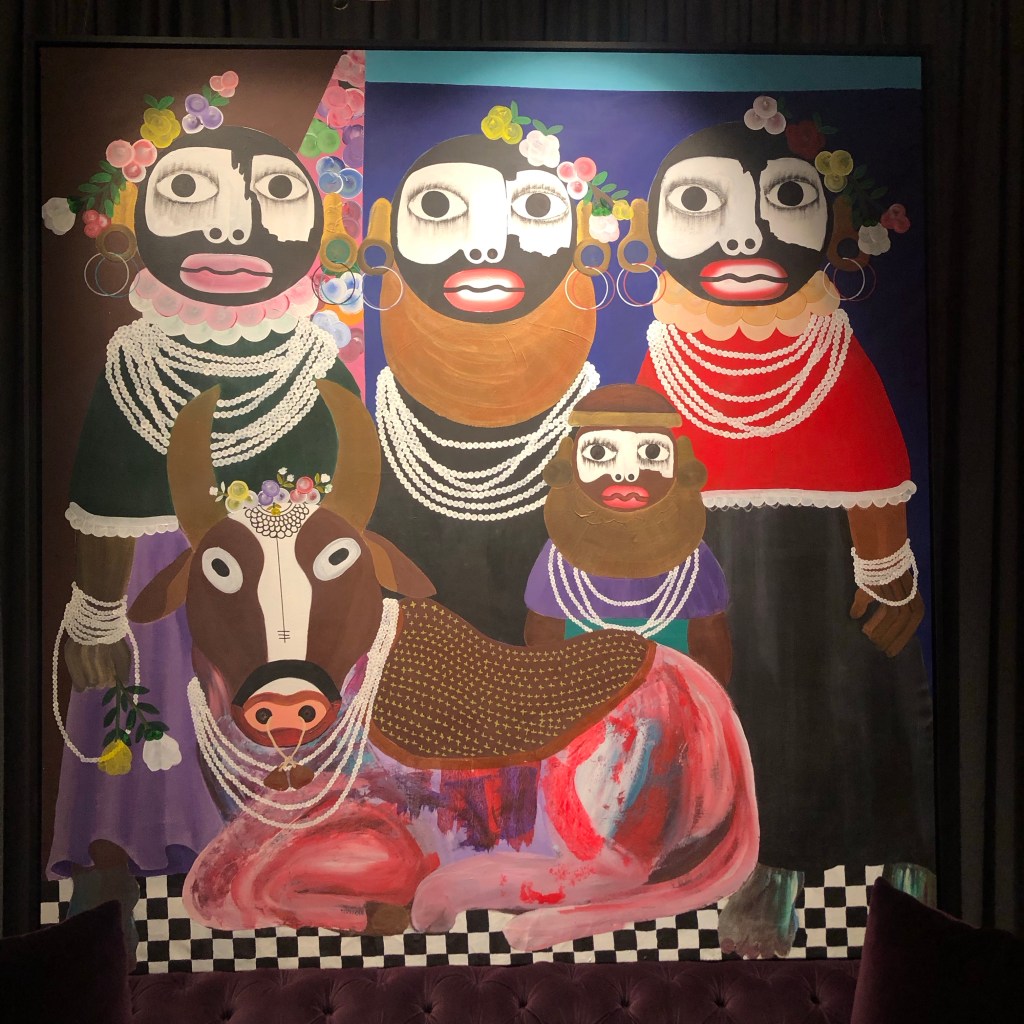
There were two Kojo Marfo paintings, both large scale oil on canvas – sizes were not specified for one of them:
Estimated size 2m x 2m
Thoughts: I once did some research on this artist as part of an essay about transcultural artists. I like his use of colour, intrigue and the way he expresses his transculturalism and uses symbols in his work. Although it’s not the kind of work that I want to make, I have been inspired by his use of symbols and have at times incorporated that into my work.
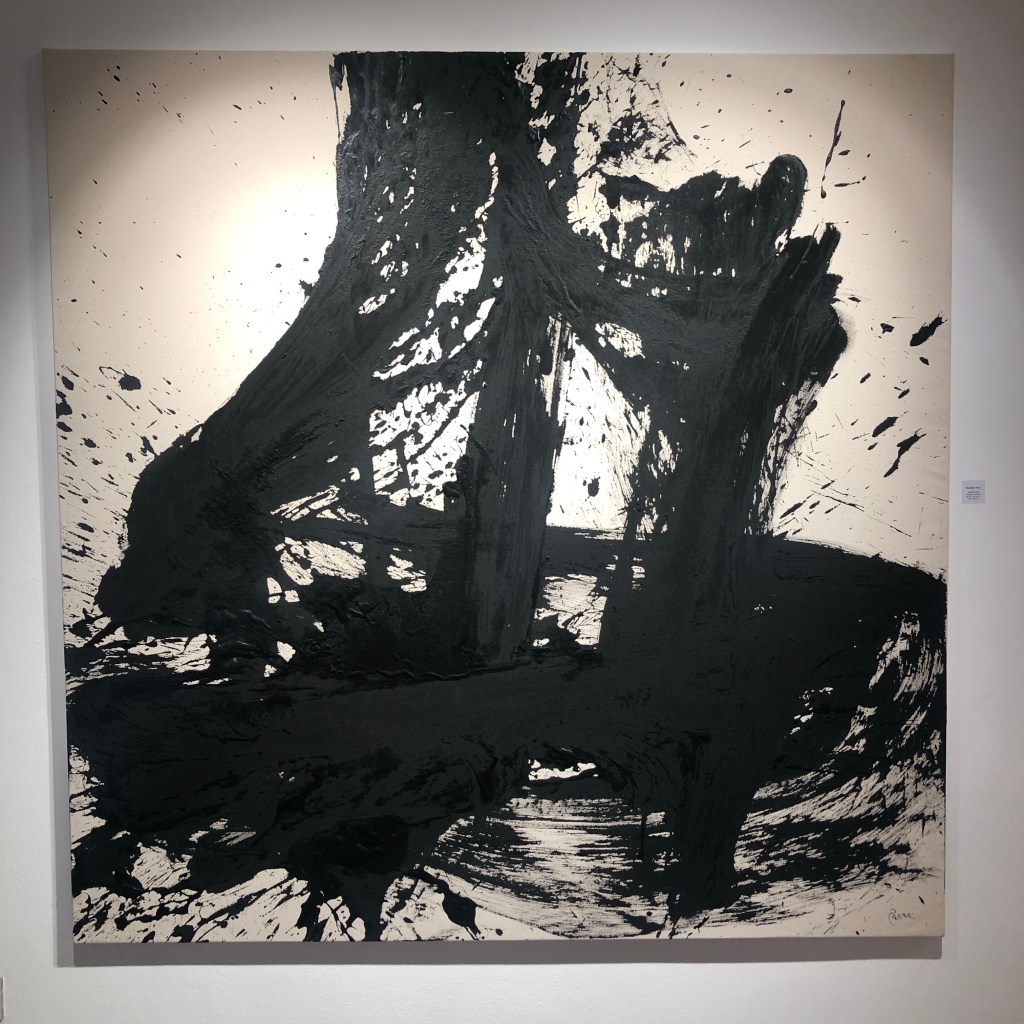
Thoughts: Out of all the works in the gallery, I was most inspired by this one. It reminded me of once seeing a video of a Chinese artist using a very large paintbrush (the size of a floor mop) and painting on the floor in black in a highly charged way. Seeing this painting reminded me of that and I want to experiment with painting in that way.
Next steps: I’ll research what can be used as an extra large paint brush and what ink or paint I would use. Then I would either use a plain background or a digitally printed canvas with a digital collage and then use the large brush to do Chinese calligraphy on the the canvas, with just one or two large characters.
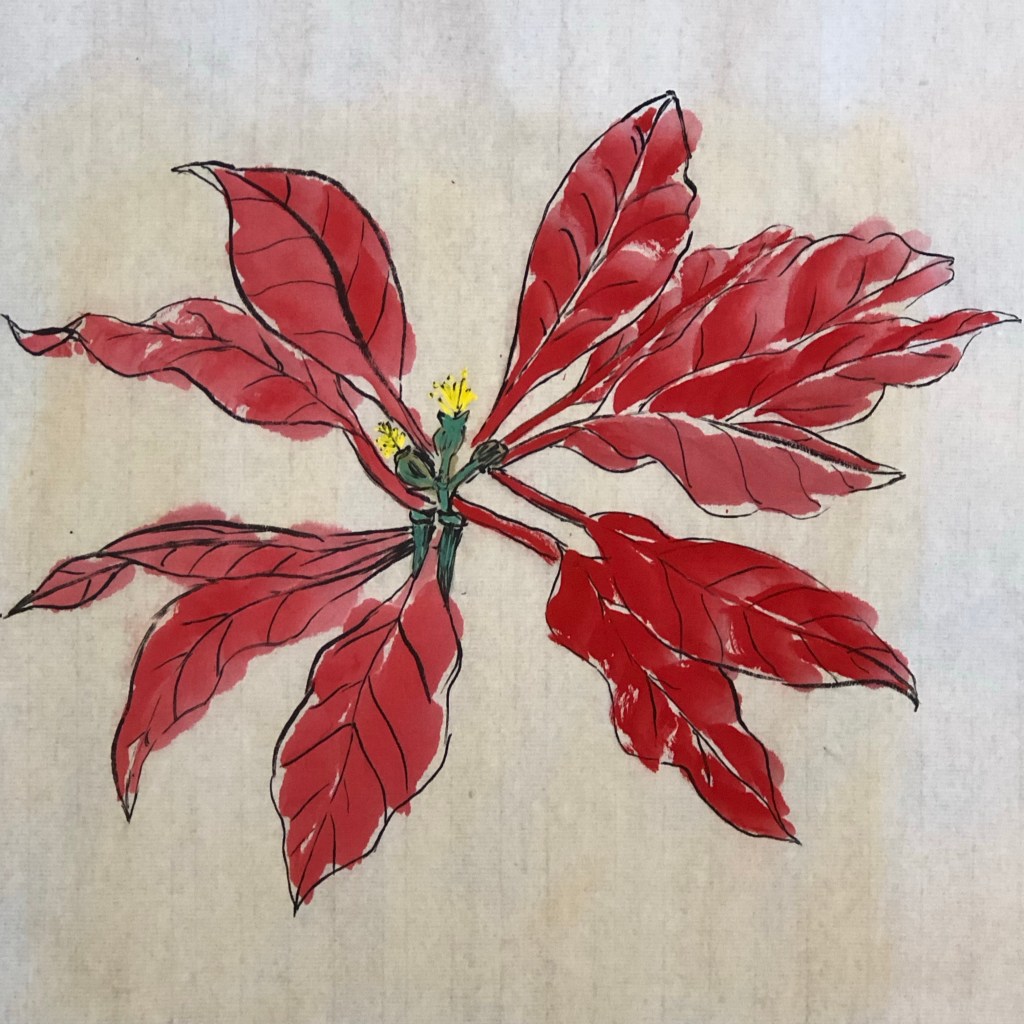
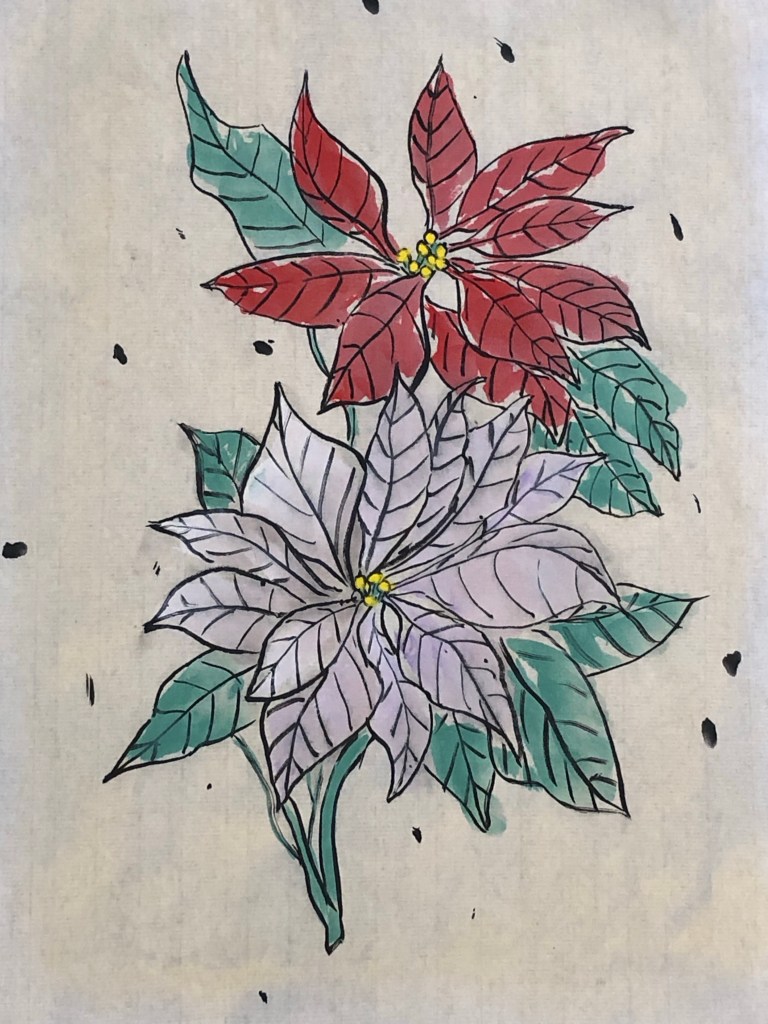
I attend a Chinese painting class once a month. This month being December, the topic was Poinsettia. See below images. They were copied from worksheets. These are skills practice exercises so I will only do a brief reflection.
REFLECTIONS– PART 1
I have enjoyed these work sheets more than the owls from the month before because I found it easier to be free with my paint application with this topic. I think it’s because I feel more confident with the subject. So this is good learning for me, that when I do abstraction work, I do better when I feel confident. When I am hesitant then brush strokes seem too deliberate and also prone to becoming too illustrative.
EXPERIENCE – PART 2
Introduction to Sumi-e painting
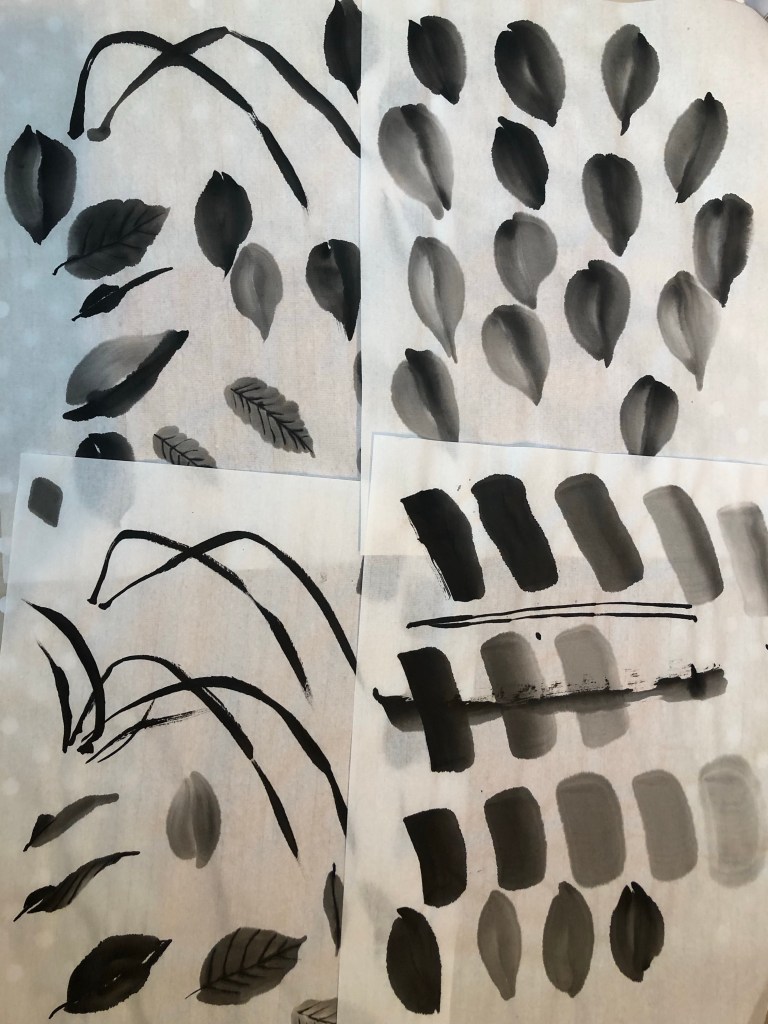
I was introduced to a new topic, Sumi-e painting, which will last the next few months. Sumi-e (水墨 water ink) painting is painting with ink and water and focuses on the simplicity of form. For this first brief introduction, the tutor asked us to practice mixing five shades using only black ink and water. Then we practiced doing different types of leaves.
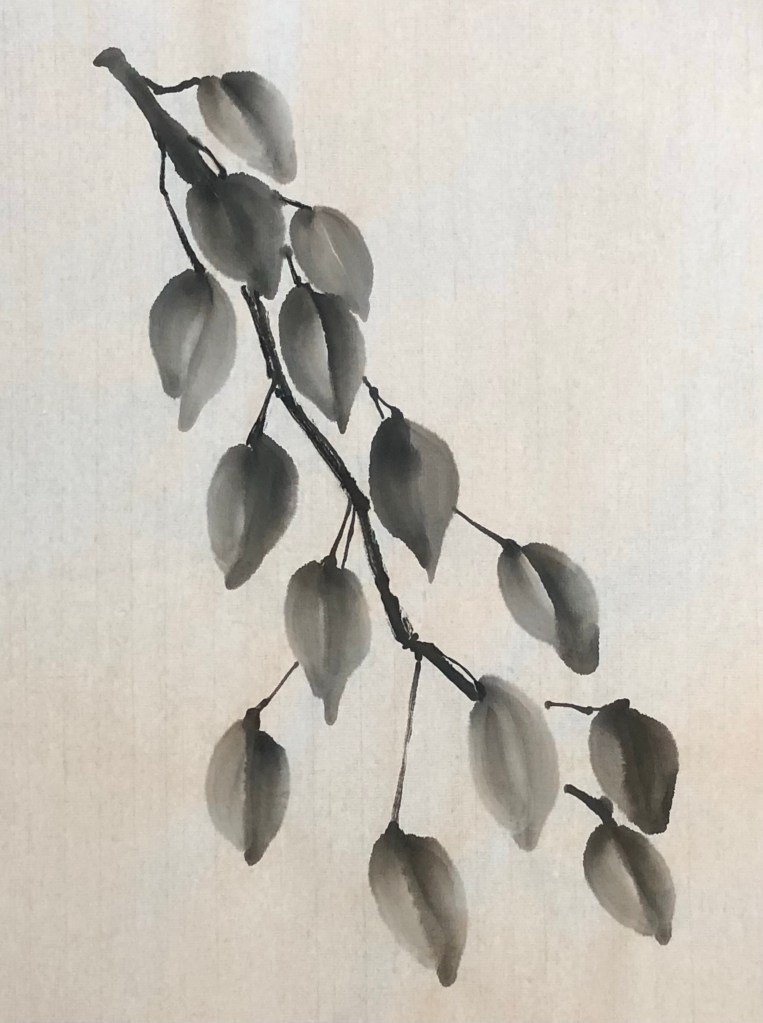
I picked out one type of leaves and made a painting using only that type as practice. Below is my first Sumi-e painting.
REFLECTIONS – PART 2
Sumi-e is very challenging! It will take a lot of practice to get to know the materials – the simplicity of materials makes it hard. Just water, ink and the performance of the brush and paper used all come into play. I have always found Chinese brush painting very unforgiving, it is not easy and most of the time not possible to correct any mistakes – in that sense, it is more like water colour than oil or acrylic (that I am used to) where mistakes can be rectified quite easily. Sumi-e’s unforgiving-ness is at an even higher level. I can imagine practicing for a long time and still not perfecting that leave that I have tried to paint.
I enjoy this challenge and I would love to be competent at Sumi-e because I like a good challenge; its simplicity of form and potential for semi-abstraction is what I find appealing. I am looking forward to continuing my learning of Sumi-e painting.
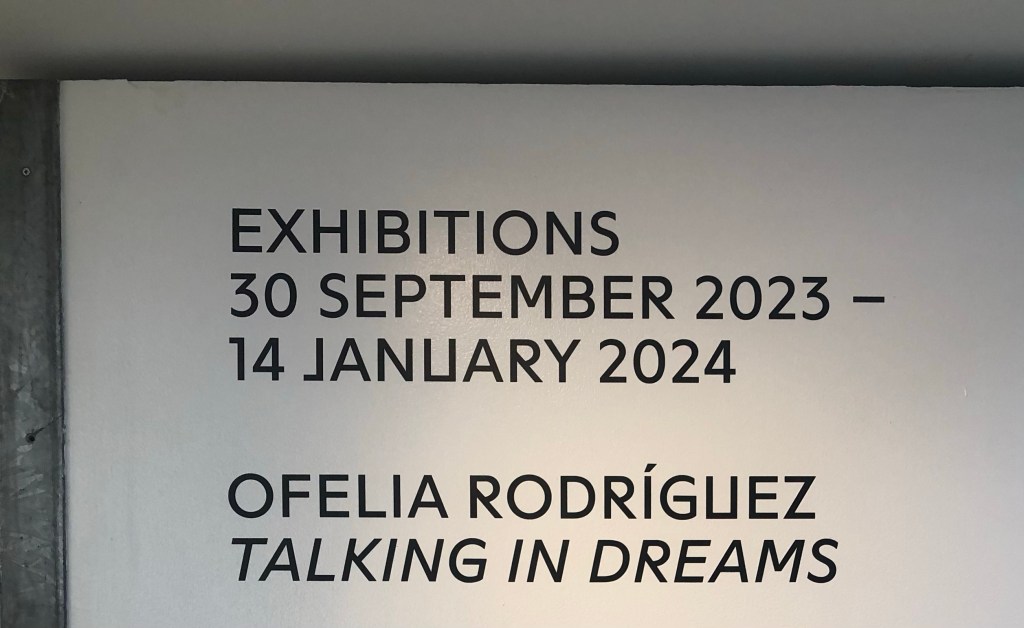
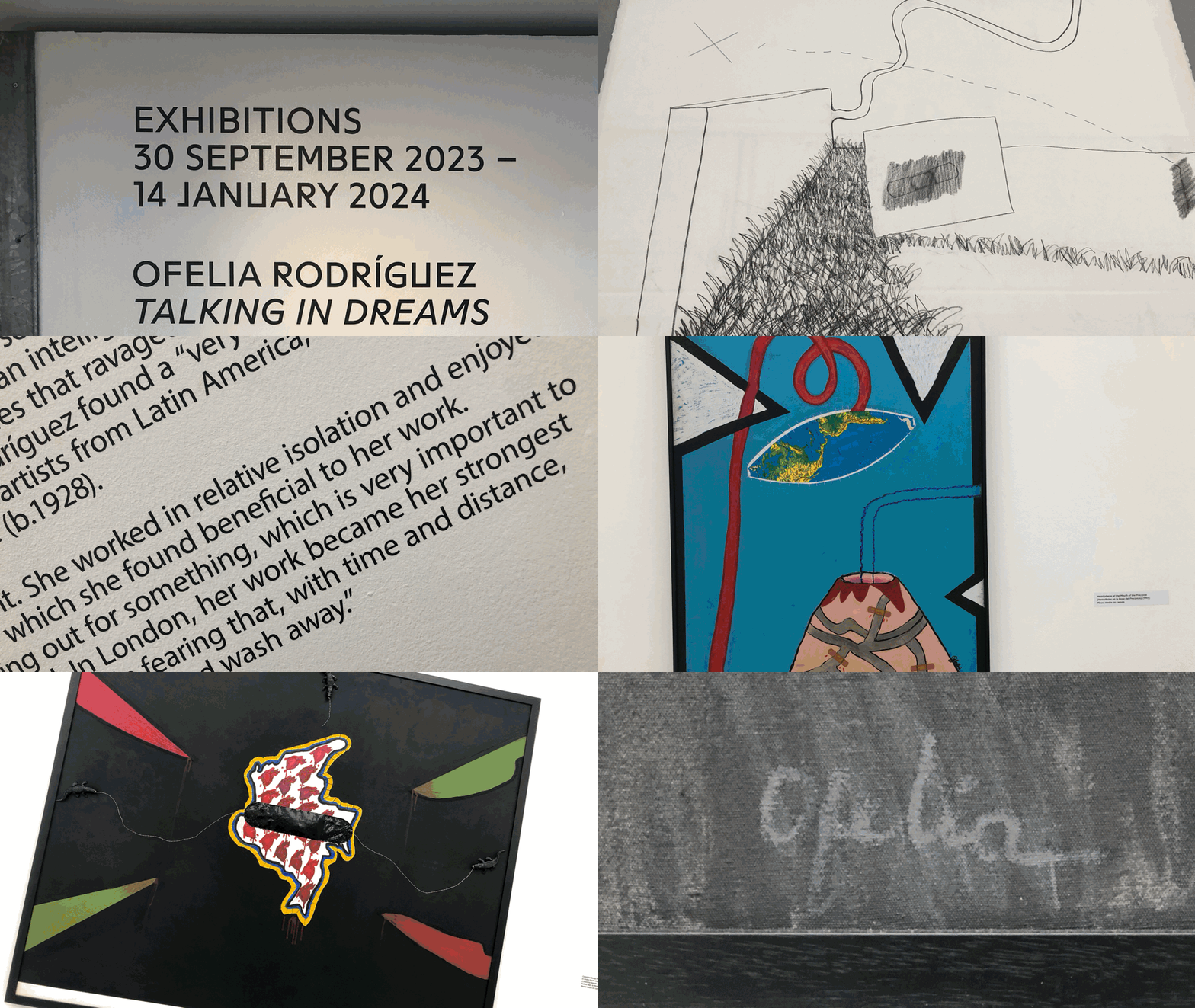
I visited Ofelia Rodriguez’s exhibition Talking in Dreams at Spike Island, Bristol. Below is a video summary of the visit compiled using the iMotion App. I learnt to use this app at a CSM online workshop and I wanted to experiment summarising a gallery or exhibition visit in this way:
REFLECTIONS
– Rodriguez’s work has really inspired me because I can relate to her work as someone who makes art about her homeland while living far away. In particular, I like her work with the bright colours and her chosen palette gave me a sense of the place she was describing. I feel I should explore a colour palette that describes my childhood home city of Hong Kong, this might help me when I am stuck on ideas about work to make.
– I was also inspired by the textiles used and the stitching in her work. Stitching into my paintings is not something that I have considered before but I have often thought about using fabric in my work. So this is an area that I will explore.
– Another thought arising from the above point… I have in the past made expanded paintings where I had eradicated the traditional canvas. I could make paint-based fabric to incorporate into my work.
– Rodriguez used a lot of found objects in her work which is fascinating to look at. However, right now, it is not an area that I am interested in because I already have several strands of enquiries going on and I feel I should make some progress before adding more variables. But I wouldn’t rule it out and I may come back to this at a later stage.
LEARNING
– Technically, I am happy with using iMotion in this way because in the past I often ended up uploading many photos from a show making the blog unnecessarily long. So I’m happy with this new discovery. Things to remember are to export the file as a GIF from iMotion to my Photos app to minimise file size and to upload the GIF to WordPress as an image and not a video. Also to give it time to upload.
– Other learning have been captured above under reflections.
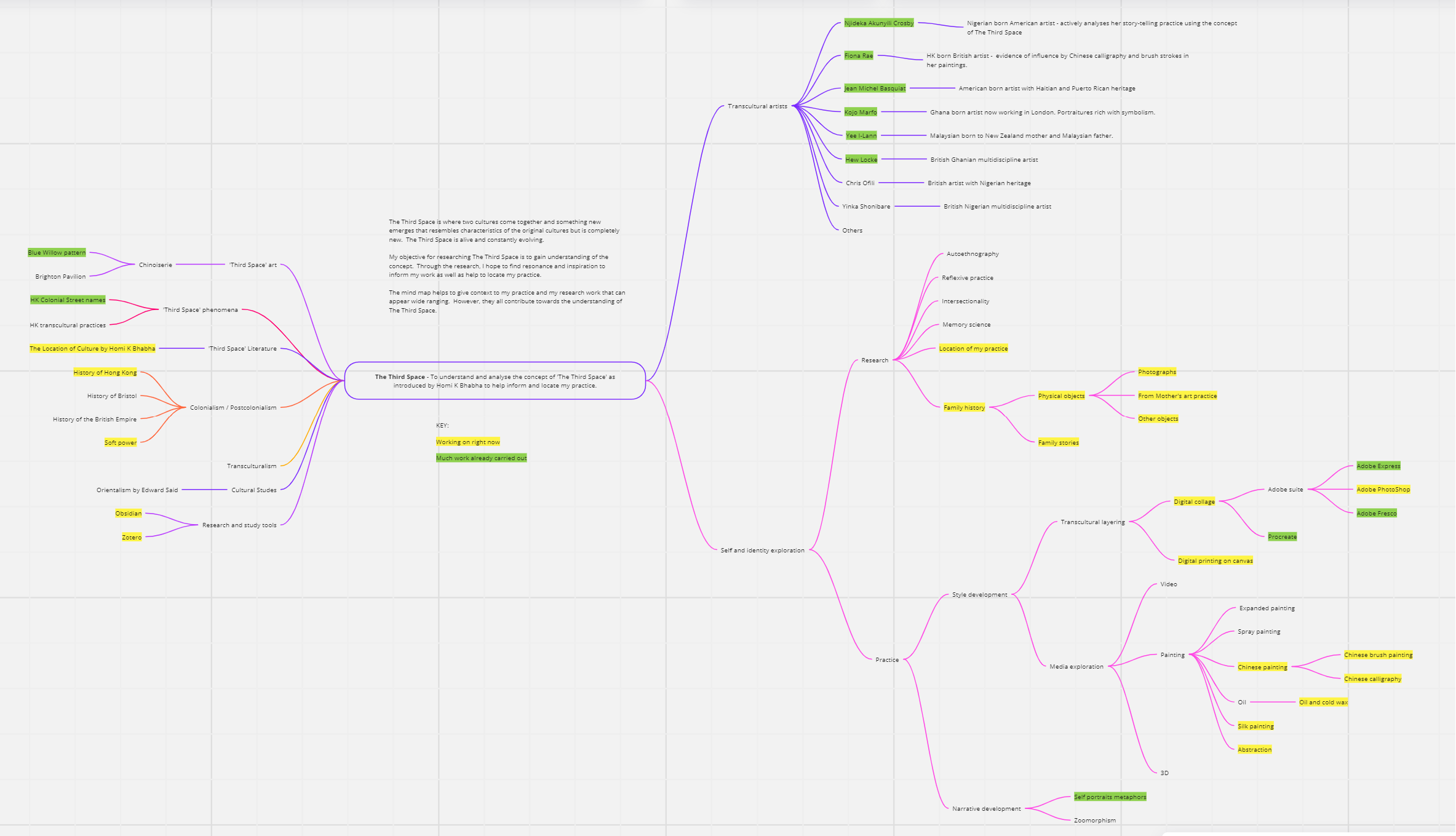
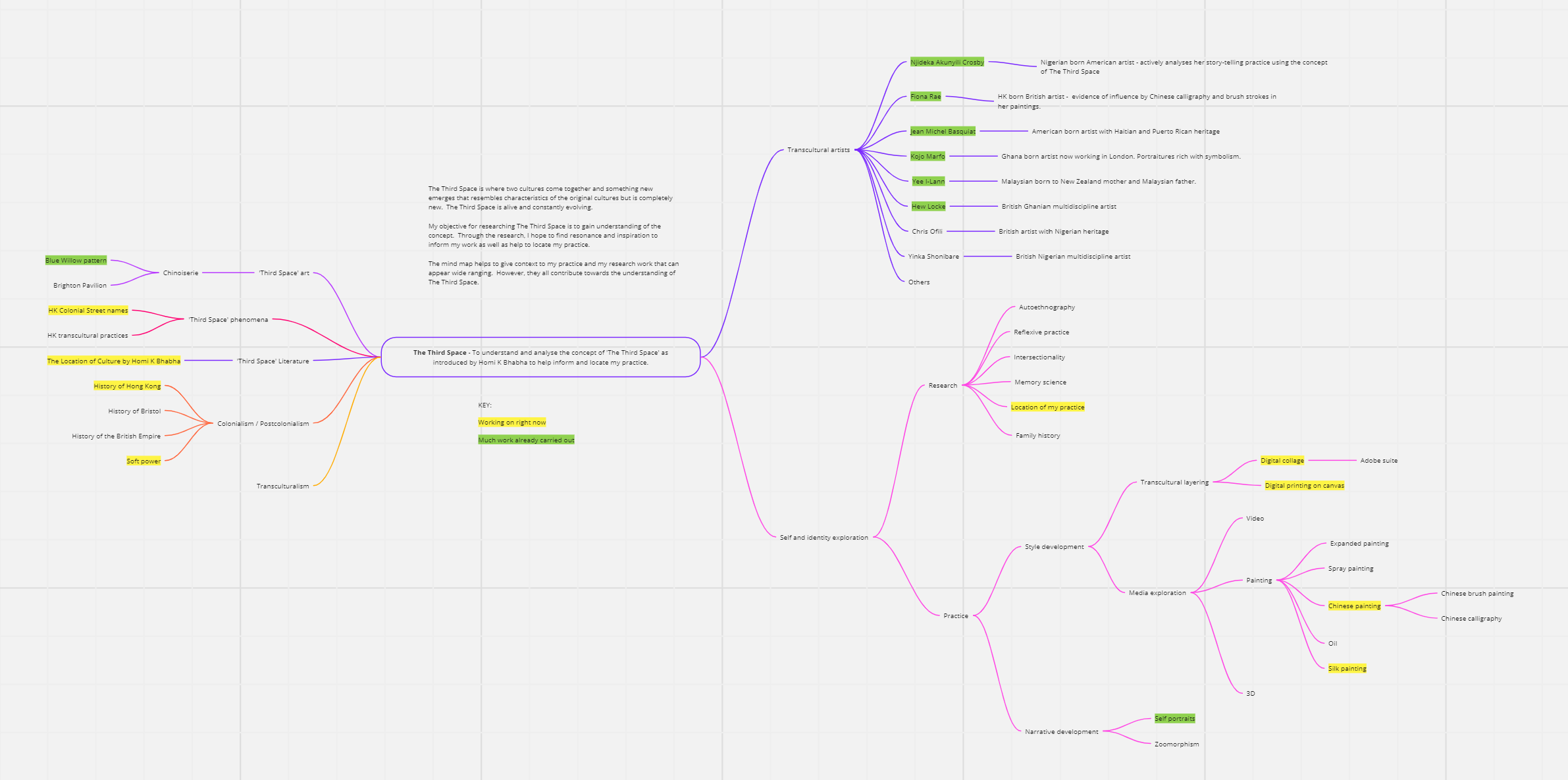
I created a MindMap at the start of the course to chart the topics that I have been working on and intended to work on. I plan to periodically update the MindMap and this is a blog to quickly capture my progress over time. I expect the map to expand or change as my practice and research grow. I am mindful not to let such a structure confine my practice development – this point was discussed with my tutor at the first tutorial.
My reason for creating the map in the first place was to examine the central purpose of my practice. Then to ensure that all the topics I am working on do contribute towards the central purpose, rather than going off in random tangents. This is important to me because of who I am; I like to freely explore but I need to have an underlying structure that I can come back to and not feel too lost in wandering.
The maps are shown in reverse chronological order.
Date updated: 11th December 2023 (End of first term)
REFLECTION:
I feel that The Third Space is still valid as the central purpose of my practice and I will continue in that direction. I have updated the map with the colour code – some items have gone to yellow and some turned green which was reassuring to know that I have worked on what I had set out to focus on. I have also added some new sub-branches which are expansions of existing topics. The only new branch was ‘Research and study tools’ – an area that I was not expecting but I am very pleased that through the MA course, I am learning about new tools that will help me to organise my research work. Since I have previously mainly used Microsoft Office products, this new knowledge and area of learning are completely new to me hence I felt I should capture them as a new area on the map.
Date created: 23rd October 2023 (Soon after start of Unit 1)
RELATED BLOG
The blog below is a time and activity analysis detailing the time spent on various aspects of my practice development on an ongoing basis:
This is Part 3 of my blog series on exploring oil and cold wax. I’m exploring this combination of medium because I have always liked the effect this combination produces and I want to explore building it into my practice. Through this exploration, I want to find ways to examine my third space from my subconscious through abstraction.
METHOD
Despite doing various practical experiments as well as online research about working with oil and cold wax. I reached a stage where I was looking for some more formal guidance. So I attended a series of online webinars ran by St Ives School of Painting.
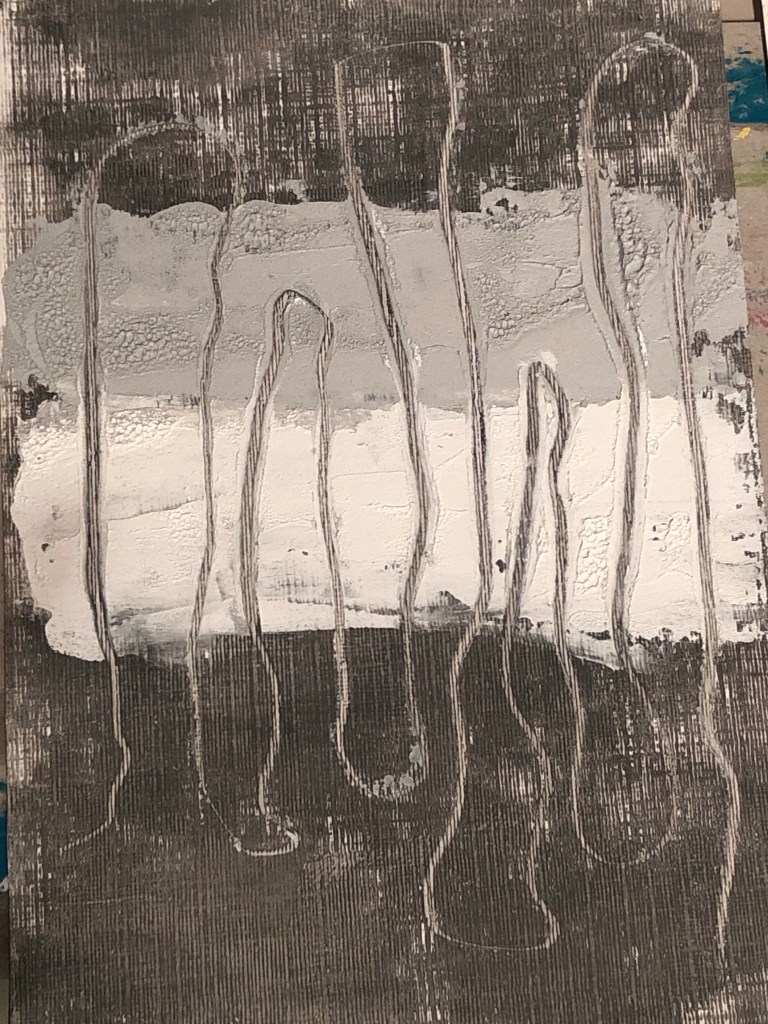
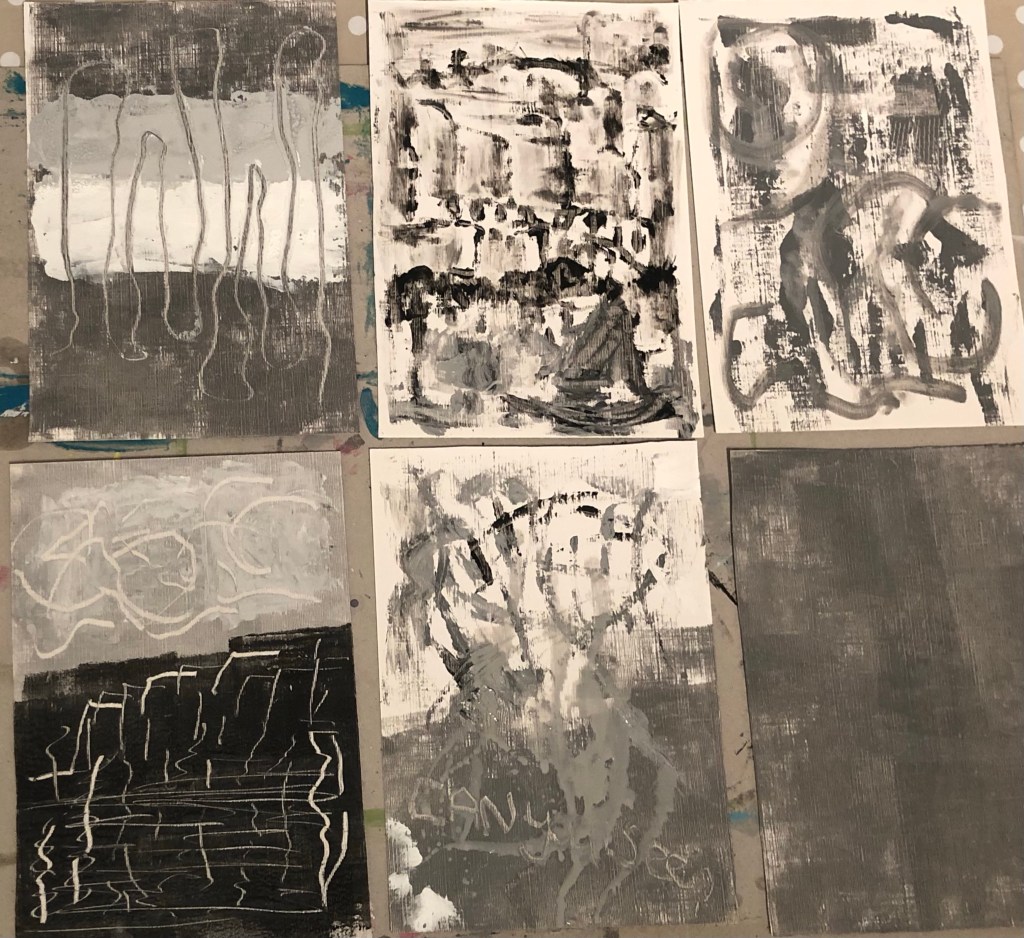
Session 1 was mainly to experiment with making marks with different tools using a limited palette of black, white and greys.
I made six small paintings and below is my favourite:
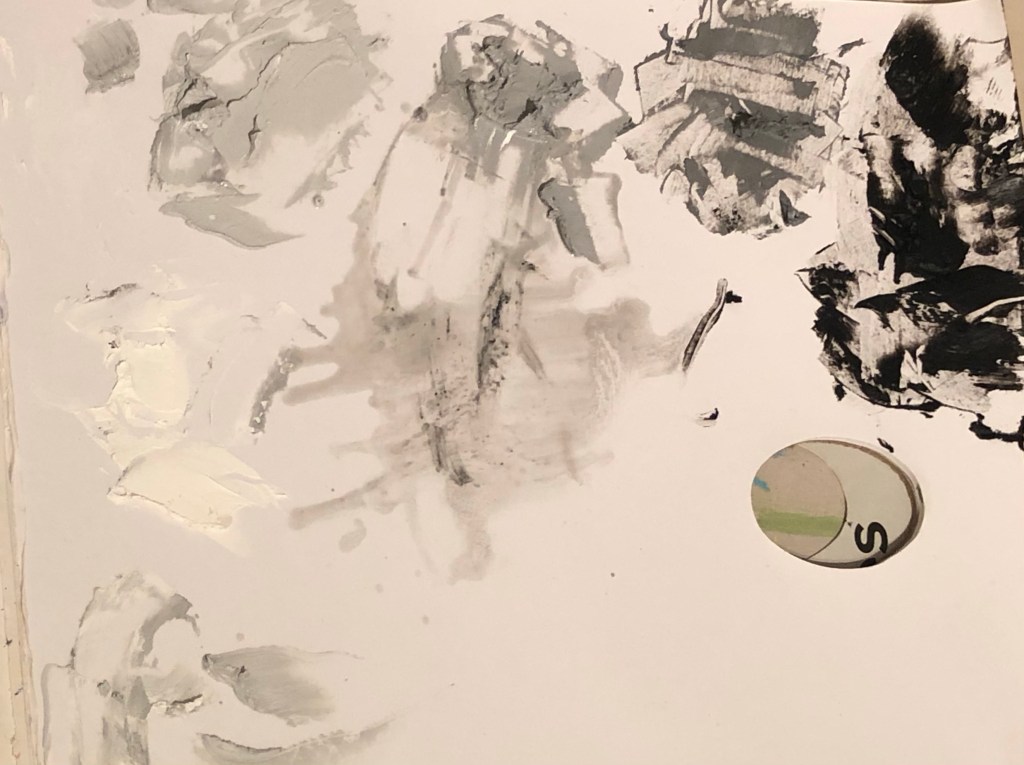
Paint palette with 50:50 mix of oil and cold wax:
I tried various tools such as palette knifes and pointed scrapers. The new ones for me were the tools typically used for scraping clay for ceramic work – they proved to be very effective at scraping oil and wax mix as one would expect.
The six images created during the session:
–
REFLECTIONS
I have enjoyed the session and I was pleased with what I have done so far. Nothing is really new but taking time to just focus on mark making with the medium was good ‘returning to basic’ work that I needed here. It gave me an opportunity to reset my thinking and to give myself time. Rather than feeling I had to produce a finished piece of work because I should be beyond the basics, it was good to just explore without giving myself pressure which was what I wanted to do.
Also, in the past, when I had wanted to experiment with oil and cold wax, I was advised against it by a previous painting tutor because it would change or flatten the oil paint luminosity. Then recently at a group crit when I was asked why I wanted to use oil and cold wax, I couldn’t really come up with a reason apart from ‘I like it; I like the texture and the effect it create’ which seemed inadequate. So I felt I couldn’t justify using the combined medium. But there’s something about it that kept drawing me back so right now I feel very excited that I’m continuing with the exploration and I am doing the webinars.
LEARNING
The technical learning so far is limited after just one session, I plan to expand on this after I have done more of the course.
From a personal learning perspective – I am just excited that I am doing this despite earlier discouragement and I no longer feel the need to justify it. I feel excited that this could be a way for me to use abstraction to express my transculturalism because of the layering and scraping then revealing nature of the medium – it appears I have just justified using this combined medium!
In exploring transcultural art and my own style, I have been looking for ways to do Chinese brush painting with ink on top of oil paint. I am hoping that through these experiments, I can find ways to combine eastern and western art materials in my work whilst maintaining the characteristics of both genre.
Here is an earlier experiment and this blog is a response to it:
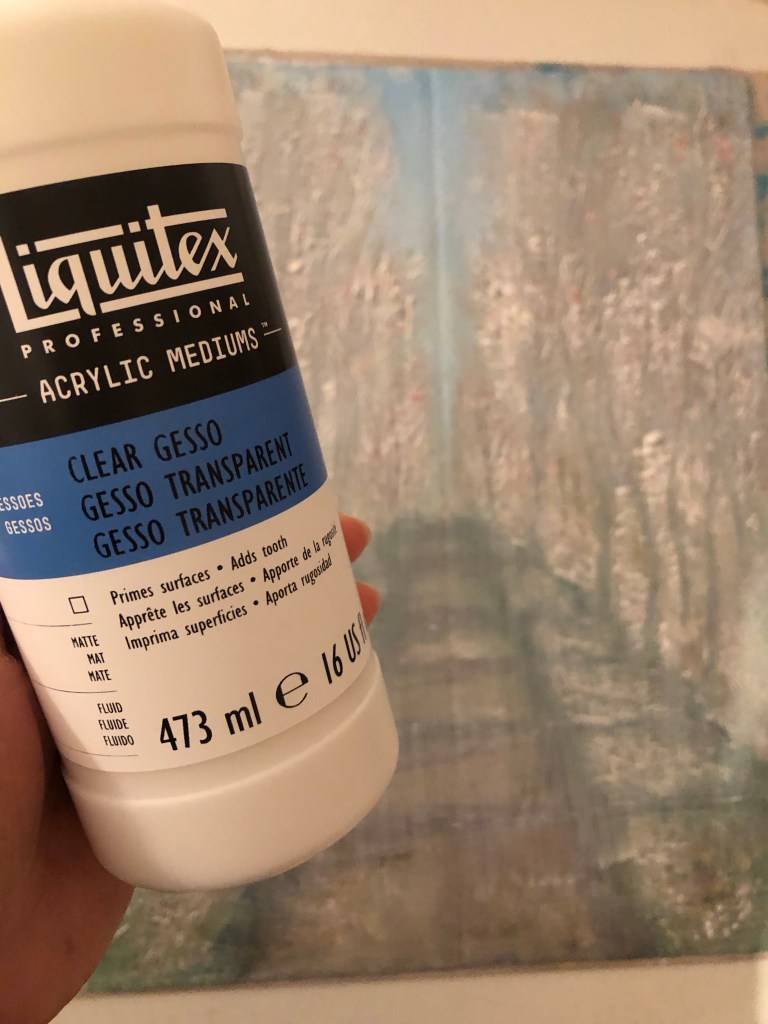
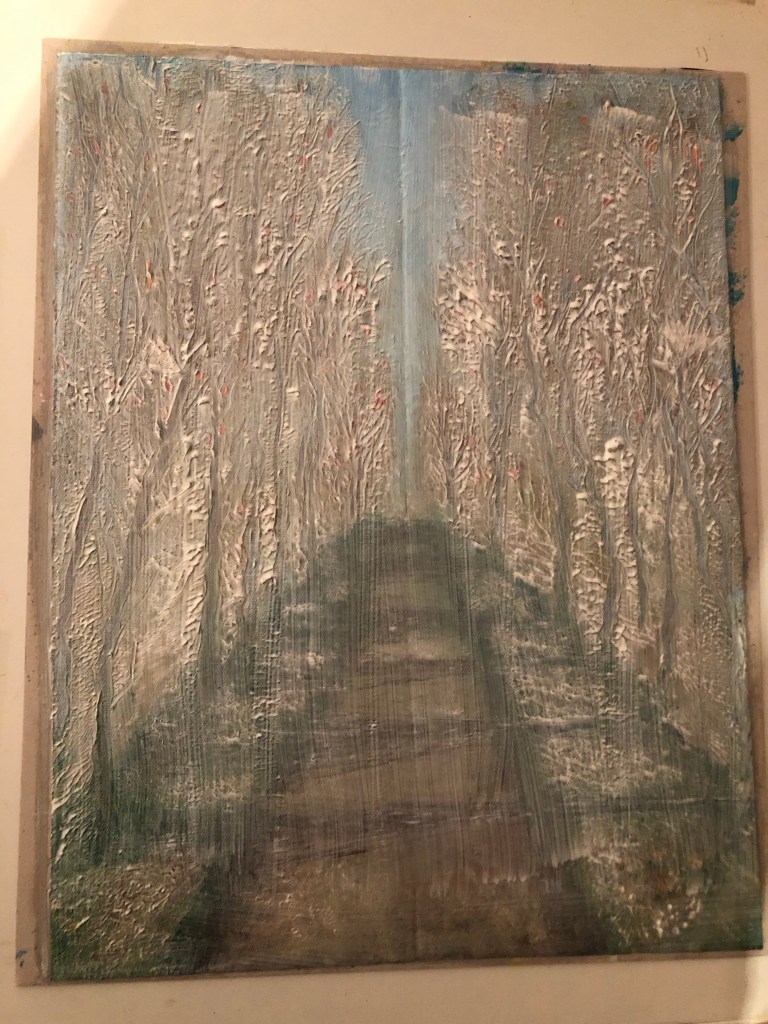
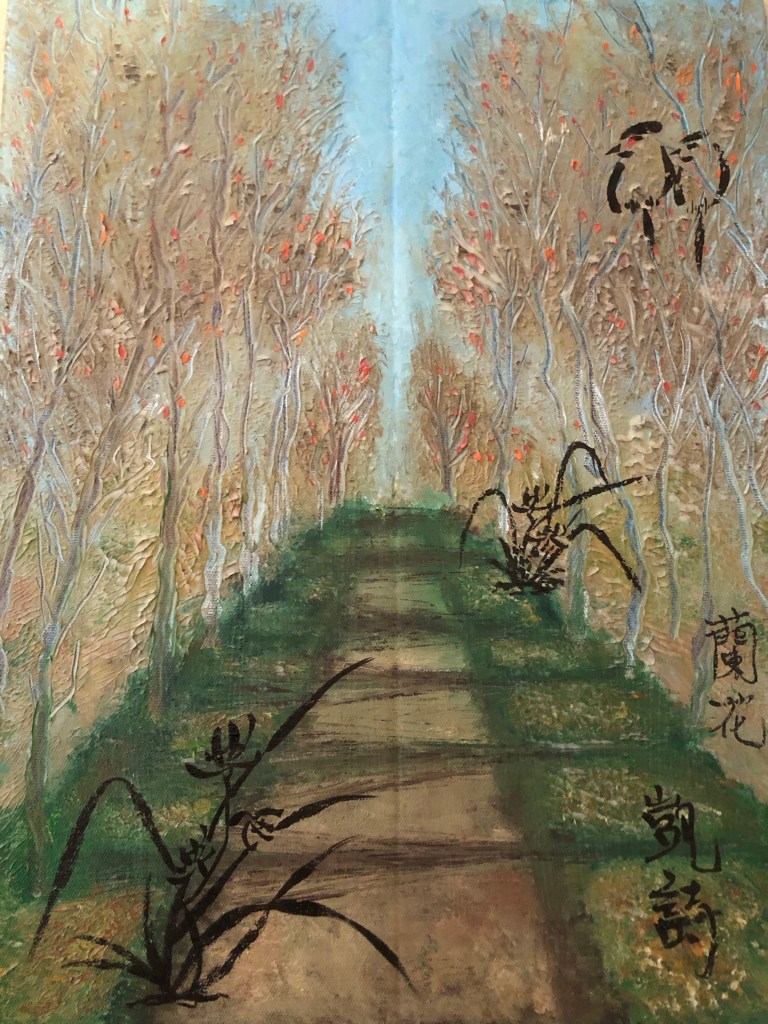
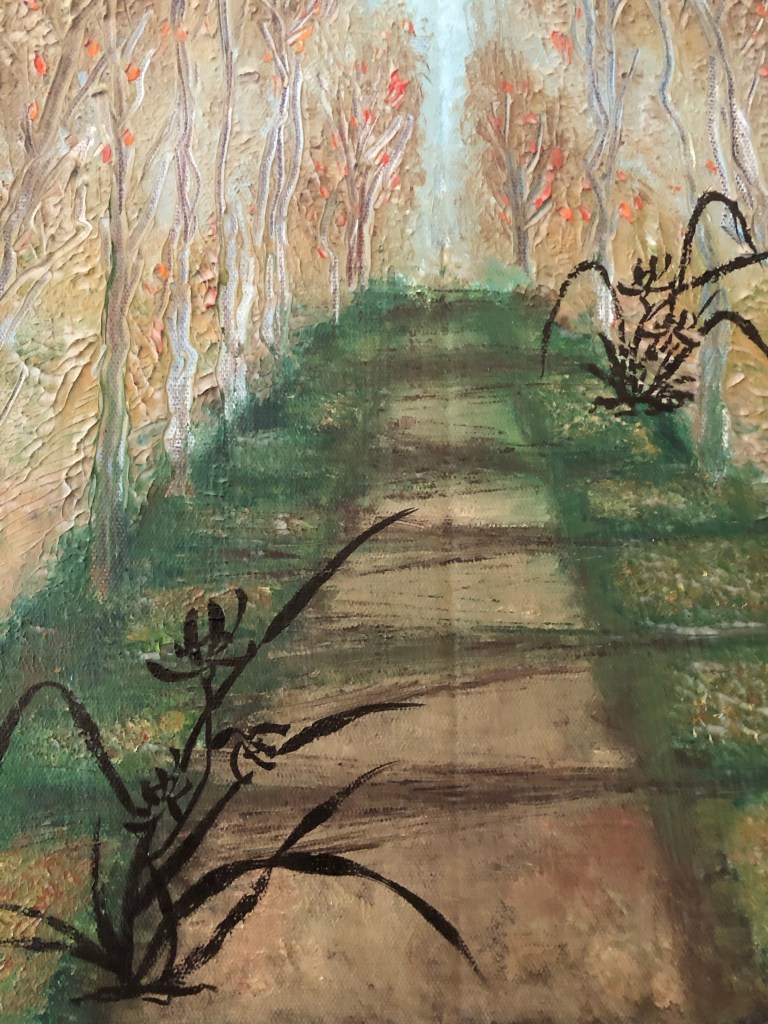
In this experiment, I took an old oil painting that had a range of textures and I applied a layer of clear gesso on top of the dried oil paint to creat a surface for Chinese brush painting to see if that would work.
A thick layer of clear gesso was applied to an oil painting.It was left to dry overnight.
After the gesso has dried, I painted various images using a Chinese brush and ink on different parts of the canvas to test out how the brush and ink performed on different textures.
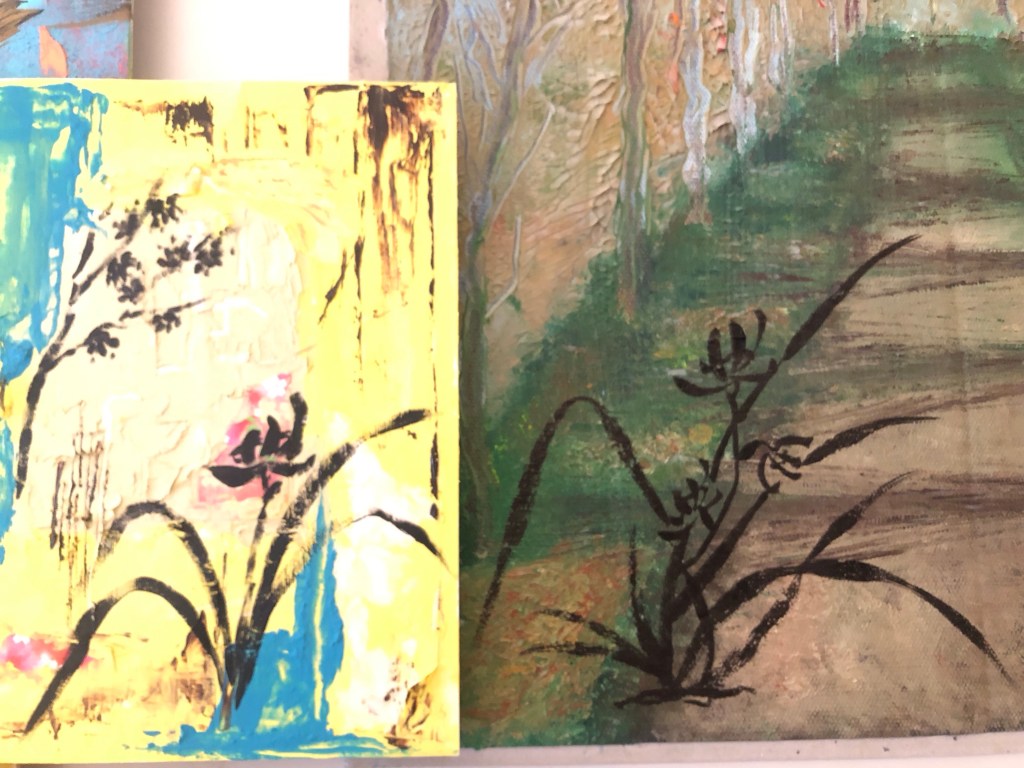
A Chinese orchid was painted in the least textured area of the painting. Here the outcome was compared to a similar exercise on dried oil without gesso (painting on the left):
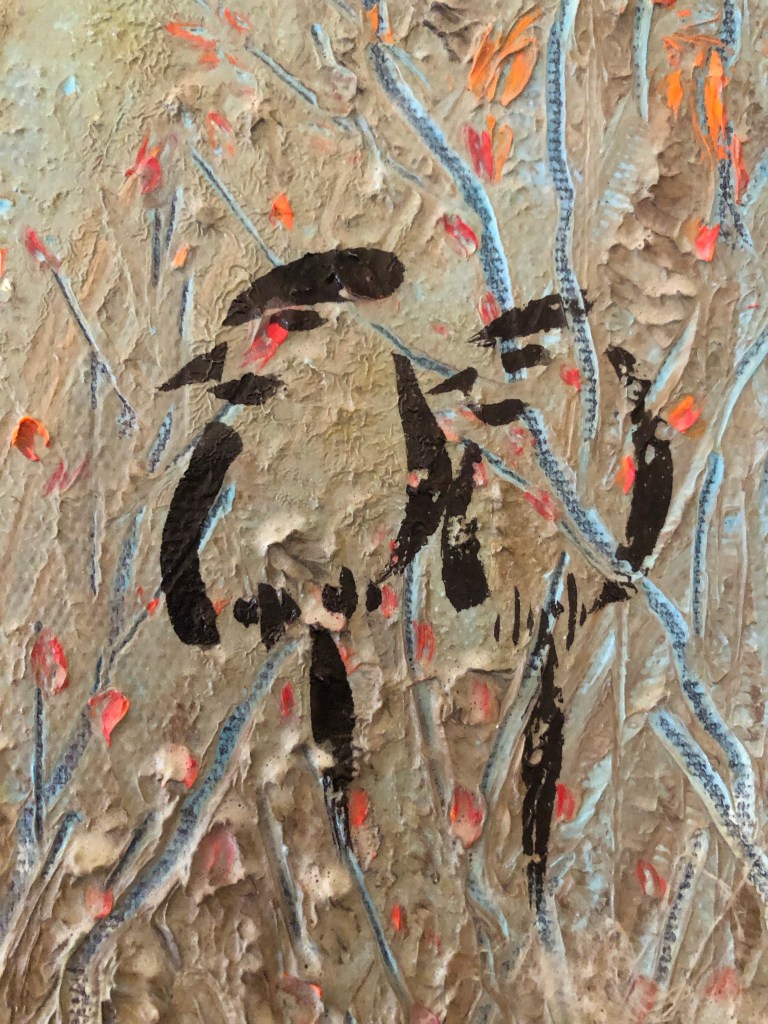
Two birds were painted in the tree branches which was the most textured area on the painting:
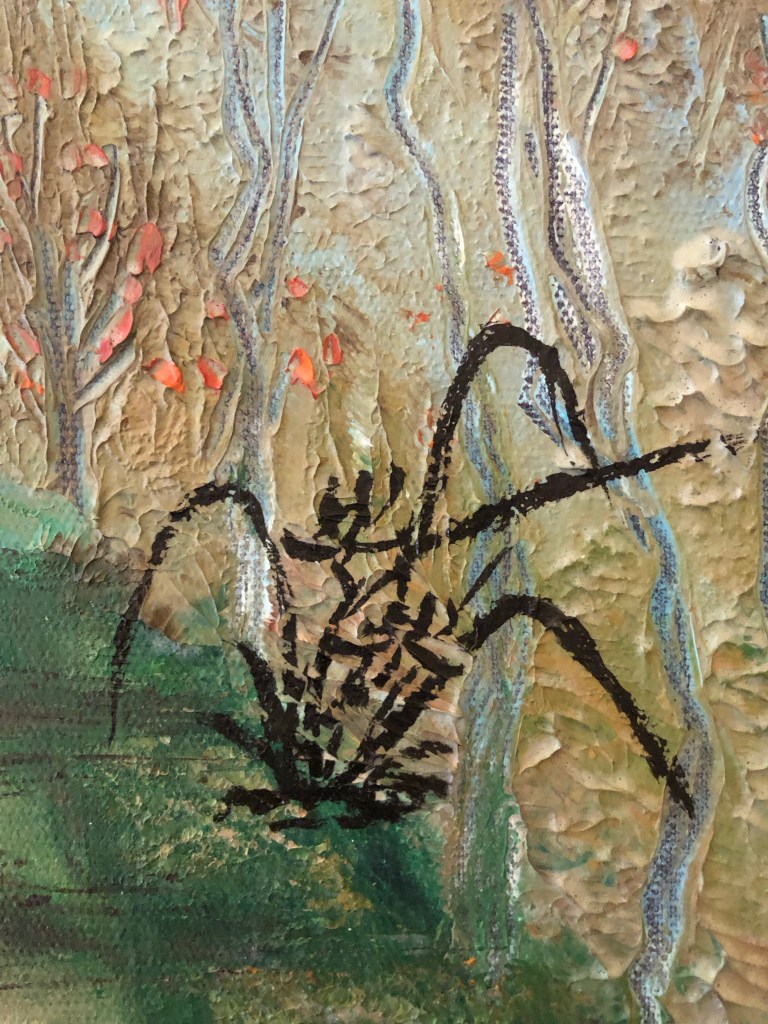
An orchid was painted in the medium textured area in the mid ground of the painting:
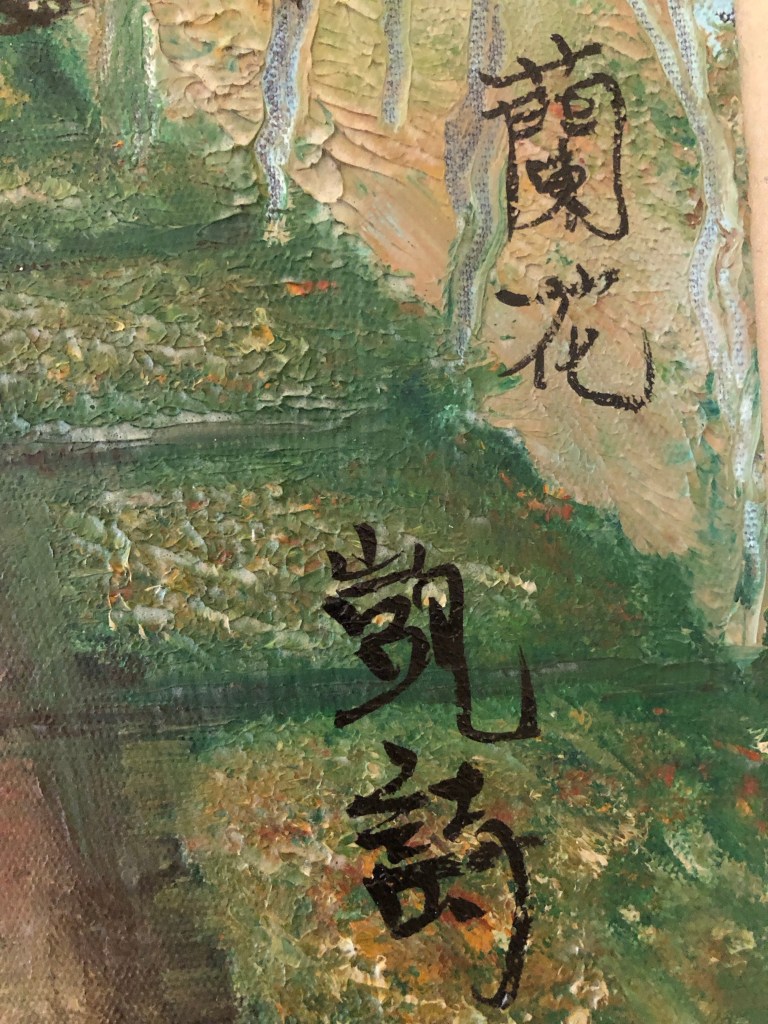
Some Chinese calligraphy was tested using different size brushes:
–
REFLECTIONS
For me, a smooth surface such as silk or Xuan/rice paper is required for Chinese brush painting to be at its best. So that the brush strokes can glide across the page. I painted the Chinese orchids in the experiment because to paint the long and bendy leaves in one stroke required a continuous smooth movement whilst slightly lifting and turning the brush. Similar to calligraphy. In the heavily textured area in the tree branches, I painted two birds because I knew that long brush strokes wouldn’t stand a chance in that area, hence the short and relatively straight strokes for the simplified birds. Since this is mainly an experiment, the technical outcomes are captured under the LEARNING section.
I will note here my reflections about how I felt during the process. I felt excited that there was another avenue to explore as I really wanted to find a way to combine on the same painting the Chinese and western materials. However, this experiment showed that although I have made progress, I have not found the ideal way to achieve my objective of combining the two different materials. Perhaps the challenges I have had is also a metaphor for my lived experience in navigating the two cultures in daily lives.
Another thought was that I should definitely research more on other transcultural artists’ work as I expect someone else would have done this before me.
LEARNING
– As expected, the smoother texture area (the large orchid) performed the best. In comparison to the earlier experiment of painting on oil without the gesso layer – it was clear that the one with gesso performed much better enabling the Chinese paint brush to glide more easily.
– The heavier textured areas had too much ‘pitting’ and even with a brush heavily loaded with ink (like with the bird on the left), it was hard to achieve a smooth stroke. Hence I don’t believe this combination of material would work satisfactorily for me. If I wanted to do Chinese style brush strokes on such a texture then I’m better off using oil on a soft brush, the oil paint would fill the pits more effectively even if not completely.
– The two sets of calligraphy were done with brushes of different size, the lower set was with a thicker brush and that comes across better. The thinner brush did not have the strength to deposit sufficient ink on the oil surface.
– There is further refinement I could do to smooth the oil surface such as sanding and more layers of gesso.
NEXT STEPS
– Research other transcultural artists to see if anyone has achieved Chinese brush painting on top of an oil painting.
– Research further how Fiona Rae achieved her Chinese style brush strokes with oil paint on traditional canvas.
– Using the same oil painting here, sand an area and then apply further layers of gesso, then sand again if needed, to see if that would create a smooth enough surface without damaging the original image too much thereby achieving the desired results.
As part of my research on The Third Space (Ref. The location of culture by Homi K Bhabha), I have been seeking out ‘third space’ phenomena from my memory and surroundings in order to gain a deeper understanding of the concept. To this end, I decided to research and do a project on the street names of Hong Kong.
When HK was a British colony, many streets were named after British Governors or officials sent to manage HK. Their English names were converted into Chinese (Cantonese) using transliteration*. As a result, the street names when pronounced in Cantonese are meaningless and often nonsensical. Since street names are such a fundamental part of daily lives, those strange sounding streets names have become a natural part of the day-to-day language without anyone questioning their nonsensical nature.
This project is to highlight the transliteration of HK street names as an example of a third space phenomenon from a place that has deep personal relevance for me.
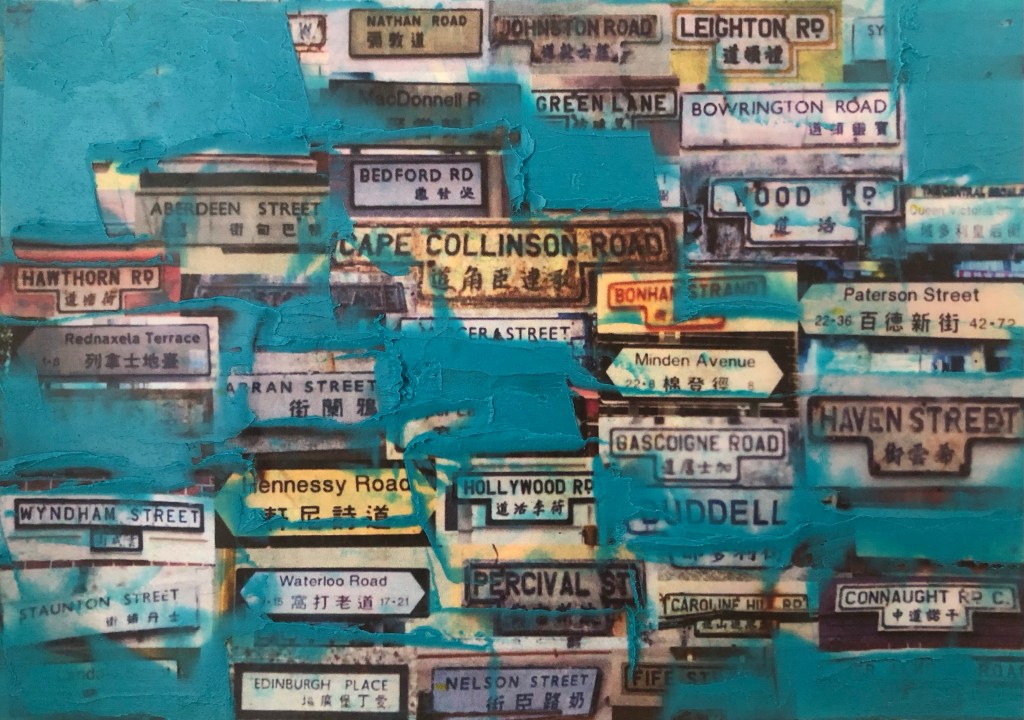
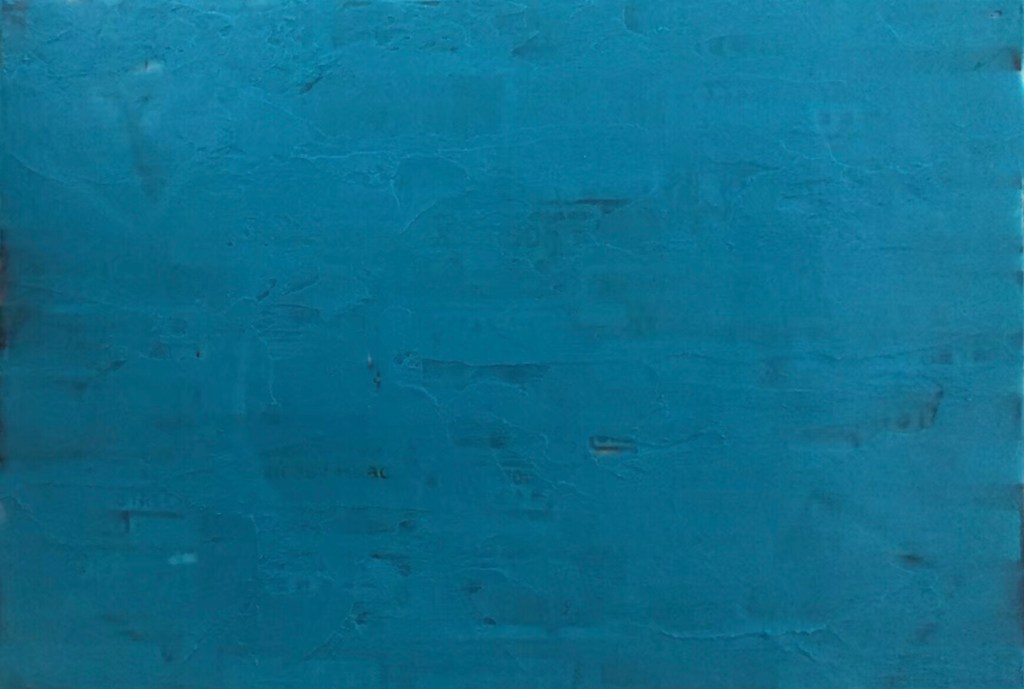
Finished painting – HK Street names 1 – oil and cold wax on inkjet printed paper, size 18.4 x 12.8 cm.
METHOD
This is the first step and an experiment to test out the idea and process.
I researched online images of street signs in HK and picked out those that were transliterated from British names. Since the HK street signs nowadays are of a new design that I am not familiar with, where possible, I have chosen images that were from the 1960s, 70s and 80s – the period when I lived in HK and when HK was still under colonial British rule.
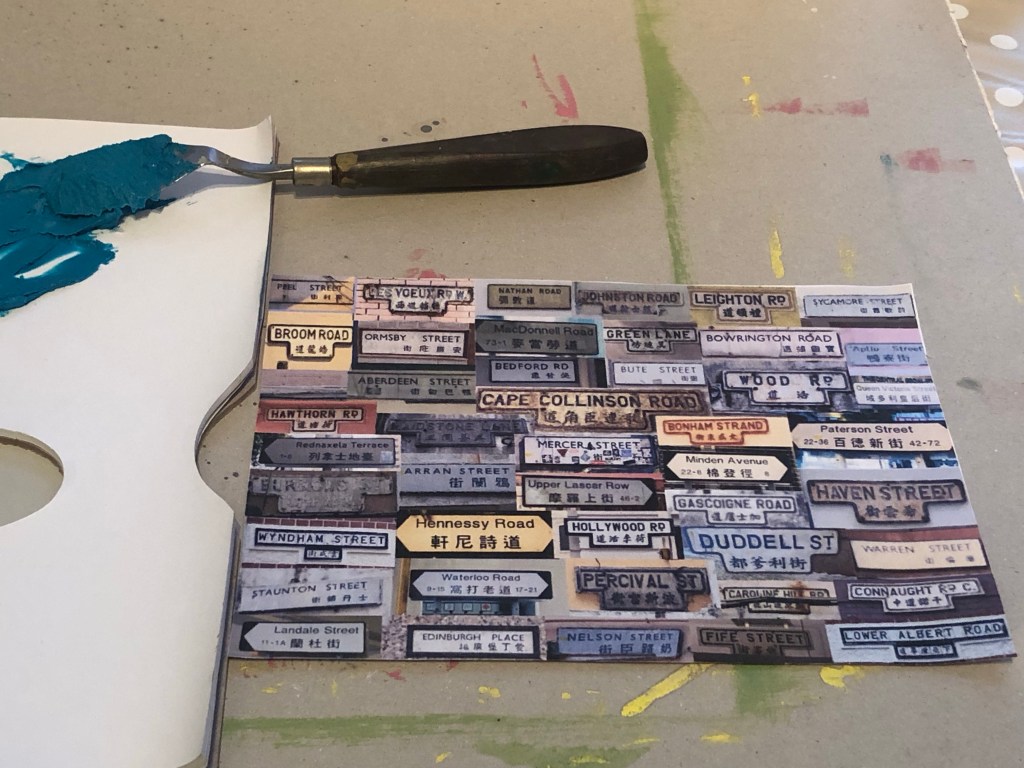
A digital collage of the road signs was made using Adobe Express then inkjet printed onto paper.
Teal colour oil paint was mixed with cold wax in 50:50 ratio and the printed image was covered in a thick layer of the oil-wax mix.
My iPhone was set up in video capture mode to record – I gradually scraped off the paint revealing most of the street signs one by one as I read out in English then Cantonese each street name. The purpose of the voice over was to enable viewers to hear the Cantonese transliteration.
–
REFLECTIONS
This was an experiment to test out the concept on a small scale before taking it onto a large canvas to create a painting. The aim is to ultimately create two pieces of work – a painting as well as a video accompanied by a piece of writing explaining the background of the street names used as part of my research into colonialism.
I believe the way these streets were named in HK was an example of how soft power worked in a British colony where the names of the colonisers such as Governors and Royalty were permanently imprinted into the day-to-day lives of the local people, serving as a reminder of the colonial power structure. The fact that road and streets were named in this way served as a constant reminder of who was in charge of the the land.
I started this project with casual research online, however, my interest in the topic increased as I went deeper into the research as it became clear the extent of the soft power exercised in these examples. As I looked at the street signs and read out each name, I could hear my late parents saying those names on a daily basis in conversation – which road had bad traffic jams, what was the shortest route to get to a place or giving directions to a shop. As a child, I listened to my parents using the transliterated and nonsensical street names like it was just normal. Everyone used those names without giving it a second thought. I left HK when I was a young teenager and never lived there as an adult. I now wonder what it was like for my parents to live their whole lives in a colony, to live, work and bring up children as colonised subjects. Doing this project has caused me to think about that more deeply. I always feel conflicted when I think about this topic – HK was a British Colony with in-built structural injustices that came with being colonised, but HK also became successful globally partly due to the commercial, legal and justice systems that were put in place by the British bringing prosperity to the city and stability for the people. This is a conflicted feeling that I will continue to examine – just like the transliterated street names, what seemed natural or normal once upon a time, now no longer make sense and I am still trying to unpack that conflicted feeling.
Regarding the art work, I was pleased with the outcome of the project, especially as an initial experiment. Through my research, I have found many more interesting facts about the naming of streets in HK, I could potentially divide them into categories and make several art work to create a series.
LEARNING
In the context of my art practice, this research project has helped me to gain a deeper understanding of The Third Space as coined by Homi K Bhabha. The phenomenon of the street names researched here is unique and only came about as a result of the English and Chinese languages coming together through colonisation. There is also the underlying cultural influences from both sides, e.g. holding military personnel in high esteem for the British and in the case of Bedford Road, the Chinese name reflecting the entrepreneurial mindset of the locals.
I am been struggling to make art through examining my third space – one that is personal to my lived experience. I have struggled to create images that is a result of that third space, instead, I have been layering together distinct images from the two cultures that have influenced me. To expand on this point with an example from the HK street names:
Example – take Wood Road that was named after John Roskruge Wood, an acting chief justice during the colonial period. If it were translated into Chinese, the character 木 for wood (as in wood from trees) would have been used. Instead, the phonetic sound of Wood was used in the transliteration, hence the Chinese character 活 meaning alive or living was used to get the closest sound to Wood. The Third Space phenomenon gave rise to a very different outcome.
Analysing the HK street names was the first time I found a concrete example of the third space phenomenon that is relevant to me and my heritage. So I will continue to research this topic as well as look for other signs of the colonial era in HK that may help with my personal identity research.
Whenever I struggle with creating images for my third space, I come back to researching the work of the artist Fiona Rae because I feel she has captured the essence of the third space well with her British and Asian influences. I will continue to research her work.
NEXT STEPS
– Repeat this work on a larger scale using proper canvas material to make a painting and a video.
– Test the video on non-Chinese speaking people to see if the transliteration sounds were noticeable, i.e. is the video voice over meaningful.
– Complete the piece of writing to accompany the art work.
– Research deeper into the HK street names to potentially make a series of work on this theme.
– Research further the history of HK to look for other third space phenomena to inform my personal identity work.
– Research Fiona Rae’s work and find more transcultural British/East Asian artists to add my list for research.
ADDITIONAL RESEARCH INFORMATION
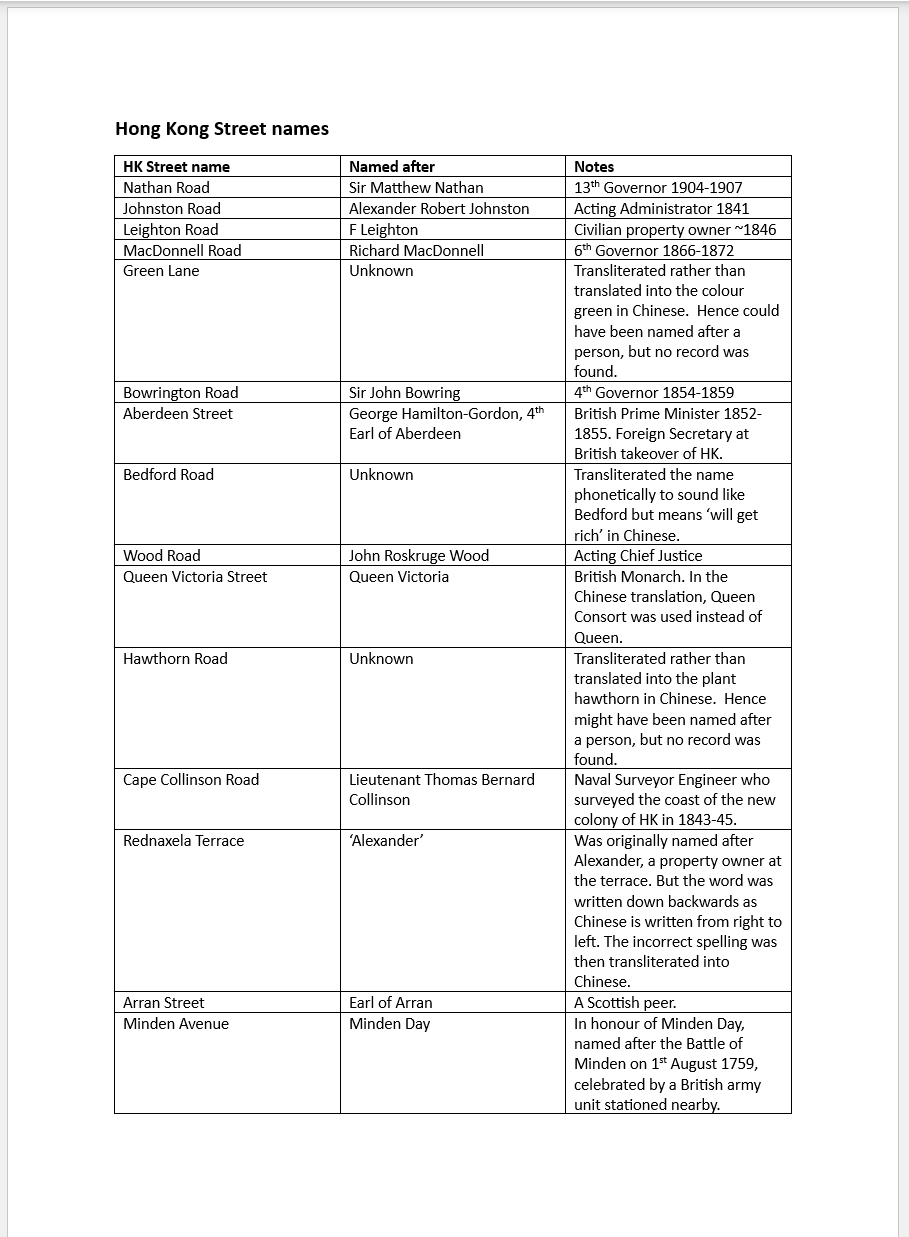
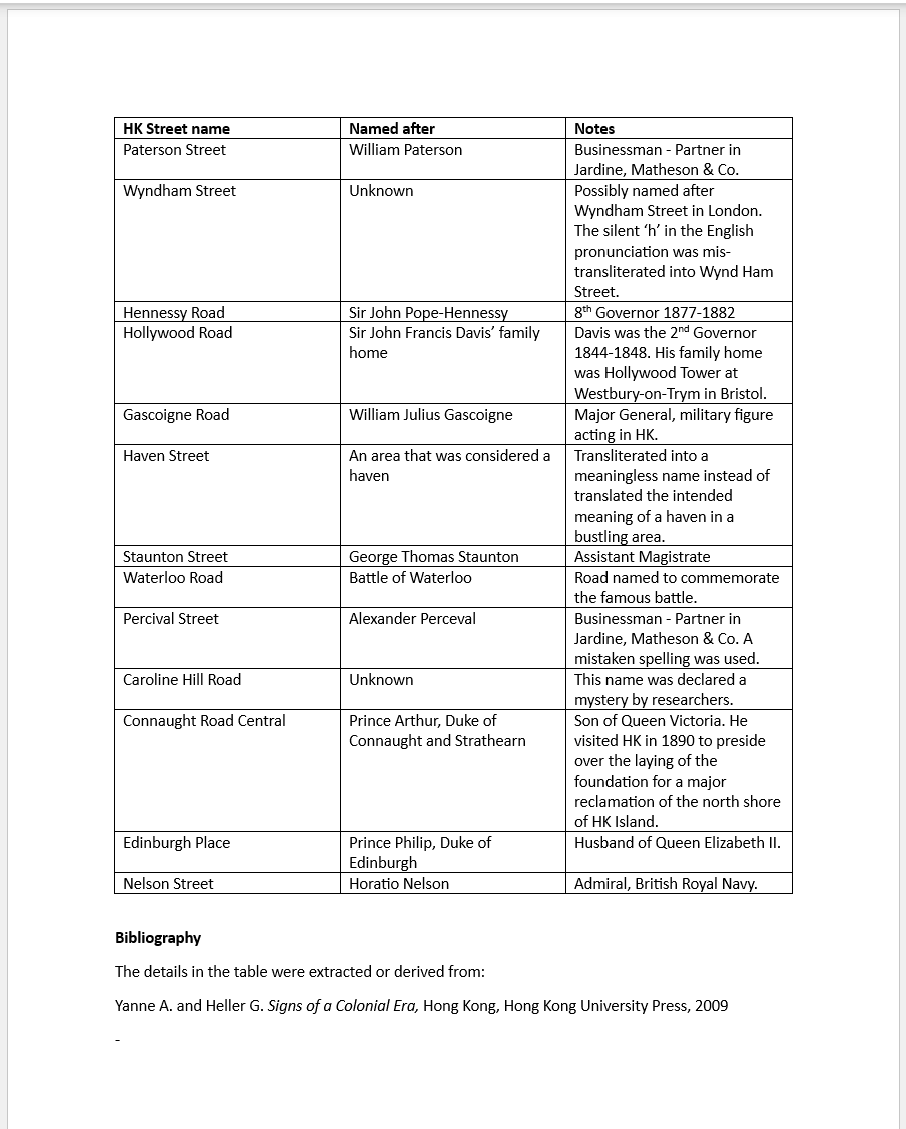
Below is a table showing the background of every street name revealed in this painting and video – whom they were named after as well as amusing mistakes in translation or transliteration.
* What is transliteration?
Below are blogs and extracts explaining the meaning of transliteration in the context of this project.
Translation provides the meaning of words in a second language. Transliteration does not provide the words’ meaning but it makes it easier to pronounce them. Transliteration alters the letters from a language or alphabet into characters of a similar-sounding in a different alphabet. It is quite clear that there is frequently a demand for the transliteration of some languages, especially in this globalised world where people who do not share the same language can have some access to languages with a dissimilar alphabet.
A transliteration doesn’t tell you the meaning of the word, but it gives you an idea of how the word is pronounced in a foreign language. It makes a language a little more accessible to people who are unfamiliar with that language’s alphabet.
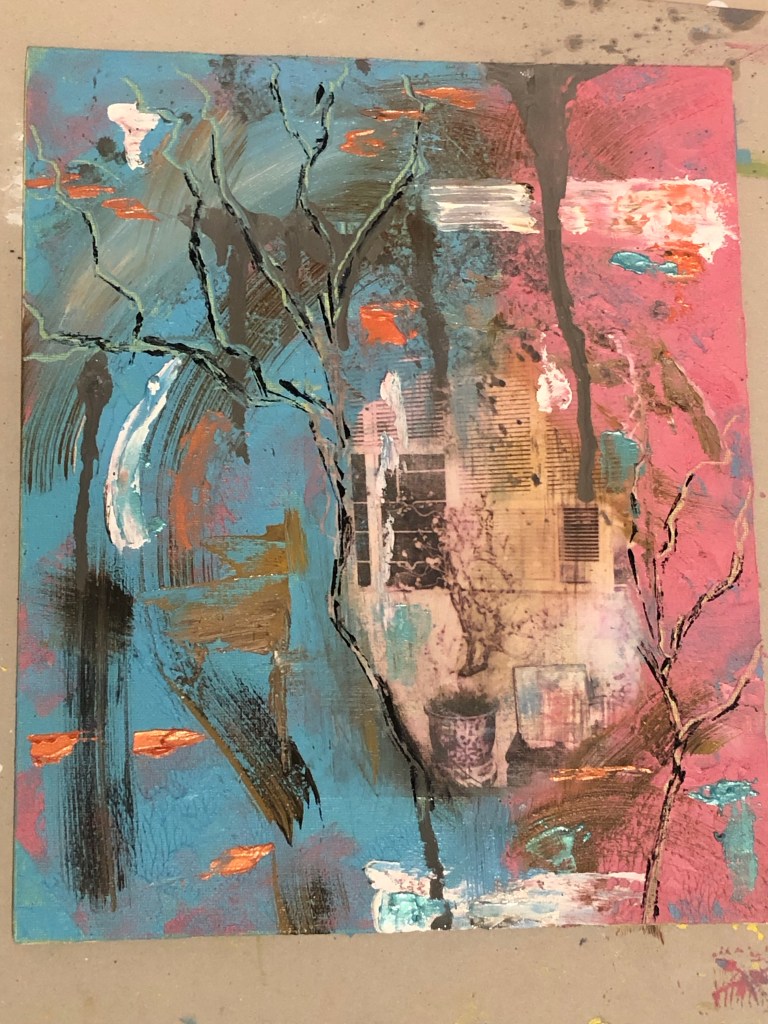
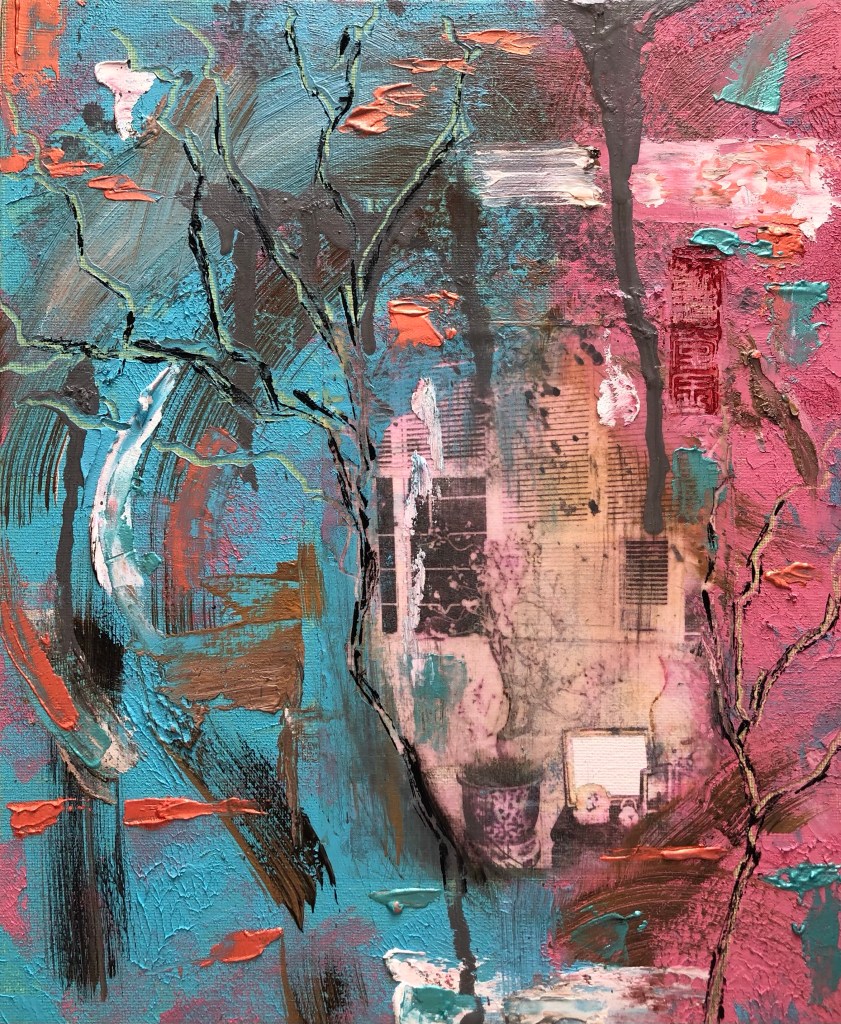
After experimenting with oil and cold wax, I wanted to do a painting with that medium. As for the subject of this work – I wanted to start with an old photograph of my parents’ home.
METHOD
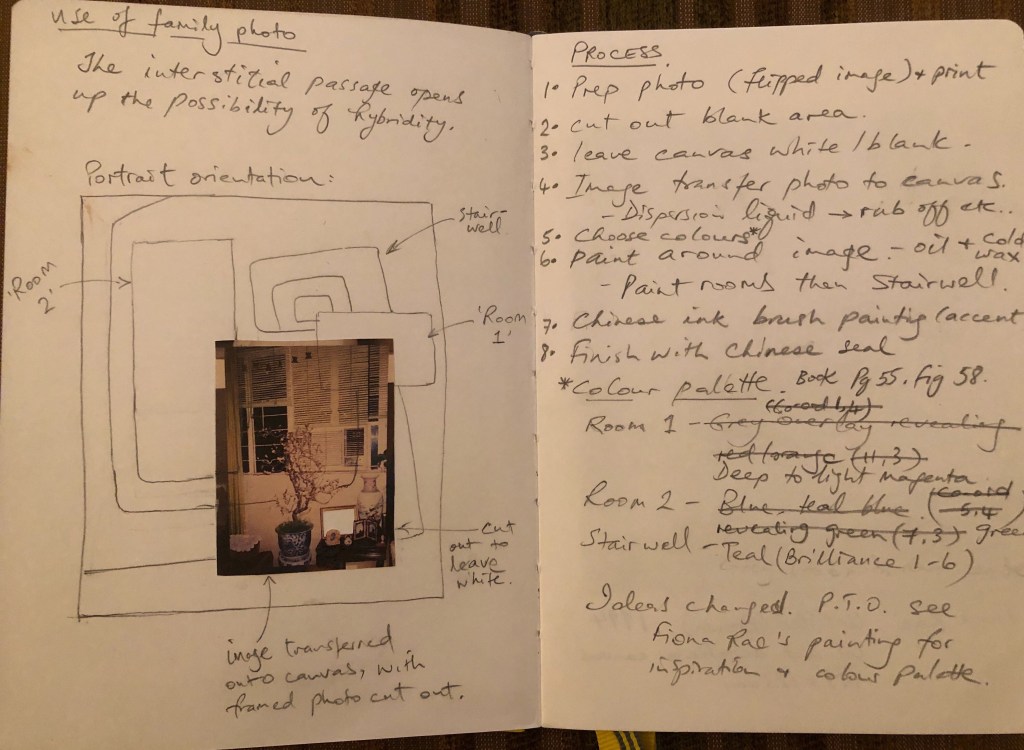
After watching a video about sketchbooks recently, I decided to return to using my sketchbook to develop ideas. Here is what I came up with for this painting.
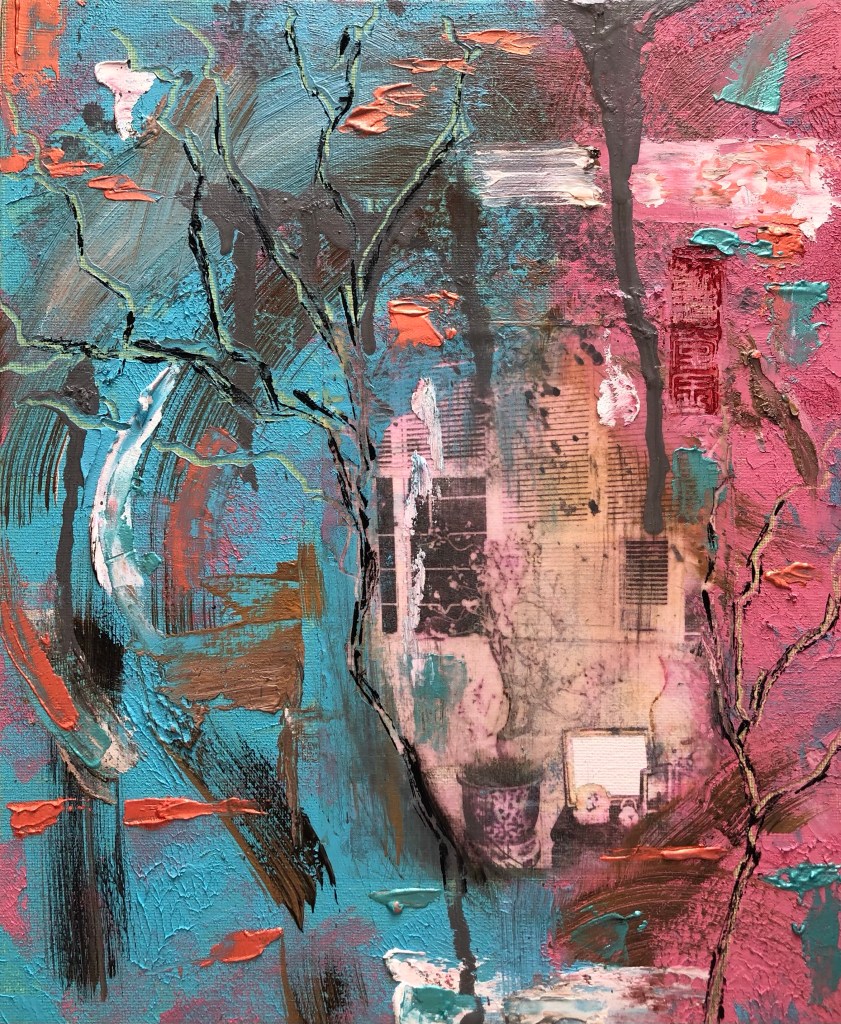
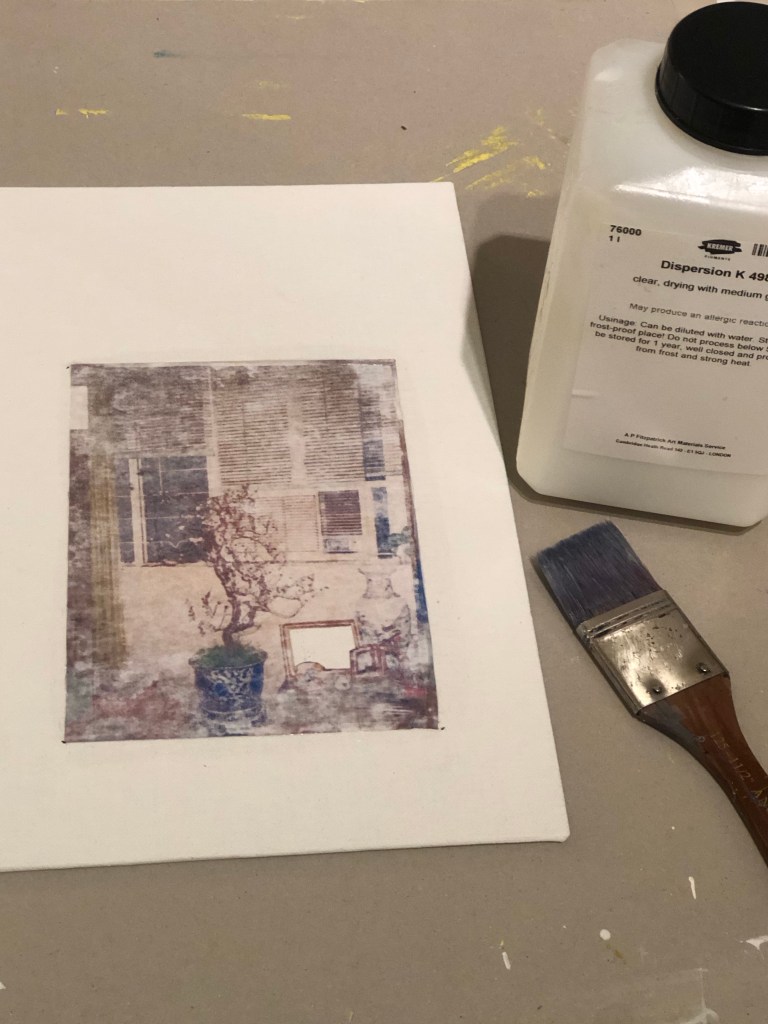
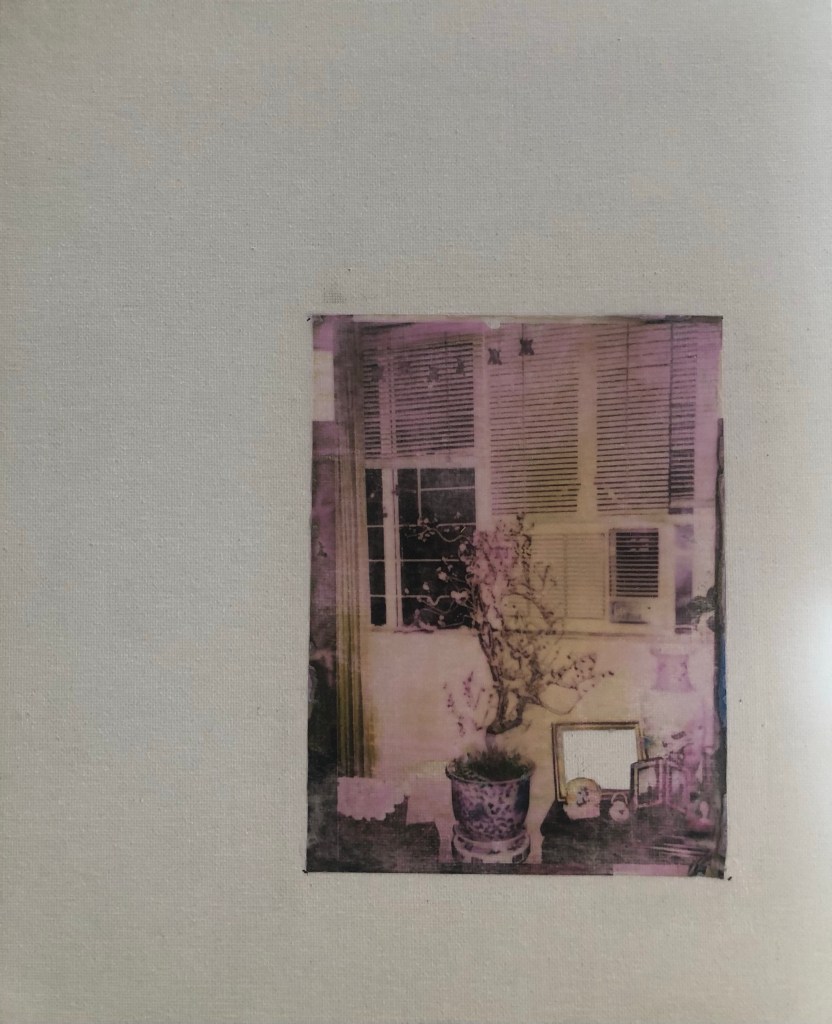
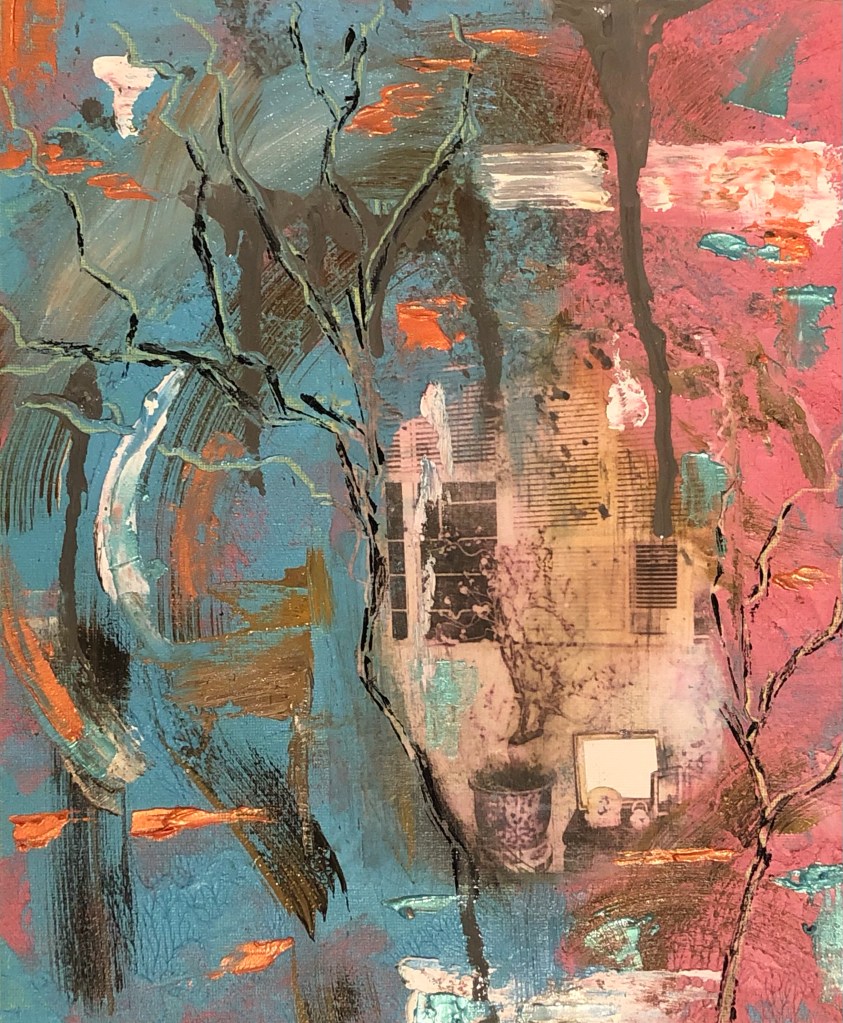
I took a digital copy of an old photo from my parents’ home, printed it out and transferred the image onto a 12×16 inch canvas board using dispersion liquid. One of the framed photos in the image was of me at my graduation with my parents from years earlier – I didn’t want to include that hence I cut it out to leave a blank space with the aim of raising questions or intrigue for the viewer.
Image being transferred onto canvas board
Below is a bare canvas board with the transferred photo image:
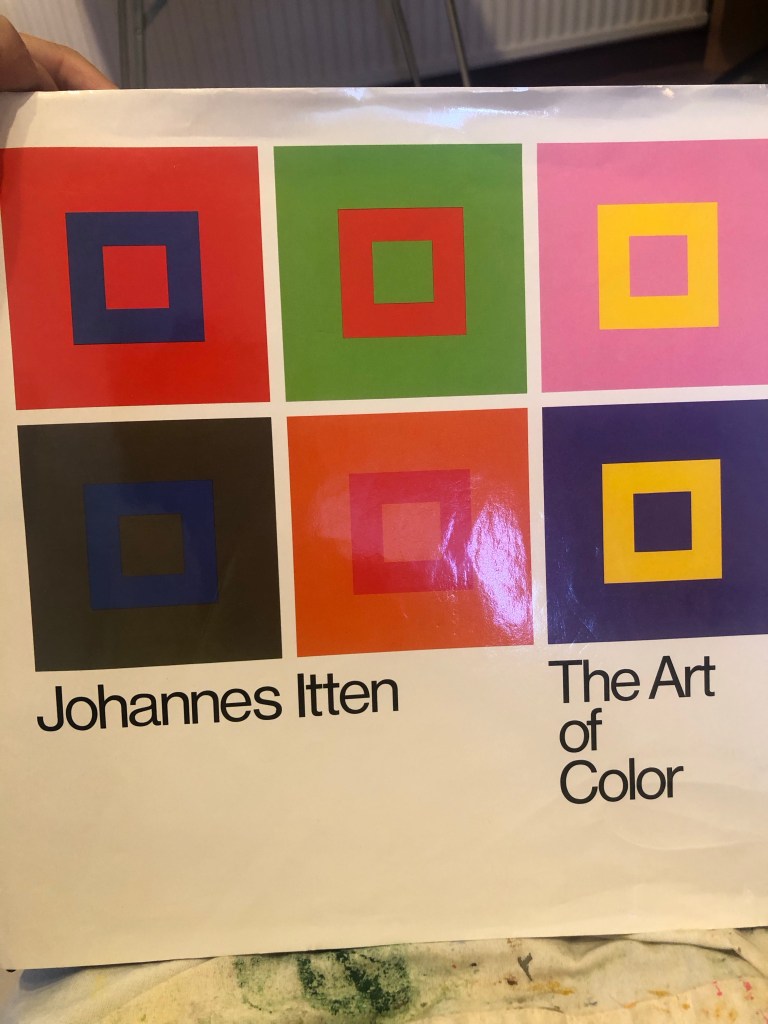
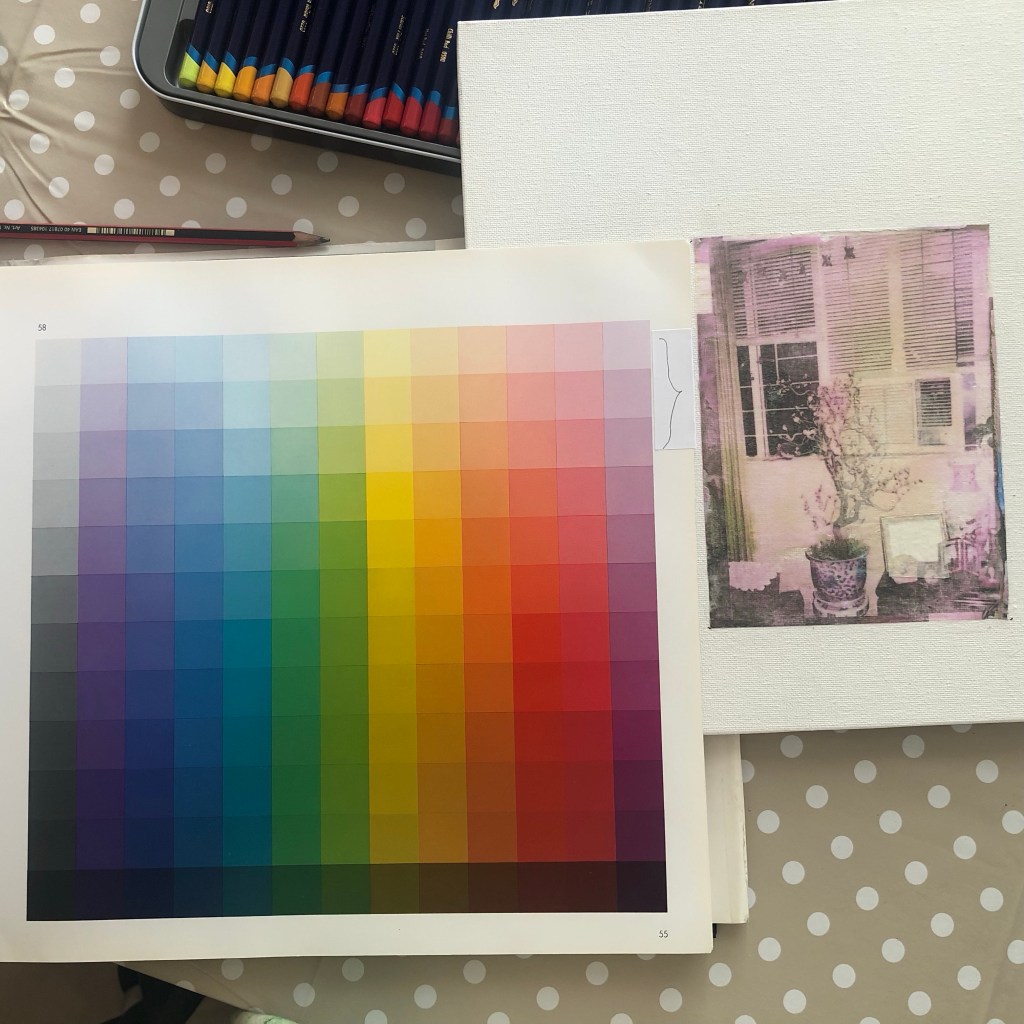
I would usually apply paint instinctively in response to the image on the canvas, however, I wanted to be more considered in my approach hence referring to The Art of Colour book to do some research and plan the colour palette for the work.
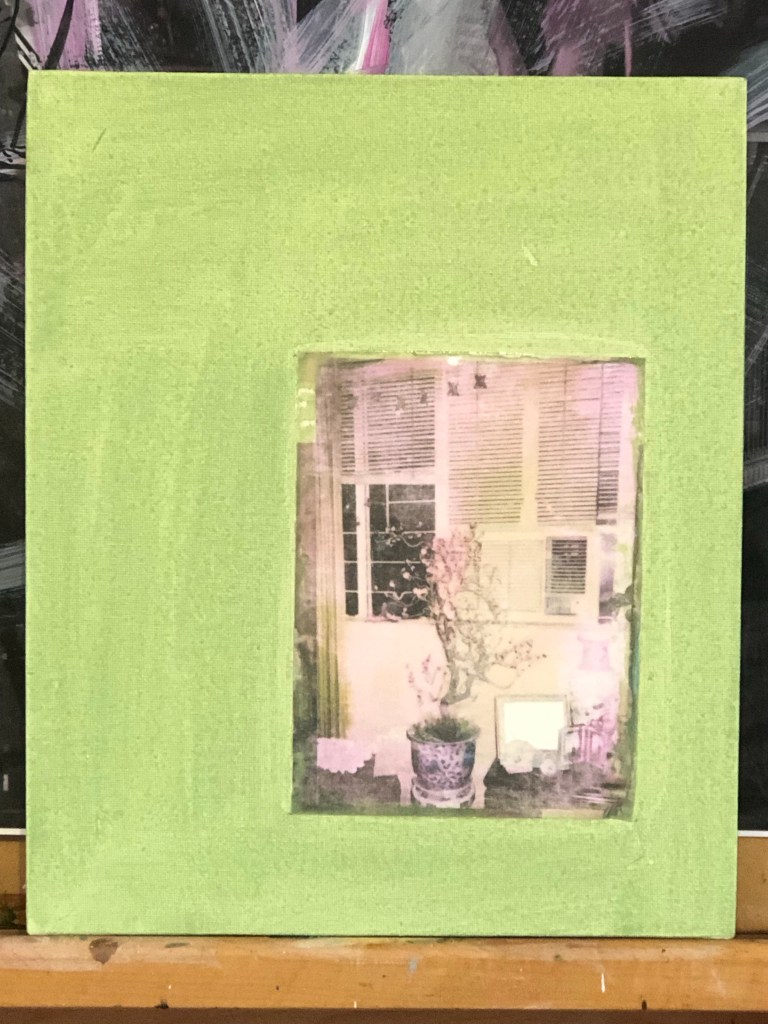
I picked out a green shade from the photo and did an acrylic wash to cover the canvas:
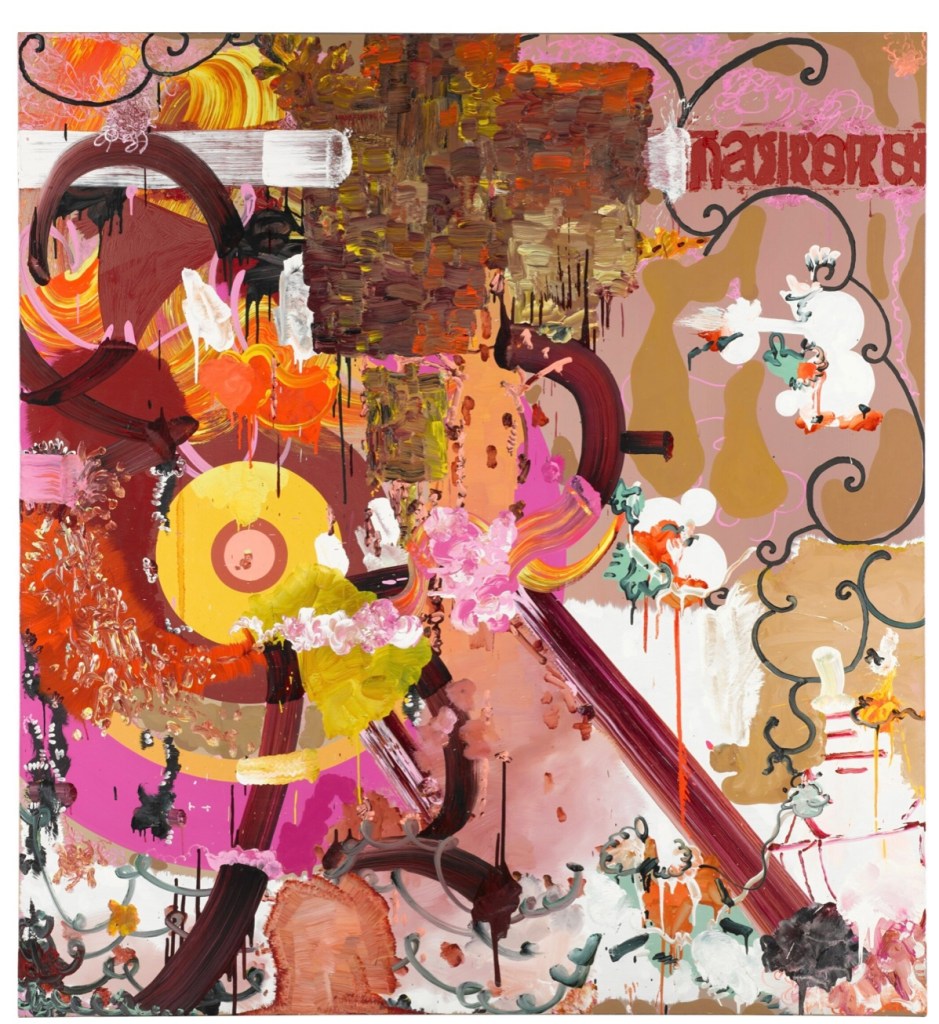
I was feeling lost despite faced with a very informative book. So I did some artist research to look at the colour palette on this painting by Fiona Rae – an artist that I admire and researching into her work was part of my intention from the last experiment:
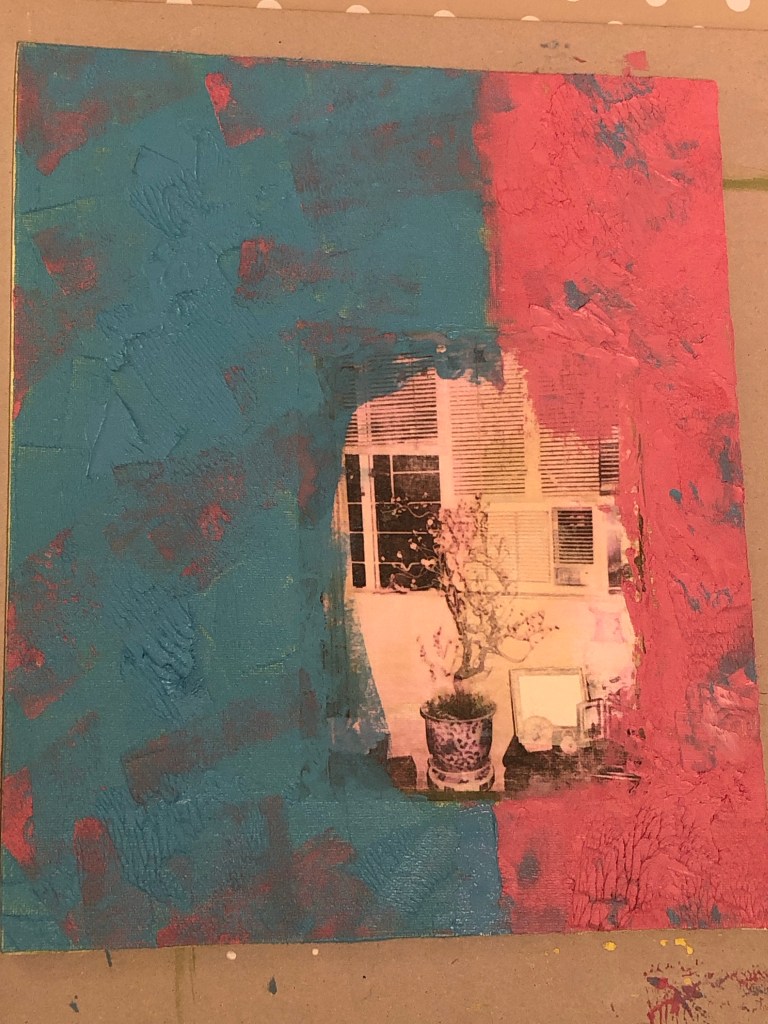
That gave me the inspiration to start painting. I tried to stay with the idea developed in my sketchbook with blocks of colours in oil and cold wax reflecting the different cultural areas that I operate in.
I wanted to add connections between the two blocks to represent the stairwell connecting ‘the two rooms’ as in the analogy used by Homi K Bhabha in his book The Location of Culture about people living in different cultures simultaneously – one ends up running back and forth. I then scratched the oil and wax medium to create branches like those on the peach tree in the photo.
I masked the cut-out of my photo while painting. Below is with the mask removed after I finished painting:
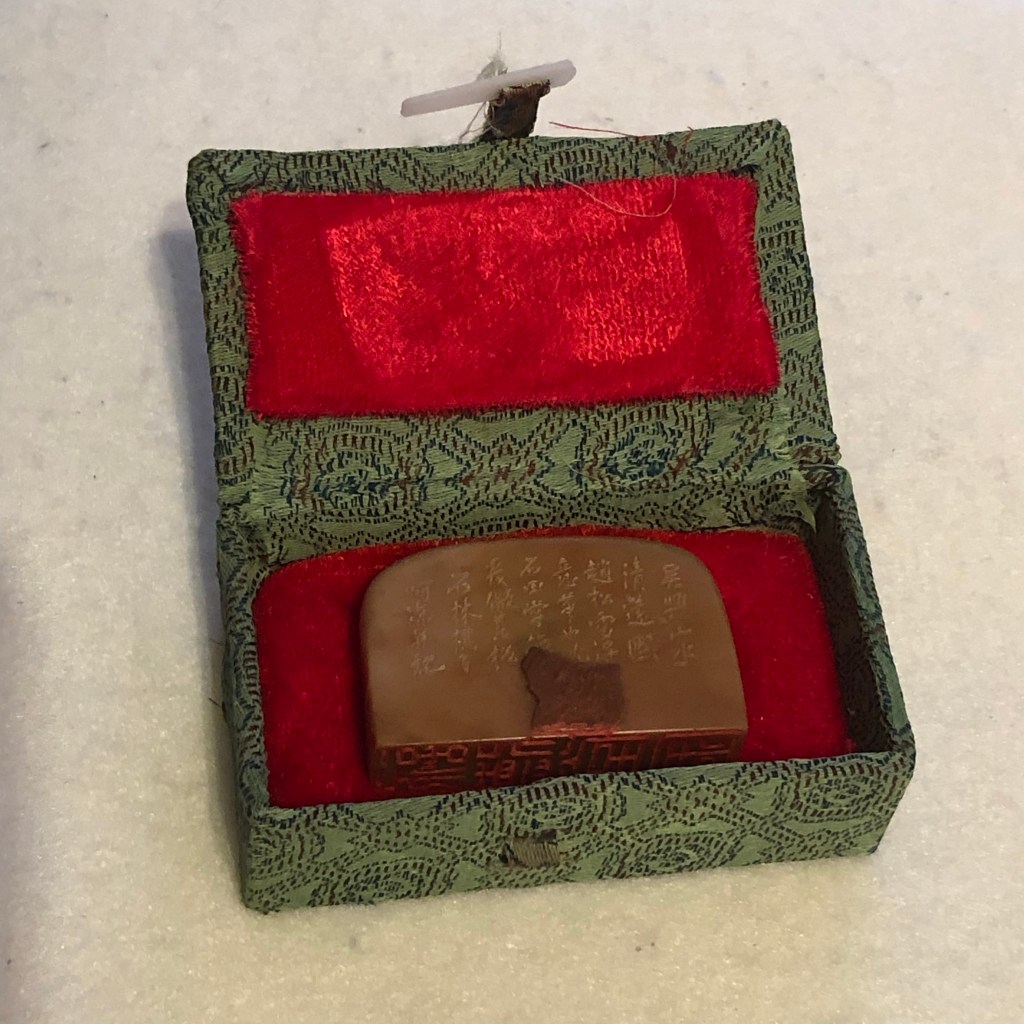
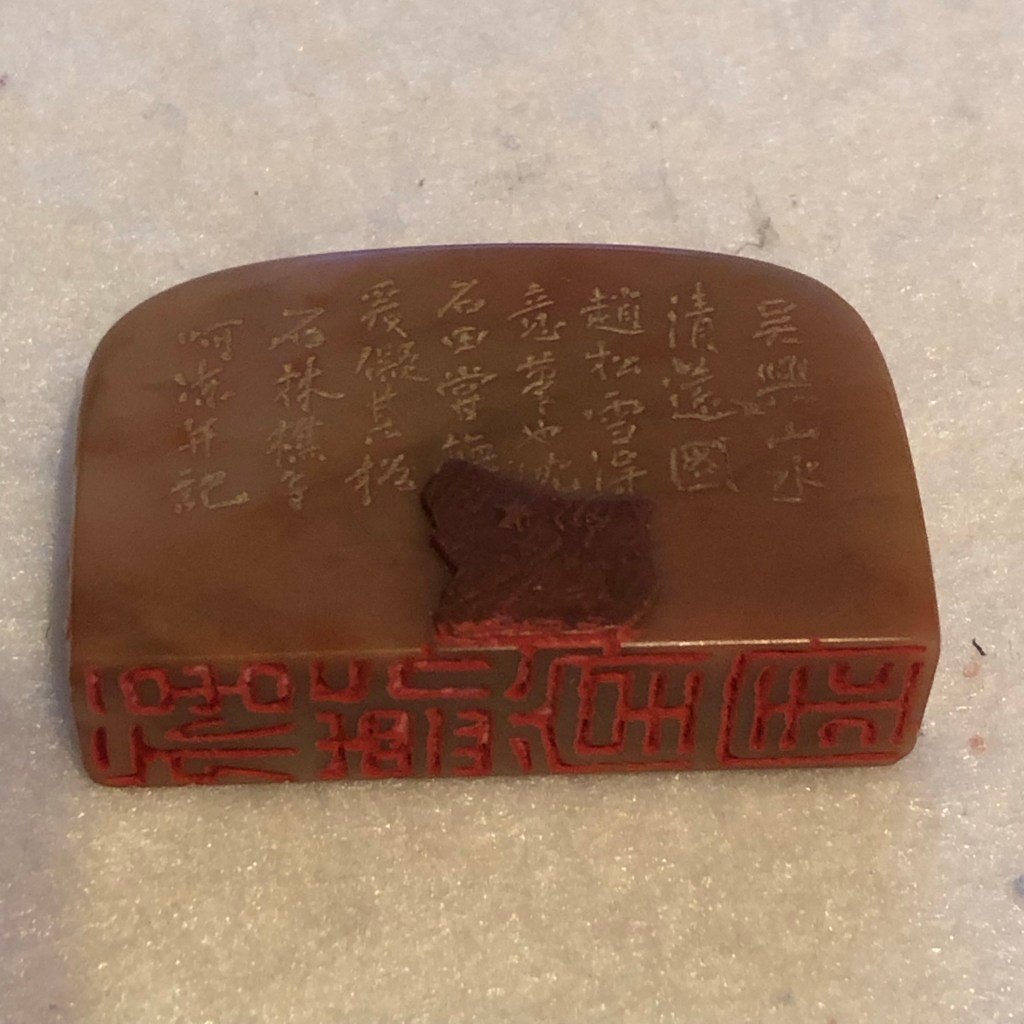
I wanted to put a seal stamp on the painting from my late mother to connect her with this work. Here is one of her seals (she was a Chinese artist):
The seal was stamped on the top right of the photo image to complete the painting.
–
REFLECTIONS
In The Location of Culture, Homi K Bhabha talks about the negotiation of cultures and where that takes place. He uses the analogy of a stairwell connecting different rooms and a transcultural person is constantly running in between those rooms. That analogy resonated with me and I wanted to build my image around this concept as captured in my sketchbook.
Regarding the use of a family photo – this idea came about when I was recently shown four photo albums that belonged to my family. I was asked to take them but I didn’t feel ready to take them yet. I wasn’t ready to start delving into my memory although working from memory is a key part of my narrative work. My deeper memory felt fragile hence I wanted to ease into the process. My tutor suggested that perhaps I could try working with one or two old photos to see how I got on. I chose one photo that was taken at Chinese New Year with the traditional new year peach blossoms surrounded by some framed family photos. It was taken many years after I left home and I didn’t feel a connection to my parents’ home even though I felt I should do. Hence I cut out the photo of me from the scene as I felt out of place there. The cutting out of part of an image from a photo was something that I wanted to try to see if it would convey that sense of ‘absence’ or ‘not belonging’. I was pleased with how it worked out on the image transfer and the masking process.
Despite the research into colour palettes and tone brilliance, I ended up doing it rather instinctively – this was a disappointment because I wanted to be more scientific and considered in my use of colours – so this remains an area of development.
I enjoyed using oil and cold wax and found that I had many options of mark making. I was pleased with how the scratched tree branches came out and the black thin marks helped to enhance the tree. I would have wanted to paint the tree in Chinese painting style but I have not worked out how to paint that delicately onto oil – ink doesn’t work on oil (materially incompatible) and oil is too viscous to achieve the delicate aesthetic – this remains an area that needs further investigation.
I presented the painting at a group crit. I didn’t mention the cut out photo and wanted to see if anyone would ask about it. No one did which made me think perhaps it was not an effective way to provoke a response.
At the crit, I was also asked by the facilitator if it would matter to me if no one understood my work. My instinctive answer was ‘no, it wouldn’t bother me’ although it’s always good if someone understood the work or found a connection with it. My take away was that perhaps this painting was aesthetically too confusing and hence people didn’t get it.
LEARNING
There were practical learning points such as to continue to work on colour theory and find ways to satisfactorily depict delicate Chinese brush painting onto a ‘western’ medium such as oil because I want to explore ways to bring different cultural genres together to convey my transcultural lived experience. This continues to be a key area of exploration for me.
On a personal point, although I liked this painting, I learnt that I still have some way to go to express myself in an abstract manner that connects with the viewer. My two colour zones with connections for the ‘stairwell’ didn’t really come across as I intended and the viewers seemed indifferent to the photo image. These made me think that what I wanted to say was not sufficiently thought-through, so I need to revisit what I wanted to say and not to rush in trying to say too much in one painting because all the messages and symbolic meanings would just get lost within the image. I have been advised before to avoid trying to say everything or too much in one painting – I must remember that.
NEXT STEPS
– Continue to learn and experiment with colours as I want to use colours appropriately to help me to convey my story.
– Do experiments: dig out some old oil painting exercises, cover with clear gesso and see if I can use Chinese ink on top of that.
– Revisit my style development. Do more research into the third space to really understand what that means to me and what it could look like aesthetically in order to develop a language that I can use. For this point, I want to develop my abstraction skills and will continue to explore oil and cold wax in this development.
– I want to continue to explore the cut-out photo technique to play with the notion of absence in my narrative. Although no one asked about it in this case, I remain excited about the possibilities.

 elizarawlings