MA U3: Weaving narratives and interculturalism

During my recent presentation on my research paper to my fellow students, I was asked why I talked about being transcultural and not intercultural. I talk about my transculturalism because I see it as a fusion process (as borrowed from physics) where two cultures come together and something completely new emerges (as per the definition by Homi K Bhabha). However, interculturalism is also applicable where I believe is when different cultures come together and intersect. It’s a process of weaving together rather than a fusion. I have not explored much about weaving cultures together although that is very much what I also do to navigate life. So I decided to investigate ways to weave my art to explore the idea of intercultural vs transcultural.

METHOD

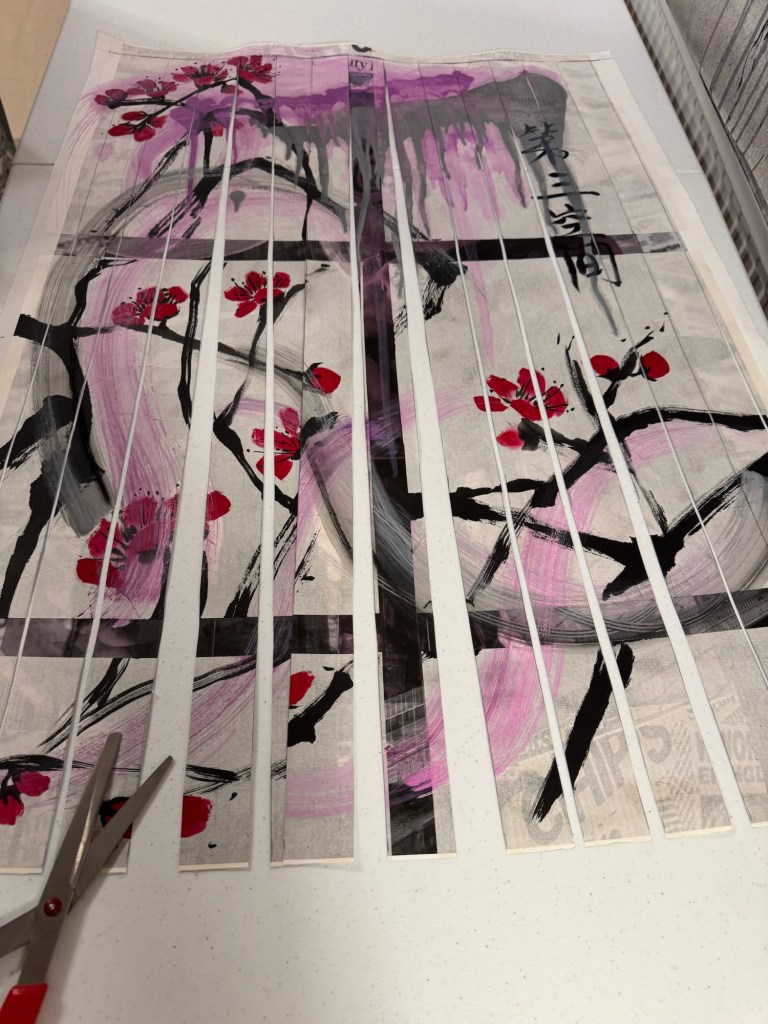
I chose two of my existing paintings for this project. To weave them together, I would need to cut them up first.

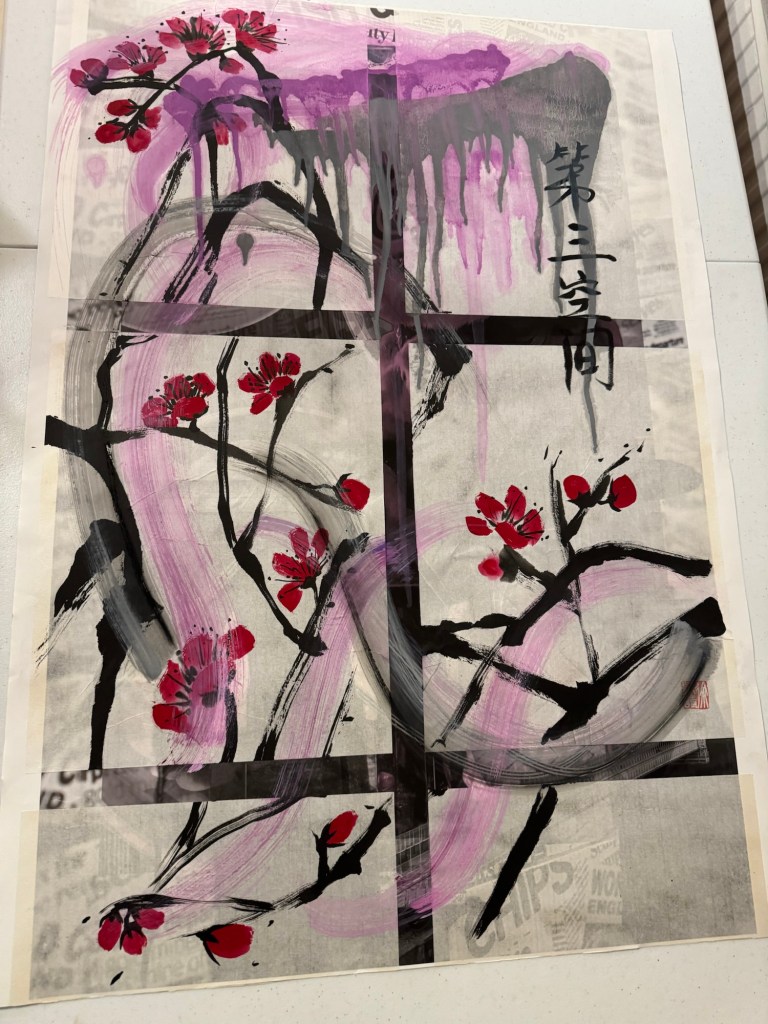
First chosen painting for cutting up – a piece of work from three years ago, Chinese ink on rice paper on inkjet printed paper:
A video I made capturing the cutting up process:

https://vimeo.com/1055045797

The cut-up painting:

Cut up painting #1

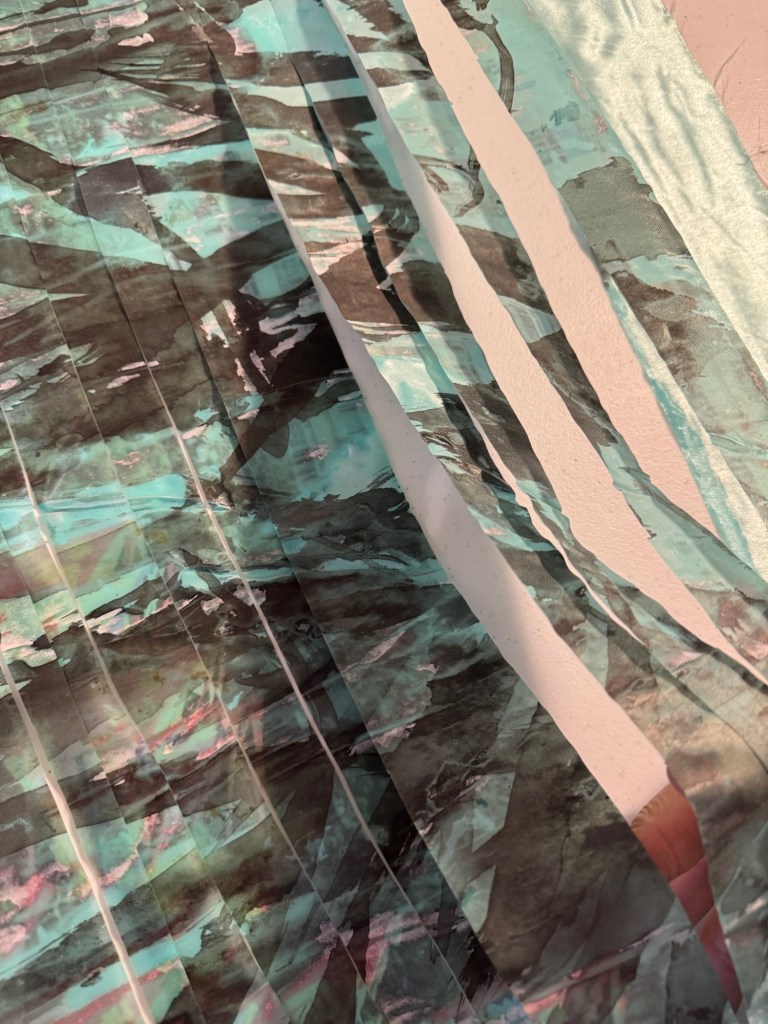
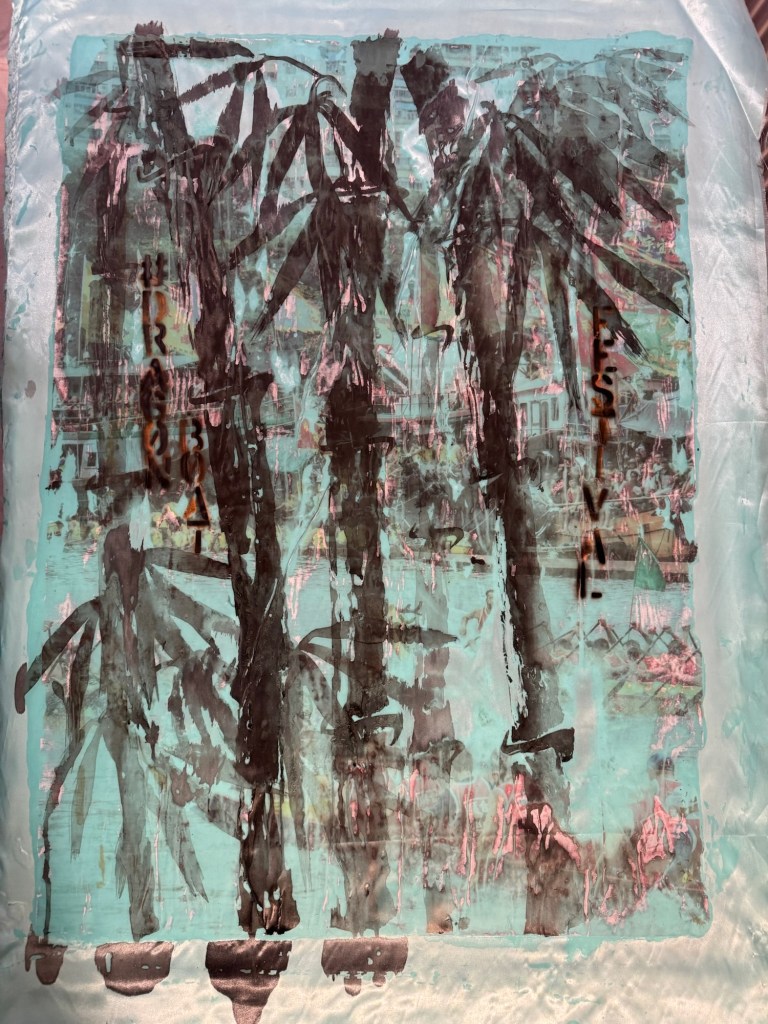
Second painting chosen for cutting up – a piece of work from three years ago, mixed media on satin canvas:
Cutting up of satin canvas:
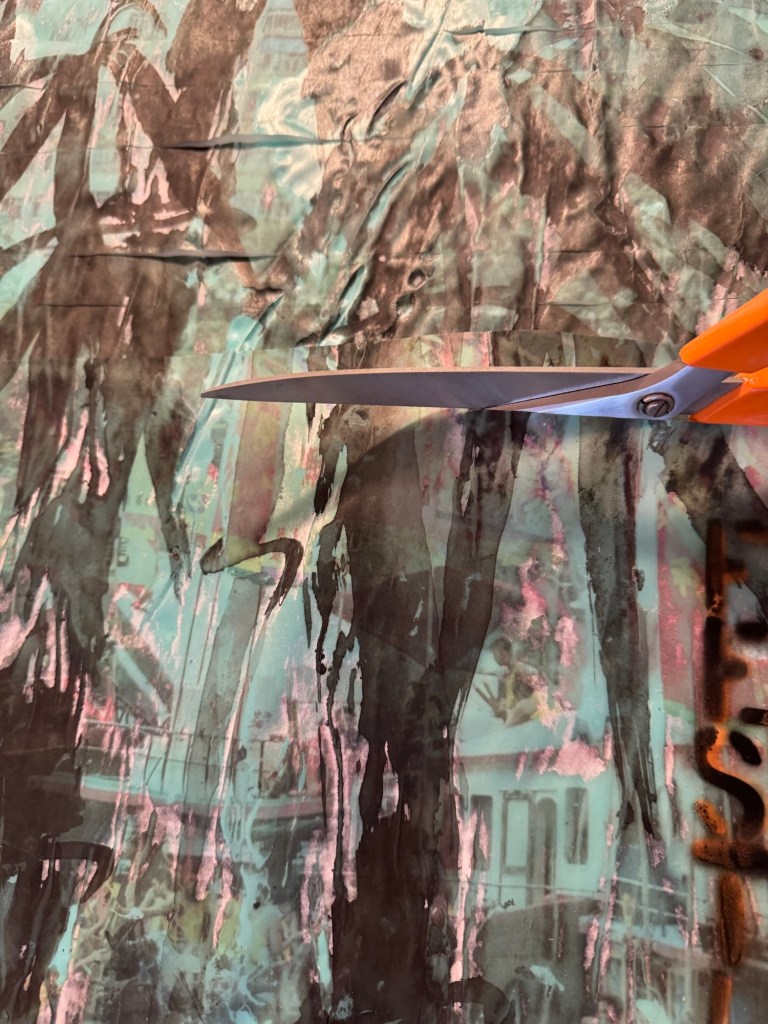
A video of the cutting up process:

https://vimeo.com/1055046609

The cut-up painting:

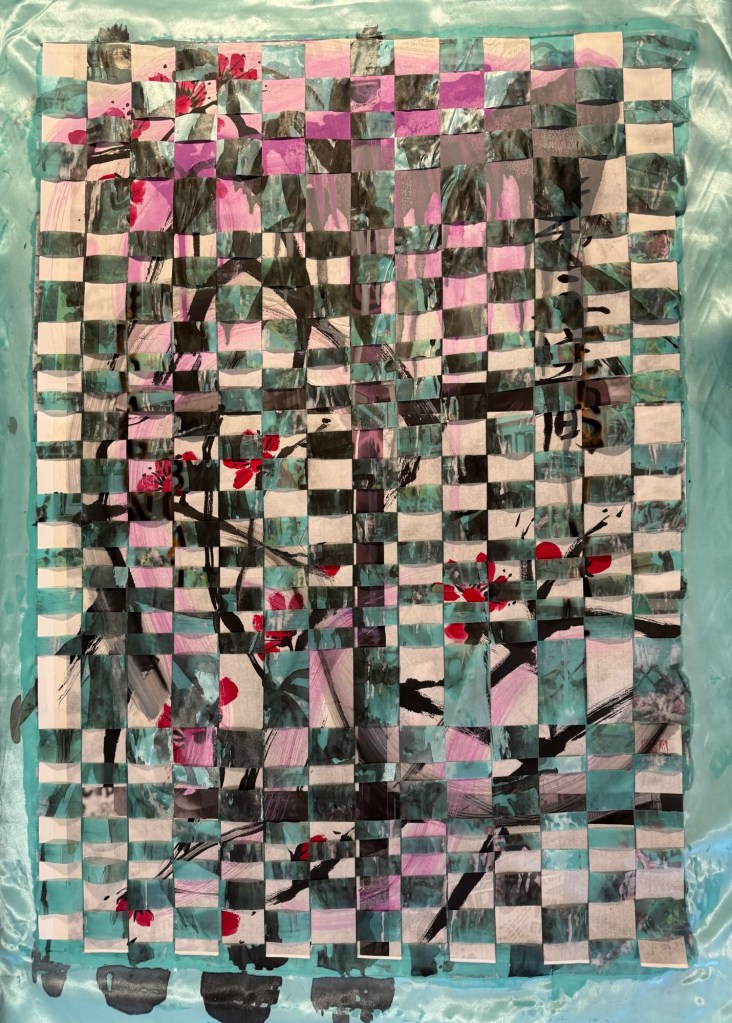
The weaving together by hand of the two cut-up paintings:
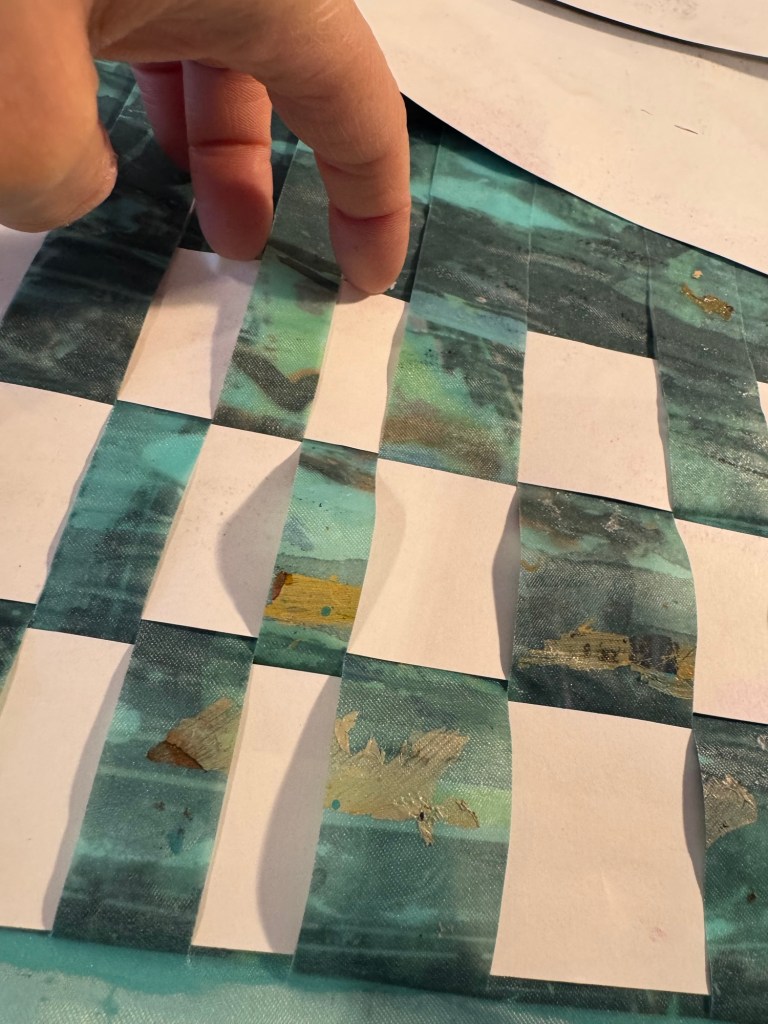
Woven tigether
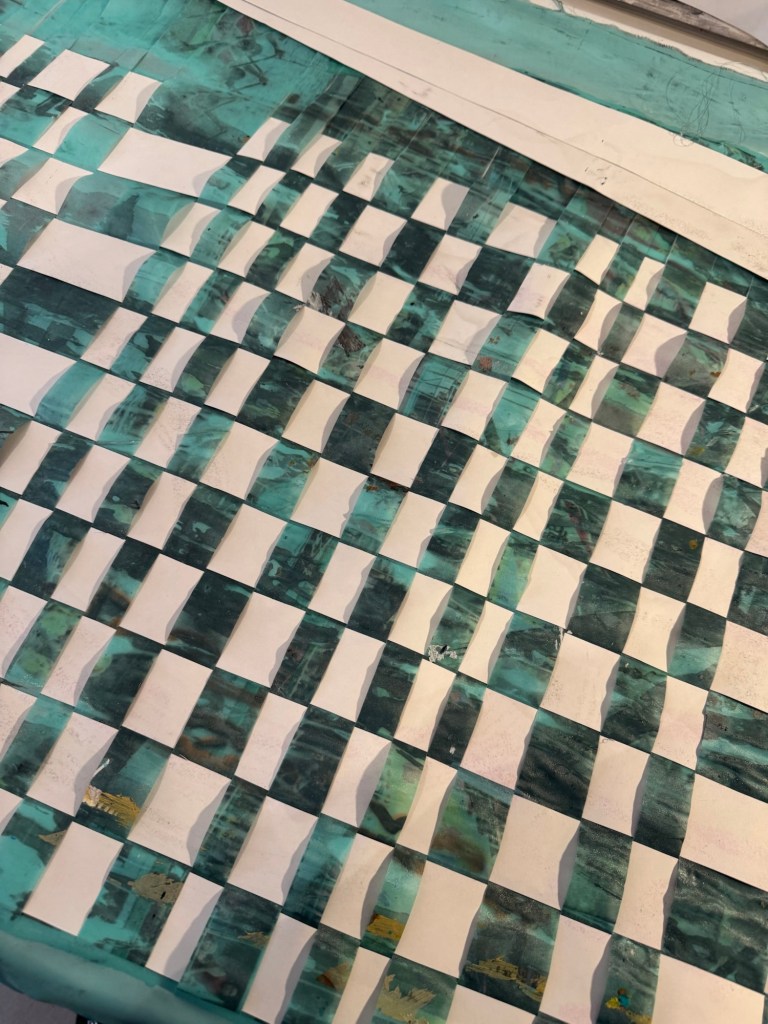
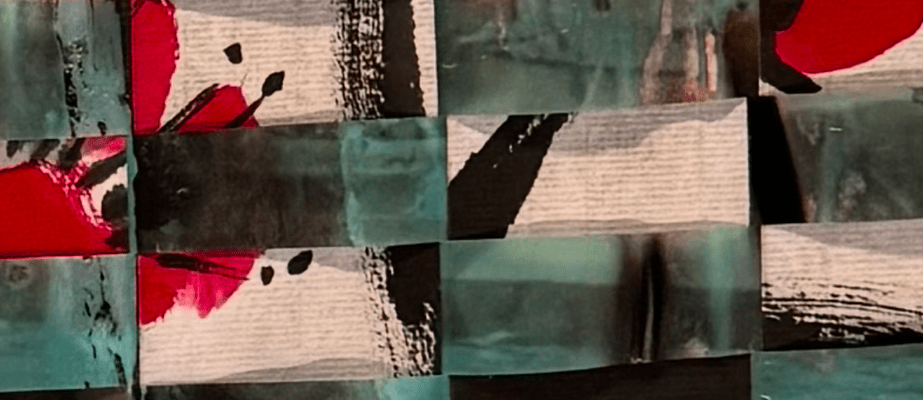
Close up of woven painting:
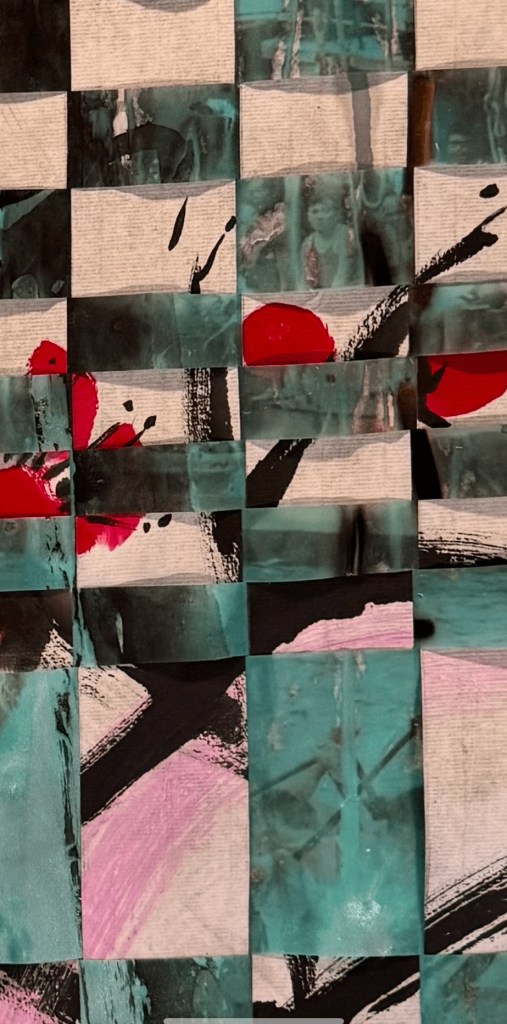
The completed woven painting, size A0.
Video with close up of completed woven painting:

https://vimeo.com/1055047150

RESEARCH AND THOUGHTS ON INTERCULTURAL

I did some quick research on the definition of intercultural. The Spring Institute said, ‘Intercultural describes communities in which there is a deep understanding and respect for all cultures. Intercultural communication focuses on the mutual exchange of ideas and cultural norms and the development of deep relationships.’ Many definitions describe intercultural as the coming together of a group of people of different cultures. From the quick research, I did not find any reference to the intercultural experience occurring within one person. I.e. when one person experiences and navigates different cultures within their daily existence.

To help explain my thinking about intercultural vs transcultural, I need to borrow an analogy from A Level chemistry – the definition of a mixture vs a compound.

Below are extracts from a website:

https://bio.libretexts.org/Bookshelves/Introductory_and_General_Biology/Biology_(Kimball)/01%3A_The_Chemical_Basis_of_Life/1.01%3A_Mixtures_and_Compounds

Mixtures are heterogeneous forms of matter. The composition of a mixture is variable with each components retaining its characteristic properties. Its components are easily separated. Examples of Mixtures: soil, ocean water, air, the cytosol of a cell.

In contrast, compounds are homogeneous forms of matter. The components of a compound do not retain their individual properties. E.g. both sodium and chlorine are poisonous; their compound, table salt (NaCl) is absolutely safe and essential to life. Another example of compounds is water (H2O).

It takes large inputs of energy to separate the components of a compound. Similarly, I have previously used the fusion concept from physics to explain the forming of transcultural characteristics. Fusion takes an immense amount of energy to take place. So learning from the analogies from science, I believe that for a transcultural person to go through the cultural transmutation process, it takes much energy and also time for the process to take place. Whereas I do believe that one can start to adapt to an intercultural life more readily. For example, an immigrant child moving to the UK with her family from say, Asia, could be adopting a full British style life at school during the day, then go home after school and be immersed back in her original culture in the home environment. That in my opinion is a form of an intercultural life.

REFLECTIONS

So where am I going with this?

Although I’m using science as analogies to explain intercultural vs transcultural, I am not asserting those thoughts as a definitive explanation, that would be grossly generalising and reductive. They are just ways of sense-making for me and to help me to think through the different cultural concepts. I could do more in depth academic research on the subject and I may well do so later. But for now, I am enjoying the thinking process based on my own experiences as I make art. I don’t believe I am anywhere near having answers, but I have started the thinking process on the subject.

How about the weaving? What did I get out of it?

My weaving experiment here was more of a technical exploration to see what happens when two paintings were woven together with a view of taking the learning to future works. Some questions that I asked myself in reflection were:

– How was the weaving process? It was quite easy and straightforward to execute, but that was because the width of each strip was fairly wide so quite easy to handle. I would like to try and weave with narrower or more irregular strips to challenge the process and create a less uniform pattern.

– What did I think of the outcome aesthetically? I wanted to see if the individual painting images would still be present but more ambiguous. I think I could say yes to this – I could make out the two original images but with missing details adding intrigue.

– How about the cutting process? That was very interesting! The cutting up of my paintings felt brutal but liberating. To not feel too precious about one’s work was definitely liberating. In previous blogs I’ve talk about how I valued the process of making more than the outcome. Once a piece of work is made, I usually feel quite detached about the piece of work. So I hope I will be prepared to cut up more paintings to investigate the weaving of work. Also, the cutting process helped me to release some of the anger and despair that has been building up for me regarding certain global issues going on right now.

– What am I really trying to achieve by the weaving process? I have struggled for some time to express my transculturality through my art. I have written about this before calling it the elusive ‘green’. I kept painting with blue and yellow (metaphorically) but couldn’t yield a satisfactory green. Meaning that I couldn’t come up with something that represented my transcultural / fusion process. When I was asked by my classmate ‘why not intercultural ?’, it occurred to me that interculturalism is also applicable to me, perhaps if I start with that, I might get more insight into the transculturality that I want to express. Imagine if the width of the cut-up painting strips were so narrow that the two images eventually became one, then that would be like a fusion process, or a ‘chemical compound’ would have been created where it’s no longer easy to separate or decipher the two original images. Hence like something new emerging in the third space.

Taking this idea further, I have in the last two years explored much about my transculturality, however, that is only a part of my identity. I consider myself a Hong Kong born British Chinese engineer artist woman business-leader and mother. In examining my identity as a transcultural person, I have not yet explored the dynamics between the engineer and the artist; or the experience of a woman and mother; or my voice as a business-leader vs that as an artist. In an earlier blog, I talked about wanting to re-explore an area that I have found comfort in the past (new objectivity industrial art). How do I combine that desire/need with my ongoing transcultural practice? They seem very different but are all part of me and my identity.

LEARNING

Since I exist in the intersection of multiple aspects of my life, I need to consider how I broaden my identity exploration beyond the current transcultural perspective. I cannot think of how I can express the different identity elements whilst remaining coherent. Perhaps I can make paintings about the different elements and then weave them together to see what images emerge. E.g. weaving together a Bristol streetscape with a Chinese ink painting, or an oil painting of my childhood family dinner with my expression of womanhood. What would that look like? This means instead of creating one image that embodies the different aspects of my intersectionality (like in Akunyili Crosby’s work as described in my research paper) which I have struggled to create satisfactorily, I can create multiple images and weave them together to see what comes out. This doesn’t mean I will adopt the weaving of paintings as a main process for my practice, but it might give me ideas and inspiration to create images (more abstract and ambiguous images) to express my overall identity. Importantly, it gives me a way forward when I’m feeling somewhat stuck with the complexity of too many ideas.

NEXT STEPS

– Cut up two more paintings with narrower strips then weave them together to see how the overall image develops. Use smaller size paintings like A4 so the experimental process can be quicker.

– If the above experiment is successful, then think about what to paint to really explore the different aspects of my identity and then weave the works together to see what comes out.
MA U3: Painting between likeness and unlikeness

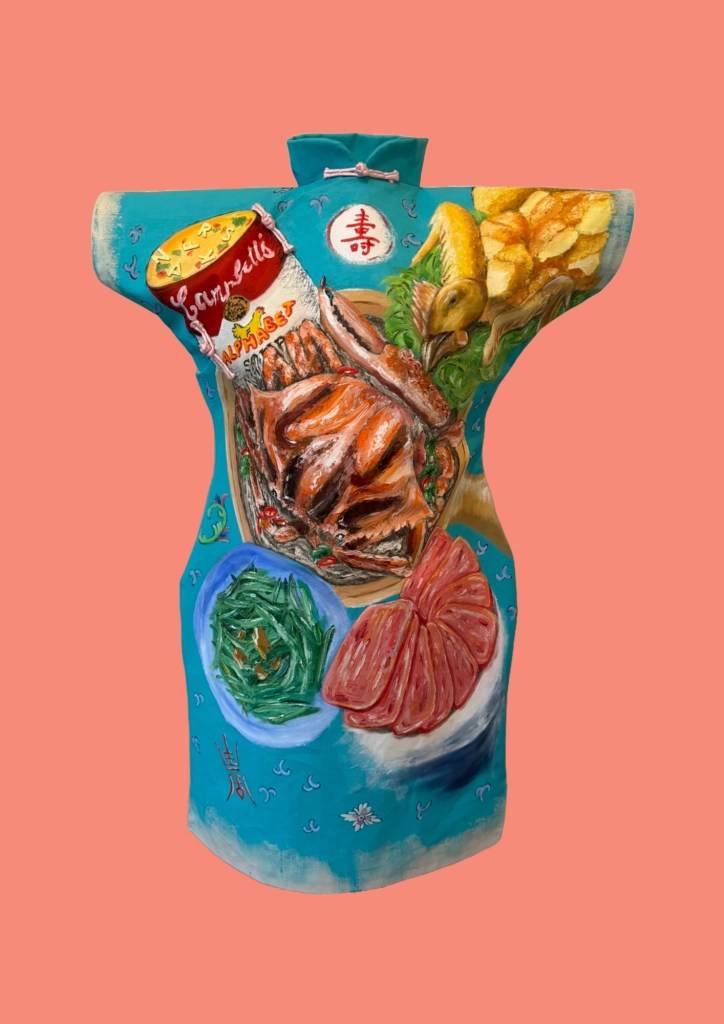
In my search and contemplation about ways of painting, I turned to a Chinese artists that I admire – Qi Baishi. His famous saying, ‘Painting must be something between likeness and unlikeness’ inspired me to experiment with different ways to paint my Family Dinner #2. Here is an image of my original painting in oil on Cheongsam shaped canvas:

METHOD

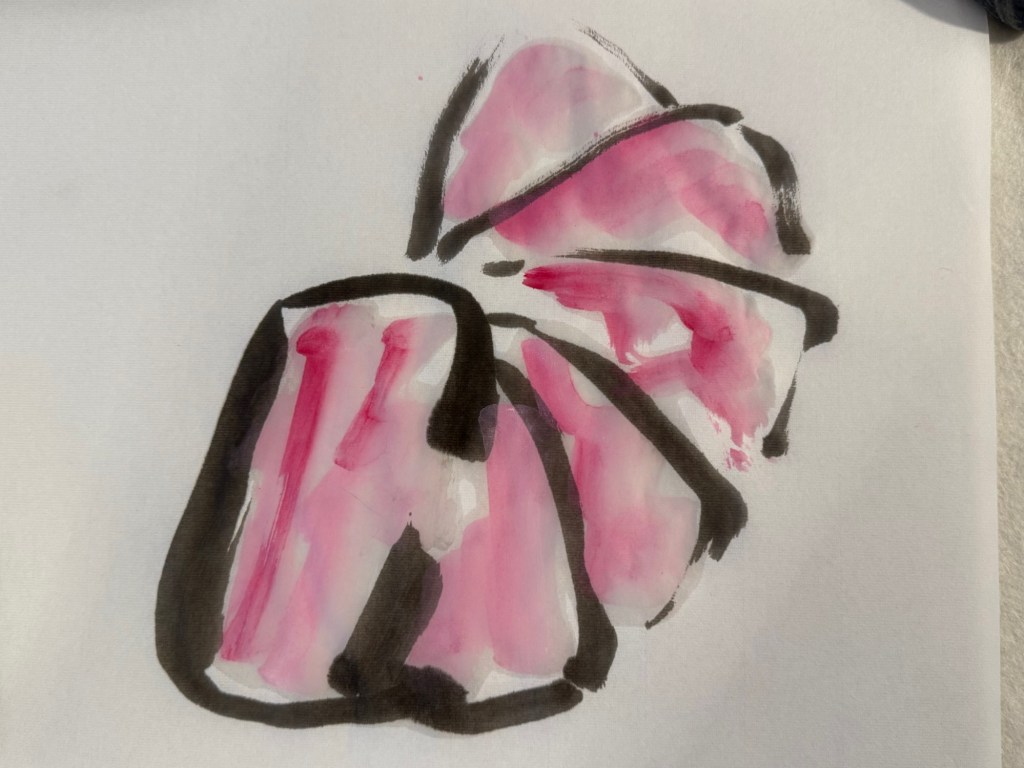
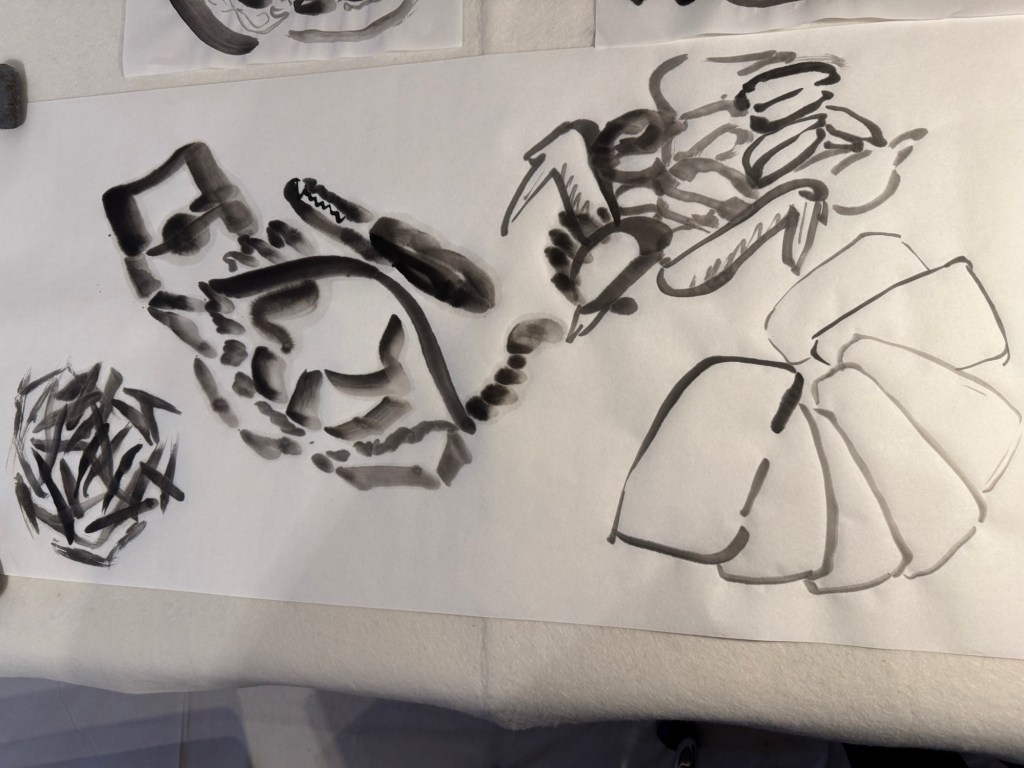
I started by doing some quick paintings of the individual dishes using Chinese painting materials: Chinese paint brushes, ink and rice paper.

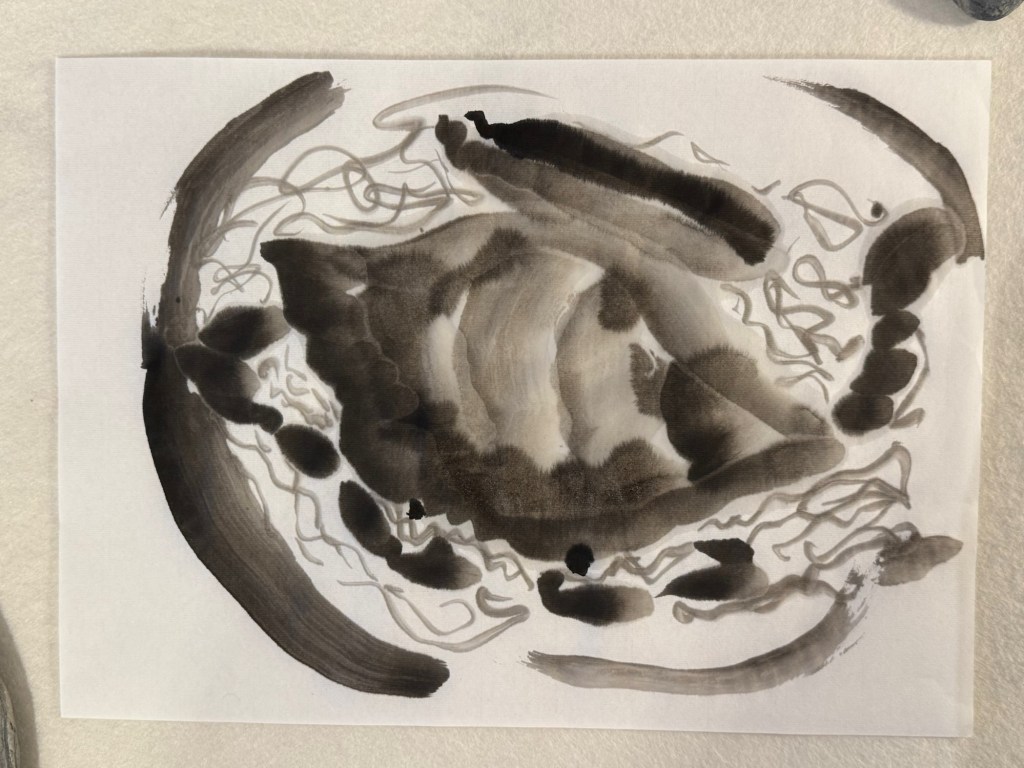
Flower crab
Pan fried sliced luncheon meat

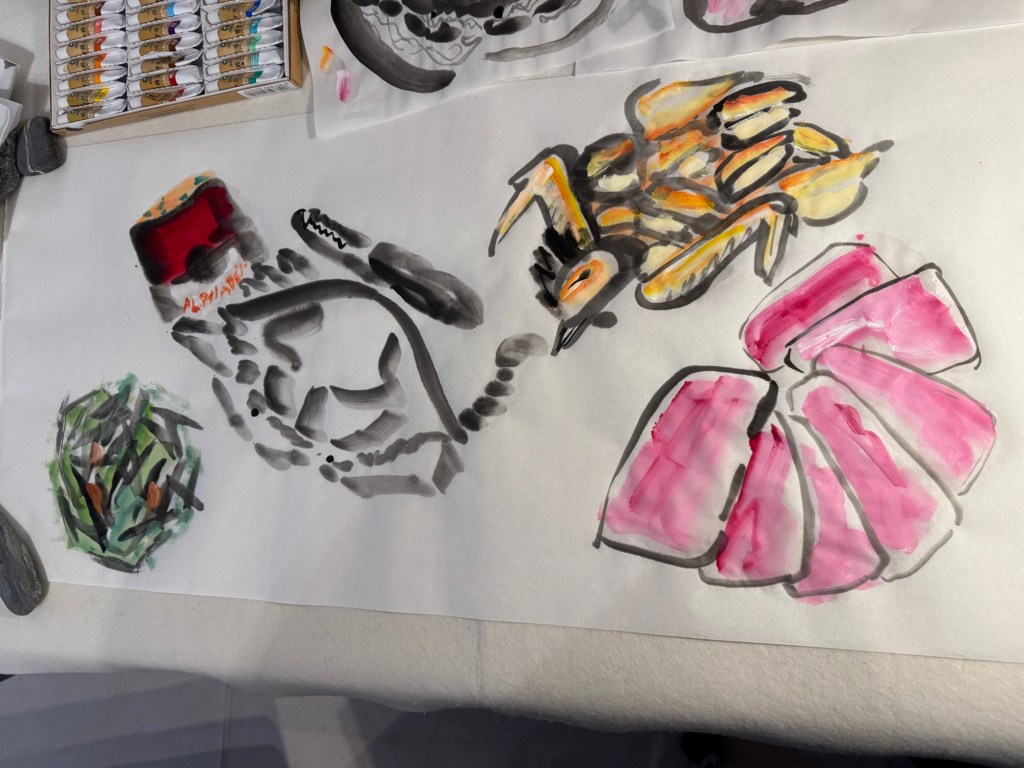
Here is the overall composition marked out on a long Chinese scroll of rice paper:

Work in progress:

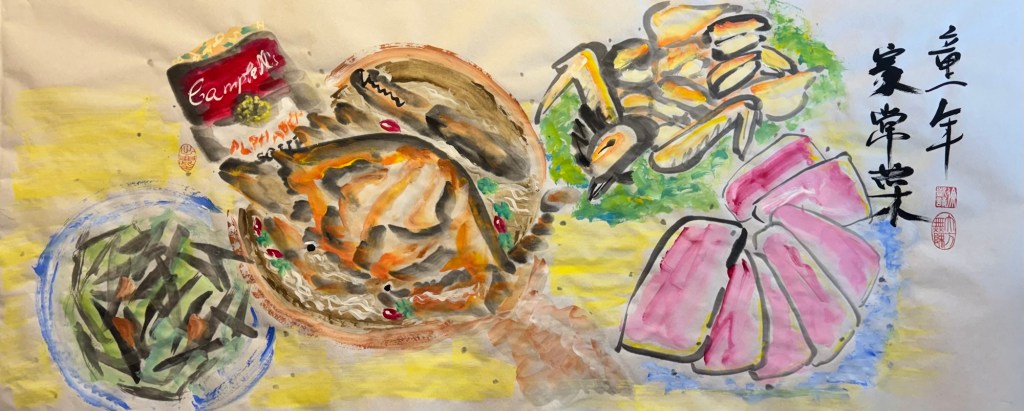
Completed painting – Chinese ink on Japanese Moon Palace (rice) paper, 114x46cm.

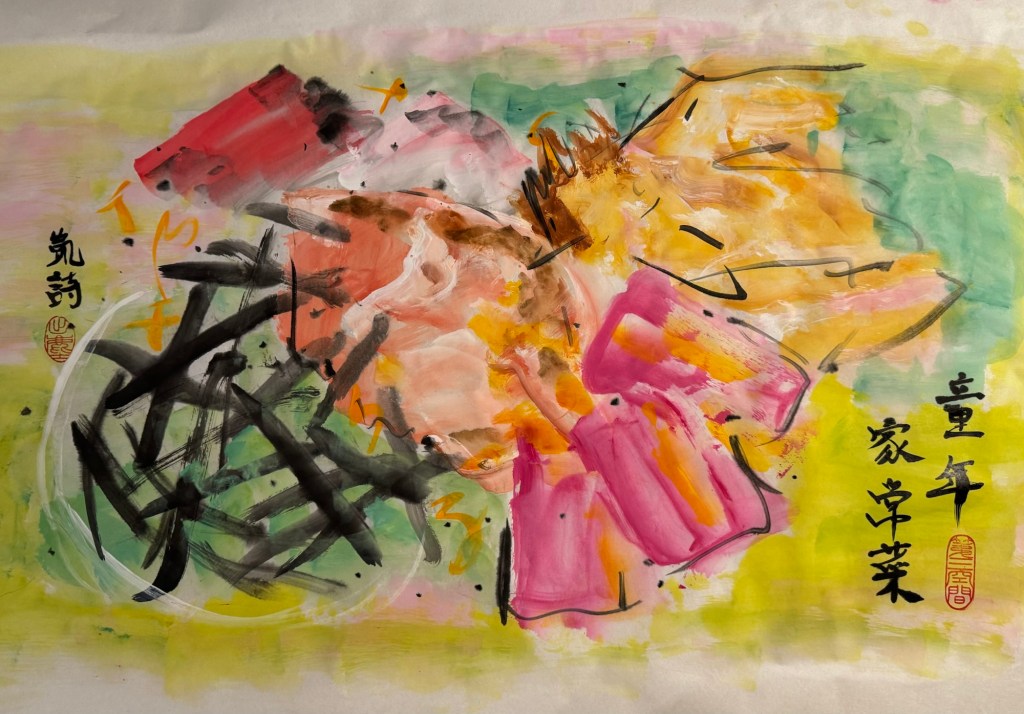
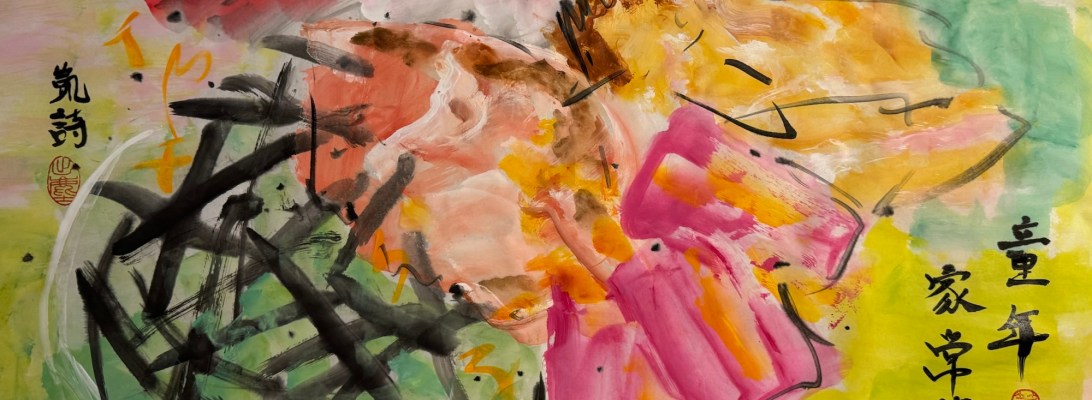
I felt the composition was too uniform and too neatly laid out. Hence I attempted another version with further abstraction to explore ‘unlikeness’:

REFLECTIONS

I enjoy painting in oil very much. I like the feel of the material, the viscosity when undiluted, the way it pushes against my palette knife or brush when painting impasto and then the luminosity when diluted. But painting in oil takes time (for me anyway) and I enjoy taking that time. I also like coming back to ‘play’ with the painting over several days.

Painting in Chinese brush and ink is a much quicker process. I can do several paintings in a day. Something about the materials make me want to paint fast with vigour. So I was pleased to do the Family Dinner explorations here using Chinese painting materials, it helps me to loosen up – both in my brush strokes and in my thinking.

One of the points I took away from my Unit 2 feedback was to paint more, and more. There was a question in the feedback asking if it was necessary to spend time making the Cheongsam canvases; I think that was a good question and perhaps I should spend more time painting and improve on that. Although I want to expand my practice to incorporate 3D, film and photography, I envisage my practice to always be rooted in painting – mainly because I enjoy it and I like the challenge. So I need to paint more to take it to the next level. I don’t know what ‘next level’ means, but I just feel the need to push my current boundaries – wherever that may take me!

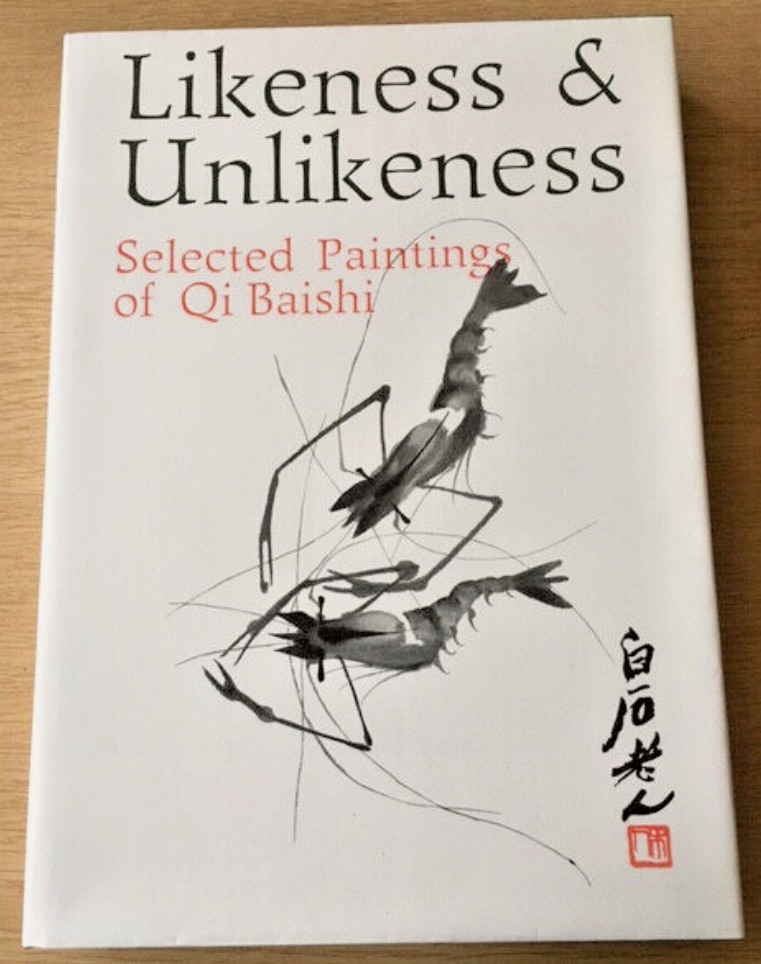
I managed to source the following book ‘Likeness and Unlikeness’ abour Qi Baishi’s work:

I need to do more research about what he really meant by his saying. Perhaps that would give me inspiration and new ideas to explore. I had thought that ‘between likeness and unlikeness’ meant a way towards abstraction. But when I look at his paintings, there was always good likeness (a shrimp looked like a shrimp). So I discussed with my Chinese art tutor what Qi meant – it appeared to be not about abstraction. She believed it was about the artists putting themselves into the work. I need to research this some more to really understand. I will start by reading the book.

I feel excited about the research between likeness and unlikeness…

LEARNING

I want to take my painting to the next level but I have not been able to decide how. The reflections above have helped me. I think I will return to painting on 2D canvas for now while I’m experimenting. I would like to return to 3D canvases such as the Cheongsam dress at some point because I have really enjoyed those paintings.

NEXT STEPS

I want to continue to build on my painting practice in the following way:

– Really explore oil as a material. I am used to using oil undiluted to create thick impasto layers, so I will experiment with thinner layers to give me more ways to express myself. Especially to find ways to create ambiguity, about distant memories.

– Research and understand the meaning of ‘between likeness and unlikeness’, start with experimenting in my Chinese art practices with ink on rice paper. Then maybe transfer the learning and understanding to painting with oil if it feels right.

MA U2: Book art – Part 1

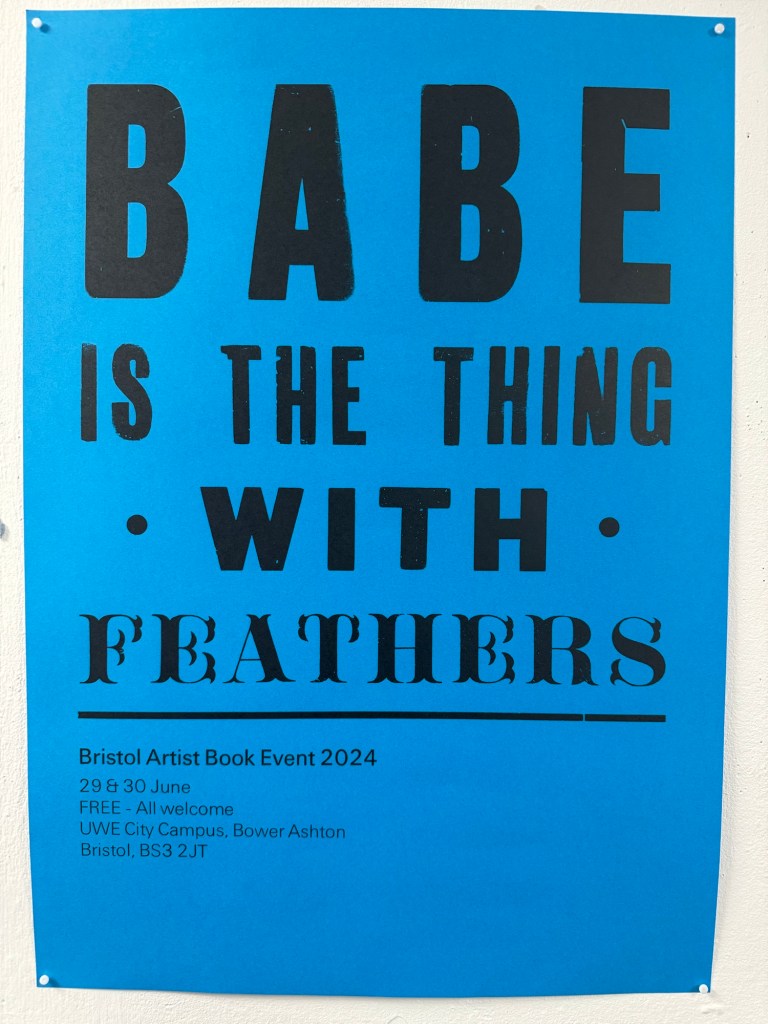
During the MA low residency at CSM in March 2024, we had a book art workshop where we learnt to make zines and some simple book. The artist hosting the session mentioned a book art event that takes place in Bristol once every few years. I was delighted to find that it was on this year and I attended the fair.

There were nearly 100 stands; it was a great opportunity to talk to and learn from experienced book artists. I came away feeling enthusiastic to try this beautiful art form.

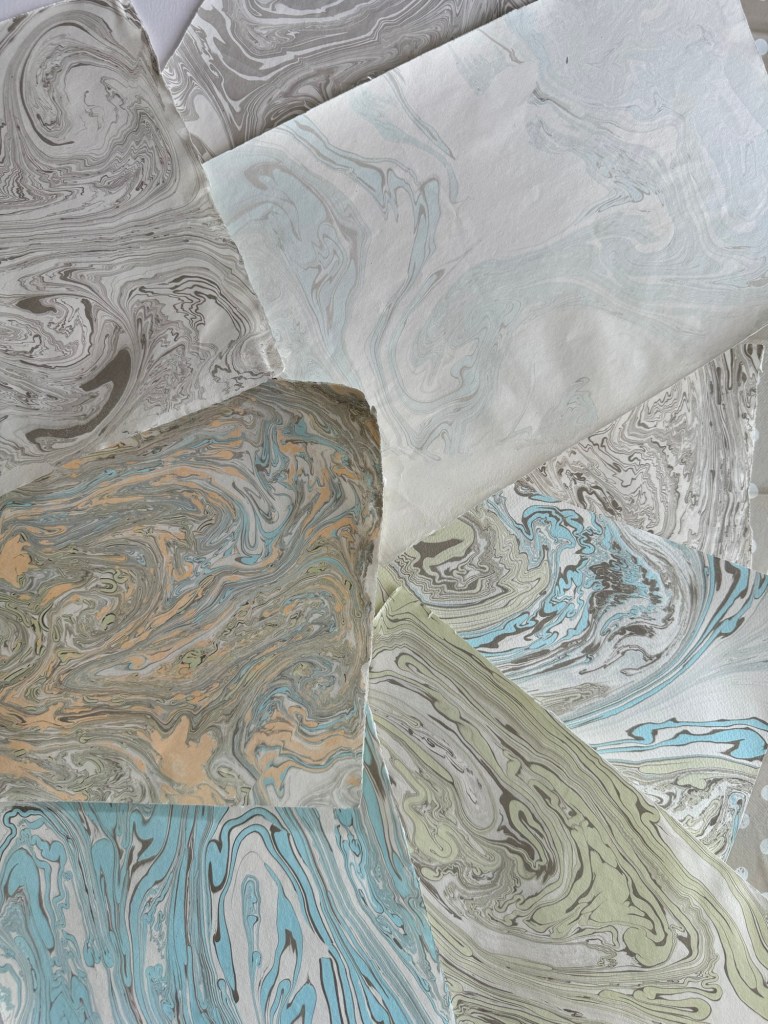
Another reason for my enthusiasm was that I recently attended a Suminagashi workshop. Suminagashi is an ancient Japanese technique of making handmade marble paper and washi by floating water-based inks on water, then laying the paper on top to absorb the ink and water pattern. See post:

https://eliza-rawlings.com/2024/07/05/suminagashi-workshop-ancient-japanese-paper-marbling-technique/

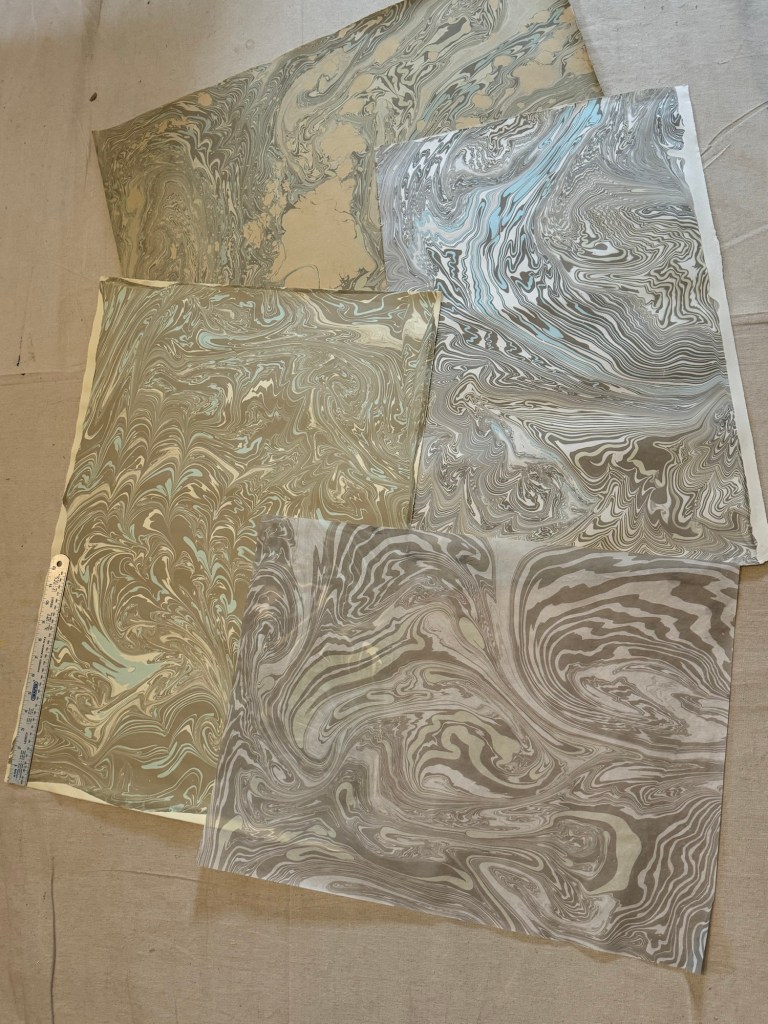
Here are some of the Suminagashi paper that I made during the workshop:

Small A4 size sheets
Larger A2 size sheets

METHOD

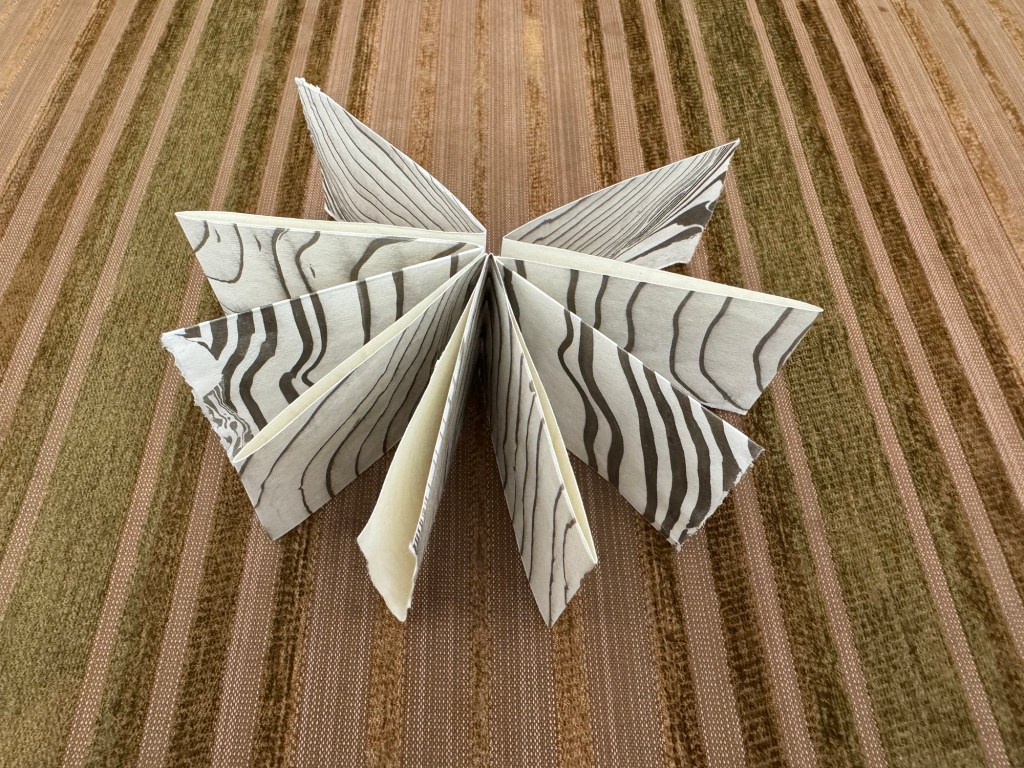
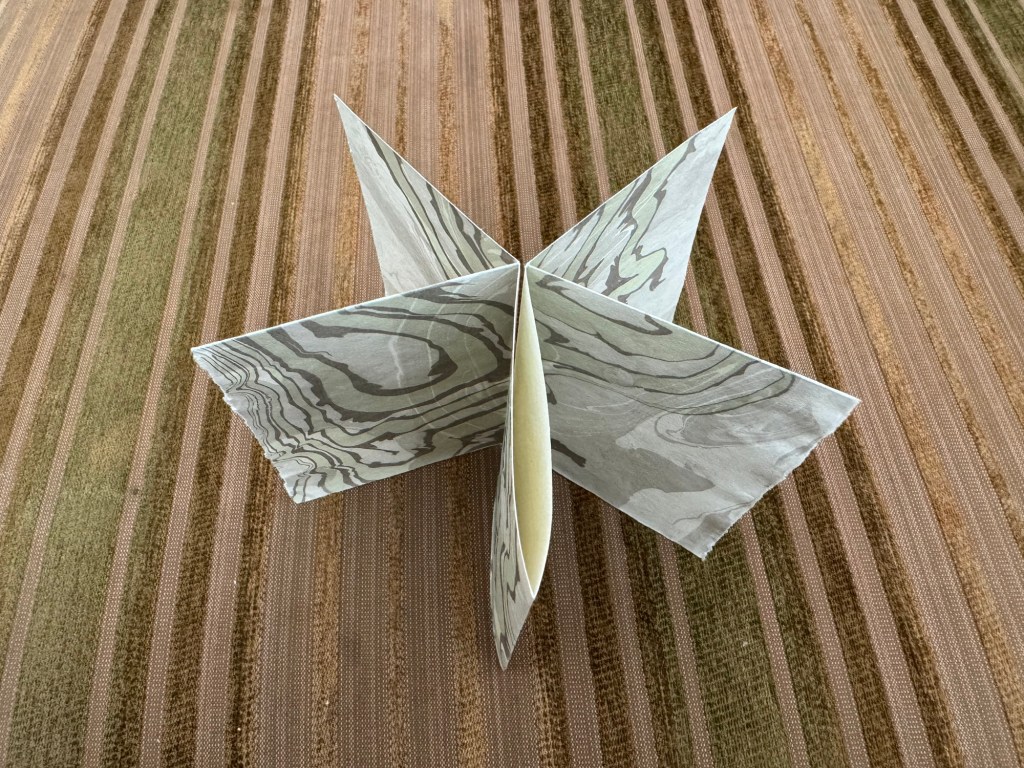
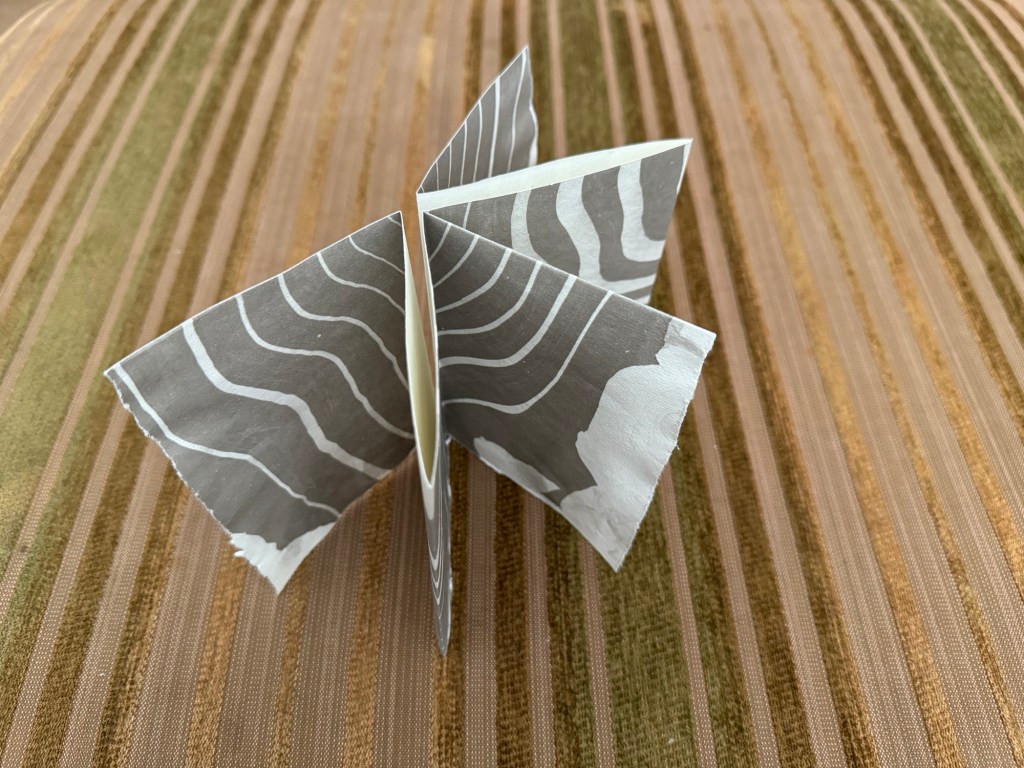
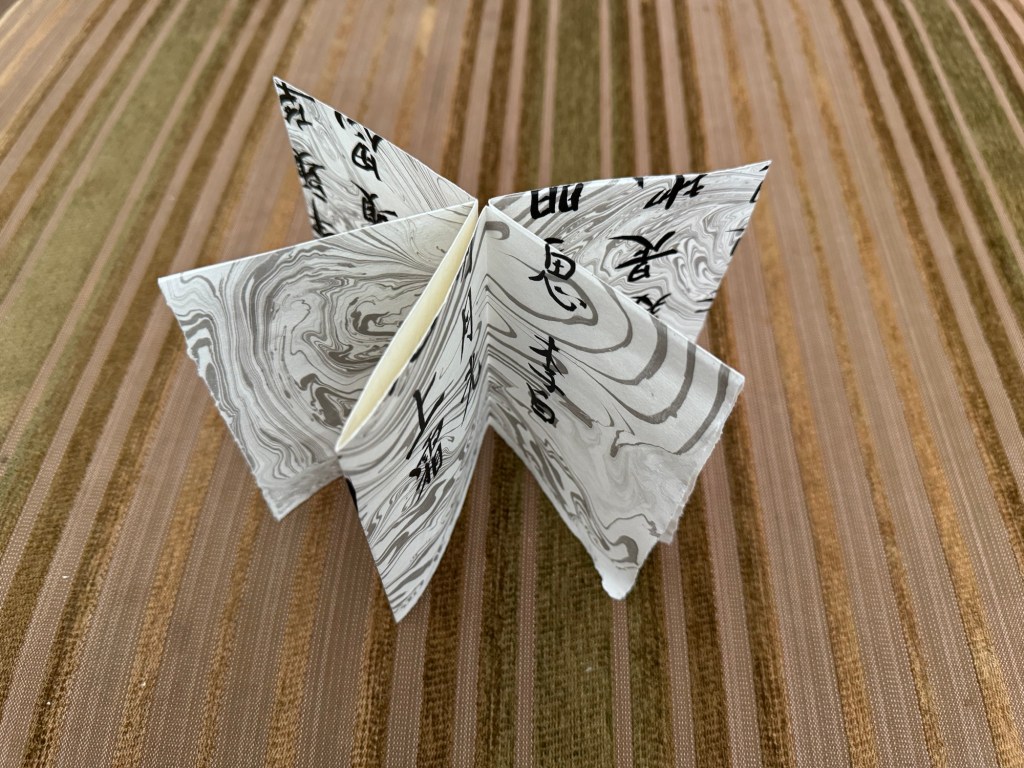
From the techniques learnt during the low residency workshop at CSM, I made a few different types of simple books using the smaller sheets of Suminagashi paper:

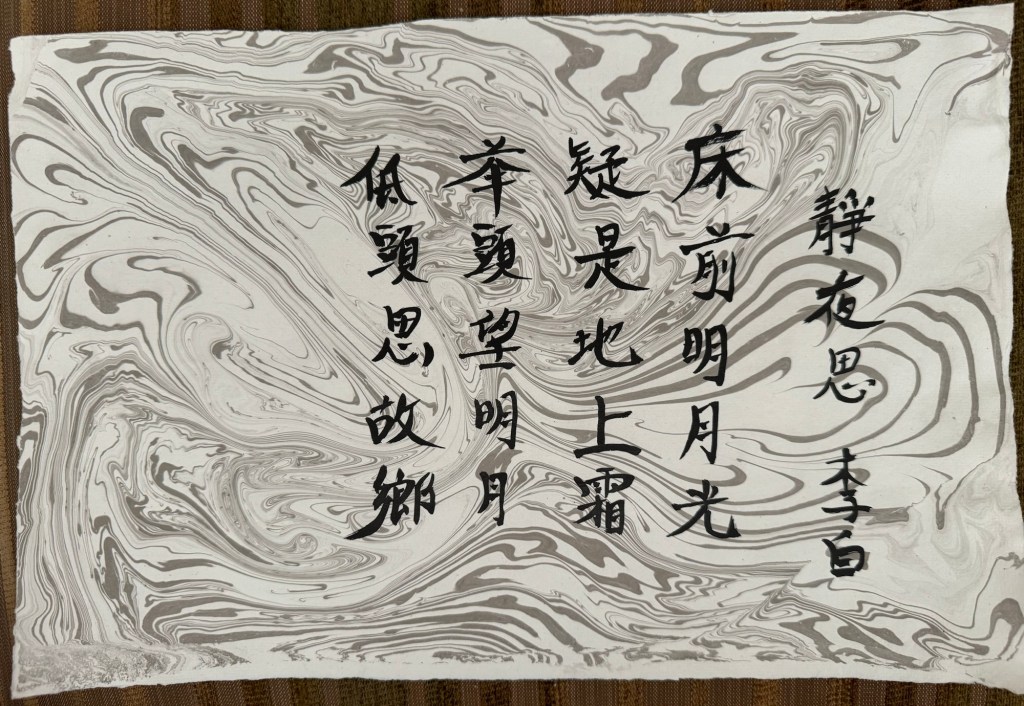
I experimented with some Chinese ink calligraphy on one sheet of paper, then folded it into a simple book:

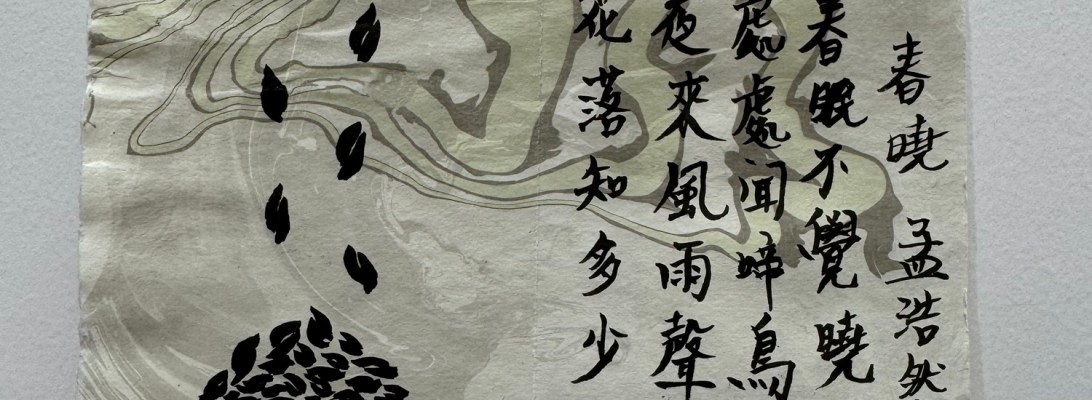
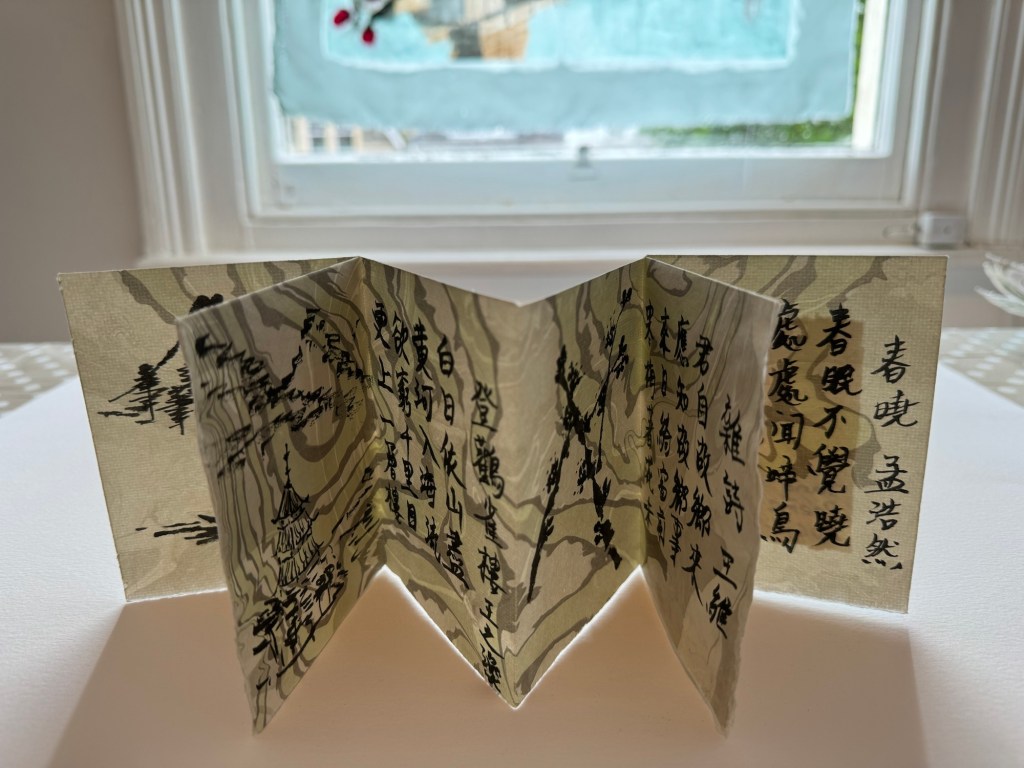
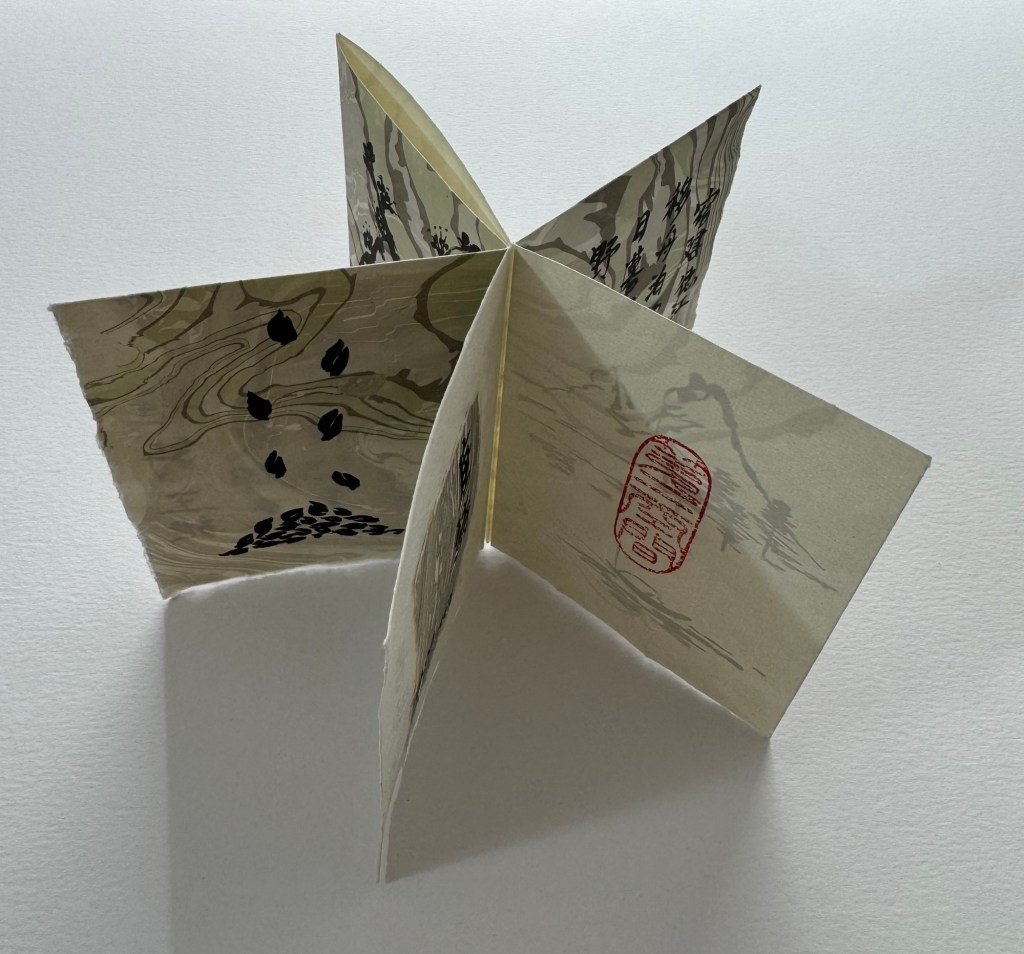
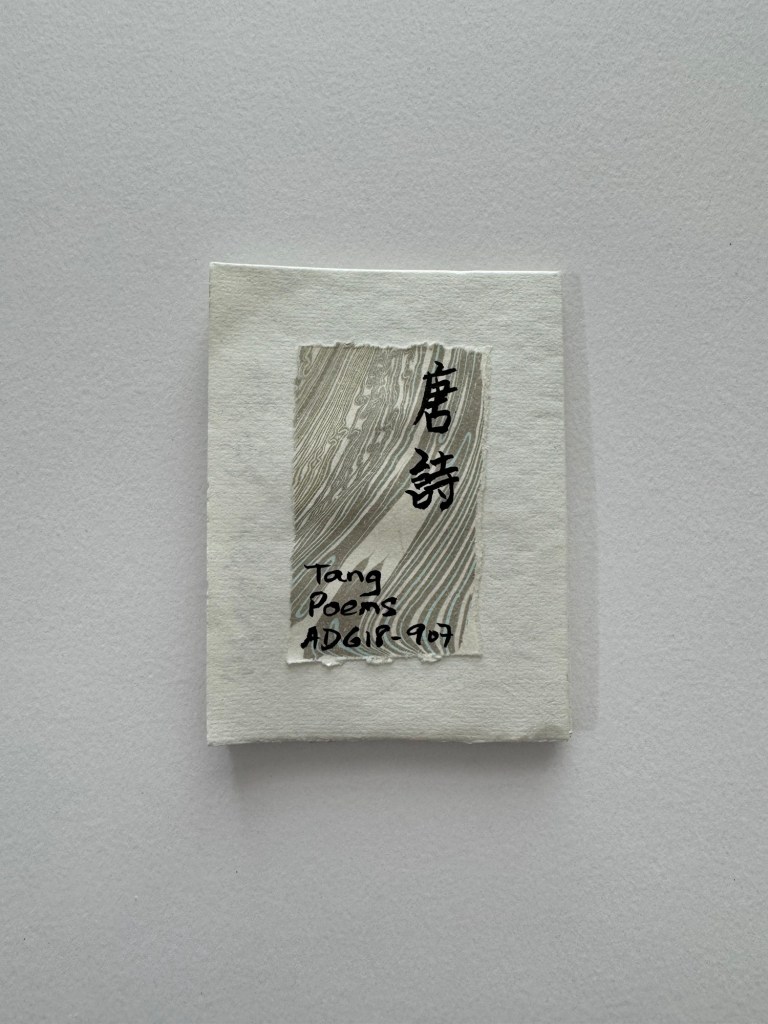
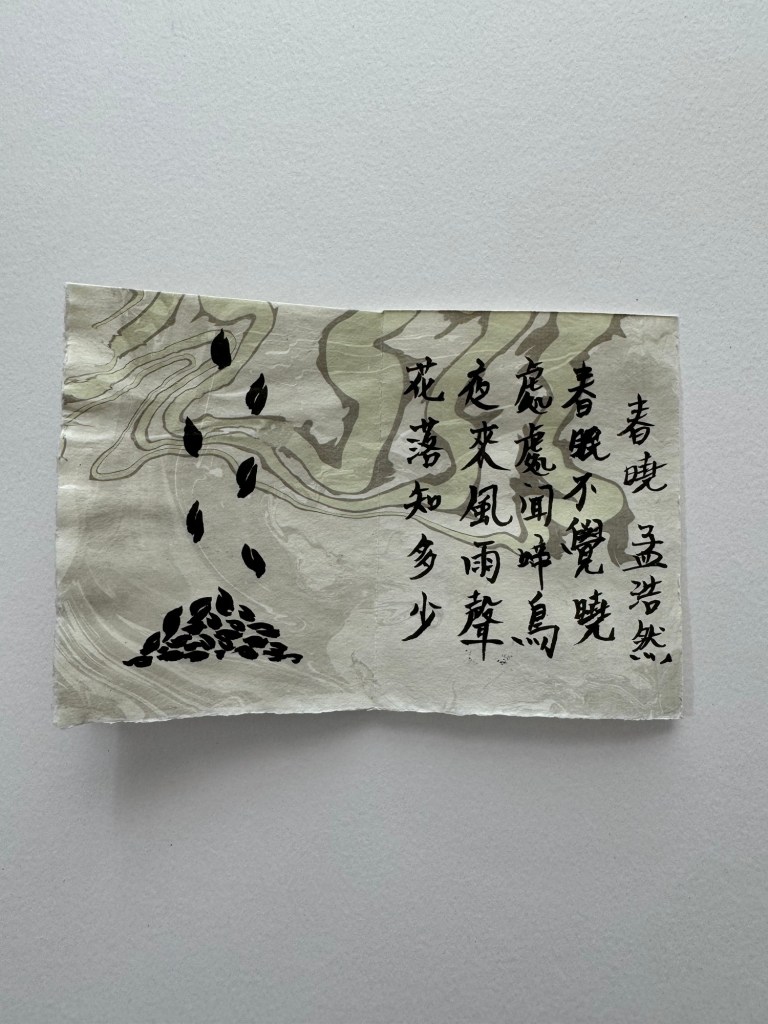
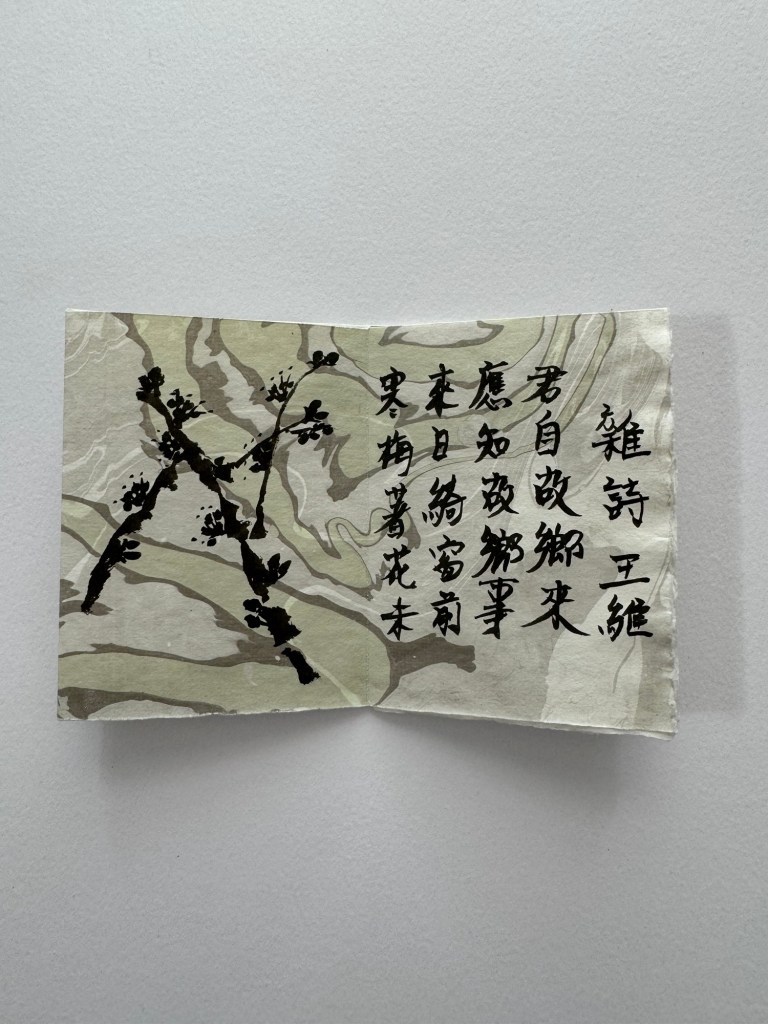
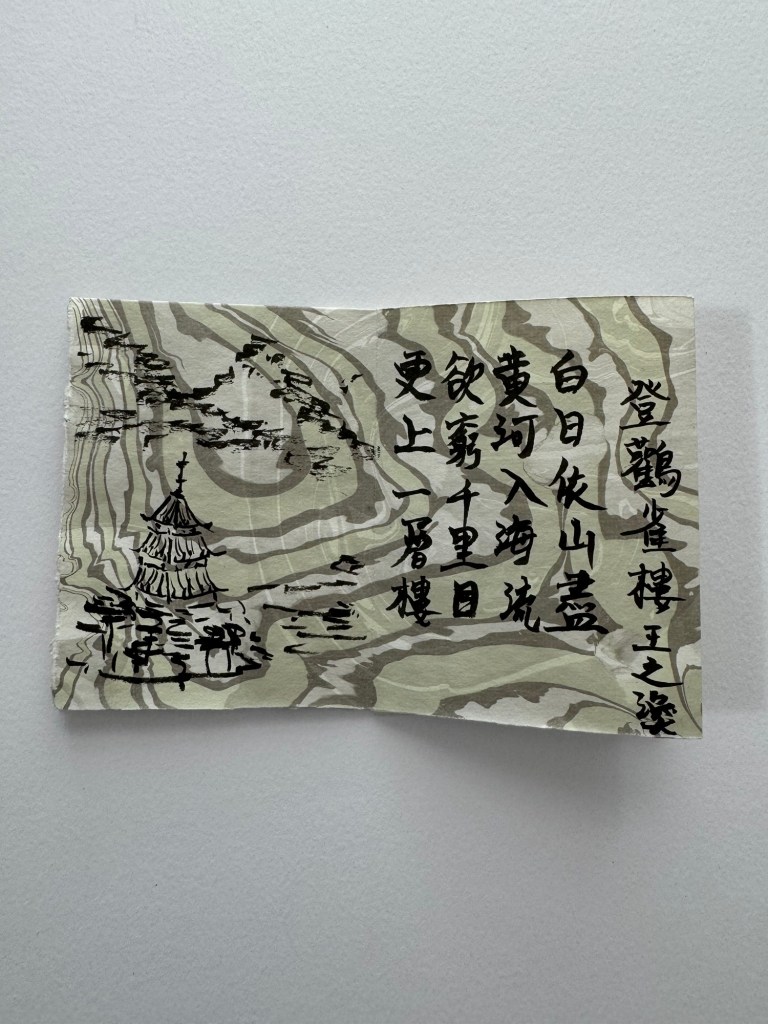
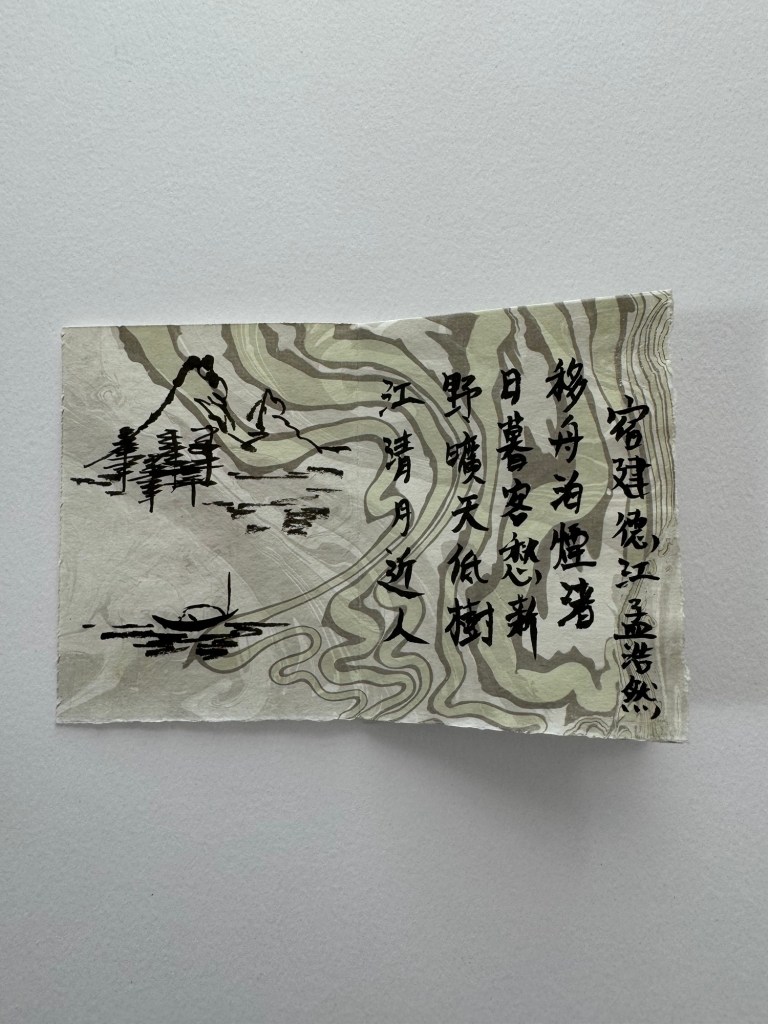
On another Suminagashi book that I made, I chose four Tang Dynasty poems and wrote them in the book using Chinese ink calligraphy, each paired with a small painting:

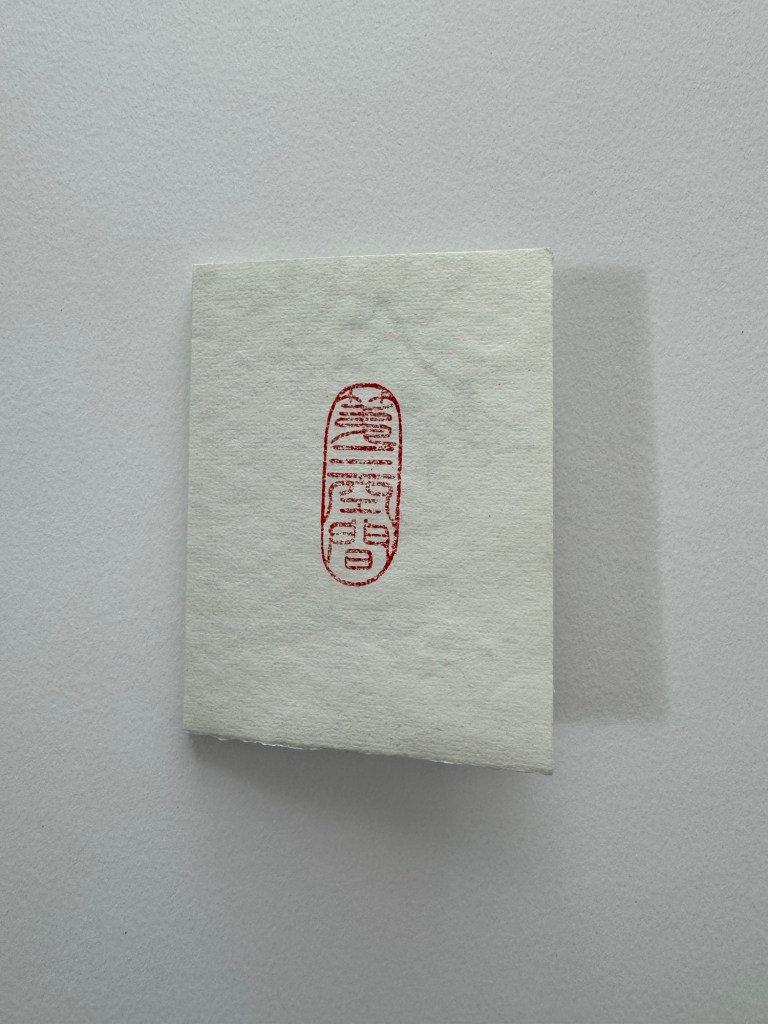
The seal on the last page of the book is a new Chinese stone seal that I designed. I managed to have it carved in Hong Kong and brought back to the UK by my Chinese painting tutor. The phrase on the seal means ‘The Third Space’, a concept that my art practice is based on so I will use it like my artist’s signature. The seal is carved in an ancient Chinese font.

Below is a video with my narration, reading out the English translation of the poems. Note that traditional Chinese books open from the opposite direction to English, Romance or Germanic language books:

REFLECTIONS

I was really inspired by the visit to the book art fair. It helped me to understand how broad the scope of this art form can be. I knew very little about book art until the low res workshop earlier this year and I am excited by it. I enjoyed making the simple books in this exploration, especially using the Suminagashi paper. Here is a summary of what I enjoyed about this exploration:

– I enjoyed the quiet pleasure in the act of folding paper carefully, especially with beautiful paper such as the Suminagashi paper. The feel of the material surface, the edges and creases all added to the meditative effect that this art form has to offer.

– I enjoyed learning a new skill in making books. Although I am only making very simple ones at the moment, I am excited by the potential complexity and scope that book making can offer. It is new knowledge and a new challenge for me.

– Once a book is made, it is like having a new canvas calling out for creativity that requires a new way of thinking compared to my other work.

For me, it is a two stage process: (1) Think about how I want ‘the canvas’ to be and realising that idea through physical making; then (2) express my art on the made canvas. The stages are similar to the Cheongsam (Chinese dress) canvases that I have been making for painting. That approach also requires creating a 3D canvas first through a step-by-step ‘technical’ process before any drawing or painting can take place.

The similarities between my book-making and dress-making to create canvases only occurred to me during the writing of the above reflections. I was beginning to feel concerned that I might be going from one thing to another too soon in my practice. I am not dropping the dress-making work, in fact, far from it – I have planned many other projects based on Cheongsam canvases. But I also want to explore book art and I now realise the similarities between the two in the context of my practice. I believe it can be explained as follows:

– The book-making or dress-making processes start by my following some guided steps, this way of making gives me a structured approach to starting a project. Meaning, it is unlike just getting out a plain sheet of paper or a pre-made blank canvas where you are immediately faced with having to decide what to paint. Through the structural and systematic start of the creative process (i.e. making a book or a dress), I can proceed to create ‘productively’ and while I am making the ‘complex canvas’, I can think about what to paint on the canvas or to finalise the ideas in my head. The process of making the canvas (which in the case of a dress can take several days) gives me quality thinking time whilst doing something productive and not just sat in front of a blank canvas feeling bad that nothing was happening.

LEARNING

Attending the book art fair taught me a lot about the scope that this art form can offer. In my own experiments, I have learnt more about the art of making books from a technical perspective – I am at a very early stage right now but I definitely want to learn more to make more complex or larger books.

My reflections above made me realise that the process of making the canvas myself (e.g. a book or a dress) has been a key part to my enjoyment in making art recently because I have been using the canvas making time and process to aid my thinking and to finalise my creative ideas. I have been doing this without consciously knowing it. I value the fact that making items such as a book or a dress are established processes and therefore give me a secure and stable route to start each piece of work. On the contrary, if I were to create a completely free-form assemblage from found items as a starting point, I would be inhibited by such an open and abstract process at the beginning of a piece of work – I would not know where to start and therefore it would be like sitting in front of a blank canvas again. This realisation is very important and useful for me because I can now think about other potential canvases that I can make from an established method in order to expand my practice.

NEXT STEPS

– Continue to make books and learn about book making to expand my knowledge.

– Think about other canvases that I can create in addition to books and dresses that would enable me to have the quality thinking time as part of my creative process and to avoid the ‘starring at a blank canvas’ problem.

UPDATE:

I made another book using a piece of Suminagashi paper folded into a small long book. In it, I wrote four short Tang Dynasty poems in Chinese calligraphy and coloured some areas using Chinese painting colour.