Background
I have been learning Chinese brush painting for nearly two years. I started this learning after I was given some of my late mother’s paint brushes and other items from her studio. She came to art late in her life and was an accomplished artist in Chinese painting with solo exhibitions as well as her own students before she died 20 years ago.
It is not my aim to specialise in Chinese painting, but I would like to learn this genre of art as part of my overall practice. I am currently exploring my identify and heritage through my art practice. I have been experimenting with a multimedia layering process with found and painted images that reflect my transcultural lived experience. I want to be competent in Chinese brush painting and calligraphy to the extent where I can confidently incorporate painted Chinese brushstrokes into my multimedia work.
I plan to start blogging about my Chinese art work so that I can use this process to reflect and improve. Also to capture any thoughts on my identity and heritage discovery along the way.
ROOSTER
METHOD
The latest topic in my Chinese art class is feathered creatures, starting with the rooster and chickens.
In Chinese culture, the rooster symbolises a range of meaning from punctuality to prosperity. It is also the tenth animal in the Chinese zodiac system.
Below are two of my latest paintings.
1. Own composition
It has taken me some time to start doing my own composition from scratch. Up to now, I have been mostly copying from worksheets or other artists’ paintings as part of the learning process.
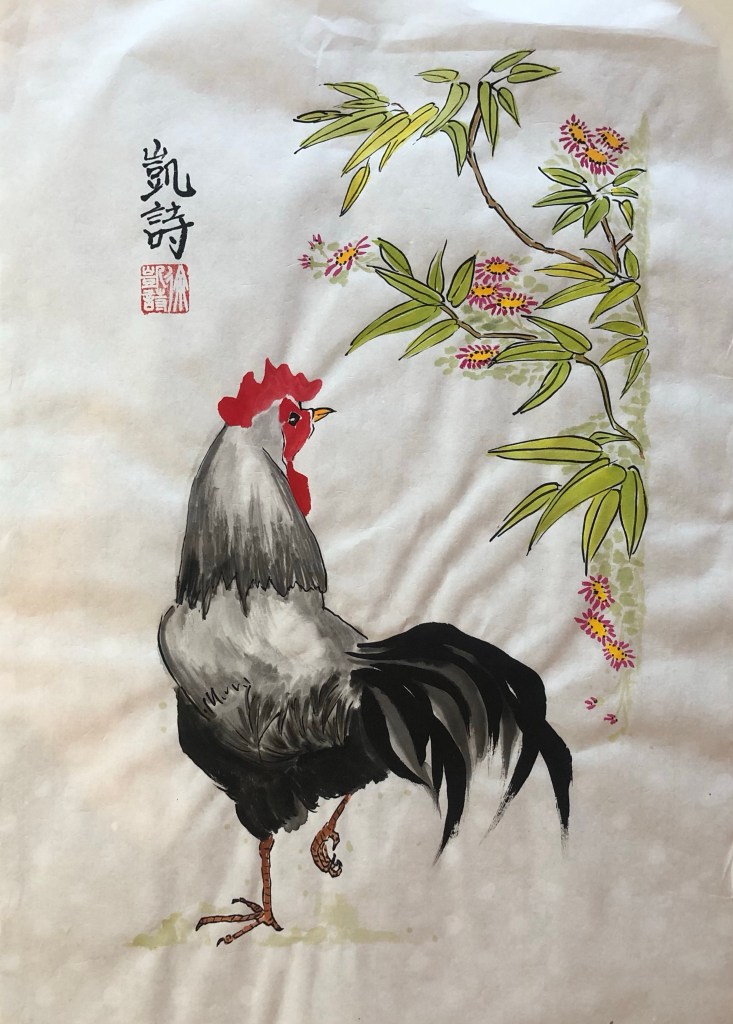
In this composition, the rooster is the host and the plant is the guest. Hence the dominance of the rooster in terms of size and positioning.
The rooster is painted in mostly freestyle. In particular, I wanted to show the energy and character in its tail which I feel is the most flamboyant part of its anatomy. It is also the most difficult to get right; if the tail looks limp then the whole bird lacks energy. Hence it is the key challenge for me.
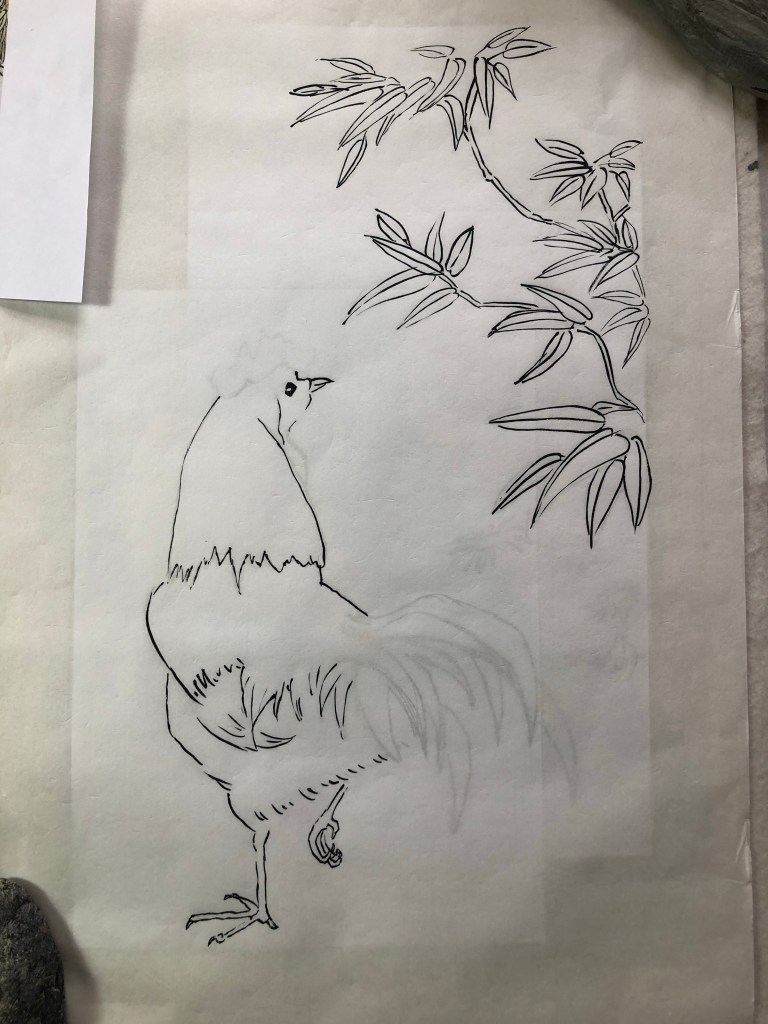
One technique that I learnt is to do a preliminary pencil sketch of the composition on paper, then lay the Xuen paper (thin rice paper for Chinese painting) on top as shown below.
–
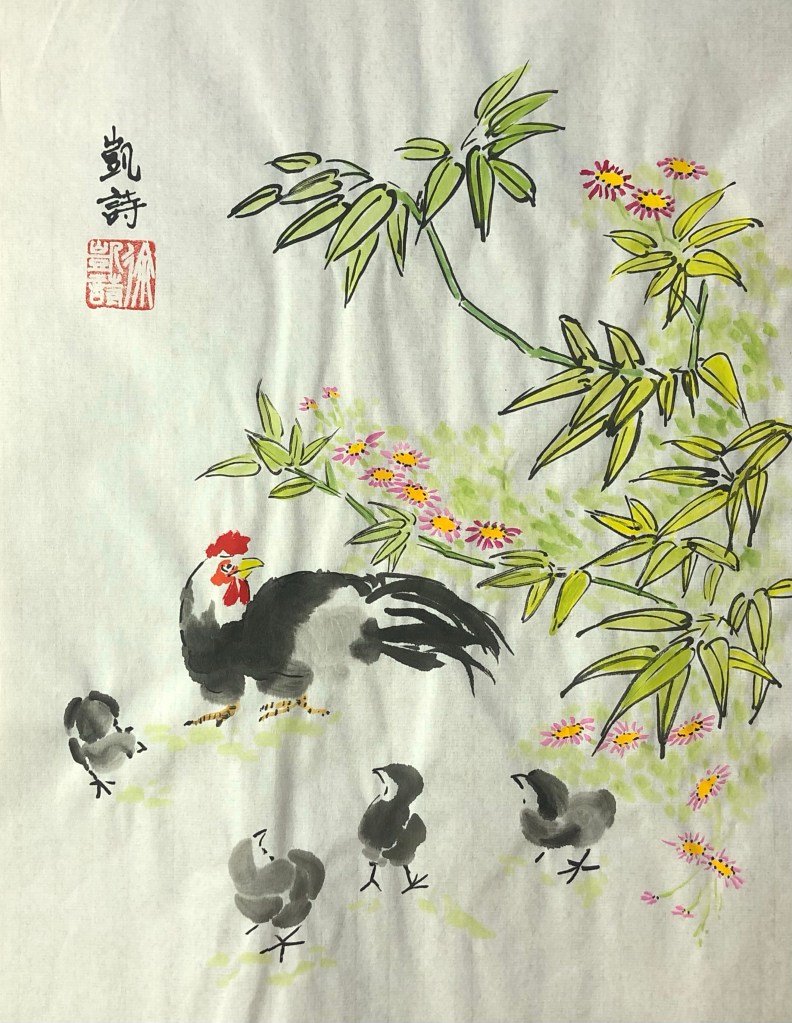
2. Copied composition – Rooster and chicks (Size 34.5 x 26.5cm)
–
REFLECTIONS
Despite learning Chinese painting for nearly two years, I have not written any blogs about my work in this area. I think it was because I wasn’t sure what learning I would get out of reflecting on this part of my work. On the surface, Chinese painting seemed illustrative to me, however, as I learnt more about it, the more I realised how complex it is. I am particularly interested in freestyle rather than meticulous style because freestyle is as it implies – I feel it gives me more freedom to express hence I can engage with it more on a physical and emotional level. However, I find freestyle painting totally unforgiving compared to the other painting media that I am used to (e.g. oil or acrylic). Meaning that with freestyle Chinese painting, often one small mistake could ruin the whole piece, hence I am rather excited by the challenge and the tension that I feel during the painting process.
I have enjoyed doing my own composition with the larger rooster painting here, it felt like a rites of passage as it was my first ‘own composition’ piece in Chinese brush painting. I was pleased with how the tail worked out in the large rooster but felt that the proportion between the rooster and the shrub didn’t seem right with the rooster being disproportionately large. So this is something to bear in mind.
Reflecting on this part of my practice, I feel that I have been keeping my Chinese painting practice quite separate from my main practice, partly because I felt I was at too early a stage in my learning here. I have not fully resolved how to handle the disparity between my levels of confidence in the two different styles (Chinese brush painting vs oil or acrylic painting) – perhaps I can incorporate limited elements or symbols in Chinese brush style within my main paintings as inspired by Fiona Rae, where individual symbols don’t have to make sense but collectively they can represent something. As I become more confident in Chinese brush painting, I want to then incorporate that on a larger scale into my practice to explore my transcultural narrative.
LEARNING
Aside from the practical learning such as the proportioning between the host (rooster) and the guest (shrub), writing this blog and reflecting here has highlighted how I have not been giving sufficient prominence to this part of my practice in my thinking or blogging. Doing this blog was a first step in properly bringing it into my main practice. As for resolving the disparities in confidence, the reflections here have provided ideas in using symbols as a start to create intrigue and possible tension on the canvas to prompt questions. This will be a good practical start.
NEXT STEPS
Continue to regularly blog about my Chinese painting work to prompt reflections and learning. Also to experiment with incorporating Chinese brush painting symbols into my main paintings as a way to explore my narrative through my practice.
 elizarawlings