Research: Drawing – left vs right hand

I introduced the idea of drawing or painting with my non-dominant hand whilst developing my body of work ‘News’. I did that as a way to challenge myself and to introduce uncertainty / vulnerability into the process to reflect how I felt about the state of the world at the time. Since then, I have become fascinated by the subject and I have been reading the book ‘The Master and his emissary’ by Iain McGilchrist on the divided brain. I read about Divergent Artistic Behaviour which states that:

Truly creative art can only result from divergent artistic behaviour – behaviour that was previously unknown or often unexpected and unexplored.

Divergent behaviour demands something from you that you have not been taught or that is not part of the suggested or normal steps in solving a problem.

That understanding has reinforced my desire to explore using my non-dominant hand to draw and paint as that has been unexplored up to now.

In this research experiment, I want to gain a deeper understanding of what the difference is between the work that is produced by my dominant hand right vs my non-dominant left hand.

METHOD

I have previously done an exercise with both hands drawing together simultaneously and one of the outcome of that was to consider whether I needed to have both hands drawing simultaneously and whether I had to have my eyes closed. My conclusion after some consideration was that no, I didn’t need to do either. If my objective is to research the difference between how the two sides of the brain produce work through my hands then there is no need to do it simultaneously or have my eyes closed. In a way, those parameters could confuse because there were too many variables introduced at the same time. Therefore, in this exercise, I’m going to just draw with each hand and compare the outcomes.

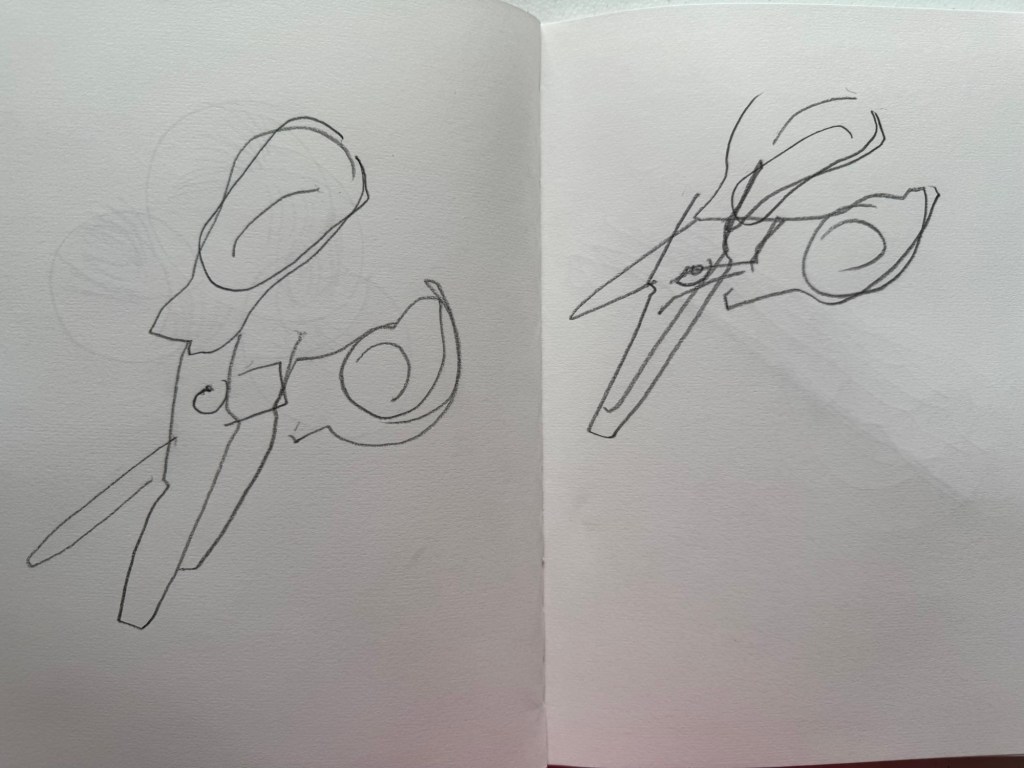
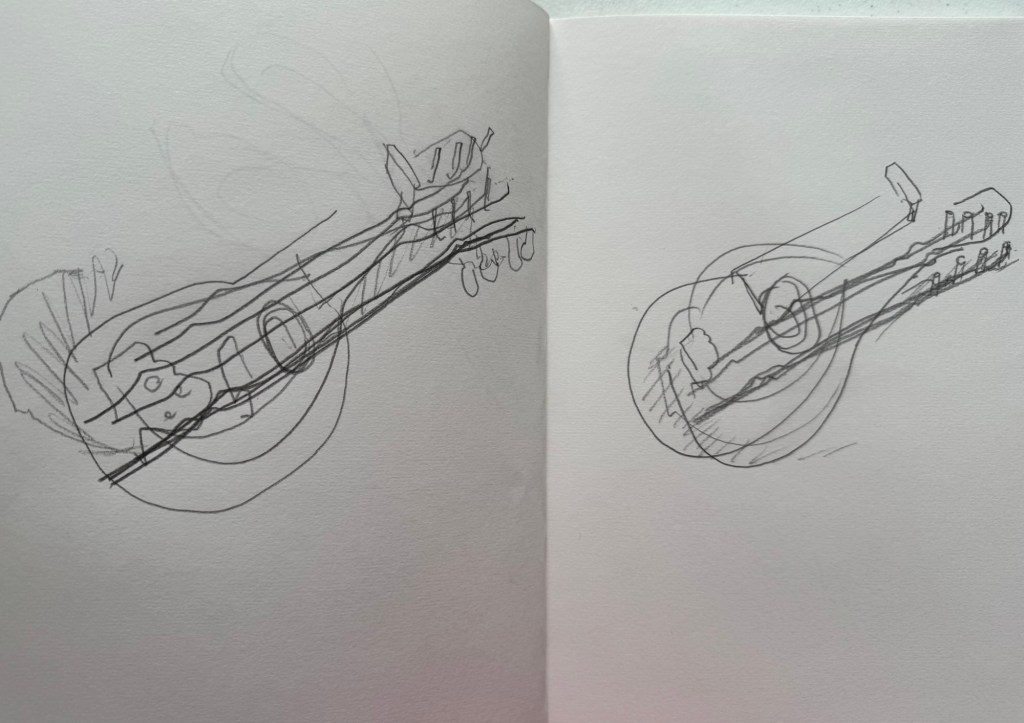
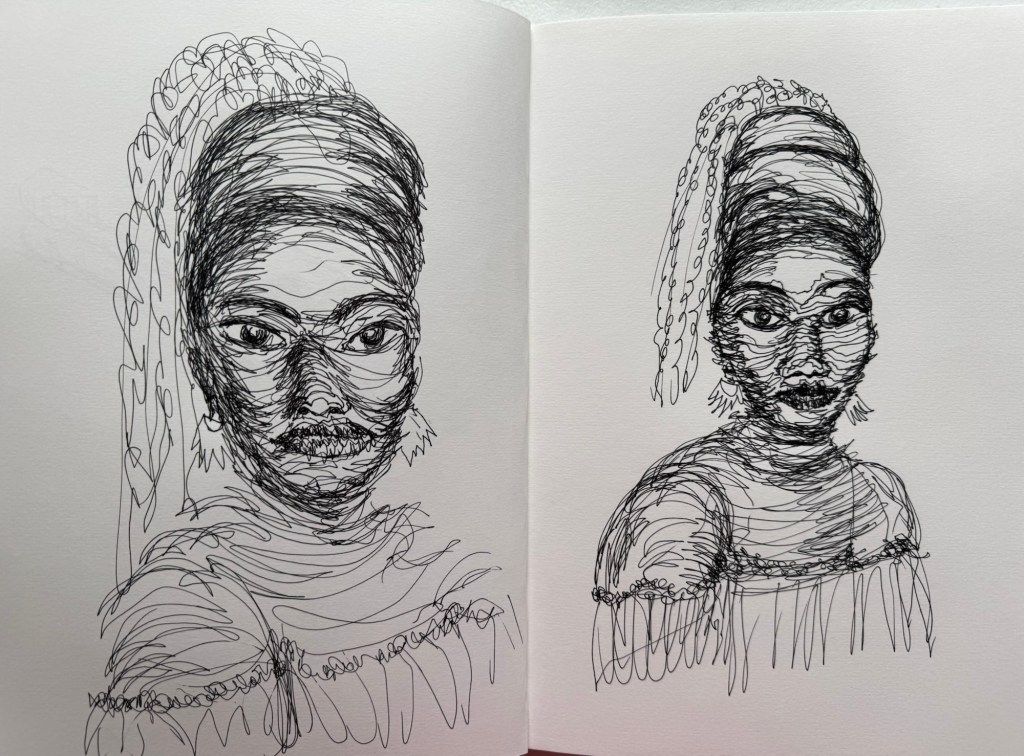
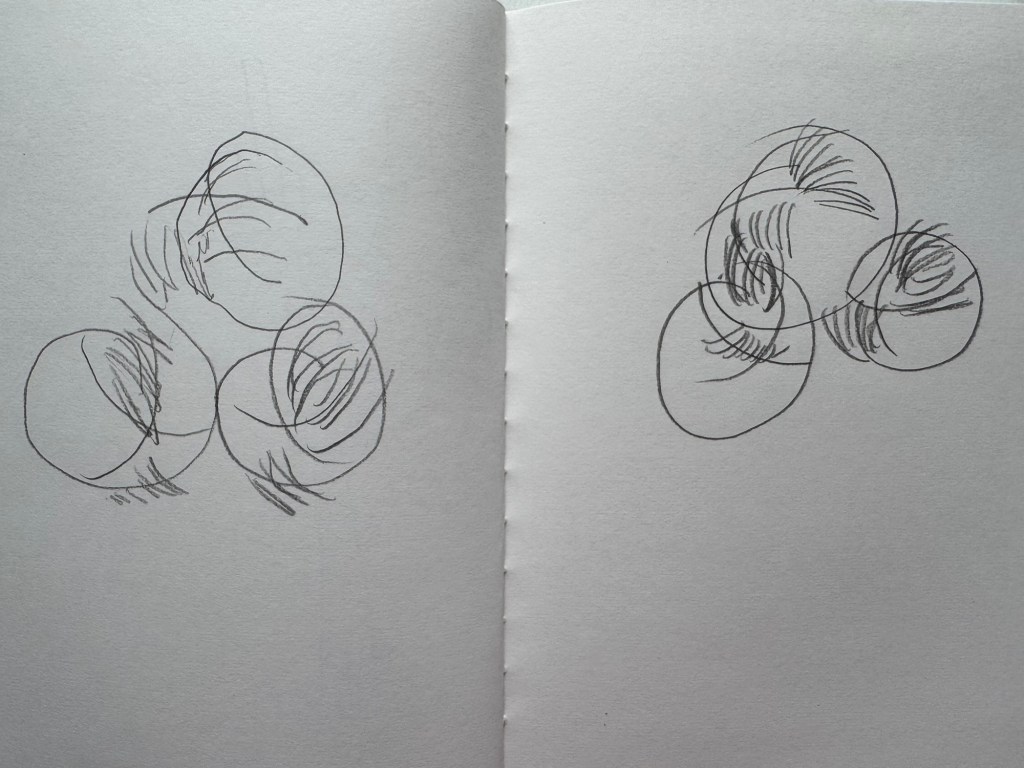
I used the method of ‘blind contour drawing’ – drawing with eyes looking at the object and not looking at all at the drawing. Below are some of the items I drew in my studio with the left page drawn by my left hand and the right by the right hand.
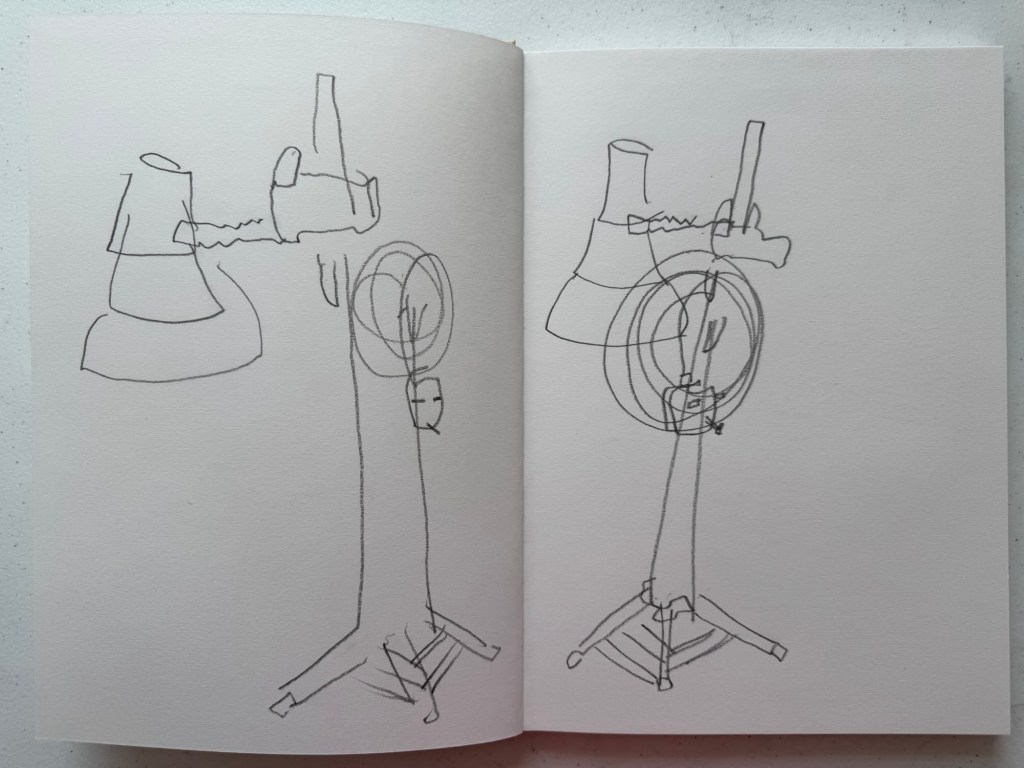
Studio light
Juggling balls
Scissors
Miniature Chinese lute – Pipa

Cross-contour drawing –

A woman’s face

REFLECTIONS

It has been an interesting exercise. Firstly, I feel that there was no need to draw simultaneous like I had done in the previous experiment. The key is to study the difference at this stage and not the difference when drawing simultaneously. One step at a time.

The images drawn with my left hand were consistently larger than those drawn with my right hand. I have observed this before in other similar experiments. I am able to be more loose when drawing with my left hand. The right hand seems to be naturally more tight, as though there are invisible boundaries on the page that I had to work within. Whereas with my left hand – I don’t feel the boundaries and therefore am not confined by it.

The left hand drawings are less accurate compared to the right hand, but there is sufficient likeness to be recognisable as the piece.

I am increasingly ‘addicted’ to drawing with my non-dominant left hand and increasingly less satisfied with my right hand because the latter is a constant reminder of my inability to push boundaries – I get pulled back into being too tight and constrained when making art with my right hand, it’s like muscle memory that I cannot erase. Whereas the lack of control in my left hand enables me to, or grants me permission to just make and not think too hard as there is no expectation for the outcome to be good. With my non-dominant hand, I am often pleasantly surprised whereas with my dominant hand I often feel disappointed.

LEARNING

I am more able to create freely with my non-dominant left hand because there is no expectation and the lack of control enables me to push myself, often ending in pleasant surprises. I enjoy this way of making with my left hand and would like to pursue it further. Perhaps even make it a key aspect of my practice.

NEXT STEPS

Keep creating and pushing boundaries with my non-dominant left hand.

Continue to explore the differences between making with my left and my right hands.

Try writing or calligraphy to see how the left hand performs on that.

At some point, I need to consider more deeply why I am drawn to this way of making. I must not ignore this point because I feel there is a link to who I am and how I am evolving. So I must come back to this point when I feel ready.
MA U3: Building my sustainable art practice

CREATING ‘MY PLAN AFTER MA’

METHOD

I have been planning how to continue to develop my art practice after I finish my MA. The key for me is to ensure I work in a way that maintains my interests with variety and balance to keep up the momentum so that it is sustainable in the long term.

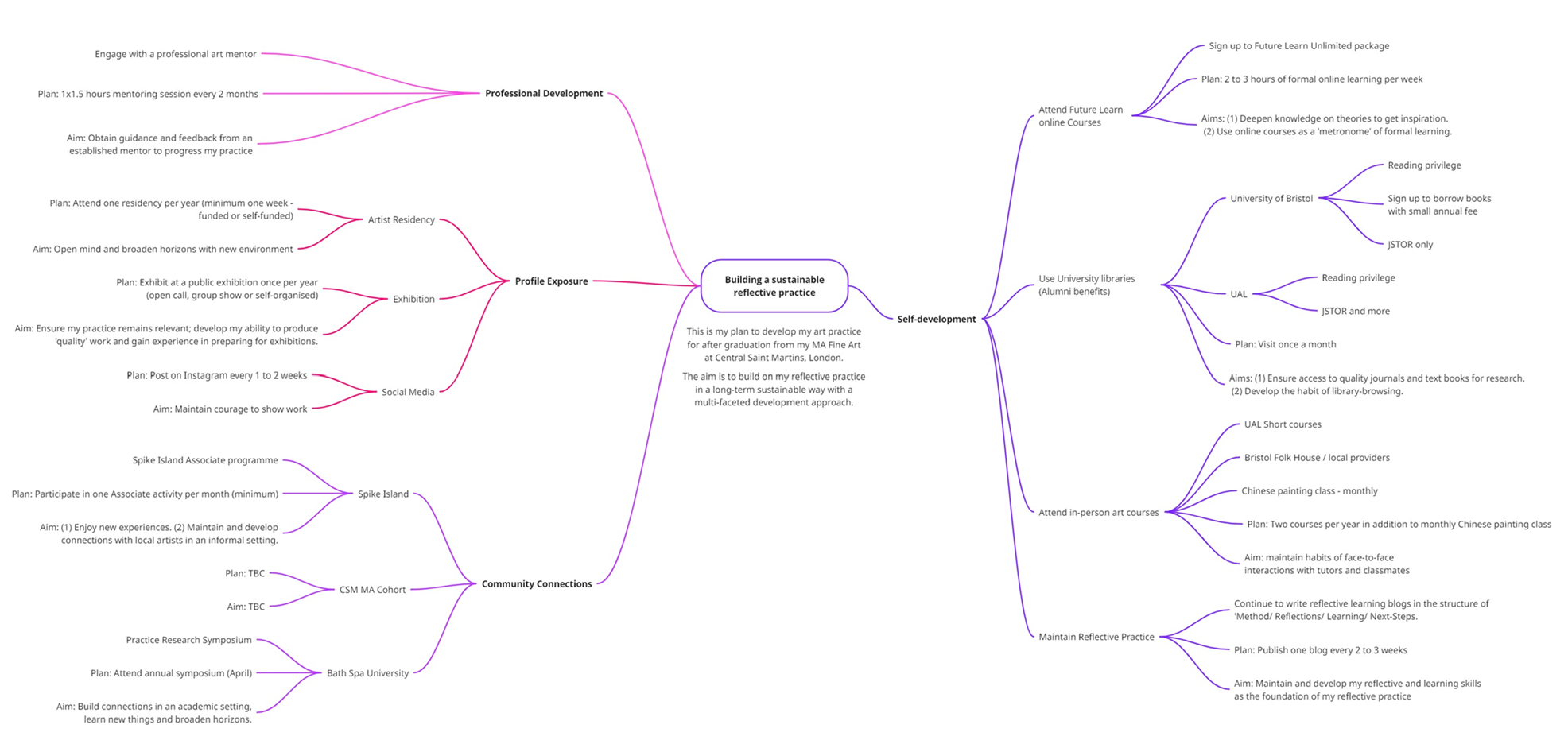
As a starting point, I have created a MindMap where I have captured my aims as well as resources that are available to me. I have tried to create a balanced plan covering the following areas with a structure that I hope will help to establish a rhyme after my MA:

Personal / Self-development: Attend in person classes, e.g. continuing my monthly Chinese painting lessons, as well as online learning. I have identified around one year’s content (with 3 to 4 hours per week starting with cultural theories) on Future Learn that I have just subscribed to and I plan to attend those online modules every Thursday afternoon in place of the MA weekly classes to keep up a learning rhythm.

Reflective practice: A key part of my self-development has been my reflective practice. The structure that I have built into my blogs has been invaluable in helping me to develop my practice. It offers a safety framework that I can return to especially when I feel a bit lost or uncertain. Writing the reflective blogs has put me back on track time and again when I have been stuck. So I plan to continue with the blogs because they help me immensely and I have set myself a goal in the frequency of blogging.

Professional development: I plan to engage with an art mentor having a session once every two months. I have been recommended a mentor used by several Spike Island Associates and I have connected with him. It’s my way of holding myself accountable and forms part of the rhythm.

Profile exposure: I need goals to work towards in order to maintain my momentum and I have set myself targets such as attending one artist-residency per year – this could be self-funded if I do not get accepted onto a competitive one as I don’t want to give myself an excuse to not do it. I feel the act of attending a residency, making art away from my environment, would open my mind and expand my horizons. In addition, I want to show my work as a way to keep my thinking and my work ‘current’. I will look out for Open Calls that are aligned with my work and if that doesn’t work out then I would create my own ‘show’. That could be in whatever capacity, even just displaying my work in a park in my neighbourhood – the purpose is to have an event of some kind for me to make work for and aim towards.

Community connections: Although I enjoy my own company and can happily make work in my studio without seeing anyone. I appreciate that being connected with other artists is important for my development and well being. Hearing others talk about their work always gives me inspiration. Talking about my work to others is also a healthy thing to do. I am fortunate to live in Bristol where there are many artist communities that I have always found to be friendly and supportive. So I will definitely continue to connect with them regularly (e.g. attend events with Spike Island Associates).

Below is my first draft MindMap plan showing my plans and aims for each element. Items within the map are there to feed into my art-making; to give me inspiration, to deepen my knowledge and to help me think.

The plan is work-in-progress and I will continue to build on it over time. I may not even fully follow it, but having a plan in place is important for me to have a starting point, so that I am not faced with a blank calendar and feeling lost the day after graduation!

I will follow the plan for as long as I enjoy it; if I stop enjoying it then I will revise it. I hope as I travel on this journey, other things will come up and the plan will evolve as my needs change. I will be very sad when my MA course ends but I am very excited to continue the journey with all the new skills, knowledge and friends that I have gained on the programme.

REFLECTIONS

A few things that were said to me recently have got me thinking about my MA…

A very good artist friend said that she noticed I have been talking about ‘my practice’ and about ‘being an artist’. I remember when I first joined the MA course, I would only describe myself as ‘an art student’. When asked if I were an artist, I would reply, ‘not really, I am just an art student’. Then sometime during the last two years and I don’t remember exactly when, I have started to talk about being an artist. I had not noticed it until my friend pointed it out to me and I am pleased to say that I feel comfortable about referring to myself as an artist now when I was certainly very hesitant two years ago. I believe it’s the MA course that has given me the confidence and encouragement to do so.

Another comment came from a photography tutor. I have attended a few one-off photography workshops locally and have got to know the tutor well. Earlier this year, she asked what I was planning to do after my MA and at the time I said I wasn’t sure – it was before I created the above MindMap and I was considering doing another taught MA. She said, ‘I am sure you are going to do something because you can’t waste an MA from Central Saint Martins.’ That really made me reflect on what an opportunity and a privilege it has been to do this course (in fact, to do further education of any kind). I do not have ambition to be a famous artist or to have gallery representation, that was not what I came here for. I came here to develop myself and to learn. I have thoroughly enjoyed the course and I am loving making art. So I am just going to keep on making and be true to myself in my art – as David Bowie said, ‘don’t make art to please other people’. I hope that is enough to not ‘waste’ this excellent learning opportunity that I have had the privilege to enjoy.

LEARNING

In addition to making art, I will continue to explore how I can use ‘my voice as an artist’ and I hope the MindMap plan will help me with this. I have always wanted to broaden my practice to examine societal issues so I plan to build on my ‘News’ art – my ambition is to make large scale industrial-style ‘News’ art installations. I am excited to see where all these will take me.

NEXT STEPS

– Follow the MindMap plan after graduation – revise it if needed. But always have a plan to maintain the rhythm.

– Explore how I can use ‘my voice as an artist’.

– Continue to make ‘News’ art – scale up.

– Keep on making art, be true to myself and keep on enjoying it!

MA U3: Rethinking and reflecting on my practice

BACKGROUND

During my recent tutorial, we discussed how the world events are affecting how I felt about my art practice. The change in world order made me not want to do bright and colourful paintings like my recent Family Dinner paintings as they now seemed frivolous with the destructions going on. I also talked about my sense of helplessness as an artist. Therefore, I am in the stage of reconsidering my practice – what do I want it to be about? I have always positioned my art practice as about identity exploration, starting with my personal identity and I started (chronologically) from my childhood in Hong Kong (e.g. the Cheongsam and Family Dinners etc.).

REFLECTIONS

– The feeling of ‘Voicelessness’ as an artist – see separate blog. I think I have worked through that one for now. Briefly – I believe my choice of being an artist (vs my previous position as a business leader within a commercial organisation) gives me much more freedom but with an unknown and unpredictable audience as there is no defined platform for communication. So having reflected on that, I do really value the freedom of voice that I have now. I just need to work out what to do with it.

– How to deal with the current feelings of despair for the change in world order? I can’t ignore it but I don’t want to directly confront it in my art practice because I would risk ranting and being too in-your-face rather than communicating and expressing sensitively and intelligently.

– So I thought about satire and actually went through the process of creating character metaphors that I would use ( one is a turkey eating French fries and the other a loaf of cheap white bread) but I decided against satire because it would require me to closely study those characters which I don’t want to do as I need to preserve my sanity.

After much thinking and reflecting, I decided to focus on how I feel instead which is anger, heartbreak and grief. Grief for the loss of a world order with values that I understood. It was not perfect at all but there was at least an established sense of right and wrong (usually according to the law); where helping the needed was applauded. I grieve for the loss of all that and more. I grieve for all the vulnerable people who will suffer even more or lose their lives and I grieve for those who have made it their mission to help but are now suddenly left helpless and scrambling for themselves. I am not against change and efficiently, but the destructive way of execution has been brutal – unnecessarily.

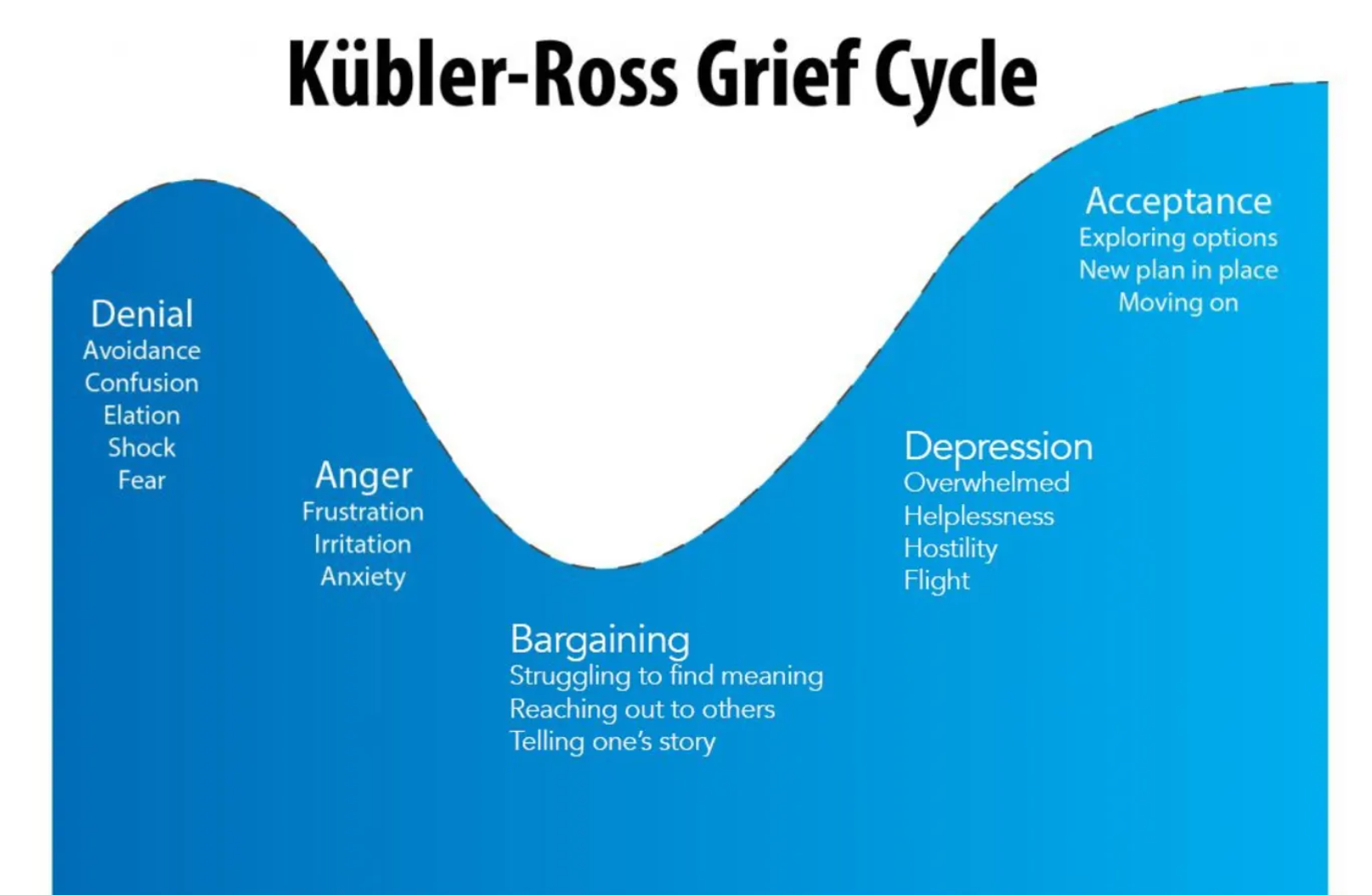
I am likening my feelings and others that I know who are going through the ‘world order change process’ as going through the Kubler-Ross grief cycle.

Diagram extracted from:

https://www.healthcentral.com/condition/depression/stages-of-grief

I find myself oscillating around Anger, Bargaining and Depression depending on what new (and shocking) information comes to light on a particular day. But unlike grieving for the loss of a loved one, I feel it’s not acceptable to reach acceptance which is a problem because I am therefore stuck in the perpetual grief cycle until ‘the show is over’.

So I decided to use my art practice to express the grief that I am feeling. I know (and hope) that it is just a temporary state because I believe I am a naturally optimistic person and I want to return to feeling hopeful about the future of humankind.

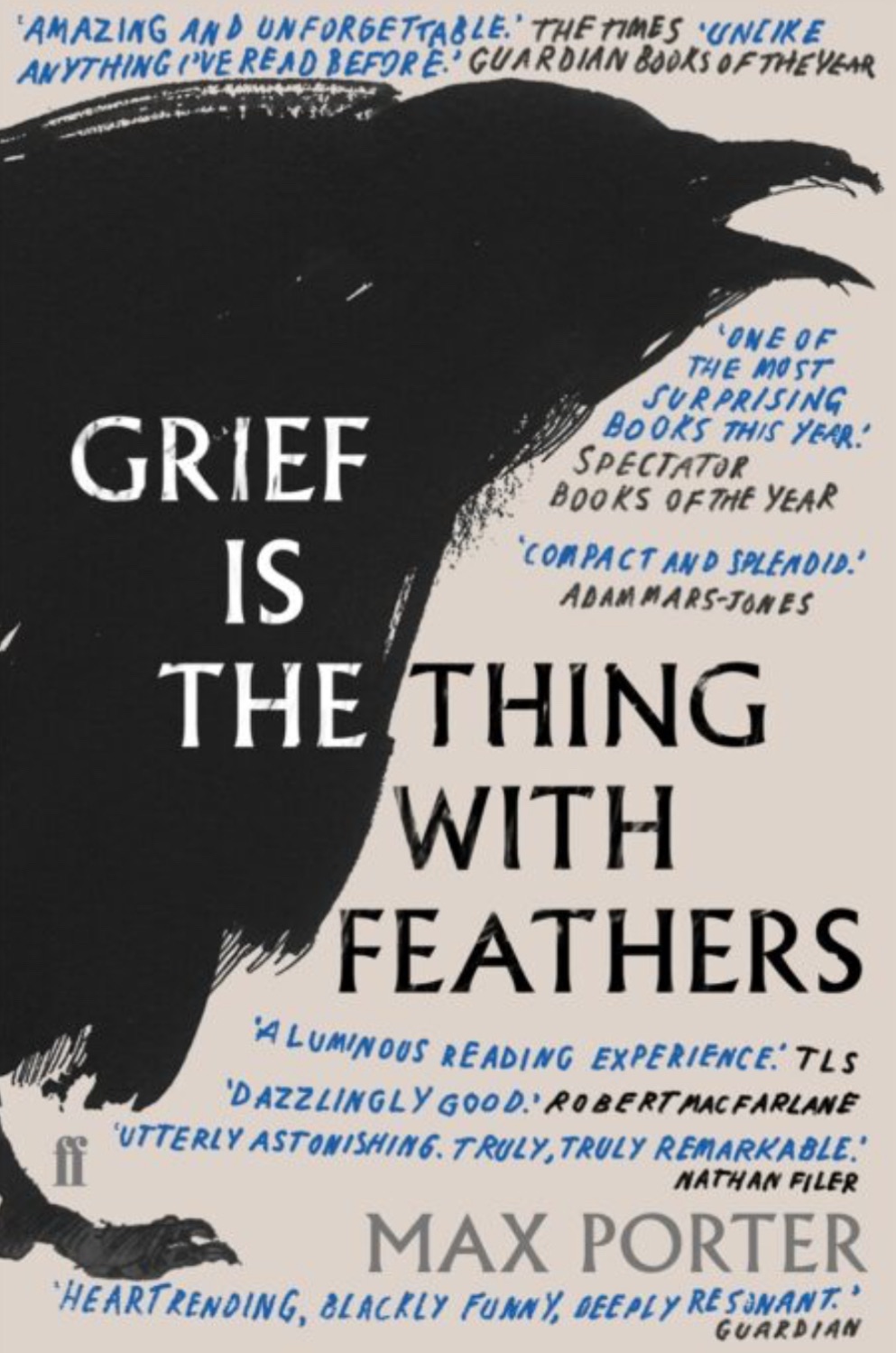
I remember the book ‘Grief is the thing with feathers’ by Max Porter where a father and two young boys grieved for the death of their lost wife/mother. Grief was portrayed as a crow. The short novel was written creatively in a way that helped me to picture the crow vividly. Inspired by the novel, I want to do something with crows and feathers in my art practice to express the grief I’m feeling right now for the world.

Other reasons for choosing crows:

– They are intelligent (compared to other bird species and mammals) but ‘voiceless’ as they can only caw (according to the human ears). I feel that is a good metaphor for how I feel as a ‘voiceless’ artist and perhaps how many artists feel in the world right now.

– Crow feathers are interesting in colour and texture. I want to explore further in my art making.

– I have always been fascinated by crows and they were once the subject of a personal project in my Chinese painting practice. So somehow I feel a connection with them.

LEARNING

So what does it all mean for my art practice?

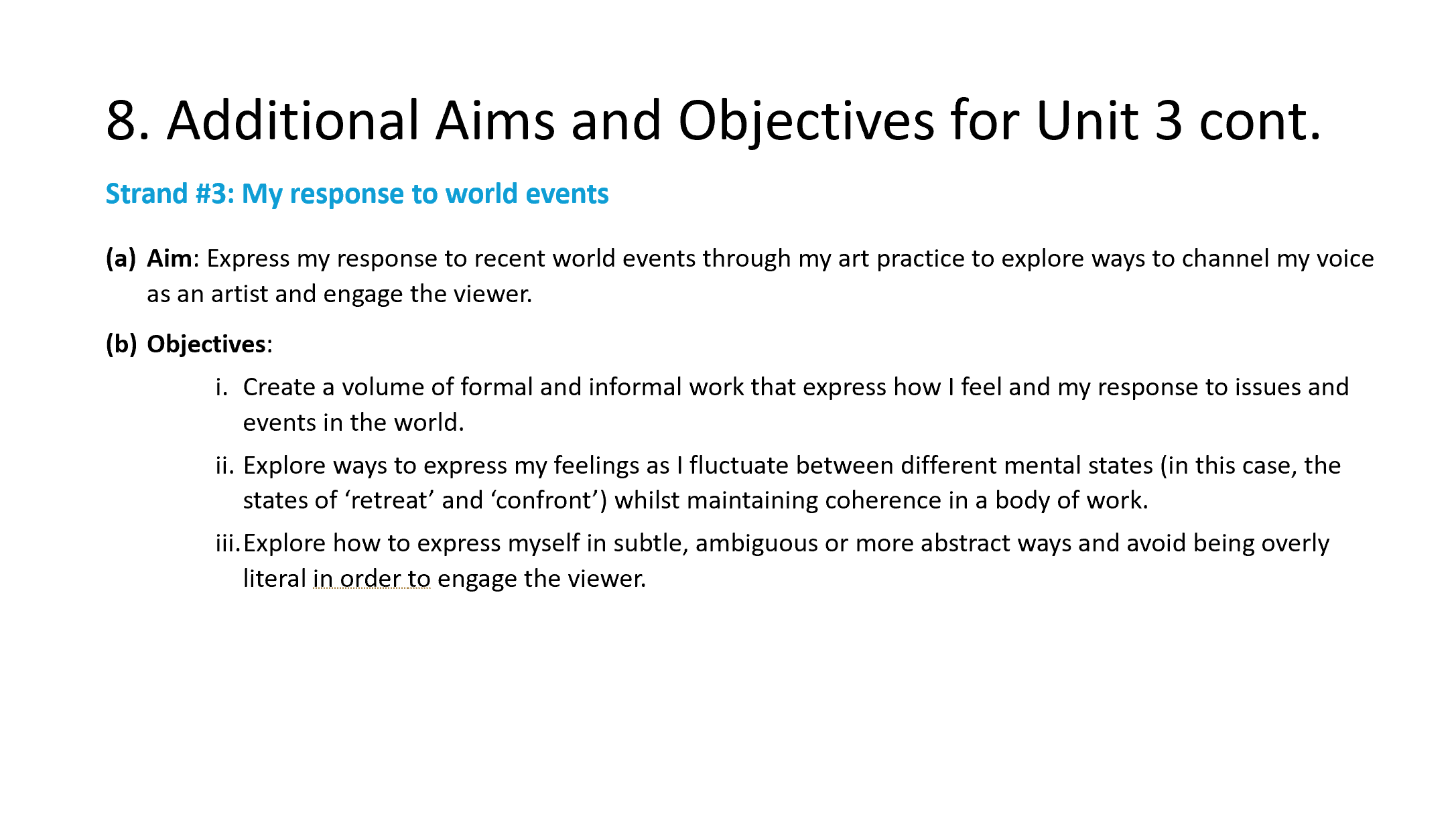
It would be useful to think about ‘the fluid circle’ that was discussed during my tutorial – I go in and out of a fluid circle depending on how able I feel in responding to the world events.

– Inside the circle is retreat mode – coming inside the circle to hide from the world and have time-out. When I’m in that mode, I want to work on things that are simpler or more familiar for comfort. I can do drawings which I find comforting, or explore photography and the new objectivity approach to give relief through working with facts and an established process; letting the process take control momentarily.

– Outside the circle is confront mode – where reality is faced and dealt with. It could be energising but likely to be draining. The most useful and manageable thing to work on there right now is dealing with that feeling of grief and work out how to channel that into my work. Therefore I have been thinking about doing art with crows and feathers.

Is this a deviation from my main practice? I have been thinking about this a lot. If my practice is about identity, then I believe reflecting on one’s state of mind is a key part of that identity exploration. So having done much thinking about this, I feel comfortable that what I am doing here remains part of my soul searching – just instead of exploring the past (my heritage), I am exploring the ‘right here’ and ‘right now’ for me.

What about the Cheongsam dresses? I have had such positive feedback from my MA course mates during the low residency week that I feel I should do some more with the dresses especially for the degree show. Perhaps make a dress with crow feathers? Many Cheongsam dresses are decorated with dragons and phoenix, so perhaps a crow instead?

NEXT STEPS

– Just make art depending on how I feel in the moment. Do something with crows and feathers to release and express the grief as well as create time to think about the future.

– Keep thinking about what else I can do with feathers, perhaps Cheongsam dresses and possible installations.

– Give space and time for the thinking.

ADDITIONAL NOTES – CONSIDERATIONS FOR MY STUDY STATEMENT

Here is my original study statement:

https://eliza-rawlings.com/2024/02/03/ma-y1-study-statement-eliza-rawlings/

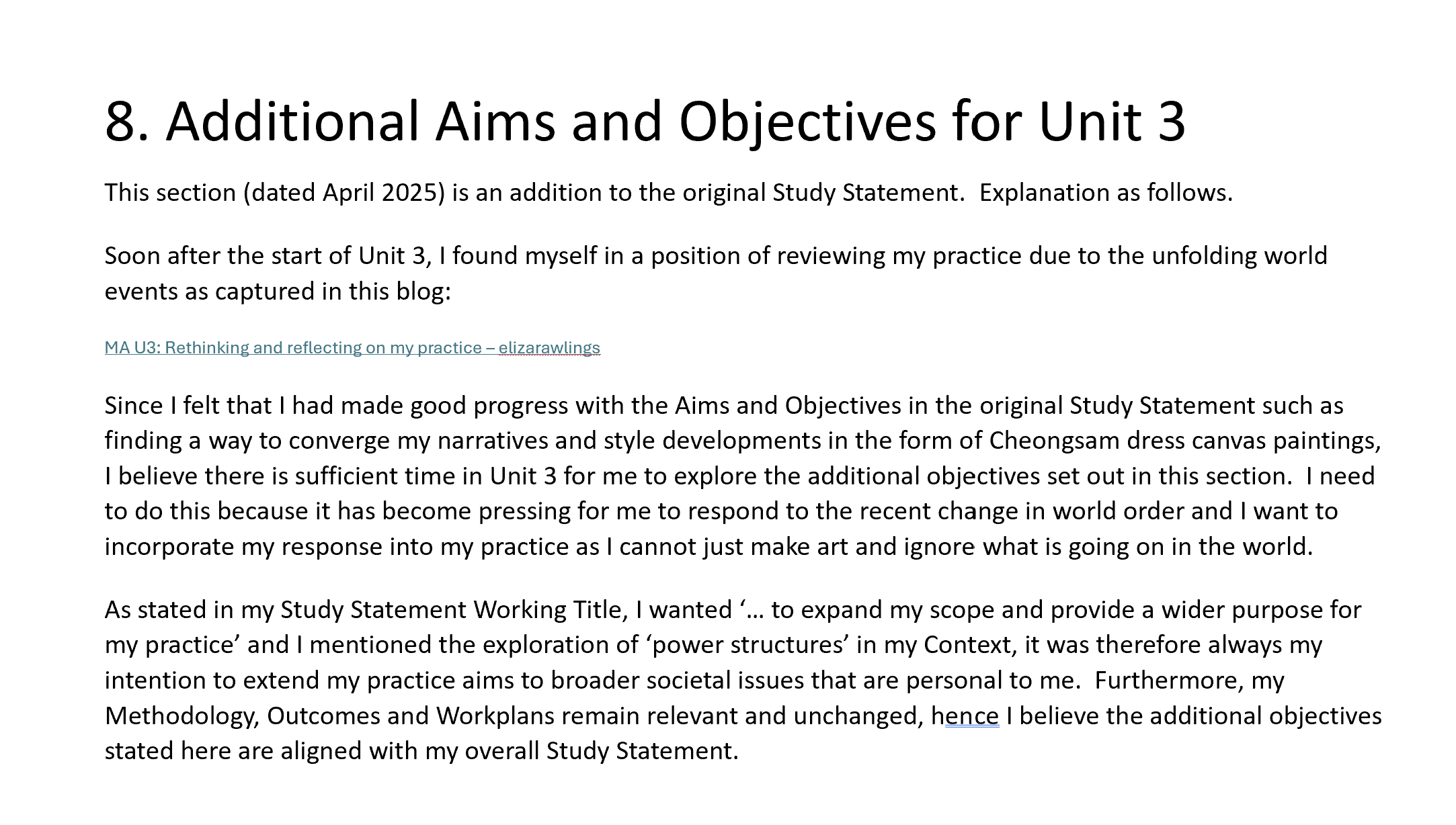
Since I am rethinking my practice, I revisited my Study Statement to see how my new exploration proposed here would impact my planned study. I feel that my Methodology and the Outcomes would remain unchanged. My aims and objectives were strongly focused on transculturalism and the work proposed here (exploring my currently feeling of grief and loss of world order) would not fall into that topic. However, within my Study Statement, my main goal was to explore my identity and I believe exploring my current state of mind falls well within that – it is all part of me and my lived experience. In my Statement, I also referred to wanting to expand my practice to explore wider societal issues including feminism and power structures – I believe my response to the current global political situations falls within this remit. To incorporate the new exploration into my study, I should consider adding some new ‘aims and objectives’ to ensure I remain on track with my study goals.

After reflecting on the overall work plan, I believe it remains valid and on track. One of the key aims of my study was to find convergence in my practice with the parallel development of my narrative and style that I started the course with. I believe I have achieved that (or at least have found a way to achieve it) in my Cheongsam series of work and I had written in my blog at the time stating that I was delighted to have found a way to converge the two strands through the Cheongsam dress canvases. Therefore I believe there is room in Unit 3 to accommodate an additional set of aims and objectives that have now become pressing for me.

NEXT STEPS

Consider additional aims and objectives for the newly proposed exploration.

COMPLETED ADDITIONAL OBJECTIVES

The following two pages have been added to my Study Statement: