BACKGROUND
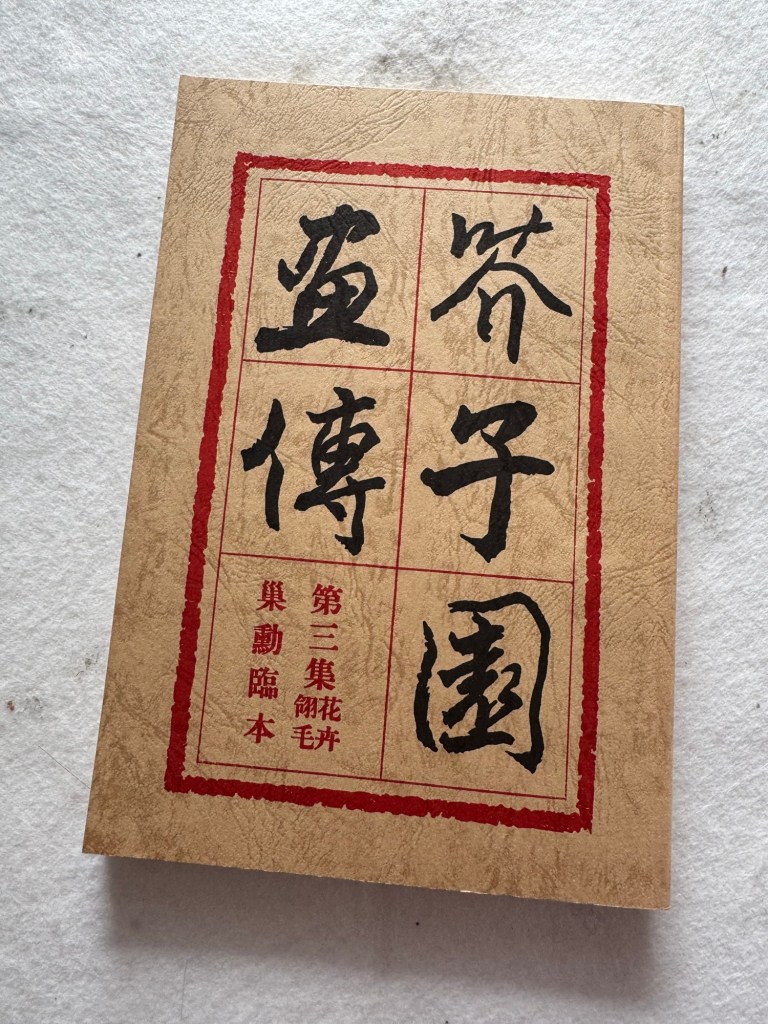
‘Manual of the Mustard Seed Garden’ is a printed manual of Chinese painting compiled during the early-Qing Dynasty (17th century). Many Chinese painters over the centuries have learnt to draw and paint from the manual. I was given my late mother’s copy among many items from her studio. It’s a well-used copy so I imagine my mother must have used it when she was learning to paint.
METHOD
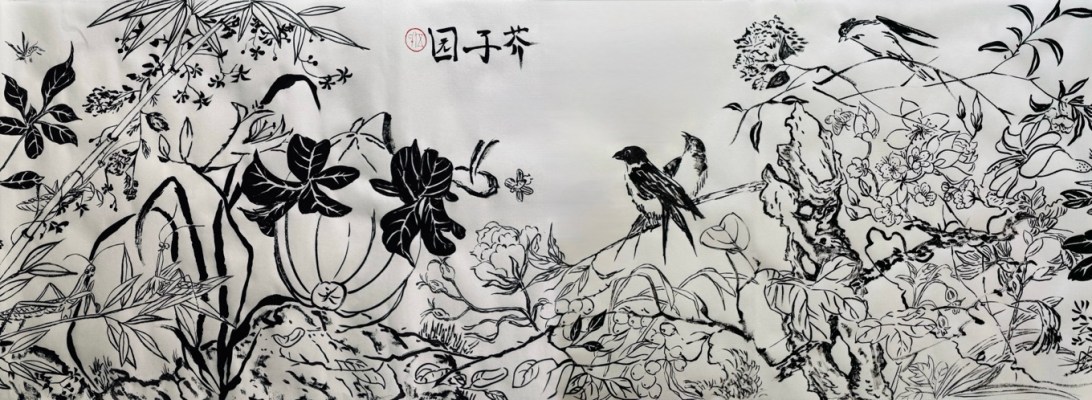
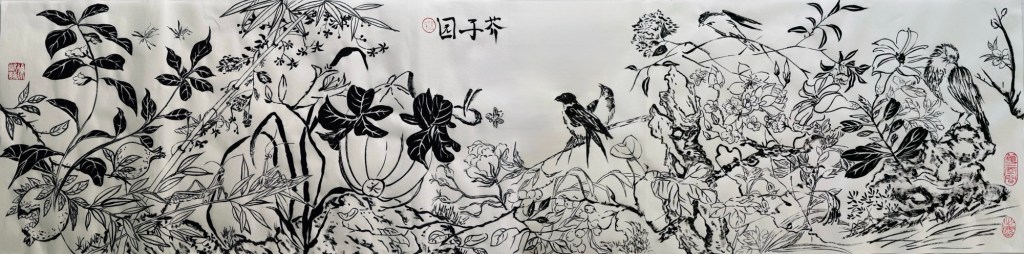
I decided to create a painting using images in the manual. To add spontaneity and uncertainty into the process, I used an online random number generator to come up with a page number, then I painted something from that page and gradually built up a composition responding to what was already on the canvas. 36 random numbers were used in total.
‘Mustard Seed Garden – random composition’ in Chinese ink on Xuan paper, 0.4 x 1.4m. Painted in Baimiao style, a traditional Chinese ink and line art technique:
REFLECTIONS
When I was working on my project ‘News’ at the end of my MA, I was mainly working with Chinese ink. I painted with Chinese ink and sometimes made drawings with the paint brush tip or pencils. At the time, I talked about fluctuating between painting and drawing. I resorted to drawing if I wanted to retreat from the world when news and world events made me despair. When I felt energised and ready to take on the world again then I would paint. One year later, I still feel the same. Some days I yearn to draw, other days I need to paint. I enjoy doing both. It’s like when thirsty one needs to drink and when hungry one needs to eat – it’s not an either / or. Both are essential for survival and to survive, we need to listen to what our body and mind tell us. That’s how I feel about this fluctuation between needing to draw or paint – it’s about finding survival strategies in the current world.
For this piece of work, Mustard Seed Garden, I was in a mood to draw but wanted a bit more than drawing with pencil. So I decided on the Chinese Baimiao* style of painting.
When I was painting ‘News’ last year, I painted with my non-dominant hand to represent the vulnerability and uncertainty that I felt at the time due to world events. For this piece, I experimented with another way of introducing uncertainty – I used a random number generator to decide on the page number to use. I repeated the process 36 times to create the overall composition.
I enjoyed making this piece very much. I enjoyed doing a large piece of work, I liked the random page number generation that made it challenging to create a coherent composition. I really enjoyed painting in the Baimiao style – for me, that’s somewhere between painting and drawing.
I have enjoyed this piece of work and I liked the outcome. But where am I going with this? What next…? Also, what did it mean that the set of Manuals belonged to my mother and she learned painting from them?
LEARNING
This was the first time I did a proper Chinese painting in the Baimiao style (I have done small pieces before), I enjoyed the process and I also liked the outcome. So I will do more work in this style.
I enjoyed the complexity of the composition and the injection of randomness into the process. That experiment worked well and I will use that method again.
I think I would like to do another Baimiao painting using this method. I have not exhausted what this process can offer me yet. Then I will think again about where this is taking me. I don’t need to rush it. If I keep going then I’m sure the path will reveal itself.
One key learning for me was to develop how I respond to the canvas using Chinese painting materials and retaining Chinese painting philosophy – such as the use of negative space, placement of calligraphy and seals. Since I introduced randomness into the process, it was more challenging which made it more interesting than just copying from the Manual – I felt it was really my creation rather than copying someone’s work. If I can build on my ability to spontaneously respond to the canvas then I can imagine taking this approach (or method) to my News work which I am keen to return to as I need to summon up the energy to return to face the news media and world events again.
NEXT STEPS
Do another Baimiao painting using the same process with the Mustard Seed Garden Manual for Chinese paining.
When I feel ready, I will return to News (painting on newspapers) to try a new way of responding to the newspaper canvas spontaneously rather than mainly painting crows. In the longer term, I would like to paint in this way as a live performance – responding live to a newspaper canvas, coming up with a composition spontaneously and use that process to draw viewers’ attention to the news headlines.
–
*Baimiao (白描), or “plain line drawing,” is a traditional Chinese brush technique that captures the essence of a subject using only finely controlled, uncolored ink lines. Emphasizing calligraphic precision, artists rely on varying line thicknesses and fluid strokes to convey form, volume, and spiritual resonance without using color or shading.
Rooted in ancient Chinese painting, this minimalist technique was perfected during the Song Dynasty by master Li Gonglin. It often forms the foundational sketch for the highly detailed Gongbi (realistic) style, though it is celebrated in its own right as an independent fine-art medium.
 elizarawlings